

Gamification of health professions education: a systematic review
Open accessThe DOI matches its Crossref record; 148 of the 149 references it cites were found in a registry or an index; none of the 15 sources its claims cite is checked for support yet.
Abstract
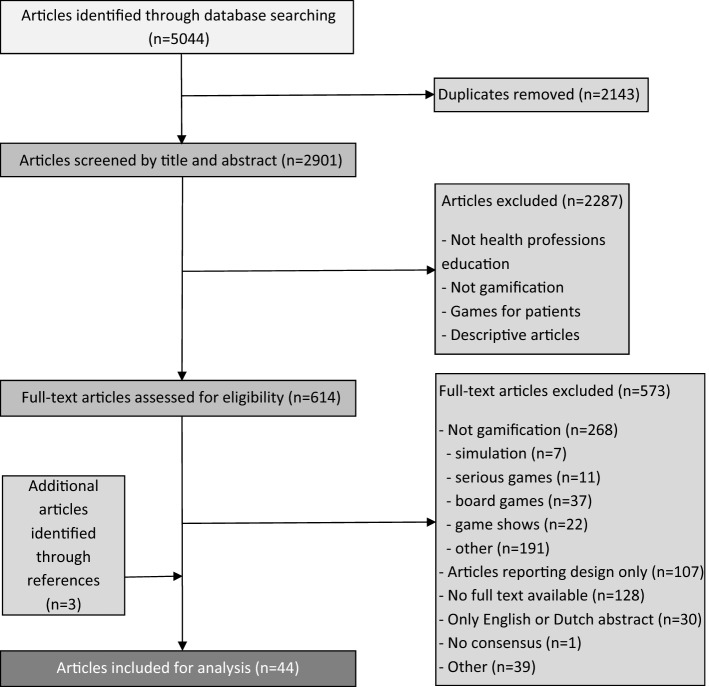
Gamification refers to using game attributes in a non-gaming context. Health professions educators increasingly turn to gamification to optimize students’ learning outcomes. However, little is known about the concept of gamification and its possible working mechanisms. This review focused on empirical evidence for the effectiveness of gamification approaches and theoretical rationales for applying the chosen game attributes. We systematically searched multiple databases, and included all empirical studies evaluating the use of game attributes in health professions education. Of 5044 articles initially identified, 44 met the inclusion criteria. Negative outcomes for using gamification were not reported. Almost all studies included assessment attributes (n = 40), mostly in combination with conflict/challenge attributes (n = 27). Eight studies revealed that this specific combination had increased the use of the learning material, sometimes leading to improved learning outcomes. A relatively small number of studies was performed to explain mechanisms underlying the use of game attributes (n = 7). Our findings suggest that it is possible to improve learning outcomes in health professions education by using gamification, especially when employing game attributes that improve learning behaviours and attitudes towards learning. However, most studies lacked well-defined control groups and did not apply and/or report theory to understand underlying processes. Future research should clarify mechanisms underlying gamified educational interventions and explore theories that could explain the effects of these interventions on learning outcomes, using well-defined control groups, in a longitudinal way. In doing so, we can build on existing theories and gain a practical and comprehensive understanding of how to select the right game elements for the right educational context and the right type of student.
Overview
CoChat Summary
TL;DR
This systematic review of 44 empirical studies found that gamification in health professions education was generally associated with positive or unchanged outcomes, with no negative outcomes reported. Assessment and conflict/challenge attributes were most common, but most studies were descriptive or lacked well-defined control groups and theory, limiting conclusions about mechanisms and effectiveness.
Key findings
- Of 5044 articles identified, 44 met inclusion criteria; no negative outcomes for gamification were reported. Almost all studies included assessment attributes (n = 40), often with conflict/challenge attributes (n = 27); this combination was linked to increased use of learning material in 8 studies and sometimes improved learning outcomes.
- Study quality varied: MERSQI scores ranged from 5 to 17 (mean 9.8, SD 3.1). Most studies were descriptive (n = 25; mean MERSQI 8.3, SD 2.3); 12 were justification studies and 7 were clarification studies. Only 8 well-controlled studies using assessment and conflict/challenge attributes were interpreted with more confidence.
- Contexts were predominantly USA (n = 20) or Canada (n = 8); digital gamified activities (n = 28) outnumbered analogue activities (n = 14). Most studies involved undergraduate (n = 15) and postgraduate medical students (n = 15), followed by nursing (n = 7).
- Theory use was limited: 7 clarification studies referenced theories including Experiential Learning Theory (3 studies), Reinforcement Learning Theory, Social Comparison Theory, Self-Directed Learning, and Deliberate Practice Theory; a common assumption was that gamification improves outcomes by changing learning behaviours or attitudes.
Methods
- Systematic review following AMEE guidelines; searched eight databases (Academic Search Premier, CINAHL, EMBASE, ERIC, Psychology and Behavior Sciences Collection, PsychINFO, PubMed, Cochrane Library) in April 2018, plus hand-searching references and citations.
- Included peer-reviewed journal articles on gamification or game elements in education for (future) health professionals, quantitative or mixed-method; excluded development-only studies, qualitative-only studies, serious games, patient education, simulations except gamified simulations, game-show/board-game contexts, and non-Dutch/English articles.
- Data extraction covered context, participants, intervention, outcomes, quality, and theory; quality was assessed with MERSQI, and studies were classified as description, justification, or clarification using Cook et al.’s framework. Double screening of a 10% excluded sample yielded 94% agreement.
Limitations
- Stated: the search may have missed articles because broad keywords were excluded; lack of consensus on definitions of game, gamification, and serious games made inclusion/exclusion subjective; only one researcher screened full texts; MERSQI does not assess qualitative parts of mixed-methods studies; the conceptual framework may over-generalize and lose information; only English and Dutch articles were included, risking language/culture bias.
- Stated/evident: most included studies lacked well-defined control groups and/or theory (36 of 44 were descriptive, confounded justification/clarification, or clarification without control groups), and combinations of game elements prevented disentangling individual effects; publication bias may have overreported positive results.
- Evident: the review reports no negative outcomes, but this may reflect underreporting; small-scale and pilot studies dominate, and the authors note gamification can have unexpected or unwanted effects (e.g., competition shifting attention from learning, over-justification effect).
Model-written summary. Check it against the paper before relying on it.
Integrity signals
Registry
Cites
Statistics
Figures
Verification
Claims the paper makes
0 Valid · 0 Not valid · 10 Not checked · 55 Own results and interpretations
A result the paper reports from its own data — it cites no other source for it, so there is none to check. The quote shows it is in the paper.
In the paper
“most of the included studies were descriptive in nature and rarely explained what was meant by gamification and how it worked in health professions education.”
§ Gamification of health professions education: a systematic review > Conclusion
plain- Asserted: passes — The authors put it forward as true.
- Checkable: passes — It can be checked against evidence.
- Load-bearing: passes — The paper’s conclusions depend on it.
- Based: passes — The paper gives a reason why it holds.
A result the paper reports from its own data — it cites no other source for it, so there is none to check. The quote shows it is in the paper.
In the paper
“Of 5044 articles initially identified, 44 met the inclusion criteria.”
- Also stated in: § Results · plain
“A total of 44 studies were eligible for inclusion in our systematic review (Table 1).”
§ Gamification of health professions education: a systematic review > Abstract
plain- Asserted: passes — The authors put it forward as true.
- Checkable: passes — It can be checked against evidence.
- Load-bearing: passes — The paper’s conclusions depend on it.
- Based: passes — The paper gives a reason why it holds.
- Also stated in: § Results · plain
A result the paper reports from its own data — it cites no other source for it, so there is none to check. The quote shows it is in the paper.
In the paper
“A combination of conflict and challenge attributes was also more often chosen by researchers from Europe (6 out of 8 European studies) and the USA (17 out of 21 USA studies) than by researchers from Canada (3 out of 8 Canadian studies).”
§ Gamification of health professions education: a systematic review > Results > Contextual differences and effects of game attributes
plainstates an association- Asserted: passes — The authors put it forward as true.
- Checkable: passes — It can be checked against evidence.
- Load-bearing: unclear — It is unclear whether the paper’s conclusions depend on it.
- Based: passes — The paper gives a reason why it holds.
A result the paper reports from its own data — it cites no other source for it, so there is none to check. The quote shows it is in the paper.
In the paper
“Most of the included studies (n = 25; Table 1) were descriptive in nature in such sense that they focused on observation and described what was done, without using comparison groups.”
§ Gamification of health professions education: a systematic review > Results > Quality of the current gamified learning research
plainn = 25- Asserted: passes — The authors put it forward as true.
- Checkable: passes — It can be checked against evidence.
- Load-bearing: passes — The paper’s conclusions depend on it.
- Based: passes — The paper gives a reason why it holds.
A result the paper reports from its own data — it cites no other source for it, so there is none to check. The quote shows it is in the paper.
In the paper
“A relatively small number of studies was performed to explain mechanisms underlying the use of game attributes (n = 7).”
§ Gamification of health professions education: a systematic review > Abstract
plainn = 7- Asserted: passes — The authors put it forward as true.
- Checkable: passes — It can be checked against evidence.
- Load-bearing: passes — The paper’s conclusions depend on it.
- Based: passes — The paper gives a reason why it holds.
30 more claims
Create a free account to see all 65 claims and to verify the 13 references still open.
- It may state two separate claims as one. 16
- Probably not a substantial claim. 21
Claims other papers make about this one
Each is checked against this paper’s own text: does it say what the citing paper says it does?
The source backs part of the claim, not all of it — or backs it for a different population, condition or comparison.
In the citing paper
“The enthusiastic participation and complexity and riskiness of strategies that emerged are consistent with the engagement observed in other gamified public health exercises, such as outbreak response simulations and health systems role-plays (78, 79).”
From Global Health Trade Summit: an AI-enhanced simulation of international trade and global health for undergraduate public health education (2025) · cites this paper as [79]
Experimental — accuracy not yet measuredThe source backs part of the claim, not all of it — or backs it for a different population, condition or comparison.
In the citing paper
“This aligns with research in health professions education demonstrating that gamification can substantially enhance learning outcomes and student motivation (79, 80).”
From Global Health Trade Summit: an AI-enhanced simulation of international trade and global health for undergraduate public health education (2025) · cites this paper as [79]
Experimental — accuracy not yet measured
Self-check
Percentages, sums and reported differences re-computed from the paper’s own numbers.
Each contradiction between two passages listed here was confirmed by an independent check.
Rated minor: it would not touch a result — a value no result rests on, a p-value that stays on the same side of the significance level, or a conflict that is clerical, resolved elsewhere in the paper, or outside its own findings.
In the paper
§ Gamification of health professions education: a systematic review > Discussion > Empirical evidence for using gamification
“The remaining eight studied included in our study were well-controlled studies using assessment and conflict/challenge attributes, so these study results could be interpreted with more confidence.”
§ Gamification of health professions education: a systematic review > Results
“| | Petrucci et al. (2015) | Residents (n = 14) | Conflict/challenge | Competition, progress, social network | Surgery (simulator) | 11 | Digital | Increased use, no difference in outcome |”
Rated minor: it would not touch a result — a value no result rests on, a p-value that stays on the same side of the significance level, or a conflict that is clerical, resolved elsewhere in the paper, or outside its own findings.
In the paper
§ Gamification of health professions education: a systematic review > Results > Educational context and student characteristics
“The majority of the studies were conducted in the USA (n = 20) or Canada (n = 8).”
§ Gamification of health professions education: a systematic review > Results > Contextual differences and effects of game attributes
“the USA (17 out of 21 USA studies)”
Cited works that were retracted
Works this paper cites that were later retracted, from the retraction notices publishers deposit. Major when the notice came out before this paper was published.
Rated major: it would touch a result — a value a result rests on, reported and recomputed p-values on opposite sides of the significance level, two passages that conflict with no sign which is right, or a cited work retracted before this paper was published.
In the paper
“…1999; Bligh and Prideaux 2002; Cook et al. 2008), which we felt should also apply to research on game-based learning in general and gamification in particular (Caponetto et al. 2014; De Sousa Borges et al. 2014; Faiella and Ricciardi 2015; Gentry et al. 2016; McCoy et al. 2016; Nah et al. 2014).”
Cited work 10.1002/14651858.cd012209 · retracted 2018-06-22 · notice 10.1002/14651858.cd012209.pub2 · this paper published 2020-10-31
Citations
Cites
1 retracted
Serious Gaming and Gamification interventions for health professional education
Gentry, S. V., Ehrstrom, B. L., Gauthier, A., Álvarez, J., Wortley, D. J., van Rijswijk, J., Car, J., Lilienthal, A., Car, L. T., Nikolaou, C. K., et al. (2016) · Cochrane Database of Systematic Reviews · doi:10.1002/14651858.cd012209 · Cited by 28 · cited 2×
“…1999; Bligh and Prideaux 2002; Cook et al. 2008), which we felt should also apply to research on game-based learning in general and gamification in particular (Caponetto et al. 2014; De Sousa Borges et al. 2014; Faiella and Ricciardi 2015; Gentry et al. 2016; McCoy et al. 2016; Nah et al. 2014).”
BackgroundRetractedRayyan-a web and mobile app for systematic reviews.
Ouzzani, M., Hammady, H., Fedorowicz, Z., & Elmagarmid, A. (2016) · Systematic Reviews · doi:10.1186/s13643-016-0384-4 · Cited by 26,092 · cited 1×
“After retrieving the search results from different databases, AvG removed the duplicates and uploaded the remaining articles to Rayyan, a mobile and web-based application developed for systematic reviews (Ouzzani et al. 2016).”
MethodA theory of social comparison processes
Festinger, L. (1954) · Human Relations · doi:10.1177/001872675400700202 · Cited by 20,926 · cited 1×
“According to the Social Comparison Theory, social comparison is a fundamental mechanism for modifying judgment and behaviour through the inner drive individuals have to gain accurate self-evaluations (Corcoran et al. 2011; Festinger 1954).”
MethodThe role of deliberate practice in the acquisition of expert performance
Ericsson, K. A., Krampe, R. T., & Tesch-Römer, C. (1993) · Psychological Review · doi:10.1037/0033-295x.100.3.363 · Cited by 9,564 · cited 1×
“Deliberate Practice Theory is based on engaging already motivated students to become experts via well-defined goals, real world tasks and immediate and informative feedback (Butt et al. 2018; Ericsson et al. 1993).”
BackgroundDeci, E. L., Koestner, R., & Ryan, R. M. (1999) · Psychological Bulletin · doi:10.1037/0033-2909.125.6.627 · Cited by 7,176 · cited 1×
“This is also called the over-justification effect (Deci et al. 1999, 2001; Hanus and Fox 2015; Landers et al. 2015; Lepper et al. 1973).”
BackgroundHomo Ludens: A Study of the Play-Element in Culture.
Gillin, J. L., & Huizinga, J. (1951) · American Sociological Review · doi:10.2307/2087716 · Cited by 6,560
Rules of Play: Game Design Fundamentals
Salen, K., & Zimmerman, E. (2003) · Medical Entomology and Zoology · Cited by 5,438
Does Gamification Work? -- A Literature Review of Empirical Studies on Gamification
Hamari, J., Koivisto, J., & Sarsa, H. (2014) · 2014 47th Hawaii International Conference on System Sciences · doi:10.1109/hicss.2014.377 · Cited by 5,201 · cited 1×
“…technology (Blohm and Leimeister 2013; Burke 2014; Burkey et al. 2013; De Sousa Borges et al. 2014; Domínguez et al. 2013; Gaggioli 2016; Hamari et al. 2014; Hsu et al. 2013; Huotari and Hamari 2012, 2017; Kumar 2013; Muntean 2011; Perrotta et al. 2013; Robson et al. 2015; Simões et al.…”
BackgroundThe Modern Practice of Adult Education: From Pedagogy to Andragogy
Knowles, M. S. (1970) · Cited by 3,905
(2020) · Journal of Medical Education · doi:10.5812/jme · Cited by 3,490
Research works printed but not linked: 8
- Caponetto, I., Earp, J., & Ott, M. (2014). Gamification and education: A literature review. In Proceedings of the European Conference on Games-Based Learning.
- Chia P Using a virtual game to enhance simulation based learning in nursing education Singapore Nurs J [Internet]. 2013 40 3 21 6
- Deterding S Khaled R Nacke L Dixon D Gamification: Toward a definition Chi 2011 2011 12 15
- Huotari, K., & Hamari, J. (2012). Defining gamification—A service marketing perspective. In Proceedings of the 16th International Academic MindTrek Conference 2012: “Envisioning Future Media Environments”, MindTrek 2012.
- Jacobs, J. W., & Dempsey, J. V. (1993). Simulation and gaming: Fidelity, feedback, and motivation. In: Dempsey, J.V. and Sales G.C. (Eds.). Interactive instruction and feedback. Englewood Cliffs, New Jersey: Educational Technology Publications
- Nemer LB Kalin D Fiorentino D Garcia JJ Estes CM The labor games Obstet Gynecol. 2016 128 1s 5s 27662001 · DOI
- Tilley, N., & Pawson, R. (2000). Realistic evaluation: An overview. The British Journal of Sociology.
- Zuk R Get in the game: How communicators can leverage gamification Public Relations Tactics 2012 19 7
Cited by
Items 201–300 of 861
Nagarajan, A., & Sen, A. (2022) · Interaction design & architecture(s)/ID&A Interaction design & architecture(s) · doi:10.55612/s-5002-053-007 · Cited by 10
OSCE 3D: a virtual clinical skills assessment tool for coronavirus pandemic times
Faria, A. L., Perdigão, A. C. B., Marçal, E., Kubrusly, M., Peixoto, R. A. C., & Peixoto, A. A. (2021) · Revista Brasileira de Educação Médica · doi:10.1590/1981-5271v45.2-20200460.ing · Cited by 12
Luokkamäki, S. (2024) · UEF eRepo (University of Eastern Finland) · Cited by 10
Antikchi, M., Heydari, S., & Bakhshi, F. (2025) · BMC Medical Education · doi:10.1186/s12909-025-07079-w · Cited by 9
A Curriculum for Enhancing Physician Teaching Skills: The Value of Physician-Educator Partnerships
Hoffert, M. M., Passalacqua, K. D., Haftka-George, A., Lanfranco, O. A., & Martin, R. A. (2021) · Journal of Medical Education and Curricular Development · doi:10.1177/23821205211032013 · Cited by 9
Critical-emancipatory educational intervention through games to face gender violence
Fornari, L. F., & da Fonseca, R. M. G. S. (2023) · Revista Brasileira de Enfermagem · doi:10.1590/0034-7167-2022-0299 · Cited by 9
Kryshtanovych, S., Olenych, I., Gavrysh, I., Saukh, I., & Khltobina, O. (2023) · Financial and credit activity problems of theory and practice · doi:10.55643/fcaptp.3.50.2023.4072 · Cited by 9
The Impact of Gamification in Research and Education: A Communication Review
Islam, F., Krishna, A., & Kumari, S. S. (2025) · Gamification and Augmented Reality. · doi:10.56294/gr2025101 · Cited by 10
Learning veterinary anatomy playing cards
Chicharro, D., García‐Manzanares, M., Gómez, O., Juárez, M., Llamazares‐Martín, C., Soriano, E. R., & Terrado, J. (2022) · AJP Advances in Physiology Education · doi:10.1152/advan.00117.2022 · Cited by 9
How Can Game-Based Learning Affect Engineering Students’ Confidence?
Perez, R. F., Chung, S., Zastavker, Y. V., Bennett, V. G., Abdoun, T. H., & Harteveld, C. (2022) · IEEE Frontiers in Education Conference (FIE) · doi:10.1109/fie56618.2022.9962463 · Cited by 9
Carrió, M., & Silva, N. (2022) · doi:10.31009/itshec.2022.01 · Cited by 9
Disaster Triage Skills Training: An Introductory Virtual Simulation for Medical Students
Pandit, K., Healy, E. W., Todman, R., Kingon, A., Wright, M. A., Raymond, M., Hill, J., Jeffrey, J. M., Papanagnou, D., & Tedeschi, C. M. (2023) · Cureus · doi:10.7759/cureus.39417 · Cited by 9
Pensieri, C., Benedictis, A. D., Micco, F. D., Saccoccia, S., Ivziku, D., Lommi, M., & Alloni, R. (2023) · Healthcare · doi:10.3390/healthcare11162236 · Cited by 9
Gamified VS Non-gamified Speaking Assessment for EFL in Higher Education
Basuki, Y. (2023) · AL-ISHLAH Jurnal Pendidikan · doi:10.35445/alishlah.v15i3.3672 · Cited by 9
“According to Gaalen et al. (2021), gamification refers to incorporating game elements into non-game contexts, such as the workplace or education, and using game-like assessments that can be classified based on the level of gaming features they incorporate.”
BackgroundKröplin, J., Friedrich, C. H. L., Harms, L., Lenz, J., & Frerich, B. (2025) · Journal of Cranio-Maxillofacial Surgery · doi:10.1016/j.jcms.2025.06.011 · Cited by 8
Use of Gamified Digital Tools in Daily Tasks of Health Care Workers: Scoping Review
Paudel, B., Al-Shehabi, H., Dörner, R., Bcheraoui, C. E., Lennemann, T., & Bernasconi, A. (2025) · JMIR Serious Games · doi:10.2196/70480 · Cited by 8
“In education, gamification can make learning activities more engaging and motivate students to achieve their goals [18,19].”
Wibowo, G. A., & Saliman, S. (2025) · Online Learning In Educational Research (OLER) · doi:10.58524/oler.v5i2.733 · Cited by 9
Digital Interventions for Palliative Care Education for Nursing Students: A Systematic Review
Alanazi, A., Mitchell, G., Halaiqa, F. A., Khraim, F., & Craig, S. G. (2026) · Nursing Reports · doi:10.3390/nursrep16010016 · Cited by 9
“Digital interventions such as web-based modules, virtual simulations, serious games, and digital storytelling can accommodate diverse learning preferences and allow students to revisit complex or emotionally demanding content at their own pace [12–15].”
Pancio, G., Kern, N., Ankam, N. S., & Zhang, X. C. (2023) · Cureus · doi:10.7759/cureus.51396 · Cited by 8
Juwita, R., & Mateha, P. (2024) · Indonesian Journal of Education Research (IJoER) · doi:10.37251/ijoer.v5i2.936 · Cited by 8
Al-Ani, S. A., Chandla, D., Delieu, J., Yu, S. T., Fratini, A., Gkountiou, R., & Stocker, C. J. (2024) · Surgical and Radiologic Anatomy · doi:10.1007/s00276-024-03439-1 · Cited by 8
Kröplin, J., Maier, L., Lenz, J., & Romeike, B. F. M. (2024) · JMIR Formative Research · doi:10.2196/58940 · Cited by 8
“Educators in the health care sector are also increasingly relying on gamification to optimize students’ learning success [10].”
Student Learning and Motivation: What, How, and Why?
López, A. A., Padilla, L. F. H., Carrión, B., & Reguera, E. A. M. (2023) · IEEE Revista Iberoamericana de Tecnologias del Aprendizaje · doi:10.1109/rita.2023.3250511 · Cited by 8
DEVELOPMENT AND VALIDITY OF SERIOUS GAME FOR TEACHING-LEARNING IN SURGICAL SITE INFECTION PREVENTION
do Nascimento, K. G., Nascimento, J. D. S. G., Raponi, M. B. G., Pires, P. D. S., Fonseca, L. M. M., & Barbosa, M. H. (2024) · Texto & Contexto - Enfermagem · doi:10.1590/1980-265x-tce-2023-0198en · Cited by 8
“…a technology offered through computers and/ or mobile devices connected to the internet 6 , generally made possible in the form of a serious game 7 , a virtual educational game that necessarily has the purpose of teaching and the ability to simulate real situations, promoting the reuse of the…”
Gamified Teaching-Learning Approaches in Higher Education: A scoping review
Mokhtari, Z., Salimi, G., & Safavi, A. (2021) · International and National Conference on E-Learning and E-Teaching (ICeLeT) · doi:10.1109/icelet202153025.2021.9712605 · Cited by 8
Cohesive Online Education Model Using Emergent Technologies to Improve Accessibility and Impact
Swanepoel, J. A. (2024) · Education Sciences · doi:10.3390/educsci14050522 · Cited by 8
Baessler, F., Hornung, T. P. P., Schuster, T. J., Hardt, N., Felter, E., Anzenberger, E., Ely, D. R., Lichtenstein, T., Steiner, K. M., Koelkebeck, K., et al. (2025) · BMC Medical Education · doi:10.1186/s12909-025-07990-2 · Cited by 7
Stathakarou, N., Kononowicz, A. A., Swain, C. S., & Karlgren, K. (2023) · JMIR Research Protocols · doi:10.2196/45969 · Cited by 7
Design and Implementation of Educational Game Using Crossword Principles
Bosakova–Ardenska, A., & Andreev, D. (2024) · International Conference on Electronics, Engineering Physics and Earth Science (EEPES) · doi:10.3390/engproc2024070012 · Cited by 7
Evaluation of the quality of oral hygiene mobile apps for children using the mobile app rating scale
Meriç, E. (2024) · International Journal of Medical Informatics · doi:10.1016/j.ijmedinf.2024.105612 · Cited by 7
Game-Based Learning and Gamification, Effective Innovation in Emergency Medicine Training Program
Heydari, M., Aghili, M., & Vahidi, E. (2024) · Journal of Medical Education · doi:10.5812/jme-150614 · Cited by 7
Kahoot! in a dental hygiene class: Motivating or stressful for students?
Sharmin, N., Wazir, A., & Chow, A. K. (2025) · Europe PMC (PubMed Central) · Cited by 7
Krishnamoorthy, Y., Govindan, D., Karunakaran, M., Parveen, M., Poul, A. J., Manohar, A., & Rajendran, G. (2025) · Simulation & Gaming · doi:10.1177/10468781251338382 · Cited by 7
Enhancing Engagement in a Learning Management System through a Raffle Ticket System
Khan, S., Srivel, V., & Wong, M. (2025) · Teaching & Learning Inquiry The ISSOTL Journal · doi:10.20343/teachlearninqu.13.27 · Cited by 7
An Educational Trading Card Game for a Medical Immunology Course
Singleton, V., Bordeaux, C., Ferguson, E., & Bland, T. (2025) · Education Sciences · doi:10.3390/educsci15060768 · Cited by 8
Xi, Y., Wu, J., Zhang, Y., Di, Z., Nie, W., Wang, M., Zhu, X., Zhang, Y., Wu, Y., Ma, Y., et al. (2025) · BMC Medical Education · doi:10.1186/s12909-025-07630-9 · Cited by 7
“Gamification, grounded in CLT principles, offers a promising alternative by optimizing cognitive load through interactive, scaffolded tasks that reduce extra-neous demands and enhance germane processing [13, 14].”
Gamification in Mobile Learning Enhancing Engagement and Retention through Interactive Design
Paudel, B., & Shrestha, S. (2025) · Journal Mobile Technologies (JMS) · doi:10.59431/jms.v3i2.543 · Cited by 7
“Revisiting educational materials through interactive game mechanics improves comprehension and memory retention by leveraging repetition and engagement (Gaalen et al ., 2020; Dustman et al ., 2021).”
Raikhel, A. V., Blau, K., Alberty, K., Cornia, P. B., Rodriguez, R. A., Steinberg, K. P., & Wu, C. (2022) · American Journal of Medical Quality · doi:10.1097/jmq.0000000000000094 · Cited by 7
Lottering, N., Lim, I., & Gough, S. (2023) · Advances in educational technologies and instructional design book series · doi:10.4018/978-1-6684-6500-4.ch009 · Cited by 7
Martínez, O. N., Silva, J., & Valle, V. I.-D. (2023) · Education Sciences · doi:10.3390/educsci13070681 · Cited by 7
“Recent systematic reviews on gamification within professional health education [2,15,16] have concluded that these results are not conclusive.”
BackgroundPerceptions of MBBS Phase II Students on Gamification
Bhat, A., Bhat, S., & Manjunath, J. (2023) · Journal of Medical Sciences and Health · doi:10.46347/jmsh.v9i3.23.243 · Cited by 7
Visual Mnemonics and Gamification: A New Approach to Teaching Muscle Physiology
Bland, T., & Guo, M. (2024) · Journal of Technology-Integrated Lessons and Teaching · doi:10.13001/jtilt.v3i1.8469 · Cited by 7
“In medical education, video games have improved various competencies, including diagnostics and clinical decision-making (van Gaalen et al., 2021).”
BackgroundDonoso, F., Peirano, D., Agüero, R., Longo, C., Apalla, Z., Lallas, A., Jaimes, N., & Navarrete‐Dechent, C. (2024) · Clinical and Experimental Dermatology · doi:10.1093/ced/llae375 · Cited by 7
Gamification as a Tool for Understanding Mental Disorders in Nursing Students: Qualitative Study
Pozo-Herce, P. D., Tovar-Reinoso, A., Blas, E. G., Casaux-Huertas, A., de Viñaspre‐Hernández, R. R., Martínez‐Sabater, A., Chover‐Sierra, E., Rodríguez-García, M., & Juárez‐Vela, R. (2025) · JMIR Nursing · doi:10.2196/71921 · Cited by 7
Palliative medicine education—Bed Race, The End of Life Board Game in undergraduates
Harris, D., & Atkinson, C. V. (2021) · BMJ Supportive & Palliative Care · doi:10.1136/bmjspcare-2021-003015 · Cited by 7
Andersen, S. A. W., Frithioff, A., von Buchwald, J. H., Sørensen, M. S., & Frendø, M. (2022) · European Archives of Oto-Rhino-Laryngology · doi:10.1007/s00405-022-07454-z · Cited by 7
“Despite much interest amongst medical educationalists, there is still little research establishing the effects of gamification on learning outcomes [22] and evidence becomes even more sparse in surgical skills training—including in ORL [23].”
BackgroundThe Impact of Gamification on Students’ Achievement in Online Learning Environments
Alsaadoun, A. (2022) · International Journal of Learning and Development · doi:10.5296/ijld.v12i3.20232 · Cited by 7
Clinical Perspectives on the Development of a Gamified Heart Failure Patient Education Web Site
Lukey, A., Mackay, M., Hasan, K., & Rush, K. L. (2022) · CIN Computers Informatics Nursing · doi:10.1097/cin.0000000000000983 · Cited by 7
Eğitim 5.0’a Geçişin Engelli Öğrenciler ve Erişilebilirlik Açısından Etkileri
KALAÇ, M. Ö., & Kılınç, M. (2023) · Üniversite Araştırmaları Dergisi · doi:10.32329/uad.1285615 · Cited by 8
A Survey on Application of Game Design Element in Edutainment
Baowidan, S. A. (2023) · Lecture notes in computer science · doi:10.1007/978-3-031-35930-9_3 · Cited by 7
Impact of gamification techniques on surgical trainee engagement with workplace-based assessment
Thelen, A. E., Nepomnayshy, Z., Qureshi, A., Schuller, M. C., Chen, X., Gates, R. S., Marcotte, K. M., Krumm, A. E., & George, B. C. (2022) · Global Surgical Education - Journal of the Association for Surgical Education · doi:10.1007/s44186-022-00056-7 · Cited by 7
Online Game-Based Parental Groups: The Experiences of First-Time Expectant Parents
Kokkinen, K., Malinen, K., Sevón, E., Hämäläinen, R., & Rönkä, A. K. (2024) · The Journal of Perinatal Education · doi:10.1891/jpe-2023-0017 · Cited by 6
Nordin, E. J., Dugan, S. M., Kusters, A., Schimek, C. A., Sherman, K., & Ebert, T. J. (2024) · Journal of Graduate Medical Education · doi:10.4300/jgme-d-23-00402.1 · Cited by 6
Gil-Hernández, E., Carrillo, I., Guilabert, M., Bohomol, E., Serpa, P., Neves, V. R., Martínez, M. M., Martín-Delgado, J., Pérez-Esteve, C., Fernández, C., et al. (2024) · JMIR Medical Education · doi:10.2196/56879 · Cited by 6
Out-BREAK!: An IDWeek 2023 Escape Room to Break Out of the Educational Mold
Zhong, D., Dong, S. W., Chu, V. T., Gabriel, N., Lusardi, K. T., Searns, J. B., Wattier, R. L., Ristagno, E. H., Bhimraj, A., Boguniewicz, J., et al. (2024) · Open Forum Infectious Diseases · doi:10.1093/ofid/ofae558 · Cited by 6
Improving Pubertal Health Education for Adolescent Girls Through a Gamified Learning Approach
Nazmi, S., Omrani, A., Behmanesh, F., Nikbakht, H., Mehrabi, M., & Hamzehpour, R. (2025) · Journal of Pediatric and Adolescent Gynecology · doi:10.1016/j.jpag.2025.01.003 · Cited by 6
Using a Serious Game to Teach Central Line Care in Pediatric Critical Care Nursing
Yabrodi, M., Abulebda, K., Pearson, K. J., Spitzer, T., Nitu, M. E., Rogerson, C. M., Tavares, N. T., & Lutfi, R. (2025) · AJN American Journal of Nursing · doi:10.1097/ajn.0000000000000008 · Cited by 6
Gamification Strategies in Undergraduate Nursing Education: A Systematic Review Protocol
Elia, R. A., Colangelo, M., Cerrone, V., Pace, D., & Andretta, V. (2025) · Nursing Reports · doi:10.3390/nursrep15090331 · Cited by 6
“More recent systematic reviews have examined gamification in health professions education, confirming its growing adoption and highlighting heterogeneous effects across contexts [3,4].”
Gamification Implementation in Health Service Website in 5.0 Society Era
Departemen Ilmu Komunikasi, U. K. I., Ramdhani, R. M., Nurrahman, A. D., Departemen Ilmu Komunikasi, U. K. I., Affendi, P. H., Departemen Ilmu Komunikasi, U. K. I., Hasugian, L. P., Departemen Sistem Informasi, U. K. I., Rafdhi, A. A., & Departemen Sistem Informasi, U. K. I. (2021) · International Journal of Research and Applied Technology · doi:10.34010/injuratech.v1i2.6777 · Cited by 6
Koontz, N. A., Tomblinson, C. M., Shatzkes, D. R., Glastonbury, C. M., Phillips, C. D., Dean, K. E., Strauß, S., Agarwal, M., Robson, C. D., & Wiggins, R. H. (2022) · American Journal of Neuroradiology · doi:10.3174/ajnr.a7711 · Cited by 6
Otomie, L. B. K., Narcisa, V. Q. R., David, E. T. J., Daniel, L. T. C., & Vielka, C. R. M. (2024) · Ciencia Latina Revista Científica Multidisciplinar · doi:10.37811/cl_rcm.v8i1.11779 · Cited by 6
The Effects of Implementing Gamification in the Hepatology Curriculum for Medical Students
Edirisuriya, C., Goldenberg, J., Breslin, Z., Wilson, A., Herrine, S. K., Tofani, C. J., & Tholey, D. M. (2024) · Cureus · doi:10.7759/cureus.66538 · Cited by 6
“Health profession educators are using gamification to improve students’ learning outcomes through educational games, online modules, mobile medical applications, and virtual patient scenarios [2].”
BackgroundHossein, M. P., Ansari, M., Fekri, N., & Yazdimoghaddam, H. (2025) · BMC Medical Education · doi:10.1186/s12909-025-07299-0 · Cited by 6
Gamification in Education: Enhancing Student Engagement and Learning Outcomes
Sinha, A. (2025) · Journal of Informatics Education and Research · doi:10.52783/jier.v5i4.3920 · Cited by 6
Hirkani, M., Hegde, G., Kamath, R., Sonwane, T., Angane, E., & Gajbhiye, R. (2021) · AJP Advances in Physiology Education · doi:10.1152/advan.00116.2021 · Cited by 6
An Interactive, Multimodal Curriculum to Teach Pediatric Cardiology to House Staff
Delany, D. R., Coffman, Z. J., Shea, J. R., & Jump, C. S. (2022) · Pediatric Cardiology · doi:10.1007/s00246-022-02859-3 · Cited by 6
Gamification in Healthcare Education: Demystifying a Trend
Padilha, J. M., Rosa, J. F., & Cunha, D. J. (2022) · Advances in game-based learning book series · doi:10.4018/978-1-6684-4287-6.ch003 · Cited by 6
Song, S. L., Yu, Z. Z., Pavlech, L. L., Scott, I. U., & Greenberg, P. B. (2022) · Journal of Graduate Medical Education · doi:10.4300/jgme-d-22-00115.1 · Cited by 6
MOTIVATING STUDENTS IN THE BIOLOGY CLASSROOM VIA GAMES
Γεωργίου, Μ., & Pandi, M. (2023) · European Journal of Education Studies · doi:10.46827/ejes.v10i10.4993 · Cited by 6
dos Anjos, F. M. S., de Oliveira, H. M., Estevam, F. E. B., Vaz, N. A. P., da Mata, L. R. F., & Carvalho, S. T. (2024) · Journal on Interactive Systems · doi:10.5753/jis.2024.4190 · Cited by 6
Global Workforce and Access: Demand, Education, Quality
Grover, S., Court, L. E., Amoo-Mitchual, S., Longo, J. M., Rodin, D. L., Scott, A. A., Lievens, Y. N., Yap, M. L., Abdel–Wahab, M., Lee, P., et al. (2024) · Seminars in Radiation Oncology · doi:10.1016/j.semradonc.2024.07.003 · Cited by 6
Editorial: Education and Training in Biomedical Science
Scott, S., Millar, B. C., & McClean, S. (2024) · British Journal of Biomedical Science · doi:10.3389/bjbs.2024.13598 · Cited by 6
Awayvirus: A Playful and Tangible Approach to Improve Children’s Hygiene Habits in Family Education
Qi, X., Lei, Y., He, S., & Cheng, S. (2023) · Lecture notes in computer science · doi:10.1007/978-3-031-42283-6_10 · Cited by 5
Acar, M. D., & Altun, E. Ç. (2024) · TOGÜ Sağlık Bilimleri Dergisi · doi:10.52369/togusagbilderg.1253512 · Cited by 5
Yahaya, H., Umar, A. B., Chijioke, I. R., Ehizemwogie, I., & Sokunbi, T. O. (2025) · BioSocial Health Journal. · doi:10.34172/bshj.69 · Cited by 5
Piquer‐Martinez, C., González-Salgado, A., Valverde-Merino, M. I., Zarzuelo-Romero, M. J., & Gómez‐Guzmán, M. (2025) · Currents in Pharmacy Teaching and Learning · doi:10.1016/j.cptl.2025.102480 · Cited by 6
Fauzi, I. N., Kumboyono, K., & Fevriasanty, F. I. (2025) · Journal of Applied Nursing and Health · doi:10.55018/janh.v7i3.448 · Cited by 5
“This indicates that gamification alone is insufficient without contextual relevance, sustained engagement, and a strong behavioral theory underpinning it (van Gaalen et al., 2021).”
E-Learning Simulations for Teaching Clinical Decision-Making in an Audiology Training Program
Tomlin, D., Bowers, P. J., & Graydon, K. (2023) · American Journal of Audiology · doi:10.1044/2023_aja-22-00210 · Cited by 5
Schmitz, L., Betz, C. S., Böttcher, A., Häußler, S. M., & Praetorius, M. (2024) · HNO · doi:10.1007/s00106-024-01437-8 · Cited by 5
The way towards ethical anesthesia care: no aim – no game – no fame or blame?
Meço, B. C., Güçlü, Ç. Y., Berger‐Estilita, J., & Radtke, F. M. (2024) · Current Opinion in Anaesthesiology · doi:10.1097/aco.0000000000001391 · Cited by 5
New trends in the use of computer tools for teaching-learning in health
Tinajero, D. N. N., Yugsi, A. J. S., & Masaquiza, C. F. N. (2024) · Sapienza International Journal of Interdisciplinary Studies · doi:10.51798/sijis.v5i3.637 · Cited by 5
“…the use of game attributes in a non-playful context, to optimize students' learning outcomes by applying games to improve the learning experience (van Gaalen et al., 2021), this premise agrees with the article called Digital tools and the teaching of the nursing process, where it indicates the…”
MethodGhaffarifar, S., Behmanesh, F., Gholamnia-Shirvani, Z., Nikbakht, H., & Nazmi, S. (2024) · BMC Medical Education · doi:10.1186/s12909-024-06316-y · Cited by 5
Giebel, C. M., Marshall, H., Cannon, J., Donnellan, W. J., Bullen, H. A., Lomas, E., Porritt, B. M., Rees, A., Curran, S., Tetlow, H., et al. (2024) · Dementia · doi:10.1177/14713012241306489 · Cited by 5
Shakoor, A., Mohansingh, C., van der Boon, R. M. A., Brugts, J. J., & Schaap, J. (2024) · Current Heart Failure Reports · doi:10.1007/s11897-024-00692-8 · Cited by 5
Gamifying urban nature experiences
Paiva, D., Carvalho, L., Sousa, A. M., Soares, A. L., & Azambuja, S. T. (2025) · Erdkunde · doi:10.3112/erdkunde.2024.04.03 · Cited by 5
“However, research has shown that reward systems can be important drivers of motivation for learning, when users are rewarded for learning or rewarded with new information or novel media ( o’D onovan et al. 2013, van g aalen et al. 2021 ).”
Naor, A. P., & Dubovi, I. (2025) · International Journal of Nursing Sciences · doi:10.1016/j.ijnss.2025.02.007 · Cited by 6
Kiviranta, P., Kankuri‐Tammilehto, M., Tulonen-Tapio, J., & Lund, T. (2024) · Työväentutkimus Vuosikirja · Cited by 5
Szaknyelvoktatás és gamifikáció
Dávidovics, A. (2021) · Porta Lingua · doi:10.48040/pl.2021.2 · Cited by 6
Mhadhbi, H., Horta, L. M., Ims, J., Draper‐Rodi, J., Mansfield, H., Shaw, R., Rinne, S., Silva, T. C., Metsälä, E., & Ménard, M. (2024) · International journal of osteopathic medicine · doi:10.1016/j.ijosm.2024.100726 · Cited by 5
Reconfigurable Gamification Platform for the Autonomous Learning of Low Value Medical Practices
Fernández, C., Vicente, M. A., Lorenzo, S., Carrillo, I., & Guilabert, M. (2022) · doi:10.5121/csit.2022.121716 · Cited by 5
Guy, J. W., Stitzlein, L. M., Dudley, R., & Oestreich, J. H. (2023) · Currents in Pharmacy Teaching and Learning · doi:10.1016/j.cptl.2023.02.028 · Cited by 5
Attaway, C. C., Mani, M., & Fortuna, D. (2022) · Academic Pathology · doi:10.1016/j.acpath.2022.100033 · Cited by 5
Nuevas tecnologías en Medicina
Alonso, J. L. I., & Sánchez, C. A. (2022) · Revista de Investigación y Educación en Ciencias de la Salud (RIECS) · doi:10.37536/riecs.2022.7.1.308 · Cited by 5
“La TMN también ha sido utilizada para valorar a los pacientes que han padecido el síndrome respiratorio agudo severo coronavirus 2 (SARS-CoV-2).”
BackgroundInfluentialLumsden, L., Cannon, P., & Wass, V. (2023) · Education for Primary Care · doi:10.1080/14739879.2023.2190936 · Cited by 5
Alzughaibi, S., Luo, J., Nazareth, D. L., Wu, M., & Fink, J. T. (2023) · Research Square · doi:10.21203/rs.3.rs-2769833/v1 · Cited by 5
Tingelhoff, P.-D., Hufert, F. T., Kiessling, C., & Otto, B. (2024) · GMS journal for medical education · doi:10.3205/zma001659 · Cited by 4
“In addition to case-based teaching formats that have been established for decades, such as problem-based or project-based learning, the use of serious games could also support the acquisition and consolidation of practical knowledge [38].”
Leveling Up: Harnessing Cutting-Edge Technology to Enhance Oncology Education and Learning
Teplinsky, E., Kim, T. H., Haddad, S., Hundal, J., Wolbrink, T. A., & Chung, C. D. (2025) · American Society of Clinical Oncology Educational Book · doi:10.1200/edbk-25-472884 · Cited by 4
Delivering a Regional Procedural Bootcamp for Incoming Pulmonary and Critical Care Medicine Fellows
Faiz, S. A., Warner, M. T., Lazarus, D. R., Ong, P., Proud, K. C., Dinh, K., Sargsyan, L. A., SANCHEZ, J. F., Hoffman, M. I., Zaidan, M. F., et al. (2025) · CHEST Journal · doi:10.1016/j.chest.2025.06.011 · Cited by 4
Moulin, T., Lellouche, N., Gandjbakhch, E., & Laredo, M. (2025) · CJC Open · doi:10.1016/j.cjco.2025.09.009 · Cited by 4
Karageorgos, S. A., Hibberd, O., Ren, D., Hornsby, Y., Roland, D., & Koutroulis, I. (2025) · Children · doi:10.3390/children12111542 · Cited by 4
“Gamification refers to the use of game-design elements in non-game settings [32].”
Metadata
- Authors
- van Gaalen, A. E. J., Brouwer, J., Schönrock-Adema, J., Bouwkamp-Timmer, T., Jaarsma, A. D. C., & Georgiadis, J. R.
- Affiliations
- University of Groningen (NL)
- University Medical Center Groningen (NL)
- Venue
- Advances in Health Sciences Education
- Published
- 2020-10-31
- Volume
- 26
- Issue
- 2
- Pages
- 683-711
- ISSN
- 1382-4996 (ISSN-L)
- 1573-1677
- PMC
- PMC8041684
- OpenAlex
- W3094919143
- Cited by
- 625
- References
- 149
- Citations by year
- 2026: 108 · 2025: 126 · 2024: 160 · 2023: 121 · 2022: 80 · 2021: 29
- FWCI
- 12.14
- Type
- journal article
- Language
- en
- Open access
- hybrid
- doi.org
- Licence
- cc-by
- creativecommons.org/licenses/by/4.0 (tdm)
- creativecommons.org/licenses/by/4.0 (vor)
- Locations
- Advances in Health Sciences Education (publishedVersion, cc-by)
- PubMed Central (publishedVersion, cc-by)
- PubMed (publishedVersion)
- University of Groningen research database (University of Groningen / Centre for Information Technology) (publishedVersion, cc-by)
- Utrecht University Repository (Utrecht University) (submittedVersion, other-oa)
- University of Groningen research database (University of Groningen / Centre for Information Technology) (submittedVersion, cc-by)
- Funders
- University of Groningen
- Topics
- Social Sciences › Psychology › Developmental and Educational Psychology › Educational Games and Gamification
- Social Sciences › Education › Innovations in Medical Education
- Physical Sciences › Engineering › Biomedical Engineering › Biomedical and Engineering Education
- Keywords
- gamification, health professions education, game attributes, learning outcomes, learning behavior, learning attitude, educational intervention
- MeSH terms
- Health Occupations, Humans, Learning, Students
About these checks
Registry, retraction, Cites and statistics results are computed, not judged, with one exception: a printed reference that no index lists is read once by a model before it counts as a citation error. Claims are extracted by a model and kept only when their quote appears verbatim in the text; each cited source is then checked, with a model’s help, for whether it says what the claim relies on. Those verdicts can be wrong — read the claim’s quote and the cited source before relying on one.
A language model drew the claims from the paper on 2026-11-23, under version 3 of the claim definition (model deepseek-v4.1-flash, prompt extract-v3).
A second model labelled each claim on 2026-11-23 (model jev-1.13-20260917, definition revision gold-guideline-v0.2).
Statistics and arithmetic are recomputed, not judged.
Confidence bands are shown only for fields calibrated on our annotated test set. None is calibrated yet, so no band is shown.
What counts as a claim ›How we measure confidence ›How we check this ›
Are you an author, or do you see a problem with this page? Request a review
Data sources
Bibliographic data: Semantic Scholar, OpenAlex, Crossref.
Contains information from the Semantic Scholar Academic Graph Datasets, made available under the ODC Attribution License (ODC-BY 1.0).
Semantic Scholar’s data is described in: Kinney, R., et al. (2023). The Semantic Scholar Open Data Platform. arXiv:2301.10140.
