

Gamification of health professions education: a systematic review
Open accessThe DOI matches its Crossref record; 148 of the 149 references it cites were found in a registry or an index; none of the 15 sources its claims cite is checked for support yet.
Abstract
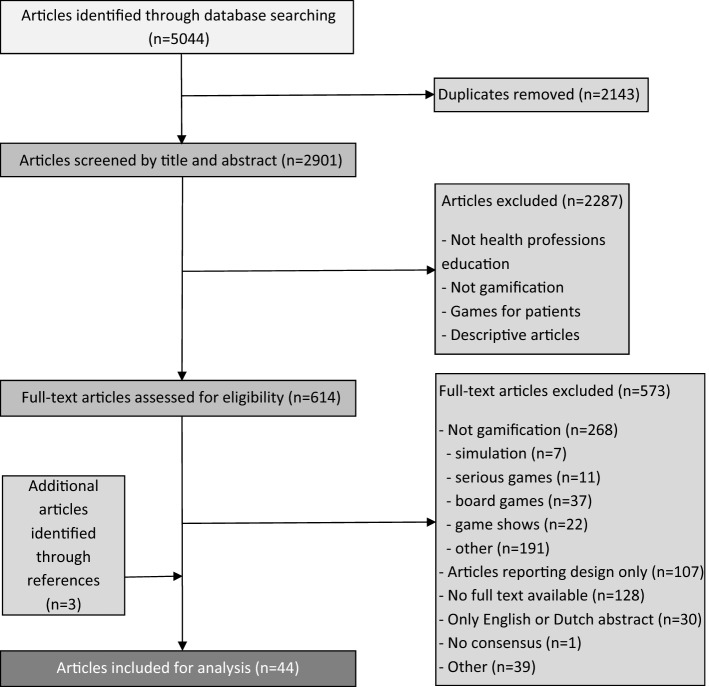
Gamification refers to using game attributes in a non-gaming context. Health professions educators increasingly turn to gamification to optimize students’ learning outcomes. However, little is known about the concept of gamification and its possible working mechanisms. This review focused on empirical evidence for the effectiveness of gamification approaches and theoretical rationales for applying the chosen game attributes. We systematically searched multiple databases, and included all empirical studies evaluating the use of game attributes in health professions education. Of 5044 articles initially identified, 44 met the inclusion criteria. Negative outcomes for using gamification were not reported. Almost all studies included assessment attributes (n = 40), mostly in combination with conflict/challenge attributes (n = 27). Eight studies revealed that this specific combination had increased the use of the learning material, sometimes leading to improved learning outcomes. A relatively small number of studies was performed to explain mechanisms underlying the use of game attributes (n = 7). Our findings suggest that it is possible to improve learning outcomes in health professions education by using gamification, especially when employing game attributes that improve learning behaviours and attitudes towards learning. However, most studies lacked well-defined control groups and did not apply and/or report theory to understand underlying processes. Future research should clarify mechanisms underlying gamified educational interventions and explore theories that could explain the effects of these interventions on learning outcomes, using well-defined control groups, in a longitudinal way. In doing so, we can build on existing theories and gain a practical and comprehensive understanding of how to select the right game elements for the right educational context and the right type of student.
Overview
CoChat Summary
TL;DR
This systematic review of 44 empirical studies found that gamification in health professions education was generally associated with positive or unchanged outcomes, with no negative outcomes reported. Assessment and conflict/challenge attributes were most common, but most studies were descriptive or lacked well-defined control groups and theory, limiting conclusions about mechanisms and effectiveness.
Key findings
- Of 5044 articles identified, 44 met inclusion criteria; no negative outcomes for gamification were reported. Almost all studies included assessment attributes (n = 40), often with conflict/challenge attributes (n = 27); this combination was linked to increased use of learning material in 8 studies and sometimes improved learning outcomes.
- Study quality varied: MERSQI scores ranged from 5 to 17 (mean 9.8, SD 3.1). Most studies were descriptive (n = 25; mean MERSQI 8.3, SD 2.3); 12 were justification studies and 7 were clarification studies. Only 8 well-controlled studies using assessment and conflict/challenge attributes were interpreted with more confidence.
- Contexts were predominantly USA (n = 20) or Canada (n = 8); digital gamified activities (n = 28) outnumbered analogue activities (n = 14). Most studies involved undergraduate (n = 15) and postgraduate medical students (n = 15), followed by nursing (n = 7).
- Theory use was limited: 7 clarification studies referenced theories including Experiential Learning Theory (3 studies), Reinforcement Learning Theory, Social Comparison Theory, Self-Directed Learning, and Deliberate Practice Theory; a common assumption was that gamification improves outcomes by changing learning behaviours or attitudes.
Methods
- Systematic review following AMEE guidelines; searched eight databases (Academic Search Premier, CINAHL, EMBASE, ERIC, Psychology and Behavior Sciences Collection, PsychINFO, PubMed, Cochrane Library) in April 2018, plus hand-searching references and citations.
- Included peer-reviewed journal articles on gamification or game elements in education for (future) health professionals, quantitative or mixed-method; excluded development-only studies, qualitative-only studies, serious games, patient education, simulations except gamified simulations, game-show/board-game contexts, and non-Dutch/English articles.
- Data extraction covered context, participants, intervention, outcomes, quality, and theory; quality was assessed with MERSQI, and studies were classified as description, justification, or clarification using Cook et al.’s framework. Double screening of a 10% excluded sample yielded 94% agreement.
Limitations
- Stated: the search may have missed articles because broad keywords were excluded; lack of consensus on definitions of game, gamification, and serious games made inclusion/exclusion subjective; only one researcher screened full texts; MERSQI does not assess qualitative parts of mixed-methods studies; the conceptual framework may over-generalize and lose information; only English and Dutch articles were included, risking language/culture bias.
- Stated/evident: most included studies lacked well-defined control groups and/or theory (36 of 44 were descriptive, confounded justification/clarification, or clarification without control groups), and combinations of game elements prevented disentangling individual effects; publication bias may have overreported positive results.
- Evident: the review reports no negative outcomes, but this may reflect underreporting; small-scale and pilot studies dominate, and the authors note gamification can have unexpected or unwanted effects (e.g., competition shifting attention from learning, over-justification effect).
Model-written summary. Check it against the paper before relying on it.
Integrity signals
Registry
Cites
Statistics
Figures
Verification
Claims the paper makes
0 Valid · 0 Not valid · 10 Not checked · 55 Own results and interpretations
A result the paper reports from its own data — it cites no other source for it, so there is none to check. The quote shows it is in the paper.
In the paper
“most of the included studies were descriptive in nature and rarely explained what was meant by gamification and how it worked in health professions education.”
§ Gamification of health professions education: a systematic review > Conclusion
plain- Asserted: passes — The authors put it forward as true.
- Checkable: passes — It can be checked against evidence.
- Load-bearing: passes — The paper’s conclusions depend on it.
- Based: passes — The paper gives a reason why it holds.
A result the paper reports from its own data — it cites no other source for it, so there is none to check. The quote shows it is in the paper.
In the paper
“Of 5044 articles initially identified, 44 met the inclusion criteria.”
- Also stated in: § Results · plain
“A total of 44 studies were eligible for inclusion in our systematic review (Table 1).”
§ Gamification of health professions education: a systematic review > Abstract
plain- Asserted: passes — The authors put it forward as true.
- Checkable: passes — It can be checked against evidence.
- Load-bearing: passes — The paper’s conclusions depend on it.
- Based: passes — The paper gives a reason why it holds.
- Also stated in: § Results · plain
A result the paper reports from its own data — it cites no other source for it, so there is none to check. The quote shows it is in the paper.
In the paper
“A combination of conflict and challenge attributes was also more often chosen by researchers from Europe (6 out of 8 European studies) and the USA (17 out of 21 USA studies) than by researchers from Canada (3 out of 8 Canadian studies).”
§ Gamification of health professions education: a systematic review > Results > Contextual differences and effects of game attributes
plainstates an association- Asserted: passes — The authors put it forward as true.
- Checkable: passes — It can be checked against evidence.
- Load-bearing: unclear — It is unclear whether the paper’s conclusions depend on it.
- Based: passes — The paper gives a reason why it holds.
A result the paper reports from its own data — it cites no other source for it, so there is none to check. The quote shows it is in the paper.
In the paper
“Most of the included studies (n = 25; Table 1) were descriptive in nature in such sense that they focused on observation and described what was done, without using comparison groups.”
§ Gamification of health professions education: a systematic review > Results > Quality of the current gamified learning research
plainn = 25- Asserted: passes — The authors put it forward as true.
- Checkable: passes — It can be checked against evidence.
- Load-bearing: passes — The paper’s conclusions depend on it.
- Based: passes — The paper gives a reason why it holds.
A result the paper reports from its own data — it cites no other source for it, so there is none to check. The quote shows it is in the paper.
In the paper
“A relatively small number of studies was performed to explain mechanisms underlying the use of game attributes (n = 7).”
§ Gamification of health professions education: a systematic review > Abstract
plainn = 7- Asserted: passes — The authors put it forward as true.
- Checkable: passes — It can be checked against evidence.
- Load-bearing: passes — The paper’s conclusions depend on it.
- Based: passes — The paper gives a reason why it holds.
30 more claims
Create a free account to see all 65 claims and to verify the 13 references still open.
- It may state two separate claims as one. 16
- Probably not a substantial claim. 21
Claims other papers make about this one
Each is checked against this paper’s own text: does it say what the citing paper says it does?
The source backs part of the claim, not all of it — or backs it for a different population, condition or comparison.
In the citing paper
“The enthusiastic participation and complexity and riskiness of strategies that emerged are consistent with the engagement observed in other gamified public health exercises, such as outbreak response simulations and health systems role-plays (78, 79).”
From Global Health Trade Summit: an AI-enhanced simulation of international trade and global health for undergraduate public health education (2025) · cites this paper as [79]
Experimental — accuracy not yet measuredThe source backs part of the claim, not all of it — or backs it for a different population, condition or comparison.
In the citing paper
“This aligns with research in health professions education demonstrating that gamification can substantially enhance learning outcomes and student motivation (79, 80).”
From Global Health Trade Summit: an AI-enhanced simulation of international trade and global health for undergraduate public health education (2025) · cites this paper as [79]
Experimental — accuracy not yet measured
Self-check
Percentages, sums and reported differences re-computed from the paper’s own numbers.
Each contradiction between two passages listed here was confirmed by an independent check.
Rated minor: it would not touch a result — a value no result rests on, a p-value that stays on the same side of the significance level, or a conflict that is clerical, resolved elsewhere in the paper, or outside its own findings.
In the paper
§ Gamification of health professions education: a systematic review > Discussion > Empirical evidence for using gamification
“The remaining eight studied included in our study were well-controlled studies using assessment and conflict/challenge attributes, so these study results could be interpreted with more confidence.”
§ Gamification of health professions education: a systematic review > Results
“| | Petrucci et al. (2015) | Residents (n = 14) | Conflict/challenge | Competition, progress, social network | Surgery (simulator) | 11 | Digital | Increased use, no difference in outcome |”
Rated minor: it would not touch a result — a value no result rests on, a p-value that stays on the same side of the significance level, or a conflict that is clerical, resolved elsewhere in the paper, or outside its own findings.
In the paper
§ Gamification of health professions education: a systematic review > Results > Educational context and student characteristics
“The majority of the studies were conducted in the USA (n = 20) or Canada (n = 8).”
§ Gamification of health professions education: a systematic review > Results > Contextual differences and effects of game attributes
“the USA (17 out of 21 USA studies)”
Cited works that were retracted
Works this paper cites that were later retracted, from the retraction notices publishers deposit. Major when the notice came out before this paper was published.
Rated major: it would touch a result — a value a result rests on, reported and recomputed p-values on opposite sides of the significance level, two passages that conflict with no sign which is right, or a cited work retracted before this paper was published.
In the paper
“…1999; Bligh and Prideaux 2002; Cook et al. 2008), which we felt should also apply to research on game-based learning in general and gamification in particular (Caponetto et al. 2014; De Sousa Borges et al. 2014; Faiella and Ricciardi 2015; Gentry et al. 2016; McCoy et al. 2016; Nah et al. 2014).”
Cited work 10.1002/14651858.cd012209 · retracted 2018-06-22 · notice 10.1002/14651858.cd012209.pub2 · this paper published 2020-10-31
Citations
Cites
1 retracted
Serious Gaming and Gamification interventions for health professional education
Gentry, S. V., Ehrstrom, B. L., Gauthier, A., Álvarez, J., Wortley, D. J., van Rijswijk, J., Car, J., Lilienthal, A., Car, L. T., Nikolaou, C. K., et al. (2016) · Cochrane Database of Systematic Reviews · doi:10.1002/14651858.cd012209 · Cited by 28 · cited 2×
“…1999; Bligh and Prideaux 2002; Cook et al. 2008), which we felt should also apply to research on game-based learning in general and gamification in particular (Caponetto et al. 2014; De Sousa Borges et al. 2014; Faiella and Ricciardi 2015; Gentry et al. 2016; McCoy et al. 2016; Nah et al. 2014).”
BackgroundRetractedRayyan-a web and mobile app for systematic reviews.
Ouzzani, M., Hammady, H., Fedorowicz, Z., & Elmagarmid, A. (2016) · Systematic Reviews · doi:10.1186/s13643-016-0384-4 · Cited by 26,092 · cited 1×
“After retrieving the search results from different databases, AvG removed the duplicates and uploaded the remaining articles to Rayyan, a mobile and web-based application developed for systematic reviews (Ouzzani et al. 2016).”
MethodA theory of social comparison processes
Festinger, L. (1954) · Human Relations · doi:10.1177/001872675400700202 · Cited by 20,926 · cited 1×
“According to the Social Comparison Theory, social comparison is a fundamental mechanism for modifying judgment and behaviour through the inner drive individuals have to gain accurate self-evaluations (Corcoran et al. 2011; Festinger 1954).”
MethodThe role of deliberate practice in the acquisition of expert performance
Ericsson, K. A., Krampe, R. T., & Tesch-Römer, C. (1993) · Psychological Review · doi:10.1037/0033-295x.100.3.363 · Cited by 9,564 · cited 1×
“Deliberate Practice Theory is based on engaging already motivated students to become experts via well-defined goals, real world tasks and immediate and informative feedback (Butt et al. 2018; Ericsson et al. 1993).”
BackgroundDeci, E. L., Koestner, R., & Ryan, R. M. (1999) · Psychological Bulletin · doi:10.1037/0033-2909.125.6.627 · Cited by 7,176 · cited 1×
“This is also called the over-justification effect (Deci et al. 1999, 2001; Hanus and Fox 2015; Landers et al. 2015; Lepper et al. 1973).”
BackgroundHomo Ludens: A Study of the Play-Element in Culture.
Gillin, J. L., & Huizinga, J. (1951) · American Sociological Review · doi:10.2307/2087716 · Cited by 6,560
Rules of Play: Game Design Fundamentals
Salen, K., & Zimmerman, E. (2003) · Medical Entomology and Zoology · Cited by 5,438
Does Gamification Work? -- A Literature Review of Empirical Studies on Gamification
Hamari, J., Koivisto, J., & Sarsa, H. (2014) · 2014 47th Hawaii International Conference on System Sciences · doi:10.1109/hicss.2014.377 · Cited by 5,201 · cited 1×
“…technology (Blohm and Leimeister 2013; Burke 2014; Burkey et al. 2013; De Sousa Borges et al. 2014; Domínguez et al. 2013; Gaggioli 2016; Hamari et al. 2014; Hsu et al. 2013; Huotari and Hamari 2012, 2017; Kumar 2013; Muntean 2011; Perrotta et al. 2013; Robson et al. 2015; Simões et al.…”
BackgroundThe Modern Practice of Adult Education: From Pedagogy to Andragogy
Knowles, M. S. (1970) · Cited by 3,905
(2020) · Journal of Medical Education · doi:10.5812/jme · Cited by 3,490
Research works printed but not linked: 8
- Caponetto, I., Earp, J., & Ott, M. (2014). Gamification and education: A literature review. In Proceedings of the European Conference on Games-Based Learning.
- Chia P Using a virtual game to enhance simulation based learning in nursing education Singapore Nurs J [Internet]. 2013 40 3 21 6
- Deterding S Khaled R Nacke L Dixon D Gamification: Toward a definition Chi 2011 2011 12 15
- Huotari, K., & Hamari, J. (2012). Defining gamification—A service marketing perspective. In Proceedings of the 16th International Academic MindTrek Conference 2012: “Envisioning Future Media Environments”, MindTrek 2012.
- Jacobs, J. W., & Dempsey, J. V. (1993). Simulation and gaming: Fidelity, feedback, and motivation. In: Dempsey, J.V. and Sales G.C. (Eds.). Interactive instruction and feedback. Englewood Cliffs, New Jersey: Educational Technology Publications
- Nemer LB Kalin D Fiorentino D Garcia JJ Estes CM The labor games Obstet Gynecol. 2016 128 1s 5s 27662001 · DOI
- Tilley, N., & Pawson, R. (2000). Realistic evaluation: An overview. The British Journal of Sociology.
- Zuk R Get in the game: How communicators can leverage gamification Public Relations Tactics 2012 19 7
Cited by
Items 501–600 of 861
Gobron, S., Lestrade, A., Sadiku, A., Bentvelzen, A., Kaci, L. A., Carrier, J.-M., Guyot, E., & Carron, P. (2025) · JMIR Formative Research · doi:10.2196/72202 · Cited by 1
“…field; Gue et al [20] surveyed residents to investigate the impact of gamification in emergency medicine residency training, and Van Gaalen et al [21] proposed a review focusing on empirical evidence for the effectiveness of gamification approaches and the theoretical justification for the…”
Learning through play: Educators and students reflect on a gamified assessment
Koch, G. G. V., Moosa, H., Smith, J., & Davidson, F. (2025) · Journal of medical imaging and radiation sciences · doi:10.1016/j.jmir.2025.102139 · Cited by 1
Experiência gamificada como estratégia educacional sobre obesidade para acadêmicos em nutrição
Silva Veras, A. P., Garcia, K. R., Faria Arquelau, P., Costa Pereira, L., & Fortes Gris, E. (2024) · EDUCAÇÃO, FORMAÇÃO & TECNOLOGIAS · doi:10.5281/zenodo.13120800 · Cited by 2
van Gaalen, A. (2023) · University of Groningen research database (University of Groningen / Centre for Information Technology) · doi:10.33612/diss.574752301 · Cited by 1
Voss, M. (2023) · Oxford University Research Archive (ORA) (University of Oxford) · doi:10.5287/ora-goy5ya0yj · Cited by 1
García‐Martínez, E. (2023) · Repositori ObertUDL (University of Lleida) · Cited by 1
Stathakarou, N. (2026) · doi:10.69622/30436624 · Cited by 1
Nieto, L. P. C. (2024) · Intellectum (Universidad de La Sabana) · doi:10.82992/intellectum/handle.10818.4125 · Cited by 1
Gamification as a tool to engage the next generation of vets with large animal medicine
Oosterlinck, M., & Decloedt, A. (2021) · Veterinary Record · doi:10.1002/vetr.533
Jugar..., algo más que entretenerse
Sánchez, J. Á. H. (2013) · EmásF: revista digital de educación física
Commonwealth Collaboration to Build Back Better
Haßler, B., & Education, O. D. &. (2022) · doi:10.53832/21ccem.1
Vorstellung und Evaluation des haptisch-visuellen, ohrchirurgischen Trainingssystems „HaptiVisT“
Sorge, M., Eixelberger, T., Dietz, A., Simon, M., Wittenberg, T. C., Katzky, U., Perret, J., Hofer, M., & Pirlich, M. (2022) · Laryngo-Rhino-Otologie · doi:10.1055/a-1802-4887
Ammirati, C. (2022) · Pédagogie médicale · doi:10.1051/pmed/2022013
THE EFFECTS OF GENETIC INHERITANCE E-GAME TO UNDERGRADUATE STUDENTS
Jufri, N. F., Ibrahim, F. W., Hamid, A., Latif, M. A., & Singh, S. S. B. (2022) · Asean Journal of Teaching and Learning in Higher Education · doi:10.17576/ajtlhe.1401.2022.01
Blumer, J., Kruidering, M., Brandl, K., McPhail, B. T., & Simmons, M. A. (2022) · Pharmacology Research & Perspectives · doi:10.1002/prp2.1014
“The following may also be included depending on the scenario: (5) Physical examination; (6) Pertinent findings (typically included); (7) Review of systems; (8) History— medical, social, family, immunizations; (9) Vital signs; (10) Results of diagnostic studies; (11) Risk factors; and (12) Community information.”
BackgroundTHE E-LERNING REMOTE TECNOLOGY IN TEACHING HUMAN PHYSIOLOGY
Erkudov, V. O., Лытаев, С. А., Пуговкин, А. П., Арпаджи, Т. А., Бельская, К. А., Гайворонская, В. В., Кипятков, Н. Ю., Кочубеев, А. В., Рогозин, С. С., Скребцова, Н. В., et al. (2022) · Russian Biomedical Research · doi:10.56871/4396.2022.91.16.003
Future Prospect of Gamification-Based Mobile in Physics Learning
Amiruddin, M. Z. B., Nisa', W. Z., Rahman, S. M. I. B., & Saini, N. A. M. B. (2022) · JPPS (Jurnal Penelitian Pendidikan Sains) · doi:10.26740/jpps.v12n1.p40-55
Music: For a Sustainable Community and the Promotion of Well-being
Finestrone, F. (2022) · Elementa Intersections between Philosophy Epistemology and Empirical Perspectives · doi:10.7358/elementa-2022-0102-fine
Gamification in laparoscopic training: a randomized, controlled studyPreprint
Zwimpfer, T. A., Wismer, C., Geissler, F., Oehler, R., Geiger, J. D., Schötzau, A., Fellmann-Fischer, B., & Heinzelmann-Schwarz, V. A. (2022) · Research Square · doi:10.21203/rs.3.rs-2331317/v1
Parozzi, M., & Lomuscio, S. (2023) · Dissertation Nursing · doi:10.54103/dn/18637
“Gli ambiti di applicazione della gamification (intesa come l’integrazione di caratteristiche proprie dei giochi in contesti non di gioco (10) sembrano essere piuttosto differenti, tuttavia, alcuni ambiti in particolare sembrano aver iniziato a riscontrare un certo interesse, fra cui, quello della Salute Mentale (11,12…”
Digital advances in health education with fun health games for childrenPreprint
Efe, H., & Topsakal, Ü. U. (2023) · Research Square · doi:10.21203/rs.3.rs-2494374/v1
GAMIFICACAO E CONCEITOS MATEMATICOS NA EDUCACAO DE JOVENS E ADULTOS [EJA]
Trentin, V. B., & Trentin, L. (2023) · CONTECSI - International Conference on Information Systems and Technology Management · doi:10.5748/19contecsi/pse/edu/7105
JOGO DE TABULEIRO: ESTRATÉGIA DE ENSINO PARA ABORDAR FISIOTERAPIA RESPIRATÓRIA E CÂNCER DE PULMÃO
dos Santos, L. M., Costa, I. S., dos Sousa, G. S., Silva, J. S., de Souza, C. C. L., Caminha, A. V. D. Q., & Raposo, M. T. (2023) · Editora e-Publicar eBooks · doi:10.47402/ed.ep.c2321692119
Avaliação da usabilidade de um material educativo digital interativo: um estudo transversal
Sobral, M. A. A. S., Rocha, V. J., dos Santos, M. R. C., Filho, M. A. B., Oliveira, A. M. G., Barros, R. A., & Goes, B. T. (2023) · Revista Educação em Saúde/Revista Educação em Saúde Unievangélica · doi:10.37951/2358-9868.2023v11i1.p4-14
Future of Health Professions Education Curricula
Gantwerker, E. A., Allen, L., & Hay, M. (2023) · Springer eBooks · doi:10.1007/978-981-15-3344-0_134
Gamified web-delivered attentional bias modification training for the management of chronic pain
Vermeir, J. F. (2023) · Queensland University of Technology · doi:10.5204/thesis.eprints.242456
Physician Assistant Student Attitudes Toward Gamification of Cardiac Auscultation Instruction
Garvick, S., Gillette, C., Bates, N. R., Jackson, T., Gao, H., & Crandall, S. J. S. (2023) · The Journal of Physician Assistant Education · doi:10.1097/jpa.0000000000000535
Gamifying Diabetes — An Education Game Teaching People with Diabetes About Physical Activity
Rauchensteiner, M. A., Colsman, T., Fatykhova, A., Faizan, N., Utesch, M. C., Wittges, H., & Krcmar, H. (2023) · Lecture notes in networks and systems · doi:10.1007/978-3-031-41637-8_35
Introducing Social Gamification to a Biomedical Signal Processing Course: A Case Study
Bender, T., Krefting, D., Jensen, C., & Spicher, N. (2023) · IEEE German Education Conference (GECon) · doi:10.1109/gecon58119.2023.10295152
Game Technologies and High-Fidelity Patient Simulation in the Field of Psychology and Medicine
Середкина, Е. В., Zhdanova, S. Y., Puzyreva, L. O., & Yuzhakov, A. A. (2023) · Lecture notes in networks and systems · doi:10.1007/978-3-031-48016-4_4
Design and evaluation of a serious game for teaching nanotechnologies in pharmacy education
Meeus, A., Sapin‐Minet, A., & Parent, M. (2023) · Pharmacy Education · doi:10.46542/pe.2023.231.762768
“Simulations provide artificial conditions mimicking a realistic environment in order to experiment with something real in a safe environment: they do not necessarily use game elements (van Gaalen et al., 2021).”
BackgroundInfluentialEvaluation of Nursing Students' Perceptions of the Phenomenon of Smoking Behavior
Gustiana, A., Ramos-Mortel, B. T. M., & Theerawasttanasiri, N. (2023) · Indonesian Journal of Education Research (IJoER) · doi:10.37251/ijoer.v4i6.953
“On the one hand, understanding the importance of health education has become a major focus for many countries around the world, considering its significant impact on improving the quality of life and reducing the number of preventable diseases and deaths [4], [5].”
BackgroundHow does creative enquiry enable us to deal with uncertainty?
Kandiah, I., & Younie, L. (2026) · BMC Medical Education · doi:10.1186/s12909-026-10060-w
Santos, M. G. D. O., Ferrari, N., Alvarenga, M. R. D. C., Moraes, L. P., Raphe, R., & Sanches, P. H. S. (2024) · MedNEXT Journal of Medical and Health Sciences · doi:10.54448/mdnt24301
“However, its practice requires qualified training, so that future professionals in the medical and, especially, surgical fields can master and execute its techniques safely and precisely [16,17].”
BackgroundScovell, N., Appuhamy, R., Heathcote, K., & Veerman, L. J. (2024) · Focus on Health Professional Education A Multi-Professional Journal · doi:10.11157/fohpe.v25i2.745
“Gamification, the application of game design principles in non-game contexts, is one such example and has shown increasing use as an educational tool for health (van Gaalen et al., 2021).”
BackgroundUsing games to clarify interprofessional roles and build a repository of curricula activities
Dreyer, A. R. (2024) · African Journal of Health Professions Education · doi:10.7196/ajhpe.2024.v16i2b.1678
Preparing health professions learners to work with uncertainty
Moffett, J. E. (2024) · Utrecht University Repository (Utrecht University) · doi:10.33540/2385
Williams, S., Fernandes, G., Adab, P., Adams, R. L., de Sousa, J. C., Chi, C., Dickens, A., Enocson, A., Farley, A., Maglakelidze, M., et al. (2024) · INQUIRY The Journal of Health Care Organization Provision and Financing · doi:10.1177/00469580241273178
Online Learning Platforms on Efl Students’ Learning Intensity and Frequency
Aprianto, D., Sutarman, S., & Rahmawati, L. (2024) · International Journal of Social Science and Human Research · doi:10.47191/ijsshr/v7-i09-25 · Cited by 1
XI Buenas Prácticas de Innovación Docente en el Espacio Europeo de Educación Superior
(2024) · Universidad San Jorge eBooks · doi:10.54391/123456789/1559
Chapter 10 - Playful practicals: breaking free from educational norms with online escape rooms
Gillaspy, E., Jones, A., Spencer, G., & Robinson, J. (2024) · doi:10.20919/vtii8045/11
Developing Gamified Learning for Healthcare Professionals Through University Partnerships
Nicely, S., Richardson, J., & Emma, T. (2024) · Lecture notes in computer science · doi:10.1007/978-3-031-74138-8_24
Üniversite Öğrencilerinin METAVERSE Algıları
Seçkin, Z., Doğan, O., & İŞLER, F. (2024) · Özgür Yayınları eBooks · doi:10.58830/ozgur.pub504
Chan, T. M., Edwards, S. L., Swamy, L., Cosimini, M. J., & Watsjold, B. K. (2024) · doi:10.32920/27922158.v1
Yıldırım, B. F., & Soylu, D. (2024) · Bilgi Yönetimi · doi:10.33721/by.1518065
Innovating in Nursing Education: A Game Prototype for Bridging the Gap in Family-Centered Care
de Oliveira, J. F., Campos, M. J., Martins, T. V., Fernandes, C. S., & Ferreira, M. C. (2024) · Lecture notes in networks and systems · doi:10.1007/978-3-031-77571-0_19
Deitos, M. V., & Trippo, K. V. (2024) · REVISTA DA ASSOCIAÇÃO BRASILEIRA DE ATIVIDADE MOTORA ADAPTADA · doi:10.36311/2674-8681.2024.v25n2.p329-346
Mira, J. J., Gil-Hernández, E., & Carrillo, I. (2024) · Educación Médica · doi:10.1016/j.edumed.2024.100987
Güneş, M. İ., BALKIŞLI, B. Ç., & Özçınar, H. (2024) · Journal of Higher Education and Science · doi:10.5961/higheredusci.1445089
Wanderley, I. J. M., da Rocha, A. M., Bordalo, L. M. F., & Barreto, B. A. P. (2025) · Cuadernos de Educación y Desarrollo · doi:10.55905/cuadv17n1-042
Integrating High-Value Cost-Conscious Care into an Existing Medical School Curriculum
Eapen, S., Tan, A., Gorman, P., Scholl, G., & Smeraglio, A. C. (2025) · MedEdPORTAL · doi:10.15766/mep_2374-8265.11490 · Cited by 1
Meeus, A., Gravoulet, J., Broséus, J., D’Aveni, M., & Perrin, J. (2025) · Pharmacy Education · doi:10.46542/pe.2025.251.5365
Development and Validation of a Quiz-type Serious Game on Oral Health of Children and Teenagers
Costa, M. A., de Oliveira, A. E. F., Lopes, F. F., Monier, E. B., Costa, J. F., Neves, P. A. M., & Costa, E. L. (2024) · Revista de Ensino Educação e Ciências Humanas · doi:10.17921/2447-8733.2024v25n5p680-687
TRANSFORMATION OF RADIOGRAPHY EDUCATION POST- COVID-19 PANDEMIC: A REVIEW PAPER
Dujović, M., PANTELIC, M., Vučinić, T., & Dujović, S. D. (2024) · IRASA International Scientific Conference Science, Education, Technology and Innovation (SETI) · doi:10.62982/seti06.midu.23
Batko, K., Stefanik, A., Witusik, A., Sipowicz, K., & Pietras, T. (2025) · Polski Merkuriusz Lekarski · doi:10.36740/merkur202501110
Jinekolojik Kanser Hastalarının Bakım ve Tedavisinde Oyunlaştırmanın Rolü
Gök, E. (2025) · Özgür Yayınları eBooks · doi:10.58830/ozgur.pub693.c2934
Serious Games as a training tool for Primary Care
Gustmann, K., de Figueirêdo, M. M., Cano, M. D., & Queiroz, J. E. D. A. (2025) · Journal of Engineering Research · doi:10.22533/at.ed.317542517035
do Nascimento, T. A. M., Verner, F. S., & Junqueira, R. B. (2025) · Dentomaxillofacial Radiology · doi:10.1093/dmfr/twaf022
Hernández, M. M., Becerra-Beltran, J. L., & Urendez-Flores, A. (2025) · Educación Médica · doi:10.1016/j.edumed.2025.101052
¿Puede ser útil la gamificación para el aprendizaje en pediatría?
Martín, L. M. G., & Álvarez, A. M. V. (2025) · Boletín de Pediatría · doi:10.63788/rr520532
Digital Literacy and Preparedness of Healthcare Professionals: The TRANSiTION Project
Nicolaidou, I. A., & On behalf of the TRANSiTION Consortium (2025) · Springer eBooks · doi:10.1007/978-3-031-87158-0_2
Nogueira, Í. B., Santos, J. R. D. O. G., & de Mendonça, M. O. L. (2025) · Revista Foco · doi:10.54751/revistafoco.v18n5-165
An Escape Room to Cultivate Interprofessional Skills: A Mixed Methods Study
Lenhardt, R., Carsone, B., Lunsford, D., Goodman, M., & Caswell, A. (2025) · Teaching and Learning in Communication Sciences & Disorders · doi:10.61403/2689-6443.1364
Características de la educación en salud desde la perspectiva de la revolución 4.0
Moreno, O. M., Monroy-Gómez, J. A., & Romero-Peña, A. (2025) · Revista Iberoamericana de Educación Superior · doi:10.22201/iisue.20072872e.2025.46.1790
“…en el que la gamificación está viendo crecer su importancia y resulta altamen - te beneficiosa para los estudiantes universitarios que cursan ciencias de la salud (Gaalen et al. , 2021: 683), ya que incide positivamente en su satisfacción y nivel de motivación académica (Arruzza y Chau, 2021: 137).”
Prescott, W. A., Foltz-Ramos, K., Kruger, J. S., Anadi, I. S., & Fusco, N. M. (2025) · Springer eBooks · doi:10.1007/978-3-031-88668-3_6
OPINIÃO DOS ESTUDANTES SOBRE GAMIFICAÇÃO NO PROCESSO DE ENSINO-APRENDIZAGEM DA ENDODONTIA
Júnior, P. M. R. D. M., Travassos, R. M. C., Maia, S. M. A. S., de Menezes, M. R. A., Valones, M. A. A., Martins, W. W. A., Santos, P. G. S. T. D., de Souza, G. F. M., & Silva, L. B. (2025) · LUMEN ET VIRTUS · doi:10.56238/levv16n49-075
Young, L., Ning, X., Pan, Y., Jackson, T., & Troutman‐Jordan, M. (2025) · Research Square · doi:10.21203/rs.3.rs-6873159/v1
Using Gamification in Athletic Training Education: Foundational Concepts
Williams, M., & Hudson, H. (2025) · Journal of Athletic Training Education and Practice · doi:10.4085/1947-380x-24-062
Gamification for Patients: Accelerating Recovery in the Postoperative Period
Merdin, Z. M. (2025) · Özgür Yayınları eBooks · doi:10.58830/ozgur.pub781.c3264
OPINIÃO DOS ESTUDANTES SOBRE GAMIFICAÇÃO NO PROCESSO DE ENSINO-APRENDIZAGEM DA ENDODONTIA
Júnior, P. M. R. D. M., Travassos, R. M. C., Maia, S. M. A. S., de Menezes, M. R. A., Valones, M. A. A., Martins, W. W. A., Santos, P. G. S. T. D., Souza, G. F. M. D., & Silva, L. B. (2025) · Aracê. · doi:10.56238/arev7n6-306
Wilson, N. (2025) · Journal of Radiotherapy in Practice · doi:10.1017/s1460396925100186
“Gamification or serious play is the application of game attributes in a non-gaming context 4,5 or as described by Gentry et al., 6 ‘ the application of the characteristics and benefits of games to real-world processes or problems ’ .”
Hsieh, J.-C. J., Bagha, Z. M., Weintraub, S. F., Jnani, J., & Block, L. (2025) · Cureus · doi:10.7759/cureus.87718
“Gamification broadly encompasses a variety of systems, including social elements (team competition), technology integration (novel devices, virtual reality), and systems (point-based scoring or a fictional world) that promote engagement and accessible and active learning [2,3].”
HEALTHTEK eLEARNING PLATFORM: AN ONLINE APPROACH TO ON BIOMEDICAL ENGINEERING
(2025) · Education and new developments · doi:10.36315/2025v1end109
Cause-Related Games and Willingness to Donate: An Empirical Study from China
Zhou, H., & Zhang, J. (2025) · VOLUNTAS International Journal of Voluntary and Nonprofit Organizations · doi:10.1007/s11266-025-00764-w
Feitosa, G. D. C., Medeiros, R. D. O., de Araújo, V. C. E., Galhardi, C. M., Rodolpho, G. C., Ferreira, I. G., Mazzetto, F. M. C., Marín, M. J. S., Soeiro, B. M., Oliveros, C. M., et al. (2025) · Mitteilungen Klosterneuburg · doi:10.61586/5zvme
Razzaq, S., Brouillette, K., Grossman, A., Pu, L., Phillipp, J., Robert, L., Perlman, L., Rumjahn-Gryte, S., Lamarre-Tellier, S., Unger, B., et al. (2025) · Canadian Journal of Emergency Medicine · doi:10.1007/s43678-025-00987-2
Leveraging Gamification to Foster Diversity and Inclusion in Healthcare
Schijven, M. P., & Kikkawa, T. (2025) · Simulation & Gaming · doi:10.1177/10468781251372524
“Systematic reviews of gami fi cation in health professions education demonstrate positive learning outcomes when game elements such as assessments combined with challenge cues are applied — although mechanisms often remain unexplored (van Gaalen et al., 2020).”
Ike, T. C., Yi, N. K. H., & Shaker, V. (2025) · Lecture notes in networks and systems · doi:10.1007/978-981-96-5214-3_35
Aftab, R., Khan, M., & Ali, A. (2025) · Journal of the Pakistan Medical Association · doi:10.47391/jpma.25-68
Serious Games: Changing the Environments in the Classrooms
França, C. S., Betencourt, G., Gonçalves, F., & Campos, P. (2025) · IFIP advances in information and communication technology · doi:10.1007/978-3-031-95334-7_7
Come on Down, Utilizing Gamification Learning Techniques to Improve Nurse-Sensitive Outcomes
Gordon, J., Erb, A., Wallis, C. D., & Hlebichuk, J. L. (2025) · Journal for Nurses in Professional Development · doi:10.1097/nnd.0000000000001152
Building a Brain: Development of a Neuroanatomy Educational Application
Chatto, C. A., & Jaffe, L. E. (2025) · Emerald Group Publishing Limited eBooks · doi:10.1108/978-1-83549-506-320251009
Orozco, F. M. V., & Acosta, I. D. P. (2025) · ASCE MAGAZINE · doi:10.70577/asce/2656.2672/2025
Gamifying Emergency Response: A Board Game for Training Teams in Ruptured Aortic Aneurysm ManagementPreprint
Ortega, E. I., Jovells-Vaqué, S., Chaos, O., Macía, I., & Huici-Sánchez, M. (2025) · Research Square · doi:10.21203/rs.3.rs-7171293/v1
Wattanawongwon, N., Boonsaen, T., Udol, K., & Homsanit, M. (2025) · Research Square · doi:10.21203/rs.3.rs-7319496/v1
Gamification for emergency radiology education and image perception: stab the diagnosis
Auffermann, W. F., Barber, N., Stockard, R., & Banerjee, S. (2025) · Journal of medical imaging · doi:10.1117/1.jmi.12.5.051808
From Concept to Classroom: Gamifying lesson design in Open and Distance Learning
Doomun, R. (2025) · Proceedings of The International Conference on Innovation in Teaching and Education · doi:10.33422/iteconference.v2i1.1313
Malage, G. R., & Mulyana, I. (2024) · JURNAL TAHURI · doi:10.30598/tahurivol21issue2page104-119
“Moreover, Gaalen et al. (2021) and Murayama et al. (2019) highlight that embodied learning significantly contributes to children’s cognitive development, particularly in distance learning situations filled with limitations.”
de Oliveira, Y. L., do Nascimento, S. S., Lopes, A. R., & Mombelli, M. A. (2025) · DELOS Desarrollo Local Sostenible · doi:10.55905/rdelosv18.n73-058
The logical circle of gamification in medical teaching
Delgado, J. I. C. (2025) · Gamification and Augmented Reality. · doi:10.56294/gr2025268
Covre, L. M. V., Pinto, L. O. S., de Lélis, R. C., & Teixeira, C. H. C. (2025) · International Journal of Health Education · doi:10.17267/2594-7907ijeh.2025.e6206
Welch, H., Carlisle, E. R., & Burgess, S. (2025) · Journal of Healthcare Simulation · doi:10.54531/mrlw9072
May, S. (2025) · Journal of Healthcare Simulation · doi:10.54531/qiil4288
da Silva, S. L. (2025) · Revista Contemporânea · doi:10.56083/rcv5n7-111
The EMazing Race: A Novel Gamified Emergency Medicine Educational Experience
Freeman, B., Vinokur, K., Zimmerman, M., & Cygan, L. (2025) · PubMed Central · doi:10.21980/j8.52075
Berral-Ortiz, B., Domingo, J. A. M., Salas, P. A., & Menéndez, A. M. (2025) · IGI Global eBooks · doi:10.4018/979-8-3373-7912-8.ch012
Metadata
- Authors
- van Gaalen, A. E. J., Brouwer, J., Schönrock-Adema, J., Bouwkamp-Timmer, T., Jaarsma, A. D. C., & Georgiadis, J. R.
- Affiliations
- University of Groningen (NL)
- University Medical Center Groningen (NL)
- Venue
- Advances in Health Sciences Education
- Published
- 2020-10-31
- Volume
- 26
- Issue
- 2
- Pages
- 683-711
- ISSN
- 1382-4996 (ISSN-L)
- 1573-1677
- PMC
- PMC8041684
- OpenAlex
- W3094919143
- Cited by
- 625
- References
- 149
- Citations by year
- 2026: 108 · 2025: 126 · 2024: 160 · 2023: 121 · 2022: 80 · 2021: 29
- FWCI
- 12.14
- Type
- journal article
- Language
- en
- Open access
- hybrid
- doi.org
- Licence
- cc-by
- creativecommons.org/licenses/by/4.0 (tdm)
- creativecommons.org/licenses/by/4.0 (vor)
- Locations
- Advances in Health Sciences Education (publishedVersion, cc-by)
- PubMed Central (publishedVersion, cc-by)
- PubMed (publishedVersion)
- University of Groningen research database (University of Groningen / Centre for Information Technology) (publishedVersion, cc-by)
- Utrecht University Repository (Utrecht University) (submittedVersion, other-oa)
- University of Groningen research database (University of Groningen / Centre for Information Technology) (submittedVersion, cc-by)
- Funders
- University of Groningen
- Topics
- Social Sciences › Psychology › Developmental and Educational Psychology › Educational Games and Gamification
- Social Sciences › Education › Innovations in Medical Education
- Physical Sciences › Engineering › Biomedical Engineering › Biomedical and Engineering Education
- Keywords
- gamification, health professions education, game attributes, learning outcomes, learning behavior, learning attitude, educational intervention
- MeSH terms
- Health Occupations, Humans, Learning, Students
About these checks
Registry, retraction, Cites and statistics results are computed, not judged, with one exception: a printed reference that no index lists is read once by a model before it counts as a citation error. Claims are extracted by a model and kept only when their quote appears verbatim in the text; each cited source is then checked, with a model’s help, for whether it says what the claim relies on. Those verdicts can be wrong — read the claim’s quote and the cited source before relying on one.
A language model drew the claims from the paper on 2026-11-23, under version 3 of the claim definition (model deepseek-v4.1-flash, prompt extract-v3).
A second model labelled each claim on 2026-11-23 (model jev-1.13-20260917, definition revision gold-guideline-v0.2).
Statistics and arithmetic are recomputed, not judged.
Confidence bands are shown only for fields calibrated on our annotated test set. None is calibrated yet, so no band is shown.
What counts as a claim ›How we measure confidence ›How we check this ›
Are you an author, or do you see a problem with this page? Request a review
Data sources
Bibliographic data: Semantic Scholar, OpenAlex, Crossref.
Contains information from the Semantic Scholar Academic Graph Datasets, made available under the ODC Attribution License (ODC-BY 1.0).
Semantic Scholar’s data is described in: Kinney, R., et al. (2023). The Semantic Scholar Open Data Platform. arXiv:2301.10140.
