

Gamification of health professions education: a systematic review
Open accessThe DOI matches its Crossref record; 148 of the 149 references it cites were found in a registry or an index; none of the 15 sources its claims cite is checked for support yet.
Abstract
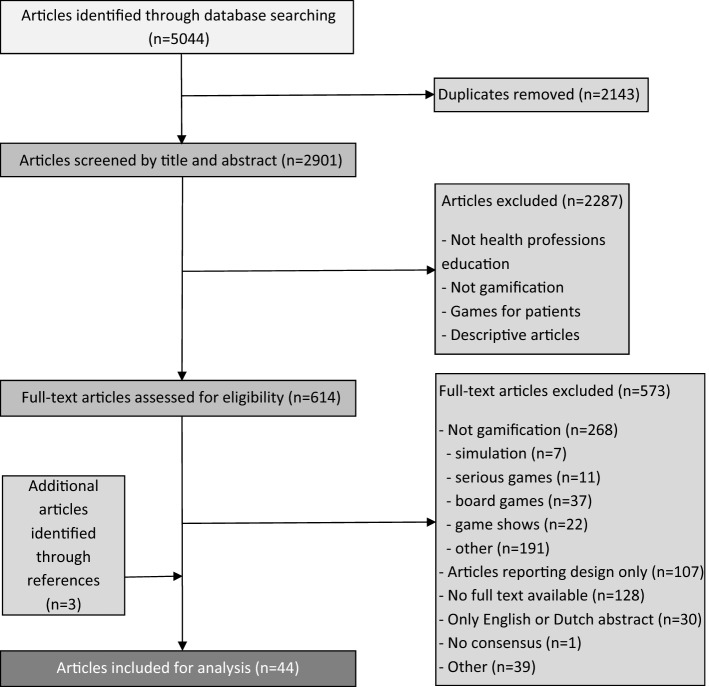
Gamification refers to using game attributes in a non-gaming context. Health professions educators increasingly turn to gamification to optimize students’ learning outcomes. However, little is known about the concept of gamification and its possible working mechanisms. This review focused on empirical evidence for the effectiveness of gamification approaches and theoretical rationales for applying the chosen game attributes. We systematically searched multiple databases, and included all empirical studies evaluating the use of game attributes in health professions education. Of 5044 articles initially identified, 44 met the inclusion criteria. Negative outcomes for using gamification were not reported. Almost all studies included assessment attributes (n = 40), mostly in combination with conflict/challenge attributes (n = 27). Eight studies revealed that this specific combination had increased the use of the learning material, sometimes leading to improved learning outcomes. A relatively small number of studies was performed to explain mechanisms underlying the use of game attributes (n = 7). Our findings suggest that it is possible to improve learning outcomes in health professions education by using gamification, especially when employing game attributes that improve learning behaviours and attitudes towards learning. However, most studies lacked well-defined control groups and did not apply and/or report theory to understand underlying processes. Future research should clarify mechanisms underlying gamified educational interventions and explore theories that could explain the effects of these interventions on learning outcomes, using well-defined control groups, in a longitudinal way. In doing so, we can build on existing theories and gain a practical and comprehensive understanding of how to select the right game elements for the right educational context and the right type of student.
Overview
CoChat Summary
TL;DR
This systematic review of 44 empirical studies found that gamification in health professions education was generally associated with positive or unchanged outcomes, with no negative outcomes reported. Assessment and conflict/challenge attributes were most common, but most studies were descriptive or lacked well-defined control groups and theory, limiting conclusions about mechanisms and effectiveness.
Key findings
- Of 5044 articles identified, 44 met inclusion criteria; no negative outcomes for gamification were reported. Almost all studies included assessment attributes (n = 40), often with conflict/challenge attributes (n = 27); this combination was linked to increased use of learning material in 8 studies and sometimes improved learning outcomes.
- Study quality varied: MERSQI scores ranged from 5 to 17 (mean 9.8, SD 3.1). Most studies were descriptive (n = 25; mean MERSQI 8.3, SD 2.3); 12 were justification studies and 7 were clarification studies. Only 8 well-controlled studies using assessment and conflict/challenge attributes were interpreted with more confidence.
- Contexts were predominantly USA (n = 20) or Canada (n = 8); digital gamified activities (n = 28) outnumbered analogue activities (n = 14). Most studies involved undergraduate (n = 15) and postgraduate medical students (n = 15), followed by nursing (n = 7).
- Theory use was limited: 7 clarification studies referenced theories including Experiential Learning Theory (3 studies), Reinforcement Learning Theory, Social Comparison Theory, Self-Directed Learning, and Deliberate Practice Theory; a common assumption was that gamification improves outcomes by changing learning behaviours or attitudes.
Methods
- Systematic review following AMEE guidelines; searched eight databases (Academic Search Premier, CINAHL, EMBASE, ERIC, Psychology and Behavior Sciences Collection, PsychINFO, PubMed, Cochrane Library) in April 2018, plus hand-searching references and citations.
- Included peer-reviewed journal articles on gamification or game elements in education for (future) health professionals, quantitative or mixed-method; excluded development-only studies, qualitative-only studies, serious games, patient education, simulations except gamified simulations, game-show/board-game contexts, and non-Dutch/English articles.
- Data extraction covered context, participants, intervention, outcomes, quality, and theory; quality was assessed with MERSQI, and studies were classified as description, justification, or clarification using Cook et al.’s framework. Double screening of a 10% excluded sample yielded 94% agreement.
Limitations
- Stated: the search may have missed articles because broad keywords were excluded; lack of consensus on definitions of game, gamification, and serious games made inclusion/exclusion subjective; only one researcher screened full texts; MERSQI does not assess qualitative parts of mixed-methods studies; the conceptual framework may over-generalize and lose information; only English and Dutch articles were included, risking language/culture bias.
- Stated/evident: most included studies lacked well-defined control groups and/or theory (36 of 44 were descriptive, confounded justification/clarification, or clarification without control groups), and combinations of game elements prevented disentangling individual effects; publication bias may have overreported positive results.
- Evident: the review reports no negative outcomes, but this may reflect underreporting; small-scale and pilot studies dominate, and the authors note gamification can have unexpected or unwanted effects (e.g., competition shifting attention from learning, over-justification effect).
Model-written summary. Check it against the paper before relying on it.
Integrity signals
Registry
Cites
Statistics
Figures
Verification
Claims the paper makes
0 Valid · 0 Not valid · 10 Not checked · 55 Own results and interpretations
A result the paper reports from its own data — it cites no other source for it, so there is none to check. The quote shows it is in the paper.
In the paper
“most of the included studies were descriptive in nature and rarely explained what was meant by gamification and how it worked in health professions education.”
§ Gamification of health professions education: a systematic review > Conclusion
plain- Asserted: passes — The authors put it forward as true.
- Checkable: passes — It can be checked against evidence.
- Load-bearing: passes — The paper’s conclusions depend on it.
- Based: passes — The paper gives a reason why it holds.
A result the paper reports from its own data — it cites no other source for it, so there is none to check. The quote shows it is in the paper.
In the paper
“Of 5044 articles initially identified, 44 met the inclusion criteria.”
- Also stated in: § Results · plain
“A total of 44 studies were eligible for inclusion in our systematic review (Table 1).”
§ Gamification of health professions education: a systematic review > Abstract
plain- Asserted: passes — The authors put it forward as true.
- Checkable: passes — It can be checked against evidence.
- Load-bearing: passes — The paper’s conclusions depend on it.
- Based: passes — The paper gives a reason why it holds.
- Also stated in: § Results · plain
A result the paper reports from its own data — it cites no other source for it, so there is none to check. The quote shows it is in the paper.
In the paper
“A combination of conflict and challenge attributes was also more often chosen by researchers from Europe (6 out of 8 European studies) and the USA (17 out of 21 USA studies) than by researchers from Canada (3 out of 8 Canadian studies).”
§ Gamification of health professions education: a systematic review > Results > Contextual differences and effects of game attributes
plainstates an association- Asserted: passes — The authors put it forward as true.
- Checkable: passes — It can be checked against evidence.
- Load-bearing: unclear — It is unclear whether the paper’s conclusions depend on it.
- Based: passes — The paper gives a reason why it holds.
A result the paper reports from its own data — it cites no other source for it, so there is none to check. The quote shows it is in the paper.
In the paper
“Most of the included studies (n = 25; Table 1) were descriptive in nature in such sense that they focused on observation and described what was done, without using comparison groups.”
§ Gamification of health professions education: a systematic review > Results > Quality of the current gamified learning research
plainn = 25- Asserted: passes — The authors put it forward as true.
- Checkable: passes — It can be checked against evidence.
- Load-bearing: passes — The paper’s conclusions depend on it.
- Based: passes — The paper gives a reason why it holds.
A result the paper reports from its own data — it cites no other source for it, so there is none to check. The quote shows it is in the paper.
In the paper
“A relatively small number of studies was performed to explain mechanisms underlying the use of game attributes (n = 7).”
§ Gamification of health professions education: a systematic review > Abstract
plainn = 7- Asserted: passes — The authors put it forward as true.
- Checkable: passes — It can be checked against evidence.
- Load-bearing: passes — The paper’s conclusions depend on it.
- Based: passes — The paper gives a reason why it holds.
30 more claims
Create a free account to see all 65 claims and to verify the 13 references still open.
- It may state two separate claims as one. 16
- Probably not a substantial claim. 21
Claims other papers make about this one
Each is checked against this paper’s own text: does it say what the citing paper says it does?
The source backs part of the claim, not all of it — or backs it for a different population, condition or comparison.
In the citing paper
“The enthusiastic participation and complexity and riskiness of strategies that emerged are consistent with the engagement observed in other gamified public health exercises, such as outbreak response simulations and health systems role-plays (78, 79).”
From Global Health Trade Summit: an AI-enhanced simulation of international trade and global health for undergraduate public health education (2025) · cites this paper as [79]
Experimental — accuracy not yet measuredThe source backs part of the claim, not all of it — or backs it for a different population, condition or comparison.
In the citing paper
“This aligns with research in health professions education demonstrating that gamification can substantially enhance learning outcomes and student motivation (79, 80).”
From Global Health Trade Summit: an AI-enhanced simulation of international trade and global health for undergraduate public health education (2025) · cites this paper as [79]
Experimental — accuracy not yet measured
Self-check
Percentages, sums and reported differences re-computed from the paper’s own numbers.
Each contradiction between two passages listed here was confirmed by an independent check.
Rated minor: it would not touch a result — a value no result rests on, a p-value that stays on the same side of the significance level, or a conflict that is clerical, resolved elsewhere in the paper, or outside its own findings.
In the paper
§ Gamification of health professions education: a systematic review > Discussion > Empirical evidence for using gamification
“The remaining eight studied included in our study were well-controlled studies using assessment and conflict/challenge attributes, so these study results could be interpreted with more confidence.”
§ Gamification of health professions education: a systematic review > Results
“| | Petrucci et al. (2015) | Residents (n = 14) | Conflict/challenge | Competition, progress, social network | Surgery (simulator) | 11 | Digital | Increased use, no difference in outcome |”
Rated minor: it would not touch a result — a value no result rests on, a p-value that stays on the same side of the significance level, or a conflict that is clerical, resolved elsewhere in the paper, or outside its own findings.
In the paper
§ Gamification of health professions education: a systematic review > Results > Educational context and student characteristics
“The majority of the studies were conducted in the USA (n = 20) or Canada (n = 8).”
§ Gamification of health professions education: a systematic review > Results > Contextual differences and effects of game attributes
“the USA (17 out of 21 USA studies)”
Cited works that were retracted
Works this paper cites that were later retracted, from the retraction notices publishers deposit. Major when the notice came out before this paper was published.
Rated major: it would touch a result — a value a result rests on, reported and recomputed p-values on opposite sides of the significance level, two passages that conflict with no sign which is right, or a cited work retracted before this paper was published.
In the paper
“…1999; Bligh and Prideaux 2002; Cook et al. 2008), which we felt should also apply to research on game-based learning in general and gamification in particular (Caponetto et al. 2014; De Sousa Borges et al. 2014; Faiella and Ricciardi 2015; Gentry et al. 2016; McCoy et al. 2016; Nah et al. 2014).”
Cited work 10.1002/14651858.cd012209 · retracted 2018-06-22 · notice 10.1002/14651858.cd012209.pub2 · this paper published 2020-10-31
Citations
Cites
1 retracted
Serious Gaming and Gamification interventions for health professional education
Gentry, S. V., Ehrstrom, B. L., Gauthier, A., Álvarez, J., Wortley, D. J., van Rijswijk, J., Car, J., Lilienthal, A., Car, L. T., Nikolaou, C. K., et al. (2016) · Cochrane Database of Systematic Reviews · doi:10.1002/14651858.cd012209 · Cited by 28 · cited 2×
“…1999; Bligh and Prideaux 2002; Cook et al. 2008), which we felt should also apply to research on game-based learning in general and gamification in particular (Caponetto et al. 2014; De Sousa Borges et al. 2014; Faiella and Ricciardi 2015; Gentry et al. 2016; McCoy et al. 2016; Nah et al. 2014).”
BackgroundRetractedRayyan-a web and mobile app for systematic reviews.
Ouzzani, M., Hammady, H., Fedorowicz, Z., & Elmagarmid, A. (2016) · Systematic Reviews · doi:10.1186/s13643-016-0384-4 · Cited by 26,092 · cited 1×
“After retrieving the search results from different databases, AvG removed the duplicates and uploaded the remaining articles to Rayyan, a mobile and web-based application developed for systematic reviews (Ouzzani et al. 2016).”
MethodA theory of social comparison processes
Festinger, L. (1954) · Human Relations · doi:10.1177/001872675400700202 · Cited by 20,926 · cited 1×
“According to the Social Comparison Theory, social comparison is a fundamental mechanism for modifying judgment and behaviour through the inner drive individuals have to gain accurate self-evaluations (Corcoran et al. 2011; Festinger 1954).”
MethodThe role of deliberate practice in the acquisition of expert performance
Ericsson, K. A., Krampe, R. T., & Tesch-Römer, C. (1993) · Psychological Review · doi:10.1037/0033-295x.100.3.363 · Cited by 9,564 · cited 1×
“Deliberate Practice Theory is based on engaging already motivated students to become experts via well-defined goals, real world tasks and immediate and informative feedback (Butt et al. 2018; Ericsson et al. 1993).”
BackgroundDeci, E. L., Koestner, R., & Ryan, R. M. (1999) · Psychological Bulletin · doi:10.1037/0033-2909.125.6.627 · Cited by 7,176 · cited 1×
“This is also called the over-justification effect (Deci et al. 1999, 2001; Hanus and Fox 2015; Landers et al. 2015; Lepper et al. 1973).”
BackgroundHomo Ludens: A Study of the Play-Element in Culture.
Gillin, J. L., & Huizinga, J. (1951) · American Sociological Review · doi:10.2307/2087716 · Cited by 6,560
Rules of Play: Game Design Fundamentals
Salen, K., & Zimmerman, E. (2003) · Medical Entomology and Zoology · Cited by 5,438
Does Gamification Work? -- A Literature Review of Empirical Studies on Gamification
Hamari, J., Koivisto, J., & Sarsa, H. (2014) · 2014 47th Hawaii International Conference on System Sciences · doi:10.1109/hicss.2014.377 · Cited by 5,201 · cited 1×
“…technology (Blohm and Leimeister 2013; Burke 2014; Burkey et al. 2013; De Sousa Borges et al. 2014; Domínguez et al. 2013; Gaggioli 2016; Hamari et al. 2014; Hsu et al. 2013; Huotari and Hamari 2012, 2017; Kumar 2013; Muntean 2011; Perrotta et al. 2013; Robson et al. 2015; Simões et al.…”
BackgroundThe Modern Practice of Adult Education: From Pedagogy to Andragogy
Knowles, M. S. (1970) · Cited by 3,905
(2020) · Journal of Medical Education · doi:10.5812/jme · Cited by 3,490
Research works printed but not linked: 8
- Caponetto, I., Earp, J., & Ott, M. (2014). Gamification and education: A literature review. In Proceedings of the European Conference on Games-Based Learning.
- Chia P Using a virtual game to enhance simulation based learning in nursing education Singapore Nurs J [Internet]. 2013 40 3 21 6
- Deterding S Khaled R Nacke L Dixon D Gamification: Toward a definition Chi 2011 2011 12 15
- Huotari, K., & Hamari, J. (2012). Defining gamification—A service marketing perspective. In Proceedings of the 16th International Academic MindTrek Conference 2012: “Envisioning Future Media Environments”, MindTrek 2012.
- Jacobs, J. W., & Dempsey, J. V. (1993). Simulation and gaming: Fidelity, feedback, and motivation. In: Dempsey, J.V. and Sales G.C. (Eds.). Interactive instruction and feedback. Englewood Cliffs, New Jersey: Educational Technology Publications
- Nemer LB Kalin D Fiorentino D Garcia JJ Estes CM The labor games Obstet Gynecol. 2016 128 1s 5s 27662001 · DOI
- Tilley, N., & Pawson, R. (2000). Realistic evaluation: An overview. The British Journal of Sociology.
- Zuk R Get in the game: How communicators can leverage gamification Public Relations Tactics 2012 19 7
Cited by
Items 301–400 of 861
The Effects of Game-Based Virtual Reality in Nursing Education: A Scoping Review
Park, M., & Moon, K. J. (2025) · Korean Journal of Adult Nursing · doi:10.7475/kjan.2025.0814 · Cited by 4
Xu, H., Man, Y.-N., Liu, S., Sun, Y., Zhong, L.-Y., & He, M. (2025) · Medicine · doi:10.1097/md.0000000000046517 · Cited by 5
Caldas, S., Gonçalves, R. Q., Silva, R. F. A., Taveira, A., & Macedo, A. P. (2025) · International Journal of Nursing Sciences · doi:10.1016/j.ijnss.2025.12.008 · Cited by 4
“Our study supports the growing international evidence that gamification, when intentionally embedded within clinical supervision, serves as a transformative pedagogical strategy in nursing education [14 – 16].”
Alhasani, M., Alshareef, A. M., & Orji, R. (2026) · International Journal of Human-Computer Interaction · doi:10.1080/10447318.2025.2595307 · Cited by 4
“Gamification, the application of game mechanics in non-game contexts (Deterding et al., 2011), has shown promise across various domains, including education (van Gaalen et al., 2021), healthcare (Sardi et al., 2017), and workplace productivity (Gerdenitsch et al., 2020).”
Zilundu, P. L. M., Mazengenya, P., Jayaraj, K. N., & Zhou, L. (2026) · JMIR Medical Education · doi:10.2196/87418 · Cited by 4
“The structured questionnaire was derived from contemporary literature on AI in health professions education and adapted to faculty contexts [7,12,32,36].”
Amaddeo, E., Bergantino, A. S., Gardelli, A., Intini, M., & Shah, A. (2026) · Case Studies on Transport Policy · doi:10.1016/j.cstp.2026.101791 · Cited by 4
Herren, T., Fivaz, L., Dufeil, E., Golay, É., Braun, E., Straub, E., Nidegger, P., Grosgurin, O., Gartner, B., Suppan, M., et al. (2023) · Interactive Journal of Medical Research · doi:10.2196/46075 · Cited by 4
A Systematic Literature Review on Serious Games Methodologies for Training in the Mining Sector
Gómez-Llanez, C. Y., Vallejo, P., & Aguilar, J. (2025) · Information · doi:10.3390/info16050389 · Cited by 4
Interprofessional Collaboration in Healthcare with escape room: a scoping review
Cunha, A., Campos, M. J., Ferreira, M. C., & Fernandes, C. S. (2025) · Journal of Interprofessional Care · doi:10.1080/13561820.2025.2530778 · Cited by 4
“Since the early 2010s, gamification has sparked growing interest, resulting in numerous academic articles and strategies on its implementation Van Gaalen et al. (2021).”
Sustaining English Language Education with Digital Educational Games: A Systematic Review
Yi, C. M., & Yunus, M. M. (2023) · International Journal of Academic Research in Progressive Education and Development · doi:10.6007/ijarped/v12-i2/16666 · Cited by 5
“Digital game-based method contributes to a diversity of academic achievement, with the majority of the cognitive domain (Behnamnia & Kamsin, 2020; Sailer & Homner, 2019; Van-Gaalen et al., 2020).”
MethodCragun, D. L., Hunt, P. P., Dean, M., Zierhut, H. A., Kaphingst, K. A., & Resnicow, K. (2023) · Journal of Genetic Counseling · doi:10.1002/jgc4.1833 · Cited by 4
“Game-based learning has become more common in training health-care professionals, as evidenced by a tenfold increase in publications related to gamification over the past 5 years (van Gaalen et al., 2021).”
BackgroundA geriatric game to strengthen older adult healthcare delivery and outcomes
Jurivich, D. A., Eck, R. N. V., Wood, J. R., Snustad, D., Holloway, J., Langendoen, D., Hughes, M., Galynker, B., Brewster, S., & Manocha, G. D. (2024) · Journal of the American Geriatrics Society · doi:10.1111/jgs.18942 · Cited by 4
Attah, J. O., Ogunlade, O. O., & Falade, A. A. (2024) · Tunas Jurnal Pendidikan Guru Sekolah Dasar · doi:10.33084/tunas.v9i2.7416 · Cited by 4
Hannani, S., Salehi, M., Amiri, F., & Azadi, N. A. (2024) · PubMed Central · doi:10.30476/jamp.2024.101115.1917 · Cited by 4
“Studies indicate that this instructional method has increased tenfold in the past five years (10).”
BackgroundTable Games as a Tool to Learn about Material Science in Engineering and Architecture Studies
Riquelme, A., de Prado, J., Bonache, M. V., Rams, J., Sánchez, M., Torres, B., Escalera-Rodríguez, M. D., Rodrigo, P., & Muñoz, B. K. (2024) · Education Sciences · doi:10.3390/educsci14101054 · Cited by 5
“According to the majority of authors who have explored gamification experiences, they report a high degree of satisfaction and agreement regarding its positive effects on student interest, learning behavior, and overall academic performance [19,20].”
O uso da gamificação no ensino da fisiologia renal
Júnior, M. C. P., Martins, R. B. O., Weyne, K. M. L. L., Nogueira, N. P. E., Lopes, E., Marques, G. F. O., & da Silva, L. P. (2024) · Revista Brasileira de Educação Médica · doi:10.1590/1981-5271v48.4-2024-0013.ing · Cited by 6
Advancing healthcare digitalization through games and gamification in the Asia
Wong, B. K. M., Tan, C. I., & Bastrygina, T. (2025) · Elsevier eBooks · doi:10.1016/b978-0-443-30168-1.00016-5 · Cited by 4
Using Gamification to Overcome Innovation Process Challenges: A Literature Review and Future Agenda
Pavithra, M. K., & Ramya, G. (2025) · IGI Global eBooks · doi:10.4018/979-8-3693-4199-5.ch012 · Cited by 4
Leveling up engagement: gamification’s role in creating immersive online events
Horita, S. I. M., Gonzaga, B. M. D. S., Mélo, R. M. F., Rodrigues, A. B. M., Ferreira, A. T., Silva, A. S. M., Marcos, A. C. S. B., Giovane, F. S., Souza, H. A. S., Oliveira-Correia, J. P. S., et al. (2025) · Smart Learning Environments · doi:10.1186/s40561-025-00386-1 · Cited by 4
“The main difference between gamification and serious games is their design intention (van Gaalen et al., 2021).”
Babková, J., & Simon, Á. (2025) · Innovations in Education and Teaching International · doi:10.1080/14703297.2025.2574461 · Cited by 4
Analysis of learning styles in terms of knowledge, skills and attitudes
Halim, A., Wirda, A., & Yusrizal, Y. (2022) · Momentum Physics Education Journal · doi:10.21067/mpej.v6i2.6581 · Cited by 4
“…of divergence, assimilation, convergence, and accommodation (Mpwanya & Dockrat, 2020), and using Honey and Mumford's Learning Style Questionnaire (H&M-LSQ) which includes 4 additional variables from the Kolb model, namely activist, reflector, theoretical, and pragmatic (van Gaalen et al., 2021).”
MethodClustering on Player Types of Students in Health Science – Trial and Data Analyses
Brandl, L. C., & Schräder, A. (2023) · Studies in health technology and informatics · doi:10.3233/shti230698 · Cited by 4
French Red Cross Competence Auvergne-Rhône-Alpes, 2. V., Mohammedi, S. B., Dinh, C., Univ. Grenoble Alpes, C., & Landelle, C. (2024) · doi:10.61440/jmcns.2024.v2.43 · Cited by 4
Nabela, P., Alarsan, S. F., & Hue, P. T. K. (2024) · Journal Evaluation in Education (JEE) · doi:10.37251/jee.v5i2.935 · Cited by 4
“Education regarding anticipatory steps to prevent acute respiratory infections is important in efforts to build public awareness of respiratory health [6], [7].”
BackgroundImpact of gamification strategies applied to an institutional pharmacy department education
Peroulas, D., Wollen, J. T., Bork, S., White, A., & Tolleson, S. (2024) · Pharmacy Education · doi:10.46542/pe.2024.241.506514 · Cited by 4
“The concept of gamification has been successfully introduced into various higher education fields, including health science education (Van Gaalen et al., 2021).”
BackgroundMallon, D. P., Fei, L., Farrell, M., Anderson, J. B., & Klein, M. (2022) · Journal of Pediatric Gastroenterology and Nutrition · doi:10.1097/mpg.0000000000003405 · Cited by 4
“Two theoretical frameworks that explain the benefits of gamification in education (4), with Social Comparison Theory (5) and Reinforcement Behavior Theory, are most applicable to ISE.”
BackgroundImproving learning by playing with an app: The FantaTraining® experience with anesthesia trainees.
Gibiino, G., Capogna, E., Velardo, M., Vecchio, A. D., Ingrassia, P. L., & Capogna, G. (2022) · MedEdPublish · doi:10.12688/mep.19148.1 · Cited by 4
Development of Gamification Design on Heart Anatomy Learning Media
Athiyah, Z., Permanasari, A. E., & Wibirama, S. (2022) · doi:10.1109/ibiomed56408.2022.9987817 · Cited by 4
“Nowadays, more health professional educators are taking advantage of the use of gamification to improve student engagement and learning outcomes [3][4][5].”
BackgroundGamification System to Improve the Personal Health of Bedridden Patients in Long-Term Care
Boiko, A., Asadov, A., Gaiduk, M., Seepold, R., & Madrid, N. M. (2022) · Lecture notes in bioengineering · doi:10.1007/978-3-031-16855-0_13 · Cited by 4
Moore, L., Campbell, N., Bower, M., Stothers, K., & Kennedy, E. (2022) · Focus on Health Professional Education A Multi-Professional Journal · doi:10.11157/fohpe.v23i3.533 · Cited by 4
Learning Theories in Games That Teach Responsible Antibiotic Use: A Literature Review
Molnar, A., & Molnar, I. (2023) · Sustainability · doi:10.3390/su15054643 · Cited by 5
Córdova, K. A., Klock, A. C. T., & Gasparini, I. (2023) · Anais do Women in Information Technology (WIT) · doi:10.5753/wit.2023.230541 · Cited by 4
“O trabalho de [Van Gaalen et al. 2021] foi similar ao citado anteriormente, mas neste caso o objetivo era fornecer uma visão abrangente do uso e eficácia da gamificação na educação de profissionais de saúde.”
BackgroundPatil, U., Terada, M., & Nelson-Hurwitz, D. C. (2025) · Frontiers in Public Health · doi:10.3389/fpubh.2025.1681199 · Cited by 3
do Nascimento, K. G., Nascimento, J. D. S. G., Raponi, M. B. G., Pires, P. D. S., Fonseca, L. M. M., & Barbosa, M. H. (2024) · Texto & Contexto - Enfermagem · doi:10.1590/1980-265x-tce-2023-0198pt · Cited by 3
Ou, L., Chen, A. C., Reifsnider, E., Todd, M. W., Amresh, A., & Mun, C. J. (2024) · Games for Health Journal · doi:10.1089/g4h.2024.0011 · Cited by 3
Wang, Z., Wu, P., Shi, S., Zhang, W. W., & Lin, C. (2025) · BMC Medical Education · doi:10.1186/s12909-025-07495-y · Cited by 3
“This outcome was based on that virtual simulation employed some game-design techniques and solutions with the intention of education rather than entertainment [45, 44].”
Chatzea, V., Panagiotakis, C., Vidakis, N., & Fanourgiakis, J. (2025) · Games for Health Journal · doi:10.1177/2161783x251361157 · Cited by 3
Enhancing Pediatric Residency Training Through Peer-Education Based Gamified Simulation
Scaglione, M., Calandrino, A., Puzone, L., Bottino, G., Conte, A., Striano, P., & Maghnie, M. (2025) · Advances in Medical Education and Practice · doi:10.2147/amep.s518814 · Cited by 3
“12 Studies examining the first American simulation-based gamified protocol designed for ER in-training doctors, “SimWars” have shown a statistically significant improvement in In-Training Examination (ITE) scores for scenarios involving Abdominal/Gastrointestinal, Thoracic, OBGyn, and Trauma.”
Gosselin, S., Dahan, L., Raux, F., Goff, S. O. L., Abdel-Gawad, S., Gouze, H., D’Agostino, M. A., Fasham, T., Dursun, E., Bourdageau, E., et al. (2025) · PubMed Central · doi:10.3290/j.jad.c_2433 · Cited by 3
“4,39 This study clearly has several limitations.”
de Oliveira, D. E. (2026) · Medical Science Educator · doi:10.1007/s40670-025-02625-z · Cited by 4
“In recent decades, differ - ent approaches to improve the educational experience at the academic level have been described, such as problem-based learning (PBL) [ 4 ], team-based learning (TBL) [ 5], gamification strategies [ 6, 7], and simulations [8].”
Supporting First-Year Chemistry Undergraduates in Data Analysis through a Gamified Excel Escape Room
Perry, S. C. (2026) · Journal of Chemical Education · doi:10.1021/acs.jchemed.5c01679 · Cited by 3
Surapaneni, K. M. (2026) · Current Opinion in Physiology · doi:10.1016/j.cophys.2026.100907 · Cited by 3
Lin, Y., Mo, C., & Wei, B. (2026) · Frontiers in Public Health · doi:10.3389/fpubh.2026.1732924 · Cited by 4
Game Elements in Military Trauma Care Education: Systematic Review
Stathakarou, N., Kononowicz, A. A., Harjani, M. G., Swain, C. S., & Karlgren, K. (2026) · JMIR Serious Games · doi:10.2196/79163 · Cited by 3
Moin, H., Zafar, S., Ashraf, R., Majeed, S., & Asad, M. (2026) · BMC Medical Education · doi:10.1186/s12909-026-08766-y · Cited by 3
Learning through play: Educators’ autoethnography on gamification in medical radiation science
Chau, M., & Arruzza, E. S. (2026) · Journal of medical imaging and radiation sciences · doi:10.1016/j.jmir.2026.102203 · Cited by 3
Stapfer, E., Saumweber, E., Schneider, A., & Kühl, S. J. (2026) · Biochemistry and Molecular Biology Education · doi:10.1002/bmb.70045 · Cited by 3
“The model has been successfully used in many studies concerning education and gamification [3, 4, 7, 8] and offers the possibility to analyze learners' motivation in detail and to develop targeted improvement strategies.”
InfluentialStange, L., Hornung, T. P. P., Schuster, T. J., Müller, B., Khatamzas, E., Kraemer, R., Zafar, A., & Baessler, F. (2026) · Medical Science Educator · doi:10.1007/s40670-026-02661-3 · Cited by 3
“Game-based learning has been linked to improved educational outcomes, increased student motivation, stronger group dynamics and enhanced social interaction [5, 6 ].”
Valera, J. A. C., Águila, M. T. D., & Canto, Y. E. (2026) · Discover Education · doi:10.1007/s44217-026-01198-2 · Cited by 4
Gamified learning in health sciences education: Terminology and considerations
Grachan, J. J., Lau, A. H., & Stiver, M. L. (2026) · Anatomical Sciences Education · doi:10.1002/ase.70241 · Cited by 4
Karpa, K. D., Ward, J., Stegman, M. A., Berg, A. S., & Leong, S. L. (2023) · Pharmacology Research & Perspectives · doi:10.1002/prp2.1141 · Cited by 3
Engaging Online Classes Through Gamification: Leveraging Innovative Tools and Technologies
Vetrivel, S. C., Sowmiya, K. C., Gomathi, T., & Arun, V. P. (2024) · Advances in computational intelligence and robotics book series · doi:10.4018/979-8-3693-4268-8.ch012 · Cited by 3
Utilizing Game-Based Learning in Literature Searching Instruction for Pharmacy Students
Whitney, R., & Wisniewski, C. S. (2024) · American Journal of Pharmaceutical Education · doi:10.1016/j.ajpe.2024.101291 · Cited by 3
Cardoso, A. A., Badaró, J. V., Machado, K. F., Lima, L. J. S., & Soares, M. E. D. C. (2024) · Caderno Pedagógico · doi:10.54033/cadpedv21n9-267 · Cited by 3
Cohen, T., Kanji, F. F., Zamudio, J., Breese, C., Avenido, R., Yoshizawa, C., Bartkowicz, S., Catchpole, K., & Anger, J. T. (2024) · Journal of Patient Safety · doi:10.1097/pts.0000000000001279 · Cited by 3
Surapaneni, K. M. (2025) · Biochemistry and Molecular Biology Education · doi:10.1002/bmb.21886 · Cited by 3
“9,10 GBL fosters a competitive yet collaborative environment that encourages students to actively participate and immerse themselves in their learning.”
Kröplin, J., Friedrich, C. H. L., Harms, L., Buttchereit, I., Lenz, J., & Frerich, B. (2025) · Innovative Surgical Sciences · doi:10.1515/iss-2025-0008 · Cited by 3
Building Confidence through Intrinsic Rewards: The ‘ASYIK’ Model in Early English Education
Malage, G. R., & Watini, S. (2024) · JURNAL TAHURI · doi:10.30598/tahurivol21issue1page54-68 · Cited by 3
“On the other hand, studies by Ferriz-Valero et al. (2020) and Gaalen et al. (2021) indicate that young children learn foreign languages more effectively when instruction focuses on positive experiences and small successes celebrated in class.”
Seriously Playful Business: Game-Based Learning at Work
Calza-Perez, M., Climent, C. M., Rey‐Martí, A., & Sánchez, J. (2025) · International Journal of Serious Games · doi:10.17083/bbjfaa40 · Cited by 3
Sartika, N. D., Jhoni, M., & Putri, J. K. (2025) · Innovatio Journal for Religious Innovations Studies · doi:10.30631/innovatio.v25i1.243 · Cited by 3
Gao, W., Chen, P., Hu, S., Liu, Y., & Xian, L. (2026) · Scientific Reports · doi:10.1038/s41598-026-35279-x · Cited by 3
“This finding aligns with previous research: Van Gaalen AEJ et al. suggest that gamified elements are often integrated into teaching strategies to boost student engagement and enjoyment, thereby enhancing learning motivation 124 .”
Fun and Games: Designing a Gamified Central Venous Catheterization Training Simulator
Tzamaras, H. M., Martinez, J., Brown, D. C., Gonzalez-Vargas, J. M., Moore, J. Z., & Miller, S. R. (2021) · Proceedings of the Human Factors and Ergonomics Society Annual Meeting · doi:10.1177/1071181321651108 · Cited by 3
Enriching Resident Engagement During Whiteboard Mini-Talks
Nelson, R. E., Jackson, C., Yang, Y., & Ricotta, D. N. (2023) · Journal of Graduate Medical Education · doi:10.4300/jgme-d-23-00234.1 · Cited by 3
Bardelli, S., Corso, G. D., Ciantelli, M., Pistoia, M. D., Scaramuzzo, R. T., & Cuttano, A. (2024) · Games for Health Journal · doi:10.1089/g4h.2023.0197 · Cited by 3
Innovations in Medical Education in Gastrointestinal Surgery Using Interactive Anatomical Tables
Kashtanov, A. D., Stetsik, E. O., Dydykin, S. S., Kytko, O. V., Trunin, E. M., Aleshkina, O. Y., Lavrentieva, A. N., Andreeva, A. N., Alekseeva, D. S., Муратова, А. А., et al. (2024) · Russian Journal of Gastroenterology Hepatology Coloproctology · doi:10.22416/1382-4376-2024-1348-3547-1 · Cited by 3
Development of Gamification for Student Participation Management Information System
Kamil, H., & Lasmana, S. R. (2024) · International Symposium on Information Technology and Digital Innovation (ISITDI) · doi:10.1109/isitdi62380.2024.10796339 · Cited by 3
Delgado, J. I. C., & Vera, M. R. S. (2025) · Revista Española de Educación Médica · doi:10.6018/edumed.678001 · Cited by 3
Future of Health Professions Education Curricula
Gantwerker, E. A., Allen, L., & Hay, M. (2022) · Springer eBooks · doi:10.1007/978-981-13-6106-7_134-1 · Cited by 3
A Behavioural Strategy to Nudge Young People to Adopt In-Person Counselling: Gamification
Piao, S., & Joo, J. (2022) · [ ] With Design: Reinventing Design Modes · doi:10.1007/978-981-19-4472-7_88 · Cited by 3
Luokkamäki, S., Härkänen, M., Saano, S., Kokkonen, K.-M., & Vehviläinen-Julkunen, K. M. (2023) · Journal of Medical Education · doi:10.5812/jme-129060 · Cited by 3
“Subsequently, the data were organized under three main themes: (1) experiences of playing; (2) usability of the game in verifying nurses’ medication competency; and (3) effectiveness of the game in fostering registered nurses’ medication competency.”
BackgroundMethodInfluentialNg, M. S. P., Jabir, A. I., Ng, T. D. R., Ang, Y.-I., Chia, J. L., Tan, D. N. H., Lee, J. W. K., Mahendran, D. C. J., Car, L. T., & Chia, C. L. K. (2023) · BMJ Open · doi:10.1136/bmjopen-2022-068740 · Cited by 3
Virtual Gamification in Mental Health Nursing Education: An In-Depth Scoping Review
Parozzi, M., Terzoni, S., Lomuscio, S., Ferrara, P., & Destrebecq, A. L. L. (2023) · Lecture notes in networks and systems · doi:10.1007/978-3-031-42134-1_27 · Cited by 3
PERSPECTIVAS E APLICABILIDADE DA GAMIFICAÇÃO NO ENSINO DA MEDICINA VETERINÁRIA
Paula, E. M. N. D. U., Vilela, G. B., & Freitas, D. R. (2024) · Multidebates · Cited by 3
Growing a growth mindset: a tabletop simulation board game
Hopkins, S. R., Rae, V. I., Smith, S. E., Mutch, C. P., Oliver, N., & Tallentire, V. R. (2023) · International Journal of Healthcare Simulation · doi:10.54531/cjfe6207 · Cited by 3
TheraQuest: A Gamified, LLM-Powered Simulation for Massage Therapy TrainingPreprint
Wang, S. (2025) · arXiv (Cornell University) · doi:10.48550/arxiv.2504.21735 · Cited by 3
Clinical Skills Development in the Virtual Learning Environment: Adapting to a New World
Serag-Bolos, E. S., Andrews, L. B., Beall, J., Lempicki, K. A., Miranda, A. C., Motycka, C. A., Renfro, C. P., Riley, B. L., Shelton, C. M., Vyas, D., et al. (2021) · Advances in medical education, research, and ethics (AMERE) book series · doi:10.4018/978-1-7998-7623-6.ch012 · Cited by 2
Choi, Y., Klok, C. W., Khaleghparast, S., & Shekhar, S. (2023) · European Conference on Games Based Learning · doi:10.34190/ecgbl.17.1.1567 · Cited by 2
“While scientists such as Keogh et al (2023) and de Almeida Souza et al (2017) have provided definitions and typologies for these terms, this paper follows the definitions supplied by van Gaalen et al (2021).”
MethodAta, M., Irum, S., Azam, F., Shaheen, A., Riyaz, S., Ali, H., Rabbani, M. W., & Ali, H. (2023) · Proceedings of Shaikh Zayed Medical Complex Lahore · doi:10.47489/szmc.v37i4.386 · Cited by 2
Gamification and serious games in dermatology education: A systematic review and quality assessment
Kristensen, S. I. P., Frithioff, A., Ternov, N. K., Guitera, P., Braun, R. P., Malvehy, J., Navarrete‐Dechent, C., Hölmich, L. R., & Frendø, M. (2023) · Journal of the European Academy of Dermatology and Venereology · doi:10.1111/jdv.19711 · Cited by 2
Bergs, I., Bell, L., Fedrowitz, S., Krüger, T., Lemos, M., Stingl, J., & Just, K. S. (2024) · European Journal of Clinical Pharmacology · doi:10.1007/s00228-024-03739-w · Cited by 2
Innovative Teaching Methods in Healthcare Education: A Comparative analysis
Soni, I., Mane, M., Singh, S. K., Upadhye, V. J., Deo, R. C., Saini, P., & Surale-Patil, S. A. (2024) · Health Leadership and Quality of Life · doi:10.56294/hl2024.394 · Cited by 2
Changing the Game of New Nurse Orientation
Maier, D., & DesCamp, E. (2025) · Nurse Leader · doi:10.1016/j.mnl.2025.102474 · Cited by 2
Cyr, A. M., Hsieh, J.-C. J., Leung, C., Rege, R. M., Weintraub, S. F., & Block, L. (2025) · Journal of clinical lipidology · doi:10.1016/j.jacl.2025.10.001 · Cited by 2
Tavares, N., & Jarrett, N. (2025) · PLOS Digital Health · doi:10.1371/journal.pdig.0001043 · Cited by 2
“Healthcare simulation can make use of some game elements, however, it is not viewed as game-based learning [11].”
Roll for Intelligence: Imaginal Serious Games and Student Learning Outcomes
Currenti, B., & Letheren, K. (2025) · Active Learning in Higher Education · doi:10.1177/14697874251387030 · Cited by 2
Laprade, J. (2025) · Anatomical Sciences Education · doi:10.1002/ase.70158 · Cited by 2
Co-Design and Evaluation of a Gamified E-Resource About Healthcare Decarbonisation: A Study Protocol
McLaughlin-Borlace, N., Craig, S. G., Flood, N., Steele, L., Anderson, T. J., Lynch, S., Sánchez‐Martín, J., Gallagher, R., Tutticci, N. F., McArdle, C., et al. (2025) · Nursing Reports · doi:10.3390/nursrep15120447 · Cited by 2
“Gamified education, defined as the integration of game design elements into learning experiences to enhance academic performance, has emerged as a highly effective pedagogical approach in health professions education and increased rapidly in recent years [25,26].”
Bu, L., Cui, B., Chen, H., Pan, W., & Li, H. (2025) · Behaviour and Information Technology · doi:10.1080/0144929x.2025.2604586 · Cited by 2
“In gamified learning and rehabilitation, consistency reduces external distraction, stabilises expectations, and strengthens focus on core tasks (Gaalen et al. 2020).”
Artificial Intelligence in Educational Serious Games: Implications and Innovations
Lamnai, A., & Elmhouti, A. (2025) · Advances in educational technologies and instructional design book series · doi:10.4018/979-8-3693-8965-2.ch012 · Cited by 2
Ekstrom, V. S. M. (2026) · JMIR Medical Education · doi:10.2196/86497 · Cited by 2
“Van Gaalen et al’s [26] systematic review found that gamification in health professional education showed no negative outcomes, though most studies were descriptive with few using theory or well-defined control groups.”
Promoting engagement in embryology through gamified student‐developed small group sessions
Byram, J. N., Woods, S. C., & Agosto, E. R. (2026) · Anatomical Sciences Education · doi:10.1002/ase.70198 · Cited by 2
“19,20 In this article we will not differentiate between gamification or serious games but will broadly refer to our gamified elements as GBL as the underlying intent is educational, but the sessions vary from gamification to the adaptation of existing entertainment games for educational purposes.”
Filha, C. D. N. M. B. L., de Lima, A. L. P., de Melo, W. Y. C., & Colognese, L. (2023) · International Journal of Human Sciences Research · doi:10.22533/at.ed.558382323039 · Cited by 2
Bulut, Ö. Ü., & Gölbaşı, Z. (2023) · Journal of General Health Sciences (JGEHES) Necmettin Erbakan University · doi:10.51123/jgehes.2023.87 · Cited by 2
Nguyen‐Viet, B., Bắc, N. V., Phương, T. N., & Vân, A. N. T. (2024) · Tạp chí Kinh tế và Phát triển · doi:10.33301/jed.vi.1692 · Cited by 3
Vipler, B. S., Merritt, F., Rehring, S. M. A., Zimmer, S. M., Adams, J. E., & Faubel, S. (2024) · Medical Teacher · doi:10.1080/0142159x.2024.2362905 · Cited by 2
Pacheco, M. A. D. L. P., Torres, J., Rico, H., Murillo, H. J. G., & Carrascal, J. X. M. (2024) · F1000Research · doi:10.12688/f1000research.151777.1 · Cited by 2
Forensica Application as Learning Media on Forensic
Wiraagni, I. A., Gizela, B. A., Firdaus, F., Auvaq, A. B., Perkumpulan Sinergi Sehat Indonesia, Y., Noormaningrum, B. R., Busyra, Wiradinata, W., Majid, N., & Perkumpulan Sinergi Sehat Indonesia, Y. (2023) · International Journal of Medical Toxicology and Forensic Medicine · doi:10.32598/ijmtfm.v13i2.40171 · Cited by 2
Framework for Enhancing Customer Service Advisor Training through Gamification
Sierra, C. P., Cutipa, E. A., & Wong, L. (2024) · International Conference on Cloud Computing, Data Science & Engineering (Confluence) · doi:10.1109/confluence60223.2024.10463275 · Cited by 2
Gamification in cardiothoracic surgical education: Time to learn more
Puri, A., Yang, S. C., & Kozower, B. D. (2024) · Journal of Thoracic and Cardiovascular Surgery · doi:10.1016/j.jtcvs.2024.03.019 · Cited by 2
Cahyani, H., Thanh, K. L. T., & Faisal, U. M. (2024) · Indonesian Journal of Education Research (IJoER) · doi:10.37251/ijoer.v5i2.927 · Cited by 2
“In Indonesia, with diverse geographic conditions and varying levels of accessibility, health education is the key to achieving equitable access to health services [13]-[14].”
Background
Metadata
- Authors
- van Gaalen, A. E. J., Brouwer, J., Schönrock-Adema, J., Bouwkamp-Timmer, T., Jaarsma, A. D. C., & Georgiadis, J. R.
- Affiliations
- University of Groningen (NL)
- University Medical Center Groningen (NL)
- Venue
- Advances in Health Sciences Education
- Published
- 2020-10-31
- Volume
- 26
- Issue
- 2
- Pages
- 683-711
- ISSN
- 1382-4996 (ISSN-L)
- 1573-1677
- PMC
- PMC8041684
- OpenAlex
- W3094919143
- Cited by
- 625
- References
- 149
- Citations by year
- 2026: 108 · 2025: 126 · 2024: 160 · 2023: 121 · 2022: 80 · 2021: 29
- FWCI
- 12.14
- Type
- journal article
- Language
- en
- Open access
- hybrid
- doi.org
- Licence
- cc-by
- creativecommons.org/licenses/by/4.0 (tdm)
- creativecommons.org/licenses/by/4.0 (vor)
- Locations
- Advances in Health Sciences Education (publishedVersion, cc-by)
- PubMed Central (publishedVersion, cc-by)
- PubMed (publishedVersion)
- University of Groningen research database (University of Groningen / Centre for Information Technology) (publishedVersion, cc-by)
- Utrecht University Repository (Utrecht University) (submittedVersion, other-oa)
- University of Groningen research database (University of Groningen / Centre for Information Technology) (submittedVersion, cc-by)
- Funders
- University of Groningen
- Topics
- Social Sciences › Psychology › Developmental and Educational Psychology › Educational Games and Gamification
- Social Sciences › Education › Innovations in Medical Education
- Physical Sciences › Engineering › Biomedical Engineering › Biomedical and Engineering Education
- Keywords
- gamification, health professions education, game attributes, learning outcomes, learning behavior, learning attitude, educational intervention
- MeSH terms
- Health Occupations, Humans, Learning, Students
About these checks
Registry, retraction, Cites and statistics results are computed, not judged, with one exception: a printed reference that no index lists is read once by a model before it counts as a citation error. Claims are extracted by a model and kept only when their quote appears verbatim in the text; each cited source is then checked, with a model’s help, for whether it says what the claim relies on. Those verdicts can be wrong — read the claim’s quote and the cited source before relying on one.
A language model drew the claims from the paper on 2026-11-23, under version 3 of the claim definition (model deepseek-v4.1-flash, prompt extract-v3).
A second model labelled each claim on 2026-11-23 (model jev-1.13-20260917, definition revision gold-guideline-v0.2).
Statistics and arithmetic are recomputed, not judged.
Confidence bands are shown only for fields calibrated on our annotated test set. None is calibrated yet, so no band is shown.
What counts as a claim ›How we measure confidence ›How we check this ›
Are you an author, or do you see a problem with this page? Request a review
Data sources
Bibliographic data: Semantic Scholar, OpenAlex, Crossref.
Contains information from the Semantic Scholar Academic Graph Datasets, made available under the ODC Attribution License (ODC-BY 1.0).
Semantic Scholar’s data is described in: Kinney, R., et al. (2023). The Semantic Scholar Open Data Platform. arXiv:2301.10140.
