

Transdiagnostic Processes as Mediators of Change in an Internet-Delivered Intervention Based on the Unified Protocol
Open accessThe DOI matches its Crossref record; 73 of the 75 references it cites were found in a registry or an index, and 1 are not checked yet; 8 of the 45 sources its claims cite were checked for support.
Abstract
Background: Transdiagnostic treatments target shared mechanisms between disorders to facilitate change across diagnoses. The Unified Protocol (UP) aims at changing dysfunctional reactions towards emotions by increasing mindful emotion awareness and cognitive flexibility, as well as decreasing anxiety sensitivity and emotion avoidance. Method: We investigated whether these transdiagnostic processes were malleable by treatment and mediated the relationship between treatment and outcome in an internet-delivered adaptation of the UP. N = 129 participants with mixed anxiety, depressive, and somatic symptom disorders were randomized to treatment or waitlist. Results: The treatment yielded significant changes in all transdiagnostic processes over time in comparison to a waitlist condition. In separate mediator models, significant mediating effects were found for mindfulness, cognitive flexibility, behavioral activation, and experiential avoidance. When all mediators were combined in a multiple mediator model, the indirect effects through mindfulness and cognitive flexibility emerged as significant. Conclusion: These findings add to the growing body of research on transdiagnostic processes as mediators of change and emphasize mindfulness and cognitive flexibility as a transdiagnostic treatment target. However, these results should be interpreted cautiously, as temporal precedence could not be established. © 2021, The Author(s).
Verified 2026-11-22 · 1 reference not checked yet
Overview
CoChat Summary
## TL;DR
This randomized trial tested whether transdiagnostic processes changed during a 10-week internet-delivered Unified Protocol (UP) intervention for mixed anxiety, depressive, and somatic symptom disorders, and whether those processes mediated symptom change. The strongest evidence in the combined model was for mindfulness and cognitive flexibility as mediators; the authors caution that causal interpretation is limited because temporal precedence could not be established.
## Key findings
- In a sample of N = 129 randomized 1:1 to treatment or waitlist, the intervention produced significant changes in all assessed transdiagnostic processes compared with waitlist: mindfulness, cognitive flexibility, anxiety sensitivity, behavioral activation, and experiential avoidance (F = 5.30–16.40, df = 1–2, p < 0.05).
- The processes changed in the hypothesized direction: mindfulness, cognitive flexibility, and behavioral activation increased (g = 0.73–0.99), while anxiety sensitivity and experiential avoidance decreased (g = 0.40–0.48).
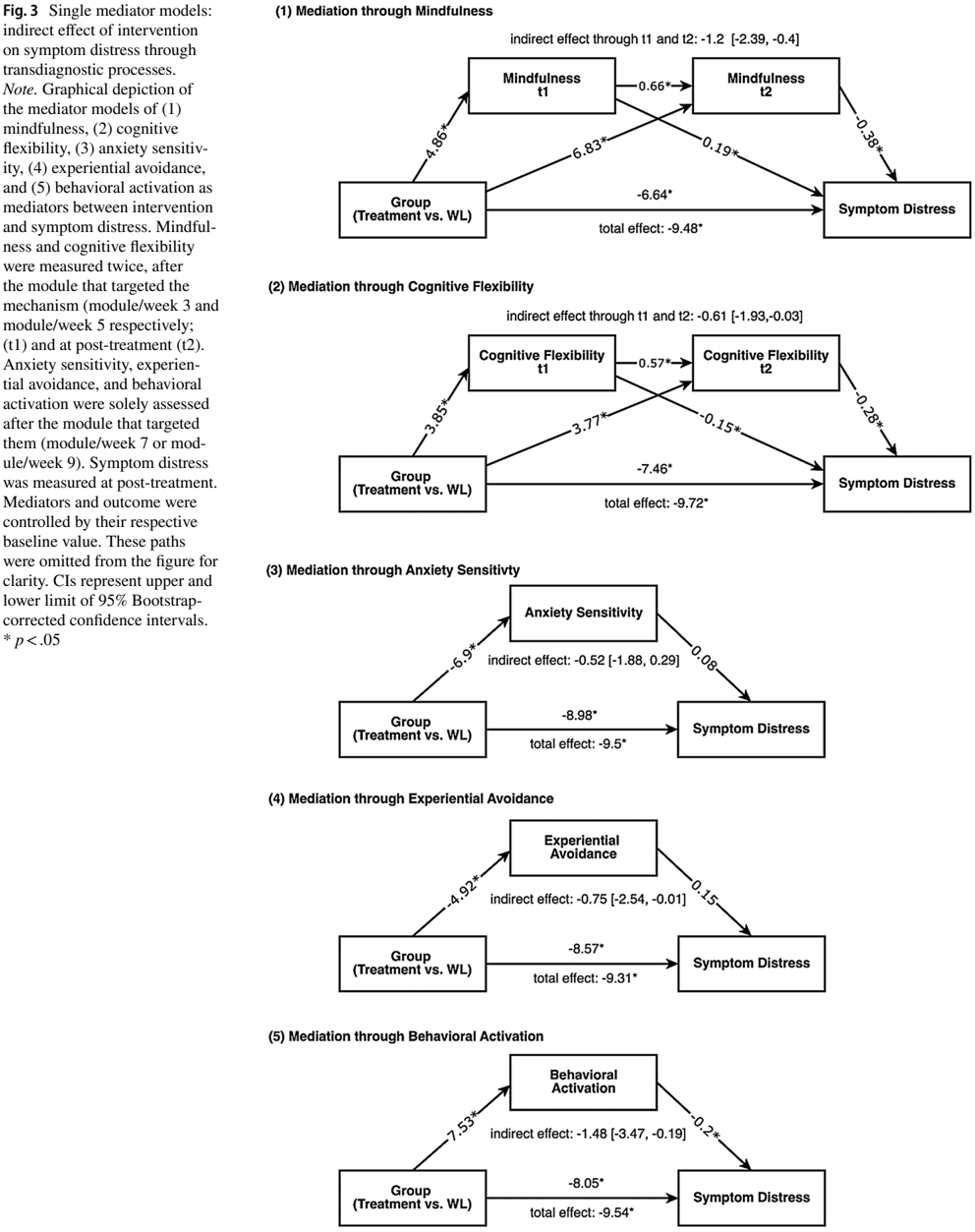
- In separate mediation models, treatment effects were partially mediated by mindfulness, cognitive flexibility, experiential avoidance, and behavioral activation; anxiety sensitivity was not a significant mediator. Reported mediation proportions were PM = .13 (mindfulness), PM = .06 (cognitive flexibility), PM = .09 (experiential avoidance), and PM = .15 (behavioral avoidance).
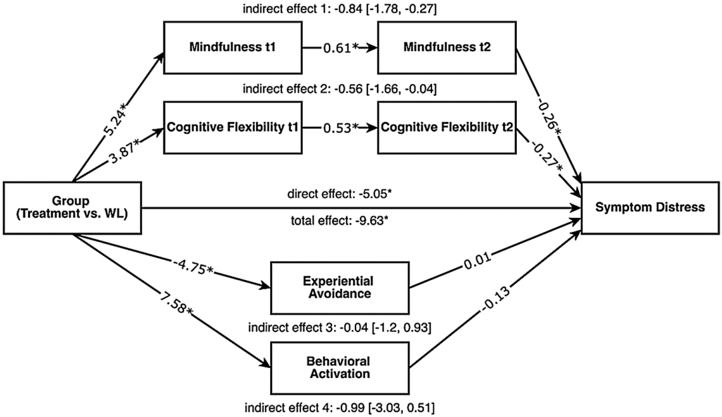
- In the multiple mediator model, only the indirect paths through mindfulness and cognitive flexibility remained significant; the total indirect effect was -4.58, corresponding to PM = .48.
## Methods
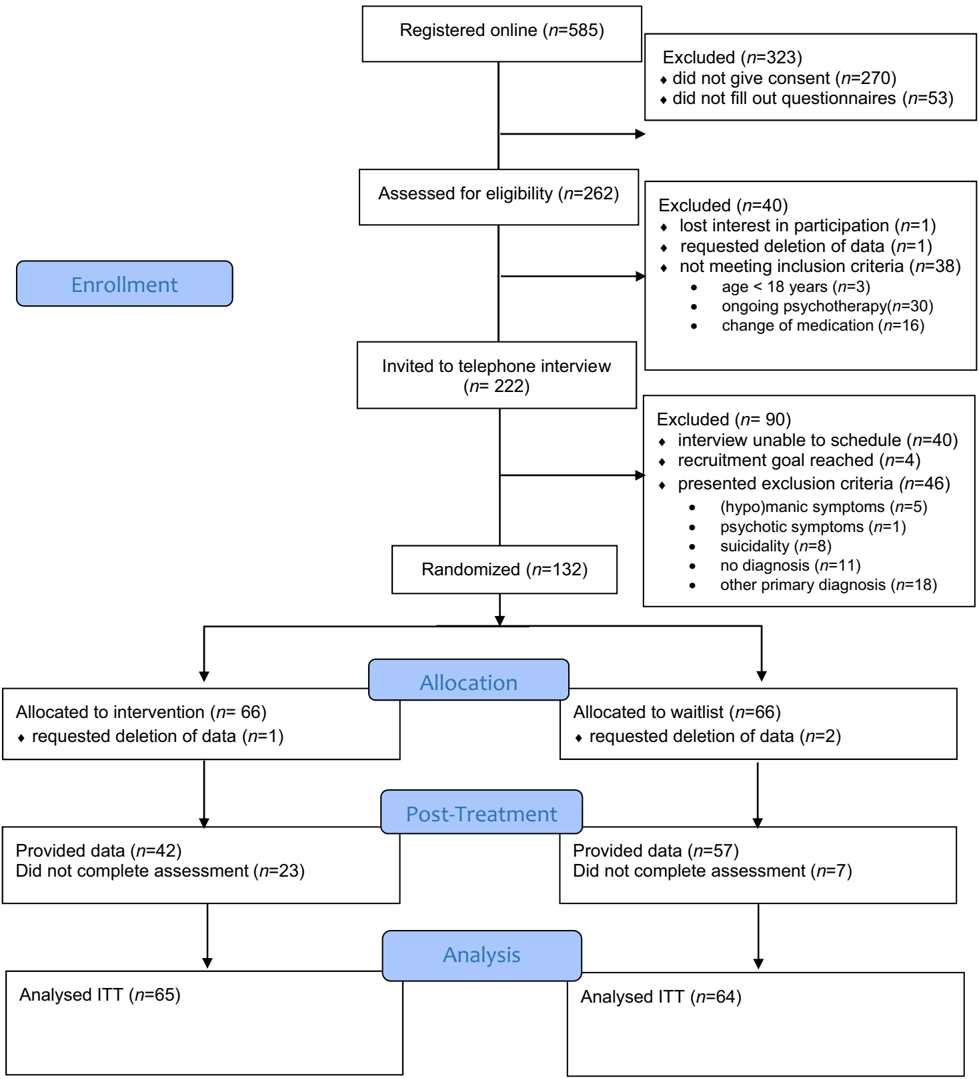
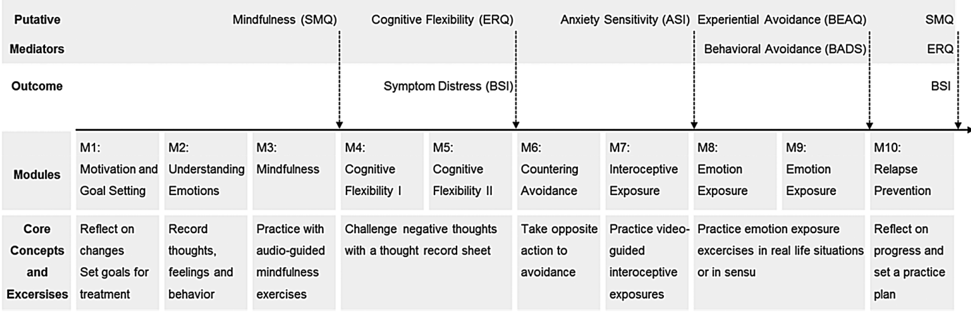
- Randomized controlled trial of an internet-based 10-week adaptation of the Unified Protocol, comparing treatment with a waitlist control in a 1:1 ratio; waitlist participants received access after 10 weeks.
- Participants were 129 adults with a primary diagnosis of anxiety, depressive, or somatic symptom disorder, diagnosed via telephone DSM-5 structured interview (DIPS); exclusions included current psychotherapy, age under 18, recent medication change, acute suicidality, substance use disorder, mania, or psychosis.
- Main analyses used linear mixed-effects models to test change in mediators over time, and path-analytic mediation models with bias-corrected bootstrapping (10,000 draws) and full maximum likelihood estimation in lavaan, controlling for baseline values.
## Limitations
- The paper states that high missingness was a major limitation: technical problems lowered response rates in the waitlist group, and dropout in the intervention meant later-module assessments were available only for participants who progressed that far.
- The authors state that the sample size did not permit mediation analyses in subsamples (for example, responders vs. non-responders), and that dropout limits generalizability.
- The paper explicitly notes that temporal precedence could not be established, so the mediation findings cannot support causal conclusions.
- Evident from the text: the intervention was self-paced and the mean number of modules completed was 7.22, which likely contributed to incomplete measurement of later mediators and may have affected the mediation results.
Model-written summary. Check it against the paper before relying on it.
Integrity signals
Registry
Cites
Statistics
Figures
Verification
Claims the paper makes
8 Valid · 0 Not valid · 20 Not checked · 46 Own results and interpretations
Every source the paper cites for this claim was checked and supports it.
In the paper
“the lack of temporal precedence does not allow to draw any conclusions on causation”
What the sources say
- Supportedcites Kazdin, 2007 matched to “Mediators and Mechanisms of Change in Psychotherapy Research” (2007) source
In “Multiple Criteria” (p. 5), Kazdin states that a timeline must be established to infer a causal relation and that causes must precede their effects. The claim paraphrases this requirement. (LLM, conf=0.93)
plain- Asserted: passes — The authors put it forward as true.
- Checkable: passes — It can be checked against evidence.
- Load-bearing: passes — The paper’s conclusions depend on it.
- Based: passes — The paper gives a reason why it holds.
- Supported
A result the paper reports from its own data — it cites no other source for it, so there is none to check. The quote shows it is in the paper.
In the paper
“In the combined multiple mediator model, the bootstrapped 95% confidence interval of the indirect path through mindfulness and cognitive flexibility (through both time points) did not contain zero: The treatment effect was partially mediated by mindfulness and cognitive flexibility, but not by the other putative processes.”
plainstates a cause- Asserted: passes — The authors put it forward as true.
- Checkable: passes — It can be checked against evidence.
- Load-bearing: passes — The paper’s conclusions depend on it.
- Based: passes — The paper gives a reason why it holds.
A result the paper reports from its own data — it cites no other source for it, so there is none to check. The quote shows it is in the paper.
In the paper
“69% of participants in the treatment group were considered responders (as determined based on the reliable change index (RCI = 1.96)).”
plainn = 129- Asserted: passes — The authors put it forward as true.
- Checkable: passes — It can be checked against evidence.
- Load-bearing: unclear — It is unclear whether the paper’s conclusions depend on it.
- Based: passes — The paper gives a reason why it holds.
A result the paper reports from its own data — it cites no other source for it, so there is none to check. The quote shows it is in the paper.
In the paper
“The indirect effect through anxiety sensitivity was not significant, while the indirect path through experiential avoidance and behavioral activation were.”
plain- Asserted: passes — The authors put it forward as true.
- Checkable: passes — It can be checked against evidence.
- Load-bearing: passes — The paper’s conclusions depend on it.
- Based: passes — The paper gives a reason why it holds.
A result the paper reports from its own data — it cites no other source for it, so there is none to check. The quote shows it is in the paper.
In the paper
“The proportion of responders would shift to a more conservative estimate of 45% if we considered all participants that did not report post-treatment data as non-responders.”
hedgedstates a causen = 129- Asserted: passes — The authors put it forward as true.
- Checkable: passes — It can be checked against evidence.
- Load-bearing: unclear — It is unclear whether the paper’s conclusions depend on it.
- Based: passes — The paper gives a reason why it holds.
22 more claims
Create a free account to see all 74 claims and to verify the 2 references still open.
- Probably not a substantial claim. 26
- It may state two separate claims as one. 33
Claims other papers make about this one
Each is checked against this paper’s own text: does it say what the citing paper says it does?
In the citing paper
“Based on previous work [25], a small to medium effect was assumed. Required sample sizes were 150 patients (75 per group) for betweengroup hypotheses.”
From Psychotherapy for Chronic In- and Outpatients with Common Mental Disorders: The "choose Change" Effectiveness Trial (2023) · cites this paper as [25]
Citations
Cites
Fitting Linear Mixed-Effects Models Using lme4
Bates, D., Mächler, M., Bolker, B., & Walker, S. (2015) · Journal of Statistical Software · doi:10.18637/jss.v067.i01 · Cited by 86,835
Preacher, K. J., & Hayes, A. F. (2008) · Behavior Research Methods · doi:10.3758/brm.40.3.879 · Cited by 34,117
lavaan : An R Package for Structural Equation Modeling
Rosseel, Y. (2012) · Journal of Statistical Software · doi:10.18637/jss.v048.i02 · Cited by 27,955 · cited 1×
“Mediation models were fitted as path analyses with bias-corrected bootstrapping (10,000 draws) and full maximum likelihood estimation to account for missing values using the lavaan package (Rosseel, 2012).”
MethodlmerTest Package: Tests in Linear Mixed Effects Models
Kuznetsova, A., Brockhoff, P. B., & Christensen, R. H. B. (2017) · Journal of Statistical Software · doi:10.18637/jss.v082.i13 · Cited by 24,346
Gross, J. J., & John, O. P. (2003) · Journal of Personality and Social Psychology · doi:10.1037/0022-3514.85.2.348 · Cited by 11,929
Preacher, K. J., & Kelley, K. (2011) · Psychological Methods · doi:10.1037/a0022658 · Cited by 3,060
Mediators and Mechanisms of Change in Psychotherapy Research
Kazdin, A. E. (2007) · Annual Review of Clinical Psychology · doi:10.1146/annurev.clinpsy.3.022806.091432 · Cited by 2,504 · cited 4×
“Another limitation concerns the lack of temporal precedence that has been described as an important prerequisite for causation (Kazdin, 2007).”
BackgroundInfluentialTaylor, S., Zvolensky, M. J., Cox, B. J., Deacon, B., Heimberg, R. G., Ledley, D. R., Abramowitz, J. S., Holaway, R. M., Sandin, B., Stewart, S. H., et al. (2007) · Psychological Assessment · doi:10.1037/1040-3590.19.2.176 · Cited by 1,866
The alliance in adult psychotherapy: A meta-analytic synthesis
Flückiger, C., Del Re, A. C., Wampold, B. E., & Horvath, A. O. (2018) · Psychotherapy · doi:10.1037/pst0000172 · Cited by 1,763
How important are the common factors in psychotherapy? An update
Wampold, B. E. (2015) · World Psychiatry · doi:10.1002/wps.20238 · Cited by 1,728 · cited 1×
“Common factors are active across virtually all therapies and settings, whereas specific factors, as the name suggests, are more treatmentspecific (Cuijpers et al., 2019; Wampold, 2015).”
BackgroundToward a unified treatment for emotional disorders
Barlow, D. H., Allen, L. B., & Choate, M. L. (2004) · Behavior Therapy · doi:10.1016/s0005-7894(04)80036-4 · Cited by 1,430
The Future of Intervention Science: Process-Based Therapy
Hofmann, S. G., & Hayes, S. C. (2019) · Clinical Psychological Science · doi:10.1177/2167702618772296 · Cited by 888
Transdiagnostic approaches to mental health problems: Current status and future directions.
Dalgleish, T., Black, M., Johnston, D., & Bevan, A. (2020) · Journal of Consulting and Clinical Psychology · doi:10.1037/ccp0000482 · Cited by 883
Barlow, D. H., Farchione, T. J., Bullis, J. R., Gallagher, M. W., Murray-Latin, H., Sauer-Zavala, S., Bentley, K. H., Thompson-Hollands, J., Conklin, L. R., Boswell, J. F., et al. (2017) · JAMA Psychiatry · doi:10.1001/jamapsychiatry.2017.2164 · Cited by 853
The Role of Common Factors in Psychotherapy Outcomes
Cuijpers, P., Reijnders, M., & Huibers, M. J. H. (2019) · Annual Review of Clinical Psychology · doi:10.1146/annurev-clinpsy-050718-095424 · Cited by 748
Unified Protocol for Transdiagnostic Treatment of Emotional Disorders: A Randomized Controlled Trial
Farchione, T. J., Fairholme, C. P., Ellard, K. K., Boisseau, C. L., Thompson-Hollands, J., Carl, J. R., Gallagher, M. W., & Barlow, D. H. (2012) · Behavior Therapy · doi:10.1016/j.beth.2012.01.001 · Cited by 746
Derogatis, L. R. (2011) · PsycTESTS Dataset · doi:10.1037/t07502-000 · Cited by 656
Newby, J. M., McKinnon, A., Kuyken, W., Gilbody, S., & Dalgleish, T. (2015) · Clinical Psychology Review · doi:10.1016/j.cpr.2015.06.002 · Cited by 545
Toward a unified treatment for emotional disorders - republished Article
Barlow, D. H., Allen, L. B., & Choate, M. L. (2016) · Behavior Therapy · doi:10.1016/j.beth.2016.11.005 · Cited by 536
Ellard, K. K., Fairholme, C. P., Boisseau, C. L., Farchione, T. J., & Barlow, D. H. (2010) · Cognitive and Behavioral Practice · doi:10.1016/j.cbpra.2009.06.002 · Cited by 523
Chadwick, P., Hember, M., Symes, J., Peters, E., Kuipers, E., & Dagnan, D. (2008) · British Journal of Clinical Psychology · doi:10.1348/014466508x314891 · Cited by 517
Barlow, D. H., Ellard, K. K., Sauer-Zavala, S., Bullis, J. R., & Carl, J. R. (2014) · Perspectives on Psychological Science · doi:10.1177/1745691614544528 · Cited by 491
The brief experiential avoidance questionnaire: Development and initial validation
Gámez, W., Chmielewski, M., Kotov, R., Ruggero, C., Suzuki, N., & Watson, D. (2014) · Psychological Assessment · doi:10.1037/a0034473 · Cited by 450
Therapeutic alliance as a mediator of change: A systematic review and evaluation of research
Baier, A. L., Kline, A. C., & Feeny, N. C. (2020) · Clinical Psychology Review · doi:10.1016/j.cpr.2020.101921 · Cited by 441
Emotion Regulation Questionnaire – Eine deutschsprachige Fassung des ERQ von Gross und John
Abler, B., & Kessler, H. (2009) · Diagnostica · doi:10.1026/0012-1924.55.3.144 · Cited by 434
Current Definitions of “Transdiagnostic” in Treatment Development: A Search for Consensus
Sauer-Zavala, S., Gutner, C. A., Farchione, T. J., Boettcher, H. T., Bullis, J. R., & Barlow, D. H. (2017) · Behavior Therapy · doi:10.1016/j.beth.2016.09.004 · Cited by 371
Sakiris, N., & Berle, D. (2019) · Clinical Psychology Review · doi:10.1016/j.cpr.2019.101751 · Cited by 369
Berger, T. (2017) · Psychotherapy Research · doi:10.1080/10503307.2015.1119908 · Cited by 364 · cited 1×
“Therapeutic alliance and treatment expectancy have also been shown to predict and mediate outcomes in the internet-based setting (Berger, 2017; Boettcher et al., 2013; El Alaoui et al., 2015, 2016; Flückiger et al., 2018; Probst et al., 2019).”
BackgroundMonotonicity of effect sizes: questioning kappa-squared as mediation effect size measure
Wen, Z., & Fan, X. (2015) · Psychological Methods · doi:10.1037/met0000029 · Cited by 350
Păsărelu, C. R., Andersson, G., Bergman Nordgren, L., & Dobrean, A. (2017) · Cognitive Behaviour Therapy · doi:10.1080/16506073.2016.1231219 · Cited by 335
Prinz, U., Nutzinger, D. O., Schulz, H., Petermann, F., Braukhaus, C., & Andreas, S. (2013) · BMC Psychiatry · doi:10.1186/1471-244x-13-104 · Cited by 278
The Behavioral Activation for Depression Scale–Short Form: Development and Validation
Manos, R. C., Kanter, J. W., & Luo, W. (2011) · Behavior Therapy · doi:10.1016/j.beth.2011.04.004 · Cited by 276
Constantino, M. J., Vîslă, A., Coyne, A. E., & Boswell, J. F. (2018) · Psychotherapy · doi:10.1037/pst0000169 · Cited by 257
Anxiety sensitivity and interoceptive exposure: A transdiagnostic construct and change strategy
Boswell, J. F., Farchione, T. J., Sauer-Zavala, S., Murray, H. W., Fortune, M. R., & Barlow, D. H. (2013) · Behavior Therapy · doi:10.1016/j.beth.2013.03.006 · Cited by 232 · cited 1×
“Single case experimental design studies found that mindfulness, cognitive flexibility, and anxiety sensitivity were associated with outcome (Boswell, 2013; Boswell et al., 2014; Brake et al., 2016).”
BackgroundBeyond linear mediation: Toward a dynamic network approach to study treatment processes
Hofmann, S. G., Curtiss, J. E., & Hayes, S. C. (2020) · Clinical Psychology Review · doi:10.1016/j.cpr.2020.101824 · Cited by 232
The processes of cognitive behavioral therapy: A review of meta-analyses
Kazantzis, N., Luong, H. K., Usatoff, A. S., Impala, T., Yew, R. Y., & Hofmann, S. G. (2018) · Cognitive Therapy and Research · doi:10.1007/s10608-018-9920-y · Cited by 218
Bullis, J. R., Boettcher, H., Sauer‐Zavala, S., Farchione, T. J., & Barlow, D. H. (2019) · Clinical Psychology: Science and Practice · doi:10.1111/cpsp.12278 · Cited by 216
Lemmens, L. H. J. M., Müller, V. N. L. S., Arntz, A., & Huibers, M. J. H. (2016) · Clinical Psychology Review · doi:10.1016/j.cpr.2016.09.004 · Cited by 211
Group CBT versus MBSR for social anxiety disorder: A randomized controlled trial.
Goldin, P. R., Morrison, A., Jazaieri, H., Brozovich, F., Heimberg, R., & Gross, J. J. (2016) · Journal of Consulting and Clinical Psychology · doi:10.1037/ccp0000092 · Cited by 202
Cassiello-Robbins, C., Southward, M. W., Tirpak, J. W., & Sauer-Zavala, S. (2020) · Clinical Psychology Review · doi:10.1016/j.cpr.2020.101852 · Cited by 179
Valente, M. J., & MacKinnon, D. P. (2017) · Structural Equation Modeling: A Multidisciplinary Journal · doi:10.1080/10705511.2016.1274657 · Cited by 173
Pearl, S. B., & Norton, P. J. (2017) · Journal of Anxiety Disorders · doi:10.1016/j.janxdis.2016.07.004 · Cited by 156
Open trial of a personalized modular treatment for mood and anxiety
Fisher, A. J., Bosley, H. G., Fernandez, K. C., Reeves, J. W., Soyster, P. D., Diamond, A. E., & Barkin, J. (2019) · Behaviour Research and Therapy · doi:10.1016/j.brat.2019.01.010 · Cited by 156
CBT at the crossroads: the rise of transdiagnostic treatments.
Schaeuffele, C., Schulz, A., Knaevelsrud, C., Renneberg, B., & Boettcher, J. (2021) · International Journal of Cognitive Therapy · doi:10.1007/s41811-020-00095-2 · Cited by 150 · cited 1×
“But since the treatment was self-paced and the mean number of modules completed was M = 7.22 (Schaeuffele et al., 2020), this naturally meant that the assessments after completion of module 7 and 9 were limited to participants who progressed to this stage of treatment.”
BackgroundInfluentialSelf-citationAn idiographic analysis of change processes in the unified transdiagnostic treatment of depression
Boswell, J. F., Anderson, L. M., & Barlow, D. H. (2014) · Journal of Consulting and Clinical Psychology · doi:10.1037/a0037403 · Cited by 138
DIPS Open Access 1.2: Diagnostisches Interview bei psychischen Störungen
Margraf, J., Cwik, J. C., von Brachel, R., Suppiger, A., & Schneider, S. (2021) · RUB (Ruhr University Bochum) · doi:10.46586/rub.172.149 · Cited by 127
Origins and outlook of interoceptive exposure
Boettcher, H., Brake, C. A., & Barlow, D. H. (2016) · Journal of Behavior Therapy and Experimental Psychiatry · doi:10.1016/j.jbtep.2015.10.009 · Cited by 124
Der Einsatz des Brief Symptom Inventory 18 (BSI-18) bei Psychotherapiepatienten
Franke, G. H., Ankerhold, A., Haase, M., Jäger, S., Tögel, C., Ulrich, C., & Frommer, J. (2011) · PPmP - Psychotherapie · Psychosomatik · Medizinische Psychologie · doi:10.1055/s-0030-1270518 · Cited by 120
Domhardt, M., Steubl, L., Boettcher, J., Buntrock, C., Karyotaki, E., Ebert, D. D., Cuijpers, P., & Baumeister, H. (2021) · Clinical Psychology Review · doi:10.1016/j.cpr.2020.101953 · Cited by 106
Self-citationEl Alaoui, S., Ljótsson, B., Hedman, E., Kaldo, V., Andersson, E., Rück, C., Andersson, G., & Lindefors, N. (2015) · PLOS ONE · doi:10.1371/journal.pone.0124258 · Cited by 98
DeRubeis, R. J., Gelfand, L. A., German, R. E., Fournier, J. C., & Forand, N. R. (2014) · Psychotherapy Research · doi:10.1080/10503307.2013.838654 · Cited by 84
Kocovski, N. L., Fleming, J. E., Hawley, L. L., Ho, M.-H. R., & Antony, M. M. (2015) · Behaviour Research and Therapy · doi:10.1016/j.brat.2015.04.005 · Cited by 78
Überprüfung der psychometrischen Qualität der deutschen Version des Angstsensitivitätsindex-3
Kemper, C. J., Ziegler, M., & Taylor, S. (2009) · Diagnostica · doi:10.1026/0012-1924.55.4.223 · Cited by 74
Rozental, A., Andersson, G., & Carlbring, P. (2019) · Frontiers in Psychology · doi:10.3389/fpsyg.2019.00589 · Cited by 74
Eustis, E. H., Hayes-Skelton, S. A., Roemer, L., & Orsillo, S. M. (2016) · Behaviour Research and Therapy · doi:10.1016/j.brat.2016.09.012 · Cited by 70
Spinhoven, P., van Hemert, A. M., & Penninx, B. W. J. H. (2017) · Cognitive Therapy and Research · doi:10.1007/s10608-017-9856-7 · Cited by 68
Sauer-Zavala, S., Cassiello-Robbins, C., Ametaj, A. A., Wilner, J. G., & Pagan, D. (2019) · Behavior Modification · doi:10.1177/0145445518774914 · Cited by 67
Eustis, E. H., Cardona, N., Nauphal, M., Sauer-Zavala, S., Rosellini, A. J., Farchione, T. J., & Barlow, D. H. (2020) · Cognitive Therapy and Research · doi:10.1007/s10608-019-10063-6 · Cited by 65
Fuhr, K., Hautzinger, M., Krisch, K., Berking, M., & Ebert, D. D. (2016) · Comprehensive Psychiatry · doi:10.1016/j.comppsych.2016.02.004 · Cited by 64
Bullis, J. R., Boettcher, H., Sauer‐Zavala, S., Farchione, T. J., & Barlow, D. H. (2019) · Clinical Psychology: Science and Practice · doi:10.1037/h0101755 · Cited by 61
Southward, M. W., Sauer-Zavala, S., & Cheavens, J. S. (2021) · Clinical Psychology: Science and Practice · doi:10.1037/cps0000003 · Cited by 60
Alex Brake, C., Sauer-Zavala, S., Boswell, J. F., Gallagher, M. W., Farchione, T. J., & Barlow, D. H. (2016) · Behavior Therapy · doi:10.1016/j.beth.2015.10.008 · Cited by 58
Sauer-Zavala, S., Cassiello-Robbins, C., Conklin, L. R., Bullis, J. R., Thompson-Hollands, J., & Kennedy, K. A. (2017) · Behavior Modification · doi:10.1177/0145445516673827 · Cited by 54
Probst, G. H., Berger, T., & Flückiger, C. (2022) · Verhaltenstherapie · doi:10.1159/000503432 · Cited by 54
El Alaoui, S., Ljótsson, B., Hedman, E., Svanborg, C., Kaldo, V., & Lindefors, N. (2016) · PLOS ONE · doi:10.1371/journal.pone.0161191 · Cited by 51
Patient Expectations in Internet-Based Self-Help for Social Anxiety
Boettcher, J., Renneberg, B., & Berger, T. (2013) · Cognitive Behaviour Therapy · doi:10.1080/16506073.2012.759615 · Cited by 47
Self-citationIntervention strategies and clinical process in transdiagnostic cognitive–behavioral therapy.
Boswell, J. F. (2013) · Psychotherapy · doi:10.1037/a0032157 · Cited by 33 · cited 1×
“Single case experimental design studies found that mindfulness, cognitive flexibility, and anxiety sensitivity were associated with outcome (Boswell, 2013; Boswell et al., 2014; Brake et al., 2016).”
BackgroundMansell, W., & McEvoy, P. M. (2017) · Journal of Anxiety Disorders · doi:10.1016/j.janxdis.2016.06.008 · Cited by 30
Psychometric Properties of the German Brief Experiential Avoidance Questionnaire (BEAQ)
Schaeuffele, C., Knaevelsrud, C., Renneberg, B., & Boettcher, J. (2022) · Assessment · doi:10.1177/10731911211010955 · Cited by 25
Self-citationWoods, B. K., Sauer-Zavala, S. E., Farchione, T. J., & Barlow, D. H. (2020) · Behavior Therapy · doi:10.1016/j.beth.2020.01.001 · Cited by 22
Southward, M. W., Sauer-Zavala, S., & Cheavens, J. (2020) · doi:10.31234/osf.io/7w3ed · Cited by 21
Validation of the German Version of the Southampton Mindfulness Questionnaire (SMQ)
Böge, K., Schaeuffele, C., Jacobsen, P., Chadwick, P., Ergen, E., Hahne, I., Bergmann, N., Boettcher, J., Wingenfeld, K., Bajbouj, M., et al. (2020) · Mindfulness · doi:10.1007/s12671-020-01447-x · Cited by 20
Self-citationCurreri, A. J., Farchione, T. J., Sauer-Zavala, S., & Barlow, D. H. (2022) · Behavior Modification · doi:10.1177/0145445520947662 · Cited by 15
Schaeuffele, C., Homeyer, S. L., Perea, L., Scharf, L., Schulz, A., Knaevelsrud, C., Renneberg, B., & Boettcher, J. (2020) · doi:10.31234/osf.io/528tw · Cited by 9
Self-citationThe Unified Protocol for Major Depressive Disorder
Boswell, J. F., Conklin, L. R., Oswald, J. M., & Bugatti, M. (2017) · Oxford University Press eBooks · doi:10.1093/med-psych/9780190255541.003.0005 · Cited by 4
Research works printed but not linked: 2
- Berger, T. (2017). The therapeutic alliance in internet interventions: A narrative review and suggestions for future research.
- Derogatis, L. R. (2000). BSI-18: Brief Symptom Inventory 18-Administration, scoring, and procedures manual . NCS Pearson.
Cited by
The role of emotion regulation in the characterization, development and treatment of psychopathology
Lincoln, T. M., Schulze, L., & Renneberg, B. (2022) · Nature Reviews Psychology · doi:10.1038/s44159-022-00040-4 · Cited by 234
Self-citationSchaeuffele, C., Homeyer, S., Perea, L., Scharf, L., Schulz, A., Knaevelsrud, C., Renneberg, B., & Boettcher, J. (2022) · PLOS ONE · doi:10.1371/journal.pone.0270178 · Cited by 35
“Since this present study, which focuses on establishing efficacy, and a previously published study, which focuses on underlying mechanisms of change [28], are based on the same sample, the descriptive characteristics of both studies are identical.”
BackgroundMethodResultInfluentialSelf-citationGloster, A. T., Haller, E., Villanueva, J., Block, V., Benoy, C., Meyer, A. H., Brogli, S., Kuhweide, V., Karekla, M., Bader, K., et al. (2023) · Psychotherapy and Psychosomatics · doi:10.1159/000529411 · Cited by 16
Screening tools assessing mental illness in primary care: A systematic review
Neulinger, B., Ebert, C., Lochbühler, K., Bergmann, A., Gensichen, J., & Lukaschek, K. (2024) · European Journal of General Practice · doi:10.1080/13814788.2024.2418299 · Cited by 30
“…additional area for further research. there is a growing number of transdiagnostic factors [22], many of which overlap in their conceptualisation [62]. thus, index tests screening for the spectrum of mood, anxiety and stress-related disorders and those targeting transdiagnostic factors should…”
BackgroundKaçar‐Başaran, S., Gökdağ, C., & Yıldırım, Z. E. (2022) · Yaşam Becerileri Psikoloji Dergisi · doi:10.31461/ybpd.1110174 · Cited by 20
Metadata
- Authors
- Schaeuffele, C., Bär, J., Buengener, I., Grafiadeli, R., Heuthaler, E., Strieder, J., Ziehn, P., Knaevelsrud, C., Renneberg, B., & Boettcher, J.
- Affiliations
- Freie Universität Berlin (DE)
- Psychologische Hochschule Berlin (DE)
- Corresponding author
- Schaeuffele, Carmen
- ORCID
- Venue
- Cognitive Therapy and Research
- Published
- 2021-10-31
- Volume
- 46
- Issue
- 2
- Pages
- 273-286
- ISSN
- 0147-5916 (ISSN-L)
- 1573-2819
- OpenAlex
- W3164764766
- Semantic Scholar
- 984e3a1e769e4a6ee34adf3fc05288fbd21c2ec3
- Cited by
- 24
- References
- 72
- Citations by year
- 2026: 4 · 2025: 4 · 2024: 8 · 2023: 4 · 2022: 4
- FWCI
- 3.87
- Type
- journal article
- Language
- en
- Open access
- hybrid
- doi.org
- Licence
- cc-by
- creativecommons.org/licenses/by/4.0 (tdm)
- creativecommons.org/licenses/by/4.0 (vor)
- Locations
- Cognitive Therapy and Research (publishedVersion, cc-by)
- Informationszentrum Lebenswissenschaften (ZB MED) (submittedVersion, cc-by)
- Refubium (Universitätsbibliothek der Freien Universität Berlin) (submittedVersion, cc-by)
- Universitätsbibliothek der FU Berlin Hochschulschriftenstelle u. Dokumentenserver (cc-by)
- Funders
- Freie Universität Berlin
- Topics
- Social Sciences › Psychology › Experimental and Cognitive Psychology › Anxiety, Depression, Psychometrics, Treatment, Cognitive Processes
- Social Sciences › Psychology › Applied Psychology › Digital Mental Health Interventions
- Social Sciences › Psychology › Clinical Psychology › Mindfulness and Compassion Interventions
- Keywords
- transdiagnostic mechanisms, Unified Protocol, online intervention, mindfulness, cognitive flexibility, behavioral activation, experiential avoidance, anxiety disorders, depression, somatic symptom disorder, emotional awareness, anxiety sensitivity
About these checks
Registry, retraction, Cites and statistics results are computed, not judged, with one exception: a printed reference that no index lists is read once by a model before it counts as a citation error. Claims are extracted by a model and kept only when their quote appears verbatim in the text; each cited source is then checked, with a model’s help, for whether it says what the claim relies on. Those verdicts can be wrong — read the claim’s quote and the cited source before relying on one.
The claim verdicts this report counts are experimental: their accuracy is not yet measured.
A language model drew the claims from the paper on 2026-10-11, under version 3 of the claim definition (model deepseek-v4.1-flash, prompt extract-v3).
A second model labelled each claim on 2026-10-11 (model jev-1.13-20260917, definition revision gold-guideline-v0.2).
Cited sources are checked with a language model’s help (gpt-6-sol).
Statistics and arithmetic are recomputed, not judged.
Confidence bands are shown only for fields calibrated on our annotated test set. None is calibrated yet, so no band is shown.
What counts as a claim ›How we measure confidence ›How we check this ›
Are you an author, or do you see a problem with this page? Request a review
Data sources
Bibliographic data: Semantic Scholar, OpenAlex, Crossref.
Contains information from the Semantic Scholar Academic Graph Datasets, made available under the ODC Attribution License (ODC-BY 1.0).
Semantic Scholar’s data is described in: Kinney, R., et al. (2023). The Semantic Scholar Open Data Platform. arXiv:2301.10140.
