

The DOI matches its Crossref record; 116 of the 116 references it cites were found in a registry or an index.
Extending the technology acceptance model (TAM) to predict university students’ intentions to use metaverse-based learning platforms
Open accessAbstract
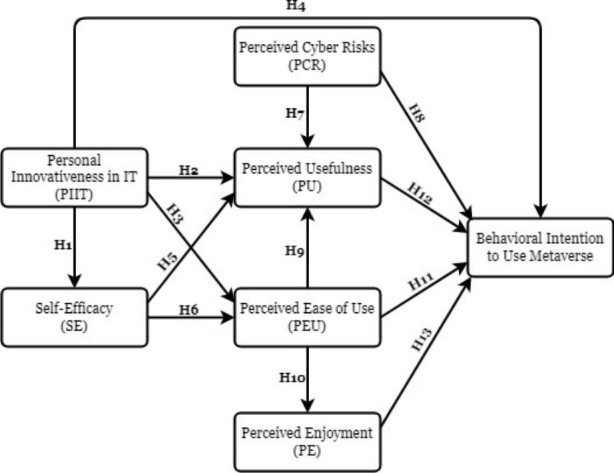
Metaverse, which combines a number of information technologies, is the Internet of the future. A media for immersive learning, metaverse could set future educational trends and lead to significant reform in education. Although the metaverse has the potential to improve the effectiveness of online learning experiences, metaverse-based educational implementations are still in their infancy. Additionally, what factors impact higher education students' adoption of the educational metaverse remains unclear. Consequently, the aim of this study is to explore the main factors that affect higher education students' behavioral intentions to adopt metaverse technology for education. This study has proposed an extended Technology Acceptance Model (TAM) to achieve this aim. The novelty of this study resides in its conceptual model, which incorporates both technological, personal, and inhibiting/enabling factors. The empirical data were collected via online questionnaires from 574 students in both private and public universities in Jordan. Based on the PLS-SEM analysis, the study identifies perceived usefulness, personal innovativeness in IT, and perceived enjoyment as key enablers of students' behavioral intentions to adopt the metaverse. Additionally, perceived cyber risk is found as the main inhibitor of students' metaverse adoption intentions. Surprisingly, the effect of perceived ease of use on metaverse adoption intentions is found to be insignificant. Furthermore, it is found that self-efficacy, personal innovativeness, and perceived cyber risk are the main determinants of perceived usefulness and perceived ease of use. While the findings of this study contribute to the extension of the TAM model, the practical value of these findings is significant since they will help educational authorities understand each factor's role and enable them to plan their future strategies.
Overview
The claims and statistics of this paper haven’t been checked yet.
Run the check — free, no account needed. It reads the open-access text and checks the sources it cites.
Integrity signals
Registry
Cites
Statistics
Figures
Verification
Claims the paper makes
The claims and statistics of this paper haven’t been checked yet.
Run the check — free, no account needed. It reads the open-access text and checks the sources it cites.
Claims other papers make about this one
Each is checked against this paper’s own text: does it say what the citing paper says it does?
The source backs part of the claim, not all of it — or backs it for a different population, condition or comparison.
In the citing paper
“They also aligned with evidence from mobile learning research showing that positive attitudes can strengthen students’ intention to use new technologies [91].”
From Advancing Undergraduate Student Mental Healthcare of Social Anxiety Disorder: Evaluating the Acceptance of AR-Assisted Cognitive Behavioral Therapy Through TAM-Based Constructs. (2026) · cites this paper as [91]
Experimental — accuracy not yet measured
Self-check
Percentages, sums and reported differences re-computed from the paper’s own numbers.
The self-check needs the paper’s full text.
Citations
Cites
Evaluating Structural Equation Models with Unobservable Variables and Measurement Error
Fornell, C., & Larcker, D. F. (1981) · Journal of Marketing Research · doi:10.2307/3151312 · Cited by 109,314
Evaluating structural equation models with unobservable variables and measurement error
Fornell, C., & Larcker, D. F. (1981) · Journal of Marketing Research · doi:10.1177/002224378101800104 · Cited by 109,190 · cited 1×
“As demonstrated in Table 4, this condition is met, concluding that discriminant validity is present (Fornell & Larcker, 1981 ).”
BackgroundThe theory of planned behavior
Ajzen, I. (1991) · Organizational Behavior and Human Decision Processes · doi:10.1016/0749-5978(91)90020-t · Cited by 90,587 · cited 1×
“According to Ajzen (1991), SE designates the confidence that one possesses in one’s capability to engage in a specific behavior.”
MethodPodsakoff, P. M., MacKenzie, S. B., Lee, J.-Y., & Podsakoff, N. P. (2003) · Journal of Applied Psychology · doi:10.1037/0021-9010.88.5.879 · Cited by 82,194 · cited 1×
“The finding showed that the loading of all measurement items in the dataset at once yielded a total variation of 44.678%, which is below the 50% threshold, indicating that CMB is absent (Podsakoff et al., 2003 ).”
BackgroundInfluentialStructural equation modeling in practice: A review and recommended two-step approach
Anderson, J. C., & Gerbing, D. W. (1988) · Psychological Bulletin · doi:10.1037/0033-2909.103.3.411 · Cited by 41,941 · cited 1×
“As instructed, we conducted the data analysis in two steps (Anderson & Gerbing, 1988 ).”
MethodA new criterion for assessing discriminant validity in variance-based structural equation modeling
Henseler, J., Ringle, C. M., & Sarstedt, M. (2015) · Journal of the Academy of Marketing Science · doi:10.1007/s11747-014-0403-8 · Cited by 38,459 · cited 1×
“Moreover, the result of the “Heterotrait–Mono - trait Ratio-HTMT” test indicates that all HTMT values < 0.85 (Henseler et al., 2015), endorsing the findings in terms of Fornell and Larcker’s criterion.”
ResultInfluentialWhen to Use and How to Report the Results of PLS-SEM
Hair, J. F., Risher, J. J., Sarstedt, M., & Ringle, C. M. (2019) · European Business Review · doi:10.1108/ebr-11-2018-0203 · Cited by 27,541 · cited 5×
“The outcomes showed that each construct in the research model acquired an accept - able Cronbech’s Alpha ( > 0.7) (Hair et al., 2019).”
BackgroundMethodResultInfluentialUser Acceptance of Computer Technology: A Comparison of Two Theoretical Models
Davis, F. D., Bagozzi, R. P., & Warshaw, P. R. (1989) · Management Science · doi:10.1287/mnsc.35.8.982 · Cited by 25,709 · cited 3×
“PU describes the extent to which individuals perceive that the usage of a specific technology enhances their performance (Davis et al., 1989).”
BackgroundInfluentialValente, T. W. (2003) · Genetics in Medicine · doi:10.1097/01.gim.0000061743.67794.c4 · Cited by 20,559
Venkatesh, V., Thong, J. Y. L., & Xu, X. (2012) · MIS Quarterly · doi:10.2307/41410412 · Cited by 15,756 · cited 1×
“Intrinsic motivation underpins the enjoyment concept (Abdullah & Ward, 2016), and is considered a hedonic motivation conceptualization (Venkatesh et al., 2012 ).”
Background
Research works printed but not linked: 5
- Bada, S. O., & Olusegun, S. (2015). Constructivism learning theory: A paradigm for teaching and learning. Journal of Research & Method in Education, 5(6), 66–70. https://doi.org/10.9790/7388-05616670 · DOI
- Kim, J. H., Lee, B. S., & Choi, S. J. (2022). A study on metaverse construction and use cases for non-face-to-face education. The Journal of the Convergence on Culture Technology, 8(1), 483–497. https://doi.org/10.17703/JCCT.2022.8.1.483 · DOI
- Lee, J., Kim, J., & Choi, J. Y. (2019b). The adoption of virtual reality devices: The technology acceptance model integrating enjoyment, social interaction, and strength of the social ties. Telematics and Informatics, 39, 37–48. https://doi.org/10.1016/j.tele.2018.12.006. · DOI · Paper page
- Mikusa, M. E. (2015). The effect of technology self-efficacy and personal engagement on students’ and teachers’ attitudes toward technology use in education (Doctoral dissertation). Appalachian State University.
- Saleh, S. S., Nat, M., & Aqel, M. (2022b). Sustainable adoption of E-Learning from the TAM Perspective. Sustainability, 14(6), 3690. https://doi.org/10.3390/su14063690. · DOI
Cited by
Sorted by citations
Items 101–200 of 637
Investigating autonomous vehicle acceptance among young adults in China
Pan, Z., & Zheng, H. (2025) · Transportation Research Part F: Traffic Psychology and Behaviour · doi:10.1016/j.trf.2025.103331 · Cited by 13
Tarhini, A., AlHinai, M., Al-Busaidi, A. S., Govindaluri, S. M., & Shaqsi, J. A. (2024) · International Journal of Information Management Data Insights · doi:10.1016/j.jjimei.2024.100235 · Cited by 15
Exploring the brand experience in the metaverse under the perspective of technology acceptance model
Yu, X., Cheng, X., Kim, K. H., & Wang, H. (2024) · Asia Pacific Journal of Marketing and Logistics · doi:10.1108/apjml-10-2023-0952 · Cited by 20
The future of human experience: the drivers of user adoption of the metaverse
Pragha, P., Dhalmahapatra, K., & Natarajan, T. (2025) · Online Information Review · doi:10.1108/oir-09-2023-0449 · Cited by 20
Sasongko, A. T., Ekhsan, M., & Fatchan, M. (2025) · Telematics and Informatics Reports · doi:10.1016/j.teler.2025.100192 · Cited by 28
Asif, M., & Fazel, H. (2024) · Global Knowledge, Memory and Communication · doi:10.1108/gkmc-12-2023-0482 · Cited by 14
Chang, Y., Wang, Y.-Y., & Tsai, H.-J. (2024) · Sustainability · doi:10.3390/su16146264 · Cited by 14
Das, T., Kondamudi, S. G., Babakerkhell, M. D., Pal, D., Roy, R., & Funilkul, S. (2024) · Cogent Business & Management · doi:10.1080/23311975.2024.2380016 · Cited by 18
“PeoU (Purohit & arora, 2021), PU (Purohit & arora, 2021), and trU (ali et al., 2023) are technology acceptance variables. att(al-adwan et al., 2023), sn (İbili et al., 2023), and PBc (Bornschlegl et al., 2021) are behavioural variables.”
InfluentialWang, Y.-Y. (2024) · Education and Information Technologies · doi:10.1007/s10639-024-13199-5 · Cited by 17
“Moreover, self-efficacy is positively associated with the perceived usefulness of metaverse-based learning platforms (Al-Adwan et al., 2023).”
Singh, R. S., Rafat, A., & Srivastava, S. (2024) · Journal of Science and Technology Policy Management · doi:10.1108/jstpm-12-2023-0240 · Cited by 14
Aideed, H., Salem, I. E., Magdy, A., AlAmri, T. K., Alzubaidi, A. S., & Elbaz, A. M. (2025) · The International Journal of Management Education · doi:10.1016/j.ijme.2025.101169 · Cited by 14
Ding, N., Chen, M., & Hu, L. (2025) · Scientific Reports · doi:10.1038/s41598-025-02926-8 · Cited by 17
“Recent studies have incorporated PR into the TAM framework 6,65,66 , demonstrating its effectiveness and reliability in boosting TAM’s explanatory power.”
Karimian, Z., Momeni, M., & Zarifsanaiey, N. (2025) · BMC Medical Education · doi:10.1186/s12909-025-07523-x · Cited by 13
Alwakid, W. N., Dahri, N. A., Humayun, M., & Alwakid, G. N. (2025) · The International Journal of Management Education · doi:10.1016/j.ijme.2025.101252 · Cited by 18
Academics’ continuance intention to use learning technologies during COVID-19 and beyond
Vasuthevan, K., Vaithilingam, S., & Ng, J. W. J. (2024) · PLoS ONE · doi:10.1371/journal.pone.0295746 · Cited by 13
Mahmoud, A. B. (2024) · British Educational Research Journal · doi:10.1002/berj.4026 · Cited by 16
Utami, I. Q., Hwang, W., & Hariyanti, U. (2024) · Journal of Educational Computing Research · doi:10.1177/07356331241249225 · Cited by 13
“The TAM constructs have been con fi rmed to be reliable and valid in several replications and applications of technologies (Al-Adwan et al., 2023).”
Guo, M. (2024) · SAGE Open · doi:10.1177/21582440241280793 · Cited by 13
“For instance, Al-Adwan et al. (2021) combined the Information System Success Model (ISSM) and the Technology Acceptance Model (TAM) to construct an extended model to study the factors influencing the CI of 537 college students toward e-learning.”
InfluentialWang, J. (2024) · International Journal of Human-Computer Interaction · doi:10.1080/10447318.2024.2430427 · Cited by 13
“Additionally, teacher and student technical acceptance presents another hurdle (Al-Adwan et al., 2023; Wu & Yu, 2023).”
He, T.-L., Zhang, C., Huang, Z.-Q., & Qin, F. (2024) · Thinking Skills and Creativity · doi:10.1016/j.tsc.2024.101723 · Cited by 13
Ninsiima, R., Mshenga, P. M., & Okello, D. (2025) · Frontiers in Sustainable Food Systems · doi:10.3389/fsufs.2025.1552637 · Cited by 17
Wang, G., Jafar, R. M. S., Hussain, S., Jabeen, M., & Al‐Adwan, A. S. (2026) · Acta Psychologica · doi:10.1016/j.actpsy.2026.106648 · Cited by 16
Taha, S., Abulibdeh, E. S. A., Qunais, J., Skaik, H. A., Alghazo, E. M., Daoud, S., & Bouzenoun, A. (2023) · Emerging Science Journal · doi:10.28991/esj-2023-sied2-016 · Cited by 12
“On the other hand, Al-Adwan et al. (2023) [44] stated that if they perceive AR as being difficult to use or not useful, they may be less likely to use it.”
BackgroundXiao, W., Wang, M., & Mo, J. (2024) · Frontiers in Psychology · doi:10.3389/fpsyg.2023.1293879 · Cited by 15
The Mediating Role of Learning Management System Use in Enhancing System Effectiveness
Hussein, L. A., Alqarni, K., Hilmi, M. F., Agina, M. F., Shirawia, N. H., Abdelreheem, K. I., Hassan, T. H., & Tashtoush, M. A. (2024) · WSEAS TRANSACTIONS ON BUSINESS AND ECONOMICS · doi:10.37394/23207.2024.21.169 · Cited by 20
Şahin, F., Şahin, Y. L., & Okur, M. R. (2024) · Journal of Computing in Higher Education · doi:10.1007/s12528-024-09419-z · Cited by 12
“Furthermore, this choice is consistent with popular acceptance models like TAM3 and UTAUT, as well as numerous TAM-based models tested in educational contexts (e.g. Al-Adwan et al., 2023; Duong et al., 2023; Lai et al., 2023; Şahin & Yıldız, 2024).”
Cognitive and cultural factors in metaverse acceptance: A TAM-based meta-analysis.
Sharma, L., Kaushık, N., Maggon, M., & Sivathanu, B. (2025) · Acta Psychologica · doi:10.1016/j.actpsy.2025.104855 · Cited by 18
Advancing conceptual understanding of technology adoption decisions in E-waste urban mining sector
Kankanamge, A. K. S. U., Erdiaw‐Kwasie, M. O., & Abunyewah, M. (2025) · Sustainable Futures · doi:10.1016/j.sftr.2025.100871 · Cited by 12
Nurses’ Intention to Integrate AI Into Their Practice: Survey Study in Canada
Paré, G., Raymond, L., & Sosso, F. A. E. (2025) · JMIR Nursing · doi:10.2196/76795 · Cited by 17
“Additionally, informed by prior studies on digital health training [13,30] and recent applications of the TAM in health care contexts [31,32], we incorporate a fourth construct— individual background—into our research model.”
Xiang, Y., Yang, C., Jin, Z., & Zhao, W. (2025) · PLoS ONE · doi:10.1371/journal.pone.0324875 · Cited by 16
“…adopting generative AI could influence their choice of willingness to adopt generative AI by influencing teachers’ outcome expectations of adopting generative AI and then influencing their choice of willing to adopt generative AI, which supports H2, which is in line with previous studies [65,66].”
Bhat, M. A., Tiwari, C. K., Bhaskar, P., & Khan, S. T. (2025) · Interactive Technology and Smart Education · doi:10.1108/itse-02-2025-0039 · Cited by 11
Zhang, N., Wong, W. L., & Barrot, J. S. (2025) · Scientific Reports · doi:10.1038/s41598-025-21205-0 · Cited by 19
“They enhance its explanatory power 29 .”
Hsu, H., & Lin, C. (2024) · Journal of Computer Assisted Learning · doi:10.1111/jcal.12969 · Cited by 18
Zhang, Q. (2024) · International Journal of Educational Technology in Higher Education · doi:10.1186/s41239-024-00484-z · Cited by 13
“…and self-directed activities, fulfilling the crucial premises of effective learning, goal attainment, and performance enhancement (Abu-Salih, 2022; Al-Adwan et al., 2023; Almarzouqi et al., 2022; AlSal-eem, 2023; Aparicio et al., 2021; Dayoub, 2022; Díaz et al., 2020; İbi ̇ li ̇ et al., 2024;…”
BackgroundInfluentialHussain, F., & Anwar, M. A. (2024) · Journal of Asian Public Policy · doi:10.1080/17516234.2024.2422917 · Cited by 12
“In the literature, the technology acceptance model (TAP) is widely used to accept technology in education (Al-Adwan et al., 2023; Lin & Yu, 2023; Na et al., 2022).”
Maldonado-López, B., Chaves, P. L., & Gil‐Cordero, E. (2024) · Journal of International Education in Business · doi:10.1108/jieb-07-2024-0085 · Cited by 11
Bassiouni, D. H., & Meshreki, H. (2024) · Journal of Consumer Behaviour · doi:10.1002/cb.2443 · Cited by 11
Himanshu, Aggarwal, R., Gupta, S., Dhingra, S., & Kumar, A. (2025) · Current Issues in Tourism · doi:10.1080/13683500.2025.2475491 · Cited by 12
“Al-Adwan et al. (2023) proposed an extended Technology Acceptance Model, which integrates inhibiting, personal, and technological factors to examine students’ intention to adopt metaverse for education.”
Oh, H., Ahn, H., & Park, E. (2025) · Behaviour and Information Technology · doi:10.1080/0144929x.2025.2486583 · Cited by 12
Wang, T., & Long, Y. (2025) · Acta Psychologica · doi:10.1016/j.actpsy.2025.105904 · Cited by 11
Park, S., & Yun, H. (2023) · Educational Technology Research and Development · doi:10.1007/s11423-023-10298-x · Cited by 13
“According to TAM (Davis et al., 1989), PEU is defined as the degree to which an indi‑ vidual believes that using a particular system will be free of physical and mental effort.”
InfluentialMata, M. N., Haider, S. A., Dantas, R. M., Rita, J. X., & Lucas, J. L. (2024) · Studies in Higher Education · doi:10.1080/03075079.2024.2357717 · Cited by 10
“A substantial body of research has demonstrated that it increases the recommendations of information technology users (Al-Adwan et al. 2023).”
Goosen, W., & Mugumo, P. V. (2024) · International Conference on Medical Imaging, Electronic Imaging, Information Technologies, and Sensors (MIEITS) · doi:10.1117/12.3030740 · Cited by 10
“The Technology Acceptance Model (TAM) provides insights into faculty and student acceptance and adoption of AI technologies [18].”
Yap, K. Y., Ho, J., & Toh, P. S. T. (2024) · Information · doi:10.3390/info15080431 · Cited by 10
Perceived Usefulness of a Mandatory Information System
Fridkin, S., Greenstein, G., Cohen, A., & Damari, A. (2024) · Applied Sciences · doi:10.3390/app14167413 · Cited by 18
Panda, G., Arora, M., Ghosal, I., Garza‐Reyes, J. A., & Kaswan, M. S. (2024) · The TQM Journal · doi:10.1108/tqm-08-2024-0279 · Cited by 12
Yang, H., Zhang, Z., Chen, J., & Ahmad, N. (2025) · PLoS ONE · doi:10.1371/journal.pone.0317993 · Cited by 13
Hernández-Tamurejo, Á., Fernández-Fernández, M., & González-Padilla, P. (2025) · European Journal of Innovation Management · doi:10.1108/ejim-07-2024-0811 · Cited by 14
Aslam, J., Saleem, A., Lai, K., & Kim, Y. B. (2025) · Technological Forecasting and Social Change · doi:10.1016/j.techfore.2025.124041 · Cited by 10
Zhang, Y., Kong, M., Wei, W., Deveci, M., Bilican, M. S., & Delen, D. (2025) · Expert Systems with Applications · doi:10.1016/j.eswa.2025.129132 · Cited by 14
Roy, R., Rao, G. A., Pal, D., Anuradha, S., & Mukherjee, S. (2025) · Sustainable Futures · doi:10.1016/j.sftr.2025.101091 · Cited by 10
Phạm, M., Nguyen, P. X. T., & Trinh, N. N. (2025) · Discover Education · doi:10.1007/s44217-025-00800-3 · Cited by 12
“Therefore, this study not only adds the emotional dimension to technology use behavior models but also emphasizes that the integration of emotions needs to be flexible and contextualized [10, 85].”
Addai, P. (2025) · International Journal of Public Leadership · doi:10.1108/ijpl-04-2025-0073 · Cited by 10
Barakat, M. M., Salim, N. A., & Sallam, M. (2024) · Research Square · doi:10.21203/rs.3.rs-3919524/v1 · Cited by 10
The Multidomain Metaverse Cancer Care Digital Platform: Development and Usability Study
Kim, S., Jung, T., Sohn, D., Chae, Y., Kim, Y. A., Kang, S., Park, Y., & Chang, Y. (2023) · JMIR Serious Games · doi:10.2196/46242 · Cited by 6
“The findings of existing studies have confirmed that TAM-based factors such as perceived usefulness, perceived ease of use, and intention to use are closely associated with the use of metaverse [27-29].”
BackgroundEmbracing the new reality: Gen Y’s intention to use metaverse apps and devices
Zhang, J.-L., Quoquab, F., & Mohammad, J. (2024) · Current Psychology · doi:10.1007/s12144-024-07160-5 · Cited by 9
“…studies have successfully applied TAM to analyze VR technology adoption in various domains such as tourism (Disztinger et al., 2017), education (Al-Adwan et al., 2023), and the gaming industry (Chen et al., 2022), there remains a dearth of research investigating the role of immersion and sense…”
InfluentialSoekamto, Y. S., Limanjaya, L. C., Purwanto, Y. K., & Kang, D.-K. (2025) · IEEE Access · doi:10.1109/access.2025.3535618 · Cited by 9
“User feedback is analyzed through Partial Least Squares Structural Equation Modeling (PLS-SEM), a method well-suited for examining complex relationships between latent variables [18], [19], [20], [21], [22], [23].”
Guo, K., Zhan, C., & Li, X. (2025) · International Journal of Systems Assurance Engineering and Management · doi:10.1007/s13198-025-02772-x · Cited by 11
“For instance, Al-Adwan et al. (2023) explored the willingness of college students to use metaverse learning platforms based on the TAM model and found that perceived usefulness, personal innovation, and perceived enjoyment are key influencing factors.”
Huang, F., & Zhang, H. (2025) · Computer Assisted Language Learning · doi:10.1080/09588221.2025.2497496 · Cited by 11
Razzouki, M., Hammou, S. B., & Izenzal, M. (2025) · Cogent Education · doi:10.1080/2331186x.2025.2553829 · Cited by 13
“PE is recognized as one of the fundamental constructs within the TAM, which is widely used to understand individuals ’ acceptance and utilization of technology (Al-Adwan et al., 2023).”
Determinants of university students’ attitudes towards smart devices in the smart campus environment
Wei, B., Zhuo, Y., Zeng, H., Hong, H., & Liu, H. (2025) · Humanities and Social Sciences Communications · doi:10.1057/s41599-025-05853-1 · Cited by 10
“Previous studies in various contexts have indicated that perceived information risk negatively in fl uences not only users ’ attitudes regarding technology use but also PU due to its association with negative consequences and uncertainty (Al-Adwan et al., 2023; Samadzad et al., 2023).”
Medical students' intentions to use virtual reality for dynamic learning: a TAM-based approach
Alkhwaldi, A. F., Abdulmuhsin, A. A., Bhat, M. A., Khan, S. T., & Tiwari, C. K. (2025) · Education and Information Technologies · doi:10.1007/s10639-025-13781-5 · Cited by 10
“The “Technology Acceptance Model” (TAM) has become a leading research tool for different sectors such as education (Al-Adwan et al., 2023 ), health informatics (Tetik et al., 2024 ), retail technologies (BURGESS et al., 2023 ), digital learning tech - nologies (Alshammari and Alkhwaldi, 2025 ),…”
Alqurni, J. S. (2026) · Frontiers in Artificial Intelligence · doi:10.3389/frai.2026.1738730 · Cited by 11
Effective Methods of Teaching Foreign Languages Online: A Global View
Kianinezhad, N. (2023) · TESOL and Technology Studies · doi:10.48185/tts.v4i1.846 · Cited by 16
“Nonetheless, it is crucial to acknowledge that the effectiveness of online learning in foreign language education may fluctuate based on diverse factors such as learner motivation, self-discipline, and access to technology (Al-Adwan et al., 2023).”
BackgroundLu, J., Dawod, A. Y., & Ying, F. (2023) · Sustainable Engineering and Innovation · doi:10.37868/sei.v5i2.id233 · Cited by 11
“After the completion of the training experiment, students were surveyed to study their perceptions of the use of drones and virtual reality using a questionnaire developed by [24], which was adapted for this study.”
Abusalim, N., Rayyan, M., Alshanmy, S. R. S., Alghazo, S. M., & Rabab'ah, G. A. (2024) · Journal of Applied Learning & Teaching · doi:10.37074/jalt.2024.7.1.24 · Cited by 9
Adouani, Y., & Khenissi, M. A. (2024) · Education and Information Technologies · doi:10.1007/s10639-023-12437-6 · Cited by 11
“Several studies (Sulaiman et al., 2023; Al-Adwan et al., 2023; Zhou et al., 2022; Mailizar et al., 2021; Ashrafi et al., 2022; Eraslan Yalcin & Kutlu, 2019) have extended the Technology Acceptance Model (TAM) framework to comprehensively evaluate and understand the dynamics of user acceptance and…”
Prabakaran, N., Patrick, H. A., & Kareem, J. (2025) · Journal of Information Technology Education Research · doi:10.28945/5484 · Cited by 8
Dahri, N. A., Yahaya, N., & Vighio, M. S. (2025) · Education and Information Technologies · doi:10.1007/s10639-025-13583-9 · Cited by 11
“Moreover, the studies indicate that enjoyable experiences with digital learning tools result in higher user satisfaction and willingness to adopt the technology for future collaborative learning (Al-Adwan et al., 2023; Khan, 2023; Teo & Noyes, 2011).”
Gkanatsiou, M. A., Triantari, S., Tzartzas, G., Kotopoulos, T., & Gkanatsios, S. (2025) · Technologies · doi:10.3390/technologies13090396 · Cited by 13
“The Technology Acceptance Model (TAM) [73] and the Unified Theory of Acceptance and Use of Technology (UTAUT) [74] help explain why AI tools are either embraced or resisted.”
Herzallah, F. A. T., Allah, H. T. M. H., Al-Sharafi, M. A., & Alhayek, M. (2025) · Computers in Human Behavior Reports · doi:10.1016/j.chbr.2025.100853 · Cited by 8
Güngören, Ö. C., Erdoğan, D. G., & Horzum, M. B. (2026) · BMC Psychology · doi:10.1186/s40359-026-03977-w · Cited by 12
Could virtual reality be the next approach for international students learning Maltese?
Żammit, J. (2024) · Educational Technology Research and Development · doi:10.1007/s11423-024-10375-9 · Cited by 8
“(Al-Adwan et al., 2023; Rosli et al., 2022).”
Ktoridou, D., Epaminonda, E., Efthymiou, L., & Michailidis, M. P. (2024) · IEEE Global Engineering Education Conference (EDUCON) · doi:10.1109/educon60312.2024.10578614 · Cited by 8
“In addition, [36] concluded that perceived ease of use and perceived usefulness positively influence attitude towards Metaverse technology use, while on the contrary, other researchers [37] have found the effect of perceived ease of use on Metaverse adoption intentions to be insignificant.”
BackgroundMedical student’s acceptance of mobile learning: Integrating TAM model with perceived reusability
Suliman, M. A. E., Zhang, W., Suluman, R. A. I., & Sleiman, K. A. A. (2024) · Education and Information Technologies · doi:10.1007/s10639-024-12917-3 · Cited by 11
“Former studies by Al-Adwan et al. (2023), Almaiah et al. (2016), and Al-Rahmi et al. (2022) have discovered that PU has a considerable positive effect on the BI to use m-learning.”
InfluentialAttitude and behavior towards chatbots: case of the beauty care industry
Dassouli, S., Satt, H., & Senhaji, N. (2024) · International Journal of Pharmaceutical and Healthcare Marketing · doi:10.1108/ijphm-09-2023-0086 · Cited by 8
Mehta, K., Nayak, K. M., Qureshi, R. A., Abhishek, N., & Parveen, S. (2025) · Journal of Applied Research in Higher Education · doi:10.1108/jarhe-08-2024-0430 · Cited by 9
Hussain, A., & Ismail, M. (2024) · Journal of Library & Information Services in Distance Learning · doi:10.1080/1533290x.2025.2470173 · Cited by 7
“Our study found that mobile services empower digital literacy and drive technological innovations in education, corroborating the findings of Al-Adwan et al. (2023).”
Al-Motrif, A., Alfayez, A. A., Almalhy, K. M., Omar, S. A., & Alruwaili, T. (2025) · Interactive Learning Environments · doi:10.1080/10494820.2025.2479157 · Cited by 10
“This model was enhanced by Al-Adwan et al. (2023), the primary assumption is that users adopt technology if they recognize it as uncomplicated to utilize and beneficial for their tasks.”
Sujood, S., Kareem, S., Siddiqui, S., & Rousan, R. A. (2025) · Journal of Quality Assurance in Hospitality & Tourism · doi:10.1080/1528008x.2025.2481467 · Cited by 7
Exploring the landscape of GenAI and education literature: A taxonomy of themes and sub‐themes
Clarke, S. (2025) · British Educational Research Journal · doi:10.1002/berj.4186 · Cited by 9
Loutfi, S., Jose, S., Jabeen, F., & Piccardi, P. (2025) · Management of Environmental Quality An International Journal · doi:10.1108/meq-01-2025-0015 · Cited by 7
Ethical Foundations of AI-Driven Avatars in the Metaverse for Innovation and User Privacy
Almomani, A., Al–Qerem, A., Alauthman, M., Aldweesh, A. Y., Aoudi, S., & Salloum, S. A. (2025) · IEEE Access · doi:10.1109/access.2025.3589714 · Cited by 11
“By doing this model development teams learn ethical behavior in their everyday activities [51].”
Lan, Y., Liu, S., Chen, H., & Xia, L. (2026) · Scientific Reports · doi:10.1038/s41598-026-36538-7 · Cited by 12
Aluko, H. A., Aluko, A., Ogunjimi, F., Offiah, G. A., Islam, M. N., & Fernandes, F. A. P. (2026) · Education and Information Technologies · doi:10.1007/s10639-026-13912-6 · Cited by 7
Hashemi, S., Singh, K. S. D., MUGHAL, M. A., & Kiumarsi, S. (2023) · GeoJournal of Tourism and Geosites · doi:10.30892/gtg.49333-1117 · Cited by 7
Evaluating the Determinants of Young Runners' Continuance Intentions toward Wearable Devices
Guo, Z., Liu, G., Liu, Z., & Khan, A. (2023) · HighTech and Innovation Journal · doi:10.28991/hij-2023-04-04-02 · Cited by 10
Embracing AI in Auditing: An Examination of Auditor Readiness Through the TRAM Framework
Handoko, B. L., Indrawati, D. S., & Zulkarnaen, S. R. P. (2024) · International Journal of Computational Methods and Experimental Measurements · doi:10.18280/ijcmem.120106 · Cited by 7
“The results contradict those of study [20], who found a significant effect of innovativeness on perceived usefulness.”
Sadam, N. Y. S., & Mamun, M. A. A. (2024) · Heliyon · doi:10.1016/j.heliyon.2024.e35977 · Cited by 7
“Many studies examined technology acceptance and explored students ’ satisfaction and intention to use them in future [8,9].”
BackgroundConceptualizing Patient as an Organization With the Adoption of Digital Health
Gupta, A. D. (2024) · Biomedical Engineering and Computational Biology · doi:10.1177/11795972241277292 · Cited by 10
“33 Researchers often combine the TAM with other models and frameworks to provide a more complete view of technology adoption.”
BackgroundInclusive VR gaming with older adults: Accessibility of entertainment and educational VR games
Forssell, M., Hassan, L., & Turunen, M. (2024) · International Academic Mindtrek Conference (Mindtrek) · doi:10.1145/3681716.3681736 · Cited by 7
Chokphukhiao, C., Pattaranit, P., Tun, W. S. T., Masa, S., Leemananil, R., Natteerapong, N., Phetcharaburanin, J., Boonlue, S., Sunat, K., & Patramanon, R. (2024) · Smart Health · doi:10.1016/j.smhl.2024.100522 · Cited by 7
Putri, L. T., Aini, A. P. N., Solekah, N. A., & Istiqomah, D. F. (2023) · International Journal of Business Economics (IJBE) · doi:10.30596/ijbe.v5i1.16262 · Cited by 16
Home-Based Intelligent Exercise System for Seniors’ Healthcare: The Example of Golf Croquet
Zhou, Y.-L., Chen, C.-M., Chang, S.-J., & Wu, A. B.-S. (2023) · Sports · doi:10.3390/sports11110207 · Cited by 6
“Many scholars have cited the TAM to enhance users’ willingness to use new technologies [16–19].”
BackgroundImmersive learning trends using digital twins
Pandey, P. K., Mahajan, S., Pandey, P. K., Paul, J., & Iyer, S. S. (2024) · Elsevier eBooks · doi:10.1016/b978-0-443-28884-5.00012-9 · Cited by 8
Wu, X., & Tınmaz, H. (2024) · Journal of Metaverse · doi:10.57019/jmv.1582429 · Cited by 6
Robbana, A., Akbar, M. A., & Mohd, M. A. B. (2024) · Journal of Islamic accounting and business research · doi:10.1108/jiabr-09-2024-0352 · Cited by 6
Şahin, F. (2025) · Education and Information Technologies · doi:10.1007/s10639-025-13430-x · Cited by 6
“…(Ajzen & Fishbein, 1980), TAM has been extensively validated across various disciplines, demonstrating its robustness in predicting user behavior (e.g., Al-Adwan et al., 2023; Chocarro et al., 2023; Rosli et al., 2022; Sukendro et al., 2020; Şahin & Dursun, 2022; Şahin et al., 2024a, 2024b, 2024c).”
Cheng, J., & Qian, J. (2025) · npj Heritage Science · doi:10.1038/s40494-025-01575-4 · Cited by 6
Chang, Y. (2025) · Journal of Computer Assisted Learning · doi:10.1111/jcal.70030 · Cited by 6
Metadata
- Authors
- Al-Adwan, A. S., Li, N., Al-Adwan, A., Abbasi, G. A., Albelbisi, N. A., & Habibi, A.
- Affiliations
- Xi’an Jiaotong-Liverpool University (CN)
- Al-Ahliyya Amman University (JO)
- King Fahd University of Petroleum and Minerals (SA)
- University of Malaya (MY)
- Universitas Jambi (ID)
- Corresponding author
- Al-Adwan, Amer
- ORCID
- Venue
- Education and Information Technologies
- Published
- 2023-04-28
- Volume
- 28
- Issue
- 11
- Pages
- 15381-15413
- ISSN
- 1360-2357 (ISSN-L)
- 1573-7608
- PMC
- PMC10140721
- OpenAlex
- W4367316498
- Cited by
- 637
- References
- 116
- Citations by year
- 2026: 169 · 2025: 244 · 2024: 191 · 2023: 33
- FWCI
- 732.78
- Type
- book chapter
- Language
- en
- Update notices
- correction (2023-06-02)
- Open access
- hybrid
- doi.org
- Locations
- Education and Information Technologies (publishedVersion, cc-by)
- PubMed Central (publishedVersion, cc-by)
- PubMed (publishedVersion)
- Figshare (submittedVersion, cc-by)
- Funders
- Hamad bin Khalifa University
- Topics
- Social Sciences › Decision Sciences › Information Systems and Management › Technology Adoption and User Behaviour
- Social Sciences › Education › Education and Learning Interventions
- Social Sciences › Education › Online and Blended Learning
- Keywords
- metaverse, technology acceptance model, technology adoption, behavioral intention, university students, perceived usefulness, perceived ease of use, perceived enjoyment, personal innovativeness, self-efficacy, immersive learning, online learning
About these checks
Registry, retraction, Cites and statistics results are computed, not judged, with one exception: a printed reference that no index lists is read once by a model before it counts as a citation error. Claims are extracted by a model and kept only when their quote appears verbatim in the text; each cited source is then checked, with a model’s help, for whether it says what the claim relies on. Those verdicts can be wrong — read the claim’s quote and the cited source before relying on one.
Statistics and arithmetic are recomputed, not judged.
Confidence bands are shown only for fields calibrated on our annotated test set. None is calibrated yet, so no band is shown.
What counts as a claim ›How we measure confidence ›How we check this ›
Are you an author, or do you see a problem with this page? Request a review
