

The DOI matches its Crossref record; 116 of the 116 references it cites were found in a registry or an index.
Extending the technology acceptance model (TAM) to predict university students’ intentions to use metaverse-based learning platforms
Open accessAbstract
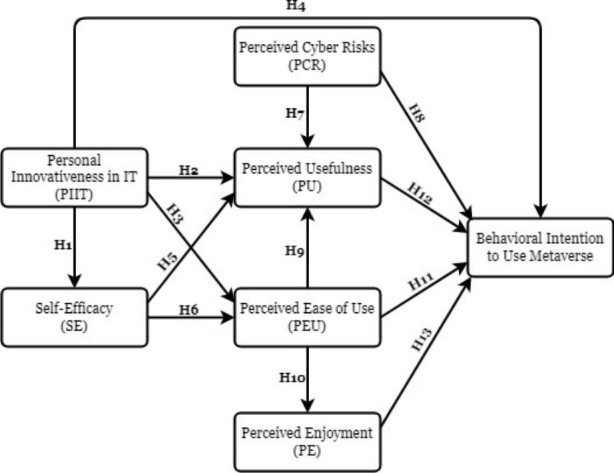
Metaverse, which combines a number of information technologies, is the Internet of the future. A media for immersive learning, metaverse could set future educational trends and lead to significant reform in education. Although the metaverse has the potential to improve the effectiveness of online learning experiences, metaverse-based educational implementations are still in their infancy. Additionally, what factors impact higher education students' adoption of the educational metaverse remains unclear. Consequently, the aim of this study is to explore the main factors that affect higher education students' behavioral intentions to adopt metaverse technology for education. This study has proposed an extended Technology Acceptance Model (TAM) to achieve this aim. The novelty of this study resides in its conceptual model, which incorporates both technological, personal, and inhibiting/enabling factors. The empirical data were collected via online questionnaires from 574 students in both private and public universities in Jordan. Based on the PLS-SEM analysis, the study identifies perceived usefulness, personal innovativeness in IT, and perceived enjoyment as key enablers of students' behavioral intentions to adopt the metaverse. Additionally, perceived cyber risk is found as the main inhibitor of students' metaverse adoption intentions. Surprisingly, the effect of perceived ease of use on metaverse adoption intentions is found to be insignificant. Furthermore, it is found that self-efficacy, personal innovativeness, and perceived cyber risk are the main determinants of perceived usefulness and perceived ease of use. While the findings of this study contribute to the extension of the TAM model, the practical value of these findings is significant since they will help educational authorities understand each factor's role and enable them to plan their future strategies.
Overview
The claims and statistics of this paper haven’t been checked yet.
Run the check — free, no account needed. It reads the open-access text and checks the sources it cites.
Integrity signals
Registry
Cites
Statistics
Figures
Verification
Claims the paper makes
The claims and statistics of this paper haven’t been checked yet.
Run the check — free, no account needed. It reads the open-access text and checks the sources it cites.
Claims other papers make about this one
Each is checked against this paper’s own text: does it say what the citing paper says it does?
The source backs part of the claim, not all of it — or backs it for a different population, condition or comparison.
In the citing paper
“They also aligned with evidence from mobile learning research showing that positive attitudes can strengthen students’ intention to use new technologies [91].”
From Advancing Undergraduate Student Mental Healthcare of Social Anxiety Disorder: Evaluating the Acceptance of AR-Assisted Cognitive Behavioral Therapy Through TAM-Based Constructs. (2026) · cites this paper as [91]
Experimental — accuracy not yet measured
Self-check
Percentages, sums and reported differences re-computed from the paper’s own numbers.
The self-check needs the paper’s full text.
Citations
Cites
Evaluating Structural Equation Models with Unobservable Variables and Measurement Error
Fornell, C., & Larcker, D. F. (1981) · Journal of Marketing Research · doi:10.2307/3151312 · Cited by 109,314
Evaluating structural equation models with unobservable variables and measurement error
Fornell, C., & Larcker, D. F. (1981) · Journal of Marketing Research · doi:10.1177/002224378101800104 · Cited by 109,190 · cited 1×
“As demonstrated in Table 4, this condition is met, concluding that discriminant validity is present (Fornell & Larcker, 1981 ).”
BackgroundThe theory of planned behavior
Ajzen, I. (1991) · Organizational Behavior and Human Decision Processes · doi:10.1016/0749-5978(91)90020-t · Cited by 90,587 · cited 1×
“According to Ajzen (1991), SE designates the confidence that one possesses in one’s capability to engage in a specific behavior.”
MethodPodsakoff, P. M., MacKenzie, S. B., Lee, J.-Y., & Podsakoff, N. P. (2003) · Journal of Applied Psychology · doi:10.1037/0021-9010.88.5.879 · Cited by 82,194 · cited 1×
“The finding showed that the loading of all measurement items in the dataset at once yielded a total variation of 44.678%, which is below the 50% threshold, indicating that CMB is absent (Podsakoff et al., 2003 ).”
BackgroundInfluentialStructural equation modeling in practice: A review and recommended two-step approach
Anderson, J. C., & Gerbing, D. W. (1988) · Psychological Bulletin · doi:10.1037/0033-2909.103.3.411 · Cited by 41,941 · cited 1×
“As instructed, we conducted the data analysis in two steps (Anderson & Gerbing, 1988 ).”
MethodA new criterion for assessing discriminant validity in variance-based structural equation modeling
Henseler, J., Ringle, C. M., & Sarstedt, M. (2015) · Journal of the Academy of Marketing Science · doi:10.1007/s11747-014-0403-8 · Cited by 38,459 · cited 1×
“Moreover, the result of the “Heterotrait–Mono - trait Ratio-HTMT” test indicates that all HTMT values < 0.85 (Henseler et al., 2015), endorsing the findings in terms of Fornell and Larcker’s criterion.”
ResultInfluentialWhen to Use and How to Report the Results of PLS-SEM
Hair, J. F., Risher, J. J., Sarstedt, M., & Ringle, C. M. (2019) · European Business Review · doi:10.1108/ebr-11-2018-0203 · Cited by 27,541 · cited 5×
“The outcomes showed that each construct in the research model acquired an accept - able Cronbech’s Alpha ( > 0.7) (Hair et al., 2019).”
BackgroundMethodResultInfluentialUser Acceptance of Computer Technology: A Comparison of Two Theoretical Models
Davis, F. D., Bagozzi, R. P., & Warshaw, P. R. (1989) · Management Science · doi:10.1287/mnsc.35.8.982 · Cited by 25,709 · cited 3×
“PU describes the extent to which individuals perceive that the usage of a specific technology enhances their performance (Davis et al., 1989).”
BackgroundInfluentialValente, T. W. (2003) · Genetics in Medicine · doi:10.1097/01.gim.0000061743.67794.c4 · Cited by 20,559
Venkatesh, V., Thong, J. Y. L., & Xu, X. (2012) · MIS Quarterly · doi:10.2307/41410412 · Cited by 15,756 · cited 1×
“Intrinsic motivation underpins the enjoyment concept (Abdullah & Ward, 2016), and is considered a hedonic motivation conceptualization (Venkatesh et al., 2012 ).”
Background
Research works printed but not linked: 5
- Bada, S. O., & Olusegun, S. (2015). Constructivism learning theory: A paradigm for teaching and learning. Journal of Research & Method in Education, 5(6), 66–70. https://doi.org/10.9790/7388-05616670 · DOI
- Kim, J. H., Lee, B. S., & Choi, S. J. (2022). A study on metaverse construction and use cases for non-face-to-face education. The Journal of the Convergence on Culture Technology, 8(1), 483–497. https://doi.org/10.17703/JCCT.2022.8.1.483 · DOI
- Lee, J., Kim, J., & Choi, J. Y. (2019b). The adoption of virtual reality devices: The technology acceptance model integrating enjoyment, social interaction, and strength of the social ties. Telematics and Informatics, 39, 37–48. https://doi.org/10.1016/j.tele.2018.12.006. · DOI · Paper page
- Mikusa, M. E. (2015). The effect of technology self-efficacy and personal engagement on students’ and teachers’ attitudes toward technology use in education (Doctoral dissertation). Appalachian State University.
- Saleh, S. S., Nat, M., & Aqel, M. (2022b). Sustainable adoption of E-Learning from the TAM Perspective. Sustainability, 14(6), 3690. https://doi.org/10.3390/su14063690. · DOI
Cited by
Sorted by citations
Items 301–400 of 637
Banaz, E. (2025) · Acta Psychologica · doi:10.1016/j.actpsy.2025.105530 · Cited by 3
Consumer Innovativeness in E-Learning Adoption: Insights From Cloud-Based Education Systems
Neelakantan, P., & Nikhith, G. S. (2025) · International Conference on Computing Technologies & Data Communication (ICCTDC) · doi:10.1109/icctdc64446.2025.11158955 · Cited by 2
“…TPB anticipates actions based on assumptions, standards, and perceived control [18, 20, 25], TAM expresses technological adoption via efficiency and functionality [2, 4, 6], IDT examines the propagation and adoption of innovations [41], and the Model of Personal Computer Utilization (MPCU) [25].”
Zavichi, M., & Aparício, M. (2025) · Journal of Innovation & Knowledge · doi:10.1016/j.jik.2025.100841 · Cited by 4
My digital mentor: a mixed-methods study of user-GAI interactions
Xian, L., Cao, G., & Zhang, N. (2025) · Frontiers in Psychology · doi:10.3389/fpsyg.2025.1636480 · Cited by 2
Solak, Ü., KABAK, T., & Yurttaş, A. (2025) · BMC Nursing · doi:10.1186/s12912-025-04150-1 · Cited by 2
“TAM explains that individuals’ intentions to adopt a technology are shaped by their perceptions of usefulness and ease of use, and it has been widely applied in educational technology research [26, 27].”
Kamdjoug, J. R. K., Wamba-Taguimdje, S.-L., & Guessele, P. J. (2025) · International Journal of Information Management · doi:10.1016/j.ijinfomgt.2025.103020 · Cited by 2
Kumar, R. (2025) · Open Information Science · doi:10.1515/opis-2025-0037 · Cited by 2
“…two key constructs: perceived usefulness (PU), the degree to which a person believes that using a technology will enhance their performance, and perceived ease of use (PEOU), the degree to which they feel using the technology will be free of e ff ort (Al-Adwan et al. 2023; Kleine et al. 2025).”
Hong, Y., Wan, M., & Yao, W. (2026) · Journal of theoretical and applied electronic commerce research · doi:10.3390/jtaer21010007 · Cited by 2
“This relationship has been empirically supported across various contexts, including e-commerce [78], educational technology [79], and mobile payment services [11].”
Enhancing Computer Network Education Through Immersive Virtual Environments: A Study on NetVerse Edu
Vieira, E. E., de Medeiros, F. P. A., & Maciel, P. D. (2025) · IEEE Frontiers in Education Conference (FIE) · doi:10.1109/fie63693.2025.11328446 · Cited by 2
EFL Teachers’ Technology Readiness and Intention to Use Online Education: The Mediating Role of TAM
Çeşme, H., & Çimen, B. A. (2026) · SAGE Open · doi:10.1177/21582440251410825 · Cited by 2
Hien, N. N., Luu, D. X., Ghi, T. N., & Nguyễn, T. N. (2026) · Human Behavior and Emerging Technologies · doi:10.1155/hbe2/5689688 · Cited by 3
Wu, J., Xiang, C., Zhao, J., Zhang, H., Ji, Y., & Li, S. (2026) · Scientific Reports · doi:10.1038/s41598-026-41062-9 · Cited by 2
“At present, the application proportion of the TAM in explaining various aspects of modern scientific and technological life is gradually increasing, such as the willingness to use scientific and technological products, Internet technology, AI products, and sports smart equipment 2,15–17 .”
Alomari, K. M., Maghaydah, S., Salloum, S. A., Mahade, A., & Abubakr, A. A. M. (2026) · Telematics and Informatics Reports · doi:10.1016/j.teler.2026.100307 · Cited by 2
Unveiling determinants of autonomous vehicle adoption through SEM-ANFIS modelling
Yadegaridehkordi, E., Foroughi, B., Iranmanesh, M., Nilashi, M., & Ghobakhloo, M. (2026) · Behaviour and Information Technology · doi:10.1080/0144929x.2026.2633773 · Cited by 2
“Based on the TAM foundation, if a customer perceives innovation as easy to use, they might consider it more effective (Al-Adwan et al. 2023).”
Alnoor, A., Abbas, S., Alazzawi, M. S., Sadaa, A. M., & Chew, X. (2026) · Asia-Pacific Journal of Business Administration · doi:10.1108/apjba-08-2025-0569 · Cited by 2
Determinants of sustained engagement with generative AI tools in language learning
Naghmeh‐Abbaspour, B., Annamalai, N., & Foroughi, B. (2026) · Journal of Applied Research in Higher Education · doi:10.1108/jarhe-05-2025-0371 · Cited by 2
Liu, J., Sun, Y., & Xiao, K. (2026) · Frontiers in Psychology · doi:10.3389/fpsyg.2026.1781974 · Cited by 5
Li, W., & Wang, S. (2026) · International Journal of Distance Education Technologies · doi:10.4018/ijdet.411905 · Cited by 2
Yu, J. (2024) · Journal of Exercise Rehabilitation · doi:10.12965/jer.2346586.293 · Cited by 3
Assessing the Impact of E-Learning Adoption on Learning Behavior in Sierra Leonean Higher Education
Sawaneh, I. A., Sesay, B., Mansaray, S. S., Koroma, M. J., & Inthavong, P. (2024) · Asian Journal of Education and Social Studies · doi:10.9734/ajess/2024/v50i51342 · Cited by 2
Ding, J., & Sazalli, N. A. H. (2024) · International Journal of Academic Research in Progressive Education and Development · doi:10.6007/ijarped/v13-i2/21123 · Cited by 4
“Al-Adwan et al (2023) discovered that PEU significantly and positively affects university students’ acceptance of metaverse - based learning platforms.”
BackgroundSoliman, D. S. A., Shalaby, R. A. E. A. Y., Khourshed, N. F., & Amara, D. (2024) · المجلة العربیة للإدارة · doi:10.21608/aja.2024.270485.1587 · Cited by 2
The effect of the COVID-19 pandemic crisis on the Jordanian higher education system
Hamasha, M. M., Alomari, A. J., & Bani‐Irshid, A. H. (2024) · PLoS ONE · doi:10.1371/journal.pone.0299531 · Cited by 2
Millones-Liza, D. Y., García-Salirrosas, E. E., Apaza-Cáceres, J. A., & Norabuena-Diaz, R. Á. (2024) · Journal of Educational and Social Research · doi:10.36941/jesr-2024-0054 · Cited by 2
“Ease of use is the student's interaction with technology, making learning much easier and more accessible, which creates a positive and motivating learning environment(Al-Adwan et al., 2023; Jovanka et al., 2023).”
BackgroundExploring the Adoption of Strategic Information Systems: A Technology Acceptance Model Perspective
Srivastava, R., Faiz, M. A., Masaeid, T. F. A., Inairat, M., & Alzoubi, H. M. (2024) · International Conference on Cyber Resilience (ICCR) · doi:10.1109/iccr61006.2024.10532932 · Cited by 2
“As proposed by the Technology Acceptance Model (TAM), the PEOU of employing a technology greatly impacts the PU of that technology [11].”
MethodNeves, J. R., & Bacalhau, L. M. (2024) · Advances in social networking and online communities book series · doi:10.4018/979-8-3693-2607-7.ch001 · Cited by 2
Purwandari, D., Saparudin, M., Wulan, M., Akbari, D. A., & Arthamevia, A. K. (2024) · Jurnal Sisfokom (Sistem Informasi dan Komputer) · doi:10.32736/sisfokom.v13i2.2122 · Cited by 2
Reis, I. W., Peruchini, M., Ulbricht, V. R., & Teixeira, J. M. (2024) · Communications in computer and information science · doi:10.1007/978-3-031-63235-8_7 · Cited by 2
Jatileni, C. N., Havu‐Nuutinen, S., Pöntinen, S., & Kukkonen, J. (2024) · Frontiers in Education · doi:10.3389/feduc.2024.1425779 · Cited by 6
A Study on Digital Natives' Adoption of Fintech: Perspectives from Generations Y and Z
Acharya, U., & Bhojak, N. P. (2024) · International Journal of Management and Humanities · doi:10.35940/ijmh.a1750.11010924 · Cited by 9
“Although user attitudes and intentions vary, TAM is widely used to evaluate the adoption of information technology (Al-Adwan et al., 2023) [20].”
Makararpong, D., Boonprasop, C., & Jantarat, J. (2024) · International Journal of E-Services and Mobile Applications · doi:10.4018/ijesma.358107 · Cited by 2
Dash, A. (2024) · Global Knowledge, Memory and Communication · doi:10.1108/gkmc-08-2024-0509 · Cited by 2
Wang, X., Razak, R. A., & Halili, S. H. (2024) · PLoS ONE · doi:10.1371/journal.pone.0308005 · Cited by 2
“In addition, scholars found that PE using the metadata learning platform in universities cannot directly affect behavioral intentions, but PU can [44].”
Li, E., Wang, Z., Liu, J., & Huang, J. (2024) · Applied Sciences · doi:10.3390/app15010250 · Cited by 2
A Student-centric Perspective on Leveraging the Metaverse in Higher Education
Qutaishat, F. T., Abushakra, A., & Al-Omari, M. (2025) · Journal of Information & Knowledge Management · doi:10.1142/s0219649225500212 · Cited by 2
تبني تقنيات الصناعة 5.0 باستخدام نموذج القبول التقني (TAM): دراسة تحليلية في جامعة الموصل
الزبيدي, ر. ز. ق., & السمان, ث. ا. س. (2024) · Tikrit Journal of Administrative and Economic Sciences · doi:10.25130/tjaes.20.68.2.7 · Cited by 2
Fu, Y., Ma, S., Xie, C., Li, S., & Liu, X. (2025) · Education and Information Technologies · doi:10.1007/s10639-025-13572-y · Cited by 2
“While most e-learning studies primarily rely on models like the Technology Acceptance Model (TAM) to explore factors such as perceived usefulness and ease of use (Al-Adwan et al., 2023; Doo & Bonk, 2021 ), the SOR model offers a more holis - tic approach.”
Understanding the adoption of sustainable weed management in Greek agriculture
Michalis, E., Ragkos, A., Travlos, I. S., & Malesios, C. (2025) · International Journal of Pest Management · doi:10.1080/09670874.2025.2495714 · Cited by 2
“…“Intention to use” SWMP (supporting H1) but also on “Actual use” (supporting H2), which are in line with results of previous studies in the context of TAM (Al-Adwan et al. 2023; Akour et al. 2022; Alalwan 2022; Dong, Wang, and Han 2022; Zarei et al. 2022; Al-Rahmi et al. 2021; Khoza et al. 2021;…”
A Study on Undergraduate Students' Willingness to Use GAI Based on the Technology Acceptance Model 3
Qiu, Z., Peng, S., & Lu, J. (2025) · International Conference on Computer Science and Technologies in Education (CSTE) · doi:10.1109/cste64638.2025.11092086 · Cited by 2
“At the undergraduate education level, as one of th e primary user groups, students’ acceptance and willingness to use GAI directly impact the successful promotion and application of this technology in universities [10]-[14].”
Torralba, E. M. (2025) · Schrödinger Journal of Physics Education · doi:10.37251/sjpe.v6i3.2031 · Cited by 2
“Quantitative data provided insights into AI’s perceived effectiveness and usability, while triangulation with qualitative responses confirmed themes like enhanced visualization and usability challenges, aligning with TAM’s framework [25][33].”
Alhusban, M. I., Sarhan, N. M., Khatatbeh, I. N., & Shbail, M. O. A. (2024) · Discover Sustainability · doi:10.1007/s43621-024-00215-4 · Cited by 2
Trust and the Future of Learning: A Model for AI-Supported Edtech in Higher EducationPreprint
Asare, A. O., & Yap, R. (2025) · Research Square · doi:10.21203/rs.3.rs-5675462/v1 · Cited by 3
Tran, H., Stell, A., & Iwashita, N. (2023) · Trends in Higher Education · doi:10.3390/higheredu2040040 · Cited by 1
Immersive Learning Constructs for Deaf and Hard-of-Hearing Students in TVET Practical Skill
Rahim, R. H. A., Nizam, D. N. M., Naim, N. F. M., & Baharum, A. (2024) · International Visualization, Informatics and Technology Conference (IVIT) · doi:10.1109/ivit62102.2024.10692890 · Cited by 1
“Another metaverse immersive learning was proposed by extending the Technology Acceptance Model (TAM), highlighting perceived usefulness, personal innovativeness, and perceived enjoyment as key enablers, while the perceived cyber risk was a significant inhibitor [13].”
BackgroundDjinn—Data Journalism Interface for Newsgathering and Notifications
Dean, S. E., Giske, L. A., Mostein, H. J., Podestà, S., Barndon, H. H., Stegane, S., & Nordberg, H. (2024) · Lecture notes in computer science · doi:10.1007/978-3-031-77918-3_11 · Cited by 1
Metaverso como espaço educativo e o uso de metáforas para um aprendizado significativo
Reis, I. W., Iriarte-Solano, M., Romeiro, A. E., & Ulbricht, V. R. (2024) · Anais do ... Simpósio Brasileiro de Informática na Educação/Anais do Simpósio Brasileiro de Informática na Educação · doi:10.5753/sbie.2024.242493 · Cited by 3
“…por exemplo, permite a interação entre os participantes, mas também com o próprio ambiente, recriando processos de construção de conhecimento e processos emocionais e cognitivos, aproximando-se das experiências presenciais em salas de aula e laboratórios (Dwivedi, 2022; Al-Adwan et al., 2023).”
Tsai, K. B., Yang, F.-C., Lu, C.-L., & Lin, C.-L. (2024) · Soft Computing · doi:10.1007/s00500-024-10323-y · Cited by 1
“…service effectiveness, behavioral attribution, and adoption intention) and 16 criteria to evaluate the sub-scription service system based on the Technology Acceptance Model (TAM) approach(Al-Adwan et al. 2023; Davis et al. 1989; Liu and Ma 2024; Venkatesh and Davis 2000; Venkatesh et al. 2003).”
Li, M., & Zhao, Z. (2025) · Frontiers in Sustainable Development · doi:10.54691/h9e0n039 · Cited by 1
“As a core variable in the Value Adoption Model and the Technology Acceptance Model, it is widely used to explain users' adoption behaviors toward new technologies or services(Al-Adwan et al., 2023).”
Khan, M. B., Hameed, I., Butt, A., & Akbar, R. (2025) · Creative Industries Journal · doi:10.1080/17510694.2025.2479460 · Cited by 1
Development and evaluation of a metaverse competency scale for university students
Hsiao, K., Chen, M., & Liao, Y.-R. (2025) · Education and Information Technologies · doi:10.1007/s10639-025-13520-w · Cited by 1
“In the virtual world, users can create their own digital avatars or virtual images and work, play, and socialize in them as if they were in the real world (Al-Adwan et al., 2023; Ooi et al., 2023).”
Factores influyentes en el aprendizaje a través del metaverso en estudiantes de educación secundaria
López-Belmonte, J., Sánchez, S. P., Moreno-Guerrero, A.-J., & Λαμπρόπουλος, Γ. (2025) · Revista Complutense de Educación · doi:10.5209/rced.93697 · Cited by 1
Zhang, X., Zhang, K., Liang, L., Zhang, J., & Chen, J. (2025) · IEEE Access · doi:10.1109/access.2025.3557006 · Cited by 3
“The extended TAM significantly improves the explanatory power of technology usage behaviors by introducing more psychological and behavioral variables [43].”
Lim, J., & Ayyagari, R. (2025) · American Journal of Business · doi:10.1108/ajb-09-2024-0195 · Cited by 2
Ríos, O. L., & Lechuga, M. (2025) · Asia Conference on Information Engineering (ACIE) · doi:10.1109/acie64499.2025.00030 · Cited by 1
Strategic Optimization of LMS in Higher Education for Working-Class Students Using SWOT Analysis
Widarini, W., Abdullah, F., & Anggara, I. G. A. (2025) · Jurnal Riset dan Inovasi Pembelajaran · doi:10.51574/jrip.v5i1.2859 · Cited by 2
Factors Influencing User Satisfaction with Generative Artificial Intelligence Power Chat System
Hutagalung, D., Sancayawati, N., Aryanty, R., Hutabarat, T., & Almumin, W. (2025) · International Research Journal of Business Studies · doi:10.21632/irjbs.18.1.67-84 · Cited by 1
“This appeal has not only engaged the technology sector but also profoundly influenced daily life, changing how individuals approach work, education, and entertainment (Li, 2023).”
Emilzoli, M., Hernawan, A. H., Rullyana, G., & Priandani, A. P. (2025) · Journal of Education Technology · doi:10.23887/jet.v9i1.84112 · Cited by 10
Privacy Concern Consideration in Smart Homes Device Usage in Indonesia
May, V. M., Cundana, W., Halim, E., & Gui, A. (2025) · International Conference on Electrical Engineering/Electronics, Computer, Telecommunications and Information Technology (ECTI-CON) · doi:10.1109/ecti-con64996.2025.11100990 · Cited by 1
“[15], [17]”
InfluentialCase Studies of Human–Machine Collaboration: Perspectives From Asia–Pacific Region
Abbasi, G. A. (2025) · Emerald Group Publishing Limited eBooks · doi:10.1108/978-1-83708-276-620251004 · Cited by 1
Tian, A., & Ye, J. (2025) · Education and human development · doi:10.5772/intechopen.1011910 · Cited by 4
Chen, L., Chang, Y.-L., Cheng, L., & Yang, J. (2025) · Education and Information Technologies · doi:10.1007/s10639-025-13703-5 · Cited by 1
“Furthermore, TAM was developed to identify cognitive and psychologi - cal factors influencing the acceptance of new technologies (Al-Adwan et al., 2023).”
Udo, G. G., & Bagchi, K. K. (2025) · Acta Psychologica · doi:10.1016/j.actpsy.2025.105535 · Cited by 1
Farooq, F., & Bashir, I. (2025) · International Journal of Pharmaceutical and Healthcare Marketing · doi:10.1108/ijphm-11-2024-0131 · Cited by 1
Jun, J. Y., Marjerison, R. K., & Kim, J. M. (2025) · Journal of theoretical and applied electronic commerce research · doi:10.3390/jtaer20040261 · Cited by 1
Unlocking Digital Payments: Understanding E-wallet Adoption Among Malaysia’s Older Adults
Tan, S., Yap, Y.-Y., Tan, S., & Reza, M. D. S. M. (2025) · Vision The Journal of Business Perspective · doi:10.1177/09722629251379657 · Cited by 1
Chen, Y., & Zheng, C. (2025) · Discover Applied Sciences · doi:10.1007/s42452-025-07847-9 · Cited by 1
“Barrett et al. (2023) [9] apply the Technology Acceptance Model to virtual learning uptake, and Al-Adwan et al. (2023) [10] extend it to metaverse-based learning.”
Boz, N., & AHMETOĞULLARI, K. (2025) · Journal of Hospitality & Tourism Education · doi:10.1080/10963758.2025.2586522 · Cited by 2
Retail Metaverse acceptance: A meta-analysis with Hofstede’s cultural moderation
Fares, O. H., Haines, S. J., Lee, S. H. (., Azmy, A., Mohan, M., & Le, S. (2025) · Journal of Retailing · doi:10.1016/j.jretai.2025.12.003 · Cited by 3
Muris, D., & Siregar, R. (2026) · SHS Web of Conferences · doi:10.1051/shsconf/202622705004 · Cited by 2
Muyambi, G. C., Nkopodi, N., & Jakovljević, M. (2026) · Discover Education · doi:10.1007/s44217-025-01076-3 · Cited by 1
“Through the application of both lenses, TRA and TAM, the study analyzes the behavioral and technological factors influencing smartphone adoption [1, 24].”
Transforming nursing education towards metaverse as an innovative teaching tool: A systematic review
Ibrahim, N. H., Norman, H., & Nasir, M. K. M. (2026) · Social Sciences & Humanities Open · doi:10.1016/j.ssaho.2026.102492 · Cited by 3
Waris, I., & Sukı, N. M. (2026) · Journal of Internet Commerce · doi:10.1080/15332861.2026.2622613 · Cited by 2
“I w i ll u s e f oo d d e l i v e r y a pp s m o r e o f t e n i n t h e f u t u r e I a m w i ll i n g t o u s i n g f oo d d e l i v e r y a pp s i n t h e f u t u r e . previous studies (Al-Adwan et al. 2023; Fan et al. 2020).”
Ntavlourou, A., Antonopoulou, H., & Halkiopoulos, C. (2026) · Sustainability · doi:10.3390/su18031555 · Cited by 9
Wang, X. (2026) · Total Quality Management & Business Excellence · doi:10.1080/14783363.2026.2615734 · Cited by 2
“Within the government setting, the level of acceptance towards blockchain varies depending on whether an employee perceives that it will lead to efficiency, accuracy, and transparency (Al-Adwan et al., 2023; Alfadda & Mahdi, 2021).”
Devi, L. D., & Arumugam, T. (2026) · Frontiers in Artificial Intelligence · doi:10.3389/frai.2026.1734151 · Cited by 1
User Perception and Awareness of AI-Generated Cyber Threats: A TAM-Based Study
Autavia, V., & Madyatmadja, E. D. (2025) · Beyond Technology Summit on Informatics International Conference (BTS-I2C) · doi:10.1109/bts-i2c67944.2025.11399306 · Cited by 1
“Fraud detection skills, experience, and how messages are interpreted also matter [13].”
InfluentialBehavioral Intentions Toward Generative AI: A Symbiotic Human-AI Relationship
Nasr, R. S., & El‐Deeb, S. (2026) · International Journal of Human-Computer Interaction · doi:10.1080/10447318.2026.2628139 · Cited by 1
“While earlier studies report mixed findings regarding the effect of PEU on behavioral intentions (Al-Adwan et al., 2023), this finding extends TAM by showing that PEU retains explanatory power even when hedonic motivation (enjoyment) is introduced, specifically in early-stage adoption contexts…”
Chen, Y., Chen, G., & Chen, J. (2026) · Frontiers in Psychology · doi:10.3389/fpsyg.2026.1788850 · Cited by 2
Chellappa, V. (2026) · Safety Science · doi:10.1016/j.ssci.2026.107194 · Cited by 2
Determinants of Academic Librarians’ Preparedness for Metaverse-Enabled Library Services in Nigeria
Oladokun, B. D., Yemi-Peters, O. E., Wiche, H. I., Aboyade, W. A., Ajani, Y. A., & Owolabi, K. A. (2026) · The International Information & Library Review · doi:10.1080/10572317.2026.2648337 · Cited by 1
“It has been extensively utilized in education and library science to examine acceptance of digital and immersive technologies (Tiwari et al., 2024; Al-Adwan, 2020; Al-Adwan et al., 2023; Al-Emran et al., 2018).”
Raza, F. A., Singh, A. D., Anwar, R., Kovilpillai, J. J. S., Hamdan, A., Konno, F., Rajaratnam, V., Raman, M., & Razami, H. H. (2026) · European Journal of STEM Education · doi:10.20897/ejsteme/18267 · Cited by 1
“3 / 41 However, TAM assumes a unidimensional notion of “use,” an assumption ill -suited to tools like ChatGPT that span technical, analytical, and creative domains (Al-Adwan et al., 2023).”
InfluentialXie, J., Al-Shaibani, G. K. S., & Ali, M. B. B. (2026) · Humanities and Social Sciences Communications · doi:10.1057/s41599-026-06962-1 · Cited by 1
“This fi nding supports the previous results (Al-Adwan et al., 2023; Al-Adwan and Al-Debei, 2024; Salloum et al., 2023).”
InfluentialFute, A. Z., Oubibi, M., Amihere, A., Kangwa, D., & Msafiri, M. M. (2026) · Humanities and Social Sciences Communications · doi:10.1057/s41599-026-07235-7 · Cited by 2
“…their performance (perceived usefulness) and free of effort (perceived ease of use) will in fl uence their attitude toward using it, which then affects their intention to use, ultimately leading to the actual use or adoption of the technology (Al-Adwan et al., 2023a; Taherdoost et al., 2024).”
Zhu, J., Guan, C., Zhang, H., Wang, L., Zhang, Y., & Bian, X. (2026) · Frontiers in Medicine · doi:10.3389/fmed.2026.1817255 · Cited by 2
“According to TAM, perceived ease of use and perceived usefulness shape behavioral intention, which in turn influences actual use behavior (19).”
Rashid, S., & Malik, S. (2026) · Cogent Education · doi:10.1080/2331186x.2026.2661437 · Cited by 1
Mangundu, J., Mutasa, L. S., Senali, M. G., & Ujakpa, M. M. (2026) · Education and Information Technologies · doi:10.1007/s10639-026-14016-x · Cited by 1
“Scholarly arguments on TAM propose that a high level of innovativeness enables individuals to attempt to use new technology earlier compared to those who are less innovative (Agarwal & Prasad, 1998; Al-Adwan et al., 2023; Fatima et al., 2017 ).”
Hatta, P., Hadiyanto, & Budiyanto, C. W. (2026) · Discover Computing · doi:10.1007/s10791-026-10160-7 · Cited by 1
“…models such as the Technology Acceptance Model (TAM), Technology Organization Environment (TOE), Diffusion of Innovation (DOI), and Unified Theory of Acceptance and Use of Technology (UTAUT) primarily emphasize the early adoption phase and individual-level behavior [4, 5, 17, 22, 23, 32, 40, 43].”
Mishra, R., & Singh, R. K. (2026) · Industrial Marketing Management · doi:10.1016/j.indmarman.2026.04.003 · Cited by 4
Mersin, N. (2026) · Journal of Educational Computing Research · doi:10.1177/07356331261456930 · Cited by 2
“Prior studies have shown PEOU influences PU (Al Adwan et al., 2023; Al Darayseh, 2023), ATT (Al Darayseh, 2023; S¸ims ¸ ek et al., 2025), BI (Tram, 2025; Zhao et al., 2025).”
InfluentialGu, Y., Xiong, B., Li, R., Pan, Z., Huang, Y., & Pan, Y. (2026) · Frontiers in Psychology · doi:10.3389/fpsyg.2026.1833613 · Cited by 1
“Researchers have pointed out that even when technology is perceived as complex, users will still adopt it due to its PU; this is particularly true for digital natives (Al-Adwan et al., 2023).”
Bridging e-commerce and the metaverse: A flow theory approach to consumer behavior
Al‐Adwan, A. S., Yaseen, H., Jafar, R. M. S., Falahat, M., Abdulmuhsin, A. A., & Habibi, A. (2026) · Human Systems Management · doi:10.1177/01672533261467180 · Cited by 1
Rayhan, M. G. S., Karuppiah, K., & Sankaranarayanan, B. (2026) · Process Integration and Optimization for Sustainability · doi:10.1007/s41660-026-00827-5 · Cited by 1
Almenara, J. C., Cejudo, M. D. C. L., Regaña, C. B., & Scagliusi, M. V. F. (2026) · Contemporary Educational Technology · doi:10.30935/cedtech/19274 · Cited by 1
Perceived risk, purchase intention, and purchase behavior in internet financial products
Yang, Q. (2023) · International Journal of Research Studies in Management · doi:10.5861/ijrsm.2023.1124 · Cited by 1
Carilo, M. S. C. –., & Apritado, J. M. M. (2023) · International Journal of Research Studies in Management · doi:10.5861/ijrsm.2023.1146 · Cited by 1
Al-Nabhani, S., & Al-Abri, A. (2023) · International Education Studies · doi:10.5539/ies.v16n6p45 · Cited by 1
Fu, E. A. J. (2023) · International Journal on Recent and Innovation Trends in Computing and Communication · doi:10.17762/ijritcc.v11i10.9044 · Cited by 2
Perception and Usage of Telemedicine Among National Health Insurance Participants in Padang City
Roza, S. H., & Sari, A. F. (2023) · Jurnal Ilmu Kesehatan Masyarakat · doi:10.26553/jikm.2023.14.2.281-292 · Cited by 3
“12,13 This theory has been proven in subsequent research on health technology.”
BackgroundAI-Driven Content Developing and Designing for Teaching Materials of Digital Healthcare
Muthmainnah, M., Yakin, A. M. A., Nurjannah, N., Mursidin, M., & Aqad, M. H. A. (2024) · Advances in medical diagnosis, treatment, and care (AMDTC) book series · doi:10.4018/979-8-3693-3679-3.ch015 · Cited by 1
Mingyu, G., Yunus, M. M., & Rafiq, K. R. M. (2024) · International Journal of Academic Research in Progressive Education and Development · doi:10.6007/ijarped/v13-i1/20856 · Cited by 1
“Researchers should pay more attention to their perceived enjoyment and perceived usefulness (Al-Adwan et al., 2023) when they use metaverse technologies.”
Background
Metadata
- Authors
- Al-Adwan, A. S., Li, N., Al-Adwan, A., Abbasi, G. A., Albelbisi, N. A., & Habibi, A.
- Affiliations
- Xi’an Jiaotong-Liverpool University (CN)
- Al-Ahliyya Amman University (JO)
- King Fahd University of Petroleum and Minerals (SA)
- University of Malaya (MY)
- Universitas Jambi (ID)
- Corresponding author
- Al-Adwan, Amer
- ORCID
- Venue
- Education and Information Technologies
- Published
- 2023-04-28
- Volume
- 28
- Issue
- 11
- Pages
- 15381-15413
- ISSN
- 1360-2357 (ISSN-L)
- 1573-7608
- PMC
- PMC10140721
- OpenAlex
- W4367316498
- Cited by
- 637
- References
- 116
- Citations by year
- 2026: 169 · 2025: 244 · 2024: 191 · 2023: 33
- FWCI
- 732.78
- Type
- book chapter
- Language
- en
- Update notices
- correction (2023-06-02)
- Open access
- hybrid
- doi.org
- Locations
- Education and Information Technologies (publishedVersion, cc-by)
- PubMed Central (publishedVersion, cc-by)
- PubMed (publishedVersion)
- Figshare (submittedVersion, cc-by)
- Funders
- Hamad bin Khalifa University
- Topics
- Social Sciences › Decision Sciences › Information Systems and Management › Technology Adoption and User Behaviour
- Social Sciences › Education › Education and Learning Interventions
- Social Sciences › Education › Online and Blended Learning
- Keywords
- metaverse, technology acceptance model, technology adoption, behavioral intention, university students, perceived usefulness, perceived ease of use, perceived enjoyment, personal innovativeness, self-efficacy, immersive learning, online learning
About these checks
Registry, retraction, Cites and statistics results are computed, not judged, with one exception: a printed reference that no index lists is read once by a model before it counts as a citation error. Claims are extracted by a model and kept only when their quote appears verbatim in the text; each cited source is then checked, with a model’s help, for whether it says what the claim relies on. Those verdicts can be wrong — read the claim’s quote and the cited source before relying on one.
Statistics and arithmetic are recomputed, not judged.
Confidence bands are shown only for fields calibrated on our annotated test set. None is calibrated yet, so no band is shown.
What counts as a claim ›How we measure confidence ›How we check this ›
Are you an author, or do you see a problem with this page? Request a review
