

The DOI matches its Crossref record; 116 of the 116 references it cites were found in a registry or an index.
Extending the technology acceptance model (TAM) to predict university students’ intentions to use metaverse-based learning platforms
Open accessAbstract
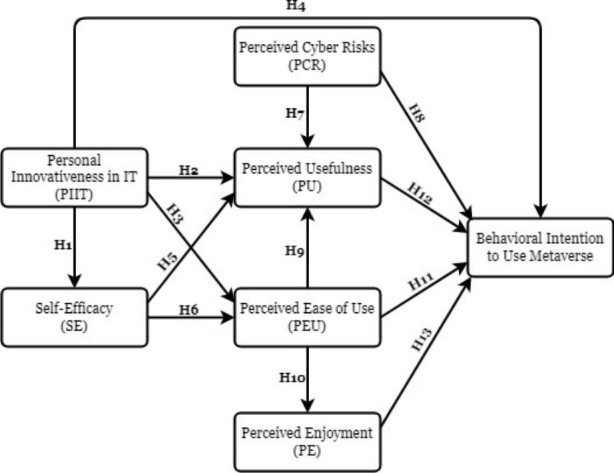
Metaverse, which combines a number of information technologies, is the Internet of the future. A media for immersive learning, metaverse could set future educational trends and lead to significant reform in education. Although the metaverse has the potential to improve the effectiveness of online learning experiences, metaverse-based educational implementations are still in their infancy. Additionally, what factors impact higher education students' adoption of the educational metaverse remains unclear. Consequently, the aim of this study is to explore the main factors that affect higher education students' behavioral intentions to adopt metaverse technology for education. This study has proposed an extended Technology Acceptance Model (TAM) to achieve this aim. The novelty of this study resides in its conceptual model, which incorporates both technological, personal, and inhibiting/enabling factors. The empirical data were collected via online questionnaires from 574 students in both private and public universities in Jordan. Based on the PLS-SEM analysis, the study identifies perceived usefulness, personal innovativeness in IT, and perceived enjoyment as key enablers of students' behavioral intentions to adopt the metaverse. Additionally, perceived cyber risk is found as the main inhibitor of students' metaverse adoption intentions. Surprisingly, the effect of perceived ease of use on metaverse adoption intentions is found to be insignificant. Furthermore, it is found that self-efficacy, personal innovativeness, and perceived cyber risk are the main determinants of perceived usefulness and perceived ease of use. While the findings of this study contribute to the extension of the TAM model, the practical value of these findings is significant since they will help educational authorities understand each factor's role and enable them to plan their future strategies.
Overview
The claims and statistics of this paper haven’t been checked yet.
Run the check — free, no account needed. It reads the open-access text and checks the sources it cites.
Integrity signals
Registry
Cites
Statistics
Figures
Verification
Claims the paper makes
The claims and statistics of this paper haven’t been checked yet.
Run the check — free, no account needed. It reads the open-access text and checks the sources it cites.
Claims other papers make about this one
Each is checked against this paper’s own text: does it say what the citing paper says it does?
The source backs part of the claim, not all of it — or backs it for a different population, condition or comparison.
In the citing paper
“They also aligned with evidence from mobile learning research showing that positive attitudes can strengthen students’ intention to use new technologies [91].”
From Advancing Undergraduate Student Mental Healthcare of Social Anxiety Disorder: Evaluating the Acceptance of AR-Assisted Cognitive Behavioral Therapy Through TAM-Based Constructs. (2026) · cites this paper as [91]
Experimental — accuracy not yet measured
Self-check
Percentages, sums and reported differences re-computed from the paper’s own numbers.
The self-check needs the paper’s full text.
Citations
Cites
Evaluating Structural Equation Models with Unobservable Variables and Measurement Error
Fornell, C., & Larcker, D. F. (1981) · Journal of Marketing Research · doi:10.2307/3151312 · Cited by 109,314
Evaluating structural equation models with unobservable variables and measurement error
Fornell, C., & Larcker, D. F. (1981) · Journal of Marketing Research · doi:10.1177/002224378101800104 · Cited by 109,190 · cited 1×
“As demonstrated in Table 4, this condition is met, concluding that discriminant validity is present (Fornell & Larcker, 1981 ).”
BackgroundThe theory of planned behavior
Ajzen, I. (1991) · Organizational Behavior and Human Decision Processes · doi:10.1016/0749-5978(91)90020-t · Cited by 90,587 · cited 1×
“According to Ajzen (1991), SE designates the confidence that one possesses in one’s capability to engage in a specific behavior.”
MethodPodsakoff, P. M., MacKenzie, S. B., Lee, J.-Y., & Podsakoff, N. P. (2003) · Journal of Applied Psychology · doi:10.1037/0021-9010.88.5.879 · Cited by 82,194 · cited 1×
“The finding showed that the loading of all measurement items in the dataset at once yielded a total variation of 44.678%, which is below the 50% threshold, indicating that CMB is absent (Podsakoff et al., 2003 ).”
BackgroundInfluentialStructural equation modeling in practice: A review and recommended two-step approach
Anderson, J. C., & Gerbing, D. W. (1988) · Psychological Bulletin · doi:10.1037/0033-2909.103.3.411 · Cited by 41,941 · cited 1×
“As instructed, we conducted the data analysis in two steps (Anderson & Gerbing, 1988 ).”
MethodA new criterion for assessing discriminant validity in variance-based structural equation modeling
Henseler, J., Ringle, C. M., & Sarstedt, M. (2015) · Journal of the Academy of Marketing Science · doi:10.1007/s11747-014-0403-8 · Cited by 38,459 · cited 1×
“Moreover, the result of the “Heterotrait–Mono - trait Ratio-HTMT” test indicates that all HTMT values < 0.85 (Henseler et al., 2015), endorsing the findings in terms of Fornell and Larcker’s criterion.”
ResultInfluentialWhen to Use and How to Report the Results of PLS-SEM
Hair, J. F., Risher, J. J., Sarstedt, M., & Ringle, C. M. (2019) · European Business Review · doi:10.1108/ebr-11-2018-0203 · Cited by 27,541 · cited 5×
“The outcomes showed that each construct in the research model acquired an accept - able Cronbech’s Alpha ( > 0.7) (Hair et al., 2019).”
BackgroundMethodResultInfluentialUser Acceptance of Computer Technology: A Comparison of Two Theoretical Models
Davis, F. D., Bagozzi, R. P., & Warshaw, P. R. (1989) · Management Science · doi:10.1287/mnsc.35.8.982 · Cited by 25,709 · cited 3×
“PU describes the extent to which individuals perceive that the usage of a specific technology enhances their performance (Davis et al., 1989).”
BackgroundInfluentialValente, T. W. (2003) · Genetics in Medicine · doi:10.1097/01.gim.0000061743.67794.c4 · Cited by 20,559
Venkatesh, V., Thong, J. Y. L., & Xu, X. (2012) · MIS Quarterly · doi:10.2307/41410412 · Cited by 15,756 · cited 1×
“Intrinsic motivation underpins the enjoyment concept (Abdullah & Ward, 2016), and is considered a hedonic motivation conceptualization (Venkatesh et al., 2012 ).”
Background
Research works printed but not linked: 5
- Bada, S. O., & Olusegun, S. (2015). Constructivism learning theory: A paradigm for teaching and learning. Journal of Research & Method in Education, 5(6), 66–70. https://doi.org/10.9790/7388-05616670 · DOI
- Kim, J. H., Lee, B. S., & Choi, S. J. (2022). A study on metaverse construction and use cases for non-face-to-face education. The Journal of the Convergence on Culture Technology, 8(1), 483–497. https://doi.org/10.17703/JCCT.2022.8.1.483 · DOI
- Lee, J., Kim, J., & Choi, J. Y. (2019b). The adoption of virtual reality devices: The technology acceptance model integrating enjoyment, social interaction, and strength of the social ties. Telematics and Informatics, 39, 37–48. https://doi.org/10.1016/j.tele.2018.12.006. · DOI · Paper page
- Mikusa, M. E. (2015). The effect of technology self-efficacy and personal engagement on students’ and teachers’ attitudes toward technology use in education (Doctoral dissertation). Appalachian State University.
- Saleh, S. S., Nat, M., & Aqel, M. (2022b). Sustainable adoption of E-Learning from the TAM Perspective. Sustainability, 14(6), 3690. https://doi.org/10.3390/su14063690. · DOI
Cited by
Sorted by citations
Items 501–600 of 637
Cameras Off: Cultural and Social Influences on Students’ Webcam Use in Online Learning
Za’rour, R. (2025) · Open Cultural Studies · doi:10.1515/culture-2025-0087
Is Metaverse accepted as Eduverse? Acceptance and use of Metaverse technologies in education sector
Ali, I., Warraich, N. F., Butt, K., & Wahid, N. (2025) · Asia Pacific Journal of Education · doi:10.1080/02188791.2025.2596177
Salma, R. D., Utomo, R. G., & Istiqfarri, A. Q. (2025) · IEEE Information Technology International Seminar (ITIS) · doi:10.1109/itis67966.2025.11309196
“In technology acceptance research, self-efficacy plays a significant role in shaping perceived ease of use, as users who feel capable are more likely to experience lower effort in system interaction [13][14][16].”
InfluentialDeterminants of blockchain adoption for supply chain tracking in Malaysia’s medical device industry
Naji, G. M. A., Savita, K. S., Azzura, N., & Iskandar, Y. H. P. (2025) · Journal of Science and Technology Policy Management · doi:10.1108/jstpm-04-2025-0172
Saraa, N., AL-Qadri, A. H., Alhaqbani, H. M., & Al-Khadher, M. A. (2025) · Psychological Reports · doi:10.1177/00332941251411212
“This fi nding aligns with the existing recent literature, such as Al-Adwan et al. (2023), who demonstrated that technology self-ef fi cacy positively in fl uenced PU in predicting students ’ intention to use metaverse educational platforms.”
Faryad, A., Boateng, B. O., Mataruna-Dos-Santos, L. J., Iqbal, N., Sergio, R., & Shah, A. (2026) · Lecture notes in networks and systems · doi:10.1007/978-3-032-00250-1_56
Metaverse: Immersive Marketing and Consumer Engagement in Emerging Economies
Ndigwe, C. I., Erondu, I. N., Nnamdi, K. C., & Otubanjo, T. (2026) · Palgrave studies of marketing in emerging economies · doi:10.1007/978-3-032-02365-0_2
Zhang, X. L., Lo, H.-P., Lai, K.-L., & Chen, H. (2026) · Disability and Rehabilitation Assistive Technology · doi:10.1080/17483107.2025.2611344
Women micro-entrepreneurs in Oman: a study on digital technology adoption
Hoque, S. M. S., Osman, A. R., Mansor, N. N. A., Jalil, S. A., Brown, J., & Qatiti, K. A. (2026) · Journal of global entrepreneurship research · doi:10.1007/s40497-025-00481-0
“Other scholars also claimed that self-efficacy significantly influences PUF and PEU (Ahmed et al., 2023; Chahal & Rani, 2022; Thongsri et al., 2020).”
Technology Acceptance of Metaverse Tourism Services: Findings from Greece
Anthopoulos, L. G., Kontogianni, E., & Malama, A. (2025) · GATR Global Journal of Business Social Sciences Review · doi:10.35609/gjbssr.2025.13.4(5
Álvarez‐Marín, A., Muñoz, C. F., Castillo‐Vergara, M., & Velázquez‐Iturbide, J. Á. (2026) · Interactive Learning Environments · doi:10.1080/10494820.2026.2616417
“In educational contexts, highly innovative students are more likely to perceive novel technologies – such as VR – as valuable for improving performance (Al-Adwan et al., 2023; Putro & Takahashi, 2024).”
Setiadi, N. J., & Sutanto, H. (2025) · International Conference on Informatics, Multimedia, Cyber and Information System (ICIMCIS) · doi:10.1109/icimcis68501.2025.11327262
“Research shows that perceived usefulness and perceived enjoyment significantly influence VR/AR adoption in education and business applications [12].”
Sajjad, A., Naz, F., Alam, A., & Jussaume, C. (2026) · Springer eBooks · doi:10.1007/978-3-031-98736-6_4
Liu, H. F. (2025) · International Conference on Software, Systems and Information Technology (SSITCON) · doi:10.1109/ssitcon66133.2025.11341962
“However, it has high computational complexity and the obligation for extensive training data, which may increase the system deployment cost and application time in large educational setups [12].”
Principle 3: Do Not Feign Mastery Where You Have None
Crawford, J. (2026) · Springer eBooks · doi:10.1007/978-981-95-4084-6_4
Chen, X., Chen, Z., Wei, D., Vallesteros, L. T., Wu, F., Li, Y., Li, H., Liu, M., Guo, H., & Qi, W. (2025) · International Conference on Artificial Intelligence and Future Education (AIFE) · doi:10.1145/3785987.3786112
Lin, X., Tan, Q., & Xiong, B. (2026) · Distance Education · doi:10.1080/01587919.2026.2618802
“Its core objective is to reveal the cognitive mechanisms and psychological motivations influencing students’ acceptance of new technologies (Al-Adwan et al., 2023).”
Aljuhmani, H. Y., Awwad, R. A., Hamdan, S., & Aldabbas, H. (2026) · Contributions to environmental sciences & innovative business technology · doi:10.1007/978-981-95-6469-9_13
Reswari, A. (2025) · JCE (Journal of Childhood Education) · doi:10.30736/jce.v9i2.2583
Hossain, M., Amin, S. Z., Gordon, B., & Hossain, F. (2026) · Technology, Knowledge and Learning · doi:10.1007/s10758-025-09952-5 · Cited by 1
Zhu, T., & Peng, M. Y. (2025) · The EUrASEANs journal on global socio-economic dynamics · doi:10.35678/2539-5645.0.6(55).2025.374-386
Burak, M. F. (2026) · Revista de Gestão e Projetos · doi:10.5585/2026.29466
Wang, J., Yuan, S.-J., Zheng, Z., Zhang, J.-P., & Zhang, Q.-T. (2026) · Research Square · doi:10.21203/rs.3.rs-7846720/v1
Putri, K. R. N., Putri, R. N., Fadhillah, R. Z., & Setiawan, S. (2025) · International Conference on ICT for Smart Society (ICISS) · doi:10.1109/iciss66954.2025.11389453
“Its relevance has been confirmed in recent research, including technology acceptance in education [36] and TAM extensions involving enjoyment and innovativeness in digital environments [37]”
The Impact of Technology Readiness in F&B Mobile Apps Among Gen Z
Cheryl, A., Viany, C. A., & Setiawan, M. (2025) · International Conference on ICT for Smart Society (ICISS) · doi:10.1109/iciss66954.2025.11389241
“EU is an indicator of how simple and easy a person believes that a certain technology is to be use [12].”
Wiangkham, A., & Vongvit, R. (2026) · Information and Software Technology · doi:10.1016/j.infsof.2026.108097
Tu, X., Biondani, F., Amin, D., Fabillar, A., Xuan, T. T. T., Adeel, H. B., Tervola, S. M. H., Berlingeri, C., Fummi, F., Salminen, J. O., et al. (2026) · ACM International Conference on Intelligent User Interfaces (IUI) · doi:10.1145/3742413.3789084
Badoo, A. N. A. (2026) · International Journal of Scientific Research and Modern Technology. · doi:10.38124/ijsrmt.v5i2.1278 · Cited by 1
Liu, R., Becerik-Gerber, B., & Lucas, G. (2026) · International Journal of Human-Computer Interaction · doi:10.1080/10447318.2026.2635682
Liu, J., Huang, X., Wang, L., & Min, L. (2026) · Education and Information Technologies · doi:10.1007/s10639-026-13957-7 · Cited by 1
“● The items for attitude (ATT) were developed with reference to the theory of planned behavior (Ajzen, 1991; Davis et al., 1989), alongside insights from its recent applications in technology acceptance studies (Al-Adwan et al., 2023 ; Al-bayati, 2024 ).”
Aurelya, F., Aprillia, D., & Leonita, L. (2025) · International Conference on Computer System, Information Technology, and Electrical Engineering (COSITE) · doi:10.1109/cosite68330.2025.11414277
“The original TAM focuses exclusively on perceived usefulness and ease of use, ignoring users' personal characteristics [20].”
Metaverse Acceptance Study for Hong Kong University Students
Lau, J., & Tang, Y.-M. (2025) · International Conference on Education and Multimedia Technology (ICEMT) · doi:10.1145/3761843.3761848
“The questionnaire developed for this study combined indicators based on the modified Technology Acceptance Model (TAM) [6] from various related literature [13] to assess the acceptance of Metaverse in education for University Students.”
A study of user acceptance theories in the context of virtual reality applications
Tahir, N. A., Hussien, N. S., Masmuzidin, M. Z., & Awang, N. B. (2026) · AIP conference proceedings · doi:10.1063/5.0312769
Transformer-Powered AI Co-Writing Tools for Collaborative Academic Research Paper Development
Goswami, A., & Kadao, A. K. (2026) · Procedia Computer Science · doi:10.1016/j.procs.2026.01.021
Duan, W., Yin, Y., Bao, X., & Yin, C. (2026) · Journal of Rural Studies · doi:10.1016/j.jrurstud.2026.104147
Wu, Q., Sun, J., & Hu, Y. (2026) · The Asia-Pacific Education Researcher · doi:10.1007/s40299-026-01103-3
“Existing research on educational technology adoption indicates that users’ perceived simplicity substantial influences their judgment of technologies’ usefulness (Al-Adwan et al., 2023; Gurer & Akkaya, 2022; Qashou, 2021).”
Nobnop, R., Ratisaksoontorn, J., Panthanan, P., & Tongpaeng, Y. (2026) · Joint International Conference on Digital Arts, Media and Technology with ECTI Northern Section Conference on Electrical, Electronics, Computer and Telecommunications Engineering (ECTI DAMT & NCON) · doi:10.1109/ectidamtncon67592.2026.11460095
“…Pre–Post instruments were administered and analyzed as within-subject changes: UMUX-Lite for interface and flow quality [34], TAM-PU for instructional value, TAM-BI for willingness to continue [35], IMI for intrinsic motivation [36], and Team Cohesion for teamwork and communication [37].”
The Role of Self-Efficacy and Technological Readiness in Student Reliance on Generative AI
Suhartono, J., Karmawan, I. G. M., & Wiryawan, D. (2026) · IEEE International Conference on Interdisciplinary Approaches in Technology and Management for Social Innovation (IATMSI) · doi:10.1109/iatmsi68868.2026.11465178
“Educationists and policymakers anticipate that the results will yield insights to promote balance and healthy integration at the higher education interface [9].”
Ajani, Y. A., Oladokun, B. D., Irivike, F. E., & Akin-Fakorede, O. O. (2026) · Information Discovery and Delivery · doi:10.1108/idd-03-2025-0072
Blas, S. S., Riera, V. B., Buzova, D., & Fierro-Rubio, P. (2026) · European Journal of Innovation Management · doi:10.1108/ejim-05-2025-0677
Lin, G.-Y., Juan, S.-J., Chen, Y.-H., & Wang, Y. (2026) · The International Journal of Management Education · doi:10.1016/j.ijme.2026.101422
Zuo, T., & Wei, Q. (2026) · International Journal of Technology and Design Education · doi:10.1007/s10798-026-10090-x
“Items were adopted from recent work by Al-Adwan et al. (2023a, 2023b), capturing users’ intention to apply novel technologies in educational contexts.”
Mohammad, J., Sadom, N. Z. M., Quoquab, F., & Rasool, S. (2026) · The International Journal of Management Education · doi:10.1016/j.ijme.2026.101424
Tella, A., & Oladokun, B. D. (2026) · Information and Learning Sciences · doi:10.1108/ils-09-2025-0182
Modelling Higher‐Education Students’ Intention to Use Educational Metaverse in Ghana
Acquah, B. Y. S., Arthur, F., Quayson, E., Quaye, S. A., Darteh, A. O., Nortey, S. A., & Frempong, D. (2026) · Human Behavior and Emerging Technologies · doi:10.1155/hbe2/4425121
Rafat, A., Srivastava, S., & Gangwar, D. (2026) · Vilakshan – XIMB Journal of Management · doi:10.1108/xjm-04-2025-0041
Kuo, Y.-C., & Kuo, Y.-T. (2026) · Education Sciences · doi:10.3390/educsci16050729
Słowiński, G., Капранов, Я. В., & Iwanowska, B. (2026) · Sustainability · doi:10.3390/su18104633
Han, M., Edusei‐Mensah, W., Li, Y., & Agbale, B. (2026) · Research Square · doi:10.21203/rs.3.rs-9594561/v1
Acceptance and use of online learning platforms among Ghanaian high school students
Khant, S., Yeboah, N., & Barfi, K. A. (2026) · Discover Education · doi:10.1007/s44217-026-01604-9
Bridging Physical and Virtual Realms
Ding, J., Chan, T. C., Wong, W., & Fu, H. (2026) · Advances in computational intelligence and robotics book series · doi:10.4018/979-8-3373-6182-6.ch002
Unlocking knowledge power in an emerging market: a structural–configurational framework
Konalingam, K., Thangavadivel, K., Sivapalan, A., Kengatharan, N., & Umanakenan, R. (2026) · Learning Organization · doi:10.1108/tlo-07-2025-0169
Social Support as a Predictor of Positive Peer Relationships in Boarding School Students
Muntadhar, A., Ayriza, Y., & Yacob, F. (2026) · JPI (Jurnal Pendidikan Indonesia) · doi:10.23887/jpi-undiksha.v15i1.102210
Rozi, F., Pujiriyanto, P., Sani, A., Darmawan, T. H., Ananta, P. A., Adibah, F., Fertasari, F., Lestari, S. V., Kumila, A., Sebu, I. U., et al. (2026) · F1000Research · doi:10.12688/f1000research.178232.1
The current status and future prospects of the Metaverse: a bibliometric analysis
Han, X., Zhou, R., Guo, R., Yang, X., & Liu, Z. (2026) · Management System Engineering · doi:10.1007/s44176-026-00068-3
Sulistyani, U. N. L., & Utami, A. (2026) · Lire Journal (Journal of Linguistics and Literature) · doi:10.33019/lire.v10i2.625
“MT tools serve as crucial scaffolding devices that instantly handle these low-level mechanical jobs, simplifying complex linguistic inputs (Al-Adwan et al., 2023; Rahmawati et al., 2025) so that learners can allocate their limited working memory to analyze high-level semantic meanings, synthesis,…”
Nurhayati, S., Wijaya, T. T., & Sudirman, S. (2026) · Research Square · doi:10.21203/rs.3.rs-9507997/v1
Cheng, X., Gao, L., & Luo, X. (. (2026) · European Journal of Information Systems · doi:10.1080/0960085x.2026.2681043
Modeling Behavioral Intentions Toward Autonomous Vehicles: Expanding the Technology Acceptance Model
Zadeh, A. V., Choo, S. Y., Nazari, N. N., Hanifah, H. M., & Nikbin, D. (2026) · Transportation Research Record Journal of the Transportation Research Board · doi:10.1177/03611981261447269
Singh, M., Yang, Y., & Sun, D. (2026) · Computers & Education X Reality · doi:10.1016/j.cexr.2026.100163 · Cited by 1
Fan, J., Huang, M., Zhao, X., Fang, Y., Zhang, H., & Lu, J. (2026) · TechTrends · doi:10.1007/s11528-026-01188-z · Cited by 1
“For instance, a comprehensive study investigating higher education students' adoption of the educational metaverse identified PI as a primary determinant of both perceived usefulness and perceived ease of use (Al-Adwan et al., 2023).”
Sun, Y., Liu, J., Liu, T., Wei, Z., & Shen, H. (2026) · Frontiers in Psychology · doi:10.3389/fpsyg.2026.1855345
Zhang, H., Hu, Q., Yu, S., Shi, H., Xia, Z., & Meng, F. (2026) · BMC Nursing · doi:10.1186/s12912-026-04853-z
“For example, in some developed countries, nurses with lower educational backgrounds can effectively use AI tools through continuing education and training, which differs from the domestic education system that emphasizes theoretical learning with relatively less practical training [6].”
Munawaroh, S., Sumartini, T. S., & Sundayana, R. (2026) · Pedagogy Jurnal Pendidikan Matematika · doi:10.30605/ft51mx52
Understanding metaverse use in educational settings: evidence from students and teachers
Roy, R., Das, T., Pal, D., Chowdary, V. G. R., Singh, V. K., Mukherjee, S., & Babakerkhell, M. D. (2026) · Cogent Education · doi:10.1080/2331186x.2026.2689762
Jung, U., & Hwang, C. G. (2026) · International Journal of Human-Computer Interaction · doi:10.1080/10447318.2026.2689525
Basher, N. N., Yunus, M. M., & Lun, W. W. (2026) · ATTARBAWIY Malaysian Online Journal of Education · doi:10.53840/attarbawiy.v10i1.338
Galvagno, M., Bruni, R., & Chrimes, C. (2026) · Journal of Innovation & Knowledge · doi:10.1016/j.jik.2026.101092
زخنيني, ص. م. ع. ا., & Alnakawa, M. (2026) · Millah Journal of Religious Studies · doi:10.20885/millah.vol25.iss1.art11
Các yếu tố ảnh hưởng sự sẵn sàng tiếp nhận mô hình số sinh đôi tại các cảng biển Việt Nam
Hiền, B. T. N. (2026) · Tạp chí Công nghiệp Kinh tế và Quản lý · doi:10.62831/nckh.2026.371.v1
Çelik, B., Kaplan, G., Tuker, C., & Cagiltay, K. (2026) · Discover Education · doi:10.1007/s44217-026-01886-z
“Even though this finding was diverging from core Technology Acceptance Model (TAM) assumptions in prior research (e.g., [3, 41], it aligns with Nikou [62], who found that PEU predicted PU, but PU alone did not determine intention.”
Altürk, A. V. (2026) · Journal of Hospitality Leisure Sport & Tourism Education · doi:10.1016/j.jhlste.2026.100624
Madimabe-Mofokeng, M., Sathorar, H., & Nubia, W. D. (2026) · Journal of Education · doi:10.17159/2520-9868/i104a02
Shi, W., Ramzy, M. I., & Ali, S. K. S. (2026) · International Journal of Entrepreneurship and Management Practices · doi:10.35631/ijepc.1163020
AI overuse in education extending the technology acceptance model with Confucian cultural moderation
Li, J., Huang, L., & Furuoka, F. (2026) · Frontiers in Psychology · doi:10.3389/fpsyg.2026.1813693 · Cited by 1
Zhang, Y., Cai, Y., Kuang, H., Yu, F., & Li, J. (2026) · Transportation Research Part E Logistics and Transportation Review · doi:10.1016/j.tre.2026.105092
How Familiarity Shapes Usability and Acceptance in Metaverse
Mogier, G. A. A., Khayat, G. A. E., Elkordy, M. M., & Hanafy, Y. A. E.-G. (2026) · IEEE International Conference on Smart Sustainable Systems for Computer and Engineering Applications (3SCEA) · doi:10.1109/3scea68071.2026.11602981
“As an example, the related research from [4] broadens the scope of the Technology Acceptance Model (TAM) to forecast the willingness of students to use Metaverse platforms in the context of higher education.”
Metaverse technologies in education: global research trends and themes (2020–2025)
Subramaniam, K., Hanid, M. F. A., Azman, S. M. S., & Li, Y. S. (2026) · Multimedia Tools and Applications · doi:10.1007/s11042-026-21776-8
“Here, TAM and related models remain highly influential, with survey-based designs and PLS-SEM appearing as common methodological choices [48, 49 ].”
Alubthane, F. O. (2026) · Journal of Metaverse · doi:10.57019/jmv.1913416
Nouvaldy, M. R., & Madyatmadja, E. D. (2026) · International Conference on Enterprise and Industrial System (ICOEINS) · doi:10.1109/icoeins69996.2026.11605487
Begum, N. F., & Venkatesan, D. (2026) · Frontiers in Education · doi:10.3389/feduc.2026.1892980
Sofiadin, A. (2026) · Global Journal of Computer Science and Technology · doi:10.34257/gjcsth259197
Bitegeko, R. M. (2026) · Educational Technology Quarterly · doi:10.55056/etq.1116
“These results highlight the importance of aligning digital technologies with students’ academic and sustainability goals, reinforcing the theoretical assumption that relevance enhances perceived value and functional utility within TAM [ 5, 98 ] .”
Firnanda, F. A., & Sukarmin, S. (2026) · Indonesian Journal of Science and Mathematics Education · doi:10.24042/ijsme.v9i2.31931
Kiswanto, E., & Maududy, R. (2026) · Indonesian Journal of Multidisciplinary on Social and Technology · doi:10.69693/ijmst.v4i3.11528
Soffer-Vital, S., Awad, N., Kaloti-Hallak, F., Horenstein, V., Ronen, H., & Atzmon, G. L. (2026) · Teaching and Teacher Education · doi:10.1016/j.tate.2026.105763
Petridou, E., Vaiopoulou, J., Μαντελάκη, Φ., Molohidis, A., & Hatzikraniotis, E. (2026) · Education Sciences · doi:10.3390/educsci16081233
Alrefaee, Y. M. H., & Al-Shammari, A. H. (2026) · Discover Education · doi:10.1007/s44217-026-01944-6 · Cited by 1
“Al-Adwan et al. [2] demonstrated in their study “Immersive Learning Meets Theory: Modeling Eduverse Adoption in Higher Education” that traditional acceptance models require contextualization when applied to emerging technologies in specialized professional or educational settings.”
Nurfadilla, R., Zafrullah, Putra, M. A. I. P., Hatimah, K., Suardi, I. K., & Najib, M. I. (2026) · Jurnal Penelitian Pendidikan IPA · doi:10.29303/jppipa.v12i7.15090
Kumari, G. G., Alharthi, S., & Singh, P. (2026) · European Journal of Education · doi:10.1111/ejed.70806
Identifying at-Risk Students in Educational Metaverse Using TAM and Data Analysis
Naimi, E., & Abed, M. (2026) · Future education and learning spaces · doi:10.1007/978-981-95-8852-7_18
Bhaskar, P., Mughairi, H. A., & Riyami, T. K. A. (2026) · Quality & Quantity · doi:10.1007/s11135-026-03035-y
Sucipto, Kristianto, V. A., Budi, L., & Sofian, F. (2026) · MATEC Web of Conferences · doi:10.1051/matecconf/202642303005
“First, digital learning experience reflects students' psychological and evaluative experience when interacting with a digital learning ecosystem — for example, perceived usefulness, enjoyment, satisfaction and wellbeing, and anxiety — which influence continuance intention and use [1, 2, 13, 15].”
From Algorithm to ESL Education: Theoretical Foundation
Alkindi, A. (2026) · Springer eBooks · doi:10.1007/978-981-95-9563-1_5
Zhang, L., Du, Y., & Li, Y. (2026) · Frontiers in Psychology · doi:10.3389/fpsyg.2026.1869785
Sustainable Education with Metaverse Based Language Teaching
Raman, K., Wong, W. L., & Khairuddin, N. I. (2026) · English language education · doi:10.1007/978-3-032-31366-9_11
Lokito, A. G., Kuang, T. M., & Setiawan, S. (2026) · Jurnal Akuntansi · doi:10.24912/ja.v30i2.3730
“While prior studies have largely treated TAM as a technology-centric model (Al-Adwan et al., 2023; Songkram & Osuwan, 2022; Zhou et al., 2022), this study incorporates both individual learning characteristics and domain-specific beliefs to more precisely capture how students form intentions to…”
Gosain, S., & Gosain, K. (2026) · Knowledge and Process Management · doi:10.1002/kpm.70148
Jang, Y.-T. J. (2026) · Education and Information Technologies · doi:10.1007/s10639-026-14138-2
“More recently, empirical studies have also revealed PE’s positive influence on the adoption of AI-assisted learning applications (Khoa & Tran, 2024 ; Wang et al., 2025 ; Xu & Thien, 2025 ) and metaverse-based learning platforms (Al-Adwan et al., 2023 ).”
Metadata
- Authors
- Al-Adwan, A. S., Li, N., Al-Adwan, A., Abbasi, G. A., Albelbisi, N. A., & Habibi, A.
- Affiliations
- Xi’an Jiaotong-Liverpool University (CN)
- Al-Ahliyya Amman University (JO)
- King Fahd University of Petroleum and Minerals (SA)
- University of Malaya (MY)
- Universitas Jambi (ID)
- Corresponding author
- Al-Adwan, Amer
- ORCID
- Venue
- Education and Information Technologies
- Published
- 2023-04-28
- Volume
- 28
- Issue
- 11
- Pages
- 15381-15413
- ISSN
- 1360-2357 (ISSN-L)
- 1573-7608
- PMC
- PMC10140721
- OpenAlex
- W4367316498
- Cited by
- 637
- References
- 116
- Citations by year
- 2026: 169 · 2025: 244 · 2024: 191 · 2023: 33
- FWCI
- 732.78
- Type
- book chapter
- Language
- en
- Update notices
- correction (2023-06-02)
- Open access
- hybrid
- doi.org
- Locations
- Education and Information Technologies (publishedVersion, cc-by)
- PubMed Central (publishedVersion, cc-by)
- PubMed (publishedVersion)
- Figshare (submittedVersion, cc-by)
- Funders
- Hamad bin Khalifa University
- Topics
- Social Sciences › Decision Sciences › Information Systems and Management › Technology Adoption and User Behaviour
- Social Sciences › Education › Education and Learning Interventions
- Social Sciences › Education › Online and Blended Learning
- Keywords
- metaverse, technology acceptance model, technology adoption, behavioral intention, university students, perceived usefulness, perceived ease of use, perceived enjoyment, personal innovativeness, self-efficacy, immersive learning, online learning
About these checks
Registry, retraction, Cites and statistics results are computed, not judged, with one exception: a printed reference that no index lists is read once by a model before it counts as a citation error. Claims are extracted by a model and kept only when their quote appears verbatim in the text; each cited source is then checked, with a model’s help, for whether it says what the claim relies on. Those verdicts can be wrong — read the claim’s quote and the cited source before relying on one.
Statistics and arithmetic are recomputed, not judged.
Confidence bands are shown only for fields calibrated on our annotated test set. None is calibrated yet, so no band is shown.
What counts as a claim ›How we measure confidence ›How we check this ›
Are you an author, or do you see a problem with this page? Request a review
