

The DOI matches its Crossref record; 116 of the 116 references it cites were found in a registry or an index.
Extending the technology acceptance model (TAM) to predict university students’ intentions to use metaverse-based learning platforms
Open accessAbstract
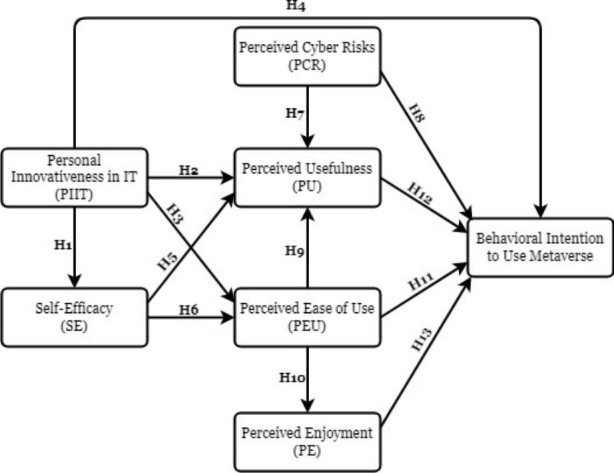
Metaverse, which combines a number of information technologies, is the Internet of the future. A media for immersive learning, metaverse could set future educational trends and lead to significant reform in education. Although the metaverse has the potential to improve the effectiveness of online learning experiences, metaverse-based educational implementations are still in their infancy. Additionally, what factors impact higher education students' adoption of the educational metaverse remains unclear. Consequently, the aim of this study is to explore the main factors that affect higher education students' behavioral intentions to adopt metaverse technology for education. This study has proposed an extended Technology Acceptance Model (TAM) to achieve this aim. The novelty of this study resides in its conceptual model, which incorporates both technological, personal, and inhibiting/enabling factors. The empirical data were collected via online questionnaires from 574 students in both private and public universities in Jordan. Based on the PLS-SEM analysis, the study identifies perceived usefulness, personal innovativeness in IT, and perceived enjoyment as key enablers of students' behavioral intentions to adopt the metaverse. Additionally, perceived cyber risk is found as the main inhibitor of students' metaverse adoption intentions. Surprisingly, the effect of perceived ease of use on metaverse adoption intentions is found to be insignificant. Furthermore, it is found that self-efficacy, personal innovativeness, and perceived cyber risk are the main determinants of perceived usefulness and perceived ease of use. While the findings of this study contribute to the extension of the TAM model, the practical value of these findings is significant since they will help educational authorities understand each factor's role and enable them to plan their future strategies.
Overview
The claims and statistics of this paper haven’t been checked yet.
Run the check — free, no account needed. It reads the open-access text and checks the sources it cites.
Integrity signals
Registry
Cites
Statistics
Figures
Verification
Claims the paper makes
The claims and statistics of this paper haven’t been checked yet.
Run the check — free, no account needed. It reads the open-access text and checks the sources it cites.
Claims other papers make about this one
Each is checked against this paper’s own text: does it say what the citing paper says it does?
The source backs part of the claim, not all of it — or backs it for a different population, condition or comparison.
In the citing paper
“They also aligned with evidence from mobile learning research showing that positive attitudes can strengthen students’ intention to use new technologies [91].”
From Advancing Undergraduate Student Mental Healthcare of Social Anxiety Disorder: Evaluating the Acceptance of AR-Assisted Cognitive Behavioral Therapy Through TAM-Based Constructs. (2026) · cites this paper as [91]
Experimental — accuracy not yet measured
Self-check
Percentages, sums and reported differences re-computed from the paper’s own numbers.
The self-check needs the paper’s full text.
Citations
Cites
Evaluating Structural Equation Models with Unobservable Variables and Measurement Error
Fornell, C., & Larcker, D. F. (1981) · Journal of Marketing Research · doi:10.2307/3151312 · Cited by 109,314
Evaluating structural equation models with unobservable variables and measurement error
Fornell, C., & Larcker, D. F. (1981) · Journal of Marketing Research · doi:10.1177/002224378101800104 · Cited by 109,190 · cited 1×
“As demonstrated in Table 4, this condition is met, concluding that discriminant validity is present (Fornell & Larcker, 1981 ).”
BackgroundThe theory of planned behavior
Ajzen, I. (1991) · Organizational Behavior and Human Decision Processes · doi:10.1016/0749-5978(91)90020-t · Cited by 90,587 · cited 1×
“According to Ajzen (1991), SE designates the confidence that one possesses in one’s capability to engage in a specific behavior.”
MethodPodsakoff, P. M., MacKenzie, S. B., Lee, J.-Y., & Podsakoff, N. P. (2003) · Journal of Applied Psychology · doi:10.1037/0021-9010.88.5.879 · Cited by 82,194 · cited 1×
“The finding showed that the loading of all measurement items in the dataset at once yielded a total variation of 44.678%, which is below the 50% threshold, indicating that CMB is absent (Podsakoff et al., 2003 ).”
BackgroundInfluentialStructural equation modeling in practice: A review and recommended two-step approach
Anderson, J. C., & Gerbing, D. W. (1988) · Psychological Bulletin · doi:10.1037/0033-2909.103.3.411 · Cited by 41,941 · cited 1×
“As instructed, we conducted the data analysis in two steps (Anderson & Gerbing, 1988 ).”
MethodA new criterion for assessing discriminant validity in variance-based structural equation modeling
Henseler, J., Ringle, C. M., & Sarstedt, M. (2015) · Journal of the Academy of Marketing Science · doi:10.1007/s11747-014-0403-8 · Cited by 38,459 · cited 1×
“Moreover, the result of the “Heterotrait–Mono - trait Ratio-HTMT” test indicates that all HTMT values < 0.85 (Henseler et al., 2015), endorsing the findings in terms of Fornell and Larcker’s criterion.”
ResultInfluentialWhen to Use and How to Report the Results of PLS-SEM
Hair, J. F., Risher, J. J., Sarstedt, M., & Ringle, C. M. (2019) · European Business Review · doi:10.1108/ebr-11-2018-0203 · Cited by 27,541 · cited 5×
“The outcomes showed that each construct in the research model acquired an accept - able Cronbech’s Alpha ( > 0.7) (Hair et al., 2019).”
BackgroundMethodResultInfluentialUser Acceptance of Computer Technology: A Comparison of Two Theoretical Models
Davis, F. D., Bagozzi, R. P., & Warshaw, P. R. (1989) · Management Science · doi:10.1287/mnsc.35.8.982 · Cited by 25,709 · cited 3×
“PU describes the extent to which individuals perceive that the usage of a specific technology enhances their performance (Davis et al., 1989).”
BackgroundInfluentialValente, T. W. (2003) · Genetics in Medicine · doi:10.1097/01.gim.0000061743.67794.c4 · Cited by 20,559
Venkatesh, V., Thong, J. Y. L., & Xu, X. (2012) · MIS Quarterly · doi:10.2307/41410412 · Cited by 15,756 · cited 1×
“Intrinsic motivation underpins the enjoyment concept (Abdullah & Ward, 2016), and is considered a hedonic motivation conceptualization (Venkatesh et al., 2012 ).”
Background
Research works printed but not linked: 5
- Bada, S. O., & Olusegun, S. (2015). Constructivism learning theory: A paradigm for teaching and learning. Journal of Research & Method in Education, 5(6), 66–70. https://doi.org/10.9790/7388-05616670 · DOI
- Kim, J. H., Lee, B. S., & Choi, S. J. (2022). A study on metaverse construction and use cases for non-face-to-face education. The Journal of the Convergence on Culture Technology, 8(1), 483–497. https://doi.org/10.17703/JCCT.2022.8.1.483 · DOI
- Lee, J., Kim, J., & Choi, J. Y. (2019b). The adoption of virtual reality devices: The technology acceptance model integrating enjoyment, social interaction, and strength of the social ties. Telematics and Informatics, 39, 37–48. https://doi.org/10.1016/j.tele.2018.12.006. · DOI · Paper page
- Mikusa, M. E. (2015). The effect of technology self-efficacy and personal engagement on students’ and teachers’ attitudes toward technology use in education (Doctoral dissertation). Appalachian State University.
- Saleh, S. S., Nat, M., & Aqel, M. (2022b). Sustainable adoption of E-Learning from the TAM Perspective. Sustainability, 14(6), 3690. https://doi.org/10.3390/su14063690. · DOI
Cited by
Sorted by citations
Items 201–300 of 637
Balaskas, S., Tsiantos, V. D., Chatzifotiou, S., Lourida, L., Rigou, M., & Komis, K. (2025) · Systems · doi:10.3390/systems13060412 · Cited by 9
Educational Potential of the Metaverse
Žunić, M., Dlab, M. H., Hoić-Božić, N., & Pribičević, Z. (2025) · International Journal of Distance Education Technologies · doi:10.4018/ijdet.382480 · Cited by 18
Hebibi, F., Runge, I., Scheiter, K., & Lazarides, R. (2025) · Education and Information Technologies · doi:10.1007/s10639-025-13795-z · Cited by 11
“This aligns with prior studies showing similar relationships (Al-Adwan et al., 2023; Joo et al., 2018; Nikou & Economides, 2019) across both teacher and non-teacher samples.”
Xie, J., Al-Shaibani, G. K. S., Zhao, J., & Talib, O. (2025) · Contemporary Educational Technology · doi:10.30935/cedtech/17301 · Cited by 6
Raymond, L., Paré, G., Doyon, O., & Wagner, G. (2025) · Journal of Advanced Nursing · doi:10.1111/jan.70307 · Cited by 6
“Moreover, following research on digital health training (e.g., Paré et al. 2022) and recent studies of the TAM (e.g., Al-Adwan et al. 2023), we include individual background as an additional variable in our model, represented by nurses' years of professional experience.”
Embracing the Metaverse: User perception and acceptance of the Metaverse in education
Baudier, P., de Vassoigne, T., Arami, M., Delannoy, A., & Germon, R. (2025) · Computers in Human Behavior · doi:10.1016/j.chb.2025.108804 · Cited by 9
Marasigan, K. M. C., Abequibel, B., Dammang, G. H., Cepeda, J. R., Laput, I. U., Tubo, M., & Sarona, J. M. (2024) · Lecture notes in networks and systems · doi:10.1007/978-3-031-48465-0_11 · Cited by 6
Hai-yin, S., & Guo, R. (2024) · International Journal of Human-Computer Interaction · doi:10.1080/10447318.2024.2331859 · Cited by 7
“Al-Adwan et al. (2023) used the TAM model to predict college students’ use of a meta-verse-based universe-based learning platform, and the study found that self-efficacy, personal innovation, and perceived network risk were the main determinants of perceived usefulness and perceived ease of use.”
Unveiling the key determinants and consequences of Virtual Reality in the immersion experience
Guo, H., Khan, A., Hsu, C.-W., & Chen, S. (2024) · Management & Marketing · doi:10.2478/mmcks-2024-0011 · Cited by 8
Unlocking the Potential of Metaverse Integration in Supply Chains: A Literature Review
Zheng, X., Keoy, K. H., & Lim, A. (2024) · PaperAsia · doi:10.59953/paperasia.v40i4b.157 · Cited by 6
Alshammari, S., & Alshammari, M. H. (2024) · PeerJ Computer Science · doi:10.7717/peerj-cs.2331 · Cited by 12
Deciphering the determinants: What guides creators in choosing their metaverse platforms?
Jung, Y., Nam, J., Choi, H., & Park, J.-H. (2024) · Technological Forecasting and Social Change · doi:10.1016/j.techfore.2024.123843 · Cited by 7
Kim, J., & Kim, M.-R. (2024) · The Journal of Korean Association of Computer Education · doi:10.32431/kace.2024.27.3.007 · Cited by 7
Student Adoption of AI Writing Tools
Malmous, M., & Zaidoune, S. (2024) · Advances in educational technologies and instructional design book series · doi:10.4018/979-8-3693-7220-3.ch009 · Cited by 7
Beyond reality: examining consumer intention to embrace metaverse within hospitality
Azhar, M., Khan, S., Kirmani, M. D., Mustafa, F., & Khan, F. M. (2025) · Journal of Hospitality and Tourism Insights · doi:10.1108/jhti-10-2024-1089 · Cited by 6
How Epistemic Curiosity Influences Digital Literacy: Evidence from International Students in China
Ma, S., Jin, X., Li, X., Dong, H., Dong, X., & Tang, B. (2025) · Behavioral Sciences · doi:10.3390/bs15030286 · Cited by 12
Theresiawati, Hidayanto, A. N., Seta, H. B., Widyatmoko, A. M., Muhammad, M. A., Said, M. F. A., & Adifai, S. R. (2025) · Interactive Learning Environments · doi:10.1080/10494820.2025.2546630 · Cited by 8
“Users who enjoy using a technology are more likely to develop a positive attitude toward it and are more likely to stick with it (Al-Adwan et al., 2023; Zhong et al., 2021).”
A new perspective in construction management; the metaverse
Öz, B. (2023) · doi:10.7764/rdlc.22.2.321 · Cited by 6
“A key barrier preventing students’ adoption of the metaverse technology is cyber risk, so some mechanisms are needed to reduce privacy and security risks (Al-Adwan et al., 2023).”
BackgroundBörekci, C., & Uyangör, N. (2025) · Balıkesir Üniversitesi Fen Bilimleri Enstitüsü Dergisi · doi:10.25092/baunfbed.1596547 · Cited by 7
When Generative AI Meets Abuse: What Are You Anxious About?
Song, Y., & Tan, H. (2025) · Journal of theoretical and applied electronic commerce research · doi:10.3390/jtaer20030215 · Cited by 5
Schlimm, J., & Breuer, C. (2025) · International Journal of Sports Marketing and Sponsorship · doi:10.1108/ijsms-05-2025-0225 · Cited by 5
Kashef, A., Wang, Y., Malatyali, A., & Ma, J.-F. (2025) · International Journal of Industrial Ergonomics · doi:10.1016/j.ergon.2025.103812 · Cited by 6
Zhao, T., Zhou, S., Liang, Q., & Xi, L. (2025) · Innovation in Language Learning and Teaching · doi:10.1080/17501229.2025.2551120 · Cited by 5
“This negative relationship was consistent with previous research showing a negative association between perceived cyber risks and the level of enjoyment (Al-Adwan et al. 2023).”
Alzahrani, A., & Alzahrani, A. (2025) · Distance Education · doi:10.1080/01587919.2025.2578734 · Cited by 5
“TAM model was built to understand the cognitive and psychological factors that influence students’ acceptance of new technologies (Al-Adwan et al., 2023). studies used TAM model to explore components such as behavior intention (BI) which determines the new technology adoption, and attitude (ATT)…”
Luo, X., & Adelopo, I. A. (2025) · Accounting Education · doi:10.1080/09639284.2025.2586574 · Cited by 5
Zhuo, Z., Li, D. Y., Chen, J., Chen, X., & Wang, S. (2025) · Systems · doi:10.3390/systems14010007 · Cited by 5
Cannavò, A., Lorenzis, F. D., Pratticò, F. G., Galante, L., & Lamberti, F. (2024) · Journal of Educational Computing Research · doi:10.1177/07356331241270658 · Cited by 5
“In order to determine the actual factors to consider for investigating the QoLE dimension, a number of works were analyzed (Al-Adwan et al., 2023; Araiza-Alba et al., 2021; Klingenberg et al., 2020; Lowell & Tagare, 2023; Song et al., 2021).”
Tin, T. T., Lee, M. Y., Chok, S. X., Huang, Y. H., Choy, X. N., Tiung, L. K., Ikumapayi, O. M., & Olugbade, T. O. (2024) · Online Journal of Communication and Media Technologies · doi:10.30935/ojcmt/15145 · Cited by 5
A Rubric for Peer Evaluation of Multi-User Virtual Environments for Education and Training
Lazou, C., Tsinakos, A. A., & Kazanidis, I. (2025) · Information · doi:10.3390/info16030174 · Cited by 10
Firman, A., Chau, K. Y., Walawalkar, A. M., & Moslehpour, M. (2025) · Journal of theoretical and applied electronic commerce research · doi:10.3390/jtaer20020118 · Cited by 9
“Adoption intentions in the Metaverse [54] and hospital information systems [13] have supported this conclusion.”
Al-Shamaileh, O., Mubin, O., & Nizamuddin, N. (2025) · International Journal of Human-Computer Interaction · doi:10.1080/10447318.2025.2532712 · Cited by 8
The illusion of reality in the gaming world: implications for libraries
Ajani, Y. A., Ahmed, A. O., & Muhammed, R. B. (2023) · Library Hi Tech News · doi:10.1108/lhtn-06-2023-0099 · Cited by 5
From Old to New Technologies: Exploring the Role and Impact of Value Resonance
Lee, K. (2024) · International Journal of Human-Computer Interaction · doi:10.1080/10447318.2023.2297328 · Cited by 5
“Furthermore, several subsequent studies on TAM have demonstrated that ease of use can directly influence behavioral intention (Al-Adwan et al., 2023; Han & Sa, 2022; Im et al., 2008; Mot � ak et al., 2018).”
InfluentialChang, T., & Hsiao, W. (2024) · Interactive Learning Environments · doi:10.1080/10494820.2024.2347309 · Cited by 5
Oraini, B. A. (2024) · E-Learning and Digital Media · doi:10.1177/20427530241256338 · Cited by 5
“Research indicates that usefulness is more effective for tasks that are intrinsically less interesting, as noted by (Al-Adwan et al., 2023; Davis et al., 2023; Zin et al., 2023).”
Students’ Flow Experience of Using AI-Powered Online English Learning Platforms
Wu, C.-H., & Fan, W. (2024) · HighTech and Innovation Journal · doi:10.28991/hij-2024-05-02-011 · Cited by 5
Petrescu, G.-D., Preda, A.-L., Radu, A.-C., ULMET, L.-A., & Radu, A.-V. (2025) · Social Sciences · doi:10.3390/socsci14030160 · Cited by 5
“Thus, according to this model there are a number of factors that have the ability to influence the use of a technology, such as the intention of a certain behavior, the perception (PER) of its usefulness, the attitude towards that technology, or the ease of use (EU), etc. (Al-Adwan et al. 2023).”
Factors Determining Acceptance of Internet of Things in Medical Education: Mixed Methods Study
Alhumaid, K. F., Ayoubi, K., Khalifa, M., & Salloum, S. A. (2025) · JMIR Human Factors · doi:10.2196/58377 · Cited by 4
“Early on in the acceptance of technology, students are usually eager to pioneer using advanced technologies [40-44].”
Osman, Z., Sulaiman, T. F. T., & Mohamad, L. (2025) · International Journal of Academic Research in Economics and Management Sciences · doi:10.6007/ijarems/v14-i2/25140 · Cited by 4
Lai, C.-Y., & Ho, W. (2025) · BMC Nursing · doi:10.1186/s12912-025-03620-w · Cited by 4
“ATU reflects an individual’s overall affective evaluation of the technology, BI indicates the user’s intention or willingness to use it, and AU represents the actual usage behavior [22, 25].”
Liu, J., & Sun, Y. (2025) · IEEE Access · doi:10.1109/access.2025.3613754 · Cited by 4
Arévalo-Tuesta, J. A., Morales-Romero, G., Quispe-Andía, A., Trinidad-Loli, N., León-Velarde, C., Arones, M., Aybar-Bellido, I., & Chamorro-Atalaya, O. (2025) · Sustainability · doi:10.3390/su17219694 · Cited by 7
Discovering how personal innovativeness drives digital banking usage in rural areas
Sang, T. M., & Ha, T. M. (2025) · Discover Sustainability · doi:10.1007/s43621-025-02217-2 · Cited by 4
“Previous research shows that individuals with high innovativeness tend to more easily convert their intentions into actions compared to those who are resistant to change [59].”
Open banking boost and brake: an extended technology acceptance model
Burchi, A., Figà‐Talamanca, G., & Tanzi, P. M. (2025) · International Journal of Bank Marketing · doi:10.1108/ijbm-03-2024-0161 · Cited by 10
Unlocking learning potentials: Understanding user intentions in AI-fueled metaverse education
Dhingra, S., Gupta, A., Chaudhry, K., Kumar, A., & Falwadiya, H. (2025) · Computers & Education X Reality · doi:10.1016/j.cexr.2025.100131 · Cited by 5
Zou, J., Kamarudin, K. M., Abidin, S. Z., Zhang, J., & Liu, J. (2025) · Scientific Reports · doi:10.1038/s41598-025-33100-9 · Cited by 5
Abbas, A. F., Ferasso, M., & Hassan, N. B. (2025) · Journal of Teaching in Travel & Tourism · doi:10.1080/15313220.2025.2607355 · Cited by 5
“Additional contributions include expert perspectives from panel discussions and the growing discourse on metaverse adoption in educational contexts (Al-Adwan et al., 2023; Hantono et al., 2018).”
Personalized, experiential, and future-centric: an adaptive business education framework
Alstete, J. W., & Meyer, J. P. (2026) · Journal of International Education in Business · doi:10.1108/jieb-03-2025-0036 · Cited by 4
Investigating the impact of chatbot interactivity on consumer behavior
Abd-El-Salam, E. M., & Youssef, A. H. (2026) · Humanities and Social Sciences Communications · doi:10.1057/s41599-026-08081-3 · Cited by 5
“In addition, TAM often disregards users ’ negative perceptions and concentrates solely on positive ones (Al-Adwan et al., 2023).”
Why Do Users Adopt Mobile Payment? An Integrated Model
Thi, T. D. P., Pham, V. K., & Duong, N. T. (2024) · Journal of the Knowledge Economy · doi:10.1007/s13132-024-02118-1 · Cited by 4
“Numerous empirical studies in the past have used the Technology Acceptance Model (TAM) to explain users’ acceptance level of information technology systems (Al-Adwan et al., 2023; Geebren et al., 2021).”
Chatterjee, R. S., Hameed, I., Chatterjee, S., Chaudhuri, R., Vrontis, D., & Foroudi, P. (2025) · Journal of Macromarketing · doi:10.1177/02761467251325070 · Cited by 4
“…technology (Huang et al., 2022; Humida et al., 2022), certain mobile-based technologies such as payment and transactions (Al-Qudah et al., 2024) and even new tech platforms such as Metaverse, which is gaining prominence as a new all-inclusive platform (Al-Adwan et al., 2023; Wu & Yu, 2023).”
Leveraging Ethics for Supporting Students' Artificial Intelligence Skills Development in Namibia
Uunona, G. N., & Goosen, L. (2025) · Advances in educational technologies and instructional design book series · doi:10.4018/979-8-3693-8965-2.ch011 · Cited by 4
Garcia, M. B. (2025) · Education and Information Technologies · doi:10.1007/s10639-025-13860-7 · Cited by 4
Surahmat, S. (2024) · Jurnal Informatika dan Teknik Elektro Terapan · doi:10.23960/jitet.v12i1.3843 · Cited by 4
E-learner’s continuance usage behavior of online learning: integration of ECM and TAM
Sumi, R. S. (2024) · International Journal of Research in Business and Social Science (2147-4478) · doi:10.20525/ijrbs.v13i2.3171 · Cited by 4
“Besides, as an external variable, PS has found a significant effect on PE in this study, which supports other research findings ( Al-Adwan et al. 2023; Luo & Du, 2022; Baki, et al. 2018).”
ResultExamining College Students' Adoption of Chatbots for Assignment Assistance
Subaveerapandiyan, A., Kataria, S., Karthiga, S. V., & Sundaram, S. R. (2024) · Advances in library and information science (ALIS) book series · doi:10.4018/979-8-3693-2782-1.ch010 · Cited by 5
Osman, Z., & Yatam, M. (2024) · International Journal of Academic Research in Accounting Finance and Management Sciences · doi:10.6007/ijarafms/v14-i2/21322 · Cited by 6
“Nurturing technological innovativeness, coupled with cultivating positive attitudes, contributes to a more seamless acceptance of AI-enabled transformations, particularly within the dynamic landscape of online distance learning institutions (Al-Adwan et al., 2023).”
BackgroundNg, P. H. F., Har, F. T. K., Tai, K. S. K., Leung, W. C. L., Chen, P. Q., Zhou, L., Lam, J. K. H., Law, H., Li, C., Lam, Y. Y., et al. (2024) · IEEE International Conference on Metaverse Computing, Networking and Applications (MetaCom) · doi:10.1109/metacom62920.2024.00035 · Cited by 4
“The evaluation of educational interventions within the Meta-verse has traditionally employed self-assessment questionnaires, utilizing frameworks such as the Technology Acceptance Model (TAM) and the Interactive, Constructive, Active, and Passive (ICAP) framework [18], [19].”
MethodAssessing the adoption and utilization of blockchain technology among software developers
Stojanović, T. D., Lazarević, S., Radenković, M., Naumović, T., & Miletić, A. (2024) · Facta universitatis - series Electronics and Energetics · doi:10.2298/fuee2401075s · Cited by 4
Osadchyi, V., & Osadchа, K. (2025) · Educological discourse · doi:10.28925/2312-5829/2025.1.1 · Cited by 4
Sun, J., Chao, Z., Long, T., & Tong, M. (2024) · Journal of Computers in Education · doi:10.1007/s40692-024-00319-w · Cited by 4
“Previous studies have demonstrated that TSE can influence TA, leading to its inclusion as an additional proposed determinant in this study (Al-Adwan et al., 2023; Huffman at al., 2013 ; Moran et al., 2010 ; Wang et al., 2023 ).”
Yuan, J., Shah, S. K., Tajeddini, K., Gamage, T. C., & Acevedo-Duque, Á. (2025) · International Journal of Human-Computer Interaction · doi:10.1080/10447318.2025.2482744 · Cited by 6
“The possible reason for the lack of PU in the second configuration is that users may not be able to actually use many MAPPs because they may lack knowledge or be unfamiliar with their working principles (Al-Adwan et al., 2023).”
How leadership fosters sustainable organizational agility through metaverse adoption
Saini, G., Gupta, S., & Baba, M. M. (2025) · International journal of organizational analysis · doi:10.1108/ijoa-08-2024-4776 · Cited by 3
Predictors of university students’ acceptance of ChatGPT in Chinese academic context
Wang, Y., & Gu, X. (2025) · Innovations in Education and Teaching International · doi:10.1080/14703297.2025.2498530 · Cited by 3
“By facilitating structured computational thinking and providing high-quality solutions (Akiba & Fraboni, 2023), ChatGPT reinforces the students’ perception of ease of use and usefulness among the Z generation students (Al-Adwan et al., 2023).”
The Emergence of Generative AI in Higher Education
Treceñe, J. K., Patiga, R. O. A., Odal, B. B., Tapales, R. G., Tuano, E. M. D., & Dayaon, M. C. (2025) · Advances in computational intelligence and robotics book series · doi:10.4018/979-8-3373-0122-8.ch004 · Cited by 3
Will Generation Z Use ChatGPT for Tourism Recommendations?
Suasapha, A. H. (2025) · Tourism and hospitality management · doi:10.20867/thm.31.3.11 · Cited by 5
“Research shows that TRU directly influences user ATT (Choung et al., 2023; Gerlich, 2023) and indirectly affects USE (Al Shamsi et al., 2022), while ENJ directly influences user intention (Al-Adwan et al., 2023; Huang et al., 2024; Wang et al., 2024b) and EOU (Kowalczyk-Anioł & Nowacki, 2020).”
Challenges and Opportunities of Artificial Intelligence (AI) for Malaysian Higher Education
Noor, N. H. M. (2025) · Advances in computational intelligence and robotics book series · doi:10.4018/979-8-3373-1827-1.ch006 · Cited by 3
Adopting net-zero supply chains: Integrated model of TOE and TAM in emerging economy context
Virmani, N., Kumar, P., Karuppiah, K., & Jagtap, S. (2025) · Sustainable Futures · doi:10.1016/j.sftr.2025.101188 · Cited by 5
Al-kfairy, M., Alfandi, O., & Alrabaee, S. (2025) · Cogent Education · doi:10.1080/2331186x.2025.2555530 · Cited by 3
“It allows for experiential learning through simulation, 3D environments, and social immersion (Dama (cid:1) sevi (cid:1) cius & Sidekerskien _ e, 2024; Al-Adwan et al., 2023).”
Liu, N. (2025) · Education and Information Technologies · doi:10.1007/s10639-025-13743-x · Cited by 3
“Furthermore, when students perceive technology as useful, they perceive the technology as easy to use, which engages students in learning activities (Al-Adwan et al., 2023 ).”
Kong, S. C., Yang, Y. P., & Zhang, H. (2025) · Computers & Education X Reality · doi:10.1016/j.cexr.2025.100121 · Cited by 3
Balancing generative AI integration and faculty well-being: evidence from Chinese higher education
Liu, G., Lan, G., Nneli, N. C., Song, F., Xiao, Q., & Zheng, M. (2025) · Frontiers in Education · doi:10.3389/feduc.2025.1688902 · Cited by 7
Factors affecting collaborative learning in the virtual world of the metaverse
Li, Z. R.-Y., & Chen, C.-H. (2025) · Interactive Learning Environments · doi:10.1080/10494820.2025.2589937 · Cited by 3
“The metaverse offers considerable benefits in simulating traditional classrooms by conveying learners’ engagement, co-presence, and body language (Al-Adwan et al., 2023; Teng et al., 2022).”
Chamboko-Mpotaringa, M. (2025) · African Journal of Hospitality Tourism and Leisure · doi:10.46222/ajhtl.19770720.610 · Cited by 3
Xue, F., Ali, A. Z. B. M., & Qi, L. (2025) · SAGE Open · doi:10.1177/21582440251388706 · Cited by 3
“Recent higher-education evidence further indicates that usefulness tends to dominate the direct pathway to adoption-related outcomes on emerging learning platforms (Al-Adwan et al., 2023), which aligns with our platform-facing route.”
InfluentialTelephysiotherapy technology acceptance among older adults: a qualitative study
Man, S. S., Wu, X., Chiu, K. T., Peng, L., & Chan, A. H. S. (2026) · Current Psychology · doi:10.1007/s12144-025-08613-1 · Cited by 3
“Furthermore, risk perception was found to affect how people adopt various technologies such as intelligent information technology (Park et al., 2022), generative artificial intelligence (Zhang & Wang, 2025), and metaverse-based learning platforms (Al-Adwan et al., 2023).”
Chen, T., Alghafes, R. A., Rustambekov, E., Malik, P., & Rai, J. S. (2026) · Technology in Society · doi:10.1016/j.techsoc.2026.103333 · Cited by 4
Oladokun, B. D., Atuase, D., Tachie‐Donkor, G., Mosweu, T. L., & Gaitanou, P. (2026) · The Journal of Academic Librarianship · doi:10.1016/j.acalib.2026.103253 · Cited by 4
Ge, Y., Wang, H., Wang, D., & Yang, B. (2026) · Scientific Reports · doi:10.1038/s41598-026-54068-0 · Cited by 4
Dang, D., Saleem, N. H., Nayani, W., & Erturk, E. (2026) · Education Sciences · doi:10.3390/educsci16060848 · Cited by 5
Exploring EFL Learners’ Technology Acceptance in Online Learning in Collaborative Education Programs
Chen, X., & Yang, Y. (2024) · Journal of Education Teaching and Social Studies · doi:10.22158/jetss.v6n2p195 · Cited by 3
Chiang, S., Chiang, D.-H., Chang, S.-H., & Yao, K. (2025) · Sustainability · doi:10.3390/su17093945 · Cited by 7
Cai, H., Chen, X., Zhao, Y., & Chen, H. (2025) · International Conference on Cloud Computing and Big Data Analytics (ICCCBDA) · doi:10.1109/icccbda64898.2025.11030420 · Cited by 3
“Al-Adwan Al-Adwan et al. aimed to explore the main factors affecting college students' behavioral intention to adopt metadata technology for education[9].”
CheatGuard: A cybersecurity inspired anti-cheating platform for higher education
Taj, I., Dadi, S. W., Wazan, A. S., Laborde, R., & Shoufan, A. (2025) · Education and Information Technologies · doi:10.1007/s10639-025-13705-3 · Cited by 3
“For instance, we plan to assess educators’ perceptions and acceptance of the platform in a subsequent study, using the Technology Acceptance Model (TAM) (Al-Adwan et al., 2023 ).”
Falebita, O. S., Abah, J. A., Asanre, A. A., Abiodun, T. O., Ayanwale, M. A., & Ayanwoye, O. K. (2025) · Education Sciences · doi:10.3390/educsci15101389 · Cited by 5
“This finding aligns with what is commonly reported in the literature, which reveals positive interactions between perceived ease of use and perceived usefulness (Al-Adwan et al., 2023; Falebita & Kok, 2025; Wu et al., 2024).”
All bark and no bite: drivers of virtual clothes purchase in the metaverse
Duarte, P., Reis, C., Silva, S. C. L. D. C. E., & Elmashhara, M. G. (2025) · Journal of Fashion Marketing and Management · doi:10.1108/jfmm-05-2024-0203 · Cited by 3
Exploration of College Students' Learning Adaptability Under the Background of Wisdom Education
Zhang, H., & Liu, X. (2024) · International Journal of Information Technology and Web Engineering · doi:10.4018/ijitwe.336486 · Cited by 3
Contribution & Power of Virtual Reality in Corporate World: A Conceptual Review
Asemi, A., & Kő, A. (2024) · International Conference on Distributed Computing and High Performance Computing (DCHPC) · doi:10.1109/dchpc60845.2024.10454076 · Cited by 3
“As organizations embrace these technologies, they can enhance employee development, improve knowledge retention, and optimize learning outcomes [102].”
BackgroundMaulana, F. I., Lestari, D. E., Purnomo, A., Arifuddin, R., Widartha, V. P., & Adi, P. D. P. (2024) · International Seminar on Intelligent Technology and Its Applications · doi:10.1109/isitia63062.2024.10668194 · Cited by 3
“It shows how important it is for people to think that new tools will help them [25], [26].”
BackgroundResultRise of the machines: Investigating service robot adoption intentions in hotel industry
Hanji, S. V., Navalgund, N. R., Hanji, S. S., Goud, G. V., Hatture, S. M., & Wadawadagi, R. S. (2024) · AIP conference proceedings · doi:10.1063/5.0229719 · Cited by 3
Demirel, A. E., Top, S. M., İlerisoy, Z. Y., & Kınacı, E. B. (2025) · Open House International · doi:10.1108/ohi-07-2024-0255 · Cited by 3
Boccia, F., & Palmieri, N. (2025) · Sustainable Horizons · doi:10.1016/j.horiz.2025.100140 · Cited by 3
Kılıç, E., & Çelik, H. E. (2025) · Computers and Education Artificial Intelligence · doi:10.1016/j.caeai.2025.100452 · Cited by 9
Virtual Learning Environment in a Philippine Higher Education Institution: Acceptance and Practices
Petancio, J. A. M. (2024) · International Journal of Information and Education Technology · doi:10.18178/ijiet.2024.14.5.2096 · Cited by 2
“The behavioral intention to use a VLE is directly influenced by its perceived usefulness [43, 46–49].”
BackgroundResultFutri, I., Ketkaew, C., & Naruetharadhol, P. (2024) · Societies · doi:10.3390/soc14080134 · Cited by 2
“Over time, new technologies have led to the extension of the TAM with the addition of predictors such as complexity, enjoyment, and image [54,55].”
Analysis of Metaverse Knowledge Levels of Prospective Mathematics: ANFIS Approach
Filiz, A., & Moralı, H. S. (2024) · Batı anadolu eğitim bilimleri dergisi · doi:10.51460/baebd.1521452 · Cited by 2
Design of an Improved Method for Visual Rendering in the Metaverse Using CIEM and MSRANet
Krishna, J. V., Singh, P., Nagaraju, R., Appaji, S. V. S., Kiran, A. U., & Spandana, K. (2025) · IEEE Access · doi:10.1109/access.2025.3532634 · Cited by 2
“…methodologies and applications that provide fine-grained details about the current state of metaverse technology and the challenges it carries [1], [2], [3], [4], [5], [6], [7], [8], [9], [10], [11], [12], [13], [14], [15], [16], [17], [18], [19], [20], [21], [22], [23], [24], [25], [26], [27],…”
An interplay among digital transformation, AI adoption and inclusive education
Thakur, A., Singla, K., Singla, K., Mishra, K. A., Kaur, P., & Kaur, S. (2025) · International Journal of Educational Management · doi:10.1108/ijem-11-2024-0686 · Cited by 5
Ukeje, N., Gutiérrez, J., Petrova, K., & Okolie, U. C. (2025) · Future Internet · doi:10.3390/fi17080326 · Cited by 2
Chiang, S., Chang, S.-H., Yao, K., & Kuo, M.-C. (2025) · Interactive Learning Environments · doi:10.1080/10494820.2025.2535675 · Cited by 2
“As a result, numerous modifications of the TAM have been developed (Kao & Huang, 2023; Putri et al., 2023; Al-Adwan et al., 2023).”
Metadata
- Authors
- Al-Adwan, A. S., Li, N., Al-Adwan, A., Abbasi, G. A., Albelbisi, N. A., & Habibi, A.
- Affiliations
- Xi’an Jiaotong-Liverpool University (CN)
- Al-Ahliyya Amman University (JO)
- King Fahd University of Petroleum and Minerals (SA)
- University of Malaya (MY)
- Universitas Jambi (ID)
- Corresponding author
- Al-Adwan, Amer
- ORCID
- Venue
- Education and Information Technologies
- Published
- 2023-04-28
- Volume
- 28
- Issue
- 11
- Pages
- 15381-15413
- ISSN
- 1360-2357 (ISSN-L)
- 1573-7608
- PMC
- PMC10140721
- OpenAlex
- W4367316498
- Cited by
- 637
- References
- 116
- Citations by year
- 2026: 169 · 2025: 244 · 2024: 191 · 2023: 33
- FWCI
- 732.78
- Type
- book chapter
- Language
- en
- Update notices
- correction (2023-06-02)
- Open access
- hybrid
- doi.org
- Locations
- Education and Information Technologies (publishedVersion, cc-by)
- PubMed Central (publishedVersion, cc-by)
- PubMed (publishedVersion)
- Figshare (submittedVersion, cc-by)
- Funders
- Hamad bin Khalifa University
- Topics
- Social Sciences › Decision Sciences › Information Systems and Management › Technology Adoption and User Behaviour
- Social Sciences › Education › Education and Learning Interventions
- Social Sciences › Education › Online and Blended Learning
- Keywords
- metaverse, technology acceptance model, technology adoption, behavioral intention, university students, perceived usefulness, perceived ease of use, perceived enjoyment, personal innovativeness, self-efficacy, immersive learning, online learning
About these checks
Registry, retraction, Cites and statistics results are computed, not judged, with one exception: a printed reference that no index lists is read once by a model before it counts as a citation error. Claims are extracted by a model and kept only when their quote appears verbatim in the text; each cited source is then checked, with a model’s help, for whether it says what the claim relies on. Those verdicts can be wrong — read the claim’s quote and the cited source before relying on one.
Statistics and arithmetic are recomputed, not judged.
Confidence bands are shown only for fields calibrated on our annotated test set. None is calibrated yet, so no band is shown.
What counts as a claim ›How we measure confidence ›How we check this ›
Are you an author, or do you see a problem with this page? Request a review
