

The DOI matches its Crossref record; 116 of the 116 references it cites were found in a registry or an index.
Extending the technology acceptance model (TAM) to predict university students’ intentions to use metaverse-based learning platforms
Open accessAbstract
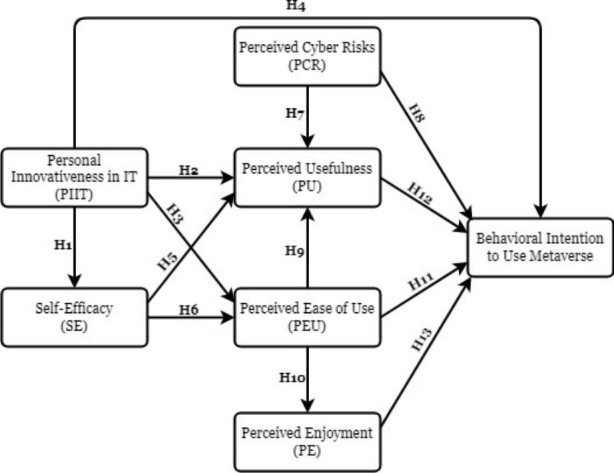
Metaverse, which combines a number of information technologies, is the Internet of the future. A media for immersive learning, metaverse could set future educational trends and lead to significant reform in education. Although the metaverse has the potential to improve the effectiveness of online learning experiences, metaverse-based educational implementations are still in their infancy. Additionally, what factors impact higher education students' adoption of the educational metaverse remains unclear. Consequently, the aim of this study is to explore the main factors that affect higher education students' behavioral intentions to adopt metaverse technology for education. This study has proposed an extended Technology Acceptance Model (TAM) to achieve this aim. The novelty of this study resides in its conceptual model, which incorporates both technological, personal, and inhibiting/enabling factors. The empirical data were collected via online questionnaires from 574 students in both private and public universities in Jordan. Based on the PLS-SEM analysis, the study identifies perceived usefulness, personal innovativeness in IT, and perceived enjoyment as key enablers of students' behavioral intentions to adopt the metaverse. Additionally, perceived cyber risk is found as the main inhibitor of students' metaverse adoption intentions. Surprisingly, the effect of perceived ease of use on metaverse adoption intentions is found to be insignificant. Furthermore, it is found that self-efficacy, personal innovativeness, and perceived cyber risk are the main determinants of perceived usefulness and perceived ease of use. While the findings of this study contribute to the extension of the TAM model, the practical value of these findings is significant since they will help educational authorities understand each factor's role and enable them to plan their future strategies.
Overview
The claims and statistics of this paper haven’t been checked yet.
Run the check — free, no account needed. It reads the open-access text and checks the sources it cites.
Integrity signals
Registry
Cites
Statistics
Figures
Verification
Claims the paper makes
The claims and statistics of this paper haven’t been checked yet.
Run the check — free, no account needed. It reads the open-access text and checks the sources it cites.
Claims other papers make about this one
Each is checked against this paper’s own text: does it say what the citing paper says it does?
The source backs part of the claim, not all of it — or backs it for a different population, condition or comparison.
In the citing paper
“They also aligned with evidence from mobile learning research showing that positive attitudes can strengthen students’ intention to use new technologies [91].”
From Advancing Undergraduate Student Mental Healthcare of Social Anxiety Disorder: Evaluating the Acceptance of AR-Assisted Cognitive Behavioral Therapy Through TAM-Based Constructs. (2026) · cites this paper as [91]
Experimental — accuracy not yet measured
Self-check
Percentages, sums and reported differences re-computed from the paper’s own numbers.
The self-check needs the paper’s full text.
Citations
Cites
Evaluating Structural Equation Models with Unobservable Variables and Measurement Error
Fornell, C., & Larcker, D. F. (1981) · Journal of Marketing Research · doi:10.2307/3151312 · Cited by 109,314
Evaluating structural equation models with unobservable variables and measurement error
Fornell, C., & Larcker, D. F. (1981) · Journal of Marketing Research · doi:10.1177/002224378101800104 · Cited by 109,190 · cited 1×
“As demonstrated in Table 4, this condition is met, concluding that discriminant validity is present (Fornell & Larcker, 1981 ).”
BackgroundThe theory of planned behavior
Ajzen, I. (1991) · Organizational Behavior and Human Decision Processes · doi:10.1016/0749-5978(91)90020-t · Cited by 90,587 · cited 1×
“According to Ajzen (1991), SE designates the confidence that one possesses in one’s capability to engage in a specific behavior.”
MethodPodsakoff, P. M., MacKenzie, S. B., Lee, J.-Y., & Podsakoff, N. P. (2003) · Journal of Applied Psychology · doi:10.1037/0021-9010.88.5.879 · Cited by 82,194 · cited 1×
“The finding showed that the loading of all measurement items in the dataset at once yielded a total variation of 44.678%, which is below the 50% threshold, indicating that CMB is absent (Podsakoff et al., 2003 ).”
BackgroundInfluentialStructural equation modeling in practice: A review and recommended two-step approach
Anderson, J. C., & Gerbing, D. W. (1988) · Psychological Bulletin · doi:10.1037/0033-2909.103.3.411 · Cited by 41,941 · cited 1×
“As instructed, we conducted the data analysis in two steps (Anderson & Gerbing, 1988 ).”
MethodA new criterion for assessing discriminant validity in variance-based structural equation modeling
Henseler, J., Ringle, C. M., & Sarstedt, M. (2015) · Journal of the Academy of Marketing Science · doi:10.1007/s11747-014-0403-8 · Cited by 38,459 · cited 1×
“Moreover, the result of the “Heterotrait–Mono - trait Ratio-HTMT” test indicates that all HTMT values < 0.85 (Henseler et al., 2015), endorsing the findings in terms of Fornell and Larcker’s criterion.”
ResultInfluentialWhen to Use and How to Report the Results of PLS-SEM
Hair, J. F., Risher, J. J., Sarstedt, M., & Ringle, C. M. (2019) · European Business Review · doi:10.1108/ebr-11-2018-0203 · Cited by 27,541 · cited 5×
“The outcomes showed that each construct in the research model acquired an accept - able Cronbech’s Alpha ( > 0.7) (Hair et al., 2019).”
BackgroundMethodResultInfluentialUser Acceptance of Computer Technology: A Comparison of Two Theoretical Models
Davis, F. D., Bagozzi, R. P., & Warshaw, P. R. (1989) · Management Science · doi:10.1287/mnsc.35.8.982 · Cited by 25,709 · cited 3×
“PU describes the extent to which individuals perceive that the usage of a specific technology enhances their performance (Davis et al., 1989).”
BackgroundInfluentialValente, T. W. (2003) · Genetics in Medicine · doi:10.1097/01.gim.0000061743.67794.c4 · Cited by 20,559
Venkatesh, V., Thong, J. Y. L., & Xu, X. (2012) · MIS Quarterly · doi:10.2307/41410412 · Cited by 15,756 · cited 1×
“Intrinsic motivation underpins the enjoyment concept (Abdullah & Ward, 2016), and is considered a hedonic motivation conceptualization (Venkatesh et al., 2012 ).”
Background
Research works printed but not linked: 5
- Bada, S. O., & Olusegun, S. (2015). Constructivism learning theory: A paradigm for teaching and learning. Journal of Research & Method in Education, 5(6), 66–70. https://doi.org/10.9790/7388-05616670 · DOI
- Kim, J. H., Lee, B. S., & Choi, S. J. (2022). A study on metaverse construction and use cases for non-face-to-face education. The Journal of the Convergence on Culture Technology, 8(1), 483–497. https://doi.org/10.17703/JCCT.2022.8.1.483 · DOI
- Lee, J., Kim, J., & Choi, J. Y. (2019b). The adoption of virtual reality devices: The technology acceptance model integrating enjoyment, social interaction, and strength of the social ties. Telematics and Informatics, 39, 37–48. https://doi.org/10.1016/j.tele.2018.12.006. · DOI · Paper page
- Mikusa, M. E. (2015). The effect of technology self-efficacy and personal engagement on students’ and teachers’ attitudes toward technology use in education (Doctoral dissertation). Appalachian State University.
- Saleh, S. S., Nat, M., & Aqel, M. (2022b). Sustainable adoption of E-Learning from the TAM Perspective. Sustainability, 14(6), 3690. https://doi.org/10.3390/su14063690. · DOI
Cited by
Sorted by citations
Items 401–500 of 637
Extended Reality Adoption in Moroccan Sports Institutes: A Vision for FIFA World Cup 2030
Bourhim, E. M., Labti, O., Faik, R., Sehbani, M., & Bettachi, K. (2024) · International Conference on Innovative Research in Applied Science, Engineering and Technology (IRASET) · doi:10.1109/iraset60544.2024.10549223 · Cited by 1
“Hence, the initial step is to investigate the factors influencing the acceptance of this technology among Moroccan sports students by employing TAM [6], as understanding these aspects is fundamental for fostering its effective implementation and utilization in their educational journey.”
BackgroundMobile Donation Application: The Role External Variable on the Application Usage Intention
Aulia, R. Y., Kholid, M. N., & Salsabilla, S. (2024) · Studies in systems, decision and control · doi:10.1007/978-3-031-54383-8_69 · Cited by 1
Yuan, H., Yuan, W., Duan, S., Yong, R., Jiao, K., Wei, Y., Leach, M. P., Li, N., Zhang, X., Lim, E. G., et al. (2024) · Humanities and Social Sciences Communications · doi:10.1057/s41599-024-03324-7 · Cited by 1
“Our student-centered FYP allocation mechanism aims to enhance its effectiveness and fairness by ensuring that the majority of students are allocated their preferred FYPs (Al-Adwan et al., 2023; Li et al., 2021).”
Unfolding e-learning services affecting factors from gender perspectives
Jovanka, D. R., Rasyono, R., Sofwan, M., Azhra, S. Y., & Habibi, A. (2024) · Edutec Revista Electrónica de Tecnología Educativa · doi:10.21556/edutec.2024.88.3099 · Cited by 1
Would You Like to Share? The Influence of Gamification in the Virtual Learning Community
Yang, Y., Yu, A., Li, J., Shafi, M., & Zhong, L. (2024) · Journal of the Knowledge Economy · doi:10.1007/s13132-024-02243-x · Cited by 1
“Previous studies have often overlooked the potential negative impacts that gamification may have, such as privacy risks (Al-Adwan et al., 2023; Büschel et al., 2014; C. Cheung et al., 2015; Nofer et al., 2014).”
Determinants of Metaverse Classroom Adoption: Insights from an African Country
Methlouthi, K. (2025) · Journal of African Business · doi:10.1080/15228916.2025.2460287 · Cited by 1
“Recent studies focusing on the Metaverse have affirmed the TAM model’s robustness as a theoretical framework for comprehending and predicting user behavior in learning and education (Al-Adwan et al., 2023; Chua & Yu, 2024; Salloum et al., 2023).”
InfluentialVirtual voyage: Unveiling the ‘3I’ influence on student learning
Fan, S., Wang, S., Mbanyele, W., Chen, Y., Miao, S., & Long, R. H. N. (2025) · PLoS ONE · doi:10.1371/journal.pone.0318548 · Cited by 1
Transforming Education with Innovative Virtual Learning Environments
Shwetha, G. K., Shetty, P. S., Baliga, S. N., Rathod, J. A., & Divya, C. (2024) · International Conference on Recent Advances in Science and Engineering Technology (ICRASET) · doi:10.1109/icraset63057.2024.10894905 · Cited by 1
“University students' intentions to adopt metaverse-based learning platforms are analyzed by Al-Adwan et al. (2023) using an extended version of the Technology Acceptance Model (TAM).”
Lee, M.-S., & Lee, J. Y. (2025) · Journal of Channel and Retailing · doi:10.17657/jcr.2025.1.31.1 · Cited by 1
Feasibility Analysis of an Immersive Network Laboratory as a Support Tool for Teaching Practices
Vieira, E. E., & de Medeiros, F. P. A. (2025) · Journal on Interactive Systems · doi:10.5753/jis.2025.5352 · Cited by 1
Li, C., & Lu, L. (2025) · Lecture notes in computer science · doi:10.1007/978-981-96-4407-0_10 · Cited by 1
An Empirical Study of Video Duration on Users’ Discontinuous Sage Intention: Based on the TAM Model
Wu, W. D., Zhang, W., & Wang, C. (2025) · Lecture notes in computer science · doi:10.1007/978-3-031-93221-2_26 · Cited by 1
Wohn, D. Y., Islam, A., Sah, Y. J., & Naderi, A. (2025) · International Journal of Human-Computer Interaction · doi:10.1080/10447318.2025.2509362 · Cited by 1
“Researchers have also applied conceptual models based on TAM with inclusion of factors such as player experience (Deng & Pan, 2023), perceived enjoyment (Al-Adwan et al., 2023) and Planned Behavior Theory (Toraman, 2022) to explore user attitudes towards the meta-verse and metaverse concerts.”
Integrating Technology to Elevate the Pedagogical Skills of Islamic Religious Educators
Sembiring, N. (2025) · Journal Evaluation in Education (JEE) · doi:10.37251/jee.v6i3.1701 · Cited by 1
Faisol, F., & Nurdiwaty, D. (2025) · Wiley eBooks · doi:10.1002/9781394411283.ch8 · Cited by 1
Zhou, Z., Zhou, Y., Ouyang, B., Man, S. S., & Chan, A. H. S. (2026) · Healthcare · doi:10.3390/healthcare14131978
“They also aligned with evidence from mobile learning research showing that positive attitudes can strengthen students’ intention to use new technologies [91].”
Khan, S., Kareem, S., Siddiqui, S., & Rousan, R. A. (2023) · SSRN Electronic Journal · doi:10.2139/ssrn.4594491
The Impact of Course Quality on University Students’ Acceptance of Online Practicum
Alsuhaymi, D. S. (2023) · International Journal of Information and Education Technology · doi:10.18178/ijiet.2023.13.12.2010
“The widespread usage of the internet and audio and videoconferencing applications (Zoom, Teams, Google Meet) installed on smartphones, tablets, and laptops have made online learning synchronously efficient [12].”
BackgroundHariyanti, U., Batita, M. S. R., & Suharsono, A. (2023) · International Conference on Sustainable Information Engineering and Technology (SIET) · doi:10.1145/3626641.3626940
Al-Hujailan, M. B. I. (2023) · Maǧallaẗ Kulliyyaẗ Al-Tarbiyyaẗ Bil-Manṣūraẗ · doi:10.21608/maed.2023.341555
“…and Davis in (1996, 2000), it focused on developing a vision of users due the use of technology and experiences link into their acceptance (Al-Adwan et al, 2023), controlling direct relationship between the user‟s technology acceptance and the external/internal factors that would impact…”
BackgroundFactors Affecting the Intention and Use of Metaverse
Alshammarı, S. H., & Alrashidi, M. E. (2024) · International Journal of Information and Communication Technology Education · doi:10.4018/ijicte.342591
Understanding Crucial Factors Of Metaverse Acceptance Among Gamers: Evidence From Empirical Studies
Sahoo, P., Saurav, A., Vemali, L. K., & Gandla, R. (2024) · doi:10.53555/kuey.v30i4.2008
Research on the Effect of Electrical Engineering Courses Enabled by Information Technology
Ji, A. (2024) · Advances in intelligent systems research/Advances in Intelligent Systems Research · doi:10.2991/978-94-6463-417-4_32
Srivastava, R., Chennelleri, H. U., Gupta, B., Abidi, N., Ramakrishna, Y., & Agarwal, R. (2024) · International Conference on Cyber Resilience (ICCR) · doi:10.1109/iccr61006.2024.10533122
“TAM considers factors like PU and PEOU with user requirements affecting technology acceptance[25].”
BackgroundSharma, A., Sharma, L. K., & Krezel, J. (2024) · Lecture notes in computer science · doi:10.1007/978-3-031-61691-4_12
Investigating the Probabilities of Customers Adopting Smartwatches During the InvestigationPreprint
Bhuiyan, M. J. U., Razzaq, A., Hossan, J., Ali, M. R., & Tonwy, T. T. (2024) · SSRN Electronic Journal · doi:10.2139/ssrn.4845384
(2024) · Journal of System and Management Sciences · doi:10.33168/jsms.2024.0908
(2024) · Journal of Logistics Informatics and Service Science · doi:10.33168/jliss.2024.0914 · Cited by 2
Musyaffi, A. M., Adha, M. A., Mukhibad, H., & Oli, M. C. (2024) · SSRN Electronic Journal · doi:10.2139/ssrn.4885498
Exploring the Relationship Between Collaborative Learning Factors and Perceived Learning
Zhong, H.-X., Lai, C., Ku, S.-H., & Chang, J.-H. (2024) · Lecture notes in computer science · doi:10.1007/978-3-031-65881-5_18
Prabowo, I. C., & Ramadhia, M. A. (2024) · Educoretax · doi:10.54957/educoretax.v4i7.938
“Therefore, TAM allows researchers to include additional potential elements by incorporating external variables that may drive the adoption of a particular technology (Al-Adwan et al., 2023).”
BackgroundAnagu, E. J., Oladunjoye, J. A., Cletus, F., & Ephraim, B. (2024) · International Journal of Technology in Education and Science · doi:10.46328/ijtes.557
“The results of the study also align with the discovery by Al-Adwan et al. (2023) that the significance of Personal Innovativeness in IT (PIIT) acts as both a direct and indirect predictor of adoption intentions among Generation Z students in making decisions about the utilization of metaverse…”
BackgroundResultExploring Electronic Ticketing Adoption in Taiwan’s Domestic Public Transportation Sector
You, C.-T., Chen, L.-B., & Kuo, S. (2024) · IEEE International Conference on Consumer Electronics - Taiwan (ICCE-Taiwan) · doi:10.1109/icce-taiwan62264.2024.10674347
Budiwati, N., Yusiana, R., Yulandri, E., & Yanti, P. (2024) · European Journal of Business Management and Research · doi:10.24018/ejbmr.2024.9.5.2475
Exploring Drivers of Online Infaq Intentions: Perspectives from the Muslims of Developing Country
Salsabilla, S. (2024) · Studies in big data · doi:10.1007/978-3-031-71213-5_37
Metaverse Adoption in Higher Education Institutions (HEIs): A Systematic Literature Review
Gautama, A., Hasim, H., Iwansaputra, R., & Kristin, D. M. (2024) · International Conference on ICT for Smart Society (ICISS) · doi:10.1109/iciss62896.2024.10750997
“…and Imagination 1 [18] Metaverse Technology 1 [3] Perceived Behavioral Control 1 [24] Perceived Curiosity 1 [8] Perceived Cyber Risks 1 [28] Perceived Privacy Risk 1 [13] Perceived Risk 1 [29] Perceived Value 1 [20] Personality 1 [23] Personalized Learning 1 [13] Situational Teaching 1…”
Metaverse technology acceptance in Indian medical education: An SEM-based empirical investigation
Hanji, S. V., Blagov, E., Navalgund, N. R., Desai, S., & Hanji, S. S. (2024) · Elsevier eBooks · doi:10.1016/b978-0-443-24049-2.00012-1
Digital Realities as Tools to Enhance Blended Learning in Accounting and Auditing Education
Mvunabandi, J. D., & Marimuthu, F. (2024) · International Journal of Applied Research in Business and Management · doi:10.51137/wrp.ijarbm.2024.jmdt.45631
Building Metaverse: Propose a design framework for the metaverse based on the requirements
Wu, Y., Chen, Y., Zhang, Y., & Liu, Y. (2024) · International Conference on Big Data and Internet of Things (BDIOT) · doi:10.1145/3697355.3697375
“In the metaverse, the demand for social interaction will remain constant, even as new forms of communication may emerge[10].”
Exploring the Trend of Metaverse Adoption in Formal Education: A Systematic Literature Review
Widyaputra, L. B., Janvieka, L., Deviany, & Cassandra, C. (2024) · International Conference on Information Management and Technology (ICIMTech) · doi:10.1109/icimtech63123.2024.10780893
Smartphone Integration for Physical Sciences: the Readiness of South African Teachers and LearnersPreprint
Muyambi, G. C., Nkopodi, N., & Jakovljević, M. (2024) · Research Square · doi:10.21203/rs.3.rs-5383247/v1
Metaverso: perspectivas, possibilidades e limitações
Marques, W. R., Viana, M. N. G., Viana, A. B., Gomes, L. C. A., Cruz, F. S., Rodrigues, B. M. C., Silva, A. L. F., Guaianaz, R. S., Bezerra, D. L. C., & Ferreira, D. J. L. (2024) · Caderno Pedagógico · doi:10.54033/cadpedv21n13-513
Barkoczi, N., Roman, A. F., & Maier, M. L. (2024) · Educatia 21 · doi:10.24193/ed21.2024.28.12
Wu, Y. (2024) · International Conference on Mobile Networks and Wireless Communications (ICMNWC) · doi:10.1109/icmnwc63764.2024.10872019
Saad, Z. A., Fauzi, M. A., & Osman, A. A. (2025) · Human Systems Management · doi:10.1177/01672533251322393
“Despite being widely used in various studies and fi elds such online learning, 32 mobile wallets, 33 or health information technologies, 34 TAM also considered the most in fl uential and commonly used framework for understanding online recruitment behavioural intentions.”
Factors influencing metaverse adoption among Korean soldiers
Kim, M. S., & Kim, S. (2025) · Acta Psychologica · doi:10.1016/j.actpsy.2025.104885
Decoding Public Sentiments: A Topic Modeling Analysis of the Metaverse Using Reddit Discourse
Sharma, L., Kaushık, N., & Sharma, T. (2025) · Springer proceedings in business and economics · doi:10.1007/978-3-031-77975-6_24
Evaluation of the Effective Online Learning for College Students using COOT Optimization Algorithm
Deng, H., & Wang, H. (2025) · International Conference on Intelligent Systems and Computational Networks (ICISCN) · doi:10.1109/iciscn64258.2025.10934200
“Ahmad Samed Al-Adwan et al. [14] implemented a Technology Acceptance Model (TAM) model was utilized to identify the major affected higher education student’s behaviors which are having intensions of to adopt the metaverse technology in their higher education.”
Intention to Use Cybersecurity in SMEs: Improving SMEs’ Performance
Halim, E., Dongalemba, B. A., & Agustin, T. (2024) · International Conference on Informatics and Computing (ICIC) · doi:10.1109/icic64337.2024.10956458
“Perceived Usefulness extent to the degree where an organization finds cybersecurity might enhance their organization's performance [21].”
InfluentialSentosa, A. V., Alverina, C., Agatha, K., & Gunawan, A. (2024) · International Conference on Informatics, Multimedia, Cyber and Information System (ICIMCIS) · doi:10.1109/icimcis63449.2024.10956753
MetaMinds and Digital Realms: Deciphering Gen Z Consumer Behavior in Metaverse Marketing
Mohanty, P., Chellasamy, A., & Nagarathinam, A. (2025) · Emerald Group Publishing Limited eBooks · doi:10.1108/978-1-83662-582-720251001
Paré, G., Raymond, L., & Sosso, F. A. E. (2025) · doi:10.2196/preprints.76795
Li, N., & Fan, Q. (2025) · IEEE International Conference on Electronics, Energy Systems and Power Engineering (EESPE) · doi:10.1109/eespe63401.2025.10986931
“Al-Adwan et al. developed an extended technology acceptance model and investigated the main factors influencing college students ’ behavioral intention to use metaverse technology for teaching [5].”
Navigating the Metaverse: Unveiling the Digital Frontier of Connectivity and Interaction
Vermani, R., & Arora, N. (2025) · Emerald Group Publishing Limited eBooks · doi:10.1108/978-1-83662-586-520251002 · Cited by 1
Villaceran, E. C., Himang, C. M., Garcia, J. M. S., & Densing, G. R. R. (2025) · SSRN Electronic Journal · doi:10.2139/ssrn.5265534
Metaverso y media digital: aprendizaje crítico y creativo
Reis, I. W., Romeiro, A. E., & Ulbricht, V. R. (2025) · Dialogia · doi:10.5585/54.2025.28413
Deploying Smart Handwashing Devices for Epidemic Prevention in Airport Terminals
You, C.-T., Chen, L.-B., & Kuo, S. (2025) · IEEE International Conference on Consumer Technology (ICCT-Pacific) · doi:10.1109/icct-pacific63901.2025.11012903
“Based on the literature review [4], [5], we propose the following hypotheses.”
Global Harwell: Should It Be Our Shared Global Educational Goal?
Chan, T.-W., Looi, C.-K., Wong, S. L., Chen, W., Kong, S. C., Chang, B., Wu, Y., Shih, J.-L., Yu, F., Chen, W., et al. (2025) · Proceedings. · doi:10.22318/icls2025.926221
Saira, S., Ali, S., & Odeh, C. D. (2025) · Journal of Applied Economic Research · doi:10.15826/vestnik.2025.24.2.016 · Cited by 1
Enhancing the Transition Phase in Lesson Planning Using AI Systems
Liu, Y., Wang, Y., & Xia, H. (2025) · Education as Change · doi:10.25159/1947-9417/18941
“Most research adopts a quantitative approach grounded in models such as the technology acceptance model (TAM) to investigate factors influencing teachers’ acceptance and use of technology (Al-Adwan et al. 2023; Kurniabudi, Sharipuddin, and Assegaff 2014; Ren 2009).”
Rassaei, E., & Mitchell, P. J. (2025) · Lecture notes in computer science · doi:10.1007/978-981-96-8430-4_13
Caluña, E. R. M., Diaz, D. J. C., Caluña, C. I. M., & Capelo, F. X. A. (2025) · Data & Metadata · doi:10.56294/dm2025728
Farida, F., Prabowo, H. A., Antón, & Rizki, H. T. N. (2025) · E-Learning Innovations Journal. · doi:10.57125/elij.2025.03.25.01
Pramesty, D. A., Usman, O., & Kusumaningtyas, D. P. (2025) · JAE (JURNAL AKUNTANSI DAN EKONOMI) · doi:10.29407/jae.v10i1.25500 · Cited by 1
“Teori yang digunakan untuk variabel ini adalah Technology Acceptance Model (TAM), menjelaskan bagaimana persepsi kegunaan dan kemudahan dapat mempengaruhi kepercayaan pengguna terhadap teknologi (Al-Adwan et al., 2023).”
Wang, T., & Long, Y. (2025) · SSRN Electronic Journal · doi:10.2139/ssrn.5362327
Alowayr, A. S. (2025) · International Journal of Computational and Experimental Science and Engineering · doi:10.22399/ijcesen.3537
Kasemwattanasuk, T., & Chaveesuk, S. (2025) · International Conference on Information Technology and Education Technology (ITET) · doi:10.1109/itet65804.2025.11101255
Exploring Virtual Clinical simulation-Based Learning with MSW Students: A mixed-Methods Study
Lynn, V., Joshi, M., Macri, L., & Simmons, C. (2025) · Studies in Clinical Social Work Transforming Practice Education and Research · doi:10.1080/28376811.2025.2546830
A Study on the Current State of the Metaverse Industry in Vietnam
Kang, H.-J., Dong-Su, Y., & Duong, T. T. T. (2025) · IGI Global eBooks · doi:10.4018/979-8-3693-7610-2.ch001
Suwarsih, Maulana, H., Janah, I. R., Ikhsan, R. B., Prabowo, H., & Helen (2025) · International Conference on Data Science and Its Applications (ICoDSA) · doi:10.1109/icodsa67155.2025.11157003
“These external variables provide insights for researchers to expand the TAM framework in adopting new technologies [20].”
Rojas-Nina, J. E., Saico, D. F. C., Pumaleque, L. Y. L., Cochón, F. F. A., & Vargas-Vizcarra, M. E. (2025) · European Public & Social Innovation Review · doi:10.31637/epsir-2026-2102
Examining factors influencing chatbot adoption in Takaful industry: Malaysian evidence
Thaker, H. M. T., Lacheheb, Z., Lelchumanan, B., Duasa, J., & Hesary, F. T. (2025) · International Journal of Islamic and Middle Eastern Finance and Management · doi:10.1108/imefm-01-2025-0056 · Cited by 2
Microlearning Factors to Impact the Digital Literacy Capabilities in the TikTok Application
Davinnov, J. K. P., & Wiryawan, D. (2025) · IEEE Symposium on Computers & Informatics (ISCI) · doi:10.1109/isci65687.2025.11167167
“The TAM model focuses on adopting information technology [20].”
Cyber-Security Effect on Smart Technology Through User Experience in the Horn of Africa
Jio, W., Kant, S., & Gautam, R. K. (2025) · IGI Global eBooks · doi:10.4018/979-8-3373-1832-5.ch002
Determinants of the Success of E-Faktur Tax Application Implementation: A Quantitative Study
Nur, M., Mulang, H., & Rosmawati, R. (2025) · Jurnal Akuntansi · doi:10.24912/ja.v29i3.3251
“A similar finding was reported by (Al-Adwan et al., 2023) in their study on the adoption of metaverse technology in higher education.”
Hubble, T. R., Carbone, L., Vandenbosch, L., Toelen, J., & Coninck, D. D. (2025) · JMIR Pediatrics and Parenting · doi:10.2196/75489
“Several studies on online educational platforms have similarly found that perceived ease of use does not significantly predict intention to use [81,82].”
Challenges of VR Adoption in Iraqi Higher Education
Al-Fayyadh, F. K., & Gilányi, A. (2025) · IEEE International Conference on Cognitive Infocommunications · doi:10.1109/coginfocom66819.2025.11200850
Digitalization of Businesses with Low-Cost Web and IoT Technologies: A Case Study of a Smart Gym
Sánchez, J. B., Barzola, V. E., & López, C. Q. (2025) · Communications in computer and information science · doi:10.1007/978-3-032-08614-3_17
The Role of External Factors on Actual Technology Use of Omni Channel Applications
Samiono, B. E., Pratiwi, A., Sunarmo, S., & Alam, R. (2025) · Jurnal Manajemen · doi:10.24912/jm.v29i3.2745
“In addition, it was found that personal innovativeness, computer self-efficacy, and perceived cyber risk strongly influence perceived usefulness and perceived ease of use (Al-Adwan et al., 2023).”
Navigating the future: Unveiling educational trends in the metaverse through text mining
Sharma, C. B., Kumar, S., Mishra, M. K., Sharma, S., Bali, P., Kautish, S., Almazyad, A. S., Mohamed, A. W., & Mousavirad, S. J. (2025) · Alexandria Engineering Journal · doi:10.1016/j.aej.2025.10.025
“The study by [26] contributed to the understanding of students ’ motivations and perceived value in adopting Metaverse environments, while another study [27] examined the factors influencing technology acceptance in metaverse platforms.”
Gonzales, G. G., Hermoso, R. M., Milano, M. L., Pasaje, S. J., Villaflor, M. G., & Gonzales, R. R. (2025) · SSRN Electronic Journal · doi:10.2139/ssrn.5707092
Alomari, K. M., Maghaydah, S., Mahde, A., Mohammed, A. A., Korany, H., & Abunawas, M. K. (2025) · IEEE International Conference on Advanced Systems and Emergent Technologies (IC_ASET) · doi:10.1109/ic_aset65966.2025.11232258
“Such insights underscore the importance of fostering a conducive innovative academic atmosphere that encourages experimentalism and meets the diverse requirements of students and educators thereby boosting adoption of Metaverse technology [23].”
Exploring the Role of Metaverse in Education: A Systematic Literature Review
Shukla, R., & Bhaskar, P. (2025) · 2025 International Conference on Next Generation of Green Information and Emerging Technologies (GIET) · doi:10.1109/giet65294.2025.11234837
“Students may be resist adopting new technologies as they feel comfort with traditional methods (Al-Adwan et al., 2023).”
Fintech Adoption and Credit Access of Micro, Small, Medium Enterprises in Nairobi City County, Kenya
Terry, F. O. I., Kithandi, C. K., & Onchomba, M. S. (2025) · East African Finance Journal · doi:10.59413/eafj/v4.i4.5
Perțicaș, D., Sabău-Popa, C., Dodescu, A., Hatos, R., Florea, A.-G., & Juma, H. W. (2025) · Amfiteatru Economic · doi:10.24818/ea/2025/s19/1441
“This is supported by the Technology Acceptance Model (TAM), which emphasises perceived usefulness and ease of use as determinants of behavioural intention (Yuen et al., 2021; Al-Adwan et al., 2023).”
Chowdhury, T. I., Raihan, M. Z., & Azad, M. A. K. (2025) · Journal of Contemporary Marketing Science · doi:10.1108/jcmars-09-2024-0033
Xiao, J., Xie, L., Zhong, C., Luo, M. J., & Xia, T. (2025) · Research Square · doi:10.21203/rs.3.rs-8617018/v1
Rashid, S. (2025) · Contemporary Educational Technology · doi:10.30935/cedtech/17546
Wibowo, S. F., Respati, D. K., Musyaffi, A. M., Sadat, A. M., Purwohedi, U., Hapsoro, D. D., Priurity, K., & Adha, M. A. (2025) · International Conference on Electrical, Computer, Communications and Mechatronics Engineering (ICECCME) · doi:10.1109/iceccme64568.2025.11277730
The Influence of Blockchain in Online Games Innovation: TAM Approach
Tjahyadi, R., & Ekaputra, H. (2025) · International Conference on Electronic and Electrical Engineering and Intelligent System (ICE3IS) · doi:10.1109/ice3is66769.2025.11280988
“It has been shown that people tend to try new technology if it isn’t complex or at least doesn’t need a lot of effort [8].”
Ajid, K. A. N. L. A., Yasirandi, R., & Insan, I. M. (2025) · International Conference on Software Engineering and Information Technology (ICoSEIT) · doi:10.1109/icoseit67010.2025.11291006
“…TRAM combines Technology Readiness Index (TRI), which includes optimism, innovativeness, discomfort, and insecurity, with TAM which includes perceived usefulness (PU) and perceived ease of use (PEOU), to explain intention to use (ITU) delivery service applications within the campus environment [9].”
Acceptance of Immersive Virtual Technology by Junior High School Students
UMEMURO, H., Saito, M., & SHIMADA, M. (2025) · The Japanese Journal of Ergonomics · doi:10.5100/jje.61.241
Diba, S. I., Karmakar, A., Hossain, M. A. S., & Emon, M. F. H. (2025) · SSRN Electronic Journal · doi:10.2139/ssrn.5565133
User intentions in Vietnam’s mobile payments: Integrating TAM, TTF, and agile practices
Pham, V. K., Huynh, A. V., Nguyen, M. K., Vo, M. H., & Nguyen, D. T. P. (2025) · AIP conference proceedings · doi:10.1063/5.0290783
Effect of System Cost, Self-Efficacy and Attitude on Acceptance of Telemedicine System
Al-Okdeh, S. K. (2025) · Advances in Science, Technology & Innovation/Advances in science, technology & innovation · doi:10.1007/978-3-031-90558-2_6
Li, Q. (2025) · International Symposium on Artificial Intelligence for Education (ISAIE) · doi:10.1145/3775073.3775184
“Practices such as algorithmic and generative art, immersive media exhibitions, and metaverse-based performances illustrate how digital creativity can enrich education and expand student skills [5, 6].”
Adaptation of Metaverse Banking Services in India: A Structural Equation Modeling Approach
Swaroop, S., Dixit, S., & Srivastava, H. (2025) · Emerald Group Publishing Limited eBooks · doi:10.1108/978-1-83662-666-420261009
Bazie, H., Lemma, B., Wasyhun, A., & Bezabih, A. (2025) · Eurasia Journal of Mathematics Science and Technology Education · doi:10.29333/ejmste/17565 · Cited by 3
“…it highlights how constructs such as perceived ease of use and perceived usefulness shape behavioral intentions, even in contexts where infrastructural limitations – such as restricted ICT resources or connectivity challenges – may undermine direct usability perceptions (Al-Adwan et al., 2023).”
Metadata
- Authors
- Al-Adwan, A. S., Li, N., Al-Adwan, A., Abbasi, G. A., Albelbisi, N. A., & Habibi, A.
- Affiliations
- Xi’an Jiaotong-Liverpool University (CN)
- Al-Ahliyya Amman University (JO)
- King Fahd University of Petroleum and Minerals (SA)
- University of Malaya (MY)
- Universitas Jambi (ID)
- Corresponding author
- Al-Adwan, Amer
- ORCID
- Venue
- Education and Information Technologies
- Published
- 2023-04-28
- Volume
- 28
- Issue
- 11
- Pages
- 15381-15413
- ISSN
- 1360-2357 (ISSN-L)
- 1573-7608
- PMC
- PMC10140721
- OpenAlex
- W4367316498
- Cited by
- 637
- References
- 116
- Citations by year
- 2026: 169 · 2025: 244 · 2024: 191 · 2023: 33
- FWCI
- 732.78
- Type
- book chapter
- Language
- en
- Update notices
- correction (2023-06-02)
- Open access
- hybrid
- doi.org
- Locations
- Education and Information Technologies (publishedVersion, cc-by)
- PubMed Central (publishedVersion, cc-by)
- PubMed (publishedVersion)
- Figshare (submittedVersion, cc-by)
- Funders
- Hamad bin Khalifa University
- Topics
- Social Sciences › Decision Sciences › Information Systems and Management › Technology Adoption and User Behaviour
- Social Sciences › Education › Education and Learning Interventions
- Social Sciences › Education › Online and Blended Learning
- Keywords
- metaverse, technology acceptance model, technology adoption, behavioral intention, university students, perceived usefulness, perceived ease of use, perceived enjoyment, personal innovativeness, self-efficacy, immersive learning, online learning
About these checks
Registry, retraction, Cites and statistics results are computed, not judged, with one exception: a printed reference that no index lists is read once by a model before it counts as a citation error. Claims are extracted by a model and kept only when their quote appears verbatim in the text; each cited source is then checked, with a model’s help, for whether it says what the claim relies on. Those verdicts can be wrong — read the claim’s quote and the cited source before relying on one.
Statistics and arithmetic are recomputed, not judged.
Confidence bands are shown only for fields calibrated on our annotated test set. None is calibrated yet, so no band is shown.
What counts as a claim ›How we measure confidence ›How we check this ›
Are you an author, or do you see a problem with this page? Request a review
