

The DOI matches its Crossref record; 212 of the 212 references it cites were found in a registry or an index.
A Conceptual Framework to Integrate Research Programs on Self-Regulation in Education
Open accessAbstract
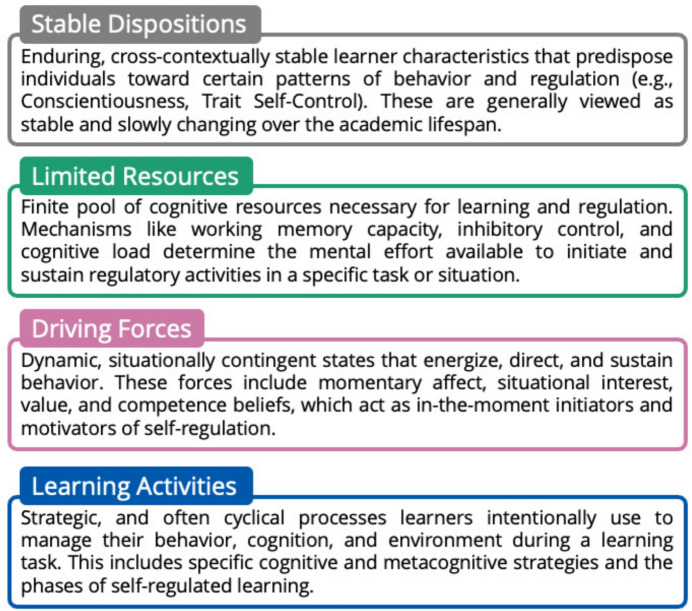
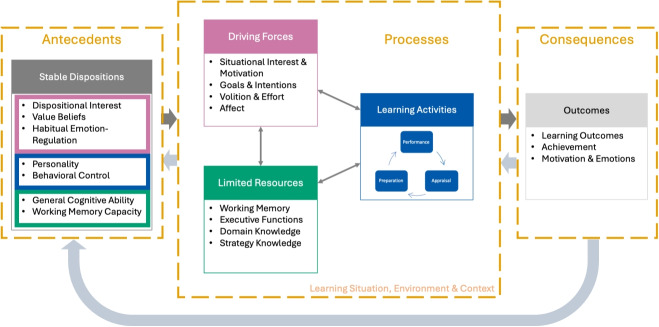
Self-regulation (SR) has emerged as a pivotal construct in educational research, yet its diverse theoretical accounts often lack comprehensive integration. This paper addresses this by proposing an integrative conceptual framework that consolidates four core research traditions on SR in educational settings, each emphasizing distinct underlying mechanisms: (1) Stable Dispositions (e.g., personality traits; Matthews et al., 2009; Roberts et al., 2007; Song et al., 2020), (2) Limited Resources (e.g., working memory capacity and executive functioning; Friedman & Miyake, 2017; Paas et al., 2003; Sweller, 1994), (3) Driving Forces (e.g., motivation, interest, and affect; Eccles & Wigfield, 2002; Hidi & Renninger, 2006; Trautwein et al., 2019), and (4) Learning Activities (e.g., self-regulated learning, cognitive and metacognitive strategies; Winne & Hadwin, 1998; 2008; Zimmerman, 2000). By synthesizing these perspectives, our framework positions SR as a dynamic, interdependent system, emphasizing how interactions and compensatory mechanisms explain individual differences and influence learning outcomes. We further argue for an integrative methodological toolkit, leveraging advanced machine learning and computational models, to capture the multi-level, temporal, and social dynamics inherent in SR. This holistic approach is crucial for advancing a comprehensive and ecologically valid understanding of SR in educational contexts.
Overview
The claims and statistics of this paper haven’t been checked yet.
Run the check — free, no account needed. It reads the open-access text and checks the sources it cites.
Integrity signals
Registry
Cites
Statistics
Figures
Verification
Claims the paper makes
The claims and statistics of this paper haven’t been checked yet.
Run the check — free, no account needed. It reads the open-access text and checks the sources it cites.
Claims other papers make about this one
Each is checked against this paper’s own text: does it say what the citing paper says it does?
The cited source says what the claim attributes to it.
In the citing paper
“This model distinguishes four key components that interact to shape learning outcomes: personal dispositions (e.g., personality traits such as conscientiousness) that describe learners' constraints when entering a learning episode, driving forces (e.g., current motivation) that energize learning behaviors, limited resources (e.g., cognitive capacity, executive functions) that determine the”
From Enhancing School Students' Self-Regulated Learning through Generative AI Support: A Randomized Controlled Trial (2026) · cites this paper as Wortha et al., 2026
The cited source says what the claim attributes to it.
In the citing paper
“Drawing on the integrative model of self-regulation in education (Wortha et al., 2026), our results suggest that motivational components-particularly utility value and interest-may be more amenable to scalable GenAI-based support than cognitive learning strategies (at least in the form of interventions that are designed like the ones in our study).”
From Enhancing School Students' Self-Regulated Learning through Generative AI Support: A Randomized Controlled Trial (2026) · cites this paper as Wortha et al., 2026
Self-check
Percentages, sums and reported differences re-computed from the paper’s own numbers.
The self-check needs the paper’s full text.
Citations
Cites
Ryan, R. M., & Deci, E. L. (2000) · American Psychologist · doi:10.1037//0003-066x.55.1.68 · Cited by 54,599
Miyake, A., Friedman, N. P., Emerson, M. J., Witzki, A. H., Howerter, A., & Wager, T. D. (2000) · Cognitive Psychology · doi:10.1006/cogp.1999.0734 · Cited by 15,798 · cited 7×
“The regulation of cognition, behavior, motivation, and affect requires considerable mental effort and attentional control, relying heavily on resources such as working-memory capacity and executive functions (Hofmann et al., 2012; Miyake et al., 2000; Pintrich & Zusho, 2002).”
InfluentialSelf-citationDiamond, A. (2013) · Annual Review of Psychology · doi:10.1146/annurev-psych-113011-143750 · Cited by 13,268
An Integrative Theory of Prefrontal Cortex Function
Miller, E. K., & Cohen, J. D. (2001) · Annual Review of Neuroscience · doi:10.1146/annurev.neuro.24.1.167 · Cited by 12,803
Metacognition and cognitive monitoring: A new area of cognitive–developmental inquiry
Flavell, J. H. (1979) · American Psychologist · doi:10.1037/0003-066x.34.10.906 · Cited by 11,282 · cited 1×
“The roots of this tradition lie in research on metacognition, that is, the monitoring and regulation of cognitive processes (Flavell, 1979).”
Motivational beliefs, values, and goals
Eccles, J. S., & Wigfield, A. (2002) · Annual Review of Psychology · doi:10.1146/annurev.psych.53.100901.135153 · Cited by 7,587
Grit: perseverance and passion for long-term goals
Duckworth, A. L., Peterson, C., Matthews, M. D., & Kelly, D. R. (2007) · Journal of Personality and Social Psychology · doi:10.1037/0022-3514.92.6.1087 · Cited by 6,911
High self-control predicts good adjustment, less pathology, better grades, and interpersonal success
Tangney, J. P., Baumeister, R. F., & Boone, A. L. (2004) · Journal of Personality · doi:10.1111/j.0022-3506.2004.00263.x · Cited by 6,557
Classrooms: Goals, structures, and student motivation.
Ames, C. (1992) · Journal of Educational Psychology · doi:10.1037/0022-0663.84.3.261 · Cited by 6,468
Zimmerman, B. J. (2000) · Handbook of Self-Regulation · doi:10.1016/b978-012109890-2/50031-7 · Cited by 6,069 · cited 5×
“…knowledge structures, and conditions required for effective regulation (Boekaerts, 1996; Efklides, 2011), process-oriented approaches focus on how Learning Activities unfold dynamically across phases of preparation, performance, and adaptation (Winne & Hadwin, 1998, 2008; Zimmerman, 2000).”
Influential
Research works printed but not linked: 15
- National Research Council. (2011). Assessing 21st century skills: Summary of a workshop. Washington, DC: The National Academic Press.
- Alloway, T. P. (2006). How does working memory work in the classroom? Educational Research and Reviews, 1(4), 134–139.
- Bauer, I. M., & Baumeister, R. F. (2011). Self-regulatory strength. In R. F. Baumeister, & K. D. Vohs (eds.), Handbook of self-regulation: Research, theory, and applications (pp. 64–82). The Guilford Press.
- Borkowski, J. G., Chan, L. K. S., & Muthukrishna, N. (2000). A process-oriented model of metacognition: Links between motivation and executive functioning. In G. Schraw, & J. Impara, (eds.), Issues in the measurement of metacognition. Lincoln, NE: Buros Institute of Mental Measurements, University of Nebraska.
- Butterfield, E. C., Albertson, L. R., & Johnston, J. C. (1995). On making cognitive theory more general and developmentally pertinent. In F. Weinert, & W. Schneider (eds.), Memory performance and competencies: Issues in growth and development (pp. 181–206). Hillsdale, NJ: Erlbaum.
- Gerjets, P. (1997). Volitional action control and cognitive mechanisms: Possible reductions on the basis of intertheoretical links. Psychologische Beitrage, 39, 441–470.
- Gutman, L. M., & Schoon, I. (2013). The impact of non-cognitive skills on outcomes for young people. a literature review. Education Endowment Foundation.
- Herman, C. F. (1979). The validity issue with respect to event data. In D. Munton (ed.), Measuring international behavior: Public sources, events and validity (pp. 29–40). Halifax, Canada: Dalhousie University.
- Holland, J. L. (1997). Making vocational choices: A theory of vocational personalities and work environments (3rd ed.). Odessa, FL, US: Psychological Assessment Resources.
- Oprescu, M., Syrgkanis, V., & Wu, Z. S. (2019). Orthogonal random forest for causal inference. In International conference on machine learning (pp. 4932–4941)
- Rieger, S., Göllner, R., Spengler, M., Trautwein, U., Nagengast, B., & Roberts, B. W. (2017). Social cognitive constructs are just as stable as the big five between grades 5 and 8. AERA Open, 3(3), 1–9. https://doi.org/10.1177/2332858417717 · DOI
- Winne, P. H. (2001). Self-regulated learning viewed from models of information processing. In B. J. Zimmerman & D. H. Schunk (Eds.), Self-regulated learning and academic achievement: Theoretical perspectives (pp. 153–189). Erlbaum.
- Winne, P. H., & Hadwin, A. F. (1998). Studying as self-regulated learning. In D. J. Hacker, J. Dunlosky, & A. C. Graesser (eds.), Metacognition in educational theory and practice (pp. 277-304). Mahwah, NJ, US: Lawrence Erlbaum Associates Publishers.
- Winne, P. H., & Hadwin, A. F. (2008). The weave of motivation and self-regulated learning. In D. Schunk & B. J. Zimmerman (eds.), Motivation and self-regulated learning: Theory, research, and applications (pp. 297–314). Mahwah, NJ: Erlbaum.
- Wolters, C. A. (2010). Self-regulated learning and the 21st century competencies Self published.
Cited by
Sorted by citations
Fütterer, T., Bardach, L., Kuhn, J., Keller, S. D., & Gerjets, P. (2026) · Educational Psychology Review · doi:10.1007/s10648-026-10133-8 · Cited by 17
Self-citation
Metadata
- Authors
- Wortha, F., Gerjets, P., Azevedo, R., Bernacki, M., Brucker, B., Bühler, B., Ehlis, A.-C., Kasneci, E., Miyake, A., Murayama, K., Nagengast, B., Roberts, B., Tibus, M., & Trautwein, U.
- Affiliations
- Loughborough University (GB)
- Leibniz-Institut für Wissensmedien (DE)
- University of Central Florida (US)
- University of North Carolina at Chapel Hill (US)
- Technical University of Munich (DE)
- Universitätsklinikum Tübingen (DE)
- University of Colorado Boulder (US)
- University of Tübingen (DE)
- University of Illinois Urbana-Champaign (US)
- Corresponding author
- Wortha, Franz
- Gerjets, Peter
- ORCID
- Venue
- Educational Psychology Review
- Published
- 2026-08-10
- Volume
- 38
- Issue
- 1
- Pages
- 110-110
- ISSN
- 1040-726X (ISSN-L)
- 1573-336X
- PMC
- PMC13454015
- OpenAlex
- W7202050467
- Cited by
- 0
- References
- 212
- FWCI
- 0.00
- Type
- journal article
- Language
- en
- Open access
- hybrid
- doi.org
- Locations
- Educational Psychology Review (publishedVersion, cc-by)
- PubMed (publishedVersion)
- PubMed Central (publishedVersion, cc-by)
- Funders
- Economic and Social Research Council (ES/W002914/1)
- Exzellenzinitiative des Bundes und der Länder (GSC1028)
- Topics
- Social Sciences › Psychology › Developmental and Educational Psychology › Innovative Teaching and Learning Methods
- Social Sciences › Psychology › Developmental and Educational Psychology › Education, Achievement, and Giftedness
- Social Sciences › Psychology › Developmental and Educational Psychology › Educational Strategies and Epistemologies
- Keywords
- self-regulation, conceptual framework, personality traits, resource constraints, working memory capacity, executive function, motivation, interest, affect, student self-regulation, metacognitive strategies, individual differences, compensatory mechanisms, machine learning, computational modeling
About these checks
Registry, retraction, Cites and statistics results are computed, not judged, with one exception: a printed reference that no index lists is read once by a model before it counts as a citation error. Claims are extracted by a model and kept only when their quote appears verbatim in the text; each cited source is then checked, with a model’s help, for whether it says what the claim relies on. Those verdicts can be wrong — read the claim’s quote and the cited source before relying on one.
Statistics and arithmetic are recomputed, not judged.
Confidence bands are shown only for fields calibrated on our annotated test set. None is calibrated yet, so no band is shown.
What counts as a claim ›How we measure confidence ›How we check this ›
Are you an author, or do you see a problem with this page? Request a review
