

The Relationship Between Nature Connectedness and Eudaimonic Well-Being: A Meta-analysis
Open accessThe DOI matches its Crossref record; 103 of the 106 references it cites were found in a registry or an index.
Abstract
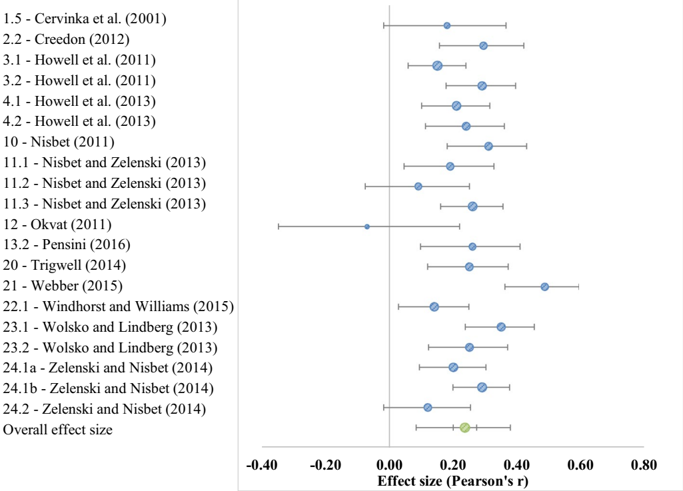
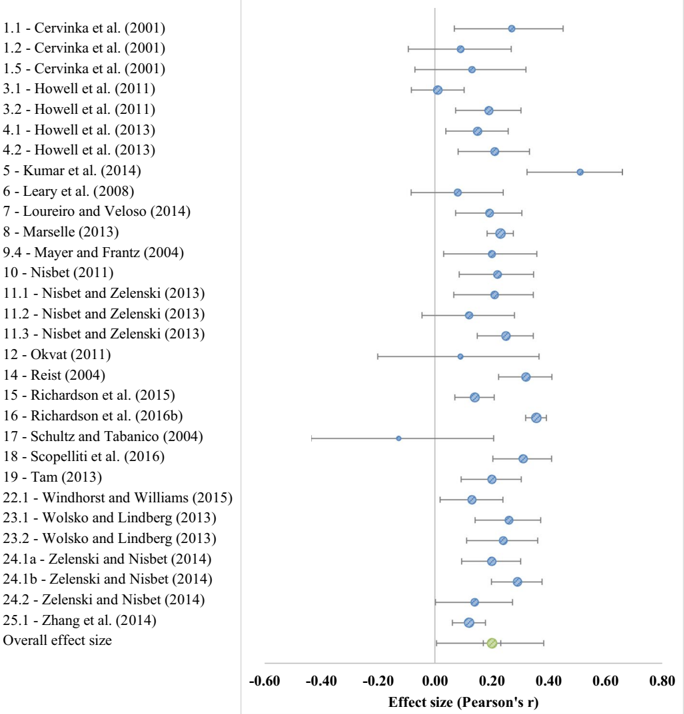
Nature connectedness relates to an individual’s subjective sense of their relationship with the natural world. A recent meta-analysis has found that people who are more connected to nature also tend to have higher levels of self-reported hedonic well-being; however, no reviews have focussed on nature connection and eudaimonic well-being. This meta-analysis was undertaken to explore the relationship of nature connection with eudaimonic well-being and to test the hypothesis that this relationship is stronger than that of nature connection and hedonic well-being. From 20 samples (n = 4758), a small significant effect size was found for the relationship of nature connection and eudaimonic well-being (r = 0.24); there was no significant difference between this and the effect size (from 30 samples n = 11,638) for hedonic well-being (r = 0.20). Of the eudaimonic well-being subscales, personal growth had a moderate effect size which was significantly larger than the effect sizes for autonomy, purpose in life/meaning, self-acceptance, positive relations with others and environmental mastery, but not vitality. Thus, individuals who are more connected to nature tend to have greater eudaimonic well-being, and in particular have higher levels of self-reported personal growth.
Overview
The claims and statistics of this paper haven’t been checked yet.
Free: it reads the open-access text and checks the first 5 claims that cite a source we can check. Create a free account to check every claim.
Integrity signals
Registry
Cites
Statistics
Figures
Verification
Claims the paper makes
The claims and statistics of this paper haven’t been checked yet.
Free: it reads the open-access text and checks the first 5 claims that cite a source we can check. Create a free account to check every claim.
Self-check
Percentages, sums and reported differences re-computed from the paper’s own numbers.
The self-check needs the paper’s full text.
Citations
Cites
Bias in meta-analysis detected by a simple, graphical test
Egger, M., Smith, G. D., Schneider, M., & Minder, C. (1997) · BMJ · doi:10.1136/bmj.315.7109.629 · Cited by 56,722 · cited 1×
“This was explored further using two more tests for publication bias: the Begg test (Begg and Mazumdar 1994) and the Egger test (Egger et al. 1997).”
MethodRyan, R. M., & Deci, E. L. (2000) · American Psychologist · doi:10.1037//0003-066x.55.1.68 · Cited by 54,599 · cited 1×
“As described in Ryan and Deci’s self-determination theory, three basic psychological needs—autonomy, competence and relatedness—are considered essential for psychological growth, integrity and well-being (Ryan and Deci 2000).”
Development and validation of brief measures of positive and negative affect: The PANAS scales.
Watson, D., Clark, L. A., & Tellegen, A. (1988) · Journal of Personality and Social Psychology · doi:10.1037/0022-3514.54.6.1063 · Cited by 32,433
The satisfaction with life scale
Diener, E., Emmons, R. A., Larsen, R. J., & Griffin, S. (1985) · Journal of Personality Assessment · doi:10.1207/s15327752jpa4901_13 · Cited by 31,768
Operating characteristics of a rank correlation test for publication bias
Begg, C. B., & Mazumdar, M. (1994) · Biometrics · doi:10.2307/2533446 · Cited by 16,955 · cited 1×
“This was explored further using two more tests for publication bias: the Begg test (Begg and Mazumdar 1994) and the Egger test (Egger et al.”
MethodHappiness is everything, or is it? Explorations on the meaning of psychological well-being.
Ryff, C. D. (1989) · Journal of Personality and Social Psychology · doi:10.1037/0022-3514.57.6.1069 · Cited by 14,847 · cited 4×
“EWB is often measured with Ryff’s scale of psychological well-being (Ryff 1989), which has six subscales: personal growth relates to being open to new ideas and experiences, and realizing one’s full potential; purpose in life links to the presence of goals in life, and feelings of meaningfulness;…”
BackgroundMethodInfluentialOn Happiness and Human Potentials: A Review of Research on Hedonic and Eudaimonic Well-Being
Ryan, R. M., & Deci, E. L. (2001) · Annual Review of Psychology · doi:10.1146/annurev.psych.52.1.141 · Cited by 11,567 · cited 4×
“(2014) included vitality as a hedonic construct, in this review, vitality was classed as a eudaimonic aspect of well-being because it is often conceptualised as such in the literature (e.g. Ryan and Deci 2001; Wolsko and Lindberg 2013; Zelenski and Nisbet 2014).”
BackgroundInfluentialCohen, J. (1992) · Psychological Bulletin · doi:10.1037//0033-2909.112.1.155 · Cited by 8,771
The restorative benefits of nature: toward an integrative framework
Kaplan, S. (1995) · Journal of Environmental Psychology · doi:10.1016/0272-4944(95)90001-2 · Cited by 6,923 · cited 2×
“…and psychological stress responses result from exposure to nature and thus results in improved well-being, and attention restoration theory (ART; Kaplan 1995) predicts that exposure to nature helps reduce attentional fatigue thus leading to improved cognitive functioning and positive affect.”
BackgroundStress recovery during exposure to natural and urban environments
Ulrich, R. S., Simons, R. F., Losito, B. D., Fiorito, E., Miles, M. A., & Zelson, M. (1991) · Journal of Environmental Psychology · doi:10.1016/s0272-4944(05)80184-7 · Cited by 5,990 · cited 1×
“For example the biophilia hypothesis (Wilson 1984) suggests that people have an innate need to affiliate with nature, and that satisfaction of this need results in well-being benefits such as improved positive affect; stress reduction theory (SRT; Ulrich et al. 1991) predicts that decreased physiological and psycholog…”
Background
Research works printed but not linked: 5
- Bullinger, M., & Kirchberger, I. (1989). SF-36 Fragebogen zum gesundheitszustand [SF-36 health-survey]. Göttingen: Hogrefe.
- Creedon, M. A. (2012). Connectedness to nature and its relationship to meaning in life. Unpublished doc- toral thesis, Massachusetts School of Professional Psychology, MA, USA.
- Kumar, R., Lal, R., Bansal, Y., & Sethi, K. V. K. (2014). Relationship between connectedness to nature and subjective well-being. Indian Journal of Psychological Science, 4, 59-63.
- Reist, D. M. (2004). Materialism vs. an ecological identity: Towards an integrative framework for a psy- chology of sustainable living. Unpublished doctoral thesis, University of Toronto, Toronto, ON.
- Steyer, R., Schwenkmezger, P., Notz, P., & Eid, M. (1997). Der mehrdimensionale befindlichkeitsfragebo- gen (MDBF) [The multidimensional comfort questionnaire (MDBF)]. Göttingen: Hogrefe.
Cited by
Items 101–200 of 700
Chin, S., Cavadino, A., Akroyd, A., Tennant, G., Dobson, R., Gautier, A., & Reynolds, L. (2022) · JMIR Cancer · doi:10.2196/38300 · Cited by 44
“The latter is not only brief but also appears particularly associated with well-being [20,21].”
BackgroundEffects of Shinrin-Yoku Retreat on Mental Health: a Pilot Study in Fukushima, Japan
Kotera, Y., & Fido, D. (2021) · International Journal of Mental Health and Addiction · doi:10.1007/s11469-021-00538-7 · Cited by 53
“…Derby, UK 2 Department of Criminology, University of Derby, Derby, UK satisfaction, and resilience (Kotera et al., 2021a; Martyn and Brymer, 2016; Pritchard et al., 2019; Ryan et al., 2010), and is considered beneficial for cognitive functioning (Cacioppo & Hawkley, 2009) and empathy towards…”
BackgroundWang, H., Khan, M. A., Zhenqiang, J., Cismaș, L. M., Ali, M. A., Saleem, U., & Negruț, L. (2022) · Sustainability · doi:10.3390/su14063191 · Cited by 51
Connectedness and well‐being in simulated nature
Pasca, L., Carrus, G., Loureiro, A., Navarro, Ó., Panno, A., Tapia-Fonllem, C. O., & Aragonés, J. I. (2021) · Applied Psychology Health and Well-Being · doi:10.1111/aphw.12309 · Cited by 49
Rethinking individual relationships with entities of nature
Lehnen, L., Arbieu, U., Böhning‐Gaese, K., Díaz, S. M., Glikman, J. A., & Mueller, T. (2022) · People and Nature · doi:10.1002/pan3.10296 · Cited by 49
Renowden, C., Beer, T., & Mata, L. (2022) · People and Nature · doi:10.1002/pan3.10301 · Cited by 51
Chen, S., Sun, Y., & Seo, B. K. (2022) · International Journal of Environmental Research and Public Health · doi:10.3390/ijerph192316170 · Cited by 38
“They spend more time outdoors, conduct diverse physical activities in various localities, and develop different ways of natural contact [59,60,118,119].”
BackgroundGu, X., Zheng, H., & Tse, C. (2023) · Scientific Reports · doi:10.1038/s41598-023-48756-4 · Cited by 51
“People with higher nature connectedness reported to do more pro-environmental behaviors 31,32 , as well as exhibited higher levels of well-being 33,34 .”
BackgroundSetti, A., Lionetti, F., Kagari, R. L., Motherway, L., & Pluess, M. (2022) · Heliyon · doi:10.1016/j.heliyon.2022.e09861 · Cited by 46
Wullenkord, M. C., Johansson, M. V., Loy, L. S., Menzel, C., & Reese, G. (2024) · Journal of Environmental Psychology · doi:10.1016/j.jenvp.2024.102278 · Cited by 46
Richardson, M. (2025) · Earth · doi:10.3390/earth6030082 · Cited by 61
“…was not the primary driver over generations, it should be remembered that increased engagement with nature can deliver sustained benefits in mental wellbeing [5,21] and mainstreaming such interventions will reinforce intergenerational transmission in cultural ways not captured in the current model.”
Self-citationChoe, E. Y., Jørgensen, A., & Sheffield, D. (2019) · Journal of Environmental Psychology · doi:10.1016/j.jenvp.2019.101382 · Cited by 46
Self-citationPalomo, R. R., Valor, C., & Bosch, I. C. (2021) · Applied Research in Quality of Life · doi:10.1007/s11482-021-09931-9 · Cited by 40
Ziervogel, G., Lennard, C., Midgley, G. F., New, M. G., Simpson, N. P., Trisos, C. H., & Zvobgo, L. (2022) · South African Journal of Science · doi:10.17159/sajs.2022/14492 · Cited by 43
Sia, A., Tan, P. Y., Yu Jin, K. I. M., & Kenneth Boon Hwee, E. R. (2023) · Landscape and Urban Planning · doi:10.1016/j.landurbplan.2023.104758 · Cited by 44
Stenfors, C. U. D., Stengård, J., Hanson, L. L. M., Kecklund, L. G., & Westerlund, H. (2023) · Environmental Research · doi:10.1016/j.envres.2023.116085 · Cited by 37
Iasiello, M. P., van Agteren, J. E., Ali, K., Fassnacht, D. B., Kyrios, M., Kashdan, T. B., & Kolovos, E. (2024) · International Journal of Wellbeing · doi:10.5502/ijw.v14i2.3621 · Cited by 51
Ruiz‐Palomino, P., Cañas, R. M., & Bañón-Gomis, A. J. (2021) · European Management Review · doi:10.1111/emre.12461 · Cited by 44
Bacevičienė, M., Jankauskienė, R., & Swami, V. (2021) · International Journal of Environmental Research and Public Health · doi:10.3390/ijerph182212246 · Cited by 39
Connection to nature is associated with social-emotional learning of children
Lanza, K., Alcazar, M., Chen, B., & Kohl, H. W. (2022) · Current Research in Ecological and Social Psychology · doi:10.1016/j.cresp.2022.100083 · Cited by 45
O’Brien, L., & Forster, J. (2021) · International Journal of Environmental Research and Public Health · doi:10.3390/ijerph18094585 · Cited by 32
“[14] in a meta-analysis of nature connectedness and eudaimonic wellbeing found a small but significant relationship between the two, with those being more connected to nature having greater eudaimonic wellbeing.”
BackgroundGibbs, K., Wilkie, L., Jarman, J., Barker-Smith, A., Kemp, A. H., & Fisher, Z. (2022) · PLOS ONE · doi:10.1371/journal.pone.0266388 · Cited by 31
The Potential of Green Schoolyards for Healthy Child Development: A Conceptual Framework
van den Bogerd, N., Hovinga, D., Hiemstra, J. A., & Maas, J. (2023) · Forests · doi:10.3390/f14040660 · Cited by 49
Down, M. J. A., Picknoll, D., Edwards, T., FARRINGDON, F. H., Hoyne, G. F., Piggott, B., & Murphy, M. (2024) · Journal of Adventure Education & Outdoor Learning · doi:10.1080/14729679.2024.2386350 · Cited by 49
Benton, J. S., Cotterill, S., Anderson, J., Macintyre, V. G., Gittins, M., Dennis, M., Lindley, S. J., & French, D. (2021) · Wellbeing Space and Society · doi:10.1016/j.wss.2021.100029 · Cited by 37
Wellbeing and blue‐green space in post‐pandemic cities: Drivers, debates and departures
Dobson, J. (2021) · Geography Compass · doi:10.1111/gec3.12593 · Cited by 38
Understanding the Role of Nature Engagement in Supporting Health and Wellbeing during COVID-19
Darcy, P. M., Taylor, J. H., Mackay, L., Ellis, N., & Gidlow, C. J. (2022) · International Journal of Environmental Research and Public Health · doi:10.3390/ijerph19073908 · Cited by 38
Zarantonello, L., Grappi, S., & Formisano, M. (2023) · Psychology and Marketing · doi:10.1002/mar.21925 · Cited by 44
Visible Garden Biodiversity Is Associated with Noticing Nature and Nature Connectedness
Hamlin, I., & Richardson, M. (2022) · Ecopsychology · doi:10.1089/eco.2021.0064 · Cited by 34
“…higher levels of mental well-being (Capaldi et al., 2014; Martin et al., 2020; Mayer & Frantz, 2004; Nisbet, Shaw, & Lachance, 2020; Nisbet, Zelenski, & Murphy, 2011; Pritchard, Richardson, Sheffield, & McEwan, 2019; Richardson, Passmore, Lumber, Thomas, & Hunt, 2021; Zelenski & Nisbet, 2014).”
Self-citationAwe experiences, the sublime, and spiritual well-being in Arctic wilderness
Løvoll, H. S., & Sæther, K.-W. (2022) · Frontiers in Psychology · doi:10.3389/fpsyg.2022.973922 · Cited by 42
“People who are connected to nature tend to have greater eudaimonic well-being, finding an especially strong relationship between personal growth and being deeply engaged in nature in an emotional, experiential, or cognitive way (Nisbet et al., 2011; Capaldi et al., 2015; Pritchard et al., 2020).”
BackgroundTiscareno-Osorno, X., Demetriou, Y., Marques, A., Peralta, M., Jorge, R., Macintyre, T. E., MacIntyre, D., Smith, S. W., Sheffield, D., Jones, M. V., et al. (2023) · Environment and Behavior · doi:10.1177/00139165231212321 · Cited by 34
Self-citationUnderstanding Human–Nature Connections Through Landscape Socialization
Peng, L.-P. (2020) · International Journal of Environmental Research and Public Health · doi:10.3390/ijerph17207593 · Cited by 30
“People are increasingly recognizing that reconnecting to nature positively contributes to individual and social health and well-being [1], particularly with regard to psychological and physiological benefits [2].”
BackgroundDevelopment and validation of self-efficacy and intention measures for spending time in nature
Maddock, J. E., Suess, C., Bratman, G. N., Smock, C., Kellstedt, D. K., Gustat, J., Perry, C. K., & Kaczynski, A. T. (2022) · BMC Psychology · doi:10.1186/s40359-022-00764-1 · Cited by 35
Klein, Y., Lindfors, P., Osika, W., Hanson, L. L. M., & Stenfors, C. U. D. (2022) · International Journal of Environmental Research and Public Health · doi:10.3390/ijerph19095668 · Cited by 40
“Moreover, nature contact can also facilitate other processes that are central to mental health—in particular stress-related symptoms and depression—including decreased rumination [50] and improved attention and executive cognitive performance [8,9,14,51], as well as an increased sense of connectedness and relatedness…”
BackgroundButler, C. W., Hamlin, I., Richardson, M., Lowe, M., & Fox, R. (2024) · Biological Conservation · doi:10.1016/j.biocon.2024.110497 · Cited by 38
Self-citationAn aspirational approach to planetary futures
Ellis, E. C., Malhi, Y. S., Ritchie, H., Montana, J., Díaz, S. M., Obura, D. O., Clayton, S., Leach, M., Pereira, L. M., Marris, E., et al. (2025) · Nature · doi:10.1038/s41586-025-09080-1 · Cited by 54
“People across many countries and communities recognize, deeply value and form identities through their connectedness with the living world 36,125–127 , and this connectedness is generally associated with both human well-being and capabilities, and action to care for nature and other people…”
Lau, S. S. S., Leung, S. S. K., Wong, J. W. C., Lee, T. C. P., Cartwright, S. R., Wong, J. K. T., Man, J. O. T., Cheung, E. T. H., & Choi, R. P. W. (2023) · Frontiers in Public Health · doi:10.3389/fpubh.2022.1057020 · Cited by 31
Hossain, M. M., Sultana, A., Ma, P., Fan, Q., Sharma, R., Purohit, N., & Sharmin, D. F. (2020) · PsyArXiv (OSF Preprints) · doi:10.31234/osf.io/4r3mh · Cited by 38
Subirana-Malaret, M., Miró, A., Camacho-Guzmán, A., Gesse, A., & McEwan, K. (2023) · Forests · doi:10.3390/f14050904 · Cited by 30
“…nature can elicit two distinct types of positive emotions: low arousal, or eudaimonic (feelings of calm, emotions of trust and hope), and high arousal, or hedonic (feelings of happiness and surprise), and also help regulate emotions through soothing and calming the parasympathetic system [5,12,35].”
Self-citationVideo Game Experiential Marketing in Tourism: Designing for Experiences
Rainoldi, M., den Winckel, A. V., Yu, J., & Neuhofer, B. (2022) · Springer eBooks · doi:10.1007/978-3-030-94751-4_1 · Cited by 43
The antecedents of pro-environmental tourist behaviour of Gen Z: an eastern society perspective
Mandić, A., Walia, S. K., & Kautish, P. (2023) · Anatolia · doi:10.1080/13032917.2023.2224368 · Cited by 34
Cuadrado, E., Macias-Zambrano, L., Carpio, A. J., & Tabernero, C. (2022) · Environmental Education Research · doi:10.1080/13504622.2022.2111407 · Cited by 36
“Moreover, at the individual level, increased contact with elements of the natural environment brings both physical and mental health benefits (Capaldi, Dopko, and Zelenski 2014; Pritchard et al. 2019; Sobko et al. 2020; Sobko and Brown 2021).”
BackgroundInfluentialNguyen, K. M., Nguyen, N. T., Ngo, T. L., & Le, T. T. (2025) · Business Strategy & Development · doi:10.1002/bsd2.70063 · Cited by 28
The effects of using psychodrama on the psychological wellbeing of university students
Kaya, F., & Deniz, H. (2020) · Perspectives In Psychiatric Care · doi:10.1111/ppc.12510 · Cited by 31
Exploring potential mechanisms underpinning the therapeutic effects of surfing
Moreton, S. G., Brennan, M. K., Nicholls, V. I., Wolf, I. D., & Muir, D. L. (2021) · Journal of Adventure Education & Outdoor Learning · doi:10.1080/14729679.2021.1884104 · Cited by 30
Greenhouse gas emissions and cross-national happiness: a global perspective
Apergis, N., & Majeed, M. T. (2021) · Air Quality Atmosphere & Health · doi:10.1007/s11869-021-01019-5 · Cited by 32
Eudaimonia in the relationship between human and nature: A systematic literature review
Lima, P. A. B., & Mariano, E. B. (2022) · Cleaner Production Letters · doi:10.1016/j.clpl.2022.100007 · Cited by 35
A closer look at the relationships between aspects of connectedness and flourishing
Rahe, M., & Jansen, P. (2023) · Frontiers in Psychology · doi:10.3389/fpsyg.2023.1137752 · Cited by 33
Mandić, A., Knight, D., Vuković, M., & Thomsen, B. (2024) · Tourism Planning & Development · doi:10.1080/21568316.2024.2353596 · Cited by 31
“Research has shown that individuals more connected to nature are happier and have higher levels of personal growth (Barrera-Hernández et al., 2020; Martin et al., 2020; Olivos & Clayton, 2017; Pritchard et al., 2020).”
Zeng, Q., Yang, Z., Chen, Z., & Chen, P. (2025) · Journal of Environmental Psychology · doi:10.1016/j.jenvp.2025.102675 · Cited by 39
Häyrinen, L., & Pynnönen, S. (2020) · Current Forestry Reports · doi:10.1007/s40725-020-00131-6 · Cited by 38
Dale, M., Wood, A., Zarotti, N., Eccles, F. J. R., Gunn, S., Kiani, R., Mobley, A., Robertson, N., & Simpson, J. (2022) · Journal of Personalized Medicine · doi:10.3390/jpm12081222 · Cited by 29
“The benefits of nature contact to mental wellbeing have been well-documented [99,100], with the level of nature connectedness having particular significance [101].”
BackgroundMiller, N., Stepanova, E. R., Desnoyers-Stewart, J., Adhikari, A., Kitson, A., Pennefather, P. P., Quesnel, D. T., Brauns, K., Friedl-Werner, A., Stahn, A. C., et al. (2023) · Designing Interactive Systems Conference · doi:10.1145/3563657.3595998 · Cited by 29
“Nature is believed to be the most common source of awe [85], a key contributor to the benefts of well-being associated with experiences of nature connectedness [96].”
BackgroundDat, L. T., Wu, H. C., Li, T., Huang, W., Liou, G., & Hsieh, C. (2024) · International Journal of Tourism Research · doi:10.1002/jtr.2621 · Cited by 32
The where, how, and who of mitigating climate change: A targeted research agenda for psychology
Gurtner, L. M., & Moser, S. (2024) · Journal of Environmental Psychology · doi:10.1016/j.jenvp.2024.102250 · Cited by 29
Local Government Responses to the COVID-19 Pandemic in the UK: A Thematic Review
Gore, T., Bimpson, E., Dobson, J., & Parkes, S. (2021) · doi:10.7190/cresr.2021.6172521344 · Cited by 25
Eudaimonic self-expansion: The effects of eudaimonic reflections on nature connectedness
Lengieza, M. L. (2024) · Journal of Environmental Psychology · doi:10.1016/j.jenvp.2024.102231 · Cited by 28
Cross-country variation in people’s connection to nature
Soga, M., & Gaston, K. J. (2025) · One Earth · doi:10.1016/j.oneear.2025.101194 · Cited by 31
Ganzevoort, W., & van den Born, R. J. G. (2023) · Journal of Environmental Planning and Management · doi:10.1080/09640568.2023.2240953 · Cited by 31
“…makes clear that social relatedness is of great importance in nature volunteering, especially in terms of difficult situations and reasons to quit, but we advocate including nature connectedness in conceptualisations of relatedness needs in the context of action for nature (Pritchard et al. 2020).”
Experiencing Values in the Flow of Events: A Phenomenological Approach to Relational Values
Gilliand, C. (2021) · Environmental Values · doi:10.3197/096327121x16141642287692 · Cited by 28
“The idea that non-human entities have ‘eudaimonic value’ for instance - i.e. that they are part of what is required to lead a good life - is quite widespread (Pritchard et al. 2020).”
BackgroundDoubling Down on Wicked Problems: Ocean ArtScience Collaborations for a Sustainable Future
Jung, J., Gupa, D. D., Hash, C., Thoms, J., Owens, D., Threlfall, J., & Juniper, S. K. (2022) · Frontiers in Marine Science · doi:10.3389/fmars.2022.873990 · Cited by 30
Prokop, V., Gerstlberger, W. D., Vrabcová, P., Zapletal, D., & Sein, Y. Y. (2022) · Heliyon · doi:10.1016/j.heliyon.2023.e16388 · Cited by 21
“Notwithstanding, we can find support for our results in the nexus between the negative impact of the environment on perceived health [61,62], with regard to reducing the risk of immune-mediated diseases [63] and in the context of a higher level of hedonic well-being [64] especially in an urban environment [65] → the n…”
ResultPromoting well-being in early adolescents through mindfulness: A cluster randomized controlled trial
Scafuto, F., Ghiroldi, S., Montecucco, N. F., De Vincenzo, F., Quinto, R. M., Presaghi, F., & Iani, L. (2024) · Journal of Adolescence · doi:10.1002/jad.12252 · Cited by 20
Birds of a feather lockdown together: Mutual bird-human benefits during a global pandemic
Brock, M., Doremus, J. M., & Li, L. (2021) · Ecological Economics · doi:10.1016/j.ecolecon.2021.107174 · Cited by 24
“Benefits in psychological well-being from engaging with the natural world are well-documented (Keyes, 2002; Dutcher et al., 2007; Pritchard et al., 2020; Wyles et al., 2019; Yang and Na, 2017).”
BackgroundCui, W., & Yang, Z. (2021) · Journal of Happiness Studies · doi:10.1007/s10902-021-00386-1 · Cited by 25
Down, M. J. A., Chivers, P., Kirsch, P., & Picknoll, D. (2021) · Health Promotion Journal of Australia · doi:10.1002/hpja.555 · Cited by 24
Cross-cultural validity of the Nature Relatedness Scale (NR-6) and links with wellbeing
Kövi, Z., Kim, H., Kamble, S. V., Mészáros, V., Lachance, D., & Nisbet, E. K. L. (2023) · International Journal of Wellbeing · doi:10.5502/ijw.v13i2.2841 · Cited by 30
“Eudaimonic aspects of wellbeing such as vitality, autonomy, personal growth, purpose and meaning in life are also higher in people who are more nature related (Cervinka et al., 2012; Howell et al., 2013; Mayer & Frantz, 2004; Nisbet et al., 2011; Pritchard et al., 2020; Zelenski & Nisbet, 2014).”
BackgroundThe Beyond-Human Natural World: Providing Meaning and Making Meaning
Passmore, H., & Krause, A. N. (2023) · International Journal of Environmental Research and Public Health · doi:10.3390/ijerph20126170 · Cited by 32
Calogiuri, G., Petersen, E., Haile, A., Flaten, O. E., Fröhlich, F., & Litleskare, S. (2023) · Journal of Environmental Psychology · doi:10.1016/j.jenvp.2023.102102 · Cited by 25
Coastal cultural ecosystem services and adolescents’ subjective well-being
Cabana, D., Pinna, S., Farina, S., Grech, D., Barbieri, N., & Guala, I. (2024) · AMBIO · doi:10.1007/s13280-024-02043-2 · Cited by 29
“Considering semi-urban environment where adolescents often live in areas where nature is central to their lives they likely have a strong connection to nature (Berto et al. 2015; Mackay and Schmitt 2019; Pritchard et al. 2020).”
Understanding Chinese Students' Well-Being: A Machine Learning Study
Wang, Y., King, R. B., & Leung, S. O. (2022) · Child Indicators Research · doi:10.1007/s12187-022-09997-3 · Cited by 27
“However, most existing studies only focus on one aspect (e.g., hedonic well-being in Llosada-Gistau et al., 2015; eudaimonic well-being in Pritchard et al., 2020), few studies exploring both aspects of well-being.”
BackgroundForstmann, M., Kettner, H., Sagioglou, C., Irvine, A., Gandy, S., Carhart-Harris, R. L., & Luke, D. P. (2023) · Journal of Psychopharmacology · doi:10.1177/02698811221146356 · Cited by 25
Feucht, V., Dierkes, P. W., & Kleespies, M. W. (2023) · Sustainability Science · doi:10.1007/s11625-023-01371-8 · Cited by 22
Physical Activity in Natural Settings: An Opportunity for Lifestyle Medicine
Maddock, J. E., & Frumkin, H. (2024) · American Journal of Lifestyle Medicine · doi:10.1177/15598276241253211 · Cited by 31
Kari, T., Ojala, A., Kurkilahti, M., & Tyrväinen, L. (2024) · Journal of Environmental Psychology · doi:10.1016/j.jenvp.2024.102452 · Cited by 33
Charisi, V., Zafeiroudi, A., Trigonis, I., Tsartsapakis, I., & Kouthouris, C. (2025) · Sustainability · doi:10.3390/su17020390 · Cited by 31
Kama Muta (≈ Being Moved) Helps Connect People in and to Nature: A Photo Elicitation Approach
Petersen, E., & Martin, A. J. (2020) · Ecopsychology · doi:10.1089/eco.2020.0032 · Cited by 25
“This is primarily due to the impact of nature connectedness on well-being (Capaldi, Dopko, & Zelenski, 2014; Howell, Dopko, Passmore, & Buro, 2011; Pritchard, Richardson, Sheffield, & McEwan, 2019).”
The impact of the COVID-19 pandemic on environmental values
Sneddon, J., Daniel, E., Fischer, R. D., & Lee, J. A. (2022) · Sustainability Science · doi:10.1007/s11625-022-01151-w · Cited by 35
“Increasing connection with nature may also be an effective alternative means of increasing well-being during this and potential future crises (see Jackson et al. 2021; Martin et al. 2020; Mintz et al. 2021; Nisbet et al. 2011; Pritchard et al. 2020).”
BackgroundBoyd, F. (2022) · Frontiers in Psychology · doi:10.3389/fpsyg.2022.865422 · Cited by 32
The past, present, and future of nature and place-based interventions for human health
Boyd, F., Allen, C., Robinson, J. M., & Redvers, N. (2023) · Landscape Research · doi:10.1080/01426397.2023.2244430 · Cited by 24
“This has been associated with pro-ecological behaviours and positive wellbeing (Howell, Dopko, Passmore, & Buro, 2011; Pritchard, Richardson, Sheffield, & McEwan, 2020).”
BackgroundConnectedness among Urban Parks from the Users’ Perspective: A Systematic Literature Review
Li, J., Dali, M. M., & Nordin, N. A. (2023) · International Journal of Environmental Research and Public Health · doi:10.3390/ijerph20043652 · Cited by 23
“Its dimensions include social connectedness [34–36], cultural connectedness [37], and connectedness to nature [37,38].”
BackgroundCommentary: Suggesting Shinrin-yoku (forest bathing) for treating addiction
Kotera, Y., & Rhodes, C. (2020) · Addictive Behaviors · doi:10.1016/j.addbeh.2020.106556 · Cited by 23
Nature connectedness in adolescents and young adults: a systematic review
Madera, F., Olcese, M., Cardinali, P., & Migliorini, L. (2025) · Journal of Environmental Psychology · doi:10.1016/j.jenvp.2025.102761 · Cited by 29
Bacevičienė, M., & Jankauskienė, R. (2021) · Sustainability · doi:10.3390/su13031312 · Cited by 18
The Peril and Potential of XR-based Interactions with Wildlife
Pimentel, D. (2021) · CHI Conference Extended Abstracts on Human Factors in Computing Systems (CHI EA) · doi:10.1145/3411763.3450378 · Cited by 21
“encouraging connectedness with nature (CWN), a subjective sense of closeness with the environment known to contribute to proenvironmental outcomes, such as awareness and protection [17, 63], and even well-being [55].”
BackgroundThe Balanced Structure of Environmental Identity
Bruni, C. M., Schultz, P. W., & Woodcock, A. (2021) · Sustainability · doi:10.3390/su13158168 · Cited by 23
A framework for agent-based models of human needs and ecological limits
Foramitti, J. (2022) · Ecological Economics · doi:10.1016/j.ecolecon.2022.107651 · Cited by 21
Mothers’ accounts of the impact of being in nature on postnatal wellbeing: a focus group study
Hall, K. S., Evans, J., Roberts, R., Brown, R., Barnes, C. R., & Turner, K. M. (2023) · BMC Women s Health · doi:10.1186/s12905-023-02165-x · Cited by 21
“Indeed, a close relationship with nature is considered by some a basic psychological need and a pre-requisite to wellbeing [18, 33, 34].”
BackgroundPhillips, T., Wells, N. M., Brown, A. H., Tralins, J., & Bonter, D. N. (2023) · People and Nature · doi:10.1002/pan3.10433 · Cited by 25
Isham, A., Morgan, G., & Kemp, A. H. (2023) · Frontiers in Psychology · doi:10.3389/fpsyg.2023.1205991 · Cited by 23
Public perceptions of an avian reintroduction aiming to connect people with nature
White, R. L., Jones, L. P., Groves, L., Hudson, M. A., Kennerley, R. J., & Crowley, S. L. (2023) · People and Nature · doi:10.1002/pan3.10538 · Cited by 18
Santos, R. S., Lousã, E. P., Sá, M. M., & Cordeiro, J. A. (2023) · Behavioral Sciences · doi:10.3390/bs13100811 · Cited by 49
“Those who are closer to their daimon—“true self”—have more well-being, because well-being is associated with self-fulfillment and the possibility of taking advantage of opportunities for individual appreciation and growth [89,90].”
BackgroundEffective Recreational Activities in Urban Green Spaces for Mental Health of Scientific Researchers
Yan, J., Wu, Y., Shao, G., Qiu, Q., & Tang, L. (2024) · Ecosystem Health and Sustainability · doi:10.34133/ehs.0199 · Cited by 21
Examining the connection between nature connectedness and dark personality
Fido, D., Rees, A., Clarke, P., Petronzi, D., & Richardson, M. (2020) · Journal of Environmental Psychology · doi:10.1016/j.jenvp.2020.101499 · Cited by 18
Self-citationDoes Spending Time in Nature Help Students Cope with the COVID-19 Pandemic?
Desrochers, J., Bell, A. L., Nisbet, E. K. L., & Zelenski, J. M. (2022) · Sustainability · doi:10.3390/su14042401 · Cited by 23
“In a recent 25-study meta-analysis by Pritchard et al. [18], nature connectedness was related to both hedonic well-being and eudaimonic well-being (especially personal growth).”
BackgroundDevelopment and testing of the Night Sky Connectedness Index (NSCI)
Barnes, C. R., & Passmore, H. (2023) · Journal of Environmental Psychology · doi:10.1016/j.jenvp.2023.102198 · Cited by 29
Understanding and promoting nature connectedness: A human ecological perspective
Christens, B. D., McCormick, M. L., & Wolf, J. (2025) · Current Opinion in Psychology · doi:10.1016/j.copsyc.2025.102046 · Cited by 25
Adams, D., & Beauchamp, G. (2020) · Journal of Outdoor and Environmental Education · doi:10.1007/s42322-020-00072-5 · Cited by 20
“…of the outdoor environment (Ampuero et al. 2015; Dillon et al. 2005; Ulset et al. 2017; Wyver 2017) and the beneficial results to one’s wellbeing when in contact with nature (Adams and Beauchamp 2020; Capaldi et al. 2015; Mayer et al. 2009; Pritchard et al. 2019; Sharma-Brymer et al. 2018).”
BackgroundDing, M., Liu, X., & Liu, P. (2024) · Current Psychology · doi:10.1007/s12144-023-05495-z · Cited by 22
“According to the biophilia hypothesis (Wilson, 1984), people have an innate tendency to seek connection with nature, and the satisfaction of this need bring out well-being benefits (Pritchard et al., 2019).”
Lian, C., & Chen, X. (2024) · Acta Psychologica · doi:10.1016/j.actpsy.2024.104180 · Cited by 21
Metadata
- Authors
- Pritchard, A., Richardson, M., Sheffield, D., & McEwan, K.
- Affiliations
- University of Derby (GB)
- Corresponding author
- Pritchard, Alison
- Venue
- Journal of Happiness Studies
- Published
- 2019-04-30
- Volume
- 21
- Issue
- 3
- Pages
- 1145-1167
- ISSN
- 1389-4978 (ISSN-L)
- 1573-7780
- OpenAlex
- W2942996956
- Cited by
- 702
- References
- 106
- Citations by year
- 2026: 106 · 2025: 138 · 2024: 122 · 2023: 108 · 2022: 103 · 2021: 77 · 2020: 39 · 2019: 8
- FWCI
- 8.76
- Type
- journal article
- Language
- en
- Open access
- hybrid
- doi.org
- Licence
- cc-by
- creativecommons.org/licenses/by/4.0 (tdm)
- Locations
- Journal of Happiness Studies (publishedVersion, cc-by)
- RePEc: Research Papers in Economics (submittedVersion)
- University of Derby Online Research Archive. (University of Derby) (submittedVersion)
- Topics
- Social Sciences › Psychology › Social Psychology › Psychological Well-being and Life Satisfaction
- Social Sciences › Urban Studies › Urban Green Space and Health
- Social Sciences › Business, Management and Accounting › Tourism, Leisure and Hospitality Management › Recreation, Leisure, Wilderness Management
- Keywords
- nature connection, eudaimonic well-being, hedonic well-being, personal growth, meaning in life, self-acceptance, environmental mastery, vitality, autonomy, positive relationships with others
About these checks
Registry, retraction, Cites and statistics results are computed, not judged, with one exception: a printed reference that no index lists is read once by a model before it counts as a citation error. Claims are extracted by a model and kept only when their quote appears verbatim in the text; each cited source is then checked, with a model’s help, for whether it says what the claim relies on. Those verdicts can be wrong — read the claim’s quote and the cited source before relying on one.
Statistics and arithmetic are recomputed, not judged.
Confidence bands are shown only for fields calibrated on our annotated test set. None is calibrated yet, so no band is shown.
What counts as a claim ›How we measure confidence ›How we check this ›
Are you an author, or do you see a problem with this page? Request a review
Data sources
Bibliographic data: Semantic Scholar, OpenAlex, Crossref.
Contains information from the Semantic Scholar Academic Graph Datasets, made available under the ODC Attribution License (ODC-BY 1.0).
Semantic Scholar’s data is described in: Kinney, R., et al. (2023). The Semantic Scholar Open Data Platform. arXiv:2301.10140.
