

The Relationship Between Nature Connectedness and Eudaimonic Well-Being: A Meta-analysis
Open accessThe DOI matches its Crossref record; 103 of the 106 references it cites were found in a registry or an index.
Abstract
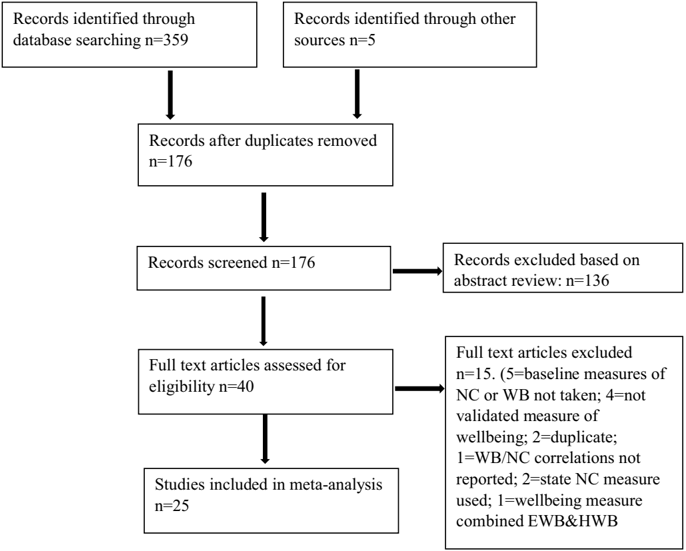
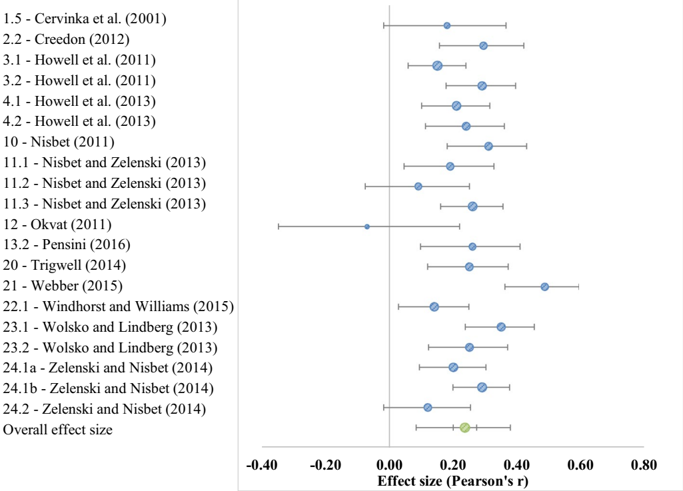
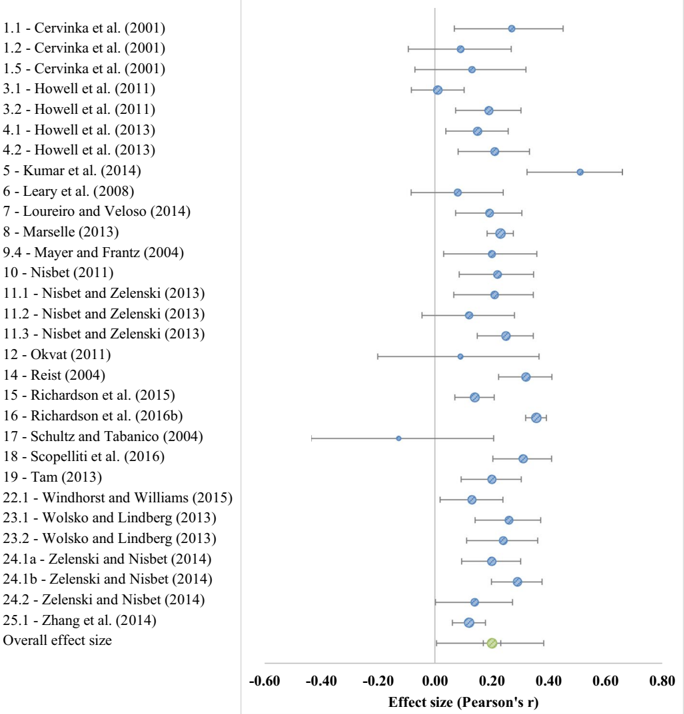
Nature connectedness relates to an individual’s subjective sense of their relationship with the natural world. A recent meta-analysis has found that people who are more connected to nature also tend to have higher levels of self-reported hedonic well-being; however, no reviews have focussed on nature connection and eudaimonic well-being. This meta-analysis was undertaken to explore the relationship of nature connection with eudaimonic well-being and to test the hypothesis that this relationship is stronger than that of nature connection and hedonic well-being. From 20 samples (n = 4758), a small significant effect size was found for the relationship of nature connection and eudaimonic well-being (r = 0.24); there was no significant difference between this and the effect size (from 30 samples n = 11,638) for hedonic well-being (r = 0.20). Of the eudaimonic well-being subscales, personal growth had a moderate effect size which was significantly larger than the effect sizes for autonomy, purpose in life/meaning, self-acceptance, positive relations with others and environmental mastery, but not vitality. Thus, individuals who are more connected to nature tend to have greater eudaimonic well-being, and in particular have higher levels of self-reported personal growth.
Overview
The claims and statistics of this paper haven’t been checked yet.
Free: it reads the open-access text and checks the first 5 claims that cite a source we can check. Create a free account to check every claim.
Integrity signals
Registry
Cites
Statistics
Figures
Verification
Claims the paper makes
The claims and statistics of this paper haven’t been checked yet.
Free: it reads the open-access text and checks the first 5 claims that cite a source we can check. Create a free account to check every claim.
Self-check
Percentages, sums and reported differences re-computed from the paper’s own numbers.
The self-check needs the paper’s full text.
Citations
Cites
Bias in meta-analysis detected by a simple, graphical test
Egger, M., Smith, G. D., Schneider, M., & Minder, C. (1997) · BMJ · doi:10.1136/bmj.315.7109.629 · Cited by 56,722 · cited 1×
“This was explored further using two more tests for publication bias: the Begg test (Begg and Mazumdar 1994) and the Egger test (Egger et al. 1997).”
MethodRyan, R. M., & Deci, E. L. (2000) · American Psychologist · doi:10.1037//0003-066x.55.1.68 · Cited by 54,599 · cited 1×
“As described in Ryan and Deci’s self-determination theory, three basic psychological needs—autonomy, competence and relatedness—are considered essential for psychological growth, integrity and well-being (Ryan and Deci 2000).”
Development and validation of brief measures of positive and negative affect: The PANAS scales.
Watson, D., Clark, L. A., & Tellegen, A. (1988) · Journal of Personality and Social Psychology · doi:10.1037/0022-3514.54.6.1063 · Cited by 32,433
The satisfaction with life scale
Diener, E., Emmons, R. A., Larsen, R. J., & Griffin, S. (1985) · Journal of Personality Assessment · doi:10.1207/s15327752jpa4901_13 · Cited by 31,768
Operating characteristics of a rank correlation test for publication bias
Begg, C. B., & Mazumdar, M. (1994) · Biometrics · doi:10.2307/2533446 · Cited by 16,955 · cited 1×
“This was explored further using two more tests for publication bias: the Begg test (Begg and Mazumdar 1994) and the Egger test (Egger et al.”
MethodHappiness is everything, or is it? Explorations on the meaning of psychological well-being.
Ryff, C. D. (1989) · Journal of Personality and Social Psychology · doi:10.1037/0022-3514.57.6.1069 · Cited by 14,847 · cited 4×
“EWB is often measured with Ryff’s scale of psychological well-being (Ryff 1989), which has six subscales: personal growth relates to being open to new ideas and experiences, and realizing one’s full potential; purpose in life links to the presence of goals in life, and feelings of meaningfulness;…”
BackgroundMethodInfluentialOn Happiness and Human Potentials: A Review of Research on Hedonic and Eudaimonic Well-Being
Ryan, R. M., & Deci, E. L. (2001) · Annual Review of Psychology · doi:10.1146/annurev.psych.52.1.141 · Cited by 11,567 · cited 4×
“(2014) included vitality as a hedonic construct, in this review, vitality was classed as a eudaimonic aspect of well-being because it is often conceptualised as such in the literature (e.g. Ryan and Deci 2001; Wolsko and Lindberg 2013; Zelenski and Nisbet 2014).”
BackgroundInfluentialCohen, J. (1992) · Psychological Bulletin · doi:10.1037//0033-2909.112.1.155 · Cited by 8,771
The restorative benefits of nature: toward an integrative framework
Kaplan, S. (1995) · Journal of Environmental Psychology · doi:10.1016/0272-4944(95)90001-2 · Cited by 6,923 · cited 2×
“…and psychological stress responses result from exposure to nature and thus results in improved well-being, and attention restoration theory (ART; Kaplan 1995) predicts that exposure to nature helps reduce attentional fatigue thus leading to improved cognitive functioning and positive affect.”
BackgroundStress recovery during exposure to natural and urban environments
Ulrich, R. S., Simons, R. F., Losito, B. D., Fiorito, E., Miles, M. A., & Zelson, M. (1991) · Journal of Environmental Psychology · doi:10.1016/s0272-4944(05)80184-7 · Cited by 5,990 · cited 1×
“For example the biophilia hypothesis (Wilson 1984) suggests that people have an innate need to affiliate with nature, and that satisfaction of this need results in well-being benefits such as improved positive affect; stress reduction theory (SRT; Ulrich et al. 1991) predicts that decreased physiological and psycholog…”
Background
Research works printed but not linked: 5
- Bullinger, M., & Kirchberger, I. (1989). SF-36 Fragebogen zum gesundheitszustand [SF-36 health-survey]. Göttingen: Hogrefe.
- Creedon, M. A. (2012). Connectedness to nature and its relationship to meaning in life. Unpublished doc- toral thesis, Massachusetts School of Professional Psychology, MA, USA.
- Kumar, R., Lal, R., Bansal, Y., & Sethi, K. V. K. (2014). Relationship between connectedness to nature and subjective well-being. Indian Journal of Psychological Science, 4, 59-63.
- Reist, D. M. (2004). Materialism vs. an ecological identity: Towards an integrative framework for a psy- chology of sustainable living. Unpublished doctoral thesis, University of Toronto, Toronto, ON.
- Steyer, R., Schwenkmezger, P., Notz, P., & Eid, M. (1997). Der mehrdimensionale befindlichkeitsfragebo- gen (MDBF) [The multidimensional comfort questionnaire (MDBF)]. Göttingen: Hogrefe.
Cited by
Items 201–300 of 700
McDougall, C. W., Elliott, L. R., White, M. P., Grellier, J., Bell, S., Bratman, G. N., Nieuwenhuijsen, M. J., Lima, M. L., Ojala, A., Cirach, M., et al. (2024) · Journal of Environmental Psychology · doi:10.1016/j.jenvp.2024.102479 · Cited by 18
Harris, N., Hartwell, B. K., Thomas, L., & Grace, M. M. (2025) · Child and Adolescent Mental Health · doi:10.1111/camh.12774 · Cited by 24
“The nature-based interventions needed to involve actively engaging with outdoor nature, as research indicates that just having access to, or simply being around, natural things does not increase NC (Arbuthnott, Sutter, & Heidt, 2014; Richardson et al., 2020; Schultz & Tabanico, 2007).”
Gauthier, P. E., Chungyalpa, D., Goldman, R. I., Davidson, R. J., & Wilson‐Mendenhall, C. D. (2025) · Current Opinion in Psychology · doi:10.1016/j.copsyc.2025.102042 · Cited by 26
Voltmer, K., & von Salisch, M. (2023) · Sustainability · doi:10.3390/su16010134 · Cited by 19
“A closely related meta-analysis noted a significant positive association between self-acceptance and nature connectedness ( r = 0.17) in four samples with N = 686 adults [115].”
BackgroundInfluentialRebuilding human-nature connections in children and adolescents: insights from a meta-analysis
Choe, E. Y., & Sheffield, D. (2024) · Environmental Education Research · doi:10.1080/13504622.2024.2404206 · Cited by 15
“…the significance of the individual’s connection to nature, emphasising that affinity with or connection to nature plays a more critical role in health benefits than can be satisfied by the mere availability of green spaces in urban settings (Pritchard et al. 2020; Richardson et al. 2021).”
Self-citationCorman, M., Dambrun, M., Ginzac, A., & Ménard, K. (2025) · BMC Palliative Care · doi:10.1186/s12904-025-01719-0 · Cited by 29
“Recognized as a factor promoting well-being [24], the connection with nature and the environment emerged as spiritual and social resources that help patients navigate the challenges posed by their illness and hospitalization.”
InfluentialUrban nature and transnational lives
Rishbeth, C., & Birch, J. (2020) · Population Space and Place · doi:10.1002/psp.2416 · Cited by 18
Known but not done: how logics of inaction limit the benefits of urban green spaces
Dobson, J., & Dempsey, N. (2021) · Landscape Research · doi:10.1080/01426397.2020.1864819 · Cited by 19
“Extensive research demonstrates positive connections between natural environments and wellbeing (for reviews, see Douglas et al., 2017; Prescott et al., 2016; Pritchard et al., 2020; World Health Organization (WHO), 2017).”
BackgroundChen, Y., & Huo, Y. (2022) · Youth & Society · doi:10.1177/0044118x221126548 · Cited by 21
“According to natural decompression theory (Naor & Mayseless, 2021; Pritchard et al., 2020), NC may compensate for the negative effects of online psychological needs.”
BackgroundMüller, S., Artmann, M., & Surrey, C. (2023) · Sustainability Science · doi:10.1007/s11625-023-01360-x · Cited by 22
Christie, M., & Elliott, D. L. (2023) · Sport in Society · doi:10.1080/17430437.2023.2233428 · Cited by 17
“This leads to increased eudemonic and hedonic wellbeing and feelings of transcendence (Passmore and Howell 2014; Pritchard et al. 2020).”
BackgroundHordley, L. A., & Fox, R. (2024) · The Science of The Total Environment · doi:10.1016/j.scitotenv.2024.171503 · Cited by 17
Li, H., Browning, M. H. E. M., Bardhan, M., Ying, M., Zhang, X., Cao, Y., & Zhang, G. (2024) · International Journal of Environmental Health Research · doi:10.1080/09603123.2024.2334767 · Cited by 21
“It has been widely identified to positively predict wellbeing (Pritchard et al. 2020; Liu et al. 2022).”
Stenfors, C. U. D., Rådmark, L., Stengård, J., Klein, Y., Osika, W., & Hanson, L. L. M. (2024) · Landscape and Urban Planning · doi:10.1016/j.landurbplan.2024.105109 · Cited by 20
Guo, D.-S., Xu, T., Luo, J., Wang, X., Lin, S., Lin, C.-M., Hong, Y., & Chang, W. (2024) · Journal of Forestry Research · doi:10.1007/s11676-024-01812-9 · Cited by 17
“People with higher nature connectedness tend to experience more psychological benefits, such as higher well-being, higher positive affect, as well as lower levels of stress (Pritchard et al. 2020; Yeo et al. 2020; Chan et al. 2021; Brambilla et al. 2022).”
Rahmani, L., Haasova, S., Czellar, S., Clergue, V., & Martin, C. (2022) · Frontiers in Psychology · doi:10.3389/fpsyg.2022.877978 · Cited by 22
Tribot, A.-S., Faget, D., Richard, T., & Changeux, T. (2022) · Biological Conservation · doi:10.1016/j.biocon.2022.109791 · Cited by 18
Hartanto, A., Teo, N. L. A., Lua, V. Y. Q., Tay, K. J. Y., Chen, N. R. Y., & Majeed, N. M. (2023) · Experimental Psychology (formerly Zeitschrift für Experimentelle Psychologie) · doi:10.1027/1618-3169/a000578 · Cited by 15
Smith, F. M., & Turner, W. (2023) · Wellbeing Space and Society · doi:10.1016/j.wss.2023.100158 · Cited by 19
Pool, U., Kenyon, A., Froggett, L., & Dooris, M. (2023) · International Journal of Environmental Research and Public Health · doi:10.3390/ijerph20146355 · Cited by 18
“This finding is compatible with a strand of research around ‘nature connectedness’, which focuses on the emotional and psychological bonds that people have with nature [37] and the links between nature connection and wellbeing [38].”
ResultZhang, C., Ma, X., & Liu, L. (2023) · Psychology Research and Behavior Management · doi:10.2147/prbm.s436612 · Cited by 15
Objective well-being level (OWL) composite indicator for sustainable and resilient cities
Sebestyén, V., Trájer, A. J., Domokos, E., Torma, A., & Abonyi, J. (2024) · Ecological Indicators · doi:10.1016/j.ecolind.2023.111460 · Cited by 17
Spors, V., Buruk, O., & Hamari, J. (2024) · CHI Conference on Human Factors in Computing Systems · doi:10.1145/3613904.3642659 · Cited by 19
“Our afective “nature experiences” [17] are a great infuence on our cognitive, behavioural and emotional wellbeing [24, 117], a source of creative inspiration [113] and a tool for (spiritual) meaning-making [76].”
BackgroundVijaikis, A., & Poškus, M. S. (2024) · SAGE Open · doi:10.1177/21582440241267156 · Cited by 16
“Connectedness to nature is important not only for promoting EC but also for one’s subjective well-being (Pritchard et al., 2020) and, overall, for pro-environmental behavior (Whitburn et al., 2020).”
Burhanudin, B., & Unnithan, A. B. (2021) · Anatolia · doi:10.1080/13032917.2021.1905014 · Cited by 18
“There were no differences seen for nature relatedness between Indian (Pritchard et al., 2020) and Indonesian tourists (Prasetyo & Djuwita, 2018).”
BackgroundDevelopment and testing of the Nature Connectedness Parental Self-Efficacy (NCPSE) scale
Barnes, C. R., Harvey, C., Holland, F., & Wall, S. (2021) · Urban forestry & urban greening · doi:10.1016/j.ufug.2021.127343 · Cited by 16
Shrestha, T., Cassarino, M., Foley, S., & Blasi, Z. D. (2025) · Journal of Environmental Psychology · doi:10.1016/j.jenvp.2025.102556 · Cited by 20
Macro-level determinants of nature connectedness: An exploratory analysis of 61 countries
Richardson, M., Lengieza, M. L., White, M. P., Tran, U. S., Voracek, M., Stieger, S., & Swami, V. (2025) · AMBIO · doi:10.1007/s13280-025-02275-w · Cited by 23
“…2002) or a sense of oneness with nature (Mayer and Frantz 2004), higher levels of nature connectedness are associated with improved human wellbeing (Pritchard et al. 2020; White et al. 2021) and greater pro-environmental behaviours and positive attitudes towards nature (Barragan-Jason et al. 2022;…”
Self-citationPsychopathy Moderates the Relationship Between Nature Connectedness and Cognitive Reappraisal
Fido, D., Rees, A., Wallace, L. M., & Mantzorou, L. (2020) · Ecopsychology · doi:10.1089/eco.2019.0075 · Cited by 14
Mejia, D. M. B., Kato, Y., & Chong, K. H. (2022) · Cities & Health · doi:10.1080/23748834.2022.2124012 · Cited by 13
Pritchard, A., & Richardson, M. (2022) · Springer eBooks · doi:10.1007/978-3-031-18329-4_6 · Cited by 18
Self-citationDiversifying citizen science through the inclusion of young people
Constant, N., & Hughes, J. (2023) · Journal of Science Communication · doi:10.22323/2.22020207 · Cited by 12
Hall, K., Evans, J., Roberts, R., Brown, R., Duggan, L., Williamson, M., Moran, P., Turner, K. M., & Barnes, C. R. (2023) · BMJ Open · doi:10.1136/bmjopen-2023-075366 · Cited by 13
Ruffell, S., Gandy, S., Tsang, W., Lopez, R., O’Rourke, N., Akhtar, A., Netzband, N., Hollingdale, J., Perkins, D., & Sarris, J. J. (2024) · Drug Science Policy and Law · doi:10.1177/20503245241235100 · Cited by 15
“It has been linked to better overall mental and physical health (Barragan-Jason et al., 2023) and strongly associated with eudaimonic well-being (for a review, see Pritchard et al. (2020), exceeding the association between the latter and socio-economic status in one study (Martin et al., 2020).”
Zhang, R., Chen, H., Liu, L., Wang, F., & Yang, Z. (2024) · Journal of Adolescence · doi:10.1002/jad.12330 · Cited by 18
The contribution of tourism experiences to eudaimonic well-being: insight from Generation Z
Bagheri, F., Guerreiro, M., Pinto, P. S. L. G. D. S., & Ghaderi, Z. (2024) · Tourism Recreation Research · doi:10.1080/02508281.2024.2417333 · Cited by 20
Situation networks: The emotions and activities that are central to nature-connectedness experiences
Lengieza, M. L., Richardson, M., & Aviste, R. (2024) · Journal of Environmental Psychology · doi:10.1016/j.jenvp.2024.102491 · Cited by 18
Self-citationWang, X., Chen, C., Qi, J., Chen, K., Huang, P., Luo, C., & Chen, S. (2025) · Journal of Environmental Psychology · doi:10.1016/j.jenvp.2025.102561 · Cited by 13
Grénman, M., Nyrhinen, J., Pihkala, P., Honkanen, A., & Räikkönen, J. (2025) · People and Nature · doi:10.1002/pan3.70075 · Cited by 14
“Challenges in comparing findings may also arise from the use of diverse well-being measures (Pritchard et al., 2020 ).”
InfluentialConnectedness to nature: Mapping the role of protected areas
Restall, B., Conrad, E., & Cop, C. (2021) · Journal of Environmental Management · doi:10.1016/j.jenvman.2021.112771 · Cited by 19
Environment, Identity, and Response to Polluted Landscapes
Clayton, S. (2021) · Sustainability · doi:10.3390/su13169422 · Cited by 15
“Experiences of nature may enhance eudaimonic wellbeing by encouraging self-transcendence and a feeling of connection to something larger—that is, by affecting the way in which people think about themselves [20,21,24].”
BackgroundCognitive, mental and social benefits of interacting with nature: A systematic review
Kasap, E. Z., Ağzıtemiz, F., & Ünal, G. (2021) · Journal of Happiness and Health · Cited by 27
Psychosocial Well-Being Determinants and Occupants’ Happiness in a Green Neighbourhood/Community
Ekhaese, E. N., & Husain, W. (2022) · Frontiers in Built Environment · doi:10.3389/fbuil.2022.816390 · Cited by 13
Masterton, W., Parkes, T., Carver, H., & Park, K. J. (2022) · BMC Public Health · doi:10.1186/s12889-022-14063-2 · Cited by 18
“Aside from reduced stress, previous meta-analyses support the finding that connection to nature is increased through time spent in greenspace and is linked to improved mental wellbeing [33, 34].”
BackgroundWilkie, L., Fisher, Z., Geidel, A., Goodall, I., Kamil, S., Wyn-Davies, E., & Kemp, A. H. (2026) · Nature Human Behaviour · doi:10.1038/s41562-025-02369-1 · Cited by 20
“This holistic definition is supported by evidence demonstrating the efficacy of well-being-promoting interventions from across disciplinary domains including psychological interventions 19 , exercise 32 , social support 33 and nature connection 34 .”
InfluentialMuneghina, O., Gordon, W. V., Barrows, P. D., & Richardson, M. (2021) · Ecopsychology · doi:10.1089/eco.2020.0068 · Cited by 13
“This study’s findings support those of previous research high-lighting the positive effects of nature connectedness on mental health more generally (Pritchard et al., 2019).”
Self-citationChhajer, R., & Hira, N. (2024) · Frontiers in Public Health · doi:10.3389/fpubh.2024.1297610 · Cited by 15
“Numerous studies have demonstrated that exposure to natural environments elicits positive emotions such as joy, awe, and relaxation (56, 57).”
BackgroundWang, Y., Timms, F., Li, J., & Yu, H. (2024) · Current Opinion in Psychiatry · doi:10.1097/yco.0000000000000937 · Cited by 12
Conceptualizing digital placemaking in nature for wellbeing
Fuentes, M. J. F. D. O., Keegan, B. J., Jones, M. V., & Macintyre, T. E. (2024) · Technological Forecasting and Social Change · doi:10.1016/j.techfore.2024.123440 · Cited by 25
Branham, L. (2024) · Frontiers in Psychology · doi:10.3389/fpsyg.2024.1400655 · Cited by 19
“Recent epidemiological studies demonstrate the association between people’s perceived health and availability of green space (de Vries et al., 2003; Maas et al., 2008), suggesting that the urban-rural health gap is mediated by a discrepancy in nature availability (Richardson et al., 2020).”
BackgroundInfluentialNuojua, S., Pahl, S., Wyles, K. J., & Thompson, R. C. (2024) · Journal of Environmental Psychology · doi:10.1016/j.jenvp.2024.102450 · Cited by 16
“…on human-nature relations has largely addressed the concept of nature connectedness more broadly (Barbaro & Pickett, 2016; Mayer et al., 2009; Pritchard et al., 2019), while the human-ocean relationship has received less research attention (Blythe et al., 2021; McKinley & Burdon, 2020; Pahl…”
Madera, F., Olcese, M., & Migliorini, L. (2024) · Journal of Prevention & Intervention in the Community · doi:10.1080/10852352.2025.2474909 · Cited by 21
“…as nature relationship or nature relatedness — refers to an individual ’ s subjective perception of their relationship with the natural environment (Martin et al., 2020; Pritchard et al., 2020); this concept under-scores that feeling connected to nature goes beyond merely spending time outdoors.”
InfluentialAlcock, I., Sheffield, D., White, P. C. L., & Richardson, M. (2025) · People and Nature · doi:10.1002/pan3.70040 · Cited by 18
“There is increasing recognition that people's emotional sentiment also plays a role in relationships between nature and both well-being (Capaldi et al., 2014 ; Pritchard et al., 2020 ), and environmentally protective behaviours (Mackay & Schmitt, 2019 ; Whitburn et al., 2020 ).”
Self-citationHall, K. S., Patel, R., Evans, J., Greenwood, R., & Hicks, J. (2022) · Sleep Science and Practice · doi:10.1186/s41606-022-00081-x · Cited by 14
“These interventions may encourage greater ‘nature connectedness’, which is associated with higher mental and physical wellbeing, by spending time outside in the natural world (Pritchard et al., 2019).”
BackgroundTzankova, I., O’Sullivan, C., Facciuto, A. I., Sacchetti, L., Fini, F., Cicognani, E., & Setti, A. (2023) · International Journal of Environmental Research and Public Health · doi:10.3390/ijerph20146432 · Cited by 15
“Psychological engagement with nature has also been found to associate with greater wellbeing through noticing nature and feeling a connection with it [4,12,13].”
BackgroundMeasuring nature-based health interventions – a rapid review of instrumentation and outcomes
Reis, A. C., Gray, T. L., Mann, J., Mallinson, J., Katnoria, M., Seach, W., & Peel, N. (2023) · Journal of Outdoor and Environmental Education · doi:10.1007/s42322-023-00135-3 · Cited by 15
May, C., & Saretzki, A. (2023) · RaumFragen: Stadt - Region - Landschaft · doi:10.1007/978-3-658-39085-3_7 · Cited by 10
Quennerstedt, M., Backman, E., & Mikaels, J. (2024) · Journal of Adventure Education & Outdoor Learning · doi:10.1080/14729679.2024.2342305 · Cited by 14
“…outdoors and human health or wellbeing can or should be conceived in different contexts in terms of what wellbeing is, how it can be measured, and, as a consequence, its relation to health (see Houge Mackenzie & Brymer, 2020; Pritchard et al., 2020; Richardson et al., 2021; Roberts et al., 2020).”
From a dark place to a blue space: open water swimming transformed our lives
Christie, M., & Elliott, D. (2024) · Sport in Society · doi:10.1080/17430437.2024.2357231 · Cited by 14
“This ultimately leads to increased Eudaimonic and Hedonic wellbeing and feelings of transcendence (Passmore and Howell 2014; Pritchard et al. 2020).”
Cho, H., & Chiu, W. (2024) · Leisure Studies · doi:10.1080/02614367.2024.2387018 · Cited by 13
“Previous research on the relationship between affective relationships and well-being revealed a strong connection between these two variables (Pritchard et al., 2020).”
López-Zayas, C., Castro, A. A., Requena‐Mullor, J. M., López-Rodríguez, M. D., Garau, E., & Quintas‐Soriano, C. (2024) · Sustainability Science · doi:10.1007/s11625-024-01538-x · Cited by 15
“This finding is in agreement with previous studies showing that people who are more connected to nature also tend to have higher levels of self-reported hedonic well-being (Capaldi et al. 2017; Pensini et al. 2016; Pritchard et al. 2020).”
Astell‐Burt, T., Kondo, M. C., Pritchard, T., Olcoń, K., Hipp, J. A., Adlakha, D., Pappas, E., & Feng, X. (2024) · Health & Place · doi:10.1016/j.healthplace.2024.103331 · Cited by 15
Psychological restoration and transformative experiences of recreational vehicle tourists
Tang, J., Yan, L., Wang, Y., & Huang, L. (2024) · Current Issues in Tourism · doi:10.1080/13683500.2024.2420849 · Cited by 18
“This relationship is pivotal for enhancing personal well-being, as a profound connection to nature is known to alleviate stress and bolster mental health (Pritchard et al., 2020).”
Papastergiou, E., Kalogeresis, A., Latinopoulos, D., & Ballas, D. (2025) · Discover Cities · doi:10.1007/s44327-025-00062-6 · Cited by 12
“Moreover, research has reported a positive association between UGSs and the experience of eudaimonic well-being [36–38].”
Richardson, M., Butler, C. W., Alcock, I., Tindley, A., Sheffield, D., & White, P. C. L. (2025) · The Historic Environment Policy & Practice · doi:10.1080/17567505.2025.2482163 · Cited by 16
Self-citationSonkar, S., Singh, P., & Dubey, R. S. (2025) · Journal of Global Marketing · doi:10.1080/08911762.2025.2518091 · Cited by 14
“Eudaimonic values are intrinsically associated with a desire for enduring fulfillment, personal growth, and meaning (Pritchard et al., 2020).”
Rockstroh, C., Blum, J., Hardt, V., & Göritz, A. S. (2020) · Frontiers in Virtual Reality · doi:10.3389/frvir.2020.598282 · Cited by 14
“A range of empirical studies support this postulated effect of nature environments on well-being and restoration (Bowler et al., 2010; Berto, 2014; Ohly et al., 2016; Pritchard et al., 2020).”
BackgroundState of science: refitting the human to nature
Richardson, M., & Thatcher, A. (2023) · Ergonomics · doi:10.1080/00140139.2023.2236340 · Cited by 14
“…surge in research, the science of nature connectedness has provided systematic reviews that show the benefits of a close relationship with nature for both human (Pritchard et al. 2020) and nature’s wellbeing through being a causal factor in pro-environmental behaviours (Mackay and Schmitt 2019).”
BackgroundSelf-citationDevelopment of the European Ladybirds Smartphone Application: A Tool for Citizen Science
Skuhrovec, J., Roy, H. E., BROWN, P. M. J., Kazlauskis, K., Inghilesi, A. F., Soares, A. O., Adriaens, T., Roy, D. B., Nedvěd, O., Zach, P., et al. (2021) · Frontiers in Ecology and Evolution · doi:10.3389/fevo.2021.741854 · Cited by 10
Mead, J., Fisher, Z., Tree, J. J., Wong, P. T. P., & Kemp, A. H. (2020) · doi:10.31234/osf.io/z2pxg · Cited by 10
“…between the predictor variables and wellbeing are congruent with previous research (Auer et al., 2016; Brajša-Žganec et al., 2018; Heo & Lee, 2010; Pritchard et al., 2020; Wiese et al., 2018; Wood et al., 2010), although effect sizes of the present data are larger than previous research.”
BackgroundResultInfluentialWilkie, S., Platt, T., & Trotter, H. (2023) · Current Research in Ecological and Social Psychology · doi:10.1016/j.cresp.2023.100127 · Cited by 12
Climate distress and social identity: bringing theory to clinical practice
Williams, M. O. (2023) · Frontiers in Psychology · doi:10.3389/fpsyg.2023.1126922 · Cited by 12
“Meta-analyses have shown strong evidence for the association between higher levels of connectedness to nature and higher well-being and happiness, and there is evidence that nearby nature buffers against social isolation (Capaldi et al., 2014; Cartwright et al., 2018; Pritchard et al., 2020).”
BackgroundDonison, L., & Halsall, T. (2023) · Journal of Childhood Education & Society · doi:10.37291/2717638x.202343281 · Cited by 21
“Outdoor and nature-based activities promote better health and academic outcomes for children (Barrable et al., 2021; Fjørtoft, 2001; Gray et al., 2015; Kuo et al., 2019; McCormick, 2017; Norwood et al., 2019; Perry et al., 2016; Preuß et al., 2019; Pritchard et al., 2020; Ulset et al., 2017; Vanaken & Danckaerts, 2018…”
BackgroundThe relational nature of citizen science
Moon, K., Yates, S., Callaghan, C. T., & Thompson, M. M. (2024) · People and Nature · doi:10.1002/pan3.10709 · Cited by 13
Explaining the influence of biophilic design on employee well-being
Valor, C., Palomo, R. R., & Bosch, I. C. (2024) · Scientific Reports · doi:10.1038/s41598-024-83791-9 · Cited by 19
Guan, H., Xue, J., Zhang, Y., Chang, F., & Liu, W. (2025) · BMC Public Health · doi:10.1186/s12889-025-22861-7 · Cited by 13
A post from the woods: Social media, well-being and our connection to the natural world
Flynn, M. A., Veilleux, E., & Stana, A. (2022) · Computers in Human Behavior Reports · doi:10.1016/j.chbr.2022.100171 · Cited by 15
Exploring autonomous and controlled motivations for nature contact to maximise health benefits
Astell‐Burt, T., Navakatikyan, M., White, M. P., & Feng, X. (2024) · People and Nature · doi:10.1002/pan3.10639 · Cited by 13
Helne, T. (2022) · Sustainability Science Practice and Policy · doi:10.1080/15487733.2022.2097507 · Cited by 15
Mellor, C., Botchway, S., Barnes, N., & Gandy, S. (2022) · International Review of Psychiatry · doi:10.1080/09540261.2022.2092391 · Cited by 11
“, 2020), encompassing an enhanced sense of happiness, vitality, life satisfaction and purpose (Pritchard et al., 2020).”
BackgroundNature Relatedness and Subjective Well-Being
Nisbet, E. K. L., & Zelenski, J. M. (2022) · Springer eBooks · doi:10.1007/978-3-319-69909-7_3909-2 · Cited by 15
Perceptions of Ecosystem Services and Bonds with Nature: The Case of Fish-Farming Ponds in FrancePreprint
Rey‐Valette, H., Salles, J.-M. A., & Blayac, T. (2022) · SSRN Electronic Journal · doi:10.1016/j.ecolecon.2023.108049 · Cited by 10
Hall, K. S., Barnes, C. R., Duggan, L., Walton, S., Moran, P., Turner, K. M., & Evans, J. (2024) · Wellbeing Space and Society · doi:10.1016/j.wss.2024.100187 · Cited by 42
What predicts well-being: connectedness to oneself, nature, others, or the transcendent?
Rahe, M., & Jansen, P. (2024) · Cogent Psychology · doi:10.1080/23311908.2024.2371024 · Cited by 10
“Nature connectedness can be defined as “an individual’s subjective sense of their relationship with the natural world” (Pritchard et al., 2020, p. 1145).”
Human-Nature Relationships through Video Games: An Exploration of Players' Sense-Making
Spors, V., Buruk, O., & Hamari, J. (2025) · CHI Conference on Human Factors in Computing Systems · doi:10.1145/3706598.3713207 · Cited by 12
“…into the player experience [1] (e.g., perceived agency, embodiment and immersion) (3) Environmental psychology (e.g., nature connectedness [75]) This order was chosen to guide the participants through the conversation, to move from more descriptive comments (e.g., out-lining the colours…”
Jain, S., Mishra, S., & Shukla, Y. S. (2025) · Journal of Hospitality and Tourism Insights · doi:10.1108/jhti-11-2024-1173 · Cited by 12
Ma, C., Zhao, M., & Zhang, Y. (2025) · Behavioral Sciences · doi:10.3390/bs15050654 · Cited by 13
“Research has shown that nature connectedness exerts numerous positive effects on human psychology and behavior (Pritchard et al., 2020), particularly on mental health.”
BioMateriOME: to understand microbe-material interactions within sustainable, living architectures
Delgado, B., Kaiser, R., Nerlich, P., Agraviador, A., & Sherry, A. (2022) · Advances in applied microbiology · doi:10.1016/bs.aambs.2022.11.001 · Cited by 9
Leão, E. R., Hingst‐Zaher, E., Savieto, R. M., Patrício, K. P., de Oliveira, L. B., Catissi, G., Lima, L. M., Borba, G. B., Bomfim, S. B., & de Abreu, F. B. (2023) · Frontiers in Psychology · doi:10.3389/fpsyg.2023.1226197 · Cited by 15
“In other words, the connection with nature can be a key factor that favors positive psychological functioning, as pointed out in an excellent current meta-analysis that investigated the relationship between nature connection and eudaimonic well-being (Pritchard et al., 2020).”
BackgroundCatalán, A., Tognin, S., Hammoud, R., Aymerich, C., Pedruzo, B., Bilbao‐González, A., de Pablo, G. S., Pacho, M., Fusar‐Poli, P., & Torres, M. Á. G. (2023) · Psychiatry Research · doi:10.1016/j.psychres.2023.115494 · Cited by 9
Grau-Ruiz, R., Løvoll, H. S., & Dyrdal, G. M. (2024) · Journal of Happiness Studies · doi:10.1007/s10902-024-00732-z · Cited by 10
Mercadé, J. Q. I., Fernández‐Llamazares, Á., Garnatje, T., Casadevall, A., Garet, A., & Gallois, S. (2024) · Plants People Planet · doi:10.1002/ppp3.10593 · Cited by 8
Synergies Between COVID-19 and Climate Change Impacts and Responses
Pelling, M., Kerr, R. B., Biesbroek, R. G., Caretta, M. A., Cissé, G., Costello, M. J., Ebi, K. L., Gunn, E. L., Parmesan, C., Schuster‐Wallace, C. J., et al. (2021) · Journal of Extreme Events · doi:10.1142/s2345737621310023 · Cited by 11
“Expand network of protected areas (Watson et al.2018, Locke et al.2019, Johnson et al. 2020) Value of nature for human well-being (Pritchard et al.2020), scientific knowledge, evolution, and novel bioactive chemicals (drugs) Biodiverse rich habitats (good status of natural capital) as resilient…”
BackgroundLuong, R. (2022) · Journal of Environmental Psychology · doi:10.1016/j.jenvp.2022.101828 · Cited by 11
Tranquil and Serene: Beekeeping and Well-Being in the Italian Alps
Whitaker, S. H. (2022) · Ecopsychology · doi:10.1089/eco.2021.0068 · Cited by 10
“The connections between nature contact and well-being (Bratman et al. 2019; Maller, Townsend, Pryor, Brown, & St Leger, 2006; Pritchard, Richardson, Sheffield, & McEwan, 2020; Richardson, Passmore, Lumber, Thomas, & Hunt, 2021) can help explain why and how beekeeping and well-being are linked.”
Contact with Nature in Social Deprivation during COVID-19: The Positive Impact on Anxiety
Fornara, F., Rinallo, E., & Scopelliti, M. (2023) · International Journal of Environmental Research and Public Health · doi:10.3390/ijerph20146361 · Cited by 10
“[51], including 20 samples and more than 4000 respondents, found a significant association between nature connectedness and eudaimonic well-being.”
BackgroundInfluentialBuilding capacity for climate-change education in Aotearoa New Zealand schools
Everth, T., Bright, R., Morey, C., DePetris, T., Gaze, S., Barker, A., Soanes, A., Gurney, L., & Eames, C. (2021) · set Research Information for Teachers · doi:10.18296/set.0202 · Cited by 12
Moran, D., Jordaan, J. A., & Jones, P. (2023) · European Journal of Criminology · doi:10.1177/14773708231186302 · Cited by 10
“The psychological and physiological mechanisms driving this effect remain somewhat ambiguous, although individuals with a greater sense of connectedness to nature seem to derive greater well-being bene fi ts from exposure (Pritchard et al., 2020).”
BackgroundDevelopment and validation of the Mindfulness Insight Scale
Jarukasemthawee, S., Halford, W. K., Fox, A. P., Smith, L., Pisitsungkagarn, K., Trower, P., Jones, C. A., Hamawandy, S., McLean, J. P., Leangsuksant, T., et al. (2023) · Personality and Individual Differences · doi:10.1016/j.paid.2023.112416 · Cited by 11
Foster‐Collins, H., Calitri, R., Tarrant, M., Orr, N., Whear, R., & Lamont, R. A. (2024) · Ageing and Society · doi:10.1017/s0144686x23000892 · Cited by 8
“In line with this, research has shown a positive association between people ’ s subjective experience of ‘ nature connection ’ and eudemonic wellbeing which relates to self-fulfilment (Pritchard et al ., 2020).”
Metadata
- Authors
- Pritchard, A., Richardson, M., Sheffield, D., & McEwan, K.
- Affiliations
- University of Derby (GB)
- Corresponding author
- Pritchard, Alison
- Venue
- Journal of Happiness Studies
- Published
- 2019-04-30
- Volume
- 21
- Issue
- 3
- Pages
- 1145-1167
- ISSN
- 1389-4978 (ISSN-L)
- 1573-7780
- OpenAlex
- W2942996956
- Cited by
- 702
- References
- 106
- Citations by year
- 2026: 106 · 2025: 138 · 2024: 122 · 2023: 108 · 2022: 103 · 2021: 77 · 2020: 39 · 2019: 8
- FWCI
- 8.76
- Type
- journal article
- Language
- en
- Open access
- hybrid
- doi.org
- Licence
- cc-by
- creativecommons.org/licenses/by/4.0 (tdm)
- Locations
- Journal of Happiness Studies (publishedVersion, cc-by)
- RePEc: Research Papers in Economics (submittedVersion)
- University of Derby Online Research Archive. (University of Derby) (submittedVersion)
- Topics
- Social Sciences › Psychology › Social Psychology › Psychological Well-being and Life Satisfaction
- Social Sciences › Urban Studies › Urban Green Space and Health
- Social Sciences › Business, Management and Accounting › Tourism, Leisure and Hospitality Management › Recreation, Leisure, Wilderness Management
- Keywords
- nature connection, eudaimonic well-being, hedonic well-being, personal growth, meaning in life, self-acceptance, environmental mastery, vitality, autonomy, positive relationships with others
About these checks
Registry, retraction, Cites and statistics results are computed, not judged, with one exception: a printed reference that no index lists is read once by a model before it counts as a citation error. Claims are extracted by a model and kept only when their quote appears verbatim in the text; each cited source is then checked, with a model’s help, for whether it says what the claim relies on. Those verdicts can be wrong — read the claim’s quote and the cited source before relying on one.
Statistics and arithmetic are recomputed, not judged.
Confidence bands are shown only for fields calibrated on our annotated test set. None is calibrated yet, so no band is shown.
What counts as a claim ›How we measure confidence ›How we check this ›
Are you an author, or do you see a problem with this page? Request a review
Data sources
Bibliographic data: Semantic Scholar, OpenAlex, Crossref.
Contains information from the Semantic Scholar Academic Graph Datasets, made available under the ODC Attribution License (ODC-BY 1.0).
Semantic Scholar’s data is described in: Kinney, R., et al. (2023). The Semantic Scholar Open Data Platform. arXiv:2301.10140.
