

The Relationship Between Nature Connectedness and Eudaimonic Well-Being: A Meta-analysis
Open accessThe DOI matches its Crossref record; 103 of the 106 references it cites were found in a registry or an index.
Abstract
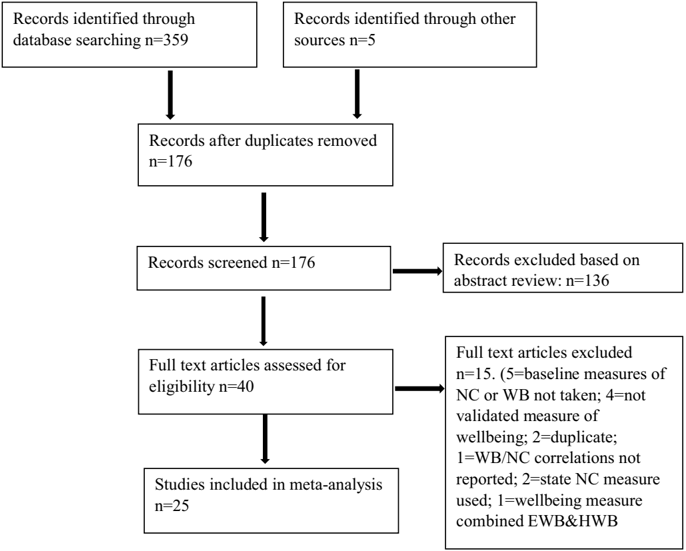
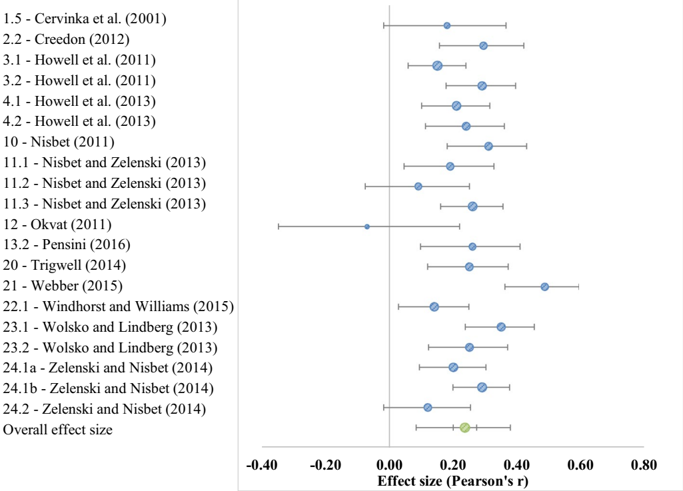
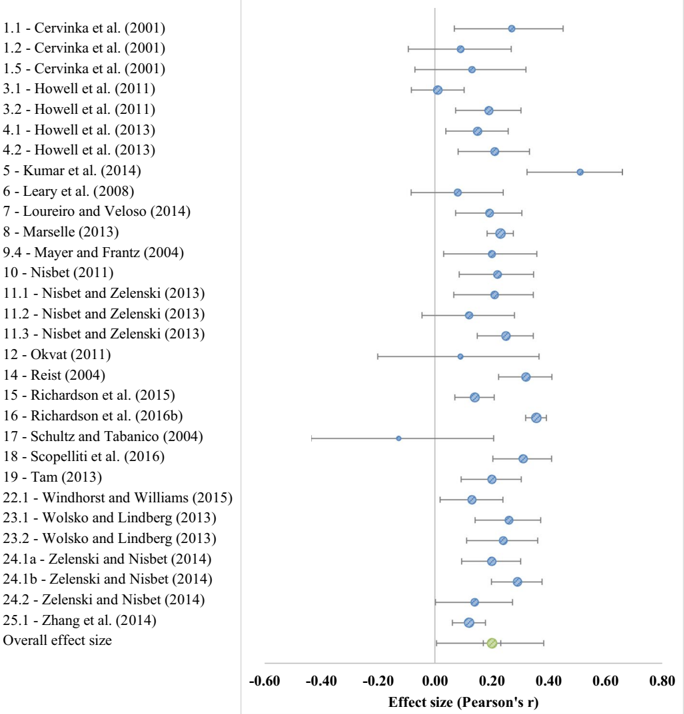
Nature connectedness relates to an individual’s subjective sense of their relationship with the natural world. A recent meta-analysis has found that people who are more connected to nature also tend to have higher levels of self-reported hedonic well-being; however, no reviews have focussed on nature connection and eudaimonic well-being. This meta-analysis was undertaken to explore the relationship of nature connection with eudaimonic well-being and to test the hypothesis that this relationship is stronger than that of nature connection and hedonic well-being. From 20 samples (n = 4758), a small significant effect size was found for the relationship of nature connection and eudaimonic well-being (r = 0.24); there was no significant difference between this and the effect size (from 30 samples n = 11,638) for hedonic well-being (r = 0.20). Of the eudaimonic well-being subscales, personal growth had a moderate effect size which was significantly larger than the effect sizes for autonomy, purpose in life/meaning, self-acceptance, positive relations with others and environmental mastery, but not vitality. Thus, individuals who are more connected to nature tend to have greater eudaimonic well-being, and in particular have higher levels of self-reported personal growth.
Overview
The claims and statistics of this paper haven’t been checked yet.
Free: it reads the open-access text and checks the first 5 claims that cite a source we can check. Create a free account to check every claim.
Integrity signals
Registry
Cites
Statistics
Figures
Verification
Claims the paper makes
The claims and statistics of this paper haven’t been checked yet.
Free: it reads the open-access text and checks the first 5 claims that cite a source we can check. Create a free account to check every claim.
Self-check
Percentages, sums and reported differences re-computed from the paper’s own numbers.
The self-check needs the paper’s full text.
Citations
Cites
Bias in meta-analysis detected by a simple, graphical test
Egger, M., Smith, G. D., Schneider, M., & Minder, C. (1997) · BMJ · doi:10.1136/bmj.315.7109.629 · Cited by 56,722 · cited 1×
“This was explored further using two more tests for publication bias: the Begg test (Begg and Mazumdar 1994) and the Egger test (Egger et al. 1997).”
MethodRyan, R. M., & Deci, E. L. (2000) · American Psychologist · doi:10.1037//0003-066x.55.1.68 · Cited by 54,599 · cited 1×
“As described in Ryan and Deci’s self-determination theory, three basic psychological needs—autonomy, competence and relatedness—are considered essential for psychological growth, integrity and well-being (Ryan and Deci 2000).”
Development and validation of brief measures of positive and negative affect: The PANAS scales.
Watson, D., Clark, L. A., & Tellegen, A. (1988) · Journal of Personality and Social Psychology · doi:10.1037/0022-3514.54.6.1063 · Cited by 32,433
The satisfaction with life scale
Diener, E., Emmons, R. A., Larsen, R. J., & Griffin, S. (1985) · Journal of Personality Assessment · doi:10.1207/s15327752jpa4901_13 · Cited by 31,768
Operating characteristics of a rank correlation test for publication bias
Begg, C. B., & Mazumdar, M. (1994) · Biometrics · doi:10.2307/2533446 · Cited by 16,955 · cited 1×
“This was explored further using two more tests for publication bias: the Begg test (Begg and Mazumdar 1994) and the Egger test (Egger et al.”
MethodHappiness is everything, or is it? Explorations on the meaning of psychological well-being.
Ryff, C. D. (1989) · Journal of Personality and Social Psychology · doi:10.1037/0022-3514.57.6.1069 · Cited by 14,847 · cited 4×
“EWB is often measured with Ryff’s scale of psychological well-being (Ryff 1989), which has six subscales: personal growth relates to being open to new ideas and experiences, and realizing one’s full potential; purpose in life links to the presence of goals in life, and feelings of meaningfulness;…”
BackgroundMethodInfluentialOn Happiness and Human Potentials: A Review of Research on Hedonic and Eudaimonic Well-Being
Ryan, R. M., & Deci, E. L. (2001) · Annual Review of Psychology · doi:10.1146/annurev.psych.52.1.141 · Cited by 11,567 · cited 4×
“(2014) included vitality as a hedonic construct, in this review, vitality was classed as a eudaimonic aspect of well-being because it is often conceptualised as such in the literature (e.g. Ryan and Deci 2001; Wolsko and Lindberg 2013; Zelenski and Nisbet 2014).”
BackgroundInfluentialCohen, J. (1992) · Psychological Bulletin · doi:10.1037//0033-2909.112.1.155 · Cited by 8,771
The restorative benefits of nature: toward an integrative framework
Kaplan, S. (1995) · Journal of Environmental Psychology · doi:10.1016/0272-4944(95)90001-2 · Cited by 6,923 · cited 2×
“…and psychological stress responses result from exposure to nature and thus results in improved well-being, and attention restoration theory (ART; Kaplan 1995) predicts that exposure to nature helps reduce attentional fatigue thus leading to improved cognitive functioning and positive affect.”
BackgroundStress recovery during exposure to natural and urban environments
Ulrich, R. S., Simons, R. F., Losito, B. D., Fiorito, E., Miles, M. A., & Zelson, M. (1991) · Journal of Environmental Psychology · doi:10.1016/s0272-4944(05)80184-7 · Cited by 5,990 · cited 1×
“For example the biophilia hypothesis (Wilson 1984) suggests that people have an innate need to affiliate with nature, and that satisfaction of this need results in well-being benefits such as improved positive affect; stress reduction theory (SRT; Ulrich et al. 1991) predicts that decreased physiological and psycholog…”
Background
Research works printed but not linked: 5
- Bullinger, M., & Kirchberger, I. (1989). SF-36 Fragebogen zum gesundheitszustand [SF-36 health-survey]. Göttingen: Hogrefe.
- Creedon, M. A. (2012). Connectedness to nature and its relationship to meaning in life. Unpublished doc- toral thesis, Massachusetts School of Professional Psychology, MA, USA.
- Kumar, R., Lal, R., Bansal, Y., & Sethi, K. V. K. (2014). Relationship between connectedness to nature and subjective well-being. Indian Journal of Psychological Science, 4, 59-63.
- Reist, D. M. (2004). Materialism vs. an ecological identity: Towards an integrative framework for a psy- chology of sustainable living. Unpublished doctoral thesis, University of Toronto, Toronto, ON.
- Steyer, R., Schwenkmezger, P., Notz, P., & Eid, M. (1997). Der mehrdimensionale befindlichkeitsfragebo- gen (MDBF) [The multidimensional comfort questionnaire (MDBF)]. Göttingen: Hogrefe.
Cited by
Items 301–400 of 700
Holland, F., Harvey, C., Ferris, E., Furlong, R., & Gibson, S. (2024) · Journal of Adventure Education & Outdoor Learning · doi:10.1080/14729679.2024.2350972 · Cited by 13
“It has been established that time spent in nature is beneficial for wellbeing (Capaldi et al., 2014; Pritchard et al., 2020) and the UK government responded by supporting funded opportunities for young people in England, particularly from lower socioeconomic areas, to have access to nature-based…”
Feucht, V., Dierkes, P. W., & Kleespies, M. W. (2024) · Sustainable Development · doi:10.1002/sd.3278 · Cited by 12
Yu, Y., Ge, J., Guo, F., & Duan, Y. (2025) · Scientific Reports · doi:10.1038/s41598-025-11719-y · Cited by 8
Whiteley, H., Lynch, M., Hartfiel, N., Cuthbert, A., Beharrell, W., & Edwards, R. T. (2025) · International Journal of Environmental Research and Public Health · doi:10.3390/ijerph22081184 · Cited by 8
“Contact and proactive interaction with nature was expected to help participants re-evaluate their connection to, and place within, the natural world and experience the documented positive impact of nature on overall well-being and mental health [30,31].”
InfluentialThe Important Role of Environmental Stewardship Groups in Supporting Human Health and Well-Being
Dacks, R. S., McMillen, H. L., Heimuli, P., Kahaleua, K., Burgess, S., Giardina, C. P., Francisco, K. S., & Ticktin, T. (2021) · Frontiers in Sustainable Cities · doi:10.3389/frsc.2021.710355 · Cited by 11
“Frequent experiences and purposeful activity in nature often foster a sense of nature connectedness and higher levels of eudaimonic well-being (Pritchard et al., 2020).”
BackgroundNature journaling in English language teaching: an introduction for practitioners
Mueller, H., & Herrera, L. J. P. (2023) · Innovation in Language Learning and Teaching · doi:10.1080/17501229.2023.2256050 · Cited by 13
Roslan, S. B., Sahak, S. N. M., Zaremohzzabieh, Z., Mohamad, Z., & Ma’rof, A. M. (2024) · Environment and Social Psychology · doi:10.54517/esp.v9i5.2346 · Cited by 16
Three moods of approaching friluftsliv and their relationships with sustainability
Løvoll, H. S., Sæther, K.-W., & Dyrdal, G. M. (2024) · Annals of Leisure Research · doi:10.1080/11745398.2024.2358753 · Cited by 8
“Connecting with nature relates to better quality of life (Capaldi et al. 2015; Nisbet, Zelenski, and Murphy 2011; Pritchard et al. 2020), and emotional connection to nature moreover is associated with pro-environ-mental behaviour (Anderson and Krettenauer 2021; Pirchio et al. 2021).”
Yuille, A., Davies, J. A. C., Green, M. A., Hardman, C. A., Knight, J., Marshall, R., Armitt, H. A., Bane, M. S., Bush, A., Carr, V. W., et al. (2024) · Health & Place · doi:10.1016/j.healthplace.2024.103368 · Cited by 8
“Research and policy increasingly emphasise investigating the pathways through which benefits from nature are derived, with feelings of nature connectedness identified as a significant mechanism (e.g. Capaldi et al., 2014; Pritchard et al., 2019).”
Greening for meaning: Sense of place in green citizen initiatives in the Netherlands
van Bommel, M. N. C., Derkzen, M. L., & Vaandrager, L. (2025) · Wellbeing Space and Society · doi:10.1016/j.wss.2025.100240 · Cited by 14
Harvey, C., Sheffield, D., Richardson, M., & Wells, R. L. (2023) · Ecopsychology · doi:10.1089/eco.2022.0014 · Cited by 13
Self-citationMoya-Méndez, N. C., Ganzevoort, W., Lenders, H. J. R., & van den Born, R. J. G. (2022) · Ecopsychology · doi:10.1089/eco.2021.0060 · Cited by 7
“This is also sometimes referred to as eudaimonic well-being, which is associated to ‘‘functioning well’’ aspects of well-being such as feelings of meaningfulness, purpose in life or personal growth (Pritch-ard, Richardson, Sheffield, & McEwan, 2020; Ryan, Huta & Deci, 2008).”
Avoiding siloed approaches: Integrating psychological insights into sustainable farming
Maltby, J. (2024) · PLoS ONE · doi:10.1371/journal.pone.0301881 · Cited by 7
“Exploring how eudaimonia correlates with sustainable farming practices [20] offers vital insights into possibly why fulfilment and meaning may be purposefully connected with the adoption of sustainable practices in farming.”
BackgroundSamus, A., Dickinson, K. J. M., Freeman, C., & van Heezik, Y. (2024) · People and Nature · doi:10.1002/pan3.10735 · Cited by 13
Friedman, S., McHaffie, S., Noble, R., & Stenning, A. C. (2025) · People and Nature · doi:10.1002/pan3.10779 · Cited by 6
Calogiuri, G., Brambilla, E., Flaten, O. E., Fröhlich, F., & Litleskare, S. (2025) · Wellbeing Space and Society · doi:10.1016/j.wss.2025.100254 · Cited by 10
Feature networks: The environmental features that are central to nature- connectedness experiences
Lengieza, M. L., Richardson, M., & Hughes, J. P. (2025) · Landscape and Urban Planning · doi:10.1016/j.landurbplan.2025.105362 · Cited by 10
Self-citationNajjinda, S., Bagire, V., Turyakira, P. K., & Akileng, G. (2025) · Journal of Ethics in Entrepreneurship and Technology · doi:10.1108/jeet-10-2024-0033 · Cited by 6
Feeling “Pawsitively” Good: Human–Pet Touch Predicts Subjective Wellbeing
Schirmer, A., Kaufmann, V., & Cham, C. (2025) · Anthrozoös · doi:10.1080/08927936.2025.2520053 · Cited by 7
“…of physical activity (Niven & Strain, 2023), whether they have a hobby (Mak et al., 2023), to what extend they connect with nature (Coventry et al., 2021; Pritchard et al., 2020), their mindfulness (Johnson et al., 2023), and their pro-sociality or how readily they help others (Hui et al., 2020).”
Linking biodiversity perception with restorativeness: Mechanism and moderators
Orth, U. R., Timm, J., Sager, A., Tischler, S., & Crouch, R. C. (2025) · Journal of Environmental Psychology · doi:10.1016/j.jenvp.2025.102671 · Cited by 7
Cultivating Care Through Nature: A Meta-Analysis of Nature Connectedness and Prosociality
Yao, Z., Li, M. D., & Liu, H. (2025) · Sustainability · doi:10.3390/su172310580 · Cited by 12
Jong, M. C., Dahlqvist, H. Z., Lown, E. A., Schats, W., Beckman, L., & Jong, M. (2023) · BMC Public Health · doi:10.1186/s12889-023-16408-x · Cited by 6
“Previous studies have reported on positive associations between nature connectedness and mental well-being [69–71] and demonstrated that individuals with increased nature connectedness have greater sense of eudemonic well-being [72].”
BackgroundFriedman, S., Noble, R., Archer, S., Gibson, J. L., & Hughes, C. H. (2024) · Autism in Adulthood · doi:10.1089/aut.2023.0009 · Cited by 11
Sands, G., Blake, H., Carter, T., & Spiby, H. (2023) · International Journal of Environmental Research and Public Health · doi:10.3390/ijerph20206921 · Cited by 9
“There is increasing evidence that access and connection to nature is beneficial to mental health and general wellbeing [1–5] and mitigates socio-economic health inequalities [6].”
BackgroundExistential Well-Being in Nature: A Cross-Cultural and Descriptive Phenomenological Approach
Baklien, B., Marthoenis, M., & Thurston, M. N. (2024) · Journal of Medical Humanities · doi:10.1007/s10912-024-09846-0 · Cited by 10
“A consequence of these trends is not just that many people have been physically repositioned away from the 1 3 natural environment (Pritchard et al. 2020; Nisbet, Shaw, and Lachance 2020; Rosa, Pro-fice, and Collado 2018) but that our collective imagination and cultural conversations about nature…”
BackgroundWiraguna, S. A., Purwanto, L., & Widjaja, R. R. (2024) · Arsitekta Jurnal Arsitektur dan Kota Berkelanjutan · doi:10.47970/arsitekta.v6i01.524 · Cited by 52
People with sensory processing sensitivity connect strongly to nature across five dimensions
Holzer, J. M., Dale, G., & Baird, J. (2024) · Sustainability Science Practice and Policy · doi:10.1080/15487733.2024.2341493 · Cited by 10
“…has positive implications for fostering global sustainability (Whitburn, Linklater, and Abrahamse 2020; Ives et al. 2018), as well as for human health (Jimenez et al. 2021) and well-being (Richardson et al. 2021; Pritchard et al. 2020), it is crucial to understand how people connect to nature.”
Chen, X., & Yang, Z. (2024) · International Journal of Environmental Health Research · doi:10.1080/09603123.2024.2381566 · Cited by 9
“Additionally, studies have demonstrated the role of nature connectedness in improving emotions, with individuals who are more closely connected to nature having a lower risk of depression and higher levels of well-being (Pritchard et al. 2020; Liu et al. 2022).”
How loss of nature through clear-cutting forestry affects well-being
Nesbakken, S., Rønningen, G. E., & Torp, S. (2024) · Health Promotion International · doi:10.1093/heapro/daae110 · Cited by 8
The importance of (not just visual) interaction with nature: A study with the Girl Scouts
Gray, C. E., Kahn, P. H., Lawler, J. J., Tandon, P. S., Bratman, G. N., Perrins, S. P., & Boyens, F. (2025) · The Journal of Environmental Education · doi:10.1080/00958964.2024.2436166 · Cited by 6
“Past research has shown that nature connectedness is positively associated with eudaimonic well-being, in particular with personal growth (Pritchard et al., 2020).”
Liu, J., Huo, Y., Wang, J., Du, Y., & Li, X. (2025) · Behavioral Sciences · doi:10.3390/bs15050686 · Cited by 11
“The meta-analysis showed that people who are more connected to nature also tend to have higher levels of self-reported hedonic and eudaimonic well-being (Pritchard et al., 2020).”
Smith, C., Allen, A., & Kannis‐Dymand, L. (2021) · Ecopsychology · doi:10.1089/eco.2021.0020 · Cited by 6
“Thus, these findings appear consistent with previous research, which suggest that nature relatedness plays an important role in the psychological influence of nature exposure (McMahan et al., 2018; Pritchard et al., 2020).”
Garza-Terán, G., Tapia-Fonllem, C. O., Fraijo-Sing, B., & Moreno-Barahona, M. (2022) · Ecopsychology · doi:10.1089/eco.2022.0003 · Cited by 7
“…refers to the emotional bond between human and nature, the level people perceive themselves to be a part of the natural environment, and the subjective sense when relating with it (Lim, Dillon, & Chew, 2020; Pritchard, Richardson, Sheffield, & McEwan, 2020; Restall & Conrad, 2015; Schultz, 2001).”
Gwedla, N., Cornelius, S. F., du Toit, M. J., & Cilliers, S. S. (2022) · Land · doi:10.3390/land11111904 · Cited by 9
Faazeli, M., & Namdar, R. (2023) · PLoS ONE · doi:10.1371/journal.pone.0274885 · Cited by 10
“NC can benefit human well-being in different ways [19, 20], such as improving human cognitive function [21].”
BackgroundFlies, E. J., Pryor, A., Henderson‐Wilson, C., Turner, M., Roydhouse, J. K., Patrick, R., O’Shea, M., Norris, K., Martin, A. J., Marsh, P., et al. (2023) · Journal of Outdoor and Environmental Education · doi:10.1007/s42322-023-00143-3 · Cited by 10
“Experiences in or with nature can also support greater connection with nature, and the eudaimonic wellbeing benefits (e.g. personal personal growth, autonomy, purpose in life, self-acceptance, positive relations to others and vitality), such nature connection can bring (Pritchard et al., 2019).”
Quendler, E., Magnini, V. P., & Driouech, N. (2021) · Zeitschrift für Tourismuswissenschaft · doi:10.1515/tw-2021-0007 · Cited by 7
Nature Relatedness and Subjective Well-Being
Nisbet, E. K. L., & Zelenski, J. M. (2023) · Springer eBooks · doi:10.1007/978-3-031-17299-1_3909 · Cited by 9
Cudworth, D., & Tymms, M. (2023) · Journal of Outdoor and Environmental Education · doi:10.1007/s42322-023-00146-0 · Cited by 8
“…a growing body of literature demonstrating the significance of consistent engagement with natural environments and green spaces on our health and wellbeing (Goodenough & Waite, 2020; Pritchard et al., 2019; McCormick, 2017; Adams & Savahl, 2017; Akpinar, 2016; Capaldi et al., 2015; Chawla, 2015).”
Korlat, S., Ristl, C., & Nikitin, J. (2024) · Australian Journal of Psychology · doi:10.1080/00049530.2024.2428306 · Cited by 11
“Empirical evidence shows that meaningful interaction with nature can foster a sense of purpose and responsibility towards the environment and society, which can drive individuals to engage in actions that benefit others and the planet (for a review see Pritchard et al., 2020).”
Chagga women´s connections with nature: fostering relationality through arts-based methods
Pearson, J., Massawe, J. J., Mbaruku, A. P., Mramba, E. I., Mwampamba, T. H., & Martín‐López, B. (2025) · Ecosystems and People · doi:10.1080/26395916.2025.2459108 · Cited by 6
“Studies have shown that connections between people and nature can have positive influences on human health and wellbeing (Martin et al. 2020; Pritchard et al. 2020) and can lead to pro-environmental behaviour and conservation actions (Martin et al. 2020).”
Memorable experience and destination loyalty in Islam-related tourism
Burhanudin, B., Ariani, S., Suroso, A., Suliyanto, S., Kartawan, K., & Banin, Q. A. (2025) · Journal of Islamic marketing · doi:10.1108/jima-09-2023-0280 · Cited by 5
Petrescu‐Mag, R. M., Rastegari, H., Hartel, T., Réti, K., & Petrescu, D. C. (2025) · PLoS ONE · doi:10.1371/journal.pone.0324444 · Cited by 7
“Research consistently shows that a strong connection to nature is linked with higher levels of hedonic (pleasure-based) and eudaimonic (meaning-based) well-being [1,2].”
Impacts of urban-rural migration on domain-specific satisfaction
Kumagai, J., Yoo, S., & Managi, S. (2025) · Cities · doi:10.1016/j.cities.2025.106056 · Cited by 5
Gao, R., Liu, J., Dai, W., Yang, J., Chen, H., & Yang, Z. (2025) · Urban forestry & urban greening · doi:10.1016/j.ufug.2025.128932 · Cited by 6
Hampejs, V., Wala, A., Tran, U. S., Pahl, S., Egger, J. A. M., Voracek, M., & White, M. P. (2026) · Journal of Environmental Psychology · doi:10.1016/j.jenvp.2026.102918 · Cited by 6
Role of Eco-spirituality in Psychological Well-Being of Selected Working Women
Quilon, A. (2024) · Bedan Research Journal · doi:10.58870/berj.v9i1.70 · Cited by 11
“…with reductions in stress and negative emotions and elevations in positive emotions, subjective well-being (Arola et. al., 2023) such as self-acceptance, personal growth, purpose in life (Pritchard et. al., 2019), and a person’s spirituality (Kamitsis & Francis, 2013; Weber & Pargament, 2014).”
BackgroundBrambilla, E., Stendal, K., Sundling, V., & Calogiuri, G. (2025) · JMIR Serious Games · doi:10.2196/63424 · Cited by 10
“Studies link nature connectedness to various health outcomes including social, psychological, physical, and general well-being [19,24-26].”
Passmore, H., Lumber, R., Niemiec, R. M., & Sofen, L. I. (2025) · Journal of Happiness Studies · doi:10.1007/s10902-025-00900-9 · Cited by 10
“A wealth of empirical literature evidences that nature connectedness is linked with both hedonic and eudaimonic well-being (see meta-analyses: Capaldi et al., 2014, Pritchard et al., 2020; Wu & Jones, 2022).”
InfluentialLinking Subjective Wellbeing and Pro-environmental Behaviour: A Multidimensional Approach
Krekel, C., & Prati, A. (2021) · Community quality-of-life and well-being · doi:10.1007/978-3-030-89559-4_11 · Cited by 9
“Eudaimonia, instead, turns out to be the best predictor of pro-environmental behaviour, in line with Venhoeven et al. (2013); Pritchard et al. (2020) and recent findings by Laffan (2020).”
Schönbach, D. M. I., Tiscareno-Osorno, X., Macintyre, T. E., Smith, S. W., MacIntyre, D., & Demetriou, Y. (2022) · PLoS ONE · doi:10.1371/journal.pone.0272344 · Cited by 9
“, personal growth) [10], hedonic well-being (i.”
Lumber, R., Passmore, H., & Niemiec, R. M. (2023) · Current Research in Ecological and Social Psychology · doi:10.1016/j.cresp.2023.100092 · Cited by 8
Gardening and Garden Therapy as a Resource for Human Psychological Well-Being
Andzaurova, P. O., & Кимовна, Н.-Б. С. (2023) · Вестник Российского университета дружбы народов. Серия: Психология и педагогика · doi:10.22363/2313-1683-2023-20-2-331-351 · Cited by 5
Carr, V. W., & Hughes, J. (2023) · Biological Conservation · doi:10.1016/j.biocon.2023.110287 · Cited by 6
Factors influencing hikers’ litter behavior in national park in China
Sun, H., Yang, F., & Guo, W. (2024) · Frontiers in Forests and Global Change · doi:10.3389/ffgc.2023.1277323 · Cited by 7
Hague, L., Brough, P. A., Buckley, R., Burton, N. W., & Spedding, J. (2024) · Applied Psychology · doi:10.1111/apps.12565 · Cited by 6
Socio‐demographic correlates of nature connection: An Australia‐wide study
Sollis, K., van Eeden, L. M., Rajeevan, U., Lin, B. B., Lee, K., Marsh, P., & Flies, E. J. (2025) · People and Nature · doi:10.1002/pan3.70181 · Cited by 9
“Increasingly, research is showing that an individual's level of nature connection is associated with how mindfully an individual interacts with nature, which in turn can act as a moderating factor for well-being (Chang et al., 2024; Dean et al., 2018 ; Pritchard et al., 2020 ).”
Wildness, infinity and freedom
Child, M. F. (2021) · Ecological Economics · doi:10.1016/j.ecolecon.2021.107055 · Cited by 9
Chęć-Małyszek, A. (2021) · Teka Komisji Architektury Urbanistyki i Studiów Krajobrazowych · doi:10.35784/teka.2785 · Cited by 6
Arbuthnott, K. D., Sutter, G. C., Belcher, J., & Stewart, S. (2022) · Environmental Education Research · doi:10.1080/13504622.2022.2074377 · Cited by 7
Rito, M. V. D., Auer, A. D., Mikkelsen, C. A., & Herrera, L. P. (2022) · Conservation and Society · doi:10.4103/cs.cs_20_124 · Cited by 5
Connecting to Zoos and Aquariums during a COVID-19 Lockdown
Macri, A. M., & Wells, D. L. (2023) · Journal of Zoological and Botanical Gardens · doi:10.3390/jzbg4020035 · Cited by 5
Heilmayr, D., & Miller, T. J. (2020) · Ecopsychology · doi:10.1089/eco.2019.0074 · Cited by 9
“…Nisbet, Zelenski, & Dopko, 2015; Hartig, Mitchell, de Vries,& Frumkin, 2014; Ohetal.,2017) and meta-analyses (Capaldi, Dopko, & Zelenski, 2014; Pritchard, Richardson, Sheffield, & Mcewan, 2019) synthesize this area of research, and also point to net positive effects of feeling connected to…”
Nature Exposure and Subjective Well-Being: The Mediating Roles of Connectedness to Nature and Awe
Zhou, M., Ying, L., Xu, Z., Zhang, R., & Liu, X. (2025) · Sustainability · doi:10.3390/su17125406 · Cited by 11
“For example, these findings are consistent across 34 different samples from various regions including Canada, Europe, the USA, Australia, India, Colombia, and Hong Kong [25].”
Contact with nature and youth well-being: Insights from natural and urban contexts
Olcese, M., Madera, F., Cardinali, P., & Migliorini, L. (2025) · Current Opinion in Psychology · doi:10.1016/j.copsyc.2025.102199 · Cited by 13
Intergenerational pathway to nature connectedness
Tam, K., Ma, X. K. K., Lam, Y.-H., & Ng, C. N. E. (2025) · Journal of Environmental Psychology · doi:10.1016/j.jenvp.2025.102891 · Cited by 9
Woolf, Y., Spotswood, F., Sinnett, D., & Bray, I. (2026) · Cities & Health · doi:10.1080/23748834.2026.2617763 · Cited by 4
Carroll, S. L., O’Brien, A., Lionetti, F., O’Reilly, A., & Setti, A. (2025) · Frontiers in Psychology · doi:10.3389/fpsyg.2025.1480669 · Cited by 6
Chhajer, R., & Bapat, S. R. (2025) · PLoS ONE · doi:10.1371/journal.pone.0323712 · Cited by 5
“Engagement with nature by visiting more than once a week can lead to better health, prevention, and treat-ment of many public health challenges, such as obesity, heart disease, depression, and anxiety [37–39].”
Influential‘It makes me a better teacher’: the benefits of outdoor learning for teachers
Frances, L., Quinn, F., Elliott, S., & Bird, J. (2025) · Journal of Adventure Education & Outdoor Learning · doi:10.1080/14729679.2025.2558044 · Cited by 4
“One such approach may be OL, which can offer teachers regular connection to nature, a factor shown to support mental health and reduce stress in adults (Carr & Hughes, 2021; Pritchard et al., 2020; Twohig-Bennett & Jones, 2018).”
Fehnker, L., Pearson, D. M., & Howland, P. J. (2022) · Australasian Journal of Environmental Management · doi:10.1080/14486563.2022.2035834 · Cited by 7
Masterson‐Algar, P., Jenkins, S. R., Windle, G., Morris-Webb, E. S., Takahashi, C., Burke, T., Rosa, I. M. D., Martinez, A. S., Torres-Mattos, E. B., Taddei, R., et al. (2022) · Frontiers in Psychology · doi:10.3389/fpsyg.2022.809009 · Cited by 4
Climate change and adventure guiding: The role of nature connection in guide wellbeing
Valdivielso-Martínez, E., & Mackenzie, S. H. (2022) · Frontiers in Public Health · doi:10.3389/fpubh.2022.946093 · Cited by 10
YENİ BİR DOĞA-TEMELLİ TURİZM: ORMAN BANYOSU (SHİNRİN-YOKU) VE BİR ROTA ÖNERİSİ
KARAŞAH, B. (2022) · TURKISH JOURNAL OF FOREST SCIENCE · doi:10.32328/turkjforsci.1170096 · Cited by 4
Biophilic Design: Virtual Nature Application in a Windowless Room
Maulina, W., & Susanto, D. (2023) · Sinektika Jurnal Arsitektur · doi:10.23917/sinektika.v20i1.20484 · Cited by 5
Die Artenkenntnis von angehenden Biologie- und Sachunterrichtslehrkräften zum Ökosystem Wattenmeer
Schmäing, T., & Grotjohann, N. (2023) · Zeitschrift für Didaktik der Naturwissenschaften · doi:10.1007/s40573-023-00153-0 · Cited by 6
Can virtual reality nudge toward green investing? An experiment with small business entrepreneurs
Vassilopoulos, A., Papadaki, L., & Koundouri, P. (2023) · Review of Behavioral Finance · doi:10.1108/rbf-01-2023-0005 · Cited by 8
Development and Preliminary Validation of the Divine Connectedness Scale in the USA
Datu, J. A. D., & Fincham, F. D. (2024) · Journal of Religion and Health · doi:10.1007/s10943-024-02111-7 · Cited by 4
Trani, L., Menzel, C., & Loy, L. S. (2024) · International Journal of Intercultural Relations · doi:10.1016/j.ijintrel.2024.102049 · Cited by 4
The impact of environmental quality on mental health: an ecological study
Wilson, K., Jackman, M. N., & Moore, W. R. (2024) · Journal of Public Mental Health · doi:10.1108/jpmh-06-2024-0071 · Cited by 4
Bhardwaj, S., Chopra, R., & Choudhary, P. (2025) · International journal of organizational analysis · doi:10.1108/ijoa-09-2024-4810 · Cited by 13
Haluza, D., Spletzer, M. S., Ortmann, J., & Jungwirth, D. (2025) · Health Science Reports · doi:10.1002/hsr2.70555 · Cited by 8
Achieving nature-human harmony: awe brings benevolence through nature connectedness
Lin, S., Chen, X., & Bai, L. (2025) · Current Psychology · doi:10.1007/s12144-025-07707-0 · Cited by 4
“This builds upon earlier studies that focused on how connection with nature affects joy (Pritchard et al., 2020), suggesting that joy can also strengthen our bond with nature.”
Selvaraj, P., Krishnamoorthy, A., Vivekanandhan, S., & Manoharan, H. (2022) · Heliyon · doi:10.1016/j.heliyon.2022.e09327 · Cited by 5
“A couple of recent meta-analysis researches exhibited positive association between nature connectedness and the facets of hedonic wellbeing (Capaldi et al., 2014) and eudaimonic wellbeing (Pritchard et al., 2020).”
The Impact of Preschool Outdoor Environment on Children’s Socio-Emotional Development
Mohamad, N., Affandi, H. M., Saari, M., Kamal, M. F. M., & Noor, M. S. M. (2022) · Jurnal Kejuruteraan · doi:10.17576/jkukm-2022-si5(1)-02 · Cited by 4
Gittins, H., Dandy, N., Wynne‐Jones, S., & Morrison, V. (2022) · Wellbeing Space and Society · doi:10.1016/j.wss.2022.100125 · Cited by 7
Jong, M., Stub, T., & Jong, M. C. (2024) · Global Advances in Integrative Medicine and Health · doi:10.1177/27536130241238150 · Cited by 4
“54,55 Several studies have shown that nature-connectedness is strongly linked to a sense of purpose, personal growth and development.”
Twilley, D., HUNTER, H., & MORRIS, L. (2022) · Journal of Education and Recreation Patterns · doi:10.53016/jerp.v3i2.73 · Cited by 5
“Studies have found a statistically significant positive relationship between nature connectedness and happiness as individuals who are more connected to nature are likely to be happier (Capaldi, 2014), and tend to be flourishing and functioning well psychologically (Pritchard et al., 2020).”
BackgroundStewart, A. E., & Bolton, M. J. (2021) · PsyArXiv (OSF Preprints) · doi:10.31234/osf.io/5yrg9 · Cited by 4
Taylor, A., O’Malley, M., O’Callaghan, R., & Goodwin, J. (2025) · International Journal of Mental Health Nursing · doi:10.1111/inm.70000 · Cited by 4
Xu, P. (2025) · Frontiers in Psychology · doi:10.3389/fpsyg.2025.1283929 · Cited by 6
Ruckert, J. H., Smith, S. S., & Kramer, H. (2025) · Review of General Psychology · doi:10.1177/10892680251335607 · Cited by 9
“You really feel Invincible”: The impact of open water swimming on student wellbeing
Duffy, E., & Ashbullby, K. J. (2025) · Journal of Environmental Psychology · doi:10.1016/j.jenvp.2025.102654 · Cited by 4
Saavedra, A., Schwartz, D. L., & Blair, K. P. (2025) · The Journal of Environmental Education · doi:10.1080/00958964.2025.2541892 · Cited by 3
“The study of connectedness is an accelerating area of research (Ives et al., 2017) with many researchers seeking to define its mental characteristics (e.g., Pritchard et al., 2020; Schultz, 2001; Tam, 2013; Whitburn et al., 2020).”
ARISOY, N. (2025) · Sustainability · doi:10.3390/su17188163 · Cited by 5
Existential Travel Psychology: An Exploration for Optimal Well-Being
Gladys Rupavathi., B., & Mahadevan, S. (2025) · Psychological Studies · doi:10.1007/s12646-025-00866-x · Cited by 3
“Psychological well-being, especially eudaimonic, is connected to nature, and studies prove that individuals connected to the natural environment are more likely to be psychologically healthy (Pritchard et al., 2019).”
Nurturing well-being through nature-based intervention: The mediating role of mindfulness state
Zeng, P.-Y., Yeh, M.-H., & Yeh, S. (2026) · Journal of Environmental Psychology · doi:10.1016/j.jenvp.2025.102849 · Cited by 3
A Nature-Based Intervention to Support the Well-Being of Baccalaureate Nursing Students
Olson, E. T., Mathiason, M. A., Vermeesch, A. L., & Bliss, D. Z. (2024) · Journal of Nursing Education · doi:10.3928/01484834-20231205-07 · Cited by 4
Sterckx, A., Delbaere, B., Blust, G. D., Spacova, I., Samson, R., den Broeck, K. V., Remmen, R., & Keune, H. (2024) · Frontiers in Public Health · doi:10.3389/fpubh.2024.1379230 · Cited by 3
Tribot, A.-S., Faget, D., & Changeux, T. (2024) · PLoS ONE · doi:10.1371/journal.pone.0303584 · Cited by 3
“…ways to experience nature, the engagement with nature’s beauty is particularly important regarding current environmental challenges [2,3], since emotional and sensory engagement with nature seems to have more effect on pro-environmental behaviors than do knowledge and theoretical education [4–7].”
Metadata
- Authors
- Pritchard, A., Richardson, M., Sheffield, D., & McEwan, K.
- Affiliations
- University of Derby (GB)
- Corresponding author
- Pritchard, Alison
- Venue
- Journal of Happiness Studies
- Published
- 2019-04-30
- Volume
- 21
- Issue
- 3
- Pages
- 1145-1167
- ISSN
- 1389-4978 (ISSN-L)
- 1573-7780
- OpenAlex
- W2942996956
- Cited by
- 702
- References
- 106
- Citations by year
- 2026: 106 · 2025: 138 · 2024: 122 · 2023: 108 · 2022: 103 · 2021: 77 · 2020: 39 · 2019: 8
- FWCI
- 8.76
- Type
- journal article
- Language
- en
- Open access
- hybrid
- doi.org
- Licence
- cc-by
- creativecommons.org/licenses/by/4.0 (tdm)
- Locations
- Journal of Happiness Studies (publishedVersion, cc-by)
- RePEc: Research Papers in Economics (submittedVersion)
- University of Derby Online Research Archive. (University of Derby) (submittedVersion)
- Topics
- Social Sciences › Psychology › Social Psychology › Psychological Well-being and Life Satisfaction
- Social Sciences › Urban Studies › Urban Green Space and Health
- Social Sciences › Business, Management and Accounting › Tourism, Leisure and Hospitality Management › Recreation, Leisure, Wilderness Management
- Keywords
- nature connection, eudaimonic well-being, hedonic well-being, personal growth, meaning in life, self-acceptance, environmental mastery, vitality, autonomy, positive relationships with others
About these checks
Registry, retraction, Cites and statistics results are computed, not judged, with one exception: a printed reference that no index lists is read once by a model before it counts as a citation error. Claims are extracted by a model and kept only when their quote appears verbatim in the text; each cited source is then checked, with a model’s help, for whether it says what the claim relies on. Those verdicts can be wrong — read the claim’s quote and the cited source before relying on one.
Statistics and arithmetic are recomputed, not judged.
Confidence bands are shown only for fields calibrated on our annotated test set. None is calibrated yet, so no band is shown.
What counts as a claim ›How we measure confidence ›How we check this ›
Are you an author, or do you see a problem with this page? Request a review
Data sources
Bibliographic data: Semantic Scholar, OpenAlex, Crossref.
Contains information from the Semantic Scholar Academic Graph Datasets, made available under the ODC Attribution License (ODC-BY 1.0).
Semantic Scholar’s data is described in: Kinney, R., et al. (2023). The Semantic Scholar Open Data Platform. arXiv:2301.10140.
