

The Relationship Between Nature Connectedness and Eudaimonic Well-Being: A Meta-analysis
Open accessThe DOI matches its Crossref record; 103 of the 106 references it cites were found in a registry or an index.
Abstract
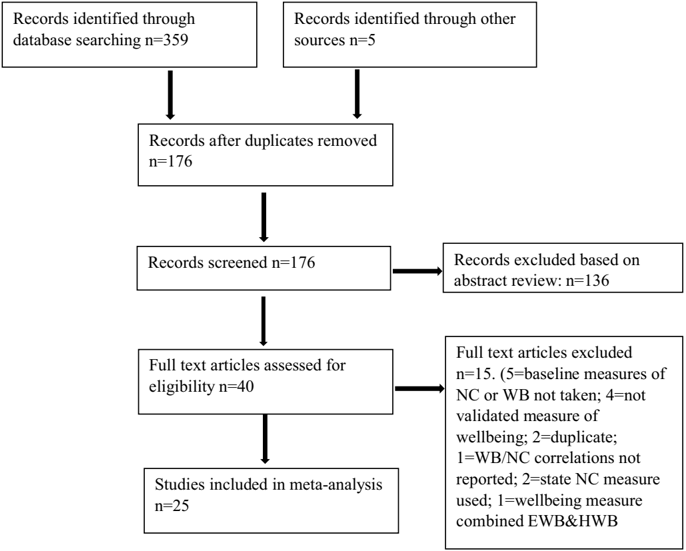
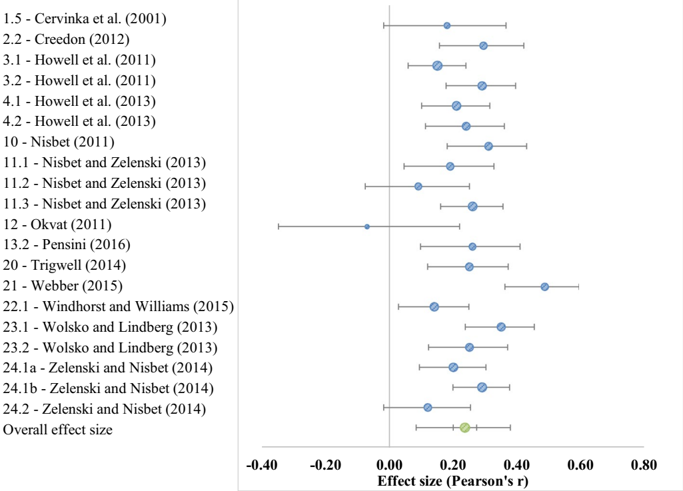
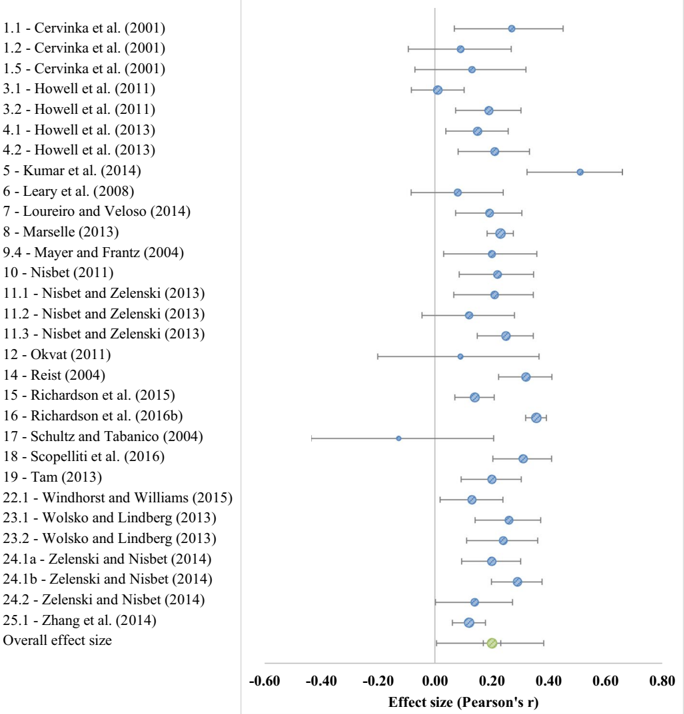
Nature connectedness relates to an individual’s subjective sense of their relationship with the natural world. A recent meta-analysis has found that people who are more connected to nature also tend to have higher levels of self-reported hedonic well-being; however, no reviews have focussed on nature connection and eudaimonic well-being. This meta-analysis was undertaken to explore the relationship of nature connection with eudaimonic well-being and to test the hypothesis that this relationship is stronger than that of nature connection and hedonic well-being. From 20 samples (n = 4758), a small significant effect size was found for the relationship of nature connection and eudaimonic well-being (r = 0.24); there was no significant difference between this and the effect size (from 30 samples n = 11,638) for hedonic well-being (r = 0.20). Of the eudaimonic well-being subscales, personal growth had a moderate effect size which was significantly larger than the effect sizes for autonomy, purpose in life/meaning, self-acceptance, positive relations with others and environmental mastery, but not vitality. Thus, individuals who are more connected to nature tend to have greater eudaimonic well-being, and in particular have higher levels of self-reported personal growth.
Overview
The claims and statistics of this paper haven’t been checked yet.
Free: it reads the open-access text and checks the first 5 claims that cite a source we can check. Create a free account to check every claim.
Integrity signals
Registry
Cites
Statistics
Figures
Verification
Claims the paper makes
The claims and statistics of this paper haven’t been checked yet.
Free: it reads the open-access text and checks the first 5 claims that cite a source we can check. Create a free account to check every claim.
Self-check
Percentages, sums and reported differences re-computed from the paper’s own numbers.
The self-check needs the paper’s full text.
Citations
Cites
Bias in meta-analysis detected by a simple, graphical test
Egger, M., Smith, G. D., Schneider, M., & Minder, C. (1997) · BMJ · doi:10.1136/bmj.315.7109.629 · Cited by 56,722 · cited 1×
“This was explored further using two more tests for publication bias: the Begg test (Begg and Mazumdar 1994) and the Egger test (Egger et al. 1997).”
MethodRyan, R. M., & Deci, E. L. (2000) · American Psychologist · doi:10.1037//0003-066x.55.1.68 · Cited by 54,599 · cited 1×
“As described in Ryan and Deci’s self-determination theory, three basic psychological needs—autonomy, competence and relatedness—are considered essential for psychological growth, integrity and well-being (Ryan and Deci 2000).”
Development and validation of brief measures of positive and negative affect: The PANAS scales.
Watson, D., Clark, L. A., & Tellegen, A. (1988) · Journal of Personality and Social Psychology · doi:10.1037/0022-3514.54.6.1063 · Cited by 32,433
The satisfaction with life scale
Diener, E., Emmons, R. A., Larsen, R. J., & Griffin, S. (1985) · Journal of Personality Assessment · doi:10.1207/s15327752jpa4901_13 · Cited by 31,768
Operating characteristics of a rank correlation test for publication bias
Begg, C. B., & Mazumdar, M. (1994) · Biometrics · doi:10.2307/2533446 · Cited by 16,955 · cited 1×
“This was explored further using two more tests for publication bias: the Begg test (Begg and Mazumdar 1994) and the Egger test (Egger et al.”
MethodHappiness is everything, or is it? Explorations on the meaning of psychological well-being.
Ryff, C. D. (1989) · Journal of Personality and Social Psychology · doi:10.1037/0022-3514.57.6.1069 · Cited by 14,847 · cited 4×
“EWB is often measured with Ryff’s scale of psychological well-being (Ryff 1989), which has six subscales: personal growth relates to being open to new ideas and experiences, and realizing one’s full potential; purpose in life links to the presence of goals in life, and feelings of meaningfulness;…”
BackgroundMethodInfluentialOn Happiness and Human Potentials: A Review of Research on Hedonic and Eudaimonic Well-Being
Ryan, R. M., & Deci, E. L. (2001) · Annual Review of Psychology · doi:10.1146/annurev.psych.52.1.141 · Cited by 11,567 · cited 4×
“(2014) included vitality as a hedonic construct, in this review, vitality was classed as a eudaimonic aspect of well-being because it is often conceptualised as such in the literature (e.g. Ryan and Deci 2001; Wolsko and Lindberg 2013; Zelenski and Nisbet 2014).”
BackgroundInfluentialCohen, J. (1992) · Psychological Bulletin · doi:10.1037//0033-2909.112.1.155 · Cited by 8,771
The restorative benefits of nature: toward an integrative framework
Kaplan, S. (1995) · Journal of Environmental Psychology · doi:10.1016/0272-4944(95)90001-2 · Cited by 6,923 · cited 2×
“…and psychological stress responses result from exposure to nature and thus results in improved well-being, and attention restoration theory (ART; Kaplan 1995) predicts that exposure to nature helps reduce attentional fatigue thus leading to improved cognitive functioning and positive affect.”
BackgroundStress recovery during exposure to natural and urban environments
Ulrich, R. S., Simons, R. F., Losito, B. D., Fiorito, E., Miles, M. A., & Zelson, M. (1991) · Journal of Environmental Psychology · doi:10.1016/s0272-4944(05)80184-7 · Cited by 5,990 · cited 1×
“For example the biophilia hypothesis (Wilson 1984) suggests that people have an innate need to affiliate with nature, and that satisfaction of this need results in well-being benefits such as improved positive affect; stress reduction theory (SRT; Ulrich et al. 1991) predicts that decreased physiological and psycholog…”
Background
Research works printed but not linked: 5
- Bullinger, M., & Kirchberger, I. (1989). SF-36 Fragebogen zum gesundheitszustand [SF-36 health-survey]. Göttingen: Hogrefe.
- Creedon, M. A. (2012). Connectedness to nature and its relationship to meaning in life. Unpublished doc- toral thesis, Massachusetts School of Professional Psychology, MA, USA.
- Kumar, R., Lal, R., Bansal, Y., & Sethi, K. V. K. (2014). Relationship between connectedness to nature and subjective well-being. Indian Journal of Psychological Science, 4, 59-63.
- Reist, D. M. (2004). Materialism vs. an ecological identity: Towards an integrative framework for a psy- chology of sustainable living. Unpublished doctoral thesis, University of Toronto, Toronto, ON.
- Steyer, R., Schwenkmezger, P., Notz, P., & Eid, M. (1997). Der mehrdimensionale befindlichkeitsfragebo- gen (MDBF) [The multidimensional comfort questionnaire (MDBF)]. Göttingen: Hogrefe.
Cited by
Items 401–500 of 700
Quah, A., Haughton, M., & Kotera, Y. (2024) · International Journal of Spa and Wellness · doi:10.1080/24721735.2024.2398313 · Cited by 4
“Research into nature connectedness (NC) and nature exposure (NE) show increasing evidence supporting a relationship between nature and well-being (Mayer et al., 2009; Pritchard et al., 2020).”
Gao, R., Chen, H., Zhang, R., Dai, W., Yang, J., & Yang, Z. (2024) · Current Psychology · doi:10.1007/s12144-024-07010-4 · Cited by 4
“Many researchers have also found that nature connectedness provides a pathway for the satisfaction of basic psychological needs (Cleary et al., 2017; Pritchard et al., 2020 ).”
The Role of Environmental Education in Improving Human Health: Literature Review
Barani, M. (2024) · Медицинский журнал Западного Казахстана · doi:10.18502/wkmj.v66i4.17769 · Cited by 3
“Nature-based educational activities promote mindfulness and emotional regulation, contributing to improved mental health outcomes [19].”
Hefti, M., Fleury‐Bahi, G., & Navarro, Ó. (2025) · PsyEcology Bilingual Journal of Environmental Psychology · doi:10.1177/21711976241308423 · Cited by 5
“En un metaanálisis, Pritchard et al. (2020) muestran que existe una tendencia a que la conexión con la naturaleza esté más fuertemente relacionada con el bienestar eudaimónico que con el hedónico.”
InfluentialEffects of a Forest Meditation Therapy Program on Reducing Daily Stress and Promoting Coping
Yeo, S.-Y., Lee, M., & Shin, W.-S. (2024) · Journal of people, plants, and environment · doi:10.11628/ksppe.2024.27.6.657 · Cited by 5
“Meta-ana-lytical evidence suggests that heightened levels of connectedness to nature are linked to increased happiness and overall well-being (Capaldi et al., 2014; Pritchard et al., 2020).”
Workplace greenery and employee green behavior: a moderated-mediation model
Valor, C., Palomo, R. R., & Bosch, I. C. (2025) · Management Research Review · doi:10.1108/mrr-07-2024-0562 · Cited by 5
R-ECO: An R script to measure the supply of urban ecosystem services in Europe
Jato‐Espino, D., & Jensen, M. B. (2025) · Sustainable Cities and Society · doi:10.1016/j.scs.2025.106358 · Cited by 3
Sherman, A., Yamamoto, K., McAlpin, E., Pal, A., AlQatami, A., & Levitan, C. (2025) · The Journal of Positive Psychology · doi:10.1080/17439760.2025.2519304 · Cited by 3
“Nature experiences, for example, promote many of the same positive outcomes as the ones we found here (Pritchard et al., 2020).”
Rhodes, C., & Lumber, R. (2021) · International Journal of Mental Health and Addiction · doi:10.1007/s11469-021-00565-4 · Cited by 6
Porter, S., & Couper, P. R. (2021) · Journal of Adventure Education & Outdoor Learning · doi:10.1080/14729679.2021.1935284 · Cited by 10
Fatores associados ao bem-estar em profissionais da atenção primária
Bruno, V. H. T., Beteto, I. D. S., Habimorad, P. H. L., Nunes, H. R. D. C., & Patrício, K. P. (2021) · Revista Brasileira em Promoção da saúde · doi:10.5020/18061230.2021.11878 · Cited by 5
Kras, N., & Keenan, J. (2023) · Island Studies Journal · doi:10.24043/isj.420 · Cited by 4
Wilson, S. E., & Flint, C. G. (2023) · Community Development · doi:10.1080/15575330.2023.2286442 · Cited by 4
“Similarly, evidence suggests that those with higher levels of nature connectedness are happier (Capaldi et al., 2014) and exhibit higher wellbeing (Pritchard et al., 2020).”
BackgroundMethodШаталова, О. В. (2023) · Cultural-Historical Psychology · doi:10.17759/chp.2023190411 · Cited by 5
Islam, M. A., Tuhin, K. A., Sarker, M. H. S., & Wakil, M. A. (2025) · Journal of Outdoor Recreation and Tourism · doi:10.1016/j.jort.2025.100885 · Cited by 4
Paradise Regained? Localised and Limited Nature Connexions in the UK's Covid-19 Lockdown
Dobson, J., Gore, T., Graham, K., & Swade, K. (2021) · Frontiers in Sustainable Cities · doi:10.3389/frsc.2021.708209 · Cited by 5
Can self-transcendent positive emotions facilitate bonds with nature?Preprint
Moreton, S. G. (2018) · PsyArXiv (OSF Preprints) · doi:10.31234/osf.io/deq8z · Cited by 3
Biodiversity and Human Health: A Scoping Review and Case Studies on Underrepresented LinkagesPreprint
Robinson, J. M., Breed, A. C., Camargo, A., Redvers, N., & Breed, M. F. (2022) · Preprints.org · doi:10.20944/preprints202210.0275.v1 · Cited by 2
Prisoner perceptions of the environmental impact on self-harm and suicidal behaviour
Nixon, L., & Goldie-Chaplin, G. (2024) · Journal of Forensic Practice · doi:10.1108/jfp-12-2023-0068 · Cited by 2
Ning, P., DeWitt, D., Chin, H. L., & Wang, H. (2025) · On the Horizon The International Journal of Learning Futures · doi:10.1108/oth-11-2024-0074 · Cited by 4
Re-Thinking Biophilic Design for Primary Schools: Exploring Children’s Preferences
Ghaziani, R. (2025) · Architecture · doi:10.3390/architecture5030042 · Cited by 4
Gunko, R., Rapeli, L., Scheinin, M., Wikström, J., & Tynkkynen, N. (2025) · Environmental Management · doi:10.1007/s00267-025-02215-0 · Cited by 2
“As noted, an increasing interest in understanding the role of nature in people ’ s well-being has been evoked among scholars and policymakers over the last decade (Capaldi et al. 2014; Pritchard et al. 2020; Richardson et al. 2021).”
Questioning Anthropocentric Utilitarianism: Expanding Ethical Horizons in the Circular Economy
Nurminen, M. (2025) · Circular Economy and Sustainability · doi:10.1007/s43615-025-00675-4 · Cited by 3
“In contrast, cognitive connectedness with nature is enhances eudaimonic well-being through the sense of personal growth [86].”
Capturing nature Connectedness: Validity and utility of the Dutch nature connection index
van den Bogerd, N., Richardson, M., Bentvelsen, J., Holtmaat, K., Labib, S. M., & Maas, J. (2025) · Journal of Environmental Psychology · doi:10.1016/j.jenvp.2025.102727 · Cited by 2
Self-citationNature Relatedness Usefully Links Well-Being, the Environment, and Sustainability
Zelenski, J. M., Lutz, P. K., Passmore, H., & Nisbet, E. K. L. (2025) · Current Directions in Psychological Science · doi:10.1177/09637214251349814 · Cited by 6
“Specific measures include the components of subjective well-being (life satisfaction and positive emotional balance) and broader eudaimonic indicators, including autonomy, personal growth, meaning, authenticity, vitality, self-acceptance, and so on (Pritchard et al., 2020).”
Noticing nature: The role of environmental awareness in promoting well‐being
Harries, B., Chalmin‐Pui, L. S., Gatersleben, B., Griffiths, A., & Ratcliffe, E. (2025) · People and Nature · doi:10.1002/pan3.70113 · Cited by 6
“…with focusing on the resulting sensory and emotional reactions (Ballew & Omoto, 2018; Capaldi et al., 2017 ; Lim et al., 2020; Martin et al., 2020 ; Pritchard et al., 2020 ; Richardson et al., 2020; Richardson, Hamlin, et al., 2021 ; Richardson, Passmore, et al., 2021; Russell et al., 2013 ; Scott…”
Decentring Intercultural Competence Frameworks in the Ecological Turn
Woodin, J. (2025) · Journal of Intercultural Communication Research · doi:10.1080/17475759.2025.2586672 · Cited by 3
“In relation to nature connectedness and wellbeing, Pritchard (2019, para.”
InfluentialChhajer, R., & McEwan, K. (2025) · Acta Psychologica · doi:10.1016/j.actpsy.2025.105961 · Cited by 3
Self-citationJin, W., Gao, Y., Yang, H., Mao, X., Zhang, H., Chen, X., Khan, W. R., Bevilacqua, S., & Shi, Y. (2025) · Urban forestry & urban greening · doi:10.1016/j.ufug.2025.129230 · Cited by 4
Zhang, Z., Liu, W., Du, L., & Qiu, J. (2025) · Buildings · doi:10.3390/buildings15244575 · Cited by 2
Barbett, L., Syropoulos, S., & Capozzoli, J. (2026) · Journal of Environmental Psychology · doi:10.1016/j.jenvp.2025.102895 · Cited by 6
Nature connectedness framework for adolescents: an integrative review
Yildirim, G., Willison, J., & Bentley, B. (2026) · Frontiers in Psychology · doi:10.3389/fpsyg.2026.1721907 · Cited by 4
“A strong bond with the natural world is associated with hedonic wellbeing through the provision of pleasure and reduction of stress, and eude-monic wellbeing through fostering a sense of purpose, meaning, and belonging (Pritchard et al., 2020).”
Reframing human–nature connectedness: A multi-scale agent-based model across time and region
Richardson, M., & Richardson, L. A. (2026) · Urban forestry & urban greening · doi:10.1016/j.ufug.2026.129399 · Cited by 3
Self-citationBarth, L. L., Rasch, J., Grech, A., Riecke, B. E., & Mayer, S. (2026) · CHI Conference on Human Factors in Computing Systems · doi:10.1145/3772318.3790282 · Cited by 4
“1: We propose a holistic experience design approach for nature embodiment, incorporating transitional elements (e.g., biophilic design, music, ritualistic performance, post-VR reflection) before and after VR and multisensory enhancements (e.g., weighted blanket, heat lamp, oil diffuser) during VR.”
Nature connectedness in the family context: A systematic scoping review
Chen, G., Wang, X., & Tam, K. (2026) · Journal of Environmental Psychology · doi:10.1016/j.jenvp.2026.103090 · Cited by 4
Potential benefits of blue space for human health and well-being
White, M. P., Elliott, L. R., Gascón, M., Roberts, B. R., & Fleming, L. E. (2021) · Routledge eBooks · doi:10.4324/9780429056161-4 · Cited by 3
Brundell, P., Harlow, N., Cameron, H., & Bowden, W. L. (2022) · International Academic Mindtrek Conference (Mindtrek) · doi:10.1145/3569219.3569362 · Cited by 2
“[13] reports that connectedness to nature is associated with eudaimonic happiness and is more likely to be associated with enduring well-being and higher perceptions of their self-growth.”
BackgroundContemplation of Nature to Promote Mental Health and Prevent Depression in Youth
Medeiros, S., Langer, A. I., & Nielsen, S. S. (2022) · Depression and personality · doi:10.1007/978-3-031-13029-8_5 · Cited by 3
Shoesmith, E., & Ratschen, E. (2023) · Wildlife Research · doi:10.1071/wr22125 · Cited by 2
“2014; Pritchard et al .”
Bidi, S. B., Alapati, V., Dmello, V. J., Weesie, E., Gil, M. T., Shenoy, S. S., Kurian, S., & Rajendran, A. (2023) · F1000Research · doi:10.12688/f1000research.131894.1 · Cited by 10
“Well-being as a topic has been investigated since the last two decades (Schellenbaum et al ., 2002; Schaufeli & Bakker, 2004; Pritchard et al ., 2019) and has become an increasingly popular topic in academic and business settings, with organisations attempting to discover what makes working…”
The Toolbox Approach: Towards a Novel Flexible Way of Implementing and Testing Positive Education
Lucciarini, E., & Boniwell, I. (2023) · Springer eBooks · doi:10.1007/978-981-99-5609-8_8 · Cited by 2
Lee, J., & Yoon, S. (2024) · HERD Health Environments Research & Design Journal · doi:10.1177/19375867241226601 · Cited by 4
“…nature connectedness moderated the effects of nature exposure on people’s more plea-sant physiological measures (Koivisto et al., 2022). . . . higher levels of nature connectedness are associated with higher levels of psychological well-being (Cervinka et al., 2012; Pritchard et al., 2020).”
Validity and Reliability Study of the Turkish Form of the Pro-Nature Conservation Behavior Scale
Akkaya, E. C., Genç, M., & Alkar, Ö. Y. (2024) · Psikiyatride Guncel Yaklasimlar - Current Approaches in Psychiatry · doi:10.18863/pgy.1521276 · Cited by 3
Esports Are Pretty Far From Bodhi Trees: Touch Grass for Performance and Well-Being
Horne, G., & Sharpe, B. T. (2024) · Journal of Electronic Gaming and Esports · doi:10.1123/jege.2024-0038 · Cited by 4
Whiteley, H., Parkinson, J. A., Hartfiel, N., Makanjuola, A., Lloyd‐Williams, H., Lawrence, C. L., & Edwards, R. T. (2024) · Behavioral Sciences · doi:10.3390/bs14121233 · Cited by 6
“There is a growing body of work exploring the health and well-being benefits of contact and proactive interaction with nature [6,7,26,30,31].”
Nature and play spaces in a Brazilian preschool setting
Benfica, R. S., Lauer-Leite, I. D., & de Novaıs, J. S. (2025) · Education 3-13 · doi:10.1080/03004279.2024.2447325 · Cited by 2
“Evidence indicates that connectedness with nature exerts a positive effect on multiple areas of healthy functioning and well-being in young people (Pritchard et al. 2020; Vella-Brodrick and Gilowska 2022; Wells 2000).”
Uotinen, J., Loivaranta, T., & SEAL, A. (2025) · Journal of Happiness Studies · doi:10.1007/s10902-024-00837-5 · Cited by 4
“In alignment with the theory, interaction with or felt connectedness to nature has been found to relate to significant benefits to health, happiness, and mental well-being (e.g. Bratman et al., 2019; Chawla, 1999; Mayer et al., 2009; Pritchard et al., 2020; Russell et al., 2013).”
Ferrari, V., Marzana, D., & D’Angelo, C. (2024) · Journal of Prevention & Intervention in the Community · doi:10.1080/10852352.2025.2479999 · Cited by 2
“Furthermore, the research examining the effects of nature-based interventions on adolescents mainly takes a clinical approach focusing on vulnerable youth (Obeng et al., 2023; Overbey et al., 2023; Richardson et al., 2020).”
From Gold to Grief: The Psychological Toll of Climate Change on Mining Communities in Zimbabwe
Nyakuwanika, M., & Panicker, M. (2025) · Sustainability · doi:10.3390/su17167503 · Cited by 3
Abi, J., Ahmad, A., Herk, W. S., & Zaini, N. (2023) · Tourism, hospitality & event management · doi:10.1007/978-3-031-28053-5_14 · Cited by 3
Creating a Post-sedentary Work Context for Software Engineering
Hedlund, M., Bogdan, C., & Meixner, G. (2022) · Lecture notes in computer science · doi:10.1007/978-3-030-98388-8_12 · Cited by 2
Fehnker, L., Pearson, D. M., & Howland, P. J. (2022) · Australian Geographer · doi:10.1080/00049182.2022.2051682 · Cited by 5
Xie, M. W., Goes, V. D. A., Lem, M., Raab, K. K., de Camargo, T. S., Barros, E., Maharaj, S. B., & Potter, T. (2023) · Challenges · doi:10.3390/challe14010017 · Cited by 2
Connectedness to Nature and Well-Being: A Survey among University Employees and Medical Students
Spletzer, M. S., Cervinka, R., & Haluza, D. (2023) · Journal of Community Medicine & Public Health · doi:10.29011/2577-2228.100384 · Cited by 1
“To the best of our knowledge, this is the first study to investigate the relationship between CN and WB using the BIT as a comprehensive measure encompassing eudemonic and hedonic aspects of WB and one of the few investigating the relationship in a German-speaking country [14,48].”
BackgroundResultPearson, E. L., Richardson, A., & Busque, B. L. (2024) · Psychology Learning & Teaching · doi:10.1177/14757257241231840 · Cited by 4
Kosić, A., Passafaro, P., Schnell, T., & Molinari, M. (2024) · Ecopsychology · doi:10.1089/eco.2024.0003 · Cited by 2
Karadağ, S. Ç. (2019) · Review of International Geographical Education Online · doi:10.33403/rigeo.580824 · Cited by 3
Facetten, Quellen und Auswirkungen von Einsamkeit
Landmann, H., & Buecker, S. (2022) · Kulturen der Gesellschaft · doi:10.14361/9783839463505-004 · Cited by 6
Suomalaisten aikuisten metsäsuhde: tuloksia tiedosta, kokemuksista ja toiminnasta
Luonnonvarakeskus (Luke), B. J. Y., Pynnönen, S., Häyrinen, L., Lähtinen, K., Tani, S., & Berghäll, S. (2024) · Metsätieteen aikakauskirja · doi:10.14214/ma.23017 · Cited by 11
Preferable, Contextual and Sustainable… Climate Futures for Ecological Citizens.
Phillips, R. T. M., Baurley, S. L., Boxall, E., Gooding, L., Knox, D., Nordmoen, C., Shepley, A., Simmons, T., West, S., & Wright, J. (2024) · Proceedings of DRS · doi:10.21606/drs.2024.335 · Cited by 2
Bork‐Hüffer, T., Wächter, L., & Hitchings, R. (2024) · People and Nature · doi:10.1002/pan3.10680 · Cited by 1
“…body of evidence showing that nature experiences and connections are positively linked to mental and psychological health and well-being (Barton et al., 2009; Dobson et al., 2019; McCormick, 2017; Pritchard et al., 2020; Richardson, 2022; World Health Organization Regional Office for Europe, 2016).”
BackgroundDoğaya Bağlılık Eğilimi Ölçeğinin Türkçe’ye Uyarlanması: Geçerlik ve Güvenirlik Çalışması
Akbaş, B., & Durmuşoğlu, M. C. (2024) · Buca eğitim fakültesi dergisi (Online)/Buca Eğitim Fakültesi dergisi · doi:10.53444/deubefd.1455914 · Cited by 1
Ecological Peace and Character Strengths
Lumber, R. (2024) · Peace psychology book series · doi:10.1007/978-3-031-66928-6_8 · Cited by 2
Chan, S. H. M., Qiu, L., & Yong, J. C. (2025) · Ecopsychology · doi:10.1089/eco.2024.0055 · Cited by 1
“Connectedness with nature is vital for both human and planetary health, as it promotes psychological well-being and life satisfaction (Capaldi et al., 2014; Pritchard et al., 2020) while fostering pro-environmental attitudes and behaviors (Davis et al., 2009; Geng et al., 2015).”
Shoesmith, E., Darcy, P. M., Piper, S. F., White, P. C. L., Needham, A., Little, A., Perry, G., & Coventry, P. A. (2025) · Frontiers in Public Health · doi:10.3389/fpubh.2025.1556230 · Cited by 3
“In addition to creative activities, connection with and activities in natural environments can also play a critical role in maintaining and enhancing mental health and wellbeing (8, 9, 42, 43).”
Tashkov, V., & Pasca, L. (2025) · PsyEcology Bilingual Journal of Environmental Psychology · doi:10.1177/21711976251330758 · Cited by 2
Henry, J., & Giannouli, V. (2025) · Psychiatria Danubina · doi:10.24869/psyd.2025.76 · Cited by 1
“…threatened by the need to alter lifestyle choices, happiness by diminishing enjoyment in nature-related activities due to ecological awareness, and meaning by a perceived lack of impact on the ecological crisis (Adams, 2006; Capaldi et al., 2014; Heine et al., 2006; Pritchard et al., 2020).”
Considering biophilic tendencies when operationalising nature as medicine: a critical review
Stonebridge, N., Sumner, R. C., & Scott, S. (2025) · Journal of Environmental Psychology · doi:10.1016/j.jenvp.2025.102678 · Cited by 2
Citizens’ support to nature in Aruba—A study on sustainability and wellbeing
Soma, K., Verweij, P., Francis, A., & van Wonderen, D. (2025) · Wellbeing Space and Society · doi:10.1016/j.wss.2025.100281 · Cited by 2
Hospitality, Tourism, and Nature-Connectedness: A Systematic Review and Research Agenda
Mihiretu, H. A., Legendre, T. S., & Chan, E. S. W. (2025) · International Journal of Hospitality & Tourism Administration · doi:10.1080/15256480.2025.2533155 · Cited by 3
“For example, Pritchard et al. (2020) found that connection with nature increased eudaimonia well-being more than hedonic well-being.”
Influential235Chapter 15 Connectedness: Unpacking an essential factor of the Inner Development Goals
von Wirth, T., & Jansen, P. (2025) · De Gruyter eBooks · doi:10.1515/9783111337913-016 · Cited by 1
Nature connectedness and moral cultivation in the Yijing
Tan, C. (2025) · Journal of Philosophy of Education · doi:10.1093/jopedu/qhaf060 · Cited by 1
Zhu, L., Zhang, P., Gui, S., Gao, C., Shen, X., & Jiao, C. (2025) · Behavioral Sciences · doi:10.3390/bs15091200 · Cited by 1
“Despite increasing evidence linking CtN to psychological well-being across populations (Howell et al., 2011; Pritchard et al., 2019), its specific role and mechanisms in older adults remain underexplored.”
The Interconnection Between Climate Change and Mental Health and Well-Being
Kurebwa, J., & Mahela, T. M. (2025) · IGI Global eBooks · doi:10.4018/979-8-3373-3281-9.ch001 · Cited by 1
Forest Therapy Trails: Development and Application of an Assessment Protocol
Gobster, P. H. (2025) · International Journal of Environmental Research and Public Health · doi:10.3390/ijerph22091440 · Cited by 4
“This work has revealed the importance of nearby nature [4,5], nature connectedness [6,7], and nature experience [8,9] on physical and mental health and wellbeing.”
Thornhill, I., Bayley, A., Collins, T. M., Goto, R., Hinde, K., Hunter, V., Kang, J., Kim, H., Kim, J., Kim, J.-G., et al. (2025) · Ecosystems and People · doi:10.1080/26395916.2025.2571450 · Cited by 1
“Moreover, the effect of the positive benefits of time spent in green space for health and wellbeing, as well as building confidence and sociability, can enable people to feel more connected with the natural world (Zelenski and Nisbet 2014; Pritchard et al. 2020).”
Ferrajão, P. C., Torres, N., & Martins, A. Q. (2025) · SAGE Open · doi:10.1177/21582440251388161 · Cited by 5
“It seems that both dimensions of eco-anxiety may not be primarily manifestations of psychological distress (Clayton & Karazsia, 2020; Pritchard et al., 2020), but rather a rational and emotional response related to individuals’ connection to the natural world and engagement in environmental…”
J., H. N. K., & Chithra, G. K. (2025) · Frontiers in Education · doi:10.3389/feduc.2025.1657999 · Cited by 5
Gerhát, A., & Haľama, P. (2025) · Mental Health, Religion & Culture · doi:10.1080/13674676.2025.2547261 · Cited by 1
“On the other hand, the eudaimonic perspective perceives well-being as a process of fulfilling one’s virtuous potential and striving for excellence, while living in accordance with one’s values and “daimon”, or true self (Deci & Ryan, 2006; Pritchard et al., 2019).”
Wu, Y., & Sato, S. (2025) · Youth · doi:10.3390/youth5040134 · Cited by 1
“Hedonic and eudaimonic well-being did not have significant results at T2, which is inconsistent with previous research (Pritchard et al., 2020; Capaldi et al., 2014) due to the data collection point or duration of the intervention (Silva et al., 2024).”
Zhao, D., Yang, Y., Sedikides, C., Han, Y., Hou, X., Yang, L., & Wang, L. (2025) · Journal of Environmental Psychology · doi:10.1016/j.jenvp.2025.102786 · Cited by 1
Catalysing transformational change through compound nature connectedness interventions
Pritchard, M., Tovey, P., Tickell, P., & Oliver, T. H. (2025) · AMBIO · doi:10.1007/s13280-025-02328-0 · Cited by 3
“…that nature connectedness promotes a range of physical and mental health outcomes (e.g. Capaldi et al. 2014; Twohig-Bennett and Jones 2018; Pritchard et al. 2020), but there is now abundant evidence that it can also foster pro-environmental attitudes and behaviours (Mackay and Schmitt…”
Martins, C. S., Brás, M. S. V., Antunes, J. P. T., Nunes, M. C. D. O. S., Guedes, C. D. S., & Carmo, C. (2025) · Springer eBooks · doi:10.1007/978-981-95-3133-2_5 · Cited by 1
Yuan, J., Chen, G., Chen, Y., Liu, T., Xiao, Y., Yu, L., & Hongye, G. (2026) · Frontiers in Psychology · doi:10.3389/fpsyg.2026.1694397 · Cited by 1
Understanding the nature-wellbeing relationship in adults: a qualitative metasynthesis review
van Bekkum, J. E., McDougall, C., Wendelboe‐Nelson, C., Mason, S. S., Williams, A. J., Jepson, R. G., & Malden, S. (2026) · Wellbeing Space and Society · doi:10.1016/j.wss.2026.100359 · Cited by 4
An Autophotographic–Phenomenological Investigation of British Transmen’s Psychological Well-Being
Cosford, H., & Williamson, I. R. (2026) · Healthcare · doi:10.3390/healthcare14030389 · Cited by 2
“This is echoed in other studies which have found that engagement in nature serves as a protective factor for psychological well-being, while nature connectedness is associated with a reduction in mental health symptoms, personal growth, purpose in life and positive effect [71].”
A glamping we will go! Unpacking the emotional and experiential triggers of vacation intentions
Zheng, L., Dastane, O., & Cham, T. (2026) · Journal Of Vacation Marketing · doi:10.1177/13567667261416491 · Cited by 1
Jansen, P., Hoja, S., Cassar, L., & Neu, T. (2026) · Applied Psychology Health and Well-Being · doi:10.1111/aphw.70137 · Cited by 3
“Pan et al. (2024) refer to subjective well-being, while Pritchard et al. (2020) employ eudaimonic well-being in addition to hedonic well-being or mental well-being (Stenfors et al., 2025).”
Nguyen, K. M., Pham, P. L. H., Do, T. T. M., Nguyễn, N. K., Vo, C. H., & Nguyen, N. T. (2026) · Journal of Tourism Futures · doi:10.1108/jtf-03-2025-0063 · Cited by 3
Schönbach, D. M. I., Tiscareno-Osorno, X., Macintyre, T. E., Smith, S., MacIntyre, D., & Demetriou, Y. (2026) · Frontiers in Public Health · doi:10.3389/fpubh.2026.1758383 · Cited by 1
“…has been associated with enhanced mental health (i.e., decreased mental distress and lower odds of needing medical treatment for depression) (16), hedonic well-being (i.e., increased positive affect, life satisfaction, and vitality) (17), and eudaimonic well-being (i.e., personal growth) (18).”
Lee, B.-T. X., & Steemers, K. (2026) · Buildings · doi:10.3390/buildings16081494 · Cited by 2
Yong, J. C., Lim, A. J. Y., Tan, E., & Chan, S. (2026) · Behavioral Sciences · doi:10.3390/bs16050650 · Cited by 3
Developing a novel instrument to assess human–nature relational values
Post, K. M. (2026) · People and Nature · doi:10.1002/pan3.70330 · Cited by 1
“Drawing on conceptual frameworks and salient articulations from the literature (Chan et al., 2016 ; Himes & Muraca, 2018 ; Mattijssen et al., 2020; Pritchard et al., 2020; Tobin, 2022 ), additional descriptors—such as identity, self-expression, spirituality, well-being, flourishing and…”
He, Y., Zhang, H., He, Z., & Zhang, H. (2026) · Journal of Hospitality and Tourism Insights · doi:10.1108/jhti-04-2025-0522 · Cited by 2
Being moved enhances pro-environmental intentions: The mediating role of connectedness to nature
Zhou, Y., Bi, C., Ling, Y., & Yue, T. (2026) · Acta Psychologica · doi:10.1016/j.actpsy.2026.107644 · Cited by 1
Positive body image is a pathway between nature contact and life satisfaction across 58 nations
Swami, V., Voracek, M., Stieger, S., Aavik, T., Ranjbar, H. A., Adebayo, S. O., Afhami, R., Ahmed, O., Aimé, A., Akel, M., et al. (2026) · Environment International · doi:10.1016/j.envint.2026.110277 · Cited by 7
Liu, S., Tan, Y., & Zang, L. (2026) · Frontiers in Psychology · doi:10.3389/fpsyg.2026.1878240 · Cited by 1
“Meta-analytic evidence indicates that connection with nature is positively associated with happiness and eudaimonic wellbeing (Capaldi et al., 2014; Pritchard et al., 2020).”
Hefti, M., Galharret, J., Navarro, O., & Fleury‐Bahi, G. (2026) · Acta Psychologica · doi:10.1016/j.actpsy.2026.107401 · Cited by 1
Barbett, L., Naumann, J. L., & Rohmann, A. (2026) · Journal of Environmental Psychology · doi:10.1016/j.jenvp.2026.103165 · Cited by 1
Gordon, J. E., Kubalíková, L., Vaněk, J., & Whalley, W. B. (2026) · Geoheritage · doi:10.1007/s12371-026-01411-6 · Cited by 1
“…growing awareness of a need to re-establish lost connections with nature, as highlighted for example during the Covid-19 pandemic (Allen 2024) and by the increasing number of research studies demonstrating the role of nature in human well-being (Pritchard et al. 2019; Richardson and Hamlin 2021).”
Metadata
- Authors
- Pritchard, A., Richardson, M., Sheffield, D., & McEwan, K.
- Affiliations
- University of Derby (GB)
- Corresponding author
- Pritchard, Alison
- Venue
- Journal of Happiness Studies
- Published
- 2019-04-30
- Volume
- 21
- Issue
- 3
- Pages
- 1145-1167
- ISSN
- 1389-4978 (ISSN-L)
- 1573-7780
- OpenAlex
- W2942996956
- Cited by
- 702
- References
- 106
- Citations by year
- 2026: 106 · 2025: 138 · 2024: 122 · 2023: 108 · 2022: 103 · 2021: 77 · 2020: 39 · 2019: 8
- FWCI
- 8.76
- Type
- journal article
- Language
- en
- Open access
- hybrid
- doi.org
- Licence
- cc-by
- creativecommons.org/licenses/by/4.0 (tdm)
- Locations
- Journal of Happiness Studies (publishedVersion, cc-by)
- RePEc: Research Papers in Economics (submittedVersion)
- University of Derby Online Research Archive. (University of Derby) (submittedVersion)
- Topics
- Social Sciences › Psychology › Social Psychology › Psychological Well-being and Life Satisfaction
- Social Sciences › Urban Studies › Urban Green Space and Health
- Social Sciences › Business, Management and Accounting › Tourism, Leisure and Hospitality Management › Recreation, Leisure, Wilderness Management
- Keywords
- nature connection, eudaimonic well-being, hedonic well-being, personal growth, meaning in life, self-acceptance, environmental mastery, vitality, autonomy, positive relationships with others
About these checks
Registry, retraction, Cites and statistics results are computed, not judged, with one exception: a printed reference that no index lists is read once by a model before it counts as a citation error. Claims are extracted by a model and kept only when their quote appears verbatim in the text; each cited source is then checked, with a model’s help, for whether it says what the claim relies on. Those verdicts can be wrong — read the claim’s quote and the cited source before relying on one.
Statistics and arithmetic are recomputed, not judged.
Confidence bands are shown only for fields calibrated on our annotated test set. None is calibrated yet, so no band is shown.
What counts as a claim ›How we measure confidence ›How we check this ›
Are you an author, or do you see a problem with this page? Request a review
Data sources
Bibliographic data: Semantic Scholar, OpenAlex, Crossref.
Contains information from the Semantic Scholar Academic Graph Datasets, made available under the ODC Attribution License (ODC-BY 1.0).
Semantic Scholar’s data is described in: Kinney, R., et al. (2023). The Semantic Scholar Open Data Platform. arXiv:2301.10140.
