

The Relationship Between Nature Connectedness and Eudaimonic Well-Being: A Meta-analysis
Open accessThe DOI matches its Crossref record; 103 of the 106 references it cites were found in a registry or an index.
Abstract
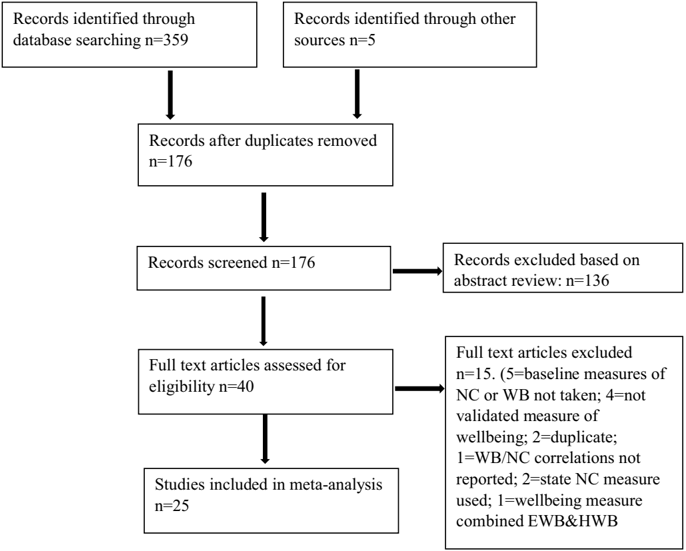
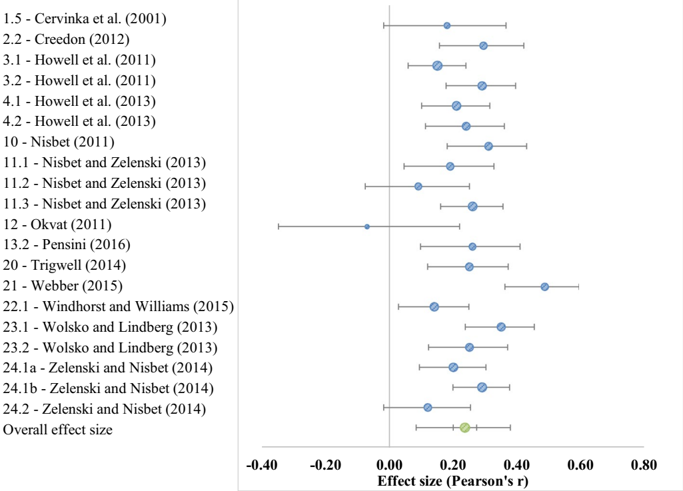
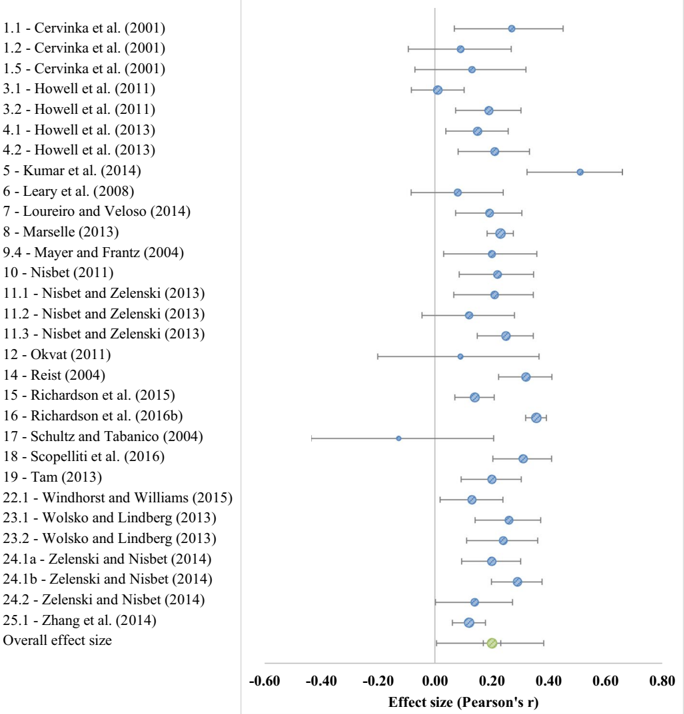
Nature connectedness relates to an individual’s subjective sense of their relationship with the natural world. A recent meta-analysis has found that people who are more connected to nature also tend to have higher levels of self-reported hedonic well-being; however, no reviews have focussed on nature connection and eudaimonic well-being. This meta-analysis was undertaken to explore the relationship of nature connection with eudaimonic well-being and to test the hypothesis that this relationship is stronger than that of nature connection and hedonic well-being. From 20 samples (n = 4758), a small significant effect size was found for the relationship of nature connection and eudaimonic well-being (r = 0.24); there was no significant difference between this and the effect size (from 30 samples n = 11,638) for hedonic well-being (r = 0.20). Of the eudaimonic well-being subscales, personal growth had a moderate effect size which was significantly larger than the effect sizes for autonomy, purpose in life/meaning, self-acceptance, positive relations with others and environmental mastery, but not vitality. Thus, individuals who are more connected to nature tend to have greater eudaimonic well-being, and in particular have higher levels of self-reported personal growth.
Overview
The claims and statistics of this paper haven’t been checked yet.
Free: it reads the open-access text and checks the first 5 claims that cite a source we can check. Create a free account to check every claim.
Integrity signals
Registry
Cites
Statistics
Figures
Verification
Claims the paper makes
The claims and statistics of this paper haven’t been checked yet.
Free: it reads the open-access text and checks the first 5 claims that cite a source we can check. Create a free account to check every claim.
Self-check
Percentages, sums and reported differences re-computed from the paper’s own numbers.
The self-check needs the paper’s full text.
Citations
Cites
Bias in meta-analysis detected by a simple, graphical test
Egger, M., Smith, G. D., Schneider, M., & Minder, C. (1997) · BMJ · doi:10.1136/bmj.315.7109.629 · Cited by 56,722 · cited 1×
“This was explored further using two more tests for publication bias: the Begg test (Begg and Mazumdar 1994) and the Egger test (Egger et al. 1997).”
MethodRyan, R. M., & Deci, E. L. (2000) · American Psychologist · doi:10.1037//0003-066x.55.1.68 · Cited by 54,599 · cited 1×
“As described in Ryan and Deci’s self-determination theory, three basic psychological needs—autonomy, competence and relatedness—are considered essential for psychological growth, integrity and well-being (Ryan and Deci 2000).”
Development and validation of brief measures of positive and negative affect: The PANAS scales.
Watson, D., Clark, L. A., & Tellegen, A. (1988) · Journal of Personality and Social Psychology · doi:10.1037/0022-3514.54.6.1063 · Cited by 32,433
The satisfaction with life scale
Diener, E., Emmons, R. A., Larsen, R. J., & Griffin, S. (1985) · Journal of Personality Assessment · doi:10.1207/s15327752jpa4901_13 · Cited by 31,768
Operating characteristics of a rank correlation test for publication bias
Begg, C. B., & Mazumdar, M. (1994) · Biometrics · doi:10.2307/2533446 · Cited by 16,955 · cited 1×
“This was explored further using two more tests for publication bias: the Begg test (Begg and Mazumdar 1994) and the Egger test (Egger et al.”
MethodHappiness is everything, or is it? Explorations on the meaning of psychological well-being.
Ryff, C. D. (1989) · Journal of Personality and Social Psychology · doi:10.1037/0022-3514.57.6.1069 · Cited by 14,847 · cited 4×
“EWB is often measured with Ryff’s scale of psychological well-being (Ryff 1989), which has six subscales: personal growth relates to being open to new ideas and experiences, and realizing one’s full potential; purpose in life links to the presence of goals in life, and feelings of meaningfulness;…”
BackgroundMethodInfluentialOn Happiness and Human Potentials: A Review of Research on Hedonic and Eudaimonic Well-Being
Ryan, R. M., & Deci, E. L. (2001) · Annual Review of Psychology · doi:10.1146/annurev.psych.52.1.141 · Cited by 11,567 · cited 4×
“(2014) included vitality as a hedonic construct, in this review, vitality was classed as a eudaimonic aspect of well-being because it is often conceptualised as such in the literature (e.g. Ryan and Deci 2001; Wolsko and Lindberg 2013; Zelenski and Nisbet 2014).”
BackgroundInfluentialCohen, J. (1992) · Psychological Bulletin · doi:10.1037//0033-2909.112.1.155 · Cited by 8,771
The restorative benefits of nature: toward an integrative framework
Kaplan, S. (1995) · Journal of Environmental Psychology · doi:10.1016/0272-4944(95)90001-2 · Cited by 6,923 · cited 2×
“…and psychological stress responses result from exposure to nature and thus results in improved well-being, and attention restoration theory (ART; Kaplan 1995) predicts that exposure to nature helps reduce attentional fatigue thus leading to improved cognitive functioning and positive affect.”
BackgroundStress recovery during exposure to natural and urban environments
Ulrich, R. S., Simons, R. F., Losito, B. D., Fiorito, E., Miles, M. A., & Zelson, M. (1991) · Journal of Environmental Psychology · doi:10.1016/s0272-4944(05)80184-7 · Cited by 5,990 · cited 1×
“For example the biophilia hypothesis (Wilson 1984) suggests that people have an innate need to affiliate with nature, and that satisfaction of this need results in well-being benefits such as improved positive affect; stress reduction theory (SRT; Ulrich et al. 1991) predicts that decreased physiological and psycholog…”
Background
Research works printed but not linked: 5
- Bullinger, M., & Kirchberger, I. (1989). SF-36 Fragebogen zum gesundheitszustand [SF-36 health-survey]. Göttingen: Hogrefe.
- Creedon, M. A. (2012). Connectedness to nature and its relationship to meaning in life. Unpublished doc- toral thesis, Massachusetts School of Professional Psychology, MA, USA.
- Kumar, R., Lal, R., Bansal, Y., & Sethi, K. V. K. (2014). Relationship between connectedness to nature and subjective well-being. Indian Journal of Psychological Science, 4, 59-63.
- Reist, D. M. (2004). Materialism vs. an ecological identity: Towards an integrative framework for a psy- chology of sustainable living. Unpublished doctoral thesis, University of Toronto, Toronto, ON.
- Steyer, R., Schwenkmezger, P., Notz, P., & Eid, M. (1997). Der mehrdimensionale befindlichkeitsfragebo- gen (MDBF) [The multidimensional comfort questionnaire (MDBF)]. Göttingen: Hogrefe.
Cited by
Items 501–600 of 700
Pre adaptivity of the student’s personality «the age of uncertainty»: search for indicators
Владимировна, К. Г., Semenovskikh, T., Soloveva, E., & Fedina, L. (2021) · CITISE · doi:10.15350/2409-7616.2021.1.34 · Cited by 1
Ahmad, N., & Rahman, S. F. A. (2021) · IIUM Journal of Educational Studies · doi:10.31436/ijes.v9i4.377 · Cited by 1
“This study also identified that most of the previous studies derived findings based on significant relationships and effect sizes (Pritchard et al., 2020).”
ResultReese, R. F., & Swank, J. M. (2022) · Applied Environmental Education & Communication · doi:10.1080/1533015x.2022.2068699 · Cited by 6
Martínez, B., Gargurevich, R., & Matos, L. (2023) · Persona · doi:10.26439/persona2023.n26(1).6347 · Cited by 3
“…inherentemente intrínsecos (Kaplan, 1995) que orientan a las personas al presente (Ryan & Deci, 2017) en el que hay una ausencia de presiones externas (Weinstein et al., 2009) mostrando así la satisfacción de la necesidad psicológica de autonomía (Pritchard et al., 2020; Ryan & Deci, 2017).”
BackgroundLegesse, S. M., & Wondimu, H. (2023) · Behavioural Neurology · doi:10.1155/2023/6669157 · Cited by 1
“E ffi cacy beliefs in fl uence how one evaluates their resources in di ffi cult situations and help them establish behavioral intentions [12].”
BackgroundThe Healing Power of Green Spaces: Combating Loneliness, Loss, and Isolation
McConatha, J. T., Ford, K., Cusmano, C., Lyman, N., & McConatha, M. (2023) · International Journal of Geriatrics and Gerontology · doi:10.29011/2577-0748.100076 · Cited by 4
“Parks, walking trails, sidewalks, and green public spaces can serve as resources and a source of connection [16,17].”
BackgroundColor green and sustainable consumption behavior: A self-expansion perspective
Sun, H., & Wu, Z. (2023) · Applied Mathematics and Nonlinear Sciences · doi:10.2478/amns.2023.2.01260 · Cited by 5
Sensory textile-bacterial hybrids: textile-bacteria fusion to impart forest-associated scents
Nerlich, P., Sherry, A., Deary, M., Morrow, R., & Scott, J. (2023) · Textile Intersections · doi:10.21606/ti-2023/111 · Cited by 2
Connectedness to Nature, Spirituality, and Resilience among Selected Filipino Adolescents
Dy, M. F. R., & Dy, E. V. Y. (2024) · INTERNATIONAL JOURNAL OF MULTIDISCIPLINARY RESEARCH AND ANALYSIS · doi:10.47191/ijmra/v7-i05-23 · Cited by 5
“Studies on connectedness to nature have been confined to Europe, North America, and Australia, thus, investigations of this construct in other countries need to be done (Pritchard et al., 2019; Scopelleti et al., 2016).”
BackgroundMAR Enhanced Hiking Experience: Exploring Multimodal Experience Design in Outdoor Scenarios
Hong, L., Hou, W., Chen, C., Zhang, H., & Li, Q. (2024) · Lecture notes in computer science · doi:10.1007/978-3-031-60012-8_22 · Cited by 1
Fernández, M. T. S., Segundo, C. R. S., Lucas, J. M., González, S. S., & Rodríguez, J. M. M. (2024) · Lecture notes in educational technology · doi:10.1007/978-981-97-1814-6_108 · Cited by 1
Reeves, J. P., Freeman, W., Patel-Calverley, R., Newth, J. L., & Plimpton, B. (2026) · Wellbeing Space and Society · doi:10.1016/j.wss.2026.100401 · Cited by 2
Sensory Textile – Bacterial Hybrids: Textile-Bacteria Fusion to Impart Forest-Associated Scents
Nerlich, P., Sherry, A., Deary, M. E., Morrow, R., & Scott, J. (2024) · Journal of Textile Design Research and Practice · doi:10.1080/20511787.2024.2394267 · Cited by 1
Wang, X., & Chen, S. (2024) · People and Nature · doi:10.1002/pan3.10726 · Cited by 3
Exploring the relation between spirituality and gratitude in a Spanish sample of nursing students
Fernández-Pascual, M. D., Reig-Ferrer, A., McSherry, W., & Martínez-Rodríguez, L. (2025) · Journal for the Study of Spirituality · doi:10.1080/20440243.2024.2439821 · Cited by 2
“Among the major interventions reviewed, those that involve the pursuit of eudaimo-nic and complex well-being, beyond hedonic or immediate well-being, stand out (Allen, Romate, and Rajkumar 2021; Pritchard et al. 2020; Ryff 2023; Salanova and Llorens 2016).”
Huish, J. L., Fisher, Z., Isham, A., & Kemp, A. H. (2025) · PLOS mental health. · doi:10.1371/journal.pmen.0000281 · Cited by 1
“This aligns with previous findings showing that engaging in nature-based activities and feeling connected to nature significantly predict the promotion of hedonic and eudaimonic markers of wellbeing, such as happiness and purpose in life [20,59].”
Walimbe, S., Nandineni, R. D., Rege, S., Chitgopkar, S., & Rajhans, V. (2025) · Discover Sustainability · doi:10.1007/s43621-025-01441-0 · Cited by 1
“The author suggests the self-actualization, vitality, and personal experience of a healthy life through Eudai-monic well-being, which exists with nature contact, analyzed through meta-analysis [25].”
Wolter-Paulsen, S., Didriksen, S. M., Litleskare, S., & Calogiuri, G. (2025) · Journal of American College Health · doi:10.1080/07448481.2025.2537104 · Cited by 4
“36,37 On the other hand, the participants tended to value the IVN as an “escape experience”, rather than a way to motivate them to physically interact with nature.”
Measuring ecological grief to guide inclusive urban forest management
Eyster, H. N., & Gould, R. K. (2025) · Canadian Journal of Forest Research · doi:10.1139/cjfr-2025-0092 · Cited by 1
Translation, Adaptation, and Validation of the Inner Peace Scale (IPS) to the Turkish Language
Seki, T., Gökalp, Z. Ş., Kurnaz, M. F., & Dilmaç, B. (2023) · TRC JOURNAL OF HUMANITARIAN ACTION · doi:10.55280/trcjha.2022.1.3.0010 · Cited by 1
Perspectiva de ‘bem-estar único’ em sistemas agroflorestais - Uma análise bibliométrica
Bichel, A., & Zanin, E. (2021) · UNICIÊNCIAS · doi:10.17921/1415-5141.2021v25n1p26-32 · Cited by 1
Finding the right words: Articulating the value of mental health promotion. A focus group study
Cresswell‐Smith, J., Mäkikärki, N., Appelqvist‐Schmidlechner, K., & Wahlbeck, K. (2022) · Journal of Community Psychology · doi:10.1002/jcop.22801 · Cited by 2
“Nature connectedness, or an individual's subjective sense of their relationship with the natural world, (Mayer & Frantz, 2004) has shown links to both hedonic and eudaimonic dimensions of mental wellbeing and levels of personal growth (Capaldi et al., 2014; Pritchard et al., 2020).”
BackgroundGore, T., Bimpson, E., Dobson, J., & Parkes, S. D. (2023) · International Review of Public Policy · doi:10.4000/irpp.3872 · Cited by 1
From mother to Mother Nature: The role of interpersonal attachment in human–nature relations
Capaldi, C. A. (2020) · Carleton University's Institutional Repository (MacOdrum Library, Carleton University) · doi:10.22215/etd/2020-13953 · Cited by 1
“Meta-analyses by Capaldi et al. (2014) and Pritchard et al. (2019) both found that individuals who have a stronger connection to nature tend to report higher positive affect, life satisfaction, and vitality compared to those who are less connected to nature.”
BackgroundPratscher, S. D. (2020) · MOspace Institutional Repository (University of Missouri) · doi:10.32469/10355/78090 · Cited by 3
Menzel, C., von der Heiden, L., Tretau, I., & Wissel, P. (2023) · doi:10.31234/osf.io/rfsuz · Cited by 1
A Theological View, Apologetic and Critical, of the Social Phenomenon “Kardashians”Preprint
Molina, M. D. C. (2023) · Qeios · doi:10.32388/7d0ccx.2
Maggino, F. (2023) · Springer eBooks · doi:10.1007/978-3-031-17299-1_302817 · Cited by 1
Charitidou, A. (2024) · PsyArXiv (OSF Preprints) · doi:10.31234/osf.io/vd9bc · Cited by 2
Ekinci, E., Parlar, F. M., Ercan, Ö., Tekin, N., Sönmez, B. Y., & Üstün, Ü. D. (2025) · Research Square · doi:10.21203/rs.3.rs-6917351/v1 · Cited by 1
Zobel, S. B., Rogier, G., Laura, P., & Velotti, P. (2022) · Research Square · doi:10.21203/rs.3.rs-1250637/v1 · Cited by 2
Whitburn, J.-A. (2020) · Open Access Victoria University of Wellington | Te Herenga Waka (Figshare) · doi:10.26686/wgtn.17145590.v1 · Cited by 4
Choe, E. Y. (2019) · White Rose eTheses Online (University of Leeds, The University of Sheffield, University of York)
Bravo, A. I. (2020) · Universidad de Lima · doi:10.26439/ulima.tesis/11320
A sense of coherence: Drawing for the mind
Robertson, E. (2020) · Drawing Research Theory Practice · doi:10.1386/drtp_00042_1 · Cited by 1
Improving the well-being of Canadians
Jarrett, P. (2021) · OECD Economics Department working papers · doi:10.1787/6ab6b718-en · Cited by 4
Effects of Biology, Drugs, Life Events, and the Environment on Wellbeing
Sirgy, M. J. (2021) · Social indicators research series · doi:10.1007/978-3-030-71888-6_8
Ma, Y., & Chen, X. (2021) · ISOCARP World Planning Congress · doi:10.47472/i86ecuiw
La pandémie de COVID-19 au Canada
(2021) · Études économiques de l'OCDE. Canada · doi:10.1787/09df8907-fr
The effects of nature in virtual reality on psychological wellbeing
Chan, S. H. M. (2021) · DR-NTU (Nanyang Technological University) · doi:10.32657/10356/156158
Need for Nature Connectedness in Urban Youth for Environmental Sustainability
Clark, T., Zolnikov, T. R., & Furio, F. (2021) · Springer eBooks · doi:10.1007/978-3-030-51812-7_66-1
Connectedness to Nature, Grit and Depression Among Selected Filipino Adolescents
Dy, M. F. R. (2022) · INTERNATIONAL JOURNAL OF MULTIDISCIPLINARY RESEARCH AND ANALYSIS · doi:10.47191/ijmra/v5-i6-12 · Cited by 1
Lumber, R., Passmore, H., & Niemiec, R. M. (2022) · SSRN Electronic Journal · doi:10.2139/ssrn.4150360
Learning in Unfamiliar Landscapes: The Role of Discomfort in Transformative Environmental Education
Winks, L. (2022) · Springer eBooks · doi:10.1007/978-3-030-94460-5_5
Psychological Well-Being of International Students Aged 15–17
Dubrovskaya, Y. Y., & Moskvitina, O. A. (2022) · Springer eBooks · doi:10.1007/978-981-19-5086-5_1
Facing urbanization: Hypothesizing an association between residential green and facial appearancePreprint
Menzel, C. (2022) · PsyArXiv (OSF Preprints) · doi:10.31234/osf.io/8b2n7
Erilaiset taide- ja luontotoimijat innostamassa ja tukemassa osallisuutta
Vapalahti, K., Hokkanen, L., & Juhola, J. (2022) · Sosiaalipedagoginen aikakauskirja · doi:10.30675/sa.122200
Need for Nature Connectedness in Urban Youth for Environmental Sustainability
Clark, T., Zolnikov, T. R., & Furio, F. (2022) · Springer eBooks · doi:10.1007/978-3-030-87745-3_66 · Cited by 1
Sehajpal, K., McCrostie, C., Charles, L., Hamill, A., Terei, P., & Hamill, J. (2023) · medRxiv · doi:10.1101/2023.03.04.23286803
“Numerous studies have shown a connection between well-being and connectedness with nature (Moll et al., 2022; Olivos & Clayton, 2017; Pritchard et al., 2020; Samus et al., 2022; Seers et al., 2022).”
BackgroundEco-Anxiety in Daily Life: Relationships with Well-Being and Pro-Environmental Behaviour
Lutz, P. (2023) · Carleton University's Institutional Repository (MacOdrum Library, Carleton University) · doi:10.22215/etd/2023-15402 · Cited by 1
Reshaping our Psyche: Establishing Closeness to Nature ensures Wellbeing
Mehrotra, R., -, A. S., Chandiramani, K., & Kaur, K. (2023) · International Journal For Multidisciplinary Research · doi:10.36948/ijfmr.2023.v05i02.2606 · Cited by 1
Development of Love for Nature Scale
Sohail, A., Tariq, S., Naseer, H. S., & Ali, S. (2023) · Pakistan Journal of Humanities and Social Sciences · doi:10.52131/pjhss.2023.1102.0491
“Their personal growth tends to improve during their visits to nature nursery (Pritchard et al., 2020).”
BackgroundMediating Role Work Motivation in the relationship between Well-being on Performance
(2023) · Journal of International Business and Management · doi:10.37227/jibm-2023-07-6188
Ajuste diádico y bienestar psicológico en el personal militar
Abata, M. F. M., & Guadalupe, G. A. P. (2023) · LATAM Revista Latinoamericana de Ciencias Sociales y Humanidades · doi:10.56712/latam.v4i3.1101
Contributions to Longevity and Well-being from Nature
Shappell, A. V., Burnett, K. A., & Gartland, S. H. (2023) · International perspectives on aging · doi:10.1007/978-3-031-30915-1_14
Liu, X., & Liu, P. (2023) · International Conference on Modern Education and Information Management (ICMEIM) · doi:10.4108/eai.8-9-2023.2340035
Desrochers, J. (2023) · Carleton University's Institutional Repository (MacOdrum Library, Carleton University) · doi:10.22215/etd/2023-15774 · Cited by 1
Parczewska, T., & Andrésdóttir, M. E. (2023) · Journal of Modern Science · doi:10.13166/jms/176742 · Cited by 2
“Research shows several important benefits in children’s development, including links to mental and physical well-being (Dopko et al., 2019; Pritchard et al., 2020), pro-environmental behavior and attitudes (Chawla and Derr, 2012; Rosa and Collado, 2019), pro-preservation behaviors (Richardson et…”
BackgroundThe Impact of Connectedness to Nature on Well-Being and Its Underlying Mechanisms
丁, 合. (2024) · Advances in Psychology · doi:10.12677/ap.2024.141034
Menzel, C., von der Heiden, L., Tretau, I., & Wissel, P. (2024) · Global Environmental Psychology · doi:10.5964/gep.11463 · Cited by 3
Normalization Effect of Pornography
Maggino, F. (2023) · Springer eBooks · doi:10.1007/978-3-031-17299-1_302954
KUMLU, S. T., Samancıoğlu, E., & Uca, S. (2024) · Journal of Tourism Leisure and Hospitality · doi:10.48119/toleho.1375893
Noonan, R. (2024) · Emerald Group Publishing Limited eBooks · doi:10.1108/978-1-83797-897-720241022
Introducing a New Model of Wellbeing: Applications to the General Public and Student Population.
Mead, J. (2023) · Cronfa (Swansea University) · doi:10.23889/suthesis.66119 · Cited by 2
Duarte, S., Taylor, T., & Ferreira, C. C. (2024) · CABI eBooks · doi:10.1079/9781800621411.0002 · Cited by 1
Shirsat, A. R., & Luvaas, E. (2024) · CABI eBooks · doi:10.1079/9781800621411.0013
(2024) · Tourism social science series · doi:10.1108/s1571-504320240000027032
Social Piety and Patience Toward the Advance of Nature-Loving Students
Hidayat, A., Azhar, M., Anis, M., & Purnomo, H. (2024) · International Journal of Islamic Educational Psychology · doi:10.18196/ijiep.v5i1.21069 · Cited by 4
Pilafas, G., Chanioti, M., & Louka, P. (2024) · Health & Research Journal · doi:10.12681/healthresj.34323
Kadali, B. R. (2024) · SSRN Electronic Journal · doi:10.2139/ssrn.4887631
Canada’s per capita COVID-19 fatalities have been below the OECD average
(2021) · OECD economic surveys. Canada · doi:10.1787/c2961d8d-en
Santé verte et bleue : les bénéfices de l’expérience de nature sur la santé globale
d’Erm, D. P. (2024) · HEGEL - HEpato-GastroEntérologie Libérale · doi:10.3917/heg.142.0195 · Cited by 1
Life, the Universe, and Connectedness
York, K. (2024) · The Journal of Value Inquiry · doi:10.1007/s10790-024-10001-0
“Having a strong sense of connection to nature, for example, involves identification with the natural world (Pritchard et al. 2020; Perrin and Benassi 2009), taking it to be important and relevant to one’s self-concept.”
Wellbeing in the TESOL Classroom
Babić, S. (2024) · Springer texts in education · doi:10.1007/978-3-031-66532-5_19
Chen, X., Chen, H., & Yang, Z. (2024) · Social Work in Mental Health · doi:10.1080/15332985.2024.2403518
“Nature connectedness, which can be referred to as “natural support” (Kellert & Wilson, 1993; Wilson, 1984), is another form of interpersonal relationship that has been shown to promote mental health (Y. Liu et al., 2022; Pritchard et al., 2019).”
Teaching Children to Let Nature to Just Be in Ecological Children's Picture Books by Kate Messner
RAMADHINA, A. P., Tristanty, A. A. I., Hidayati, N., & Saraswati, R. (2024) · Lakon Jurnal Kajian Sastra dan Budaya · doi:10.20473/lakon.v13i1.45469
“Many believe that human life depends on nature, so if nature is damaged, human physical and mental health conditions will be affected (Pritchard et al., 2019).”
BackgroundIntegrative Eco Art Therapy: Addressing Humanity’s Fractured Attachment to Nature
Keshet, M. (2024) · Ecopsychology · doi:10.1089/eco.2024.0034 · Cited by 2
“This interconnected, universally oriented attachment allows for greater resourcefulness, altruism to self, others and planet, as well as greater hedonic and eudaimonic well-being, with higher levels of self-reported personal growth (Pritchard, et al., 2020).”
Jamnik, M. R., Corbin, F., Grimm, M. H., & Hobbs, R. J. H. (2024) · Oxford University Press eBooks · doi:10.1093/obo/9780199828340-0328
Hurdman, S. L., & Kampman, H. (2024) · American Journal of Qualitative Research · doi:10.29333/ajqr/15596 · Cited by 4
Medina-Cabrera, P., & Castro, L. D. C. R. (2025) · Revista Terapéutica · doi:10.33967/rt.v19i1.217 · Cited by 1
Participating in Tree Planting Improves Mood, Reduces Stress, and Alleviates Anxiety
Gungormus, D. B., & Pérez‐Mármol, J. M. (2025) · Ecopsychology · doi:10.1089/eco.2024.0038 · Cited by 1
Effect of Flow, Experience and Motivation on Connectedness to NaturePreprint
Akdenız, H., Yağar, G., YILMAZ, O., & Altunöz, Ö. (2025) · Research Square · doi:10.21203/rs.3.rs-6165402/v1
Druid: (Re)connecting with Nature through Computational Fashion Wearables
Jabari, S., Slezas, A., Demircan, B., Sarkar, S., & Genç, Ç. (2025) · CHI Conference Extended Abstracts on Human Factors in Computing Systems (CHI EA) · doi:10.1145/3706599.3720310
“Furthermore, developing a relationship with the natural world creates ecological awareness, resulting in sustainable behavior in activities like creating food forests and conservation activities [18].”
Oe, H., Yamaoka, Y., & Bai, S. (2025) · International Journal of Academic Research in Business and Social Sciences · doi:10.6007/ijarbss/v15-i4/25246 · Cited by 1
“These hypotheses serve as a foundation for empirical investigation, guiding the subsequent research methodology (Pritchard et al., 2020).”
Horváth, M. D., Torma, Z. L., Mihók, B., Sallay, V., & Martos, T. (2025) · Szociológiai szemle · doi:10.51624/szocszemle.17022 · Cited by 2
Die soziale Dimension des Lebenssinns
Schnell, T. (2025) · Springer eBooks · doi:10.1007/978-3-662-70097-6_8
Pearson, E. L., Busque, B. L., & Richardson, A. (2025) · Springer eBooks · doi:10.1007/978-981-96-4349-3_15
Williams, J. L., & Borda, A. (2025) · Design for Health · doi:10.1080/24735132.2025.2498282
“…in happiness, subjective wellbeing, positive affect, positive social interactions as well as reduced mental distress. in their meta-analysis, Pritchard et al. (2020) found that people who feel more connected to nature have greater ‘eudaimonic wellbeing’, which they defined as a sense of…”
Environmental psychology: Future directions
Bonaiuto, M., & Theodorou, A. (2025) · Elsevier eBooks · doi:10.1016/b978-0-443-23536-8.00018-6
Going Deeper: Development and Validation of a Multidimensional DEEP Connection to Nature Scale
Lindsay, D., & Dobkins, K. R. (2025) · Sustainability · doi:10.3390/su17135680 · Cited by 1
“This is of interest, as there is increasing literature showing that CTN has a small-to-moderate relationship with well-being [46–48].”
Boonyasukha, P. (2025) · Asia Social Issues · doi:10.48048/asi.2025.268746 · Cited by 1
Djernis, D., Troije, C. P., Lygum, V. L., Bentsen, P., Grangaard, S., Ladegaard, Y., Nielsen, H. H., Dupret, K., & Jensen, C. G. (2025) · Healthcare · doi:10.3390/healthcare13141677 · Cited by 1
“Other studies have found significant associations between nature connectedness and well-being [22,59], but this relationship was not observed in our study.”
Embodiment in Nature Connectedness Research: Chiasm as an Applied Theory and MethodologyPreprint
Faazeli, M., Namdar, R., Fouladchang, M., & Zylstra, M. (2025) · SSRN Electronic Journal · doi:10.2139/ssrn.5364286
Ferrajão, P. C., Torres, N., & Martins, A. Q. (2025) · SSRN Electronic Journal · doi:10.2139/ssrn.5374965
Barón, W. S., Gómez-Acosta, A., Luna-Krauletz, M. D., Falla-Tapias, S., & López-Santamaría, E. J. (2025) · International Journal of Environmental Research and Public Health · doi:10.3390/ijerph22081185
“This connection is considered a key factor in promoting pro-environmental attitudes and behaviors, as well as people’s well-being [18–20].”
Green, M. A., Zhang, W., Moseley, P., Scott, R., Butters, O. W., Wang, R., Wheeler, B. W., & Geary, R. S. (2025) · Cities & Health · doi:10.1080/23748834.2025.2536891 · Cited by 2
“Increased connection with nature (Pritchard et al .”
Metadata
- Authors
- Pritchard, A., Richardson, M., Sheffield, D., & McEwan, K.
- Affiliations
- University of Derby (GB)
- Corresponding author
- Pritchard, Alison
- Venue
- Journal of Happiness Studies
- Published
- 2019-04-30
- Volume
- 21
- Issue
- 3
- Pages
- 1145-1167
- ISSN
- 1389-4978 (ISSN-L)
- 1573-7780
- OpenAlex
- W2942996956
- Cited by
- 702
- References
- 106
- Citations by year
- 2026: 106 · 2025: 138 · 2024: 122 · 2023: 108 · 2022: 103 · 2021: 77 · 2020: 39 · 2019: 8
- FWCI
- 8.76
- Type
- journal article
- Language
- en
- Open access
- hybrid
- doi.org
- Licence
- cc-by
- creativecommons.org/licenses/by/4.0 (tdm)
- Locations
- Journal of Happiness Studies (publishedVersion, cc-by)
- RePEc: Research Papers in Economics (submittedVersion)
- University of Derby Online Research Archive. (University of Derby) (submittedVersion)
- Topics
- Social Sciences › Psychology › Social Psychology › Psychological Well-being and Life Satisfaction
- Social Sciences › Urban Studies › Urban Green Space and Health
- Social Sciences › Business, Management and Accounting › Tourism, Leisure and Hospitality Management › Recreation, Leisure, Wilderness Management
- Keywords
- nature connection, eudaimonic well-being, hedonic well-being, personal growth, meaning in life, self-acceptance, environmental mastery, vitality, autonomy, positive relationships with others
About these checks
Registry, retraction, Cites and statistics results are computed, not judged, with one exception: a printed reference that no index lists is read once by a model before it counts as a citation error. Claims are extracted by a model and kept only when their quote appears verbatim in the text; each cited source is then checked, with a model’s help, for whether it says what the claim relies on. Those verdicts can be wrong — read the claim’s quote and the cited source before relying on one.
Statistics and arithmetic are recomputed, not judged.
Confidence bands are shown only for fields calibrated on our annotated test set. None is calibrated yet, so no band is shown.
What counts as a claim ›How we measure confidence ›How we check this ›
Are you an author, or do you see a problem with this page? Request a review
Data sources
Bibliographic data: Semantic Scholar, OpenAlex, Crossref.
Contains information from the Semantic Scholar Academic Graph Datasets, made available under the ODC Attribution License (ODC-BY 1.0).
Semantic Scholar’s data is described in: Kinney, R., et al. (2023). The Semantic Scholar Open Data Platform. arXiv:2301.10140.
