

The Relationship Between Nature Connectedness and Eudaimonic Well-Being: A Meta-analysis
Open accessThe DOI matches its Crossref record; 103 of the 106 references it cites were found in a registry or an index.
Abstract
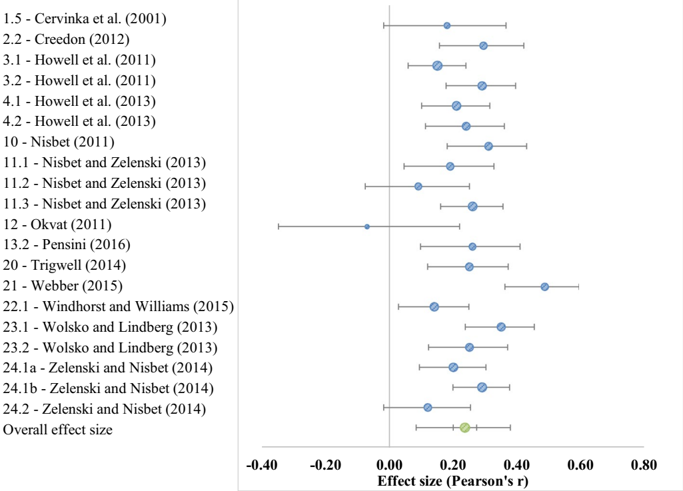
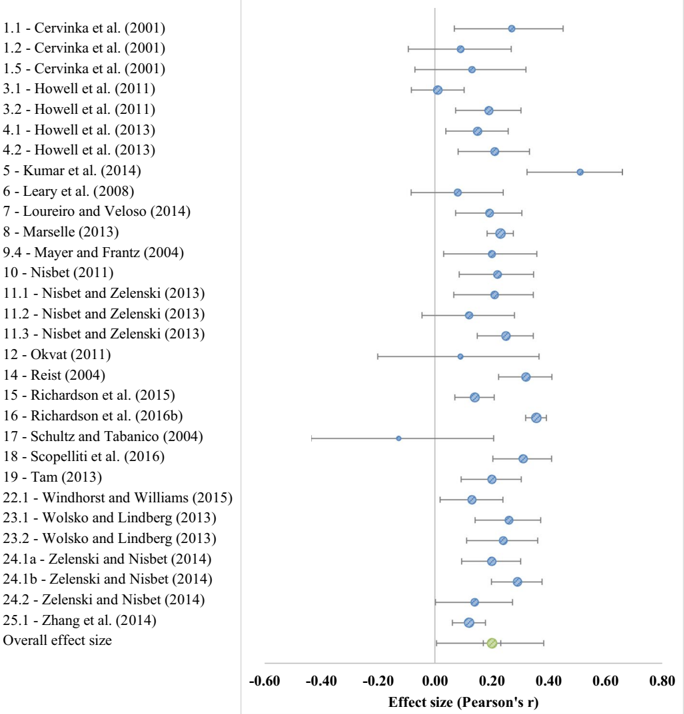
Nature connectedness relates to an individual’s subjective sense of their relationship with the natural world. A recent meta-analysis has found that people who are more connected to nature also tend to have higher levels of self-reported hedonic well-being; however, no reviews have focussed on nature connection and eudaimonic well-being. This meta-analysis was undertaken to explore the relationship of nature connection with eudaimonic well-being and to test the hypothesis that this relationship is stronger than that of nature connection and hedonic well-being. From 20 samples (n = 4758), a small significant effect size was found for the relationship of nature connection and eudaimonic well-being (r = 0.24); there was no significant difference between this and the effect size (from 30 samples n = 11,638) for hedonic well-being (r = 0.20). Of the eudaimonic well-being subscales, personal growth had a moderate effect size which was significantly larger than the effect sizes for autonomy, purpose in life/meaning, self-acceptance, positive relations with others and environmental mastery, but not vitality. Thus, individuals who are more connected to nature tend to have greater eudaimonic well-being, and in particular have higher levels of self-reported personal growth.
Overview
The claims and statistics of this paper haven’t been checked yet.
Free: it reads the open-access text and checks the first 5 claims that cite a source we can check. Create a free account to check every claim.
Integrity signals
Registry
Cites
Statistics
Figures
Verification
Claims the paper makes
The claims and statistics of this paper haven’t been checked yet.
Free: it reads the open-access text and checks the first 5 claims that cite a source we can check. Create a free account to check every claim.
Self-check
Percentages, sums and reported differences re-computed from the paper’s own numbers.
The self-check needs the paper’s full text.
Citations
Cites
Bias in meta-analysis detected by a simple, graphical test
Egger, M., Smith, G. D., Schneider, M., & Minder, C. (1997) · BMJ · doi:10.1136/bmj.315.7109.629 · Cited by 56,722 · cited 1×
“This was explored further using two more tests for publication bias: the Begg test (Begg and Mazumdar 1994) and the Egger test (Egger et al. 1997).”
MethodRyan, R. M., & Deci, E. L. (2000) · American Psychologist · doi:10.1037//0003-066x.55.1.68 · Cited by 54,599 · cited 1×
“As described in Ryan and Deci’s self-determination theory, three basic psychological needs—autonomy, competence and relatedness—are considered essential for psychological growth, integrity and well-being (Ryan and Deci 2000).”
Development and validation of brief measures of positive and negative affect: The PANAS scales.
Watson, D., Clark, L. A., & Tellegen, A. (1988) · Journal of Personality and Social Psychology · doi:10.1037/0022-3514.54.6.1063 · Cited by 32,433
The satisfaction with life scale
Diener, E., Emmons, R. A., Larsen, R. J., & Griffin, S. (1985) · Journal of Personality Assessment · doi:10.1207/s15327752jpa4901_13 · Cited by 31,768
Operating characteristics of a rank correlation test for publication bias
Begg, C. B., & Mazumdar, M. (1994) · Biometrics · doi:10.2307/2533446 · Cited by 16,955 · cited 1×
“This was explored further using two more tests for publication bias: the Begg test (Begg and Mazumdar 1994) and the Egger test (Egger et al.”
MethodHappiness is everything, or is it? Explorations on the meaning of psychological well-being.
Ryff, C. D. (1989) · Journal of Personality and Social Psychology · doi:10.1037/0022-3514.57.6.1069 · Cited by 14,847 · cited 4×
“EWB is often measured with Ryff’s scale of psychological well-being (Ryff 1989), which has six subscales: personal growth relates to being open to new ideas and experiences, and realizing one’s full potential; purpose in life links to the presence of goals in life, and feelings of meaningfulness;…”
BackgroundMethodInfluentialOn Happiness and Human Potentials: A Review of Research on Hedonic and Eudaimonic Well-Being
Ryan, R. M., & Deci, E. L. (2001) · Annual Review of Psychology · doi:10.1146/annurev.psych.52.1.141 · Cited by 11,567 · cited 4×
“(2014) included vitality as a hedonic construct, in this review, vitality was classed as a eudaimonic aspect of well-being because it is often conceptualised as such in the literature (e.g. Ryan and Deci 2001; Wolsko and Lindberg 2013; Zelenski and Nisbet 2014).”
BackgroundInfluentialCohen, J. (1992) · Psychological Bulletin · doi:10.1037//0033-2909.112.1.155 · Cited by 8,771
The restorative benefits of nature: toward an integrative framework
Kaplan, S. (1995) · Journal of Environmental Psychology · doi:10.1016/0272-4944(95)90001-2 · Cited by 6,923 · cited 2×
“…and psychological stress responses result from exposure to nature and thus results in improved well-being, and attention restoration theory (ART; Kaplan 1995) predicts that exposure to nature helps reduce attentional fatigue thus leading to improved cognitive functioning and positive affect.”
BackgroundStress recovery during exposure to natural and urban environments
Ulrich, R. S., Simons, R. F., Losito, B. D., Fiorito, E., Miles, M. A., & Zelson, M. (1991) · Journal of Environmental Psychology · doi:10.1016/s0272-4944(05)80184-7 · Cited by 5,990 · cited 1×
“For example the biophilia hypothesis (Wilson 1984) suggests that people have an innate need to affiliate with nature, and that satisfaction of this need results in well-being benefits such as improved positive affect; stress reduction theory (SRT; Ulrich et al. 1991) predicts that decreased physiological and psycholog…”
Background
Research works printed but not linked: 5
- Bullinger, M., & Kirchberger, I. (1989). SF-36 Fragebogen zum gesundheitszustand [SF-36 health-survey]. Göttingen: Hogrefe.
- Creedon, M. A. (2012). Connectedness to nature and its relationship to meaning in life. Unpublished doc- toral thesis, Massachusetts School of Professional Psychology, MA, USA.
- Kumar, R., Lal, R., Bansal, Y., & Sethi, K. V. K. (2014). Relationship between connectedness to nature and subjective well-being. Indian Journal of Psychological Science, 4, 59-63.
- Reist, D. M. (2004). Materialism vs. an ecological identity: Towards an integrative framework for a psy- chology of sustainable living. Unpublished doctoral thesis, University of Toronto, Toronto, ON.
- Steyer, R., Schwenkmezger, P., Notz, P., & Eid, M. (1997). Der mehrdimensionale befindlichkeitsfragebo- gen (MDBF) [The multidimensional comfort questionnaire (MDBF)]. Göttingen: Hogrefe.
Cited by
Items 601–700 of 700
Cannabis growers as gardeners: results from a survey among Italian and British small-scale growers
Fortin, D., Beo, V. D., Kowalski, M., Sevigny, E. L., Grigg, J., Protopopescu, C., & Potter, G. (2025) · International Journal of Drug Policy · doi:10.1016/j.drugpo.2025.104959
Reining, C. E., Groulx, M. W., Lavallee, L. F., Bueddefeld, J. N. H., Brady, R. M., Tenute, A., & Lemieux, C. J. (2025) · Social Science & Medicine · doi:10.1016/j.socscimed.2025.118493
Socio-cultural patterns in how residents value and use green space in new greenfield developments
Macaulay, R., Lavau, S., Williams, N. S. G., & Hahs, A. K. (2025) · Urban forestry & urban greening · doi:10.1016/j.ufug.2025.129030 · Cited by 2
Yang, J., Liu, J., Dai, W., Gao, R., & Yang, Z. (2025) · Journal of Environmental Psychology · doi:10.1016/j.jenvp.2025.102739
Li, Y. (2025) · Online Information Review · doi:10.1108/oir-03-2024-0198
Ferrajão, P. C., Torres, N., & Martins, A. Q. (2025) · SSRN Electronic Journal · doi:10.2139/ssrn.5437037
Kraft, C., Bühren, C., & Wicker, P. V. (2025) · Frontiers in Psychology · doi:10.3389/fpsyg.2025.1604029
Aykut, M., & Kara, H. G. E. (2025) · Frontiers in Psychology · doi:10.3389/fpsyg.2025.1583794 · Cited by 2
“Emerging evidence suggests that connection to nature may serve as a protective factor, supporting attention, stress regulation, and social–emotional skills in children (Lanza et al., 2022; Pritchard et al., 2020).”
Nachhaltige und naturbasierte Interventionen (NNBI)
Köhler, K. (2025) · Springer eBooks · doi:10.1007/978-3-662-71605-2_3
Posthumanist counseling theory: a contemporary reconceptualization of person-centered theory
Peel, E. (2025) · Person-Centered & Experiential Psychotherapies · doi:10.1080/14779757.2025.2589201
Rasmussen, B. D., & Rogge, R. D. (2025) · Journal of Happiness Studies · doi:10.1007/s10902-025-00992-3
Luo, X., Xu, D., Wan, L. C., & Li, Y. (2025) · Journal of Travel Research · doi:10.1177/00472875251394735
Masterton, W., Parkes, T., Carver, H., & Park, K. J. (2022) · Figshare · doi:10.6084/m9.figshare.20787109
Jong, M. C., Dahlqvist, H. Z., Lown, E. A., Schats, W., Beckman, L., & Jong, M. (2023) · Figshare · doi:10.6084/m9.figshare.23908837
Awan, M., Gul, I., Aleem, S., & Ahmed, M. (2025) · Advances in global change research · doi:10.1007/978-3-032-04141-8_16
Junker, M., Hobson, K., Poortinga, W., Reeves, J. P., Newth, J., Stead, M., Marshall, M., & Gattis, M. (2025) · Environmental Education Research · doi:10.1080/13504622.2025.2600603
Identifying the Ecosystem Services of Biodiversity on the Island of Martinique for Society
Hirep, L. M. (2025) · Natural Resources · doi:10.4236/nr.2025.1613039
Beyond the place: Attachment to a place reduces generalized social avoidance
Zha, Y., Ye, Y., Li, Y., Sun, Y., Wang, Z., Wu, K., Zhou, X. J., & Kou, Y. (2026) · Journal of Social and Personal Relationships · doi:10.1177/02654075251415445 · Cited by 1
“First , feeling connected to and a sense of belonging in nature environments fosters positive social emotions such as awe, compassion and gratitude (Petersen et al., 2019; Pritchard et al., 2020), which in turn promote active and willing social interactions (Stellar et al., 2017).”
InfluentialZhu, J., Li, W., & Li, L. M. W. (2026) · Ecopsychology · doi:10.1177/19429347251412402 · Cited by 1
Compton, S., Morton, K., Savage, L. D. R., Fredheim, H., Armitt, H. A., Tracey, L., & Blower, S. L. (2026) · Wellbeing Space and Society · doi:10.1016/j.wss.2026.100358 · Cited by 1
Zierhut, M. M., Hartter, N., von Eisenhart-Rothe, V., Hahne, I., Bergmann, N., Kraft, J., Braun, A., Bayer, M., Ta, T. M. T., Ripke, S., et al. (2026) · Ecopsychology · doi:10.1177/19429347261419214
(2025) · Emerald Group Publishing Limited eBooks · doi:10.1108/978-1-83608-190-620251015
Tang, Y., Fu, J., & Yao, Y. (2026) · Sustainability · doi:10.3390/su18052565
Psychometric Properties of the Turkish Version of the Green Space Use Satisfaction Scale
Aydemir, B., & Çetinkaya, G. (2026) · Pamukkale Journal of Sport Sciences · doi:10.54141/psbd.1744497 · Cited by 1
Valuation of changes in ecosystems based on their impact on quality of life
de Vries, S., Remme, R. P., & Lof, M. E. (2026) · Sustainability Science · doi:10.1007/s11625-026-01819-7 · Cited by 1
Silence to grow: psychological transformation during long-time engagement in green and blue nature
Løvoll, H. S., & Dyrdal, G. M. (2026) · Frontiers in Psychology · doi:10.3389/fpsyg.2026.1652406
“Pritchard et al. (2020) conducted a meta-analysis showing a strong relationship between nature connectedness and eudaimonic wellbeing, highlighting how meaningful engagement with nature supports personal growth and life purpose.”
Schaupp, J., Wunderli, J. M., Schäffer, B., Hediger, K., & Bauer, N. (2026) · PLoS ONE · doi:10.1371/journal.pone.0342906
Emerging friluftsliv in higher education: voices and perspectives
Wold, D. E., & Løvoll, H. S. (2026) · Journal of Adventure Education & Outdoor Learning · doi:10.1080/14729679.2026.2644349
Does size matter in the human–nature relationship?
Lutz, P. K., Wadlow, M. E. A., Zelenski, J. M., Desrochers, J., & Nisbet, E. K. L. (2026) · Personality and Individual Differences · doi:10.1016/j.paid.2026.113707 · Cited by 1
Fernee, C. R., Mattsson, M. T., Lyytinen, P., & Harper, N. J. (2026) · International Journal of Environmental Research and Public Health · doi:10.3390/ijerph23030394
“These considerations overlap with the proposed third construct, connectedness, which refers to both within-and between-human contact and affiliations with other living beings and nature environments [40,41].”
Madera, F., Olcese, M., & Migliorini, L. (2026) · Journal of Environmental Psychology · doi:10.1016/j.jenvp.2026.103010
Ng, H. K. S. (2026) · Journal of Environmental Psychology · doi:10.1016/j.jenvp.2026.103012
Yang, S., Long, R., Chen, H. M., & Na, J. (2026) · Environmental Impact Assessment Review · doi:10.1016/j.eiar.2026.108436 · Cited by 1
Girgin, D., & Elkonca, F. (2026) · Geoheritage · doi:10.1007/s12371-026-01303-9 · Cited by 1
Warburton, V. E., Bartholomew, K. J., & Beaumont, L. C. (2026) · Journal of Adventure Education & Outdoor Learning · doi:10.1080/14729679.2026.2653249 · Cited by 1
“…evidence on nature-connectedness we know that this connection can lead to a range of positive outcomes (Capaldi et al., 2014; Ewert et al., 2021; Pritchard et al., 2020), but whether it is a refinement to the existing need for relatedness or a candidate for a new, distinct, psychological need…”
Chattopadhyay, B., Bapat, S. R., & Chhajer, R. (2026) · Sequential Analysis · doi:10.1080/07474946.2026.2640935
“Pritchard et al. (2020) mentioned that individuals more connected to nature tend to have higher levels of eudemonic well-being.”
The Path to Sustainability Consciousness: The Role of Subjective Well-Being and Civic Engagement
Bacci, S., Beccari, G., Bertaccini, B., & Pettini, A. (2026) · Italian Economic Journal · doi:10.1007/s40797-026-00374-5
Holmes, L. M., McQuoid, J., Shepard, L., Anjum, N., Warner, E., Jasso, F. G., Bradley, D., Allen, A., Do, L., Bose, M., et al. (2026) · Health & Place · doi:10.1016/j.healthplace.2026.103663
Beyond passive exposure: active engagement and green behavior amplify urban wellbeing
Chen, N., & Kang, Y. (2026) · Frontiers in Public Health · doi:10.3389/fpubh.2026.1797797
La présence au monde : réflexions écophénoménologiques sur la participation
Gilliand, C. (2024) · theses.fr (ABES) · doi:10.70675/fa03f3c7z4651z44d0zbf4ezc5ed2d36d528
Hefti, M. (2024) · theses.fr (ABES) · doi:10.70675/c103b009zd80bz4255zbdf9zeec1fd1782cd
Exploring the Paradox of Using Digital Technologies in Nature
Perera, P., Webber, S. E., & Smith, W. (2026) · CHI Conference on Human Factors in Computing Systems · doi:10.1145/3772318.3790708 · Cited by 2
“Nature experiences have been found to contribute not only to physical and mental health but also eudaimonic well-being - supporting a sense of flourishing, meaning, and deeper connection with the world [68, 78].”
Sınıf Öğretmenlerinin İyi Oluş Okuryazarlıklarının İncelenmesi
Akalın, M. B., & Işık, Ş. (2026) · Batı anadolu eğitim bilimleri dergisi · doi:10.51460/baebd.1670766
Searle, B., Sawyer, H., Staton, S., & Thorpe, K. J. (2026) · Journal of Environmental Psychology · doi:10.1016/j.jenvp.2026.103052
Wang, Y., Liu, Y., Zhao, Y., Lin, L., Hua, L., & Li, J. (2026) · Journal of Happiness Studies · doi:10.1007/s10902-026-01041-3
“…that contact with nature had a significant effect on MIL ( d = 0.38, SE = 0.05, p <.001, 95% CI = [0.285, 0.483]), which was comparable to the effects that have been reported in previ - ous meta-analyses and short-term intervention studies (Passmore & Howell, 2014a, 2014b; Pritchard et al., 2020).”
InfluentialJacobs, T. P. (2026) · Journal of Social and Clinical Psychology · doi:10.1521/jscp.2026.45.2.159 · Cited by 1
Avcı, N., & Özdemir, E. (2026) · Akademik Açı · doi:10.59597/akademikaci.1760111
Maulana, M., Chairunnisa, A., & Aulia, L. S. (2026) · Ecopsychology · doi:10.1177/19429347261449426 · Cited by 1
“Research findings suggest that the level of CN is positively associated with well-being and pro-environmental behavior (PEB) (Capaldi, Dopko, and Zelenski, 2014; Otto and Pen-sini, 2017; Pritchard et al., 2020).”
Cumulative benefits of nature: Childhood nature experiences and daily well-being in young adults
Liu, Q., Wang, S., Niu, X., Li, C., Guo, T., Chen, X., & Kong, F. (2026) · Journal of Environmental Psychology · doi:10.1016/j.jenvp.2026.103076
Rasmussen, E. B., & Alvarado, A. Y. (2026) · Perspectives on Behavior Science · doi:10.1007/s40614-026-00502-7
“Indeed, individuals who have strong connectedness to nature have higher eudaimonic (purpose and meaning-based) well-being, as opposed to more hedonic well-being (see meta-analysis by Pritchard et al., 2020).”
Bitting, K. S., McSweeney, J. M., Kaufman, E., & Campagna, K. (2026) · Innovative Higher Education · doi:10.1007/s10755-026-09917-1
“…& Morpeth, 2019; Bellinger et al., 2015; Breedvelt et al., 2019; Ma et al., 2019; Schwind et al., 2017; Slavik, 2014; Strait et al., 2020) and nature connection (Capaldi et al., 2014; Pritchard et al., 2020) for mental health and wellbeing, following the biophilia hypothesis (Wilson, 1986).”
Dobson, L., & Blaskova, L. J. (2026) · Journal of Adventure Education & Outdoor Learning · doi:10.1080/14729679.2026.2669766
Psychometric evaluation of a 7-item Connectedness to Nature Scale in a Polish national adult sample
Bajkowska, K., Modlińska, K., Rycielska, L., & Domaradzka, E. (2026) · Current Psychology · doi:10.1007/s12144-026-09512-9 · Cited by 1
“…connectedness to nature would be associated with lower psychological distress (White et al., 2021), greater well-being (Capaldi et al., 2014 ; Pritchard et al., 2020), more reported pro-environmental behaviours (Barbaro & Pickett, 2016; Martin et al., 2020; Rosa et al., 2018), and more…”
Promoting Nature Connectedness: Insights into the Roles of Mindfulness and Nonattachment
Ergüler, H., & Simione, L. (2026) · Sustainability · doi:10.3390/su18115352
Connection to Nature and Psychological Wellbeing: The Role of Mindfulness and Spirituality
Kazemi, S., Torquati, J., & Huynh, T. (2026) · International Journal of Environmental Research and Public Health · doi:10.3390/ijerph23060725
“Extant research links connection to nature to several dimensions of wellbeing [7–10] with meta-analytic evidence indicating moderate to large effect sizes across psychological and emotional wellbeing outcomes [2,11].”
Das, M. (2026) · Discover Public Health · doi:10.1186/s12982-026-02211-7
Mazza, M., Attanasio, M., Covone, N., Santicchia, I., Poli, L., Carpineti, L., Nikoghosyan, N., & Paola, F. (2026) · SSRN Electronic Journal · doi:10.2139/ssrn.6910701
What Counts as Nature? A Cross-Sectional Study of American Adults’ Perceptions of Nature Places
Maddock, J. E., Patterson, M. S., & Price, A. E. (2026) · Ecopsychology · doi:10.1177/19429347261459867
Tribot, A.-S., & Mouquet, N. (2026) · Biological Conservation · doi:10.1016/j.biocon.2026.111977
Vijaikis, A., & Poškus, M. S. (2026) · Sustainability · doi:10.3390/su18126336
Shattuck, E. C., McKinnon, L., Herrera, I. M. R., Sagastume, R. C., Cruz, Q. D., Hernández, P. T. G., Sunil, T. S., & Samson, D. R. (2026) · American Journal of Human Biology · doi:10.1002/ajhb.70298
Ecological Humility and Geoengineering the Earth
DesRoches, C. T., McGregor, J., & Syropoulos, S. (2026) · Canadian Journal of Philosophy · doi:10.1017/can.2026.10076
“…been shown to not only foster prosocial and pro-environmental attitudes but also to predict individual flourishing, as indexed by higher levels of psychological well-being and life satisfaction (e.g., Hinds & Sparks, 2009; Monroy & Keltner, 2023; Pritchard et al., 2020; Van Tongeren et al., 2016).”
Ryu, H., & Kim, H. (2026) · Sustainability and Education · doi:10.67115/se.260004
Frescura, A., & Spada, M. (2026) · Urban Geography · doi:10.1080/02723638.2026.2703066
Connected by Nature: Nature-Based Intervention to Support Young Adults with Advanced Cancer
Corazon, S. S., Fray, M. S., Saldern, G., Andersen, C. W., & Bekke-Hansen, S. (2026) · International Journal of Environmental Research and Public Health · doi:10.3390/ijerph23080953
“This aligns with research on the eudaimonic dimensions of nature connectedness, which emphasizes meaning and perspective expansion as outcomes [22–24].”
Chhajer, R., McEwan, K., & Goyal, J. (2026) · Cities · doi:10.1016/j.cities.2026.107429
Self-citationBosnyak, D., Tornóczky, G. J., & Szabó, A. (2026) · Healthcare · doi:10.3390/healthcare14152293
Zhou, Y., & Geng, L. (2026) · Journal of Happiness Studies · doi:10.1007/s10902-026-01082-8
Fan, Y., Zhang, J., Lei, X., Zhou, M., Tao, J., Qiu, T., Ma, L., & Yu, X. (2026) · Current Psychology · doi:10.1007/s12144-026-09826-8
“In nature, primary school students find themselves in a calm, united, and accepting atmosphere, enabling them to introspect, heighten self-awareness, discern needs and aspirations, and make autonomous decisions to fulfill their quest for independence (Pritchard et al., 2020).”
Analyzing Mathematical Problem-Solving Skills from the Perspective of Psychological Well-Being
Zahrah, R. F., Febriani, W. D., Wakih, A. A., & Pratiwi, V. R. (2026) · IJORER International Journal of Recent Educational Research · doi:10.46245/ijorer.v7i4.1443
“One such influential factor is psychological well-being, which encompasses self-acceptance, autonomy, environmental mastery, positive social relations, and personal growth (Pritchard et al., 2020; Stenling & Tafvelin, 2014).”
Rowsell, K., Gordon-Rawlings, T., & Hunt, D. F. (2026) · Forensic Update · doi:10.53841/bpsfu.2026.1.152.45
Influence of Plant Attitude Towards Environmental Identity of Plant Lovers in Angeles City
Ayson, N., Bautista, C., Wilson, J., Dayrit, J. E. D. J. E., Sangalang, A., Pineda, N., & Celis, M. L. (2026) · PUNLA · doi:10.67730/yk84ys63
Ritpanitchajchaval, N., Apollo, M., & Ashton, A. S. (2026) · Frontiers in Sustainable Tourism · doi:10.3389/frsut.2026.1873254
Bekke-Hansen, S., Corazon, S. S., & Stigsdotter, U. K. (2026) · Open Research Europe · doi:10.12688/openreseurope.24198.1
Ma, R., & Zhang, M. (2026) · Chinese Geographical Science · doi:10.1007/s11769-026-1644-4
“Beyond behavioral engagement, public health and environmental psychology research further suggests that individuals also need to develop positive emotional bonds with the natural environment to fully realize the potential benefits of green spaces (Pritchard et al., 2020; Gu et al., 2023).”
Lockhart, C., Malinen, S., Blair, S., Blair, S.-R., & Lyver, P. O. (2026) · Wellbeing Space and Society · doi:10.1016/j.wss.2026.100463
Kaia, W.-M., Frederick, P., Fuoco, J., Loose, T., Chartrand, E., Alain, G., Bolanis, D., Pennestri, M., Khoury, B., Ouellet‐Morin, I., et al. (2026) · Journal of Environmental Psychology · doi:10.1016/j.jenvp.2026.103188
Bolognesi, M., Angelini, A., Lanciano, F., Marchi, V. D., Secco, L., Pazzaglia, F., & Moè, A. (2026) · Journal of Adventure Education & Outdoor Learning · doi:10.1080/14729679.2026.2723106
Feucht, V., Schulte, F., Dierkes, P. W., & Kleespies, M. W. (2026) · Environmental Education Research · doi:10.1080/13504622.2026.2720230
Lengieza, M. L., Richardson, E., & Richardson, M. (2026) · AMBIO · doi:10.1007/s13280-026-02472-1
Self-citationZieris, P., Müller, M., Krebs-Fehrmann, M., Thümer, K., Loreth, P., Pokorny, D., & Kals, E. (2026) · Applied Psychology Health and Well-Being · doi:10.1111/aphw.70220 · Cited by 2
“Modern lifestyles often separate individuals from natural environments physically and psychologically (Capaldi et al., 2015; Soga & Gaston, 2016), weakening the emotional bonds crucial for conservation efforts (Martin et al., 2020; Pritchard et al., 2020; Shrestha et al., 2025).”
Personal health impacts of adventurous outdoor learning
Priest, S., Ritchie, S., & Down, M. J. A. (2026) · Journal of Outdoor and Environmental Education · doi:10.1007/s42322-026-00268-1
Walimbe, S., Bhat, I. N., & Chitgopkar, S. (2026) · International Journal of Community Well-Being · doi:10.1007/s42413-026-00314-2
“In contrast, the Cognitive and Psychological Factors evaluate how green spaces contribute to stress reduction, emotional regulation, memory retention, and adaptability to different learning styles, enhancing problem-solving and reasoning skills (Pritchard et al., 2020).”
Xing, Y., Pitzettu, R., & McEwan, K. (2026) · International Journal of Environmental Research and Public Health · doi:10.3390/ijerph23091233
Self-citationJia, H., & Liu, Y. (2026) · Frontiers in Public Health · doi:10.3389/fpubh.2026.1978168
Zhang, Y. K., Xu, X., Chang, S., Huang, Y., Xu, M., & 辛素飞 (2026) · Behavioral Sciences · doi:10.3390/bs16101785
“However, growing evidence indicates that nature connectedness is also associated with psychological well-being and adaptive functioning (Barragan-Jason et al., 2023; Pritchard et al., 2020).”
Nature relatedness and wellbeing among university students
Ozola, A., Svence, G., Griškēviča, I., & Mārtinsone, K. (2026) · SHS Web of Conferences · doi:10.1051/shsconf/202623804004
Jin, Z., Liu, X., Shi, Y., & Peng, J. (2026) · Environmental Research · doi:10.1016/j.envres.2026.125827
Trends Towards Transformation in Canadian Outdoor Health
Priest, S., & Ritchie, S. D. (2026) · Springer eBooks · doi:10.1007/978-981-92-0585-1_4
Frantz, C. M., Özbaş, S., Sallee, C., Holmes, T., & Mayer, F. S. (2026) · The Journal of Environmental Education · doi:10.1080/00958964.2026.2738381
Hristova, V., & Bliznashki, S. (2026) · Ecopsychology · doi:10.1177/19429347261498555
Tam, K., Ma, X. K. K., Ng, C. N. E., & Lam, Y.-H. (2026) · Environmental Psychology Research · doi:10.1002/epr2.70022
Touching grass: Real-time effects of nature exposure on cognition, body image, and mood
Mian, M. H., Won, Y. Q., & Krug, I. (2026) · Body Image · doi:10.1016/j.bodyim.2026.102210
郭德盛, Sun, R., Chen, H., Liu, M., & Chang, W. (2026) · Journal of Forestry Research · doi:10.1007/s11676-026-02150-8
“Nature connectedness, defined as the emotional connection individuals have with nature, is considered a key psychological mechanism through which nature provides health benefits (Pritchard et al. 2020; Schultz 2002).”
Bubalo, M., van den Broek, K. L., Helbich, M., & Labib, S. M. (2026) · Journal of Environmental Psychology · doi:10.1016/j.jenvp.2026.103254 · Cited by 1
Negative Aspects of Self-Compassion Are Negatively Associated with Adolescents’ Mental Well-Being
Rahe, M., & Jansen, P. (2026) · Adolescents · doi:10.3390/adolescents6050088
Clarke, A. (2026) · The British Journal of Social Work · doi:10.1093/bjsw/bcag237
Åkesson, M., Granqvist, P., Johansson, R., & Brulin, J. G. (2026) · Frontiers in Psychiatry · doi:10.3389/fpsyt.2026.1924069
“Beyond the documented harms of loneliness, positive forms of connection appear to actively support fl our-ishing; nature connectedness, for example, is associated with higher wellbeing (25).”
Metadata
- Authors
- Pritchard, A., Richardson, M., Sheffield, D., & McEwan, K.
- Affiliations
- University of Derby (GB)
- Corresponding author
- Pritchard, Alison
- Venue
- Journal of Happiness Studies
- Published
- 2019-04-30
- Volume
- 21
- Issue
- 3
- Pages
- 1145-1167
- ISSN
- 1389-4978 (ISSN-L)
- 1573-7780
- OpenAlex
- W2942996956
- Cited by
- 702
- References
- 106
- Citations by year
- 2026: 106 · 2025: 138 · 2024: 122 · 2023: 108 · 2022: 103 · 2021: 77 · 2020: 39 · 2019: 8
- FWCI
- 8.76
- Type
- journal article
- Language
- en
- Open access
- hybrid
- doi.org
- Licence
- cc-by
- creativecommons.org/licenses/by/4.0 (tdm)
- Locations
- Journal of Happiness Studies (publishedVersion, cc-by)
- RePEc: Research Papers in Economics (submittedVersion)
- University of Derby Online Research Archive. (University of Derby) (submittedVersion)
- Topics
- Social Sciences › Psychology › Social Psychology › Psychological Well-being and Life Satisfaction
- Social Sciences › Urban Studies › Urban Green Space and Health
- Social Sciences › Business, Management and Accounting › Tourism, Leisure and Hospitality Management › Recreation, Leisure, Wilderness Management
- Keywords
- nature connection, eudaimonic well-being, hedonic well-being, personal growth, meaning in life, self-acceptance, environmental mastery, vitality, autonomy, positive relationships with others
About these checks
Registry, retraction, Cites and statistics results are computed, not judged, with one exception: a printed reference that no index lists is read once by a model before it counts as a citation error. Claims are extracted by a model and kept only when their quote appears verbatim in the text; each cited source is then checked, with a model’s help, for whether it says what the claim relies on. Those verdicts can be wrong — read the claim’s quote and the cited source before relying on one.
Statistics and arithmetic are recomputed, not judged.
Confidence bands are shown only for fields calibrated on our annotated test set. None is calibrated yet, so no band is shown.
What counts as a claim ›How we measure confidence ›How we check this ›
Are you an author, or do you see a problem with this page? Request a review
Data sources
Bibliographic data: Semantic Scholar, OpenAlex, Crossref.
Contains information from the Semantic Scholar Academic Graph Datasets, made available under the ODC Attribution License (ODC-BY 1.0).
Semantic Scholar’s data is described in: Kinney, R., et al. (2023). The Semantic Scholar Open Data Platform. arXiv:2301.10140.
