

The Ethics of AI Ethics: An Evaluation of Guidelines
Open accessThe DOI matches its Crossref record; 98 of the 101 references it cites were found in a registry or an index, and 3 are not checked yet; 6 of the 88 sources its claims cite were checked for support.
Abstract
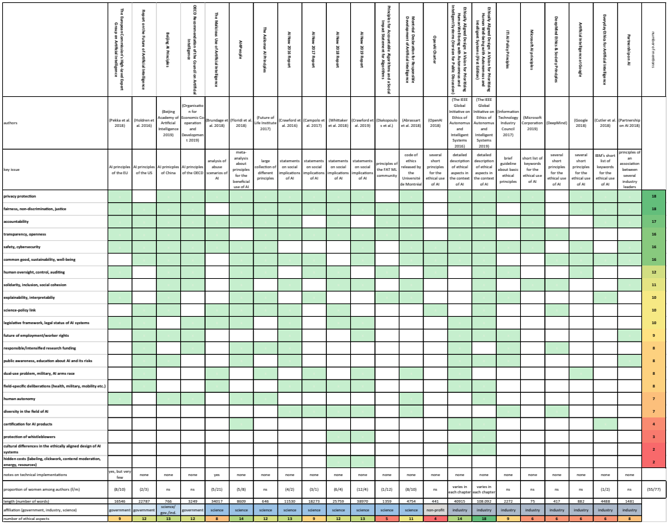
Abstract Current advances in research, development and application of artificial intelligence (AI) systems have yielded a far-reaching discourse on AI ethics. In consequence, a number of ethics guidelines have been released in recent years. These guidelines comprise normative principles and recommendations aimed to harness the “disruptive” potentials of new AI technologies. Designed as a semi-systematic evaluation, this paper analyzes and compares 22 guidelines, highlighting overlaps but also omissions. As a result, I give a detailed overview of the field of AI ethics. Finally, I also examine to what extent the respective ethical principles and values are implemented in the practice of research, development and application of AI systems—and how the effectiveness in the demands of AI ethics can be improved.
Verified 2026-11-25 · 3 references not checked yet
Overview
CoChat Summary
## TL;DR
This paper semi-systematically reviews 22 AI ethics guidelines, finding strong overlap on a few technicalizable topics but many important omissions. It argues that AI ethics is often ineffective in practice and should be supplemented by more concrete technical guidance and a shift toward virtue ethics.
## Key findings
- The paper analyzes and compares 22 AI ethics guidelines and finds that accountability, privacy, and fairness appear in about 80% of them, making them the closest thing to a common minimum standard.
- The author reports that guidelines from industrial contexts name on average 9.1 distinct ethical aspects, while science-based ethics codes average 10.8.
- Only two guidelines contain genuinely technical explanations, and these are described as very sparse; the most extensive technical commentary is in “The Malicious Use of AI”.
- The paper says a controlled study found the effectiveness of ethics guidelines or codes to be “almost zero”: among 63 software engineering students and 105 professional software developers, there was no statistically significant difference in responses between those who did and did not see the ACM code of ethics.
- The paper highlights major omissions across guidelines, including political abuse of AI, hidden social and ecological costs, lack of diversity, robot ethics, trolley problems, and public-private partnerships/industry-funded research.
## Methods
- Semi-systematic literature analysis of AI ethics guidelines, with a deliberate focus on comprehensive guideline documents rather than all AI-ethics-related writings.
- The final sample consisted of 22 major ethical guidelines, identified through searches in Google, Google Scholar, Web of Science, ACM Digital Library, arXiv, and SSRN, plus manual reference screening and the Algorithm Watch AI Ethics Guidelines Global Inventory.
- The paper compares which ethical issues are present or absent in the guidelines, and then relates those principles to practice using cited empirical studies and examples from AI development and deployment.
## Limitations
- The author states the sample is biased toward western/northern documents and excludes guidelines not written in English.
- The selection deliberately excludes guidelines focused on robot ethics, big data, algorithms, or robotics, so omissions in those areas are partly a result of the sampling method.
- The paper notes that its list of omissions is non-exhaustive.
- Evident from the text: the paper is primarily a theoretical/semi-systematic overview, not a direct empirical test of all AI ethics guideline implementations.
Model-written summary. Check it against the paper before relying on it.
Integrity signals
Registry
Cites
Statistics
Figures
Verification
Claims the paper makes
5 Valid · 3 Not valid · 62 Not checked · 64 Own results and interpretations
The cited sources support only part of this claim — read each source’s verdict below.
In the paper
“So far, some papers have been published on the subject of teaching ethics to data scientists (Garzcarek and Steuer 2019; Burton etal. 2017; Goldsmith and Burton 2017; Johnson 2017) but by and large very little to nothing has been written about the tangible implementation of ethical goals and values.”
What the sources say
- Supportedcites Garzcarek and Steuer 2019 matched to “Approaching Ethical Guidelines for Data Scientists” (2019) source
The citation is attached to the statement that papers have discussed teaching ethics to data scientists, not to the citing authors’ subsequent assessment of writing on tangible implementation. Section 5.2 (p. 14) explicitly argues that ethics should be part of the data-science curriculum. (LLM, conf=0.90)
- Not matchedcites Burton etal. 2017
An author–year citation the paper’s reference list doesn’t settle. We don’t search these by name.
- Supportedcites Goldsmith and Burton 2017 matched to “Why Teaching Ethics to AI Practitioners Is Important” (2017) source
The citation appears in a list of papers about teaching ethics to data scientists, not as support for the sentence’s later claim about how little has been written on implementation. The Introduction (p. 1) presents the paper as an argument for ethical training for AI students and practitioners, and the Conclusions (p. 4) advocate teaching ethics in AI classes. (LLM, conf=0.91)
plain- Asserted: passes — The authors put it forward as true.
- Checkable: passes — It can be checked against evidence.
- Load-bearing: passes — The paper’s conclusions depend on it.
- Based: passes — The paper gives a reason why it holds.
- Supported
The cited sources support only part of this claim — read each source’s verdict below.
In the paper
“Leading, of course, is the military use of AI in cyber warfare or regarding weaponized unmanned vehicles or drones (Ernest and Carroll 2016; Anderson and Waxman 2013).”
What the sources say
- Partly supportedcites Ernest and Carroll 2016 matched to “Genetic Fuzzy based Artificial Intelligence for Unmanned Combat Aerial Vehicle Control in Simulated Air Combat Missions” (2016) sourceExperimental — accuracy not yet measured
Our copy does support the drone half of the claim as an identification citation: the paper is squarely about applying AI to a weaponized unmanned vehicle (Introduction: UCAV research, 'this white paper will primarily focus on the increase in capabilities of real-time decision making'; Problem Statement: ALPHA controlling aircraft motion and firing in AFSIM). But it does not support the claim's core assertion that military AI is a leading area of unwanted side effects and malevolent use — the nearest passage (Introduction, 'There are a number of obstacles to a system being an effective AI within this context') frames the issues as engineering and verification difficulties (adversaries trying to 'fool and exploit the system', V&V, safety specifications, crashes/sensor failures), and the Results and Conclusions treat autonomy as 'a revolutionary leap in capability of airpower' and a way of 'reducing risk to our pilots'. Cyber appears only once, as an unrelated civilian/defence application domain of the GFT method ('Examples include robotic surgery, design automation, and cyber security'), not as cyber warfare, so that element of the claim is not from this source. (LLM, conf=0.72)
- Not checked — no full text of the sourcecites Anderson and Waxman 2013 matched to “Law and Ethics for Autonomous Weapon Systems: Why a Ban Won't Work and How the Laws of War Can” (2013) source
boostedstates an association- Asserted: passes — The authors put it forward as true.
- Checkable: passes — It can be checked against evidence.
- Load-bearing: unclear — It is unclear whether the paper’s conclusions depend on it.
- Based: passes — The paper gives a reason why it holds.
- Partly supported
The cited sources support only part of this claim — read each source’s verdict below.
In the paper
“In the light of these two approaches, the traditional type of AI ethics can be assigned to the deontological concept (Mittelstadt 2019).”
What the sources say
- Partly supportedcites Mittelstadt 2019 matched to “Principles alone cannot guarantee ethical AI” (2019) sourceExperimental — accuracy not yet measured
The paper describes a prominent, principle-based approach to AI ethics and says AI ethics initiatives have converged around principles resembling those of medical ethics (opening section; page unavailable). It does not classify that approach as deontological, so the claimed assignment to the deontological concept is not supported by our copy. (LLM, conf=0.78)
plainstates an association- Asserted: passes — The authors put it forward as true.
- Checkable: passes — It can be checked against evidence.
- Load-bearing: passes — The paper’s conclusions depend on it.
- Based: passes — The paper gives a reason why it holds.
- Partly supported
A result the paper reports from its own data — it cites no other source for it, so there is none to check. The quote shows it is in the paper.
In the paper
“My analysis of the distribution of female and male authors of the guidelines, as far as authors were indicated in the documents, showed that the proportion of women was 41.7%.”
plain- Asserted: passes — The authors put it forward as true.
- Checkable: passes — It can be checked against evidence.
- Load-bearing: passes — The paper’s conclusions depend on it.
- Based: passes — The paper gives a reason why it holds.
A result the paper reports from its own data — it cites no other source for it, so there is none to check. The quote shows it is in the paper.
In the paper
“Finally, yet importantly, it is noteworthy that almost all guidelines suggest that technical solutions exist for many of the problems described.”
hedged- Asserted: passes — The authors put it forward as true.
- Checkable: passes — It can be checked against evidence.
- Load-bearing: unclear — It is unclear whether the paper’s conclusions depend on it.
- Based: passes — The paper gives a reason why it holds.
54 more claims
Create a free account to see all 134 claims and to verify the 1 reference still open.
- Probably not a substantial claim. 59
- It may state two separate claims as one. 29
Claims other papers make about this one
Each is checked against this paper’s own text: does it say what the citing paper says it does?
The source backs part of the claim, not all of it — or backs it for a different population, condition or comparison.
In the citing paper
“Ethical concerns arising from the design and deployment of AI technology have motivated a number of initiatives [47]—such as the Ethical Guidelines for Trustworthy AI by the European Commission expert group on AI, and Microsoft’s FATE: Fairness, Accountability, Transparency, and Ethics in AI—addressing issues including mitigating bias and discrimination in AI systems and fairness in the use of AI”
From Future directions for chatbot research: An interdisciplinary research agenda (2021) · cites this paper as [47]
Experimental — accuracy not yet measuredThe source backs part of the claim, not all of it — or backs it for a different population, condition or comparison.
In the citing paper
“Additional recommendations on AI ethics teaching content include “explainability,” “liability,” and “accountability,” which are also considered important by available guidelines [30,40].”
From Proposing a Principle-Based Approach for Teaching AI Ethics in Medical Education (2024) · cites this paper as [30]
Experimental — accuracy not yet measuredThe source backs part of the claim, not all of it — or backs it for a different population, condition or comparison.
In the citing paper
“This emphasis is also echoed by existing guidelines and frameworks regarding AI ethics [30].”
From Proposing a Principle-Based Approach for Teaching AI Ethics in Medical Education (2024) · cites this paper as [30]
Experimental — accuracy not yet measuredThe source backs part of the claim, not all of it — or backs it for a different population, condition or comparison.
In the citing paper
“En dépit de nombreuses chartes, discussions et nombreux documents sur les bonnes pratiques éthiques, l’espoir est faible que l’IA puisse éventuellement se montrer généralement conforme (Hagendorff, 2020) :”
From Gouvernance algorithmique, intelligence artificielle, enjeux, éthique : esquisse d’une analyse critique (2021) · cites this paper as Hagendorff, 2020
Experimental — accuracy not yet measuredThe source backs part of the claim, not all of it — or backs it for a different population, condition or comparison.
In the citing paper
“The experience of mixed emotional responses and ethnical navigation was supported by literature (Hagendorff, 2020;Mamo et al., 2024;Mittelstadt, 2019).”
From Into the Unknown: AI Adoption and Job Satisfaction of Christian Faculty (2026) · cites this paper as Hagendorff, 2020
Experimental — accuracy not yet measured
13 more claims about this paper
Create a free account to see every claim other papers make about this one.
Citations
Cites
The spread of true and false news online
Vosoughi, S., Roy, D., & Aral, S. (2018) · Science · doi:10.1126/science.aap9559 · Cited by 8,847
The future of employment: How susceptible are jobs to computerisation?
Frey, C. B., & Osborne, M. A. (2017) · Technological Forecasting and Social Change · doi:10.1016/j.techfore.2016.08.019 · Cited by 8,727
The global landscape of AI ethics guidelines
Jobin, A., Ienca, M., & Vayena, E. (2019) · Nature Machine Intelligence · doi:10.1038/s42256-019-0088-2 · Cited by 6,220
Floridi, L., Cowls, J., Beltrametti, M., Chatila, R., Chazerand, P., Dignum, V., Luetge, C., Madelin, R., Pagallo, U., Rossi, F., et al. (2018) · Minds and Machines · doi:10.1007/s11023-018-9482-5 · Cited by 4,774 · cited 2×
“They include the adoption of legal framework conditions, the establishment of mechanisms for an independent auditing of technologies, the establishment of institutions for complaints, which also compensate for harms caused by AI systems, and the expansion of university curricula in particular through content from ethi…”
Background(2011) · Cited by 4,430
Lazer, D. M. J., Baum, M. A., Benkler, Y., Berinsky, A. J., Greenhill, K. M., Menczer, F., Metzger, M. J., Nyhan, B., Pennycook, G., Rothschild, D., et al. (2018) · Science · doi:10.1126/science.aao2998 · Cited by 4,160
The Black Box Society: The Secret Algorithms That Control Money and Information
Pasquale, F. (2015) · doi:10.4159/harvard.9780674736061 · Cited by 3,796
Experimental evidence of massive-scale emotional contagion through social networks
Kramer, A. D. I., Guillory, J. E., & Hancock, J. T. (2014) · Proceedings of the National Academy of Sciences · doi:10.1073/pnas.1320040111 · Cited by 3,687
(2018) · Cited by 3,510
Private traits and attributes are predictable from digital records of human behavior
Kosinski, M., Stillwell, D., & Graepel, T. (2013) · Proceedings of the National Academy of Sciences · doi:10.1073/pnas.1218772110 · Cited by 2,829
Research works printed but not linked: 24
- Abrassart, C., Bengio, Y., Chicoisne, G., de Marcellis-Warin, N., Dilhac, M.-A., Gambs, S., Gautrais, V., etal. (2018). Montréal declaration for responsible development of artificial intelligence (pp. 1-21).
- Asimov, I. (2004). I, Robot . New York: Random House LLC.
- Bakewell, J. D., Clement-Jones, T. F., Giddens, A., Grender, R. M., Hollick, C. R., Holmes, C., Levene, P. K. etal. (2018). AI in the UK: Ready, willing and able?. Select committee on artificial intelligence (pp. 1-183).
- Baron, B., Musolesi, M. (2017). Interpretable machine learning for privacy-preserving pervasive systems. arXiv (pp. 1-10).
- Bourdieu, P. (1984). Distinction: A social critique of the judgement of taste . Cambridge: Harvard University Press.
- Brahnam, S. (2006). Gendered bots and bot abuse. In Antonella de Angeli, Sheryl Brahnam, Peter Wallis, & Peter Dix (Eds.), Misuse and abuse of interactive technologies (pp. 1-4). Montreal: ACM.
- Derrida, J. (1997). Of grammatology . Baltimore: Johns Hopkins Univ. Press.
- Gebru, T., Morgenstern, J., Vecchione, B., Vaughan, J. W., Wallach, H., Daumeé, III, H., Crawford, K. (2018). Datasheets for datasets. arXiv (pp. 1-17).
- Google. (2019). Perspectives on issues in AI governance (pp. 1-34). Retrieved February 11, 2019. https :// ai.googl e/stati c/docum ents/persp ectiv es-on-issue s-in-ai-gover nance .pdf.
- Helbing, D. (Ed.). (2019). Towards digital enlightment: Essays on the darf and light sides of the digital revolution. Cham: Springer.
- Johnson, D. G. (2017). Can engineering ethics be taught? The Bridge, 47 (1), 59-64.
- Luhmann, N. (1988). Die Wirtschaft der Gesellschaft . Frankfurt A.M: Suhrkamp.
- Morley, J., Floridi, L., Kinsey, L., Elhalal, A. (2019). From what to how. An overview of AI ethics tools, methods and research to translate principles into practices. arXiv (pp. 1-21).
- Organisation for Economic Co-operation and Development. (2019). Recommendation of the Council on Artificial Intelligence (pp. 1-12). Retrieved June 18, 2019. https ://legal instr ument s.oecd.org/en/ instr ument s/OECD-LEGAL -0449.
- Pekka, A.-P., Bauer, W., Bergmann, U., Bieliková, M., Bonefeld-Dahl, C., Bonnet, Y., Bouarfa, L. etal. (2018). The European Commission's high-level expert group on artificial intelligence: Ethics guidelines for trustworthy ai . Working Document for stakeholders' consultation. Brussels (pp. 1-37).
- Pistono, F., Yampolskiy, R. (2016). Unethical research: How to create a malevolent artificial intelligence. arXiv (pp. 1-6).
- Podgaiska, I., Shklovski, I. Nordic engineers’ stand on artificial intelligence and ethics: Policy recommendations and guidelines (pp. 1–40).
- Rawls, J. (1975). Eine Theorie Der Gerechtigkeit . Frankfurt am Main: Suhrkamp.
- Shoham, Y., Perrault, R., Brynjolfsson, E., Clark, J., Manyika, J., Niebles, J. C., Lyons, T., Etchemendy, J., Grosz, B., Bauer, Z. (2018). The AI index 2018 annual report. Stanford, Kalifornien (pp. 1-94). <!-- image --> 1 3
- Sitawarin, C., Bhagoji, A. N., Mosenia, A., Chiang, M., Mittal, P. (2018). DARTS: Deceiving autonomous cars with toxic signs. arXiv (pp. 1-27).
- Tegmark, A. (2017). Life 3.0: Being human in the age of artificial intelligence . New York: Alfred A. Knopf.
- The IEEE Global Initiative on Ethics of Autonomous and Intelligent Systems. (2016). Ethically aligned design: A vision for prioritizing human well-being with artificial intelligence and autonomous systems (pp. 1-138).
- Whittaker, M., Crawford, K., Dobbe, R., Fried, G., Kaziunas, E., Mathur, V., West, S. M., Richardson, R., Schultz, J., Schwartz, O. (2018). AI now report 2018 (pp. 1-62).
- Zeng, Y., Lu, E., Huangfu, C. (2018). Linking artificial intelligence principles. arXiv (pp. 1-4). Publisher's Note Springer Nature remains neutral with regard to jurisdictional claims in published maps and institutional affiliations. <!-- image --> 1 3
Cited by
Items 1,401–1,500 of 1,821
Powerful AI in Social Science Research
Singh, S., & Aggarwal, R. K. (2024) · Advances in educational technologies and instructional design book series · doi:10.4018/979-8-3693-3015-9.ch012
Bucchiarone, A., Chiarello, F., Raffaghelli, J. E., Giordano, V., Vázquez‐Ingelmo, A., Schiavo, G., Antonaci, A., Grion, V., & Guadagni, A. (2024) · IEEE Global Engineering Education Conference (EDUCON) · doi:10.1109/educon60312.2024.10578861 · Cited by 2
“Furthermore, there are specific concerns relating the features of intelligent systems, like for example the existence of educa-tors’ concerns about AI ethics in education, including fairness, transparency, and biases, as it has been shown in recent studies [66]–[68].”
Yarozkaja, L., & Aleynikova, D. V. (2024) · doi:10.29039/978-5-94472-207-2-07-2024 · Cited by 1
Wu, M. (2024) · Advances in humanities and modern education research; · doi:10.70114/ahmer.2024.1.1.p18
Ethics Versus Technological Advancements: Partners in Crime
Nemat, A. T., & Charton, J. E. (2024) · Springer eBooks · doi:10.1007/978-3-031-61593-1_2 · Cited by 3
Assessing the Health Belief Model of Students with Regard to Breast Cancer: A Descriptive Study
Boateng, K.-H. T., Asirifi, S. K. A., & Micah, A. K. (2024) · Journal of Cancer and Tumor International · doi:10.9734/jcti/2024/v14i4263
Social Listening in Pharmacovigilance: Uncovering Unreported Adverse Drug Reactions With NLP
Dwivedi, D. N., Mahanty, G., & Dwivedi, V. N. (2024) · Advances in medical technologies and clinical practice book series · doi:10.4018/979-8-3693-3212-2.ch009
Discursive AI Infrastructures: Envisioned and Overlooked Museum Futures
Kist, C. (2024) · Proceedings of the Association for Information Science and Technology · doi:10.1002/pra2.1020 · Cited by 3
“…inside and outside the museum sector, including its potential to hallucinate (provide fake information), perpetuate biases, respond in ways that are insensitive or inappropriate, and create challenges around copyright/authorship and privacy/security of users’ data (Cox, 2022; Hagendorff, 2020).”
Elabidi, H., Cuénoud, T., Đặng, R., & Sahut, J. (2024) · La Revue des Sciences de Gestion · doi:10.3917/rsg.321.0029 · Cited by 1
Adapting to the AI Age: Recommendations for Enhancing Computer Science Education
Schefer-Wenzl, S., & Miladinović, I. (2024) · Lecture notes in networks and systems · doi:10.1007/978-3-031-73427-4_16
Mehan, V. (2024) · Advances in business strategy and competitive advantage book series · doi:10.4018/979-8-3693-1495-1.ch003
Franses, P. H. (2024) · Cambridge University Press eBooks · doi:10.1017/9781009428033.014
A Rossian Method for Applying Principles in AI: The Missing Link Between Principles and Policy
Andes, P., Lau, R. S., Rockwell, G., & Mah-Fraser, T. (2024) · The International Review of Information Ethics · doi:10.29173/irie537
Who Should Obey Asimov's Laws of Robotics? A Question of Responsibility
Hedlund, M., & Persson, E. (2024) · Emerald Group Publishing Limited eBooks · doi:10.1108/978-1-83797-635-520241002
A Triadic Approach to Generative AI Solutions for Educators in Transforming Higher Education
Leong, M. K., Khie, K. T. M., Yaacob, A., Kumar, T. B. J., & Rathakrishnan, T. (2024) · Emerald Group Publishing Limited eBooks · doi:10.1108/978-1-83549-486-820241014
Conductas deshonestas: ¿se juzga a los otros como a uno mismo?
Berumen, S. A., Rabadán, F., & Ibarra, K. A. (2024) · Estudios Sociológicos de El Colegio de México · doi:10.24201/es.2024v42.e2664
“En segundo lugar, el uso cada vez más genera-lizado e intensivo de herramientas de inteligencia artificial (ia) ya plantea enormes retos en cuestio-nes de naturaleza ética (Hagendorff, 2020; Hauer, 2022; Stahl, 2023; Müller, 2023).”
A Review on the Classification of Body Movement Time Series to Support Clinical Decision-Making
Spolaôr, N., Lee, H., Ensina, L. A., Takaki, W. S. R., Coy, C. S. R., & Wu, F. C. (2024) · Studies in computational intelligence · doi:10.1007/978-3-031-69769-2_2
The Basics of Communicative AI
Kempt, H. (2024) · Social and cultural studies of robots and AI · doi:10.1007/978-3-031-75558-3_4
Kempt, H. (2024) · Social and cultural studies of robots and AI · doi:10.1007/978-3-031-75558-3_2
Appropriating Legal AI Development: The Existential and Political Dynamics of Legal AI-Artifacts
Zweistra, C. (2024) · Information technology and law series/Information technology & law series · doi:10.1007/978-94-6265-639-0_11 · Cited by 1
Hussain, M., & Soomro, T. R. (2024) · Global Conference on Wireless and Optical Technologies (GCWOT) · doi:10.1109/gcwot63882.2024.10805696 · Cited by 1
Ethische Dimensionen der Digitalwirtschaft
Frischhut, M. (2024) · Springer eBooks · doi:10.1007/978-3-658-45724-2_5
Bohlens, C. (2025) · Advances in educational technologies and instructional design book series · doi:10.4018/979-8-3693-7949-3.ch012 · Cited by 1
The European Approach to Artificial Intelligence. Ethical and Regulatory Implications
Mezei, K., & Träger, A. (2022) · Acta Universitatis Sapientiae Legal Studies · doi:10.47745/ausleg.2022.11.2.02 · Cited by 4
“57) and Hagendorff (2020 .”
Azzi, G., & Ajaka, J. (2025) · Springer eBooks · doi:10.1007/978-3-031-75589-7_12 · Cited by 1
Yoon, C. (2025) · The Journal of Korean Institute of Information Technology · doi:10.14801/jkiit.2025.23.1.191
The University as an AI Ombudsman—Part II
Wu, Y. (2025) · Computer · doi:10.1109/mc.2024.3520882
IA como disrupción educativa: Un nuevo panorama paras las universidades latinoamericanas
Ballestero, L. J. L. (2025) · Scientia Iter · doi:10.70452/scientiaiter11.3
Juraev, J. (2025) · International Journal of Law and Policy · doi:10.59022/ijlp.287
“…Digital Financial Assets" (2020) and "On Digital Rights" (2021), India's "Information Technology Act" (2000) and "Personal Data Protection Bill" (2019), Brazil's "General Data Protection Law" (2018) and "Legal Framework for Artificial Intelligence" (2021), and South Africa's "Protection of…”
Evaluation of the Applicability of ChatGPT in Patient Education on Obstructive Sleep Apnea
Riolobos, C. L., Riestra‐Ayora, J., Moreno, B. R., Rubio, N. L., García, J. M. D., Vaduva, C., Rodríguez, I. A., Pérez, L. S., García-Prieto, F., Pardo, S. C., et al. (2025) · Journal of Respiration · doi:10.3390/jor5010003
“Thus spoke Socrates”: enhancing ethical inquiry, decision, and reflection through generative AI
Li, Y. (2025) · AI and Ethics · doi:10.1007/s43681-025-00694-9
ChatGPT & Co. – Neue Lösungen und alte Probleme. Es bleibt kompliziert
Diebel-Fischer, H. (2025) · Ars digitalis · doi:10.1007/978-3-658-45542-2_9
AI, Ethics, and Human Rights: Navigating the Intersection of Technology and Human Dignity
Kaliraman, S., & Dhand, S. (2025) · Advances in human and social aspects of technology book series · doi:10.4018/979-8-3693-9035-1.ch005 · Cited by 1
EduGorilla: Gen AI for educational content creation
Sinha, R. K., & Kumar, P. (2025) · Journal of Information Technology Teaching Cases · doi:10.1177/20438869251328998
CCLBot—An AI-Powered Chatbot for Streamlined Client Management and Automated Proposal Generation
Olive-Okafor, O., Tamunotonye, D., & Obasi, F. (2025) · Springer eBooks · doi:10.1007/978-3-031-81619-2_9
Algorethics: On the Relationship Among Artificial Intelligence, Law and Religion
Ferrante, M. (2025) · SpringerBriefs in philosophy · doi:10.1007/978-3-031-85478-1_4
Savelidi, M., Savelidis, S., Christoforidis, C., Kleitsas, V., Tzanetopoulou, A., & Fasouraki, R. (2024) · European Journal of Engineering and Technology Research · doi:10.24018/ejeng.2024.1.cie.3237
“…hand, notwithstanding the possible assets, progressive dependence on AI-driven chatbots puts forward notable ethical issues, such as data privacy, intellectual property, authenticity of scientific production, to name but a few, all of them being integral to the controversy over their use [15].”
Lukyanenko, R. (2025) · Qeios · doi:10.32388/0386ck
Industrial Metaverse Towards Human-Centric Smart Manufacturing
Mourtzis, D. (2025) · Springer eBooks · doi:10.1007/978-3-031-82170-7_1
Utilization of Artificial Intelligence on Educational Climate and Students’ Academic Achievement
Chanpokin, R., & Lomarda, E. Y. (2025) · Psychology and Education A Multidisciplinary Journal · doi:10.70838/pemj.350509
Aliza, & Tripathi, A. R. (2025) · Emerald Group Publishing Limited eBooks · doi:10.1108/978-1-83549-418-920251008
Uncharted Territory: Gen Z’s Unethical AI Use and Organizational Cybersecurity
Smith, K., Kaur, J., Dhillon, S., Shori, S., & Dhillon, G. S. (2025) · Journal of Computer Information Systems · doi:10.1080/08874417.2025.2490518 · Cited by 3
Yilma, K. (2025) · AI and Ethics · doi:10.1007/s43681-025-00719-3
Dave’s Decision: What Would You Do?
Dornelas, J. S. (2025) · Springer eBooks · doi:10.1007/978-3-031-85272-5_1
Martin, S., Piperkova, A., Zschüntzsch, J., Gross, E. S., Schenk, J., Theisen, D., Kyosovska-Peshtenska, G., & HANSSON, M. G. (2025) · AI and Ethics · doi:10.1007/s43681-025-00727-3
“…agreed to fully endorse and Our results provided a CoEP for the Screen4Care project in line with the attention on ethical assessment in research regarding AI, ML, or other technological innovation in relation to health [ 12–14 ] but also in line with the literature on “ethics by design” [15].”
Fintech Innovations in Service Marketing and Intersecting Natural Language Processing
Perumal, E., Danyasree, R., & Krishnan, R. (2025) · IGI Global eBooks · doi:10.4018/979-8-3693-9944-6.ch013
Practicing equity in the AI ecosystem: Co-designing solutions for sociotechnical challenges
Munarini, M. (2025) · CHI Conference Extended Abstracts on Human Factors in Computing Systems (CHI EA) · doi:10.1145/3706599.3707636 · Cited by 1
“In response to these disparities, a wave of non-binding ethical guidelines emerged at various levels of governance from international organisations, nations to private companies [21, 28], followed by binding regulations aimed at mitigating the risks of AI [12].”
Opening the Black Box of AI, Only to Be Disappointed
Maas, J., & van den Hoven, J. (2025) · Philosophy of engineering and technology · doi:10.1007/978-3-031-87974-6_5
Algorithmic Accountability Gets the Deborah Johnson Treatment
Miller, K. (2025) · Philosophy of engineering and technology · doi:10.1007/978-3-031-87974-6_3 · Cited by 1
Искусственный интеллект для управления всеми человеческими даннымиPreprint
Lukyanenko, R. (2025) · doi:10.24108/preprints-3113532
Farber, S. (2025) · SSRN Electronic Journal · doi:10.2139/ssrn.5228798 · Cited by 1
Mitigating the Risks of Generative AI in Government through Algorithmic GovernancePreprint
Esposito, M., Halkias, D., Tse, T. C. M., & Harkiolakis, T. (2025) · SSRN Electronic Journal · doi:10.2139/ssrn.5169801 · Cited by 1
Keleş, Ö. (2025) · Advances in computational intelligence and robotics book series · doi:10.4018/979-8-3693-5623-4.ch005
Evolution and Future Perspectives in AI Ethics
González-Padilla, P., Fernández-Fernández, M., & Lacárcel, F. J. S. (2025) · Contributions to management science · doi:10.1007/978-3-031-88781-9_4
Yun, S. J. (2025) · IFIP advances in information and communication technology · doi:10.1007/978-3-031-91054-8_2
A.I, A.I, Captain! New Directions for Business Events in the Artificial Intelligence Landscape
Tham, A. (2025) · International Journal of Business Events and Legacies · doi:10.63007/jbou8659
Richter, F. (2025) · Philosophy of engineering and technology · doi:10.1007/978-3-031-83549-0_6 · Cited by 1
The lament[s] of the (post)human: Existential voice and/in NieR: Automata (2017)1
Greenfield-Casas, S. (2024) · Journal of Interdisciplinary Voice Studies · doi:10.1386/jivs_00088_1
Beyond Fear: Unleashing the Power of AI in Ethical and Psychological Growth
Hoke, T. (2025) · International Women in Data Science Conference at Prince Sultan University (WiDS PSU) · doi:10.1109/wids-psu64963.2025.00038 · Cited by 1
“Hagendorff (2020) evaluates various AI ethical guidelines, emphasizing the need for psychological insights to address real-world challenges effectively.”
Moral Coherentism in the Age of Artificial Intelligence
Muntean, I. L. (2025) · American Philosophical Quarterly · doi:10.5406/21521123.62.3.06
Reward Shaping for Video Game Playing Agents Based on Human Motivations
Close, D., & Chauveau, P. D. V. (2025) · Communications in computer and information science · doi:10.1007/978-3-031-94162-7_28
Ethical Framework for the Application of Intelligent Systems in Iranian Universities
Saed, S., Montazer, G. A., Kalashi, K., & Olyaee, S. (2025) · International and National Conference on E-Learning and E-Teaching (ICeLeT) · doi:10.1109/icelet66022.2025.11025202
“In AI, this interdisciplinary field focuses on aligning technological progress with social values, ensuring transparency, fairness, and accountability in intelligent educational systems [6], [7].”
AI Copilots: Revolutionary Designs for Safer Space Vehicles
Gupta, S. T., Hải, V. N., & Das, S. (2025) · Springer eBooks · doi:10.1007/978-981-96-5977-7_4
Complexity and Decision-Making
Gilmour, D., Simpson, E., Spiers, A. J., Blackwood, D. J., & Bradley, D. (2025) · Springer eBooks · doi:10.1007/978-3-031-83571-1_4 · Cited by 1
Navigating the Tension Between Algorithmic and Human Ethics: Toward a Responsible Balance
Arencibia, M. G., Ordóñez, H., & González-Sanabria, J.-S. (2025) · Revista Facultad de Ingeniería · doi:10.19053/uptc.01211129.v34.n71.2025.19650 · Cited by 1
“For example, Hagendorff [2] examined the limitations of the current ethical approaches in AI, focusing on the need to develop more comprehensive frameworks that address the ethical complexities of these technologies.”
Ethical Challenges in Technology Development
Alsaud, N., Saleh, S., & Mubarak, M. A. (2025) · Studies in systems, decision and control · doi:10.1007/978-3-031-86708-8_7 · Cited by 1
Benchmarking Large Language Models for Data Pipeline Code Generation and ExecutionPreprint
Rucco, C., Saad, M., Martina, T., & Longo, A. (2025) · Research Square · doi:10.21203/rs.3.rs-6786102/v1
Subjectness of learners in the process of neuro‑digitalization of education
Valeeva, G. V., Filatova, L. E., Menshikov, P. V., & Arpent'eva, M. R. (2025) · Professional education in the modern world · doi:10.20913/2618-7515-2025-1-17 · Cited by 1
Wang, D., Shang, L., & Zhang, Y. (2025) · Springer eBooks · doi:10.1007/978-3-031-90080-8_10
Societal, Legal, and Ethical Aspects of Trustworthy AI
Abadía, M. C., Goisauf, M., Hesso, I., Kayyali, R., Kogut-Czarkowska, M., Martínez, R. M., & Jiménez, P. N. (2025) · Springer eBooks · doi:10.1007/978-3-031-89963-8_1 · Cited by 2
Роль технологий искусственного интеллекта в обеспечении устойчивого городского развития
Карпова, Н. В., Карпов, В. С., & Афанасьева, М. Ф. (2025) · Вестник Ростовского государственного экономического университета (РИНХ) · doi:10.54220/v.rsue.1991-0533.2025.90.2.003
21. Yüzyılda Yapay Zekâ Destekli 3D Baskı Teknolojisinin Heykel Alanındaki İşlevsel Dönüşümü
Özdal, M. A. (2025) · Mentor · doi:10.64293/mentor.v1i2.15
Conceptions of Machine Learning: Limitations and Weaknesses from the Viewpoint of Ethics
Bolander, B. (2025) · Boston studies in the philosophy of science · doi:10.1007/978-3-031-92958-8_8
Approccio umanocentrico all’intelligenza artificiale: sfide etiche, sociali ed economiche
Mancini, R., Pellegrini, S., Sebastiani, R., & Glori, D. (2025) · Community Notebook People Education and Welfare in the Society 5 0 · doi:10.61007/qdc.2025.1.295
The future of narcolepsy treatment: what role will artificial intelligence play?
Maghsoudi, A., Ramezani, A., Razjouyan, J., & Sharafkhaneh, A. (2025) · Elsevier eBooks · doi:10.1016/b978-0-443-30004-2.00050-x · Cited by 1
Forschungsintegrität in aufkommenden Technologien: Geneditierung und KI-Forschung in der Medizin
Redman, B. K. (2025) · Springer eBooks · doi:10.1007/978-3-031-92469-9_9
Code and Character: The Ethical Journey of Artificial Intelligence
Gündüz, A. Y. (2025) · IGI Global eBooks · doi:10.4018/979-8-3373-1702-1.ch001
Towards Transparent Ethical AI: A Roadmap for Trustworthy Robotic Systems
Farooq, A., & Iqbal, K. (2025) · International Conference on Robotics, Control and Vision Engineering (RCVE) · doi:10.1145/3747393.3747400 · Cited by 2
“Involving diverse stakeholders, including ethicists, end-users, and policymakers in the design process can ensure transparency measures meet varied needs and expectations [18].”
Design for Values: Drei Ansätze (VSD, VBE, EbD-AI) im Vergleich
Gauß, D. (2025) · Springer eBooks · doi:10.1007/978-3-658-48455-2_5
Tu, J., & Tang, M. (2025) · Lecture notes in computer science · doi:10.1007/978-3-032-02534-0_11 · Cited by 1
Taddeo, M., Blanchard, A., & Thomas, C. (2025) · De Gruyter eBooks · doi:10.1515/9783111346632-024
Governance of AI in the Judicial System
Prieto, J. V. (2025) · Oxford University Press eBooks · doi:10.1093/9780198918752.003.0015
General Theory of Information and Mindful Machines
Mikkilineni, R. (2025) · doi:10.3390/proceedings2025126003 · Cited by 9
The 3D model of ethical AI practice
Ball, B., & Helliwell, A. C. (2025) · AI and Ethics · doi:10.1007/s43681-025-00812-7 · Cited by 1
Ghial, R., Pundir, D., Kaur, R., et al. (2025) · Lecture notes in networks and systems · doi:10.1007/978-981-96-6300-2_31
Using and Managing Information from Social Media
Sierra, L. F. C., & Huertas, J. I. (2025) · Springer eBooks · doi:10.1007/978-3-031-96751-1_11
Ética digital: los retos morales de la era tecnológica
Arencibia, M. G., Corozo, E. H. V., Ordóñez, H., & González-Sanabria, J.-S. (2024) · doi:10.19053/uptc.9789586608626
AI and Healthcare Disparities: Lessons from a Cautionary Tale in Knee Radiology
Hull, G. (2025) · The Journal of Medicine and Philosophy A Forum for Bioethics and Philosophy of Medicine · doi:10.1093/jmp/jhaf020 · Cited by 3
A Novel Ethical Design Framework Applied to Image Classification Challenges in the Fashion Industry
Guillen-Alvarez, L., Martínez-Villaseñor, L., & Ponce-Espinosa, H. (2025) · Communications in computer and information science · doi:10.1007/978-3-031-97907-1_26
Staying Human in a Smart Machine World
Gregory, A., & Virmani, S. (2025) · Wiley eBooks · doi:10.1002/9781394275434.ch1
Brink, A. (2025) · Springer eBooks · doi:10.1007/978-3-662-71567-3_21
Exploring AI Technology Management: Scope, Development, and Success Factors
Cleveland, S., & Moschoglou, G. (2025) · Advances in computational intelligence and robotics book series · doi:10.4018/979-8-3373-2419-7.ch003
Ética, bioética y derecho: límites legales en la práctica médica contemporánea
Suco, A. M. E. (2025) · Imperium Académico Multidisciplinary Journal · doi:10.63969/xv2mgq93
Conceptual framework for game addiction: A hierarchical quantitative model approach (Preprint)Preprint
Ali, N., Tajuddin, S., Bramantoro, A., & Alzahrani, A. A. (2025) · doi:10.2196/preprints.85767
AI-enhanced supply chain management in chemical engineering
Hamaguchi, Y. (2025) · Elsevier eBooks · doi:10.1016/b978-0-443-34076-5.00003-1 · Cited by 1
AI Ethics Advisory and Principlism: Bridging Theory and Practice
Carnevale, A. (2025) · Springer eBooks · doi:10.1007/978-3-032-05526-2_2
AI Ethics Advisor Office: Scope and Purpose
Carnevale, A. (2025) · Springer eBooks · doi:10.1007/978-3-032-05526-2_1
AI Ethics Advisor’s Guide to Trust: Why Perception Matters
Carnevale, A. (2025) · Springer eBooks · doi:10.1007/978-3-032-05526-2_3
Metadata
- Authors
- Hagendorff, T.
- Affiliations
- University of Tübingen (DE)
- Corresponding author
- Hagendorff, Thilo
- ORCID
- Hagendorff, Thilo
- Venue
- Minds and Machines
- Published
- 2020-02-01
- Volume
- 30
- Issue
- 1
- Pages
- 99-120
- ISSN
- 0924-6495 (ISSN-L)
- 1572-8641
- OpenAlex
- W3003385079
- Semantic Scholar
- 11159bdb213aaa243916f42f576396d483ba474b
- Cited by
- 1,911
- References
- 86
- Citations by year
- 2026: 370 · 2025: 446 · 2024: 361 · 2023: 290 · 2022: 239 · 2021: 160 · 2020: 41
- FWCI
- 248.38
- Type
- journal article
- Language
- en
- Update notices
- correction (2020-07-28)
- Open access
- hybrid
- doi.org
- Licence
- cc-by
- creativecommons.org/licenses/by/4.0 (tdm)
- creativecommons.org/licenses/by/4.0 (vor)
- Locations
- Minds and Machines (publishedVersion, cc-by)
- arXiv (Cornell University) (submittedVersion)
- arXiv (Cornell University)
- Funders
- Deutsche Forschungsgemeinschaft (390727645)
- Topics
- Physical Sciences › Computer Science › Artificial Intelligence › Ethics and Social Impacts of AI
- Social Sciences › Law › Digitalization, Law, and Regulation
- Social Sciences › Business, Management and Accounting › Organizational Behavior and Human Resource Management › Ethics in Business and Education
- Keywords
- AI ethics, ethics guidelines, normative principles, moral values
About these checks
Registry, retraction, Cites and statistics results are computed, not judged, with one exception: a printed reference that no index lists is read once by a model before it counts as a citation error. Claims are extracted by a model and kept only when their quote appears verbatim in the text; each cited source is then checked, with a model’s help, for whether it says what the claim relies on. Those verdicts can be wrong — read the claim’s quote and the cited source before relying on one.
The claim verdicts this report counts are experimental: their accuracy is not yet measured.
A language model drew the claims from the paper on 2026-10-12, under version 3 of the claim definition (model deepseek-v4.1-flash, prompt extract-v3).
A second model labelled each claim on 2026-10-12 (model jev-1.13-20260917, definition revision gold-guideline-v0.2).
Cited sources are checked with a language model’s help (gpt-6-sol and qwen3.8-omni-flash).
Statistics and arithmetic are recomputed, not judged.
Confidence bands are shown only for fields calibrated on our annotated test set. None is calibrated yet, so no band is shown.
What counts as a claim ›How we measure confidence ›How we check this ›
Are you an author, or do you see a problem with this page? Request a review
Data sources
Bibliographic data: Semantic Scholar, OpenAlex, Crossref.
Contains information from the Semantic Scholar Academic Graph Datasets, made available under the ODC Attribution License (ODC-BY 1.0).
Semantic Scholar’s data is described in: Kinney, R., et al. (2023). The Semantic Scholar Open Data Platform. arXiv:2301.10140.
