

The Ethics of AI Ethics: An Evaluation of Guidelines
Open accessThe DOI matches its Crossref record; 97 of the 100 references it cites were found in a registry or an index, and 3 are not checked yet; 6 of the 88 sources its claims cite were checked for support.
Abstract
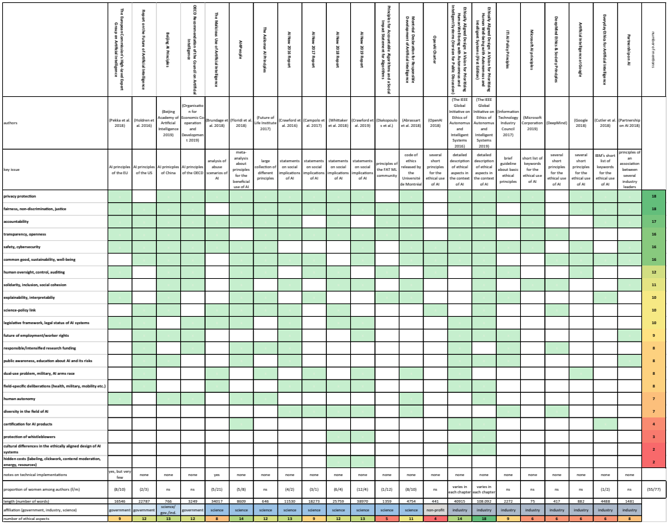
Abstract Current advances in research, development and application of artificial intelligence (AI) systems have yielded a far-reaching discourse on AI ethics. In consequence, a number of ethics guidelines have been released in recent years. These guidelines comprise normative principles and recommendations aimed to harness the “disruptive” potentials of new AI technologies. Designed as a semi-systematic evaluation, this paper analyzes and compares 22 guidelines, highlighting overlaps but also omissions. As a result, I give a detailed overview of the field of AI ethics. Finally, I also examine to what extent the respective ethical principles and values are implemented in the practice of research, development and application of AI systems—and how the effectiveness in the demands of AI ethics can be improved.
Verified 2026-11-25 · 3 references not checked yet
Overview
CoChat Summary
## TL;DR
This paper semi-systematically reviews 22 AI ethics guidelines, finding strong overlap on a few technicalizable topics but many important omissions. It argues that AI ethics is often ineffective in practice and should be supplemented by more concrete technical guidance and a shift toward virtue ethics.
## Key findings
- The paper analyzes and compares 22 AI ethics guidelines and finds that accountability, privacy, and fairness appear in about 80% of them, making them the closest thing to a common minimum standard.
- The author reports that guidelines from industrial contexts name on average 9.1 distinct ethical aspects, while science-based ethics codes average 10.8.
- Only two guidelines contain genuinely technical explanations, and these are described as very sparse; the most extensive technical commentary is in “The Malicious Use of AI”.
- The paper says a controlled study found the effectiveness of ethics guidelines or codes to be “almost zero”: among 63 software engineering students and 105 professional software developers, there was no statistically significant difference in responses between those who did and did not see the ACM code of ethics.
- The paper highlights major omissions across guidelines, including political abuse of AI, hidden social and ecological costs, lack of diversity, robot ethics, trolley problems, and public-private partnerships/industry-funded research.
## Methods
- Semi-systematic literature analysis of AI ethics guidelines, with a deliberate focus on comprehensive guideline documents rather than all AI-ethics-related writings.
- The final sample consisted of 22 major ethical guidelines, identified through searches in Google, Google Scholar, Web of Science, ACM Digital Library, arXiv, and SSRN, plus manual reference screening and the Algorithm Watch AI Ethics Guidelines Global Inventory.
- The paper compares which ethical issues are present or absent in the guidelines, and then relates those principles to practice using cited empirical studies and examples from AI development and deployment.
## Limitations
- The author states the sample is biased toward western/northern documents and excludes guidelines not written in English.
- The selection deliberately excludes guidelines focused on robot ethics, big data, algorithms, or robotics, so omissions in those areas are partly a result of the sampling method.
- The paper notes that its list of omissions is non-exhaustive.
- Evident from the text: the paper is primarily a theoretical/semi-systematic overview, not a direct empirical test of all AI ethics guideline implementations.
Model-written summary. Check it against the paper before relying on it.
Integrity signals
Registry
Cites
Statistics
Figures
Verification
Claims the paper makes
5 Valid · 3 Not valid · 62 Not checked · 64 Own results and interpretations
The cited sources support only part of this claim — read each source’s verdict below.
In the paper
“So far, some papers have been published on the subject of teaching ethics to data scientists (Garzcarek and Steuer 2019; Burton etal. 2017; Goldsmith and Burton 2017; Johnson 2017) but by and large very little to nothing has been written about the tangible implementation of ethical goals and values.”
What the sources say
- Supportedcites Garzcarek and Steuer 2019 matched to “Approaching Ethical Guidelines for Data Scientists” (2019) source
The citation is attached to the statement that papers have discussed teaching ethics to data scientists, not to the citing authors’ subsequent assessment of writing on tangible implementation. Section 5.2 (p. 14) explicitly argues that ethics should be part of the data-science curriculum. (LLM, conf=0.90)
- Not matchedcites Burton etal. 2017
An author–year citation the paper’s reference list doesn’t settle. We don’t search these by name.
- Supportedcites Goldsmith and Burton 2017 matched to “Why Teaching Ethics to AI Practitioners Is Important” (2017) source
The citation appears in a list of papers about teaching ethics to data scientists, not as support for the sentence’s later claim about how little has been written on implementation. The Introduction (p. 1) presents the paper as an argument for ethical training for AI students and practitioners, and the Conclusions (p. 4) advocate teaching ethics in AI classes. (LLM, conf=0.91)
plain- Asserted: passes — The authors put it forward as true.
- Checkable: passes — It can be checked against evidence.
- Load-bearing: passes — The paper’s conclusions depend on it.
- Based: passes — The paper gives a reason why it holds.
- Supported
The cited sources support only part of this claim — read each source’s verdict below.
In the paper
“Leading, of course, is the military use of AI in cyber warfare or regarding weaponized unmanned vehicles or drones (Ernest and Carroll 2016; Anderson and Waxman 2013).”
What the sources say
- Partly supportedcites Ernest and Carroll 2016 matched to “Genetic Fuzzy based Artificial Intelligence for Unmanned Combat Aerial Vehicle Control in Simulated Air Combat Missions” (2016) sourceExperimental — accuracy not yet measured
Our copy does support the drone half of the claim as an identification citation: the paper is squarely about applying AI to a weaponized unmanned vehicle (Introduction: UCAV research, 'this white paper will primarily focus on the increase in capabilities of real-time decision making'; Problem Statement: ALPHA controlling aircraft motion and firing in AFSIM). But it does not support the claim's core assertion that military AI is a leading area of unwanted side effects and malevolent use — the nearest passage (Introduction, 'There are a number of obstacles to a system being an effective AI within this context') frames the issues as engineering and verification difficulties (adversaries trying to 'fool and exploit the system', V&V, safety specifications, crashes/sensor failures), and the Results and Conclusions treat autonomy as 'a revolutionary leap in capability of airpower' and a way of 'reducing risk to our pilots'. Cyber appears only once, as an unrelated civilian/defence application domain of the GFT method ('Examples include robotic surgery, design automation, and cyber security'), not as cyber warfare, so that element of the claim is not from this source. (LLM, conf=0.72)
- Not checked — no full text of the sourcecites Anderson and Waxman 2013 matched to “Law and Ethics for Autonomous Weapon Systems: Why a Ban Won't Work and How the Laws of War Can” (2013) source
boostedstates an association- Asserted: passes — The authors put it forward as true.
- Checkable: passes — It can be checked against evidence.
- Load-bearing: unclear — It is unclear whether the paper’s conclusions depend on it.
- Based: passes — The paper gives a reason why it holds.
- Partly supported
The cited sources support only part of this claim — read each source’s verdict below.
In the paper
“In the light of these two approaches, the traditional type of AI ethics can be assigned to the deontological concept (Mittelstadt 2019).”
What the sources say
- Partly supportedcites Mittelstadt 2019 matched to “Principles alone cannot guarantee ethical AI” (2019) sourceExperimental — accuracy not yet measured
The paper describes a prominent, principle-based approach to AI ethics and says AI ethics initiatives have converged around principles resembling those of medical ethics (opening section; page unavailable). It does not classify that approach as deontological, so the claimed assignment to the deontological concept is not supported by our copy. (LLM, conf=0.78)
plainstates an association- Asserted: passes — The authors put it forward as true.
- Checkable: passes — It can be checked against evidence.
- Load-bearing: passes — The paper’s conclusions depend on it.
- Based: passes — The paper gives a reason why it holds.
- Partly supported
A result the paper reports from its own data — it cites no other source for it, so there is none to check. The quote shows it is in the paper.
In the paper
“My analysis of the distribution of female and male authors of the guidelines, as far as authors were indicated in the documents, showed that the proportion of women was 41.7%.”
plain- Asserted: passes — The authors put it forward as true.
- Checkable: passes — It can be checked against evidence.
- Load-bearing: passes — The paper’s conclusions depend on it.
- Based: passes — The paper gives a reason why it holds.
A result the paper reports from its own data — it cites no other source for it, so there is none to check. The quote shows it is in the paper.
In the paper
“Finally, yet importantly, it is noteworthy that almost all guidelines suggest that technical solutions exist for many of the problems described.”
hedged- Asserted: passes — The authors put it forward as true.
- Checkable: passes — It can be checked against evidence.
- Load-bearing: unclear — It is unclear whether the paper’s conclusions depend on it.
- Based: passes — The paper gives a reason why it holds.
54 more claims
Create a free account to see all 134 claims and to verify the 1 reference still open.
- Probably not a substantial claim. 59
- It may state two separate claims as one. 29
Claims other papers make about this one
Each is checked against this paper’s own text: does it say what the citing paper says it does?
The source backs part of the claim, not all of it — or backs it for a different population, condition or comparison.
In the citing paper
“Ethical concerns arising from the design and deployment of AI technology have motivated a number of initiatives [47]—such as the Ethical Guidelines for Trustworthy AI by the European Commission expert group on AI, and Microsoft’s FATE: Fairness, Accountability, Transparency, and Ethics in AI—addressing issues including mitigating bias and discrimination in AI systems and fairness in the use of AI”
From Future directions for chatbot research: An interdisciplinary research agenda (2021) · cites this paper as [47]
Experimental — accuracy not yet measuredThe source backs part of the claim, not all of it — or backs it for a different population, condition or comparison.
In the citing paper
“Additional recommendations on AI ethics teaching content include “explainability,” “liability,” and “accountability,” which are also considered important by available guidelines [30,40].”
From Proposing a Principle-Based Approach for Teaching AI Ethics in Medical Education (2024) · cites this paper as [30]
Experimental — accuracy not yet measuredThe source backs part of the claim, not all of it — or backs it for a different population, condition or comparison.
In the citing paper
“This emphasis is also echoed by existing guidelines and frameworks regarding AI ethics [30].”
From Proposing a Principle-Based Approach for Teaching AI Ethics in Medical Education (2024) · cites this paper as [30]
Experimental — accuracy not yet measuredThe source backs part of the claim, not all of it — or backs it for a different population, condition or comparison.
In the citing paper
“En dépit de nombreuses chartes, discussions et nombreux documents sur les bonnes pratiques éthiques, l’espoir est faible que l’IA puisse éventuellement se montrer généralement conforme (Hagendorff, 2020) :”
From Gouvernance algorithmique, intelligence artificielle, enjeux, éthique : esquisse d’une analyse critique (2021) · cites this paper as Hagendorff, 2020
Experimental — accuracy not yet measuredThe source backs part of the claim, not all of it — or backs it for a different population, condition or comparison.
In the citing paper
“The experience of mixed emotional responses and ethnical navigation was supported by literature (Hagendorff, 2020;Mamo et al., 2024;Mittelstadt, 2019).”
From Into the Unknown: AI Adoption and Job Satisfaction of Christian Faculty (2026) · cites this paper as Hagendorff, 2020
Experimental — accuracy not yet measured
13 more claims about this paper
Create a free account to see every claim other papers make about this one.
Citations
Cites
The spread of true and false news online
Vosoughi, S., Roy, D., & Aral, S. (2018) · Science · doi:10.1126/science.aap9559 · Cited by 8,847
The future of employment: How susceptible are jobs to computerisation?
Frey, C. B., & Osborne, M. A. (2017) · Technological Forecasting and Social Change · doi:10.1016/j.techfore.2016.08.019 · Cited by 8,727
The global landscape of AI ethics guidelines
Jobin, A., Ienca, M., & Vayena, E. (2019) · Nature Machine Intelligence · doi:10.1038/s42256-019-0088-2 · Cited by 6,220
Floridi, L., Cowls, J., Beltrametti, M., Chatila, R., Chazerand, P., Dignum, V., Luetge, C., Madelin, R., Pagallo, U., Rossi, F., et al. (2018) · Minds and Machines · doi:10.1007/s11023-018-9482-5 · Cited by 4,774 · cited 2×
“They include the adoption of legal framework conditions, the establishment of mechanisms for an independent auditing of technologies, the establishment of institutions for complaints, which also compensate for harms caused by AI systems, and the expansion of university curricula in particular through content from ethi…”
Background(2011) · Cited by 4,430
Lazer, D. M. J., Baum, M. A., Benkler, Y., Berinsky, A. J., Greenhill, K. M., Menczer, F., Metzger, M. J., Nyhan, B., Pennycook, G., Rothschild, D., et al. (2018) · Science · doi:10.1126/science.aao2998 · Cited by 4,160
The Black Box Society: The Secret Algorithms That Control Money and Information
Pasquale, F. (2015) · doi:10.4159/harvard.9780674736061 · Cited by 3,796
Experimental evidence of massive-scale emotional contagion through social networks
Kramer, A. D. I., Guillory, J. E., & Hancock, J. T. (2014) · Proceedings of the National Academy of Sciences · doi:10.1073/pnas.1320040111 · Cited by 3,687
(2018) · Cited by 3,510
Private traits and attributes are predictable from digital records of human behavior
Kosinski, M., Stillwell, D., & Graepel, T. (2013) · Proceedings of the National Academy of Sciences · doi:10.1073/pnas.1218772110 · Cited by 2,829
Research works printed but not linked: 24
- Abrassart, C., Bengio, Y., Chicoisne, G., de Marcellis-Warin, N., Dilhac, M.-A., Gambs, S., Gautrais, V., etal. (2018). Montréal declaration for responsible development of artificial intelligence (pp. 1-21).
- Asimov, I. (2004). I, Robot . New York: Random House LLC.
- Bakewell, J. D., Clement-Jones, T. F., Giddens, A., Grender, R. M., Hollick, C. R., Holmes, C., Levene, P. K. etal. (2018). AI in the UK: Ready, willing and able?. Select committee on artificial intelligence (pp. 1-183).
- Baron, B., Musolesi, M. (2017). Interpretable machine learning for privacy-preserving pervasive systems. arXiv (pp. 1-10).
- Bourdieu, P. (1984). Distinction: A social critique of the judgement of taste . Cambridge: Harvard University Press.
- Brahnam, S. (2006). Gendered bots and bot abuse. In Antonella de Angeli, Sheryl Brahnam, Peter Wallis, & Peter Dix (Eds.), Misuse and abuse of interactive technologies (pp. 1-4). Montreal: ACM.
- Derrida, J. (1997). Of grammatology . Baltimore: Johns Hopkins Univ. Press.
- Gebru, T., Morgenstern, J., Vecchione, B., Vaughan, J. W., Wallach, H., Daumeé, III, H., Crawford, K. (2018). Datasheets for datasets. arXiv (pp. 1-17).
- Google. (2019). Perspectives on issues in AI governance (pp. 1-34). Retrieved February 11, 2019. https :// ai.googl e/stati c/docum ents/persp ectiv es-on-issue s-in-ai-gover nance .pdf.
- Helbing, D. (Ed.). (2019). Towards digital enlightment: Essays on the darf and light sides of the digital revolution. Cham: Springer.
- Johnson, D. G. (2017). Can engineering ethics be taught? The Bridge, 47 (1), 59-64.
- Luhmann, N. (1988). Die Wirtschaft der Gesellschaft . Frankfurt A.M: Suhrkamp.
- Morley, J., Floridi, L., Kinsey, L., Elhalal, A. (2019). From what to how. An overview of AI ethics tools, methods and research to translate principles into practices. arXiv (pp. 1-21).
- Organisation for Economic Co-operation and Development. (2019). Recommendation of the Council on Artificial Intelligence (pp. 1-12). Retrieved June 18, 2019. https ://legal instr ument s.oecd.org/en/ instr ument s/OECD-LEGAL -0449.
- Pekka, A.-P., Bauer, W., Bergmann, U., Bieliková, M., Bonefeld-Dahl, C., Bonnet, Y., Bouarfa, L. etal. (2018). The European Commission's high-level expert group on artificial intelligence: Ethics guidelines for trustworthy ai . Working Document for stakeholders' consultation. Brussels (pp. 1-37).
- Pistono, F., Yampolskiy, R. (2016). Unethical research: How to create a malevolent artificial intelligence. arXiv (pp. 1-6).
- Podgaiska, I., Shklovski, I. Nordic engineers’ stand on artificial intelligence and ethics: Policy recommendations and guidelines (pp. 1–40).
- Rawls, J. (1975). Eine Theorie Der Gerechtigkeit . Frankfurt am Main: Suhrkamp.
- Shoham, Y., Perrault, R., Brynjolfsson, E., Clark, J., Manyika, J., Niebles, J. C., Lyons, T., Etchemendy, J., Grosz, B., Bauer, Z. (2018). The AI index 2018 annual report. Stanford, Kalifornien (pp. 1-94). <!-- image --> 1 3
- Sitawarin, C., Bhagoji, A. N., Mosenia, A., Chiang, M., Mittal, P. (2018). DARTS: Deceiving autonomous cars with toxic signs. arXiv (pp. 1-27).
- Tegmark, A. (2017). Life 3.0: Being human in the age of artificial intelligence . New York: Alfred A. Knopf.
- The IEEE Global Initiative on Ethics of Autonomous and Intelligent Systems. (2016). Ethically aligned design: A vision for prioritizing human well-being with artificial intelligence and autonomous systems (pp. 1-138).
- Whittaker, M., Crawford, K., Dobbe, R., Fried, G., Kaziunas, E., Mathur, V., West, S. M., Richardson, R., Schultz, J., Schwartz, O. (2018). AI now report 2018 (pp. 1-62).
- Zeng, Y., Lu, E., Huangfu, C. (2018). Linking artificial intelligence principles. arXiv (pp. 1-4). Publisher's Note Springer Nature remains neutral with regard to jurisdictional claims in published maps and institutional affiliations. <!-- image --> 1 3
Cited by
Items 1,101–1,200 of 1,821
Guidelines without guidance: underdetermination in AI ethics
Max, R. (2026) · AI and Ethics · doi:10.1007/s43681-026-01188-y · Cited by 8
Jou, M., & Hao, Y. (2026) · Journal of Computing in Higher Education · doi:10.1007/s12528-026-09496-2 · Cited by 4
Creely, E. (2026) · AI in Education · doi:10.3390/aieduc2020020 · Cited by 6
Yang, Y., Qi, J., & Ji, X. (2026) · International Journal of Human-Computer Interaction · doi:10.1080/10447318.2026.2683905 · Cited by 2
Students’ multimodal prompting practices as epistemic work in AI literacy development
Hashemi, S. S. (2026) · Computers and Education Artificial Intelligence · doi:10.1016/j.caeai.2026.100635 · Cited by 4
Discrimination DRIFT: A Practical Framework for Responsible AI
Wyer, S. (2026) · AI and Ethics · doi:10.1007/s43681-026-01211-2 · Cited by 3
Kinana, O. B. B. (2026) · Horizons Intermediary Journal of Business Research · doi:10.67150/hijbr.v1i1.6 · Cited by 2
Judgment Cannot Be Delegated: A Subject-Preserving Framework for AI Governance
Torrecilla-Pinero, J. A. (2026) · Philosophy & Technology · doi:10.1007/s13347-026-01140-2 · Cited by 7
“Hagendorff (2020) subjected these guidelines to critical evaluation and found that the vast majority lacked implementation mechanisms, enforcement procedures, and engagement with the political-economic structures within which AI systems are actually developed and deployed.”
Elagamy, S. H., & Elattar, R. H. (2026) · Analytical Letters · doi:10.1080/00032719.2026.2709666 · Cited by 4
Responsible Leadership and Human-Centered Governance in Technology-Mediated Organizations
Meyer, L., Schmid, A., Braun, S., & Keller, L. (2026) · Journal of Applied Organizational Systems and Behavior · doi:10.51847/vjz12wp6rv · Cited by 2
Major threats to the continued adoption of Artificial Intelligence in today's hyperconnected world
Eluwole, O. T., Akande, S., & Adegbola, O. A. (2022) · IEEE World AI IoT Congress (AIIoT) · doi:10.1109/aiiot54504.2022.9817247 · Cited by 2
HAAL: A healthy ageing eco-system for people with dementia
Nap, H. H., Lukkien, D., Lin, C. C., Lin, C. J., Chieh, H.-F., Wong, Y. T., Su, F. C., Bevilacqua, R., Amabili, G., Morresi, N., et al. (2022) · Gerontechnology · doi:10.4017/gt.2022.21.s.587.sp4 · Cited by 2
Key Principles for Effective Regulation and Supervision of Credit Reporting Service Providers
Bank, W. (2022) · World Bank, Washington, DC eBooks · doi:10.1596/38248 · Cited by 2
“For a broad overview of the existing ethics guidelines on AI, see Hagendorff (2020).”
BackgroundBeyond 100 Ethical Concerns in the Development of Robot-to-Robot Cooperation
Rousi, R. A., Vakkuri, V., Daubaris, P., Linkola, S., Samani, H. A., Mäkitalo, N., Halme, E., Agbese, M., Mohanani, R., Mikkonen, T., et al. (2022) · IEEE International Conference on Internet of Things (iThings) and IEEE Green Computing and Communications (GreenCom) and IEEE Cyber, Physical and Social Computing (CPSCom) and IEEE Smart Data (SmartData) · doi:10.1109/ithings-greencom-cpscom-smartdata-cybermatics55523.2022.00092 · Cited by 7
“…analysing outcomes) [15], and even virtue ethics (traditionally also connected to business ethics - relating to the characteristics of a person/entity in terms of morality and honesty) [19] are some of the ethical schools that are currently being brought into predominant AI ethics discussions.”
BackgroundBrandão, R., & Arbix, G. (2022) · Journal of Service Science and Management · doi:10.4236/jssm.2022.155032 · Cited by 8
In Defence of Ethics and the Law in AI Governance: The Case of Computer Vision
Završník, A. (2023) · Critical criminological perspectives · doi:10.1007/978-3-031-19149-7_5 · Cited by 6
Testamentary capacity assessment in dementia using artificial intelligence: prospects and challenges
Economou, A., & Kontos, J. (2023) · Frontiers in Psychiatry · doi:10.3389/fpsyt.2023.1137792 · Cited by 3
“International guidelines for trustworthy AI place explainability in the center of trustworthy systems and regulatory guidelines (42, 43).”
BackgroundDatenethik zwischen gesellschaftlichem Anspruch und betrieblicher Praxis
Hemel, U. (2023) · Springer eBooks · doi:10.1007/978-3-662-66278-6_7 · Cited by 4
Aplicação da Inteligência Artificial no Ensino Superior: Áreas e Características
Cavalcanti, W. M., Tavares, E. M., & Júnior, J. L. C. P. (2021) · Revista ADM.MADE/Adm.MADE · doi:10.5935/2237-51392020v25n1p040061 · Cited by 7
Exploring Responsible AI Practices in Dutch Media Organizations
Mioch, T., Stembert, N., Timmers, C., Hajri, O., Wiggers, P., & Harbers, M. (2023) · Lecture notes in computer science · doi:10.1007/978-3-031-42293-5_58 · Cited by 3
Sustained Enablement of AI Ethics in Industry
Flatscher, M., Fessler, A., & Janez, I. (2023) · Communications in computer and information science · doi:10.1007/978-3-031-42307-9_1 · Cited by 2
Powell, R. (2023) · BJHS Themes · doi:10.1017/bjt.2023.8 · Cited by 2
Using structured ethical techniques to facilitate reasoning in technology ethics
Murphy, M. (2023) · AI and Ethics · doi:10.1007/s43681-023-00371-9 · Cited by 3
“Technology ethics scholar Thilo Hagendorff calls for a move past checklists to a “…situation-sensitive ethical approach based on virtues and personality dispositions, knowledge expansions, responsible autonomy and freedom of action” [11].”
Transforming Experimental Cobot Cell to Industrial Realization – an Ethical AI Approach
Mezgár, I., Váncza, J., Paniti, I., & Tóth, J. (2023) · IFAC-PapersOnLine · doi:10.1016/j.ifacol.2023.10.347 · Cited by 4
Guiding the Next Technological Revolution: Principles for Responsible AI and Nanotech Progress
Gutierrez, R. (2023) · Advances in computational intelligence and robotics book series · doi:10.4018/979-8-3693-0368-9.ch011 · Cited by 8
Introduction: Knowledge and Digital Technology
Panitz, R., & Glückler, J. (2024) · Knowledge and space · doi:10.1007/978-3-031-39101-9_1 · Cited by 4
Cultivating Dignity in Intelligent Systems
Fasoro, S. A. (2024) · Philosophies · doi:10.3390/philosophies9020046 · Cited by 11
The ethics of online AI-driven agriculture and food systems
Benefo, E. O., Pradhan, A. K., & Patra, D. (2024) · Elsevier eBooks · doi:10.1016/b978-0-443-18851-0.00009-3 · Cited by 2
Technical Overview of AI and Its Participation in the Contract Formation
Ismayilzada, T. (2024) · Data science, machine intelligence, and law · doi:10.1007/978-3-031-61999-1_4 · Cited by 2
Universidad 5.0 El futuro de la Universidad y la Alfabetización en Inteligencia Artificial
Torres, F. J. A., Sagahón, F. J. V., & Torres, G. C. L. (2024) · TIES Revista de Tecnología e Innovación en Educación Superior · doi:10.22201/dgtic.26832968e.2024.10.17 · Cited by 16
“En un mundo tan caótico la IA se considera ajena a las preocupaciones cotidianas [5].”
BackgroundYoung, G. (2024) · AI and Ethics · doi:10.1007/s43681-024-00509-3 · Cited by 3
Phattanaviroj, T., Moslehpour, M., & Walawalkar, A. M. (2024) · Advances in computational intelligence and robotics book series · doi:10.4018/979-8-3693-3860-5.ch010 · Cited by 5
Walawalkar, A. M., Kumar, S., Moslehpour, M., & Moslehpour, M. (2024) · Advances in computational intelligence and robotics book series · doi:10.4018/979-8-3693-3860-5.ch003 · Cited by 3
Sattlegger, A. (2024) · Lecture notes in computer science · doi:10.1007/978-3-031-70804-6_9 · Cited by 3
Artificial Intelligence Literacy in Research
Contreras, M. R., & JAIMES, J. O. P. (2024) · IEEE Colombian Conference on Applications of Computational Intelligence (ColCACI) · doi:10.1109/colcaci63187.2024.10666582 · Cited by 6
“En forma complementaria, destacan el alto valor de integrar en la alfabetización en IA temas relacionados con la inclusión, la equidad, la responsabilidad, la transparencia y la ética [10].”
BackgroundEthical AI Assessment: A Framework with Composite Scores
Dwivedi, D. N., Mahanty, G., & Dwivedi, V. N. (2024) · Lecture notes in networks and systems · doi:10.1007/978-981-97-6588-1_37 · Cited by 3
Governing Technology: A MacIntyrean Approach to the Ethics of Artificial Intelligence
Ruiz, P. G. (2024) · Ethical economy · doi:10.1007/978-3-031-78888-8_9 · Cited by 2
Ethical Aspects of Research on AI-Based Social Assessment
Kruip, G., Späth, E., & Sabater, A. (2025) · Artificial intelligence, simulation and society · doi:10.1007/978-3-031-71678-2_3 · Cited by 3
STRIFE: A Socio-Technical Framework for Threat Modeling of Artificial Intelligence Systems
Parthasarathy, R., Rangarajan, A., Ghatak, S., & Bingi, P. (2025) · International Journal of Intelligent Information Technologies · doi:10.4018/ijiit.370967 · Cited by 2
Nababan, K., Siregar, D. M., Kuendo, W. A. C., Baluntu, W., Said, A. P., & Gulo, W. (2024) · Jurnal Ilmiah Sekolah Dasar · doi:10.23887/jisd.v8i4.85902 · Cited by 2
“The use of AI in education helps to automate the evaluation and assessment process and provide faster and more accurate feedback to students (Hagendorff, 2020) .”
Detection and Analysis of AI-Generated Malicious Content
Arafah, M. E., Al-Banna, A.-K., & Aladawi, A. (2025) · Advances in computational intelligence and robotics book series · doi:10.4018/979-8-3373-0832-6.ch011 · Cited by 4
Power Imbalances in Society and AI: On the Need to Expand the Feminist Approach
Gengler, E. J., Wedel, M., Wudel, A., & Laumer, S. (2025) · Lecture notes in information systems and organisation · doi:10.1007/978-3-031-80119-8_6 · Cited by 2
Yetişensoy, O. (2025) · Globalisation, comparative education and policy research · doi:10.1007/978-3-031-86145-1_9 · Cited by 3
Performing Productivity: Exploring the Narratives of State-Funded AI Projects Over a Decade in Chile
López, C., Luco, F., Humeres, M., & Correa, T. (2025) · Social Science Computer Review · doi:10.1177/08944393251361444 · Cited by 6
“Our study shifts the focus from macro-level AI narratives, prevalent in existing research that analyzes AI national policies (Filgueiras, 2023; Hagendorff, 2020), to micro-level narratives re fl ected in projects selected for public fi nancial support.”
Critical Reflections and Ethical Considerations for the Future
Hayudini, M. A. E., & Aming, S. E. (2025) · Advances in computational intelligence and robotics book series · doi:10.4018/979-8-3373-0275-1.ch012 · Cited by 2
Co-Designing Islamic AI Ethics: Insights from the UK Muslim Community
Campbell-Esen, R., Mahoney, J., & Talhouk, R. (2026) · CHI Conference on Human Factors in Computing Systems · doi:10.1145/3772318.3790413 · Cited by 8
“The recent ‘AI Ethics Boom’ reflects the growing urgency for artificial intelligence (AI) governance as the societal, economic, and (geo)political impacts of AI become increasingly apparent [24, 26, 57, 74].”
Rhetoric vs Responsibility: How Tech Companies Shape AI for Accessibility
Marathe, A. S., Zhou, Q., Mishra, A., & Piper, A. M. (2026) · CHI Conference on Human Factors in Computing Systems · doi:10.1145/3772318.3791854 · Cited by 2
“For example, AI ethics scholars have pointed to mixed models of enforcement—including independent auditing and certification programs—that help make ethical commitments more robust [40].”
Generative AI Models as Wicked Resources: A Dynamic Perspective on Resource Governance
Albayraktaroğlu, A., Mergen, A., & Güven, Ç. (2026) · Journal of Management · doi:10.1177/01492063261434193 · Cited by 3
A Habermasian Approach to Fair Processes in AI Algorithms
Xivuri, K., & Twinomurinzi, H. (2022) · Communications in computer and information science · doi:10.1007/978-3-030-95070-5_22 · Cited by 5
From Principles to Processes: Lessons for Higher Education From the Development of AI Ethics
Knox, J., Hoel, T., & Yuan, L. Y. (2022) · Advances in higher education and professional development book series · doi:10.4018/978-1-7998-9247-2.ch005 · Cited by 3
Etyka sztucznej inteligencji w dokumentach Unii Europejskiej w latach 2017–2020
", & Lipińska, I. (2022) · Edukacja Filozoficzna · doi:10.14394/edufil.2022.0001 · Cited by 3
Consideration of respondents' attitudes towards the concept of ethics in the audit profession
Jakovljević, N., Jeremić, M., & Jeremić, N. (2022) · Univerzitetska misao - casopis za nauku kulturu i umjetnost Novi Pazar · doi:10.5937/univmis2221115j · Cited by 2
Future: The Foreseeable Development of AI
Floridi, L. (2023) · Oxford University Press eBooks · doi:10.1093/oso/9780198883098.003.0003 · Cited by 2
AI and the UN Sustainable Development Goals
Floridi, L. (2023) · Oxford University Press eBooks · doi:10.1093/oso/9780198883098.003.0012 · Cited by 2
An Information Theoretic Approach to Privacy-Preserving Interpretable and Transferable Learning
Kumar, M., Moser, B., Fischer, L., & Freudenthaler, B. (2023) · Algorithms · doi:10.3390/a16090450 · Cited by 9
أخلاقيات الذكاء الاصطناعي في البيئة الصحفية الرقمية:
توفيق, ش. (2023) · Al-Maǧallah Al-Miṣriyyaẗ Li-Buḥūṯ Al-Iʿlām · doi:10.21608/ejsc.2023.343329 · Cited by 2
Khan, S. O., Morales, A., & Plale, B. (2024) · Lecture notes of the Institute for Computer Sciences, Social Informatics and Telecommunications Engineering · doi:10.1007/978-3-031-71304-0_3 · Cited by 2
Ai Systems’ Negative Social Impacts and Their Potential FactorsPreprint
Ahmad, N. H., Stigholt, L., & Penzenstadler, B. (2022) · SSRN Electronic Journal · doi:10.2139/ssrn.4047871 · Cited by 4
The Extremism Machine: Exploring the Effects of Digital Capitalism on the Far-Right Field
Lindsay, A. (2024) · Open Access Victoria University of Wellington | Te Herenga Waka (Figshare) · doi:10.26686/wgtn.25476043 · Cited by 4
Perception Challenges and Ethics on the Future of Ai as Encountered by Surveyed New EngineersPreprint
Khogali, H. O., & Mekid, S. (2024) · SSRN Electronic Journal · doi:10.2139/ssrn.4803295 · Cited by 2
The Role of Artificial Intelligence in Advancing Energy Justice and Equity
Gholizadeh, N., Hussein, N., & Musílek, P. (2025) · Wiley eBooks · doi:10.1002/9781394265749.ch14 · Cited by 2
Ética militar e inteligencia artificial: reflexiones para Colombia desde el contexto global actual
Gantiva-Castiblanco, C. (2021) · doi:10.21830/9789585377134.05 · Cited by 1
Advanced Analytics for Ethical Considerations in Mining Industry
Kaul, A., & Soofastaei, A. (2022) · Springer eBooks · doi:10.1007/978-3-030-91589-6_3 · Cited by 2
Conceptualisation of the Relational Governance of Artificial Intelligence
Wiesmüller, S. (2023) · Relational economics and organization governance · doi:10.1007/978-3-031-25023-1_3 · Cited by 2
Data Ethics and Data Science: An Uneasy Marriage?
Keymolen, E., & Taylor, L. (2021) · Classroom companion: business · doi:10.1007/978-3-031-19554-9_20 · Cited by 5
Systematic Review on Safety of Artificial Intelligence and Transportation
Biddala, S. C. R., Ibikunle, O., & Duffy, V. G. (2023) · Lecture notes in computer science · doi:10.1007/978-3-031-48047-8_16 · Cited by 2
A Systems-Theoretic Approach for the Analysis of AI Ethics
Lumme, E. M. (2023) · Communications in computer and information science · doi:10.1007/978-3-031-49215-0_6 · Cited by 1
Responsible users and platform competition: A computational model
Katsamakas, E. G., & Sanchez-Cartas, J. M. (2024) · Heliyon · doi:10.1016/j.heliyon.2024.e25010 · Cited by 4
“Other social issues include workers ’ rights [23], loss of control, unemployment [24], and AI ethics [25,26].”
BackgroundThe Historical Evolution of Employee Idea Management: A Comprehensive Review
Angyal, V. (2024) · Soproni Egyetem Kiadó eBooks · doi:10.35511/978-963-334-499-6-angyal · Cited by 1
Sokolchik, V., & РАЗУВАНОВ, А. (2024) · Proceedings of the National Academy of Sciences of Belarus Humanitarian Series · doi:10.29235/2524-2369-2024-69-2-95-107 · Cited by 2
Examining Value Creation in Public Sector AI Implementation
Molin, A., Rudmark, D., Koutsikouri, D., & Nylén, D. (2024) · Lecture notes in computer science · doi:10.1007/978-3-031-70274-7_20 · Cited by 2
AI at Work: Performance Paradigms in the Age of Automation from the OCDE
López-García, J., Romero-Gómez, D., Castañón–Puga, M., & Tello, E. A. (2024) · Portland International Conference on Management of Engineering and Technology (PICMET) · doi:10.23919/picmet64035.2024.10653232 · Cited by 3
“Both approaches aim to address the ethical implications of AI development and use [2].”
BackgroundSpeith, T., & Xu, J. (2024) · Lecture notes in computer science · doi:10.1007/978-3-031-70074-3_12 · Cited by 3
Evaluating a Global Citizenship Course on Developing Business Students’ AI Literacy Skills
Ching, A. C. H., Law, S. W., & Ng, D. T. K. (2024) · Emerald Group Publishing Limited eBooks · doi:10.1108/978-1-83608-852-320241010 · Cited by 3
Regulace rizik a etické výzvy umělé inteligence v kontextu nařízení AI Act
Jedličková, A. (2024) · Anthropologia integra · doi:10.5817/ai2024-2-7 · Cited by 1
Polydoropoulos, A., Nestoras, F., & Groumpos, P. P. (2024) · International Conference on Information, Intelligence, Systems & Applications (IISA) · doi:10.1109/iisa62523.2024.10786692 · Cited by 2
“There are also interesting results that explore the ethical side of AI and FCM theories and their impact on our everyday life [35-36].”
Artificial Intelligence’s (AI’s) Responsible Use: How to Manage Digital Ethicswashing
Bernini, F., Ferretti, P., & Rosa, F. L. (2024) · SIDREA series in accounting and business administration · doi:10.1007/978-3-031-74292-7_2 · Cited by 1
Ethics in the Use of Artificial Intelligence in the Media
Çupi, D. (2024) · Lecture notes in computer science · doi:10.1007/978-3-031-76827-9_2 · Cited by 2
Innovative Horizons: Ethical AI, Sustainability, and Economic Impacts in Supply Chain Management
Sarao, P., Dar, A. A., Sindhuja, S., Malhotra, M., Jain, A., & Shruti (2025) · Advances in business strategy and competitive advantage book series · doi:10.4018/979-8-3693-4433-0.ch011 · Cited by 2
Evaluating Gender Bias in Computational AI-Based Approaches: A Case Analysis of LinkedIn
Gautam, J., Singh, H., Mishra, N., -, K. K. S., Tripathy, R., & Nayak, R. K. (2025) · Advances in computational intelligence and robotics book series · doi:10.4018/979-8-3693-7478-8.ch010 · Cited by 1
Avrupa Birliği Yapay Zekâ Yasası: 2018-2024 Avrupa Komisyonu Tekliflerinde Demokrasinin Yeri
Yolcu, T., & Gülbahar, Y. (2025) · Ankara Avrupa Calismalari Dergisi · doi:10.32450/aacd.1482706 · Cited by 2
Cultural Intelligence in AI Ethics: A Systematic Framework for Implementation Across Global Contexts
Kumar, D., Kumar, K., Choudhary, R. K., & Singh, V. (2025) · International Conference on Intelligent Systems, Advanced Computing and Communication (ISACC) · doi:10.1109/isacc65211.2025.10969295 · Cited by 4
“This rapid advancement raises fundamental questions about cultural values, ethical frameworks, and societal norms, particularly as AI capabilities continue to expand and evolve across different cultural contexts [4].”
Walter Benjamin in the bathhouse: Meditations on robot mothers, daydreams, and art in the AI era
O’Donnell, J. L. (2025) · Anthropology & Humanism · doi:10.1111/anhu.70006 · Cited by 2
The Governance of AI Technologies
Noorman, M. E. (2025) · Philosophy of engineering and technology · doi:10.1007/978-3-031-87974-6_6 · Cited by 1
Wee, A. K. J., Lin, M., Jenkins, M. A., & Lee, S. E. (2025) · Advances in computational intelligence and robotics book series · doi:10.4018/979-8-3693-5837-5.ch004 · Cited by 3
Education as Hermeneutic Study: Uncovering Meaning in The Digital Era
Faridah, F., & Nurhayati, S. (2025) · Jurnal Riset dan Inovasi Pembelajaran · doi:10.51574/jrip.v5i1.2603 · Cited by 4
“Hagendorff (2020) underscores the significance of ethics in the advancement of AI and other automated systems.”
Huang, Y. K., Kleespies, M. W., & Shiang‐Yao, L. (2025) · Biochemistry and Molecular Biology Education · doi:10.1002/bmb.21905 · Cited by 3
Li, X., Liu, Q., Bai, Q., & Xu, X. (2025) · Computer · doi:10.1109/mc.2025.3545036 · Cited by 1
Using Generative Artificial Intelligence to Support Young Writers: Ethical Stickiness
Kershen, J. L., & Johnson, B. (2025) · The Clearing House A Journal of Educational Strategies Issues and Ideas · doi:10.1080/00098655.2025.2510298 · Cited by 1
“The ever growing body of literature on AI ethics (Hagendorff 2020; Jobin, Ienca, and Vayena 2019; Ng, Su, and Chu 2024) highlights the need for users to develop a deeper understanding of how GenAI technologies work.”
Jadallah, N. (2025) · The social science · doi:10.11648/j.ss.20251403.14 · Cited by 1
Incorporating emergence in data-driven algorithms: the circularity pathway
Deepak, P., Parsodkar, A. P., Nair, V. S., & Chakraborti, S. (2025) · AI and Ethics · doi:10.1007/s43681-025-00763-z · Cited by 1
“Yet , this has been observed to focus on aspects such as accountability, privacy and fairness, which are, as noted in [7], ethical aspects ‘ for which technical fixes can be or have already been developed ’.”
Ndjama, J. D. N., & Westhuizen, J. V. D. (2025) · IGI Global eBooks · doi:10.4018/979-8-3693-9989-7.ch005 · Cited by 3
Mansoor, S. I. U., Kausar, H., Khan, M. S. B., & Yadav, G. (2025) · Advances in computational intelligence and robotics book series · doi:10.4018/979-8-3693-9576-9.ch003 · Cited by 1
Psychological impact of ai in the automation of clinical decision-making
Hernández, D. C. V., Contreras-Vásquez, L. F., Espinoza, G. F. S., Tufiño, A., Teneda, A. C. C., Rosero, E. A. R., Velasteguí, V. G. S., Hernández, R. E. V., Cabezas, F. A. V. D. L. B., & Salazar-Garcés, L. F. (2025) · Salud Ciencia y Tecnología · doi:10.56294/saludcyt20251586 · Cited by 1
The Integration of Ethical and Trustworthy AI in Industrial Engineering: Practical Approaches
Salvatore, S. D., Yahyaoui, O. D., Marchi, M. D., & Rauch, E. (2025) · International Conference on Smart Management in Industrial and Logistics Engineering (SMILE) · doi:10.3390/engproc2025097042 · Cited by 2
Artificial Intelligence Ethics: Anthropocentric Approach
Koval, E., Zhadunova, N. V., & Martynova, M. Y. (2025) · Ural Symposium on Biomedical Engineering, Radioelectronics and Information Technology (USBEREIT) · doi:10.1109/usbereit65494.2025.11054203 · Cited by 1
Toward a responsible and ethical authorization to operate: A case study in AI consulting
Pittman, J. M., & Schaefer, G. (2025) · Journal of Responsible Technology · doi:10.1016/j.jrt.2025.100130 · Cited by 2
The Knowledge Politics of GeoAI
Oluoch, I. (2025) · Springer geography · doi:10.1007/978-3-031-87421-5_24 · Cited by 1
The representation problem in AI ethics
Ye, B. (2025) · AI & Society · doi:10.1007/s00146-025-02538-w · Cited by 4
Ali, E., Weichert, J., Sun, Y. S., Eldardiry, H., Zhu, Q., & Kim, D. (2025) · IEEE International Symposium on Ethics in Engineering, Science, and Technology (ETHICS) · doi:10.1109/ethics65148.2025.11098179 · Cited by 1
“However, AI ethics manifest itself as sets of ethical principles (e.g. nonmaleficence or autonomy ) that aim to guide the design and deployment of AI systems [8], [21], [22].”
Metadata
- Authors
- Hagendorff, T.
- Affiliations
- University of Tübingen (DE)
- Corresponding author
- Hagendorff, Thilo
- ORCID
- Hagendorff, Thilo
- Venue
- Minds and Machines
- Published
- 2020-02-01
- Volume
- 30
- Issue
- 1
- Pages
- 99-120
- ISSN
- 0924-6495 (ISSN-L)
- 1572-8641
- OpenAlex
- W3003385079
- Semantic Scholar
- 11159bdb213aaa243916f42f576396d483ba474b
- Cited by
- 1,911
- References
- 86
- Citations by year
- 2026: 370 · 2025: 446 · 2024: 361 · 2023: 290 · 2022: 239 · 2021: 160 · 2020: 41
- FWCI
- 248.38
- Type
- journal article
- Language
- en
- Update notices
- correction (2020-07-28)
- Open access
- hybrid
- doi.org
- Licence
- cc-by
- creativecommons.org/licenses/by/4.0 (tdm)
- creativecommons.org/licenses/by/4.0 (vor)
- Locations
- Minds and Machines (publishedVersion, cc-by)
- arXiv (Cornell University) (submittedVersion)
- arXiv (Cornell University)
- Funders
- Deutsche Forschungsgemeinschaft (390727645)
- Topics
- Physical Sciences › Computer Science › Artificial Intelligence › Ethics and Social Impacts of AI
- Social Sciences › Law › Digitalization, Law, and Regulation
- Social Sciences › Business, Management and Accounting › Organizational Behavior and Human Resource Management › Ethics in Business and Education
- Keywords
- AI ethics, ethics guidelines, normative principles, moral values
About these checks
Registry, retraction, Cites and statistics results are computed, not judged, with one exception: a printed reference that no index lists is read once by a model before it counts as a citation error. Claims are extracted by a model and kept only when their quote appears verbatim in the text; each cited source is then checked, with a model’s help, for whether it says what the claim relies on. Those verdicts can be wrong — read the claim’s quote and the cited source before relying on one.
The claim verdicts this report counts are experimental: their accuracy is not yet measured.
A language model drew the claims from the paper on 2026-10-12, under version 3 of the claim definition (model deepseek-v4.1-flash, prompt extract-v3).
A second model labelled each claim on 2026-10-12 (model jev-1.13-20260917, definition revision gold-guideline-v0.2).
Cited sources are checked with a language model’s help (gpt-6-sol and qwen3.8-omni-flash).
Statistics and arithmetic are recomputed, not judged.
Confidence bands are shown only for fields calibrated on our annotated test set. None is calibrated yet, so no band is shown.
What counts as a claim ›How we measure confidence ›How we check this ›
Are you an author, or do you see a problem with this page? Request a review
Data sources
Bibliographic data: Semantic Scholar, OpenAlex, Crossref.
Contains information from the Semantic Scholar Academic Graph Datasets, made available under the ODC Attribution License (ODC-BY 1.0).
Semantic Scholar’s data is described in: Kinney, R., et al. (2023). The Semantic Scholar Open Data Platform. arXiv:2301.10140.
