

The Ethics of AI Ethics: An Evaluation of Guidelines
Open accessThe DOI matches its Crossref record; 97 of the 100 references it cites were found in a registry or an index, and 3 are not checked yet; 6 of the 88 sources its claims cite were checked for support.
Abstract
Abstract Current advances in research, development and application of artificial intelligence (AI) systems have yielded a far-reaching discourse on AI ethics. In consequence, a number of ethics guidelines have been released in recent years. These guidelines comprise normative principles and recommendations aimed to harness the “disruptive” potentials of new AI technologies. Designed as a semi-systematic evaluation, this paper analyzes and compares 22 guidelines, highlighting overlaps but also omissions. As a result, I give a detailed overview of the field of AI ethics. Finally, I also examine to what extent the respective ethical principles and values are implemented in the practice of research, development and application of AI systems—and how the effectiveness in the demands of AI ethics can be improved.
Verified 2026-11-25 · 3 references not checked yet
Overview
CoChat Summary
## TL;DR
This paper semi-systematically reviews 22 AI ethics guidelines, finding strong overlap on a few technicalizable topics but many important omissions. It argues that AI ethics is often ineffective in practice and should be supplemented by more concrete technical guidance and a shift toward virtue ethics.
## Key findings
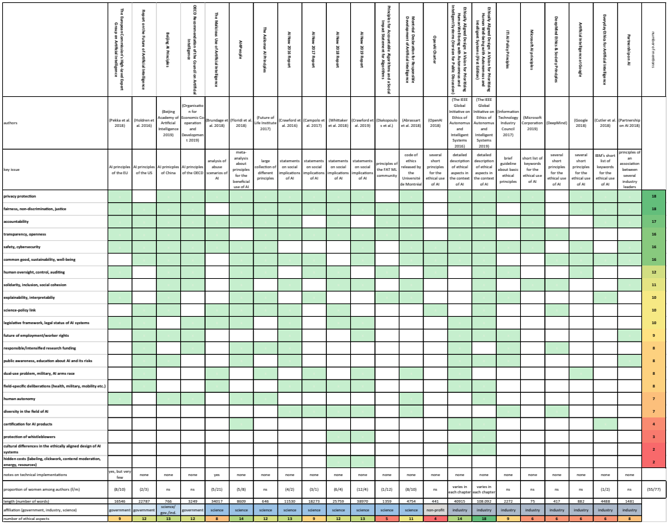
- The paper analyzes and compares 22 AI ethics guidelines and finds that accountability, privacy, and fairness appear in about 80% of them, making them the closest thing to a common minimum standard.
- The author reports that guidelines from industrial contexts name on average 9.1 distinct ethical aspects, while science-based ethics codes average 10.8.
- Only two guidelines contain genuinely technical explanations, and these are described as very sparse; the most extensive technical commentary is in “The Malicious Use of AI”.
- The paper says a controlled study found the effectiveness of ethics guidelines or codes to be “almost zero”: among 63 software engineering students and 105 professional software developers, there was no statistically significant difference in responses between those who did and did not see the ACM code of ethics.
- The paper highlights major omissions across guidelines, including political abuse of AI, hidden social and ecological costs, lack of diversity, robot ethics, trolley problems, and public-private partnerships/industry-funded research.
## Methods
- Semi-systematic literature analysis of AI ethics guidelines, with a deliberate focus on comprehensive guideline documents rather than all AI-ethics-related writings.
- The final sample consisted of 22 major ethical guidelines, identified through searches in Google, Google Scholar, Web of Science, ACM Digital Library, arXiv, and SSRN, plus manual reference screening and the Algorithm Watch AI Ethics Guidelines Global Inventory.
- The paper compares which ethical issues are present or absent in the guidelines, and then relates those principles to practice using cited empirical studies and examples from AI development and deployment.
## Limitations
- The author states the sample is biased toward western/northern documents and excludes guidelines not written in English.
- The selection deliberately excludes guidelines focused on robot ethics, big data, algorithms, or robotics, so omissions in those areas are partly a result of the sampling method.
- The paper notes that its list of omissions is non-exhaustive.
- Evident from the text: the paper is primarily a theoretical/semi-systematic overview, not a direct empirical test of all AI ethics guideline implementations.
Model-written summary. Check it against the paper before relying on it.
Integrity signals
Registry
Cites
Statistics
Figures
Verification
Claims the paper makes
5 Valid · 3 Not valid · 62 Not checked · 64 Own results and interpretations
The cited sources support only part of this claim — read each source’s verdict below.
In the paper
“So far, some papers have been published on the subject of teaching ethics to data scientists (Garzcarek and Steuer 2019; Burton etal. 2017; Goldsmith and Burton 2017; Johnson 2017) but by and large very little to nothing has been written about the tangible implementation of ethical goals and values.”
What the sources say
- Supportedcites Garzcarek and Steuer 2019 matched to “Approaching Ethical Guidelines for Data Scientists” (2019) source
The citation is attached to the statement that papers have discussed teaching ethics to data scientists, not to the citing authors’ subsequent assessment of writing on tangible implementation. Section 5.2 (p. 14) explicitly argues that ethics should be part of the data-science curriculum. (LLM, conf=0.90)
- Not matchedcites Burton etal. 2017
An author–year citation the paper’s reference list doesn’t settle. We don’t search these by name.
- Supportedcites Goldsmith and Burton 2017 matched to “Why Teaching Ethics to AI Practitioners Is Important” (2017) source
The citation appears in a list of papers about teaching ethics to data scientists, not as support for the sentence’s later claim about how little has been written on implementation. The Introduction (p. 1) presents the paper as an argument for ethical training for AI students and practitioners, and the Conclusions (p. 4) advocate teaching ethics in AI classes. (LLM, conf=0.91)
plain- Asserted: passes — The authors put it forward as true.
- Checkable: passes — It can be checked against evidence.
- Load-bearing: passes — The paper’s conclusions depend on it.
- Based: passes — The paper gives a reason why it holds.
- Supported
The cited sources support only part of this claim — read each source’s verdict below.
In the paper
“Leading, of course, is the military use of AI in cyber warfare or regarding weaponized unmanned vehicles or drones (Ernest and Carroll 2016; Anderson and Waxman 2013).”
What the sources say
- Partly supportedcites Ernest and Carroll 2016 matched to “Genetic Fuzzy based Artificial Intelligence for Unmanned Combat Aerial Vehicle Control in Simulated Air Combat Missions” (2016) sourceExperimental — accuracy not yet measured
Our copy does support the drone half of the claim as an identification citation: the paper is squarely about applying AI to a weaponized unmanned vehicle (Introduction: UCAV research, 'this white paper will primarily focus on the increase in capabilities of real-time decision making'; Problem Statement: ALPHA controlling aircraft motion and firing in AFSIM). But it does not support the claim's core assertion that military AI is a leading area of unwanted side effects and malevolent use — the nearest passage (Introduction, 'There are a number of obstacles to a system being an effective AI within this context') frames the issues as engineering and verification difficulties (adversaries trying to 'fool and exploit the system', V&V, safety specifications, crashes/sensor failures), and the Results and Conclusions treat autonomy as 'a revolutionary leap in capability of airpower' and a way of 'reducing risk to our pilots'. Cyber appears only once, as an unrelated civilian/defence application domain of the GFT method ('Examples include robotic surgery, design automation, and cyber security'), not as cyber warfare, so that element of the claim is not from this source. (LLM, conf=0.72)
- Not checked — no full text of the sourcecites Anderson and Waxman 2013 matched to “Law and Ethics for Autonomous Weapon Systems: Why a Ban Won't Work and How the Laws of War Can” (2013) source
boostedstates an association- Asserted: passes — The authors put it forward as true.
- Checkable: passes — It can be checked against evidence.
- Load-bearing: unclear — It is unclear whether the paper’s conclusions depend on it.
- Based: passes — The paper gives a reason why it holds.
- Partly supported
The cited sources support only part of this claim — read each source’s verdict below.
In the paper
“In the light of these two approaches, the traditional type of AI ethics can be assigned to the deontological concept (Mittelstadt 2019).”
What the sources say
- Partly supportedcites Mittelstadt 2019 matched to “Principles alone cannot guarantee ethical AI” (2019) sourceExperimental — accuracy not yet measured
The paper describes a prominent, principle-based approach to AI ethics and says AI ethics initiatives have converged around principles resembling those of medical ethics (opening section; page unavailable). It does not classify that approach as deontological, so the claimed assignment to the deontological concept is not supported by our copy. (LLM, conf=0.78)
plainstates an association- Asserted: passes — The authors put it forward as true.
- Checkable: passes — It can be checked against evidence.
- Load-bearing: passes — The paper’s conclusions depend on it.
- Based: passes — The paper gives a reason why it holds.
- Partly supported
A result the paper reports from its own data — it cites no other source for it, so there is none to check. The quote shows it is in the paper.
In the paper
“My analysis of the distribution of female and male authors of the guidelines, as far as authors were indicated in the documents, showed that the proportion of women was 41.7%.”
plain- Asserted: passes — The authors put it forward as true.
- Checkable: passes — It can be checked against evidence.
- Load-bearing: passes — The paper’s conclusions depend on it.
- Based: passes — The paper gives a reason why it holds.
A result the paper reports from its own data — it cites no other source for it, so there is none to check. The quote shows it is in the paper.
In the paper
“Finally, yet importantly, it is noteworthy that almost all guidelines suggest that technical solutions exist for many of the problems described.”
hedged- Asserted: passes — The authors put it forward as true.
- Checkable: passes — It can be checked against evidence.
- Load-bearing: unclear — It is unclear whether the paper’s conclusions depend on it.
- Based: passes — The paper gives a reason why it holds.
54 more claims
Create a free account to see all 134 claims and to verify the 1 reference still open.
- Probably not a substantial claim. 59
- It may state two separate claims as one. 29
Claims other papers make about this one
Each is checked against this paper’s own text: does it say what the citing paper says it does?
The source backs part of the claim, not all of it — or backs it for a different population, condition or comparison.
In the citing paper
“Ethical concerns arising from the design and deployment of AI technology have motivated a number of initiatives [47]—such as the Ethical Guidelines for Trustworthy AI by the European Commission expert group on AI, and Microsoft’s FATE: Fairness, Accountability, Transparency, and Ethics in AI—addressing issues including mitigating bias and discrimination in AI systems and fairness in the use of AI”
From Future directions for chatbot research: An interdisciplinary research agenda (2021) · cites this paper as [47]
Experimental — accuracy not yet measuredThe source backs part of the claim, not all of it — or backs it for a different population, condition or comparison.
In the citing paper
“Additional recommendations on AI ethics teaching content include “explainability,” “liability,” and “accountability,” which are also considered important by available guidelines [30,40].”
From Proposing a Principle-Based Approach for Teaching AI Ethics in Medical Education (2024) · cites this paper as [30]
Experimental — accuracy not yet measuredThe source backs part of the claim, not all of it — or backs it for a different population, condition or comparison.
In the citing paper
“This emphasis is also echoed by existing guidelines and frameworks regarding AI ethics [30].”
From Proposing a Principle-Based Approach for Teaching AI Ethics in Medical Education (2024) · cites this paper as [30]
Experimental — accuracy not yet measuredThe source backs part of the claim, not all of it — or backs it for a different population, condition or comparison.
In the citing paper
“En dépit de nombreuses chartes, discussions et nombreux documents sur les bonnes pratiques éthiques, l’espoir est faible que l’IA puisse éventuellement se montrer généralement conforme (Hagendorff, 2020) :”
From Gouvernance algorithmique, intelligence artificielle, enjeux, éthique : esquisse d’une analyse critique (2021) · cites this paper as Hagendorff, 2020
Experimental — accuracy not yet measuredThe source backs part of the claim, not all of it — or backs it for a different population, condition or comparison.
In the citing paper
“The experience of mixed emotional responses and ethnical navigation was supported by literature (Hagendorff, 2020;Mamo et al., 2024;Mittelstadt, 2019).”
From Into the Unknown: AI Adoption and Job Satisfaction of Christian Faculty (2026) · cites this paper as Hagendorff, 2020
Experimental — accuracy not yet measured
13 more claims about this paper
Create a free account to see every claim other papers make about this one.
Citations
Cites
The spread of true and false news online
Vosoughi, S., Roy, D., & Aral, S. (2018) · Science · doi:10.1126/science.aap9559 · Cited by 8,847
The future of employment: How susceptible are jobs to computerisation?
Frey, C. B., & Osborne, M. A. (2017) · Technological Forecasting and Social Change · doi:10.1016/j.techfore.2016.08.019 · Cited by 8,727
The global landscape of AI ethics guidelines
Jobin, A., Ienca, M., & Vayena, E. (2019) · Nature Machine Intelligence · doi:10.1038/s42256-019-0088-2 · Cited by 6,220
Floridi, L., Cowls, J., Beltrametti, M., Chatila, R., Chazerand, P., Dignum, V., Luetge, C., Madelin, R., Pagallo, U., Rossi, F., et al. (2018) · Minds and Machines · doi:10.1007/s11023-018-9482-5 · Cited by 4,774 · cited 2×
“They include the adoption of legal framework conditions, the establishment of mechanisms for an independent auditing of technologies, the establishment of institutions for complaints, which also compensate for harms caused by AI systems, and the expansion of university curricula in particular through content from ethi…”
Background(2011) · Cited by 4,430
Lazer, D. M. J., Baum, M. A., Benkler, Y., Berinsky, A. J., Greenhill, K. M., Menczer, F., Metzger, M. J., Nyhan, B., Pennycook, G., Rothschild, D., et al. (2018) · Science · doi:10.1126/science.aao2998 · Cited by 4,160
The Black Box Society: The Secret Algorithms That Control Money and Information
Pasquale, F. (2015) · doi:10.4159/harvard.9780674736061 · Cited by 3,796
Experimental evidence of massive-scale emotional contagion through social networks
Kramer, A. D. I., Guillory, J. E., & Hancock, J. T. (2014) · Proceedings of the National Academy of Sciences · doi:10.1073/pnas.1320040111 · Cited by 3,687
(2018) · Cited by 3,510
Private traits and attributes are predictable from digital records of human behavior
Kosinski, M., Stillwell, D., & Graepel, T. (2013) · Proceedings of the National Academy of Sciences · doi:10.1073/pnas.1218772110 · Cited by 2,829
Research works printed but not linked: 24
- Abrassart, C., Bengio, Y., Chicoisne, G., de Marcellis-Warin, N., Dilhac, M.-A., Gambs, S., Gautrais, V., etal. (2018). Montréal declaration for responsible development of artificial intelligence (pp. 1-21).
- Asimov, I. (2004). I, Robot . New York: Random House LLC.
- Bakewell, J. D., Clement-Jones, T. F., Giddens, A., Grender, R. M., Hollick, C. R., Holmes, C., Levene, P. K. etal. (2018). AI in the UK: Ready, willing and able?. Select committee on artificial intelligence (pp. 1-183).
- Baron, B., Musolesi, M. (2017). Interpretable machine learning for privacy-preserving pervasive systems. arXiv (pp. 1-10).
- Bourdieu, P. (1984). Distinction: A social critique of the judgement of taste . Cambridge: Harvard University Press.
- Brahnam, S. (2006). Gendered bots and bot abuse. In Antonella de Angeli, Sheryl Brahnam, Peter Wallis, & Peter Dix (Eds.), Misuse and abuse of interactive technologies (pp. 1-4). Montreal: ACM.
- Derrida, J. (1997). Of grammatology . Baltimore: Johns Hopkins Univ. Press.
- Gebru, T., Morgenstern, J., Vecchione, B., Vaughan, J. W., Wallach, H., Daumeé, III, H., Crawford, K. (2018). Datasheets for datasets. arXiv (pp. 1-17).
- Google. (2019). Perspectives on issues in AI governance (pp. 1-34). Retrieved February 11, 2019. https :// ai.googl e/stati c/docum ents/persp ectiv es-on-issue s-in-ai-gover nance .pdf.
- Helbing, D. (Ed.). (2019). Towards digital enlightment: Essays on the darf and light sides of the digital revolution. Cham: Springer.
- Johnson, D. G. (2017). Can engineering ethics be taught? The Bridge, 47 (1), 59-64.
- Luhmann, N. (1988). Die Wirtschaft der Gesellschaft . Frankfurt A.M: Suhrkamp.
- Morley, J., Floridi, L., Kinsey, L., Elhalal, A. (2019). From what to how. An overview of AI ethics tools, methods and research to translate principles into practices. arXiv (pp. 1-21).
- Organisation for Economic Co-operation and Development. (2019). Recommendation of the Council on Artificial Intelligence (pp. 1-12). Retrieved June 18, 2019. https ://legal instr ument s.oecd.org/en/ instr ument s/OECD-LEGAL -0449.
- Pekka, A.-P., Bauer, W., Bergmann, U., Bieliková, M., Bonefeld-Dahl, C., Bonnet, Y., Bouarfa, L. etal. (2018). The European Commission's high-level expert group on artificial intelligence: Ethics guidelines for trustworthy ai . Working Document for stakeholders' consultation. Brussels (pp. 1-37).
- Pistono, F., Yampolskiy, R. (2016). Unethical research: How to create a malevolent artificial intelligence. arXiv (pp. 1-6).
- Podgaiska, I., Shklovski, I. Nordic engineers’ stand on artificial intelligence and ethics: Policy recommendations and guidelines (pp. 1–40).
- Rawls, J. (1975). Eine Theorie Der Gerechtigkeit . Frankfurt am Main: Suhrkamp.
- Shoham, Y., Perrault, R., Brynjolfsson, E., Clark, J., Manyika, J., Niebles, J. C., Lyons, T., Etchemendy, J., Grosz, B., Bauer, Z. (2018). The AI index 2018 annual report. Stanford, Kalifornien (pp. 1-94). <!-- image --> 1 3
- Sitawarin, C., Bhagoji, A. N., Mosenia, A., Chiang, M., Mittal, P. (2018). DARTS: Deceiving autonomous cars with toxic signs. arXiv (pp. 1-27).
- Tegmark, A. (2017). Life 3.0: Being human in the age of artificial intelligence . New York: Alfred A. Knopf.
- The IEEE Global Initiative on Ethics of Autonomous and Intelligent Systems. (2016). Ethically aligned design: A vision for prioritizing human well-being with artificial intelligence and autonomous systems (pp. 1-138).
- Whittaker, M., Crawford, K., Dobbe, R., Fried, G., Kaziunas, E., Mathur, V., West, S. M., Richardson, R., Schultz, J., Schwartz, O. (2018). AI now report 2018 (pp. 1-62).
- Zeng, Y., Lu, E., Huangfu, C. (2018). Linking artificial intelligence principles. arXiv (pp. 1-4). Publisher's Note Springer Nature remains neutral with regard to jurisdictional claims in published maps and institutional affiliations. <!-- image --> 1 3
Cited by
Items 901–1,000 of 1,821
Lin, J., Chen, C., Feng, T., Huo, S. G., Zhang, K., Dong, B., Xiang, S., Wang, K., & Huang, L. (2026) · Landscape and Urban Planning · doi:10.1016/j.landurbplan.2026.105602 · Cited by 5
Algorithms, policing, and race
Ugwudike, P. (2023) · Routledge eBooks · doi:10.4324/9781003176619-16 · Cited by 9
AI's Double-Edged Sword: Examining the Dark Side of AI in Human Lives
Singla, L., Kaur, K. P., & Kaur, N. (2024) · Advances in human resources management and organizational development book series · doi:10.4018/979-8-3693-0724-3.ch003 · Cited by 5
Balancing Innovation and Ethics in AI- and Big Data-Driven Marketing
Ahmad, N., & Haque, S. (2024) · Computer · doi:10.1109/mc.2024.3405708 · Cited by 5
A values-based approach to designing military autonomous systems
Burken, C. B.-V., Spruit, S. L., Geijsen, T., & Fillerup, L. (2024) · Ethics and Information Technology · doi:10.1007/s10676-024-09789-z · Cited by 4
“There are many more principles listed for AI development in the civil domain (Hagendorff, 2020) that could be relevant to the design and use of autonomous systems in defence, but some may not necessarily map onto a military context.”
Farhad, M. A., & Zakir, M. H. (2024) · AI and Ethics · doi:10.1007/s43681-024-00555-x · Cited by 12
Cañas, P., Nieto, M., Otaegui, O., & Rodríguez, I. (2024) · SAE International Journal of Connected and Automated Vehicles · doi:10.4271/12-08-01-0010 · Cited by 4
Arriagada-Bruneau, G., & Arias, J. (2024) · Revista de filosofía · doi:10.5354/0718-4360.2024.74905 · Cited by 8
Strategies for Combating Criminal Use and Abuse of Artificial Intelligence
Ayyaswamy, K., Kathirvel, N., & Vianny, M. M. (2025) · Advances in marketing, customer relationship management, and e-services book series · doi:10.4018/979-8-3693-7041-4.ch009 · Cited by 8
Enhancing Communication Quality between Government and Citizens: The Role of AI Modification
Zhang, R., & Nie, L. (2026) · Information Polity · doi:10.1177/15701255261427986 · Cited by 29
“…AI shapes messages—whether through amplification or reduction of emotional intensity—depends heavily on underlying design instructions and ethical considerations established by public administrators (Campion et al., 2022; Hagendorff, 2020; Wirtz et al., 2019 (Ju et al., 2023; Li & Wang, 2024).”
Prospective Algorithmic Accountability and the Role of the News Media
Diakopoulos, N. A. (2025) · Philosophy of engineering and technology · doi:10.1007/978-3-031-87974-6_8 · Cited by 20
Karimova, G., LeMay, S. A., Müller, A., & Klumpp, M. (2025) · Business Ethics the Environment & Responsibility · doi:10.1111/beer.12839 · Cited by 9
Onel, N., Elgaaïed‐Gambier, L., Baskentli, S., & van Tonder, E. (2025) · AMS Review · doi:10.1007/s13162-025-00308-x · Cited by 9
“These regulations could also require mandatory impact assessments of social, environmental, and ethical implications (Hagendorff, 2020).”
AI and Workforce Transformation—Opportunities and Challenges
Mohieldin, M., González-Pérez, M. A., & Zahran, M. (2025) · Springer eBooks · doi:10.1007/978-3-031-93357-8_6 · Cited by 5
Developing a framework for addressing ethical challenges in generative AI
Lucas, S., Heinitz, R. M., Becker, S. J., & Charton, J. E. (2025) · Journal of Information Technology Case and Application Research · doi:10.1080/15228053.2025.2558443 · Cited by 8
“Many of the principles contained in Merck’s CoDE transcend specific company boundaries and are prevalent in much of the academic literature and in various ethical frameworks of for-profit and not-for-profit entities (Becker et al., 2022; Fjeld et al., 2020; Hagendorff, 2020; Jobin et al., 2019).”
Responsible AI for AI Sustainable Future: Governance, Ethics, and The Reality Behind the Promise
Atianashie Miracle, A., Kuffour, M. K., Kyiewu, B., & Serwaa, P. (2025) · Journal of Information Technology Cybersecurity and Artificial Intelligence · doi:10.70715/jitcai.2025.v2.i2.012 · Cited by 15
Examining trends in AI ethics across countries and institutions via quantitative discourse analysis
Bar-Gil, O. (2025) · AI & Society · doi:10.1007/s00146-025-02673-4 · Cited by 12
Utilizing User Stories to Bring AI Ethics into Practice in Software Engineering
Kemell, K., Vakkuri, V., & Halme, E. (2022) · Lecture notes in computer science · doi:10.1007/978-3-031-21388-5_41 · Cited by 10
Kirov, B. (2023) · International Scientific Conference on Computer Science (COMSCI) · doi:10.1109/comsci59259.2023.10315821 · Cited by 7
“To foster trust, transparency in the design and functionality of AI algorithms is essential, enabling the detection and rectification of potential biases or inaccuracies [34].”
BackgroundYAPAY ZEKÂ BAĞLAMINDA OKUL LİDERLERİNİ BEKLEYEN ZORLUKLAR
Sincar, M. (2023) · Mustafa Kemal Üniversitesi Eğitim Fakültesi Dergisi · doi:10.56677/mkuefder.1407065 · Cited by 10
Sustainable Development of Industry 5.0 and Its Application of Metaverse Practices
Das, S., Kanwal, N. D. S., Patro, U. S., Panda, T., Saibabu, N., & Badawy, H. (2024) · Advances in social networking and online communities book series · doi:10.4018/979-8-3693-5868-9.ch008 · Cited by 5
Trust Junk and Evil Knobs: Calibrating Trust in AI Visualization
Wall, E., Matzen, L. E., El‐Assady, M., Masters, P., Hosseinpour, H., Endert, A., Borgo, R., Chau, P., Perer, A., Schupp, H. T., et al. (2024) · IEEE Pacific Visualization Conference (PacificVis) · doi:10.1109/pacificvis60374.2024.00012 · Cited by 19
“Guidelines about AI systems and ethics aim to control these troublesome developments [35].”
BackgroundMishchenko, V., & Naumenkova, S. (2024) · Economy of Ukraine · doi:10.15407/economyukr.2024.05.030 · Cited by 12
Evers, C. (2024) · ACM Conference on Fairness, Accountability, and Transparency (FAccT) · doi:10.1145/3630106.3659013 · Cited by 12
“Hagendorff equally finds that 80% of guidelines converge around the principles of accountability, privacy, and fairness [13].”
BackgroundCalzati, S., & Ploeger, H. D. (2024) · Big Data & Society · doi:10.1177/20539517241270687 · Cited by 6
“As Hagendorff (2020: 103) writes ‘ most frequently mentioned aspects are those for which technical fi xes can be or have already been developed ’ .”
Solicitude, Emotions, and Narrative in Technology Design Ethics
Hayes, P., & Fitzpatrick, N. (2024) · Études Ricoeuriennes / Ricoeur Studies · doi:10.5195/errs.2024.645 · Cited by 8
Bridging the Gap: The Integration of Sustainable Technologies in Artificial General Intelligence
Malhotra, P., Sachdeva, P., & Mitra, A. (2024) · Advanced technologies and societal change · doi:10.1007/978-981-97-3222-7_3 · Cited by 6
Baumgartner, M., Kopp, T., Kick, E., Richter, D., & Kinkel, S. (2024) · Zeitschrift für Arbeitswissenschaft · doi:10.1007/s41449-024-00431-8 · Cited by 5
“(Mittelstadt 2019; Hagendorff 2020).”
Artificial Intelligence and mass media: negative aspects of content personalization algorithms
Tikhoniuk, A. A. (2024) · Communicology · doi:10.21453/2311-3065-2024-12-3-43-60 · Cited by 10
Optimizing Workplace Happiness: Integrating Artificial Intelligence for Employee Well-Being
Pooja, L., & Sareen, P. (2024) · Advances in wireless technologies and telecommunication book series · doi:10.4018/979-8-3693-6552-6.ch011 · Cited by 6
HRI Wasn’t Built In a Day: A Call To Action For Responsible HRI Research
Spitale, M., Stower, R. E., Parreira, M. T., Yadollahi, E., Leite, I., & Güneş, H. (2024) · IEEE RO-MAN · doi:10.1109/ro-man60168.2024.10731210 · Cited by 7
“…research communities have followed the RRI framework, for example, the artificial intelligence (AI) community has attempted to address ethical challenges by proposing a set of guidelines that include principles and recommendations aimed at harnessing the potentials of new AI technologies [3]–[5].”
BackgroundDeveloping and evaluating a design method for positive artificial intelligence
van der Maden, W., Lomas, D., & Hekkert, P. (2024) · Artificial intelligence for engineering design analysis and manufacturing · doi:10.1017/s0890060424000155 · Cited by 11
“For example, a review of 84 documents on AI ethics found extensive discussion of principles like transparency and fairness, but very little on technical explanations for achieving them (Hagendorff, 2020).”
Equitable AI Audits: evaluating the evaluators in today's world
Munarini, M., Brusseau, J., & Angeli, L. (2024) · International Conference on Theory and Practice of Electronic Governance · doi:10.1145/3680127.3680140 · Cited by 6
“However, an analysis of these guidelines showed that they were not taken into consideration in the decision-making process in the de-sign of AI systems, mostly because they were not enforced within the very corporations who developed them [23].”
Building Intelligent Academic Service Agents: FAQ Extraction and Chatbots With Large Language Models
Wangwiwattana, C., & Jantarick, W. (2024) · International Conference on Information Technology · doi:10.1109/incit63192.2024.10810553 · Cited by 5
“The field of AI transparency still needs further investigation [18], [19].”
Unlocking practical wisdom through the inner voice of robots
Pipitone, A., Seidita, I., Sullins, J. P., & Chella, A. (2025) · Scientific Reports · doi:10.1038/s41598-025-86193-7 · Cited by 4
“However, the efforts to instill ethical behavior in AMAs are considered inadequate 7–9 , and there are not evidences about their real utility when caring a suffering individual through a lens of wisdom and discernment, rather than just technical solutions.”
Process industry disrupted: AI and the need for human orchestration
Vegter, M. W., Blok, V., & Wesselink, R. (2025) · Journal of Responsible Technology · doi:10.1016/j.jrt.2025.100105 · Cited by 8
Piasecki, S., & Helberger, N. (2025) · The Information Society · doi:10.1080/01972243.2025.2473398 · Cited by 8
“The implementation of guidelines in the larger field of AI has been challenging (Hagendorff 2020).”
Education 2070: A Conceptual Framework
Carvalho, I., Iglesias, M., & Ivanov, S. H. (2025) · World Futures · doi:10.1080/02604027.2025.2482504 · Cited by 4
“In such a “post-privacy society” (Hagendorff, 2020, p. 8), the ethical concerns that the personalization could raise would be considered much less problematic, so education would not be concerned with preparing students to protect their privacy.”
InfluentialBig Data Versus Big GPU: Evolving Requirements and Governance Dynamics of AI Training Data
Cheng, L., Gong, X., & Zhao, Y. (2025) · International Journal of Digital Law and Governance · doi:10.1515/ijdlg-2025-0004 · Cited by 5
Beyond aversion – principles of appropriate algorithmic decision-making in human resource management
Strohmeier, S., Becker, M., & Scheer-Weller, E. (2025) · Expert Systems with Applications · doi:10.1016/j.eswa.2025.128954 · Cited by 10
AI in a Comparative Perspective: Linking Policy Formulation and Implementation
Guenduez, A. A., Fuchs, S., & Demircioğlu, M. A. (2025) · Journal of Comparative Policy Analysis Research and Practice · doi:10.1080/13876988.2025.2543984 · Cited by 15
“At the same time, as governments worldwide recognize the importance of AI, they face the dual challenge of harnessing its benefits and managing its associated risks, including legal accountability (Čerka et al. 2017), ethics (Hagendorff 2020), and governance (Dafoe 2018).”
Greeshma, Isha, & Aithal, P. S. (2025) · Poornaprajna International Journal of Teaching & Research Case Studies (PIJTRCS) · doi:10.64818/pijtrcs.3107.8494.0026 · Cited by 11
When Artificial Intelligence Meets Behavioural Economics
Balasubramanian, G. (2020) · NHRD Network Journal · doi:10.1177/2631454120974810 · Cited by 5
“The other major limitation of AI is the ability to replicate and understand the emotion and the ethical concerns of the decision of the AI (Hagendorff, 2020)development and application of artificial intelligence (AI, which should hopefully be overcome through breakthroughs in natural language…”
BackgroundVon der KI-Ethik zur Bewusstseinsethik: Ethische Aspekte der Computational Psychiatry
Wiese, W. (2021) · Psychiatrische Praxis · doi:10.1055/a-1369-2824 · Cited by 4
“Hierdurch kann der Eindruck entstehen, ein verantwortlicher Umgang mit KI würde sich im Abhaken einer Checkliste erschöpfen [11].”
BackgroundTangible and Intangible Impact of AI Usage: AI for Information Accessibility
Rao, J. P., & Prasad, R. S. (2021) · The International Review of Information Ethics · doi:10.29173/irie423 · Cited by 4
Robots Are Actor-Networks: Awareness, Bottom-Up Ethics and Transforming Responsibility
Duller, N. (2022) · Mechanisms and machine science · doi:10.1007/978-3-031-04870-8_71 · Cited by 5
‘Cambridge Moralica’ - Towards an Ethical Framework for Social Media Analytics
Jung, A.-K., Clausen, S., Franzke, A. S., & Marx, J. (2022) · AJIS. Australasian journal of information systems/AJIS. Australian journal of information systems/Australian journal of information systems · doi:10.3127/ajis.v26i0.3121 · Cited by 6
“Besides hands-on guidance, additional meta studies on the role of ethics guidelines also address the guidelines’ shortcomings (Hagendorff, 2020; Jobin, Ienca, & Vayena, 2019; Mittelstadt, 2019).”
BackgroundIntroduction to the Topical Collection on AI and Responsibility
Conradie, N. H., Kempt, H., & Königs, P. (2022) · Philosophy & Technology · doi:10.1007/s13347-022-00583-7 · Cited by 4
“Furthermore, there is often an apparent gulf between the general principles that inform the criteria and the details of how they are to be implemented technically (Hagendorf, 2020; Peters et al., 2020).”
BackgroundLearning Domain Ethical Principles from Interactions with Users
Dyoub, A., Costantini, S., & Lisi, F. A. (2022) · Digital Society · doi:10.1007/s44206-022-00026-y · Cited by 7
Requirements Elicitation Techniques and Tools in the Context of Artificial Intelligence
Silva, A. F. D. S., Silva, G. R. S., & Canedo, E. D. (2022) · Lecture notes in computer science · doi:10.1007/978-3-031-21686-2_2 · Cited by 6
Responsible AI Adoption Through Private-Sector Governance
Wiesmüller, S., Fischer, N., Mehnert, W., & Ammon, S. (2023) · CSR, sustainability, ethics & governance · doi:10.1007/978-3-031-09245-9_5 · Cited by 6
Clancy, R. F., Bode, I., & Zhu, Q. (2023) · Ethics and Information Technology · doi:10.1007/s10676-023-09680-3 · Cited by 7
“For example, research exploring the effects of formal AI ethics guidelines and training within organizations has found that these have no effect on decision-making involving AI (Hagendorff, 2020; Rességuier & Rodrigues, 2020).”
BackgroundFair privacy: how college students perceive fair privacy protection in online datasets
Tao, Y., & Wang, H. (2023) · Information Communication & Society · doi:10.1080/1369118x.2023.2166361 · Cited by 5
“No research on AI ethics seems to address fairness in privacy protection (Hagendor ff , 2020).”
BackgroundInfluentialAgainst the Conflation of Corporate Strategy, Ethics, and the Politics of AI
Sætra, H. S. (2023) · Digital Society · doi:10.1007/s44206-023-00035-5 · Cited by 4
“All the big tech companies have their own AI ethicists, and the links between these corporation and academia are becoming quite strong (Hagendorff, 2020; Sætra et al., 2021).”
BackgroundMeasuring ethics level of technological topics using phylogenetic tree
Jeong, D., Park, C., Kang, T., Shin, K., Choi, S., & Hwang, J. (2023) · Technology Analysis and Strategic Management · doi:10.1080/09537325.2023.2209214 · Cited by 6
“Hagendor ff (2020) studied 22 major guidelines, including his own, proposed by researchers and private AI developers, to con fi rm that various AI ethics-related attributes are combined in several guidelines.”
Artificial Intelligence and Morality: A Social Responsibility
Kanade, A. S., Bhoite, S., Kanade, S. P., & Jain, N. (2023) · Journal of Intelligence Studies in Business · doi:10.37380/jisib.v13i1.992 · Cited by 7
Present: AI as a New Form of Agency, Not Intelligence
Floridi, L. (2023) · Oxford University Press eBooks · doi:10.1093/oso/9780198883098.003.0002 · Cited by 6
The Automated Future: How AI and Automation Are Revolutionizing Online Services
Desmal, A. J., Alsaeed, M., Hamid, S. B., & Zolait, A. H. (2023) · IEEE International Conference on Engineering Technologies and Applied Sciences (ICETAS) · doi:10.1109/icetas59148.2023.10346472 · Cited by 9
“Researchers emphasize the need for holistic impact assessment, diversity in development teams, transparent system design, and ongoing monitoring of deployed models [26].”
BackgroundHuman-AI interaction and ethics of AI: how well are we following the guidelines
Li, F., & Lü, Y. (2022) · International Symposium of Chinese CHI (Chinese CHI) · doi:10.1145/3565698.3565773 · Cited by 7
“As a result, the questions of defining ethical principles and developing ethical guidelines in designing with AI has been increasingly important [16].”
BackgroundAssessing the Effect of Task Automation in Labor Markets: Case of IT Services Industry
Upreti, A., & Sridhar, V. (2024) · IEEE Transactions on Technology and Society · doi:10.1109/tts.2024.3365423 · Cited by 7
“Future research could focus on modeling dynamic task changes due to human ingenuity and addressing ethical concerns of deploying AI-based automation, specifically in areas of justice and fairness, privacy, nonmaleficence, transparency and responsibility [58], [59].”
BackgroundAI implications for vocational foreign language teaching and learning: new meaning
Aleynikova, D. V., & Yarotskaya, L. V. (2024) · Вестник Тамбовского университета. Серия: Гуманитарные науки · doi:10.20310/1810-0201-2024-29-1-46-56 · Cited by 7
Katirai, A., & Nagato, Y. (2024) · AI and Ethics · doi:10.1007/s43681-024-00477-8 · Cited by 11
Kasirzadeh, A., & Klein, C. (2021) · Proceedings of the AAAI/ACM Conference on AI Ethics and Society · doi:10.1145/3461702.3462606 · Cited by 11
Burnett, D., El-Haber, N., Alahakoon, D., Karnouskos, S., & Silva, D. D. (2022) · Studies in computational intelligence · doi:10.1007/978-3-030-99108-1_26 · Cited by 4
Research Ethics Guidelines for the Engineering Sciences and Computer and Information Sciences
Brey, P. A. E. (2022) · The International library of ethics, law and technology · doi:10.1007/978-3-030-86201-5_2 · Cited by 7
Mühlhoff, R. (2020) · SSRN Electronic Journal · doi:10.2139/ssrn.3666727 · Cited by 4
Conceptualizing Ethical AI-Enabled Marketing: Current State and Agenda for Future ResearchPreprint
Eid, M. A. H., Abuhashesh, M., Sharabati, A. A., et al. (2024) · Preprints.org · doi:10.20944/preprints202404.0786.v1 · Cited by 4
Using gamification to engage citizens in micro-mobility data sharing
Masso, A., Puura, A., Gerassimenko, J., & Järv, O. (2025) · Data in Brief · doi:10.1016/j.dib.2025.111676 · Cited by 6
A Formal Model for Integrating Consent Management Into MLOps
Peyrone, N., & Wichadakul, D. (2024) · IEEE Access · doi:10.1109/access.2024.3471773 · Cited by 5
“These guidelines focus on fairness, the absence of bias, and improving the well-being of society, but lack legal support [41].”
BackgroundConcerns and Values in Human-Robot Interactions: A Focus on Social Robotics
Abbo, G. A., Belpaeme, T., & Spitale, M. (2026) · International Journal of Social Robotics · doi:10.1007/s12369-025-01351-1 · Cited by 24
“P6 commented on the overall categorization of values and topics, suggesting that some topics could themselves be considered values, as noted in the ethics of AI literature [107].”
Ethics in AI-Driven Sustainable Finance: Balancing Innovation With Integrity
Islam, Q. T., & Faria, M. H. (2025) · Advances in computational intelligence and robotics book series · doi:10.4018/979-8-3693-9684-1.ch006 · Cited by 3
Dolińska, N., Wojciechowska, G., & Bednarz, Ł. J. (2025) · International Journal of Conservation Science · doi:10.36868/ijcs.2025.si.10 · Cited by 17
Lukmanjaya, W., Butler, T. G., Cox, S. L., Perez‐Concha, O., Bromfield, L., & Karystianis, G. (2025) · JMIR Pediatrics and Parenting · doi:10.2196/73579 · Cited by 7
“Human judgement needs to take priority over AI outputs [48] and adhere to research ethics and legal standards [49-51].”
AI Governance for Sustainable Development: Lessons for Malaysia From the EU AI Act
Yap, S. N. (2025) · IGI Global eBooks · doi:10.4018/979-8-3373-1792-2.ch011 · Cited by 6
Mahato, S., Bi, H., & Neethirajan, S. R. (2025) · Frontiers in Artificial Intelligence · doi:10.3389/frai.2025.1545247 · Cited by 6
“As Hagendorff (2020) cautions, many AI ethics frameworks risk becoming symbolic unless grounded in actionable principles.”
Xu, B., Wang, S., Bhatti, U. A., Zhang, X., & Tang, H. (2025) · Computer Networks · doi:10.1016/j.comnet.2025.111696 · Cited by 4
Papademas, M., Ziouvelou, X., Troumpoukis, A., & Karkaletsis, V. (2025) · Frontiers in Computer Science · doi:10.3389/fcomp.2025.1658128 · Cited by 4
AI, Ethics, and Cognitive Bias: An LLM-Based Synthetic Simulation for Education and Research
Bertoncini, A. L., Matsushita, R. Y., & Silva, S. D. (2025) · AI in Education · doi:10.3390/aieduc1010003 · Cited by 11
“This disparity suggests the need for ethics-centered research that moves beyond theoretical discourse to offer practical, grounded solutions (Floridi & Cowls, 2019; Hagendorff, 2020).”
Lim, S., Yang, Q., Meng, J., & Rains, S. A. (2025) · Behaviour and Information Technology · doi:10.1080/0144929x.2025.2567989 · Cited by 3
“Since other disciplines are increasingly examining the ethical considerations of AI (e.g. Hagendorff 2020; Jobin, Ienca, and Vayena 2019), we suggest future researchers to study the fairness standards of health AI.”
Learning ethics through the Metaverse: challenges and responsible educational design solutions
Haugsbakken, H., Hagelia, M., & Bergsjø, L. O. (2025) · Frontiers in Education · doi:10.3389/feduc.2025.1698260 · Cited by 5
Towards ethical guidelines for AI in sport
Páez, N. M. (2025) · Sport in Society · doi:10.1080/17430437.2025.2573285 · Cited by 5
“Hagendorff (2020) argues that AI ethics should move beyond merely following rules or checking boxes of acceptable behavior.”
InfluentialCarter, L., Stone-Jovicich, S., Bohensky, E. L., Coates, R. L., Douglas, D., Ferrer‐Mestres, J., Harwood, B., Islam, M. Z., Kandanaarachchi, S., McGrath, M. J., et al. (2025) · Applied Artificial Intelligence · doi:10.1080/08839514.2025.2584380 · Cited by 4
“…helpful, the historically limited utility of applying universal ethical principles to highly contextualized applications, and the lack of regulatory support to guide their compliance, may compromise their intended impact (Hagendorff 2020; Jobin, Ienca, and Vayena 2019; Mittelstadt 2019).”
How AI social responsibility shapes consumers’ brand advocacy
Shen, P., Peng, D., Zhu, A., & Xu, J. (2025) · Humanities and Social Sciences Communications · doi:10.1057/s41599-025-06344-z · Cited by 4
“While prior research on Responsible AI (Wang et al. 2020; Huang et al. 2023)and technology ethics (Hagendorff 2020) offers valuable conceptual foundations, these works predominantly focus on high-level principles (e.g., fairness, transparency), sector-speci fi c applications (e.g., healthcare AI in…”
AI Ethics Education in India: A Syllabus-Level Review of Computing Courses
Mittal, A. M., Parthasarathy, P. D., & Joshi, S. (2025) · Communications in computer and information science · doi:10.1007/978-3-032-14583-3_6 · Cited by 7
“Apply ethical reasoning models to assess and justify decisions made in the development and deployment of AI systems 7.”
An infographic framework of GeoAI ethics based on news data
Chen, C., Wei, M., Zhang, P., Luo, P., & Meng, L. (2025) · Cartography and Geographic Information Science · doi:10.1080/15230406.2025.2593949 · Cited by 5
“Building on this work, Hagendorff (2020) conducted a semi-systematic review of 22 AI ethics guidelines, highlighting commonalities, gaps, and areas for improvement in their practical application.”
Development and Validation of the Lifelong Artificial Intelligence Ethical Awareness Scale (LAIEAS)
Arslankara, V. B., & Usta, E. (2025) · Journal of Teacher Education and Lifelong Learning · doi:10.51535/tell.1813310 · Cited by 3
Youth AI designs meet eternal values: responsible digital technology design and innovation education
Haarjärvi, T., Norouzi, B., Kinnula, M., Ventä-Olkkonen, L., Hartikainen, H., & Sharma, S. (2026) · Behaviour and Information Technology · doi:10.1080/0144929x.2026.2615036 · Cited by 4
“…research has long been interested in ethics and values as well (Hannafey 2003; Harris, Sapienza, and Bowie 2009; Vallaster et al. 2019), and this kind of work is especially needed when focusing on AI and the development of AI systems (Hagendorff 2020; Jobin, Ienca, and Vayena 2019).”
Biases and Ethical Considerations in AI-Driven Knowledge Management
Gafni, R., Kantsepolsky, B., & Sherman, S. (2026) · Emerald Group Publishing Limited eBooks · doi:10.1108/978-1-80592-391-620261013 · Cited by 3
NAKANO, M. (2026) · International Journal of Software Innovation · doi:10.4018/ijsi.401497 · Cited by 7
Making AI in education responsible: classroom-ready ethical guidelines for teachers and students
Go, B., Min, S., & Jeon, M. (2026) · AI and Ethics · doi:10.1007/s43681-026-01176-2 · Cited by 13
“Developers shape the ethical landscape indirectly through design choices, whereas class - room actors carry the burden of enacting ethical decisions in practice [ 45].”
Beyond control? Governing AI in organizations for responsible use
Sturm, S. G., Krause, F., & van Giffen, B. (2026) · European Management Journal · doi:10.1016/j.emj.2026.06.003 · Cited by 6
Effective, Explainable and Ethical: AI for Law Enforcement and Community Safety
Wilson, C., Dalins, J., & Rolan, G. (2020) · IEEE/ITU International Conference on Artificial Intelligence for Good (AI4G) · doi:10.1109/ai4g50087.2020.9311021 · Cited by 4
“From a broader perspective, our ethics stance needs to take into account the broader sociological implications of law enforcement work [6].”
BackgroundVertrauenswürdige künstliche Intelligenz
Beckert, B. (2021) · TATuP - Zeitschrift für Technikfolgenabschätzung in Theorie und Praxis · doi:10.14512/tatup.30.3.17 · Cited by 3
Stützer, C. M., & Kravčík, M. (2023) · Springer eBooks · doi:10.1007/978-3-658-40079-8_11 · Cited by 8
Future Design: An Analysis of the Impact of AI on Designers’ Workflow and Skill Sets
Singh, K. D., & Duo, Y. X. (2023) · Lecture notes in networks and systems · doi:10.1007/978-3-031-50330-6_23 · Cited by 6
Technological Governance (Cybersecurity and AI): Role of Digital Governance
Bowen, G. L., Sothinathan, J., & Bowen, R. (2024) · Advanced sciences and technologies for security applications · doi:10.1007/978-3-031-52272-7_6 · Cited by 4
Empowering Lifelong Learning: Embracing the Impact of Artificial Intelligence
Kumar, J., Jieyao, Z., & Soeiro, J. D. (2024) · Advances in educational marketing, administration, and leadership book series · doi:10.4018/979-8-3693-6955-5.ch003 · Cited by 4
Outlook, trends, and future directions toward Industry 5.0
Mourtzis, D. (2024) · Elsevier eBooks · doi:10.1016/b978-0-443-13924-6.00015-6 · Cited by 4
Steinerová, J., & Ondrišová, M. (2024) · Acta Informatica Pragensia · doi:10.18267/j.aip.237 · Cited by 8
“…ethics studies can be found in works such as Burgess and Knox (2019), Bawden and Robinson (2022), Kelly and Bielby (2016) or McMenemy (2021) and, in the context of AI ethics, mainly Floridi (2023a), Stahl (2021), Davenport (2018), Hagendorff (2020), van Otterlo (2018) or Etzioni and Etzioni (2017).”
The future of medicine or a threat? Artificial intelligence representation in Chicago Med
Nádasi, E., & Héder, M. (2024) · Humanities and Social Sciences Communications · doi:10.1057/s41599-024-03810-y · Cited by 4
“Another comprehensive overview is “ The ethics of AI ethics: An evaluation of guidelines ” (Hagendorff, 2020), which systematically reviews twenty-two ethics guidelines, identi fi es twenty-two issues, and ranks them by coverage.”
Metadata
- Authors
- Hagendorff, T.
- Affiliations
- University of Tübingen (DE)
- Corresponding author
- Hagendorff, Thilo
- ORCID
- Hagendorff, Thilo
- Venue
- Minds and Machines
- Published
- 2020-02-01
- Volume
- 30
- Issue
- 1
- Pages
- 99-120
- ISSN
- 0924-6495 (ISSN-L)
- 1572-8641
- OpenAlex
- W3003385079
- Semantic Scholar
- 11159bdb213aaa243916f42f576396d483ba474b
- Cited by
- 1,911
- References
- 86
- Citations by year
- 2026: 370 · 2025: 446 · 2024: 361 · 2023: 290 · 2022: 239 · 2021: 160 · 2020: 41
- FWCI
- 248.38
- Type
- journal article
- Language
- en
- Update notices
- correction (2020-07-28)
- Open access
- hybrid
- doi.org
- Licence
- cc-by
- creativecommons.org/licenses/by/4.0 (tdm)
- creativecommons.org/licenses/by/4.0 (vor)
- Locations
- Minds and Machines (publishedVersion, cc-by)
- arXiv (Cornell University) (submittedVersion)
- arXiv (Cornell University)
- Funders
- Deutsche Forschungsgemeinschaft (390727645)
- Topics
- Physical Sciences › Computer Science › Artificial Intelligence › Ethics and Social Impacts of AI
- Social Sciences › Law › Digitalization, Law, and Regulation
- Social Sciences › Business, Management and Accounting › Organizational Behavior and Human Resource Management › Ethics in Business and Education
- Keywords
- AI ethics, ethics guidelines, normative principles, moral values
About these checks
Registry, retraction, Cites and statistics results are computed, not judged, with one exception: a printed reference that no index lists is read once by a model before it counts as a citation error. Claims are extracted by a model and kept only when their quote appears verbatim in the text; each cited source is then checked, with a model’s help, for whether it says what the claim relies on. Those verdicts can be wrong — read the claim’s quote and the cited source before relying on one.
The claim verdicts this report counts are experimental: their accuracy is not yet measured.
A language model drew the claims from the paper on 2026-10-12, under version 3 of the claim definition (model deepseek-v4.1-flash, prompt extract-v3).
A second model labelled each claim on 2026-10-12 (model jev-1.13-20260917, definition revision gold-guideline-v0.2).
Cited sources are checked with a language model’s help (gpt-6-sol and qwen3.8-omni-flash).
Statistics and arithmetic are recomputed, not judged.
Confidence bands are shown only for fields calibrated on our annotated test set. None is calibrated yet, so no band is shown.
What counts as a claim ›How we measure confidence ›How we check this ›
Are you an author, or do you see a problem with this page? Request a review
Data sources
Bibliographic data: Semantic Scholar, OpenAlex, Crossref.
Contains information from the Semantic Scholar Academic Graph Datasets, made available under the ODC Attribution License (ODC-BY 1.0).
Semantic Scholar’s data is described in: Kinney, R., et al. (2023). The Semantic Scholar Open Data Platform. arXiv:2301.10140.
