

The Ethics of AI Ethics: An Evaluation of Guidelines
Open accessThe DOI matches its Crossref record; 97 of the 100 references it cites were found in a registry or an index, and 3 are not checked yet; 6 of the 88 sources its claims cite were checked for support.
Abstract
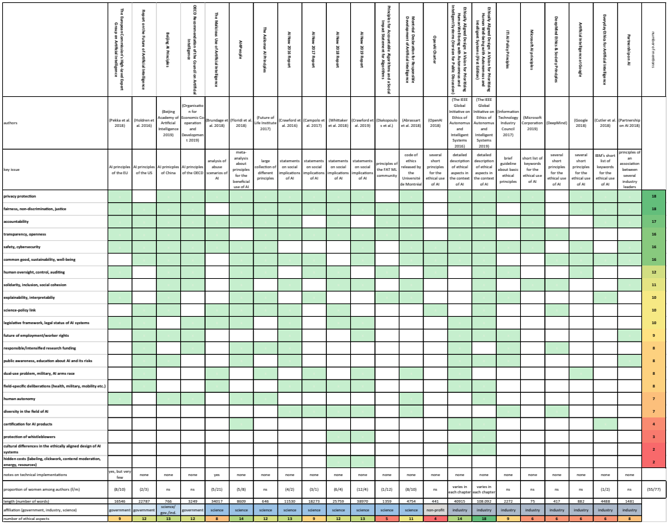
Abstract Current advances in research, development and application of artificial intelligence (AI) systems have yielded a far-reaching discourse on AI ethics. In consequence, a number of ethics guidelines have been released in recent years. These guidelines comprise normative principles and recommendations aimed to harness the “disruptive” potentials of new AI technologies. Designed as a semi-systematic evaluation, this paper analyzes and compares 22 guidelines, highlighting overlaps but also omissions. As a result, I give a detailed overview of the field of AI ethics. Finally, I also examine to what extent the respective ethical principles and values are implemented in the practice of research, development and application of AI systems—and how the effectiveness in the demands of AI ethics can be improved.
Verified 2026-11-25 · 3 references not checked yet
Overview
CoChat Summary
## TL;DR
This paper semi-systematically reviews 22 AI ethics guidelines, finding strong overlap on a few technicalizable topics but many important omissions. It argues that AI ethics is often ineffective in practice and should be supplemented by more concrete technical guidance and a shift toward virtue ethics.
## Key findings
- The paper analyzes and compares 22 AI ethics guidelines and finds that accountability, privacy, and fairness appear in about 80% of them, making them the closest thing to a common minimum standard.
- The author reports that guidelines from industrial contexts name on average 9.1 distinct ethical aspects, while science-based ethics codes average 10.8.
- Only two guidelines contain genuinely technical explanations, and these are described as very sparse; the most extensive technical commentary is in “The Malicious Use of AI”.
- The paper says a controlled study found the effectiveness of ethics guidelines or codes to be “almost zero”: among 63 software engineering students and 105 professional software developers, there was no statistically significant difference in responses between those who did and did not see the ACM code of ethics.
- The paper highlights major omissions across guidelines, including political abuse of AI, hidden social and ecological costs, lack of diversity, robot ethics, trolley problems, and public-private partnerships/industry-funded research.
## Methods
- Semi-systematic literature analysis of AI ethics guidelines, with a deliberate focus on comprehensive guideline documents rather than all AI-ethics-related writings.
- The final sample consisted of 22 major ethical guidelines, identified through searches in Google, Google Scholar, Web of Science, ACM Digital Library, arXiv, and SSRN, plus manual reference screening and the Algorithm Watch AI Ethics Guidelines Global Inventory.
- The paper compares which ethical issues are present or absent in the guidelines, and then relates those principles to practice using cited empirical studies and examples from AI development and deployment.
## Limitations
- The author states the sample is biased toward western/northern documents and excludes guidelines not written in English.
- The selection deliberately excludes guidelines focused on robot ethics, big data, algorithms, or robotics, so omissions in those areas are partly a result of the sampling method.
- The paper notes that its list of omissions is non-exhaustive.
- Evident from the text: the paper is primarily a theoretical/semi-systematic overview, not a direct empirical test of all AI ethics guideline implementations.
Model-written summary. Check it against the paper before relying on it.
Integrity signals
Registry
Cites
Statistics
Figures
Verification
Claims the paper makes
5 Valid · 3 Not valid · 62 Not checked · 64 Own results and interpretations
The cited sources support only part of this claim — read each source’s verdict below.
In the paper
“So far, some papers have been published on the subject of teaching ethics to data scientists (Garzcarek and Steuer 2019; Burton etal. 2017; Goldsmith and Burton 2017; Johnson 2017) but by and large very little to nothing has been written about the tangible implementation of ethical goals and values.”
What the sources say
- Supportedcites Garzcarek and Steuer 2019 matched to “Approaching Ethical Guidelines for Data Scientists” (2019) source
The citation is attached to the statement that papers have discussed teaching ethics to data scientists, not to the citing authors’ subsequent assessment of writing on tangible implementation. Section 5.2 (p. 14) explicitly argues that ethics should be part of the data-science curriculum. (LLM, conf=0.90)
- Not matchedcites Burton etal. 2017
An author–year citation the paper’s reference list doesn’t settle. We don’t search these by name.
- Supportedcites Goldsmith and Burton 2017 matched to “Why Teaching Ethics to AI Practitioners Is Important” (2017) source
The citation appears in a list of papers about teaching ethics to data scientists, not as support for the sentence’s later claim about how little has been written on implementation. The Introduction (p. 1) presents the paper as an argument for ethical training for AI students and practitioners, and the Conclusions (p. 4) advocate teaching ethics in AI classes. (LLM, conf=0.91)
plain- Asserted: passes — The authors put it forward as true.
- Checkable: passes — It can be checked against evidence.
- Load-bearing: passes — The paper’s conclusions depend on it.
- Based: passes — The paper gives a reason why it holds.
- Supported
The cited sources support only part of this claim — read each source’s verdict below.
In the paper
“Leading, of course, is the military use of AI in cyber warfare or regarding weaponized unmanned vehicles or drones (Ernest and Carroll 2016; Anderson and Waxman 2013).”
What the sources say
- Partly supportedcites Ernest and Carroll 2016 matched to “Genetic Fuzzy based Artificial Intelligence for Unmanned Combat Aerial Vehicle Control in Simulated Air Combat Missions” (2016) sourceExperimental — accuracy not yet measured
Our copy does support the drone half of the claim as an identification citation: the paper is squarely about applying AI to a weaponized unmanned vehicle (Introduction: UCAV research, 'this white paper will primarily focus on the increase in capabilities of real-time decision making'; Problem Statement: ALPHA controlling aircraft motion and firing in AFSIM). But it does not support the claim's core assertion that military AI is a leading area of unwanted side effects and malevolent use — the nearest passage (Introduction, 'There are a number of obstacles to a system being an effective AI within this context') frames the issues as engineering and verification difficulties (adversaries trying to 'fool and exploit the system', V&V, safety specifications, crashes/sensor failures), and the Results and Conclusions treat autonomy as 'a revolutionary leap in capability of airpower' and a way of 'reducing risk to our pilots'. Cyber appears only once, as an unrelated civilian/defence application domain of the GFT method ('Examples include robotic surgery, design automation, and cyber security'), not as cyber warfare, so that element of the claim is not from this source. (LLM, conf=0.72)
- Not checked — no full text of the sourcecites Anderson and Waxman 2013 matched to “Law and Ethics for Autonomous Weapon Systems: Why a Ban Won't Work and How the Laws of War Can” (2013) source
boostedstates an association- Asserted: passes — The authors put it forward as true.
- Checkable: passes — It can be checked against evidence.
- Load-bearing: unclear — It is unclear whether the paper’s conclusions depend on it.
- Based: passes — The paper gives a reason why it holds.
- Partly supported
The cited sources support only part of this claim — read each source’s verdict below.
In the paper
“In the light of these two approaches, the traditional type of AI ethics can be assigned to the deontological concept (Mittelstadt 2019).”
What the sources say
- Partly supportedcites Mittelstadt 2019 matched to “Principles alone cannot guarantee ethical AI” (2019) sourceExperimental — accuracy not yet measured
The paper describes a prominent, principle-based approach to AI ethics and says AI ethics initiatives have converged around principles resembling those of medical ethics (opening section; page unavailable). It does not classify that approach as deontological, so the claimed assignment to the deontological concept is not supported by our copy. (LLM, conf=0.78)
plainstates an association- Asserted: passes — The authors put it forward as true.
- Checkable: passes — It can be checked against evidence.
- Load-bearing: passes — The paper’s conclusions depend on it.
- Based: passes — The paper gives a reason why it holds.
- Partly supported
A result the paper reports from its own data — it cites no other source for it, so there is none to check. The quote shows it is in the paper.
In the paper
“My analysis of the distribution of female and male authors of the guidelines, as far as authors were indicated in the documents, showed that the proportion of women was 41.7%.”
plain- Asserted: passes — The authors put it forward as true.
- Checkable: passes — It can be checked against evidence.
- Load-bearing: passes — The paper’s conclusions depend on it.
- Based: passes — The paper gives a reason why it holds.
A result the paper reports from its own data — it cites no other source for it, so there is none to check. The quote shows it is in the paper.
In the paper
“Finally, yet importantly, it is noteworthy that almost all guidelines suggest that technical solutions exist for many of the problems described.”
hedged- Asserted: passes — The authors put it forward as true.
- Checkable: passes — It can be checked against evidence.
- Load-bearing: unclear — It is unclear whether the paper’s conclusions depend on it.
- Based: passes — The paper gives a reason why it holds.
54 more claims
Create a free account to see all 134 claims and to verify the 1 reference still open.
- Probably not a substantial claim. 59
- It may state two separate claims as one. 29
Claims other papers make about this one
Each is checked against this paper’s own text: does it say what the citing paper says it does?
The source backs part of the claim, not all of it — or backs it for a different population, condition or comparison.
In the citing paper
“Ethical concerns arising from the design and deployment of AI technology have motivated a number of initiatives [47]—such as the Ethical Guidelines for Trustworthy AI by the European Commission expert group on AI, and Microsoft’s FATE: Fairness, Accountability, Transparency, and Ethics in AI—addressing issues including mitigating bias and discrimination in AI systems and fairness in the use of AI”
From Future directions for chatbot research: An interdisciplinary research agenda (2021) · cites this paper as [47]
Experimental — accuracy not yet measuredThe source backs part of the claim, not all of it — or backs it for a different population, condition or comparison.
In the citing paper
“Additional recommendations on AI ethics teaching content include “explainability,” “liability,” and “accountability,” which are also considered important by available guidelines [30,40].”
From Proposing a Principle-Based Approach for Teaching AI Ethics in Medical Education (2024) · cites this paper as [30]
Experimental — accuracy not yet measuredThe source backs part of the claim, not all of it — or backs it for a different population, condition or comparison.
In the citing paper
“This emphasis is also echoed by existing guidelines and frameworks regarding AI ethics [30].”
From Proposing a Principle-Based Approach for Teaching AI Ethics in Medical Education (2024) · cites this paper as [30]
Experimental — accuracy not yet measuredThe source backs part of the claim, not all of it — or backs it for a different population, condition or comparison.
In the citing paper
“En dépit de nombreuses chartes, discussions et nombreux documents sur les bonnes pratiques éthiques, l’espoir est faible que l’IA puisse éventuellement se montrer généralement conforme (Hagendorff, 2020) :”
From Gouvernance algorithmique, intelligence artificielle, enjeux, éthique : esquisse d’une analyse critique (2021) · cites this paper as Hagendorff, 2020
Experimental — accuracy not yet measuredThe source backs part of the claim, not all of it — or backs it for a different population, condition or comparison.
In the citing paper
“The experience of mixed emotional responses and ethnical navigation was supported by literature (Hagendorff, 2020;Mamo et al., 2024;Mittelstadt, 2019).”
From Into the Unknown: AI Adoption and Job Satisfaction of Christian Faculty (2026) · cites this paper as Hagendorff, 2020
Experimental — accuracy not yet measured
13 more claims about this paper
Create a free account to see every claim other papers make about this one.
Citations
Cites
The spread of true and false news online
Vosoughi, S., Roy, D., & Aral, S. (2018) · Science · doi:10.1126/science.aap9559 · Cited by 8,847
The future of employment: How susceptible are jobs to computerisation?
Frey, C. B., & Osborne, M. A. (2017) · Technological Forecasting and Social Change · doi:10.1016/j.techfore.2016.08.019 · Cited by 8,727
The global landscape of AI ethics guidelines
Jobin, A., Ienca, M., & Vayena, E. (2019) · Nature Machine Intelligence · doi:10.1038/s42256-019-0088-2 · Cited by 6,220
Floridi, L., Cowls, J., Beltrametti, M., Chatila, R., Chazerand, P., Dignum, V., Luetge, C., Madelin, R., Pagallo, U., Rossi, F., et al. (2018) · Minds and Machines · doi:10.1007/s11023-018-9482-5 · Cited by 4,774 · cited 2×
“They include the adoption of legal framework conditions, the establishment of mechanisms for an independent auditing of technologies, the establishment of institutions for complaints, which also compensate for harms caused by AI systems, and the expansion of university curricula in particular through content from ethi…”
Background(2011) · Cited by 4,430
Lazer, D. M. J., Baum, M. A., Benkler, Y., Berinsky, A. J., Greenhill, K. M., Menczer, F., Metzger, M. J., Nyhan, B., Pennycook, G., Rothschild, D., et al. (2018) · Science · doi:10.1126/science.aao2998 · Cited by 4,160
The Black Box Society: The Secret Algorithms That Control Money and Information
Pasquale, F. (2015) · doi:10.4159/harvard.9780674736061 · Cited by 3,796
Experimental evidence of massive-scale emotional contagion through social networks
Kramer, A. D. I., Guillory, J. E., & Hancock, J. T. (2014) · Proceedings of the National Academy of Sciences · doi:10.1073/pnas.1320040111 · Cited by 3,687
(2018) · Cited by 3,510
Private traits and attributes are predictable from digital records of human behavior
Kosinski, M., Stillwell, D., & Graepel, T. (2013) · Proceedings of the National Academy of Sciences · doi:10.1073/pnas.1218772110 · Cited by 2,829
Research works printed but not linked: 24
- Abrassart, C., Bengio, Y., Chicoisne, G., de Marcellis-Warin, N., Dilhac, M.-A., Gambs, S., Gautrais, V., etal. (2018). Montréal declaration for responsible development of artificial intelligence (pp. 1-21).
- Asimov, I. (2004). I, Robot . New York: Random House LLC.
- Bakewell, J. D., Clement-Jones, T. F., Giddens, A., Grender, R. M., Hollick, C. R., Holmes, C., Levene, P. K. etal. (2018). AI in the UK: Ready, willing and able?. Select committee on artificial intelligence (pp. 1-183).
- Baron, B., Musolesi, M. (2017). Interpretable machine learning for privacy-preserving pervasive systems. arXiv (pp. 1-10).
- Bourdieu, P. (1984). Distinction: A social critique of the judgement of taste . Cambridge: Harvard University Press.
- Brahnam, S. (2006). Gendered bots and bot abuse. In Antonella de Angeli, Sheryl Brahnam, Peter Wallis, & Peter Dix (Eds.), Misuse and abuse of interactive technologies (pp. 1-4). Montreal: ACM.
- Derrida, J. (1997). Of grammatology . Baltimore: Johns Hopkins Univ. Press.
- Gebru, T., Morgenstern, J., Vecchione, B., Vaughan, J. W., Wallach, H., Daumeé, III, H., Crawford, K. (2018). Datasheets for datasets. arXiv (pp. 1-17).
- Google. (2019). Perspectives on issues in AI governance (pp. 1-34). Retrieved February 11, 2019. https :// ai.googl e/stati c/docum ents/persp ectiv es-on-issue s-in-ai-gover nance .pdf.
- Helbing, D. (Ed.). (2019). Towards digital enlightment: Essays on the darf and light sides of the digital revolution. Cham: Springer.
- Johnson, D. G. (2017). Can engineering ethics be taught? The Bridge, 47 (1), 59-64.
- Luhmann, N. (1988). Die Wirtschaft der Gesellschaft . Frankfurt A.M: Suhrkamp.
- Morley, J., Floridi, L., Kinsey, L., Elhalal, A. (2019). From what to how. An overview of AI ethics tools, methods and research to translate principles into practices. arXiv (pp. 1-21).
- Organisation for Economic Co-operation and Development. (2019). Recommendation of the Council on Artificial Intelligence (pp. 1-12). Retrieved June 18, 2019. https ://legal instr ument s.oecd.org/en/ instr ument s/OECD-LEGAL -0449.
- Pekka, A.-P., Bauer, W., Bergmann, U., Bieliková, M., Bonefeld-Dahl, C., Bonnet, Y., Bouarfa, L. etal. (2018). The European Commission's high-level expert group on artificial intelligence: Ethics guidelines for trustworthy ai . Working Document for stakeholders' consultation. Brussels (pp. 1-37).
- Pistono, F., Yampolskiy, R. (2016). Unethical research: How to create a malevolent artificial intelligence. arXiv (pp. 1-6).
- Podgaiska, I., Shklovski, I. Nordic engineers’ stand on artificial intelligence and ethics: Policy recommendations and guidelines (pp. 1–40).
- Rawls, J. (1975). Eine Theorie Der Gerechtigkeit . Frankfurt am Main: Suhrkamp.
- Shoham, Y., Perrault, R., Brynjolfsson, E., Clark, J., Manyika, J., Niebles, J. C., Lyons, T., Etchemendy, J., Grosz, B., Bauer, Z. (2018). The AI index 2018 annual report. Stanford, Kalifornien (pp. 1-94). <!-- image --> 1 3
- Sitawarin, C., Bhagoji, A. N., Mosenia, A., Chiang, M., Mittal, P. (2018). DARTS: Deceiving autonomous cars with toxic signs. arXiv (pp. 1-27).
- Tegmark, A. (2017). Life 3.0: Being human in the age of artificial intelligence . New York: Alfred A. Knopf.
- The IEEE Global Initiative on Ethics of Autonomous and Intelligent Systems. (2016). Ethically aligned design: A vision for prioritizing human well-being with artificial intelligence and autonomous systems (pp. 1-138).
- Whittaker, M., Crawford, K., Dobbe, R., Fried, G., Kaziunas, E., Mathur, V., West, S. M., Richardson, R., Schultz, J., Schwartz, O. (2018). AI now report 2018 (pp. 1-62).
- Zeng, Y., Lu, E., Huangfu, C. (2018). Linking artificial intelligence principles. arXiv (pp. 1-4). Publisher's Note Springer Nature remains neutral with regard to jurisdictional claims in published maps and institutional affiliations. <!-- image --> 1 3
Cited by
Items 1,601–1,700 of 1,821
Navigating the AI Landscape: Ethics, Governance and Responsible AI
Kaurav, R. P. S., & Koul, S. (2026) · Emerald Group Publishing Limited eBooks · doi:10.1108/978-1-83708-888-120261010
Bayuo, B. B., & Goriola, O. O. (2026) · Emerald Group Publishing Limited eBooks · doi:10.1108/978-1-83662-790-620261009
Pantao, J. G., Cahapay, M. B., Ulanday, D. M. P., Pelones, M. T. P., Andang-Alaiden, E., Lañojan, R. S., Sales, A. M., & Bagayas, J. C. (2026) · European Journal of Educational Research · doi:10.12973/eu-jer.15.3.699 · Cited by 3
Impact of AI on Trust in the Media
Kolo, C., Mütterlein, J., & Schmid, S. A. (2026) · Future of business and finance · doi:10.1007/978-3-032-07605-2_8
aiHumanoid v11.9: a large concept model for autonomous ethical reasoning in clinical AI
Danter, W. R. (2026) · AI and Ethics · doi:10.1007/s43681-026-01060-z
Designing Inclusive Hybrid Pedagogies in Physical Science With AI From Classroom to Cloud
Devaki, V., Suresh, C., Vidya, V., & Boopathi, L. (2026) · Advances in computational intelligence and robotics book series · doi:10.4018/979-8-3373-7462-8.ch009 · Cited by 1
gentiletti, M. G. (2022) · theses.fr (ABES) · doi:10.70675/f5c153fbza23fz44e1zafe9z47680aed9e5a · Cited by 3
Learning to Grasp in Robotics with Quality-Diversity Generated Data
Huber, J. B. (2024) · theses.fr (ABES) · doi:10.70675/b98f392dz4df9z4646z8b34z59f447564543
Learning on graphs : from algorithms to socio-technical analyses on AI
Delarue, S. (2025) · theses.fr (ABES) · doi:10.70675/9b959076z9900z480ez90b4z48f18740c846 · Cited by 1
Haidar, A. (2024) · theses.fr (ABES) · doi:10.70675/bee40239z04e9z4bedz9dafz562ce0fcc4c1 · Cited by 2
La preuve en droit des systèmes d'intelligence artificielle
Pons, R. (2024) · theses.fr (ABES) · doi:10.70675/1e108f6ezfa39z422az8706zed4d031bb110
What is the Ecological Value of AI Used for Environmental Purposes and to What Extent is It Ethical?
Moyano-Fernández, C. (2026) · Law, governance and technology series · doi:10.1007/978-3-032-13063-1_15
74923 Ethische Aspekte künstlicher Intelligenz
Remmers, P., Burchardt, A., & Beck, B. (2026) · doi:10.1515/9783111386690-028
Ethical snd Privacy Concerns in AI-Mediated Education: Toward a Human-Centered Pedagogy
ÇİFTCİ, H. (2026) · Advances in computational intelligence and robotics book series · doi:10.4018/979-8-3373-8027-8.ch011
Okoro, Y. O. (2026) · AI & Society · doi:10.1007/s00146-026-03032-7
“Although considerable consensus has emerged around a shared set of AI ethics guidelines and principles (Floridi and Cowls 2022), the capacity of such frameworks to meaningfully influence the ethical development of AI in practice has faced substantial criticism (Hagendorff 2020).”
Ethical AI in healthcare: insights from European policy discourses
Iannuzzi, E., Curiello, S., & Nigro, C. (2026) · BMC Medical Ethics · doi:10.1186/s12910-026-01403-9
“…in this regard, as it focuses on key dimensions such as: – Institutional Entrepreneurship : this dimension examines the role of IEs in influencing and reshaping 4 institutional contexts, including their use of institutional strategies to navigate and shape the regulatory landscape [11, 27].”
Artificial Intelligence Ethics in Digital Citizenship Education
Sırvermez, U., Baltaci-Goktalay, S., & ONAN, B. C. (2026) · IGI Global eBooks · doi:10.4018/979-8-3373-6566-4.ch008 · Cited by 2
Witczak, O., Dewalska–Opitek, A., & Szejniuk, A. (2026) · Journal of Modern Science · doi:10.13166/jms/218202 · Cited by 1
“…mogą oni zadecydować, czy SI stanie się narzędziem inkluzywnego wzrostu i zrównoważonego rozwoju, poprawiając dostęp do edukacji, zdrowia i rynku pracy, czy też będzie źródłem zagrożeń społecznych, takich jak dezinformacja, algorytmiczne uprzedzenia i pogłębianie nierówności (Hagendorff, 2020).”
Advancing sustainable construction: a trust-enhanced model of AI adoption and actual usePreprint
Regona, M., Yiğitcanlar, T., Hon, C. K. H., & Teo, M. M. (2026) · SSRN Electronic Journal · doi:10.2139/ssrn.6614001
Fukuda, Y., & Fukuda, K. (2026) · Digital Health · doi:10.1177/20552076261444907
Alwali, A. (2026) · Journal of Information Communication and Ethics in Society · doi:10.1108/jices-12-2025-0393 · Cited by 2
A Deep Learning Model for Textual Content Moderation Across Social Platforms Using LSTM and BERT
Adnan, M., Bismil, K., Imran, M., & Jamal, T. (2026) · Advances in computational intelligence and robotics book series · doi:10.4018/407629
Governing the Agentic Enterprise Guardrails for Autonomous AI Agents in B2BPreprint
Alam, S. M. K. (2026) · SSRN Electronic Journal · doi:10.2139/ssrn.6626059
Han, S., & Peters, M. A. (2026) · Springer eBooks · doi:10.1007/60490_2026_11
Ethical and social dynamics in artificial intelligence and society: A bibliometric study
Игоревна, Т. Л., Gorshkova, K. L., Kolomiets, O. M., Карева, Е. Н., Zaitseva, N. A., Sokolova, E. G., & Коробкова, О. К. (2026) · Online Journal of Communication and Media Technologies · doi:10.30935/ojcmt/18475 · Cited by 1
Ethical and legal consideration associated with AI use
Priyadarshini, A., Dahiya, D., Baby, Rani, R., & Choudhary, R. (2026) · Elsevier eBooks · doi:10.1016/b978-0-443-34423-7.00009-2
Be warned: what counts as ethics is reformatted when ethical programmes are digitized
Laflamme, D. (2026) · Information Technology and People · doi:10.1108/itp-12-2025-1940
Agency by Design: A Value Sensitive Model for Educational AI
Sharma, V. C., & Babber, K. (2026) · IGI Global eBooks · doi:10.4018/979-8-3373-7102-3.ch003
Crespo, R. F. (2026) · Springer eBooks · doi:10.1007/978-3-032-18462-7_9
Inala, R., Sheelam, G. K., Aitha, A. R., Lakshmi, A. U., Nagabhyru, K. C., & Segireddy, A. R. (2026) · IEEE International Conference on AI Engineering and Innovations (AIEI) · doi:10.1109/aiei69164.2026.11497971 · Cited by 3
Artificial Images and Imaginary of Care
Neri, V. (2026) · Springer eBooks · doi:10.1007/978-3-032-15112-4_28
Just AI Systems and the European Union’s AI Act
Perušić, L. (2026) · Springer eBooks · doi:10.1007/978-3-032-15112-4_13
Ethical AI and Responsible AI Practices in Business
Jagtap, P., Ghadage, T., & Nayakal, P. (2026) · Lecture notes in networks and systems · doi:10.1007/978-3-032-19672-9_25
Responsible Black Boxes: How Virtue Ethics Can Bridge the Responsibility Gap in AI
Hällström, H. J., & Gouveia, S. S. (2026) · Springer eBooks · doi:10.1007/978-3-032-15112-4_22
Keane, T., Wang, T., & Cerovac, M. (2026) · Springer eBooks · doi:10.1007/978-3-032-12174-5_27
Agentic AI Risk Governance: A Policy-Driven Regulatory Framework
Mahmud, M., Tariq, Z., Saeed, T., & Bashar, A. (2026) · IEEE International Conference on Communication Systems and Network Technologies (CSNT) · doi:10.1109/csnt69054.2026.11502302
“These consequences include biased financial scoring [4], explainability failures in clinical diagnostics [5], and unsafe decision making in autonomous vehicles [6].”
InfluentialGuidelines for Safe and Robust Reinforcement Learning: From Definitions to Design
Yamagata, T., & Santos‐Rodríguez, R. (2026) · Communications in computer and information science · doi:10.1007/978-3-032-19099-4_40
Asamoah, E. S., Doku, S. T. G., Koomson, S., Osae, E. M., & Mickson, M. K. (2026) · International Journal of Ethics and Systems · doi:10.1108/ijoes-04-2026-0246
Liu, Q. (2026) · International Journal of Digital Law and Governance · doi:10.1515/ijdlg-2025-0021
From evaluator to principal: the agentic AI literacy framework (AALF) for delegated autonomy
Nama, R. (2026) · AI and Ethics · doi:10.1007/s43681-026-01167-3 · Cited by 3
From Principles to Practices: Implementing AI Responsibly for Social and Sustainable Impact
Blasco‐Arcas, L., & Lee, H.-H. M. (2026) · Springer eBooks · doi:10.1007/978-3-031-75316-9_42-1
Ethical AI Standards and Governance: A Perspective of Human-Centered AI
Kim, E. E. (2026) · Springer eBooks · doi:10.1007/978-981-95-3658-0_61
Land Use and Land Allocation in Nigeria: The Role of Artificial Intelligence (AI)
Utebor, E. (2026) · Contributions to environmental sciences & innovative business technology · doi:10.1007/978-981-95-8473-4_8
Comparing AI Ethics and AI Regulation: Ethical Values and Principles and the Case of Well-being
Martin, D., Schmidt, M. W., & Hillerbrand, R. (2026) · Synthese Library/Synthese library · doi:10.1007/978-3-032-10073-3_21 · Cited by 2
Enabling Diversity and Gender Equity in Human-Centered AI
Anderson, T. D., & Marshall, R. (2026) · Springer eBooks · doi:10.1007/978-981-95-3658-0_104
Worldwide AI Ethics, Principles, and Blank Spots
Corrêa, N. K. (2026) · The International library of ethics, law and technology · doi:10.1007/978-3-032-22150-6_1
121Chapter 3 Why AI requires better regulation: Ten compelling arguments
(2026) · De Gruyter eBooks · doi:10.1515/9783112245958-004
Regional cognitive pathways to intention to use AI: a structural equation modeling approach
Jang, Y., Jeong, T. G., & Suh, T. (2026) · Frontiers in Psychology · doi:10.3389/fpsyg.2026.1758998
“…advancement paradigm shifts (Feuerriegel et al., 2024) and technology is recognized as a significant factor influencing social norms, discussions have increasingly focused on not only on the positive effects of technology but also on its social impact and responsibility (Hagendorff, 2020).”
Human-Centered Intelligent Manufacturing
Wang, B., Song, C., Bai, J., Xie, H., & Yang, H. (2026) · Springer eBooks · doi:10.1007/978-981-95-5585-7_27 · Cited by 2
Stracke, C. M. (2026) · AI and Ethics · doi:10.1007/s43681-026-01092-5 · Cited by 3
“First reflections are already discussing the ethics of ethical AI as analysis how ethical principles and values are implemented in ethical AI policies and guidelines and how their effectiveness can be improved [ 51 ].”
Bridging the silos in affective AI: a critical perspective from data to society
Inoshita, K. (2026) · AI & Society · doi:10.1007/s00146-026-03324-y · Cited by 5
Alhuwaydi, A. M. (2026) · Journal of Clinical Medicine · doi:10.3390/jcm15113993 · Cited by 1
“Other studies may have had the advantage of using AI as a background analysis signal (such as response stratification or stimulus modification), but this does not imply that the intervention should be treated as a free therapeutic agent [53,54].”
Jorge, M. O. Q. (2026) · ACM Web Science Conference (WebSci) · doi:10.1145/3795513.3807423
“Another concern is that AI ethics may serve a strategic purpose of avoiding legal regulation while maintaining legitimacy [8, 14– 16 , In response, scholars propose a shift from abstract principles to actionable governance.”
A Semester with Generative AI Tools: University Students Lived Experiences and Insights
Jack, L., Cho, M.-H., Major, A. D. C., & Peruta, A. (2026) · TechTrends · doi:10.1007/s11528-026-01191-4 · Cited by 1
“…(Gander & Harris, 2024; Johnson et al., 2024), promotion of crucial understanding of AI concepts for higher education students (Kong et al., 2021), and ultimately preparing college students, both technically and ethically, for a working environment that has embraced AI tools (Hagendorff, 2020).”
Sharma, A. K., & Kunkel, J. M. (2026) · IEEE Annual Computers, Software, and Applications Conference (COMPSAC) · doi:10.1109/compsac69091.2026.00379
“What was once a field of voluntary guidelines [3], [4] is becoming a landscape of enforceable, operational obligations.”
Vemula, S. (2026) · Artificial intelligence · doi:10.5772/intechopen.1015310
The transparency pitfall for AI regulation
Sass, R. (2026) · AI & Society · doi:10.1007/s00146-026-03128-0
“In some cases, this may be an attempt to preempt more disruptive scrutiny that could impose meaningful constraints on “business” decisions (Metcalf et al. 2021; Hagendorff 2020; Attard-Frost et al. 2022).”
Lima, A. (2026) · Premier journal of business and management. · doi:10.70389/pjbm.100014 · Cited by 1
Falcon, G., & Registre, J. F. R. (2026) · SSRN Electronic Journal · doi:10.2139/ssrn.6850329
The Impact of Datafication and the Necessity of Ethical Guidelines for (Big) Data
Franzke, A., & Solzbacher, L. (2026) · Springer eBooks · doi:10.1007/978-3-658-49118-5_13 · Cited by 1
Empirical AI Ethics: Grounded, relational, transformative
Helm, P., & Gerlek, S. (2026) · Cambridge Forum on AI Culture and Society · doi:10.1017/cfc.2026.10023 · Cited by 3
AI Governance in the Data Collection Phase of Building an AI Model
Bennouk, K., Mahouachi, D., Aali, N. A., Idrissi, Y. E. B. E., Sebai, B., & Faroukhi, A. Z. (2026) · IEEE International Conference on Computing and Machine Intelligence (ICMI) · doi:10.1109/icmi68585.2026.11539923
“The author proposes improvement axes related to technical micro-ethics, virtue ethics, and structural changes throughout a technical practices process [16].”
Deliberating the algorithmic future: Reconfiguring AI ethics through citizen juries
Stefanija, A. P., & Heyman, R. (2026) · Cambridge Forum on AI Culture and Society · doi:10.1017/cfc.2026.10026
“The literature does expand on the context or means of production of these guidelines to illustrate how this form of ethics is perfor-mative (Kerr et al. 2020), strategic, and often leads to ethics washing (Green 2021; Hagendorff 2020; Munn 2022).”
Detecting What AI Metrics Miss: A Diagnostic Test for Value-Level Failures
Combe, C. G. (2026) · IEEE Swiss Conference on Data Science (SDS) · doi:10.1109/sds70563.2026.00010
“Hagendorff’s meta-analysis revealed systematic gaps in which considerations AI ethics frameworks render visible [28].”
Impact of AI on Educational Policy and Governance
Patre, K., Kunte, K., Sankathala, S., Vasa, A., & Das, S. (2026) · Advances in computational intelligence and robotics book series · doi:10.4018/979-8-2600-2163-7.ch001
ARTIFICIAL INTELLIGENCE, ETHICS, AND LEGAL ACCOUNTABILITY IN HIGHER EDUCATION INSTITUTIONS
Srivastava, M., Sahoo, G. R., Bhatt, G., Mukherji, J., Singh, J., & Mohapatra, A. (2026) · ShodhKosh Journal of Visual and Performing Arts · doi:10.29121/shodhkosh.v7.i14s.2026.8537 · Cited by 1
Gharib, M. (2026) · Lecture notes in business information processing · doi:10.1007/978-3-032-28274-3_28
Operationalizing Pluralist AI Governance with the Integrated Axiology–MCDA Framework
Sun, F., Isovic, D., & Dodig-Crnković, G. (2026) · Philosophies · doi:10.3390/philosophies11030093 · Cited by 1
“In line with broader critiques of AI ethics guidance, these limitations indicate that lists of principles alone do not constitute a sufficient method for managing the conflicts that arise during real-world deployment [12].”
Methodologies for ethical risk management of digital health interventions: a discussion paper
Bergsjø, L. O., Moltu, C., Schjøtt, J. D., & Norekvål, T. M. (2026) · European Journal of Cardiovascular Nursing · doi:10.1093/eurjcn/zvag107
AI Fundamentals for Educators: A Comprehensive Introduction
Kayyali, M. (2026) · Advances in computational intelligence and robotics book series · doi:10.4018/979-8-3373-1285-9.ch003
Leading the Way: Strategic Leadership and Policy Frameworks for AI Integration in Higher Education
Mazid-Ul-Haque, M., & Emon, M. M. H. (2026) · Advances in computational intelligence and robotics book series · doi:10.4018/979-8-3373-1285-9.ch012
Yan, J., Wu, J., & Wei, X. (2026) · Advances in computational intelligence and robotics book series · doi:10.4018/979-8-3373-6571-8.ch004
AI Ethics in Cybersecurity: Designing for Accountability, Trust, and Human Oversight
Ramachandran, M. (2026) · Texts in computer science · doi:10.1007/978-3-032-25874-8_4
Project Leadership, Management, and Society for AI in Cybersecurity
Ramachandran, M. (2026) · Texts in computer science · doi:10.1007/978-3-032-25874-8_5
SAFE AI: Designing a Gender-Responsive and Child-Safe AI Framework
Rosalinda, H., Liliana, D. Y., & Pallikadavath, S. (2026) · doi:10.1145/3816713.3819509
“The next [11, 15] section discusses previous works on inclusive AI development, especially on gender-responsive and child-safe aspects, followed by the proposed conceptual frameworks section, results, and discussions to interpret the survey results on the design framework.”
Beyond alignment: algorithmic conatus and the spinozist ethics of composition
Yalur, T. T. (2026) · AI and Ethics · doi:10.1007/s43681-026-01195-z
Navigating AI at Work: An Ethics-in-Practice Approach
Tinsman, C., Krishan, A., & Neff, G. (2026) · ACM Conference on Fairness, Accountability, and Transparency (FAccT) · doi:10.1145/3805689.3812382 · Cited by 1
“Critiques of ethical guidelines further point to their ambiguity, limited engagement with power dynamics, and lack of enforceable accountability, raising concerns that such frameworks may enable symbolic compliance rather than substantive change [7, 25, 26, 44].”
BNIM in Participatory AI Design: Centering Minoritized Lived Experiences in Healthcare
Portegies, T. C., Harbers, M., Sileno, G., Willemsen, L. M., & Ghebreab, S. (2026) · ACM Conference on Fairness, Accountability, and Transparency (FAccT) · doi:10.1145/3805689.3812390 · Cited by 1
Mahajan, P. T. (2026) · AI and Ethics · doi:10.1007/s43681-026-01202-3 · Cited by 1
“Significant scholarly and regulatory attention has been directed toward algorithmic bias, technical robustness, explainabil-ity, risk management, compliance mechanisms, and alignment frameworks [ 12 – 15 ].”
Khalifah of the Self: Spiritual Leadership as the First Boundary in an AI-Driven World
Herari, N., Santika, A. A., Hassan, Z. B., Anjani, F. F., & Pratama, M. R. K. (2026) · IGI Global eBooks · doi:10.4018/979-8-3373-8192-3.ch008
Successful implementations of artificial intelligence in healthcare metaverse
Mythry, S. V., Kumar, N. D., Awotunde, J. B., Gupta, S. K., Oruganti, S. K., & Randle, O. (2026) · Elsevier eBooks · doi:10.1016/b978-0-443-27692-7.00020-4
Ética e Inteligência Artificial: explorando indicadores da produção científica
Rocha, E. S. S., Andrade, D. R. D. S., & dos Santos, J. C. F. (2026) · Revista Ibero-Americana de Ciência da Informação · doi:10.26512/rici.v19.n1.2026.57464 · Cited by 1
Tshilemba, D. N., Mickelsson, J., & Nyström, A. (2026) · The Journal of Marketing Theory and Practice · doi:10.1080/10696679.2026.2692436
Dijital Etik: Yapay Zekâ ve Akıllı Sistem İhlalleri Üzerine Değer Temelli Bir Analiz
Aslan, A. (2026) · Düşünce ve Toplum Sosyal Bilimler Dergisi · doi:10.55796/dusuncevetoplum.1955088
Developing an Assessment Tool for AI Guidelines
Pelloth, J., & Zweig, K. A. (2026) · ACM Conference on Fairness, Accountability, and Transparency (FAccT) · doi:10.1145/3805689.3812345
“Ethical AI guidelines exhibit significant differences in their content and scope; reviews by Hagendorff [20] and Jobin et al. [26] demonstrate considerable variation in the topics covered by different frameworks.”
A Review on Artificial Intelligence Enabled Policy and Governance Frameworks for Sustainability
Dixit, Y., Goswami, S., Dangi, S., Khanna, A., Sah, A., & Srivastava, A. (2026) · Springer eBooks · doi:10.1007/978-3-032-28217-0_2
Loughrey, D. G., Brosens, C., Moiselle, R., Shterionov, D., Vandeghinste, V., Way, A., & Leeson, L. M. (2026) · AI and Ethics · doi:10.1007/s43681-026-01230-z · Cited by 3
An Enhancement Alternative to the Principled Approach to AI Ethics
Ye, B. (2026) · Philosophy of engineering and technology · doi:10.1007/978-981-95-8023-1_4 · Cited by 1
Bilge, R., & Sağlamtimur, Z. Ö. (2026) · The Turkish Online Journal of Design Art and Communication · doi:10.7456/tojdac.1933019
Society-oriented AI governance: a parallel layered model and multi-actor coordination framework
Ihsan, A. F., Siadari, T. S., Alamsyah, A., Lhaksmana, K. M., & Jumhur, H. M. (2026) · Frontiers in Artificial Intelligence · doi:10.3389/frai.2026.1872620
“The first two levels are relatively well-developed through OECD, UNESCO, and international standards bodies (Hagendorff, 2020).”
Cleofas, J. V. (2026) · AI & Society · doi:10.1007/s00146-026-03099-2
“Within this intellectual trajectory, AI ethics scholarship has been described as a patchwork of principles across various fora (Ismail & Ahmad 2025; Hagendorff, 2020) and often fails to bridge the gap between articulated guidelines and actionable practice (Cihon et al., 2020; Corrêa et al. 2025).”
Counterfactual Red Teaming and Dialogical Ethics in Distributed Human–Computer Interaction
Martín-Peña, R. E. (2026) · Lecture notes in computer science · doi:10.1007/978-3-032-29583-5_31
Richter, F., & Uhl, M. (2026) · Social Sciences & Humanities Open · doi:10.1016/j.ssaho.2026.103207
Loriga, L. (2026) · Ethics & bioethics · doi:10.2478/ebce-2026-0014
LLM-Based Classification and Topic Modeling of Generative AI Ethical Risk Discourse on Social Media
Kim, S., Yoon, C., Kim, S. H., & Lee, B. G. (2026) · Electronics · doi:10.3390/electronics15142994
Praharenka, J. (2026) · AI and Ethics · doi:10.1007/s43681-026-01209-w · Cited by 1
Ismail, H. E. M. (2026) · Advances in computational intelligence and robotics book series · doi:10.4018/979-8-3373-9345-2.ch003
Bottoni, G., & Iazzetta, F. (2026) · IGI Global eBooks · doi:10.4018/979-8-3373-8423-8.ch011
Chen, H.-Y., & Chi, Y. (2026) · Computers in Human Behavior Reports · doi:10.1016/j.chbr.2026.101205 · Cited by 1
Metadata
- Authors
- Hagendorff, T.
- Affiliations
- University of Tübingen (DE)
- Corresponding author
- Hagendorff, Thilo
- ORCID
- Hagendorff, Thilo
- Venue
- Minds and Machines
- Published
- 2020-02-01
- Volume
- 30
- Issue
- 1
- Pages
- 99-120
- ISSN
- 0924-6495 (ISSN-L)
- 1572-8641
- OpenAlex
- W3003385079
- Semantic Scholar
- 11159bdb213aaa243916f42f576396d483ba474b
- Cited by
- 1,911
- References
- 86
- Citations by year
- 2026: 370 · 2025: 446 · 2024: 361 · 2023: 290 · 2022: 239 · 2021: 160 · 2020: 41
- FWCI
- 248.38
- Type
- journal article
- Language
- en
- Update notices
- correction (2020-07-28)
- Open access
- hybrid
- doi.org
- Licence
- cc-by
- creativecommons.org/licenses/by/4.0 (tdm)
- creativecommons.org/licenses/by/4.0 (vor)
- Locations
- Minds and Machines (publishedVersion, cc-by)
- arXiv (Cornell University) (submittedVersion)
- arXiv (Cornell University)
- Funders
- Deutsche Forschungsgemeinschaft (390727645)
- Topics
- Physical Sciences › Computer Science › Artificial Intelligence › Ethics and Social Impacts of AI
- Social Sciences › Law › Digitalization, Law, and Regulation
- Social Sciences › Business, Management and Accounting › Organizational Behavior and Human Resource Management › Ethics in Business and Education
- Keywords
- AI ethics, ethics guidelines, normative principles, moral values
About these checks
Registry, retraction, Cites and statistics results are computed, not judged, with one exception: a printed reference that no index lists is read once by a model before it counts as a citation error. Claims are extracted by a model and kept only when their quote appears verbatim in the text; each cited source is then checked, with a model’s help, for whether it says what the claim relies on. Those verdicts can be wrong — read the claim’s quote and the cited source before relying on one.
The claim verdicts this report counts are experimental: their accuracy is not yet measured.
A language model drew the claims from the paper on 2026-10-12, under version 3 of the claim definition (model deepseek-v4.1-flash, prompt extract-v3).
A second model labelled each claim on 2026-10-12 (model jev-1.13-20260917, definition revision gold-guideline-v0.2).
Cited sources are checked with a language model’s help (gpt-6-sol and qwen3.8-omni-flash).
Statistics and arithmetic are recomputed, not judged.
Confidence bands are shown only for fields calibrated on our annotated test set. None is calibrated yet, so no band is shown.
What counts as a claim ›How we measure confidence ›How we check this ›
Are you an author, or do you see a problem with this page? Request a review
Data sources
Bibliographic data: Semantic Scholar, OpenAlex, Crossref.
Contains information from the Semantic Scholar Academic Graph Datasets, made available under the ODC Attribution License (ODC-BY 1.0).
Semantic Scholar’s data is described in: Kinney, R., et al. (2023). The Semantic Scholar Open Data Platform. arXiv:2301.10140.
