

The Ethics of AI Ethics: An Evaluation of Guidelines
Open accessThe DOI matches its Crossref record; 95 of the 100 references it cites were found in a registry or an index, and 5 are not checked yet; 6 of the 88 sources its claims cite were checked for support.
Abstract
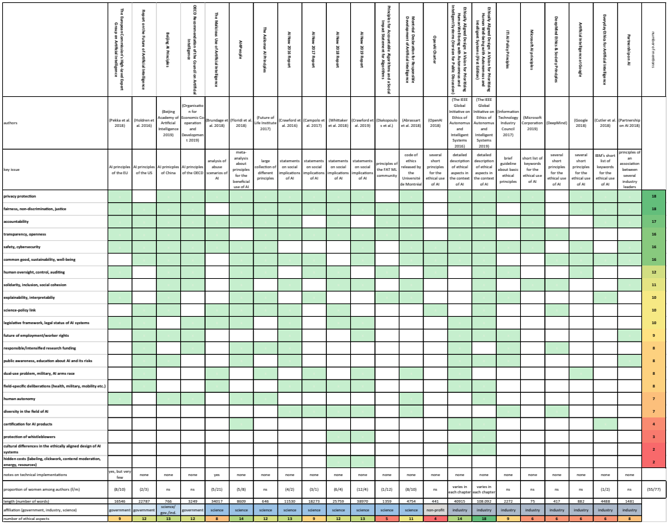
Abstract Current advances in research, development and application of artificial intelligence (AI) systems have yielded a far-reaching discourse on AI ethics. In consequence, a number of ethics guidelines have been released in recent years. These guidelines comprise normative principles and recommendations aimed to harness the “disruptive” potentials of new AI technologies. Designed as a semi-systematic evaluation, this paper analyzes and compares 22 guidelines, highlighting overlaps but also omissions. As a result, I give a detailed overview of the field of AI ethics. Finally, I also examine to what extent the respective ethical principles and values are implemented in the practice of research, development and application of AI systems—and how the effectiveness in the demands of AI ethics can be improved.
Verified 2026-11-22 · 5 references not checked yet
Overview
CoChat Summary
## TL;DR
This paper semi-systematically reviews 22 AI ethics guidelines, finding strong overlap on a few technicalizable topics but many important omissions. It argues that AI ethics is often ineffective in practice and should be supplemented by more concrete technical guidance and a shift toward virtue ethics.
## Key findings
- The paper analyzes and compares 22 AI ethics guidelines and finds that accountability, privacy, and fairness appear in about 80% of them, making them the closest thing to a common minimum standard.
- The author reports that guidelines from industrial contexts name on average 9.1 distinct ethical aspects, while science-based ethics codes average 10.8.
- Only two guidelines contain genuinely technical explanations, and these are described as very sparse; the most extensive technical commentary is in “The Malicious Use of AI”.
- The paper says a controlled study found the effectiveness of ethics guidelines or codes to be “almost zero”: among 63 software engineering students and 105 professional software developers, there was no statistically significant difference in responses between those who did and did not see the ACM code of ethics.
- The paper highlights major omissions across guidelines, including political abuse of AI, hidden social and ecological costs, lack of diversity, robot ethics, trolley problems, and public-private partnerships/industry-funded research.
## Methods
- Semi-systematic literature analysis of AI ethics guidelines, with a deliberate focus on comprehensive guideline documents rather than all AI-ethics-related writings.
- The final sample consisted of 22 major ethical guidelines, identified through searches in Google, Google Scholar, Web of Science, ACM Digital Library, arXiv, and SSRN, plus manual reference screening and the Algorithm Watch AI Ethics Guidelines Global Inventory.
- The paper compares which ethical issues are present or absent in the guidelines, and then relates those principles to practice using cited empirical studies and examples from AI development and deployment.
## Limitations
- The author states the sample is biased toward western/northern documents and excludes guidelines not written in English.
- The selection deliberately excludes guidelines focused on robot ethics, big data, algorithms, or robotics, so omissions in those areas are partly a result of the sampling method.
- The paper notes that its list of omissions is non-exhaustive.
- Evident from the text: the paper is primarily a theoretical/semi-systematic overview, not a direct empirical test of all AI ethics guideline implementations.
Model-written summary. Check it against the paper before relying on it.
Integrity signals
Registry
Cites
Statistics
Figures
Verification
Claims the paper makes
5 Valid · 3 Not valid · 62 Not checked · 64 Own results and interpretations
The cited sources support only part of this claim — read each source’s verdict below.
In the paper
“So far, some papers have been published on the subject of teaching ethics to data scientists (Garzcarek and Steuer 2019; Burton etal. 2017; Goldsmith and Burton 2017; Johnson 2017) but by and large very little to nothing has been written about the tangible implementation of ethical goals and values.”
What the sources say
- Supportedcites Garzcarek and Steuer 2019 matched to “Approaching Ethical Guidelines for Data Scientists” (2019) source
The citation is attached to the statement that papers have discussed teaching ethics to data scientists, not to the citing authors’ subsequent assessment of writing on tangible implementation. Section 5.2 (p. 14) explicitly argues that ethics should be part of the data-science curriculum. (LLM, conf=0.90)
- Not matchedcites Burton etal. 2017
An author–year citation the paper’s reference list doesn’t settle. We don’t search these by name.
- Supportedcites Goldsmith and Burton 2017 matched to “Why Teaching Ethics to AI Practitioners Is Important” (2017) source
The citation appears in a list of papers about teaching ethics to data scientists, not as support for the sentence’s later claim about how little has been written on implementation. The Introduction (p. 1) presents the paper as an argument for ethical training for AI students and practitioners, and the Conclusions (p. 4) advocate teaching ethics in AI classes. (LLM, conf=0.91)
plain- Asserted: passes — The authors put it forward as true.
- Checkable: passes — It can be checked against evidence.
- Load-bearing: passes — The paper’s conclusions depend on it.
- Based: passes — The paper gives a reason why it holds.
- Supported
The cited sources support only part of this claim — read each source’s verdict below.
In the paper
“Leading, of course, is the military use of AI in cyber warfare or regarding weaponized unmanned vehicles or drones (Ernest and Carroll 2016; Anderson and Waxman 2013).”
What the sources say
- Partly supportedcites Ernest and Carroll 2016 matched to “Genetic Fuzzy based Artificial Intelligence for Unmanned Combat Aerial Vehicle Control in Simulated Air Combat Missions” (2016) sourceExperimental — accuracy not yet measured
Our copy does support the drone half of the claim as an identification citation: the paper is squarely about applying AI to a weaponized unmanned vehicle (Introduction: UCAV research, 'this white paper will primarily focus on the increase in capabilities of real-time decision making'; Problem Statement: ALPHA controlling aircraft motion and firing in AFSIM). But it does not support the claim's core assertion that military AI is a leading area of unwanted side effects and malevolent use — the nearest passage (Introduction, 'There are a number of obstacles to a system being an effective AI within this context') frames the issues as engineering and verification difficulties (adversaries trying to 'fool and exploit the system', V&V, safety specifications, crashes/sensor failures), and the Results and Conclusions treat autonomy as 'a revolutionary leap in capability of airpower' and a way of 'reducing risk to our pilots'. Cyber appears only once, as an unrelated civilian/defence application domain of the GFT method ('Examples include robotic surgery, design automation, and cyber security'), not as cyber warfare, so that element of the claim is not from this source. (LLM, conf=0.72)
- Not checked — no full text of the sourcecites Anderson and Waxman 2013 matched to “Law and Ethics for Autonomous Weapon Systems: Why a Ban Won't Work and How the Laws of War Can” (2013) source
boostedstates an association- Asserted: passes — The authors put it forward as true.
- Checkable: passes — It can be checked against evidence.
- Load-bearing: unclear — It is unclear whether the paper’s conclusions depend on it.
- Based: passes — The paper gives a reason why it holds.
- Partly supported
The cited sources support only part of this claim — read each source’s verdict below.
In the paper
“In the light of these two approaches, the traditional type of AI ethics can be assigned to the deontological concept (Mittelstadt 2019).”
What the sources say
- Partly supportedcites Mittelstadt 2019 matched to “Principles alone cannot guarantee ethical AI” (2019) sourceExperimental — accuracy not yet measured
The paper describes a prominent, principle-based approach to AI ethics and says AI ethics initiatives have converged around principles resembling those of medical ethics (opening section; page unavailable). It does not classify that approach as deontological, so the claimed assignment to the deontological concept is not supported by our copy. (LLM, conf=0.78)
plainstates an association- Asserted: passes — The authors put it forward as true.
- Checkable: passes — It can be checked against evidence.
- Load-bearing: passes — The paper’s conclusions depend on it.
- Based: passes — The paper gives a reason why it holds.
- Partly supported
A result the paper reports from its own data — it cites no other source for it, so there is none to check. The quote shows it is in the paper.
In the paper
“My analysis of the distribution of female and male authors of the guidelines, as far as authors were indicated in the documents, showed that the proportion of women was 41.7%.”
plain- Asserted: passes — The authors put it forward as true.
- Checkable: passes — It can be checked against evidence.
- Load-bearing: passes — The paper’s conclusions depend on it.
- Based: passes — The paper gives a reason why it holds.
A result the paper reports from its own data — it cites no other source for it, so there is none to check. The quote shows it is in the paper.
In the paper
“Finally, yet importantly, it is noteworthy that almost all guidelines suggest that technical solutions exist for many of the problems described.”
hedged- Asserted: passes — The authors put it forward as true.
- Checkable: passes — It can be checked against evidence.
- Load-bearing: unclear — It is unclear whether the paper’s conclusions depend on it.
- Based: passes — The paper gives a reason why it holds.
54 more claims
Create a free account to see all 134 claims and to verify the 1 reference still open.
- Probably not a substantial claim. 59
- It may state two separate claims as one. 29
Claims other papers make about this one
Each is checked against this paper’s own text: does it say what the citing paper says it does?
The source backs part of the claim, not all of it — or backs it for a different population, condition or comparison.
In the citing paper
“Ethical concerns arising from the design and deployment of AI technology have motivated a number of initiatives [47]—such as the Ethical Guidelines for Trustworthy AI by the European Commission expert group on AI, and Microsoft’s FATE: Fairness, Accountability, Transparency, and Ethics in AI—addressing issues including mitigating bias and discrimination in AI systems and fairness in the use of AI”
From Future directions for chatbot research: An interdisciplinary research agenda (2021) · cites this paper as [47]
Experimental — accuracy not yet measuredThe source backs part of the claim, not all of it — or backs it for a different population, condition or comparison.
In the citing paper
“Additional recommendations on AI ethics teaching content include “explainability,” “liability,” and “accountability,” which are also considered important by available guidelines [30,40].”
From Proposing a Principle-Based Approach for Teaching AI Ethics in Medical Education (2024) · cites this paper as [30]
Experimental — accuracy not yet measuredThe source backs part of the claim, not all of it — or backs it for a different population, condition or comparison.
In the citing paper
“This emphasis is also echoed by existing guidelines and frameworks regarding AI ethics [30].”
From Proposing a Principle-Based Approach for Teaching AI Ethics in Medical Education (2024) · cites this paper as [30]
Experimental — accuracy not yet measuredThe source backs part of the claim, not all of it — or backs it for a different population, condition or comparison.
In the citing paper
“En dépit de nombreuses chartes, discussions et nombreux documents sur les bonnes pratiques éthiques, l’espoir est faible que l’IA puisse éventuellement se montrer généralement conforme (Hagendorff, 2020) :”
From Gouvernance algorithmique, intelligence artificielle, enjeux, éthique : esquisse d’une analyse critique (2021) · cites this paper as Hagendorff, 2020
Experimental — accuracy not yet measuredThe source backs part of the claim, not all of it — or backs it for a different population, condition or comparison.
In the citing paper
“The experience of mixed emotional responses and ethnical navigation was supported by literature (Hagendorff, 2020;Mamo et al., 2024;Mittelstadt, 2019).”
From Into the Unknown: AI Adoption and Job Satisfaction of Christian Faculty (2026) · cites this paper as Hagendorff, 2020
Experimental — accuracy not yet measured
13 more claims about this paper
Create a free account to see every claim other papers make about this one.
Citations
Cites
The spread of true and false news online
Vosoughi, S., Roy, D., & Aral, S. (2018) · Science · doi:10.1126/science.aap9559 · Cited by 8,847
The future of employment: How susceptible are jobs to computerisation?
Frey, C. B., & Osborne, M. A. (2017) · Technological Forecasting and Social Change · doi:10.1016/j.techfore.2016.08.019 · Cited by 8,727
The global landscape of AI ethics guidelines
Jobin, A., Ienca, M., & Vayena, E. (2019) · Nature Machine Intelligence · doi:10.1038/s42256-019-0088-2 · Cited by 6,220
Floridi, L., Cowls, J., Beltrametti, M., Chatila, R., Chazerand, P., Dignum, V., Luetge, C., Madelin, R., Pagallo, U., Rossi, F., et al. (2018) · Minds and Machines · doi:10.1007/s11023-018-9482-5 · Cited by 4,774 · cited 2×
“They include the adoption of legal framework conditions, the establishment of mechanisms for an independent auditing of technologies, the establishment of institutions for complaints, which also compensate for harms caused by AI systems, and the expansion of university curricula in particular through content from ethi…”
Background(2011) · Cited by 4,430
Lazer, D. M. J., Baum, M. A., Benkler, Y., Berinsky, A. J., Greenhill, K. M., Menczer, F., Metzger, M. J., Nyhan, B., Pennycook, G., Rothschild, D., et al. (2018) · Science · doi:10.1126/science.aao2998 · Cited by 4,160
The Black Box Society: The Secret Algorithms That Control Money and Information
Pasquale, F. (2015) · doi:10.4159/harvard.9780674736061 · Cited by 3,796
Experimental evidence of massive-scale emotional contagion through social networks
Kramer, A. D. I., Guillory, J. E., & Hancock, J. T. (2014) · Proceedings of the National Academy of Sciences · doi:10.1073/pnas.1320040111 · Cited by 3,687
(2018) · Cited by 3,510
Private traits and attributes are predictable from digital records of human behavior
Kosinski, M., Stillwell, D., & Graepel, T. (2013) · Proceedings of the National Academy of Sciences · doi:10.1073/pnas.1218772110 · Cited by 2,829
(1984) · Cited by 2,705
(1982) · Works - Scholarship, Research, & Creative Expression (Swarthmore College) · Cited by 2,425
(2016) · Cited by 2,334
Filter Bubbles, Echo Chambers, and Online News Consumption
Flaxman, S., Goel, S., & Rao, J. M. (2016) · Public Opinion Quarterly · doi:10.1093/poq/nfw006 · Cited by 1,992
Superintelligence: paths, dangers, strategies
(2015) · Choice Reviews Online · doi:10.5860/choice.187536 · Cited by 1,979
Principles alone cannot guarantee ethical AI
Mittelstadt, B. (2019) · Nature Machine Intelligence · doi:10.1038/s42256-019-0114-4 · Cited by 1,886 · cited 1×
“In the light of these two approaches, the traditional type of AI ethics can be assigned to the deontological concept (Mittelstadt 2019).”
BackgroundAwad, E., Dsouza, S., Kim, R., Schulz, J., Henrich, J., Shariff, A., Bonnefon, J.-F., & Rahwan, I. (2018) · Nature · doi:10.1038/s41586-018-0637-6 · Cited by 1,859 · cited 2×
“popular trolley problems (Awad et al. 2018) and their alleged relation to ethical questions surrounding selfdriving cars or other autonomous vehicles.”
BackgroundKish-Gephart, J. J., Harrison, D. A., & Treviño, L. K. (2010) · Journal of Applied Psychology · doi:10.1037/a0017103 · Cited by 1,690
Fairness and Abstraction in Sociotechnical Systems
Selbst, A. D., Boyd, D., Friedler, S. A., Venkatasubramanian, S., & Vertesi, J. (2019) · Proceedings of the Conference on Fairness, Accountability, and Transparency · doi:10.1145/3287560.3287598 · Cited by 1,631 · cited 1×
“Many of those endeavors are unified under the FAT ML or XAI community (Veale and Binns 2017; Selbst et al. 2018).”
BackgroundEmotion shapes the diffusion of moralized content in social networks
Brady, W. J., Wills, J. A., Jost, J. T., Tucker, J. A., & Van Bavel, J. J. (2017) · Proceedings of the National Academy of Sciences · doi:10.1073/pnas.1618923114 · Cited by 1,580 · cited 1×
“From echo chamber effects (Pariser 2011) to the use of propaganda bots (Howard and Kollanyi 2016), or the spread of fake-news (Vosoughi, Roy, and Aral 2018), AI always played a key role to the effect of diminishing social cohesion, fostering instead radicalization, the decline of reason in public discourse and social…”
BackgroundPersuasive technology: using computers to change what we think and do
Fogg, B. J. (2002) · Ubiquity · doi:10.1145/764008.763957 · Cited by 1,554
Die Gesellschaft der Gesellschaft
Ward, S., & Luhmann, N. (2000) · The German Quarterly · doi:10.2307/407978 · Cited by 1,514
The Black Box Society: The Secret Algorithms That Control Money and Information
(2016) · Contemporary Sociology: A Journal of Reviews · doi:10.1177/0094306116641409c · Cited by 1,334
Concrete Problems in AI Safety
Amodei, D., Olah, C., Steinhardt, J., Christiano, P., Schulman, J., & Mané, D. (2016) · arXiv · doi:10.48550/arxiv.1606.06565 · Cited by 1,314 · cited 1×
“These occur in various areas (Pistono and Yampolskiy 2016; Amodei et al. 2017).”
Thinking critically about and researching algorithms
Kitchin, R. (2017) · Information, Communication & Society · doi:10.1080/1369118x.2016.1154087 · Cited by 1,186
(2018) · Cited by 1,167
Graham, M., Hjorth, I., & Lehdonvirta, V. (2017) · Transfer: European Review of Labour and Research · doi:10.1177/1024258916687250 · Cited by 1,089
Code/Space: Software and Everyday Life
Kitchin, R., & Dodge, M. (2011) · doi:10.7551/mitpress/9780262042482.001.0001 · Cited by 964
Kosinski, M., Matz, S. C., Gosling, S. D., Popov, V., & Stillwell, D. (2015) · American Psychologist · doi:10.1037/a0039210 · Cited by 925 · cited 1×
“6 personal traits that are actually secret or private via machine learning applications (Kosinski and Wang 2018; Kosinski, Stillwell, and Graepel 2013; Kosinski et al. 2015).”
BackgroundTechnology and the Virtues: A Philosophical Guide to a Future Worth Wanting
Vallor, S. (2016) · doi:10.1093/acprof:oso/9780190498511.001.0001 · Cited by 910
Psychological targeting as an effective approach to digital mass persuasion
Matz, S. C., Kosinski, M., Nave, G., & Stillwell, D. J. (2017) · Proceedings of the National Academy of Sciences · doi:10.1073/pnas.1710966114 · Cited by 892 · cited 1×
“Furthermore, countless companies strive for the opposite of human autonomy, employing more and more subtle techniques for manipulating user behavior via micro targeting, nudging, UX-design and so on (Fogg 2003; Matz et al. 2017).”
MethodThe Malicious Use of Artificial Intelligence: Forecasting, Prevention, and Mitigation
Brundage, M., Avin, S., Clark, J., Toner, H., Eckersley, P., Garfinkel, B., Dafoe, A., Scharre, P., Zeitzoff, T., Filar, B., et al. (2018) · Apollo - University of Cambridge Repository · doi:10.17863/cam.22520 · Cited by 849
Mittelstadt, B., Russell, C., & Wachter, S. (2019) · Proceedings of the Conference on Fairness, Accountability, and Transparency · doi:10.1145/3287560.3287574 · Cited by 794 · cited 1×
“Enormous technical efforts are undertaken to meet ethical targets in the fields of accountability and explainable AI (Mittelstadt et al. 2019), fairness and discrimination aware data mining (Gebru et al.”
Background(2002) · Cited by 770
Wang, Y., & Kosinski, M. (2018) · Journal of Personality and Social Psychology · doi:10.1037/pspa0000098 · Cited by 766
How AI can be a force for good
Taddeo, M., & Floridi, L. (2018) · Science · doi:10.1126/science.aat5991 · Cited by 760 · cited 2×
“This implies that the purposes for which AI systems are developed and applied are not in accordance with societal values or fundamental rights such as beneficence, non-maleficence, justice, and explicability (Taddeo and Floridi 2018; Pekka et al.”
BackgroundFuture Progress in Artificial Intelligence: A Survey of Expert Opinion
Müller, V. C., & Bostrom, N. (2016) · Synthese Library · doi:10.1007/978-3-319-26485-1_33 · Cited by 655 · cited 2×
“the danger of a malevolent AGI or existential threats is not discussed in any of the ethics guidelines, even though this is a thoroughly discussed topic in other contexts (Bostrom 2014; Tegmark 2017; Müller and Bostrom 2016; Omohundro 2014). This may be due to the fact that most of the guidelines are not written by re…”
BackgroundThe cultural work of microwork
Irani, L. (2015) · New Media & Society · doi:10.1177/1461444813511926 · Cited by 568
Veale, M., & Binns, R. (2017) · Big Data & Society · doi:10.1177/2053951717743530 · Cited by 512 · cited 1×
“Many of those endeavors are unified under the FAT ML or XAI community (Veale and Binns 2017; Selbst et al. 2018).”
Veale, M., & Binns, R. (2017) · doi:10.31235/osf.io/ustxg · Cited by 512
Preparing for the future of Artificial Intelligence
Bundy, A. (2017) · AI & SOCIETY · doi:10.1007/s00146-016-0685-0 · Cited by 425
Bots, #StrongerIn, and #Brexit: Computational Propaganda during the UK-EU Referendum
Howard, P., & Kollanyi, B. (2016) · arXiv.org · doi:10.48550/arxiv.1606.06356 · Cited by 400
Toward an Ethics of Algorithms: Convening, Observation, Probability, and Timeliness
Ananny, M. (2016) · Science, Technology, & Human Values · doi:10.1177/0162243915606523 · Cited by 395 · cited 2×
“The technologists or software engineers and their social context are the primary addressees of such an ethics (Ananny 2016), not technology itself.”
BackgroundBots, #Strongerin, and #Brexit: Computational Propaganda During the UK-EU Referendum
Howard, P. N., & Kollanyi, B. (2016) · doi:10.2139/ssrn.2798311 · Cited by 392
Incorporating Ethics into Artificial Intelligence
Etzioni, A., & Etzioni, O. (2017) · The Journal of Ethics · doi:10.1007/s10892-017-9252-2 · Cited by 388
Greene, D., Hoffmann, A. L., & Stark, L. (2019) · Proceedings of the Annual Hawaii International Conference on System Sciences · doi:10.24251/hicss.2019.258 · Cited by 386 · cited 1×
“2018) over meta-studies about AI ethics (Vakkuri and Abrahamsson 2018; Prates et al. 2018; Boddington 2017; Greene et al. 2019; Goldsmith and Burton 2017) or the empirical analysis on how trolley problems are solved (Awad et al.”
BackgroundPicturing Algorithmic Surveillance: The Politics of Facial Recognition Systems
Introna, L., & Wood, D. (2002) · Surveillance & Society · doi:10.24908/ss.v2i2/3.3373 · Cited by 346
Tackling climate change with machine learning
Rolnick, D., Donti, P. L., Kaack, L. H., Kochanski, K., Lacoste, A., Sankaran, K., Ross, A. S., Milojevic-Dupont, N., Jaques, N., Waldman-Brown, A., et al. (2023) · ACM Computing Surveys · doi:10.1145/3485128 · Cited by 336
Gegengifte : die organisierte Unverantwortlichkeit
Beck, U. (1988) · Cited by 328
Perceptions of Ingroup and Outgroup Variability: A Meta-Analytic Integration
Mullen, B., & Hu, L.-T. (1989) · Basic and Applied Social Psychology · doi:10.1207/s15324834basp1003_3 · Cited by 308 · cited 2×
“Constructed outgroups are subject 1 3 to devaluation, are perceived de-individualized and in the worst case can become victims of violence simply because of their status as “others” (Mullen and Hu 1989; Vaes et al.”
BackgroundInfluentialThe IEEE Global Initiative on Ethics of Autonomous and Intelligent Systems
Chatila, R., & Havens, J. C. (2019) · Intelligent Systems, Control and Automation: Science and Engineering · doi:10.1007/978-3-030-12524-0_2 · Cited by 307
Towards a Code of Ethics for Artificial Intelligence
Boddington, P. (2017) · Artificial Intelligence: Foundations, Theory, and Algorithms · doi:10.1007/978-3-319-60648-4 · Cited by 294 · cited 6×
“2018; Boddington 2017; Greene et al.”
BackgroundInfluentialKritik der praktischen Vernunft
Kant, I., Klemme, H. F., & Brandt, H. D. (1961) · Cited by 275
Artificial Intelligence Crime: An Interdisciplinary Analysis of Foreseeable Threats and Solutions
King, T. C., Aggarwal, N., Taddeo, M., & Floridi, L. (2020) · Science and Engineering Ethics · doi:10.1007/s11948-018-00081-0 · Cited by 271 · cited 1×
“All in all, only a very small number of papers is published about the misuse of AI systems, even though they impressively show what massive damage can be done with those systems (Brundage et al. 2018; King et al. 2019; O'Neil 2016).”
BackgroundHursthouse, R. (2001) · doi:10.1093/0199247994.001.0001 · Cited by 252
Does ACM’s code of ethics change ethical decision making in software development?
McNamara, A., Smith, J., & Murphy-Hill, E. (2018) · Proceedings of the 2018 26th ACM Joint Meeting on European Software Engineering Conference and Symposium on the Foundations of Software Engineering · doi:10.1145/3236024.3264833 · Cited by 244
Darling, K. (2016) · Robot Law · doi:10.4337/9781783476732.00017 · Cited by 243
Surveillance as social sorting : Computer codes and mobile bodies
Lyon, D. G. (2005) · doi:10.4324/9780203994887-6 · Cited by 234 · cited 1×
“and disinformation campaigns (Lazer et al. 2018), social control (Engelmann et al. 2019), surveillance (Helbing 2019), face recognition or sentiment analysis (Introna and Wood 2004), social sorting (Lyon 2003), or improved interrogation techniques (McAllister 2017). Notwithstanding the above, companies can cause massi…”
BackgroundDuchi, J. C., Jordan, M. I., & Wainwright, M. J. (2014) · Journal of the ACM · doi:10.1145/2666468 · Cited by 231
Floridi, L. (2016) · SSRN Electronic Journal · doi:10.2139/ssrn.3835211 · Cited by 227 · cited 1×
“This is why researchers such as Floridi argue that every actor who is causally relevant for bringing about the collective consequence or impacts in question, has to be held accountable (Floridi 2016).”
BackgroundAnderson, M. R., & Anderson, S. (2011) · Cited by 212
Building Ethics into Artificial Intelligence
Yu, H., Shen, Z., Miao, C., Leung, C., Lesser, V. R., & Yang, Q. (2018) · Proceedings of the Twenty-Seventh International Joint Conference on Artificial Intelligence · doi:10.24963/ijcai.2018/779 · Cited by 210
Artificial Intelligence Policy: A Primer and Roadmap
Calo, R. (2018) · University of Bologna Law Review · doi:10.6092/issn.2531-6133/8670 · Cited by 197
Artificial Intelligence Policy: A Roadmap
Calo, R. (2017) · SSRN Electronic Journal · doi:10.2139/ssrn.3015350 · Cited by 191 · cited 2×
“…of the emergence of superintelligence is more frequently expressed by people who lack technical experience in the field of AI—one just has to think of people like Stephen Hawking, Elon Musk or Bill Gates—while “real” experts generally regard the idea of a strong AI as rather absurd (Calo 2017, 26).”
BackgroundCrawford, K., & Joler, V. (2019) · Virtual Creativity · doi:10.1386/vcr_00008_7 · Cited by 190
Ernest, N., & Carroll, D. (2016) · Journal of Defense Management · doi:10.4172/2167-0374.1000144 · Cited by 185
Ethical Considerations in Artificial Intelligence Courses
Burton, E., Goldsmith, J., Koenig, S., Kuipers, B., Mattei, N., & Walsh, T. (2017) · AI Magazine · doi:10.1609/aimag.v38i2.2731 · Cited by 172 · cited 1×
“So far, some papers have been published on the subject of teaching ethics to data scientists (Garzcarek and Steuer 2019; Burton et al. 2017; Goldsmith and Burton 2017) but by and large very little to nothing has been written about the tangible implementation of ethical goals and values.”
Background(2008) · Cited by 132
Leonelli, S. (2016) · Philosophical Transactions of the Royal Society A: Mathematical, Physical and Engineering Sciences · doi:10.1098/rsta.2016.0122 · Cited by 131 · cited 2×
“The virtue ethics approach, on the other hand, focuses more on “deeper-lying” structures and situation-specific deliberations, on addressing personality traits and behavioral dispositions on the part of technology developers (Leonelli 2016).”
BackgroundAn AI Race for Strategic Advantage: Rhetoric and Risks
Cave, S., & ÓhÉigeartaigh, S. S. (2018) · Proceedings of the 2018 AAAI/ACM Conference on AI, Ethics, and Society · doi:10.1145/3278721.3278780 · Cited by 124 · cited 2×
“team” with superior AI military technology. In fact, potential risks emerge from the AI race narrative, as well as from an actual competitive race to develop AI systems for technological superiority (Cave and ÓhÉigeartaigh 2018). One risk of this rhetoric is that “impediments” in the form of ethical considerations wil…”
BackgroundDigital Labor Studies Go Global: Toward a Digital Decolonial Turn
Casilli, A. A. (2017) · HAL · Cited by 120
Law and Ethics for Autonomous Weapon Systems: Why a Ban Won't Work and How the Laws of War Can
Anderson, K., & Waxman, M. C. (2013) · doi:10.2139/ssrn.2250126 · Cited by 119 · cited 1×
“reas (Pistono and Yampolskiy 2016; Amodei et al. 2017). Leading, of course, is the military use of AI in cyber warfare or regarding weaponized unmanned vehicles or drones (Ernest and Carroll 2016; K. Anderson and Waxman 2013). According to media reports, the US government alone intends to invest two billion dollars in…”
BackgroundResponsible research with crowds: pay crowdworkers at least minimum wage
Silberman, M. S., Tomlinson, B., LaPlante, R., Ross, J., Irani, L., & Zaldivar, A. (2018) · Communications of the ACM · doi:10.1145/3180492 · Cited by 109 · cited 1×
“Although “clickwork” is a necessary prerequisite for the application of methods of supervised machine learning, it is associated with numerous social problems (Silberman et al. 2018), such as low wages, work conditions and psychological work consequences, which tend to be ignored by the AI community.”
Backgroundde Bruin, B., & Floridi, L. (2016) · Science and Engineering Ethics · doi:10.1007/s11948-016-9759-0 · Cited by 108 · cited 1×
“That means reflecting on the ways data are generated, recorded, curated, processed, disseminated, shared, and used (Bruin and Floridi 2017), on the ways of designing algorithms and code, respectively (Kitchin 2017; Kitchin and Dodge 2011), or on the ways training data sets are selected (Gebru et al.”
MethodEngelmann, S., Chen, M., Fischer, F., Kao, C.-Y., & Grossklags, J. (2019) · Proceedings of the Conference on Fairness, Accountability, and Transparency · doi:10.1145/3287560.3287585 · Cited by 98 · cited 2×
“2018), social control (Engelmann et al. 2019), surveillance (Helbing 2019), face recognition or sentiment analysis (Introna and Wood 2004), social sorting (Lyon 2003), or improved interrogation techniques (McAllister 2017).”
BackgroundAutonomous technology and the greater human good
Omohundro, S. (2014) · Journal of Experimental & Theoretical Artificial Intelligence · doi:10.1080/0952813x.2014.895111 · Cited by 85 · cited 2×
“…as well as associated dangers for humanity or existential threats as a likely scenario (Müller and Bostrom 2016; Bostrom 2014; Tegmark 2017; Omohundro 2014), one could argue that those topics could be discussed in ethics guidelines under the umbrella of potential prohibitions to pursue…”
BackgroundProlegomena to a White Paper on an Ethical Framework for a Good AI Society
Cowls, J., & Floridi, L. (2018) · SSRN Electronic Journal · doi:10.2139/ssrn.3198732 · Cited by 76
Eckersley, P. (2019) · arXiv (Cornell University) · doi:10.48550/arxiv.1901.00064 · Cited by 76
Non-contractual Society: A Feminist View
Held, V. (1987) · Canadian Journal of Philosophy Supplementary Volume · doi:10.1080/00455091.1987.10715932 · Cited by 75
Taming Ourselves or Going Feral? Toward a Nonpatriarchal Metaethic of Animal Liberation
Luke, B. (1995) · Duke University Press eBooks · doi:10.1215/9780822381952-013 · Cited by 63
Why Teaching Ethics to AI Practitioners Is Important
Goldsmith, J., & Burton, E. (2017) · Proceedings of the AAAI Conference on Artificial Intelligence · doi:10.1609/aaai.v31i1.11139 · Cited by 60 · cited 6×
“They include the adoption of legal framework conditions, the establishment of mechanisms for an independent auditing of technologies, the establishment of institutions for complaints, which also compensate for harms caused by AI systems, and the expansion of university curricula in particular through content from ethi…”
BackgroundInfluentialThe synthetization of human voices
Bendel, O. (2017) · AI & Society · doi:10.1007/s00146-017-0748-x · Cited by 60
An Ethical Framework for a Good AI Society: Opportunities, Risks, Principles, and RecommendationsPreprint
Floridi, L., Cowls, J., Beltrametti, M., Chatila, R., Chazerand, P., Dignum, V., Luetge, C., Madelin, R., Pagallo, U., Rossi, F., et al. (2018) · SocArXiv (OSF Preprints) · doi:10.31235/osf.io/2hfsc · Cited by 58
Toward ensuring ethical behavior from autonomous systems: a case-supported principle-based paradigm
Anderson, M., & Anderson, S. (2015) · Industrial robot · doi:10.1108/ir-12-2014-0434 · Cited by 57
ACM code of ethics: a guide for positive action
Gotterbarn, D., Bruckman, A., Flick, C., Miller, K., & Wolf, M. J. (2017) · Communications of the ACM · doi:10.1145/3173016 · Cited by 55
Privacy for All: Ensuring Fair and Equitable Privacy Protections
Ekstrand, M. D., Joshaghani, R., & Mehrpouyan, H. (2018) · Cited by 54
The Key Concepts of Ethics of Artificial Intelligence
Vakkuri, V., & Abrahamsson, P. (2018) · 2018 IEEE International Conference on Engineering, Technology and Innovation (ICE/ITMC) · doi:10.1109/ice.2018.8436265 · Cited by 49 · cited 2×
“2018) over meta-studies about AI ethics (Vakkuri and Abrahamsson 2018; Prates et al. 2018; Boddington 2017; Greene et al. 2019; Goldsmith and Burton 2017) or the empirical analysis on how trolley problems are solved (Awad et al.”
BackgroundEaton, E., Koenig, S., Schulz, C., Maurelli, F., Lee, J., Eckroth, J., Crowley, M., Freedman, R. G., Cardona-Rivera, R. E., Machado, T., et al. (2018) · AI Matters · doi:10.1145/3175502.3175509 · Cited by 46
The hidden faces of automation
Irani, L. (2016) · XRDS: Crossroads, The ACM Magazine for Students · doi:10.1145/3014390 · Cited by 43 · cited 2×
“Issues such as lithium mining, e-waste, the one-way use of rare earth minerals, energy consumption, low-wage “clickworkers” creating labels for data sets or doing content moderation are of relevance here (Crawford and Joler 2018; Irani 2016; Veglis 2014; Fang 2019; Casilli 2017).”
BackgroundModeration Techniques for Social Media Content
Veglis, A. (2014) · Interacción · doi:10.1007/978-3-319-07632-4_13 · Cited by 40 · cited 1×
“Issues such as lithium mining, e-waste, the one-way use of rare earth minerals, energy consumption, low-wage “clickworkers” creating labels for data sets or doing content moderation are of relevance here (Crawford and Joler 2018; Irani 2016; Veglis 2014; Fang 2019; Casilli 2017).”
BackgroundForbidden knowledge in machine learning reflections on the limits of research and publication
Hagendorff, T. (2020) · AI & Society · doi:10.1007/s00146-020-01045-4 · Cited by 36
Self-citationSingla, A. K., Horvitz, E., Kamar, E. S., & White, R. W. (2014) · Proceedings of the AAAI Conference on Artificial Intelligence · doi:10.1609/aaai.v28i1.8734 · Cited by 26
Approaching Ethical Guidelines for Data Scientists
Garzcarek, U., & Steuer, D. (2019) · Studies in Classification, Data Analysis, and Knowledge Organization · doi:10.1007/978-3-030-25147-5_10 · Cited by 21 · cited 1×
“So far, some papers have been published on the subject of teaching ethics to data scientists (Garzcarek and Steuer 2019; Burton et al. 2017; Goldsmith and Burton 2017; Johnson 2017) but by and large very little to nothing has been written about the tangible implementation of ethical goals and values.”
Background(2018) · Cited by 21
McAllister, A. (2017) · Minnesota law review · doi:10.24926/265535.1080 · Cited by 20 · cited 1×
“2019), surveillance (Helbing 2019), face recognition or sentiment analysis (Introna and Wood 2004), social sorting (Lyon 2003), or improved interrogation techniques (McAllister 2017).”
BackgroundPrates, M., Avelar, P., & Lamb, L. C. (2018) · EPiC series in computing · doi:10.29007/74gj · Cited by 17
Embracing Humanity in the Face of Death: Why Do Existential Concerns Moderate Ingroup Humanization?
Vaes, J., Bain, P. G., & Bastian, B. B. (2014) · The Journal of Social Psychology · doi:10.1080/00224545.2014.953027 · Cited by 9 · cited 1×
“1 3 to devaluation, are perceived de-individualized and in the worst case can become victims of violence simply because of their status as “others” (Mullen and Hu 1989; Vaes et al. 2014).”
BackgroundLyons, S. (2018) · Springer eBooks · doi:10.1007/978-981-13-0335-7 · Cited by 5 · cited 1×
“it (Lyons 2018), as this topic is also omitted from all examined ethical guidelines.”
BackgroundWirksamkeitssteigerungen gesellschaftskritischer Diskurse
Hagendorff, T. (2016) · Soziale Probleme · doi:10.1007/s41059-016-0013-4 · Cited by 2 · cited 1×
“Ethical intervention in those systems is only possible to a very limited extent (Hagendorff 2016).”
BackgroundSelf-citation
Research works printed but not linked: 24
- Abrassart, C., Bengio, Y., Chicoisne, G., de Marcellis-Warin, N., Dilhac, M.-A., Gambs, S., Gautrais, V., etal. (2018). Montréal declaration for responsible development of artificial intelligence (pp. 1-21).
- Asimov, I. (2004). I, Robot . New York: Random House LLC.
- Bakewell, J. D., Clement-Jones, T. F., Giddens, A., Grender, R. M., Hollick, C. R., Holmes, C., Levene, P. K. etal. (2018). AI in the UK: Ready, willing and able?. Select committee on artificial intelligence (pp. 1-183).
- Baron, B., Musolesi, M. (2017). Interpretable machine learning for privacy-preserving pervasive systems. arXiv (pp. 1-10).
- Bourdieu, P. (1984). Distinction: A social critique of the judgement of taste . Cambridge: Harvard University Press.
- Brahnam, S. (2006). Gendered bots and bot abuse. In Antonella de Angeli, Sheryl Brahnam, Peter Wallis, & Peter Dix (Eds.), Misuse and abuse of interactive technologies (pp. 1-4). Montreal: ACM.
- Derrida, J. (1997). Of grammatology . Baltimore: Johns Hopkins Univ. Press.
- Gebru, T., Morgenstern, J., Vecchione, B., Vaughan, J. W., Wallach, H., Daumeé, III, H., Crawford, K. (2018). Datasheets for datasets. arXiv (pp. 1-17).
- Google. (2019). Perspectives on issues in AI governance (pp. 1-34). Retrieved February 11, 2019. https :// ai.googl e/stati c/docum ents/persp ectiv es-on-issue s-in-ai-gover nance .pdf.
- Helbing, D. (Ed.). (2019). Towards digital enlightment: Essays on the darf and light sides of the digital revolution. Cham: Springer.
- Johnson, D. G. (2017). Can engineering ethics be taught? The Bridge, 47 (1), 59-64.
- Luhmann, N. (1988). Die Wirtschaft der Gesellschaft . Frankfurt A.M: Suhrkamp.
- Morley, J., Floridi, L., Kinsey, L., Elhalal, A. (2019). From what to how. An overview of AI ethics tools, methods and research to translate principles into practices. arXiv (pp. 1-21).
- Organisation for Economic Co-operation and Development. (2019). Recommendation of the Council on Artificial Intelligence (pp. 1-12). Retrieved June 18, 2019. https ://legal instr ument s.oecd.org/en/ instr ument s/OECD-LEGAL -0449.
- Pekka, A.-P., Bauer, W., Bergmann, U., Bieliková, M., Bonefeld-Dahl, C., Bonnet, Y., Bouarfa, L. etal. (2018). The European Commission's high-level expert group on artificial intelligence: Ethics guidelines for trustworthy ai . Working Document for stakeholders' consultation. Brussels (pp. 1-37).
- Pistono, F., Yampolskiy, R. (2016). Unethical research: How to create a malevolent artificial intelligence. arXiv (pp. 1-6).
- Podgaiska, I., Shklovski, I. Nordic engineers’ stand on artificial intelligence and ethics: Policy recommendations and guidelines (pp. 1–40).
- Rawls, J. (1975). Eine Theorie Der Gerechtigkeit . Frankfurt am Main: Suhrkamp.
- Shoham, Y., Perrault, R., Brynjolfsson, E., Clark, J., Manyika, J., Niebles, J. C., Lyons, T., Etchemendy, J., Grosz, B., Bauer, Z. (2018). The AI index 2018 annual report. Stanford, Kalifornien (pp. 1-94). <!-- image --> 1 3
- Sitawarin, C., Bhagoji, A. N., Mosenia, A., Chiang, M., Mittal, P. (2018). DARTS: Deceiving autonomous cars with toxic signs. arXiv (pp. 1-27).
- Tegmark, A. (2017). Life 3.0: Being human in the age of artificial intelligence . New York: Alfred A. Knopf.
- The IEEE Global Initiative on Ethics of Autonomous and Intelligent Systems. (2016). Ethically aligned design: A vision for prioritizing human well-being with artificial intelligence and autonomous systems (pp. 1-138).
- Whittaker, M., Crawford, K., Dobbe, R., Fried, G., Kaziunas, E., Mathur, V., West, S. M., Richardson, R., Schultz, J., Schwartz, O. (2018). AI now report 2018 (pp. 1-62).
- Zeng, Y., Lu, E., Huangfu, C. (2018). Linking artificial intelligence principles. arXiv (pp. 1-4). Publisher's Note Springer Nature remains neutral with regard to jurisdictional claims in published maps and institutional affiliations. <!-- image --> 1 3
Cited by
Conceptualizing AI literacy: An exploratory review
Ng, D. T. K., Leung, J. K. L., Chu, S. K. W., & Qiao, M. S. (2021) · Computers and Education: Artificial Intelligence · doi:10.1016/j.caeai.2021.100041 · Cited by 2,205
Principles alone cannot guarantee ethical AI
Mittelstadt, B. (2019) · Nature Machine Intelligence · doi:10.1038/s42256-019-0114-4 · Cited by 1,886
A Unified Framework of Five Principles for AI in Society
Floridi, L., & Cowls, J. (2019) · Harvard Data Science Review · doi:10.1162/99608f92.8cd550d1 · Cited by 1,631
Ethical principles for artificial intelligence in education
Nguyen, A., Ngo, H. N., Hong, Y., Dang, B., & Nguyen, B.-P. T. (2023) · Education and Information Technologies · doi:10.1007/s10639-022-11316-w · Cited by 1,228
“…and open communica - tions with beneficiaries: educators, students, parents, AI developers, and policymak - ers (Berendt et al., 2020 ; Nigam et al., 2021 ; Hagendorff, 2020 ) stated that more emphasis is necessary to enforce ethical guidelines for AI systems to better align with societal values.”
BackgroundTrust in AI and Its Role in the Acceptance of AI Technologies
Choung, H., David, P., & Ross, A. (2023) · International Journal of Human–Computer Interaction · doi:10.1080/10447318.2022.2050543 · Cited by 963
“Their guidelines commonly recommend that trustworthy AI should be built into the system by design (Hagendorff, 2020; Jobin et al., 2019).”
Background
Metadata
- Authors
- Hagendorff, T.
- Affiliations
- University of Tübingen (DE)
- Corresponding author
- Hagendorff, Thilo
- ORCID
- Hagendorff, Thilo
- Venue
- Minds and Machines
- Published
- 2020-02-01
- Volume
- 30
- Issue
- 1
- Pages
- 99-120
- ISSN
- 0924-6495 (ISSN-L)
- 1572-8641
- OpenAlex
- W3003385079
- Cited by
- 1,911
- References
- 86
- Citations by year
- 2026: 370 · 2025: 446 · 2024: 361 · 2023: 290 · 2022: 239 · 2021: 160 · 2020: 41
- FWCI
- 248.38
- Type
- journal article
- Language
- en
- Update notices
- correction (2020-07-28)
- Open access
- hybrid
- doi.org
- Licence
- cc-by
- creativecommons.org/licenses/by/4.0 (tdm)
- creativecommons.org/licenses/by/4.0 (vor)
- Locations
- Minds and Machines (publishedVersion, cc-by)
- arXiv (Cornell University) (submittedVersion)
- arXiv (Cornell University)
- Funders
- Deutsche Forschungsgemeinschaft (390727645)
- Topics
- Physical Sciences › Computer Science › Artificial Intelligence › Ethics and Social Impacts of AI
- Social Sciences › Law › Digitalization, Law, and Regulation
- Social Sciences › Business, Management and Accounting › Organizational Behavior and Human Resource Management › Ethics in Business and Education
- Keywords
- AI ethics, ethics guidelines, normative principles, moral values
About these checks
Registry, retraction, Cites and statistics results are computed, not judged, with one exception: a printed reference that no index lists is read once by a model before it counts as a citation error. Claims are extracted by a model and kept only when their quote appears verbatim in the text; each cited source is then checked, with a model’s help, for whether it says what the claim relies on. Those verdicts can be wrong — read the claim’s quote and the cited source before relying on one.
The claim verdicts this report counts are experimental: their accuracy is not yet measured.
A language model drew the claims from the paper on 2026-10-12, under version 3 of the claim definition (model deepseek-v4.1-flash, prompt extract-v3).
A second model labelled each claim on 2026-10-12 (model jev-1.13-20260917, definition revision gold-guideline-v0.2).
Cited sources are checked with a language model’s help (gpt-6-sol and qwen3.8-omni-flash).
Statistics and arithmetic are recomputed, not judged.
Confidence bands are shown only for fields calibrated on our annotated test set. None is calibrated yet, so no band is shown.
What counts as a claim ›How we measure confidence ›How we check this ›
Are you an author, or do you see a problem with this page? Request a review
Data sources
Bibliographic data: Semantic Scholar, OpenAlex, Crossref.
Contains information from the Semantic Scholar Academic Graph Datasets, made available under the ODC Attribution License (ODC-BY 1.0).
Semantic Scholar’s data is described in: Kinney, R., et al. (2023). The Semantic Scholar Open Data Platform. arXiv:2301.10140.
