

The Ethics of AI Ethics: An Evaluation of Guidelines
Open accessThe DOI matches its Crossref record; 97 of the 100 references it cites were found in a registry or an index, and 3 are not checked yet; 6 of the 88 sources its claims cite were checked for support.
Abstract
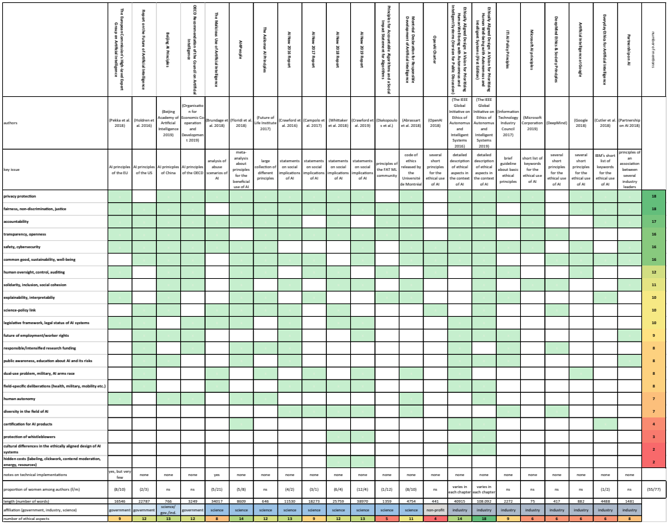
Abstract Current advances in research, development and application of artificial intelligence (AI) systems have yielded a far-reaching discourse on AI ethics. In consequence, a number of ethics guidelines have been released in recent years. These guidelines comprise normative principles and recommendations aimed to harness the “disruptive” potentials of new AI technologies. Designed as a semi-systematic evaluation, this paper analyzes and compares 22 guidelines, highlighting overlaps but also omissions. As a result, I give a detailed overview of the field of AI ethics. Finally, I also examine to what extent the respective ethical principles and values are implemented in the practice of research, development and application of AI systems—and how the effectiveness in the demands of AI ethics can be improved.
Verified 2026-11-25 · 3 references not checked yet
Overview
CoChat Summary
## TL;DR
This paper semi-systematically reviews 22 AI ethics guidelines, finding strong overlap on a few technicalizable topics but many important omissions. It argues that AI ethics is often ineffective in practice and should be supplemented by more concrete technical guidance and a shift toward virtue ethics.
## Key findings
- The paper analyzes and compares 22 AI ethics guidelines and finds that accountability, privacy, and fairness appear in about 80% of them, making them the closest thing to a common minimum standard.
- The author reports that guidelines from industrial contexts name on average 9.1 distinct ethical aspects, while science-based ethics codes average 10.8.
- Only two guidelines contain genuinely technical explanations, and these are described as very sparse; the most extensive technical commentary is in “The Malicious Use of AI”.
- The paper says a controlled study found the effectiveness of ethics guidelines or codes to be “almost zero”: among 63 software engineering students and 105 professional software developers, there was no statistically significant difference in responses between those who did and did not see the ACM code of ethics.
- The paper highlights major omissions across guidelines, including political abuse of AI, hidden social and ecological costs, lack of diversity, robot ethics, trolley problems, and public-private partnerships/industry-funded research.
## Methods
- Semi-systematic literature analysis of AI ethics guidelines, with a deliberate focus on comprehensive guideline documents rather than all AI-ethics-related writings.
- The final sample consisted of 22 major ethical guidelines, identified through searches in Google, Google Scholar, Web of Science, ACM Digital Library, arXiv, and SSRN, plus manual reference screening and the Algorithm Watch AI Ethics Guidelines Global Inventory.
- The paper compares which ethical issues are present or absent in the guidelines, and then relates those principles to practice using cited empirical studies and examples from AI development and deployment.
## Limitations
- The author states the sample is biased toward western/northern documents and excludes guidelines not written in English.
- The selection deliberately excludes guidelines focused on robot ethics, big data, algorithms, or robotics, so omissions in those areas are partly a result of the sampling method.
- The paper notes that its list of omissions is non-exhaustive.
- Evident from the text: the paper is primarily a theoretical/semi-systematic overview, not a direct empirical test of all AI ethics guideline implementations.
Model-written summary. Check it against the paper before relying on it.
Integrity signals
Registry
Cites
Statistics
Figures
Verification
Claims the paper makes
5 Valid · 3 Not valid · 62 Not checked · 64 Own results and interpretations
The cited sources support only part of this claim — read each source’s verdict below.
In the paper
“So far, some papers have been published on the subject of teaching ethics to data scientists (Garzcarek and Steuer 2019; Burton etal. 2017; Goldsmith and Burton 2017; Johnson 2017) but by and large very little to nothing has been written about the tangible implementation of ethical goals and values.”
What the sources say
- Supportedcites Garzcarek and Steuer 2019 matched to “Approaching Ethical Guidelines for Data Scientists” (2019) source
The citation is attached to the statement that papers have discussed teaching ethics to data scientists, not to the citing authors’ subsequent assessment of writing on tangible implementation. Section 5.2 (p. 14) explicitly argues that ethics should be part of the data-science curriculum. (LLM, conf=0.90)
- Not matchedcites Burton etal. 2017
An author–year citation the paper’s reference list doesn’t settle. We don’t search these by name.
- Supportedcites Goldsmith and Burton 2017 matched to “Why Teaching Ethics to AI Practitioners Is Important” (2017) source
The citation appears in a list of papers about teaching ethics to data scientists, not as support for the sentence’s later claim about how little has been written on implementation. The Introduction (p. 1) presents the paper as an argument for ethical training for AI students and practitioners, and the Conclusions (p. 4) advocate teaching ethics in AI classes. (LLM, conf=0.91)
plain- Asserted: passes — The authors put it forward as true.
- Checkable: passes — It can be checked against evidence.
- Load-bearing: passes — The paper’s conclusions depend on it.
- Based: passes — The paper gives a reason why it holds.
- Supported
The cited sources support only part of this claim — read each source’s verdict below.
In the paper
“Leading, of course, is the military use of AI in cyber warfare or regarding weaponized unmanned vehicles or drones (Ernest and Carroll 2016; Anderson and Waxman 2013).”
What the sources say
- Partly supportedcites Ernest and Carroll 2016 matched to “Genetic Fuzzy based Artificial Intelligence for Unmanned Combat Aerial Vehicle Control in Simulated Air Combat Missions” (2016) sourceExperimental — accuracy not yet measured
Our copy does support the drone half of the claim as an identification citation: the paper is squarely about applying AI to a weaponized unmanned vehicle (Introduction: UCAV research, 'this white paper will primarily focus on the increase in capabilities of real-time decision making'; Problem Statement: ALPHA controlling aircraft motion and firing in AFSIM). But it does not support the claim's core assertion that military AI is a leading area of unwanted side effects and malevolent use — the nearest passage (Introduction, 'There are a number of obstacles to a system being an effective AI within this context') frames the issues as engineering and verification difficulties (adversaries trying to 'fool and exploit the system', V&V, safety specifications, crashes/sensor failures), and the Results and Conclusions treat autonomy as 'a revolutionary leap in capability of airpower' and a way of 'reducing risk to our pilots'. Cyber appears only once, as an unrelated civilian/defence application domain of the GFT method ('Examples include robotic surgery, design automation, and cyber security'), not as cyber warfare, so that element of the claim is not from this source. (LLM, conf=0.72)
- Not checked — no full text of the sourcecites Anderson and Waxman 2013 matched to “Law and Ethics for Autonomous Weapon Systems: Why a Ban Won't Work and How the Laws of War Can” (2013) source
boostedstates an association- Asserted: passes — The authors put it forward as true.
- Checkable: passes — It can be checked against evidence.
- Load-bearing: unclear — It is unclear whether the paper’s conclusions depend on it.
- Based: passes — The paper gives a reason why it holds.
- Partly supported
The cited sources support only part of this claim — read each source’s verdict below.
In the paper
“In the light of these two approaches, the traditional type of AI ethics can be assigned to the deontological concept (Mittelstadt 2019).”
What the sources say
- Partly supportedcites Mittelstadt 2019 matched to “Principles alone cannot guarantee ethical AI” (2019) sourceExperimental — accuracy not yet measured
The paper describes a prominent, principle-based approach to AI ethics and says AI ethics initiatives have converged around principles resembling those of medical ethics (opening section; page unavailable). It does not classify that approach as deontological, so the claimed assignment to the deontological concept is not supported by our copy. (LLM, conf=0.78)
plainstates an association- Asserted: passes — The authors put it forward as true.
- Checkable: passes — It can be checked against evidence.
- Load-bearing: passes — The paper’s conclusions depend on it.
- Based: passes — The paper gives a reason why it holds.
- Partly supported
A result the paper reports from its own data — it cites no other source for it, so there is none to check. The quote shows it is in the paper.
In the paper
“My analysis of the distribution of female and male authors of the guidelines, as far as authors were indicated in the documents, showed that the proportion of women was 41.7%.”
plain- Asserted: passes — The authors put it forward as true.
- Checkable: passes — It can be checked against evidence.
- Load-bearing: passes — The paper’s conclusions depend on it.
- Based: passes — The paper gives a reason why it holds.
A result the paper reports from its own data — it cites no other source for it, so there is none to check. The quote shows it is in the paper.
In the paper
“Finally, yet importantly, it is noteworthy that almost all guidelines suggest that technical solutions exist for many of the problems described.”
hedged- Asserted: passes — The authors put it forward as true.
- Checkable: passes — It can be checked against evidence.
- Load-bearing: unclear — It is unclear whether the paper’s conclusions depend on it.
- Based: passes — The paper gives a reason why it holds.
54 more claims
Create a free account to see all 134 claims and to verify the 1 reference still open.
- Probably not a substantial claim. 59
- It may state two separate claims as one. 29
Claims other papers make about this one
Each is checked against this paper’s own text: does it say what the citing paper says it does?
The source backs part of the claim, not all of it — or backs it for a different population, condition or comparison.
In the citing paper
“Ethical concerns arising from the design and deployment of AI technology have motivated a number of initiatives [47]—such as the Ethical Guidelines for Trustworthy AI by the European Commission expert group on AI, and Microsoft’s FATE: Fairness, Accountability, Transparency, and Ethics in AI—addressing issues including mitigating bias and discrimination in AI systems and fairness in the use of AI”
From Future directions for chatbot research: An interdisciplinary research agenda (2021) · cites this paper as [47]
Experimental — accuracy not yet measuredThe source backs part of the claim, not all of it — or backs it for a different population, condition or comparison.
In the citing paper
“Additional recommendations on AI ethics teaching content include “explainability,” “liability,” and “accountability,” which are also considered important by available guidelines [30,40].”
From Proposing a Principle-Based Approach for Teaching AI Ethics in Medical Education (2024) · cites this paper as [30]
Experimental — accuracy not yet measuredThe source backs part of the claim, not all of it — or backs it for a different population, condition or comparison.
In the citing paper
“This emphasis is also echoed by existing guidelines and frameworks regarding AI ethics [30].”
From Proposing a Principle-Based Approach for Teaching AI Ethics in Medical Education (2024) · cites this paper as [30]
Experimental — accuracy not yet measuredThe source backs part of the claim, not all of it — or backs it for a different population, condition or comparison.
In the citing paper
“En dépit de nombreuses chartes, discussions et nombreux documents sur les bonnes pratiques éthiques, l’espoir est faible que l’IA puisse éventuellement se montrer généralement conforme (Hagendorff, 2020) :”
From Gouvernance algorithmique, intelligence artificielle, enjeux, éthique : esquisse d’une analyse critique (2021) · cites this paper as Hagendorff, 2020
Experimental — accuracy not yet measuredThe source backs part of the claim, not all of it — or backs it for a different population, condition or comparison.
In the citing paper
“The experience of mixed emotional responses and ethnical navigation was supported by literature (Hagendorff, 2020;Mamo et al., 2024;Mittelstadt, 2019).”
From Into the Unknown: AI Adoption and Job Satisfaction of Christian Faculty (2026) · cites this paper as Hagendorff, 2020
Experimental — accuracy not yet measured
13 more claims about this paper
Create a free account to see every claim other papers make about this one.
Citations
Cites
The spread of true and false news online
Vosoughi, S., Roy, D., & Aral, S. (2018) · Science · doi:10.1126/science.aap9559 · Cited by 8,847
The future of employment: How susceptible are jobs to computerisation?
Frey, C. B., & Osborne, M. A. (2017) · Technological Forecasting and Social Change · doi:10.1016/j.techfore.2016.08.019 · Cited by 8,727
The global landscape of AI ethics guidelines
Jobin, A., Ienca, M., & Vayena, E. (2019) · Nature Machine Intelligence · doi:10.1038/s42256-019-0088-2 · Cited by 6,220
Floridi, L., Cowls, J., Beltrametti, M., Chatila, R., Chazerand, P., Dignum, V., Luetge, C., Madelin, R., Pagallo, U., Rossi, F., et al. (2018) · Minds and Machines · doi:10.1007/s11023-018-9482-5 · Cited by 4,774 · cited 2×
“They include the adoption of legal framework conditions, the establishment of mechanisms for an independent auditing of technologies, the establishment of institutions for complaints, which also compensate for harms caused by AI systems, and the expansion of university curricula in particular through content from ethi…”
Background(2011) · Cited by 4,430
Lazer, D. M. J., Baum, M. A., Benkler, Y., Berinsky, A. J., Greenhill, K. M., Menczer, F., Metzger, M. J., Nyhan, B., Pennycook, G., Rothschild, D., et al. (2018) · Science · doi:10.1126/science.aao2998 · Cited by 4,160
The Black Box Society: The Secret Algorithms That Control Money and Information
Pasquale, F. (2015) · doi:10.4159/harvard.9780674736061 · Cited by 3,796
Experimental evidence of massive-scale emotional contagion through social networks
Kramer, A. D. I., Guillory, J. E., & Hancock, J. T. (2014) · Proceedings of the National Academy of Sciences · doi:10.1073/pnas.1320040111 · Cited by 3,687
(2018) · Cited by 3,510
Private traits and attributes are predictable from digital records of human behavior
Kosinski, M., Stillwell, D., & Graepel, T. (2013) · Proceedings of the National Academy of Sciences · doi:10.1073/pnas.1218772110 · Cited by 2,829
Research works printed but not linked: 24
- Abrassart, C., Bengio, Y., Chicoisne, G., de Marcellis-Warin, N., Dilhac, M.-A., Gambs, S., Gautrais, V., etal. (2018). Montréal declaration for responsible development of artificial intelligence (pp. 1-21).
- Asimov, I. (2004). I, Robot . New York: Random House LLC.
- Bakewell, J. D., Clement-Jones, T. F., Giddens, A., Grender, R. M., Hollick, C. R., Holmes, C., Levene, P. K. etal. (2018). AI in the UK: Ready, willing and able?. Select committee on artificial intelligence (pp. 1-183).
- Baron, B., Musolesi, M. (2017). Interpretable machine learning for privacy-preserving pervasive systems. arXiv (pp. 1-10).
- Bourdieu, P. (1984). Distinction: A social critique of the judgement of taste . Cambridge: Harvard University Press.
- Brahnam, S. (2006). Gendered bots and bot abuse. In Antonella de Angeli, Sheryl Brahnam, Peter Wallis, & Peter Dix (Eds.), Misuse and abuse of interactive technologies (pp. 1-4). Montreal: ACM.
- Derrida, J. (1997). Of grammatology . Baltimore: Johns Hopkins Univ. Press.
- Gebru, T., Morgenstern, J., Vecchione, B., Vaughan, J. W., Wallach, H., Daumeé, III, H., Crawford, K. (2018). Datasheets for datasets. arXiv (pp. 1-17).
- Google. (2019). Perspectives on issues in AI governance (pp. 1-34). Retrieved February 11, 2019. https :// ai.googl e/stati c/docum ents/persp ectiv es-on-issue s-in-ai-gover nance .pdf.
- Helbing, D. (Ed.). (2019). Towards digital enlightment: Essays on the darf and light sides of the digital revolution. Cham: Springer.
- Johnson, D. G. (2017). Can engineering ethics be taught? The Bridge, 47 (1), 59-64.
- Luhmann, N. (1988). Die Wirtschaft der Gesellschaft . Frankfurt A.M: Suhrkamp.
- Morley, J., Floridi, L., Kinsey, L., Elhalal, A. (2019). From what to how. An overview of AI ethics tools, methods and research to translate principles into practices. arXiv (pp. 1-21).
- Organisation for Economic Co-operation and Development. (2019). Recommendation of the Council on Artificial Intelligence (pp. 1-12). Retrieved June 18, 2019. https ://legal instr ument s.oecd.org/en/ instr ument s/OECD-LEGAL -0449.
- Pekka, A.-P., Bauer, W., Bergmann, U., Bieliková, M., Bonefeld-Dahl, C., Bonnet, Y., Bouarfa, L. etal. (2018). The European Commission's high-level expert group on artificial intelligence: Ethics guidelines for trustworthy ai . Working Document for stakeholders' consultation. Brussels (pp. 1-37).
- Pistono, F., Yampolskiy, R. (2016). Unethical research: How to create a malevolent artificial intelligence. arXiv (pp. 1-6).
- Podgaiska, I., Shklovski, I. Nordic engineers’ stand on artificial intelligence and ethics: Policy recommendations and guidelines (pp. 1–40).
- Rawls, J. (1975). Eine Theorie Der Gerechtigkeit . Frankfurt am Main: Suhrkamp.
- Shoham, Y., Perrault, R., Brynjolfsson, E., Clark, J., Manyika, J., Niebles, J. C., Lyons, T., Etchemendy, J., Grosz, B., Bauer, Z. (2018). The AI index 2018 annual report. Stanford, Kalifornien (pp. 1-94). <!-- image --> 1 3
- Sitawarin, C., Bhagoji, A. N., Mosenia, A., Chiang, M., Mittal, P. (2018). DARTS: Deceiving autonomous cars with toxic signs. arXiv (pp. 1-27).
- Tegmark, A. (2017). Life 3.0: Being human in the age of artificial intelligence . New York: Alfred A. Knopf.
- The IEEE Global Initiative on Ethics of Autonomous and Intelligent Systems. (2016). Ethically aligned design: A vision for prioritizing human well-being with artificial intelligence and autonomous systems (pp. 1-138).
- Whittaker, M., Crawford, K., Dobbe, R., Fried, G., Kaziunas, E., Mathur, V., West, S. M., Richardson, R., Schultz, J., Schwartz, O. (2018). AI now report 2018 (pp. 1-62).
- Zeng, Y., Lu, E., Huangfu, C. (2018). Linking artificial intelligence principles. arXiv (pp. 1-4). Publisher's Note Springer Nature remains neutral with regard to jurisdictional claims in published maps and institutional affiliations. <!-- image --> 1 3
Cited by
Items 1,701–1,800 of 1,821
From Algorithmic Welfare to Participatory Data Justice
Gripsy, J. V., Praneesh, M., Senthilkumar, G., Baskar, G., Kamalam, K. S., & Sheeba, L. (2026) · IGI Global eBooks · doi:10.4018/979-8-3373-8423-8.ch005
Wiajya, A., Subriadi, A. P., Nadlifatin, R., & Haryanti, T. (2026) · Digital Education Review · doi:10.1344/der.2026.49.46-78 · Cited by 3
Who Teaches AI Ethics? Understanding the Gaps in AI Ethics Education in Computing Programs
Aljedaani, W., Parthasarathy, P. D., & Aljohani, A. (2026) · ACM/IEEE International Conference on Software Engineering: Companion Proceedings (ICSE-Companion) · doi:10.1145/3786580.3786966
“Nevertheless, concerns over their ethical misuse and unintended harm have sparked global interest [18].”
Embodied Intelligence Security with Vision-language Models: A Survey
Duan, J., Zhu, H., Liu, C., Li, S. Y., Tang, X., & Wang, Y. (2026) · Machine Intelligence Research · doi:10.1007/s11633-025-1626-x · Cited by 2
Affective Computing in the Age of GenAI: Balancing Risks and Rewards
Latif, S., Shoukat, M., Pervez, F., Shamshad, F., Usama, M., Sandhu, M. M., & Schuller, B. W. (2026) · IEEE Computational Intelligence Magazine · doi:10.1109/mci.2026.3678879 · Cited by 1
“Although the ethical implications of AI have been widely discussed [98], [99], [100], [101], the unique challenges of applying GenAI in critical AffComp domains have received less attention.”
A Mandate Beyond Accuracy: Forging the Algorithm’s Social Contract
Singh, N., & Foulds, J. R. (2026) · Artificial intelligence · doi:10.5772/intechopen.1015619
Rebalancing the algorithm: pathways for mitigating bias in predictive policing
Nautiyal, L., Malik, P., Mittal, V., & Zieni, B. (2026) · Service Oriented Computing and Applications · doi:10.1007/s11761-026-00501-1
AI ethics in academia among higher education students’ perceptions and practices
Ghosh, R., Gardia, A., & Mehta, D. (2026) · Discover Education · doi:10.1007/s44217-026-01881-4
“Hagendorff [25] describes the proliferation of ethical frameworks as “principlism without practice,” highlighting weak mechanisms for real-world implementation.”
VETTING: A dual-LLM framework for in-loop safety verification via policy isolation in educational AI
Li, H., Zhang, S., & Botelho, A. F. (2026) · Computers and Education Artificial Intelligence · doi:10.1016/j.caeai.2026.100646 · Cited by 1
Algorithmic ethics and economic regulation: how do antitrust authorities address the risks of AI?
Costa, M. C., & Freire, F. D. S. (2026) · Revista de Administração Pública · doi:10.1590/0034-761220250255x
Technically Love: The Evolution of Human–AI Romance Discourse on Reddit
Chang, T., Huh, J., & Razi, A. (2026) · ACM Conference on Conversational User Interfaces (CUI) · doi:10.1145/3816046.3816222 · Cited by 2
“This does not, however, straightforwardly imply that moderation should be relaxed; the safety and ethical risks of unrestrained AI systems are well enough established [4, 6, 22, 67] to outright reject wholly unmoderated intimate CAI systems.”
Governance configurations driving AI innovation: A comparative analysis from 40 countries
Fang, F., Dai, Y., Blind, K., & Shan, B. (2026) · Technological Forecasting and Social Change · doi:10.1016/j.techfore.2026.124813
Data Ethics and Digital CSR in AI-Driven Learning Governance
Öztaş, E. Ş. (2026) · Advances in computational intelligence and robotics book series · doi:10.4018/979-8-3693-4099-8.ch010
Berdida, D. J. E., Alhudaib, N. A. A., Grande, R. A. N., Alsharafi, S. A., Agunod, C. D., Santos, A. M., Alanazi, H. H., Al‐Moteri, M., Alqarawi, N., & Alasqah, I. (2026) · Journal of Nursing Management · doi:10.1155/jonm/5338801
“These include risks related to bias, privacy, accountability, human rights, patient safety, and the spread of misinformation and disinformation [2, 3].”
Urban digital twin governance readiness and institutional trust: Panel evidence from the EU
Zhou, W., & Kriviņš, A. (2026) · Open Research Europe · doi:10.12688/openreseurope.24443.1
Artificial intelligence and emotional intelligence: Can machines understand human emotions?
Dandona, A., & Bhatt, S. (2026) · Elsevier eBooks · doi:10.1016/b978-0-443-43934-6.00017-1
Barón, M. J. S. (2026) · Springer proceedings in business and economics · doi:10.1007/978-3-032-24600-4_9
AI and Governance (Including Ethics)
Stuart, J. (2026) · Springer eBooks · doi:10.1007/978-3-031-52643-5_269-1
Troche, D. R. C., Domínguez, A. L., & Vizcaíno-Imacaña, P. (2026) · Revista Interuniversitaria de Formación del Profesorado Continuación de la antigua Revista de Escuelas Normales · doi:10.6018/rifop.698601 · Cited by 1
Durango, R. A. B., Correa, D. A. C., Flores, E. A. R., & Zuluaga, C. D. J. G. (2026) · Philosophies · doi:10.3390/philosophies11040133
“Hagendorff’s semi‑systematic evaluation of twenty‑two AI ethics guidelines documented the convergence of the field around principles of transparency, accountability, fairness, and privacy, while critiquing the gap between principles and practice [22].”
Acquah, B. Y. S., Salifu, I., Arthur, F., Inkoom, M., Suradji, S. D., Inkoom, C., Quayson, E., Quaye, S. A., Gyedu, F. O., & Nortey, S. A. (2026) · Computers and Education Artificial Intelligence · doi:10.1016/j.caeai.2026.100652
Putra, W. K., & Nurmiati, E. (2026) · Global Advances in Science Engineering & Technology (GASET) · doi:10.62671/gaset.v2i1.300
“Hagendorff (2020) critically evaluated the gap between AI ethical principles and practical implementation, while Veale and Zuiderveen Borgesius (2021) analyzed regulatory challenges within the European Union's AI governance framework.”
Advancing sustainable construction: A trust-enhanced model of AI adoption and realised use
Regona, M., Yiğitcanlar, T., Hon, C. K. H., & Teo, M. (2026) · Sustainable Cities and Society · doi:10.1016/j.scs.2026.107755 · Cited by 1
Trust, Transparency, and Ethics in AI-Driven Consumer Engagement: The Role of AI Governance
Haque, A., Faisal-E-Alam, M., Akter, M. S., Rupa, R. A., & Islam, M. Z. (2026) · Advances in computational intelligence and robotics book series · doi:10.4018/979-8-2600-2977-0.ch001
Fragoso, J., Silva, C., Peixoto, M., & Vilela, J. (2026) · Revista Eletrônica de Iniciação Científica em Computação · doi:10.5753/reic.2026.7830
$\mathrm{A}^{4}$ -Gov: A Governance Architecture for AI Service Systems
Ahn, M. S., & Yoon, Y. I. (2026) · IEEE/ACIS International Conference on Software Engineering Research, Management and Applications (SERA) · doi:10.1109/sera69989.2026.11618631 · Cited by 1
Hündür, T., & Taş, E. (2026) · Trakya Eğitim Dergisi · doi:10.24315/tred.1746487 · Cited by 1
Erin, O. A. (2026) · CSR, sustainability, ethics & governance · doi:10.1007/978-3-032-20091-4_10
Tsaban, S. (2026) · Research Square · doi:10.21203/rs.3.rs-10462716/v1
Collaborative Curriculum Design Guidelines for Interdisciplinary AI Literacy Education
Taş, E., & Bittner, E. A. C. (2026) · Lecture notes in networks and systems · doi:10.1007/978-3-032-24810-7_33
Ong, D. P., Jr., & Madayag, J. (2026) · AI and Ethics · doi:10.1007/s43681-026-01263-4
Shaping a Just Future: Environmental Justice, Inclusion, and the Impact of Artificial Intelligence
Barak, M. E. M. (2026) · Emerald Group Publishing Limited eBooks · doi:10.1108/978-1-80686-929-920261031
Brik, A. B. (2026) · Quality & Quantity · doi:10.1007/s11135-026-03044-x · Cited by 1
Runtime configuration for situated governance of AI agents: a case study in investigative journalism
Hagar, N., & Diakopoulos, N. (2026) · AI and Ethics · doi:10.1007/s43681-026-01298-7
Same System, Opposite Verdicts: Metric Discretion in AI Ethics Audits and the Limits of DisclosurePreprint
Tsaban, S. (2026) · Research Square · doi:10.21203/rs.3.rs-10576395/v1
From Innovation to Integrity: Why Africa's Artificial Intelligence Future Depends on Ethics
Викторович, О. А., Shlychkova, Y., & Yiadom, G. (2026) · ITU Kaleidoscope Academic Conference (ITU K) · doi:10.23919/ituk70038.2026.11632388
“This understanding reflects the argument that high-level principles, while necessary, remain largely declaratory unless they are supported by institutional arrangements, implementation methods and accountability structures that give them practical force in concrete contexts [4, 5].”
Educational leadership in the age of artificial intelligence: The moral compass in the machine
Ali, N. A. (2026) · Management in Education · doi:10.1177/08920206261473366 · Cited by 1
A multi-layer social-theoretical framework for AI ethics
Fakrudeen, M., & Otieno, J. O. (2026) · AI and Ethics · doi:10.1007/s43681-026-01307-9
“Similarly, Hagendorff’s comparative evaluation of AI ethics guidelines shows that formal agreement around prin - ciples does not necessarily result in effective implementation [11].”
Eng, P. H., Cao, J. R., Liu, R. L., & Yang, B. (2026) · Contributions to management science · doi:10.1007/978-3-032-23399-8_28
AI ethics after generative AI: from consequences to effects
Gianni, R. (2026) · AI & Society · doi:10.1007/s00146-026-03308-y
Ethics Readiness Levels for AI Systems: A Practical Evaluation Framework
Adomaitis, L., Israël-Jost, V., & Grinbaum, A. (2026) · Zooming Innovation in Consumer Technologies Conference (ZINC) · doi:10.1109/zinc69910.2026.11655821
“This is the substance of ethics-washing [33] and the reason why principles alone do not lead to responsible development and use of AI [3], [4].”
Niszczota, P., & Antoniou, E. (2026) · Journal of Experimental Social Psychology · doi:10.1016/j.jesp.2026.104991 · Cited by 1
From stability to responsibility: the ethical evolution of AI-driven control systems
Khaki-Sedigh, A. (2026) · AI & Society · doi:10.1007/s00146-026-03302-4
Diogo, J. E., & Andrade, C. S. (2026) · AI & Society · doi:10.1007/s00146-026-03332-y
Hypernomie. Zum gesellschaftsstrukturellen Wirkpotenzial des Machine Learning
Ochs, C. (2026) · Berliner Journal für Soziologie · doi:10.1007/s11609-026-00599-2
Applications of AI in Health Services
Ain, Q. T. (2023) · International Journal of Innovations in Science and Technology · doi:10.33411/ijist/507
Empirically Derived AI Harm Profiles and the Case for Context-Sensitive Moral ResponsibilityPreprint
Mumtaz, U., Noor, R., & Mumtaz, S. (2026) · Research Square · doi:10.21203/rs.3.rs-10542055/v1
AI in Play: A Game to Strengthen Responsible AI Adoption Skills
Paladino, L., Chimenti, P. C. P. D. S., & da Fonseca, A. L. A. (2026) · IT Professional · doi:10.1109/mitp.2026.3713072
Supplementing Korean artificial intelligence ethical principles: A five-year update
Lee, U.-K. (2026) · PLoS ONE · doi:10.1371/journal.pone.0356766
“Hagendorff (2020) reviewed 22 previous studies published between 2016 and 2019 to increase timeliness and incorporated similar principles [18].”
InfluentialDesigning Contestability and Employee Appeals Into Artificial Intelligence–Mediated Management
Bello, A., Sule, Z., Musa, I., Adeyemi, G., & Youssef, A. (2025) · Journal of Applied Organizational Systems and Behavior · doi:10.51847/i6a1ccaykk
Cybersophy: A framework for human cognition, identity, and values in the age of artificial agents
Ning, H., & Ding, J. (2026) · Computers in Human Behavior Artificial Humans · doi:10.1016/j.chbah.2026.100385 · Cited by 2
Dickinson, R., & Sethna, Z. (2026) · Springer proceedings in business and economics · doi:10.1007/978-3-032-21347-1_4
Renda, M. (2026) · AI and Ethics · doi:10.1007/s43681-026-01310-0
Shao, T. (2026) · AI and Ethics · doi:10.1007/s43681-026-01321-x
Redín, D. M., & Ames, M. C. F. D. C. (2026) · Journal of Business Ethics · doi:10.1007/s10551-026-06450-1 · Cited by 1
Containing AI: from responsible to critical AI governance
Schütze, P., & Brevini, B. (2026) · AI & Society · doi:10.1007/s00146-026-03337-7 · Cited by 1
Hariyanto, H., Tantra, M. W., Sadtyadi, H., & Yatno, T. (2026) · AI and Ethics · doi:10.1007/s43681-026-01340-8
“Existing responsible AI discourse commonly emphasizes fairness, accountability, transparency, explainability, safety, privacy, reliability, and human-centered design [ 5, 14 , 20 , 28 ].”
Integrating Emotion, Social Intelligence, and Culture in Robotic Companions
Subrahmanyam, S., & Anand, J. (2026) · Advances in computational intelligence and robotics book series · doi:10.4018/979-8-3373-6836-8.ch007
Rashid, S., Malik, S., & Ghauri, F. (2026) · Asian-Pacific Journal of Second and Foreign Language Education · doi:10.1186/s40862-026-00451-3
“First, the majority of the ethical principles (UNESCO, 2021; Hagendorff, 2020) are not operationalized but rather aspirational, i.e., they outline what needs to be undertaken (ex, be transparent) but not how these principles should be integrated into the daily aspects of the instructional process.”
InfluentialAmmon, S. (2026) · Philosophy & Technology · doi:10.1007/s13347-026-01134-0 · Cited by 1
“…approved to ensure that the development of artificial intelligence is based on ethical principles (e.g. Corrêa et al., 2023; Fjeld et al., 2020 ; Hagendorff, 2020; Jobin et al., 2019), including perhaps one of the best known, the European Ethics guidelines for trustworthy AI with its…”
Displacement, Dilemma, and Exit: The Ethical Stakes of Algorithmic Decision-Making
Kong, L., & Chang, Y. (2026) · Social Sciences · doi:10.3390/socsci15090593
Bridging the Principle–Practice Gap in Responsible AI: A Cross-Domain Review
Sun, F. (2026) · Lecture notes in computer science · doi:10.1007/978-3-032-35506-5_28
Privacy, Data Sovereignty, and Consent Ethics of Agentic AI in Higher Education
Nwasra, N. M., & Alharthy, A. (2026) · Advances in computational intelligence and robotics book series · doi:10.4018/979-8-2600-4050-8.ch002
Perry, A., & Cameron, C. D. (2026) · Cambridge University Press eBooks · doi:10.1017/9781009639057.024
Lost in Translation: A Typology of Multi-Level Responsible AI Governance
Symeonidis, D., & Nikiforova, A. (2026) · Lecture notes in computer science · doi:10.1007/978-3-032-36676-4_26 · Cited by 1
A Conceptual Typology of Scientific Harm from Misused Materials AI
Okafor, C., & Bello, A. (2024) · Journal of Artificial Intelligence for Materials Science · doi:10.68159/u520585185
Jung, H. S., & Lee, H. (2026) · International Journal of Human-Computer Interaction · doi:10.1080/10447318.2026.2719118
From automation to ethical authority: governing AI-mediated decision-making in global digital trade
Mou, D. (2026) · AI and Ethics · doi:10.1007/s43681-026-01366-y
Organizational AI Governance: Integrating Ethical, Strategic, and Regulatory Dimensions
Romero, B., del Castillo, I., Medina, A., & Vega, L. (2025) · Journal of Digital Business and Management Studies · doi:10.68159/s097590835
Ethical Use of Artificial Intelligence in Research Publication: A Scoping Review
Dakhesh, S., Khademizadeh, S., Atlasi, R., Zareivenovel, M., & Ouchi, A. (2026) · International Journal of Health Policy and Management · doi:10.34172/ijhpm.9759
“…adherence to publication ethics within research systems 23,72 - Strengthening a culture of scientific integrity in research involving AI tools 61,66,72 - Reducing publication-related pressures within educational and research systems 66,70 - Institutional modeling and support for responsible…”
InfluentialCornet, M., Yang, T., Βογιατζής, Η., Zhang, Z., Ludec, C. L., Chandhiramowuli, S., Cierpe, J. T., & Wirth*, A. (2026) · De Gruyter eBooks · doi:10.1515/9783111373096-015
Nkwo, M. S., Adamu, M. S., Brako, F., Okolo, C. T., & Orji, R. (2026) · AI and Ethics · doi:10.1007/s43681-026-01361-3 · Cited by 1
Davidian, M., Mazliah, D., Slovin, G., Joshua, B., Lurie, Y., & Mark, S. (2026) · Software · doi:10.3390/software5030039
Visave, J. (2026) · Journal of Emergency Management · doi:10.5055/jem.1021
Introduction to artificial intelligence and machine learning
Singh, M. (2026) · Elsevier eBooks · doi:10.1016/b978-0-443-43914-8.00014-5
Kahyaoğlu, M., & Kenanoğlu, R. (2026) · Fen Bilimleri Öğretimi Dergisi · doi:10.56423/fbod.1841698
Teichmann, F. M. J. (2026) · AI and Ethics · doi:10.1007/s43681-026-01358-y · Cited by 1
Fel, S., Kozak, J., & Choroszewicz, M. (2026) · Roczniki Nauk Społecznych · doi:10.18290/rns2026.0032
Kim, G., Gwak, J., & Chung, H. (2026) · doi:10.2196/preprints.111966
Governance by Negotiation: How Organizations Translate AI Ethics into Practice
Birkstedt, T., Minkkinen, M., & Mäntymäki, M. (2026) · Lecture notes in computer science · doi:10.1007/978-3-032-38014-2_22
Will AI save ethics—and make ethicists obsolete?
Tretter, M. (2026) · AI and Ethics · doi:10.1007/s43681-026-01384-w
Sabhnani, T., Thirunavukkarasu, V., & John, T. J. (2026) · International Conference on Trends in Quantum Computing and Emerging Business Technologies (TQCEBT) · doi:10.1109/tqcebt67648.2026.11681906
“There are no compliance metrics, and neither do they provide a vehicle to apply the law [11].”
Barnett, S., Pasquini, A., Kurniawan, S., Sivasothy, S., Hill, R., & Vasa, R. (2026) · IEEE/ACM International Conference on AI Engineering – Software Engineering for AI (CAIN) · doi:10.1145/3793653.3793778 · Cited by 1
“Emerging standards and legislative proposals increasingly demand empirically verifiable transparency, explainability, and observability to support accountability for error, bias, and drift [12].”
An Ethics-Aware Requirements Template for Embedding Ethics in Requirements Engineering
Muhammad, A. P., Inayat, I., Svensson, R. B., & Knauss, E. (2026) · IEEE International Requirements Engineering Conference Workshops (REW) · doi:10.1109/rew72749.2026.00065
“However, several studies point to a gap between such high-level principles and their practical implementation in system design and engineering processes[9, 17, 10].”
Balakrishnan, M. S., Khan, Z. R., Mayumu, N., Krásničan, V., Rosenthal, L., Willis, M., & Reed, R. H. (2026) · doi:10.2196/preprints.111731
Chen, Y., & Zare, S. (2026) · AI and Ethics · doi:10.1007/s43681-026-01363-1
“Existing theories of AI responsibility have largely been developed in Euro-American contexts and often assume more individualistic value systems, decentralized governance traditions, and stronger norms of student autonomy [24, 29 ].”
Miklošík, A., & Rosenbaum, T. (2026) · AI and Ethics · doi:10.1007/s43681-026-01344-4
“Hagendorff [ 16], examining twenty-two prominent guidelines, confirmed the conver - gence at the level of headline principles but documented substantial omissions—in particular around the politics of AI development, labour and the environment—and a near-total absence of implementation mechanisms.”
InfluentialHow ethics operationalization breaks down in practice: expert perspectives from healthcare AI
Minocher, R., Velarde, I., Bürger, V., Pluktaite, G., & Madai, V. I. (2026) · AI and Ethics · doi:10.1007/s43681-026-01381-z · Cited by 1
What is AI ethics, and what is it good for? Clarifying debates on AI ethics
Schomäcker, A., Speith, T., Deck, L., Helfer, T., Zhang, H., & Kästner, L. (2026) · AI and Ethics · doi:10.1007/s43681-026-01326-6 · Cited by 1
Echoes of Radha in the Machine:
Sharma, J. (2026) · Dia-noesis. · doi:10.12681/dia.46981
“Recent debates in AI ethics have highlighted concerns regarding bias, opacity, and the cultural implications of algorithmic systems, particularly in the humanities where meaning, interpretation, and context are central (Hagendorff, 2020; Heilinger, 2022).”
Altamirano, S., Anadria, D., van der Wees, S., Tensen, P., van de Vijver, S. J. M., & Ghebreab, S. (2026) · Frontiers in Artificial Intelligence · doi:10.3389/frai.2026.1911214
Principles over Politics? A Critical Reading of India AI Governance Framework
Priyadarshi, P., & Kumar, M. (2026) · Studies in Indian Politics · doi:10.1177/23210230261483375
Bae, S., & Gastelum, Z. (2026) · Journal of Responsible Innovation · doi:10.1080/23299460.2026.2731654
LangBiTe: model-driven bias testing of text-to-text large language models
Morales, S., Clarisó, R., & Cabot, J. (2026) · Software & Systems Modeling · doi:10.1007/s10270-026-01425-2
Vergun, A., Parashchuk, B., & Кіт, З. (2026) · Professional Pedagogics · doi:10.32835/2707-3092.2026.33.124-134
Metadata
- Authors
- Hagendorff, T.
- Affiliations
- University of Tübingen (DE)
- Corresponding author
- Hagendorff, Thilo
- ORCID
- Hagendorff, Thilo
- Venue
- Minds and Machines
- Published
- 2020-02-01
- Volume
- 30
- Issue
- 1
- Pages
- 99-120
- ISSN
- 0924-6495 (ISSN-L)
- 1572-8641
- OpenAlex
- W3003385079
- Semantic Scholar
- 11159bdb213aaa243916f42f576396d483ba474b
- Cited by
- 1,911
- References
- 86
- Citations by year
- 2026: 370 · 2025: 446 · 2024: 361 · 2023: 290 · 2022: 239 · 2021: 160 · 2020: 41
- FWCI
- 248.38
- Type
- journal article
- Language
- en
- Update notices
- correction (2020-07-28)
- Open access
- hybrid
- doi.org
- Licence
- cc-by
- creativecommons.org/licenses/by/4.0 (tdm)
- creativecommons.org/licenses/by/4.0 (vor)
- Locations
- Minds and Machines (publishedVersion, cc-by)
- arXiv (Cornell University) (submittedVersion)
- arXiv (Cornell University)
- Funders
- Deutsche Forschungsgemeinschaft (390727645)
- Topics
- Physical Sciences › Computer Science › Artificial Intelligence › Ethics and Social Impacts of AI
- Social Sciences › Law › Digitalization, Law, and Regulation
- Social Sciences › Business, Management and Accounting › Organizational Behavior and Human Resource Management › Ethics in Business and Education
- Keywords
- AI ethics, ethics guidelines, normative principles, moral values
About these checks
Registry, retraction, Cites and statistics results are computed, not judged, with one exception: a printed reference that no index lists is read once by a model before it counts as a citation error. Claims are extracted by a model and kept only when their quote appears verbatim in the text; each cited source is then checked, with a model’s help, for whether it says what the claim relies on. Those verdicts can be wrong — read the claim’s quote and the cited source before relying on one.
The claim verdicts this report counts are experimental: their accuracy is not yet measured.
A language model drew the claims from the paper on 2026-10-12, under version 3 of the claim definition (model deepseek-v4.1-flash, prompt extract-v3).
A second model labelled each claim on 2026-10-12 (model jev-1.13-20260917, definition revision gold-guideline-v0.2).
Cited sources are checked with a language model’s help (gpt-6-sol and qwen3.8-omni-flash).
Statistics and arithmetic are recomputed, not judged.
Confidence bands are shown only for fields calibrated on our annotated test set. None is calibrated yet, so no band is shown.
What counts as a claim ›How we measure confidence ›How we check this ›
Are you an author, or do you see a problem with this page? Request a review
Data sources
Bibliographic data: Semantic Scholar, OpenAlex, Crossref.
Contains information from the Semantic Scholar Academic Graph Datasets, made available under the ODC Attribution License (ODC-BY 1.0).
Semantic Scholar’s data is described in: Kinney, R., et al. (2023). The Semantic Scholar Open Data Platform. arXiv:2301.10140.
