

Looking inside the spiky bits: a critical review and conceptualisation of entrepreneurial ecosystems
Open accessThe DOI matches its Crossref record; 153 of the 159 references it cites were found in a registry or an index.
Abstract
The concept of entrepreneurial ecosystems has quickly established itself as one of the latest ‘fads’ in entrepreneurship research. At face value, this kind of systemic approach to entrepreneurship offers a new and distinctive path for scholars and policy makers to help understand and foster growth-oriented entrepreneurship. However, its lack of specification and conceptual limitations has undoubtedly hindered our understanding of these complex organisms. Indeed, the rapid adoption of the concept has tended to overlook the heterogeneous nature of ecosystems. This paper provides a critical review and conceptualisation of the ecosystems concept: it unpacks the dynamics of the concept; outlines its theoretical limitations; measurement approaches and use in policy-making. It sets out a preliminary taxonomy of different archetypal ecosystems. The paper concludes that entrepreneurial ecosystems are a highly variegated, multi-actor and multi-scalar phenomenon, requiring bespoke policy interventions.
Overview
The claims and statistics of this paper haven’t been checked yet.
Free: it reads the open-access text and checks the first 5 claims that cite a source we can check. Create a free account to check every claim.
Integrity signals
Registry
Cites
Statistics
Figures
Verification
Claims the paper makes
The claims and statistics of this paper haven’t been checked yet.
Free: it reads the open-access text and checks the first 5 claims that cite a source we can check. Create a free account to check every claim.
Claims other papers make about this one
Each is checked against this paper’s own text: does it say what the citing paper says it does?
The source backs part of the claim, not all of it — or backs it for a different population, condition or comparison.
In the citing paper
“which are responsible for the bulk of new job creation in devel -oped economies, making it a crucial target for economic development policy ( Brown & Mason, 2017).”
From Toward an Entrepreneurial Ecosystem Research Program (2022) · cites this paper as Brown & Mason, 2017
Experimental — accuracy not yet measuredThe cited source says what the claim attributes to it.
In the citing paper
“Different ecosystem configurations can lead to different outcomes (Brown & Mason, 2017).”
From Toward an Entrepreneurial Ecosystem Research Program (2022) · cites this paper as Brown & Mason, 2017
Self-check
Percentages, sums and reported differences re-computed from the paper’s own numbers.
The self-check needs the paper’s full text.
Citations
Cites
(1994) · Journal of the American Dietetic Association · doi:10.1016/0002-8223(94)92216-0 · Cited by 45,910
Teece, D. J. (2007) · Strategic Management Journal · doi:10.1002/smj.640 · Cited by 16,825
External Control of Organizations: Resource Dependence Perspective
(2011) · Organizational Behavior 6 · doi:10.4324/9781315701967-54 · Cited by 14,181
Clarifying the Entrepreneurial Orientation Construct and Linking It to Performance
Lumpkin, G. T., & Dess, G. G. (1996) · The Academy of Management Review · doi:10.5465/amr.1996.9602161568 · Cited by 10,159
Geography and TradePreprint
Krugman, P. (1991) · RePEc: Research Papers in Economics · Cited by 6,123
National Systems of Innovation: Toward a Theory of Innovation and Interactive Learning
(2010) · Anthem Press eBooks · doi:10.7135/upo9781843318903 · Cited by 6,032
The Spatial Economy: Cities, Regions, and International Trade
Holmes, T. J., Fujita, M., Krugman, P., & Venables, A. J. (2000) · Southern Economic Journal · doi:10.2307/1061487 · Cited by 5,032
Location, Competition, and Economic Development: Local Clusters in a Global Economy
Porter, M. E. (2000) · Economic Development Quarterly · doi:10.1177/089124240001400105 · Cited by 4,460
Clusters and knowledge: local buzz, global pipelines and the process of knowledge creation
Bathelt, H., Malmberg, A., & Maskell, P. (2004) · Progress in Human Geography · doi:10.1191/0309132504ph469oa · Cited by 4,450 · cited 3×
“Storper and Venables (2004) and Bathelt et al. (2004) have emphasised the importance of ‘local buzz’, a concept analogous to Marshall’s concept of ‘industrial atmosphere’.”
BackgroundThe Second Industrial Divide: Possibilities for Prosperity
Becker, W. H., Piore, M. J., & Sabel, C. F. (1987) · The Journal of American History · doi:10.2307/1904160 · Cited by 4,315
Sarasvathy, S. D. (2001) · Academy of Management Review · doi:10.5465/amr.2001.4378020 · Cited by 4,275 · cited 2×
“…scholars have traditionally viewed the process of new firm formation through a resourcebased lens (Garnsey, 1998), more recently greater attention has been attributed to the behavioural, social and cultural underpinnings of entrepreneurship (Sarasvathy, 2001; Baker and Nelson, 2005; Welter, 2011).”
BackgroundCreating Something from Nothing: Resource Construction through Entrepreneurial Bricolage
Baker, T., & Nelson, R. E. (2005) · Administrative Science Quarterly · doi:10.2189/asqu.2005.50.3.329 · Cited by 4,060 · cited 2×
“…scholars have traditionally viewed the process of new firm formation through a resourcebased lens (Garnsey, 1998), more recently greater attention has been attributed to the behavioural, social and cultural underpinnings of entrepreneurship (Sarasvathy, 2001; Baker and Nelson, 2005; Welter, 2011).”
BackgroundEntrepreneurship: Productive, unproductive, and destructive
Baumol, W. J. (1996) · Journal of Business Venturing · doi:10.1016/0883-9026(94)00014-x · Cited by 3,972
(1993) · PubMed · Cited by 3,302
The ‘National System of Innovation’ in historical perspective
(1995) · Cambridge Journal of Economics · doi:10.1093/oxfordjournals.cje.a035309 · Cited by 3,036 · cited 1×
“In parallel with the growth of the cluster literature, innovation scholars devised the concept of innovation systems to understand the systemic processes underpinning localised knowledge generation and transfer (Freeman, 1995; Lundvall, 2010).”
BackgroundContextualizing Entrepreneurship—Conceptual Challenges and Ways Forward
Welter, F. (2011) · Entrepreneurship Theory and Practice · doi:10.1111/j.1540-6520.2010.00427.x · Cited by 2,703 · cited 4×
“…scholars have traditionally viewed the process of new firm formation through a resourcebased lens (Garnsey, 1998), more recently greater attention has been attributed to the behavioural, social and cultural underpinnings of entrepreneurship (Sarasvathy, 2001; Baker and Nelson, 2005; Welter, 2011).”
BackgroundInfluentialBuzz: face-to-face contact and the urban economy
Storper, M., & Venables, A. J. (2004) · Journal of Economic Geography · doi:10.1093/jnlecg/lbh027 · Cited by 2,616 · cited 1×
“Storper and Venables (2004) and Bathelt et al. (2004) have emphasised the importance of ‘local buzz’, a concept analogous to Marshall’s concept of ‘industrial atmosphere’.”
BackgroundSticky Places in Slippery Space: A Typology of Industrial Districts
Markusen, A. (1996) · Economic Geography · doi:10.2307/144402 · Cited by 2,446 · cited 2×
“We therefore propose a preliminary classification of different types of EEs and their underlying logic and dynamics to help us better conceptualise their fundamental dynamics similar in nature to the work classifying industrial districts (Markusen, 1996).”
BackgroundEntrepreneurial Ecosystems and Regional Policy: A Sympathetic Critique
Stam, E. (2015) · European Planning Studies · doi:10.1080/09654313.2015.1061484 · Cited by 2,406 · cited 12×
“Stam (2015) offers a broad definition of EEs as a ‘set of interdependent actors and factors coordinated in such a way that they enable productive entrepreneurship’ (p. 1765).”
BackgroundInfluentialRegional innovation systems: Institutional and organisational dimensions
Cooke, P., Gomez Uranga, M., & Etxebarria, G. (1997) · Research Policy · doi:10.1016/s0048-7333(97)00025-5 · Cited by 2,398
The Relational Organization of Entrepreneurial Ecosystems
Spigel, B. (2017) · Entrepreneurship Theory and Practice · doi:10.1111/etap.12167 · Cited by 2,257 · cited 11×
“However, the majority of observers view ecosystems primarily as a spatial concept (Feldman and Braunerhjelm, 2006; Mason and Brown, 2014; Audretsch and Belitski, 2016) to explain why certain places have high levels of entrepreneurial activity (Spigel, 2015; Stam, 2015).”
BackgroundInfluentialDeconstructing clusters: chaotic concept or policy panacea?
Martin, R., & Sunley, P. (2003) · Journal of Economic Geography · doi:10.1093/jeg/3.1.5 · Cited by 2,234 · cited 5×
“In the 1990s, research shifted to geographical ‘clusters’ (Porter, 2000; Martin and Sunley, 2003).”
BackgroundMethodInfluentialTeece, D. J. (2014) · Academy of Management Perspectives · doi:10.5465/amp.2013.0116 · Cited by 2,013 · cited 1×
“Whereas traditional economic development concepts highlight the need for resource accumulation, dynamic capabilities stress ‘the importance of entrepreneurship, innovation, and good strategy’ in the growth of some countries (Teece, 2014, 337).”
BackgroundTacit knowledge and the economic geography of context, or The undefinable tacitness of being (there)
Gertler, M. S. (2003) · Journal of Economic Geography · doi:10.1093/jeg/3.1.75 · Cited by 1,962 · cited 1×
“Buzz relies on geography, but it also depends on the structure of local social relations and history of local interactions (Gertler, 2003).”
BackgroundEcosystems and the Biosphere as Complex Adaptive Systems
Levin, S. A. (1998) · Ecosystems · doi:10.1007/s100219900037 · Cited by 1,726
Phillips McDougall, P., Shane, S., & Oviatt, B. M. (1994) · Journal of Business Venturing · doi:10.1016/0883-9026(94)90017-5 · Cited by 1,691
Why encouraging more people to become entrepreneurs is bad public policy
Shane, S. (2009) · Small Business Economics · doi:10.1007/s11187-009-9215-5 · Cited by 1,606 · cited 4×
“Consequently, the view that a focus on start-ups is ‘bad public policy’ (Shane, 2009) has gained currency, arguing that policy should focus on growthoriented firms instead (Mason and Brown, 2013).”
BackgroundInfluentialStorper, M. (1995) · European Urban and Regional Studies · doi:10.1177/096977649500200301 · Cited by 1,595 · cited 1×
“Socially embedded ‘untraded interdependencies’ (external to the firm but internal to a region) provided firms with access to human capital, knowledge exchange and specialist suppliers (Scott, 1988; Storper, 1995).”
BackgroundUnderstanding corporate coherence
Teece, D. J., Rumelt, R., Dosi, G., & Winter, S. (1994) · Journal of Economic Behavior & Organization · doi:10.1016/0167-2681(94)90094-9 · Cited by 1,512
Entrepreneurial innovation: The importance of context
Autio, E., Kenney, M., Mustar, P., Siegel, D., & Wright, M. (2014) · Research Policy · doi:10.1016/j.respol.2014.01.015 · Cited by 1,456 · cited 2×
“The primary outcome from this wider research focus has been a much stronger focus on the ‘localised’ determinants of entrepreneurship (Acs et al., 2014; Autio et al., 2014).”
BackgroundNational systems of entrepreneurship: measurement issues and policy implications
Ács, Z. J., Autio, E., & Szerb, L. (2014) · Research Policy · doi:10.1016/j.respol.2013.08.016 · Cited by 1,301 · cited 3×
“This is very much in line with those who wish to adopt a systemic approach towards understanding entrepreneurship more generally through the concept of national systems of entrepreneurship (Acs et al., 2014).”
BackgroundMethodInnovation systems: analytical and methodological issues
Carlsson, B., Jacobsson, S., Holmén, M., & Rickne, A. (2002) · Research Policy · doi:10.1016/s0048-7333(01)00138-x · Cited by 1,288 · cited 1×
“These systemic approaches to innovation have had a powerful impact in shaping industrial policy across manyOECD economies (Carlsson et al., 2002; Warwick, 2013).”
BackgroundNetwork Support and the Success of Newly Founded Business
Brüderl, J., & Preisendörfer, P. (1998) · Small Business Economics · doi:10.1023/a:1007997102930 · Cited by 1,221 · cited 1×
“4.3 Entrepreneurial connectors Networks are crucial for nascent ventures (Brüderl & Preisendörfer, 1998).”
BackgroundInfluentialEntrepreneurship, economic development and institutions
Acs, Z. J., Desai, S., & Hessels, J. (2008) · Small Business Economics · doi:10.1007/s11187-008-9135-9 · Cited by 1,195 · cited 2×
“Most of the evidence shows a higher propensity to incorporate in developing countries, reflects greater levels of necessity entrepreneurship (Acs et al., 2008b).”
BackgroundThe financing of business start-ups
Cassar, G. (2004) · Journal of Business Venturing · doi:10.1016/s0883-9026(03)00029-6 · Cited by 1,106 · cited 1×
“Finance is a fundamental resource for start-ups and growth-oriented innovative firms (Cassar, 2004; Lerner, 2010; Lee et al., 2015).”
BackgroundAsheim, B. T., Boschma, R., & Cooke, P. (2011) · Regional Studies · doi:10.1080/00343404.2010.543126 · Cited by 1,034 · cited 2×
“Key actors within a RIS are universities, research organisations, technical training colleges, regulatory bodies and venture capitalists.”
BackgroundGazelles as job creators: a survey and interpretation of the evidence
Henrekson, M., & Johansson, D. (2010) · Small Business Economics · doi:10.1007/s11187-009-9172-z · Cited by 1,002 · cited 2×
“Entrepreneurship scholars and policy makers have recently become fascinated with the role of high growth firms (HGFs) (Henrekson and Johansson, 2010; Brown et al., 2017), young innovative companies (YICs) (Schneider and Veugelers 2010) and new technology based firms (NTBFs) (Colombo and Grilli, 2007).”
Delgado, M., Porter, M. E., & Stern, S. (2010) · Journal of Economic Geography · doi:10.1093/jeg/lbq010 · Cited by 983
Marshall, A. (1982) · Palgrave Macmillan UK eBooks · doi:10.1007/978-1-349-15213-1 · Cited by 978 · cited 2×
“…and non-pecuniary advantages firms from spatial co-location with firms in the same sector, notably the development of specialised pools of human capital, the creation of specialist suppliers and the creation of specialist infrastructure benefiting firms in the same sector (Marshall, 1890).”
BackgroundEntrepreneurial ecosystems in cities: establishing the framework conditions
Audretsch, D. B., & Belitski, M. (2017) · The Journal of Technology Transfer · doi:10.1007/s10961-016-9473-8 · Cited by 977 · cited 5×
“However, the majority of observers view ecosystems primarily as a spatial concept (Feldman and Braunerhjelm, 2006; Mason and Brown, 2014; Audretsch and Belitski, 2016) to explain why certain places have high levels of entrepreneurial activity (Spigel, 2015; Stam, 2015).”
BackgroundInfluential(2014) · Cited by 950
Self-citationBruton, G., Khavul, S., Siegel, D., & Wright, M. (2015) · Entrepreneurship Theory and Practice · doi:10.1111/etap.12143 · Cited by 822 · cited 1×
“Increasingly, sources of alternative funding, such as peer-to-peer lending and crowdfunding have also been added to this entrepreneurial architecture (Bruton et al., 2015).”
BackgroundEveryday Entrepreneurship—A Call for Entrepreneurship Research to Embrace Entrepreneurial Diversity
Welter, F., Baker, T., Audretsch, D. B., & Gartner, W. B. (2017) · Entrepreneurship Theory and Practice · doi:10.1111/etap.12258 · Cited by 807
Sustainable valley entrepreneurial ecosystems
Cohen, B. (2006) · Business Strategy and the Environment · doi:10.1002/bse.428 · Cited by 796 · cited 3×
“Yet, from our reading of most ecosystem policy frameworks, the adoption of bespoke policy frameworks does not seem immediately evident.7 7 One common form of policy focus is on environmental technologies to help develop ecosystems (Cohen, 2006).”
BackgroundInfluentialIndustrial Districts: Old Wine in New Bottles?
Harrison, B. (1992) · Regional Studies · doi:10.1080/00343409212331347121 · Cited by 769 · cited 3×
“While some scholars question the true novelty of these perspectives (Martin, 1999), instrumental to this trend was the large number of investigations on the evolutionary dynamics of the so-called ‘Third Italy’—the dense networks of inter-related SMEs based around traditional industrial sectors such as ceramics, machin…”
BackgroundMarkusen, A. (2003) · Regional Studies · doi:10.1080/0034340032000108796 · Cited by 729
Transnational Entrepreneurship: An Emergent Field of Study
Drori, I., Honig, B., & Wright, M. (2009) · Entrepreneurship Theory and Practice · doi:10.1111/j.1540-6520.2009.00332.x · Cited by 687 · cited 2×
“A good example would be the crucial role of transnational entrepreneurship and external VC have played in developing some ecosystems (Mason et al., 2002: Saxenian, 2006; Drori et al., 2009; Lerner, 2010).”
BackgroundThe rise of systemic instruments in innovation policy
Smits, R., & Kuhlmann, S. (2004) · International Journal of Foresight and Innovation Policy · doi:10.1504/ijfip.2004.004621 · Cited by 677
The evolutionary dynamics of entrepreneurial ecosystems
Mack, E., & Mayer, H. (2016) · Urban Studies · doi:10.1177/0042098015586547 · Cited by 657
Creating a Cluster While Building a Firm: Entrepreneurs and the Formation of Industrial Clusters
Feldman, M., Francis, J., & Bercovitz, J. (2005) · Regional Studies · doi:10.1080/0034340052000320888 · Cited by 642 · cited 2×
“…geographers were quick to critique the ‘national’ systems of innovation approach (Cooke et al., 1997), numerous scholars have noted that entrepreneurship is fundamentally a localised phenomenon (Stam, 2007; Dahl and Sorenson, 2009; Feldman et al., 2005; Feldman, 2014; Gertler, 2010; Welter 2011).”
BackgroundCritical survey. The new 'geographical turn' in economics: some critical reflections
Martin, R. (1999) · Cambridge Journal of Economics · doi:10.1093/cje/23.1.65 · Cited by 641 · cited 1×
“While some scholars question the true novelty of these perspectives (Martin, 1999), instrumental to this trend was the large number of investigations on the evolutionary dynamics of the so-called ‘Third Italy’—the dense networks of inter-related SMEs based around traditional industrial sectors such…”
BackgroundAccess to finance for innovative SMEs since the financial crisis
Lee, N., Sameen, H., & Cowling, M. (2015) · Research Policy · doi:10.1016/j.respol.2014.09.008 · Cited by 616 · cited 1×
“Finance is a fundamental resource for start-ups and growth-oriented innovative firms (Cassar, 2004; Lerner, 2010; Lee et al., 2015).”
BackgroundNambisan, S., & Baron, R. A. (2013) · Entrepreneurship Theory and Practice · doi:10.1111/j.1540-6520.2012.00519.x · Cited by 580 · cited 1×
“The example of Google’s Android innovation ecosystem is often held up as an exemplar of this phenomenon (Nambisan and Baron, 2013).”
BackgroundEntrepreneurs’ networks and the success of start-ups
Witt, P. (2004) · Entrepreneurship & Regional Development · doi:10.1080/0898562042000188423 · Cited by 565 · cited 1×
“This echoes other work which emphasises how networking and relational factors are crucial for early stage ventures more generally (Sullivan & Ford, 2014; Witt, 2004).”
BackgroundCreating good public policy to support high-growth firms
Mason, C., & Brown, R. (2013) · Small Business Economics · doi:10.1007/s11187-011-9369-9 · Cited by 565 · cited 1×
“Consequently, the view that a focus on start-ups is ‘bad public policy’ (Shane, 2009) has gained currency, arguing that policy should focus on growthoriented firms instead (Mason and Brown, 2013).”
BackgroundSelf-citationWieczorek, A. J., & Hekkert, M. P. (2012) · Science and Public Policy · doi:10.1093/scipol/scr008 · Cited by 559
Saxenian, A. (1996) · Harvard University Press eBooks · doi:10.2307/j.ctvjnrsqh · Cited by 538
Startup communities: Building an Entrepreneurial Ecosystem in Your City
(2012) · doi:10.1002/9781119204459 · Cited by 505
Entrepreneurial universities: emerging models in the new social and economic landscape
Guerrero, M., Urbano, D., Fayolle, A., Klofsten, M., & Mian, S. (2016) · Small Business Economics · doi:10.1007/s11187-016-9755-4 · Cited by 495 · cited 2×
“Entrepreneurial universities, in particular, are widely seen as a vital entrepreneurial actors (Guerrero et al., 2016) while others take the view that their role has been over-stated (Brown, 2016).”
BackgroundMarkusen, A. (1999) · Regional Studies · doi:10.1080/00343409950075506 · Cited by 494
An Entrepreneurial System View of New Venture Creation
Neck, H. M., Meyer, G. D., Cohen, B., & Corbett, A. C. (2004) · Journal of Small Business Management · doi:10.1111/j.1540-627x.2004.00105.x · Cited by 488 · cited 2×
“This, in turn, propelled the cluster concept even higher up the agenda for policy makers (Hospers, 2006) and the quest to generate the next Silicon Valley become something of the ‘holy grail’ for regional policy makers intent on ‘replication’ (Neck et al., 2004; Isenberg, 2011; Feldman, 2014).”
BackgroundPublic policy to promote entrepreneurship: a call to arms
Acs, Z., Åstebro, T., Audretsch, D., & Robinson, D. T. (2016) · Small Business Economics · doi:10.1007/s11187-016-9712-2 · Cited by 476 · cited 1×
“In many economies, there are sufficient new entrants (Acs et al., 2016) but insufficient quality entrants (Nightingale and Coad, 2014).”
BackgroundRules of the Game: The Place of Institutions in Regional Economic Change
Gertler, M. S. (2010) · Regional Studies · doi:10.1080/00343400903389979 · Cited by 467 · cited 5×
“…geographers were quick to critique the ‘national’ systems of innovation approach (Cooke et al., 1997), numerous scholars have noted that entrepreneurship is fundamentally a localised phenomenon (Stam, 2007; Dahl and Sorenson, 2009; Feldman et al., 2005; Feldman, 2014; Gertler, 2010; Welter 2011).”
BackgroundInfluentialRegional transformation through technological entrepreneurship
Venkataraman, S. (2004) · Journal of Business Venturing · doi:10.1016/j.jbusvent.2003.04.001 · Cited by 453 · cited 2×
“One aspect of EEs often overlooked in the emerging literature is the fundamental role played by social and cultural factors in shaping entrepreneurship (Venkataraman, 2004).”
BackgroundInnovation with Limited Resources: Management Lessons from theGermanMittelstand
De Massis, A., Audretsch, D., Uhlaner, L., & Kammerlander, N. (2018) · Journal of Product Innovation Management · doi:10.1111/jpim.12373 · Cited by 446
O'Connor, A. (2013) · Journal of Business Venturing · doi:10.1016/j.jbusvent.2012.07.003 · Cited by 439
Economic geography and the evolution of networks
Gluckler, J. (2007) · Journal of Economic Geography · doi:10.1093/jeg/lbm023 · Cited by 437 · cited 2×
“network formation and knowledge exchange and most ecosystems follow a strong spatial logic (Glückler, 2007).”
BackgroundA Theory of the Early Growth of the Firm
GARNSEY, E. (1998) · Industrial and Corporate Change · doi:10.1093/icc/7.3.523 · Cited by 433 · cited 2×
“While scholars have traditionally viewed the process of new firm formation through a resourcebased lens (Garnsey, 1998), more recently greater attention has been attributed to the behavioural, social and cultural underpinnings of entrepreneurship (Sarasvathy, 2001; Baker and Nelson, 2005; Welter, 2011).”
BackgroundThe role of venture capital firms in Silicon Valley's complex innovation network
Ferrary, M., & Granovetter, M. (2009) · Economy and Society · doi:10.1080/03085140902786827 · Cited by 432 · cited 2×
“Dynamic EEs, typically have strong informal and formal networks which help alleviate resource deficiencies in start-ups and facilitate tacit knowledge sharing (Ferrary and Granovetter, 2009; Sullivan and Ford, 2014).”
BackgroundConceptualizing Cluster Evolution: Beyond the Life Cycle Model?
Martin, R., & Sunley, P. (2011) · Regional Studies · doi:10.1080/00343404.2011.622263 · Cited by 392 · cited 2×
“Like clusters, how ecosystems become established and evolve is varied (Martin and Sunley, 2011).”
BackgroundRegional systems of entrepreneurship: the nexus of human capital, knowledge and new firm formation
Qian, H., Acs, Z. J., & Stough, R. R. (2013) · Journal of Economic Geography · doi:10.1093/jeg/lbs009 · Cited by 390 · cited 2×
“The regional systems of entrepreneurship approach acknowledges how regional factors ‘interactively influence the creation, discovery and exploitation of entrepreneurial opportunities’ (Qian et al., 2013, p. 560).”
BackgroundAmit, R., MacCrimmon, K. R., Zietsma, C., & Oesch, J. M. (2001) · Journal of Business Venturing · doi:10.1016/s0883-9026(99)00044-0 · Cited by 380 · cited 1×
“Growth-oriented opportunity entrepreneurs on the other hand have a very different entrepreneurial and behavioural make up (Baumol, 1996; Amit et al., 2001).”
BackgroundThe Link between Firm Births and Job Creation: Is there a Upas Tree Effect?
Van Stel, A., & Storey, D. (2004) · Regional Studies · doi:10.1080/0034340042000280929 · Cited by 380 · cited 2×
“Given start-ups programmes have proved highly ineffective at counteracting the powerful path-dependent nature of entrepreneurship within economies (Van Stel and Storey, 2004; Fritsch and Storey, 2014), designing appropriate policies to foster scale-ups may prove equally illusive.8 The second core…”
BackgroundThe Second Industrial Divide: Possibilities for Prosperity
Piore, M. J., & Sabel, C. F. (1984) · bepress Legal Repository · Cited by 369
The future of public efforts to boost entrepreneurship and venture capital
Lerner, J. (2010) · Small Business Economics · doi:10.1007/s11187-010-9298-z · Cited by 357
Muppets and gazelles: political and methodological biases in entrepreneurship research
Nightingale, P., & Coad, A. (2014) · Industrial and Corporate Change · doi:10.1093/icc/dtt057 · Cited by 357 · cited 4×
“…to some, this focus is symptomatic of the misplaced obsession with SMEs and start-ups in terms of their ability to generate innovation and growth (Isenberg, 2012; Fritsch and Storey, 2014; Mazzucato 2014), despite significant evidence to the contrary (Nightingale and Coad, 2014; Shane, 2009).”
BackgroundInfluentialWhy Butterflies Don‘t Leave: Locational Behavior of Entrepreneurial Firms
Stam, E. (2007) · Economic Geography · doi:10.1111/j.1944-8287.2007.tb00332.x · Cited by 356 · cited 2×
“…geographers were quick to critique the ‘national’ systems of innovation approach (Cooke et al., 1997), numerous scholars have noted that entrepreneurship is fundamentally a localised phenomenon (Stam, 2007; Dahl and Sorenson, 2009; Feldman et al., 2005; Feldman, 2014; Gertler, 2010; Welter 2011).”
BackgroundThe happy story of small business financing
Vos, E., Yeh, A. J.-Y., Carter, S., & Tagg, S. (2007) · Journal of Banking & Finance · doi:10.1016/j.jbankfin.2006.09.011 · Cited by 352 · cited 1×
“Seemingly, this presupposes financial obstacles are the core stumbling block for growth-oriented firms, despite evidence to the contrary (Binks and Ennew, 1996; Vos et al., 2007). entrepreneurship policy.”
BackgroundOn young highly innovative companies: why they matter and how (not) to policy support them
Schneider, C., & Veugelers, R. (2010) · Industrial and Corporate Change · doi:10.1093/icc/dtp052 · Cited by 349 · cited 3×
“Barriers accessing finance is often a key growth constraint for these rapidly growing innovative firms (Colombo and Grilli, 2007; Schneider and Veugelers 2010; Lee, 2014).”
BackgroundThe entrepreneurial system: On entrepreneurship in the context of a mega-event
Spilling, O. R. (1996) · Journal of Business Research · doi:10.1016/0148-2963(95)00166-2 · Cited by 346 · cited 1×
“In many respects, entrepreneurship takes place within the framework of ‘sociocultural structures’ (Spilling, 1996, p. 92) which are fundamentally determined locally and are heavily path-dependent (Gertler, 2010; Welter, 2011).”
BackgroundGrowing firms and the credit constraint
Binks, M. R., & Ennew, C. T. (1996) · Small Business Economics · doi:10.1007/bf00391972 · Cited by 340 · cited 2×
“Seemingly, this presupposes financial obstacles are the core stumbling block for growth-oriented firms, despite evidence to the contrary (Binks and Ennew, 1996; Vos et al., 2007). entrepreneurship policy.”
BackgroundThe character of innovative places: entrepreneurial strategy, economic development, and prosperity
Feldman, M. P. (2014) · Small Business Economics · doi:10.1007/s11187-014-9574-4 · Cited by 338 · cited 4×
“This, in turn, propelled the cluster concept even higher up the agenda for policy makers (Hospers, 2006) and the quest to generate the next Silicon Valley become something of the ‘holy grail’ for regional policy makers intent on ‘replication’ (Neck et al., 2004; Isenberg, 2011; Feldman, 2014).”
BackgroundInfluentialBhidé, A. (2010) · Harvard business review · Cited by 326
Regional Social Capital: Why it Matters
Malecki, E. J. (2012) · Regional Studies · doi:10.1080/00343404.2011.607806 · Cited by 296 · cited 1×
“Often dense ecosystems feature a myriad of different networking fora, business clubs, mentoring opportunities and start-up networks which act as the communal lifeblood of the ecosystem which develop a region’s level of social capital (Malecki, 2012).”
BackgroundEntrepreneurship in a regional context: Historical roots, recent developments and future challenges
Fritsch, M., & Storey, D. J. (2014) · Regional Studies · doi:10.1080/00343404.2014.892574 · Cited by 296
Beyond Industrial Policy: Emerging Issues and New Trends
(2013) · OECD Science, Technology and Industry Policy Papers · doi:10.1787/5k4869clw0xp-en · Cited by 288 · cited 1×
“These systemic approaches to innovation have had a powerful impact in shaping industrial policy across manyOECD economies (Carlsson et al., 2002; Warwick, 2013).”
BackgroundWhat does “entrepreneurship” data really show?
Acs, Z. J., Desai, S., & Klapper, L. F. (2008) · Small Business Economics · doi:10.1007/s11187-008-9137-7 · Cited by 283
Funding Gaps? Access To Bank Loans By High-Tech Start-Ups
Colombo, M. G., & Grilli, L. (2007) · Small Business Economics · doi:10.1007/s11187-005-4067-0 · Cited by 282 · cited 3×
“Barriers accessing finance is often a key growth constraint for these rapidly growing innovative firms (Colombo and Grilli, 2007; Schneider and Veugelers 2010; Lee, 2014).”
BackgroundDahl, M. S., & Sorenson, O. (2009) · European Management Review · doi:10.1057/emr.2009.14 · Cited by 280 · cited 2×
“…geographers were quick to critique the ‘national’ systems of innovation approach (Cooke et al., 1997), numerous scholars have noted that entrepreneurship is fundamentally a localised phenomenon (Stam, 2007; Dahl and Sorenson, 2009; Feldman et al., 2005; Feldman, 2014; Gertler, 2010; Welter 2011).”
BackgroundAgglomeration externalities: Marshall versus Jacobs
van der Panne, G. (2004) · Journal of Evolutionary Economics · doi:10.1007/s00191-004-0232-x · Cited by 276 · cited 1×
“Jacobs argued that knowledge may spillover between unrelated industries within urbanised agglomerations as ‘ideas developed by one industry can be applied in other industries’ (van der Panne, 2004, p. 595).”
BackgroundThe Spatial Economy: Cities, Regions, and International Trade
Fujita, M., Krugman, P., & Venables, A. J. (2001) · Oxford University Research Archive (ORA) (University of Oxford) · Cited by 266
Is entrepreneurship necessarily good? Microeconomic evidence from developed and developing countries
Vivarelli, M. (2013) · Industrial and Corporate Change · doi:10.1093/icc/dtt005 · Cited by 265 · cited 2×
“However, research in both advanced and developing countries (Vivarelli, 2004; Vivarelli, 2013; Quatraro and Vivarelli, 2015) shows that this tends to encourage low-quality entrants and associated deadweight (Shane, 2009).”
BackgroundAre high-growth firms one-hit wonders? Evidence from Sweden
Daunfeldt, S.-O., & Halvarsson, D. (2015) · Small Business Economics · doi:10.1007/s11187-014-9599-8 · Cited by 258
Welter, F., Baker, T., Audretsch, D. B., & Gartner, W. B. (2019) · Entrepreneurship and Context · doi:10.4337/9781788119474.00025 · Cited by 252
After the exit: Acquisitions, entrepreneurial recycling and regional economic development
Mason, C. M., & Harrison, R. T. (2006) · Regional Studies · doi:10.1080/00343400500450059 · Cited by 237
Self-citationMyth-busting and entrepreneurship policy: the case of high growth firms
Brown, R., Mawson, S., & Mason, C. (2017) · Entrepreneurship & Regional Development · doi:10.1080/08985626.2017.1291762 · Cited by 234 · cited 2×
“Entrepreneurship scholars and policy makers have recently become fascinated with the role of high growth firms (HGFs) (Henrekson and Johansson, 2010; Brown et al., 2017), young innovative companies (YICs) (Schneider and Veugelers 2010) and new technology based firms (NTBFs) (Colombo and Grilli, 2007).”
BackgroundSelf-citationDo serial entrepreneurs run successively better-performing businesses?
Parker, S. C. (2013) · Journal of Business Venturing · doi:10.1016/j.jbusvent.2012.08.001 · Cited by 216 · cited 1×
“Serial entrepreneurs in particular play a pivotal role within economies as venturing tends to confer positive spillovers from one venture into subsequent ones even when their initial ventures perform poorly (Parker, 2013).”
BackgroundEntrepreneurship in global innovation ecosystems
Zahra, S. A., & Nambisan, S. (2011) · AMS Review · doi:10.1007/s13162-011-0004-3 · Cited by 215
High‐technology clustering through spin‐out and attraction: The Cambridge case
Garnsey, E., & Heffernan, P. (2005) · Regional Studies · doi:10.1080/00343400500328289 · Cited by 213
Mission impossible? Entrepreneurial universities and peripheral regional innovation systems
Brown, R. (2016) · Industry and Innovation · doi:10.1080/13662716.2016.1145575 · Cited by 206 · cited 2×
“, 2016) while others take the view that their role has been over-stated (Brown, 2016).”
BackgroundSelf-citationZhang, J. (2011) · Small Business Economics · doi:10.1007/s11187-009-9216-4 · Cited by 204
Industrial Districts: A New Approach To Industrial Change
Becattini, G. (2004) · Medical Entomology and Zoology · Cited by 195
To be born is not enough: the key role of innovative start-ups
Colombelli, A., Krafft, J., & Vivarelli, M. (2016) · Small Business Economics · doi:10.1007/s11187-016-9716-y · Cited by 191 · cited 2×
“Therefore, high levels of entrepreneurship per se cannot be equated with dynamic economies (Isenberg and Brown, 2014; Mazzucato, 2014; Colombelli et al., 2016).”
BackgroundGaining leverage effects from knowledge modes within corporate incubators
Becker, B., & Gassmann, O. (2006) · R and D Management · doi:10.1111/j.1467-9310.2005.00411.x · Cited by 189 · cited 1×
“In addition, in some ecosystems, major corporate firms are beginning to operate corporate accelerator programmes as a way of seeding new innovative firms (Becker and Gassmann, 2006).”
BackgroundSullivan, D. M., & Ford, C. M. (2014) · Entrepreneurship Theory and Practice · doi:10.1111/etap.12009 · Cited by 188 · cited 2×
“This echoes other work which emphasises how networking and relational factors are crucial for early stage ventures more generally (Sullivan & Ford, 2014; Witt, 2004).”
BackgroundMountains in a flat world: why proximity still matters for the location of economic activity
Rodriguez-Pose, A., & Crescenzi, R. (2008) · Cambridge Journal of Regions, Economy and Society · doi:10.1093/cjres/rsn011 · Cited by 183 · cited 1×
“Arguably, technological advancement has accentuated this process making the world ‘more curved’ than ever before (McCann, 2008, p. 368; Rodríguez-Pose and Crescenzi, 2008).”
BackgroundInside the high-tech black box: A critique of technology entrepreneurship policy
Brown, R., & Mason, C. (2014) · Technovation · doi:10.1016/j.technovation.2014.07.013 · Cited by 181 · cited 18×
“However, the majority of observers view ecosystems primarily as a spatial concept (Feldman and Braunerhjelm, 2006; Mason and Brown, 2014; Audretsch and Belitski, 2016) to explain why certain places have high levels of entrepreneurial activity (Spigel, 2015; Stam, 2015).”
BackgroundInfluentialSelf-citationDealmakers in Place: Social Capital Connections in Regional Entrepreneurial Economies
Feldman, M., & Zoller, T. D. (2012) · Regional Studies · doi:10.1080/00343404.2011.607808 · Cited by 178 · cited 6×
“Feldman and Zoller (2012) show that firm births are closely associated with the prevalence of dealmakers, especially well-connected dealmakers like Matthews.”
BackgroundInfluentialPublic Policy Support for the Informal Venture Capital Market in Europe: A Critical Review
Mason, C. M. (2009) · International Small Business Journal Researching Entrepreneurship · doi:10.1177/0266242609338754 · Cited by 175 · cited 3×
“Despite substantial resources committed to this kind of activity, much remains unknown about their effectiveness (Mason, 2009).”
BackgroundInfluentialSelf-citationMalecki, E. J. (2011) · International Journal of Entrepreneurship and Innovation Management · doi:10.1504/ijeim.2011.040821 · Cited by 171 · cited 1×
“As Moore (1993) did himself, some view ecosystems as a facilitator of innovation where different actors interact and work to help cumulatively co-produce new knowledge (Malecki, 2011; Zahra and Nambisan, 2011).”
BackgroundRebalancing the Spatial Economy: The Challenge for Regional Theory
Martin, R. (2015) · Territory Politics Governance · doi:10.1080/21622671.2015.1064825 · Cited by 168 · cited 1×
“In recent years, entrepreneurial ecosystems (EEs) has become the latest conceptual ‘fad’ (Martin, 2015) seeking to help explain the dynamics of these entrepreneurial ‘spiky bits’ (Neck et al., 2004; Isenberg, 2011; Mason and Brown, 2014; WEF, 2014; Stam, 2015).”
BackgroundIndustrial Districts: A New Approach to Industrial Change
Becattini, G. (2004) · Edward Elgar Publishing eBooks · doi:10.4337/9781782544005 · Cited by 167
Saxenian, A. (1996) · Harvard University Press eBooks · doi:10.4159/9780674418042 · Cited by 158 · cited 1×
“Although both are highly successful regions, their internal dynamics and workings were deemed fundamentally different and distinctive (Saxenian, 1996).”
BackgroundDeterminants of long-distance investing by business angels in the UK
Harrison, R., Mason, C. M., & Robson, P. (2010) · Entrepreneurship and Regional Development · doi:10.1080/08985620802545928 · Cited by 154 · cited 1×
“For example, most business angels tend to favour investment in investee businesses that are in close geographic proximity (Harrison et al., 2010).”
BackgroundSelf-citationAre All the Potential Entrepreneurs So Good?
Vivarelli, M. (2004) · Small Business Economics · doi:10.1023/b:sbej.0000026023.11752.a9 · Cited by 150 · cited 1×
“However, research in both advanced and developing countries (Vivarelli, 2004; Vivarelli, 2013; Quatraro and Vivarelli, 2015) shows that this tends to encourage low-quality entrants and associated deadweight (Shane, 2009).”
BackgroundWhat holds back high-growth firms? Evidence from UK SMEs
Lee, N. (2013) · Small Business Economics · doi:10.1007/s11187-013-9525-5 · Cited by 150
Innovation, Entrepreneurs, and Regional Development
Sweeney, G. P. (1987) · Medical Entomology and Zoology · Cited by 144
Audretsch, D. B. (2015) · Oxford University Press eBooks · doi:10.1093/acprof:oso/9780199351251.001.0001 · Cited by 140
The Oxford Handbook of Local Competitiveness
(2015) · Oxford University Press eBooks · doi:10.1093/oxfordhb/9780199993307.001.0001 · Cited by 134
Drivers of Entrepreneurship and Post-entry Performance of Newborn Firms in Developing Countries
Quatraro, F., & Vivarelli, M. (2014) · The World Bank Research Observer · doi:10.1093/wbro/lku012 · Cited by 119 · cited 1×
“However, research in both advanced and developing countries (Vivarelli, 2004; Vivarelli, 2013; Quatraro and Vivarelli, 2015) shows that this tends to encourage low-quality entrants and associated deadweight (Shane, 2009).”
BackgroundNorth, D., Baldock, R., & Ullah, F. (2013) · Venture Capital · doi:10.1080/13691066.2013.804755 · Cited by 116 · cited 1×
“The need for well a developed system or ‘funding escalator’ to help firms transition between different types of funding sources is critical to enable firms to grow and upscale (North et al., 2013; Schreiber and Pinelli, 2013).”
BackgroundFrom resource munificence to ecosystem integration: the case of government sponsorship in St. Louis
Motoyama, Y., & Knowlton, K. (2016) · Entrepreneurship & Regional Development · doi:10.1080/08985626.2016.1186749 · Cited by 111
Isenberg, D. J., & Onyemah, V. (2016) · Innovations Technology Governance Globalization · doi:10.1162/inov_a_00248 · Cited by 104 · cited 1×
“…of Business, University of Glasgow, Glasgow, UK e-mail: Colin.Mason@glasgow.ac.uk together with its increasing prominence in public policy circles (Isenberg and Onyemah, 2016), it appears timely to scrutinise the concept in greater depth to help develop this important area of research (Borissenko…”
BackgroundGeography and Economy: Three Lectures
Scott, A. J. (2006) · Oxford University Press eBooks · doi:10.1093/oso/9780199284306.001.0001 · Cited by 100 · cited 1×
“The spatial concentration of economic activity is one of the most enduring traits of contemporary capitalism (Marshall, 1890; Myrdal, 1957; Krugman, 1991; Fujita et al., 2001; Scott, 2006).”
BackgroundOn the Marshall-Jacobs controversy: it takes two to tango
van der Panne, G. (2006) · Industrial and Corporate Change · doi:10.1093/icc/dtl021 · Cited by 95 · cited 1×
“However, the literature i s la rge ly inconclus ive over whether Marshallian specialisation or Jacobian diversification externalities most favours regional innovation (van der Panne and Van Beers, 2006).”
BackgroundEnvironmental and innovation policies for the evolution of green technologies: a survey and a test
Crespi, F., Ghisetti, C., & Quatraro, F. (2015) · Eurasian economic review : · doi:10.1007/s40821-015-0027-z · Cited by 92
The biotechnological competence bloc
Eliasson, G., & Eliasson, Å. (1996) · Revue d économie industrielle · doi:10.3406/rei.1996.1641 · Cited by 91 · cited 1×
“Competence blocs are the defined as the infrastructure necessary to create, select and diffuse new ideas throughout clusters of firms (Eliasson and Eliasson, 1996).”
BackgroundThe economic value of local social networks
Kemeny, T., Feldman, M. P., Ethridge, F., & Zoller, T. (2015) · Journal of Economic Geography · doi:10.1093/jeg/lbv043 · Cited by 90
Firm dynamics and job creation in the United Kingdom: 1998–2013
Anyadike-Danes, M. K., Hart, M., & Du, J. (2015) · International Small Business Journal Researching Entrepreneurship · doi:10.1177/0266242614552334 · Cited by 88 · cited 1×
“Recent longitudinal tracking research shows in the UK that only a tiny number of ‘extraordinary prolific job creators’ contribute disproportionately to the levels of job creation by HGFs (Anyadike-Danes et al., 2015).”
BackgroundSilicon Somewhere? Assessing the usefulness of best practices in regional policy
Hospers, G. (2006) · Policy Studies · doi:10.1080/01442870500499934 · Cited by 84
Brown, R., & Mawson, S. (2016) · Environment and Planning C Government and Policy · doi:10.1177/0263774x15614680 · Cited by 83
Self-citationFrom Funding Gaps to Thin Markets: UK Government Support for Early-Stage Venture CapitalPreprint
Cowling, M., Baden‐Fuller, C. W. F., Mason, C. M., Hopkins, M., & Murray, G. C. (2009) · SSRN Electronic Journal · doi:10.2139/ssrn.1478902 · Cited by 77
Self-citationGreater Boston׳s industrial ecosystem: A manufactory of sectors
Best, M. H. (2014) · Technovation · doi:10.1016/j.technovation.2014.04.004 · Cited by 77 · cited 5×
“develop more nuanced methods of measuring the multidimensional issues within EEs (Best, 2015; Mack and Mayer, 2015).”
BackgroundMethodInfluentialContextualizing Entrepreneurship – Conceptual Challenges and Ways Forward
Welter, F. (2019) · Edward Elgar Publishing eBooks · doi:10.4337/9781788119474.00016 · Cited by 74
Industrial policy, competence blocs and the role of science in economic development
Elíasson, G. (2001) · Physica-Verlag eBooks · doi:10.1007/978-3-662-11287-8_12 · Cited by 71
Innovation and export performance: do young and mature innovative firms differ?
Gkypali, A., Rafailidis, A., & Tsekouras, K. D. (2015) · Eurasian economic review : · doi:10.1007/s40821-015-0030-4 · Cited by 70
B2C—bubble to cluster: the dot-com boom, spin-off entrepreneurship, and regional agglomeration
Buenstorf, G., & Fornahl, D. (2008) · Journal of Evolutionary Economics · doi:10.1007/s00191-008-0119-3 · Cited by 69 · cited 1×
“Even blockbusters that subsequently ‘flop’ can bring positive externalities for regions in terms of spin-offs (see Buenstorf and Fornahl, 2009).1 This distinction between HGFs and scaled-up firms is very important because, for a variety of reasons, most HGFs do not upscale into larger corporate…”
BackgroundHigh growth firms, jobs and peripheral regions: the case of Scotland
Mason, C. M., Brown, R., Hart, M., & Anyadike-Danes, M. K. (2015) · Cambridge Journal of Regions Economy and Society · doi:10.1093/cjres/rsu032 · Cited by 61 · cited 2×
“Indeed, work in Scotland found that nearly a third of Scottish HGFs relied on the oil and gas sector for the majority of their revenue (Mason et al., 2015).”
BackgroundSelf-citationIndustrial policy, competence blocs and the role of science in economic development
Elíasson, G. (2000) · Journal of Evolutionary Economics · doi:10.1007/s001910050013 · Cited by 53 · cited 4×
“…related concept of technological ‘competence blocs’ was introduced by scholars to denote the role different institutional actors play in aiding the transformation of knowledge into commercial products in science based contexts in and around university campuses and science parks (Eliasson, 2000).”
BackgroundInfluentialGrowing where you are planted: Exogenous firms and the seeding of Silicon Valley
Adams, S. B. (2011) · Research Policy · doi:10.1016/j.respol.2010.12.002 · Cited by 50 · cited 1×
“In some areas, large exogenous defence companies play a central role in shaping EEs (Adams, 2011).”
BackgroundInbound foreign direct investment and domestic entrepreneurial activity
Pathak, S., Laplume, A. O., & Xavier-Oliveira, E. (2015) · Entrepreneurship and Regional Development · doi:10.1080/08985626.2015.1058424 · Cited by 50 · cited 1×
“These deleterious impacts would appear to be more engrained and acute in locations dominated by foreign investment (Pathak et al., 2015).”
BackgroundAudretsch, D. B. (2015) · OUP Catalogue · Cited by 50
A critical review of entrepreneurial ecosystems: towards a future research agendaPreprint
Borissenko, Y., & Boschma, R. A. (2016) · RePEc: Research Papers in Economics · Cited by 49
Smart money? The impact of having top venture capital investors and underwriters backing a venture
Lange, J. E., Bygrave, W., Nishimoto, S., Roedel, J., & Stock, W. (2001) · Venture Capital · doi:10.1080/13691060110037129 · Cited by 47
The Genesis of Industrial Clusters
(2006) · Cluster Genesis · doi:10.1093/acprof:oso/9780199207183.003.0001 · Cited by 41 · cited 8×
“However, the majority of observers view ecosystems primarily as a spatial concept (Feldman and Braunerhjelm, 2006; Mason and Brown, 2014; Audretsch and Belitski, 2016) to explain why certain places have high levels of entrepreneurial activity (Spigel, 2015; Stam, 2015).”
BackgroundInfluentialMayer, H. (2013) · Regional Studies · doi:10.1080/00343404.2013.806792 · Cited by 40 · cited 1×
“However, there is considerable evidence which shows that large incumbent firms often play a central role in configuring some ecosystems (Mayer, 2013), as attractors of skilled labour (Harrison et al., 2004); the incubation of entrepreneurs, the spill-over of knowledge and as important initial…”
BackgroundBuilding Regional Innovation Capacity: The San Diego Experience
Walshok, M. L., Furtek, E., Lee, C. W. B., & Windham, P. (2002) · Industry and Higher Education · doi:10.5367/000000002101296063 · Cited by 34
The Employment Outlook for Youth: Building Entrepreneurial Ecosystems as a Way Forward
Vogel, P. M. (2013) · Alexandria (UniSG) (University of St.Gallen) · Cited by 33
Cluster Genesis : The Origins and Emergence of Technology-Based Economic Development
Braunerhjelm, P., & Feldman, M. M. A. (2006) · Cited by 32
The Role of Venture Capital in Building Technology Companies in the Ottawa Region
Callahan, J., & Charbonneau, K. (2004) · Emerald Group Publishing Limited eBooks · doi:10.1108/s1479-067x(2004)0000009010 · Cited by 10
Venture capital and high technology clusters: the case of Ottawa
Mason, C., Cooper, S. Y., & Harrison, R. T. (2002) · ENLIGHTEN (Jurnal Bimbingan dan Konseling Islam) · Cited by 10
Self-citationThe Economic Value of Local Social Networks
Ethridge, F., Feldman, M. P., Kemeny, T., et al. (2015) · London School of Economics and Political Science Research Online (London School of Economics and Political Science) · Cited by 3
Scotland's Companies of Scale Programme
Brown, R., & Mawson, S. (2013) · Stirling Online Research Repository (University of Stirling) · Cited by 2
Self-citation
Research works printed but not linked: 11
- 32. Clarysse, B., Wright, M., & VanHove, J. (2015). A look inside accelerators. London: Nesta.
- 44. Eliasson, G., & Eliasson, A. (1996). The biotechnological compe- tence bloc.Revue d'Economie. Industrielle, 78(1), 7-26.
- 54. Florida, R. (2005). The world is spiky: globalization has changed the economic playing field, but hasn't leveled it. Atlantic Monthly, 296(3), 48.
- 70. Kantis, H. D., & Federico, J. S. (2012). Entrepreneurial ecosys- tems in Latin America: the role of policies. In International research and policy roundtable (Kauffman Foundation). Liverpool: UK.
- 73. Isenberg, D. J. (2010). How to start an entrepreneurial revolution. Harvard Business Review, 88(6), 40-50.
- 81. Levie, J., Autio, E., Reeves, J., Chisholm, D., Harris, J., Grey, S., Ritchie, I., & Cleevely, M. (2013). Assessing regional inno- vative entrepreneurship ecosystems with the global entrepre- neurship and development index: the case of Scotland. Hunter Centre for Entrepreneurship: University of Strathclyde.
- 106. Miller, P., & Bound, K. (2011). The startup factories. London: NESTA.
- 111. Napier, G., & Hansen, C. (2011). Ecosystems for young scaleable firms. Cophehagen: FORA Group.
- 128. Schreiber, U., & Pinelli, M. (2013). The power of three: Together, governments, entrepreneurs and corporations can spur growth across the G20. The EY G20 entrepreneurship ba- rometer 2013. London: EYGM Limited.
- 136. Stangler, D., & Bell-Masterton, J. (2015). Measuring and entre- preneurial ecosystem. Kansas City: Kauffman Foundation.
- 158. WEF. (2014). Entrepreneurial ecosystems and around the globe and early-stage company growth dynamics-an entrepre- neurs perspective. Davos: World Economic Forum h t t p : / / w w w 3 . w e f o r u m . o / F _ I I _ EntrepreneurialEcosystemsEarlyStageCompany_ Report_2014.pdf.
Cited by
Startups in times of crisis – A rapid response to the COVID-19 pandemic
Kuckertz, A., Brändle, L., Gaudig, A., Hinderer, S., Morales Reyes, C. A., Prochotta, A., Steinbrink, K. M., & Berger, E. S. C. (2020) · Journal of Business Venturing Insights · doi:10.1016/j.jbvi.2020.e00169 · Cited by 1,178
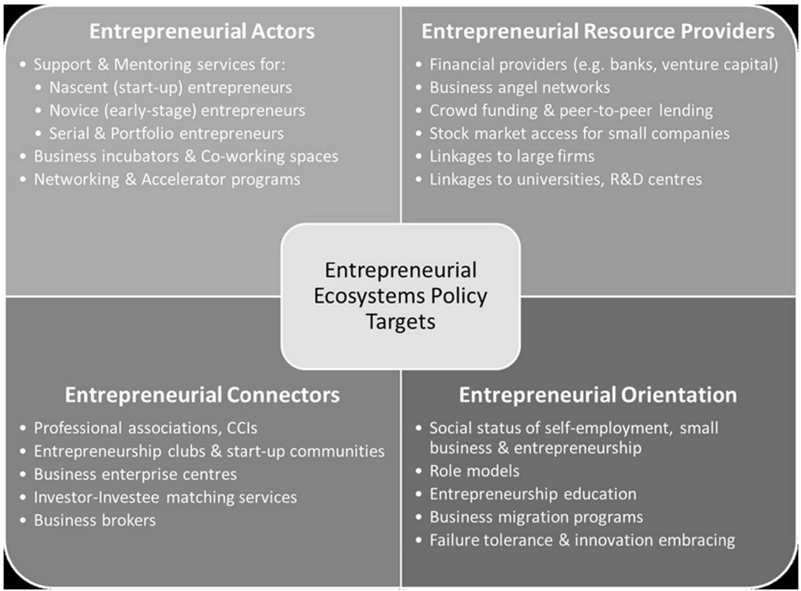
“The methods involved are a qualitative analysis of interviews with 16 participants in various roles in a German entrepreneurial ecosystem (i.e., entrepreneurial actors, resource providers, and connectors, see Brown & Mason, 2017) and an analysis of the international public press coverage.”
Elia, G., Margherita, A., & Passiante, G. (2020) · Technological Forecasting and Social Change · doi:10.1016/j.techfore.2019.119791 · Cited by 1,044
The lineages of the entrepreneurial ecosystem approach
Acs, Z. J., Stam, E., Audretsch, D. B., & O’Connor, A. (2017) · Small Business Economics · doi:10.1007/s11187-017-9864-8 · Cited by 1,020
“…characters of the entrepreneurial ecosystem do not address the heterogeneity that is apparent among its actors, scale, and focus, making it difficult to determine which approach to policy-making may be most useful in improving the entrepreneurial ecosystem performance (Brown and Mason 2017).”
Toward an Entrepreneurial Ecosystem Research Program
Wurth, B., Stam, E., & Spigel, B. (2022) · Entrepreneurship Theory and Practice · doi:10.1177/1042258721998948 · Cited by 789
“It is often proxied with high-growth firms (e.g., Stam & Bosma, 2015 ), which are responsible for the bulk of new job creation in devel - oped economies, making it a crucial target for economic development policy ( Brown & Mason, 2017).”
InfluentialEntrepreneurship and entrepreneurial ecosystems
Malecki, E. J. (2018) · Geography Compass · doi:10.1111/gec3.12359 · Cited by 784
“The principal characteristic of scale‐up ecosystems is their ability “to produce, support and nourish the growth of firms into larger corporate entities” (Brown & Mason, 2017, p. 14).”
BackgroundInfluential
Metadata
- Authors
- Brown, R., & Mason, C.
- Affiliations
- University of St Andrews (GB)
- University of Glasgow (GB)
- Corresponding author
- Brown, Ross
- Venue
- Small Business Economics
- Published
- 2017-05-02
- Volume
- 49
- Issue
- 1
- Pages
- 11-30
- ISSN
- 0921-898X (ISSN-L)
- 1573-0913
- OpenAlex
- W2611046202
- Cited by
- 852
- References
- 159
- Citations by year
- 2026: 104 · 2025: 124 · 2024: 120 · 2023: 99 · 2022: 102 · 2021: 103 · 2020: 82 · 2019: 78 · 2018: 31 · 2017: 8
- FWCI
- 85.67
- Type
- journal article
- Language
- en
- Open access
- hybrid
- doi.org
- Locations
- Small Business Economics (publishedVersion, cc-by)
- ENLIGHTEN (Jurnal Bimbingan dan Konseling Islam) (acceptedVersion)
- RePEc: Research Papers in Economics (submittedVersion)
- St Andrews Research Repository (St Andrews Research Repository) (submittedVersion, cc-by)
- Funders
- University of St. Andrews
- Topics
- Social Sciences › Business, Management and Accounting › Management of Technology and Innovation › Entrepreneurship Studies and Influences
- Social Sciences › Business, Management and Accounting › Management of Technology and Innovation › University-Industry-Government Innovation Models
- Social Sciences › Sociology and Political Science › Migration, Ethnicity, and Economy
- Keywords
- entrepreneurial ecosystems, ecosystem concept, ecosystem heterogeneity, multi-actor systems, entrepreneurship policy
About these checks
Registry, retraction, Cites and statistics results are computed, not judged, with one exception: a printed reference that no index lists is read once by a model before it counts as a citation error. Claims are extracted by a model and kept only when their quote appears verbatim in the text; each cited source is then checked, with a model’s help, for whether it says what the claim relies on. Those verdicts can be wrong — read the claim’s quote and the cited source before relying on one.
Statistics and arithmetic are recomputed, not judged.
Confidence bands are shown only for fields calibrated on our annotated test set. None is calibrated yet, so no band is shown.
What counts as a claim ›How we measure confidence ›How we check this ›
Are you an author, or do you see a problem with this page? Request a review
Data sources
Bibliographic data: Semantic Scholar, OpenAlex, Crossref.
Contains information from the Semantic Scholar Academic Graph Datasets, made available under the ODC Attribution License (ODC-BY 1.0).
Semantic Scholar’s data is described in: Kinney, R., et al. (2023). The Semantic Scholar Open Data Platform. arXiv:2301.10140.
