

The DOI matches its Crossref record; 251 of the 251 references it cites were found in a registry or an index; 36 of the 199 sources its claims cite were checked for support.
Toward an Entrepreneurial Ecosystem Research Program
Open accessAbstract
Entrepreneurial ecosystems have become a prominent concept, yet in its current state, the concept itself represents a paradox. While it draws on a rich intellectual history and provides an opportunity to synthesize different strands of research, it is also under-theorized and the mechanisms that govern ecosystem evolution are not well understood. This paper takes stock of recent advancements in ecosystem scholarship and synthesizes the empirical reality of the causal mechanisms. We use these dynamics to position ecosystems in a broader context, within and beyond the domain of entrepreneurship research, and propose a transdisciplinary research program for ecosystem research and practice.
Overview
CoChat Summary
TL;DR
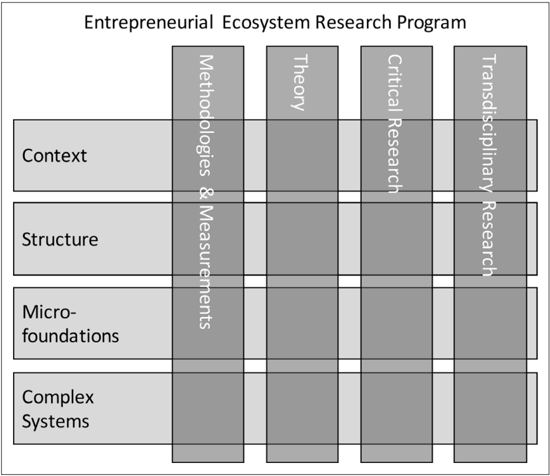
This paper reviews entrepreneurial ecosystem scholarship and argues the concept remains under-theorized, with the mechanisms governing ecosystem evolution not well understood. It synthesizes empirical causal mechanisms and proposes a transdisciplinary research program organized around context, structure, microfoundations, and complex systems.
Key findings
- The systematic review’s final sample contains 62 empirical articles; the initial search yielded 724 articles, reduced to an intermediate sample of 183, with 44 papers studying ecosystems at the city or regional level and 18 at the national level.
- The review identifies causal mechanisms linking ecosystem elements to outputs and outcomes: intra-layer interdependence among elements, upward causation from elements to outputs/outcomes, downward causation and path dependency/feedback, and inter-ecosystem links.
- Country-level studies link entrepreneurial ecosystems to economic growth and find mature ecosystems enable knowledge spillovers and more efficient resource allocation; regional evidence on whether ecosystems moderate the entrepreneurship–economic growth relationship is mixed, with Bruns et al. (2017) finding no moderating effect and Szerb et al. (2019) finding a positive moderating effect.
- The paper proposes a transdisciplinary entrepreneurial ecosystem research program with four research streams (context, structure, microfoundations, complex systems) and four cross-sectional themes (methodologies and measurements, theory, critical research, transdisciplinary research).
Methods
- Systematic literature review using Web of Science and Scopus, with topic searches for terms such as “entrep* ecosys*,” “startup ecosys*,” and “sys* of entrep*,” yielding an initial 724 articles.
- The review restricted sources to the top 25% Scimago-ranked journals in relevant business, management, economics, geography, and urban studies subareas, producing an intermediate sample of 183 articles; after in-depth reading and exclusions, 62 empirical articles remained.
- Analysis was guided by the Stam (2015) and Stam and Van de Ven (2019) framework to identify causal mechanisms: intra-layer causation, upward causation, downward causation/feedback, and inter-ecosystem links.
Limitations
- The paper states that ecosystem research is fragmented and heterogeneous, under-theorized, and that mechanisms governing ecosystem evolution are not well understood; much literature uses the ecosystem concept metaphorically without taking interdependence seriously.
- The paper states there is a lack of empirical evidence on path dependency and ecosystem boundaries, and that research is dominated by observational and case-study methods, making causality difficult to infer; it also warns of the ecological fallacy and notes that non-Gaussian distributions are often ignored.
- Evident from the methods: the review is limited to journal articles in top 25% journals, excluding book chapters, conference papers, and non-empirical work, and the final sample of 62 articles may narrow the evidence base.
Model-written summary of a shortened version of the paper’s full text (it is longer than we read). Check it against the paper before relying on it.
Integrity signals
Registry
Cites
Statistics
Figures

Verification
Claims the paper makes
31 Valid · 16 Not valid · 116 Not checked · 37 Own results and interpretations
The cited sources support only part of this claim — read each source’s verdict below.
In the paper
“There is also a subset of studies that focus on a singular innovation project within in a spatial setting, not looking at the aggregate preva -lence of entrepreneurship, nor at the interdependencies in the ecosystem at large (e.g., DiVito & Ingen- Housz, 2019).”
What the sources say
- Partly supportedcites DiVito & Ingen-Housz, 2019 sourceExperimental — accuracy not yet measured
The Methods section describes a single collaborative innovation project in Amsterdam and says the study does not aim to reveal relationships between variables, supporting the project-level and spatial characterization. But it names the broader ecosystem as a unit of analysis, and the Introduction explicitly says the study examines interdependencies among ecosystem actors. The claim that it does not look at those interdependencies is therefore unsupported. Page numbers are not available in our copy. (LLM, conf=0.88)
plain- Asserted: passes — The authors put it forward as true.
- Checkable: passes — It can be checked against evidence.
- Load-bearing: unclear — It is unclear whether the paper’s conclusions depend on it.
- Based: passes — The paper gives a reason why it holds.
- Partly supported
The cited sources support only part of this claim — read each source’s verdict below.
In the paper
“which are responsible for the bulk of new job creation in devel -oped economies, making it a crucial target for economic development policy ( Brown & Mason, 2017).”
What the sources say
- Partly supportedcites Brown & Mason, 2017 sourceExperimental — accuracy not yet measured
Section 4.1.2, “Blockbuster entrepreneurship” (page unavailable), says that a tiny number of UK firms contribute disproportionately to job creation by high-growth firms. That supports their importance as job creators, but it does not establish that high-growth firms account for the bulk of all new jobs across developed economies. (LLM, conf=0.85)
plainstates a cause- Asserted: passes — The authors put it forward as true.
- Checkable: passes — It can be checked against evidence.
- Load-bearing: unclear — It is unclear whether the paper’s conclusions depend on it.
- Based: passes — The paper gives a reason why it holds.
- Rests on an assumption not shown here.
- Partly supported
Every source the paper cites for this claim was checked and supports it.
In the paper
“An example is the investment in physical infrastructure without supporting the underlying cultural and social support, which turned planned innovation hotspots into empty real estate (Pugh et al., 2018).”
What the sources say
- Supportedcites Pugh et al., 2018 source
The Discussion and Conclusion says Technium buildings had low occupancy and that firms received little on-site support beyond physical space. The passage labelled Table 4 about here describes a lack of softer support and local networks, with empty space ultimately leased out as the government became a landlord. Together, these support the citing sentence’s paraphrase. (LLM, conf=0.89)
plainstates a cause- Asserted: passes — The authors put it forward as true.
- Checkable: passes — It can be checked against evidence.
- Load-bearing: passes — The paper’s conclusions depend on it.
- Based: passes — The paper gives a reason why it holds.
- Supported
The cited sources support only part of this claim — read each source’s verdict below.
In the paper
“These co- evolutionary dynamics are the result of the interactions of individuals within eco -systems ( Johnson et al., 2019 ; Thompson et al., 2018).”
What the sources say
- Partly supportedcites Johnson et al., 2019 sourceExperimental — accuracy not yet measured
Section 5.1 links the evolution of university-centered entrepreneurial ecosystems to agents’ behavior and their interconnected responses. The Conclusion adds that evolution depends on both those responses and the built environment; the claim broadens this finding to ecosystems generally and leaves out that additional factor. Page numbers are unavailable in our copy. (LLM, conf=0.83)
- Supportedcites Thompson et al., 2018 source
The Discussion (p. 27) states that a field-theory approach considers 'how individuals doing things together contributes to the particular features and dynamics of an ecosystem,' and the Introduction (p. 4) credits endogenous, bottom-up, time-patterned processes driven by micro social interaction, with interactions and shared meanings becoming 'common and mutually reinforcing' across the phase transition (pp. 4, 26). Our copy does not use the term 'co-evolutionary' (searches for it returned only semantic matches), but it substantively treats ecosystem dynamics as the product of actor interactions within the ecosystem, so the paraphrase is carried. The one narrowing worth noting is that the paper bounds this to the early moments of ecosystem formation in its Seattle social-impact setting and pairs interactions with shared meanings rather than interactions alone. (LLM, conf=0.82)
plainstates a cause- Asserted: passes — The authors put it forward as true.
- Checkable: passes — It can be checked against evidence.
- Load-bearing: unclear — It is unclear whether the paper’s conclusions depend on it.
- Based: passes — The paper gives a reason why it holds.
- Partly supported
Every source the paper cites for this claim was checked and supports it.
In the paper
“Ecosystem configurations can vary significantly and new policies/investments should develop support among underlying social and cultural attributes [53] Spigel (2017)”
What the sources say
- Supportedcites Spigel (2017) source
Section 2.4 states that entrepreneurial ecosystems can have multiple possible configurations. Section 3.1 likewise describes different configurations and relationships among ecosystem attributes, supporting the claim that configurations vary. (LLM, conf=0.92)
plain- Asserted: passes — The authors put it forward as true.
- Checkable: passes — It can be checked against evidence.
- Load-bearing: unclear — It is unclear whether the paper’s conclusions depend on it.
- Based: passes — The paper gives a reason why it holds.
- Supported
81 more claims · 12 with their cited sources checked
Create a free account to see all 200 claims and to verify the 26 references still open.
- Probably not a substantial claim. 82
- It may state two separate claims as one. 52
Self-check
Percentages, sums and reported differences re-computed from the paper’s own numbers.
Each contradiction between two passages listed here was confirmed by an independent check.
Rated minor: it would not touch a result — a value no result rests on, a p-value that stays on the same side of the significance level, or a conflict that is clerical, resolved elsewhere in the paper, or outside its own findings.
In the paper
§ Microfoundations · p. 24
“We must be aware of the ecological fallacy (Robinson, 2009 )”
§ References · p. 47
“- Robinson, W. S. (1950). Ecological correlations and the behavior of individuals.”
Citations
Cites
The Theory of Economic Development
Schumpeter, J., & Backhaus, U. (2006) · The European Heritage in Economics and the Social Sciences · doi:10.1007/0-306-48082-4_3 · Cited by 22,506
Introductory Econometrics: A Modern Approach
Wooldridge, J. M. (1999) · Cited by 14,451
(1993) · Journal of the American Dietetic Association · doi:10.1016/0002-8223(93)92196-5 · Cited by 11,976
Teece, D. J. (1986) · Research Policy · doi:10.1016/0048-7333(86)90027-2 · Cited by 7,842 · cited 1×
“Untraded interdependencies include the complementarities between actors and resources, and information flows which do not entirely correspond to the flows of commodities (Richardson, 1972 ; Teece, 1986 , 1998; Tripsas, 1997).”
Competing Technologies, Increasing Returns, and Lock-In by Historical Events
Arthur, W. B. (1989) · The Economic Journal · doi:10.2307/2234208 · Cited by 7,489 · cited 1×
“The concept of path dependency goes back to the work by David (1988) and Arthur (1989) and “can be used to offer an understanding of why some optional developments are followed, or intention - ally chosen, over others […] path dependence conditions, but does not determine, a specific outcome”…”
Analyzing the Past to Prepare for the Future: Writing a Literature Review
Webster, J., & Watson, R. T. (2002) · MIS Quarterly · doi:10.2307/4132319 · Cited by 7,449
Teece, D. (1993) · Research Policy · doi:10.1016/0048-7333(93)90063-n · Cited by 7,242
Clusters and the new economics of competition.
Porter, M. E. (1998) · PubMed · Cited by 5,679
Clusters and the New Economics of Competition
Milošević, D. (2014) · Harvard business review · Cited by 4,853
Beyond Markets and States: Polycentric Governance of Complex Economic Systems
Ostrom, E. (2010) · American Economic Review · doi:10.1257/aer.100.3.641 · Cited by 4,529 · cited 2×
“In combination with insights from polynuclear governance (Ostrom, 2010) and multilevel governance (Bache et al.”
Research works printed but not linked: 21
- *Bennett D. L, 2020, Small Business Economics, 30
- *Biru A., 2020, Entrepreneurship & Regional Development, 16, 1
- *Bischoff K, 2019, Small Business Economics, 32
- 10.1016/S0149-2063_03_00013-8 · doi:10.1016/s0149-2063_03_00013-8 · Paper page
- Cao Z., 2020, Small Business Economics, 51
- David P. A. (1988). Path-dependence: Putting the past into the future of economics . Institute for Mathematical Studies in the Social Sciences Technical Report No. 533: Stanford University Press.
- DiVito L., 2019, Small Business Economics, 43, 1
- World Economic Forum, 2014, Entrepreneurial ecosystems around the globe and early-stage company growth dynamics
- Freeman C, 1995, Cambridge Journal of Economics, 19, 5
- Isenberg D, 2010, Harvard Business Review, 88, 40
- Krugman P, 1991, Geography and trade
- Loots E., 2020, Growth and Change, 30
- Marshall A, 1920, Principles of Economics
- O’Shea G., 2019, Small Business Economics, 1
- *Pittz T. G., 2019, Small Business Economics, 43
- Porter M. E, 1998, Harvard Business Review, 76, 77
- *Pugh R., 2019, Small Business Economics, 47
- *Stam E., 2019, Small Business Economics
- Startup Genome, 2020, The Global Startup Ecosystem Report GSER 2020: The New Normal for the Global Startup Economy and the Impact of COVID-19
- *Wagner M., 2019, Small Business Economics, 10
- Webster J., 2002, MIS Quarterly, 26, xiii
Cited by
Building sustainable entrepreneurial ecosystems: A holistic approach
Theodoraki, C., Dana, L.-P., & Caputo, A. (2022) · Journal of Business Research · doi:10.1016/j.jbusres.2021.11.005 · Cited by 297
Measure Twice, Cut Once: Entrepreneurial Ecosystem Metrics
Leendertse, J., Schrijvers, M., & Stam, E. (2022) · Research Policy · doi:10.1016/j.respol.2021.104336 · Cited by 282
Self-citationFocusing the ecosystem lens on innovation studies
Baldwin, C. Y., Bogers, M. L. A. M., Kapoor, R., & West, J. (2024) · Research Policy · doi:10.1016/j.respol.2023.104949 · Cited by 170
Digital infrastructure and entrepreneurial action-formation: A multilevel study
Schade, P., & Schuhmacher, M. C. (2022) · Journal of Business Venturing · doi:10.1016/j.jbusvent.2022.106232 · Cited by 153
Unpacking the process of resource allocation within an entrepreneurial ecosystem
Shi, X., & Shi, Y. (2021) · Research Policy · doi:10.1016/j.respol.2021.104378 · Cited by 141
Metadata
- Authors
- Wurth, B., Stam, E., & Spigel, B.
- Affiliations
- University of Strathclyde (GB)
- Utrecht University (NL)
- University of Edinburgh (GB)
- Corresponding author
- Wurth, Bernd
- Venue
- Entrepreneurship Theory and Practice
- Publisher
- SAGE Publications
- Published
- 2021-03-22
- Volume
- 46
- Issue
- 3
- Pages
- 729-778
- ISSN
- 1042-2587 (ISSN-L)
- 1540-6520
- OpenAlex
- W3128170268
- Cited by
- 789
- References
- 238
- Citations by year
- 2026: 181 · 2025: 190 · 2024: 159 · 2023: 132 · 2022: 92 · 2021: 35
- FWCI
- 89.59
- Type
- journal article
- Language
- en
- Open access
- hybrid
- doi.org
- Locations
- Entrepreneurship Theory and Practice (publishedVersion, cc-by)
- ENLIGHTEN (Jurnal Bimbingan dan Konseling Islam) (acceptedVersion, cc-by-sa)
- Strathprints: The University of Strathclyde institutional repository (University of Strathclyde) (submittedVersion)
- RePEc: Research Papers in Economics (submittedVersion)
- Utrecht University Repository (Utrecht University) (submittedVersion, other-oa)
- Edinburgh Research Explorer (University of Edinburgh) (submittedVersion, cc-by)
- Funders
- Universiteit Utrecht
- Topics
- Social Sciences › Business, Management and Accounting › Management of Technology and Innovation › Entrepreneurship Studies and Influences
- Social Sciences › Business, Management and Accounting › Management of Technology and Innovation › University-Industry-Government Innovation Models
- Social Sciences › Business, Management and Accounting › Strategy and Management › Innovation and Knowledge Management
- Keywords
- entrepreneurial ecosystems, ecosystem evolution, causal mechanisms, transdisciplinary research, entrepreneurship research agenda, ecosystem theory
About these checks
Registry, retraction, Cites and statistics results are computed, not judged, with one exception: a printed reference that no index lists is read once by a model before it counts as a citation error. Claims are extracted by a model and kept only when their quote appears verbatim in the text; each cited source is then checked, with a model’s help, for whether it says what the claim relies on. Those verdicts can be wrong — read the claim’s quote and the cited source before relying on one.
The claim verdicts this report counts are experimental: their accuracy is not yet measured.
A language model drew the claims from the paper on 2026-10-29, under version 3 of the claim definition (model deepseek-v4.1-flash, prompt extract-v3).
A second model labelled each claim on 2026-10-29 (model jev-1.13-20260917, definition revision gold-guideline-v0.2).
Cited sources are checked with a language model’s help (gpt-6-sol and qwen3.8-omni-flash).
Statistics and arithmetic are recomputed, not judged.
Confidence bands are shown only for fields calibrated on our annotated test set. None is calibrated yet, so no band is shown.
What counts as a claim ›How we measure confidence ›How we check this ›
Are you an author, or do you see a problem with this page? Request a review
How to cite
Cite CoChat for the checks on this page, and the paper for its own findings.
- This page
- CoChat. (2026). Citation check: Toward an Entrepreneurial Ecosystem Research Program. https://app.cochat.ai/papers/10.1177/1042258721998948
- The paper
- Wurth, B., Stam, E., & Spigel, B. (2022). Toward an Entrepreneurial Ecosystem Research Program. Entrepreneurship Theory and Practice. https://doi.org/10.1177/1042258721998948
Data sources
Bibliographic data: Semantic Scholar, OpenAlex, Crossref.
Contains information from the Semantic Scholar Academic Graph Datasets, made available under the ODC Attribution License (ODC-BY 1.0).
Semantic Scholar’s data is described in: Kinney, R., et al. (2023). The Semantic Scholar Open Data Platform. arXiv:2301.10140.
