

Towards investigating the validity of measurement of self-regulated learning based on trace data
Open accessThe DOI matches its Crossref record; 53 of the 54 references it cites were found in a registry or an index.
Abstract
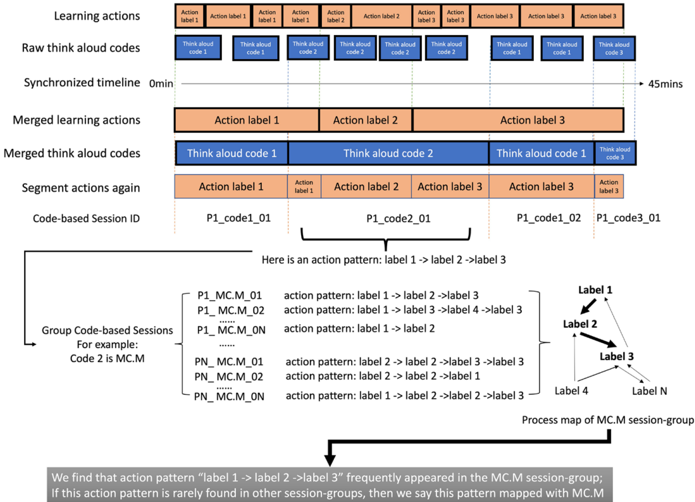
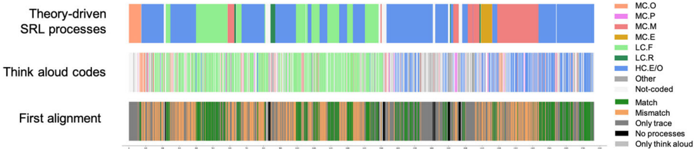
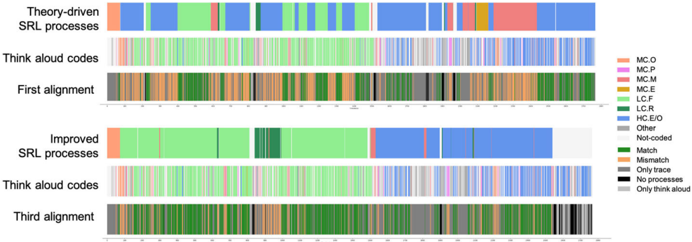
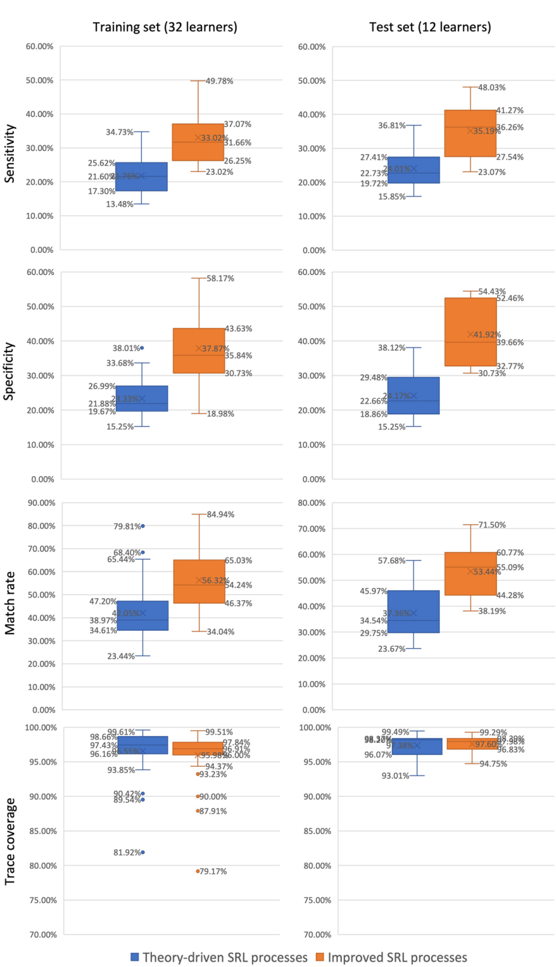
Contemporary research that looks at self-regulated learning (SRL) as processes of learning events derived from trace data has attracted increasing interest over the past decade. However, limited research has been conducted that looks into the validity of trace-based measurement protocols. In order to fill this gap in the literature, we propose a novel validation approach that combines theory-driven and data-driven perspectives to increase the validity of interpretations of SRL processes extracted from trace-data. The main contribution of this approach consists of three alignments between trace data and think aloud data to improve measurement validity. In addition, we define the match rate between SRL processes extracted from trace data and think aloud as a quantitative indicator together with other three indicators (sensitivity, specificity and trace coverage), to evaluate the “degree” of validity. We tested this validation approach in a laboratory study that involved 44 learners who learned individually about the topic of artificial intelligence in education with the use of a technology-enhanced learning environment for 45 minutes. Following this new validation approach, we achieved an improved match rate between SRL processes extracted from trace-data and think aloud data (training set: 54.24%; testing set: 55.09%) compared to the match rate before applying the validation approach (training set: 38.97%; test set: 34.54%). By considering think aloud data as “reference point”, this improvement of the match rate quantified the extent to which validity can be improved by using our validation approach. In conclusion, the novel validation approach presented in this study used both empirical evidence from think aloud data and rationale from our theoretical framework of SRL, which now, allows testing and improvement of the validity of trace-based SRL measurements.
Overview
The claims and statistics of this paper haven’t been checked yet.
Free: it reads the open-access text and checks the first 5 claims that cite a source we can check. Create a free account to check every claim.
Integrity signals
Registry
Cites
Statistics
Figures
Verification
Claims the paper makes
The claims and statistics of this paper haven’t been checked yet.
Free: it reads the open-access text and checks the first 5 claims that cite a source we can check. Create a free account to check every claim.
Claims other papers make about this one
Each is checked against this paper’s own text: does it say what the citing paper says it does?
The cited source says what the claim attributes to it.
In the citing paper
“Coding was performed by experts using theory-driven guidelines and a tracing protocol adapted from validated methods for measuring SRL via trace data (Fan et al., 2022; Rakovic et al., 2022; Li et al., 2023; van der Graaf et al., 2023a; Lim et al., 2023).”
From Towards reliable generative AI-driven scaffolding: Reducing hallucinations and enhancing quality in self-regulated learning support (2026) · cites this paper as Fan et al., 2022
The cited source says what the claim attributes to it.
In the citing paper
“We measured SRL processes via trace data with Fan et al.'s (2022) approach, using an SRL process library (see Appendix A) that parsed raw data into sequences of learning actions representing SRL activities.”
From How do students regulate their learning with a genAI chatbot? (2026) · cites this paper as Fan et al.'s (2022)
In the citing paper
“Specifically, AI can detect the SRL processes automatically in the separate data streams and at the same time determine the synchronicity between the different layers, such as the work in FLoRa (Fan et al., 2022).”
From Measuring self-regulated learning and the role of AI: Five years of research using multimodal multichannel data (2023) · cites this paper as Fan et al., 2022
In the citing paper
“The flora project validated the algorithms by first building a theory-driven process library and then training a multimodal data-driven process library on top of it (Fan et al., 2022).”
From Measuring self-regulated learning and the role of AI: Five years of research using multimodal multichannel data (2023) · cites this paper as Fan et al., 2022
Self-check
Percentages, sums and reported differences re-computed from the paper’s own numbers.
The self-check needs the paper’s full text.
Citations
Cites
Cohen, J. (1992) · Psychological Bulletin · doi:10.1037//0033-2909.112.1.155 · Cited by 8,771
The Role of Goal Orientation in Self-Regulated Learning
Pintrich, P. R. (2000) · Handbook of Self-Regulation · doi:10.1016/b978-012109890-2/50043-3 · Cited by 5,173
A Conceptual Framework for Assessing Motivation and Self-Regulated Learning in College Students
Pintrich, P. R. (2004) · Educational Psychology Review · doi:10.1007/s10648-004-0006-x · Cited by 3,269 · cited 1×
“To date, researchers have proposed several theoretical models to describe SRL processes (e.g., Winne and Hadwin (1998), Pintrich (2004), and Zimmerman (2000)).”
BackgroundMeasuring Self-Regulated Learning
Winne, P. H., & Perry, N. E. (2000) · Handbook of Self-Regulation · doi:10.1016/b978-012109890-2/50045-7 · Cited by 1,383
Kizilcec, R. F., Pérez-Sanagustín, M., & Maldonado, J. J. (2017) · Computers & Education · doi:10.1016/j.compedu.2016.10.001 · Cited by 1,003 · cited 2×
“Building on the previous literature (Siadaty et al., 2016b, c; Saint et al., 2020a, b; Kizilcec et al., 2017), we conducted multiple rounds of in-depth discussion to construct the theorydriven process library that is based on our theoretical framework.”
BackgroundDoes adaptive scaffolding facilitate students’ ability to regulate their learning with hypermedia?
Azevedo, R., Cromley, J. G., & Seibert, D. (2004) · Contemporary Educational Psychology · doi:10.1016/j.cedpsych.2003.09.002 · Cited by 473 · cited 1×
“…scheme operationalises five macro-level SRL processes such as planning, monitoring and strategy use, which are further subdivided into 35 micro-level SRL processes such as judgement of learning, self-questioning and content evaluation, as per (Azevedo et al., 2004, 2005; Greene et al., 2008).”
MethodToward Meta-cognitive Tutoring: A Model of Help Seeking with a Cognitive Tutor
Aleven, V., McLaren, B., Roll, I., & Koedinger, K. (2006) · International Journal of Artificial Intelligence in Education · doi:10.3233/irg-2006-16(2)02 · Cited by 406
Improving Measurements of Self-Regulated Learning
WINNE, P. H. (2010) · Educational Psychologist · doi:10.1080/00461520.2010.517150 · Cited by 405 · cited 12×
“Once the trace-based measurement protocols are validated, they could and should be combined with think aloud protocols to measure and describe “a fuller picture” of SRL (Winne, 2010).”
BackgroundMethodInfluentialMotivated Strategies for Learning Questionnaire
Pintrich, P. R., & De Groot, E. V. (2012) · PsycTESTS Dataset · doi:10.1037/t09161-000 · Cited by 399
The Experience of Agency: Feelings, Judgments, and Responsibility
Haggard, P., & Tsakiris, M. (2009) · Current Directions in Psychological Science · doi:10.1111/j.1467-8721.2009.01644.x · Cited by 367 · cited 1×
“In these models, learners are commonly considered as agents (Haggard & Tsakiris, 2009) who decide which learning processes they should engage in to accomplish their goals for learning (Dunlosky & Thiede, 2013).”
Background
Research works printed but not linked: 6
- 7. Azevedo, R., & Witherspoon, A. (2009). Self-regulated learning with hypermedia. In Handbook of metacog- nition in education (pp. 331-351). Routledge.
- 13. Biswas, G., Segedy, J. R., & Kinnebrew, J. S. (2014). "A Combined Theory-and Data-Driven Approach for Interpreting Learners' Metacognitive Behaviors in Open-Ended Tutoring Environments. Design recommendations for intelligent tutoring systems, 2, 135.
- 17. Fan, Y., Lim, L., van der Graaf, J., Kilgour, J., Engelmann, K., Bannert, M., Molenaar, I., Moore, J., & Gase- vic, D. (2020). Measuring Micro-Level Self-Regulated Learning Processes with Enhanced Log Data and Eye Tracking Data.pdf. In Companion Proceedings 10th International Conference on Learning Analytics & Knowledge (LAK20) (pp. 433-436).
- 21. Günther, C. W., & Rozinat, A. (2012). Disco: discover your processes. BPM (Demos), 940, 40-44. Publisher: Citeseer.
- 56. Winne, P. H., & Hadwin, A. F. (2007). The weave of motivation and self-regulated learning. In Motivation and Self-Regulated Learning. Routledge. Num Pages: 18.
- 59. Zimmerman, B. J. (2000). Chapter 2 -attaining self-regulation: a social cognitive perspective. In M. Boekaerts, P. R. Pintrich, & M. Zeidner (Eds.) Handbook of Self-Regulation (pp. 13-39). San Diego: Academic Press.
Cited by
Items 101–126 of 126
Consistent Performance in Adaptive Learning Technologies as a Measure of Self-Regulated Learning
Ring, J., Hinne, M., & Molenaar, I. (2026) · International Conference on Learning Analytics and Knowledge (LAK) · doi:10.1145/3785022.3785068
Self-citationIda, L., & Odja, A. H. (2026) · JURNAL EDUSCIENCE · doi:10.36987/jes.v13i2.8549
Measuring task-level behavioral learning engagement during text revision
Schiller, R., Fleckenstein, J., Mertens, U., & Meyer, J. (2026) · Computers & Education · doi:10.1016/j.compedu.2026.105656
Aksela, O., Lämsä, J., & Järvelä, S. (2026) · Behaviour and Information Technology · doi:10.1080/0144929x.2026.2666284
Third and fifth graders’ self-regulation in multiple digital documents reading
Troncoso‐Ruiz, A., van de Ven, M., & Segers, E. (2026) · Computers in Human Behavior Reports · doi:10.1016/j.chbr.2026.101127
Leren over leren met AI: Het Flora Lighthouse Project
van der Graaf, J., West, H. V. D., de Mooij, S. M. M., & Molenaar, I. (2026) · Onderzoek van Onderwijs · doi:10.66802/yj6dpx47
Self-citationThree Paths to Adaptation: Temporal Profiles of Self-Regulated Learning with Generative AI Support
Alghamdi, S. R., Raković, M., Fan, Y., Chen, G., Yang, K., Li, X. Q., & Gašević, D. (2026) · Lecture notes in computer science · doi:10.1007/978-3-032-29770-9_40
Self-citationChuang, C. K., Dai, W., Li, T., Lin, J., Li, X., Fan, Y., & Gašević, D. (2026) · Lecture notes in computer science · doi:10.1007/978-3-032-29763-1_12
Self-citationWang, C., CHEN, Y., & Wang, G. (2026) · Behavioral Sciences · doi:10.3390/bs16071200
Human or GenAI Support? Conditions Impacting Students' Strategy Choices in an Essay Revision Task
Iqbal, S., Jovanović, J., Fan, Y., Raković, M., Li, X., Chen, G., & Gašević, D. (2026) · Journal of Computer Assisted Learning · doi:10.1002/jcal.70300
Self-citationAskarnia, M., Cheon, J., & Park, E. (2026) · SSRN Electronic Journal · doi:10.2139/ssrn.7269178
Zhang, J., Yang, Y., & Niu, X. (2026) · The Internet and Higher Education · doi:10.1016/j.iheduc.2026.101106 · Cited by 1
Lämsä, J., & Järvelä, S. (2026) · Theory Into Practice · doi:10.1080/00405841.2026.2721203
Lu, X., Lu, Y., Ren, S., & Zhang, D. (2026) · International Journal of Science Education · doi:10.1080/09500693.2026.2701381
Alnashiri, H., Raković, M., Nawaz, S., Li, X., Fernandez-Nieto, G. M., Qian, K., Lämsä, J., Lim, L., Bannert, M., Järvelä, S., et al. (2026) · Journal of Computer Assisted Learning · doi:10.1002/jcal.70331
Self-citationRodríguez‐Triana, M. J., Prieto, L. P., Saban, M., Asensio-Pérez, J. I., Villa-Torrano, C., Haba-Ortuño, I., & Gillet, D. (2026) · Journal of Computer Assisted Learning · doi:10.1002/jcal.70334
Lin, M. P.-C., & Chang, D. (2026) · SSRN Electronic Journal · doi:10.2139/ssrn.7544941
NEW APPROACHES TO ASSESSING STUDENTS' INDEPENDENT WORK IN THE ERA OF GENERATIVE AI
Shakirova, S. (2026) · MAKTABGACHA VA MAKTAB TA’LIMI JURNALI · doi:10.5281/zenodo.23064760
Athavale, S., Lim, L., & Bannert, M. (2026) · Metacognition and Learning · doi:10.1007/s11409-026-09500-1
“We used a Moodle-based learning environment embedded with digital tools, as in prior SRL studies (Fan et al., 2022b; Li et al., 2024; Lim et al., 2023; van der Graaf et al., 2022).”
InfluentialSelf-citationHorvers, A., Molenaar, I., Snoeijen, K., Costache, O., van der Graaf, J., Kramer, A., de Mooij, S. M. M., Topali, P., Vermeire, Z., & Sleegers, P. J. C. (2026) · Behaviour and Information Technology · doi:10.1080/0144929x.2026.2740744 · Cited by 1
Self-citationLuu, A., Nguyen, A., Duong, N.-A.-T., Dang, B., & Ng, D. T. K. (2026) · IEEE International Conference on Advanced Learning Technologies (ICALT) · doi:10.1109/icalt68022.2026.00082
“The integration of trace data into SRL research represents a significant advance in capturing the nuanced, real-time learning processes that underpin successful self-regulation [19].”
Horz, H., Czora, P., Mendzheritskaya, J., Naumann, P., & Zirenko, M. (2026) · Behavioral Sciences · doi:10.3390/bs16101938
“No recorded action is itself S, A, or M. Theory-linked inferences require other methods and tests of alternative explanations (Boulahmel et al., 2025; Fan et al., 2022).”
Digital Scaffolding for Self-Regulated Learning in English Language Teaching: A Systematic Review
Sukmawati, S., Abduh, A., & Sulaiman, I. (2026) · FOSTER Journal of English Language Teaching · doi:10.24256/foster-jelt.v7i4.457
Plans and Strategy Use in Higher Education: A Narrative Review of Measurement Alignment
Awal, J. (2026) · EDUSOSHUM Journal of Islamic Education and Social Humanities · doi:10.52366/edusoshum.v6i3.694
A GitHub Proxy Framework for Promoting SRL and Student Agency in Software Engineering Capstones
Lu, J., Misiejuk, K., López‐Pernas, S., Saqr, M., Vassar, A., Renzella, J., & de Oliveira, E. A. (2026) · Koli Calling International Conference on Computing Education Research · doi:10.1145/3856208.3856258
Metadata
- Authors
- Fan, Y., van der Graaf, J., Lim, L., Raković, M., Singh, S., Kilgour, J., Moore, J., Molenaar, I., Bannert, M., & Gašević, D.
- Affiliations
- University of Edinburgh (GB)
- Technical University of Munich (DE)
- Monash University (AU)
- Radboud University Nijmegen (NL)
- Corresponding author
- Fan, Yizhou
- ORCID
- Venue
- Metacognition and Learning
- Published
- 2022-05-04
- Volume
- 17
- Issue
- 3
- Pages
- 949-987
- ISSN
- 1556-1623 (ISSN-L)
- 1556-1631
- OpenAlex
- W4225374280
- Semantic Scholar
- 97d3a315dac3e647bad116f94651f3c4e455b42b
- Cited by
- 101
- References
- 54
- Citations by year
- 2026: 33 · 2025: 27 · 2024: 23 · 2023: 11 · 2022: 7
- FWCI
- 13.13
- Type
- journal article
- Language
- en
- Open access
- hybrid
- doi.org
- Licence
- cc-by
- creativecommons.org/licenses/by/4.0 (tdm)
- creativecommons.org/licenses/by/4.0 (vor)
- Locations
- Metacognition and Learning (publishedVersion, cc-by)
- Edinburgh Research Explorer (University of Edinburgh) (submittedVersion, cc-by)
- Monash University Research Portal (Monash University) (submittedVersion, other-oa)
- HAL (submittedVersion)
- mediaTUM – the media and publications repository of the Technical University Munich (Technical University Munich) (submittedVersion)
- mediaTUM – the media and publications repository of the Technical University Munich (Technical University Munich) (submittedVersion, other-oa)
- Radboud Repository (Radboud University) (submittedVersion)
- Radboud Repository (Radboud University) (submittedVersion, other-oa)
- Funders
- Deutsche Forschungsgemeinschaft (BA20144/10-1)
- Nederlandse Organisatie voor Wetenschappelijk Onderzoek (NWO464.18.104)
- Economic and Social Research Council (ES/S015701/1)
- Topics
- Physical Sciences › Computer Science › Computer Science Applications › Online Learning and Analytics
- Social Sciences › Psychology › Developmental and Educational Psychology › Innovative Teaching and Learning Methods
- Physical Sciences › Computer Science › Artificial Intelligence › Intelligent Tutoring Systems and Adaptive Learning
- Keywords
- student self-regulation, trace data, measurement validity, validation methodology, match rate, sensitivity and specificity, technology-enhanced learning environments, artificial intelligence in education, learning analytics
About these checks
Registry, retraction, Cites and statistics results are computed, not judged, with one exception: a printed reference that no index lists is read once by a model before it counts as a citation error. Claims are extracted by a model and kept only when their quote appears verbatim in the text; each cited source is then checked, with a model’s help, for whether it says what the claim relies on. Those verdicts can be wrong — read the claim’s quote and the cited source before relying on one.
Statistics and arithmetic are recomputed, not judged.
Confidence bands are shown only for fields calibrated on our annotated test set. None is calibrated yet, so no band is shown.
What counts as a claim ›How we measure confidence ›How we check this ›
Are you an author, or do you see a problem with this page? Request a review
Data sources
Bibliographic data: Semantic Scholar, OpenAlex, Crossref.
Contains information from the Semantic Scholar Academic Graph Datasets, made available under the ODC Attribution License (ODC-BY 1.0).
Semantic Scholar’s data is described in: Kinney, R., et al. (2023). The Semantic Scholar Open Data Platform. arXiv:2301.10140.
