

Learning analytics: state of the art
Open accessThe DOI matches its Crossref record; 41 of the 41 references it cites were found in a registry or an index.
Abstract
Learning Analytics is a field that measures, analyses, and reports data about students and their contexts to understand/improve learning and the place in which it occurs. Educational institutions have different motivations to use Learning Analytics . Some want to improve students' outcomes or optimize their educational technology and reduce the dropout rate and others. This concept is presented with practical experiences that have been acquired and validated by 16 institutions. Besides, an analysis of the results, challenges, and expectations was performed. It was found that the majority of initiatives use Learning Analytics to improve retention of students; few are focused merely on improving the teaching/learning process or academic issues. The organizations invest their resources in acquiring Learning Analytics software; however, most universities develop their technology. The technology helps organizations be preventive and not reactive as various models determine students at risk of failing. This information allows them to make suitable interventions, which increases the success of the initiative. CoViD19 pandemic is also put in context in this research; Learning Analytics could be a great approach to help the educational community adapt effectively to the new forms of educational delivery. Based on an exhaustive bibliographic review, various educational projects and experiences were analyzed, presenting an overview detailing applications, results, and potentialities and opportunities, hoping that this article will be a useful reference for researchers and faculty to exploit Learning Analytics education.
Overview
The claims and statistics of this paper haven’t been checked yet.
Free: it reads the open-access text and checks the first 5 claims that cite a source we can check. Create a free account to check every claim.
Integrity signals
Registry
Cites
Statistics
Figures
Verification
Claims the paper makes
The claims and statistics of this paper haven’t been checked yet.
Free: it reads the open-access text and checks the first 5 claims that cite a source we can check. Create a free account to check every claim.
Claims other papers make about this one
Each is checked against this paper’s own text: does it say what the citing paper says it does?
The source backs part of the claim, not all of it — or backs it for a different population, condition or comparison.
In the citing paper
“Studies on learning analytics indicate that teaching data are not limited to student management purposes, but can also provide evidence to help teachers improve classroom interaction, assessment design, and feedback quality (11).”
From Reframing faculty development for digital transformation and generative AI in higher education (2026) · cites this paper as [11]
Experimental — accuracy not yet measured
Self-check
Percentages, sums and reported differences re-computed from the paper’s own numbers.
The self-check needs the paper’s full text.
Citations
Cites
Impacts of the COVID-19 pandemic on life of higher education students: A global perspective
Aristovnik, A., Keržič, D., Ravšelj, D., Tomaževič, N., & Umek, L. (2020) · Sustainability · doi:10.3390/su12208438 · Cited by 2,047
Learning analytics: drivers, developments and challenges
Ferguson, R. (2012) · International Journal of Technology Enhanced Learning · doi:10.1504/ijtel.2012.051816 · Cited by 1,354 · cited 4×
“Whatever the motivation is, LA is a field that has existed since 1979 when The Open University (UK) could analyze ten years of progress of their thousands of distance students [25].”
BackgroundInfluentialThe current landscape of learning analytics in higher education
Viberg, O., Hatakka, M., Bälter, O., & Mavroudi, A. (2018) · Computers in Human Behavior · doi:10.1016/j.chb.2018.07.027 · Cited by 766 · cited 1×
“Interest inLA is high amongeducational institutions; however, adoption remains low even though the HEI sector is incrementing its use to understand better and support students learning [70].”
BackgroundUtilising learning analytics to support study success in higher education: a systematic review
Ifenthaler, D., & Yau, J. Y.-K. (2020) · Educational Technology Research and Development · doi:10.1007/s11423-020-09788-z · Cited by 659 · cited 7×
“On the other hand, studies indicate that LA has successfully allowed students to complete their courses or continue with them [32].”
BackgroundInfluentialSmart manufacturing must embrace big data
Kusiak, A. (2017) · Nature · doi:10.1038/544023a · Cited by 618 · cited 1×
“Many companies do not know what to do with all their generated data [44].,this is the case for education and manufacturing organizations.”
BackgroundPost-Covid-19 Education and Education Technology ‘Solutionism’: a Seller’s Market
Teräs, M., Suoranta, J., Teräs, H., & Curcher, M. (2020) · Postdigital Science and Education · doi:10.1007/s42438-020-00164-x · Cited by 594 · cited 1×
“This is the other side of LA (Teräs, Suoranta, Teräs, & Cur, [67].”
BackgroundAldowah, H., Al-Samarraie, H., & Fauzy, W. M. (2019) · Telematics and Informatics · doi:10.1016/j.tele.2019.01.007 · Cited by 564
Namoun, A., & Alshanqiti, A. (2020) · Applied Sciences · doi:10.3390/app11010237 · Cited by 473 · cited 1×
“Developed countries, such as the USA and those from Europe, are the ones that lead research in LA [52].”
BackgroundHandbook of Learning Analytics
(2017) · Society for Learning Analytics Research (SoLAR) eBooks · doi:10.18608/hla17 · Cited by 393 · cited 1×
“HEI is an education area that uses LA with different focuses: research, knowledge exchange, and praxis [45].”
BackgroundImpacts of the COVID-19 Pandemic on Life of Higher Education Students: A Global PerspectivePreprint
Aristovnik, A., Keržič, D., Ravšelj, D., et al. (2020) · Preprints.org · doi:10.20944/preprints202008.0246.v1 · Cited by 372
Research works printed but not linked: 22
- 4. Avella, J.T., Kebritchi, M., Nunn, S.G., Kanai, T.: Learning ana- lytics methods, benefits, and challenges in higher education : a systematic literature review. Online Learn. 20(2), 13-29 (2016)
- 7. Barana, A., Conte, A., Fissore, C., Marchisio, M., Rabellino, S.: Learning analytics to improve formative assessment strategies. J of E-Learn. and Knowledge Soc. 15(3), 75-88 (2019)
- 8. Bellini, C., Santis, ADe., Sannicandro, K., Minerva, T.: Data Man- agement in learning analytics: terms and perspectives. J. E-Learn. Knowledge Soc. 15(3), 133-144 (2019)
- 15. Charitopoulos, A., Rangoussi, M., & Koulouriotis, D.: On the Use of Soft Computing Methods in Educational Data Mining and Learning Analytics Research : a Review of Years 2010 - 2018. Int J of Artificial Intelligence in Education. Retrieved from //link.springer.com/article/10.1007%2Fs40593-020-00200-8#cit eas (2020) · DOI · Paper page
- 20. Dietz-uhler, B., Hurn, J.E.: Using learning analytics to predict (and improve) student success: a faculty perspective. J. Interactive Online Learn. 12(1), 17-26 (2013)
- 25. Ferguson, R., Brasher, A., Clow, D., Cooper, A., Hillaire, G., Mittelmeier, J., Vuorikari, R.: Research Evidence on the Use of Learning Analytics -Implications for Education Policy. (R. Vuorikari & J. Muñoz, Eds.). Joint Research Centre Science for Policy Report; EUR 28294 EN; (2016)
- 27. Hilbig, R., & Schildhauer, T.: Data analytics : the future of inno- vative teaching and learning. In The ISPIM Innovation Conference (pp. 1-17). (2019)
- 28. Huang, R.H., Liu, D.J., Tlili, A., Yang, J.F., Wang, H.H., et al.: Handbook on Facilitating FlexibleLearning During Educational Disruption: The Chinese Experience in Maintaining Undisrupted Learning in COVID-19 Outbreak. Smart Learning Institute of Bei- jing Normal University, Beijing (2020)
- 29. Hwang, G., Spikol, D., Li, K.: Trends and research issues of learn- ing analytics and educational big data. Edu. Technol. Soc. 21(2), 134-136 (2018)
- 30. Ifenthaler, D., Yau, J.: Higher education stakeholders ' views on learning analytics policy recommendations for supporting study success. Int J. Learn. Anal. Artificial Intell. Edu. 1(1), 28-42 (2019)
- 33. Joksimović, S., Kovanović, V., Dawson, S.: The journey of learning analytics. HERDSA Rev. Higher Edu. 6, 37-63 (2019)
- 34. Jones, K.M.L.: Learning analytics and higher education : a pro- posed model for establishing informed consent mechanisms to promote student privacy and autonomy. Int J. Edu. Technol. Higher Edu. 16(24), 1-22 (2019)
- 38. Kilis, S. & Uzun, A.: E-learning analytics: moodle case. multidis- ciplinary academic conference, pp 223-228. (2019)
- 46. Lee, L.K., Cheung, S.K.: Learning analytics: current trends and innovative practices. J. Comput. Edu. 7(1), 1-6 (2020) · DOI · Paper page
- 48. Lizier, A. (2020). Remember, Learning Analytics are About Learn- ing. Training and Development, pp. 1-3.
- 49. Lombardo, M.M., Eichinger, R.W.: The Career Architect Devel- opment Planner, 1st edn. Lominger, Minneapolis (1996)
- 50. Morán-Mirabal, L.F. Multimodal technologies for learning analyt- ics research. IFE Living Lab & Data Hub 52. Namoun, A., Alshanqiti, A.: Predicting student performance using data mining and learning analytics techniques: a systematic litera- ture review. Appl. Sci. 11(1), 237 (2020)
- 61. Sclater, N., Peasgood, A., & Mullan, J.: Learning analytics in higher education. A review of UK and international practice. Jisc. (2016)
- 62. Schmidt, M. T.: Assessing the Effectiveness of personalized computer-administered feedback in an introductory biology course (Doctoral dissertation, University of Saskatchewan). (2019)
- 63. Shenoy, V., Mahendra, S., Vijay, N.: COVID 19 lockdown technol- ogy adaption, teaching, learning, students engagement and faculty experience. Mukt Shabd J 9(4), 698-702 (2020)
- 67. Tsai, Y., Rates, D., Moreno-marcos, P.M., Muñoz-merino, P.J., Jivet, I., Scheffel, M., Gašević, D.: Learning analytics in european higher education -trends and barriers. Comput. Edu. 155(May), 1-15 (2020)
- 70. West, D., Heath, D., Huijser, H.: Let's talk learning analytics: a framework for implementation in relation to student retention. J. Asynchronous Learn. Netw. 20(2), 1-21 (2016)
Cited by
Susnjak, T. (2024) · International Journal of Artificial Intelligence in Education · doi:10.1007/s40593-023-00336-3 · Cited by 109
“[17] investigated the practices of 16 HEIs that have deployed LA projects.”
BackgroundMallek, F., Mazhar, T., Shah, S. F. A., Ghadi, Y. Y., & Hamam, H. (2024) · PeerJ Computer Science · doi:10.7717/peerj-cs.2000 · Cited by 138
Guo, S., Zheng, Y., & Zhai, X. (2024) · Education and Information Technologies · doi:10.1007/s10639-024-12491-8 · Cited by 117
“Reviews of learning analytics also found that a majority of studies use learning analytics to improve retention of students, while few are focused merely on improving the teaching/learning process or academic issues (Hernández-de-Menéndez et al., 2022).”
Sharif, H., & Atif, A. (2024) · Education Sciences · doi:10.3390/educsci14020176 · Cited by 80
Fairness, Trust, Transparency, Equity, and Responsibility in Learning Analytics
Khalil, M., Prinsloo, P., & Slade, S. (2023) · Journal of Learning Analytics · doi:10.18608/jla.2023.7983 · Cited by 58
Educational Data Mining: A Foundational Overview
Papadogıannıs, I., Wallace, M., & Karountzou, G. (2024) · Encyclopedia · doi:10.3390/encyclopedia4040108 · Cited by 63
“This area has become increasingly important in recent years as technology-enhanced learning and large data sets are generated [40].”
Peralta, M. A. C., Martínez, J. L. V., & Castillo-Heredia, L. (2024) · Results in Engineering · doi:10.1016/j.rineng.2024.103782 · Cited by 44
AI'S Impact on Vocational Training and Employability: Innovation, Challenges, and Perspectives
-, R. E. (2024) · International Journal For Multidisciplinary Research · doi:10.36948/ijfmr.2024.v06i04.24967 · Cited by 58
“This shift necessitates a robust understanding of AI tools and methodologies, underscoring the need for extensive teacher training and professional development [40].”
BackgroundDobashi, K., Ho, C. P., Fulford, C. P., Grace Lin, M.-F., & Higa, C. (2022) · Computers and Education: Artificial Intelligence · doi:10.1016/j.caeai.2022.100105 · Cited by 35
Suárez, C. A. H., Gamboa-Suárez, A. A., & Nuñez, R. P. (2024) · Formación universitaria · doi:10.4067/s0718-50062024000100129 · Cited by 33
Digital higher education: Emerging quality standards, practices and supports
Staring, F., Brown, M., Bacsich, P. D., & Ifenthaler, D. (2022) · OECD education working papers · doi:10.1787/f622f257-en · Cited by 66
Embracing digital learning: Benefits and challenges of using Canvas in education
Oudat, Q., & Othman, M. (2024) · Journal of Nursing Education and Practice · doi:10.5430/jnep.v14n10p39 · Cited by 31
Students' expectations of Learning Analytics across Europe
Wollny, S., Mitri, D. D., Jivet, I., Muñoz‐Merino, P. J., Scheffel, M., Schneider, J., Tsai, Y., Whitelock‐Wainwright, A., Gašević, D., & Drachsler, H. (2023) · Journal of Computer Assisted Learning · doi:10.1111/jcal.12802 · Cited by 36
Plant disease identification and pesticides recommendation using Dense Net
Banothu, S., Madhavi, K., Kumar, K. M. V. M., Gajula, R., Rao, C. M., Dixit, S., & Chhetri, A. (2024) · Cogent Engineering · doi:10.1080/23311916.2024.2353080 · Cited by 24
Sargent, J., Rienties, B., Perryman, L., & FitzGerald, E. (2023) · Journal of Interactive Media in Education · doi:10.5334/jime.805 · Cited by 23
Dixon, N., Howe, R., & Richter, U. M. (2025) · Research in Learning Technology · doi:10.25304/rlt.v33.3127 · Cited by 17
Bettahi, A., Beloudha, F.-Z., & Harroud, H. (2025) · IEEE Access · doi:10.1109/access.2025.3622103 · Cited by 18
The automated model of comprehension version 4.0 – Validation studies and integration of ChatGPT
Corlatescu, D.-G., Watanabe, M., Ruşeţi, Ş., Dascălu, M., & McNamara, D. S. (2024) · Computers in Human Behavior · doi:10.1016/j.chb.2024.108154 · Cited by 15
Kearney, C. A., Fensken, M., & Dupont, R. (2024) · Frontiers in Education · doi:10.3389/feduc.2024.1272297 · Cited by 13
Research on LMS and KPIs for Learning Analysis in Education
Krumova, M. (2023) · Smart Cities · doi:10.3390/smartcities6010029 · Cited by 12
Ortiz-Beltrán, A., Hernández‐Leo, D., & Amarasinghe, I. (2023) · Australasian Journal of Educational Technology · doi:10.14742/ajet.8958 · Cited by 13
Giler-Meza, C. A., Ayala-Cedeño, K. A., Fernández, R. L., & Mérida-Córdova, E. J. (2023) · MQRInvestigar · doi:10.56048/mqr20225.7.4.2023.2356-2373 · Cited by 11
Katsenos, I., & Pierrakeas, C. J. (2025) · Education Sciences · doi:10.3390/educsci15030279 · Cited by 12
Kaouni, M., Lakrami, F., & Labouidya, O. (2023) · IEEE Congress on Information Science and Technology (CiSt) · doi:10.1109/cist56084.2023.10409971 · Cited by 13
Analíticas de aprendizaje y su potencial para una educación de calidad sostenible
Mella-Norambuena, J., Sáez-Delgado, F., López-Angulo, Y., Sáez-Delgado, Y., & Ron, V. L. (2023) · Ciencia Latina Revista Científica Multidisciplinar · doi:10.37811/cl_rcm.v7i1.4840 · Cited by 9
Yang, X., Sitharan, R., Sharji, E. A., & Feng, H. (2024) · Soft Computing · doi:10.1007/s00500-023-09570-2 · Cited by 8
“Herna´ndez-de-Mene´ndez et al. (2022) have studied the transition of the landscape perception layer MLD model into an automaton scheduling model in the high-density, and analyzes the high-density, three-dimensional IoT landscape.”
RetractedOro, J. M. F., García-Regodeseves, P., Santamaría, L., González, J., Barrio, R., & Pandal, A. (2024) · Technology Knowledge and Learning · doi:10.1007/s10758-024-09803-9 · Cited by 7
“Learning Analytics emerges as an innovative tool (Wollny et al., 2023) to analyse data about students and its learning environment (Hernández-de-Menéndez et al., 2022).”
Žilak, M., & Car, Ž. (2025) · Applied Sciences · doi:10.3390/app15042161 · Cited by 6
Learning analytics for reducing student dropout in digital video platforms
Al-Hafdi, F. S., & Alhalafawy, W. S. (2026) · PeerJ Computer Science · doi:10.7717/peerj-cs.3532 · Cited by 5
Using educational analytics for adaptive management of academic processes in universities
Verbovskyi, I., Нrechanovska, O., Yunyk, I., Bilozerska, S., & Ivanchenko, D. (2026) · Journal of Education and e-Learning Research · doi:10.20448/jeelr.v13i2.8569 · Cited by 6
Feng, R., & Luo, J. (2024) · Education and Information Technologies · doi:10.1007/s10639-024-12980-w · Cited by 6
“…services have begun to lever - age data related to users’ learning preferences (Imran et al., 2023), knowledge acquisition states (Duan et al., 2023), learning behaviors (Hernández-de-Menéndez et al., 2022), and learning styles (Troussas et al., 2023) to recommend resources that users require.”
Eli, A. A., Rahman, A., & Kshetri, N. (2025) · Digital · doi:10.3390/digital5030042 · Cited by 6
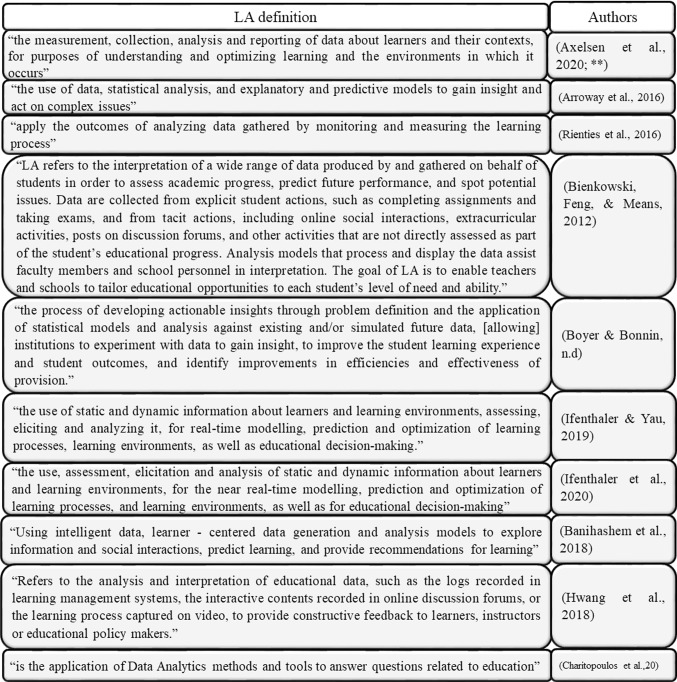
“Learning analytics is the process of gathering, examining, and interpreting data about learners and their specific situations to promote better learning outcomes and environments [16].”
Kaouni, M., Lakrami, F., & Labouidya, O. (2024) · International Journal of Information Science and Technology · doi:10.57675/imist.prsm/ijist-v8i4.258 · Cited by 5
Shegupta, U. U., Islam, M. S., & Hardt, W. (2024) · International Symposium on Computer Science and Educational Technology (ISCSET) · doi:10.1109/iscset58624.2024.10807906 · Cited by 4
Bridging the Digital Divide: Challenges and Opportunities for Sustainable EdTech in Emerging Markets
Riyat, M. K., Kakkar, A., Rana, A., & Mathur, D. (2025) · Emerald Group Publishing Limited eBooks · doi:10.1108/978-1-83549-109-620251002 · Cited by 6
Janifa, D., & Gokulakrishnan, A. (2026) · International Academic Journal of Science and Engineering · doi:10.71086/iajse/v13i2/iajse1368 · Cited by 3
Mukred, M., Ahmed, W. A., Mokhtar, U. A., & Hawash, B. (2023) · Studies in computational intelligence · doi:10.1007/978-3-031-48397-4_19 · Cited by 4
Mohammed, S. (2025) · Currents in Pharmacy Teaching and Learning · doi:10.1016/j.cptl.2025.102440 · Cited by 3
Potentialities of Learning Analytics to Overcome Students Dropout in Distance Higher Education
Hamdane, K., Mhouti, A. E., Massar, M., & Chihab, L. (2023) · Lecture notes in networks and systems · doi:10.1007/978-3-031-29857-8_40 · Cited by 3
How Well Students Perceive Their Understanding of Logic Programming Course Content?
Lovrenčić, S., & Sekovanić, V. (2023) · International Convention on Information and Communication Technology, Electronics and Microelectronics · doi:10.23919/mipro57284.2023.10159945 · Cited by 5
“The use of learning analytics enables better understanding of students' learning process and can improve learning support and teaching [23], as well as retention of students [24].”
BackgroundDigital Twin-Based Learning Analytics with Fog Computing and LLAMAPreprint
Abdelaziz, A. A., El-Ghany, S. A., & Tolba, A. S. (2024) · Preprints.org · doi:10.20944/preprints202508.0255.v1 · Cited by 3
Lines of research in the area of educational data mining in higher education: A theoretical review
Semyonkina, I. A., & Прусакова, П. В. (2023) · Pedagogy Theory & Practice · doi:10.30853/ped20230111 · Cited by 2
University Learning Analytics in the Age of Big Data: The Case of the Chinese Educational System
Li, W. (2025) · European Journal of Education · doi:10.1111/ejed.70121 · Cited by 2
Raghavjee, R., Subramaniam, P. R., & Govender, I. (2025) · Data · doi:10.3390/data11010001 · Cited by 2
From One-Size-Fits-All to AI-Driven Personalization in Education
Salendab, F. A., Baraguir, R. S., Nuñez, R. A. S., & Cogo, D. A. (2026) · Advances in computational intelligence and robotics book series · doi:10.4018/979-8-3373-2752-5.ch009 · Cited by 2
Themeli, A., Kotsifakos, D., & Psaromiligkos, Y. (2026) · Applied Sciences · doi:10.3390/app16073398 · Cited by 2
Agal, S. (2026) · Scientific Reports · doi:10.1038/s41598-026-55514-9 · Cited by 2
“Hernandez et al. (2022) 33 reviewed state of the art methods for learning analytics, highlighting the potential of hybrid approaches that combine data driven generation with expert informed constraints.”
Assessment and Analysis Through CGScholar
Saini, A. K. (2023) · Advances in educational technologies and instructional design book series · doi:10.4018/978-1-6684-5124-3.ch003 · Cited by 2
Expanding Learning Analytics in MOOCs to Track Learners' Engagement with Interactive Content
Sofyan, Z., Staubitz, T., & Meinel, C. (2023) · IEEE Learning With MOOCS (LWMOOCS) · doi:10.1109/lwmoocs58322.2023.10306066 · Cited by 2
“Learning analytics in the MOOC platform aims to be a tool to measure, diagnose and help instructors and learners to predict and finally analyze the outcome of a course [16].”
Emotional Learning Analytics in Education: Current Status, Trends, and Challenges
Tychola, K. A., Vrochidou, Ε., & Papakostas, G. A. (2024) · Advances in educational technologies and instructional design book series · doi:10.4018/979-8-3693-2663-3.ch004 · Cited by 5
Bogdanova, A. V., Aleksandrova, Y. K., Goiko, V. L., & Орлова, В. В. (2023) · Высшее образование в России · doi:10.31992/0869-3617-2023-32-10-133-150 · Cited by 2
Silva, R. (2024) · Digital Library of Theses and Dissertations (Universidade de São Paulo) · doi:10.11606/t.8.2024.tde-03072024-183251 · Cited by 2
Designing Digital Learning Content to Support a Corporate Digital Learning Strategy
Moreira, L. (2024) · Advances in human resources management and organizational development book series · doi:10.4018/979-8-3693-0556-0.ch007 · Cited by 1
A Study on Powers of Higher Education Leadership and Solutions for Challenges
Dinesh, A., Shandilya, S., Parmar, D. V., Sundharesalingam, P., & Chinnusamy, S. (2024) · Advances in educational marketing, administration, and leadership book series · doi:10.4018/979-8-3693-9215-7.ch011 · Cited by 1
Towards a Comprehensive Data Pipeline Model for Learning Analytics
Sghir, N., Adadi, A., & Lahmer, M. (2024) · Lecture notes in networks and systems · doi:10.1007/978-3-031-74491-4_23 · Cited by 1
Research and Design of Intelligent Management Module for Fragmented Knowledge Based on Connectivism
Zhang, H., Lv, M., & Yuan, S. (2025) · Lecture notes in computer science · doi:10.1007/978-3-031-93822-1_26 · Cited by 1
A Self-Assessment for Ethical and Transparent Use of Educational Data
Prado, V., Delgado, C. A. D. M., & Moraes, L. O. (2025) · Lecture notes in computer science · doi:10.1007/978-3-031-98417-4_19 · Cited by 1
Competencias Digitales Docentes en la Educación De las TIC a la Inteligencia Artificial
(BUAP), J. B. U. A. D. P., & Garnica, C. C. (2025) · doi:10.59343/jlaed.4 · Cited by 1
Chagas, P. A., Gomide, J., & Santana, L. E. A. D. S. (2025) · Revista Brasileira de Informática na Educação · doi:10.5753/rbie.2025.5196 · Cited by 2
Learning Analytics, Artificial Intelligence, and the Future of Democratic Curricular Governance
Carrión, J., Jaramillo, C., & Villarreal, S. N. C. (2026) · Advances in computational intelligence and robotics book series · doi:10.4018/979-8-3373-4480-5.ch015 · Cited by 1
Shannaq, B. (2026) · Journal of Information & Knowledge Management · doi:10.1142/s0219649226500449 · Cited by 2
LEARNING ANALYTICS AND DIGITAL FEEDBACK IN EDUCATIONAL PROCESS MANAGEMENT
Юрченко, А. О., Shamonia, V., & Семеніхіна, О. В. (2026) · Academic Notes Series Pedagogical Science · doi:10.36550/2415-7988-2026-1-222-631-636 · Cited by 1
Real-time Feedback for Developing Conversation Literacy
Anderson, K. (2022) · INTERNATIONAL CONFERENCE ON MULTIMODAL INTERACTION · doi:10.1145/3536221.3557031 · Cited by 1
“Many universities have attempted to create LA tools of their own for a variety of purposes: increasing retention, improving graduation rates, personalizing students’ curriculum, improving learning experience and performance, determining student success and analyzing behavior[9].”
BackgroundInfluentialSync Ratio and Cluster Heat Map for Visualizing Student Engagement
Dobashi, K. (2023) · Big data management · doi:10.1007/978-981-99-0026-8_7 · Cited by 1
Lūsēna-Ezera, I., Siliņa-Jasjukeviča, G., Līduma, D., & Kaulēns, O. (2023) · International Conference on Education Technology and Computer · doi:10.1145/3629296.3629352 · Cited by 1
“…such as a term or a year. important to raise schools’ awareness of the purposes of data collection and the possibilities of using data analytics to improve student learning and the quality of education [28, 29], which would also facilitate the SLO implementation in school management in Latvia.”
Empowering Students: A Reflective Learning Analytics Approach to Enhance Academic Performance
Duch, D., May, M., & George, S. (2024) · International Conference on Computer Supported Education · doi:10.5220/0012634600003693 · Cited by 1
“Learning Analytics (LA) is a powerful tool that substantially supports educators and content creators in enhancing the teaching and learning experiences (Banihashem et al., 2022; Hern´andez-de Men´endez et al., 2022).”
BackgroundKesylė, K., & Melnikova, J. (2024) · Regional Formation and Development Studies · doi:10.15181/rfds.v42i1.2612 · Cited by 1
Optimizing Global Learning Programs Through Learner Analytics
Yadav, M., Chandel, A., & Bui, L. V. (2025) · IGI Global eBooks · doi:10.4018/979-8-3373-5322-7.ch008 · Cited by 1
Predicting drop-out in Toastmasters
Griffin, S. (2025) · Open Research Online (The Open University) · doi:10.21954/ou.ro.00102495 · Cited by 1
Reframing faculty development for digital transformation and generative AI in higher education
Hou, Z., Chen, J., & Zhang, H. (2026) · Frontiers in Medicine · doi:10.3389/fmed.2026.1864520
“Studies on learning analytics indicate that teaching data are not limited to student management purposes, but can also provide evidence to help teachers improve classroom interaction, assessment design, and feedback quality (11).”
InfluentialMachine Learning Strategy for Enhancing Academic Achievement in Private University
Cam, H. N. T., Sarlan, A. B., Arshad, N. I., & Thanh, V. V. T. (2022) · International Conference on Digital Transformation and Intelligence (ICDI) · doi:10.1109/icdi57181.2022.10007107
“The utilization of educational data in conjunction with artificial intelligence and soft computing techniques is highly advantageous[10].”
MethodKnobbout, J., & van Teylingen, T. (2023) · Advances in educational technologies and instructional design book series · doi:10.4018/978-1-6684-9527-8.ch003
Lin, J., Harada, K., & Goto, M. (2023) · SSRN Electronic Journal · doi:10.2139/ssrn.4588683
What Can Students Learn From Their Own Data? Data Literacy With Student-Facing Learning Analytics
López, N. P. H., & Hu, X. (2023) · Proceedings. · doi:10.22318/icls2023.579283
Predicting Academic Success in Large Online Courses at a Mega ODL University
Saykılı, A., Aydın, S., UĞURHAN, Y. Z. C., Öztürk, A., & Birgin, M. K. (2024) · Technology Knowledge and Learning · doi:10.1007/s10758-024-09757-y
“Beyond tracking learner digital behaviors and predicting learning performance (Hernández-de-Menéndez et al., 2022; Tempelaar et al., 2021), LA has been identified as instrumental in tutoring and mentoring learners (Pishtari et al., 2020), providing evaluation and feedback (Misiejuk et al., 2021),…”
Hanke, J. (2024) · European Conference on Education official conference proceedings · doi:10.22492/issn.2188-1162.2024.22
Bektursyn, S., Abdreyeva, S., Akbar, I., Artemyev, A., Pazylkhaiyr, B., & Kartanova, I. (2025) · Space and Culture India · doi:10.20896/n682nc15
George, B., & Resmi, K. R. (2025) · International Journal for Research in Applied Science and Engineering Technology · doi:10.22214/ijraset.2025.73689 · Cited by 1
Exploring the Analytics Readiness Among Students in Kumasi Technical University, Ghana
Amos, E., Essel, H. B., Fobiri, G. K., Boakye, A. A., & Ampadu, Y. B. (2025) · SAGE Open · doi:10.1177/21582440251368938
“As clearly defined by Herna´ndez-de-Mene´ndez et al. (2022) and confirmed by Masiello et al. (2024) and Pen˜a-Ayala (2017) among several scholars, Learning Analytics (LA) is the measurement, collection, analysis, and reporting of data about learners and their contexts, for purposes of understanding…”
Chusna, N., Novaryatiin, S., Purbayanti, D., Mulyani, E., Ardina, R., Rahmah, W. N., & Pratama, M. R. F. (2025) · Borneo Journal of Medical Laboratory Technology · doi:10.33084/bjmlt.v7i2.7166
Hanke, J. (2025) · International Journal for Digital Society · doi:10.20533/ijds.2040.2570.2025.0248
ВИКОРИСТАННЯ ІКТ У СИСТЕМАХ УПРАВЛІННЯ БАЗАМИ ДАНИХ І ЗНАНЬ ДЛЯ ОСВІТНЬОЇ АНАЛІТИКИ
Кутафін, Ю., Бацуровська, І., Кашина, Г., & Самойленко, О. О. (2025) · Суспільство та національні інтереси. · doi:10.52058/3041-1572-2025-11(19)-268-279
Velandia, J. (2023) · Lancaster EPrints (Lancaster University) · doi:10.17635/lancaster/thesis/2134
Rosas-Espín, D. A. (2023) · Re-Unir (International University of La Rioja) · Cited by 1
Oppimisanalytiikka ja oppimisen hallintajärjestelmät matematiikan opetuksessa ja opiskelussa
Tulijoki, W. (2023) · UTUPub (University of Turku)
Suojansalo, S. (2024) · Theseus (Ammattikorkeakoulujen)
Mielikäinen, M. (2024) · Lauda (University of Lapland) · Cited by 4
Development of a Moodle Log‐File Analyzer
Lainestu, K. (2025) · DSpace repository (University of Tartu)
Ghader Azad, H. (2025) · PolyPublie (École Polytechnique de Montréal) · Cited by 1
Naik, M. N., Vamsi Krishna, B., Wafiya, S., & Sucharitha, B. S. (2025) · International Conference on IoT Based Control Networks and Intelligent Systems (ICICNIS) · doi:10.1109/icicnis66685.2025.11315816 · Cited by 1
“…bridge the gaps in current platforms, enhancing engagement, accessibility, and efficiency in online learning ecosystems[9][10] AI-driven personalization algorithms can improve the platform efficiency by analyzing learner’s learning patterns and by recommending optimized content dynamically [11].”
Chukhray, A. G., Yevdokymov, O., Mandrikova, L., Dehtiarova, T. O., & Havrylenko, O. (2025) · Communications in computer and information science · doi:10.1007/978-3-032-10477-9_11
En transición de la Igualdad a un Paradigma Educativo Equitativo apoyado por IA
Rodríguez, Á. R., Chiappe, A., & González, E. O. (2026) · Revista de Investigación en Educación · doi:10.35869/reined.v24i1.6477
INTELIGENCIA ARTIFICIAL, TECNOLOGÍA Y DISCURSO EN LA EDUCACIÓN SUPERIOR
García-Cervigón, A. H., Calzada, F. M. D. C., & Rodríguez, N. C. (2025) · Editorial Comares eBooks · doi:10.55323/9791370330453
Developing a Mobile Application for Student Learning and Time Management
Selani, K., Mwansa, G., & Ngandu, M. R. (2026) · EAI/Springer Innovations in Communication and Computing · doi:10.1007/978-3-032-10310-9_17
Overview of Research on Higher Education Teachers’ Involvement in Learning Analytics
Marolt, M., & Jakšić, D. (2026) · Organizacija · doi:10.2478/orga-2026-0005
“According to Hernández-de-Menéndez et al. (2022), few primarily focus on improving the teaching process or addressing academic issues.”
Education Not Cancelled: Pathways from absence to post-secondary education
(2026) · Frontiers research topics · doi:10.3389/978-2-8325-7590-1
Elbradei, A. M. M., Mohamed, N. E. E., & El-Okkiah, A. A. F. H. (2024) · International Journal of Advances in Signal and Image Sciences · doi:10.29284/ijasis.10.1.2024.56-87
The scoping review on digital financial literacy among older adults
Izekenova, A., Grimm, A. T., Zhussupova, A., & Зайтенова, Н. К. (2026) · Bulletin of Turan University · doi:10.46914/1562-2959-2026-1-1-153-165
Skola kā mācīšanās organizācija Latvijā: no politikas līdz praksei
Oskars Kaulēns, A. L. (2026) · LU Akadēmiskais apgāds eBooks · doi:10.22364/skmol.26
Metadata
- Authors
- Hernández-de-Menéndez, M., Morales-Menendez, R., Escobar, C. A., & Ramírez Mendoza, R. A.
- Affiliations
- Tecnológico de Monterrey (MX)
- General Motors (United States) (US)
- Venue
- International Journal on Interactive Design and Manufacturing (IJIDeM)
- Published
- 2022-06-18
- Volume
- 16
- Issue
- 3
- Pages
- 1209-1230
- ISSN
- 1955-2505 (ISSN-L)
- 1955-2513
- PMC
- PMC9206225
- OpenAlex
- W4283066004
- Cited by
- 93
- References
- 41
- Citations by year
- 2026: 30 · 2025: 17 · 2024: 21 · 2023: 21 · 2022: 4
- FWCI
- 12.16
- Type
- journal article
- Language
- en
- Open access
- hybrid
- doi.org
- Licence
- cc-by
- creativecommons.org/licenses/by/4.0 (tdm)
- creativecommons.org/licenses/by/4.0 (vor)
- Locations
- International Journal on Interactive Design and Manufacturing (IJIDeM) (publishedVersion, cc-by)
- PubMed Central (publishedVersion, cc-by)
- PubMed (publishedVersion)
- Greater South Information System
- Funders
- Instituto Tecnológico y de Estudios Superiores de Monterrey
- Topics
- Physical Sciences › Computer Science › Computer Science Applications › Online Learning and Analytics
- Physical Sciences › Computer Science › Information Systems › Educational and Technological Research
- Physical Sciences › Computer Science › Artificial Intelligence › Intelligent Tutoring Systems and Adaptive Learning
- Keywords
- learning analytics, student retention, school dropout, at-risk students, early warning systems, educational technology, higher education institutions, COVID-19 pandemic, online learning, student success
About these checks
Registry, retraction, Cites and statistics results are computed, not judged, with one exception: a printed reference that no index lists is read once by a model before it counts as a citation error. Claims are extracted by a model and kept only when their quote appears verbatim in the text; each cited source is then checked, with a model’s help, for whether it says what the claim relies on. Those verdicts can be wrong — read the claim’s quote and the cited source before relying on one.
Statistics and arithmetic are recomputed, not judged.
Confidence bands are shown only for fields calibrated on our annotated test set. None is calibrated yet, so no band is shown.
What counts as a claim ›How we measure confidence ›How we check this ›
Are you an author, or do you see a problem with this page? Request a review
Data sources
Bibliographic data: Semantic Scholar, OpenAlex, Crossref.
Contains information from the Semantic Scholar Academic Graph Datasets, made available under the ODC Attribution License (ODC-BY 1.0).
Semantic Scholar’s data is described in: Kinney, R., et al. (2023). The Semantic Scholar Open Data Platform. arXiv:2301.10140.
