

Assessing Acceptance of Assistive Social Agent Technology by Older Adults: the Almere Model
Open accessThe DOI matches its Crossref record; 69 of the 69 references it cites were found in a registry or an index.
Abstract
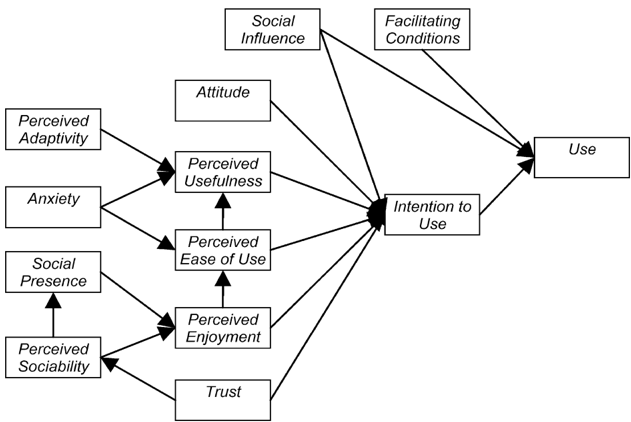
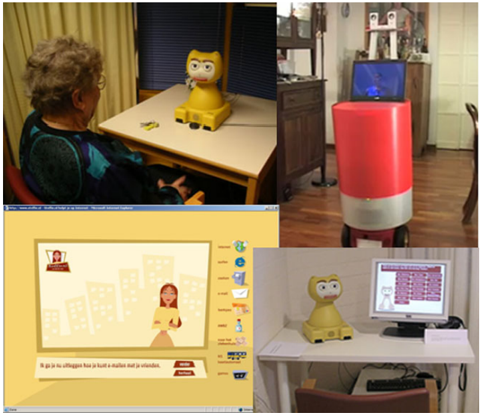
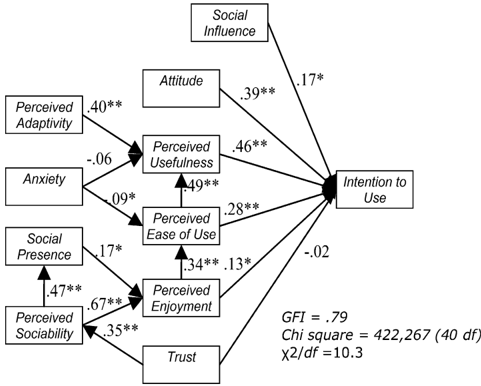
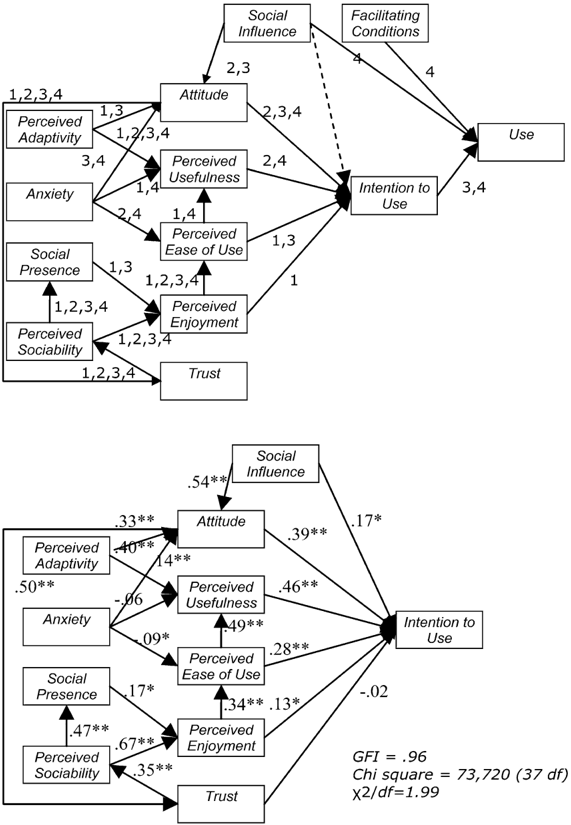
This paper proposes a model of technology acceptance that is specifically developed to test the acceptance of assistive social agents by elderly users. The research in this paper develops and tests an adaptation and theoretical extension of the Unified Theory of Acceptance and Use of Technology (UTAUT) by explaining intent to use not only in terms of variables related to functional evaluation like perceived usefulness and perceived ease of use, but also variables that relate to social interaction. The new model was tested using controlled experiment and longitudinal data collected regarding three different social agents at elderly care facilities and at the homes of older adults. The model was strongly supported accounting for 59–79% of the variance in usage intentions and 49–59% of the variance in actual use. These findings contribute to our understanding of how elderly users accept assistive social agents.
Overview
The claims and statistics of this paper haven’t been checked yet.
Free: it reads the open-access text and checks the first 5 claims that cite a source we can check. Create a free account to check every claim.
Integrity signals
Registry
Cites
Statistics
Figures

Verification
Claims the paper makes
The claims and statistics of this paper haven’t been checked yet.
Free: it reads the open-access text and checks the first 5 claims that cite a source we can check. Create a free account to check every claim.
Claims other papers make about this one
Each is checked against this paper’s own text: does it say what the citing paper says it does?
The source backs part of the claim, not all of it — or backs it for a different population, condition or comparison.
In the citing paper
“The extant literature attests to a positive correlation between users’ trust in technology and their inclination to use it, as evidenced by many studies [25-31].”
From Investigating the impact of user trust on the adoption and use of ChatGPT: Survey analysis (2023) · cites this paper as [31]
Experimental — accuracy not yet measuredThe cited source says what the claim attributes to it.
In the citing paper
“Prior research has established a positive correlation between intent to use and actual use of technology, indicating that users who intend to use the technology are more likely to actually use it [25,31,34].”
From Investigating the impact of user trust on the adoption and use of ChatGPT: Survey analysis (2023) · cites this paper as [31]
In the citing paper
“For instance, studies on adopting robots as assistive social agents found that users’ intent to use them strongly predicted their actual use [25,31].”
From Investigating the impact of user trust on the adoption and use of ChatGPT: Survey analysis (2023) · cites this paper as [31]
In the citing paper
“A study on technology acceptance for assistive social robots among older adult users found that the intention to use plays a mediating role in the relationship between trust and actual use [31].”
From Investigating the impact of user trust on the adoption and use of ChatGPT: Survey analysis (2023) · cites this paper as [31]
In the citing paper
“Heerink [15] found ITU is impacted by other acceptance factors and can be predicted by users' attitude and how much they perceive the robot to be useful.”
From Factors Affecting the Acceptability of Social Robots by Older Adults Including People with Dementia or Cognitive Impairment: A Literature Review (2018) · cites this paper as [15]
11 more claims about this paper
Create a free account to see every claim other papers make about this one.
Self-check
Percentages, sums and reported differences re-computed from the paper’s own numbers.
The self-check needs the paper’s full text.
Citations
Cites
Perceived usefulness, perceived ease of use, and user acceptance of information technology
Davis, F. D. (1989) · MIS Quarterly · doi:10.2307/249008 · Cited by 68,483
User Acceptance of Information Technology: Toward A Unified View1
Venkatesh, V., Morris, M. G., Davis, G. B., & Davis, F. D. (2003) · MIS Quarterly · doi:10.2307/30036540 · Cited by 45,035
(1975) · PhilPapers (PhilPapers Foundation) · Cited by 36,737
A Beginner's Guide to Structural Equation Modeling: Fourth Edition
Schumacker, R. E., & Lomax, R. G. (2015) · doi:10.4324/9781315749105 · Cited by 6,604
Structural Equation Modeling and Regression: Guidelines for Research Practice
Gefen, D., Straub, D., & Boudreau, M.-C. (2000) · Communications of the Association for Information Systems · doi:10.17705/1cais.00407 · Cited by 6,416
Measuring Presence in Virtual Environments: A Presence Questionnaire
Witmer, B. G., & Singer, M. J. (1998) · Presence: Teleoperators and Virtual Environments · doi:10.1162/105474698565686 · Cited by 6,371
A Beginner's Guide to Structural Equation Modeling
Schumacker, R. E., & Lomax, R. G. (2004) · doi:10.4324/9781410610904 · Cited by 6,235
Extrinsic and Intrinsic Motivation to Use Computers in the Workplace 1
Davis, F. D., Bagozzi, R. P., & Warshaw, P. R. (1992) · Journal of Applied Social Psychology · doi:10.1111/j.1559-1816.1992.tb00945.x · Cited by 6,231
Multivariate Data Analysis with Readings.
Rutherford, G. S. W., Hair, J. F., Anderson, R. E., & Tatham, R. L. (1988) · The Statistician · doi:10.2307/2348783 · Cited by 5,830
Multivariate Data Analysis with Readings.
Jolliffe, I. T., Hair, J. F., Anderson, R. E., & Tatham, R. L. (1988) · Journal of the Royal Statistical Society. Series A (Statistics in Society) · doi:10.2307/2983017 · Cited by 5,077
Research works printed but not linked: 6
- United Nations (2007) World population prospects: the 2006 revision-comprehensive tables. United Nations Publications, New York
- Pollack M (2005) Intelligent technology for an aging population: the use of AI to assist elders with cognitive impairment. AI Mag 26(2):9-24
- Zajicek M, Arnold A (1999) The 'technology push' and the user Tailored information environment. In: 5th European research con- sortium for informatics and mathematics, workshop on user inter- faces for all
- Pollack ME, Brown L, Colbry D, Orosz C, Peintner B, Ramakr- ishnan S, Engberg S, Matthews JT, Dunbar-Jacob J, McCarthy CE, Thrun S, Montemerlo M, Pineau J, Pearl NR (2002) A mobile ro- botic assistant for the elderly. In: AAAI workshop on automation as eldercare
- Heerink M (2009) Exploring adaptability, adaptivity and user control. Information Engineering Institute, Almere
- Heerink M (2008) Evaluating steffie. Information Engineering Institute, Almere
Cited by
Items 301–400 of 1,002
Would You Like to Listen to My Music, My Friend? An Experiment on AI Musicians
Sun, D., Wang, H., & Xiong, J. (2023) · International Journal of Human-Computer Interaction · doi:10.1080/10447318.2023.2181872 · Cited by 41
Research Hotspots and Trends of Social Robot Interaction Design: A Bibliometric Analysis
Wang, J., Chen, Y., Huo, S., Mai, L., & Jia, F. (2023) · Sensors · doi:10.3390/s23239369 · Cited by 41
Human-robot interaction research to improve quality of life in elder care: an approach and issues
Broadbent, E., Jayawardena, C., Kerse, N. M., Stafford, R. Q., & MacDonald, B. A. (2011) · ResearchSpace (University of Auckland) · Cited by 55
Amirabdollahian, F., op den Akker, R., Bedaf, S., Bormann, R., Draper, H., Evers, V., Gelderblom, G. J., Ruiz, C. G., Hewson, D., Hu, N., et al. (2013) · 2013 6th International Conference on Human System Interactions (HSI) · doi:10.1109/hsi.2013.6577882 · Cited by 22
Self-citationStara, V., Vera, B., Bolliger, D., Rossi, L., Felici, E., Di Rosa, M., de Jong, M., & Paolini, S. (2020) · JMIR mHealth and uHealth · doi:10.2196/25891 · Cited by 36
Zhong, R., & Ma, M. (2022) · BMC Geriatrics · doi:10.1186/s12877-022-03428-2 · Cited by 36
The Effects of Physically Embodied Multiple Conversation Robots on the Elderly
Nishio, T., Yoshikawa, Y., Sakai, K., Iio, T., Chiba, M., Asami, T., Isoda, Y., & Ishiguro, H. (2021) · Frontiers in Robotics and AI · doi:10.3389/frobt.2021.633045 · Cited by 39
Dosso, J. A., Bandari, E., Malhotra, A., Guerra, G. K., Hoey, J., Michaud, F., Prescott, T. J., & Robillard, J. M. (2022) · Journal of Rehabilitation and Assistive Technologies Engineering · doi:10.1177/20556683221108364 · Cited by 40
Factors affecting parental intention to use AI-based social robots for children’s ESL learning
Lin, G.-Y., Jhang, C.-C., & Wang, Y. (2023) · Education and Information Technologies · doi:10.1007/s10639-023-12023-w · Cited by 40
Human–robot interactions and experiences of staff and service robots in aged care
Chira, V. A. M., Miller, E., Martin, L., & Caldwell, G. A. (2025) · Scientific Reports · doi:10.1038/s41598-025-86255-w · Cited by 40
Boumans, R., van Meulen, F., Hindriks, K. V., Neerincx, M. A., & Rikkert, M. G. M. O. (2019) · International Journal of Social Robotics · doi:10.1007/s12369-019-00561-8 · Cited by 36
Expectation vs. Reality: Attitudes Towards a Socially Assistive Robot in Cardiac Rehabilitation
Casas, J., Céspedes, N., Cifuentes, C. A., Gutiérrez, L. F., Rincón-Roncancio, M., & Múnera, M. (2019) · Applied Sciences · doi:10.3390/app9214651 · Cited by 43
Investigating the relationship between AI and trust in human-AI collaboration
Bao, Y., Cheng, X., de Vreede, T., & de Vreede, G. (2021) · Hawaii International Conference on System Sciences (HICSS) · doi:10.24251/hicss.2021.074 · Cited by 51
Irfan, B., Céspedes, N., Casas, J., Senft, E., Gutiérrez, L. F., Rincón-Roncancio, M., Cifuentes, C. A., Belpaeme, T., & Múnera, M. (2022) · User Modeling and User-Adapted Interaction · doi:10.1007/s11257-022-09323-0 · Cited by 48
Gumasing, M. J. J., Prasetyo, Y. T., Ong, A. K. S., Persada, S. F., & Nadlifatin, R. (2022) · International Journal of Industrial Ergonomics · doi:10.1016/j.ergon.2022.103401 · Cited by 38
Yuan, F., Anderson, J. G., Wyatt, T. H., Lopez, R. P., Crane, M., Montgomery, A., & Zhao, X. (2022) · International Journal of Social Robotics · doi:10.1007/s12369-021-00862-x · Cited by 35
The effect of robot speed on comfortable passing distances
Neggers, M. M. E., Cuijpers, R. H., Ruijten, P. A. M., & IJsselsteijn, W. A. (2022) · Frontiers in Robotics and AI · doi:10.3389/frobt.2022.915972 · Cited by 35
Liu, X., Zhang, L., & Zhu, T. (2024) · Journal of Hospitality Marketing & Management · doi:10.1080/19368623.2024.2402488 · Cited by 41
Elprama, S., Makrini, I. E., Vanderborght, B., & Jacobs, A. (2016) · VUBIR (Vrije Universiteit Brussel) · Cited by 35
Hurtado, L. C., Viñas, P. F., Zalama, E., Gómez‐García‐Bermejo, J., Delgado, J. M., & García, B. V. (2021) · Healthcare · doi:10.3390/healthcare9081067 · Cited by 42
Acceptance of Remote Assistive Robots with and without Human-in-the-Loop for Healthcare Applications
Nertinger, S., Kirschner, R. J., Naceri, A., & Haddadin, S. (2022) · International Journal of Social Robotics · doi:10.1007/s12369-022-00931-9 · Cited by 40
Vichitvanichphong, S., Talaei‐Khoei, A., Kerr, D. V., & Ghapanchi, A. H. (2018) · Information Technology and People · doi:10.1108/itp-03-2017-0090 · Cited by 38
Straßmann, C., Krämer, N. C., Buschmeier, H., & Kopp, S. (2020) · Journal of Medical Internet Research · doi:10.2196/13726 · Cited by 37
Boustani, M. M., Lunn, S. J., Visser, U., & Lisetti, C. (2021) · Journal of Medical Internet Research · doi:10.2196/25837 · Cited by 35
Children’s Intention to Adopt Social Robots: A Model of its Distal and Proximal Predictors
de Jong, C., Peter, J., Kühne, R., & Barco, À. (2021) · International Journal of Social Robotics · doi:10.1007/s12369-021-00835-0 · Cited by 36
A user-study with Tangy the Bingo facilitating robot and long-term care residents
Li, J., Louie, W.-Y. G., Mohamed, S. C., Despond, F., & Nejat, G. (2016) · IEEE International Symposium on Robotics and Intelligent Sensors (IRIS) · doi:10.1109/iris.2016.8066075 · Cited by 42
Use of a Humanoid Robot in Supporting Dementia Care: A Qualitative Analysis
Liao, Y. K., Jao, Y., Boltz, M. P., Adekeye, O. T., Berish, D. E., Yuan, F., & Zhao, X. (2023) · SAGE Open Nursing · doi:10.1177/23779608231179528 · Cited by 40
Saffaryazdi, N., Gunasekaran, T. S., Loveys, K., Broadbent, E., & Billinghurst, M. (2025) · International Journal of Human-Computer Interaction · doi:10.1080/10447318.2025.2540500 · Cited by 38
Determining and validating smart TV UX factors: A multiple-study approach
Jang, J., & Yi, M. Y. (2019) · International Journal of Human-Computer Studies · doi:10.1016/j.ijhcs.2019.05.001 · Cited by 35
God-like robots: the semantic overlap between representation of divine and artificial entities
Spatola, N., & Urbanska, K. (2019) · AI & Society · doi:10.1007/s00146-019-00902-1 · Cited by 43
Ostrowski, A. K., Zygouras, V., Park, H. W., & Breazeal, C. (2021) · ACM/IEEE International Conference on Human-Robot Interaction (HRI) · doi:10.1145/3434073.3444655 · Cited by 43
Social robot-delivered customer-facing services: an assessment of the experience
Forgas-Coll, S., Huertas-Garcia, R., Andriella, A., & Alenyà, G. (2023) · The Service Industries Journal · doi:10.1080/02642069.2022.2163995 · Cited by 29
The Effects of Exposure to Different Social Robots on Attitudes toward Preferences
Vlachos, E., Jochum, E., & Demers, L.-P. (2016) · Interaction Studies Social Behaviour and Communication in Biological and Artificial Systems · doi:10.1075/is.17.3.04vla · Cited by 39
Wargnier, P., Benveniste, S., Jouvelot, P., & Rigaud, A.-S. (2018) · Technology and Disability · doi:10.3233/tad-180189 · Cited by 32
Acceptance of social assistant robots for the older adults living in the community in China
He, Q., He, Y., Liu, Q., & Ma, C. (2023) · Geriatric Nursing · doi:10.1016/j.gerinurse.2023.06.006 · Cited by 33
Amin, M. A. S., Johnson, V., Prybutok, V. R., & Koh, C. E. (2024) · Industrial Management & Data Systems · doi:10.1108/imds-09-2023-0608 · Cited by 37
New technologies and assistive robotics for elderly: A review on psychological variables
Costanzo, M., Smeriglio, R., & Nuovo, S. D. (2024) · Archives of Gerontology and Geriatrics Plus · doi:10.1016/j.aggp.2024.100056 · Cited by 40
Becker, H. K. (2018) · Springer eBooks · doi:10.1007/978-3-658-22698-5_13 · Cited by 52
Robot Morphology and Children's Perception of Social Robots: An Exploratory Study
Barco, À., de Jong, C., Peter, J., Kühne, R., & van Straten, C. L. (2020) · ACM/IEEE International Conference on Human-Robot Interaction (HRI) · doi:10.1145/3371382.3378348 · Cited by 32
Blavette, L., Rigaud, A., Anzalone, S. M., Kergueris, C., Isabet, B., Dacunha, S., & Pino, M. (2022) · International Journal of Environmental Research and Public Health · doi:10.3390/ijerph19095222 · Cited by 33
Exploring E-Health Literacy and Technology-Use Anxiety among Older Adults in Korea
Kim, J., Jeon, S., Byun, H., & Yi, E.-S. (2023) · Healthcare · doi:10.3390/healthcare11111556 · Cited by 35
Wamba, S. F., de Queiroz, M. M., & Hamzi, L. (2023) · Technological Forecasting and Social Change · doi:10.1016/j.techfore.2023.122912 · Cited by 38
Configuring the User: "Robots have Needs Too"
Cheon, E., & Su, N. M. (2017) · ACM Conference on Computer Supported Cooperative Work (CSCW) · doi:10.1145/2998181.2998329 · Cited by 37
The Impact of Intergroup Bias on Trust and Approach Behaviour Towards a Humanoid Robot
Deligianis, C., Stanton, C. J., McGarty, C., & Stevens, C. (2017) · Journal of Human-Robot Interaction · doi:10.5898/jhri.6.3.deligianis · Cited by 34
Aging and Engaging: A Social Conversational Skills Training Program for Older Adults
Ali, M. R., Van Orden, K., Parkhurst, K., Liu, S., Nguyen, V.-D., Duberstein, P., & Hoque, M. E. (2018) · 23rd International Conference on Intelligent User Interfaces · doi:10.1145/3172944.3172958 · Cited by 30
Could Robots Help Older People with Age-Related Nutritional Problems? Opinions of Potential Users
Łukasik, S., Tobis, S., Wieczorowska–Tobis, K., & Suwalska, A. (2018) · International Journal of Environmental Research and Public Health · doi:10.3390/ijerph15112535 · Cited by 35
Biswas, M., Romeo, M., Cangelosi, A., & Jones, R. B. (2019) · Journal on Multimodal User Interfaces · doi:10.1007/s12193-019-00306-x · Cited by 33
Kramer, L. L., van Velsen, L., Clark, J. L., Mulder, B. C., & de Vet, E. (2022) · JMIR Formative Research · doi:10.2196/33974 · Cited by 31
A Cross-Cultural Comparison on Implicit and Explicit Attitudes Towards Artificial Agents
Diana, F., Kawahara, M., Saccardi, I., Hortensius, R., Tanaka, A., & Kret, M. E. (2022) · International Journal of Social Robotics · doi:10.1007/s12369-022-00917-7 · Cited by 33
Blavette, L., Dacunha, S., Alameda-Pineda, X., García, D. H., Gannot, S., Gras, F., Gunson, N., Lemaignan, S., Polic, M., Tandeitnik, P., et al. (2025) · JMIR Human Factors · doi:10.2196/76496 · Cited by 35
The robot Tangy facilitating Trivia games: A team-based user-study with long-term care residents
Thompson, C., Mohamed, S. C., Louie, W.-Y. G., He, J. C., Li, J., & Nejat, G. (2017) · IEEE International Symposium on Robotics and Intelligent Sensors (IRIS) · doi:10.1109/iris.2017.8250117 · Cited by 39
A survey of assistive robots and systems for elderly care
Santhanaraj, K. K., Ramya, M. M., & Dinakaran, D. (2021) · Journal of Enabling Technologies · doi:10.1108/jet-10-2020-0043 · Cited by 39
Li, T., Wang, L., Liu, J., Yuan, J., & Liu, P. (2021) · International Journal of Human-Computer Interaction · doi:10.1080/10447318.2021.1938392 · Cited by 35
Assche, M. V., Moreels, T., Petrović, M., Cambier, D. C., Calders, P., & VELDE, D. V. D. (2021) · Scandinavian Journal of Occupational Therapy · doi:10.1080/11038128.2021.2009560 · Cited by 33
Abendschein, B., Edwards, A. P., & Edwards, C. C. (2022) · Frontiers in Robotics and AI · doi:10.3389/frobt.2022.733078 · Cited by 35
How Should Your Assistive Robot Look Like? A Scoping Review on Embodiment for Assistive Robots
Ringwald, M., Theben, P., Gerlinger, K., Hedrich, A., & Klein, B. D. (2023) · Journal of Intelligent & Robotic Systems · doi:10.1007/s10846-022-01781-3 · Cited by 56
Tandon, U., Ertz, M., & Shashi, S. (2023) · International Journal of Human-Computer Interaction · doi:10.1080/10447318.2023.2232977 · Cited by 34
Needs and user acceptance of older adults for mobile service robot
Saaskilahti, K., Kangaskorte, R., Pieska, S., Jauhiainen, J., & Luimula, M. (2012) · 2012 IEEE RO-MAN: The 21st IEEE International Symposium on Robot and Human Interactive Communication · doi:10.1109/roman.2012.6343810 · Cited by 17
Deriving Cyber Security Risks from Human and Organizational Factors – A Socio-technical Approach
McEvoy, T. R., & Kowalski, S. J. (2019) · Complex Systems Informatics and Modeling Quarterly · doi:10.7250/csimq.2019-18.03 · Cited by 41
Designing VUIs for Social Assistance Robots for People with Dementia
Striegl, J., Gollasch, D., Loitsch, C., & Weber, G. (2021) · Mensch und Computer (MuC) · doi:10.1145/3473856.3473887 · Cited by 31
User Experience of Older People While Using Digital Health Technologies: A Systematic Review
Takano, E., Maruyama, H., Takahashi, T., Mori, K., Nishiyori, K., Morita, Y., Fukuda, T., Kondo, I., & Ishibashi, Y. (2023) · Applied Sciences · doi:10.3390/app132312815 · Cited by 29
Rigaud, A., Dacunha, S., Harzo, C., Lenoir, H., Sfeir, I., Piccoli, M., & Pino, M. (2024) · Journal of Rehabilitation and Assistive Technologies Engineering · doi:10.1177/20556683241284765 · Cited by 33
Horng, J., Wang, Y., Liu, C.-H. S., Chou, S.-F., Yu, T., Huang, Y., & Hu, D.-C. (2024) · Journal of Hospitality Marketing & Management · doi:10.1080/19368623.2024.2425673 · Cited by 33
Elderly’s acceptance of companion robots from the perspective of user factors
Huang, T., & Huang, C. (2019) · Universal Access in the Information Society · doi:10.1007/s10209-019-00692-9 · Cited by 35
Rebitschek, F. G., & Wagner, G. G. (2020) · Zeitschrift für Gerontologie und Geriatrie · doi:10.1007/s00391-020-01780-9 · Cited by 32
Franke, A., Nass, E., Piereth, A.-K., Zettl, A., & Heidl, C. M. (2021) · Frontiers in Psychology · doi:10.3389/fpsyg.2021.694297 · Cited by 30
Emotional experiences of service robots’ anthropomorphic appearance: a multimodal measurement method
Zhang, Y., Cao, Y., Proctor, R. W., & Liu, Y. (2023) · Ergonomics · doi:10.1080/00140139.2023.2182751 · Cited by 32
Human Trust in Robots: A Survey on Trust Models and Their Controls/Robotics Applications
Wang, Y., Li, F., Zheng, H., Jiang, L., Mahani, M. F., & Liao, Z. (2023) · IEEE Open Journal of Control Systems · doi:10.1109/ojcsys.2023.3345090 · Cited by 34
Zhao, Y., Chen, Y., Sun, Y., & Shen, X. (2024) · Internet Research · doi:10.1108/intr-10-2022-0807 · Cited by 30
Raigoso, D., Céspedes, N., Cifuentes, C. A., del‐Ama, A. J., & Múnera, M. (2021) · Brain Sciences · doi:10.3390/brainsci11060738 · Cited by 34
Teachers’ views on the use of robots and cloud services in education for sustainable development
Park, I.-W., & Han, J. (2016) · Cluster Computing · doi:10.1007/s10586-016-0558-9 · Cited by 38
Sørensen, L., Johannesen, D. T. S., & Johnsen, H. M. (2024) · Assistive Technology · doi:10.1080/10400435.2024.2337194 · Cited by 32
Mayer, C. J., Mahal, J., Geisel, D., Geiger, E. J., Staatz, E., Zappel, M., Lerch, S. P., Ehrenthal, J. C., Walter, S., & Ditzen, B. (2024) · Computers in Human Behavior · doi:10.1016/j.chb.2024.108419 · Cited by 32
Zuschnegg, J., Paletta, L., Fellner, M., Steiner, J., Pansy-Resch, S., Jos, A. M., Koini, M., Prodromou, D., Halfens, R. J. G., Lohrmann, C., et al. (2021) · Aging & Mental Health · doi:10.1080/13607863.2021.1913476 · Cited by 28
Robots and Sustainability: Robots as Persuaders to Promote Recycling
Lo, S.-Y., Lai, Y., Liu, J.-C., & Yeh, S. (2022) · International Journal of Social Robotics · doi:10.1007/s12369-021-00828-z · Cited by 29
Finding ikigai: How robots can support meaning in later life
Randall, N., Joshi, S., Kamino, W., Hsu, L.-J., Agnihotri, A., Li, G., Williamson, D. S., Tsui, K., & Šabanović, S. (2022) · Frontiers in Robotics and AI · doi:10.3389/frobt.2022.1011327 · Cited by 33
Li, G., Zhao, Z., Li, L., Li, Y., Zhu, M., & Jiao, Y. (2023) · Journal of Research in Interactive Marketing · doi:10.1108/jrim-07-2022-0222 · Cited by 36
Tu, Y., Liu, W., & Yang, Z. (2023) · Journal of service management · doi:10.1108/josm-05-2022-0174 · Cited by 30
Application of experiential locus of control to understand users' judgments toward useful experience
Jang, J., Shin, H., Aum, H., Kim, M., & Kim, J. (2015) · Computers in Human Behavior · doi:10.1016/j.chb.2015.08.010 · Cited by 34
A Comparison of Trust Measures in Human–Robot Interaction Scenarios
Kessler, T. T., Larios, C. N., Walker, T., Yerdon, V., & Hancock, P. A. (2016) · Advances in intelligent systems and computing · doi:10.1007/978-3-319-41959-6_29 · Cited by 34
Evaluating older adults' interaction with a mobile assistive robot
Mucchiani, C., Sharma, S., Johnson, M., Sefcik, J. S., Vivio, N., Huang, J. T., Cacchione, P. Z., Johnson, M. J., Rai, R., Canoso, A., et al. (2017) · IEEE/RSJ International Conference on Intelligent Robots and Systems (IROS) · doi:10.1109/iros.2017.8202246 · Cited by 31
Boumans, R., van Meulen, F., van Aalst, W., Albers, J., Janssen, M., Peters-Kop, M., Waal, G. H., van de Poll, A., Hindriks, K. V., Neerincx, M. A., et al. (2020) · Journal of Medical Internet Research · doi:10.2196/18787 · Cited by 31
Troncone, A., Amorese, T., Cuciniello, M., Saturno, R., Pugliese, L., Cordasco, G., Vogel, C. M., & Esposito, A. A. (2020) · Acta Polytechnica Hungarica · doi:10.12700/aph.17.2.2020.2.10 · Cited by 32
Randall, N., Kamino, W., Joshi, S., Chen, W.-C., Hsu, L.-J., Tsui, K. M., & Šabanović, S. (2023) · JMIR Aging · doi:10.2196/45442 · Cited by 30
Mindsets and mirrors: How growth mindsets shape anthropomorphism in AI‐enabled technologies
Chen, Q. Q., & Yi, Y. (2024) · Psychology and Marketing · doi:10.1002/mar.22108 · Cited by 31
Céspedes, N., Raigoso, D., Múnera, M., & Cifuentes, C. A. (2021) · Frontiers in Neurorobotics · doi:10.3389/fnbot.2021.612034 · Cited by 29
Long-Term Exercise Assistance: Group and One-on-One Interactions between a Social Robot and Seniors
Shao, M., Pham-Hung, M., Alves, S. F. D. R., Snyder, M., Eshaghi, K., Benhabib, B., & Nejat, G. (2023) · Robotics · doi:10.3390/robotics12010009 · Cited by 32
Haltaufderheide, J., Lucht, A., Strünck, C., & Vollmann, J. (2023) · Science and Engineering Ethics · doi:10.1007/s11948-022-00419-9 · Cited by 27
Li, S., Milligan, K., Blythe, P. T., Zhang, Y., Edwards, S., Palmarini, N., Corner, L., Ji, Y., Zhang, F., & Namdeo, A. K. (2023) · Scientific Reports · doi:10.1038/s41598-023-33837-1 · Cited by 30
Needs and attitudes of Singaporeans towards home service robots: a multi-generational perspective
Xu, Q., Ng, J., Tan, O., & Huang, Z. (2014) · Universal Access in the Information Society · doi:10.1007/s10209-014-0355-2 · Cited by 29
Conversational Interfaces: Devices, Wearables, Virtual Agents, and Robots
McTear, M., Callejas, Z., & Griol, D. (2016) · Springer eBooks · doi:10.1007/978-3-319-32967-3_13 · Cited by 31
How to Increase the Customer Experience by the Usage of Remote Control Robot Concierge Solutions
Etemad‐Sajadi, R., & Sturman, M. C. (2021) · International Journal of Social Robotics · doi:10.1007/s12369-021-00800-x · Cited by 32
Evaluating Telepresence Robots in the Field
Cesta, A., Cortellessa, G., Orlandini, A., & Tiberio, L. (2013) · Communications in computer and information science · doi:10.1007/978-3-642-36907-0_29 · Cited by 32
No man is an island: Will service robots reduce employee loneliness?
Liu, X., Lin, Z., Fang, S., & Zhang, L. (2025) · Tourism Management · doi:10.1016/j.tourman.2025.105151 · Cited by 29
Bradwell, H. L., Winnington, R., Thill, S., & Jones, R. B. (2021) · IEEE RO-MAN · doi:10.1109/ro-man50785.2021.9515446 · Cited by 29
Łukasik, S., Tobis, S., Suwalska, J., Łojko, D., Napierała, M., Proch, M., Neumann‐Podczaska, A., & Suwalska, A. (2021) · Sustainability · doi:10.3390/su131810394 · Cited by 28
Kuhl, U., Artelt, A., & Hammer, B. (2023) · Frontiers in Computer Science · doi:10.3389/fcomp.2023.1087929 · Cited by 31
Ventura, S., Ottoboni, G., Pappadà, A., & Tessari, A. (2023) · Journal of Clinical Medicine · doi:10.3390/jcm12082962 · Cited by 29
Customers' value changes on robot‐serviced restaurants
Kim, C. Y., & Cha, S. (2024) · International Journal of Tourism Research · doi:10.1002/jtr.2631 · Cited by 31
Imagery of Disabled People within Social Robotics Research
Yumakulov, S., Yergens, D., & Wolbring, G. (2012) · Lecture notes in computer science · doi:10.1007/978-3-642-34103-8_17 · Cited by 43
Metadata
- Authors
- Heerink, M., Kröse, B., Evers, V., & Wielinga, B.
- Affiliations
- Amsterdam University of Applied Sciences (NL)
- University of Amsterdam (NL)
- Corresponding author
- Heerink, Marcel
- Venue
- International Journal of Social Robotics
- Published
- 2010-09-04
- Volume
- 2
- Issue
- 4
- Pages
- 361-375
- ISSN
- 1875-4791 (ISSN-L)
- 1875-4805
- OpenAlex
- W2137577228
- Cited by
- 1,229
- References
- 69
- Citations by year
- 2026: 145 · 2025: 138 · 2024: 115 · 2023: 142 · 2022: 125 · 2021: 119 · 2020: 104 · 2019: 91 · 2018: 46 · 2017: 47 · 2016: 39 · 2015: 28 · 2014: 34 · 2013: 31 · 2012: 14
- Type
- book review
- Language
- en
- Open access
- hybrid
- doi.org
- Licence
- cc-by-nc
- Locations
- International Journal of Social Robotics (publishedVersion, cc-by-nc)
- UvA-DARE (University of Amsterdam) (publishedVersion, other-oa)
- VU Research Portal (publishedVersion, other-oa)
- UvA-DARE (University of Amsterdam) (submittedVersion, other-oa)
- Data Archiving and Networked Services (DANS) (submittedVersion, other-oa)
- Digital Academic REpository of VU University Amsterdam (Vrije Universiteit Amsterdam) (submittedVersion)
- Funders
- European Commission
- Rabobank Foundation
- Topics
- Social Sciences › Psychology › Social Psychology › Social Robot Interaction and HRI
- Health Sciences › Medicine › Geriatrics and Gerontology › Technology Use by Older Adults
- Social Sciences › Decision Sciences › Information Systems and Management › Technology Adoption and User Behaviour
- Keywords
- technology acceptance, older adults, UTAUT, intention to use, perceived usefulness, perceived ease of use, social interaction, elderly care, social robots
About these checks
Registry, retraction, Cites and statistics results are computed, not judged, with one exception: a printed reference that no index lists is read once by a model before it counts as a citation error. Claims are extracted by a model and kept only when their quote appears verbatim in the text; each cited source is then checked, with a model’s help, for whether it says what the claim relies on. Those verdicts can be wrong — read the claim’s quote and the cited source before relying on one.
Statistics and arithmetic are recomputed, not judged.
Confidence bands are shown only for fields calibrated on our annotated test set. None is calibrated yet, so no band is shown.
What counts as a claim ›How we measure confidence ›How we check this ›
Are you an author, or do you see a problem with this page? Request a review
Data sources
Bibliographic data: Semantic Scholar, OpenAlex, Crossref.
Contains information from the Semantic Scholar Academic Graph Datasets, made available under the ODC Attribution License (ODC-BY 1.0).
Semantic Scholar’s data is described in: Kinney, R., et al. (2023). The Semantic Scholar Open Data Platform. arXiv:2301.10140.
