

Assessing Acceptance of Assistive Social Agent Technology by Older Adults: the Almere Model
Open accessThe DOI matches its Crossref record; 69 of the 69 references it cites were found in a registry or an index.
Abstract
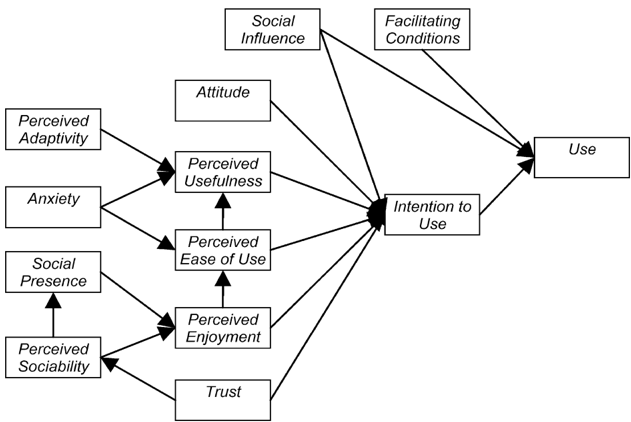
This paper proposes a model of technology acceptance that is specifically developed to test the acceptance of assistive social agents by elderly users. The research in this paper develops and tests an adaptation and theoretical extension of the Unified Theory of Acceptance and Use of Technology (UTAUT) by explaining intent to use not only in terms of variables related to functional evaluation like perceived usefulness and perceived ease of use, but also variables that relate to social interaction. The new model was tested using controlled experiment and longitudinal data collected regarding three different social agents at elderly care facilities and at the homes of older adults. The model was strongly supported accounting for 59–79% of the variance in usage intentions and 49–59% of the variance in actual use. These findings contribute to our understanding of how elderly users accept assistive social agents.
Overview
The claims and statistics of this paper haven’t been checked yet.
Free: it reads the open-access text and checks the first 5 claims that cite a source we can check. Create a free account to check every claim.
Integrity signals
Registry
Cites
Statistics
Figures
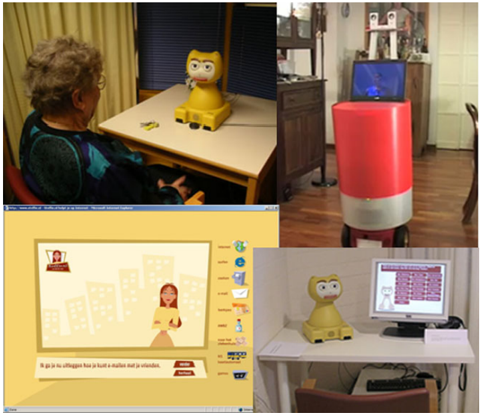
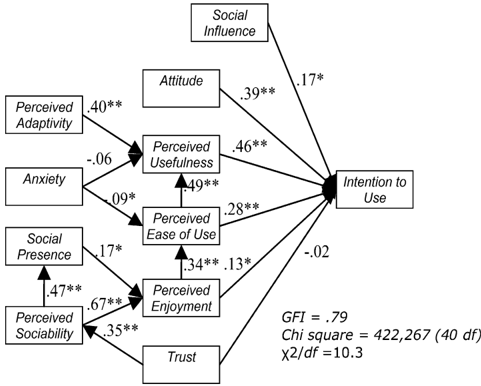

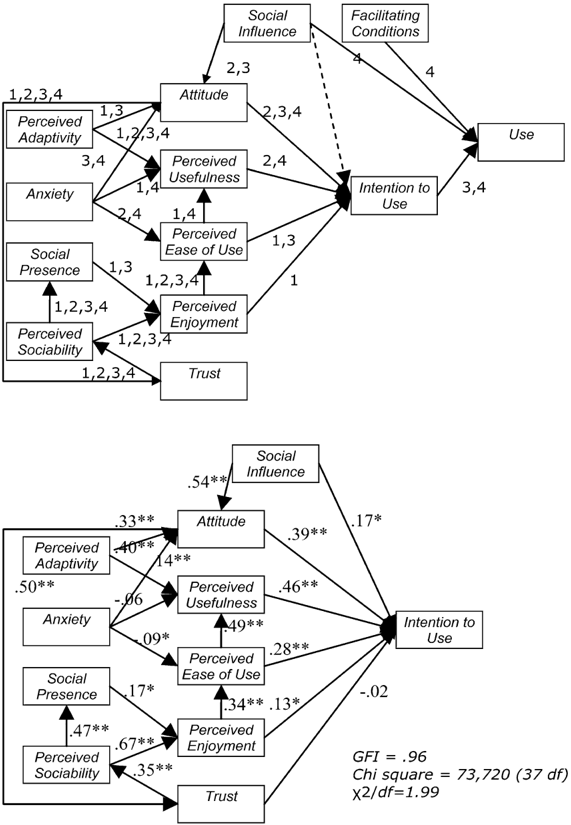
Verification
Claims the paper makes
The claims and statistics of this paper haven’t been checked yet.
Free: it reads the open-access text and checks the first 5 claims that cite a source we can check. Create a free account to check every claim.
Claims other papers make about this one
Each is checked against this paper’s own text: does it say what the citing paper says it does?
The source backs part of the claim, not all of it — or backs it for a different population, condition or comparison.
In the citing paper
“The extant literature attests to a positive correlation between users’ trust in technology and their inclination to use it, as evidenced by many studies [25-31].”
From Investigating the impact of user trust on the adoption and use of ChatGPT: Survey analysis (2023) · cites this paper as [31]
Experimental — accuracy not yet measuredThe cited source says what the claim attributes to it.
In the citing paper
“Prior research has established a positive correlation between intent to use and actual use of technology, indicating that users who intend to use the technology are more likely to actually use it [25,31,34].”
From Investigating the impact of user trust on the adoption and use of ChatGPT: Survey analysis (2023) · cites this paper as [31]
In the citing paper
“For instance, studies on adopting robots as assistive social agents found that users’ intent to use them strongly predicted their actual use [25,31].”
From Investigating the impact of user trust on the adoption and use of ChatGPT: Survey analysis (2023) · cites this paper as [31]
In the citing paper
“A study on technology acceptance for assistive social robots among older adult users found that the intention to use plays a mediating role in the relationship between trust and actual use [31].”
From Investigating the impact of user trust on the adoption and use of ChatGPT: Survey analysis (2023) · cites this paper as [31]
In the citing paper
“Heerink [15] found ITU is impacted by other acceptance factors and can be predicted by users' attitude and how much they perceive the robot to be useful.”
From Factors Affecting the Acceptability of Social Robots by Older Adults Including People with Dementia or Cognitive Impairment: A Literature Review (2018) · cites this paper as [15]
11 more claims about this paper
Create a free account to see every claim other papers make about this one.
Self-check
Percentages, sums and reported differences re-computed from the paper’s own numbers.
The self-check needs the paper’s full text.
Citations
Cites
Perceived usefulness, perceived ease of use, and user acceptance of information technology
Davis, F. D. (1989) · MIS Quarterly · doi:10.2307/249008 · Cited by 68,483
User Acceptance of Information Technology: Toward A Unified View1
Venkatesh, V., Morris, M. G., Davis, G. B., & Davis, F. D. (2003) · MIS Quarterly · doi:10.2307/30036540 · Cited by 45,035
(1975) · PhilPapers (PhilPapers Foundation) · Cited by 36,737
A Beginner's Guide to Structural Equation Modeling: Fourth Edition
Schumacker, R. E., & Lomax, R. G. (2015) · doi:10.4324/9781315749105 · Cited by 6,604
Structural Equation Modeling and Regression: Guidelines for Research Practice
Gefen, D., Straub, D., & Boudreau, M.-C. (2000) · Communications of the Association for Information Systems · doi:10.17705/1cais.00407 · Cited by 6,416
Measuring Presence in Virtual Environments: A Presence Questionnaire
Witmer, B. G., & Singer, M. J. (1998) · Presence: Teleoperators and Virtual Environments · doi:10.1162/105474698565686 · Cited by 6,371
A Beginner's Guide to Structural Equation Modeling
Schumacker, R. E., & Lomax, R. G. (2004) · doi:10.4324/9781410610904 · Cited by 6,235
Extrinsic and Intrinsic Motivation to Use Computers in the Workplace 1
Davis, F. D., Bagozzi, R. P., & Warshaw, P. R. (1992) · Journal of Applied Social Psychology · doi:10.1111/j.1559-1816.1992.tb00945.x · Cited by 6,231
Multivariate Data Analysis with Readings.
Rutherford, G. S. W., Hair, J. F., Anderson, R. E., & Tatham, R. L. (1988) · The Statistician · doi:10.2307/2348783 · Cited by 5,830
Multivariate Data Analysis with Readings.
Jolliffe, I. T., Hair, J. F., Anderson, R. E., & Tatham, R. L. (1988) · Journal of the Royal Statistical Society. Series A (Statistics in Society) · doi:10.2307/2983017 · Cited by 5,077
Research works printed but not linked: 6
- United Nations (2007) World population prospects: the 2006 revision-comprehensive tables. United Nations Publications, New York
- Pollack M (2005) Intelligent technology for an aging population: the use of AI to assist elders with cognitive impairment. AI Mag 26(2):9-24
- Zajicek M, Arnold A (1999) The 'technology push' and the user Tailored information environment. In: 5th European research con- sortium for informatics and mathematics, workshop on user inter- faces for all
- Pollack ME, Brown L, Colbry D, Orosz C, Peintner B, Ramakr- ishnan S, Engberg S, Matthews JT, Dunbar-Jacob J, McCarthy CE, Thrun S, Montemerlo M, Pineau J, Pearl NR (2002) A mobile ro- botic assistant for the elderly. In: AAAI workshop on automation as eldercare
- Heerink M (2009) Exploring adaptability, adaptivity and user control. Information Engineering Institute, Almere
- Heerink M (2008) Evaluating steffie. Information Engineering Institute, Almere
Cited by
Items 101–200 of 1,002
Philip, P., Dupuy, L., Auriacombe, M., Serre, F., de Sevin, E., Sauteraud, A., & Micoulaud-Franchi, J.-A. (2020) · npj Digital Medicine · doi:10.1038/s41746-019-0213-y · Cited by 103
Acceptance of Social Robots by Elder People: Does Psychosocial Functioning Matter?
Baisch, S., Kolling, T., Schall, A., Rühl, S., Selic, S., Kim, Z., Roßberg, H., Klein, B. D., Pantel, J., Oswald, F., et al. (2017) · International Journal of Social Robotics · doi:10.1007/s12369-016-0392-5 · Cited by 124
Wu, Y., Mou, Y., Li, Z., & Xu, K. (2020) · Computers in Human Behavior · doi:10.1016/j.chb.2019.106186 · Cited by 94
Socially Assistive Robots: Measuring Older Adults' Perceptions
Beuscher, L. M., Fan, J., Sarkar, N., Dietrich, M. S., Newhouse, P. A., Miller, K. F., & Mion, L. C. (2017) · Journal of Gerontological Nursing · doi:10.3928/00989134-20170707-04 · Cited by 106
Reframing Assistive Robots to Promote Successful Aging
Lee, H. R., & Riek, L. D. (2018) · ACM Transactions on Human-Robot Interaction · doi:10.1145/3203303 · Cited by 106
Chatterjee, S., Chaudhuri, R., & Vrontis, D. (2021) · Information Systems Frontiers · doi:10.1007/s10796-021-10197-7 · Cited by 119
Ribino, P. (2023) · Artificial Intelligence Review · doi:10.1007/s10462-023-10540-1 · Cited by 105
Social robots: The influence of human and robot characteristics on acceptance
Bishop, L. M., van Maris, A., Dogramadzi, S., & Zook, N. (2019) · Paladyn Journal of Behavioral Robotics · doi:10.1515/pjbr-2019-0028 · Cited by 133
Using SOR framework to explore the driving factors of older adults smartphone use behavior
Huang, T. (2023) · Humanities and Social Sciences Communications · doi:10.1057/s41599-023-02221-9 · Cited by 102
May I teach you? Students' behavior when lectured by robotic vs. human teachers
Fernández-Llamas, C., Conde, M. A., Rodríguez-Lera, F. J., Rodríguez-Sedano, F. J., & García, F. (2018) · Computers in Human Behavior · doi:10.1016/j.chb.2017.09.028 · Cited by 91
Questionnaires to Measure Acceptability of Social Robots: A Critical Review
Krägeloh, C. U., Bharatharaj, J., Sasthan Kutty, S. K., Nirmala, P. R., & Huang, L. (2019) · Robotics · doi:10.3390/robotics8040088 · Cited by 89
Personalized home-care support for the elderly: a field experience with a social robot at home
Napoli, C. D., Ercolano, G., & Rossi, S. (2022) · User Modeling and User-Adapted Interaction · doi:10.1007/s11257-022-09333-y · Cited by 116
Moro, C., Lin, S., Nejat, G., & Mihailidis, A. (2018) · International Journal of Social Robotics · doi:10.1007/s12369-018-0488-1 · Cited by 103
Wagner, K., Nimmermann, F., & Schramm-Klein, H. (2019) · Proceedings of the Annual Hawaii International Conference on System Sciences · doi:10.24251/hicss.2019.169 · Cited by 90
Irfan, B., Kuoppamäki, S., Hosseini, A., & Skantze, G. (2025) · Autonomous Robots · doi:10.1007/s10514-025-10190-y · Cited by 108
Older adults’ acceptance of a robot for partner dance-based exercise
Chen, T. L. B., Bhattacharjee, T., Beer, J. M., Ting, L. H., Hackney, M. E., Rogers, W. A., & Kemp, C. C. (2017) · PLoS ONE · doi:10.1371/journal.pone.0182736 · Cited by 99
Designing Ethical Social Robots—A Longitudinal Field Study With Older Adults
van Maris, A., Zook, N., Caleb-Solly, P., Studley, M., Winfield, A., & Dogramadzi, S. (2020) · Frontiers in Robotics and AI · doi:10.3389/frobt.2020.00001 · Cited by 91
González‐Jiménez, H. (2018) · Futures · doi:10.1016/j.futures.2018.01.004 · Cited by 104
Mou, Y., Shi, C., Shen, T., & Xu, K. (2020) · International Journal of Human–Computer Interaction · doi:10.1080/10447318.2019.1663008 · Cited by 82
Proposal for modeling social robot acceptance by retail customers: CAN model + technophobia
Navarro, A. S., Borondo, J. P., Lara, E. M. R., & Pascual, C. O. (2021) · Journal of Retailing and Consumer Services · doi:10.1016/j.jretconser.2021.102813 · Cited by 102
Customer acceptance of frontline service robots in retail banking: A qualitative approach
Amelia, A., Mathies, C., & Patterson, P. G. (2022) · Journal of Service Management · doi:10.1108/josm-10-2020-0374 · Cited by 76
Engagement and experience of older people with socially assistive robots in home care
Khosla, R., Chu, M.-T., Khaksar, S. M. S., Nguyen, K., & Nishida, T. (2021) · Assistive Technology · doi:10.1080/10400435.2019.1588805 · Cited by 89
Identifying Features that Enhance Older Adults’ Acceptance of Robots: A Mixed Methods Study
Chu, L., Chen, H.-W., Cheng, P.-Y., Ho, P., Weng, I. C., Yang, P.-L., Chien, S.-E., Tu, Y., Yang, C.-C., Wang, T., et al. (2019) · Gerontology · doi:10.1159/000494881 · Cited by 102
Knaust, T., Felnhofer, A., Kothgassner, O. D., Höllmer, H., Gorzka, R.-J., & Schulz, H. (2021) · Virtual Reality · doi:10.1007/s10055-021-00595-2 · Cited by 94
The role of chatbots’ human-like characteristics in online shopping
Fu, J., Mouakket, S., & Sun, Y. (2023) · Electronic Commerce Research and Applications · doi:10.1016/j.elerap.2023.101304 · Cited by 103
Moyle, W., Jones, C., Sung, B., Bramble, M., O’Dwyer, S., Blumenstein, M., & Estivill-Castro, V. (2016) · International Journal of Social Robotics · doi:10.1007/s12369-015-0326-7 · Cited by 85
Shore, L., Power, V., de Eyto, A., & O'Sullivan, L. W. (2018) · Robotics · doi:10.3390/robotics7010003 · Cited by 101
Age Difference in Perceived Ease of Use, Curiosity, and Implicit Negative Attitude toward Robots
Chien, S.-E., Chu, L., Lee, H.-H., Yang, C.-C., Lin, F.-H., Yang, P.-L., Wang, T.-M., & Yeh, S.-L. (2019) · ACM Transactions on Human-Robot Interaction · doi:10.1145/3311788 · Cited by 77
Tröbinger, M., Jähne, C., Qu, Z., Elsner, J., Reindl, A., Getz, S., Goll, T., Loinger, B., Loibl, T., Kugler, C., et al. (2021) · IEEE Robotics and Automation Letters · doi:10.1109/lra.2021.3082012 · Cited by 87
Abrams, A. M. H., Dautzenberg, P. S. C., Jakobowsky, C., Ladwig, S., & Pütten, A. M. R.-V. D. (2021) · ACM/IEEE International Conference on Human-Robot Interaction (HRI) · doi:10.1145/3434073.3444662 · Cited by 107
Occupational Safety and Health Equity Impacts of Artificial Intelligence: A Scoping Review
Fisher, E., Flynn, M. A., Pratap, P., & Vietas, J. (2023) · International Journal of Environmental Research and Public Health · doi:10.3390/ijerph20136221 · Cited by 97
Koumpouros, Y. (2016) · Journal of Healthcare Engineering · doi:10.1155/2016/1048964 · Cited by 86
Rizomyliotis, I., Kastanakis, M. N., Giovanis, A., Konstantoulaki, K., & Kostopoulos, I. (2022) · Journal of Business Research · doi:10.1016/j.jbusres.2022.08.035 · Cited by 85
Measuring the Perceived Social Intelligence of Robots
Barchard, K. A., Lapping-Carr, L. R., Westfall, R. S., Fink-Armold, A., Banisetty, S. B., & Feil-Seifer, D. (2020) · ACM Transactions on Human-Robot Interaction · doi:10.1145/3415139 · Cited by 96
Robovie as a Mascot: A Qualitative Study for Long-Term Presence of Robots in a Shopping Mall
Sabelli, A. M., & Kanda, T. (2015) · International Journal of Social Robotics · doi:10.1007/s12369-015-0332-9 · Cited by 92
Challenges for Service Robots—Requirements of Elderly Adults with Cognitive Impairments
Korchut, A., Szklener, S., Abdelnour, C., Tantinya, N., Hernández-Farigola, J., Ribes, J. C., Skrobas, U., Grabowska-Aleksandrowicz, K., Szczęśniak-Stańczyk, D., & Rejdak, K. (2017) · Frontiers in Neurology · doi:10.3389/fneur.2017.00228 · Cited by 84
Performance of daily activities by older adults with dementia: The role of an assistive robot
Begum, M., Wang, R., Huq, R., & Mihailidis, A. (2013) · 2013 IEEE 13th International Conference on Rehabilitation Robotics (ICORR) · doi:10.1109/icorr.2013.6650405 · Cited by 84
Learning and Personalizing Socially Assistive Robot Behaviors to Aid with Activities of Daily Living
Moro, C., Nejat, G., & Mihailidis, A. (2018) · ACM Transactions on Human-Robot Interaction · doi:10.1145/3277903 · Cited by 100
Han, J., & Conti, D. (2020) · Robotics · doi:10.3390/robotics9020034 · Cited by 104
Predictors of consumers’ willingness to share personal information with fashion sales robots
Song, C. S., & Kim, Y. (2021) · Journal of Retailing and Consumer Services · doi:10.1016/j.jretconser.2021.102727 · Cited by 91
Liao, S., Lin, L., & Chen, Q. (2023) · International Journal of Industrial Ergonomics · doi:10.1016/j.ergon.2023.103455 · Cited by 93
Irfan, B., Kuoppamäki, S., & Skantze, G. (2024) · Frontiers in Robotics and AI · doi:10.3389/frobt.2024.1363713 · Cited by 99
Care Robot Orientation: What, Who and How? Potential Users’ Perceptions
Johansson-Pajala, R.-M., Thommes, K., Hoppe, J. A., Tuisku, O., Hennala, L., Pekkarinen, S., Melkas, H., & Gustafsson, C. (2020) · International Journal of Social Robotics · doi:10.1007/s12369-020-00619-y · Cited by 72
Singh, C., Dash, M. K., Sahu, R., & Kumar, A. (2024) · Heliyon · doi:10.1016/j.heliyon.2024.e25031 · Cited by 97
Understanding the potential of PARO for healthy older adults
McGlynn, S. A., Kemple, S., Mitzner, T. L., King, C.-H. A., & Rogers, W. A. (2017) · International Journal of Human-Computer Studies · doi:10.1016/j.ijhcs.2016.12.004 · Cited by 82
Impact of AI regulation on intention to use robots: From citizens and government perspective
Chatterjee, S. (2020) · International Journal of Intelligent Unmanned Systems · doi:10.1108/ijius-09-2019-0051 · Cited by 81
Gessl, A. S., Schlögl, S., & Mevenkamp, N. (2019) · Behaviour and Information Technology · doi:10.1080/0144929x.2019.1566499 · Cited by 84
Increasing acceptance of medical AI: The role of medical staff participation in AI development
Huo, W., Yuan, X., Li, X., Luo, W., Xie, J., & Shi, B. (2023) · International Journal of Medical Informatics · doi:10.1016/j.ijmedinf.2023.105073 · Cited by 62
Influence of legibility on perceived safety in a virtual human-robot path crossing task
Lichtenthäler, C., Lorenzy, T., & Kirsch, A. (2012) · IEEE RO-MAN · doi:10.1109/roman.2012.6343829 · Cited by 80
Matching Robot KASPAR to Autism Spectrum Disorder (ASD) Therapy and Educational Goals
Huijnen, C. A. G. J., Lexis, M. A. S., & de Witte, L. (2016) · International Journal of Social Robotics · doi:10.1007/s12369-016-0369-4 · Cited by 80
Learning and Comfort in Human–Robot Interaction: A Review
Wang, W., Chen, Y., Li, R., & Jia, Y. (2019) · Applied Sciences · doi:10.3390/app9235152 · Cited by 93
Socially Assistive Robots Helping Older Adults through the Pandemic and Life after COVID-19
Getson, C., & Nejat, G. (2021) · Robotics · doi:10.3390/robotics10030106 · Cited by 87
Bhatnagr, P., Rajesh, A., & Misra, R. (2024) · Journal of Enterprise Information Management · doi:10.1108/jeim-11-2023-0617 · Cited by 85
A Theory of Social Agency for Human-Robot Interaction
Jackson, R. B., & Williams, T. (2021) · Frontiers in Robotics and AI · doi:10.3389/frobt.2021.687726 · Cited by 76
MARIO Project: validation and evidence of service robots for older people with dementia
D’Onofrio, G., Sancarlo, D., Raciti, M., Burke, M., Teare, A., Kovacic, T., Cortis, K., Murphy, K., Barrett, E., Whelan, S., et al. (2019) · Journal of Alzheimer s Disease · doi:10.3233/jad-181165 · Cited by 76
Ötting, S. K., Masjutin, L., Steil, J. J., & Maier, G. W. (2020) · Human Factors The Journal of the Human Factors and Ergonomics Society · doi:10.1177/0018720820966433 · Cited by 87
Are pre‐service teachers disinclined to utilise embodied humanoid social robots in the classroom?
Starčič, A. I., Bratko, I., & Rosanda, V. (2021) · British Journal of Educational Technology · doi:10.1111/bjet.13144 · Cited by 85
Saari, U. A., Tossavainen, A., Kaipainen, K., & Mäkinen, S. (2022) · Robotics and Autonomous Systems · doi:10.1016/j.robot.2022.104033 · Cited by 82
Esper, F. S., Ostrovskaya, L., Rodríguez-Sánchez, C., & Campayo-Sánchez, F. (2022) · Journal Of Vacation Marketing · doi:10.1177/13567667221080567 · Cited by 77
Méndez-Suárez, M., Monfort, A., & Hervás-Oliver, J.-L. (2023) · European Research on Management and Business Economics · doi:10.1016/j.iedeen.2023.100223 · Cited by 83
Lee, S., Ratan, R., & Park, T. (2019) · Multimodal Technologies and Interaction · doi:10.3390/mti3010020 · Cited by 68
Man vs machine: examining the three themes of service robotics in tourism and hospitality
Manthiou, A., Klaus, P., Kuppelwieser, V. G., & Reeves, W. (2020) · Electronic Markets · doi:10.1007/s12525-020-00434-3 · Cited by 80
Computer acceptance of older adults
Nägle, S., & Schmidt, L. (2012) · WORK: A Journal of Prevention, Assessment & Rehabilitation · doi:10.3233/wor-2012-0633-3541 · Cited by 68
Rossi, S., Conti, D., Garramone, F., Santangelo, G., Staffa, M., Varrasi, S., & Nuovo, A. G. D. (2020) · Robotics · doi:10.3390/robotics9020039 · Cited by 84
Liu, X., Shen, Q., & Hancock, J. T. (2021) · Computers in Human Behavior · doi:10.1016/j.chb.2021.106942 · Cited by 77
Between fear and trust: Older adults’ evaluation of socially assistive robots
Zafrani, O., Nimrod, G., & Edan, Y. (2022) · International Journal of Human-Computer Studies · doi:10.1016/j.ijhcs.2022.102981 · Cited by 97
Social Robots: Views of Staff of a Disability Service Organization
Wolbring, G., & Yumakulov, S. (2014) · International Journal of Social Robotics · doi:10.1007/s12369-014-0229-z · Cited by 83
Is a Soft Robot More “Natural”? Exploring the Perception of Soft Robotics in Human–Robot Interaction
Jørgensen, J., Bojesen, K. B., & Jochum, E. (2021) · International Journal of Social Robotics · doi:10.1007/s12369-021-00761-1 · Cited by 79
Siedl, S. M., & Mara, M. (2021) · Wearable Technologies · doi:10.1017/wtc.2021.10 · Cited by 76
Lünich, M. (2022) · Springer eBooks · doi:10.1007/978-3-658-36368-0 · Cited by 71
Chatbots in the frontline: drivers of acceptance
Aslam, W., Ahmed Siddiqui, D., Arif, I., & Farhat, K. (2023) · Kybernetes · doi:10.1108/k-11-2021-1119 · Cited by 58
Balki, E., Holland, C., & Hayes, N. (2023) · Journal of Medical Internet Research · doi:10.2196/41535 · Cited by 73
The Role of Healthcare Robotics in Providing Support to Older Adults: a Socio-ecological Perspective
Mois, G., & Beer, J. M. (2020) · Current Geriatrics Reports · doi:10.1007/s13670-020-00314-w · Cited by 72
van Straten, C. L., Peter, J., Kühne, R., & Barco, À. (2020) · ACM Transactions on Human-Robot Interaction · doi:10.1145/3365668 · Cited by 87
In-home service consumption: A systematic review, integrative framework and future research agenda
Tsiotsou, R. H., & Boukis, A. (2022) · Journal of Business Research · doi:10.1016/j.jbusres.2022.02.050 · Cited by 69
Joosse, M., Sardar, A., Lohse, M., & Evers, V. (2013) · International Journal of Social Robotics · doi:10.1007/s12369-013-0191-1 · Cited by 76
Self-citationSim, D. Y. Y., & Loo, C. K. (2014) · Information Sciences · doi:10.1016/j.ins.2014.12.017 · Cited by 74
Randall, N., Bennett, C. C., Šabanović, S., Nagata, S., Eldridge, L. A., Collins, S., & Piatt, J. A. (2019) · Paladyn Journal of Behavioral Robotics · doi:10.1515/pjbr-2019-0020 · Cited by 87
Bradwell, H. L., Noury, G. A., Edwards, K. J., Winnington, R., Thill, S., & Jones, R. B. (2021) · Health Policy and Technology · doi:10.1016/j.hlpt.2021.100544 · Cited by 72
Assessment of personal care and medical robots from older adults’ perspective
Goher, K., Mansouri, N., & Fadlallah, S. O. (2017) · Robotics and Biomimetics · doi:10.1186/s40638-017-0061-7 · Cited by 74
McMurray, J., Strudwick, G., Forchuk, C., Morse, A., LaChance, J., Baskaran, A. B., Allison, L., & Booth, R. G. (2017) · JMIR Research Protocols · doi:10.2196/resprot.8772 · Cited by 68
Mannheim, I., Wouters, E., van Boekel, L. C., & van Zaalen, Y. (2021) · Journal of Medical Internet Research · doi:10.2196/26232 · Cited by 69
Psychometric Evaluation Supported by a Social Robot: Personality Factors and Technology Acceptance
Rossi, S., Santangelo, G., Staffa, M., Varrasi, S., Conti, D., & Nuovo, A. G. D. (2018) · IEEE RO-MAN · doi:10.1109/roman.2018.8525838 · Cited by 70
Łukasik, S., Tobis, S., Kropińska, S., & Suwalska, A. (2020) · Journal of Medical Internet Research · doi:10.2196/18003 · Cited by 74
Saadatzi, M. N., Logsdon, M. C., Abubakar, S., Das, S. K., Jankoski, P. E., Mitchell, H., Chlebowy, D. O., & Popa, D. O. (2020) · Journal of Medical Internet Research · doi:10.2196/17509 · Cited by 67
AI and robotics to help older adults: Revisiting projects in search of lessons learned
Cortellessa, G., Benedictis, R. D., Fracasso, F., Orlandini, A., Umbrico, A., & Cesta, A. (2021) · Paladyn Journal of Behavioral Robotics · doi:10.1515/pjbr-2021-0025 · Cited by 67
Shore, L., Power, V., Hartigan, B., Schülein, S., Graf, E. S., de Eyto, A., & O'Sullivan, L. W. (2019) · Human Factors The Journal of the Human Factors and Ergonomics Society · doi:10.1177/0018720819868122 · Cited by 63
Intention to Use Exoskeletons in Geriatric Care Work: Need for Ergonomic and Social Design
Turja, T., Saurio, R., Katila, J., Hennala, L., Pekkarinen, S., & Melkas, H. (2020) · Ergonomics in Design The Quarterly of Human Factors Applications · doi:10.1177/1064804620961577 · Cited by 61
What Older People Expect of Robots: A Mixed Methods Approach
Frennert, S., Eftring, H., & Östlund, B. (2013) · Lecture Notes in Computer Science · doi:10.1007/978-3-319-02675-6_3 · Cited by 60
A Survey on Recent Advances in Social Robotics
Youssef, K., Said, S., Kork, S. A., & Beyrouthy, T. (2022) · Robotics · doi:10.3390/robotics11040075 · Cited by 67
Politeness in Human–Robot Interaction: A Multi-Experiment Study with Non-Humanoid Robots
Kumar, S., Itzhak, E., Edan, Y., Nimrod, G., Sarne‐Fleischmann, V., & Tractinsky, N. (2022) · International Journal of Social Robotics · doi:10.1007/s12369-022-00911-z · Cited by 66
Wang, X., Luo, R., Liu, Y., Chen, P., Tao, Y., & He, Y. (2023) · Information Processing & Management · doi:10.1016/j.ipm.2023.103444 · Cited by 63
A Robotic Fitness Coach for the Elderly
Görer, B., Salah, A. A., & Akın, H. L. (2013) · Lecture notes in computer science · doi:10.1007/978-3-319-03647-2_9 · Cited by 60
Robot moderation of a collaborative game: Towards socially assistive robotics in group interactions
Short, E. S., & Matarić, M. J. (2017) · IEEE RO-MAN · doi:10.1109/roman.2017.8172331 · Cited by 60
Overcoming Barriers and Increasing Independence – Service Robots for Elderly and Disabled People
Hersh, M. A. (2015) · International Journal of Advanced Robotic Systems · doi:10.5772/59230 · Cited by 65
The adoption of teaching assistant robots: a technology acceptance model approach
Park, E., & Kwon, S. J. (2016) · Data Technologies and Applications · doi:10.1108/prog-02-2016-0017 · Cited by 68
Human-robot interaction: Conceptualising trust in frontline teams through LEGO® Serious Play®
Simon, O., Neuhofer, B., & Egger, R. (2020) · Tourism Management Perspectives · doi:10.1016/j.tmp.2020.100692 · Cited by 67
Shore, L., de Eyto, A., & O'Sullivan, L. W. (2020) · Disability and Rehabilitation Assistive Technology · doi:10.1080/17483107.2020.1817988 · Cited by 64
Orea-Giner, A., Mazón, A. I. M., Villacé-Molinero, T., & Moraleda, L. F. (2022) · Journal of Tourism Futures · doi:10.1108/jtf-04-2022-0115 · Cited by 67
Embodied Conversational Agents for Chronic Diseases: Scoping Review
Jiang, Z., Huang, X., Wang, Z., Liu, Y., Huang, L., & Luo, X. (2024) · Journal of Medical Internet Research · doi:10.2196/47134 · Cited by 59
Metadata
- Authors
- Heerink, M., Kröse, B., Evers, V., & Wielinga, B.
- Affiliations
- Amsterdam University of Applied Sciences (NL)
- University of Amsterdam (NL)
- Corresponding author
- Heerink, Marcel
- Venue
- International Journal of Social Robotics
- Published
- 2010-09-04
- Volume
- 2
- Issue
- 4
- Pages
- 361-375
- ISSN
- 1875-4791 (ISSN-L)
- 1875-4805
- OpenAlex
- W2137577228
- Cited by
- 1,229
- References
- 69
- Citations by year
- 2026: 145 · 2025: 138 · 2024: 115 · 2023: 142 · 2022: 125 · 2021: 119 · 2020: 104 · 2019: 91 · 2018: 46 · 2017: 47 · 2016: 39 · 2015: 28 · 2014: 34 · 2013: 31 · 2012: 14
- Type
- book review
- Language
- en
- Open access
- hybrid
- doi.org
- Licence
- cc-by-nc
- Locations
- International Journal of Social Robotics (publishedVersion, cc-by-nc)
- UvA-DARE (University of Amsterdam) (publishedVersion, other-oa)
- VU Research Portal (publishedVersion, other-oa)
- UvA-DARE (University of Amsterdam) (submittedVersion, other-oa)
- Data Archiving and Networked Services (DANS) (submittedVersion, other-oa)
- Digital Academic REpository of VU University Amsterdam (Vrije Universiteit Amsterdam) (submittedVersion)
- Funders
- European Commission
- Rabobank Foundation
- Topics
- Social Sciences › Psychology › Social Psychology › Social Robot Interaction and HRI
- Health Sciences › Medicine › Geriatrics and Gerontology › Technology Use by Older Adults
- Social Sciences › Decision Sciences › Information Systems and Management › Technology Adoption and User Behaviour
- Keywords
- technology acceptance, older adults, UTAUT, intention to use, perceived usefulness, perceived ease of use, social interaction, elderly care, social robots
About these checks
Registry, retraction, Cites and statistics results are computed, not judged, with one exception: a printed reference that no index lists is read once by a model before it counts as a citation error. Claims are extracted by a model and kept only when their quote appears verbatim in the text; each cited source is then checked, with a model’s help, for whether it says what the claim relies on. Those verdicts can be wrong — read the claim’s quote and the cited source before relying on one.
Statistics and arithmetic are recomputed, not judged.
Confidence bands are shown only for fields calibrated on our annotated test set. None is calibrated yet, so no band is shown.
What counts as a claim ›How we measure confidence ›How we check this ›
Are you an author, or do you see a problem with this page? Request a review
Data sources
Bibliographic data: Semantic Scholar, OpenAlex, Crossref.
Contains information from the Semantic Scholar Academic Graph Datasets, made available under the ODC Attribution License (ODC-BY 1.0).
Semantic Scholar’s data is described in: Kinney, R., et al. (2023). The Semantic Scholar Open Data Platform. arXiv:2301.10140.
