

Assessing Acceptance of Assistive Social Agent Technology by Older Adults: the Almere Model
Open accessThe DOI matches its Crossref record; 69 of the 69 references it cites were found in a registry or an index.
Abstract
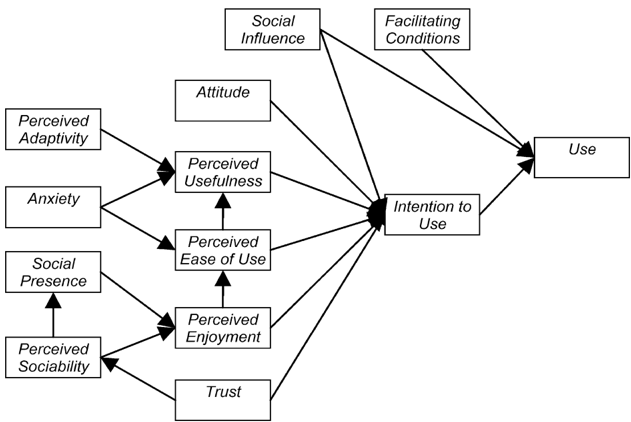
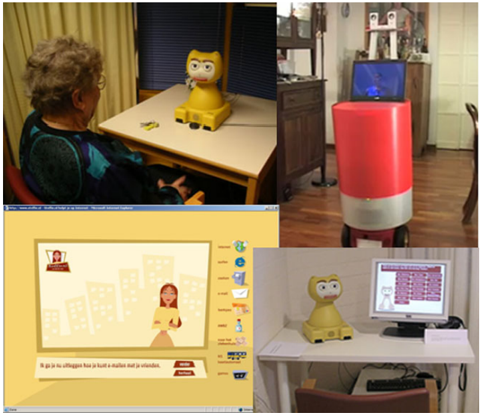
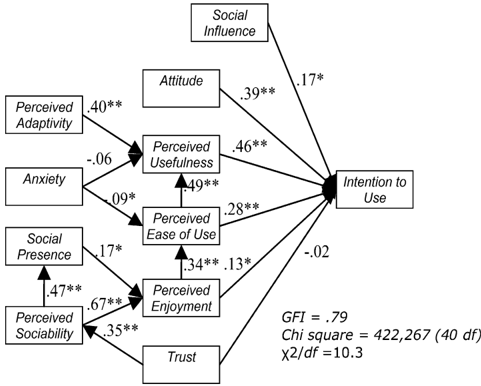
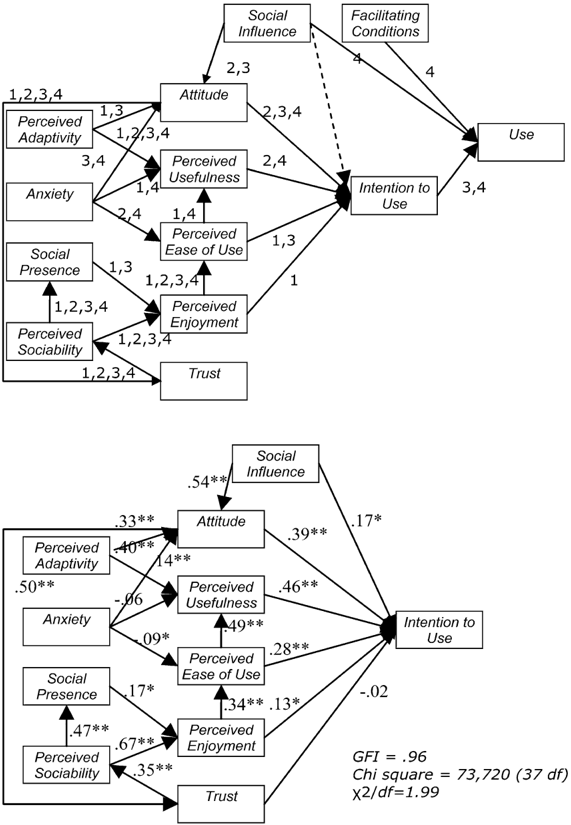
This paper proposes a model of technology acceptance that is specifically developed to test the acceptance of assistive social agents by elderly users. The research in this paper develops and tests an adaptation and theoretical extension of the Unified Theory of Acceptance and Use of Technology (UTAUT) by explaining intent to use not only in terms of variables related to functional evaluation like perceived usefulness and perceived ease of use, but also variables that relate to social interaction. The new model was tested using controlled experiment and longitudinal data collected regarding three different social agents at elderly care facilities and at the homes of older adults. The model was strongly supported accounting for 59–79% of the variance in usage intentions and 49–59% of the variance in actual use. These findings contribute to our understanding of how elderly users accept assistive social agents.
Overview
The claims and statistics of this paper haven’t been checked yet.
Free: it reads the open-access text and checks the first 5 claims that cite a source we can check. Create a free account to check every claim.
Integrity signals
Registry
Cites
Statistics
Figures

Verification
Claims the paper makes
The claims and statistics of this paper haven’t been checked yet.
Free: it reads the open-access text and checks the first 5 claims that cite a source we can check. Create a free account to check every claim.
Claims other papers make about this one
Each is checked against this paper’s own text: does it say what the citing paper says it does?
The source backs part of the claim, not all of it — or backs it for a different population, condition or comparison.
In the citing paper
“The extant literature attests to a positive correlation between users’ trust in technology and their inclination to use it, as evidenced by many studies [25-31].”
From Investigating the impact of user trust on the adoption and use of ChatGPT: Survey analysis (2023) · cites this paper as [31]
Experimental — accuracy not yet measuredThe cited source says what the claim attributes to it.
In the citing paper
“Prior research has established a positive correlation between intent to use and actual use of technology, indicating that users who intend to use the technology are more likely to actually use it [25,31,34].”
From Investigating the impact of user trust on the adoption and use of ChatGPT: Survey analysis (2023) · cites this paper as [31]
In the citing paper
“For instance, studies on adopting robots as assistive social agents found that users’ intent to use them strongly predicted their actual use [25,31].”
From Investigating the impact of user trust on the adoption and use of ChatGPT: Survey analysis (2023) · cites this paper as [31]
In the citing paper
“A study on technology acceptance for assistive social robots among older adult users found that the intention to use plays a mediating role in the relationship between trust and actual use [31].”
From Investigating the impact of user trust on the adoption and use of ChatGPT: Survey analysis (2023) · cites this paper as [31]
In the citing paper
“Heerink [15] found ITU is impacted by other acceptance factors and can be predicted by users' attitude and how much they perceive the robot to be useful.”
From Factors Affecting the Acceptability of Social Robots by Older Adults Including People with Dementia or Cognitive Impairment: A Literature Review (2018) · cites this paper as [15]
11 more claims about this paper
Create a free account to see every claim other papers make about this one.
Self-check
Percentages, sums and reported differences re-computed from the paper’s own numbers.
The self-check needs the paper’s full text.
Citations
Cites
Perceived usefulness, perceived ease of use, and user acceptance of information technology
Davis, F. D. (1989) · MIS Quarterly · doi:10.2307/249008 · Cited by 68,483
User Acceptance of Information Technology: Toward A Unified View1
Venkatesh, V., Morris, M. G., Davis, G. B., & Davis, F. D. (2003) · MIS Quarterly · doi:10.2307/30036540 · Cited by 45,035
(1975) · PhilPapers (PhilPapers Foundation) · Cited by 36,737
A Beginner's Guide to Structural Equation Modeling: Fourth Edition
Schumacker, R. E., & Lomax, R. G. (2015) · doi:10.4324/9781315749105 · Cited by 6,604
Structural Equation Modeling and Regression: Guidelines for Research Practice
Gefen, D., Straub, D., & Boudreau, M.-C. (2000) · Communications of the Association for Information Systems · doi:10.17705/1cais.00407 · Cited by 6,416
Measuring Presence in Virtual Environments: A Presence Questionnaire
Witmer, B. G., & Singer, M. J. (1998) · Presence: Teleoperators and Virtual Environments · doi:10.1162/105474698565686 · Cited by 6,371
A Beginner's Guide to Structural Equation Modeling
Schumacker, R. E., & Lomax, R. G. (2004) · doi:10.4324/9781410610904 · Cited by 6,235
Extrinsic and Intrinsic Motivation to Use Computers in the Workplace 1
Davis, F. D., Bagozzi, R. P., & Warshaw, P. R. (1992) · Journal of Applied Social Psychology · doi:10.1111/j.1559-1816.1992.tb00945.x · Cited by 6,231
Multivariate Data Analysis with Readings.
Rutherford, G. S. W., Hair, J. F., Anderson, R. E., & Tatham, R. L. (1988) · The Statistician · doi:10.2307/2348783 · Cited by 5,830
Multivariate Data Analysis with Readings.
Jolliffe, I. T., Hair, J. F., Anderson, R. E., & Tatham, R. L. (1988) · Journal of the Royal Statistical Society. Series A (Statistics in Society) · doi:10.2307/2983017 · Cited by 5,077
Research works printed but not linked: 6
- United Nations (2007) World population prospects: the 2006 revision-comprehensive tables. United Nations Publications, New York
- Pollack M (2005) Intelligent technology for an aging population: the use of AI to assist elders with cognitive impairment. AI Mag 26(2):9-24
- Zajicek M, Arnold A (1999) The 'technology push' and the user Tailored information environment. In: 5th European research con- sortium for informatics and mathematics, workshop on user inter- faces for all
- Pollack ME, Brown L, Colbry D, Orosz C, Peintner B, Ramakr- ishnan S, Engberg S, Matthews JT, Dunbar-Jacob J, McCarthy CE, Thrun S, Montemerlo M, Pineau J, Pearl NR (2002) A mobile ro- botic assistant for the elderly. In: AAAI workshop on automation as eldercare
- Heerink M (2009) Exploring adaptability, adaptivity and user control. Information Engineering Institute, Almere
- Heerink M (2008) Evaluating steffie. Information Engineering Institute, Almere
Cited by
Items 601–700 of 1,002
Best of Both Worlds? Combining Different Forms of Mixed Reality Deictic Gestures
Brown, L., Hamilton, J., Zhao, H., Phan, A., Phung, T., Hansen, E., Tran, N., & Williams, T. (2023) · ACM Transactions on Human-Robot Interaction · doi:10.1145/3563387 · Cited by 13
Spatola, N., Wudarczyk, O. A., Nomura, T., & Chérif, E. (2023) · International Journal of Social Robotics · doi:10.1007/s12369-023-01056-3 · Cited by 15
Lin, G.-Y., Ruan, J.-H., & Wang, Y. (2023) · International Journal of Human-Computer Interaction · doi:10.1080/10447318.2023.2263247 · Cited by 14
Autonomy Acceptance Model (AAM): The Role of Autonomy and Risk in Security Robot Acceptance
Ye, X., Jo, W., Ali, A., Bhatti, S. C., Esterwood, C. T., Kassie, H. A., & Robert, L. (2024) · ACM/IEEE International Conference on Human-Robot Interaction (HRI) · doi:10.1145/3610977.3635005 · Cited by 16
Manuela, L. F. C., Giallanza, A., Scalia, G. L., & Micale, R. (2025) · The International Journal of Advanced Manufacturing Technology · doi:10.1007/s00170-025-16039-z · Cited by 12
Oh, Y. H., Kim, J., & Ju, D. Y. (2019) · Interaction Studies Social Behaviour and Communication in Biological and Artificial Systems · doi:10.1075/is.18070.oh · Cited by 11
Hamilton, J., Phung, T., Tran, N., & Williams, T. (2021) · ACM/IEEE International Conference on Human-Robot Interaction (HRI) · doi:10.1145/3434073.3444676 · Cited by 18
Exploring Behavioral Creativity of a Proactive Robot
Buyukgoz, S., Pandey, A. K., Chamoux, M., & Chétouani, M. (2021) · Frontiers in Robotics and AI · doi:10.3389/frobt.2021.694177 · Cited by 14
Socially Interactive Agents for Supporting Aging
Ghafurian, M., Muñoz, J. E., Boger, J. N., Hoey, J., & Dautenhahn, K. (2022) · ACM eBooks · doi:10.1145/3563659.3563671 · Cited by 13
A Social Robot to Assist in Addressing Disruptive Eating Behaviors by People with Dementia
Astorga, M., Sandoval, D. C., & Favela, J. (2023) · Robotics · doi:10.3390/robotics12010029 · Cited by 13
Older adults’ expectations, experiences, and preferences in programming physical robot assistance
Ajaykumar, G., Pineda, K. T., & Huang, C. (2023) · International Journal of Human-Computer Studies · doi:10.1016/j.ijhcs.2023.103127 · Cited by 12
Lee, L. Y. K., Yeung, C.-K., Choi, C.-W., Leung, M.-N., Lui, S.-Y., Tam, W.-Y., Tang, K.-Y., Wong, C.-S., Wong, Y.-S., Yau, C.-Y., et al. (2024) · BMC Geriatrics · doi:10.1186/s12877-023-04567-w · Cited by 15
Knowledge and Digital Technology
Glückler, J., & Panitz, R. (2024) · Knowledge and space · doi:10.1007/978-3-031-39101-9 · Cited by 13
Talaei‐Khoei, A., Lewis, L. M., Khoei, T. T., Ghapanchi, A. H., & Vichitvanichphong, S. (2015) · Victoria University Research Repository (Victoria University) · Cited by 12
Investigating Effects of Professional Status and Ethnicity in Human-Agent Interaction
Obaid, M., Salem, M., Ziadee, M., Boukaram, H., Moltchanova, E. V., & Sakr, M. F. (2016) · International Conference on Human-Agent Interaction (HAI) · doi:10.1145/2974804.2974813 · Cited by 14
Latikka, R., Savela, N., Koivula, A., & Oksanen, A. (2021) · Lecture notes in computer science · doi:10.1007/978-3-030-78465-2_20 · Cited by 11
Ageism in applying digital technology in healthcare
Mannheim, I., van Zaalen, Y., & Wouters, E. (2021) · Routledge eBooks · doi:10.4324/9781003155317-7 · Cited by 14
Vichitvanichphong, S., Talaei‐Khoei, A., & Kerr, D. V. (2017) · Hawaii International Conference on System Sciences (HICSS) · doi:10.24251/hicss.2017.445 · Cited by 13
Understanding robot acceptance/rejection: the SAR model
Mele, C., Spena, T. R., Tregua, M., Laddaga, C., Ranieri, A., Ruggiero, A., & Gargiulo, R. (2020) · IEEE RO-MAN · doi:10.1109/ro-man47096.2020.9223577 · Cited by 11
Use of a Socially Assistive Robot to Promote Physical Activity of Older Adults at Home
Ruf, E., Lehmann, S., & Misoch, S. (2021) · Communications in computer and information science · doi:10.1007/978-3-030-70807-8_5 · Cited by 15
Artists as HRI Pioneers: A Creative Approach to Developing Novel Interactions for Living with Robots
Lehmann, H., Walters, M. L., Dumitriu, A., May, A., Koay, K. L., Sàez-Pons, J., Syrdal, D. S., Wood, L. J., Saunders, J., Burke, N., et al. (2013) · Lecture notes in computer science · doi:10.1007/978-3-319-02675-6_40 · Cited by 14
Look who's talking: appearance of embodied conversational agents in eHealth
ter Stal, S. (2021) · doi:10.3990/1.9789036551267 · Cited by 12
Pinto, A., Lemos, L., de Carvalho, C. M. S., Santos, J., Menezes, P. J., & Nomura, T. (2025) · Human Behavior and Emerging Technologies · doi:10.1155/hbe2/8816379 · Cited by 10
The Role of Artificial Intelligence in Increasing E-Commerce Brand Equity
Febrian, A. (2025) · Journal of technology management & innovation · doi:10.4067/s0718-27242025000100061 · Cited by 13
A framework for AI-driven value co-creation across customer journey stages
Chandra, B., & Rahman, Z. (2026) · Service Industries Journal · doi:10.1080/02642069.2026.2612702 · Cited by 13
Do People Purchase a Robot Because of Its Coolness?
Kim, G.-R., Chung, K., & Shin, D. (2015) · ACM/IEEE International Conference on Human-Robot Interaction (HRI) · doi:10.1145/2701973.2702063 · Cited by 10
Acceptance of a Smartphone-Based Visual Field Screening Platform for Glaucoma: Pre-Post Study
Nida, E. K., Bekele, S., Geurts, L., & Abeele, V. V. (2021) · JMIR Formative Research · doi:10.2196/26602 · Cited by 10
Qiao, Q., Wu, W., & Li, Y. (2022) · International Conference on Information Management · doi:10.1109/icim56520.2022.00025 · Cited by 12
Exploring stakeholder perspectives: Enhancing robot acceptance for sustainable healthcare solutions
Höpfl, F., Peisl, T. C., & Greiner, C. (2023) · Sustainable Technology and Entrepreneurship · doi:10.1016/j.stae.2023.100045 · Cited by 11
Wilson, C. M., Boright, L. E., Louie, W.-Y. G., Shahverdi, P., Arena, S. K., Benbow, R., Wilson, J. R., Chen, Q., Rousso, K., & Huang, N. Z. (2023) · Cureus · doi:10.7759/cureus.44264 · Cited by 11
Design Attributes of Socially Assistive Robots for People with Dementia: A Systematic Review
Green, M., Dao, D. V., & Moyle, W. (2023) · International Journal of Social Robotics · doi:10.1007/s12369-023-01087-w · Cited by 10
One Size Does Not Fit All: Mechanisms of Employees’ Acceptance of Robotic Lower-Level Managers
Wolf, F. D., & Stock‐Homburg, R. (2025) · Group & Organization Management · doi:10.1177/10596011251313568 · Cited by 11
Liébana-Cabanillas, F. J., Higueras‐Castillo, E., Alonso-Palomo, R., & Japutra, A. (2025) · Academia Revista Latinoamericana de Administración · doi:10.1108/arla-05-2024-0090 · Cited by 12
Cereghetti, D. M., Kleanthous, S., Christophorou, C., Tsiourti, C., Wings, C., & Christodoulou, E. (2015) · Cited by 10
Proof of Concept of a Social Robot for Patient Reported Outcome Measurements in Elderly Persons
Boumans, R., van Meulen, F., Hindriks, K. V., Neerincx, M. A., & Rikkert, M. G. M. O. (2018) · ACM/IEEE International Conference on Human-Robot Interaction (HRI) · doi:10.1145/3173386.3177013 · Cited by 10
Designing Nudge Agents that Promote Human Altruism
Hang, C., Ono, T., & Yamada, S. (2021) · Lecture notes in computer science · doi:10.1007/978-3-030-90525-5_32 · Cited by 13
Kim, S. K., Hwang, Y. S., Jang, J., & Jo, H. S. (2022) · Journal of Korean Gerontological Nursing · doi:10.17079/jkgn.2022.24.2.142 · Cited by 11
Gerontechnology acceptance by older adults and their satisfaction on its servitization in Hong Kong
Cheng, M., An, S., Cheung, C. F., Leung, Z. C. S., & Chun, T. K. (2022) · Behaviour and Information Technology · doi:10.1080/0144929x.2022.2151936 · Cited by 11
Applying “Designerly Framing” to Understand Assisted Feeding as Social Aesthetic Bodily Experiences
Ljungblad, S. (2023) · ACM Transactions on Human-Robot Interaction · doi:10.1145/3583742 · Cited by 14
The positive–negative–competence (PNC) model of psychological responses to representations of robots
Krpan, D., Booth, J. E., & Damien, A. (2023) · Nature Human Behaviour · doi:10.1038/s41562-023-01705-7 · Cited by 10
Walker, B. A. (2014) · Games for Health Journal · doi:10.1089/g4h.2014.0062 · Cited by 11
Role of Social Robotics in Supporting Employees and Advancing Productivity
Vänni, K. J., & Korpela, A. K. (2015) · Lecture notes in computer science · doi:10.1007/978-3-319-25554-5_67 · Cited by 14
Clabaugh, C., & Matarić, M. J. (2016) · IEEE RO-MAN · doi:10.1109/roman.2016.7745226 · Cited by 11
Animating the adelino robot with ERIK: the expressive robotics inverse kinematics
Ribeiro, T., & Paiva, A. (2017) · INTERNATIONAL CONFERENCE ON MULTIMODAL INTERACTION · doi:10.1145/3136755.3136791 · Cited by 10
Pellichero, A., Best, K. L., Routhier, F., Viswanathan, P., Wang, R. H., & Miller, W. C. (2021) · Disability and Rehabilitation Assistive Technology · doi:10.1080/17483107.2021.1983654 · Cited by 12
Factors influencing trust in Ambient Assisted Living Technology: A scenario-based analysis
Steinke, F., Bading, N., Fritsch, T., & Simonsen, S. (2014) · Gerontechnology · doi:10.4017/gt.2013.12.2.002.00 · Cited by 9
Experiments with Vizzy as a Coach for Elderly Exercise
Simão, H., Ribeiro, P., Moreno, P., de Figueiredo, R. P., Duarte, N. F., Nunes, R. R., Bernardino, A. J. M., Čaić, M., Mahr, D., & Odekerken‐Schröder, G. (2018) · Research Publications (Maastricht University) · Cited by 18
Machine Learning and Social Robotics for Detecting Early Signs of DementiaPreprint
Jonell, P., Mendelson, J., Storskog, T., Hagman, G., Östberg, P., Leite, I., Kucherenko, T., Mikheeva, O., Akenine, U., Jelić, V., et al. (2017) · arXiv (Cornell University) · doi:10.48550/arxiv.1709.01613 · Cited by 11
Chin, J., & Desai, S. (2022) · TMS Proceedings 2021 · doi:10.1037/tms0000027 · Cited by 9
Personality- and Memory-based framework for Emotionally Intelligent agents
Nardelli, A., Maccagni, G., Minutoli, F., Sgorbissa, A., & Recchiuto, C. T. (2024) · IEEE RO-MAN · doi:10.1109/ro-man60168.2024.10731309 · Cited by 11
Lawrence, S., Azizi, N., Fan, K., Jouaiti, M., Hoey, J., Nehaniv, C. L., & Dautenhahn, K. (2025) · ACM Transactions on Human-Robot Interaction · doi:10.1145/3719211 · Cited by 10
Arora, M., Kaur, S., & Mittal, A. (2025) · International Journal of Human-Computer Interaction · doi:10.1080/10447318.2025.2508308 · Cited by 9
Li, Q., Liu, Y., & Jin, Z. (2025) · Journal of Quality Assurance in Hospitality & Tourism · doi:10.1080/1528008x.2025.2511835 · Cited by 9
Application of Social Robots in Higher Education: A Long-Term Study
Donnermann, M., Schäper, P., & Lugrin, B. (2025) · International Journal of Social Robotics · doi:10.1007/s12369-025-01286-7 · Cited by 12
Examining Technology Perspectives of Older Adults With Mild Cognitive Impairment: Scoping Review
Schmidt, S. B., Isbel, S. T., John, B. M., Subramanian, R., & D'Cunha, N. M. (2025) · JMIR Aging · doi:10.2196/78229 · Cited by 11
Nomura, T., & Tanaka, M. (2021) · AI & Society · doi:10.1007/s00146-021-01196-y · Cited by 10
de Azevedo, F. X. M., Heimgärtner, R., & Nebe, K. (2022) · Ergonomics · doi:10.1080/00140139.2022.2127920 · Cited by 11
In Technology We Trust! But Should We?
Sica, A., & Sætra, H. S. (2023) · Lecture notes in computer science · doi:10.1007/978-3-031-35599-8_19 · Cited by 10
Mitsuno, S., Yoshikawa, Y., Ban, M., & Ishiguro, H. (2024) · Advanced Robotics · doi:10.1080/01691864.2023.2301425 · Cited by 12
Why Should We Imitate Robots? Effect of Back Imitation on Judgment of Imitative Skill
Mohammad, Y. F. O., & Nishida, T. (2015) · International Journal of Social Robotics · doi:10.1007/s12369-015-0282-2 · Cited by 10
Roboter zur Unterstützung im Alter
Ruf, E., Lehmann, S., Pauli, C., & Misoch, S. (2020) · HMD Praxis der Wirtschaftsinformatik · doi:10.1365/s40702-020-00681-0 · Cited by 9
Understanding worker trust in industrial robots for improving workplace safety
Choi, H.-S., & Swanson, N. G. (2020) · Elsevier eBooks · doi:10.1016/b978-0-12-819472-0.00005-8 · Cited by 13
Factors influencing the intention to use assistive technologies by older adults
Ejdys, J., & Gulc, A. (2022) · Human Technology · doi:10.14254/1795-6889.2022.18-1.2 · Cited by 9
Evaluating Robot Acceptance in Children with ASD and Their Parents
Zehnder, E., Jouaiti, M., & Charpillet, F. (2022) · Lecture notes in computer science · doi:10.1007/978-3-031-24670-8_5 · Cited by 9
Turnadžić, T., Peštek, A., & Činjarević, M. (2024) · South East European Journal of Economics and Business · doi:10.2478/jeb-2024-0010 · Cited by 11
Development of a Socially Interactive System with Whole-Body Movements for BHR-4
Ma, G., Gao, J., Yu, Z., Chen, X., Huang, Q., & Liu, Y. (2015) · International Journal of Social Robotics · doi:10.1007/s12369-015-0330-y · Cited by 9
FakhrHosseini, S., Hilliger, S., Barnes, J. A., Jeon, M., Park, C. H., & Howard, A. M. (2017) · IEEE RO-MAN · doi:10.1109/roman.2017.8172366 · Cited by 9
Exploring Low-Cost Mobile Manipulation for Elder Care Within a Community Based Setting
Mucchiani, C., Cacchione, P. Z., Torres, W. O., Johnson, M. J., & Yim, M. H. (2019) · Journal of Intelligent & Robotic Systems · doi:10.1007/s10846-019-01041-x · Cited by 9
Robot Use for Older Adults – Attitudes, Wishes and Concerns. First Results from Switzerland
Lehmann, S., Ruf, E., & Misoch, S. (2020) · Communications in computer and information science · doi:10.1007/978-3-030-50732-9_9 · Cited by 9
Adoption of Robots for Disasters: Lessons from the Response to COVID-19
Murphy, R. R., Gandudi, V. B. M., Adams, J., Clendenin, A., & Moats, J. (2021) · Foundations and Trends in Robotics · doi:10.1561/2300000062 · Cited by 9
Emotions, Technology, and Health
Tettegah, S. Y., & Garcia, Y. E. (2016) · Elsevier eBooks · doi:10.1016/c2014-0-00811-8 · Cited by 17
MARIO Project: Experimentation in the Hospital Setting
D’Onofrio, G., Sancarlo, D., Raciti, M., Recupero, D. R., Mangiacotti, A., Russo, A., Ricciardi, F., Vitanza, A., Cantucci, F., Presutti, V., et al. (2019) · Lecture notes in electrical engineering · doi:10.1007/978-3-030-04672-9_20 · Cited by 10
Aware Intelligent Virtual Agent's Effect on Social Presence and Empathy of Caregivers
Ahmmed, A., Butts, E., Naeiji, K., Thiamwong, L., Ancis, J., & Daher, S. (2024) · Proceedings of the ACM International Conference on Intelligent Virtual Agents · doi:10.1145/3652988.3673951 · Cited by 8
Health Care Social Robots in the Age of Generative AI: Protocol for a Scoping Review
Lempe, P. N., Guinemer, C., Fürstenau, D., Dressler, C., Balzer, F., & Schaaf, T. (2025) · JMIR Research Protocols · doi:10.2196/63017 · Cited by 9
Döven, G., Sezen, B., Demir, K. A., & Balcıoğlu, Y. S. (2025) · Applied Sciences · doi:10.3390/app15031591 · Cited by 11
What Influences Potential Users’ Intentions to Use Hotel Robots?
Ren, G., Wang, G., & Huang, T. (2025) · Sustainability · doi:10.3390/su17125271 · Cited by 10
Considerations for designing socially assistive robots for older adults
Olatunji, S., Falcon, V., Ramesh, A., & Rogers, W. A. (2025) · Frontiers in Robotics and AI · doi:10.3389/frobt.2025.1622206 · Cited by 10
Li, Q., Chen, X., Chen, Y., Ma, Y., & Zhang, J. (2025) · International Journal of Human-Computer Interaction · doi:10.1080/10447318.2025.2578063 · Cited by 10
Tran, H., Cha, G.-E., & Jeong, S. (2025) · IEEE RO-MAN · doi:10.1109/ro-man63969.2025.11217862 · Cited by 9
Acceptance of Social and Telepresence Robot Assistance in German Households
Winterstein, K., Keller, L. A., Huffstadt, K., & Müller, N. H. (2021) · Lecture notes in computer science · doi:10.1007/978-3-030-77943-6_22 · Cited by 8
Hu, Q., Pan, Z., Lu, Y., & Gupta, S. (2023) · Internet Research · doi:10.1108/intr-04-2022-0253 · Cited by 9
Liu, X., Shen, Q., & Hancock, J. T. (2024) · New Media & Society · doi:10.1177/14614448231220346 · Cited by 10
Lee, J., You, J. S., & Lee, D. (2024) · International Journal of Human-Computer Interaction · doi:10.1080/10447318.2024.2307695 · Cited by 11
Human-Computer Interaction in Intelligent Environments
Stephanidis, C., & Salvendy, G. (2024) · CRC Press eBooks · doi:10.1201/9781003490685 · Cited by 8
Maggi, G., Raggioli, L., Rossi, A., & Rossi, S. (2025) · IEEE Transactions on Affective Computing · doi:10.1109/taffc.2025.3539015 · Cited by 8
Aryania, A., Huertas-García, R., Forgas‐Coll, S., Ángulo, C., & Alenyà, G. (2025) · International Journal of Social Robotics · doi:10.1007/s12369-025-01244-3 · Cited by 8
Robot-Assisted Training with Swedish and Israeli Older Adults
Akalın, N., Krakovski, M., Avioz-Sarig, O., Loutfi, A., & Edan, Y. (2021) · Lecture notes in computer science · doi:10.1007/978-3-030-90525-5_42 · Cited by 10
Mazuz, K., & Biswas, S. (2022) · Gerontechnology · doi:10.4017/gt.2022.21.1.475.03 · Cited by 8
Socially Assistive Robots in Smart Homes: Design Factors that Influence the User Perception
Toscano, E., Spitale, M., & Garzotto, F. (2022) · ACM/IEEE International Conference on Human-Robot Interaction (HRI) · doi:10.1109/hri53351.2022.9889467 · Cited by 8
Smart Voice Assitance System for Visually Impaired Persons
Manikandan, P., Ramesh, G., Reddy, P. S. M., Suman, J., Kumar, M. D. V., & Reddy, K. C. S. (2022) · International Conference on Advances in Computing, Communication Control and Networking (ICAC3N) · doi:10.1109/icac3n56670.2022.10074529 · Cited by 8
Personality- and Memory-Based Software Framework for Human-Robot Interaction
Nardelli, A., Sgorbissa, A., & Recchiuto, C. T. (2024) · Proceedings - IEEE International Conference on Robotics and Automation/Proceedings · doi:10.1109/icra57147.2024.10611168 · Cited by 11
Salzmann‐Erikson, M., & Eriksson, H. (2018) · Telematics and Informatics · doi:10.1016/j.tele.2018.04.001 · Cited by 8
From HCI to HRI: About Users, Acceptance and Emotions
Heuer, T., & Stein, J. (2019) · Advances in intelligent systems and computing · doi:10.1007/978-3-030-27928-8_23 · Cited by 11
Investigating Design Elements of Companion Robots for Older Adults
Oh, Y. H., Kim, J.-W., Jeong, S., & Ju, A. Y. (2019) · Proceedings - IEEE International Conference on Robotics and Automation/Proceedings · doi:10.1109/icra.2019.8793583 · Cited by 8
Design, Fabrication, and Evaluation of the “Maya” Social Robot
Ranjkar, E., Rafatnejad, R., Nobaveh, A. A., Meghdari, A. F., & Alemi, M. (2019) · RSI International Conference on Robotics and Mechatronics (ICRoM) · doi:10.1109/icrom48714.2019.9071795 · Cited by 9
Abri, D., & Boll, T. J. (2020) · European Psychologist · doi:10.1027/1016-9040/a000407 · Cited by 9
Rosanda, V., & Starčič, A. I. (2021) · Lecture notes in computer science · doi:10.1007/978-3-030-77431-8_29 · Cited by 10
Identifying Specific Reasons Behind Unmet Needs May Inform More Specific Eldercare Robot Design
Stafford, R. Q., MacDonald, B. A., & Broadbent, E. (2012) · Lecture notes in computer science · doi:10.1007/978-3-642-34103-8_15 · Cited by 8
Attitude Toward and Intention to Use Care Robot Technology in Older Adults and Family Members
Han, A., & Park, Y. (2019) · Korean Journal of Adult Nursing · doi:10.7475/kjan.2019.31.6.650 · Cited by 8
A Survey on Current Practices in User Evaluation of Companion Robots
Werner, F. (2020) · Springer series on bio- and neurosystems · doi:10.1007/978-3-030-42307-0_3 · Cited by 9
Metadata
- Authors
- Heerink, M., Kröse, B., Evers, V., & Wielinga, B.
- Affiliations
- Amsterdam University of Applied Sciences (NL)
- University of Amsterdam (NL)
- Corresponding author
- Heerink, Marcel
- Venue
- International Journal of Social Robotics
- Published
- 2010-09-04
- Volume
- 2
- Issue
- 4
- Pages
- 361-375
- ISSN
- 1875-4791 (ISSN-L)
- 1875-4805
- OpenAlex
- W2137577228
- Cited by
- 1,229
- References
- 69
- Citations by year
- 2026: 145 · 2025: 138 · 2024: 115 · 2023: 142 · 2022: 125 · 2021: 119 · 2020: 104 · 2019: 91 · 2018: 46 · 2017: 47 · 2016: 39 · 2015: 28 · 2014: 34 · 2013: 31 · 2012: 14
- Type
- book review
- Language
- en
- Open access
- hybrid
- doi.org
- Licence
- cc-by-nc
- Locations
- International Journal of Social Robotics (publishedVersion, cc-by-nc)
- UvA-DARE (University of Amsterdam) (publishedVersion, other-oa)
- VU Research Portal (publishedVersion, other-oa)
- UvA-DARE (University of Amsterdam) (submittedVersion, other-oa)
- Data Archiving and Networked Services (DANS) (submittedVersion, other-oa)
- Digital Academic REpository of VU University Amsterdam (Vrije Universiteit Amsterdam) (submittedVersion)
- Funders
- European Commission
- Rabobank Foundation
- Topics
- Social Sciences › Psychology › Social Psychology › Social Robot Interaction and HRI
- Health Sciences › Medicine › Geriatrics and Gerontology › Technology Use by Older Adults
- Social Sciences › Decision Sciences › Information Systems and Management › Technology Adoption and User Behaviour
- Keywords
- technology acceptance, older adults, UTAUT, intention to use, perceived usefulness, perceived ease of use, social interaction, elderly care, social robots
About these checks
Registry, retraction, Cites and statistics results are computed, not judged, with one exception: a printed reference that no index lists is read once by a model before it counts as a citation error. Claims are extracted by a model and kept only when their quote appears verbatim in the text; each cited source is then checked, with a model’s help, for whether it says what the claim relies on. Those verdicts can be wrong — read the claim’s quote and the cited source before relying on one.
Statistics and arithmetic are recomputed, not judged.
Confidence bands are shown only for fields calibrated on our annotated test set. None is calibrated yet, so no band is shown.
What counts as a claim ›How we measure confidence ›How we check this ›
Are you an author, or do you see a problem with this page? Request a review
Data sources
Bibliographic data: Semantic Scholar, OpenAlex, Crossref.
Contains information from the Semantic Scholar Academic Graph Datasets, made available under the ODC Attribution License (ODC-BY 1.0).
Semantic Scholar’s data is described in: Kinney, R., et al. (2023). The Semantic Scholar Open Data Platform. arXiv:2301.10140.
