

Assessing Acceptance of Assistive Social Agent Technology by Older Adults: the Almere Model
Open accessThe DOI matches its Crossref record; 69 of the 69 references it cites were found in a registry or an index.
Abstract
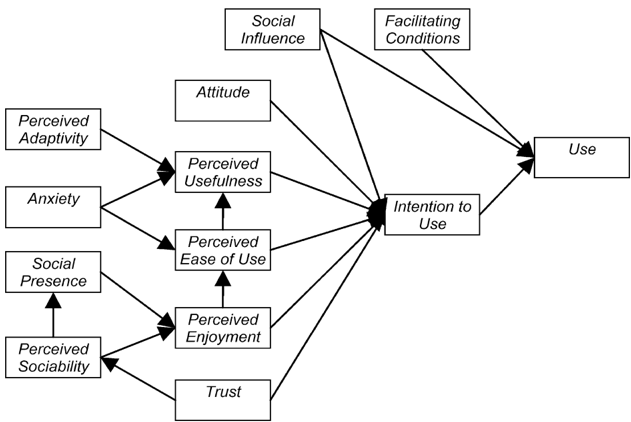
This paper proposes a model of technology acceptance that is specifically developed to test the acceptance of assistive social agents by elderly users. The research in this paper develops and tests an adaptation and theoretical extension of the Unified Theory of Acceptance and Use of Technology (UTAUT) by explaining intent to use not only in terms of variables related to functional evaluation like perceived usefulness and perceived ease of use, but also variables that relate to social interaction. The new model was tested using controlled experiment and longitudinal data collected regarding three different social agents at elderly care facilities and at the homes of older adults. The model was strongly supported accounting for 59–79% of the variance in usage intentions and 49–59% of the variance in actual use. These findings contribute to our understanding of how elderly users accept assistive social agents.
Overview
The claims and statistics of this paper haven’t been checked yet.
Free: it reads the open-access text and checks the first 5 claims that cite a source we can check. Create a free account to check every claim.
Integrity signals
Registry
Cites
Statistics
Figures

Verification
Claims the paper makes
The claims and statistics of this paper haven’t been checked yet.
Free: it reads the open-access text and checks the first 5 claims that cite a source we can check. Create a free account to check every claim.
Claims other papers make about this one
Each is checked against this paper’s own text: does it say what the citing paper says it does?
The source backs part of the claim, not all of it — or backs it for a different population, condition or comparison.
In the citing paper
“The extant literature attests to a positive correlation between users’ trust in technology and their inclination to use it, as evidenced by many studies [25-31].”
From Investigating the impact of user trust on the adoption and use of ChatGPT: Survey analysis (2023) · cites this paper as [31]
Experimental — accuracy not yet measuredThe cited source says what the claim attributes to it.
In the citing paper
“Prior research has established a positive correlation between intent to use and actual use of technology, indicating that users who intend to use the technology are more likely to actually use it [25,31,34].”
From Investigating the impact of user trust on the adoption and use of ChatGPT: Survey analysis (2023) · cites this paper as [31]
In the citing paper
“For instance, studies on adopting robots as assistive social agents found that users’ intent to use them strongly predicted their actual use [25,31].”
From Investigating the impact of user trust on the adoption and use of ChatGPT: Survey analysis (2023) · cites this paper as [31]
In the citing paper
“A study on technology acceptance for assistive social robots among older adult users found that the intention to use plays a mediating role in the relationship between trust and actual use [31].”
From Investigating the impact of user trust on the adoption and use of ChatGPT: Survey analysis (2023) · cites this paper as [31]
In the citing paper
“Heerink [15] found ITU is impacted by other acceptance factors and can be predicted by users' attitude and how much they perceive the robot to be useful.”
From Factors Affecting the Acceptability of Social Robots by Older Adults Including People with Dementia or Cognitive Impairment: A Literature Review (2018) · cites this paper as [15]
11 more claims about this paper
Create a free account to see every claim other papers make about this one.
Self-check
Percentages, sums and reported differences re-computed from the paper’s own numbers.
The self-check needs the paper’s full text.
Citations
Cites
Perceived usefulness, perceived ease of use, and user acceptance of information technology
Davis, F. D. (1989) · MIS Quarterly · doi:10.2307/249008 · Cited by 68,483
User Acceptance of Information Technology: Toward A Unified View1
Venkatesh, V., Morris, M. G., Davis, G. B., & Davis, F. D. (2003) · MIS Quarterly · doi:10.2307/30036540 · Cited by 45,035
(1975) · PhilPapers (PhilPapers Foundation) · Cited by 36,737
A Beginner's Guide to Structural Equation Modeling: Fourth Edition
Schumacker, R. E., & Lomax, R. G. (2015) · doi:10.4324/9781315749105 · Cited by 6,604
Structural Equation Modeling and Regression: Guidelines for Research Practice
Gefen, D., Straub, D., & Boudreau, M.-C. (2000) · Communications of the Association for Information Systems · doi:10.17705/1cais.00407 · Cited by 6,416
Measuring Presence in Virtual Environments: A Presence Questionnaire
Witmer, B. G., & Singer, M. J. (1998) · Presence: Teleoperators and Virtual Environments · doi:10.1162/105474698565686 · Cited by 6,371
A Beginner's Guide to Structural Equation Modeling
Schumacker, R. E., & Lomax, R. G. (2004) · doi:10.4324/9781410610904 · Cited by 6,235
Extrinsic and Intrinsic Motivation to Use Computers in the Workplace 1
Davis, F. D., Bagozzi, R. P., & Warshaw, P. R. (1992) · Journal of Applied Social Psychology · doi:10.1111/j.1559-1816.1992.tb00945.x · Cited by 6,231
Multivariate Data Analysis with Readings.
Rutherford, G. S. W., Hair, J. F., Anderson, R. E., & Tatham, R. L. (1988) · The Statistician · doi:10.2307/2348783 · Cited by 5,830
Multivariate Data Analysis with Readings.
Jolliffe, I. T., Hair, J. F., Anderson, R. E., & Tatham, R. L. (1988) · Journal of the Royal Statistical Society. Series A (Statistics in Society) · doi:10.2307/2983017 · Cited by 5,077
Research works printed but not linked: 6
- United Nations (2007) World population prospects: the 2006 revision-comprehensive tables. United Nations Publications, New York
- Pollack M (2005) Intelligent technology for an aging population: the use of AI to assist elders with cognitive impairment. AI Mag 26(2):9-24
- Zajicek M, Arnold A (1999) The 'technology push' and the user Tailored information environment. In: 5th European research con- sortium for informatics and mathematics, workshop on user inter- faces for all
- Pollack ME, Brown L, Colbry D, Orosz C, Peintner B, Ramakr- ishnan S, Engberg S, Matthews JT, Dunbar-Jacob J, McCarthy CE, Thrun S, Montemerlo M, Pineau J, Pearl NR (2002) A mobile ro- botic assistant for the elderly. In: AAAI workshop on automation as eldercare
- Heerink M (2009) Exploring adaptability, adaptivity and user control. Information Engineering Institute, Almere
- Heerink M (2008) Evaluating steffie. Information Engineering Institute, Almere
Cited by
Items 801–900 of 1,002
Behavioral analysis of ChatGPT users based on the ABC model: Focusing on a socio-technical approach
Liu, Y., Wang, H., & Park, Y. (2025) · European Management Journal · doi:10.1016/j.emj.2024.12.007 · Cited by 7
Shore, L., de Eyto, A., & O'Sullivan, L. W. (2018) · Proceedings of DRS · doi:10.21606/drs.2018.477 · Cited by 6
Towards an improved acceptability assessment model of innovative solutions in the design phase
Salgado, L. A., Bonjour, É., & Rakotondranaivo, A. (2020) · International Journal of Business Information Systems · doi:10.1504/ijbis.2020.10029802 · Cited by 6
The Evolving Design of a Socially Therapeutic Robotic Dog*
Henkel, K. B., Henkel, Z., Aldridge, A. L., & Bethel, C. L. (2023) · World Symposium on Digital Intelligence for Systems and Machines (DISA) · doi:10.1109/disa59116.2023.10308940 · Cited by 6
Designing robotic avatars: are user's impression affected by avatar's age?
Marin, A. L., Jo, D., & Lee, S. (2013) · ACM/IEEE International Conference on Human-Robot Interaction (HRI) · doi:10.5555/2447556.2447634 · Cited by 8
Making life richer, easier and healthier: Robots, their future and the roles for public policy
Nolan, A. (2021) · OECD science, technology and industry policy papers · doi:10.1787/5ea15d01-en · Cited by 11
Customer Acceptance of Service Robots: Marketing Outcomes and Service Complexity
Ferreira, F. F. M., Barbosa, P. P., Cesário, L. C., Lizarelli, F. L., & Mendes, G. H. D. S. (2025) · Services Marketing Quarterly · doi:10.1080/15332969.2025.2544368 · Cited by 4
Robots behind the bar: senior patrons’ perspectives on automated bartending experience
Li, J., Bai, M., & Cain, L. (2025) · Journal of Hospitality and Tourism Technology · doi:10.1108/jhtt-10-2024-0664 · Cited by 4
Ageism, Power, and Gaps: Co-Designing Robots with Older Adults
Mannheim, I., Edan, Y., Alon, R., Peine, A., & Nimrod, G. (2025) · International Journal of Social Robotics · doi:10.1007/s12369-025-01325-3 · Cited by 4
Employee willingness to collaborate with autonomous delivery robots: a cross-cultural perspective
Shin, J., Wen, J., Liu, Z., Liu, X., Boone, C. A., Landers, V. M., Lee, G., & Huang, J. (2025) · International Journal of Physical Distribution & Logistics Management · doi:10.1108/ijpdlm-01-2025-0019 · Cited by 4
Cultural Feasibility of Conversational Robots for Dementia Care in India: Participatory Design Study
Lima, M. R., Srinivasan, N., Daniels, S., Vaitheswaran, S., & Vaidyanathan, R. (2025) · Journal of Participatory Medicine · doi:10.2196/80457 · Cited by 4
Shore, J., Hwang, A. S., & Wang, R. H. (2026) · JMIR Rehabilitation and Assistive Technologies · doi:10.2196/79026 · Cited by 4
Ibrahim, F., Telle, N.-T., Lauckner, M., Karl, J. A., & Daseking, M. (2026) · Computers in Human Behavior Reports · doi:10.1016/j.chbr.2026.101003 · Cited by 4
Extroversion-Introversion Design of Social Robots: The Role of the Mental Model Attribution Process
Oberhofer, V. M., Seeber, I., & Waizenegger, L. (2026) · Group Decision and Negotiation · doi:10.1007/s10726-026-09990-z · Cited by 4
Fiorini, L., Pani, J., Rovini, E., D’Onofrio, G., Iannacone, G., Russo, S., Giuliani, F., Lorusso, L., Toccafondi, L., Calamida, N., et al. (2026) · International Journal of Medical Informatics · doi:10.1016/j.ijmedinf.2026.106475 · Cited by 4
Informatik angepasst an Mensch, Organisation und Umwelt
Horbach, M. (2013) · Cited by 4
Wasić, C., Erzgräber, R., Unger-Büttner, M., Donath, C., Böhme, H.-J., & Graessel, E. (2024) · Frontiers in Robotics and AI · doi:10.3389/frobt.2024.1258847 · Cited by 4
Visualizing Confidence in Delivery Robots: Insights from Two Online Studies
Cumbal, R., Calvo-Barajas, N., Escobar-Planas, M., Rouchitsas, A., & Castellano, G. (2025) · CHI Conference Extended Abstracts on Human Factors in Computing Systems (CHI EA) · doi:10.1145/3706599.3719695 · Cited by 4
Platz, T., Umlauft, A.-N., Pedersen, A. L., & Forbrig, P. (2025) · Biomimetics · doi:10.3390/biomimetics10050289 · Cited by 4
Rudaz, D. (2025) · Human Studies · doi:10.1007/s10746-025-09809-x · Cited by 5
Formica, C., Giambò, F. M., Latella, D., Bonanno, L., Lombardo, M., Tomarchio, O., Marra, A., Alagna, A., Bonanno, C., Quartarone, A., et al. (2025) · Frontiers in Psychology · doi:10.3389/fpsyg.2025.1579626 · Cited by 5
Mehmood, F., Mahzoon, H., Yoshikawa, Y., & Ishiguro, H. (2021) · IEEE RO-MAN · doi:10.1109/ro-man50785.2021.9515503 · Cited by 4
Kramer, I., Zigan, N., Tanner, A., Schulze, H., & Schubert, M. (2022) · Gruppe Interaktion Organisation Zeitschrift für Angewandte Organisationspsychologie (GIO) · doi:10.1007/s11612-022-00646-5 · Cited by 4
Say Aye to AI: Customer Acceptance and Intention to Use Service Robots in the Hospitality Industry
Zulfakar, Z. A., Rahim, F. A., Yat, D. N. C., Mun, L. H., & Cham, T. (2022) · Lecture notes in networks and systems · doi:10.1007/978-3-031-16865-9_7 · Cited by 4
Yuan, F., Boltz, M. P., Jao, Y., Casenhiser, A., Siddiqi, A., Bray, R., Duzan, J., Crane, M. K., & Zhao, X. (2022) · Lecture notes in computer science · doi:10.1007/978-3-031-24670-8_52 · Cited by 6
Zheng, S., Appolloni, A., Lin, H., & Ding, X. (2023) · European Journal of Innovation Management · doi:10.1108/ejim-03-2023-0209 · Cited by 4
Echikr, A., Yachir, A., Kerrache, C. A., & Sahraoui, Z. (2023) · International Conference on Networking and Advanced Systems (ICNAS) · doi:10.1109/icnas59892.2023.10330511 · Cited by 4
Ghost in the Machine : Discourses with AI
Bhardwaj, P., & Sra, M. (2023) · doi:10.1145/3610591.3616429 · Cited by 5
The Naked Android: Synthetic Socialness and the Human Gaze
Carpenter, J. (2024) · Chapman & Hall/CRC eBooks · doi:10.1201/9781003170457 · Cited by 7
Effect of scenario media on elder adults' evaluation of human-robot interaction
Xu, Q., Ng, J., Cheong, Y. L., Tan, O., Wong, J. B., Tay, T. C., & Park, T. (2012) · IEEE RO-MAN · doi:10.1109/roman.2012.6343794 · Cited by 7
Behavioural Prototyping: Making Interactive and Intelligent Systems Meaningful for the User
Benton, S., Altemeyer, B., & Manning, B. R. M. (2010) · International Conference on Intelligent Networking and Collaborative Systems (INCoS) · doi:10.1109/incos.2010.51 · Cited by 4
Belviso, C., Hasenauer, R. P., & Bechtold, U. (2018) · Portland International Conference on Management of Engineering and Technology (PICMET) · doi:10.23919/picmet.2018.8482001 · Cited by 4
Real-Time Interactive Multimodal Systems for Physiological and Emotional Wellbeing
Biloria, N. M., & Dritsa, D. (2019) · S.M.A.R.T. environments · doi:10.1007/978-3-030-12180-8_9 · Cited by 4
Are We Ready for “Them” Now? The Relationship Between Human and Humanoid Robots
Dou, X., & Wu, C. (2021) · Integrated science · doi:10.1007/978-3-030-65273-9_18 · Cited by 5
Service Sector Professionals’ Perspective on Robots Doing Their Job in the Future
Savela, N., Latikka, R., Oksa, R., & Oksanen, A. (2021) · Lecture notes in computer science · doi:10.1007/978-3-030-78465-2_23 · Cited by 4
Korn, O., Buchweitz, L., Theil, A., Fracasso, F., & Cesta, A. (2021) · Springer eBooks · doi:10.1007/978-3-658-31114-8_4 · Cited by 5
Mitsuno, S., Yoshikawa, Y., Ban, M., & Ishiguro, H. (2022) · Transactions of the Japanese Society for Artificial Intelligence · doi:10.1527/tjsai.37-3_ids-i · Cited by 7
Zehnder, E., Dinet, J., & Charpillet, F. (2022) · IEEE RO-MAN · doi:10.1109/ro-man53752.2022.9900593 · Cited by 5
I Am in Love with the Shape of You: The Effect of Mass Customization on the Human-Robot Relationship
Liberman-Pincu, E., Bulgaro, A., & Oron-Gilad, T. (2023) · Communications in computer and information science · doi:10.1007/978-3-031-49368-3_1 · Cited by 6
Assistive Humanoid Robots for the Elderly with Mild Cognitive Impairment
Ferland, F., Agrigoroaie, R., & Tapus, A. (2018) · Springer eBooks · doi:10.1007/978-94-007-6046-2_134 · Cited by 5
Zhou, J., Li, W., & Hu, H. Y. (2022) · Computational Intelligence and Neuroscience · doi:10.1155/2022/4895038 · Cited by 4
RetractedÖtting, S. K. (2021) · PUB – Publications at Bielefeld University (Bielefeld University) · doi:10.4119/unibi/2953489 · Cited by 9
Zhong, V. J., & Schmiedel, T. (2025) · arXiv (Cornell University) · doi:10.48550/arxiv.2509.22146 · Cited by 9
Examining Humanized Bot Interaction for the Retail Revenue Growth
Kumar, N., Garg, P., Gupta, N., & Upreti, K. (2026) · Journal of Revenue and Pricing Management · doi:10.1057/s41272-025-00549-2 · Cited by 3
Patnaik, T., Gnankob, R. I., & Nanda, N. S. (2026) · Frontiers in Artificial Intelligence · doi:10.3389/frai.2026.1911545 · Cited by 3
Evaluation Tools for Human-AI Interactions Involving Older Adults with Mild Cognitive Impairments
Kiyemba, D. M., Marwad, J., Carter, E. J., & Norton, A. (2024) · ACM/IEEE International Conference on Human-Robot Interaction (HRI) · doi:10.1145/3610977.3637474 · Cited by 4
Chu, C., Shen, Z., Xu, H., Wei, Q., & Cao, C. (2024) · Humanities and Social Sciences Communications · doi:10.1057/s41599-024-03684-0 · Cited by 3
Yoon, H.-J., Lee, J.-W., Shin, H., & Kim, Y. S. (2024) · The Journal of Korean Institute of Information Technology · doi:10.14801/jkiit.2024.22.11.101 · Cited by 3
Acceptance of Needy Socially Assistive Robots: A Systematic Review
Jones, N., Loizides, F., & Jones, K. (2025) · International Journal of Social Robotics · doi:10.1007/s12369-025-01272-z · Cited by 5
Ossadnik, J., & Muehlfeld, K. S. (2025) · International Journal of Social Robotics · doi:10.1007/s12369-025-01268-9 · Cited by 4
Exploring trends in gerontechnology research: a bibliometric analysis
Wider, W., Oo, C. T. L., Jiang, L., Fauzi, M. A., Tanucan, J. C. M., & Thet, K. Z. Z. (2025) · Disability and Rehabilitation Assistive Technology · doi:10.1080/17483107.2025.2525535 · Cited by 4
Older Adults’ Perceptions of Robots with Differing Intelligence in Social Multi-Robot Interactions
Giorgi, I., Rajapakse, S., Palomino, M. A., & Masala, G. L. (2025) · ACM Transactions on Human-Robot Interaction · doi:10.1145/3769854 · Cited by 4
Conde, M., Fischedick, S. B., Richter, K., Arboleda, S. A., Groß, H., Raake, A., & Döring, N. M. (2025) · ACM Transactions on Human-Robot Interaction · doi:10.1145/3770851 · Cited by 4
Speech-to-Joy: Self-Supervised Features for Enjoyment Prediction in Human–Robot Conversation
Santana, R. E. S., Irfan, B., Lagerstedt, E., Skantze, G., & Pereira, A. (2025) · INTERNATIONAL CONFERENCE ON MULTIMODAL INTERACTION · doi:10.1145/3716553.3750747 · Cited by 4
Sharan, N. N., Peter, J., Lemmens, J. S., Kühne, R., de Jong, C., & Barco, À. (2025) · International Journal of Human-Computer Interaction · doi:10.1080/10447318.2025.2575299 · Cited by 3
Determinants of customer acceptance of frontline service robots in a retail context
Chaysang, A., Patterson, P., Kimpakorn, N., & Chaisuwan, C. (2025) · Journal of Services Marketing · doi:10.1108/jsm-02-2025-0109 · Cited by 4
Robots with Attitudes: Influence of LLM-Driven Robot Personalities on Motivation and Performance
Becker, D., Ahrens, K., Gäde, C., Strahl, E., & Wermter, S. (2025) · International Conference on Human-Agent Interaction (HAI) · doi:10.1145/3765766.3765780 · Cited by 6
Transforming dementia caregiver support with AI-powered social robotics
Morris, T., Brown, C., Zhao, X., Nichols, L. O., Martindale-Adams, J. L., Bowland, S., & Zhou, W. (2026) · Frontiers in Robotics and AI · doi:10.3389/frobt.2025.1704313 · Cited by 3
An Integrated Analysis of Factors Influencing Acceptance of Care Robots Among Older Korean Adults
Yoon, H. J., Ban, S. W., Han, Y., Shin, H., Kim, Y. S., Shin, W. C., Yoo, S. D., & Park, J. H. (2026) · Healthcare · doi:10.3390/healthcare14030322 · Cited by 3
Ji, P., & Liu, X. (2026) · Frontiers in Psychology · doi:10.3389/fpsyg.2026.1725814 · Cited by 4
Cao, K., Wang, P., Siyu, K., & Zhang, C. (2026) · Frontiers in Artificial Intelligence · doi:10.3389/frai.2026.1630717 · Cited by 4
Robots for Older Adults: A Scoping Review
Olatunji, S., Tsai, Y.-L., Gowrishankar, S. A., Bayles, M. A., & Rogers, W. A. (2026) · ACM Transactions on Human-Robot Interaction · doi:10.1145/3799977 · Cited by 4
Karaosmanoglu, E., Rozendaal, M. C., Vallery, H., & Cramm, J. M. (2026) · International Journal of Social Robotics · doi:10.1007/s12369-026-01391-1 · Cited by 3
Adoption and Use of a Smart Home Connected Care System by Older Adults: Mixed Methods Study
Pemberton, L. J., Carter, M., & Mehandjiev, N. (2026) · JMIR Aging · doi:10.2196/76012 · Cited by 3
Designing a Robot for Enhancing Attention of Office Workers with the Heavily Use of Screen
Tan, Z., Liu, Z., Guo, Z., & Gong, S. (2023) · Lecture notes in computer science · doi:10.1007/978-3-031-35696-4_18 · Cited by 3
Adepoju, O. E., Dang, P., Jacobs, W., & Baiden, P. (2024) · Population Health Management · doi:10.1089/pop.2023.0256 · Cited by 4
Review of service robot technology acceptance model research
Sun, F. (2023) · International Journal of Mechanical and Electrical Engineering · doi:10.62051/ijmee.v1n1.04 · Cited by 3
Samaddar, S., & Petrie, H. (2024) · Nordic Conference on Human-Computer Interaction · doi:10.1145/3679318.3685409 · Cited by 3
Dobrosovestnova, A., Vetter, R., & Weiss, A. (2024) · IEEE RO-MAN · doi:10.1109/ro-man60168.2024.10731405 · Cited by 4
Nagai, N., Miyamoto, T., & Katagami, D. (2025) · Applied Sciences · doi:10.3390/app15073897 · Cited by 4
Pan, Z.-Q., Zhang, X.-C., Li, Z.-S., Peng, Z.-H., Fan, M.-M., & Ma, X.-J. (2025) · International Conference on Human Factors in Computing Systems · doi:10.1145/3706598.3713791 · Cited by 7
What Makes People Use Social Robots? Integrating Trustworthiness Into the UTAUT Model
Fischer, K., Kim, D.-G., & Hong, J.-W. (2025) · Lecture notes in computer science · doi:10.1007/978-3-031-93412-4_4 · Cited by 3
Villa, L., Hervás, R., Cabañero, L., Fontecha, J., López, G., & Favela, J. (2025) · Behaviour and Information Technology · doi:10.1080/0144929x.2025.2546976 · Cited by 3
Utilising Capability Approach for Adoption of Assistive Technologies among Seniors: Conceptual Model
Vichitvanichphong, S., Kerr, D. V., Talaei‐Khoei, A., & Ghapanchi, A. H. (2014) · Tuwhera (Auckland University of Technology) · Cited by 4
Liu, B., Markopoulos, P., & Tetteroo, D. (2020) · Communications in computer and information science · doi:10.1007/978-3-030-46970-2_18 · Cited by 3
Examining Social Robot Acceptability for Older Adults and People with Dementia
Whelan, S., & Casey, D. (2021) · IntechOpen eBooks · doi:10.5772/intechopen.98365 · Cited by 3
Liu, X. (2021) · Journal of Clinical and Nursing Research · doi:10.26689/jcnr.v5i4.2325 · Cited by 5
Banytė, J., Lindžiuvienė, J., & Dargytė, G. (2024) · Smart innovation, systems and technologies · doi:10.1007/978-981-97-1552-7_10 · Cited by 4
Jo, H., & Park, D.-H. (2024) · IEEE Access · doi:10.1109/access.2024.3434544 · Cited by 4
Fiorini, L., Pani, J., Rovini, E., Calamida, N., Toccafondi, L., Giuliani, F., Russo, S., Iannacone, G., Lorusso, L., D’Onofrio, G., et al. (2025) · International Journal of Medical Informatics · doi:10.1016/j.ijmedinf.2025.105913 · Cited by 3
Ariyanto, D., Subroto, B., Purnomosidhi, B., & Rosidi (2014) · Journals & Books Hosting (International Knowledge Sharing Platform) · Cited by 13
A knowledge-driven approach to predicting technology adoption among Persons with Dementia
Patterson, T. J., McClean, S. I., Langdon, P., Zhang, S., Nugent, C., & Cleland, I. (2014) · Annual International Conference of the IEEE Engineering in Medicine and Biology Society (EMBC) · doi:10.1109/embc.2014.6944978 · Cited by 4
Marin, A. L., & Lee, S. (2013) · Lecture notes in computer science · doi:10.1007/978-3-642-39191-0_42 · Cited by 4
Evaluating an adaptive dialog system for the public
Weiß, B., Willkomm, S., & Möller, S. (2013) · Interspeech (USB) · doi:10.21437/interspeech.2013-482 · Cited by 3
An Effort to Develop a Web-Based Approach to Assess the Need for Robots Among the Elderly
Vänni, K. J., & Korpela, A. K. (2016) · Lecture notes in computer science · doi:10.1007/978-3-319-47437-3_70 · Cited by 3
Towards Autonomous Moderation of an Assembly Game
Short, E. S., & Matarić, M. J. (2016) · IEEE RO-MAN · Cited by 3
2. Human–Robot Interaction for Rehabilitation Robots
Louie, W.-Y. G., Mohamed, S. C., & Nejat, G. (2017) · CRC Press eBooks · doi:10.4324/9781315368788-2 · Cited by 5
Ngaruiya, N., Orwa, D., & Waiganjo, P. (2017) · IST-Africa Conference (IST-Africa) · doi:10.23919/istafrica.2017.8102353 · Cited by 3
Vänni, K. J., Cabibihan, J., & Salin, S. E. (2018) · Lecture notes in computer science · doi:10.1007/978-3-030-05204-1_46 · Cited by 3
D’Haeseleer, I., Schoofs, J., Schutters, K., Schreurs, D., & Abeele, V. V. (2021) · EAI Endorsed Transactions on Pervasive Health and Technology · doi:10.4108/eai.24-11-2021.172219 · Cited by 3
Embodied Virtual Agents as a Means to Foster E-Inclusion of Older People
Noy, D., Ribeiro, P., & Iurgel, I. (2013) · Human-computer interaction series · doi:10.1007/978-1-4471-5082-4_7 · Cited by 6
Designing social cues for effective persuasive robots
Ghazali, A. S. (2019) · TU/e Research Portal · Cited by 4
Accepting Robots as Assistants: A Social, Personal, and Principled Matter
Turja, T. (2019) · Tampere University Institutional Repository (Tampere University) · Cited by 27
Human–Robot Interaction: Robots for Older Adults
Rogers, W. A., & Mitzner, T. L. (2016) · CRC Press eBooks · doi:10.1081/e-ecst2-140000160 · Cited by 5
The Application of Collaborative Robots in Garment Factories
Nguyen, K. P. (2022) · ISU Red - Research and eData (Illinois State University) · doi:10.30707/etd2022.20220705065053049742.999977 · Cited by 4
Rosanda, V., & Starčič, A. I. (2023) · doi:10.26493/978-961-293-255-8.101-121 · Cited by 2
Voice Volume Gauge to Encourage Vocal Adaptation of an Operator of a Teleoperated Social Robot
Matsushima, K., Kubota, T., Murakami, H., Sato, S., & Ogawa, K. (2024) · International Conference on Human-Agent Interaction (HAI) · doi:10.1145/3687272.3688313 · Cited by 2
Designing socially assistive robots: Qualitative analysis of stakeholders’ expectations and desires
Green, M., Dao, D. V., & Moyle, W. (2024) · Interaction Studies Social Behaviour and Communication in Biological and Artificial Systems · doi:10.1075/is.24010.gre · Cited by 2
Conde, M., Arboleda, S. A., Raake, A., & Döring, N. M. (2025) · Communications in computer and information science · doi:10.1007/978-3-031-94159-7_19 · Cited by 3
Zolanvari, S. M. J., Taheri, A., Meghdari, A. F., & Alemi, M. (2025) · International Journal of Social Robotics · doi:10.1007/s12369-025-01296-5 · Cited by 2
Metadata
- Authors
- Heerink, M., Kröse, B., Evers, V., & Wielinga, B.
- Affiliations
- Amsterdam University of Applied Sciences (NL)
- University of Amsterdam (NL)
- Corresponding author
- Heerink, Marcel
- Venue
- International Journal of Social Robotics
- Published
- 2010-09-04
- Volume
- 2
- Issue
- 4
- Pages
- 361-375
- ISSN
- 1875-4791 (ISSN-L)
- 1875-4805
- OpenAlex
- W2137577228
- Cited by
- 1,229
- References
- 69
- Citations by year
- 2026: 145 · 2025: 138 · 2024: 115 · 2023: 142 · 2022: 125 · 2021: 119 · 2020: 104 · 2019: 91 · 2018: 46 · 2017: 47 · 2016: 39 · 2015: 28 · 2014: 34 · 2013: 31 · 2012: 14
- Type
- book review
- Language
- en
- Open access
- hybrid
- doi.org
- Licence
- cc-by-nc
- Locations
- International Journal of Social Robotics (publishedVersion, cc-by-nc)
- UvA-DARE (University of Amsterdam) (publishedVersion, other-oa)
- VU Research Portal (publishedVersion, other-oa)
- UvA-DARE (University of Amsterdam) (submittedVersion, other-oa)
- Data Archiving and Networked Services (DANS) (submittedVersion, other-oa)
- Digital Academic REpository of VU University Amsterdam (Vrije Universiteit Amsterdam) (submittedVersion)
- Funders
- European Commission
- Rabobank Foundation
- Topics
- Social Sciences › Psychology › Social Psychology › Social Robot Interaction and HRI
- Health Sciences › Medicine › Geriatrics and Gerontology › Technology Use by Older Adults
- Social Sciences › Decision Sciences › Information Systems and Management › Technology Adoption and User Behaviour
- Keywords
- technology acceptance, older adults, UTAUT, intention to use, perceived usefulness, perceived ease of use, social interaction, elderly care, social robots
About these checks
Registry, retraction, Cites and statistics results are computed, not judged, with one exception: a printed reference that no index lists is read once by a model before it counts as a citation error. Claims are extracted by a model and kept only when their quote appears verbatim in the text; each cited source is then checked, with a model’s help, for whether it says what the claim relies on. Those verdicts can be wrong — read the claim’s quote and the cited source before relying on one.
Statistics and arithmetic are recomputed, not judged.
Confidence bands are shown only for fields calibrated on our annotated test set. None is calibrated yet, so no band is shown.
What counts as a claim ›How we measure confidence ›How we check this ›
Are you an author, or do you see a problem with this page? Request a review
Data sources
Bibliographic data: Semantic Scholar, OpenAlex, Crossref.
Contains information from the Semantic Scholar Academic Graph Datasets, made available under the ODC Attribution License (ODC-BY 1.0).
Semantic Scholar’s data is described in: Kinney, R., et al. (2023). The Semantic Scholar Open Data Platform. arXiv:2301.10140.
