

Assessing Acceptance of Assistive Social Agent Technology by Older Adults: the Almere Model
Open accessThe DOI matches its Crossref record; 69 of the 69 references it cites were found in a registry or an index.
Abstract
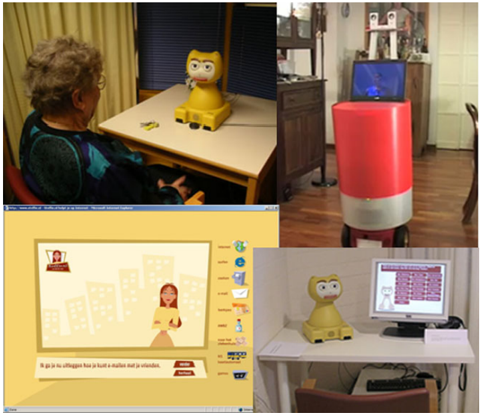
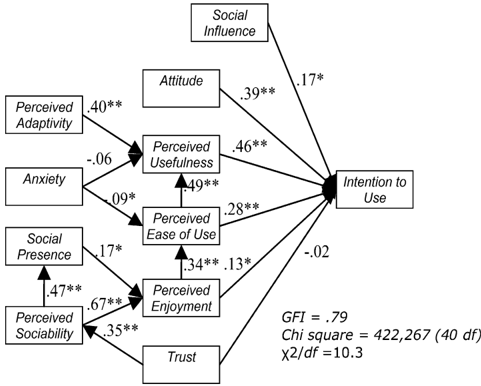
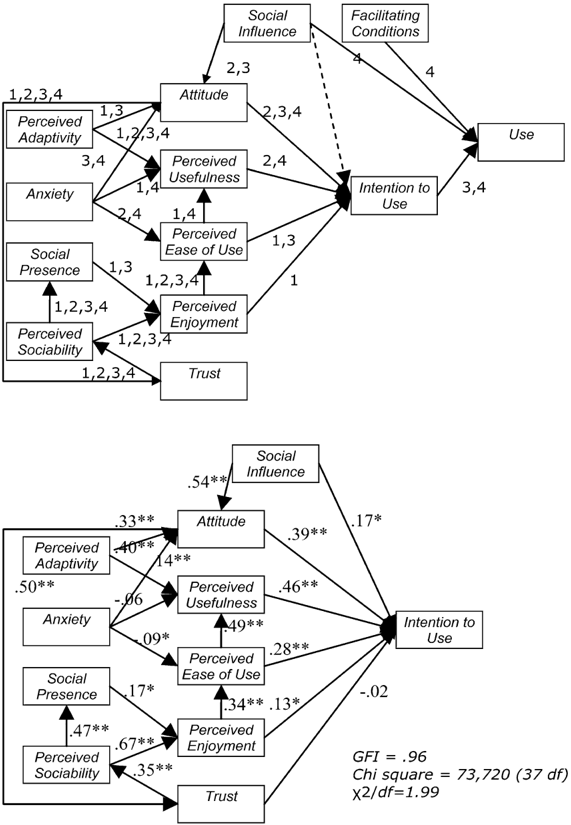
This paper proposes a model of technology acceptance that is specifically developed to test the acceptance of assistive social agents by elderly users. The research in this paper develops and tests an adaptation and theoretical extension of the Unified Theory of Acceptance and Use of Technology (UTAUT) by explaining intent to use not only in terms of variables related to functional evaluation like perceived usefulness and perceived ease of use, but also variables that relate to social interaction. The new model was tested using controlled experiment and longitudinal data collected regarding three different social agents at elderly care facilities and at the homes of older adults. The model was strongly supported accounting for 59–79% of the variance in usage intentions and 49–59% of the variance in actual use. These findings contribute to our understanding of how elderly users accept assistive social agents.
Overview
The claims and statistics of this paper haven’t been checked yet.
Free: it reads the open-access text and checks the first 5 claims that cite a source we can check. Create a free account to check every claim.
Integrity signals
Registry
Cites
Statistics
Figures

Verification
Claims the paper makes
The claims and statistics of this paper haven’t been checked yet.
Free: it reads the open-access text and checks the first 5 claims that cite a source we can check. Create a free account to check every claim.
Claims other papers make about this one
Each is checked against this paper’s own text: does it say what the citing paper says it does?
The source backs part of the claim, not all of it — or backs it for a different population, condition or comparison.
In the citing paper
“The extant literature attests to a positive correlation between users’ trust in technology and their inclination to use it, as evidenced by many studies [25-31].”
From Investigating the impact of user trust on the adoption and use of ChatGPT: Survey analysis (2023) · cites this paper as [31]
Experimental — accuracy not yet measuredThe cited source says what the claim attributes to it.
In the citing paper
“Prior research has established a positive correlation between intent to use and actual use of technology, indicating that users who intend to use the technology are more likely to actually use it [25,31,34].”
From Investigating the impact of user trust on the adoption and use of ChatGPT: Survey analysis (2023) · cites this paper as [31]
In the citing paper
“For instance, studies on adopting robots as assistive social agents found that users’ intent to use them strongly predicted their actual use [25,31].”
From Investigating the impact of user trust on the adoption and use of ChatGPT: Survey analysis (2023) · cites this paper as [31]
In the citing paper
“A study on technology acceptance for assistive social robots among older adult users found that the intention to use plays a mediating role in the relationship between trust and actual use [31].”
From Investigating the impact of user trust on the adoption and use of ChatGPT: Survey analysis (2023) · cites this paper as [31]
In the citing paper
“Heerink [15] found ITU is impacted by other acceptance factors and can be predicted by users' attitude and how much they perceive the robot to be useful.”
From Factors Affecting the Acceptability of Social Robots by Older Adults Including People with Dementia or Cognitive Impairment: A Literature Review (2018) · cites this paper as [15]
11 more claims about this paper
Create a free account to see every claim other papers make about this one.
Self-check
Percentages, sums and reported differences re-computed from the paper’s own numbers.
The self-check needs the paper’s full text.
Citations
Cites
Perceived usefulness, perceived ease of use, and user acceptance of information technology
Davis, F. D. (1989) · MIS Quarterly · doi:10.2307/249008 · Cited by 68,483
User Acceptance of Information Technology: Toward A Unified View1
Venkatesh, V., Morris, M. G., Davis, G. B., & Davis, F. D. (2003) · MIS Quarterly · doi:10.2307/30036540 · Cited by 45,035
(1975) · PhilPapers (PhilPapers Foundation) · Cited by 36,737
A Beginner's Guide to Structural Equation Modeling: Fourth Edition
Schumacker, R. E., & Lomax, R. G. (2015) · doi:10.4324/9781315749105 · Cited by 6,604
Structural Equation Modeling and Regression: Guidelines for Research Practice
Gefen, D., Straub, D., & Boudreau, M.-C. (2000) · Communications of the Association for Information Systems · doi:10.17705/1cais.00407 · Cited by 6,416
Measuring Presence in Virtual Environments: A Presence Questionnaire
Witmer, B. G., & Singer, M. J. (1998) · Presence: Teleoperators and Virtual Environments · doi:10.1162/105474698565686 · Cited by 6,371
A Beginner's Guide to Structural Equation Modeling
Schumacker, R. E., & Lomax, R. G. (2004) · doi:10.4324/9781410610904 · Cited by 6,235
Extrinsic and Intrinsic Motivation to Use Computers in the Workplace 1
Davis, F. D., Bagozzi, R. P., & Warshaw, P. R. (1992) · Journal of Applied Social Psychology · doi:10.1111/j.1559-1816.1992.tb00945.x · Cited by 6,231
Multivariate Data Analysis with Readings.
Rutherford, G. S. W., Hair, J. F., Anderson, R. E., & Tatham, R. L. (1988) · The Statistician · doi:10.2307/2348783 · Cited by 5,830
Multivariate Data Analysis with Readings.
Jolliffe, I. T., Hair, J. F., Anderson, R. E., & Tatham, R. L. (1988) · Journal of the Royal Statistical Society. Series A (Statistics in Society) · doi:10.2307/2983017 · Cited by 5,077
Research works printed but not linked: 6
- United Nations (2007) World population prospects: the 2006 revision-comprehensive tables. United Nations Publications, New York
- Pollack M (2005) Intelligent technology for an aging population: the use of AI to assist elders with cognitive impairment. AI Mag 26(2):9-24
- Zajicek M, Arnold A (1999) The 'technology push' and the user Tailored information environment. In: 5th European research con- sortium for informatics and mathematics, workshop on user inter- faces for all
- Pollack ME, Brown L, Colbry D, Orosz C, Peintner B, Ramakr- ishnan S, Engberg S, Matthews JT, Dunbar-Jacob J, McCarthy CE, Thrun S, Montemerlo M, Pineau J, Pearl NR (2002) A mobile ro- botic assistant for the elderly. In: AAAI workshop on automation as eldercare
- Heerink M (2009) Exploring adaptability, adaptivity and user control. Information Engineering Institute, Almere
- Heerink M (2008) Evaluating steffie. Information Engineering Institute, Almere
Cited by
Items 701–800 of 1,002
An EEG investigation on planning human-robot handover tasks
Cooper, S., Gow, S., F.P.Fensome, S., Dragone, M., & Kourtis, D. (2020) · IEEE International Conference on Human-Machine Systems (ICHMS) · doi:10.1109/ichms49158.2020.9209543 · Cited by 8
Bender, N., Faramawy, S. E., Kraus, J., & Baumann, M. R. K. (2021) · arXiv (Cornell University) · doi:10.48550/arxiv.2104.06863 · Cited by 10
Reerink-Boulanger, J. (2012) · theses.fr (ABES) · doi:10.70675/5341f827z77baz422czb3a8zf0ddc8c55151 · Cited by 28
Perception of Society’s Trust in Care Robots by Public Opinion Leaders
Hoppe, J. A., Melkas, H., Pekkarinen, S., Tuisku, O., Hennala, L., Johansson-Pajala, R.-M., Gustafsson, C., & Thommes, K. (2023) · International Journal of Human–Computer Interaction · doi:10.1080/10447318.2022.2081283 · Cited by 7
“…different acceptance models on the individual level, such as the unified theory of acceptance and use of technology, the technology acceptance model, or Almere model. which investigate the explanation of users’ technology adoption (Heerink et al., 2010; Venkatesh & Davis, 2000; Wu et al., 2011).”
BackgroundNardelli, A., Maccagni, G., Minutoli, F., Sgorbissa, A., & Recchiuto, C. T. (2025) · International Journal of Social Robotics · doi:10.1007/s12369-025-01260-3 · Cited by 8
Satake, Y., Nygren, M. O., Yu, C. T. K., Katsuki, K., Endo, I., Tsuboi, A., Ishimaru, D., Umemura, K., Rapaport, P., Bianchi‐Berthouze, N., et al. (2026) · International Psychogeriatrics · doi:10.1016/j.inpsyc.2026.100216 · Cited by 7
Man, S. S., Li, X. X., Chen, J., Lun, C., & Chan, A. H. S. (2026) · International Journal of Human-Computer Interaction · doi:10.1080/10447318.2026.2663072 · Cited by 9
Liu, B., Tetteroo, D., Timmermans, A. A. A., & Markopoulos, P. (2022) · IEEE RO-MAN · doi:10.1109/ro-man53752.2022.9900804 · Cited by 9
Consumer acceptance of robotic surgeons in health services
Souto-Romero, M., Borondo, J. P., Arias-Oliva, M., & Almahameed, A. A. (2024) · Humanities and Social Sciences Communications · doi:10.1057/s41599-024-03388-5 · Cited by 7
Assessment of Exoskeletons for Work Activities: The Dilemma behind the Product
Lefint, J., & Moniz, A. B. (2024) · Applied Sciences · doi:10.3390/app14167108 · Cited by 7
The General Attitudes Towards Robots Scale (GAToRS): A Preliminary Validation of the Italian Version
Carradore, M., Artioli, G., & Sarli, A. (2024) · International Journal of Social Robotics · doi:10.1007/s12369-024-01170-w · Cited by 7
Randall, N., & Šabanović, S. (2025) · ACM Transactions on Human-Robot Interaction · doi:10.1145/3714476 · Cited by 9
Starčič, A. I., Podpečan, V., Rosanda, V., & Zhai, X. (2025) · Cogent Education · doi:10.1080/2331186x.2025.2489820 · Cited by 8
Social Prescribing Across the Lifespan with Virtual Humans
Yalçın, Ö. N., Moreno, S., & DiPaola, S. (2020) · ACM International Conference on Intelligent Virtual Agents (IVA) · doi:10.1145/3383652.3423897 · Cited by 8
Calvo-Barajas, N., Elgarf, M., Perugia, G., Paiva, A., Peters, C., & Castellano, G. (2021) · Frontiers in Robotics and AI · doi:10.3389/frobt.2021.652035 · Cited by 8
Mehmood, F., Mahzoon, H., Yoshikawa, Y., & Ishiguro, H. (2021) · Frontiers in Robotics and AI · doi:10.3389/frobt.2021.758177 · Cited by 8
Getson, C., & Nejat, G. (2022) · IEEE RO-MAN · doi:10.1109/ro-man53752.2022.9900620 · Cited by 8
What behavioral beliefs could robot-served hotels focus on to attract potential consumers?
Barrenetxea, L. Z., Barrutia, J. M., & Marcos, A. (2023) · Journal Of Vacation Marketing · doi:10.1177/13567667231170235 · Cited by 8
Influence of robot motion and human factors on users' perceived safety in HRI
Nertinger, S., Kirschner, R. J., Abdolshah, S., Naceri, A., & Haddadin, S. (2023) · IEEE Workshop on Advanced Robotics and its Social Impacts (ARSO) · doi:10.1109/arso56563.2023.10187525 · Cited by 10
A transformer-based multi-stream approach for isolated iranian sign language recognition
Ghadami, A., Meghdari, A. F., & Taheri, A. (2026) · Computer Speech & Language · doi:10.1016/j.csl.2026.102017 · Cited by 7
Hei, X., Zhang, H., & Tapus, A. (2024) · IEEE RO-MAN · doi:10.1109/ro-man60168.2024.10731328 · Cited by 8
Hygiene and the Use of Robotic Animals in Hospitals: A Review of the Literature
Scholten, T. S., Vissenberg, C., & Heerink, M. (2016) · International Journal of Social Robotics · doi:10.1007/s12369-016-0367-6 · Cited by 7
Self-citationMo, F., Zhou, J., & Yi, S. (2017) · Lecture notes in computer science · doi:10.1007/978-3-319-58530-7_27 · Cited by 9
Multi-agent approach to foster regular physical activity in elderly users
Menezes, P. J., & Rocha, R. P. (2020) · IEEE International Conference on Autonomous Robot Systems and Competitions · doi:10.1109/icarsc49921.2020.9096129 · Cited by 7
ROBOTS IN EDUCATION: A JORDANIAN UNIVERSITY CASE STUDY
Almahameed, A. A., Alshwayat, D., Arias-Oliva, M., & Borondo, J. P. (2020) · Journal of Management and Business Education · doi:10.35564/jmbe.2020.0011 · Cited by 7
Humans and Robots in Times of Quarantine Based on First-Hand Accounts
Lafranca, L., & Li, J. J. (2020) · Lecture notes in computer science · doi:10.1007/978-3-030-62056-1_57 · Cited by 8
Dupuy, L., de Sevin, É., Micoulaud‐Franchi, J., & Philip, P. (2021) · ACM International Conference on Intelligent Virtual Agents (IVA) · doi:10.1145/3472306.3478334 · Cited by 8
An Empirical Study of Consumer Attitude Toward Adoption of Online Food Ordering App
Khandelwal, U., & Singh, T. P. (2021) · International Journal of E-Services and Mobile Applications · doi:10.4018/ijesma.285549 · Cited by 7
Examining the antecedents and consequences of addiction to mobile games: an empirical study
Chatterjee, S., Chaudhuri, R., & Vrontis, D. (2022) · Information Systems and e-Business Management · doi:10.1007/s10257-022-00614-y · Cited by 10
Hsiung, C., León, G. A., Stinson, D., & Chiou, E. K. (2023) · Human Factors and Ergonomics in Manufacturing & Service Industries · doi:10.1002/hfm.20998 · Cited by 8
Using Rapid Prototyping to Explore Design Implications for a Pill-Dispensing Social Agent
Deneke, J., Lehane, D., Kandler, A., Menchini, T., Laaksoharju, M., & Obaid, M. (2017) · International Conference on Human-Agent Interaction (HAI) · doi:10.1145/3125739.3125754 · Cited by 7
Assistive Humanoid Robots for the Elderly with Mild Cognitive Impairment
Ferland, F., Agrigoroaie, R., & Tapus, A. (2017) · Springer eBooks · doi:10.1007/978-94-007-7194-9_134-1 · Cited by 7
An Effective TeleHealth Assistive System to Support Senior Citizen at Home or Care-Homes
Sharif, M. S., Alsallal, M., & Herghelegiu, L. (2018) · International Conference on Computing, Electronics & Communications Engineering (iCCECE) · doi:10.1109/iccecome.2018.8658877 · Cited by 7
The Impact of Affective Verbal Expressions in Social Robots
van Maris, A., Sutherland, A., Mazel, A., Dogramadzi, S., Zook, N., Studley, M., Winfield, A. F. T., & Caleb-Solly, P. (2020) · ACM/IEEE International Conference on Human-Robot Interaction (HRI) · doi:10.1145/3371382.3378358 · Cited by 7
Factors Influencing Acceptance of Technology by Senior Citizens: A Systematic Review
Seman, A. H. A., Ahmad, R. B., & Alhussian, H. (2020) · Advances in intelligent systems and computing · doi:10.1007/978-3-030-51965-0_31 · Cited by 11
Bradwell, H. L., Winnington, R., Thill, S., & Jones, R. B. (2021) · Lecture notes in computer science · doi:10.1007/978-3-030-90525-5_70 · Cited by 7
Designing robotic avatars Are user's impression affected by avatar's age?
Marin, A. L., Jo, D., & Lee, S. (2013) · ACM/IEEE International Conference on Human-Robot Interaction (HRI) · doi:10.1109/hri.2013.6483568 · Cited by 7
Descriptive Statistics for Variables
LeVan, A. C. (2014) · Cambridge University Press eBooks · doi:10.1017/cbo9781139962872.009 · Cited by 7
Non-Real-Time Chatbot: Improving Anthropomorphism and Realizing Long-Term Human–Chatbot Interaction
Mitsuno, S., Ban, M., Arimoto, T., Sugiyama, H., Ishiguro, H., & Yoshikawa, Y. (2025) · International Journal of Human-Computer Interaction · doi:10.1080/10447318.2025.2508316 · Cited by 6
Jung, H. W., Kim, Y., Kim, H., Kim, M.-K., Lee, H., Park, J. Y., Kim, W. J., & Park, J. (2025) · Journal of Clinical Medicine · doi:10.3390/jcm15010217 · Cited by 7
Jiang, Z., Guo, H., Kong, K., Zhao, M., & Li, S. (2026) · Current Psychology · doi:10.1007/s12144-026-09041-5 · Cited by 6
BEGUM, N. U., Rana, N. P., Nunkoo, R., & Faisal, M. N. (2026) · Tourism Management · doi:10.1016/j.tourman.2026.105421 · Cited by 6
Chu, M., & Liu, M. (2026) · npj Heritage Science · doi:10.1038/s40494-026-02622-4 · Cited by 7
Under what conditions will I let social robots into my home? A configuration theory perspective
Gao, Y., Chang, Y., He, Y., & Yu, Z. (2025) · Journal of Research in Interactive Marketing · doi:10.1108/jrim-07-2024-0363 · Cited by 8
Binesh, F., Rippee, R., Belarmino, A. M., & Syah, A. (2025) · International Journal of Social Robotics · doi:10.1007/s12369-024-01198-y · Cited by 8
Lee, C., & Kwak, H. S. (2025) · Food Research International · doi:10.1016/j.foodres.2025.116626 · Cited by 7
Observation of Human–Robot Interactions at a Science Museum: A Dual-Level Analytical Approach
Yoon, H., Shim, G., Lee, H., Kim, M., & Kim, S. (2025) · Electronics · doi:10.3390/electronics14122368 · Cited by 7
Wangmo, T., Tian, Y. J., Schwab, D. R., & Meyer, A. H. (2025) · Innovation in Aging · doi:10.1093/geroni/igaf051 · Cited by 6
SUZUKI, T., Yamada, S., NOMURA, T., & Kanda, T. (2019) · Journal of Japan Society for Fuzzy Theory and Intelligent Informatics · doi:10.3156/jsoft.31.5_789 · Cited by 10
Understanding the Utilization of Artificial Intelligence and Robotics in the Service Sector
Çallı, B. A., & Çallı, L. (2022) · Accounting, finance, sustainability, governance & fraud · doi:10.1007/978-981-16-8997-0_14 · Cited by 7
Weber, K., Haug, S., Lauer, N., Meussling-Sentpali, A., Mohr, C., Pfingsten, A., Raptis, G., & Bahr, G. (2022) · Regensburger Beiträge zur Digitalisierung des Gesundheitswesens · doi:10.1515/9783839462355 · Cited by 14
The Development of the Wearable Robot Perception (WeaR-P) Questionnaire
Valentin, Y., & Choi, H.-S. (2023) · Proceedings of the Human Factors and Ergonomics Society Annual Meeting · doi:10.1177/21695067231192558 · Cited by 7
Probst, T. M., Lindgren, R. J., Dorosh, R., Allen, J., Pascual, L. S., & Luo, M. (2023) · IISE Transactions on Occupational Ergonomics and Human Factors · doi:10.1080/24725838.2023.2284193 · Cited by 7
Human-robot interactions with an autonomous health screening robot in long-term care settings
Getson, C., & Nejat, G. (2023) · Advanced Robotics · doi:10.1080/01691864.2023.2293133 · Cited by 8
Exploring the influence of perceived extroversion in embodied virtual agents on trust and likability
Lithoxoidou, E. E., Stamos, A., Triantafyllidis, A. K., Georgiadis, C., Avonds, J., Altsitsiadis, E., Giakoumis, D., Votis, K., Dewitte, S., Tzovaras, D., et al. (2025) · User Modeling and User-Adapted Interaction · doi:10.1007/s11257-025-09428-2 · Cited by 7
Yuan, J., Shah, S. K., Tajeddini, K., Gamage, T. C., & Acevedo-Duque, Á. (2025) · International Journal of Human-Computer Interaction · doi:10.1080/10447318.2025.2482744 · Cited by 7
Can Older Adults’ Acceptance Toward Robots Be Enhanced by Observational Learning?
Chien, S.-E., Yu, C.-J., Lai, Y., Liu, J.-C., Fu, L., & Yeh, S. (2020) · Lecture notes in computer science · doi:10.1007/978-3-030-49788-0_43 · Cited by 6
Social Presence in Evaluations for a Humanoid Robot and Its Effect on Children-Robot Relationship
Chen, Y., Gamborino, E., Fu, L., Yueh, H., & Yeh, S. (2021) · Communications in computer and information science · doi:10.1007/978-3-030-78635-9_27 · Cited by 6
Zhang, Z., Zhang, C., & Li, X. (2022) · Sustainability · doi:10.3390/su14042303 · Cited by 7
Stower, R. E., Tatarian, K., Rudaz, D., Chamoux, M., Chétouani, M., & Kappas, A. (2022) · IEEE RO-MAN · doi:10.1109/ro-man53752.2022.9900782 · Cited by 7
Hurmuz, M. Z. M., Jansen-Kosterink, S. M., Flierman, I., Signore, S. D., Zia, G., Signore, S. D., & Fard, B. (2023) · Computers in Human Behavior Artificial Humans · doi:10.1016/j.chbah.2023.100017 · Cited by 9
EEGs as potential predictors of virtual agents’ acceptance
Tolgay, B., Dell’Orco, S., Maldonato, M. N., Vogel, C. M., Trojano, L., & Esposito, A. A. (2019) · IEEE International Conference on Cognitive Infocommunications · doi:10.1109/coginfocom47531.2019.9089944 · Cited by 6
Onofrio, R., Gandolla, M., Lettieri, E., & Pedrocchi, A. (2020) · Advances in intelligent systems and computing · doi:10.1007/978-3-030-51828-8_120 · Cited by 6
Schmidbauer, C., Umele, M., Zigart, T., Weiss, A., & Schlund, S. (2020) · International Conference on Human-Agent Interaction (HAI) · doi:10.1145/3406499.3415062 · Cited by 8
Wisdom of the IoT Crowd: Envisioning a Smart Home-based Nutritional Intake Monitoring System
Faltaous, S., Janzon, S., Heger, R., Strauss, M. D., Golkar, P., Viefhaus, M., Prochazka, M., Gruenefeld, U., & Schneegaß, S. (2021) · Mensch und Computer (MuC) · doi:10.1145/3473856.3474009 · Cited by 6
Aliasghari, P., Ghafurian, M., Nehaniv, C. L., & Dautenhahn, K. (2021) · International Conference on Human-Agent Interaction (HAI) · doi:10.1145/3472307.3484184 · Cited by 9
He, Y., Liu, Q., He, Q., & Li, L. (2022) · Clinical Interventions in Aging · doi:10.2147/cia.s367781 · Cited by 6
Ambient Assisted Living: Benefits and Barriers From a User-Centered Perspective
Jaschinski, C., & Allouch, S. B. (2014) · University of Twente Research Information · Cited by 12
Jaschinski, C. (2018) · doi:10.3990/1.9789036546348 · Cited by 12
Ferland, L., Huffstutler, T., Rice, J. B., Zheng, J., Ni, S., & Gini, M. L. (2019) · arXiv (Cornell University) · doi:10.48550/arxiv.1902.04393 · Cited by 6
Williams, T. (2020) · OSF Preprints (OSF Preprints) · doi:10.31219/osf.io/ye2w5 · Cited by 6
L’italiano delle intelligenze artificiali generative
Cicero, F. (2023) · Italiano LinguaDue · doi:10.54103/2037-3597/21990 · Cited by 5
Seßner, J., Porstmann, A., Kirst, S., Merz, N., Dziobek, I., & Franke, J. E. (2022) · IEEE RO-MAN · doi:10.1109/ro-man53752.2022.9900704 · Cited by 5
Deformable Object Manipulation in Caregiving Scenarios: A Review
Wang, L., & Zhu, J. (2023) · Machines · doi:10.3390/machines11111013 · Cited by 12
Building trust in long-term care settings using assistive technology: a systematic review
Zheng, K., Han, F., Yang, S., & Li, N. (2024) · Frontiers in Rehabilitation Sciences · doi:10.3389/fresc.2024.1492104 · Cited by 5
AI-Powered Social Robot for Cognitive Stimulation in the Elderly Through Personalized Storytelling
Almeida, P., & Rocha, R. P. (2025) · International Conference on Automation, Robotics and Applications · doi:10.1109/icara64554.2025.10977621 · Cited by 6
Turja, T., Jylhä, V., Rosenlund, M., & Kuusisto, H. (2025) · Sustainable Futures · doi:10.1016/j.sftr.2025.101003 · Cited by 6
Gul, A., Turner, L. D., & Fuentes, C. (2025) · Frontiers in Robotics and AI · doi:10.3389/frobt.2025.1631206 · Cited by 5
Loneliness increases consumers’ preference for virtual human companionship
Liao, J., Wang, X., & Dong, X. (2026) · Journal of Business Research · doi:10.1016/j.jbusres.2026.116001 · Cited by 7
Interrupting resonant amplification: A mechanistic and design framework for human–AI interaction
Kim, R. S. (2026) · Computers in Human Behavior Reports · doi:10.1016/j.chbr.2026.100975 · Cited by 8
Technology adoption models for Operator 5.0 implementations: A harmonized framework
Gładysz, B., Cimini, C., Lagorio, A., Mattsson, S., Pinzone, M., Romero, D., Ruppert, T., & Thorvald, P. (2026) · Computers & Industrial Engineering · doi:10.1016/j.cie.2026.112089 · Cited by 5
Investigating the impact of chatbot interactivity on consumer behavior
Abd-El-Salam, E. M., & Youssef, A. H. (2026) · Humanities and Social Sciences Communications · doi:10.1057/s41599-026-08081-3 · Cited by 6
de Jong, M., Hettinga, M., Stara, V., Evers, V., & Li, J. J. (2019) · ACM International Joint Conference on Pervasive and Ubiquitous Computing (UbiComp) · doi:10.1145/3341162.3343827 · Cited by 6
Self-citationImpact of the E-brand on the Consumer's E-trust, Reliance and Resistance Towards the Chatbot
Ltifi, M. (2023) · Springer series in design and innovation · doi:10.1007/978-3-031-35385-7_16 · Cited by 6
Yeo, Y., Lau, Y., Ang, W. W., Wong, Q. F., Tam, H. L., Loh, W. L., Wong, S. H., & Lau, S. T. (2023) · Geriatric Nursing · doi:10.1016/j.gerinurse.2023.10.012 · Cited by 5
Human Perception on Social Robot’s Face and Color Expression Using Computational Emotion Model
Dzhoroev, T., Park, H., Lee, J., Kim, B., & Lee, H. S. (2023) · IEEE RO-MAN · doi:10.1109/ro-man57019.2023.10309452 · Cited by 7
Sequential model based on human cognitive processing to robot acceptance
Saeki, W., & Ueda, Y. (2024) · Frontiers in Robotics and AI · doi:10.3389/frobt.2024.1362044 · Cited by 6
Stanojević, Č., Piatt, J. A., & Šabanović, S. (2024) · Journal of Special Education Technology · doi:10.1177/01626434241270592 · Cited by 5
Arlinghaus, C. S., Straßmann, C., & Dix, A. (2025) · Computers in Human Behavior Artificial Humans · doi:10.1016/j.chbah.2025.100173 · Cited by 8
Ali, H., Bhansali, S., Köksal, I., Möller, M., Rosin, T. P., Sharma, S., Thebille, A.-K., Tobergte, J., Hübner, S., Logacjov, A., et al. (2019) · Lecture notes in computer science · doi:10.1007/978-3-030-35888-4_33 · Cited by 5
Artificial Companions in Stroke Rehabilitation: Likeability, Familiarity and Expectations
Alex, M., Lottridge, D. M., & Wuensche, B. C. (2020) · Hawaii International Conference on System Sciences (HICSS) · doi:10.24251/hicss.2020.463 · Cited by 5
Poolsawad, K., Songkram, N., Piromsopa, K., & Songkram, N. (2021) · Emerging Science Journal · doi:10.28991/esj-2021-sp1-09 · Cited by 6
Wasić, C., Bahrmann, F., Vogt, S., Böhme, H.-J., & Graessel, E. (2022) · Lecture notes in computer science · doi:10.1007/978-3-031-08645-8_29 · Cited by 5
González, A. L., Geiskkovitch, D. Y., & Young, J. E. (2023) · i-com · doi:10.1515/icom-2022-0047 · Cited by 5
Stiti, S., Caroux, L., Gaillard, P., Paubel, P., & Déguine, O. (2023) · PLoS ONE · doi:10.1371/journal.pone.0285927 · Cited by 5
Robinson, F., Cen, Z., Naguib, H. E., & Nejat, G. (2023) · Advanced Robotics · doi:10.1080/01691864.2023.2236170 · Cited by 7
Perceptions of Assistive Robots at Work: An Experimental Approach to Social Influence
Latikka, R., Savela, N., & Oksanen, A. (2023) · International Journal of Social Robotics · doi:10.1007/s12369-023-01046-5 · Cited by 6
Nalvaiz, N. L., Lucia‐Palacios, L., & Pérez‐López, R. (2023) · Journal of Research in Interactive Marketing · doi:10.1108/jrim-05-2023-0140 · Cited by 5
Orientational Knowledge in the Adoption and Use of Robots in Care Services
Melkas, H., Pekkarinen, S., & Hennala, L. (2024) · Knowledge and space · doi:10.1007/978-3-031-39101-9_2 · Cited by 5
How do people intend to disclose personal information to a social robot in public spaces?
Aryania, A., Huertas-García, R., Forgas‐Coll, S., Ángulo, C., & Alenyà, G. (2024) · IEEE RO-MAN · doi:10.1109/ro-man60168.2024.10731370 · Cited by 5
Metadata
- Authors
- Heerink, M., Kröse, B., Evers, V., & Wielinga, B.
- Affiliations
- Amsterdam University of Applied Sciences (NL)
- University of Amsterdam (NL)
- Corresponding author
- Heerink, Marcel
- Venue
- International Journal of Social Robotics
- Published
- 2010-09-04
- Volume
- 2
- Issue
- 4
- Pages
- 361-375
- ISSN
- 1875-4791 (ISSN-L)
- 1875-4805
- OpenAlex
- W2137577228
- Cited by
- 1,229
- References
- 69
- Citations by year
- 2026: 145 · 2025: 138 · 2024: 115 · 2023: 142 · 2022: 125 · 2021: 119 · 2020: 104 · 2019: 91 · 2018: 46 · 2017: 47 · 2016: 39 · 2015: 28 · 2014: 34 · 2013: 31 · 2012: 14
- Type
- book review
- Language
- en
- Open access
- hybrid
- doi.org
- Licence
- cc-by-nc
- Locations
- International Journal of Social Robotics (publishedVersion, cc-by-nc)
- UvA-DARE (University of Amsterdam) (publishedVersion, other-oa)
- VU Research Portal (publishedVersion, other-oa)
- UvA-DARE (University of Amsterdam) (submittedVersion, other-oa)
- Data Archiving and Networked Services (DANS) (submittedVersion, other-oa)
- Digital Academic REpository of VU University Amsterdam (Vrije Universiteit Amsterdam) (submittedVersion)
- Funders
- European Commission
- Rabobank Foundation
- Topics
- Social Sciences › Psychology › Social Psychology › Social Robot Interaction and HRI
- Health Sciences › Medicine › Geriatrics and Gerontology › Technology Use by Older Adults
- Social Sciences › Decision Sciences › Information Systems and Management › Technology Adoption and User Behaviour
- Keywords
- technology acceptance, older adults, UTAUT, intention to use, perceived usefulness, perceived ease of use, social interaction, elderly care, social robots
About these checks
Registry, retraction, Cites and statistics results are computed, not judged, with one exception: a printed reference that no index lists is read once by a model before it counts as a citation error. Claims are extracted by a model and kept only when their quote appears verbatim in the text; each cited source is then checked, with a model’s help, for whether it says what the claim relies on. Those verdicts can be wrong — read the claim’s quote and the cited source before relying on one.
Statistics and arithmetic are recomputed, not judged.
Confidence bands are shown only for fields calibrated on our annotated test set. None is calibrated yet, so no band is shown.
What counts as a claim ›How we measure confidence ›How we check this ›
Are you an author, or do you see a problem with this page? Request a review
Data sources
Bibliographic data: Semantic Scholar, OpenAlex, Crossref.
Contains information from the Semantic Scholar Academic Graph Datasets, made available under the ODC Attribution License (ODC-BY 1.0).
Semantic Scholar’s data is described in: Kinney, R., et al. (2023). The Semantic Scholar Open Data Platform. arXiv:2301.10140.
