

Smart tourism: foundations and developments
Open accessThe DOI matches its Crossref record; 79 of the 81 references it cites were found in a registry or an index; 3 of the 66 sources its claims cite were checked for support.
Abstract
Abstract Smart tourism is a new buzzword applied to describe the increasing reliance of tourism destinations, their industries and their tourists on emerging forms of ICT that allow for massive amounts of data to be transformed into value propositions. However, it remains ill-defined as a concept, which hinders its theoretical development. The paper defines smart tourism, sheds light on current smart tourism trends, and then lays out its technological and business foundations. This is followed by a brief discussion on the prospects and drawbacks of smart tourism. The paper further draws attention to the great need for research to inform smart tourism development and management.
Overview
CoChat Summary
## TL;DR
This paper defines smart tourism and argues it is more than e-tourism or isolated tech projects: it is a destination-level system that uses integrated ICT and big data to create on-site experiences and business value. It also says the concept is under-theorized, heavily influenced by smart city ideas, and in need of much more critical research.
## Key findings
- Smart tourism is defined as “tourism supported by integrated efforts at a destination to collect and aggregate/harness data” from physical infrastructure, social connections, government/organizational sources, and human bodies/minds, using advanced technologies to transform that data into “on-site experiences and business value-propositions” with a focus on efficiency, sustainability, and experience enrichment.
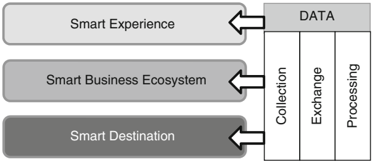
- The paper identifies three basic components of smart tourism: smart destinations, smart business ecosystems, and smart experiences; it also says smart tourism spans three layers: a smart information layer, smart exchange layer, and smart processing layer.
- The paper contrasts smart tourism with e-tourism: smart tourism bridges the digital and physical spheres, relies on sensors & smartphones rather than websites, focuses on the during-trip phase rather than pre- and post-travel, uses big data as its lifeblood, and is organized as an ecosystem rather than a value chain/intermediary structure.
- It notes that smart tourism research is still limited and mostly case-study based, with a strong consumer focus and an overly optimistic, uncritical stance; the paper itself proposes a research agenda and says existing smart tourism initiatives are mostly in development and often government-subsidized.
## Methods
- Conceptual/theoretical paper: it provides definitional clarification and an overview of the foundations of smart tourism rather than reporting an empirical dataset.
- It synthesizes prior literature on ICT, smart cities, service ecosystems, business models, and tourism technology to build its framework and definitions.
- It uses a conceptual comparison with e-tourism and organizes the discussion around technological foundations, business foundations, and research implications.
## Limitations
- The paper itself states that research in smart tourism is “very limited,” mostly case studies, and largely focused on the consumer perspective with an optimistic, uncritical stance.
- It explicitly says the proposed research agenda is “far from being comprehensive.”
- Evident from the text: the paper is conceptual and does not present original empirical data or tests, so its claims are theoretical rather than evidence from a study sample.
Model-written summary. Check it against the paper before relying on it.
Integrity signals
Registry
Cites
Statistics
Figures
Verification
Claims the paper makes
2 Valid · 17 Not valid · 47 Not checked · 59 Own results and interpretations
The cited sources support only part of this claim — read each source’s verdict below.
In the paper
“It has been identified as an important foundation for the services to be provided by smart tourism cities (Guo et al. 2014;Perera et al. 2014).”
§ Smart tourism: foundations and developments > Technological foundations of smart tourism
What the sources say
- Supportedcites Guo et al. 2014
The Introduction calls IoT technology the “core carrier” of the smart tourism information system. The Conclusion also identifies a tourism IoT information platform as critical to smart tourism development in China, supporting the claim that IoT is an important foundation for its services. (LLM, conf=0.93)
- Partly supportedcites Perera et al. 2014 matched to “Sensing as a service model for smart cities supported by Internet of Things” (2014) sourceExperimental — accuracy not yet measured
Section 3 (p. 2) describes an IoT-based sensing-as-a-service model as infrastructure for addressing smart-city challenges. The paper supports the general link between IoT and smart-city services, but the cited passages do not address tourism cities or their services specifically. (LLM, conf=0.85)
plainstates a cause- Asserted: passes — The authors put it forward as true.
- Checkable: passes — It can be checked against evidence.
- Load-bearing: unclear — It is unclear whether the paper’s conclusions depend on it.
- Based: passes — The paper gives a reason why it holds.
- Supported
A result the paper states — it cites no source for it, so there is none to check. The quote shows it is in the paper.
In the paper
“It also revealed a lack of critical literature that scrutinizes smart tourism assumptions and questioned its feasibility and positive experiential, economic and societal impacts.”
§ Smart tourism: foundations and developments > Conclusion
plain- Asserted: passes — The authors put it forward as true.
- Checkable: passes — It can be checked against evidence.
- Load-bearing: passes — The paper’s conclusions depend on it.
- Based: passes — The paper gives a reason why it holds.
In the paper
“Governments in China and South Korea are heavily funding initiatives mostly focused on building the technological infrastructure that supports smart tourism (Hwang et al. 2015).”
§ Smart tourism: foundations and developments > Abstract
What the sources say
- Not checked — no full text of the sourcecites Hwang et al. 2015 matched to “Constructivism in Smart Tourism Research : Seoul Destination Image” (2015) source
plain- Asserted: passes — The authors put it forward as true.
- Checkable: passes — It can be checked against evidence.
- Load-bearing: unclear — It is unclear whether the paper’s conclusions depend on it.
- Based: passes — The paper gives a reason why it holds.
A claim is checked only against the cited paper’s full text, never its abstract, and none is available for its sources.
In the paper
“Academic work is largely focused on describing the phenomenon in the form of case studies (e.g., Boes et al. 2015a, b;Bakıcı et al. 2013;Wang et al. 2013) or on discussing isolated technological developments (e.g., Huang and Chen 2015;Boes et al. 2015a, b) rather than on laying the theoretical foundations for its advancement and/or critique.”
§ Smart tourism: foundations and developments > Abstract
What the sources say
- Not checked — no full text of the sourcecites Boes et al. 2015a, b matched to “The Acceptance of NFC Smart Posters in Tourism” (2015) source
- Not checked — no full text of the sourcecites Bakıcı et al. 2013 matched to “A Smart City Initiative: the Case of Barcelona” (2013) source
- Not checked — no full text of the sourcecites Wang et al. 2013 matched to “China's “smart tourism destination” initiative: A taste of the service-dominant logic” (2013) source
plain- Asserted: passes — The authors put it forward as true.
- Checkable: passes — It can be checked against evidence.
- Load-bearing: passes — The paper’s conclusions depend on it.
- Based: passes — The paper gives a reason why it holds.
In the paper
“Remaining largely a vision at this stage, the Internet of Things has the potential to rapidly become a new reality as a technological infrastructure (Atzori et al. 2010).”
§ Smart tourism: foundations and developments > Technological foundations of smart tourism
What the sources say
- Not checked — no full text of the sourcecites Atzori et al. 2010 matched to “The Internet of Things: A survey” (2010) source
hedged- Asserted: passes — The authors put it forward as true.
- Checkable: passes — It can be checked against evidence.
- Load-bearing: unclear — It is unclear whether the paper’s conclusions depend on it.
- Based: passes — The paper gives a reason why it holds.
21 more claims
Create a free account to see all 125 claims and to verify the 3 references still open.
- It may state two separate claims as one. 46
- Probably not a substantial claim. 81
Citations
Cites
The Internet of Things: A survey
Atzori, L., Iera, A., & Morabito, G. (2010) · Computer Networks · doi:10.1016/j.comnet.2010.05.010 · Cited by 15,613
Business models, business strategy and innovation
Teece, D. J. (2010) · Long Range Planning · doi:10.1016/j.lrp.2009.07.003 · Cited by 8,335
Service-dominant logic: continuing the evolution
Vargo, S. L., & Lusch, R. F. (2008) · Journal of the Academy of Marketing Science · doi:10.1007/s11747-007-0069-6 · Cited by 7,824 · cited 1×
“In this vein, labels and roles assigned to players like travelers, firms and intermediaries are not valid anymore (Vargo and Lusch 2008).”
BackgroundBuhalis, D., & Law, R. (2008) · Tourism Management · doi:10.1016/j.tourman.2008.01.005 · Cited by 5,903 · cited 2×
“tion and of tourism consumers (Buhalis and Law 2008; Wang et al. 2012).”
BackgroundInternet of things: Vision, applications and research challenges
Miorandi, D., Sicari, S., De Pellegrini, F., & Chlamtac, I. (2012) · Ad Hoc Networks · doi:10.1016/j.adhoc.2012.02.016 · Cited by 3,578 · cited 1×
“Content and services will all be around us, persistently available, creating conditions for new applications and enabling new ways of working, interacting, entertainment, and living (Miorandi et al. 2012).”
BackgroundOn value and value co-creation: A service systems and service logic perspective
Vargo, S. L., Maglio, P. P., & Akaka, M. A. (2008) · European Management Journal · doi:10.1016/j.emj.2008.04.003 · Cited by 3,152 · cited 1×
“Vargo et al. (2008) and Spohrer et al. (2007) described a service ecosystem as a spontaneously sensing and responding spatial and temporal structure of largely loosely-coupled value-proposing social and economic actors interacting through institutions and technology, to: (1) co-produce service…”
BackgroundDahlander, L., & Gann, D. M. (2010) · Research Policy · doi:10.1016/j.respol.2010.01.013 · Cited by 2,435 · cited 1×
“Open innovation is based on the assumption that an organisation cannot just rely on its own resources, but has to engage with partners in order to innovate (Dahlander and Gann 2010; West and Gallagher 2006).”
BackgroundMacKenzie, D., & Millo, Y. (2003) · American Journal of Sociology · doi:10.1086/374404 · Cited by 1,464 · cited 1×
“By introducing new business models, firms develop new markets (Callon and Muniesa 2005; MacKenzie and Millo 2003; Pollock and Williams 2009; Inversini and Masiero 2014; Storbacka and Nenonen 2011).”
BackgroundPeripheral Vision: Economic Markets as Calculative Collective Devices
Callon, M., & Muniesa, F. (2005) · Organization Studies · doi:10.1177/0170840605056393 · Cited by 1,378 · cited 1×
“By introducing new business models, firms develop new markets (Callon and Muniesa 2005; MacKenzie and Millo 2003; Pollock and Williams 2009; Inversini and Masiero 2014; Storbacka and Nenonen 2011).”
Foundations for Smarter Cities
Harrison, C., Eckman, B., Hamilton, R., Hartswick, P., Kalagnanam, J., Paraszczak, J., & Williams, P. (2010) · IBM Journal of Research and Development · doi:10.1147/jrd.2010.2048257 · Cited by 1,347 · cited 1×
“Harrison et al. (2010) conceptualize smart as exploiting operational, near-real-time real-world data, integrating and sharing data, and using complex analytics, modelling, optimization and visualization to make better operational decisions.”
Background
Research works printed but not linked: 4
- 3. Anuar, F. I. & Gretzel, U. (2011). Privacy Concerns in the Context of Location Based Services for Tourism. ENTER 2011 Conference, Innsbruck, Austria, January 26-28, 2011. Accessed online (March 1, 2015) at http://ertr.tamu.edu/enter-2011-short-papers/.
- 16. Lopez de Avila, A. (2015). Smart Destinations: XXI Century Tourism. Presented at the ENTER2015 Conference on Information and Communication Technologies in Tourism, Lugano, Switzerland, February 4-6, 2015.
- 58. Tu, Q. & Liu, A. (2014). Framework of Smart Tourism Research and Related Progress in China. In International Conference on Management and Engineering (CME 2014), pp. 140-146.
- 77. In R. Egger, I. Gula, & D. Walcher (Eds.), Open Tourism - Open Innovation, Crowdsourcing and Collaborative Consumption challenging the tourism industry. Heidelberg: Springer Verlag.
Cited by
Items 1,201–1,300 of 2,494
Virtual Dark Tourism: The Role of Sound Branding and Augmented Reality for Death Sites
Handayani, B., & Korstanje, M. E. (2020) · IGI Global eBooks · doi:10.4018/978-1-7998-2469-5.ch012 · Cited by 4
Nikas, I. A., Koutras, A., Panagopoulos, A., & Vasileiadis, A. (2022) · Springer proceedings in business and economics · doi:10.1007/978-3-030-92491-1_58 · Cited by 3
Foriş, D., Bâra, G.-R., & Mălăescu, S. (2022) · Smart innovation, systems and technologies · doi:10.1007/978-981-16-9268-0_44 · Cited by 4
Bruhn, M., & Hadwich, K. (2022) · Forum Dienstleistungsmanagement · doi:10.1007/978-3-658-37346-7_1 · Cited by 3
Bruhn, M., & Hadwich, K. (2022) · Forum Dienstleistungsmanagement · doi:10.1007/978-3-658-37344-3_1 · Cited by 3
Wu, H., Xiao, L., Qi, Y., et al. (2022) · Journal of Circuits Systems and Computers · doi:10.1142/s0218126623500421 · Cited by 3
Review of research on smart tourism at home and abroad
Zhang, J., Li, Y., & Cheng, R. (2020) · Smart Tourism · doi:10.54517/st.v1i2.1696 · Cited by 4
Veerasamy, S., & Goswami, S. (2022) · Asean Journal on Hospitality and Tourism · doi:10.5614/ajht.2022.20.2.07 · Cited by 5
Aplicações de Destino Inteligente de acordo com a Roda da Cidade Inteligente de Cohen:
GÖK, H. S., & ŞALVARCI, S. (2022) · Revista Rosa dos Ventos - Turismo e Hospitalidade · doi:10.18226/21789061.v14i3p807 · Cited by 5
Treviño-Villalobos, M., Cardinale-Villalobos, L., Fernández-Mora, L., Víquez-Acuña, L., & González-Quirós, R. (2022) · Revista Rosa dos Ventos - Turismo e Hospitalidade · doi:10.18226/21789061.v14i3p685 · Cited by 2
TRANSPORT BEHAVIOUR, PERCEIVED EXPERIENCE AND SMART TECHNOLOGY USAGE OF TOURIST DESTINATION VISITORS
Kovačić, N., Car, T., & Stifanich, L. P. (2022) · Ekonomska misao i praksa · doi:10.17818/emip/2022/2.5 · Cited by 3
The Tourism Experience: A Smart Tourism Ecosystem Perspective
Serra, P. V., Seabra, C., & Caldeira, A. (2022) · Communications in computer and information science · doi:10.1007/978-3-031-20316-9_10 · Cited by 5
Design and Development of Travel Assist, An App to Support Smart Tourism
Samsudin, N., Fahmy, S., Ali, I. M., et al. (2022) · International Journal of Integrated Engineering · doi:10.30880/ijie.2022.14.03.013 · Cited by 3
Smart Tourism: Validation and Analysis of the Displacement of Tourists
Tyagi, P. K., Singh, A. K., Tyagi, P., & Singh, A. K. (2022) · International Conference on Innovations in Science and Technology for Sustainable Development (ICISTSD) · doi:10.1109/icistsd55159.2022.10010672 · Cited by 3
Affirmation of Cultural Heritage Digital Promotion within Smart Destination Concept
Florcic, T., Šker, I., & Benassi, H. M. (2022) · Proceedings of the ENTRENOVA - Enterprise Research Innovation Conference · doi:10.54820/entrenova-2022-0015 · Cited by 3
Munasinghe, L. M., Gunawardhana, T., Wickramaarachchi, N. C., & Ariyawansa, R. G. (2022) · Tourism and Sustainable Development Review · doi:10.31098/tsdr.v3i2.68 · Cited by 5
Possibilities of Using Online Tools and Artificial Intelligence in City Marketing
Labudová, L. (2023) · European Conference on Innovation and Entrepreneurship · doi:10.34190/ecie.18.1.1834 · Cited by 5
Unleashing the digital building bricks: A smart service taxonomy for retail
Muschkiet, M., Wulfert, T., Woroch, R., Strobel, G., & Banh, L. (2023) · Electronic Markets · doi:10.1007/s12525-023-00666-z · Cited by 14
Eco-City Tourism in Smart Cities for Sustainability
KIVILCIM, B. (2023) · Emerald Group Publishing Limited eBooks · doi:10.1108/s1877-636120230000033009 · Cited by 5
Livable cities in the global south: Buenos Aires city in the new normal
Korstanje, M. E. (2024) · International Journal of Tourism Cities · doi:10.1108/ijtc-11-2023-0239 · Cited by 4
The Evolution of Knowledge Sharing in Post-Pandemic Business Tourism
Coutinho, R. P. (2024) · Advances in hospitality, tourism and the services industry (AHTSI) book series · doi:10.4018/979-8-3693-2619-0.ch011 · Cited by 4
Resilience in Tourism: A bibliometric analysis of trends and perspectives in research
Rivera-López, F. B. (2023) · Journal Economic History · doi:10.35429/jeh.2023.13.7.37.48 · Cited by 2
Sitones, M. L. A., Romano, N. P., Joven, E. L. M., & Avenido, M. R. L. (2024) · International Journal of Social Science and Human Research · doi:10.47191/ijsshr/v7-i04-18 · Cited by 4
Bianchi, E. C., & Zanfardini, M. (2024) · Ayana Revista de Investigación en Turismo · doi:10.24215/27186717e050 · Cited by 3
The Sharing Economy in the Tourism Sector: Microeconomic Factors
Navickas, V., & Petrokė, I. (2024) · Marketing and Management of Innovations · doi:10.21272/mmi.2024.2-06 · Cited by 3
Gianni, M., & Gotzamani, K. D. (2024) · Springer proceedings in business and economics · doi:10.1007/978-3-031-65115-1_3 · Cited by 4
Artificial Intelligence in HMI System
Rawat, A. S., Kukreti, R., Dimari, A., & Dani, R. (2024) · International Conference on Advance Computing and Innovative Technologies in Engineering (ICACITE) · doi:10.1109/icacite60783.2024.10617209 · Cited by 4
Naimi, L., Bouziane, E. M., Jakimi, A., et al. (2024) · doi:10.1109/mscc62288.2024.10697008 · Cited by 3
Nair, S. K. K. R. (2024) · Advances in business strategy and competitive advantage book series · doi:10.4018/979-8-3693-7683-6.ch017 · Cited by 3
The Truth about Smart Tourism: A Qualitative Research Agenda
Cho, H. D. (2023) · Journal of Smart Tourism · doi:10.52255/smarttourism.2023.3.4.3 · Cited by 4
Impact of Technology-Based Service Innovations on Tourist Site Revisits
Radhika, P. C., Babu, E., Johnson, J., & Joseph, N. M. (2025) · Tourism · doi:10.37741/t.73.2.7 · Cited by 4
González-Mora, C., Garrigós, I., Bernabéu, M. A. C., Sánchez, D. G., & Mazón, J.-N. (2025) · IEEE Access · doi:10.1109/access.2025.3575725 · Cited by 6
Smart Tourism via Digital Governance: A case for Jeju Volcanic Island and Lava Tubes
Fatai, A. F., & Hyeyeong, A. (2017) · Journal of Tourism, Hospitality and Sports · Cited by 7
Composite Indicators for Measuring the Online Search Interest by a Tourist Destination
Dinis, G., da Costa, C. M. M., & Pacheco, O. M. D. R. (2019) · Springer eBooks · doi:10.1007/978-981-13-6339-9_1 · Cited by 3
Bieger, T., & Beritelli, P. (2019) · Forum Dienstleistungsmanagement · doi:10.1007/978-3-658-26389-8_15 · Cited by 3
Island Tourism: Keep It Smart and Sustainable—An Exploratory Approach
Avelar, S. M. M. (2019) · Springer proceedings in business and economics · doi:10.1007/978-3-030-12453-3_81 · Cited by 4
Deployment of Wi-Fi services for foreign tourists in a mountainous area of Japan
Satake, Y. (2019) · Netcom · doi:10.4000/netcom.4675 · Cited by 3
Towards Constructing a Comprehensive Framework of Smart Destinations
Sorokina, E. A. (2019) · STARS (University of Central Florida) · Cited by 3
Pan, C.-L., Liu, Y., Zhou, X., Qiu, J., & Chen, Z. (2020) · International Conference on E-Commerce and Internet Technology (ECIT) · doi:10.1109/ecit50008.2020.00024 · Cited by 3
Knowledge Management Perspective in the Tourism and Hospitality Industry
Barišić, A. F., Barišić, J. R., & Miloloža, I. (2020) · RePEc: Research Papers in Economics · Cited by 3
Rucci, A. C., Porto, N., Darcy, S., & Becka, L. (2021) · Advances in hospitality, tourism and the services industry (AHTSI) book series · doi:10.4018/978-1-7998-6428-8.ch006 · Cited by 9
Modeling SMART Technology Mobility of Students for Open Education System
Chvanova, M. S. (2020) · International Conference "Quality Management, Transport and Information Security, Information Technologies" (IT&QM&IS) · doi:10.1109/itqmis51053.2020.9322973 · Cited by 3
Turystyczne aplikacje mobilne – ocena funkcjonalności oprogramowania VisitMalopolska
Manczak, I., & Bajak, M. (2021) · Turyzm/Tourism · doi:10.18778/0867-5856.31.1.04 · Cited by 3
Smart Tourism in Destinations: Can It Be the Way Forward?
Yüksel, F. (2021) · Advances in hospitality, tourism and the services industry (AHTSI) book series · doi:10.4018/978-1-7998-8528-3.ch003 · Cited by 3
Smart Tourists and Intelligent Behaviour
Pearce, P. L. (2021) · Springer eBooks · doi:10.1007/978-3-030-05324-6_66-2 · Cited by 3
Artificial Intelligence in the Delivery of Mobile Tourism Services
Türkmendağ, Z. (2022) · Advances in hospitality, tourism and the services industry (AHTSI) book series · doi:10.4018/978-1-7998-6904-7.ch008 · Cited by 4
Knowledge Development in Tourism Distribution Channels: From Single Channel to Omnichannel
Soltani-Nejad, N., Irani, H. R., Soltani, M., & Yazdani, H. R. (2022) · Advances in Hospitality and Tourism Research (AHTR) · doi:10.30519/ahtr.958114 · Cited by 6
Exploring Information Technology in Smart Tourism in Indonesia
Hengky, S. H. (2022) · Springer eBooks · doi:10.1007/978-981-16-2210-6_22 · Cited by 4
A Systematic Review of Indonesia’s Heritage Tourism in Perspective of Smart Tourism Conceptual Model
Absari, D. T., Djunaidy, A., & Susanto, T. D. (2023) · INTENSIF Jurnal Ilmiah Penelitian dan Penerapan Teknologi Sistem Informasi · doi:10.29407/intensif.v7i1.18889 · Cited by 6
Berjozkina, G., & Kuruvilla, K. J. (2023) · Worldwide Hospitality and Tourism Themes · doi:10.1108/whatt-06-2023-0077 · Cited by 3
Smart marketing of an alpine destination – a conceptual framework
Stettler, J., Zemp, M., & Steffen, A. (2016) · ScholarWorks@UMassAmherst (University of Massachusetts Amherst) · Cited by 8
Electronic Markets on academic supply chains
Alt, R. (2017) · Electronic Markets · doi:10.1007/s12525-017-0258-1 · Cited by 3
Route Recommendations to Business Travelers Exploiting Crowd-Sourced Data
Collerton, T., Marrella, A., Mecella, M., & Catarci, T. (2017) · Lecture notes in computer science · doi:10.1007/978-3-319-65515-4_1 · Cited by 3
Identifying and structuring service functions of mobile applications in Google’s Android Market
Suh, Y., & Park, Y. (2017) · Information Systems and e-Business Management · doi:10.1007/s10257-017-0366-7 · Cited by 3
The relationship between smart cities and smart tourism in low density regions
Lopes, I., & Oliveira, P. (2018) · Iberian Conference on Information Systems and Technologies (CISTI) · doi:10.23919/cisti.2018.8399444 · Cited by 3
Chinese Researchers in the Journal of Travel Research (2011–2016): A Content Analysis
Qian, J., Law, R., & Wei, J. (2018) · Journal of China Tourism Research · doi:10.1080/19388160.2018.1518178 · Cited by 3
IoT-based omni channel service for smart exhibition and value of data
Park, A., Han, J. Y., & Lee, K. J. (2017) · International Conference on Electronic Commerce · doi:10.1145/3154943.3154966 · Cited by 4
Smart Applications in the Hospitality Business: A Qualitative Study on the City of Eskişehir
Zencir, B., & Emir, O. (2019) · Journal of Business Research - Turk · doi:10.20491/isarder.2019.761 · Cited by 3
Sustainable Tourism: Trends, Challenges and Concerns
Costa, T. G., & Ribeiro, F. P. (2019) · European journal of tourism, hospitality and recreation · doi:10.2478/ejthr-2019-0013 · Cited by 3
Charting service ecosystems flexibility: A museum setting
Brozović, D., & Tregua, M. (2020) · International Journal of Nonprofit and Voluntary Sector Marketing · doi:10.1002/nvsm.1677 · Cited by 4
Application of Big Data in Forecasting the Travel Behaviour of International Tourists
Padmaja, N., Sudha, T., & Saurab, S. S. (2020) · Learning and analytics in intelligent systems · doi:10.1007/978-3-030-46943-6_30 · Cited by 4
Smart Tourists and Intelligent Behaviour
Pearce, P. L. (2020) · Springer eBooks · doi:10.1007/978-3-030-05324-6_66-1 · Cited by 5
Information Characteristics on Instagram and Viewer Behavior
Kim, E.-M., Park, J. E., Kim, J.-Y., & Koo, C. (2021) · Springer eBooks · doi:10.1007/978-3-030-65785-7_31 · Cited by 5
Self-citationAkıllı Şehir Endeksi Kapsamında Ankara ya İlişkin Karşılaştırmalı Bir Analiz
Silik, C. E., & Akgül, S. Ö. (2021) · Turk Turizm Arastirmalari Dergisi · doi:10.26677/tr1010.2021.679 · Cited by 11
A Bibliometric Analysis on E-Government and Tourism
Nindito, H., Prabowo, H., Hendric, S. W. H. L., et al. (2021) · International Conference on Information Management and Technology (ICIMTech) · doi:10.1109/icimtech53080.2021.9534960 · Cited by 3
Technology Application in the Tourism Industry for Socio-Economic Development in Bangladesh
Rahman, M. H. A., & Saima, F. N. (2021) · Springer eBooks · doi:10.1007/978-981-16-2434-6_21 · Cited by 5
Monica, F. A. U. R. (2021) · Annals of Faculty of Economics · doi:10.47535/1991auoes30(2)009 · Cited by 4
Turismo e gestão do conhecimento: uma revisão integrativa da literatura
Emmendoerfer, L., de Lacerda, L. L. L., Otowicz, M. H., & Biz, A. A. (2022) · PASOS Revista de Turismo y Patrimonio Cultural · doi:10.25145/j.pasos.2022.20.052 · Cited by 6
The insiders' gaze: fieldworks, social media and visual methodologies in urban tourism
Graziano, T. (2022) · AIMS Geosciences · doi:10.3934/geosci.2022021 · Cited by 4
Triple helix stakeholder visions for smart tourism
Berrío, S. P. R., Rincón-Novoa, J. L., & Restrepo, L. A. M. (2022) · Smart Tourism · doi:10.54517/st.v3i1.1725 · Cited by 3
Digital Leadership for Sustainable Community-Based Tourism (CBT)
Haider, M., Shannon, R. M., & Vatananan-Thesenvitz, R. (2022) · Portland International Conference on Management of Engineering and Technology (PICMET) · doi:10.23919/picmet53225.2022.9882550 · Cited by 3
DIGITALIZATION AND ARTIFICIAL INTELLIGENCE: NEW DIMENSIONS IN TOURISM
Lučić, S. (2022) · International Scientific Conference The Future of Tourism · doi:10.52370/tisc22564sl · Cited by 9
Smart Tourism Triggers Tourist Minds-Do you have the mind to mind it?
Shuxratovna, M. N., Kiran, P., & Erdogan, E. (2023) · Vallis Aurea (Journal of Sustainable Development and Innovation) · doi:10.2507/ijva.9.1.2.99 · Cited by 3
From Tradition to Transformation: The Role of AI in the Evolution of Smart Tourism
Singh, A. J., & Dhiman, M. C. (2023) · Advances in business information systems and analytics book series · doi:10.4018/979-8-3693-1902-4.ch014 · Cited by 3
Considerations on Information and Communication Overload Issue in Smart Cities
Batista, J., & Marques, R. P. (2017) · Smart innovation, systems and technologies · doi:10.1007/978-3-319-61322-2_13 · Cited by 5
Tourist mobile applications: Evaluation of the VisitMalopolska app
Manczak, I., & Bajak, M. (2021) · Turyzm/Tourism · doi:10.18778/0867-5856.31.1.14 · Cited by 3
Digital transformation in the manufacturing industry : business models and smart service systems
Dreyer, S. (2020) · Institutional Repository of Leibniz Universität Hannover (Leibniz Universität Hannover) · doi:10.15488/9383 · Cited by 3
Special issue on informatics/data analytics in smart tourism
Koo, C., & Cantoni, L. (2019) · Information Processing & Management · doi:10.1016/j.ipm.2019.102154 · Cited by 3
Self-citationButtar, A. M., Shahzad, F., & Jamil, U. (2024) · Wiley eBooks · doi:10.1002/9781394200801.ch3 · Cited by 6
Technological Revolution and Transformation of the Tourism Sector
Gam, A., & Bahri-Ammari, N. (2024) · Advances in hospitality, tourism and the services industry (AHTSI) book series · doi:10.4018/979-8-3693-2619-0.ch010 · Cited by 4
Tourism 4.0: tourism in the digital world
ЖУКОВСКАЯ, И. Ф. (2024) · Modern Economy Success · doi:10.58224/2500-3747-2024-2-66-71 · Cited by 2
Specificities of Thermalism in Health Tourism: The Mediating Role of the Territory
Brandão, F., Liberato, D., Duarte, J., Liberato, P., & Quintela, J. A. (2024) · Springer proceedings in business and economics · doi:10.1007/978-3-031-54342-5_33 · Cited by 2
SMART-ТУРИЗМ ЯК ЕКОСИСТЕМА: СУТНІСТЬ, СКЛАДОВІ ТА ЗНАЧЕННЯ В ЗАБЕЗПЕЧЕНІ СТАЛОГО РОЗВИТКУ ТЕРИТОРІЙ
Кочума, І., & Красномовець, В. (2024) · Сталий розвиток економіки · doi:10.32782/2308-1988/2024-50-73 · Cited by 8
РЕГІОНАЛЬНА ТУРИСТИЧНА ПОЛІТИКА В УМОВАХ КРИЗИ: ПРІОРИТЕТИ ТА НОВІ ПІДХОДИ
Графська, О., Холявка, В., & Кулик, О. (2024) · Економіка та суспільство · doi:10.32782/2524-0072/2024-67-7 · Cited by 2
La profesionalización del Turismo en la era digital: competencias tecnológicas y formación en Línea
Franco, N. T., Alonso, A. M. C., & Coyoli, C. G. (2024) · LATAM Revista Latinoamericana de Ciencias Sociales y Humanidades · doi:10.56712/latam.v5i5.2835 · Cited by 5
Geleceğin Dünyasında Dijital Bir Pazarlama Aracı: Avatar Pazarlama
Aksoy, M., & Yılmaz, Ö. (2024) · Özgür Yayınları eBooks · doi:10.58830/ozgur.pub587.c2432 · Cited by 4
Digital tourism: A bibliometric study of trends and research
Kurt, F., & Genç, V. (2025) · Journal of Multidisciplinary Academic Tourism · doi:10.31822/jomat.2025-10-1-121 · Cited by 4
An Exploration of Smart Tourism Ecosystem from the Value Co-Creation Lens A Case Study in China
Liu, J., & Gao, P. (2024) · IEEE International Conference on Technology Management, Operations and Decisions (ICTMOD) · doi:10.1109/ictmod63116.2024.10878249 · Cited by 3
Zheng, Q., Luo, M., Zhang, J., & Tian, Y. (2025) · Tourism Review · doi:10.1108/tr-08-2024-0709 · Cited by 4
Harnessing Big Data for Smarter Tourism
Hernández-Tamurejo, Á., González-Padilla, P., & Saura, J. R. (2025) · Tourism on the verge · doi:10.1007/978-3-031-88582-2_12 · Cited by 2
Data-Driven Practices in European Smart Tourism Destinations: Towards a Tourism Data Space
Gajdošík, T., & Marciš, M. (2025) · Springer proceedings in business and economics · doi:10.1007/978-3-031-83705-0_4 · Cited by 3
Shankar, S., & Greenwood, S. (2025) · Tourism and Hospitality Research · doi:10.1177/14673584251356792 · Cited by 7
Putri, S. N., Alamsyah, A., & Ariyanti, M. (2025) · International Conference on Smart Computing, IoT and Machine Learning (SIML) · doi:10.1109/siml65326.2025.11081147 · Cited by 2
Power of visuals: The impact of user-generated image richness on the helpfulness of online reviews
Wang, D., Zhu, Y., Feng, Y., & Cheng, T. C. E. (2025) · Electronic Commerce Research and Applications · doi:10.1016/j.elerap.2025.101535 · Cited by 2
Dynamic Network Slicing for IoT in Smart Tourism: A Hybrid Management Approach
Ahmed, A., Abdelatif, S., & Derdour, M. (2025) · International Conference on Pattern Analysis and Intelligent Systems (PAIS) · doi:10.1109/pais66004.2025.11126047 · Cited by 2
Exploring beyond the surface: Geofenced storytelling in Isfahan's tourism experience
Korani, Z., Jahanian, M., & Heris, J. A. (2025) · City Culture and Society · doi:10.1016/j.ccs.2025.100652 · Cited by 2
Ristanović, V., Budić, H., & Marinac, A. (2025) · WSEAS TRANSACTIONS ON BUSINESS AND ECONOMICS · doi:10.37394/23207.2025.22.163 · Cited by 6
The role of digital technologies in promoting social innovation in tourism Brazilian companies
Maiurro, M., Breda, Z. M. D. J., Brandão, F., & da Costa, C. M. M. (2025) · European Public & Social Innovation Review · doi:10.31637/epsir-2026-1979 · Cited by 5
Karunaratna, D., Senevirathne, C., Jayasinghe, P. S. K., Samarakkody, T. N., Peksha, P., & Fernando, K. (2025) · Journal of Hospitality and Tourism Insights · doi:10.1108/jhti-02-2025-0241 · Cited by 6
Pilelienė, L., & Alsharif, A. H. (2025) · Baltic Journal of Economic Studies · doi:10.30525/2256-0742/2025-11-5-92-112 · Cited by 2
Metadata
- Authors
- Gretzel, U., Sigala, M., Xiang, Z., & Koo, C.
- Affiliations
- Virginia Tech (US)
- Kyung Hee University (KR)
- Corresponding author
- Koo, Chulmo
- Venue
- Electronic Markets
- Published
- 2015-08-01
- Volume
- 25
- Issue
- 3
- Pages
- 179-188
- ISSN
- 1019-6781 (ISSN-L)
- 1422-8890
- OpenAlex
- W974480840
- Cited by
- 2,589
- References
- 81
- Citations by year
- 2026: 532 · 2025: 364 · 2024: 307 · 2023: 255 · 2022: 283 · 2021: 239 · 2020: 232 · 2019: 163 · 2018: 93 · 2017: 82 · 2016: 36 · 2015: 2
- FWCI
- 234.92
- Type
- journal article
- Language
- en
- Open access
- hybrid
- doi.org
- Licence
- cc-by
- creativecommons.org/licenses/by/4.0/ (tdm)
- creativecommons.org/licenses/by/4.0/ (vor)
- Locations
- Electronic Markets (publishedVersion, cc-by)
- UniSA Research Outputs Repository (University of South Australia) (acceptedVersion)
- Adelaide Research & Scholarship (AR&S) (University of Adelaide) (submittedVersion, cc-by)
- Funders
- National Research Foundation
- National Research Foundation of Korea (NRF-2013S1A3A2043345)
- Topics
- Social Sciences › Business, Management and Accounting › Tourism, Leisure and Hospitality Management › Diverse Aspects of Tourism Research
- Social Sciences › Business, Management and Accounting › Management of Technology and Innovation › Digital Innovation in Industries
- Social Sciences › Business, Management and Accounting › Marketing › AI in Service Interactions
- Keywords
- smart tourism, information and communication technologies, tourism destinations, tourism industry, big data, value proposition, conceptual definitions, tourism management, technological foundations, business foundations
About these checks
Registry, retraction, Cites and statistics results are computed, not judged, with one exception: a printed reference that no index lists is read once by a model before it counts as a citation error. Claims are extracted by a model and kept only when their quote appears verbatim in the text; each cited source is then checked, with a model’s help, for whether it says what the claim relies on. Those verdicts can be wrong — read the claim’s quote and the cited source before relying on one.
The claim verdicts this report counts are experimental: their accuracy is not yet measured.
A language model drew the claims from the paper on 2026-10-10, under version 3 of the claim definition (model deepseek-v4.1-flash, prompt extract-v3).
A second model labelled each claim on 2026-10-10 (model jev-1.13-20260917, definition revision gold-guideline-v0.2).
Cited sources are checked with a language model’s help (gpt-6-sol).
Statistics and arithmetic are recomputed, not judged.
Confidence bands are shown only for fields calibrated on our annotated test set. None is calibrated yet, so no band is shown.
What counts as a claim ›How we measure confidence ›How we check this ›
Are you an author, or do you see a problem with this page? Request a review
Data sources
Bibliographic data: Semantic Scholar, OpenAlex, Crossref.
Contains information from the Semantic Scholar Academic Graph Datasets, made available under the ODC Attribution License (ODC-BY 1.0).
Semantic Scholar’s data is described in: Kinney, R., et al. (2023). The Semantic Scholar Open Data Platform. arXiv:2301.10140.
