

Smart tourism: foundations and developments
Open accessThe DOI matches its Crossref record; 79 of the 81 references it cites were found in a registry or an index; 3 of the 66 sources its claims cite were checked for support.
Abstract
Abstract Smart tourism is a new buzzword applied to describe the increasing reliance of tourism destinations, their industries and their tourists on emerging forms of ICT that allow for massive amounts of data to be transformed into value propositions. However, it remains ill-defined as a concept, which hinders its theoretical development. The paper defines smart tourism, sheds light on current smart tourism trends, and then lays out its technological and business foundations. This is followed by a brief discussion on the prospects and drawbacks of smart tourism. The paper further draws attention to the great need for research to inform smart tourism development and management.
Overview
CoChat Summary
## TL;DR
This paper defines smart tourism and argues it is more than e-tourism or isolated tech projects: it is a destination-level system that uses integrated ICT and big data to create on-site experiences and business value. It also says the concept is under-theorized, heavily influenced by smart city ideas, and in need of much more critical research.
## Key findings
- Smart tourism is defined as “tourism supported by integrated efforts at a destination to collect and aggregate/harness data” from physical infrastructure, social connections, government/organizational sources, and human bodies/minds, using advanced technologies to transform that data into “on-site experiences and business value-propositions” with a focus on efficiency, sustainability, and experience enrichment.
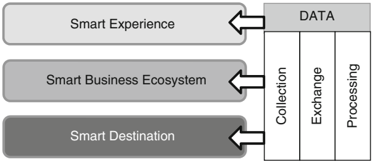
- The paper identifies three basic components of smart tourism: smart destinations, smart business ecosystems, and smart experiences; it also says smart tourism spans three layers: a smart information layer, smart exchange layer, and smart processing layer.
- The paper contrasts smart tourism with e-tourism: smart tourism bridges the digital and physical spheres, relies on sensors & smartphones rather than websites, focuses on the during-trip phase rather than pre- and post-travel, uses big data as its lifeblood, and is organized as an ecosystem rather than a value chain/intermediary structure.
- It notes that smart tourism research is still limited and mostly case-study based, with a strong consumer focus and an overly optimistic, uncritical stance; the paper itself proposes a research agenda and says existing smart tourism initiatives are mostly in development and often government-subsidized.
## Methods
- Conceptual/theoretical paper: it provides definitional clarification and an overview of the foundations of smart tourism rather than reporting an empirical dataset.
- It synthesizes prior literature on ICT, smart cities, service ecosystems, business models, and tourism technology to build its framework and definitions.
- It uses a conceptual comparison with e-tourism and organizes the discussion around technological foundations, business foundations, and research implications.
## Limitations
- The paper itself states that research in smart tourism is “very limited,” mostly case studies, and largely focused on the consumer perspective with an optimistic, uncritical stance.
- It explicitly says the proposed research agenda is “far from being comprehensive.”
- Evident from the text: the paper is conceptual and does not present original empirical data or tests, so its claims are theoretical rather than evidence from a study sample.
Model-written summary. Check it against the paper before relying on it.
Integrity signals
Registry
Cites
Statistics
Figures
Verification
Claims the paper makes
2 Valid · 17 Not valid · 47 Not checked · 59 Own results and interpretations
The cited sources support only part of this claim — read each source’s verdict below.
In the paper
“It has been identified as an important foundation for the services to be provided by smart tourism cities (Guo et al. 2014;Perera et al. 2014).”
§ Smart tourism: foundations and developments > Technological foundations of smart tourism
What the sources say
- Supportedcites Guo et al. 2014
The Introduction calls IoT technology the “core carrier” of the smart tourism information system. The Conclusion also identifies a tourism IoT information platform as critical to smart tourism development in China, supporting the claim that IoT is an important foundation for its services. (LLM, conf=0.93)
- Partly supportedcites Perera et al. 2014 matched to “Sensing as a service model for smart cities supported by Internet of Things” (2014) sourceExperimental — accuracy not yet measured
Section 3 (p. 2) describes an IoT-based sensing-as-a-service model as infrastructure for addressing smart-city challenges. The paper supports the general link between IoT and smart-city services, but the cited passages do not address tourism cities or their services specifically. (LLM, conf=0.85)
plainstates a cause- Asserted: passes — The authors put it forward as true.
- Checkable: passes — It can be checked against evidence.
- Load-bearing: unclear — It is unclear whether the paper’s conclusions depend on it.
- Based: passes — The paper gives a reason why it holds.
- Supported
A result the paper states — it cites no source for it, so there is none to check. The quote shows it is in the paper.
In the paper
“It also revealed a lack of critical literature that scrutinizes smart tourism assumptions and questioned its feasibility and positive experiential, economic and societal impacts.”
§ Smart tourism: foundations and developments > Conclusion
plain- Asserted: passes — The authors put it forward as true.
- Checkable: passes — It can be checked against evidence.
- Load-bearing: passes — The paper’s conclusions depend on it.
- Based: passes — The paper gives a reason why it holds.
In the paper
“Governments in China and South Korea are heavily funding initiatives mostly focused on building the technological infrastructure that supports smart tourism (Hwang et al. 2015).”
§ Smart tourism: foundations and developments > Abstract
What the sources say
- Not checked — no full text of the sourcecites Hwang et al. 2015 matched to “Constructivism in Smart Tourism Research : Seoul Destination Image” (2015) source
plain- Asserted: passes — The authors put it forward as true.
- Checkable: passes — It can be checked against evidence.
- Load-bearing: unclear — It is unclear whether the paper’s conclusions depend on it.
- Based: passes — The paper gives a reason why it holds.
A claim is checked only against the cited paper’s full text, never its abstract, and none is available for its sources.
In the paper
“Academic work is largely focused on describing the phenomenon in the form of case studies (e.g., Boes et al. 2015a, b;Bakıcı et al. 2013;Wang et al. 2013) or on discussing isolated technological developments (e.g., Huang and Chen 2015;Boes et al. 2015a, b) rather than on laying the theoretical foundations for its advancement and/or critique.”
§ Smart tourism: foundations and developments > Abstract
What the sources say
- Not checked — no full text of the sourcecites Boes et al. 2015a, b matched to “The Acceptance of NFC Smart Posters in Tourism” (2015) source
- Not checked — no full text of the sourcecites Bakıcı et al. 2013 matched to “A Smart City Initiative: the Case of Barcelona” (2013) source
- Not checked — no full text of the sourcecites Wang et al. 2013 matched to “China's “smart tourism destination” initiative: A taste of the service-dominant logic” (2013) source
plain- Asserted: passes — The authors put it forward as true.
- Checkable: passes — It can be checked against evidence.
- Load-bearing: passes — The paper’s conclusions depend on it.
- Based: passes — The paper gives a reason why it holds.
In the paper
“Remaining largely a vision at this stage, the Internet of Things has the potential to rapidly become a new reality as a technological infrastructure (Atzori et al. 2010).”
§ Smart tourism: foundations and developments > Technological foundations of smart tourism
What the sources say
- Not checked — no full text of the sourcecites Atzori et al. 2010 matched to “The Internet of Things: A survey” (2010) source
hedged- Asserted: passes — The authors put it forward as true.
- Checkable: passes — It can be checked against evidence.
- Load-bearing: unclear — It is unclear whether the paper’s conclusions depend on it.
- Based: passes — The paper gives a reason why it holds.
21 more claims
Create a free account to see all 125 claims and to verify the 3 references still open.
- It may state two separate claims as one. 46
- Probably not a substantial claim. 81
Citations
Cites
The Internet of Things: A survey
Atzori, L., Iera, A., & Morabito, G. (2010) · Computer Networks · doi:10.1016/j.comnet.2010.05.010 · Cited by 15,613
Business models, business strategy and innovation
Teece, D. J. (2010) · Long Range Planning · doi:10.1016/j.lrp.2009.07.003 · Cited by 8,335
Service-dominant logic: continuing the evolution
Vargo, S. L., & Lusch, R. F. (2008) · Journal of the Academy of Marketing Science · doi:10.1007/s11747-007-0069-6 · Cited by 7,824 · cited 1×
“In this vein, labels and roles assigned to players like travelers, firms and intermediaries are not valid anymore (Vargo and Lusch 2008).”
BackgroundBuhalis, D., & Law, R. (2008) · Tourism Management · doi:10.1016/j.tourman.2008.01.005 · Cited by 5,903 · cited 2×
“tion and of tourism consumers (Buhalis and Law 2008; Wang et al. 2012).”
BackgroundInternet of things: Vision, applications and research challenges
Miorandi, D., Sicari, S., De Pellegrini, F., & Chlamtac, I. (2012) · Ad Hoc Networks · doi:10.1016/j.adhoc.2012.02.016 · Cited by 3,578 · cited 1×
“Content and services will all be around us, persistently available, creating conditions for new applications and enabling new ways of working, interacting, entertainment, and living (Miorandi et al. 2012).”
BackgroundOn value and value co-creation: A service systems and service logic perspective
Vargo, S. L., Maglio, P. P., & Akaka, M. A. (2008) · European Management Journal · doi:10.1016/j.emj.2008.04.003 · Cited by 3,152 · cited 1×
“Vargo et al. (2008) and Spohrer et al. (2007) described a service ecosystem as a spontaneously sensing and responding spatial and temporal structure of largely loosely-coupled value-proposing social and economic actors interacting through institutions and technology, to: (1) co-produce service…”
BackgroundDahlander, L., & Gann, D. M. (2010) · Research Policy · doi:10.1016/j.respol.2010.01.013 · Cited by 2,435 · cited 1×
“Open innovation is based on the assumption that an organisation cannot just rely on its own resources, but has to engage with partners in order to innovate (Dahlander and Gann 2010; West and Gallagher 2006).”
BackgroundMacKenzie, D., & Millo, Y. (2003) · American Journal of Sociology · doi:10.1086/374404 · Cited by 1,464 · cited 1×
“By introducing new business models, firms develop new markets (Callon and Muniesa 2005; MacKenzie and Millo 2003; Pollock and Williams 2009; Inversini and Masiero 2014; Storbacka and Nenonen 2011).”
BackgroundPeripheral Vision: Economic Markets as Calculative Collective Devices
Callon, M., & Muniesa, F. (2005) · Organization Studies · doi:10.1177/0170840605056393 · Cited by 1,378 · cited 1×
“By introducing new business models, firms develop new markets (Callon and Muniesa 2005; MacKenzie and Millo 2003; Pollock and Williams 2009; Inversini and Masiero 2014; Storbacka and Nenonen 2011).”
Foundations for Smarter Cities
Harrison, C., Eckman, B., Hamilton, R., Hartswick, P., Kalagnanam, J., Paraszczak, J., & Williams, P. (2010) · IBM Journal of Research and Development · doi:10.1147/jrd.2010.2048257 · Cited by 1,347 · cited 1×
“Harrison et al. (2010) conceptualize smart as exploiting operational, near-real-time real-world data, integrating and sharing data, and using complex analytics, modelling, optimization and visualization to make better operational decisions.”
Background
Research works printed but not linked: 4
- 3. Anuar, F. I. & Gretzel, U. (2011). Privacy Concerns in the Context of Location Based Services for Tourism. ENTER 2011 Conference, Innsbruck, Austria, January 26-28, 2011. Accessed online (March 1, 2015) at http://ertr.tamu.edu/enter-2011-short-papers/.
- 16. Lopez de Avila, A. (2015). Smart Destinations: XXI Century Tourism. Presented at the ENTER2015 Conference on Information and Communication Technologies in Tourism, Lugano, Switzerland, February 4-6, 2015.
- 58. Tu, Q. & Liu, A. (2014). Framework of Smart Tourism Research and Related Progress in China. In International Conference on Management and Engineering (CME 2014), pp. 140-146.
- 77. In R. Egger, I. Gula, & D. Walcher (Eds.), Open Tourism - Open Innovation, Crowdsourcing and Collaborative Consumption challenging the tourism industry. Heidelberg: Springer Verlag.
Cited by
Items 1,601–1,700 of 2,494
Technology Application in the Asian Tourism Industry: Sustainability Concern
İştin, A. E., & Karakaş, Y. E. (2022) · Springer eBooks · doi:10.1007/978-981-16-2210-6_55 · Cited by 1
SMART TOURISM AND TOURIST ATTRACTIONS
Singh, R., & Duhan, A. (2022) · PARIPEX-INDIAN JOURNAL OF RESEARCH · doi:10.36106/paripex/4804209 · Cited by 1
Bravo, N. G. M., Rodríguez, C. J. H., Cinco, R. R. P., & Cárdenas, G. M. C. (2022) · Revista Innovaciones de Negocios · doi:10.29105/revin19.37-384 · Cited by 2
E-Tools for Tourism Innovation Management: A New Typology
Hjalager, A., Smed, S. G., & Jensen, J. F. (2022) · Springer eBooks · doi:10.1007/978-3-030-48652-5_79 · Cited by 2
Value Co-creation in Dynamic Networks and E-Tourism
Pohjola, T., Lemmetyinen, A., & Dimitrovski, D. (2022) · Springer eBooks · doi:10.1007/978-3-030-48652-5_92 · Cited by 1
Digitalization and the Transformation of Tourism Economics
Moreno‐Izquierdo, L., Rodríguez, A. B. R., & Más-Ferrando, A. (2022) · Springer eBooks · doi:10.1007/978-3-030-48652-5_139 · Cited by 4
Yollarda Ararım, Karekodumla Bulurum Seni- GOG10 Uygulaması: Balıkesir Örneği
GÜLEN, A. H., GÜR, B., ZORBAZER, E., et al. (2022) · Güncel Turizm Araştırmaları Dergisi · doi:10.32572/guntad.1030845 · Cited by 1
Using the Technology Acceptance Model in Tourism Businesses
BARAKAZI, M. (2022) · Advances in hospitality, tourism and the services industry (AHTSI) book series · doi:10.4018/978-1-6684-4645-4.ch024 · Cited by 2
Romanyuk, A. V., Gareev, R. R., & Gadimova, F. (2022) · Scientific Research and Development Economics of the Firm · doi:10.12737/2306-627x-2022-11-4-62-72 · Cited by 1
قیاس تأثیر تقنیات الصناعة 4.0 والتعلم التنظیمی على خلق التحول الرقمی القائم على القیمة فی السیاحة
عماره, د. (2022) · مجلة کلية السياحة والفنادق - جامعة مدينة السادات · doi:10.21608/mfth.2022.280647 · Cited by 1
Wang, Z., & Lin, Z. (2022) · Atlantis highlights in social sciences, education and humanities/Atlantis Highlights in Social Sciences, Education and Humanities · doi:10.2991/978-94-6463-044-2_106 · Cited by 3
PERSONALIZACIJA USLUGA KROZ NOVE TEHNOLOGIJE
Mušanović, J., & Šimić, M. (2022) · Hotelska kuća · doi:10.20867/hk.1.6 · Cited by 2
(2018) · HORIZONS A · doi:10.20544/horizons.a.23.2.18.p39 · Cited by 1
Jang, W.-J. (2023) · Asia-pacific Journal of Convergent Research Interchange · doi:10.47116/apjcri.2023.04.02 · Cited by 1
Fondevila-Gascón, J.-F., López-López, D., Puiggròs, E., & Perez-Cubero, P. (2023) · Springer proceedings in business and economics · doi:10.1007/978-3-031-31836-8_22 · Cited by 1
Blending Technology-Driven and Social-Driven Innovation in Smart Tourism Destinations
Pasquinelli, C., & Trunfio, M. (2023) · Tourism on the verge · doi:10.1007/978-3-031-33677-5_2 · Cited by 7
Zhang, M., & Tang, J. (2023) · Journal of Social Sciences and Economics · doi:10.61363/jsse.v2i2.80 · Cited by 1
Ščepková, S., & Zaušková, A. (2023) · European Conference on Innovation and Entrepreneurship · doi:10.34190/ecie.18.2.1824 · Cited by 3
Traveller Behavıoral Changes: Push And Pull Factors Analysıs
Octaviany, V., & Ervina, E. (2023) · Asia Pacific Management and Business Application · doi:10.21776/ub.apmba.2023.012.01.8 · Cited by 3
Development of Social Media-Based Cultural Community Applications: A Design Science Approach
(2023) · Journal of System and Management Sciences · doi:10.33168/jsms.2023.0416 · Cited by 1
Digital Innovation in Tourism and Hospitality With Artificial Intelligence
Panjrolia, D., Panjrolia, D., & Aacharya, K. (2023) · Advances in hospitality, tourism and the services industry (AHTSI) book series · doi:10.4018/979-8-3693-0650-5.ch003 · Cited by 3
Level of conformity to expectations for smart tourism experiences in Ho Chi Minh City (Vietnam)
Phạm, T. T. N. (2023) · Science & Technology Development Journal - Social Sciences & Humanities · doi:10.32508/stdjssh.v7i2.854 · Cited by 2
Cimbaljević, M., Pavluković, V., Pivac, Т., & Kovačić, S. (2023) · Tourism in South East Europe .../Tourism in Southern and Eastern Europe · doi:10.20867/tosee.07.2 · Cited by 2
Data Scientist in Tourism: Needs, Skills, and Scope
Sharma, S. (2023) · Springer international handbooks of education · doi:10.1007/978-981-99-3895-7_16-1 · Cited by 2
Jewandah, S., Bhushan, P., Özen, E., et al. (2023) · Advances in finance, accounting, and economics book series · doi:10.4018/979-8-3693-1388-6.ch017 · Cited by 1
Utazom, tehát posztolok – Magyar utazók az Instagramon
Pálfi, A. M. (2023) · Turisztikai és Vidékfejlesztési Tanulmányok · doi:10.15170/tvt.2023.08.04.02 · Cited by 4
Kontogianni, A., Alepis, E., Virvou, M. K., & Patsakis, C. (2024) · Intelligent systems reference library · doi:10.1007/978-3-031-50883-7_1 · Cited by 1
Custodero, F. (2024) · Springer eBooks · doi:10.1007/978-3-031-52041-9_19 · Cited by 3
Digital Entrepreneurship in Tourism and Hospitality Sector: Lessons from the Global South
Dzingirai, M., Chirodzero, T. C., & Mutanda, V. (2024) · Springer eBooks · doi:10.1007/978-981-97-1931-0_7 · Cited by 4
Tides of change: employee training strategies for promoting risk-taking tourism in the North Sea
Bilderback, S. (2024) · Marine Economics and Management · doi:10.1108/maem-01-2024-0002 · Cited by 8
Kontribusi Media Sosial terhadap Penguatan Usaha dan Sustainable Tourism di Kota Lama Semarang
Nuralam, I. P., Asmoro, P. S., Ramadhan, H. M., Novianti, N., Laili, F., & Aini, E. K. (2024) · DEDIKASI PKM · doi:10.32493/dkp.v5i2.38927 · Cited by 6
Ways of Effective Using of Mobile Technologies in the Development of Recreational Tourism
Yusupovna, S. N., & ugli, V. R. A. (2024) · Lecture notes in computer science · doi:10.1007/978-3-031-60997-8_2 · Cited by 1
Garbani-Nerini, E., Marchiori, E., Sabatini, N., & Cantoni, L. (2024) · Annual International Conference on Digital Government Research · doi:10.1145/3657054.3657275 · Cited by 1
Pengembangan Aplikasi Sistem Informasi Untuk Bisnis Pariwisata Indonesia
Amin, B. A., & Hidayat, S. (2024) · Jurnal Indonesia Manajemen Informatika dan Komunikasi · doi:10.35870/jimik.v5i2.766 · Cited by 1
From Sustainable to Regenerative Tourism: Study on Chinese Hospitality Industry
Omar, A., El-shari, A. L., Jamshaid, S., & Bayram, G. E. (2024) · Emerald Group Publishing Limited eBooks · doi:10.1108/978-1-83753-746-420241010 · Cited by 3
Silva, F. F., & Barreto, L. M. T. D. S. (2023) · Revista Hospitalidade · doi:10.29147/revhosp.v20.1041 · Cited by 1
Knowing the State of the Art of the Application of Technology in Tourism: A Bibliometric Analysis
González-Mendes, S., Alonso‐Muñoz, S., García‐Muiña, F. E., & Sánchez, R. G. (2024) · Eurasian studies in business and economics · doi:10.1007/978-3-031-51212-4_14 · Cited by 3
The Impact of Artificial Intelligence on Event Experiences: A Virtual Task Technique Approach
Banerjee, M. (2024) · Advances in hospitality, tourism and the services industry (AHTSI) book series · doi:10.4018/979-8-3693-7909-7.ch023 · Cited by 1
Gade, J., Johnpaul, M., Agnihotri, S., & Miryala, R. K. (2024) · Advances in hospitality, tourism and the services industry (AHTSI) book series · doi:10.4018/979-8-3693-7898-4.ch026 · Cited by 1
Singh, S., Prince, P., Aggarwal, N., & Dabas, D. (2024) · Turyzm/Tourism · doi:10.18778/0867-5856.34.2.03 · Cited by 3
Data Scientist in Tourism: Needs, Skills, and Scope
Sharma, S. (2024) · Springer international handbooks of education · doi:10.1007/978-981-97-4318-6_16 · Cited by 1
The Smart Traveler: Impact of Artificial Intelligence on Tourist Behavior
Sharma, S., Sood, D., & Kumar, N. (2024) · Advances in hospitality, tourism and the services industry (AHTSI) book series · doi:10.4018/979-8-3693-3972-5.ch008 · Cited by 2
Digital Branding and Relational Marketing in Online Consumer Loyalty
Chalupa, M. J., & Sousa, B. B. (2024) · Advances in logistics, operations, and management science book series · doi:10.4018/979-8-3693-6205-1.ch011 · Cited by 2
Smart tourism transformation of the Şi̇le district: strategic aspects through a SWOT analysis
Aksoy, M., Tokatlı, C., Altıntaş, V., & Koçak, A. (2024) · Worldwide Hospitality and Tourism Themes · doi:10.1108/whatt-09-2024-0223 · Cited by 2
Malvica, S., Messina, G., Nicosia, E. D. G., et al. (2024) · Lecture notes in networks and systems · doi:10.1007/978-3-031-74608-6_13 · Cited by 1
Acting as a Destination Management Organisation (DMO) in the Era of Digital Transformation
Pawłowska-Legwand, A. (2024) · Advances in geographical and environmental sciences · doi:10.1007/978-3-031-72130-4_8 · Cited by 3
Özdemir, S. (2024) · Seyahat ve Otel İşletmeciliği Dergisi · doi:10.24010/soid.1544273 · Cited by 3
Saikia, B., & Verma, S. (2024) · Advances in hospitality, tourism and the services industry (AHTSI) book series · doi:10.4018/979-8-3693-7096-4.ch015 · Cited by 1
Conceptualizing Sustainable Smart Country: Understanding Its Dependency on Smart Social Structure
Younus, M., Nurmandi, A., Mutiarin, D., Prianto, A. L., & Manaf, H. B. A. (2024) · Advances in public policy and administration (APPA) book series · doi:10.4018/979-8-3693-8069-7.ch008 · Cited by 1
(2024) · Fondo Editorial Universitario Servando Garcés de la Universidad Politécnica Territorial de Falcón Alonso Gamero / Alianza de Investigadores Internacionales S.A.S. eBooks · doi:10.47212/globalizacioneinterconexion2024 · Cited by 3
From Tourism Capital to Smart City: A Strategic Framework for Sustainable Tourism in Pokhara
Khatri, S. K., Upadhyay, R., Baral, S., et al. (2024) · Prithvi Journal of Research and Innovation · doi:10.3126/pjri.v6i1.72856 · Cited by 1
Smart Tourism Ecosystem: From Connectivity to Value Co-creation
Serra, P. V., Seabra, C., & Caldeira, A. (2025) · Communications in computer and information science · doi:10.1007/978-3-031-83435-6_28 · Cited by 1
Technological Innovations for Regenerative Wildlife Tourism: A Systematic Literature Review
Tiwari, A., Sood, D., & Sharma, S. (2025) · IGI Global eBooks · doi:10.4018/979-8-3693-8232-5.ch010 · Cited by 1
Exploring tourism experiences: comparative trends and hotspots in Chinese and American research
Yaling, Z., Rehman, A. U., Ullah, I., Nawal, A., & Hussain, K. (2025) · Cogent Business & Management · doi:10.1080/23311975.2025.2482027 · Cited by 4
Putjorn, P., Putjorn, J., Sutumma, J., et al. (2025) · Joint International Conference on Digital Arts, Media and Technology with ECTI Northern Section Conference on Electrical, Electronics, Computer and Telecommunications Engineering (ECTI DAMT & NCON) · doi:10.1109/ectidamtncon64748.2025.10962002 · Cited by 1
Balaadich, Y., & Jakimi, A. (2024) · International Conference on Computer Theory and Applications (ICCTA) · doi:10.1109/iccta64612.2024.10974777 · Cited by 1
The Contribution of AI Applications to Customer Value Creation in Hospitality
Nejjari, R., & Fakir, Y. E. (2025) · Advances in computational intelligence and robotics book series · doi:10.4018/979-8-3373-0918-7.ch002 · Cited by 4
Integrating AI into your Tourism Operations Leadership Strategies
Mehmood, W., & Rehman, M. K. U. (2025) · Goodfellow Publishers Ltd eBooks · doi:10.23912/9781915097859-6103 · Cited by 1
The integration of physical and digital experiences in ecotourism
Subadra, I. N. (2025) · Research in Hospitality Management · doi:10.1080/22243534.2025.2517269 · Cited by 2
Digital Evolution in Dubai Tourism: The Impact of ICT and Emerging Technologies
Kumar, S., Sajnani, M., & Chopra, A. (2025) · International Conference on Technology Enabled Economic Changes (InTech) · doi:10.1109/intech64186.2025.11198346 · Cited by 1
Salun, M., & Tymoshenko, K. (2025) · Innovations and Technologies in the Service Sphere and Food Industry · doi:10.32782/2708-4949.3(17).2025.25 · Cited by 23
Information and Communication Technologies: Impacts on Older Tourists’ Behavior
Vigolo, V. (2017) · Tourism, hospitality & event management · doi:10.1007/978-3-319-47735-0_4 · Cited by 3
Park, A., Jun, J., & Lee, K. J. (2017) · Sustainability · doi:10.3390/su9112007 · Cited by 2
Museum Cluster in a Small City: Evidence from Russia
Шерешева, М., & Кондюкова, Е. С. (2019) · Springer proceedings in business and economics · doi:10.1007/978-3-030-03910-3_16 · Cited by 1
Vila, N. A., Muñiz, D. R.-T., & Brea, J. A. F. (2019) · Smart innovation, systems and technologies · doi:10.1007/978-981-15-2024-2_6 · Cited by 2
Visiones de los actores de la triple hélice para el turismo inteligente
Berrío, S. P. R., Rincón-Novoa, J. L., & Restrepo, L. A. M. (2020) · NOVUM · Cited by 7
Martucci, O., Acampora, A., Arcese, G., & Poponi, S. (2020) · Advances in business strategy and competitive advantage book series · doi:10.4018/978-1-7998-2097-0.ch008 · Cited by 4
A Survey on Product of Smart Service System
Azmy, M. R. (2019) · Jurnal Sistem Cerdas · doi:10.37396/jsc.v2i3.50 · Cited by 1
Smart Tourism Prospects: A Descriptive Sample Survey on a Sample of Potential Tourists
Konstantinou, P., Nomicos, S., Stathakis, G., & Mountzouri, A. (2020) · Springer proceedings in business and economics · doi:10.1007/978-3-030-36126-6_4
The Thing About the Internet of Things: Scoping the Social Science Discourse in IoT Research
Mähler, V. (2020) · IFIP advances in information and communication technology · doi:10.1007/978-3-030-43605-6_14 · Cited by 3
A Study on the Smart Tourism Awareness through Bigdata Analysis
Lee, S. Y., & Lee, H. (2020) · Journal of Industrial Distribution & Business · doi:10.13106/jidb.2020.vol11.no5.45 · Cited by 1
Innovations in the Polish tourism sector in the eyes of consumers – selected examples
Godlewski, G. (2020) · Studia Periegetica · doi:10.5604/01.3001.0014.1260 · Cited by 2
Wang, S.-T., & Ting, P.-H. (2020) · Journal of Tourism and Hospitality Management · doi:10.15640/jthm.v8n1a4 · Cited by 1
Embracing Service Innovation and Emerging Technologies: Smart System in World Heritage
Liu, Y., Yang, Z., & Yuan, J. (2020) · International Conference on Big Data and Informatization Education (ICBDIE) · doi:10.1109/icbdie50010.2020.00102 · Cited by 7
Bafna, P. B., & Saini, J. R. (2020) · Advances in intelligent systems and computing · doi:10.1007/978-981-15-5616-6_9 · Cited by 4
Moiseeva, V., & Zolotovskiy, V. (2020) · Lecture notes in networks and systems · doi:10.1007/978-3-030-59126-7_10 · Cited by 2
Sustainable Forms of Smart Tourism
Kazandzhieva, V. (2020) · Izvestia Journal of the Union of Scientists - Varna Economic Sciences Series · doi:10.36997/ijusv-ess/2020.9.2.85 · Cited by 3
Setiawan, A., Munandar, J. M., & Sarma, M. (2020) · Jurnal Aplikasi Manajemen · doi:10.21776/ub.jam.2020.018.04.06 · Cited by 8
Developing Tourism in Remote Communities: An Open Architecture Approach
Prideaux, B. R., & Thompson, M. A. (2020) · Emerald Group Publishing Limited eBooks · doi:10.1108/s1745-354220200000016003 · Cited by 1
Blue Ocean or Dry Desert? Blockchain and Bitcoin Impact on Tourism Industry
Acciarini, C., Bolici, F., Diana, G., Marchegiani, L., & Pirolo, L. (2021) · Lecture notes in information systems and organisation · doi:10.1007/978-3-030-83321-3_6 · Cited by 1
Smart Tourism Services: A Systematic Literature Review
Madyatmadja, E. D., Pristinella, D., Rahardja, N., et al. (2021) · doi:10.1109/iccsai53272.2021.9609758 · Cited by 1
SMART Technologies for Student Mobility in the Open Education System and their Application Criteria
Chvanova, M. S. (2021) · International Conference on Quality Management, Transport and Information Security, Information Technologies (IT&QM&IS) · doi:10.1109/itqmis53292.2021.9642868 · Cited by 1
Tomazzoni, E. L., Tomazin, M., & Oliveira, R. (2021) · Journal of Multidisciplinary Academic Tourism · doi:10.31822/jomat.2021-sp-1-23 · Cited by 2
Potensi Kabupaten Simalungun dalam Menerapkan Konsep Smart Tourism melalui Infrastruktur TIK
Yanti, D. (2022) · Jurnal Akademi Pariwisata Medan · doi:10.36983/japm.v10i1.177 · Cited by 1
Perspectives of the Adoption of Cloud Computing in the Tourism Sector
Palos‐Sánchez, P. R., & Correia, M. B. (2021) · IGI Global eBooks · doi:10.4018/978-1-7998-5339-8.ch104 · Cited by 1
Choice-Based Recreation Facility for Smart Cities
Marimuthu, R., Thomas, B. A., Dcruz, N., & Hayar, A. M. (2022) · EAI/Springer Innovations in Communication and Computing · doi:10.1007/978-3-030-84182-9_16 · Cited by 1
Service Management in the E-Tourism Era
Volo, S., & D’Acunto, D. (2022) · Springer eBooks · doi:10.1007/978-3-030-48652-5_73 · Cited by 1
Višekriterijumska evaluacija karakteristika pametnih gradova kao pametnih turističkih destinacija
Đukić, T., Doljanica, D., & Popović, G. (2022) · Ecologica · doi:10.18485/ecologica.2022.29.107.1 · Cited by 1
Análise Bibliométrica de Cidades Inteligentes e Estudos de Turismo com Técnica de Mapeamento Visual
YAPICI, O. Ö. (2022) · Revista Rosa dos Ventos - Turismo e Hospitalidade · doi:10.18226/21789061.v14i3p824 · Cited by 1
Visual and Positioning Information Fusion Towards Urban Place Recognition
Hettiarachchi, D., & Kamijo, S. (2022) · SN Computer Science · doi:10.1007/s42979-022-01472-8 · Cited by 2
Cultural Heritage and New Technologies for the Tourist Enhancement of Cities
Madau, C., & Lampreu, S. (2021) · Euro-Asia Tourism Studies Journal · doi:10.58345/fadh7922 · Cited by 1
How the 5G Network Will Boost the Concept of Smart Tourism in Portugal: A Literature Review
Lopes, I., Guarda, T., Fernandes, A., et al. (2023) · Smart innovation, systems and technologies · doi:10.1007/978-981-19-9960-4_32 · Cited by 1
The Motivation of Tour Guide in Using “Guidemu”: A Mobile Application-Based Tour Guide Service
Adityaji, R., Djati, S. P., Oktadiana, H., Kaihatu, T. S., & Oktavio, A. (2023) · International Conference on Economic, Management, Business and Accounting (ICEMBA) · doi:10.4108/eai.17-12-2022.2333295 · Cited by 3
Pacheco, G. J. A. (2023) · Turismo - Visão e Ação · doi:10.14210/rtva.v25n3.p505-522 · Cited by 1
Evaluation of perceived usability of an App for planning tourist destinations based on experiences
Rodríguez, C. J. H. (2023) · Journal Business Administration and Business Economics Marketing Accounting · doi:10.35429/jbab.2023.12.7.11.17 · Cited by 1
Suryawanshi, A., & Ragde, R. (2023) · Euro-Asia Tourism Studies Journal · doi:10.58345/scbx7535 · Cited by 2
Sotiriadis, M. D. (2023) · Cambridge University Press eBooks · doi:10.1017/9781107165250.022 · Cited by 1
Pino, A. A. (2022) · Revista CINTEX · doi:10.33131/24222208.424 · Cited by 1
Meo, M. S., Kanwal, S., Ali, S., et al. (2020) · SSRN Electronic Journal · doi:10.2139/ssrn.3712462 · Cited by 1
Task allocation interface design and personalization in gamified participatory sensing for tourismPreprint
Kawanaka, S., Miehle, J., Matsuda, Y., Suwa, H., Yasumoto, K., & Minker, W. (2021) · arXiv (Cornell University) · doi:10.48550/arxiv.2105.12032 · Cited by 2
Metadata
- Authors
- Gretzel, U., Sigala, M., Xiang, Z., & Koo, C.
- Affiliations
- Virginia Tech (US)
- Kyung Hee University (KR)
- Corresponding author
- Koo, Chulmo
- Venue
- Electronic Markets
- Published
- 2015-08-01
- Volume
- 25
- Issue
- 3
- Pages
- 179-188
- ISSN
- 1019-6781 (ISSN-L)
- 1422-8890
- OpenAlex
- W974480840
- Cited by
- 2,589
- References
- 81
- Citations by year
- 2026: 532 · 2025: 364 · 2024: 307 · 2023: 255 · 2022: 283 · 2021: 239 · 2020: 232 · 2019: 163 · 2018: 93 · 2017: 82 · 2016: 36 · 2015: 2
- FWCI
- 234.92
- Type
- journal article
- Language
- en
- Open access
- hybrid
- doi.org
- Licence
- cc-by
- creativecommons.org/licenses/by/4.0/ (tdm)
- creativecommons.org/licenses/by/4.0/ (vor)
- Locations
- Electronic Markets (publishedVersion, cc-by)
- UniSA Research Outputs Repository (University of South Australia) (acceptedVersion)
- Adelaide Research & Scholarship (AR&S) (University of Adelaide) (submittedVersion, cc-by)
- Funders
- National Research Foundation
- National Research Foundation of Korea (NRF-2013S1A3A2043345)
- Topics
- Social Sciences › Business, Management and Accounting › Tourism, Leisure and Hospitality Management › Diverse Aspects of Tourism Research
- Social Sciences › Business, Management and Accounting › Management of Technology and Innovation › Digital Innovation in Industries
- Social Sciences › Business, Management and Accounting › Marketing › AI in Service Interactions
- Keywords
- smart tourism, information and communication technologies, tourism destinations, tourism industry, big data, value proposition, conceptual definitions, tourism management, technological foundations, business foundations
About these checks
Registry, retraction, Cites and statistics results are computed, not judged, with one exception: a printed reference that no index lists is read once by a model before it counts as a citation error. Claims are extracted by a model and kept only when their quote appears verbatim in the text; each cited source is then checked, with a model’s help, for whether it says what the claim relies on. Those verdicts can be wrong — read the claim’s quote and the cited source before relying on one.
The claim verdicts this report counts are experimental: their accuracy is not yet measured.
A language model drew the claims from the paper on 2026-10-10, under version 3 of the claim definition (model deepseek-v4.1-flash, prompt extract-v3).
A second model labelled each claim on 2026-10-10 (model jev-1.13-20260917, definition revision gold-guideline-v0.2).
Cited sources are checked with a language model’s help (gpt-6-sol).
Statistics and arithmetic are recomputed, not judged.
Confidence bands are shown only for fields calibrated on our annotated test set. None is calibrated yet, so no band is shown.
What counts as a claim ›How we measure confidence ›How we check this ›
Are you an author, or do you see a problem with this page? Request a review
Data sources
Bibliographic data: Semantic Scholar, OpenAlex, Crossref.
Contains information from the Semantic Scholar Academic Graph Datasets, made available under the ODC Attribution License (ODC-BY 1.0).
Semantic Scholar’s data is described in: Kinney, R., et al. (2023). The Semantic Scholar Open Data Platform. arXiv:2301.10140.
