

Smart tourism: foundations and developments
Open accessThe DOI matches its Crossref record; 79 of the 81 references it cites were found in a registry or an index; 3 of the 66 sources its claims cite were checked for support.
Abstract
Abstract Smart tourism is a new buzzword applied to describe the increasing reliance of tourism destinations, their industries and their tourists on emerging forms of ICT that allow for massive amounts of data to be transformed into value propositions. However, it remains ill-defined as a concept, which hinders its theoretical development. The paper defines smart tourism, sheds light on current smart tourism trends, and then lays out its technological and business foundations. This is followed by a brief discussion on the prospects and drawbacks of smart tourism. The paper further draws attention to the great need for research to inform smart tourism development and management.
Overview
CoChat Summary
## TL;DR
This paper defines smart tourism and argues it is more than e-tourism or isolated tech projects: it is a destination-level system that uses integrated ICT and big data to create on-site experiences and business value. It also says the concept is under-theorized, heavily influenced by smart city ideas, and in need of much more critical research.
## Key findings
- Smart tourism is defined as “tourism supported by integrated efforts at a destination to collect and aggregate/harness data” from physical infrastructure, social connections, government/organizational sources, and human bodies/minds, using advanced technologies to transform that data into “on-site experiences and business value-propositions” with a focus on efficiency, sustainability, and experience enrichment.
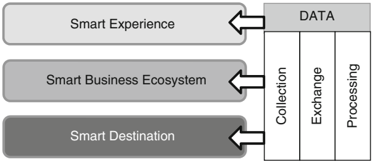
- The paper identifies three basic components of smart tourism: smart destinations, smart business ecosystems, and smart experiences; it also says smart tourism spans three layers: a smart information layer, smart exchange layer, and smart processing layer.
- The paper contrasts smart tourism with e-tourism: smart tourism bridges the digital and physical spheres, relies on sensors & smartphones rather than websites, focuses on the during-trip phase rather than pre- and post-travel, uses big data as its lifeblood, and is organized as an ecosystem rather than a value chain/intermediary structure.
- It notes that smart tourism research is still limited and mostly case-study based, with a strong consumer focus and an overly optimistic, uncritical stance; the paper itself proposes a research agenda and says existing smart tourism initiatives are mostly in development and often government-subsidized.
## Methods
- Conceptual/theoretical paper: it provides definitional clarification and an overview of the foundations of smart tourism rather than reporting an empirical dataset.
- It synthesizes prior literature on ICT, smart cities, service ecosystems, business models, and tourism technology to build its framework and definitions.
- It uses a conceptual comparison with e-tourism and organizes the discussion around technological foundations, business foundations, and research implications.
## Limitations
- The paper itself states that research in smart tourism is “very limited,” mostly case studies, and largely focused on the consumer perspective with an optimistic, uncritical stance.
- It explicitly says the proposed research agenda is “far from being comprehensive.”
- Evident from the text: the paper is conceptual and does not present original empirical data or tests, so its claims are theoretical rather than evidence from a study sample.
Model-written summary. Check it against the paper before relying on it.
Integrity signals
Registry
Cites
Statistics
Figures
Verification
Claims the paper makes
2 Valid · 17 Not valid · 47 Not checked · 59 Own results and interpretations
The cited sources support only part of this claim — read each source’s verdict below.
In the paper
“It has been identified as an important foundation for the services to be provided by smart tourism cities (Guo et al. 2014;Perera et al. 2014).”
§ Smart tourism: foundations and developments > Technological foundations of smart tourism
What the sources say
- Supportedcites Guo et al. 2014
The Introduction calls IoT technology the “core carrier” of the smart tourism information system. The Conclusion also identifies a tourism IoT information platform as critical to smart tourism development in China, supporting the claim that IoT is an important foundation for its services. (LLM, conf=0.93)
- Partly supportedcites Perera et al. 2014 matched to “Sensing as a service model for smart cities supported by Internet of Things” (2014) sourceExperimental — accuracy not yet measured
Section 3 (p. 2) describes an IoT-based sensing-as-a-service model as infrastructure for addressing smart-city challenges. The paper supports the general link between IoT and smart-city services, but the cited passages do not address tourism cities or their services specifically. (LLM, conf=0.85)
plainstates a cause- Asserted: passes — The authors put it forward as true.
- Checkable: passes — It can be checked against evidence.
- Load-bearing: unclear — It is unclear whether the paper’s conclusions depend on it.
- Based: passes — The paper gives a reason why it holds.
- Supported
A result the paper states — it cites no source for it, so there is none to check. The quote shows it is in the paper.
In the paper
“It also revealed a lack of critical literature that scrutinizes smart tourism assumptions and questioned its feasibility and positive experiential, economic and societal impacts.”
§ Smart tourism: foundations and developments > Conclusion
plain- Asserted: passes — The authors put it forward as true.
- Checkable: passes — It can be checked against evidence.
- Load-bearing: passes — The paper’s conclusions depend on it.
- Based: passes — The paper gives a reason why it holds.
In the paper
“Governments in China and South Korea are heavily funding initiatives mostly focused on building the technological infrastructure that supports smart tourism (Hwang et al. 2015).”
§ Smart tourism: foundations and developments > Abstract
What the sources say
- Not checked — no full text of the sourcecites Hwang et al. 2015 matched to “Constructivism in Smart Tourism Research : Seoul Destination Image” (2015) source
plain- Asserted: passes — The authors put it forward as true.
- Checkable: passes — It can be checked against evidence.
- Load-bearing: unclear — It is unclear whether the paper’s conclusions depend on it.
- Based: passes — The paper gives a reason why it holds.
A claim is checked only against the cited paper’s full text, never its abstract, and none is available for its sources.
In the paper
“Academic work is largely focused on describing the phenomenon in the form of case studies (e.g., Boes et al. 2015a, b;Bakıcı et al. 2013;Wang et al. 2013) or on discussing isolated technological developments (e.g., Huang and Chen 2015;Boes et al. 2015a, b) rather than on laying the theoretical foundations for its advancement and/or critique.”
§ Smart tourism: foundations and developments > Abstract
What the sources say
- Not checked — no full text of the sourcecites Boes et al. 2015a, b matched to “The Acceptance of NFC Smart Posters in Tourism” (2015) source
- Not checked — no full text of the sourcecites Bakıcı et al. 2013 matched to “A Smart City Initiative: the Case of Barcelona” (2013) source
- Not checked — no full text of the sourcecites Wang et al. 2013 matched to “China's “smart tourism destination” initiative: A taste of the service-dominant logic” (2013) source
plain- Asserted: passes — The authors put it forward as true.
- Checkable: passes — It can be checked against evidence.
- Load-bearing: passes — The paper’s conclusions depend on it.
- Based: passes — The paper gives a reason why it holds.
In the paper
“Remaining largely a vision at this stage, the Internet of Things has the potential to rapidly become a new reality as a technological infrastructure (Atzori et al. 2010).”
§ Smart tourism: foundations and developments > Technological foundations of smart tourism
What the sources say
- Not checked — no full text of the sourcecites Atzori et al. 2010 matched to “The Internet of Things: A survey” (2010) source
hedged- Asserted: passes — The authors put it forward as true.
- Checkable: passes — It can be checked against evidence.
- Load-bearing: unclear — It is unclear whether the paper’s conclusions depend on it.
- Based: passes — The paper gives a reason why it holds.
21 more claims
Create a free account to see all 125 claims and to verify the 3 references still open.
- It may state two separate claims as one. 46
- Probably not a substantial claim. 81
Citations
Cites
The Internet of Things: A survey
Atzori, L., Iera, A., & Morabito, G. (2010) · Computer Networks · doi:10.1016/j.comnet.2010.05.010 · Cited by 15,613
Business models, business strategy and innovation
Teece, D. J. (2010) · Long Range Planning · doi:10.1016/j.lrp.2009.07.003 · Cited by 8,335
Service-dominant logic: continuing the evolution
Vargo, S. L., & Lusch, R. F. (2008) · Journal of the Academy of Marketing Science · doi:10.1007/s11747-007-0069-6 · Cited by 7,824 · cited 1×
“In this vein, labels and roles assigned to players like travelers, firms and intermediaries are not valid anymore (Vargo and Lusch 2008).”
BackgroundBuhalis, D., & Law, R. (2008) · Tourism Management · doi:10.1016/j.tourman.2008.01.005 · Cited by 3,823 · cited 2×
“tion and of tourism consumers (Buhalis and Law 2008; Wang et al. 2012).”
BackgroundInternet of things: Vision, applications and research challenges
Miorandi, D., Sicari, S., De Pellegrini, F., & Chlamtac, I. (2012) · Ad Hoc Networks · doi:10.1016/j.adhoc.2012.02.016 · Cited by 3,578 · cited 1×
“Content and services will all be around us, persistently available, creating conditions for new applications and enabling new ways of working, interacting, entertainment, and living (Miorandi et al. 2012).”
BackgroundOn value and value co-creation: A service systems and service logic perspective
Vargo, S. L., Maglio, P. P., & Akaka, M. A. (2008) · European Management Journal · doi:10.1016/j.emj.2008.04.003 · Cited by 3,152 · cited 1×
“Vargo et al. (2008) and Spohrer et al. (2007) described a service ecosystem as a spontaneously sensing and responding spatial and temporal structure of largely loosely-coupled value-proposing social and economic actors interacting through institutions and technology, to: (1) co-produce service…”
BackgroundDahlander, L., & Gann, D. M. (2010) · Research Policy · doi:10.1016/j.respol.2010.01.013 · Cited by 2,435 · cited 1×
“Open innovation is based on the assumption that an organisation cannot just rely on its own resources, but has to engage with partners in order to innovate (Dahlander and Gann 2010; West and Gallagher 2006).”
BackgroundMacKenzie, D., & Millo, Y. (2003) · American Journal of Sociology · doi:10.1086/374404 · Cited by 1,464 · cited 1×
“By introducing new business models, firms develop new markets (Callon and Muniesa 2005; MacKenzie and Millo 2003; Pollock and Williams 2009; Inversini and Masiero 2014; Storbacka and Nenonen 2011).”
BackgroundPeripheral Vision: Economic Markets as Calculative Collective Devices
Callon, M., & Muniesa, F. (2005) · Organization Studies · doi:10.1177/0170840605056393 · Cited by 1,378 · cited 1×
“By introducing new business models, firms develop new markets (Callon and Muniesa 2005; MacKenzie and Millo 2003; Pollock and Williams 2009; Inversini and Masiero 2014; Storbacka and Nenonen 2011).”
Foundations for Smarter Cities
Harrison, C., Eckman, B., Hamilton, R., Hartswick, P., Kalagnanam, J., Paraszczak, J., & Williams, P. (2010) · IBM Journal of Research and Development · doi:10.1147/jrd.2010.2048257 · Cited by 1,347 · cited 1×
“Harrison et al. (2010) conceptualize smart as exploiting operational, near-real-time real-world data, integrating and sharing data, and using complex analytics, modelling, optimization and visualization to make better operational decisions.”
BackgroundSteps toward a science of service systems
Spohrer, J., Maglio, P. P., Bailey, J., & Gruhl, D. (2007) · Computer · doi:10.1109/mc.2007.33 · Cited by 1,264 · cited 1×
“Vargo et al. (2008) and Spohrer et al. (2007) described a service ecosystem as a spontaneously sensing and responding spatial and temporal structure of largely loosely-coupled value-proposing social and economic actors interacting through institutions and technology, to: (1) co-produce service…”
BackgroundStinchcombe, A. L. (2019) · University of California Press eBooks · doi:10.1525/9780520909625 · Cited by 1,211
A Smart City Initiative: the Case of Barcelona
Bakıcı, T., Almirall, E., & Wareham, J. (2013) · Journal of the Knowledge Economy · doi:10.1007/s13132-012-0084-9 · Cited by 1,163 · cited 2×
“Academic work is largely focused on describing the phenomenon in the form of case studies (e.g., Boes et al. 2015a, b; Bakıcı et al. 2013; Wang et al. 2013) or on discussing isolated technological developments (e.”
BackgroundChallenges of open innovation: the paradox of firm investment in open-source software
West, J., & Gallagher, S. (2006) · R and D Management · doi:10.1111/j.1467-9310.2006.00436.x · Cited by 1,136 · cited 1×
“Open innovation is based on the assumption that an organisation cannot just rely on its own resources, but has to engage with partners in order to innovate (Dahlander and Gann 2010; West and Gallagher 2006).”
Sensing as a service model for smart cities supported by Internet of Things
Perera, C., Zaslavsky, A., Christen, P., & Georgakopoulos, D. (2014) · Transactions on Emerging Telecommunications Technologies · doi:10.1002/ett.2704 · Cited by 991 · cited 1×
“It has been identified as an important foundation for the services to be provided by smart tourism cities (Guo et al. 2014; Perera et al. 2014).”
BackgroundSmart Tourism Destinations Enhancing Tourism Experience Through Personalisation of Services
Buhalis, D., & Amaranggana, A. (2015) · Information and Communication Technologies in Tourism 2015 · doi:10.1007/978-3-319-14343-9_28 · Cited by 969 · cited 2×
“technology-mediated tourism experiences and their enhancement through personalization, context-awareness and realtime monitoring (Buhalis and Amaranggana 2015).”
BackgroundConceptual foundations for understanding smart tourism ecosystems
Gretzel, U., Werthner, H., Koo, C., & Lamsfus, C. (2015) · Computers in Human Behavior · doi:10.1016/j.chb.2015.03.043 · Cited by 863 · cited 2×
“In a smart tourism ecosystem, any type of stakeholder can become a producer, consumer, intermediary etc. depending on resources and connections rather than pre- defined roles (Gretzel et al. 2015).”
BackgroundSelf-citationRepairing innovation defectiveness in tourism
Hjalager, A.-M. (2002) · Tourism Management · doi:10.1016/s0261-5177(02)00013-4 · Cited by 798 · cited 1×
“It also struggles notoriously with innovation deficiencies despite its strong reliance on ICT (Hjalager 2002).”
Background(2003) · Cited by 795
Information Technology and Tourism — A Challenging Relationship
Werthner, H., & Klein, S. (1999) · doi:10.1007/978-3-7091-6363-4 · Cited by 774
The Role of Smartphones in Mediating the Touristic Experience
Wang, D., Park, S., & Fesenmaier, D. R. (2012) · Journal of Travel Research · doi:10.1177/0047287511426341 · Cited by 770 · cited 1×
“This developmental trajectory continued with the widespread adoption of social media (Sigala et al. 2012), and a move towards realizing mobile tourism in recognition of the high mobility of tourism information and of tourism consumers (Buhalis and Law 2008; Wang et al. 2012).”
BackgroundProgress on information and communication technologies in hospitality and tourism
Law, R., Buhalis, D., & Cobanoglu, C. (2014) · International Journal of Contemporary Hospitality Management · doi:10.1108/ijchm-08-2013-0367 · Cited by 748 · cited 2×
“Given the information-intensity of tourism and the resulting high dependence on information and communication technologies (ICTs) (Law et al. 2014; Koo et al. 2015; Werthner and Klein 1999; Benckendorff et al. 2014), it is not surprising to see the concept of Bsmart^ being applied to phenomena that…”
BackgroundBuhalis, D., & Amaranggana, A. (2013) · Information and Communication Technologies in Tourism 2014 · doi:10.1007/978-3-319-03973-2_40 · Cited by 723 · cited 1×
“Buhalis and Amaranggana (2014) describe the business component of smart tourism as being characterized by dynamically interconnected stakeholders, the digitalization of core business processes, and organizational agility.”
BackgroundSmart technologies for personalized experiences: a case study in the hospitality domain
Neuhofer, B., Buhalis, D., & Ladkin, A. (2015) · Electronic Markets · doi:10.1007/s12525-015-0182-1 · Cited by 699 · cited 1×
“Neuhofer et al. (2015) identify information aggregation, ubiquitous connectedness and real-time synchronization as the major drivers of such smart tourism experiences.”
BackgroundTourism information technology
(2019) · CABI eBooks · doi:10.1079/9781786393432.0000 · Cited by 588
Smart Sustainable Cities: Definition and Challenges
Höjer, M., & Wangel, J. (2015) · Advances in Intelligent Systems and Computing · doi:10.1007/978-3-319-09228-7_20 · Cited by 570 · cited 1×
“Höjer and Wangel (2015) argue that it is not so much the individual technological advances but rather the interconnection, synchronization and concerted use of different technologies that constitutes smartness.”
BackgroundSocial Media in Travel, Tourism and Hospitality: Theory, Practice and Cases
Σιγάλα, Μ., Christou, E., & Gretzel, U. (2012) · Eureka! Institutional Repository (Eureka!) · Cited by 477
Self-citationIntelligent systems in tourism
Gretzel, U. (2011) · Annals of Tourism Research · doi:10.1016/j.annals.2011.04.014 · Cited by 468 · cited 6×
“…physical and governance dimensions of tourism are entering the digital playing field, new levels of intelligence are achieved in tourism systems (Gretzel 2011), the fabric of the industry is yet again changed and the ways in which tourism experiences are created, exchanged, consumed and shared…”
BackgroundInfluentialSelf-citationWerthner, H., & Ricci, F. (2004) · Communications of the ACM · doi:10.1145/1035134.1035141 · Cited by 458 · cited 2×
“…early with the extensive adoption of information and communication technologies (ICT) in tourism, for instance in the form of global distribution and central reservation systems, the integration of Webbased technologies that led to the emergence of e-Tourism (Buhalis 2003; Werthner and Ricci 2004).”
BackgroundEnabling the Internet of Things
Want, R., Schilit, B. N., & Jenson, S. (2015) · Computer · doi:10.1109/mc.2015.12 · Cited by 444 · cited 1×
“…of the IoT is the pervasive presence around us of a variety of objects such as Radio-Frequency-Identification (RFID) tags, sensors, actuators, mobile devices, etc., which are able to interact with each other and cooperate with their neighboring objects to achieve common goals (Want et al. 2015).”
BackgroundMeystel, A. (2001) · Cited by 392
Smart cities in the new service economy: building platforms for smart services
Anttiroiko, A.-V., Valkama, P., & Bailey, S. J. (2014) · AI & SOCIETY · doi:10.1007/s00146-013-0464-0 · Cited by 369 · cited 6×
“Similarly, Anttiroiko et al (2014) describe the necessary creative mutuality and cooperation in these systems as more difficult to manage than traditional competitive rivalry.”
BackgroundInfluentialChina's “smart tourism destination” initiative: A taste of the service-dominant logic
Wang, D., Li, X. (., & Li, Y. (2013) · Journal of Destination Marketing & Management · doi:10.1016/j.jdmm.2013.05.004 · Cited by 352 · cited 1×
“Academic work is largely focused on describing the phenomenon in the form of case studies (e.g., Boes et al. 2015a, b; Bakıcı et al. 2013; Wang et al. 2013) or on discussing isolated technological developments (e.g., Huang and Chen 2015; Boes et al. 2015a, b) rather than on laying the theoretical…”
BackgroundConceptualising Smart Tourism Destination Dimensions
Boes, K., Buhalis, D., & Inversini, A. (2015) · Information and Communication Technologies in Tourism 2015 · doi:10.1007/978-3-319-14343-9_29 · Cited by 351 · cited 3×
“Academic work is largely focused on describing the phenomenon in the form of case studies (e.g., Boes et al. 2015a, b; Bakıcı et al. 2013; Wang et al. 2013) or on discussing isolated technological developments (e.g., Huang and Chen 2015; Boes et al. 2015a, b) rather than on laying the theoretical…”
BackgroundBusiness model design: conceptualizing networked value co‐creation
Nenonen, S., & Storbacka, K. (2010) · International Journal of Quality and Service Sciences · doi:10.1108/17566691011026595 · Cited by 348 · cited 1×
“To define their business model, firms should therefore determine the following design elements: customer value creation, the actor’s earnings logic, value network of the actor, resources and capabilities that the actor has, and strategic decisions that the actor makes (Nenonen and Storbacka 2010).”
BackgroundInversions of service-dominant logic
Vargo, S. L., & Lusch, R. F. (2014) · Marketing Theory · doi:10.1177/1470593114534339 · Cited by 253 · cited 1×
“However, although a functioning service ecosystem is seen as a major prerequisite for enabling the co-creation of customer experiences (Vargo and Lusch 2014), little is still known about how firms can actually construct and continuously manage such service ecosystems.”
BackgroundTourism information technology
(2014) · CABI eBooks · doi:10.1079/9781780641850.0000 · Cited by 244
Corporate Governance of Big Data: Perspectives on Value, Risk, and Cost
Tallon, P. P. (2013) · Computer · doi:10.1109/mc.2013.155 · Cited by 232 · cited 1×
“Smart tourism raises big issues with respect to information governance (Tallon 2013) and correctly deriving the value of information.”
BackgroundPreface: Technologies for a Smarter Planet
Martin, J. L., Varilly, H., Cohn, J., & Wightwick, G. R. (2010) · IBM Journal of Research and Development · doi:10.1147/jrd.2010.2051498 · Cited by 228
Scripting markets: From value propositions to market propositions
Storbacka, K., & Nenonen, S. (2011) · Industrial Marketing Management · doi:10.1016/j.indmarman.2010.06.038 · Cited by 220 · cited 1×
“By introducing new business models, firms develop new markets (Callon and Muniesa 2005; MacKenzie and Millo 2003; Pollock and Williams 2009; Inversini and Masiero 2014; Storbacka and Nenonen 2011).”
BackgroundAndrejevic, M., & Burdon, M. (2015) · Television & New Media · doi:10.1177/1527476414541552 · Cited by 218 · cited 1×
“Smart tourism is becoming a big contributor to and benefactor of the Bsensor society^ (Andrejevic and Burdon 2015) that is characterized by ubiquitous, always-on data capture.”
BackgroundConstructivist Research in Smart Tourism
Professor, D. O. C. M. A. T. C. O. C. O. H. A. T. M., Hunter, W. C., Chung, N., Gretzel, U., & Koo, C. (2015) · Asia Pacific Journal of Information Systems · doi:10.14329/apjis.2015.25.1.105 · Cited by 217 · cited 2×
“In addition to including a destination component, smart tourism is a social phenomenon arising from the convergence of ICTs with the tourism experience (Hunter et al. 2015).”
BackgroundSelf-citationMinghetti, V., & Buhalis, D. (2010) · Journal of Travel Research · doi:10.1177/0047287509346843 · Cited by 214 · cited 1×
“This has clear implications in terms of a widening digital divide (Minghetti and Buhalis 2010) for those without smartphones and destinations that cannot afford to build smart tourism infostructures.”
BackgroundSelling rooms online: the use of social media and online travel agents
Inversini, A., & Masiero, L. (2014) · International Journal of Contemporary Hospitality Management · doi:10.1108/ijchm-03-2013-0140 · Cited by 210 · cited 1×
“By introducing new business models, firms develop new markets (Callon and Muniesa 2005; MacKenzie and Millo 2003; Pollock and Williams 2009; Inversini and Masiero 2014; Storbacka and Nenonen 2011).”
BackgroundSmart business networks: how the network wins
Heck, E. V., & Vervest, P. (2007) · Communications of the ACM · doi:10.1145/1247001.1247002 · Cited by 207
Smart Tourism Destinations: An Extended Conception of Smart Cities Focusing on Human Mobility
Lamsfus, C., Martín, D., Alzua-Sorzabal, A., & Torres-Manzanera, E. (2015) · Information and Communication Technologies in Tourism 2015 · doi:10.1007/978-3-319-14343-9_27 · Cited by 184 · cited 1×
“The focus in Europe, however, is more on innovation and competitiveness and developing smart end-user applications that support enriched tourism experiences using already existing data combined and processed in new ways (Lamsfus et al. 2015; Boes et al. 2015a, b).”
BackgroundGoing Mobile: Defining Context for On-the-Go Travelers
Lamsfus, C., Wang, D., Alzua-Sorzabal, A., & Xiang, Z. (2015) · Journal of Travel Research · doi:10.1177/0047287514538839 · Cited by 179
Self-citationIntelligent systems for tourism
Stabb, S., Werther, H., Ricci, F., Zipf, A., Gretzel, U., Fesenmaier, D. R., Paris, C., & Knoblock, C. (2002) · IEEE Intelligent Systems · doi:10.1109/mis.2002.1134362 · Cited by 166 · cited 2×
“…and sometimes even fragmented, the overarching goal of developing these systems should be open, scalable, and cooperative, enabling full autonomy of the respective participants of the industry as well as supporting the entire tourist experience and all business phases (Staab and Werthner 2002).”
BackgroundSelf-citationSigala, M. (2012) · International Journal of Contemporary Hospitality Management · doi:10.1108/09596111211258874 · Cited by 161
Future research issues in IT and tourism
Werthner, H., Alzua-Sorzabal, A., Cantoni, L., Dickinger, A., Ulrike Gretzel, B., Jannach, D., Neidhardt, J., Pröll, B., Ricci⋆, F., Scaglione, M., et al. (2015) · Information Technology & Tourism · doi:10.1007/s40558-014-0021-9 · Cited by 158 · cited 1×
“Werthner et al. (2015) have recently published a research manifesto that outlines the many layers on which tourism and ICT-related research needs to make significant contributions.”
BackgroundSelf-citationDestination recommendation systems: behavioural foundations and applications
(2006) · doi:10.1079/9780851990231.0000 · Cited by 146 · cited 1×
“…such as decision support systems and the more recent recommender systems, context-aware systems, autonomous agents searching and mining Web sources, ambient intelligence, as well as systems that create augmented realities (Fesenmaier et al. 2006; Lamsfus et al. 2014; Venturini and Ricci 2006).”
Background(2014) · DergiPark (Istanbul University) · Cited by 141
Social Media and Crisis Management in Tourism: Applications and Implications for Research
Sigala, M. (2011) · Information Technology & Tourism · doi:10.3727/109830512x13364362859812 · Cited by 139 · cited 1×
“…the industry perspective, the emphasis is on the potential contributions of these smart systems in terms of process automation, efficiency gains, new product development, demand forecasting, crisis management, and value co-creation (Werthner 2003; Wöber 2003; Sigala 2012a and b; Yoo et al. 2015).”
BackgroundInformation supply in tourism management by marketing decision support systems
Wöber, K. W. (2003) · Tourism Management · doi:10.1016/s0261-5177(02)00071-7 · Cited by 135 · cited 2×
“…the industry perspective, the emphasis is on the potential contributions of these smart systems in terms of process automation, efficiency gains, new product development, demand forecasting, crisis management, and value co-creation (Werthner 2003; Wöber 2003; Sigala 2012a and b; Yoo et al. 2015).”
BackgroundBig Data and Analytics: Strategic and Organizational Impacts
Morabito, V. (2015) · doi:10.1007/978-3-319-10665-6 · Cited by 129 · cited 2×
“Morabito (2015) suggests that operating in a big data driven, smart environment affects all nine elements of business models in fundamental ways: 1) customer segments; 2) value propositions; 3) channels; 4) customer relationships; 5) revenue streams; 6) key resources; 7) key activities; 8) key…”
BackgroundThe New Landscape of Travel: A Comprehensive Analysis of Smartphone Apps
Wang, D., & Xiang, Z. (2012) · Information and Communication Technologies in Tourism 2012 · doi:10.1007/978-3-7091-1142-0_27 · Cited by 126 · cited 7×
“Many technological developments that support mobile access, such as CloudComputing and End-User Internet Service Systems are thus instrumental to facilitating smart tourism goals.”
BackgroundInfluentialSelf-citationHow “smart cities” will change supply chain management
Tachizawa, E. M., Alvarez-Gil, M. J., & Montes-Sancho, M. J. (2015) · Supply Chain Management: An International Journal · doi:10.1108/scm-03-2014-0108 · Cited by 124 · cited 2×
“At the same time, smart tourism infostructure can lead to new information asymmetries that can be commercially exploited (Tachizawa et al. 2015).”
BackgroundSigala, M., & Chalkiti, K. (2014) · Computers in Human Behavior · doi:10.1016/j.chb.2013.05.032 · Cited by 117 · cited 1×
“…is the key component of information systems that promise to supply tourism consumers and service providers with more relevant information, better decision support, greater mobility, and, ultimately, more enjoyable tourism experiences (Gretzel 2011; Werthner 2003; Sigala and Chalkiti 2014).”
BackgroundMinghetti, V. (2022) · Encyclopedia of Tourism Management and Marketing · doi:10.4337/9781800377486.digital.divide.in · Cited by 109
Yoo, K., Σιγάλα, Μ., & Gretzel, U. (2016) · Tourism on the verge · doi:10.1007/978-3-642-54089-9_17 · Cited by 103
Self-citationEditorial : The Role of IT in Tourism
Associate Professor, D. O. C. M. A. T. C. O. H. A. T. M., Koo, C., Gretzel, U., Hunter, W. C., & Chung, N. (2015) · Asia Pacific Journal of Information Systems · doi:10.14329/apjis.2015.25.1.099 · Cited by 97
Self-citationPost-Global Network and Everyday Life
Kien, G., & Levina, M. (2010) · Peter Lang eBooks · Cited by 74
(2003) · International Joint Conference on Artificial Intelligence · Cited by 74
Tourism Information Technology
Sheldon, P. J. (2006) · International Handbook on the Economics of Tourism · doi:10.4337/9781847201638.00030 · Cited by 72
(2010) · Research Online (University of Wollongong) · Cited by 64
Self-citationThe sociology of a market analysis tool: How industry analysts sort vendors and organize markets
Pollock, N., & Williams, R. (2009) · Information and Organization · doi:10.1016/j.infoandorg.2009.01.001 · Cited by 63 · cited 1×
“By introducing new business models, firms develop new markets (Callon and Muniesa 2005; MacKenzie and Millo 2003; Pollock and Williams 2009; Inversini and Masiero 2014; Storbacka and Nenonen 2011).”
BackgroundSmartSantander: Internet of Things Research and Innovation through Citizen Participation
Gutiérrez, V., Galache, J. A., Sánchez, L., Muñoz, L., Hernández-Muñoz, J. M., Fernandes, J., & Presser, M. (2013) · Lecture Notes in Computer Science · doi:10.1007/978-3-642-38082-2_15 · Cited by 60
MacKenzie, D. A., & Millo, Y. (2003) · Réseaux · doi:10.3917/res.122.0015 · Cited by 48
Designing for mobile value co-creation—the case of travel counselling
Schmidt-Rauch, S., & Schwabe, G. (2014) · Electronic Markets · doi:10.1007/s12525-013-0124-8 · Cited by 46 · cited 1×
“the opportunities, challenges and affordances of smart tourism and to re-define their business models and sustain competitiveness (Schmidt_Rauch and Schwabe 2014).”
BackgroundΣιγάλα, Μ. (2015) · Journal of Travel & Tourism Marketing · doi:10.1080/10548408.2015.1063801 · Cited by 43 · cited 1×
“Sigala (2015) describes smart tourism as changing all or some of the following five market elements: exchange object, market actors, market structure, market institutions, and market practices.”
BackgroundConstructivism in Smart Tourism Research : Seoul Destination Image
Ph. D. Candidate, C. A. E. M. D., Hwang, J., Park, H.-Y., & Hunter, W. C. (2015) · Asia Pacific Journal of Information Systems · doi:10.14329/apjis.2015.25.1.163 · Cited by 40 · cited 2×
“on building the technological infrastructure that supports smart tourism (Hwang et al. 2015).”
BackgroundThe Acceptance of NFC Smart Posters in Tourism
Boes, K., Borde, L., & Egger, R. (2015) · Information and Communication Technologies in Tourism 2015 · doi:10.1007/978-3-319-14343-9_32 · Cited by 37 · cited 3×
“Academic work is largely focused on describing the phenomenon in the form of case studies (e.g., Boes et al. 2015a, b; Bakıcı et al. 2013; Wang et al. 2013) or on discussing isolated technological developments (e.g., Huang and Chen 2015; Boes et al. 2015a, b) rather than on laying the theoretical…”
BackgroundWhy we compete in DARPA's Urban Challenge autonomous robot race
Thrun, S. (2007) · Communications of the ACM · doi:10.1145/1290958.1290985 · Cited by 29
(2006) · Open Research (University of Surrey) · Cited by 23
Sigala, M., & Marinidis, D. (2012) · International Journal of Business Information Systems · doi:10.1504/ijbis.2012.046293 · Cited by 21 · cited 1×
“…in how to increase their performance and competitiveness by (hyper)-automating, informating and transforming their business functions and processes such as marketing, procurement/supply chain management, human resource management, and customer service and management (Sigala and Marinidis 2012).”
BackgroundHuang, C., & Chen, S. (2015) · Applied Mechanics and Materials · doi:10.4028/www.scientific.net/amm.764-765.1265 · Cited by 11 · cited 1×
“…the phenomenon in the form of case studies (e.g., Boes et al. 2015a, b; Bakıcı et al. 2013; Wang et al. 2013) or on discussing isolated technological developments (e.g., Huang and Chen 2015; Boes et al. 2015a, b) rather than on laying the theoretical foundations for its advancement and/or critique.”
Background(2012) · Cited by 6
Research works printed but not linked: 4
- 3. Anuar, F. I. & Gretzel, U. (2011). Privacy Concerns in the Context of Location Based Services for Tourism. ENTER 2011 Conference, Innsbruck, Austria, January 26-28, 2011. Accessed online (March 1, 2015) at http://ertr.tamu.edu/enter-2011-short-papers/.
- 16. Lopez de Avila, A. (2015). Smart Destinations: XXI Century Tourism. Presented at the ENTER2015 Conference on Information and Communication Technologies in Tourism, Lugano, Switzerland, February 4-6, 2015.
- 58. Tu, Q. & Liu, A. (2014). Framework of Smart Tourism Research and Related Progress in China. In International Conference on Management and Engineering (CME 2014), pp. 140-146.
- 77. In R. Egger, I. Gula, & D. Walcher (Eds.), Open Tourism - Open Innovation, Crowdsourcing and Collaborative Consumption challenging the tourism industry. Heidelberg: Springer Verlag.
Cited by
Di Vaio, A., Palladino, R., Hassan, R., & Escobar, O. (2020) · Journal of Business Research · doi:10.1016/j.jbusres.2020.08.019 · Cited by 1,096
Tussyadiah, I. (2020) · Annals of Tourism Research · doi:10.1016/j.annals.2020.102883 · Cited by 1,033
Buhalis, D. (2020) · Tourism Review · doi:10.1108/tr-06-2019-0258 · Cited by 914
Conceptual foundations for understanding smart tourism ecosystems
Gretzel, U., Werthner, H., Koo, C., & Lamsfus, C. (2015) · Computers in Human Behavior · doi:10.1016/j.chb.2015.03.043 · Cited by 863
Self-citationThe digital revolution in the travel and tourism industry
Pencarelli, T. (2020) · Information Technology & Tourism · doi:10.1007/s40558-019-00160-3 · Cited by 830
Metadata
- Authors
- Gretzel, U., Sigala, M., Xiang, Z., & Koo, C.
- Affiliations
- Virginia Tech (US)
- Kyung Hee University (KR)
- Corresponding author
- Koo, Chulmo
- Venue
- Electronic Markets
- Published
- 2015-08-01
- Volume
- 25
- Issue
- 3
- Pages
- 179-188
- ISSN
- 1019-6781 (ISSN-L)
- 1422-8890
- OpenAlex
- W974480840
- Cited by
- 2,589
- References
- 81
- Citations by year
- 2026: 532 · 2025: 364 · 2024: 307 · 2023: 255 · 2022: 283 · 2021: 239 · 2020: 232 · 2019: 163 · 2018: 93 · 2017: 82 · 2016: 36 · 2015: 2
- FWCI
- 234.92
- Type
- journal article
- Language
- en
- Open access
- hybrid
- doi.org
- Licence
- cc-by
- creativecommons.org/licenses/by/4.0/ (tdm)
- creativecommons.org/licenses/by/4.0/ (vor)
- Locations
- Electronic Markets (publishedVersion, cc-by)
- UniSA Research Outputs Repository (University of South Australia) (acceptedVersion)
- Adelaide Research & Scholarship (AR&S) (University of Adelaide) (submittedVersion, cc-by)
- Funders
- National Research Foundation
- National Research Foundation of Korea (NRF-2013S1A3A2043345)
- Topics
- Social Sciences › Business, Management and Accounting › Tourism, Leisure and Hospitality Management › Diverse Aspects of Tourism Research
- Social Sciences › Business, Management and Accounting › Management of Technology and Innovation › Digital Innovation in Industries
- Social Sciences › Business, Management and Accounting › Marketing › AI in Service Interactions
- Keywords
- smart tourism, information and communication technologies, tourism destinations, tourism industry, big data, value proposition, conceptual definitions, tourism management, technological foundations, business foundations
About these checks
Registry, retraction, Cites and statistics results are computed, not judged, with one exception: a printed reference that no index lists is read once by a model before it counts as a citation error. Claims are extracted by a model and kept only when their quote appears verbatim in the text; each cited source is then checked, with a model’s help, for whether it says what the claim relies on. Those verdicts can be wrong — read the claim’s quote and the cited source before relying on one.
The claim verdicts this report counts are experimental: their accuracy is not yet measured.
A language model drew the claims from the paper on 2026-10-10, under version 3 of the claim definition (model deepseek-v4.1-flash, prompt extract-v3).
A second model labelled each claim on 2026-10-10 (model jev-1.13-20260917, definition revision gold-guideline-v0.2).
Cited sources are checked with a language model’s help (gpt-6-sol).
Statistics and arithmetic are recomputed, not judged.
Confidence bands are shown only for fields calibrated on our annotated test set. None is calibrated yet, so no band is shown.
What counts as a claim ›How we measure confidence ›How we check this ›
Are you an author, or do you see a problem with this page? Request a review
Data sources
Bibliographic data: Semantic Scholar, OpenAlex, Crossref.
Contains information from the Semantic Scholar Academic Graph Datasets, made available under the ODC Attribution License (ODC-BY 1.0).
Semantic Scholar’s data is described in: Kinney, R., et al. (2023). The Semantic Scholar Open Data Platform. arXiv:2301.10140.
