

Psychological Treatment of Exhaustion Due to Persistent Non-Traumatic Stress: A Scoping Review.
Open accessThe DOI matches its Crossref record; 122 of the 123 references it cites were found in a registry or an index; 17 of the 41 sources its claims cite were checked for support.
Abstract
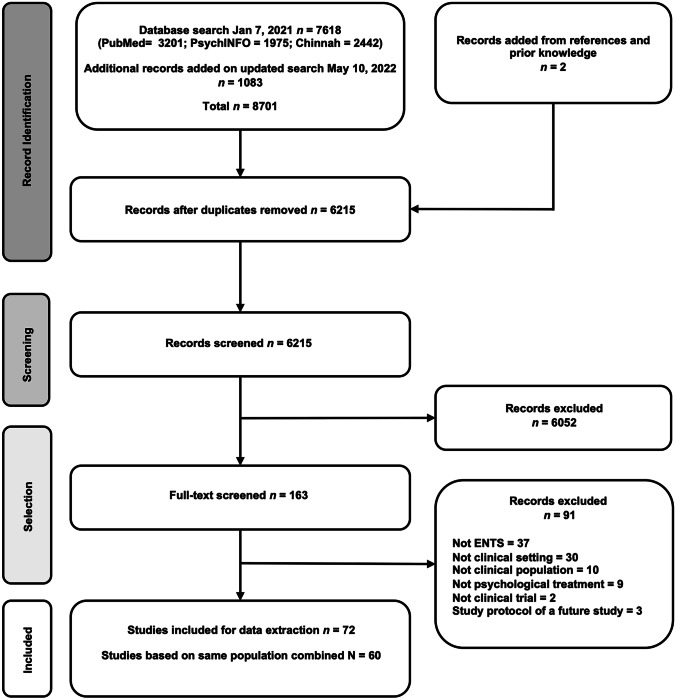
Background: Exhaustion due to persistent non-traumatic stress (ENTS) is a significant health problem with substantial personal, social, and economic impact. While there are increasing studies of ENTS, there is no international agreement on how it should be diagnosed and treated. This scoping review aimed to map definitions, diagnoses, treatments, outcome measures, and outcomes in psychological treatment studies of ENTS. A further aim was to assess the quality of the treatments and map what change processes are described within ENTS interventions. Methods: A PRISMA-guided scoping review of psychological treatment studies delivered in a clinical setting for ENTS was conducted using the databases of PubMed, PsycINFO, and CINAHL. Results: Of the 60 studies included, the majority (87%) stemmed from Europe. The most recurrent term for ENTS was burnout, and the diagnosis most often utilized was exhaustion disorder. Several treatments were reported, the most frequent being cognitive behavioral therapy (CBT) (68%). Statistically significant outcomes relevant to ENTS were reported in 65% (n = 39) of the studies, with effect sizes between 0.13 and 1.80. In addition, 28% of the treatments were rated as high quality. The most frequent change processes described were dysfunctional sleep, avoidance, behavioral activation, irrational thoughts and beliefs, worry, perceived competence/positive management, psychological flexibility, and recuperation. Conclusions: While several treatments based on CBT show promising results for ENTS, there do not seem to be any uniformly established methods, theoretical models, or change processes. Instead of adopting a monocausal, syndromal, and potentially bio-reductionist perspective on ENTS, a process-based approach to treatment is encouraged.
Overview
CoChat Summary
## TL;DR
This PRISMA-guided scoping review mapped 60 clinical psychological treatment studies of exhaustion due to persistent non-traumatic stress (ENTS) published from 1986 to 2022. The literature is dominated by European studies and CBT-based interventions, but the paper concludes that there are no uniformly established treatments, theoretical models, or change processes for ENTS.
## Key findings
- Of the 60 included studies, 87% stemmed from Europe; the most common locations were Sweden (20 studies) and the Netherlands (12 studies).
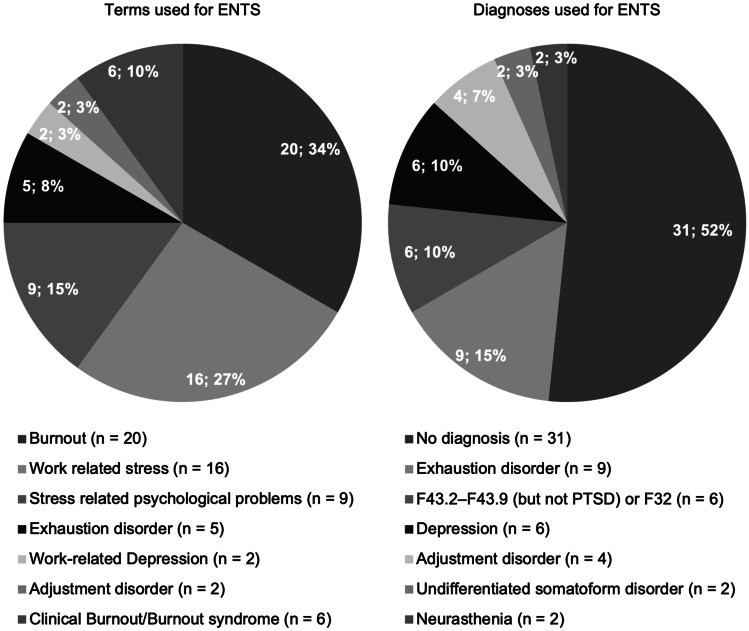
- The most recurrent term for ENTS was burnout (n = 20), and the diagnosis most often used was exhaustion disorder (n = 9); no diagnosis was used in 31 studies.
- Cognitive behavioral therapy (CBT) was the most frequent treatment approach, appearing in 68% of studies in the abstract and 64% (n = 38) in the detailed results.
- Statistically significant outcomes relevant to ENTS were reported in 65% (n = 39) of studies, with effect sizes ranging from 0.13 to 1.80; 28% (n = 17) of treatments were rated high quality.
## Methods
- PRISMA-guided scoping review of psychological treatment studies delivered in clinical settings for ENTS, using PubMed, PsycINFO, and CINAHL.
- Included full-text English primary research reports with adult participants, clinical treatment in a clinical setting, quantitative treatment designs with clinical outcomes, and psychological or multimodal interventions with a substantial psychological component.
- Data extracted included study characteristics, terms/diagnoses, interventions, outcome measures, significant outcomes, effect sizes, and processes of change; treatment quality was rated on a 0–4 scale based on four criteria about theory and change processes.
## Limitations
- The authors state this was a scoping review and not a systematic review of efficacy, so efficacy conclusions remain to be done.
- They note that summarizing many trials as frequencies or percentages may conceal clinically important findings, including secondary outcomes such as biomarkers and economic outcomes.
- The review is primarily based on European studies and only included English scientific journals, which the authors say limits cross-cultural breadth; this limitation is stated in the paper.
Model-written summary. Check it against the paper before relying on it.
Integrity signals
Registry
Cites
Statistics
Figures
Verification
Claims the paper makes
13 Valid · 2 Not valid · 12 Not checked · 99 Own results and interpretations
The cited sources support only part of this claim — read each source’s verdict below.
In the paper
“Of all secondary findings, only one was replicated across two studies, showing that the effect of Internet-CBT on symptoms of stress and exhaustion was mediated by insomnia severity [68, 80].”
§ Psychological Treatment of Exhaustion Due to Persistent Non-Traumatic Stress: A Scoping Review > Results > Treatment Outcomes and Results
What the sources say
- Partly supportedcites [68] Lindsäter E, Axelsson E, Salomonsson S, Santoft F, Ljótsson B, Åkerstedt T, et al. The mediating role of insomnia severity in internet-based cognitive behavioral therapy for chronic stress: secondary analysis of a randomized controlled trial. Behav Res Ther [Internet]. 2021 Jan;136(April 2020):103782. Available from: https://linkinghub.elsevier.com/retrieve/pii/S0005796720302369. 33276274 sourceExperimental — accuracy not yet measured
The Mediation analysis reports that reduced insomnia severity statistically mediated Internet-CBT’s effects on both perceived stress and exhaustion. The Discussion says this is in line with an earlier face-to-face CBT study, but that earlier study found mediation for exhaustion; the extension to perceived stress and Internet delivery belongs to the present study. Thus, the source does not establish that the full Internet-CBT finding was replicated across two studies. (LLM, conf=0.88)
- Not checked — no full text of the sourcecites [80] Santoft F, Salomonsson S, Hesser H, Lindsäter E, Ljótsson B, Lekander M, et al. Mediators of change in cognitive behavior therapy for clinical burnout. Behav Ther [Internet]. 2019 May;50(3):475–88. Available from: https://linkinghub.elsevier.com/retrieve/pii/S0005789418301084. 31030867 source
plainstates a causen = 2- Asserted: passes — The authors put it forward as true.
- Checkable: passes — It can be checked against evidence.
- Load-bearing: unclear — It is unclear whether the paper’s conclusions depend on it.
- Based: passes — The paper gives a reason why it holds.
- Partly supported
Every source the paper cites for this claim was checked and supports it.
In the paper
“No evidence-based treatment has been identified for ENTS, and it appears that various treatments with varying theoretical frameworks, components, and methods are utilized in regular care [16].”
§ Psychological Treatment of Exhaustion Due to Persistent Non-Traumatic Stress: A Scoping Review > Introduction
What the sources say
- Supportedcites [16] Lindsäter E, Svärdman F, Wallert J, Ivanova E, Söderholm A, Fondberg R, et al. Exhaustion disorder: scoping review of research on a recently introduced stress-related diagnosis. BJ Psych Open [Internet]. 2022 Sep 24;8(5):e159. Available from: https://www.cambridge.org/core/product/identifier/S2056472422005592/type/journal_article. PMC9438479 36458830 source
The Results (Synthesis of results; page not available) state that evidence for any one intervention is limited and that methodological limitations prevent firm conclusions about treatment effectiveness. The same section describes multimodal rehabilitation as common in clinical settings and lists its varied components, supporting the sentence's qualified description of routine care. (LLM, conf=0.87)
plain- Asserted: passes — The authors put it forward as true.
- Checkable: passes — It can be checked against evidence.
- Load-bearing: passes — The paper’s conclusions depend on it.
- Based: passes — The paper gives a reason why it holds.
- Supported
The cited sources support only part of this claim — read each source’s verdict below.
In the paper
“and it appears that various treatments with varying theoretical frameworks, components, and methods are utilized in regular care [16].”
§ Psychological Treatment of Exhaustion Due to Persistent Non-Traumatic Stress: A Scoping Review > Introduction
What the sources say
- Partly supportedcites [16] Lindsäter E, Svärdman F, Wallert J, Ivanova E, Söderholm A, Fondberg R, et al. Exhaustion disorder: scoping review of research on a recently introduced stress-related diagnosis. BJ Psych Open [Internet]. 2022 Sep 24;8(5):e159. Available from: https://www.cambridge.org/core/product/identifier/S2056472422005592/type/journal_article. PMC9438479 36458830 sourceExperimental — accuracy not yet measured
The Results (Synthesis of results; page unavailable) describe a wide range of interventions for exhaustion disorder and say multimodal rehabilitation is commonly used in clinical settings, with antidepressants described as seemingly common. They do not establish that the full range of treatments investigated is used in regular care. (LLM, conf=0.84)
hedged- Asserted: passes — The authors put it forward as true.
- Checkable: passes — It can be checked against evidence.
- Load-bearing: passes — The paper’s conclusions depend on it.
- Based: passes — The paper gives a reason why it holds.
- Partly supported
A result the paper states — it cites no source for it, so there is none to check. The quote shows it is in the paper.
In the paper
“The most frequent change processes described were dysfunctional sleep, avoidance, behavioral activation, irrational thoughts and beliefs, worry, perceived competence/positive management, psychological flexibility, and recuperation.”
- Also stated in: § Discussion · plain
“The most frequent change processes described were dysfunctional sleep, avoidance, behavioral activation, irrational thoughts and beliefs, worry, perceived competence/positive management, psychological flexibility, and recuperation.”
§ Psychological Treatment of Exhaustion Due to Persistent Non-Traumatic Stress: A Scoping Review > Abstract > Results
plain- Asserted: passes — The authors put it forward as true.
- Checkable: passes — It can be checked against evidence.
- Load-bearing: passes — The paper’s conclusions depend on it.
- Based: passes — The paper gives a reason why it holds.
- Also stated in: § Discussion · plain
A result the paper reports from its own data — it cites no other source for it, so there is none to check. The quote shows it is in the paper.
In the paper
“the most frequent being cognitive behavioral therapy (CBT) (68%).”
§ Psychological Treatment of Exhaustion Due to Persistent Non-Traumatic Stress: A Scoping Review > Abstract > Results
plain- Asserted: passes — The authors put it forward as true.
- Checkable: passes — It can be checked against evidence.
- Load-bearing: unclear — It is unclear whether the paper’s conclusions depend on it.
- Based: passes — The paper gives a reason why it holds.
52 more claims
Create a free account to see all 126 claims and to verify the 1 reference still open.
- Probably not a substantial claim. 52
- It may state two separate claims as one. 29
- The quote only partly states this claim. 1
Claims other papers make about this one
Each is checked against this paper’s own text: does it say what the citing paper says it does?
The source backs part of the claim, not all of it — or backs it for a different population, condition or comparison.
In the citing paper
“Emotional distress, which includes exhaustion, hopelessness and psychological instability, should be understood as an emergent product of repeated treatment disruption rather than solely a symptom of underlying disorders [51].”
From Treatment Experiences of Individuals With Co-Occurring Mental Health and Substance Use Disorders and Perspectives of Mental Health Workers in Ashanti Region, Ghana (2026) · cites this paper as [51]
Experimental — accuracy not yet measured
Self-check
Percentages, sums and reported differences re-computed from the paper’s own numbers.
Each contradiction between two passages listed here was confirmed by an independent check.
Rated minor: it would not touch a result — a value no result rests on, a p-value that stays on the same side of the significance level, or a conflict that is clerical, resolved elsewhere in the paper, or outside its own findings.
In the paper
§ Psychological Treatment of Exhaustion Due to Persistent Non-Traumatic Stress: A Scoping Review > Results > Study Characteristics
“The included 60 studies were published between 1986 and 2022 (see Table 1). The studies primarily stem from Europe (52 studies),”
§ Psychological Treatment of Exhaustion Due to Persistent Non-Traumatic Stress: A Scoping Review > Discussion
“Of the 60 studies included, 53 were based in Europe, with the most common locations being Sweden and the Netherlands.”
Rated minor: it would not touch a result — a value no result rests on, a p-value that stays on the same side of the significance level, or a conflict that is clerical, resolved elsewhere in the paper, or outside its own findings.
In the paper
§ Psychological Treatment of Exhaustion Due to Persistent Non-Traumatic Stress: A Scoping Review > Abstract > Results
“the most frequent being cognitive behavioral therapy (CBT) (68%).”
§ Psychological Treatment of Exhaustion Due to Persistent Non-Traumatic Stress: A Scoping Review > Results > Treatments Used for ENTS
“Different forms of cognitive behavior therapies (CBT) were examined in 64% of the studies (n = 38).”
Citations
Cites
Diagnostic and Statistical Manual of Mental Disorders
American Psychiatric Association (2013) · doi:10.1176/appi.books.9780890425596 · Cited by 116,369
PRISMA Extension for Scoping Reviews (PRISMA-ScR): Checklist and Explanation
Tricco, A. C., Lillie, E., Zarin, W., O'Brien, K. K., Colquhoun, H., Levac, D., Moher, D., Peters, M. D. J., Horsley, T., Weeks, L., et al. (2018) · Annals of Internal Medicine · doi:10.7326/m18-0850 · Cited by 43,565 · cited 1×
“This scoping review was conducted following the guidelines from the Joanna Briggs Institute, and the reporting follows the PRISMA-ScR guidelines [37, 38].”
MethodCochrane Handbook for Systematic Reviews of Interventions
(2019) · doi:10.1002/9781119536604 · Cited by 14,828
Munn, Z., Peters, M. D. J., Stern, C., Tufanaru, C., McArthur, A., & Aromataris, E. (2018) · BMC Medical Research Methodology · doi:10.1186/s12874-018-0611-x · Cited by 11,385 · cited 1×
“A scoping review is an excellent way to map a field of study particularly one still in its youth, where more detailed questions are not yet possible [36].”
BackgroundUnderstanding the burnout experience: Recent research and its implications for psychiatry
Maslach, C., & Leiter, M. P. (2016) · World Psychiatry · doi:10.1002/wps.20311 · Cited by 4,200 · cited 1×
“Instead, clinical burnout is sometimes used to describe the end stage of a severe burnout process that requires clinical attention [24, 25].”
BackgroundA network theory of mental disorders
Borsboom, D. (2017) · World Psychiatry · doi:10.1002/wps.20375 · Cited by 3,482 · cited 1×
“…monocausal latent disease model for understanding illnesses, a network approach is recommended, concep-tualizing mental illness from a multicausal network of inter-acting symptoms and associated processes, where specific syndromes are the result of dynamically self-reinforcing clusters [120, 121].”
BackgroundPsychological Stress and Disease
Cohen, S., Janicki-Deverts, D., & Miller, G. E. (2007) · JAMA · doi:10.1001/jama.298.14.1685 · Cited by 3,168
Mediators and Mechanisms of Change in Psychotherapy Research
Kazdin, A. E. (2007) · Annual Review of Clinical Psychology · doi:10.1146/annurev.clinpsy.3.022806.091432 · Cited by 2,504 · cited 1×
“Change processes are the specific variables through which a treatment method exerts its influence over a targeted dependent variable [34].”
BackgroundPeters, M., Godfrey, C., McInerney, P., Munn, Z., Tricco, A., & Khalil, H. (2019) · JBI Reviewer's Manual · doi:10.46658/jbirm-20-01 · Cited by 2,222 · cited 1×
“This scoping review was conducted following the guidelines from the Joanna Briggs Institute, and the reporting follows the PRISMA-ScR guidelines [37, 38].”
MethodBurnout: 35 years of research and practice.
Schaufeli, W. B., Leiter, M. P., & Maslach, C. (2009) · Career Development International · doi:10.1108/13620430910966406 · Cited by 1,964 · cited 1×
“For the past 40 years, the interest in ENTS has been reawakened through the concept of burnout, a construct used in organizational psychology to describe how employees gradually succumb to exhaustion, cynicism, and professional inefficiency due to organizational factors [21].”
BackgroundThe relationship between burnout, depression, and anxiety: a systematic review and meta-analysis.
Koutsimani, P., Montgomery, A., & Georganta, K. (2019) · Frontiers in Psychology · doi:10.3389/fpsyg.2019.00284 · Cited by 1,091
Making Mental Health Count: The Social and Economic Costs of Neglecting Mental Health Care
Hewlett, E., & Moran, V. (2014) · OECD Health Policy Studies · doi:10.1787/9789264208445-en · Cited by 1,036
The Future of Intervention Science: Process-Based Therapy
Hofmann, S. G., & Hayes, S. C. (2019) · Clinical Psychological Science · doi:10.1177/2167702618772296 · Cited by 888 · cited 2×
“Maybe it is a condition that emerges from a network of pathological interactions of behavioral, cognitive, emotional, physiological, and social elements — a network that can be altered by targeting explicit processes of change, in specific situations, for particular people [35].”
BackgroundBurnout–Depression Overlap: A Review
Bianchi, R., Schonfeld, I. S., & Laurent, E. (2015) · Clinical Psychology Review · doi:10.1016/j.cpr.2015.01.004 · Cited by 868
Uncertainty and stress: Why it causes diseases and how it is mastered by the brain
Peters, A., McEwen, B. S., & Friston, K. (2017) · Progress in Neurobiology · doi:10.1016/j.pneurobio.2017.05.004 · Cited by 652 · cited 1×
“From a biomechanical view, persistent stress symptoms are regarded as the result of a physiological resource-demand imbalance rather than a consequence of interacting physiological, behavioral, cognitive, emotional, and social elements [119].”
BackgroundToward a Philosophical Structure for Psychiatry
Kendler, K. S. (2005) · American Journal of Psychiatry · doi:10.1176/appi.ajp.162.3.433 · Cited by 561 · cited 1×
“One possible explanation could be the mono-causal latent disease model inherent in a syndromal approach, favoring biologic reductionism over a complex multilevel view [118].”
Background(2012) · doi:10.1787/9789264124523-en · Cited by 490
(2002) · Cited by 479
HEALTH PSYCHOLOGY: Mapping Biobehavioral Contributions to Health and Illness
Baum, A., & Posluszny, D. M. (1999) · Annual Review of Psychology · doi:10.1146/annurev.psych.50.1.137 · Cited by 413
Neurasthenia, or Nervous Exhaustion
Beard, G. (1869) · The Boston Medical and Surgical Journal · doi:10.1056/nejm186904290801301 · Cited by 412 · cited 1×
“In 1869, George Miller Beard described the diagnosis of neurasthenia, a condition — well known to clinical practitioners of that time — characterized by persistent exhaustion due to the fast pace and demands of the “modern life,” as Beard himself put it [17].”
Backgroundvan der Klink, J. J. L., Blonk, R. W. B., Schene, A. H., & van Dijk, F. J. H. (2003) · Occupational and Environmental Medicine · doi:10.1136/oem.60.6.429 · Cited by 378
Burnout and Depression: Two Entities or One?
Schonfeld, I. S., & Bianchi, R. (2016) · Journal of Clinical Psychology · doi:10.1002/jclp.22229 · Cited by 345
The role of the individual in the coming era of process-based therapy
Hayes, S. C., Hofmann, S. G., Stanton, C. E., Carpenter, J. K., Sanford, B. T., Curtiss, J. E., & Ciarrochi, J. (2019) · Behaviour Research and Therapy · doi:10.1016/j.brat.2018.10.005 · Cited by 295 · cited 2×
“In recent years, a group of prominent researchers in clinical psychology have set out to change the agenda for modern clinical interventional research: away from syndrome-based diagnoses and syndrome-specific protocol-based interventions and toward a process-based approach to treatment [33].”
BackgroundGrossi, G., Perski, A., Osika, W., & Savic, I. (2015) · Scandinavian Journal of Psychology · doi:10.1111/sjop.12251 · Cited by 273 · cited 1×
“Persistent non-traumatic stress can have detrimental health effects and can result in symptoms of exhaustion, reduced performance, and cognitive impairments [1–4].”
BackgroundHayes, S. C., Ciarrochi, J., Hofmann, S. G., Chin, F., & Sahdra, B. (2022) · Behaviour Research and Therapy · doi:10.1016/j.brat.2022.104155 · Cited by 234 · cited 2×
“While not described in the review of Hayes et al. [123], avoidance and perceived competence are incorporated within several overlapping constructs, such as self-efficacy, non-reactivity to inner experience, and perceived control in the pre-sent.”
BackgroundHayes, S. C., Hofmann, S. G., & Ciarrochi, J. (2020) · Clinical Psychology Review · doi:10.1016/j.cpr.2020.101908 · Cited by 227 · cited 1×
“…therapy adopts an idi-ographic perspective where treatment models should have explicit philosophical assumptions, be theoretically coherent and enable clinicians to select components to target established, evidence-based, and modifiable change processes tailored to specific individuals [122].”
BackgroundSCHENE, A. H., KOETER, M. W. J., KIKKERT, M. J., SWINKELS, J. A., & McCRONE, P. (2007) · Psychological Medicine · doi:10.1017/s0033291706009366 · Cited by 203
ANDERSON, N. B. (1998) · Annals of the New York Academy of Sciences · doi:10.1111/j.1749-6632.1998.tb09595.x · Cited by 165 · cited 1×
“Persistent non-traumatic stress can have detrimental health effects and can result in symptoms of exhaustion, reduced performance, and cognitive impairments [1–4].”
BackgroundThe survival of psychiatric diagnosis
Pilgrim, D. (2007) · Social Science & Medicine · doi:10.1016/j.socscimed.2007.03.054 · Cited by 156 · cited 1×
“Conveniently, syndromal diagnoses are clinical judgments that lack independent validation, and so what is or is not a disease is, to a large extent, socially negotiated through scientific discussion and clinical practice [115], which currently centers around the ICD and DSM.”
BackgroundDe Vente, W., Kamphuis, J. H., Emmelkamp, P. M. G., & Blonk, R. W. B. (2008) · Journal of Occupational Health Psychology · doi:10.1037/1076-8998.13.3.214 · Cited by 142
Dutch practice guidelines for managing adjustment disorders in occupational and primary health care
van der Klink, J. J., & van Dijk, F. J. (2003) · Scandinavian Journal of Work, Environment & Health · doi:10.5271/sjweh.756 · Cited by 136
A clinical perspective on burnout: diagnosis, classification, and treatment of clinical burnout
van Dam, A. (2021) · European Journal of Work and Organizational Psychology · doi:10.1080/1359432x.2021.1948400 · Cited by 134 · cited 1×
“Instead, clinical burnout is sometimes used to describe the end stage of a severe burnout process that requires clinical attention [24, 25].”
BackgroundShould Burnout Be Conceptualized as a Mental Disorder?
Nadon, L., De Beer, L. T., & Morin, A. J. S. (2022) · Behavioral Sciences · doi:10.3390/bs12030082 · Cited by 112 · cited 1×
“There is an ongoing debate as to whether ENTS should be considered a disorder on its own or whether it should be a part of depression, with diverging evidence currently supporting both positions [26–32].”
ResultStenlund, T., Ahlgren, C., Lindahl, B., Burell, G. K., Steinholtz, K., Edlund, C., Nilsson, L., Knutsson, A., & Birgander, L. S. (2009) · International Journal of Behavioral Medicine · doi:10.1007/s12529-008-9011-7 · Cited by 110
Maj, M. (2018) · World Psychiatry · doi:10.1002/wps.20512 · Cited by 109 · cited 2×
“This focus could shift away from whether ENTS exists “by its own right” as a latent disease within the already debated diagnostic systems, where low specificity and high comorbidity are the norm rather than the rule [116].”
BackgroundOosterholt, B. G., Van der Linden, D., Maes, J. H., Verbraak, M. J., & Kompier, M. A. (2012) · Scandinavian Journal of Work, Environment & Health · doi:10.5271/sjweh.3256 · Cited by 106
Changes in experienced value of everyday occupations after nature-based vocational rehabilitation
Pálsdóttir, A. M., Grahn, P., & Persson, D. (2013) · Scandinavian Journal of Occupational Therapy · doi:10.3109/11038128.2013.832794 · Cited by 104
The role of work-related personal projects during two burnout interventions: a longitudinal study
Salmela-aro *, K., Näätänen, P., & Nurmi, J.-E. (2004) · Work & Stress · doi:10.1080/02678370412331317480 · Cited by 93
Burnout: Moving beyond the status quo.
Bianchi, R., Schonfeld, I. S., & Laurent, E. (2019) · International Journal of Stress Management · doi:10.1037/str0000088 · Cited by 93
Sleep physiology in recovery from burnout
Ekstedt, M., Söderström, M., & Åkerstedt, T. (2009) · Biological Psychology · doi:10.1016/j.biopsycho.2009.08.006 · Cited by 89 · cited 1×
“Other interesting results relate to differences in lower cortisol levels at awakening [101, 102] or reductions in the arousal from sleep being predictive of decreased exhaustion symptoms during treatment [93].”
ResultNeckel, S., Schaffner, A. K., & Wagner, G. (2017) · Springer eBooks · doi:10.1007/978-3-319-52887-8 · Cited by 85
Burnout: 35 Years of research and practice
Schaufeli, W. B., Leiter, M. P., & Maslach, C. (2010) · IEEE Engineering Management Review · doi:10.1109/emr.2010.5645750 · Cited by 84
Cortisol deviations in people with burnout before and after psychotherapy: A pilot study.
Mommersteeg, P. M. C., Keijsers, G. P. J., Heijnen, C. J., Verbraak, M. J. P. M., & van Doornen, L. J. P. (2006) · Health Psychology · doi:10.1037/0278-6133.25.2.243 · Cited by 83 · cited 2×
“Other interesting results relate to differences in lower cortisol levels at awakening [101, 102] or reductions in the arousal from sleep being predictive of decreased exhaustion symptoms during treatment [93].”
BackgroundResultEklund, M., & Erlandsson, L.-K. (2011) · Women & Health · doi:10.1080/03630242.2011.618215 · Cited by 82 · cited 1×
“One of the studies [66] only included male participants, while three only included women [50, 64, 105].”
BackgroundGrensman, A., Acharya, B. D., Wändell, P., Nilsson, G. H., Falkenberg, T., Sundin, Ö., & Werner, S. (2018) · BMC Complementary and Alternative Medicine · doi:10.1186/s12906-018-2141-9 · Cited by 81
Lappalainen, P., Kaipainen, K., Lappalainen, R., Hoffrén, H., Myllymäki, T., Kinnunen, M.-L., Mattila, E., Happonen, A. P., Rusko, H., & Korhonen, I. (2013) · JMIR Research Protocols · doi:10.2196/resprot.2389 · Cited by 79
Defining mental disorder. Exploring the 'natural function' approach
Varga, S. (2011) · Philosophy, Ethics, and Humanities in Medicine · doi:10.1186/1747-5341-6-1 · Cited by 79 · cited 1×
“Mental health professionals and researchers have long debated the most effective ways to define and classify mental disorders [114].”
BackgroundComparing two burnout interventions: Perceived job control mediates decreases in burnout.
Hätinen, M., Kinnunen, U., Pekkonen, M., & Kalimo, R. (2007) · International Journal of Stress Management · doi:10.1037/1072-5245.14.3.227 · Cited by 76 · cited 1×
“One of the studies [66] only included male participants, while three only included women [50, 64, 105].”
BackgroundTreatment development: can we find a better way?
Hayes, S. C., Long, D. M., Levin, M. E., & Follette, W. C. (2013) · Clinical Psychology Review · doi:10.1016/j.cpr.2012.09.009 · Cited by 75 · cited 1×
“Based on the recommendations of Hayes et al. [40], a quality assessment tool was developed.”
MethodUgwoke, S. C., Eseadi, C., Onuigbo, L. N., Aye, E. N., Akaneme, I. N., Oboegbulem, A. I., Ezenwaji, I. O., Nwobi, A. U., Nwaubani, O. O., Ezegbe, B. N., et al. (2018) · Medicine · doi:10.1097/md.0000000000010475 · Cited by 73
A longitudinal study on cortisol and complaint reduction in burnout
Mommersteeg, P. M. C., Heijnen, C. J., Verbraak, M. J. P. M., & van Doornen, L. J. P. (2006) · Psychoneuroendocrinology · doi:10.1016/j.psyneuen.2006.03.003 · Cited by 72 · cited 2×
“Other interesting results relate to differences in lower cortisol levels at awakening [101, 102] or reductions in the arousal from sleep being predictive of decreased exhaustion symptoms during treatment [93].”
BackgroundResultInternet-based stress management for distressed managers: results from a randomised controlled trial
Persson Asplund, R., Dagöö, J., Fjellström, I., Niemi, L., Hansson, K., Zeraati, F., Ziuzina, M., Geraedts, A., Ljótsson, B., Carlbring, P., et al. (2018) · Occupational and Environmental Medicine · doi:10.1136/oemed-2017-104458 · Cited by 68
Sahlin, E., Ahlborg, G., Tenenbaum, A., & Grahn, P. (2015) · International Journal of Environmental Research and Public Health · doi:10.3390/ijerph120201928 · Cited by 67
Occupational stress, clinical treatment and changes in job perceptions
Firth‐Cozens, J., & Hardy, G. E. (1992) · Journal of Occupational and Organizational Psychology · doi:10.1111/j.2044-8325.1992.tb00486.x · Cited by 67
Willert, M. V., Thulstrup, A. M., & Bonde, J. P. (2011) · Scandinavian Journal of Work, Environment & Health · doi:10.5271/sjweh.3130 · Cited by 66
Coping with Work-Related Stress through Guided Imagery and Music (GIM): Randomized Controlled Trial
Beck, B. D., Hansen, Å. M., & Gold, C. (2015) · Journal of Music Therapy · doi:10.1093/jmt/thv011 · Cited by 65
Sahlin, E., Ahlborg, G., Matuszczyk, J., & Grahn, P. (2014) · International Journal of Environmental Research and Public Health · doi:10.3390/ijerph110606586 · Cited by 65 · cited 1×
“One of the studies [66] only included male participants, while three only included women [50, 64, 105].”
BackgroundInternet-Based Cognitive Behavioral Therapy for Chronic Stress: A Randomized Controlled Trial
Lindsäter, E., Axelsson, E., Salomonsson, S., Santoft, F., Ejeby, K., Ljótsson, B., Åkerstedt, T., Lekander, M., & Hedman-Lagerlöf, E. (2018) · Psychotherapy and Psychosomatics · doi:10.1159/000490742 · Cited by 64
Exhaustion disorder: scoping review of research on a recently introduced stress-related diagnosis
Lindsäter, E., Svärdman, F., Wallert, J., Ivanova, E., Söderholm, A., Fondberg, R., Nilsonne, G., Cervenka, S., Lekander, M., & Rück, C. (2022) · BJPsych Open · doi:10.1192/bjo.2022.559 · Cited by 63 · cited 2×
“No evidence-based treatment has been identified for ENTS, and it appears that various treatments with varying theoretical frameworks, components, and methods are utilized in regular care [16].”
BackgroundTaylor, R. E. (2001) · The British Journal of Psychiatry · doi:10.1192/bjp.179.6.550 · Cited by 62 · cited 1×
“However, with the introduction of psychoanalysis, favoring internal psychological explanations for mental disorders, followed by the world wars, the scientific interest in neurasthe-nia faded [19].”
BackgroundGrahn, P., Pálsdóttir, A. M., Ottosson, J., & Jonsdottir, I. H. (2017) · International Journal of Environmental Research and Public Health · doi:10.3390/ijerph14111310 · Cited by 60
Stenlund, T., Nordin, M., & Järvholm, L. (2012) · Journal of Rehabilitation Medicine · doi:10.2340/16501977-1003 · Cited by 57
Willert, M. V., Thulstrup, A. M., Hertz, J., & Bonde, J. P. (2009) · Scandinavian Journal of Work, Environment & Health · doi:10.5271/sjweh.1313 · Cited by 56
Oosterholt, B. G., Maes, J. H. R., van der Linden, D., Verbraak, M. J. P. M., & Kompier, M. A. J. (2016) · Biological Psychology · doi:10.1016/j.biopsycho.2016.02.009 · Cited by 56
Role of rehabilitation in chronic stress-induced exhaustion disorder: A narrative review
Wallensten, J., Åsberg, M., Wiklander, M., & Nager, A. (2019) · Journal of Rehabilitation Medicine · doi:10.2340/16501977-2545 · Cited by 56 · cited 2×
“In Sweden, the diagnosis of exhaustion disorder has been accepted into the Swedish ICD-10, and in other countries, terms such as work-related neurasthenia, “work-related depression,” “adjustment disorder,” and “somatization syndrome” are used interchangeably to describe clinical burnout/ENTS [15].”
BackgroundMethodA biological perspective on differences and similarities between burnout and depression
Orosz, A., Federspiel, A., Haisch, S., Seeher, C., Dierks, T., & Cattapan, K. (2017) · Neuroscience & Biobehavioral Reviews · doi:10.1016/j.neubiorev.2016.12.005 · Cited by 55
A complex network approach to clinical science
Hofmann, S. G., & Curtiss, J. (2018) · European Journal of Clinical Investigation · doi:10.1111/eci.12986 · Cited by 52 · cited 1×
“…monocausal latent disease model for understanding illnesses, a network approach is recommended, concep-tualizing mental illness from a multicausal network of inter-acting symptoms and associated processes, where specific syndromes are the result of dynamically self-reinforcing clusters [120, 121].”
BackgroundBertoch, M. R., Nielsen, E. C., Curley, J. R., & Borg, W. R. (1989) · The Journal of Experimental Education · doi:10.1080/00220973.1989.10806500 · Cited by 51
(2013) · doi:10.1787/9789264188730-en · Cited by 50
Gavelin, H. M., Boraxbekk, C.-J., Stenlund, T., Järvholm, L. S., & Neely, A. S. (2015) · Stress · doi:10.3109/10253890.2015.1064892 · Cited by 48
Hätinen, M., Kinnunen, U., Mäkikangas, A., Kalimo, R., Tolvanen, A., & Pekkonen, M. (2009) · Anxiety, Stress & Coping · doi:10.1080/10615800802567023 · Cited by 45 · cited 2×
“Many of the included studies contained potentially important secondary findings, such as trajectories for patients going through long-term rehabilitation for burnout [110] or economic outcomes.”
BackgroundNetterstrøm, B., & Bech, P. (2010) · BMC Public Health · doi:10.1186/1471-2458-10-658 · Cited by 45
Group intervention for burnout in parents of chronically ill children – a small‐scale study
Lindström, C., Åman, J., Anderzén‐Carlsson, A., & Lindahl Norberg, A. (2016) · Scandinavian Journal of Caring Sciences · doi:10.1111/scs.12287 · Cited by 41
Eklund, M., & Erlandsson, L. (2013) · Work · doi:10.3233/wor-121524 · Cited by 40
Swedish Acceptance and Action Questionnaire (SAAQ): a psychometric evaluation
Lundgren, T., & Parling, T. (2017) · Cognitive Behaviour Therapy · doi:10.1080/16506073.2016.1250228 · Cited by 40 · cited 1×
“Furthermore, approaching behaviors in line with values, rather than being governed by negatively reinforced avoidance, constitute a central part of psychological flexibility [124].”
BackgroundSteensma, H., Heijer, M. D., & Stallen, V. (2007) · International Quarterly of Community Health Education · doi:10.2190/iq.27.2.e · Cited by 39
Eskilsson, T., Slunga Järvholm, L., Malmberg Gavelin, H., Stigsdotter Neely, A., & Boraxbekk, C.-J. (2017) · BMC Psychiatry · doi:10.1186/s12888-017-1457-1 · Cited by 39
Igbokwe, U. L., Nwokenna, E. N., Eseadi, C., Ogbonna, C. S., Nnadi, E. M., Ololo, K. O., Enyoghasim, M. O., Otu, O. A., Uma, K. E., Onuora, T. N., et al. (2019) · Medicine · doi:10.1097/md.0000000000016219 · Cited by 38
Barkham, M., & Shapiro, D. A. (1990) · Counselling Psychology Quarterly · doi:10.1080/09515079008254242 · Cited by 37 · cited 1×
“In the third case study [42], 55–73% of the participants showed reliable clinical improvement at 6 months follow-up, depending on the outcome instrument.”
BackgroundGavelin, H. M., Neely, A. S., Andersson, M., Eskilsson, T., Järvholm, L. S., & Boraxbekk, C. (2017) · Psychiatry Research Neuroimaging · doi:10.1016/j.pscychresns.2017.08.008 · Cited by 36
Malmberg Gavelin, H., Eskilsson, T., Boraxbekk, C.-J., Josefsson, M., Stigsdotter Neely, A., & Slunga Järvholm, L. (2018) · Stress · doi:10.1080/10253890.2018.1461833 · Cited by 36
Zielhorst, T., van den Brule, D., Visch, V., Melles, M., van Tienhoven, S., Sinkbaek, H., Schrieken, B., Tan, E. S., & Lange, A. (2015) · Cyberpsychology Behavior and Social Networking · doi:10.1089/cyber.2013.0690 · Cited by 35
Engebretsen, K. M., & Bjorbækmo, W. S. (2019) · Journal of Evaluation in Clinical Practice · doi:10.1111/jep.13244 · Cited by 35
Salomonsson, S., Santoft, F., Lindsäter, E., Ejeby, K., Ingvar, M., Ljótsson, B., Öst, L., Lekander, M., & Hedman‐Lagerlöf, E. (2020) · Scandinavian Journal of Psychology · doi:10.1111/sjop.12590 · Cited by 35 · cited 1×
“The lack of theory-driven evidence-based treatments for stress-related conditions such as ENTS, compared to anxiety and mood disorders, has previously been highlighted [79].”
BackgroundEzenwaji, I. O., Eseadi, C., Ugwoke, S. C., Vita-Agundu, U. C., Edikpa, E. C., Okeke, F. C., Nwafor, B. N., Ozioko, A. N., Ebinyasi, J. O., Nwabuko, L. O., et al. (2019) · Medicine · doi:10.1097/md.0000000000016352 · Cited by 34
van der Meulen, R. T., Valentin, S., Bögels, S. M., & de Bruin, E. I. (2020) · Mindfulness · doi:10.1007/s12671-020-01557-6 · Cited by 32 · cited 1×
“…reporting outcomes and contents of treatment, 10% of the included studies ( n = 6) did not specifically have the primary focus to evaluate a clinical intervention but instead other aims, such as investigating biomarkers, mediators, or sub-group trajectories during treatment [46, 101, 102, 110–112].”
BackgroundEngebretsen, K. M. (2018) · Journal of Evaluation in Clinical Practice · doi:10.1111/jep.12986 · Cited by 31 · cited 1×
“The fear of increasing healthcare and social insurance costs and medical-izing “regular” work stress by accepting ENTS as a medical diagnosis is evident in the national writings discussing the matter [10, 113].”
BackgroundMediators of Change in Cognitive Behavior Therapy for Clinical Burnout
Santoft, F., Salomonsson, S., Hesser, H., Lindsäter, E., Ljótsson, B., Lekander, M., Kecklund, G., Öst, L.-G., & Hedman-Lagerlöf, E. (2019) · Behavior Therapy · doi:10.1016/j.beth.2018.08.005 · Cited by 31 · cited 1×
“Of all secondary findings, only one was replicated across two studies, showing that the effect of Internet-CBT on symptoms of stress and exhaustion was mediated by insomnia severity [68, 80].”
BackgroundGrigorescu, S., Cazan, A., Rogozea, L. M., & Grigorescu, D. O. (2020) · The EPMA Journal · doi:10.1007/s13167-020-00201-6 · Cited by 31
Sandahl, C., Lundberg, U., Lindgren, A., Rylander, G., Herlofson, J., Nygren, Å., & Åsberg, M. (2011) · International Journal of Group Psychotherapy · doi:10.1521/ijgp.2011.61.4.538 · Cited by 30
An evaluation of psychotherapy for job‐related distress
FIRTH, J., & SHAPIRO, D. A. (1986) · Journal of Occupational Psychology · doi:10.1111/j.2044-8325.1986.tb00218.x · Cited by 30
van de Leur, J. C., Buhrman, M., Åhs, F., Rozental, A., & Jansen, G. B. (2020) · BMC Psychiatry · doi:10.1186/s12888-020-02907-3 · Cited by 30
Self-citationGlasscock, D., Carstensen, O., & Dalgaard, V. L. (2018) · International Archives of Occupational and Environmental Health · doi:10.1007/s00420-018-1314-7 · Cited by 29
Finnes, A., Enebrink, P., Sampaio, F., Sorjonen, K., Dahl, J., Ghaderi, A., Nager, A., & Feldman, I. (2017) · Journal of Occupational & Environmental Medicine · doi:10.1097/jom.0000000000001156 · Cited by 28
Kinnunen, S. M., Puolakanaho, A., Tolvanen, A., Mäkikangas, A., & Lappalainen, R. (2019) · International Journal of Stress Management · doi:10.1037/str0000095 · Cited by 28
Academic burnout among undergraduate history students: Effect of an intervention
Oloidi, F. J., Sewagegn, A. A., Amanambu, O. V., Umeano, B. C., & Ilechukwu, L. C. (2022) · Medicine · doi:10.1097/md.0000000000028886 · Cited by 27
Beutel, M. E., Knickenberg, R. J., Krug, B., Mund, S., Schattenburg, L., & Zwerenz, R. (2006) · International Journal of Group Psychotherapy · doi:10.1521/ijgp.2006.56.3.285 · Cited by 24 · cited 1×
“…reporting outcomes and contents of treatment, 10% of the included studies ( n = 6) did not specifically have the primary focus to evaluate a clinical intervention but instead other aims, such as investigating biomarkers, mediators, or sub-group trajectories during treatment [46, 101, 102, 110–112].”
BackgroundAnclair, M., & Hiltunen, A. J. (2014) · Clinical Case Studies · doi:10.1177/1534650114522090 · Cited by 22 · cited 1×
“Although, in two of the case studies [41, 43], the participants improved from pre-to post-treatment.”
ResultDalgaard, V. L., Andersen, L. P., Andersen, J. H., Willert, M. V., Carstensen, O., & Glasscock, D. (2017) · Journal of Negative Results in BioMedicine · doi:10.1186/s12952-017-0078-z · Cited by 22
Eklund, M. (2013) · International Journal of Mental Health · doi:10.2753/imh0020-7411420402 · Cited by 21
Wallensten, J., Mobarrez, F., Åsberg, M., Borg, K., Beser, A., Wilczek, A., & Nager, A. (2021) · Scientific Reports · doi:10.1038/s41598-021-96313-8 · Cited by 19
Pretreatment of Worry Enhances the Effects of Stress Management Therapy: A Randomized Clinical Trial
Verkuil, B., BROSSCHOT, J. F., Korrelboom, K., Reul-Verlaan, R., & Thayer, J. F. (2011) · Psychotherapy and Psychosomatics · doi:10.1159/000320328 · Cited by 18
Orosz, A., Federspiel, A., Eckert, A., Seeher, C., Dierks, T., Tschitsaz, A., & Cattapan, K. (2020) · Clinical Psychology & Psychotherapy · doi:10.1002/cpp.2539 · Cited by 18
Fang, C. M., McMahon, K., Miller, M. L., & Rosenthal, M. Z. (2021) · Journal of Clinical Psychology · doi:10.1002/jclp.23245 · Cited by 18
Finnes, A., Hoch, J. S., Enebrink, P., Dahl, J., Ghaderi, A., Nager, A., & Feldman, I. (2022) · Scandinavian Journal of Work, Environment & Health · doi:10.5271/sjweh.4012 · Cited by 17 · cited 1×
“For example, it appears that using ACT, work-directed intervention (WDI), and a combination of both reduced healthcare costs, whereas WDI alone reduced welfare costs [59].”
MethodIntervention for burnout among chemistry education undergraduates in Nigeria
Ezeudu, F. O., Nwoji, I. H. N., Dave-Ugwu, P. O., Abaeme, D. O., Ikegbunna, N. R., Agugu, C. V., Muoneke, M. N., Alabi, A. O., & Nwefuru, B. C. (2019) · Journal of International Medical Research · doi:10.1177/0300060519867832 · Cited by 16
Millet, P. (2008) · International Journal of Disability Management · doi:10.1375/jdmr.3.2.39 · Cited by 15
Lindsäter, E., Axelsson, E., Salomonsson, S., Santoft, F., Ljótsson, B., Åkerstedt, T., Lekander, M., & Hedman-Lagerlöf, E. (2021) · Behaviour Research and Therapy · doi:10.1016/j.brat.2020.103782 · Cited by 15 · cited 1×
“Of all secondary findings, only one was replicated across two studies, showing that the effect of Internet-CBT on symptoms of stress and exhaustion was mediated by insomnia severity [68, 80].”
BackgroundJensen, J. H., Miskowiak, K. W., Purdon, S. E., Thomsen, J. F., & Eller, N. H. (2021) · Scandinavian Journal of Work Environment & Health · doi:10.5271/sjweh.3990 · Cited by 13
Exhaustion Disorder: A Scoping Review of Research on a Recently Introduced Stress-Related DiagnosisPreprint
Lindsäter, E., Svärdman, F., Wallert, J., et al. (2022) · doi:10.31234/osf.io/m4w9x · Cited by 13
Wästberg, B. A., Erlandsson, L., & Eklund, M. (2015) · Disability and Rehabilitation · doi:10.3109/09638288.2015.1046567 · Cited by 12
Treating Depression Mindfully in a Day Hospital: a Randomised Controlled Pilot Study
Buxton, A. E., Remmers, C., Unger, H., Plinz, N., & Michalak, J. (2019) · Mindfulness · doi:10.1007/s12671-019-01233-4 · Cited by 9
Multidisciplinary program for stress-related disease in primary health care
Hansson, E. E. (2009) · Journal of Multidisciplinary Healthcare · doi:10.2147/jmdh.s5298 · Cited by 8
Thomas, T. E., Eyal, R., Menchavez, F., Mocci, T., Goldblatt, G., Lanoff, J., Hays, M., Shim, J. J., & Barry, T. P. (2019) · The Permanente Journal · doi:10.7812/tpp/19.027 · Cited by 8
Noppen, P. V., van Dun, K., Depestele, S., Verstraelen, S., Meesen, R., & Manto, M. U. (2020) · F1000Research · doi:10.12688/f1000research.21831.2 · Cited by 8
Cléach, O. (2014) · La Nouvelle revue du travail · doi:10.4000/nrt.1765 · Cited by 7 · cited 1×
“The fear of increasing healthcare and social insurance costs and medical-izing “regular” work stress by accepting ENTS as a medical diagnosis is evident in the national writings discussing the matter [10, 113].”
BackgroundNeckel, S., Schaffner, A. K., & Wagner, G. (2017) · Springer eBooks · doi:10.1007/978-3-319-52887-8_1 · Cited by 6
Burnout Syndrome: Therapeutic Approach With Beneficial Effects on Personality and Quality of Life.
Mariș, A., Vesa, Ș. C., & Nirestean, A. P. (2021) · PubMed · Cited by 6
Day treatment of patients with severe work-related complaints
Meesters, Y., Horwitz, & Velzen, V. (2012) · Psychology Research and Behavior Management · doi:10.2147/prbm.s31032 · Cited by 2
Burnout syndrome and empathy and altruism level among nurses - the preliminary study.
Tylec, A., Kot, E., Kostecka, B., Kiełczewska, C., Kania, A., Siejko, K., & Kucharska, K. (2021) · Kwartalnik Naukowy Fides et Ratio · doi:10.34766/fetr.v47i3.923 · Cited by 2 · cited 1×
“A particular stress-related disorder called exhaustion due to persistent non-traumatic stress (ENTS) is an increasing subject of clinical research [9–14].”
BackgroundGyllensten, K., & Palmer, S. (2005) · Counselling Psychology Review · doi:10.53841/bpscpr.2005.20.4.4 · Cited by 2 · cited 1×
“Although, in two of the case studies [41, 43], the participants improved from pre-to post-treatment.”
Result
Research works printed but not linked: 4
- European Agency for Safety and Health at Work, Hassard J, Teoh K, Cox T, Dewe P, Cosmar M, et al. Calculating the cost of work-related stress and psychosocial risks: European risk observatory: literature review. www.Healthy-Workplaces.Eu. 2014. 1–42 p.
- Eurofound. Burnout in the workplace: a review of data and policy responses in the EU [Internet]. Publications Office of the European Union. Luxemburg: Publications Office of the European Union; 2018. 1–41 p. Available from: http://eurofound.link/ef18047.
- World Health Organization The ICD-10 classification of mental and behavioural disorders 1992 Geneva World Health Organization
- Kjellgren A, Buhrkall H. Preventing sick-leave for sufferers of high stress-load and burnout syndrome: a pilot study combining psychotherapy and the flotation tank Torsten Norlander Karolinska Institutet [Internet]. Article in International Journal of Psychology and Psychological Therapy. 2011.
Cited by
Making a Case for Whole Person Health
Herman, P. M., Pitcher, M. H., & Langevin, H. M. (2024) · Global Advances in Integrative Medicine and Health · doi:10.1177/27536130241293642 · Cited by 20
“…person care scenario incorporated several evidence-based nonpharmacologic interventions emphasizing health promotion and symptom self-management, including cognitive-behavioral therapy, 13,14 deep breathing techniques, 15-18 physiotherapy, 19,20 health coaching, 21 and nutritionist consultations.”
BackgroundAronsson, I., Neely, A. S., Boraxbekk, C., Eskilsson, T., & Gavelin, H. M. (2024) · BMC Psychology · doi:10.1186/s40359-024-01756-z · Cited by 12
Burnout as experienced by autistic people: A systematic review
Ali, D., Bougoure, M., Cooper, B., Quinton, A. M. G., Tan, D. W., Brett, J. D., Mandy, W., Maybery, M. T., Magiati, I., & Happe, F. G. E. (2025) · Clinical Psychology Review · doi:10.1016/j.cpr.2025.102669 · Cited by 22
de la Fuente, J., Ubani, E., Karagiannopoulou, E., & Kauffman, D. F. (2025) · Frontiers in Psychology · doi:10.3389/fpsyg.2025.1533725 · Cited by 5
Sundström, A. E., Nordin, M., Nordin, S., Neely, A. S., & Gavelin, H. M. (2025) · Stress and Health · doi:10.1002/smi.70001 · Cited by 6
Metadata
- Authors
- van de Leur, J. C., Jovicic, F., Åhslund, A., McCracken, L. M., & Buhrman, M.
- Affiliations
- Uppsala University (SE)
- Venue
- International Journal of Behavioral Medicine
- Published
- 2023-06-12
- Volume
- 31
- Issue
- 2
- Pages
- 175-191
- ISSN
- 1070-5503 (ISSN-L)
- 1532-7558
- PMC
- PMC11001660
- OpenAlex
- W4380363485
- Cited by
- 16
- References
- 121
- Citations by year
- 2026: 2 · 2025: 6 · 2024: 6 · 2023: 2
- FWCI
- 0.78
- Type
- journal article
- Language
- en
- Open access
- hybrid
- doi.org
- Licence
- cc-by
- creativecommons.org/licenses/by/4.0 (tdm)
- creativecommons.org/licenses/by/4.0 (vor)
- Locations
- International Journal of Behavioral Medicine (publishedVersion, cc-by)
- PubMed Central (publishedVersion, cc-by)
- PubMed (publishedVersion)
- Uppsala University Publications (Uppsala University) (submittedVersion, other-oa)
- Funders
- Uppsala Universitet
- Topics
- Social Sciences › Psychology › Social Psychology › Stress and Burnout Research
- Health Sciences › Health Professions › General Health Professions › Healthcare professionals’ stress and burnout
- Health Sciences › Medicine › Public Health, Environmental and Occupational Health › Occupational Health and Burnout
- Keywords
- burnout, psychological intervention, cognitive behavioral therapy, treatment quality, change processes, avoidance, behavioral activation, psychological flexibility, exhaustion disorder, treatment outcome measures
- MeSH terms
- Burnout, Professional, Humans, Psychotherapy, Stress, Psychological, Cognitive Behavioral Therapy
About these checks
Registry, retraction, Cites and statistics results are computed, not judged, with one exception: a printed reference that no index lists is read once by a model before it counts as a citation error. Claims are extracted by a model and kept only when their quote appears verbatim in the text; each cited source is then checked, with a model’s help, for whether it says what the claim relies on. Those verdicts can be wrong — read the claim’s quote and the cited source before relying on one.
The claim verdicts this report counts are experimental: their accuracy is not yet measured.
A language model drew the claims from the paper on 2026-10-11, under version 3 of the claim definition (model deepseek-v4.1-flash, prompt extract-v3).
A second model labelled each claim on 2026-10-11 (model jev-1.13-20260917, definition revision gold-guideline-v0.2).
Cited sources are checked with a language model’s help (gpt-6-sol).
Statistics and arithmetic are recomputed, not judged.
Confidence bands are shown only for fields calibrated on our annotated test set. None is calibrated yet, so no band is shown.
What counts as a claim ›How we measure confidence ›How we check this ›
Are you an author, or do you see a problem with this page? Request a review
Data sources
Bibliographic data: Semantic Scholar, OpenAlex, Crossref.
Contains information from the Semantic Scholar Academic Graph Datasets, made available under the ODC Attribution License (ODC-BY 1.0).
Semantic Scholar’s data is described in: Kinney, R., et al. (2023). The Semantic Scholar Open Data Platform. arXiv:2301.10140.
