

Dispositional Mindfulness and Psychological Health: a Systematic Review
Open accessThe DOI matches its Crossref record; 126 of the 126 references it cites were found in a registry or an index; 10 of the 87 sources its claims cite were checked for support.
Abstract
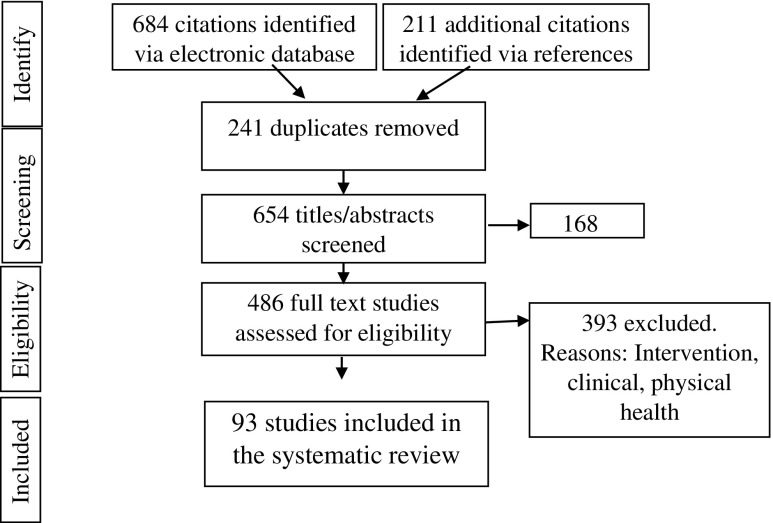
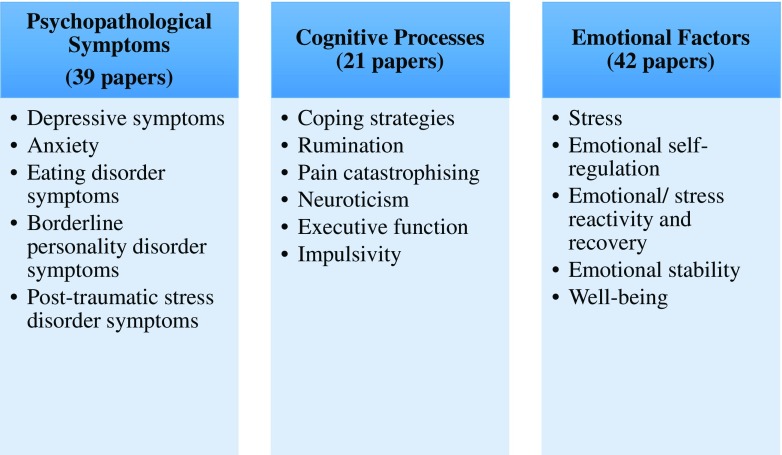
Interest in the influence of dispositional mindfulness (DM) on psychological health has been gathering pace over recent years. Despite this, a systematic review of this topic has not been conducted. A systematic review can benefit the field by identifying the terminology and measures used by researchers and by highlighting methodological weaknesses and empirical gaps. We systematically reviewed non-interventional, quantitative papers on DM and psychological health in non-clinical samples published in English up to June 2016, following the Preferred Reporting Items for Systematic Reviews and Meta-analyses (PRISMA) guidelines. A literature search was conducted using PsycINFO, PubMED, Medline and Embase, and 93 papers met the inclusion criteria. Within these, three main themes emerged, depicting the relationship between DM and psychological health: (1) DM appears to be inversely related to psychopathological symptoms such as depressive symptoms, (2) DM is positively linked to adaptive cognitive processes such as less rumination and pain catastrophizing and (3) DM appears to be associated with better emotional processing and regulation. These themes informed the creation of a taxonomy. We conclude that research has consistently shown a positive relationship between DM and psychological health. Suggestions for future research and conceptual and methodological limitations within the field are discussed.
Overview
CoChat Summary
## TL;DR
This systematic review synthesized 93 quantitative, non-interventional studies on dispositional mindfulness (DM) and psychological health in non-clinical samples published in English up to June 2016. Across the included literature, DM was consistently associated with better psychological health, especially lower psychopathological symptoms, more adaptive cognitive processes, and better emotional processing/regulation.
## Key findings
- The review included 93 papers with a combined 34,620 participants; study sizes ranged from 12 to 5,287 participants.
- 39 studies examined psychopathological symptoms, 21 examined cognitive processes, and 42 examined emotional factors; the authors report that DM was generally linked to better outcomes across all three themes.
- For depressive symptoms, 21 papers focused on depression and all 21 found a negative relationship between DM and depressive symptoms.
- For psychological well-being, 13 papers examined the outcome and all 13 showed positive associations between DM and psychological well-being.
- For stress, the review notes 27 papers focused on stress and found that higher DM was associated with lower perceived stress and emotional distress.
- The most commonly used DM measure was the Mindful Attention Awareness Scale (MAAS), used in 48 papers; the Five Facet Mindfulness Questionnaire (FFMQ) was used in 30 studies.
## Methods
- Systematic review conducted following PRISMA guidelines; included quantitative, non-interventional studies on DM and psychological health in non-clinical samples.
- Searched PsycINFO, PubMED, Medline, and Embase for papers published up to June 2016, with additional backward and forward citation searches.
- Included papers had to be English, empirical, peer-reviewed, and use a validated measure of DM; quality was rated with the Standard Quality Assessment Criteria.
## Limitations
- The paper states that it included only published articles in English, so non-English studies were excluded and may have provided additional cross-cultural evidence.
- The search terms were applied to titles and abstracts only, which may have missed relevant studies not explicitly framed around DM in those fields.
- The text makes evident that the evidence base is limited by heavy reliance on cross-sectional, self-report, and often student/white Caucasian samples; the review itself notes this reduces external validity and that many studies analyzed ordinal Likert data with parametric tests.
Model-written summary. Check it against the paper before relying on it.
Integrity signals
Registry
Cites
Statistics
Figures
Verification
Claims the paper makes
7 Valid · 0 Not valid · 61 Not checked · 63 Own results and interpretations
Every source the paper cites for this claim was checked and supports it.
In the paper
“They found that DM mediates the effects of procrastination on health.”
§ Dispositional Mindfulness and Psychological Health: a Systematic Review > Results > Emergent Themes
What the sources say
- Supportedcites Sirois and Tosti (2012) matched to “Lost in the Moment? An Investigation of Procrastination, Mindfulness, and Well-being” (2012) source
The Abstract (p.1) states that tests of the nested mediation models revealed the effects of procrastination on stress and health were mediated by mindfulness, with bootstrapping confirming significance. The Structural Model section (p.~7) reports the fit-index comparison showing mindfulness also mediated the effects of procrastination on (perceived) health, and the Discussion summarises that low mindfulness 'mediates the association of procrastination to poor perceived health' in a sample of 339 students measured with trait/dispositional mindfulness scales (MAAS, KIMS). The paraphrase matches the source's population, predictor, mediator and outcome. (LLM, conf=0.92)
plainstates a cause- Asserted: passes — The authors put it forward as true.
- Checkable: passes — It can be checked against evidence.
- Load-bearing: unclear — It is unclear whether the paper’s conclusions depend on it.
- Based: passes — The paper gives a reason why it holds.
- Supported
The cited sources support only part of this claim — read each source’s verdict below.
In the paper
“Studies suggest that DM buffers against the negative influence of perceived stress on psychological health (Adams et al. 2015; Bergin and Pakenham 2016; Bränström et al. 2011; Cole et al. 2014; Daubenmier et al. 2014).”
§ Dispositional Mindfulness and Psychological Health: a Systematic Review > Results > Emergent Themes
What the sources say
- Partly supportedcites Adams et al. 2015 matched to “Testing a Moderated Mediation Model of Mindfulness, Psychosocial Stress, and Alcohol Use Among African American Smokers” (2015) sourceExperimental — accuracy not yet measured
Our copy does show a buffering (moderation) effect: the Discussion reports that 'mindfulness significantly moderated the relationship of perceived stress with quantity of alcohol use,' with higher stress predicting greater drinking and more frequent binging 'among participants with low, but not high, mindfulness scores' (Results, Path Analyses; binge interaction only a trend, β = −0.14, p = 0.056; the mindfulness × stress interaction for probable alcohol use disorder was non-significant, β = −0.05, p = 0.44). However, the outcomes buffered were alcohol-use variables in a specific sample of predominantly low-SES African American smokers, not 'psychological health' as the citing sentence generalizes; the paper's only broader mental-health content is background citations to others' work (e.g., Brown & Ryan 2003; McKee et al. 2007) in the Introduction, plus the mediation pathway whereby mindfulness was associated with lower perceived stress. So the moderation point is supported for stress → drinking, while the extension to psychological health and to populations beyond the study sample is not. (LLM, conf=0.72)
- Not checked yetcites Bergin and Pakenham 2016
- Supportedcites Bränström et al. 2011 matched to “The association between dispositional mindfulness, psychological well‐being, and perceived health in a Swedish population‐based sample” (2011) source
The Abstract's Conclusions (p. 1) state almost verbatim that 'Results suggest that dispositional mindfulness might buffer against the negative influence of perceived stress on psychological well-being,' matching the citing sentence's hedged framing ('studies suggest'). The Discussion (p. 9) and Results section 'The effect of mindfulness as a moderator of stress' (p. 6) report significant stress × mindfulness interactions for acting with awareness, non-judging, non-reactivity (and describing) on depression and for non-judging on perceived health, with the buffer appearing chiefly at higher stress levels. Minor qualification: the effect was facet-specific and cross-sectional, and no moderation emerged for anxiety or physical symptoms/other complaints, but the attributed point itself is stated by the source. (LLM, conf=0.85)
hedgedstates a possible cause- Asserted: passes — The authors put it forward as true.
- Checkable: passes — It can be checked against evidence.
- Load-bearing: passes — The paper’s conclusions depend on it.
- Based: passes — The paper gives a reason why it holds.
- Partly supported
Every source the paper cites for this claim was checked and supports it.
In the paper
“Finally, one paper has found that lower coping motives in students mediate the link between mindfulness facets and alcohol use (Vinci et al. 2016).”
§ Dispositional Mindfulness and Psychological Health: a Systematic Review > Results > Emergent Themes
What the sources say
- Supportedcites Vinci et al. 2016 matched to “Drinking motives mediate the relationship between facets of mindfulness and problematic alcohol use” (2016) source
The Abstract reports that, among 207 college students classified as engaging in problematic drinking, lower coping motives significantly mediated the relationships of Acting with Awareness and Nonjudging with lower AUDIT scores. The Discussion likewise identifies coping motives as a significant mediator for those two mindfulness facets. (LLM, conf=0.93)
plainstates a cause- Asserted: passes — The authors put it forward as true.
- Checkable: passes — It can be checked against evidence.
- Load-bearing: unclear — It is unclear whether the paper’s conclusions depend on it.
- Based: passes — The paper gives a reason why it holds.
- Supported
Every source the paper cites for this claim was checked and supports it.
In the paper
“It appears that one of the possible mechanisms through which DM does this is by improving emotional regulation (Coffey and Hartman 2008; de Frias 2014; Feldman et al. 2016; Kadziolka et al. 2016; McDonald et al. 2016; Prakash et al. 2015).”
§ Dispositional Mindfulness and Psychological Health: a Systematic Review > Results > Emergent Themes
What the sources say
- Supportedcites Coffey and Hartman 2008 matched to “Mechanisms of action in the inverse relationship between mindfulness and psychological distress” (2008) source
The Discussion identifies emotion regulation as a mediator between dispositional mindfulness and psychological distress and reports that greater mindfulness was associated with better management of negative emotion. The paper studied depressive and anxious symptoms, so its evidence concerns psychological distress rather than every form of stress. (LLM, conf=0.90)
- Supportedcites de Frias 2014 matched to “Memory Compensation in Older Adults: The Role of Health, Emotion Regulation, and Trait Mindfulness” (2014) source
The Discussion (p. 6) proposes that mindfulness may buffer against stress by lowering rumination and reducing excessive processing of negative information during emotional challenges. The introduction (p. 2) also describes emotion regulation and stress reduction as reported benefits of mindfulness. The claim is a hedged paraphrase of that proposed mechanism, not a claim that this study tested it. (LLM, conf=0.88)
- Supportedcites Feldman et al. 2016 matched to “Dispositional Mindfulness Uncouples Physiological and Emotional Reactivity to a Laboratory Stressor and Emotional Reactivity to Executive Functioning Lapses in Daily Life” (2016) source
The General Discussion reports that people higher in dispositional mindfulness showed less emotional reactivity to stress-related experiences and describes this as more emotionally even responding to stressors. That supports the citing sentence’s cautious proposal that better emotional regulation is a possible way mindfulness buffers stress, although the studies did not directly test a mediating mechanism. (LLM, conf=0.88)
hedgedstates a possible cause- Asserted: passes — The authors put it forward as true.
- Checkable: passes — It can be checked against evidence.
- Load-bearing: passes — The paper’s conclusions depend on it.
- Based: passes — The paper gives a reason why it holds.
- Supported
A result the paper reports from its own data — it cites no other source for it, so there is none to check. The quote shows it is in the paper.
In the paper
“93 papers met the inclusion criteria”
- Also stated in: § Results · plain
“Ninety-three papers, all of which used quantitative methodology, met the eligibility criteria and were included in the systematic review”
§ Dispositional Mindfulness and Psychological Health: a Systematic Review > Abstract
plain- Asserted: passes — The authors put it forward as true.
- Checkable: passes — It can be checked against evidence.
- Load-bearing: unclear — It is unclear whether the paper’s conclusions depend on it.
- Based: passes — The paper gives a reason why it holds.
- Also stated in: § Results · plain
71 more claims
Create a free account to see all 131 claims and to verify the 77 references still open.
- It may state two separate claims as one. 28
- Probably not a substantial claim. 35
Claims other papers make about this one
Each is checked against this paper’s own text: does it say what the citing paper says it does?
The source backs part of the claim, not all of it — or backs it for a different population, condition or comparison.
In the citing paper
“Further, the strong relationship between dispositional mindfulness and physical health is related to stress.”
From What is the mindful personality? Implications for physical and psychological health (2022) · cites this paper as Tomlinson et al., 2018
Experimental — accuracy not yet measuredThe source backs part of the claim, not all of it — or backs it for a different population, condition or comparison.
In the citing paper
“Dispositional mindfulness has protective effects against psychological distress (Tomlinson et al., 2018).”
From Does the practice of mindfulness reduce somatic symptoms and COVID-19-related anxiety? A community-based survey (2022) · cites this paper as Tomlinson et al., 2018
Experimental — accuracy not yet measuredThe source backs part of the claim, not all of it — or backs it for a different population, condition or comparison.
In the citing paper
“In fact, a longer experience in meditation is associated with higher levels of dispositional mindfulness (Josefsson et al., 2011; Tomlinson et al., 2018)”
From Does the practice of mindfulness reduce somatic symptoms and COVID-19-related anxiety? A community-based survey (2022) · cites this paper as Tomlinson et al., 2018
Experimental — accuracy not yet measuredThe cited source says what the claim attributes to it.
In the citing paper
“Over the years, research has demonstrated that trait mindfulness is associated with psychological health outcomes, such as lower levels of stress, anxiety and depression (for review see, Tomlinson et al., 2018).”
From The association between facets of mindfulness and COVID-19 related distress: A cross-sectional study (2023) · cites this paper as Tomlinson et al., 2018
The cited source says what the claim attributes to it.
In the citing paper
“A systematic review on mindfulness and psychological health revealed that trait mindfulness was negatively related to psychopathology symptoms (i.e., depression and anxiety) and positively related to adaptive functioning (Tomlinson et al., 2018).”
From Examining the Prospective Associations Between Mindfulness Facets and Substance Use in Emerging Adulthood. (2021) · cites this paper as Tomlinson et al., 2018
4 more claims about this paper
Create a free account to see every claim other papers make about this one.
Citations
Cites
Preferred Reporting Items for Systematic Reviews and Meta-Analyses: the PRISMA statement
Moher, D., Liberati, A., Tetzlaff, J., Altman, D. G., & for the PRISMA Group (2009) · BMJ · doi:10.1136/bmj.b2535 · Cited by 83,823
The CES-D Scale: A Self-Report Depression Scale for Research in the General Population
Radloff, L. S. (1977) · Applied Psychological Measurement · doi:10.1177/014662167700100306 · Cited by 53,267
Preferred reporting items for systematic reviews and meta-analyses: the PRISMA Statement.
(2009) · PubMed Central · Cited by 44,859
Development and validation of brief measures of positive and negative affect: The PANAS scales.
Watson, D., Clark, L. A., & Tellegen, A. (1988) · Journal of Personality and Social Psychology · doi:10.1037/0022-3514.54.6.1063 · Cited by 32,433 · cited 2×
“The positive and negative subscales are internally consistent (Cronbach’s alpha for negative affect = .084–0.87 and positive affect = .86–.90) with good test-retest reliability of r = .48 and .42 for positive and negative affect, respectively (Watson et al. 1988).”
BackgroundMethodInfluentialPreferred Reporting Items for Systematic Reviews and Meta-Analyses: The PRISMA Statement
Moher, D., Liberati, A., Tetzlaff, J., & Altman, D. G. (2009) · Journal of Clinical Epidemiology · doi:10.1016/j.jclinepi.2009.06.005 · Cited by 19,575
(2017) · Cited by 16,319
Lovibond, P. F., & Lovibond, S. H. (1995) · Behaviour Research and Therapy · doi:10.1016/0005-7967(94)00075-u · Cited by 14,523 · cited 1×
“The Depression, Anxiety and Stress Scale (DASS-21; Lovibond and Lovibond 1995) was frequently used within the papers.”
MethodThe benefits of being present: Mindfulness and its role in psychological well-being
Brown, K. W., & Ryan, R. M. (2003) · Journal of Personality and Social Psychology · doi:10.1037/0022-3514.84.4.822 · Cited by 13,448 · cited 8×
“The MAAS measures mindfulness as a single construct.”
BackgroundMethodInfluentialUsing Self-Report Assessment Methods to Explore Facets of Mindfulness
Baer, R. A., Smith, G. T., Hopkins, J., Krietemeyer, J., & Toney, L. (2006) · Assessment · doi:10.1177/1073191105283504 · Cited by 7,511 · cited 6×
“Despite promoting the use of multi-faceted DM measures such as the FFMQ, it has been argued that the factor structure of this measure may need to be re-evaluated first (Baer et al. 2006; Petrocchi and Ottaviani 2016).”
BackgroundMethodInfluential(2008) · Medical Entomology and Zoology · Cited by 7,477
Cited by
Items 501–561 of 561
Magalhães, S., Rasteiro, I., Soeiro, I., Carvalheiras, C., Castro, S. L., Leal, T., & Limpo, T. (2025) · Current Psychology · doi:10.1007/s12144-025-08088-0 · Cited by 1
Dispositional Mindfulness and University Adjustment: The Mediating Role of Coping Self-Efficacy
Kiafar, A., Petrovic, J., Mettler, J., Joly, M., Böke, B. N., & Heath, N. L. (2025) · Psychological Reports · doi:10.1177/00332941251370252
Cerrahi Hastalarında Bilinçli Farkındalık Uygulamalarının Perioperatif Süreçteki Etkileri
Yalçın, C., Muslu, İ. E., & Ongün, P. (2025) · Balıkesir Medical Journal · doi:10.33716/bmedj.1745918 · Cited by 1
Wenli, S., Chong, Z. Y., & Xu, W. (2025) · The Journal of Psychology · doi:10.1080/00223980.2025.2557878 · Cited by 1
“Results indicated that, consistent with previous studies (Tomlinson et al., 2018; Tsai et al., 2024), dispositional mindfulness at T1 negatively predicted mental health problems (depression, anxiety and stress) at T3.”
InfluentialExperiential Mindfulness Meditation and the Experimental Method
Leyland, A., & Berry, L. M. (2025) · Springer eBooks · doi:10.1007/978-3-031-91451-5_15
Contributions of Mindfulness to the Treatment of Anxiety
Papenfuss, I., & Ostafin, B. D. (2025) · Springer eBooks · doi:10.1007/978-3-031-91451-5_16
Sattler, F. A. (2025) · Cogent Psychology · doi:10.1080/23311908.2025.2561436 · Cited by 1
“…a risk factor for diminished DM, which in turn contributes to depressive symptoms, consistent with prior research in the general population (tomlinson et al., 2018). the full mediation by DM indicates that enhancing mindfulness may buffer or even eliminate the negative impact of ih on…”
Powers, A. D., Lipschutz, R. S., Lathan, E. C., Mekawi, Y., Dixon, H. D., Bradley, B., Kaslow, N. J., & Nugent, N. R. (2025) · Mindfulness · doi:10.1007/s12671-025-02693-7 · Cited by 2
Mindfulness in trauma recovery: applications, insights, and future directions
Chopko, B. A., Mantzios, M., Papazoglou, K., & Adams, R. E. (2025) · Frontiers in Psychology · doi:10.3389/fpsyg.2025.1700047
“…health, studies have suggested that people often are mindful as a consequence of their socialization or experiences with others (i.e., dispositional mindfulness), but that people can also be trained in mindfulness techniques (Chopko et al., 2018; Tang et al., 2019; Tomlinson et al., 2018).”
Mindfulness in Tourist Experiences and Behaviors
Wang, Y. (2025) · Elsevier eBooks · doi:10.1016/b978-0-443-27698-9.00020-9
Dillard, A. J., Meier, B. P., Williams, T. J., Wolfe, M. B. W., & Thakur, M. (2025) · European Journal of Health Psychology · doi:10.1027/2512-8442/a000189
Wenli, S., Chong, Z. Y., Zhang, C., & Xu, W. (2025) · Current Psychology · doi:10.1007/s12144-025-08865-x
de Sousa, G. M., Lima-Araújo, G. L. D., Araújo, D. B. D., & de Sousa, M. B. C. (2021) · Figshare · doi:10.6084/m9.figshare.13684528
de Sousa, G. M., Lima-Araújo, G. L. D., Araújo, D. B. D., & de Sousa, M. B. C. (2021) · Figshare · doi:10.6084/m9.figshare.13684534
Galluzzi, S., Lanfredi, M., Moretti, D. V., Rossi, R., Meloni, S., Tomasoni, E., Frisoni, G. B., Chiesa, A., & Pievani, M. (2024) · Figshare · doi:10.6084/m9.figshare.25217338
de Sousa, G. M., Lima-Araújo, G. L. D., Araújo, D. B. D., & de Sousa, M. B. C. (2021) · Figshare · doi:10.6084/m9.figshare.13684531
Galluzzi, S., Lanfredi, M., Moretti, D. V., Rossi, R., Meloni, S., Tomasoni, E., Frisoni, G. B., Chiesa, A., & Pievani, M. (2024) · Figshare · doi:10.6084/m9.figshare.25216797
Mascarenhas, M. A., Segal, Z. V., Brown, T. D., & Zakzanis, K. K. (2025) · Neuropsychological Rehabilitation · doi:10.1080/09602011.2025.2607149
“…between DM and depression and anxiety, the former of which mirrors findings from Krzeczkowski et al. (2017), who observed this relationship in a sample of students who reported a previous head injury, and findings in other clinical populations (Pleman et al., 2019; Tomlinson et al., 2018).”
Tiek, L. K., & Chin, Y. W. (2026) · Emerald Group Publishing Limited eBooks · doi:10.1108/978-1-80592-717-420261009
Cho, Y. I., Kim, H. J., & Kim, D. H. (2026) · SAGE Open · doi:10.1177/21582440251414281 · Cited by 1
“Mindfulness is a cognitive ability, commonly defined as an awareness of and a non-judgmental attitude toward present-moment experiences (Tomlinson et al., 2018; Van Dam et al., 2018).”
Virrey, E. M. F. G., & Lozano, N. L. (2025) · Journal of Learning and Educational Policy · doi:10.55529/jlep.52.21.31
Importance of Maternal Empowerment During Pregnancy in Enhancing Postpartum Psychological Well-Being
Dossen, P. C., & Hong, S.-Y. (2026) · Marriage & Family Review · doi:10.1080/01494929.2026.2616525 · Cited by 2
Benítez-Agudelo, J. C., Navarro-Jiménez, E., & Clemente‐Suárez, V. J. (2026) · Frontiers in Psychology · doi:10.3389/fpsyg.2026.1704398
“Dispositional or trait mindfulness refers to a relatively stable tendency to maintain awareness and attention to present-moment experience in daily life, reflecting an enduring psychological characteristic (Tomlinson et al., 2018).”
Malboeuf‐Hurtubise, C., Taylor, G., Léger‐Goodes, T., Fry, Z. D., Fitzpatrick, C., & Smith, J. (2026) · Discover Mental Health · doi:10.21203/rs.3.rs-8502428/v1 · Cited by 1
Wang, W., Zhou, Y., Qin, Y., Luo, Q., Xi, F., Wu, X., & Liao, X. (2026) · Mindfulness · doi:10.1007/s12671-026-02805-x
“behaviors (Birnie et al., 2010; Donald et al., 2019; Goldin et al., 2017; Tomlinson et al., 2018), traditional research has focused predominantly on its intrapersonal aspects (Hayes et al., 1999; Wallace, 2001).”
Mróz, F., Roszak, P., & Krogmann, A. (2026) · Journal of Religion and Health · doi:10.1007/s10943-026-02623-4
“Research has demonstrated that the practice of mindfulness reduces symptoms of psychopathology and promotes well-being (Feliu-Soler et al., 2024; Tomlinson, et al., 2018).”
Donofry, S. D., Dämon, S., Jouppi, R. J., Davis, J. A., Kolko, R. P., Call, C. C., & Levine, M. D. (2026) · Appetite · doi:10.1016/j.appet.2026.108545 · Cited by 2
Goswami, M. (2026) · Emerald Group Publishing Limited eBooks · doi:10.1108/978-1-83708-156-120261005
Mesure de la conscience du corps et de l'impact sur la cognition de l'information corporelle
Verdonk, C. (2021) · theses.fr (ABES) · doi:10.70675/abc55e86zddc9z4a4ezaba1z2cc93cac3fb9 · Cited by 1
Corman, M. (2020) · theses.fr (ABES) · doi:10.70675/74a76275z07abz47d6zb249z4ba89cead767
Zhou, X.-N., Liu, J.-L., Guo, J.-H., Ge, Q.-Q., Zhong, S.-Y., & Jiang, C.-L. (2026) · Anxiety Stress & Coping · doi:10.1080/10615806.2026.2655786
“Previous research demonstrated that perceived stress directly influences individuals’ overall perception of well-being and their ability to experience positive emotions (Tomlinson et al., 2018).”
Evertz, L., Klingenberg, I., & Schwinges-Hess, L. (2026) · Mindfulness · doi:10.1007/s12671-026-02813-x
“In Western cultures, mindfulness is practiced as a spiritual exercise within Buddhism, but may be more commonly as a secular training to improve mental functioning and reduce stress (Jayawardene et al., 2017; Sha-piro et al., 2006; Tomlinson et al., 2018).”
The prospective association between mindfulness and flourishing in mid-to-late life
Chen, Y., Kim, E. S., Nakamura, J. S., Lomas, T., & VanderWeele, T. J. (2026) · Aging & Mental Health · doi:10.1080/13607863.2026.2664080 · Cited by 1
“In addition, recent reviews of observational studies also found that trait mindfulness was associated with better emotional and psychological health (Tomlinson et al., 2018), and greater interpersonal relationship quality (McGill et al., 2016).”
Holopainen, M., Hintsanen, M., Lahti, J. M. T., Vahlberg, T., & Volanen, S. (2026) · Journal of Positive Behavior Interventions · doi:10.1177/10983007261435187
Sheikh, M. A. (2026) · Journal of Psychiatric Practice · doi:10.1097/pra.0000000000000926
Trait mindfulness is negatively related to physical health symptoms over time
Dillard, A. J., Frobish, D., Hanna, M., Korol, J., Lappas, C. M., & Meier, B. P. (2026) · Psychology and Health · doi:10.1080/08870446.2026.2668116
Guo, M., Zhang, X., Liu, A., Wang, P., Gu, L., Zhang, S., Jia, O., & Kirby, J. N. (2026) · Mindfulness · doi:10.1007/s12671-026-02859-x
“These are all factors that enhance psychological health (Tomlinson et al., 2018).”
Mindfulness in teaching as a mediator between higher education teachers’ teaching and well-being
Parpala, A., Nokelainen, P., Räisänen, M., Kosenkranius, M., Puhakka, I., & Postareff, L. (2026) · Discover Psychology · doi:10.1007/s44202-026-00726-3 · Cited by 1
“In relation to burnout, mindfulness has been found to reduce emotional exhaustion and improve stress management [43, 66, 78, 97, 101], with several studies confirming its mediating role in burnout [65, 69].”
Cook, S. H., Wood, E., Rodrigues, M., Delorme, M., Tatar, R. G., Goldberg, S. B., Javdani, S., & Godfrey, E. (2026) · Mindfulness · doi:10.1007/s12671-026-02874-y
Promoting Nature Connectedness: Insights into the Roles of Mindfulness and Nonattachment
Ergüler, H., & Simione, L. (2026) · Sustainability · doi:10.3390/su18115352
Zhang, Y., Fei, W., Zhou, X., Chen, Y., Yan, Y., Zhou, X., & Zhou, J. (2026) · Acta Psychologica · doi:10.1016/j.actpsy.2026.107172
Connection to Nature and Psychological Wellbeing: The Role of Mindfulness and Spirituality
Kazemi, S., Torquati, J., & Huynh, T. (2026) · International Journal of Environmental Research and Public Health · doi:10.3390/ijerph23060725
“While mindfulness and spirituality have been independently linked to connection to nature [12–14] and to psychological wellbeing [15,16], their role as explanatory pathways remain largely unexamined—a gap the current study aims to bridge.”
Waclawek, T., Monette, G. A., & Schütz, A. (2026) · Communications Psychology · doi:10.1038/s44271-026-00483-y
Sánchez‐Cardona, I., Pérez, Y. A., Cepeda-Hernández, S., Rivera, C. R., Rivera, J., Cintrón, J. F., Adames, C., & Sánchez-Cesáreo, M. (2026) · Journal of Evidence-Based Social Work · doi:10.1080/26408066.2026.2685132
Psychotherapy Approaches and Behavioral Modification Strategies
Royuela-Colomer, E., Navarrete, J., Sanabria‐Mazo, J. P., Neblett, R., & Luciano, J. V. (2026) · Springer eBooks · doi:10.1007/978-3-032-21675-5_32
Zhang, F., Soysa, C. K., & Parmley, M. (2026) · Current Psychology · doi:10.1007/s12144-026-09673-7
Široká, K., Antalová, A., & Čechová, D. (2026) · Current Psychology · doi:10.1007/s12144-026-09641-1
Trait mindfulness influences self-reported mental health in individuals with depression
de Sousa, G. M., de Lima-Araujo, G. L., Tavares, V. D. D. O., Campanelli, S. E., Barros, M. L. D. M., Varela, Y. M., Gonçalves, K. T. D. C., Arcoverde-Nunes, E., Schuch, F. B., Hallak, J. E. C., et al. (2026) · Current Psychology · doi:10.1007/s12144-026-09635-z
Burzler, M. A., Grund, S., & Tran, U. S. (2026) · Mindfulness · doi:10.1007/s12671-026-02946-z
Associations of Mindful Partnering With Mental and Relational Health
Rigsby, B. A., Dunlop, H. C., Brown, S. M., Faw, M. H., & Lucas‐Thompson, R. G. (2026) · Journal of Marital and Family Therapy · doi:10.1111/jmft.70158
Spirituality as a coping resource: Towards integration into mental health framework
Nepali, S. (2026) · PLOS mental health. · doi:10.1371/journal.pmen.0000667
“Mindfulness further supports this process by fostering present-moment awareness and a non-judgmental stance toward thoughts and emotions, allowing individuals to observe internal experiences without excessive reactivity [49].”
Jiang, S., Liu, D., Ahemaitijiang, N., & Cheung, R. Y. M. (2026) · Springer eBooks · doi:10.1007/978-3-030-90465-4_144-1
Yupanqui-Lorenzo, D. E., Diaz-Leon, I., Palao-Loayza, L., Reyes-Bossio, M. A., Carbajal‐León, C., Cárcamo-Zepeda, E., Lobos-Rivera, M. E., & Hernández, M. D. L. C. (2026) · European Journal of Mental Health · doi:10.5708/ejmh.21.2026.0059
Holas, P., & Roczon, P. (2026) · Research Square · doi:10.21203/rs.3.rs-10562583/v1
Heldal, R., Skredsvig, M., Hoff, F. G. D., & Vøllestad, J. (2026) · Mindfulness · doi:10.1007/s12671-026-02964-x
Cheung, R. Y. M., & Tamang, S. (2026) · Mindfulness · doi:10.1007/s12671-026-02963-y
Mindful Buying: Unpacking the Cognitive Mechanisms Behind Intentional Consumption
Sharma, R., Sachdeva, T., & Sharma, A. (2026) · Emerald Group Publishing Limited eBooks · doi:10.1108/978-1-80686-859-920261014
Relationship between mindfulness and student engagement among university students
Abdelrahman, R. M., الدواش, ف. م., & Ali, R. M. A. (2026) · Social Sciences & Humanities Open · doi:10.1016/j.ssaho.2026.103502
Mouatassim, S., Callahan, S., & Chassagne, J. F. (2026) · Personality and Individual Differences · doi:10.1016/j.paid.2026.114083
Moy, J., Takács, Z. K., & Goodall, K. (2026) · Research Square · doi:10.21203/rs.3.rs-10666197/v1
What are the transdiagnostic components associated with diverse symptoms of psychological distress?
Mansell, W., Tindall, I. K., Wheeler, A. R., Morris, L., & Preece, D. (2026) · Journal of Affective Disorders · doi:10.1016/j.jad.2026.122583
Metadata
- Authors
- Tomlinson, E. R., Yousaf, O., Vittersø, A. D., & Jones, L.
- Affiliations
- University of Bath (GB)
- Corresponding author
- Yousaf, Omar
- Venue
- Mindfulness
- Published
- 2017-07-01
- Volume
- 9
- Issue
- 1
- Pages
- 23-43
- ISSN
- 1868-8527 (ISSN-L)
- 1868-8535
- PMC
- PMC5770488
- OpenAlex
- W2672899517
- Cited by
- 560
- References
- 125
- Citations by year
- 2026: 49 · 2025: 72 · 2024: 85 · 2023: 82 · 2022: 87 · 2021: 75 · 2020: 58 · 2019: 40 · 2018: 9
- FWCI
- 4.47
- Type
- journal article
- Language
- en
- Open access
- hybrid
- doi.org
- Locations
- Mindfulness (publishedVersion, cc-by)
- Europe PMC (PubMed Central) (publishedVersion, cc-by)
- PubMed Central (publishedVersion, cc-by)
- PubMed (publishedVersion)
- The University of Bath Online Publications Store (The University of Bath) (submittedVersion, cc-by)
- Research Space (submittedVersion)
- Pure (University of Bath) (submittedVersion, cc-by)
- Funders
- University of Bath
- Topics
- Social Sciences › Psychology › Clinical Psychology › Mindfulness and Compassion Interventions
- Social Sciences › Psychology › Social Psychology › Psychological Well-being and Life Satisfaction
- Social Sciences › Health › Religion, Spirituality, and Psychology
- Keywords
- trait mindfulness, mental health, depressive symptoms, rumination, pain catastrophizing, emotion regulation, emotional processing, psychopathology, non-clinical sample, mindfulness measurement
About these checks
Registry, retraction, Cites and statistics results are computed, not judged, with one exception: a printed reference that no index lists is read once by a model before it counts as a citation error. Claims are extracted by a model and kept only when their quote appears verbatim in the text; each cited source is then checked, with a model’s help, for whether it says what the claim relies on. Those verdicts can be wrong — read the claim’s quote and the cited source before relying on one.
The claim verdicts this report counts are experimental: their accuracy is not yet measured.
A language model drew the claims from the paper on 2026-10-11, under version 3 of the claim definition (model deepseek-v4.1-flash, prompt extract-v3).
A second model labelled each claim on 2026-10-11 (model jev-1.13-20260917, definition revision gold-guideline-v0.2).
Cited sources are checked with a language model’s help (qwen3.8-omni-flash and gpt-6-sol).
Statistics and arithmetic are recomputed, not judged.
Confidence bands are shown only for fields calibrated on our annotated test set. None is calibrated yet, so no band is shown.
What counts as a claim ›How we measure confidence ›How we check this ›
Are you an author, or do you see a problem with this page? Request a review
Data sources
Bibliographic data: Semantic Scholar, OpenAlex, Crossref.
Contains information from the Semantic Scholar Academic Graph Datasets, made available under the ODC Attribution License (ODC-BY 1.0).
Semantic Scholar’s data is described in: Kinney, R., et al. (2023). The Semantic Scholar Open Data Platform. arXiv:2301.10140.
