

The DOI matches its Crossref record; 62 of the 64 references it cites were found in a registry or an index; none of the 61 sources its claims cite is checked for support yet.
Agile science: creating useful products for behavior change in the real world
Open accessAbstract
Evidence-based practice is important for behavioral interventions but there is debate on how best to support real-world behavior change. The purpose of this paper is to define products and a preliminary process for efficiently and adaptively creating and curating a knowledge base for behavior change for real-world implementation. We look to evidence-based practice suggestions and draw parallels to software development. We argue to target three products: (1) the smallest, meaningful, self-contained, and repurposable behavior change modules of an intervention; (2) "computational models" that define the interaction between modules, individuals, and context; and (3) "personalization" algorithms, which are decision rules for intervention adaptation. The "agile science" process includes a generation phase whereby contender operational definitions and constructs of the three products are created and assessed for feasibility and an evaluation phase, whereby effect size estimates/casual inferences are created. The process emphasizes early-and-often sharing. If correct, agile science could enable a more robust knowledge base for behavior change.
Overview
AI snapshot
Written from the paper’s full text.
TL;DR
The paper proposes “agile science” as a process and three product types—behavior change modules, computational behavioral models, and personalization algorithms—for creating and curating real-world behavior change interventions. It argues for early-and-often sharing of operations, constructs, and failed tests, drawing parallels to agile software development and optimization methods, but presents a first-draft conceptual process rather than empirical validation.
Key findings
- Defines three target products: behavior change modules (smallest, meaningful, self-contained, repurposable; structured as inputs, processes, outputs), computational behavioral models (mathematically specified theories including dynamics and threshold conditions), and personalization algorithms (decision rules for selecting interventions for a person/unit at a time and context).
- Argues that sharing operations and constructs early and often—prior to effect size estimation—could reduce “reinventing the wheel,” facilitate specialization, and enable more robust tests of external validity across populations, treatments, outcomes, and settings.
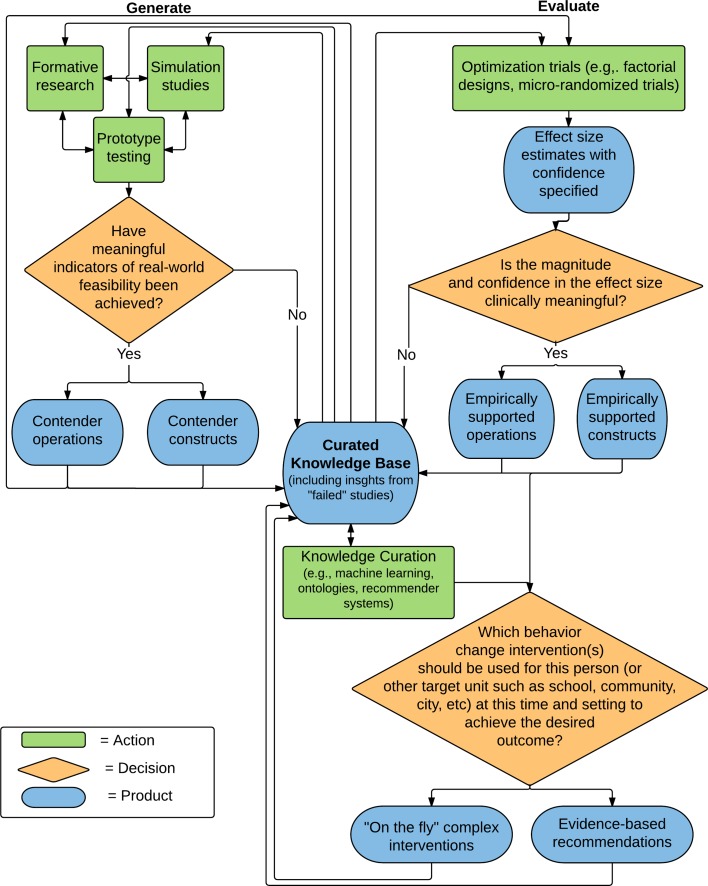
- Outlines agile science process v0.1 with two iterative phases: a generate phase (formative work, simulation studies, prototype testing; feasibility criteria from Bowen et al.) and an evaluate phase (effect size estimates/causal inferences using optimization methods such as MOST, SMART, and micro-randomized trials).
- Describes ongoing complementary physical activity projects as a case study: developing “ambitious but doable” step goals, context-relevant cues and daily planning modules, and a Paco-based system for rapid creation and sharing of behavior change modules.
Methods
- Conceptual/position paper; no empirical sample, primary data, or original quantitative results are reported.
- Draws on evidence-based practice literature, optimization methods (MOST, SMART, micro-randomized trials), and analogies to agile software development, open-source software, APIs, and lean start-up methods.
- Proposes a first-draft agile science process (v0.1) and illustrates it with ongoing, descriptive case-study projects focused on physical activity.
Limitations
- The paper states that future work is needed on the generate phase, resource-efficient experimental designs and statistics, cognitive biases (e.g., sunk cost), and academic incentives for early-and-often sharing; curation strategies are not fully articulated.
- The paper labels the process as first draft (v0.1) and generate-phase products as “contender” rather than evidence-based; no empirical validation of the agile science process is reported.
- Evident from the text: the case study is ongoing and descriptive, and the paper provides no original effect sizes or formal evaluation of the proposed products/process.
Model-written summary. Check it against the paper before relying on it.
Integrity signals
Registry
Cites
Statistics
Figures
Verification
Claims the paper makes
49 Own interpretation · 48 Not checked yet · 12 No basis given
In the paper
“MOST establishes a process for continuous optimization of behavior change interventions by iteratively evaluating the efficacy of intervention components.”
§ Agile science: creating useful products for behavior change in the real world > EVIDENCE-BASED PRACTICE
What the sources say
- Not checked yetcites [14] Collins LM, Baker TB, Mermelstein RJ, et al. The multiphase optimization strategy for engineering effective tobacco use interventions. Ann Behav Med. 2011; 41: 208–226. source
plaindirect- Asserted: passes — The authors put it forward as true.
- Checkable: passes — It can be checked against evidence.
- Load-bearing: passes — The paper’s conclusions depend on it.
- Based: passes — The paper gives a reason why it holds.
In the paper
“As implied by behavioral ecological models (e.g., [8]), individual and contextual differences (e.g., when, where, for whom, in what state of the person) can moderate when a behavioral intervention will produce its targeted effect [9].”
§ Agile science: creating useful products for behavior change in the real world > EVIDENCE-BASED PRACTICE
What the sources say
- Not checked yetcites [9] Rothman AJ. Exploring connections between moderators and mediators: commentary on subgroup analyses in intervention research. Prev Sci. 2013; 14: 189–192. source
plainconditional- Asserted: passes — The authors put it forward as true.
- Checkable: passes — It can be checked against evidence.
- Load-bearing: passes — The paper’s conclusions depend on it.
- Based: passes — The paper gives a reason why it holds.
None of the sources cited for this claim have been checked yet.
In the paper
“To complicate things further, behavior change interventions have multiple criteria for success for real-world use such as being effective, usable, desirable to the target group, and safe [5, 10].”
§ Agile science: creating useful products for behavior change in the real world > EVIDENCE-BASED PRACTICE
What the sources say
- Not checked yetcites [5] Craig P, Dieppe P, Macintyre S, et al. Developing and evaluating complex interventions: the new medical research council guidance. Int J Nurs Stud. 2013; 50: 587–592. source
- Not checked yetcites [10] Bowen DJ, Kreuter M, Spring B, et al. How we design feasibility studies. Am J Prev Med. 2009; 36: 452–457. source
plain- Asserted: passes — The authors put it forward as true.
- Checkable: passes — It can be checked against evidence.
- Load-bearing: passes — The paper’s conclusions depend on it.
- Based: passes — The paper gives a reason why it holds.
In the paper
“For example, the factorial/fractional factorial design provides a resource-efficient way of examining main effects of each intervention component within an intervention and the interaction effects among components [15].”
§ Agile science: creating useful products for behavior change in the real world > EVIDENCE-BASED PRACTICE
What the sources say
- Not checked yetcites [15] Collins LM, Murphy SA, Strecher V. The multiphase optimization strategy (MOST) and the sequential multiple assignment randomized trial (SMART): new methods for more potent eHealth interventions. Am J Prev Med. 2007; 32: S112–S118. source
plaindirect- Asserted: passes — The authors put it forward as true.
- Checkable: passes — It can be checked against evidence.
- Load-bearing: unclear — It is unclear whether the paper’s conclusions depend on it.
- Based: passes — The paper gives a reason why it holds.
In the paper
“Further, when developing interventions delivered via digital technologies, there is an added issue that the technologies are often mutating at a faster rate than the scientific process [3].”
§ Agile science: creating useful products for behavior change in the real world > EVIDENCE-BASED PRACTICE
What the sources say
- Not checked yetcites [3] Riley WT, Glasgow RE, Etheredge L, Abernethy AP. Rapid, responsive, relevant (R3) research: a call for a rapid learning health research enterprise. Clin Translat Med. 2013; 2: 1–6. source
plaincorrelational- Asserted: passes — The authors put it forward as true.
- Checkable: passes — It can be checked against evidence.
- Load-bearing: passes — The paper’s conclusions depend on it.
- Based: passes — The paper gives a reason why it holds.
A conclusion the paper draws from its own results — it cites no other source for it, so there is none to check. The quote shows it is in the paper.
In the paper
“As more features are added, the module becomes increasingly idiosyncratic to the specific use case.”
§ Agile science: creating useful products for behavior change in the real world > AGILE SCIENCE PRODUCT TYPES FOR BEHAVIORAL INTERVENTIONS
plaindirect- Asserted: passes — The authors put it forward as true.
- Checkable: passes — It can be checked against evidence.
- Load-bearing: passes — The paper’s conclusions depend on it.
- Based: passes — The paper gives a reason why it holds.
In the paper
“The sequential multiple assignment randomized trial (SMART) is a methodology that can test the decision rules within an adaptive intervention, when, for instance, there are non-responders to an initial intervention [15].”
§ Agile science: creating useful products for behavior change in the real world > EVIDENCE-BASED PRACTICE
What the sources say
- Not checked yetcites [15] Collins LM, Murphy SA, Strecher V. The multiphase optimization strategy (MOST) and the sequential multiple assignment randomized trial (SMART): new methods for more potent eHealth interventions. Am J Prev Med. 2007; 32: S112–S118. source
plain- Asserted: passes — The authors put it forward as true.
- Checkable: passes — It can be checked against evidence.
- Load-bearing: unclear — It is unclear whether the paper’s conclusions depend on it.
- Based: passes — The paper gives a reason why it holds.
In the paper
“Within HCI, there is an emphasis on novel technology tools and artifacts, not necessarily reliable effect size estimates/causal inferences [47].”
§ Agile science: creating useful products for behavior change in the real world > AGILE SCIENCE PRODUCT TYPES FOR BEHAVIORAL INTERVENTIONS > Agile science process
What the sources say
- Not checked yetcites [47] Kaye M, Nelson GL, Hekler EB. Researcher-centered design of statistics: why Bayesian statistics better fit the culture and incentives of HCI. Proceedings of SIGCHI Conference on Human Factors in Computing Systems (CHI’16). San Jose, CA: ACM; 2016. source
plain- Asserted: passes — The authors put it forward as true.
- Checkable: passes — It can be checked against evidence.
- Load-bearing: passes — The paper’s conclusions depend on it.
- Based: passes — The paper gives a reason why it holds.
In the paper
“To create these modules, XP uses software “sprints” to create a “minimal viable product” (MVP) that is released to target users [23].”
§ Agile science: creating useful products for behavior change in the real world > EVIDENCE-BASED PRACTICE > Agile software development
What the sources say
- Not checked yetcites [23] Abrahamsson P, Warsta J, Siponen MT, Ronkainen J. New directions on agile methods: a comparative analysis. Proceedings of the International Conference on Software Engineering, 2003.
plaindirect- Asserted: passes — The authors put it forward as true.
- Checkable: passes — It can be checked against evidence.
- Load-bearing: passes — The paper’s conclusions depend on it.
- Based: passes — The paper gives a reason why it holds.
A conclusion the paper draws from its own results — it cites no other source for it, so there is none to check. The quote shows it is in the paper.
In the paper
“As the Dropbox example illustrates, formative research methods, simulation studies, and prototype testing can examine feasibility prior to development of final operations, let alone constructs, or causal inferences.”
§ Agile science: creating useful products for behavior change in the real world > AGILE SCIENCE PRODUCT TYPES FOR BEHAVIORAL INTERVENTIONS > Agile science process
plainconditional- Asserted: passes — The authors put it forward as true.
- Checkable: passes — It can be checked against evidence.
- Load-bearing: passes — The paper’s conclusions depend on it.
- Based: passes — The paper gives a reason why it holds.
- Probably not a substantial claim. 64
- It may state two separate claims as one. 32
The paper states this without a source or data behind it here, so there is nothing to check it against. The quote shows it is in the paper.
In the paper
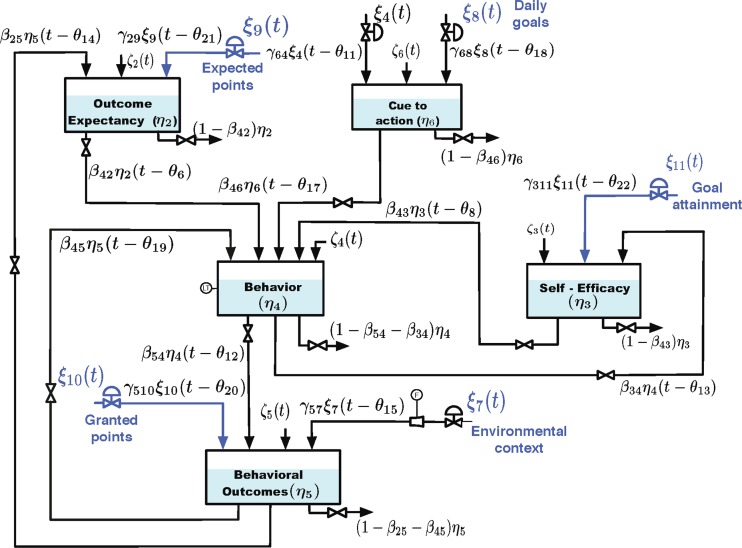
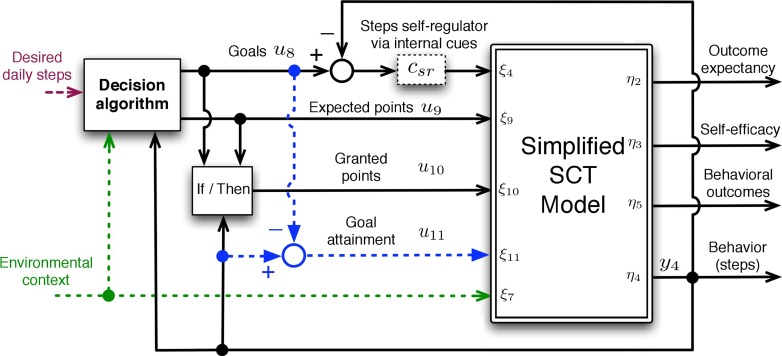
“For example, in the Fig. 1 dynamical model, the team has conducted a series of simulations to explore different ways of defining an “ambitious but doable” goal based on interactions between the variables in the model.”
§ Agile science: creating useful products for behavior change in the real world > AGILE SCIENCE PRODUCT TYPES FOR BEHAVIORAL INTERVENTIONS > Agile science process
plain- Asserted: passes — The authors put it forward as true.
- Checkable: passes — It can be checked against evidence.
- Load-bearing: fails — The paper’s conclusions may not depend on it.
- Based: passes — The paper gives a reason why it holds.
Probably not a substantial claim. The paper’s conclusions may not depend on it.
The paper states this without a source or data behind it here, so there is nothing to check it against. The quote shows it is in the paper.
In the paper
“As our ongoing suite of complementary projects illustrate, we are actively working toward testing the assumptions outlined.”
§ Agile science: creating useful products for behavior change in the real world > SUMMARY
plain- Asserted: passes — The authors put it forward as true.
- Checkable: fails — It may be too vague to check against evidence.
- Load-bearing: fails — The paper’s conclusions may not depend on it.
- Based: fails — The paper may give no reason why it holds.
Probably not a substantial claim. It may be too vague to check against evidence. The paper’s conclusions may not depend on it. The paper may give no reason why it holds.
The paper states this without a source or data behind it here, so there is nothing to check it against. The quote shows it is in the paper.
In the paper
“Multiple complementary research projects are underway that each focus on developing a different module for a complex intervention for physical activity.”
§ Agile science: creating useful products for behavior change in the real world > AGILE SCIENCE PRODUCT TYPES FOR BEHAVIORAL INTERVENTIONS > Ongoing case study of agile science
plain- Asserted: passes — The authors put it forward as true.
- Checkable: passes — It can be checked against evidence.
- Load-bearing: fails — The paper’s conclusions may not depend on it.
- Based: passes — The paper gives a reason why it holds.
Probably not a substantial claim. The paper’s conclusions may not depend on it.
The paper states this without a source or data behind it here, so there is nothing to check it against. The quote shows it is in the paper.
In the paper
“A third complementary project is focused on the development of a tool that can support the rapid creation and early-and-often sharing of behavior change modules.”
§ Agile science: creating useful products for behavior change in the real world > AGILE SCIENCE PRODUCT TYPES FOR BEHAVIORAL INTERVENTIONS > Ongoing case study of agile science
plain- Asserted: passes — The authors put it forward as true.
- Checkable: passes — It can be checked against evidence.
- Load-bearing: fails — The paper’s conclusions may not depend on it.
- Based: passes — The paper gives a reason why it holds.
Probably not a substantial claim. The paper’s conclusions may not depend on it.
The paper states this without a source or data behind it here, so there is nothing to check it against. The quote shows it is in the paper.
In the paper
“In partnership with Bob Evans at Google and his open-source Paco system (www.pacoapp.com), at the time of writing, we are building a system that allows researchers to rapidly build behavior change modules.”
§ Agile science: creating useful products for behavior change in the real world > AGILE SCIENCE PRODUCT TYPES FOR BEHAVIORAL INTERVENTIONS > Ongoing case study of agile science
plain- Asserted: passes — The authors put it forward as true.
- Checkable: passes — It can be checked against evidence.
- Load-bearing: fails — The paper’s conclusions may not depend on it.
- Based: fails — The paper may give no reason why it holds.
Probably not a substantial claim. The paper’s conclusions may not depend on it. The paper may give no reason why it holds.
The paper states this without a source or data behind it here, so there is nothing to check it against. The quote shows it is in the paper.
In the paper
“Within the ambitious but doable and context cue/implementation intention projects, we previously engaged in formative work, simulation studies, and prototype testing and thus are currently utilizing the operations created previously in the evaluate phase.”
§ Agile science: creating useful products for behavior change in the real world > AGILE SCIENCE PRODUCT TYPES FOR BEHAVIORAL INTERVENTIONS > Ongoing case study of agile science
plaindirect- Asserted: passes — The authors put it forward as true.
- Checkable: passes — It can be checked against evidence.
- Load-bearing: fails — The paper’s conclusions may not depend on it.
- Based: fails — The paper may give no reason why it holds.
Probably not a substantial claim. The paper’s conclusions may not depend on it. The paper may give no reason why it holds. It may state two separate claims as one.
In the paper
“Evidence-based practices not only require careful examination of the efficacy of an intervention but also the ability of the evidence-based practice to be translated and disseminated for real-world use [2].”
§ Agile science: creating useful products for behavior change in the real world > INTRODUCTION
What the sources say
- Not checked yetcites [2] Rotheram-Borus MJ, Swendeman D, Chorpita BF. Disruptive innovations for designing and diffusing evidence-based interventions. Am Psychol. 2012; 67: 463. source
plain- Asserted: passes — The authors put it forward as true.
- Checkable: passes — It can be checked against evidence.
- Load-bearing: passes — The paper’s conclusions depend on it.
- Based: passes — The paper gives a reason why it holds.
It may state two separate claims as one.
In the paper
“Indeed, Chorpita et al. [20] have argued that the fundamental challenge in behavior change science may be an overemphasis on knowledge proliferation (i.e., the development of new treatments) at the cost of knowledge management (e.g., developing new ways to design, organize, and share existing resources) and thus suggest focusing more on algorithms to curate knowledge.”
§ Agile science: creating useful products for behavior change in the real world > EVIDENCE-BASED PRACTICE
What the sources say
- Not checked yetcites [20] Chorpita BF, Rotheram-Borus MJ, Daleiden EL, et al. The old solutions are the new problem how do we better use what we already know about reducing the burden of mental illness? Perspect Psychol Sci. 2011; 6: 493–497. source
hedgedconditional- Asserted: passes — The authors put it forward as true.
- Checkable: passes — It can be checked against evidence.
- Load-bearing: fails — The paper’s conclusions may not depend on it.
- Based: passes — The paper gives a reason why it holds.
Probably not a substantial claim. The paper’s conclusions may not depend on it. It may state two separate claims as one.
A conclusion the paper draws from its own results — it cites no other source for it, so there is none to check. The quote shows it is in the paper.
In the paper
“This reduces independent groups reinventing similar operations and also, if the information is well-curated and modules are interoperable, could facilitate increased specialization.”
§ Agile science: creating useful products for behavior change in the real world > THE CASE FOR GREATER EMPHASIS ON OPERATIONS
hedgedconditional- Asserted: passes — The authors put it forward as true.
- Checkable: passes — It can be checked against evidence.
- Load-bearing: passes — The paper’s conclusions depend on it.
- Based: passes — The paper gives a reason why it holds.
It may state two separate claims as one.
In the paper
“This testing of assumptions via MVP modules is achieved via “sprints,” which involve a rapid cycle of identifying an assumption, building an MVP module to test the assumption, and then releasing the module to relevant stakeholders to test the assumption [23].”
§ Agile science: creating useful products for behavior change in the real world > EVIDENCE-BASED PRACTICE > Agile software development
What the sources say
- Not checked yetcites [23] Abrahamsson P, Warsta J, Siponen MT, Ronkainen J. New directions on agile methods: a comparative analysis. Proceedings of the International Conference on Software Engineering, 2003.
plaindirect- Asserted: passes — The authors put it forward as true.
- Checkable: passes — It can be checked against evidence.
- Load-bearing: passes — The paper’s conclusions depend on it.
- Based: passes — The paper gives a reason why it holds.
Probably not a substantial claim.
A conclusion the paper draws from its own results — it cites no other source for it, so there is none to check. The quote shows it is in the paper.
In the paper
“Put differently, sharing early and often enables individuals to build on one another’s work at the beginning and thus makes it easier for the process to facilitate interoperable and repurposable modules across complex interventions.”
§ Agile science: creating useful products for behavior change in the real world > THE CASE FOR GREATER EMPHASIS ON OPERATIONS
plaindirect- Asserted: passes — The authors put it forward as true.
- Checkable: unclear — It is unclear whether it could be checked against evidence.
- Load-bearing: passes — The paper’s conclusions depend on it.
- Based: unclear — It is unclear why the paper says it holds.
It may state two separate claims as one.
A conclusion the paper draws from its own results — it cites no other source for it, so there is none to check. The quote shows it is in the paper.
In the paper
“As such, the personalization algorithm is a pragmatic target for developing evidence-based recommendations of complex interventions as the personalization algorithms establish the evidence base for selecting the right intervention option for a particular person in context.”
§ Agile science: creating useful products for behavior change in the real world > AGILE SCIENCE PRODUCT TYPES FOR BEHAVIORAL INTERVENTIONS
plaindirect- Asserted: passes — The authors put it forward as true.
- Checkable: fails — It may be too vague to check against evidence.
- Load-bearing: passes — The paper’s conclusions depend on it.
- Based: passes — The paper gives a reason why it holds.
Probably not a substantial claim. It may be too vague to check against evidence.
A conclusion the paper draws from its own results — it cites no other source for it, so there is none to check. The quote shows it is in the paper.
In the paper
“(3) sharing of operations enables different research groups to use the same operations in different use cases, which enables a more robust testing of external validity.”
§ Agile science: creating useful products for behavior change in the real world > THE CASE FOR GREATER EMPHASIS ON OPERATIONS
plaindirect- Asserted: passes — The authors put it forward as true.
- Checkable: passes — It can be checked against evidence.
- Load-bearing: passes — The paper’s conclusions depend on it.
- Based: unclear — It is unclear why the paper says it holds.
It may state two separate claims as one.
None of the sources cited for this claim have been checked yet.
In the paper
“Behavioral theories have classically been how behavioral sciences describe how interventions, individuals, and context interact but these are fraught with well-documented problems such as lack of falsification, lack of information about subtle dynamics, and they are often so abstract that they are difficult to apply in practice [36, 37].”
§ Agile science: creating useful products for behavior change in the real world > AGILE SCIENCE PRODUCT TYPES FOR BEHAVIORAL INTERVENTIONS
What the sources say
- Not checked yetcites [36] Hekler EB, Klasnja P, Froehlich JE, Buman MP. Mind the theoretical gap: interpreting, using, and developing behavioral theory in HCI research. Proceedings of SIGCHI Conference on Human Factors in Computing Systems (CHI’13). 2013; 3307–3316. source
- Not checked yetcites [37] Riley WT, Rivera DE, Atienza AA, et al. Health behavior models in the age of mobile interventions: are our theories up to the task? Translat Behav Med. 2011; 1: 53–71. source
boosted- Asserted: passes — The authors put it forward as true.
- Checkable: passes — It can be checked against evidence.
- Load-bearing: passes — The paper’s conclusions depend on it.
- Based: passes — The paper gives a reason why it holds.
It may state two separate claims as one.
A conclusion the paper draws from its own results — it cites no other source for it, so there is none to check. The quote shows it is in the paper.
In the paper
“A plausible reason for this siloing of evidence-based protocols is simply that we are sharing our operations at the wrong time.”
§ Agile science: creating useful products for behavior change in the real world > THE CASE FOR GREATER EMPHASIS ON OPERATIONS
hedgedconditional- Asserted: passes — The authors put it forward as true.
- Checkable: fails — It may be too vague to check against evidence.
- Load-bearing: passes — The paper’s conclusions depend on it.
- Based: fails — The paper may give no reason why it holds.
Probably not a substantial claim. It may be too vague to check against evidence. The paper may give no reason why it holds.
In the paper
“It has been argued elsewhere that evidence-based practices often become their own separate silos of evidence, rendering it very difficult to mix and match modules across evidence-based practices [2].”
§ Agile science: creating useful products for behavior change in the real world > THE CASE FOR GREATER EMPHASIS ON OPERATIONS
What the sources say
- Not checked yetcites [2] Rotheram-Borus MJ, Swendeman D, Chorpita BF. Disruptive innovations for designing and diffusing evidence-based interventions. Am Psychol. 2012; 67: 463. source
plaindirect- Asserted: passes — The authors put it forward as true.
- Checkable: passes — It can be checked against evidence.
- Load-bearing: passes — The paper’s conclusions depend on it.
- Based: passes — The paper gives a reason why it holds.
Probably not a substantial claim.
A conclusion the paper draws from its own results — it cites no other source for it, so there is none to check. The quote shows it is in the paper.
In the paper
“Together, these three agile science products each uniquely contribute to supporting evidence-based decision making about which intervention to use for whom and at what time.”
§ Agile science: creating useful products for behavior change in the real world > AGILE SCIENCE PRODUCT TYPES FOR BEHAVIORAL INTERVENTIONS
plaindirect- Asserted: passes — The authors put it forward as true.
- Checkable: fails — It may be too vague to check against evidence.
- Load-bearing: passes — The paper’s conclusions depend on it.
- Based: fails — The paper may give no reason why it holds.
Probably not a substantial claim. It may be too vague to check against evidence. The paper may give no reason why it holds.
A conclusion the paper draws from its own results — it cites no other source for it, so there is none to check. The quote shows it is in the paper.
In the paper
“In brief, striving for small modules enables repurposability.”
§ Agile science: creating useful products for behavior change in the real world > AGILE SCIENCE PRODUCT TYPES FOR BEHAVIORAL INTERVENTIONS
plaindirect- Asserted: passes — The authors put it forward as true.
- Checkable: fails — It may be too vague to check against evidence.
- Load-bearing: passes — The paper’s conclusions depend on it.
- Based: passes — The paper gives a reason why it holds.
Probably not a substantial claim. It may be too vague to check against evidence.
A conclusion the paper draws from its own results — it cites no other source for it, so there is none to check. The quote shows it is in the paper.
In the paper
“It is likely that a researcher engages in formative work, simulation studies, and even prototyping testing iteratively and/or simultaneously.”
§ Agile science: creating useful products for behavior change in the real world > AGILE SCIENCE PRODUCT TYPES FOR BEHAVIORAL INTERVENTIONS > Agile science process
hedged- Asserted: passes — The authors put it forward as true.
- Checkable: fails — It may be too vague to check against evidence.
- Load-bearing: passes — The paper’s conclusions depend on it.
- Based: fails — The paper may give no reason why it holds.
Probably not a substantial claim. It may be too vague to check against evidence. The paper may give no reason why it holds.
In the paper
“MVPs are the simplified modules that are designed to test assumptions about the module with relevant stakeholders [25].”
§ Agile science: creating useful products for behavior change in the real world > EVIDENCE-BASED PRACTICE > Agile software development
What the sources say
- Not checked yetcites [25] Ries E. The lean startup: how today’s entrepreneurs use continuous innovation to create radically successful businesses. Random House LLC; 2011.
plain- Asserted: passes — The authors put it forward as true.
- Checkable: passes — It can be checked against evidence.
- Load-bearing: fails — The paper’s conclusions may not depend on it.
- Based: passes — The paper gives a reason why it holds.
Probably not a substantial claim. The paper’s conclusions may not depend on it.
A conclusion the paper draws from its own results — it cites no other source for it, so there is none to check. The quote shows it is in the paper.
In the paper
“In terms of construct specification, concrete examples, particularly multiple examples, provide richer information about a construct than a textual definition alone.”
§ Agile science: creating useful products for behavior change in the real world > THE CASE FOR GREATER EMPHASIS ON OPERATIONS
plaindirect- Asserted: passes — The authors put it forward as true.
- Checkable: fails — It may be too vague to check against evidence.
- Load-bearing: passes — The paper’s conclusions depend on it.
- Based: passes — The paper gives a reason why it holds.
Probably not a substantial claim. It may be too vague to check against evidence.
A conclusion the paper draws from its own results — it cites no other source for it, so there is none to check. The quote shows it is in the paper.
In the paper
“Careful delineation of inputs, processes, and outputs makes it easier to draw connections between behavior change modules and thus the architecture on how modules interact (including modules for measuring attributes of the person/population, setting, or outcome measure but,”
§ Agile science: creating useful products for behavior change in the real world > AGILE SCIENCE PRODUCT TYPES FOR BEHAVIORAL INTERVENTIONS
plaindirect- Asserted: passes — The authors put it forward as true.
- Checkable: fails — It may be too vague to check against evidence.
- Load-bearing: passes — The paper’s conclusions depend on it.
- Based: passes — The paper gives a reason why it holds.
Probably not a substantial claim. It may be too vague to check against evidence.
In the paper
“Within software development, the basic structure of modules is that they have specific inputs, a process that utilizes these inputs to transform them in some way and then this process creates specific outputs [24].”
§ Agile science: creating useful products for behavior change in the real world > EVIDENCE-BASED PRACTICE > Agile software development
What the sources say
- Not checked yetcites [24] Garlan D, Shaw M. An introduction to software architecture. Advances in software engineering and knowledge engineering. 1993; 1. source
plain- Asserted: passes — The authors put it forward as true.
- Checkable: passes — It can be checked against evidence.
- Load-bearing: fails — The paper’s conclusions may not depend on it.
- Based: passes — The paper gives a reason why it holds.
Probably not a substantial claim. The paper’s conclusions may not depend on it.
In the paper
“The disruptive innovation process emphasizes the focus on providing simpler and less expensive alternatives to current practices that meet the essential need for the majority of users in order to make them more easily accessible, scalable, and replicable [2].”
§ Agile science: creating useful products for behavior change in the real world > EVIDENCE-BASED PRACTICE
What the sources say
- Not checked yetcites [2] Rotheram-Borus MJ, Swendeman D, Chorpita BF. Disruptive innovations for designing and diffusing evidence-based interventions. Am Psychol. 2012; 67: 463. source
plaindirect- Asserted: passes — The authors put it forward as true.
- Checkable: passes — It can be checked against evidence.
- Load-bearing: passes — The paper’s conclusions depend on it.
- Based: passes — The paper gives a reason why it holds.
Probably not a substantial claim.
A conclusion the paper draws from its own results — it cites no other source for it, so there is none to check. The quote shows it is in the paper.
In the paper
“With the value of sharing operations specified, there are three behavior change intervention product types that we view as particularly important for targeting as they are the conceptual building blocks for personalized complex interventions: behavior change intervention modules, computational models, and personalization algorithms.”
§ Agile science: creating useful products for behavior change in the real world > AGILE SCIENCE PRODUCT TYPES FOR BEHAVIORAL INTERVENTIONS
plain- Asserted: passes — The authors put it forward as true.
- Checkable: fails — It may be too vague to check against evidence.
- Load-bearing: passes — The paper’s conclusions depend on it.
- Based: passes — The paper gives a reason why it holds.
Probably not a substantial claim. It may be too vague to check against evidence.
None of the sources cited for this claim have been checked yet.
In the paper
“The micro-randomized trial is a sequential factorial design for modeling effectiveness of treatment components over time.”
§ Agile science: creating useful products for behavior change in the real world > EVIDENCE-BASED PRACTICE
What the sources say
- Not checked yetcites [16] Klasnja P, Hekler EB, Shiffman S, et al. Micro-randomized trials: an experimental design for developing just-in-time adaptive interventions. Health Psychol. 2016. source
- Not checked yetcites [17] Martin CA, Desphande S, Hekler EB, Rivera DE. A system identification approach for improving behavioral interventions based on social cognitive theory. American Control Conference (ACC). 2015; 5878–5883. doi: 10.1109/ACC.2015.7172261 . source
- Not checked yetcites [18] Martin CA, Rivera DE, Hekler EB. An identification test monitoring procedure for MIMO systems based on statistical uncertainty estimation. IEEE Conference on Decision and Control (CDC); 2015. source
plain- Asserted: passes — The authors put it forward as true.
- Checkable: passes — It can be checked against evidence.
- Load-bearing: fails — The paper’s conclusions may not depend on it.
- Based: passes — The paper gives a reason why it holds.
Probably not a substantial claim. The paper’s conclusions may not depend on it.
A conclusion the paper draws from its own results — it cites no other source for it, so there is none to check. The quote shows it is in the paper.
In the paper
“By contender, we explicitly acknowledge that the products produced via the generate phase are not evidence-based.”
§ Agile science: creating useful products for behavior change in the real world > AGILE SCIENCE PRODUCT TYPES FOR BEHAVIORAL INTERVENTIONS > Agile science process
plain- Asserted: passes — The authors put it forward as true.
- Checkable: passes — It can be checked against evidence.
- Load-bearing: passes — The paper’s conclusions depend on it.
- Based: passes — The paper gives a reason why it holds.
Probably not a substantial claim.
In the paper
“As discussed earlier, Riley et al. utilized simulation to generate a computational model of social cognitive theory [39].”
§ Agile science: creating useful products for behavior change in the real world > AGILE SCIENCE PRODUCT TYPES FOR BEHAVIORAL INTERVENTIONS > Agile science process
What the sources say
- Not checked yetcites [39] Riley WT, Martin CA, Rivera DE, et al. The development of a control systems model of social cognitive theory. Translat Behav Med. 2016.
plaindirect- Asserted: passes — The authors put it forward as true.
- Checkable: passes — It can be checked against evidence.
- Load-bearing: fails — The paper’s conclusions may not depend on it.
- Based: passes — The paper gives a reason why it holds.
Probably not a substantial claim. The paper’s conclusions may not depend on it.
In the paper
“As this example illustrates, good external validity requires variations in who uses an intervention, how the intervention might be operationalized, the outcomes the intervention is being targeted to influence, and the settings in which the intervention is used.”
§ Agile science: creating useful products for behavior change in the real world > THE CASE FOR GREATER EMPHASIS ON OPERATIONS
What the sources say
- Not checked yetcites [28] Shadish WR, Cook TD, Campbell DT. Experimental and quasi-experimental designs for generalized causal inference. Wadsworth Cengage learning; 2002.
plaindirect- Asserted: passes — The authors put it forward as true.
- Checkable: passes — It can be checked against evidence.
- Load-bearing: passes — The paper’s conclusions depend on it.
- Based: passes — The paper gives a reason why it holds.
Probably not a substantial claim.
A conclusion the paper draws from its own results — it cites no other source for it, so there is none to check. The quote shows it is in the paper.
In the paper
“(3) algorithms for supporting decisions about matching interventions and modules with specific individuals in context is a second valuable target product and could be useful for curation.”
§ Agile science: creating useful products for behavior change in the real world > EVIDENCE-BASED PRACTICE
hedged- Asserted: passes — The authors put it forward as true.
- Checkable: fails — It may be too vague to check against evidence.
- Load-bearing: passes — The paper’s conclusions depend on it.
- Based: passes — The paper gives a reason why it holds.
Probably not a substantial claim. It may be too vague to check against evidence. It may state two separate claims as one.
A conclusion the paper draws from its own results — it cites no other source for it, so there is none to check. The quote shows it is in the paper.
In the paper
“Greater value should be placed on concrete operations, even if they have not been empirically validated because:”
§ Agile science: creating useful products for behavior change in the real world > THE CASE FOR GREATER EMPHASIS ON OPERATIONS
plain- Asserted: passes — The authors put it forward as true.
- Checkable: fails — It may be too vague to check against evidence.
- Load-bearing: passes — The paper’s conclusions depend on it.
- Based: passes — The paper gives a reason why it holds.
Probably not a substantial claim. It may be too vague to check against evidence.
None of the sources cited for this claim have been checked yet.
In the paper
“Model predictive control [40–43], recommender systems [44], agent-based modeling [45], or Bayesian network analysis [46] are all plausible personalization algorithm strategies.”
§ Agile science: creating useful products for behavior change in the real world > AGILE SCIENCE PRODUCT TYPES FOR BEHAVIORAL INTERVENTIONS
What the sources say
- Not checked yetcites [40] Dong Y, Rivera DE, Downs DS, et al. Hybrid model predictive control for optimizing gestational weight gain behavioral interventions. American Control Conference (ACC). 2013; 1970–1975. source
- Not checked yetcites [41] Nandola NN, Rivera DE. An improved formulation of hybrid model predictive control with application to production-inventory systems. IEEE Trans Control Syst Technol. 2013; 1: 121–135. source
- Not checked yetcites [42] Deshpande S, Rivera DE, Younger JW, Nandola NN. A control systems engineering approach for adaptive behavioral interventions: illustration with a fibromyalgia intervention. Translat Behav Med. 2014; 4: 275–289. Errratum in 274(273), p439. source
- Not checked yetcites [43] Martin CA, Rivera DE, Hekler EB. A decision framework for an adaptive behavioral intervention for physical activity using hybrid model predictive control. American Control Conference (ACC). 2016. source
- Not checked yetcites [44] Resnick P, Varian HR. Recommender systems. Commun ACM. 1997; 40: 56–58. source
- Not checked yetcites [45] Gilbert N. Agent-based models. Sage; 2008. source
hedged- Asserted: passes — The authors put it forward as true.
- Checkable: passes — It can be checked against evidence.
- Load-bearing: unclear — It is unclear whether the paper’s conclusions depend on it.
- Based: passes — The paper gives a reason why it holds.
It may state two separate claims as one.
The paper states this without a source or data behind it here, so there is nothing to check it against. The quote shows it is in the paper.
In the paper
“For example, the founders of Dropbox made the assumption that there would be demand for a service that makes it easy to sync and share files. To test this assumption, they could have built the technology but that would have required considerable resources. Instead, they tested their assumption with a video (http://techcrunch.com/2011/10/19/dropbox-minimal-viable-product/). The video was a test on”
§ Agile science: creating useful products for behavior change in the real world > AGILE SCIENCE PRODUCT TYPES FOR BEHAVIORAL INTERVENTIONS > Agile science process
hedgedSingle case- Asserted: passes — The authors put it forward as true.
- Checkable: passes — It can be checked against evidence.
- Load-bearing: fails — The paper’s conclusions may not depend on it.
- Based: passes — The paper gives a reason why it holds.
Probably not a substantial claim. The paper’s conclusions may not depend on it.
None of the sources cited for this claim have been checked yet.
In the paper
“It can be used to test proximal main effects of components over time, time-varying moderation [16], and with variations in study design based on strategies from system identification, the development of idiographic computational models [17, 18].”
§ Agile science: creating useful products for behavior change in the real world > EVIDENCE-BASED PRACTICE
What the sources say
- Not checked yetcites [16] Klasnja P, Hekler EB, Shiffman S, et al. Micro-randomized trials: an experimental design for developing just-in-time adaptive interventions. Health Psychol. 2016. source
- Not checked yetcites [17] Martin CA, Desphande S, Hekler EB, Rivera DE. A system identification approach for improving behavioral interventions based on social cognitive theory. American Control Conference (ACC). 2015; 5878–5883. doi: 10.1109/ACC.2015.7172261 . source
- Not checked yetcites [18] Martin CA, Rivera DE, Hekler EB. An identification test monitoring procedure for MIMO systems based on statistical uncertainty estimation. IEEE Conference on Decision and Control (CDC); 2015. source
plaindirect- Asserted: passes — The authors put it forward as true.
- Checkable: passes — It can be checked against evidence.
- Load-bearing: passes — The paper’s conclusions depend on it.
- Based: passes — The paper gives a reason why it holds.
It may state two separate claims as one.
In the paper
“Within the behavioral sciences, reliable effect size estimates for constructs are more important to support evidence-based decisions [1].”
§ Agile science: creating useful products for behavior change in the real world > AGILE SCIENCE PRODUCT TYPES FOR BEHAVIORAL INTERVENTIONS > Agile science process
What the sources say
- Not checked yetcites [1] Kelly M, Morgan A, Ellis S, et al. Evidence based public health: a review of the experience of the National Institute of Health and Clinical Excellence (NICE) of developing public health guidance in England. Soc Sci Med. 2010; 71: 1056–1062. source
plain- Asserted: passes — The authors put it forward as true.
- Checkable: fails — It may be too vague to check against evidence.
- Load-bearing: fails — The paper’s conclusions may not depend on it.
- Based: passes — The paper gives a reason why it holds.
Probably not a substantial claim. It may be too vague to check against evidence. The paper’s conclusions may not depend on it.
A conclusion the paper draws from its own results — it cites no other source for it, so there is none to check. The quote shows it is in the paper.
In the paper
“(2) while complex interventions might be desired in practice, modules of complex interventions are plausibly more valuable for science;”
§ Agile science: creating useful products for behavior change in the real world > EVIDENCE-BASED PRACTICE
hedged- Asserted: passes — The authors put it forward as true.
- Checkable: fails — It may be too vague to check against evidence.
- Load-bearing: passes — The paper’s conclusions depend on it.
- Based: fails — The paper may give no reason why it holds.
Probably not a substantial claim. It may be too vague to check against evidence. The paper may give no reason why it holds. It may state two separate claims as one.
In the paper
“These methods are acknowledged as critical for a wide range of evidence-based practice recommendations related to the research enterprise [5].”
§ Agile science: creating useful products for behavior change in the real world > AGILE SCIENCE PRODUCT TYPES FOR BEHAVIORAL INTERVENTIONS > Agile science process
What the sources say
- Not checked yetcites [5] Craig P, Dieppe P, Macintyre S, et al. Developing and evaluating complex interventions: the new medical research council guidance. Int J Nurs Stud. 2013; 50: 587–592. source
plaindirect- Asserted: passes — The authors put it forward as true.
- Checkable: passes — It can be checked against evidence.
- Load-bearing: fails — The paper’s conclusions may not depend on it.
- Based: passes — The paper gives a reason why it holds.
Probably not a substantial claim. The paper’s conclusions may not depend on it.
A conclusion the paper draws from its own results — it cites no other source for it, so there is none to check. The quote shows it is in the paper.
In the paper
“we see these two as complementary with, roughly, HCI processes conforming to the generate phase and behavioral science processes roughly conforming to the evaluate phase, though obviously there is overlap.”
§ Agile science: creating useful products for behavior change in the real world > AGILE SCIENCE PRODUCT TYPES FOR BEHAVIORAL INTERVENTIONS > Agile science process
hedgedcorrelational- Asserted: passes — The authors put it forward as true.
- Checkable: passes — It can be checked against evidence.
- Load-bearing: passes — The paper’s conclusions depend on it.
- Based: fails — The paper may give no reason why it holds.
Probably not a substantial claim. The paper may give no reason why it holds. It may state two separate claims as one.
The paper states this without a source or data behind it here, so there is nothing to check it against. The quote shows it is in the paper.
In the paper
“It is essential to note that while modules are often built initially for a specific use case, an advantage of software module structure is that the module is built to be self-contained and thus repurposable for any use case with the requisite inputs (e.g., personal identification information, permission) and desires the requisite output (e.g., a secure bridge to share data across systems).”
§ Agile science: creating useful products for behavior change in the real world > EVIDENCE-BASED PRACTICE > Agile software development
plaindirect- Asserted: passes — The authors put it forward as true.
- Checkable: passes — It can be checked against evidence.
- Load-bearing: fails — The paper’s conclusions may not depend on it.
- Based: fails — The paper may give no reason why it holds.
Probably not a substantial claim. The paper’s conclusions may not depend on it. The paper may give no reason why it holds.
A conclusion the paper draws from its own results — it cites no other source for it, so there is none to check. The quote shows it is in the paper.
In the paper
“As something is learned with one action, that information is fed into the others until contender operations and constructs emerge that show promise for being useful in the real-world.”
§ Agile science: creating useful products for behavior change in the real world > AGILE SCIENCE PRODUCT TYPES FOR BEHAVIORAL INTERVENTIONS > Agile science process
plaindirect- Asserted: passes — The authors put it forward as true.
- Checkable: fails — It may be too vague to check against evidence.
- Load-bearing: passes — The paper’s conclusions depend on it.
- Based: fails — The paper may give no reason why it holds.
Probably not a substantial claim. It may be too vague to check against evidence. The paper may give no reason why it holds.
In the paper
“For example, extreme programming (XP), which is one agile method [23], emphasizes well-specified modules that are shared early-and-often with relevant stakeholders when building complex multi-component systems.”
§ Agile science: creating useful products for behavior change in the real world > EVIDENCE-BASED PRACTICE > Agile software development
What the sources say
- Not checked yetcites [23] Abrahamsson P, Warsta J, Siponen MT, Ronkainen J. New directions on agile methods: a comparative analysis. Proceedings of the International Conference on Software Engineering, 2003.
plain- Asserted: passes — The authors put it forward as true.
- Checkable: passes — It can be checked against evidence.
- Load-bearing: fails — The paper’s conclusions may not depend on it.
- Based: passes — The paper gives a reason why it holds.
Probably not a substantial claim. The paper’s conclusions may not depend on it.
A conclusion the paper draws from its own results — it cites no other source for it, so there is none to check. The quote shows it is in the paper.
In the paper
“(1) operations are highly valuable for better specifying constructs;”
§ Agile science: creating useful products for behavior change in the real world > THE CASE FOR GREATER EMPHASIS ON OPERATIONS
boosteddirect- Asserted: passes — The authors put it forward as true.
- Checkable: fails — It may be too vague to check against evidence.
- Load-bearing: passes — The paper’s conclusions depend on it.
- Based: fails — The paper may give no reason why it holds.
Probably not a substantial claim. It may be too vague to check against evidence. The paper may give no reason why it holds.
A conclusion the paper draws from its own results — it cites no other source for it, so there is none to check. The quote shows it is in the paper.
In the paper
“Modules, computational models, and personalization algorithms provide the evidence-based “building blocks” for generating practice recommendations for combining modules into complex interventions for unique use cases.”
§ Agile science: creating useful products for behavior change in the real world > AGILE SCIENCE PRODUCT TYPES FOR BEHAVIORAL INTERVENTIONS > Agile science process
plaindirect- Asserted: passes — The authors put it forward as true.
- Checkable: fails — It may be too vague to check against evidence.
- Load-bearing: passes — The paper’s conclusions depend on it.
- Based: fails — The paper may give no reason why it holds.
Probably not a substantial claim. It may be too vague to check against evidence. The paper may give no reason why it holds.
A conclusion the paper draws from its own results — it cites no other source for it, so there is none to check. The quote shows it is in the paper.
In the paper
“This is easier with software but can be difficult with other modalities.”
§ Agile science: creating useful products for behavior change in the real world > DISCUSSION
plaincorrelational- Asserted: passes — The authors put it forward as true.
- Checkable: fails — It may be too vague to check against evidence.
- Load-bearing: fails — The paper’s conclusions may not depend on it.
- Based: fails — The paper may give no reason why it holds.
Probably not a substantial claim. It may be too vague to check against evidence. The paper’s conclusions may not depend on it. The paper may give no reason why it holds. It may state two separate claims as one.
A conclusion the paper draws from its own results — it cites no other source for it, so there is none to check. The quote shows it is in the paper.
In the paper
“That said, it could very likely improve the scientific community’s ability to create efficient accumulation of knowledge about behavior change.”
§ Agile science: creating useful products for behavior change in the real world > DISCUSSION > Future directions
hedgedconditional- Asserted: passes — The authors put it forward as true.
- Checkable: fails — It may be too vague to check against evidence.
- Load-bearing: passes — The paper’s conclusions depend on it.
- Based: fails — The paper may give no reason why it holds.
Probably not a substantial claim. It may be too vague to check against evidence. The paper may give no reason why it holds.
A conclusion the paper draws from its own results — it cites no other source for it, so there is none to check. The quote shows it is in the paper.
In the paper
“Further, sharing contender operations and constructs and also failed tests of these contenders from early work has great value for supporting better construct specification, improved efficiency in the scientific process, supporting earlier tests of feasibility, and could plausibly support better collection of data related to external validity and, by extension, support recommender systems for”
§ Agile science: creating useful products for behavior change in the real world > DISCUSSION
hedgedconditional- Asserted: passes — The authors put it forward as true.
- Checkable: fails — It may be too vague to check against evidence.
- Load-bearing: passes — The paper’s conclusions depend on it.
- Based: fails — The paper may give no reason why it holds.
Probably not a substantial claim. It may be too vague to check against evidence. The paper may give no reason why it holds. It may state two separate claims as one.
In the paper
“Other recommendations suggest a clear distinction between testing feasibility of the operations versus research methods [54].”
§ Agile science: creating useful products for behavior change in the real world > DISCUSSION > Future directions
What the sources say
- Not checked yetcites [54] Arain M, Campbell MJ, Cooper CL, Lancaster GA. What is a pilot or feasibility study? A review of current practice and editorial policy. BMC Med Res Methodol. 2010; 10: 67. source
hedged- Asserted: fails — The authors may not put it forward as true.
- Checkable: passes — It can be checked against evidence.
- Load-bearing: fails — The paper’s conclusions may not depend on it.
- Based: passes — The paper gives a reason why it holds.
Probably not a substantial claim. The authors may not put it forward as true. The paper’s conclusions may not depend on it.
In the paper
“For example, sequential n-of-1 trials could serve as a more efficient feasibility testing method by allowing for intervention adjustments after each series of trials [55].”
§ Agile science: creating useful products for behavior change in the real world > DISCUSSION > Future directions
What the sources say
- Not checked yetcites [55] Dallery J, Raiff BR. Optimizing behavioral health interventions with single-case designs: from development to dissemination. Translat Behav Med. 2014; 4: 1–14. source
hedgedconditional- Asserted: passes — The authors put it forward as true.
- Checkable: passes — It can be checked against evidence.
- Load-bearing: fails — The paper’s conclusions may not depend on it.
- Based: passes — The paper gives a reason why it holds.
Probably not a substantial claim. The paper’s conclusions may not depend on it.
In the paper
“We see at least three use cases: (1) quality assurance of a complex intervention that will be released “as is” to a large population; (2) as an “A/B” style test that is often used in the tech industry; and (3) as used in the “trials of principles” [51].”
§ Agile science: creating useful products for behavior change in the real world > DISCUSSION
What the sources say
- Not checked yetcites [51] Mohr DC, Schueller SM, Riley WT, et al. Trials of intervention principles: evaluation methods for evolving behavioral intervention technologies. J Med Internet Res. 2015; 17. source
plainn = 3- Asserted: passes — The authors put it forward as true.
- Checkable: passes — It can be checked against evidence.
- Load-bearing: passes — The paper’s conclusions depend on it.
- Based: passes — The paper gives a reason why it holds.
It may state two separate claims as one.
In the paper
“For example, Bond et al. conducted a 61 million person A/B-style experiment on Facebook to explore how message framing might influence voting behavior [52].”
§ Agile science: creating useful products for behavior change in the real world > DISCUSSION
What the sources say
- Not checked yetcites [52] Bond RM, Fariss CJ, Jones JJ, et al. A 61-million-person experiment in social influence and political mobilization. Nature. 2012; 489: 295–298. source
plainn = 61- Asserted: passes — The authors put it forward as true.
- Checkable: passes — It can be checked against evidence.
- Load-bearing: fails — The paper’s conclusions may not depend on it.
- Based: passes — The paper gives a reason why it holds.
Probably not a substantial claim. The paper’s conclusions may not depend on it.
A conclusion the paper draws from its own results — it cites no other source for it, so there is none to check. The quote shows it is in the paper.
In the paper
“With regard to idea generation and vetting, there are important cognitive biases that likely come into play that need to be better acknowledged in the generate phase.”
§ Agile science: creating useful products for behavior change in the real world > DISCUSSION > Future directions
hedged- Asserted: passes — The authors put it forward as true.
- Checkable: fails — It may be too vague to check against evidence.
- Load-bearing: fails — The paper’s conclusions may not depend on it.
- Based: passes — The paper gives a reason why it holds.
Probably not a substantial claim. It may be too vague to check against evidence. The paper’s conclusions may not depend on it.
The paper states this without a source or data behind it here, so there is nothing to check it against. The quote shows it is in the paper.
In the paper
“The two versions represent different hypotheses on how the system might function and are often only subtly different.”
§ Agile science: creating useful products for behavior change in the real world > DISCUSSION
plain- Asserted: passes — The authors put it forward as true.
- Checkable: passes — It can be checked against evidence.
- Load-bearing: fails — The paper’s conclusions may not depend on it.
- Based: passes — The paper gives a reason why it holds.
Probably not a substantial claim. The paper’s conclusions may not depend on it. It may state two separate claims as one.
In the paper
“As suggested by Ioannidis, it is quite plausible that the current reward system for academics, particularly the currency (i.e., publications and grants), may be resulting in the unintended consequence of incentivizing the creation of only minimally useful products for real-world use.”
§ Agile science: creating useful products for behavior change in the real world > DISCUSSION > Future directions
What the sources say
- Not checked yetcites [60] Ioannidis JP. How to make more published research true. PLoS Med/ Public Libr Sci. 2014; 11, e1001747.
hedgedconditional- Asserted: passes — The authors put it forward as true.
- Checkable: passes — It can be checked against evidence.
- Load-bearing: fails — The paper’s conclusions may not depend on it.
- Based: passes — The paper gives a reason why it holds.
Probably not a substantial claim. The paper’s conclusions may not depend on it.
A conclusion the paper draws from its own results — it cites no other source for it, so there is none to check. The quote shows it is in the paper.
In the paper
“In particular, behavior change modules, computational models, and personalization algorithms are the building blocks for creating complex interventions and thus are logical scientific targets.”
§ Agile science: creating useful products for behavior change in the real world > DISCUSSION
plaindirect- Asserted: passes — The authors put it forward as true.
- Checkable: fails — It may be too vague to check against evidence.
- Load-bearing: passes — The paper’s conclusions depend on it.
- Based: fails — The paper may give no reason why it holds.
Probably not a substantial claim. It may be too vague to check against evidence. The paper may give no reason why it holds.
In the paper
“A sister project headed by coauthor Klasnja, is focused on developing modules that support physical activity maintenance [16].”
§ Agile science: creating useful products for behavior change in the real world > AGILE SCIENCE PRODUCT TYPES FOR BEHAVIORAL INTERVENTIONS > Ongoing case study of agile science
What the sources say
- Not checked yetcites [16] Klasnja P, Hekler EB, Shiffman S, et al. Micro-randomized trials: an experimental design for developing just-in-time adaptive interventions. Health Psychol. 2016. source
plain- Asserted: passes — The authors put it forward as true.
- Checkable: passes — It can be checked against evidence.
- Load-bearing: fails — The paper’s conclusions may not depend on it.
- Based: passes — The paper gives a reason why it holds.
Probably not a substantial claim. The paper’s conclusions may not depend on it.
In the paper
“From a human-participants perspective, micro-randomization trials are very efficient and thus could also be used after more classic n-of-1 trials have provided enough confidence to warrant investment in the design of one [16].”
§ Agile science: creating useful products for behavior change in the real world > DISCUSSION > Future directions
What the sources say
- Not checked yetcites [16] Klasnja P, Hekler EB, Shiffman S, et al. Micro-randomized trials: an experimental design for developing just-in-time adaptive interventions. Health Psychol. 2016. source
hedged- Asserted: passes — The authors put it forward as true.
- Checkable: passes — It can be checked against evidence.
- Load-bearing: fails — The paper’s conclusions may not depend on it.
- Based: passes — The paper gives a reason why it holds.
Probably not a substantial claim. The paper’s conclusions may not depend on it.
In the paper
“As such, the four-phase model ignores variations of units, treatments, outcomes, and settings until the end of the process but it is highly feasible that when, where, for whom, and in what state of the individual can all moderate when an intervention will produce an effect [9].”
§ Agile science: creating useful products for behavior change in the real world > DISCUSSION
What the sources say
- Not checked yetcites [9] Rothman AJ. Exploring connections between moderators and mediators: commentary on subgroup analyses in intervention research. Prev Sci. 2013; 14: 189–192. source
hedgedconditional- Asserted: passes — The authors put it forward as true.
- Checkable: passes — It can be checked against evidence.
- Load-bearing: passes — The paper’s conclusions depend on it.
- Based: passes — The paper gives a reason why it holds.
It may state two separate claims as one.
In the paper
“The major limitations are intervention specification to support replication, which is ideal for all sciences and effective curation as already pointed out by others [20].”
§ Agile science: creating useful products for behavior change in the real world > DISCUSSION
What the sources say
- Not checked yetcites [20] Chorpita BF, Rotheram-Borus MJ, Daleiden EL, et al. The old solutions are the new problem how do we better use what we already know about reducing the burden of mental illness? Perspect Psychol Sci. 2011; 6: 493–497. source
plain- Asserted: passes — The authors put it forward as true.
- Checkable: passes — It can be checked against evidence.
- Load-bearing: fails — The paper’s conclusions may not depend on it.
- Based: passes — The paper gives a reason why it holds.
Probably not a substantial claim. The paper’s conclusions may not depend on it. It may state two separate claims as one.
A conclusion the paper draws from its own results — it cites no other source for it, so there is none to check. The quote shows it is in the paper.
In the paper
“As with any scientific process, the essential requirement is replication with sound definitions, robust versioning control, and a process of rapidly sharing and curating that information.”
§ Agile science: creating useful products for behavior change in the real world > DISCUSSION
plain- Asserted: passes — The authors put it forward as true.
- Checkable: fails — It may be too vague to check against evidence.
- Load-bearing: passes — The paper’s conclusions depend on it.
- Based: fails — The paper may give no reason why it holds.
Probably not a substantial claim. It may be too vague to check against evidence. The paper may give no reason why it holds. It may state two separate claims as one.
A conclusion the paper draws from its own results — it cites no other source for it, so there is none to check. The quote shows it is in the paper.
In the paper
“As such, it is more akin to the optimization methods discussed earlier.”
§ Agile science: creating useful products for behavior change in the real world > DISCUSSION
plain- Asserted: passes — The authors put it forward as true.
- Checkable: passes — It can be checked against evidence.
- Load-bearing: fails — The paper’s conclusions may not depend on it.
- Based: passes — The paper gives a reason why it holds.
Probably not a substantial claim. The paper’s conclusions may not depend on it.
In the paper
“In the digital technology industry, there is a common practice of comparing different versions (often two, hence A/B) of a given system.”
§ Agile science: creating useful products for behavior change in the real world > DISCUSSION
What the sources say
- Not checked yetcites [36] Hekler EB, Klasnja P, Froehlich JE, Buman MP. Mind the theoretical gap: interpreting, using, and developing behavioral theory in HCI research. Proceedings of SIGCHI Conference on Human Factors in Computing Systems (CHI’13). 2013; 3307–3316. source
plain- Asserted: passes — The authors put it forward as true.
- Checkable: passes — It can be checked against evidence.
- Load-bearing: fails — The paper’s conclusions may not depend on it.
- Based: passes — The paper gives a reason why it holds.
Probably not a substantial claim. The paper’s conclusions may not depend on it.
A conclusion the paper draws from its own results — it cites no other source for it, so there is none to check. The quote shows it is in the paper.
In the paper
“As such, it fits well with agile science within the evaluate phase.”
§ Agile science: creating useful products for behavior change in the real world > DISCUSSION
boostedcorrelational- Asserted: passes — The authors put it forward as true.
- Checkable: fails — It may be too vague to check against evidence.
- Load-bearing: fails — The paper’s conclusions may not depend on it.
- Based: passes — The paper gives a reason why it holds.
Probably not a substantial claim. It may be too vague to check against evidence. The paper’s conclusions may not depend on it.
A conclusion the paper draws from its own results — it cites no other source for it, so there is none to check. The quote shows it is in the paper.
In the paper
“RCTs of complex interventions are the most logical method for establishing that a specific complex intervention will work for a specific target population.”
§ Agile science: creating useful products for behavior change in the real world > DISCUSSION
plaindirect- Asserted: passes — The authors put it forward as true.
- Checkable: fails — It may be too vague to check against evidence.
- Load-bearing: passes — The paper’s conclusions depend on it.
- Based: passes — The paper gives a reason why it holds.
Probably not a substantial claim. It may be too vague to check against evidence.
In the paper
“This stay the course observation is similar to the sunk cost bias [59], which is a well-known cognitive bias that suggests an individual will pursue a less desirable option even if a more desirable option becomes available because of the resources already invested.”
§ Agile science: creating useful products for behavior change in the real world > DISCUSSION > Future directions
What the sources say
- Not checked yetcites [59] Arkes HR, Ayton P. The sunk cost and Concorde effects: are humans less rational than lower animals? Psychol Bull. 1999; 125: 591. source
hedgedcorrelational- Asserted: passes — The authors put it forward as true.
- Checkable: passes — It can be checked against evidence.
- Load-bearing: passes — The paper’s conclusions depend on it.
- Based: passes — The paper gives a reason why it holds.
It may state two separate claims as one.
A conclusion the paper draws from its own results — it cites no other source for it, so there is none to check. The quote shows it is in the paper.
In the paper
“More rapid and parallel development could support both better defining of a construct and minimize the impact of the sunk cost bias, thus further reinforcing the value of early-and-often sharing and developing multiple operations.”
§ Agile science: creating useful products for behavior change in the real world > DISCUSSION > Future directions
hedgedconditional- Asserted: passes — The authors put it forward as true.
- Checkable: fails — It may be too vague to check against evidence.
- Load-bearing: passes — The paper’s conclusions depend on it.
- Based: passes — The paper gives a reason why it holds.
Probably not a substantial claim. It may be too vague to check against evidence. It may state two separate claims as one.
In the paper
“The third use case for RCTs is the trials of principles, which emphasizes that in behavioral intervention technologies, it is common for a software to change over time but the general principle (e.g., using goal setting as a technique) does not.”
§ Agile science: creating useful products for behavior change in the real world > DISCUSSION
What the sources say
- Not checked yetcites [51] Mohr DC, Schueller SM, Riley WT, et al. Trials of intervention principles: evaluation methods for evolving behavioral intervention technologies. J Med Internet Res. 2015; 17. source
plain- Asserted: passes — The authors put it forward as true.
- Checkable: passes — It can be checked against evidence.
- Load-bearing: passes — The paper’s conclusions depend on it.
- Based: passes — The paper gives a reason why it holds.
It may state two separate claims as one.
In the paper
“As demonstrated elsewhere, careful use of priors within studies of novel systems can be used to help mitigate problems with magnitude effect errors and thus could be a more appropriate statistical method for the generate phase [47].”
§ Agile science: creating useful products for behavior change in the real world > DISCUSSION > Future directions
What the sources say
- Not checked yetcites [47] Kaye M, Nelson GL, Hekler EB. Researcher-centered design of statistics: why Bayesian statistics better fit the culture and incentives of HCI. Proceedings of SIGCHI Conference on Human Factors in Computing Systems (CHI’16). San Jose, CA: ACM; 2016. source
hedgedconditional- Asserted: passes — The authors put it forward as true.
- Checkable: passes — It can be checked against evidence.
- Load-bearing: fails — The paper’s conclusions may not depend on it.
- Based: passes — The paper gives a reason why it holds.
Probably not a substantial claim. The paper’s conclusions may not depend on it. It may state two separate claims as one.
In the paper
“Previous work suggests early studies often test feasibility of methods (e.g., recruitment, randomization, retention, and assessment), not hypotheses [48].”
§ Agile science: creating useful products for behavior change in the real world > DISCUSSION > Future directions
What the sources say
- Not checked yetcites [48] Leon AC, Davis LL, Kraemer HC. The role and interpretation of pilot studies in clinical research. J Psychiatr Res. 2011; 45: 626–629. source
hedged- Asserted: passes — The authors put it forward as true.
- Checkable: passes — It can be checked against evidence.
- Load-bearing: fails — The paper’s conclusions may not depend on it.
- Based: passes — The paper gives a reason why it holds.
Probably not a substantial claim. The paper’s conclusions may not depend on it.
In the paper
“Results found that individuals randomized to work on multiple ideas at once (i.e., parallel group) had greater openness to incorporating feedback and also produced better end products compared to the single iterative concept group.”
§ Agile science: creating useful products for behavior change in the real world > DISCUSSION > Future directions
What the sources say
- Not checked yetcites [58] Dow SP, Klemmer SR. The efficacy of prototyping under time constraints. Design Thinking. Springer; 2011:111–128. source
plaindirect- Asserted: passes — The authors put it forward as true.
- Checkable: passes — It can be checked against evidence.
- Load-bearing: passes — The paper’s conclusions depend on it.
- Based: passes — The paper gives a reason why it holds.
It may state two separate claims as one.
None of the sources cited for this claim have been checked yet.
In the paper
“For example, Dow and colleagues showed the possibility of developing better results through iteration [57] and a subsequent study examined the differences between parallel and iterative development versus serial and iterative development [58].”
§ Agile science: creating useful products for behavior change in the real world > DISCUSSION > Future directions
What the sources say
- Not checked yetcites [57] Dow SP, Glassco A, Kass J, et al. Parallel prototyping leads to better design results, more divergence, and increased self-efficacy. Transactions of Computer-Human Interactions (ToCHI). 2010; 17: 18.
- Not checked yetcites [58] Dow SP, Klemmer SR. The efficacy of prototyping under time constraints. Design Thinking. Springer; 2011:111–128. source
hedgeddirect- Asserted: passes — The authors put it forward as true.
- Checkable: passes — It can be checked against evidence.
- Load-bearing: passes — The paper’s conclusions depend on it.
- Based: passes — The paper gives a reason why it holds.
It may state two separate claims as one.
A conclusion the paper draws from its own results — it cites no other source for it, so there is none to check. The quote shows it is in the paper.
In the paper
“We believe it is quite plausible that the same process can work for other intervention modalities (e.g., face-to-face, group) and other types of complex problems (e.g., precision medications, public policy initiatives).”
§ Agile science: creating useful products for behavior change in the real world > DISCUSSION
hedgedconditional- Asserted: passes — The authors put it forward as true.
- Checkable: fails — It may be too vague to check against evidence.
- Load-bearing: fails — The paper’s conclusions may not depend on it.
- Based: passes — The paper gives a reason why it holds.
Probably not a substantial claim. It may be too vague to check against evidence. The paper’s conclusions may not depend on it. It may state two separate claims as one.
A conclusion the paper draws from its own results — it cites no other source for it, so there is none to check. The quote shows it is in the paper.
In the paper
“As this example illustrates, the A/B test uses the logic of an RCT but is focused on small differences.”
§ Agile science: creating useful products for behavior change in the real world > DISCUSSION
plain- Asserted: passes — The authors put it forward as true.
- Checkable: passes — It can be checked against evidence.
- Load-bearing: unclear — It is unclear whether the paper’s conclusions depend on it.
- Based: passes — The paper gives a reason why it holds.
It may state two separate claims as one.
The paper states this without a source or data behind it here, so there is nothing to check it against. The quote shows it is in the paper.
In the paper
“The incredible array of software developed modularly (e.g., Apache, arguably the foundation of the Internet) provides evidence for this approach, but there are also epistemological reasons.”
§ Agile science: creating useful products for behavior change in the real world > DISCUSSION
plaincorrelational- Asserted: passes — The authors put it forward as true.
- Checkable: passes — It can be checked against evidence.
- Load-bearing: fails — The paper’s conclusions may not depend on it.
- Based: fails — The paper may give no reason why it holds.
Probably not a substantial claim. The paper’s conclusions may not depend on it. The paper may give no reason why it holds.
A conclusion the paper draws from its own results — it cites no other source for it, so there is none to check. The quote shows it is in the paper.
In the paper
“Focusing on modules, building in context, and updating fit embraces these variations and can be codified in computational models and personalization algorithms.”
§ Agile science: creating useful products for behavior change in the real world > DISCUSSION
plaindirect- Asserted: passes — The authors put it forward as true.
- Checkable: unclear — It is unclear whether it could be checked against evidence.
- Load-bearing: passes — The paper’s conclusions depend on it.
- Based: passes — The paper gives a reason why it holds.
It may state two separate claims as one.
None of the sources cited for this claim have been checked yet.
In the paper
“In terms of statistics, a Bayesian approach might be more appropriate than Fisherian statistics [56] as the Fisher approach is not appropriate with limited data [48].”
§ Agile science: creating useful products for behavior change in the real world > DISCUSSION > Future directions
What the sources say
- Not checked yetcites [56] Dienes Z. Bayesian versus orthodox statistics: which side are you on? Perspect Psychol Sci. 2011; 6: 274–290. source
- Not checked yetcites [48] Leon AC, Davis LL, Kraemer HC. The role and interpretation of pilot studies in clinical research. J Psychiatr Res. 2011; 45: 626–629. source
hedgedconditional- Asserted: passes — The authors put it forward as true.
- Checkable: fails — It may be too vague to check against evidence.
- Load-bearing: fails — The paper’s conclusions may not depend on it.
- Based: passes — The paper gives a reason why it holds.
Probably not a substantial claim. It may be too vague to check against evidence. The paper’s conclusions may not depend on it. It may state two separate claims as one.
A conclusion the paper draws from its own results — it cites no other source for it, so there is none to check. The quote shows it is in the paper.
In the paper
“These research streams were largely the inspiration for v0.1 of the agile science process and thus are informative to help make the potential of agile science more concrete.”
§ Agile science: creating useful products for behavior change in the real world > AGILE SCIENCE PRODUCT TYPES FOR BEHAVIORAL INTERVENTIONS > Ongoing case study of agile science
plaindirect- Asserted: passes — The authors put it forward as true.
- Checkable: fails — It may be too vague to check against evidence.
- Load-bearing: fails — The paper’s conclusions may not depend on it.
- Based: fails — The paper may give no reason why it holds.
Probably not a substantial claim. It may be too vague to check against evidence. The paper’s conclusions may not depend on it. The paper may give no reason why it holds. It may state two separate claims as one.
The paper states this without a source or data behind it here, so there is nothing to check it against. The quote shows it is in the paper.
In the paper
“In a trial of principles, heterogeneity between conditions is minimized with careful comparator selection and the method does not ignore technology changes.”
§ Agile science: creating useful products for behavior change in the real world > DISCUSSION
plaindirect- Asserted: passes — The authors put it forward as true.
- Checkable: passes — It can be checked against evidence.
- Load-bearing: passes — The paper’s conclusions depend on it.
- Based: fails — The paper may give no reason why it holds.
Probably not a substantial claim. The paper may give no reason why it holds. It may state two separate claims as one.
In the paper
“Individuals in the single concept group were less open to feedback and instead often “stayed the course.””
§ Agile science: creating useful products for behavior change in the real world > DISCUSSION > Future directions
What the sources say
- Not checked yetcites [58] Dow SP, Klemmer SR. The efficacy of prototyping under time constraints. Design Thinking. Springer; 2011:111–128. source
plaincorrelational- Asserted: passes — The authors put it forward as true.
- Checkable: passes — It can be checked against evidence.
- Load-bearing: passes — The paper’s conclusions depend on it.
- Based: passes — The paper gives a reason why it holds.
It may state two separate claims as one.
A conclusion the paper draws from its own results — it cites no other source for it, so there is none to check. The quote shows it is in the paper.
In the paper
“For example, early-and-often sharing is not well incentivized in the current research enterprise, particularly the products from the generate phase.”
§ Agile science: creating useful products for behavior change in the real world > DISCUSSION > Future directions
plain- Asserted: passes — The authors put it forward as true.
- Checkable: fails — It may be too vague to check against evidence.
- Load-bearing: fails — The paper’s conclusions may not depend on it.
- Based: fails — The paper may give no reason why it holds.
Probably not a substantial claim. It may be too vague to check against evidence. The paper’s conclusions may not depend on it. The paper may give no reason why it holds.
A conclusion the paper draws from its own results — it cites no other source for it, so there is none to check. The quote shows it is in the paper.
In the paper
“In this paper, we established three products: modules, computational models, and personalization algorithms, as logical targets for supporting more effective and efficient knowledge accumulation for evidence-based practice.”
§ Agile science: creating useful products for behavior change in the real world > SUMMARY
plain- Asserted: passes — The authors put it forward as true.
- Checkable: passes — It can be checked against evidence.
- Load-bearing: passes — The paper’s conclusions depend on it.
- Based: fails — The paper may give no reason why it holds.
Probably not a substantial claim. The paper may give no reason why it holds.
The paper relies on this without support.
Many behavior change operations, particularly interventions, are currently treated as the “secret sauce” of research and only shared after years of evaluation.
“At present, many of our operations, particularly our interventions, are often treated as the “secret sauce” of our research and only shared after years of evaluation.”
The paper relies on this without support.
A single research group often conducts the evaluation of a behavior change intervention.
“As a single research group often does the evaluation, this results in limited variability related to populations, treatments, outcomes, and settings, thus providing limited data for external validity claims.”
Claims other papers make about this one
Each is checked against this paper’s own text: does it say what the citing paper says it does?
In the citing paper
“This is in line with agile science, which states that eHealth development should be iterative and flexible, with short sprints to allow for constant changes to the process and products [14,183].”
From Methods for Human-Centered eHealth Development: Narrative Scoping Review (2022) · cites this paper as [14]
In the citing paper
“However, a technology can be designed for multiple target groups and, depending on the individual user goals and the desired outcomes, technology can be used in many different ways in terms of the features that are used, as well as the frequency, time, and place of use [13,14].”
From Clarifying the Concept of Adherence to eHealth Technology: Systematic Review on When Usage Becomes Adherence (2017) · cites this paper as [13]
In the citing paper
“Therefore, no insight can be obtained on process outcomes or how the use of the different components of the technology has contributed to healthier living, improved well-being, or a user’s ability to conduct daily tasks [7,9,10].”
From Opening the Black Box of Electronic Health: Collecting, Analyzing, and Interpreting Log Data (2017) · cites this paper as [7]
In the citing paper
“In electronic health (eHealth) research, limited insight has been obtained on process outcomes or how the use of technology has contributed to the users’ ability to have a healthier life, improved well-being, or activate new attitudes in their daily tasks.”
From Opening the Black Box of Electronic Health: Collecting, Analyzing, and Interpreting Log Data (2017) · cites this paper as [7]
In the citing paper
“Furthermore, to conform to the complexity of behavior change, eHealth technologies often consist of multiple components that may interact in reaching a certain effect and that people can use in many different ways in terms of the elements they use as well as the frequency, time, and place of use [7,8].”
From Opening the Black Box of Electronic Health: Collecting, Analyzing, and Interpreting Log Data (2017) · cites this paper as [7]
In the citing paper
“However, the possibilities of log data in eHealth research have not been exploited to their fullest extent.”
From Opening the Black Box of Electronic Health: Collecting, Analyzing, and Interpreting Log Data (2017) · cites this paper as [7]
Self-check
Percentages, sums and reported differences re-computed from the paper’s own numbers.
Each contradiction between two passages listed here was confirmed by an independent check.
Rated minor: it would not touch a result — a value no result rests on, a p-value that stays on the same side of the significance level, or a conflict that is clerical, resolved elsewhere in the paper, or outside its own findings.
In the paper
§ Agile science: creating useful products for behavior change in the real world > AGILE SCIENCE PRODUCT TYPES FOR BEHAVIORAL INTERVENTIONS
“Figure: Fig 2 Diagram of the model predictive controller that utilizes the computational model in Fig. 2.”
§ Agile science: creating useful products for behavior change in the real world > AGILE SCIENCE PRODUCT TYPES FOR BEHAVIORAL INTERVENTIONS
“For example, Fig. 1 is a computational model operation, specifically a mathematically specified dynamical model that is being used for a specific intervention implementation [17, 38].”
Rated minor: it would not touch a result — a value no result rests on, a p-value that stays on the same side of the significance level, or a conflict that is clerical, resolved elsewhere in the paper, or outside its own findings.
In the paper
§ Agile science: creating useful products for behavior change in the real world > AGILE SCIENCE PRODUCT TYPES FOR BEHAVIORAL INTERVENTIONS
“Figure: Fig 1 Computational model structure of a just in time adaptive intervention. Adapted from Martin, Deshpande, Hekler, and Rivera [38]”
§ Agile science: creating useful products for behavior change in the real world > References
“38. Martin CA, Rivera DE, Riley WT, et al. A dynamical systems model of social cognitive theory.”
Citations
Cites
(2002) · Cited by 13,211
Developing and evaluating complex interventions: the new Medical Research Council guidance
Craig, P., Dieppe, P., Macintyre, S., Michie, S., Nazareth, I., & Petticrew, M. (2008) · BMJ · doi:10.1136/bmj.a1655 · Cited by 10,995
Michie, S., Richardson, M., Johnston, M., Abraham, C., Francis, J., Hardeman, W., Eccles, M. P., Cane, J., & Wood, C. E. (2013) · Annals of Behavioral Medicine · doi:10.1007/s12160-013-9486-6 · Cited by 7,629
How we design feasibility studies
Bowen, D. J., Kreuter, M., Spring, B., Cofta-Woerpel, L., Linnan, L., Weiner, D., Bakken, S., Kaplan, C. P., Squiers, L., Fabrizio, C., et al. (2009) · American Journal of Preventive Medicine · doi:10.1016/j.amepre.2009.02.002 · Cited by 4,021 · cited 2×
“To complicate things further, behavior change interventions have multiple criteria for success for real-world use such as being effective, usable, desirable to the target group, and safe [5, 10].”
BackgroundMethodResnick, P., & Varian, H. R. (1997) · Communications of the ACM · doi:10.1145/245108.245121 · Cited by 3,772
(2011) · Cited by 3,330
A 61-million-person experiment in social influence and political mobilization
Bond, R. M., Fariss, C. J., Jones, J. J., Kramer, A. D. I., Marlow, C., Settle, J. E., & Fowler, J. H. (2012) · Nature · doi:10.1038/nature11421 · Cited by 2,575
The role and interpretation of pilot studies in clinical research
Leon, A. C., Davis, L. L., & Kraemer, H. C. (2011) · Journal of Psychiatric Research · doi:10.1016/j.jpsychires.2010.10.008 · Cited by 1,917 · cited 3×
“In terms of statistics, a Bayesian approach might be more appropriate than Fisherian statistics [56] as the Fisher approach is not appropriate with limited data [48].”
BackgroundMethodDeveloping and Evaluating Complex Interventions: New Guidance
Craig, P., Dieppe, P. A., MacIntyre, S., Michie, S., Nazareth, I., & Petticrew, M. P. (2006) · UCL Discovery (University College London) · Cited by 1,878
The dynamic sustainability framework: addressing the paradox of sustainment amid ongoing change
Chambers, D. A., Glasgow, R. E., & Stange, K. C. (2013) · Implementation Science · doi:10.1186/1748-5908-8-117 · Cited by 1,724
Developing and evaluating complex interventions: the new Medical Research Council guidance
Craig, P., Dieppe, P., Macintyre, S., Michie, S., Nazareth, I., & Petticrew, M. (2013) · International Journal of Nursing Studies · doi:10.1016/j.ijnurstu.2012.09.010 · Cited by 1,658
What is a pilot or feasibility study? A review of current practice and editorial policy
Arain, M., Campbell, M. J., Cooper, C. L., & Lancaster, G. A. (2010) · BMC Medical Research Methodology · doi:10.1186/1471-2288-10-67 · Cited by 1,483
Introduction to Software Architecture
Garlan, D., & Shaw, M. (2009) · Advanced topics in science and technology in China · doi:10.1007/978-3-540-74343-9_1 · Cited by 1,101
Collins, L. M., Murphy, S. A., & Strecher, V. (2007) · American Journal of Preventive Medicine · doi:10.1016/j.amepre.2007.01.022 · Cited by 1,082
Methods to support human-centred design
MAGUIRE, M. (2001) · International Journal of Human-Computer Studies · doi:10.1006/ijhc.2001.0503 · Cited by 1,057
Gilbert, N. (2007) · Cited by 981
Health behavior models in the age of mobile interventions: are our theories up to the task?
Riley, W. T., Rivera, D. E., Atienza, A. A., Nilsen, W., Allison, S. M., & Mermelstein, R. (2011) · Translational Behavioral Medicine · doi:10.1007/s13142-011-0021-7 · Cited by 978 · cited 1×
“Behavioral theories have classically been how behavioral sciences describe how interventions, individuals, and context interact but these are fraught with well-documented problems such as lack of falsification, lack of information about subtle dynamics, and they are often so abstract that they are difficult to apply i…”
BackgroundSelf-citationBayesian Versus Orthodox Statistics: Which Side Are You On?
Dienes, Z. (2011) · Perspectives on Psychological Science · doi:10.1177/1745691611406920 · Cited by 938 · cited 1×
“In terms of statistics, a Bayesian approach might be more appropriate than Fisherian statistics [56] as the Fisher approach is not appropriate with limited data [48].”
MethodCognitive dissonance: Progress on a pivotal theory in social psychology.
(1999) · doi:10.1037/10318-000 · Cited by 884
How to Make More Published Research True
Ioannidis, J. P. A. (2014) · PLoS Medicine · doi:10.1371/journal.pmed.1001747 · Cited by 760
Handbook of Applied Behavior Analysis.
Fisher, W. W., Piazza, C. C., & Roane, H. S. (2011) · Cited by 725
Gilbert, N. (2008) · doi:10.4135/9781412983259 · Cited by 692
Microrandomized trials: An experimental design for developing just-in-time adaptive interventions.
Klasnja, P., Hekler, E. B., Shiffman, S., Boruvka, A., Almirall, D., Tewari, A., & Murphy, S. A. (2015) · Health Psychology · doi:10.1037/hea0000305 · Cited by 671
Self-citationNew directions on agile methods: a comparative analysis
Abrahamsson, P., Warsta, J., Siponen, M. T., & Ronkainen, J. K. (2003) · ACM/IEEE International Conference on Software Engineering: Companion Proceedings (ICSE-Companion) · doi:10.1109/icse.2003.1201204 · Cited by 667
AN INTRODUCTION TO SOFTWARE ARCHITECTURE
GARLAN, D., & SHAW, M. (1993) · Series on Software Engineering and Knowledge Engineering · doi:10.1142/9789812798039_0001 · Cited by 621
Weber, S. (2004) · doi:10.4159/9780674044999 · Cited by 611
Nahum-Shani, I., Hekler, E. B., & Spruijt-Metz, D. (2015) · Health Psychology · doi:10.1037/hea0000306 · Cited by 568
Self-citationThe sunk cost and Concorde effects: Are humans less rational than lower animals?
Arkes, H. R., & Ayton, P. (1999) · Psychological Bulletin · doi:10.1037/0033-2909.125.5.591 · Cited by 554
A Bayesian network of eutrophication models for synthesis, prediction, and uncertainty analysis
Borsuk, M. E., Stow, C. A., & Reckhow, K. H. (2003) · Ecological Modelling · doi:10.1016/j.ecolmodel.2003.08.020 · Cited by 494
Can We Systematically Review Studies That Evaluate Complex Interventions?
Shepperd, S., Lewin, S., Straus, S., Clarke, M., Eccles, M. P., Fitzpatrick, R., Wong, G., & Sheikh, A. (2009) · PLoS Medicine · doi:10.1371/journal.pmed.1000086 · Cited by 408
Interaction Design: Beyond Human-Computer Interaction. Second Edition
Rogers, Y., Sharp, H., & Preece, J. J. (2007) · Wiley eBooks · Cited by 390
A Proposal to Speed Translation of Healthcare Research Into Practice
Kessler, R., & Glasgow, R. E. (2011) · American Journal of Preventive Medicine · doi:10.1016/j.amepre.2011.02.023 · Cited by 376
Parallel prototyping leads to better design results, more divergence, and increased self-efficacy
Dow, S. P., Glassco, A., Kass, J., Schwarz, M., Schwartz, D. L., & Klemmer, S. R. (2010) · ACM Transactions on Computer-Human Interaction · doi:10.1145/1879831.1879836 · Cited by 367
Open mHealth Architecture: An Engine for Health Care Innovation
Estrin, D. L., & Sim, I. (2010) · Science · doi:10.1126/science.1196187 · Cited by 347
Mind the theoretical gap: interpreting, using, and developing behavioral theory in HCI research
Hekler, E. B., Klasnja, P., Froehlich, J. E., & Buman, M. P. (2013) · Proceedings of the SIGCHI Conference on Human Factors in Computing Systems · doi:10.1145/2470654.2466452 · Cited by 328
Self-citationThe Multiphase Optimization Strategy for Engineering Effective Tobacco Use Interventions
Collins, L. M., Baker, T. B., Mermelstein, R. J., Piper, M. E., Jorenby, D. E., Smith, S. S., Christiansen, B. A., Schlam, T. R., Cook, J. W., & Fiore, M. C. (2011) · Annals of Behavioral Medicine · doi:10.1007/s12160-010-9253-x · Cited by 300
Protocol - realist and meta-narrative evidence synthesis: Evolving Standards (RAMESES)
Greenhalgh, T., Wong, G., Westhorp, G., & Pawson, R. (2011) · BMC Medical Research Methodology · doi:10.1186/1471-2288-11-115 · Cited by 279
Rapid, responsive, relevant (R3) research: a call for a rapid learning health research enterprise
Riley, W. T., Glasgow, R. E., Etheredge, L., & Abernethy, A. P. (2013) · Clinical and Translational Medicine · doi:10.1186/2001-1326-2-10 · Cited by 267
Self-citationWeisz, J. R., Ng, M. Y., & Bearman, S. K. (2013) · Clinical Psychological Science · doi:10.1177/2167702613501307 · Cited by 254
Spruijt‐Metz, D., Hekler, E. B., Saranummi, N., Intille, S. S., Korhonen, I., Nilsen, W., Rivera, D. E., Spring, B. J., Michie, S., Asch, D. A., et al. (2015) · Translational Behavioral Medicine · doi:10.1007/s13142-015-0324-1 · Cited by 217
Self-citationMohr, D. C., Schueller, S. M., Riley, W. T., Brown, C. H., Cuijpers, P., Duan, N., Kwasny, M. J., Stiles-Shields, C., & Cheung, K. (2015) · Journal of Medical Internet Research · doi:10.2196/jmir.4391 · Cited by 216
Self-citationDisruptive innovations for designing and diffusing evidence-based interventions
Rotheram-Borus, M. J., Swendeman, D., & Chorpita, B. F. (2012) · American Psychologist · doi:10.1037/a0028180 · Cited by 210
Kelly, M., Morgan, A., Ellis, S., Younger, T., Huntley, J., & Swann, C. (2010) · Social Science & Medicine · doi:10.1016/j.socscimed.2010.06.032 · Cited by 182
Proceedings of the 2004 ACM conference on Computer supported cooperative work
Herbsleb, J., & Olson, G. M. (2004) · doi:10.1145/1031607 · Cited by 117
How to make more published research true
Ioannidis, J. P. A. (2015) · Acimed · Cited by 115
Kay, M., Nelson, G. L., & Hekler, E. B. (2016) · Proceedings of the 2016 CHI Conference on Human Factors in Computing Systems · doi:10.1145/2858036.2858465 · Cited by 113
Self-citationA dynamical systems model of Social Cognitive Theory
Martín, C. A., Rivera, D. E., Riley, W. T., Hekler, E. B., Buman, M. P., Adams, M. A., & King, A. C. (2014) · Proceedings of the ... American Control Conference/Proceedings of the American Control Conference · doi:10.1109/acc.2014.6859463 · Cited by 83
Self-citationDallery, J., & Raiff, B. R. (2014) · Translational Behavioral Medicine · doi:10.1007/s13142-014-0258-z · Cited by 82
Sometimes you need to see through walls
de Souza, C. R. B., Redmiles, D., Cheng, L.-T., Millen, D. R., & Patterson, J. D. (2004) · ACM Conference on Computer Supported Cooperative Work (CSCW) · doi:10.1145/1031607.1031620 · Cited by 80
Nandola, N. N., & Rivera, D. E. (2013) · IEEE Transactions on Control Systems Technology · doi:10.1109/tcst.2011.2177525 · Cited by 64
Self-citationChorpita, B. F., Rotheram-Borus, M. J., Daleiden, E. L., Bernstein, A., Cromley, T., Swendeman, D., & Regan, J. (2011) · Perspectives on Psychological Science · doi:10.1177/1745691611418240 · Cited by 49
Exploring Behavioral Markers of Long-Term Physical Activity Maintenance
Hekler, E. B., Buman, M. P., Poothakandiyil, N., Rivera, D. E., Dzierzewski, J. M., Morgan, A. A., McCrae, C. S., Roberts, B. L., Marsiske, M., & Giacobbi, P. R. (2013) · Health Education & Behavior · doi:10.1177/1090198113496787 · Cited by 41
Self-citationRapkin, B. D., & Trickett, E. J. (2005) · doi:10.1093/oso/9780195160239.003.0011 · Cited by 36
The Efficacy of Prototyping Under Time Constraints
Dow, S. P., & Klemmer, S. R. (2011) · Design Thinking · doi:10.1007/978-3-642-13757-0_7 · Cited by 35
Rothman, A. J. (2013) · Prevention Science · doi:10.1007/s11121-012-0333-y · Cited by 30
Methodologies for optimizing behavioral interventions: introduction to special section
Riley, W. T., & Rivera, D. E. (2014) · Translational Behavioral Medicine · doi:10.1007/s13142-014-0281-0 · Cited by 28
Self-citationDeshpande, S., Rivera, D. E., Younger, J. W., & Nandola, N. N. (2014) · Translational Behavioral Medicine · doi:10.1007/s13142-014-0282-z · Cited by 24
Self-citationMartin, C. A., Deshpande, S., Hekler, E. B., & Rivera, D. E. (2015) · 2015 American Control Conference (ACC) · doi:10.1109/acc.2015.7172261 · Cited by 23
Self-citationHybrid model predictive control for optimizing gestational weight gain behavioral interventions
Dong, Y., Rivera, D. E., Downs, D. S., Savage, J. S., Thomas, D. M., & Collins, L. M. (2013) · 2013 American Control Conference · doi:10.1109/acc.2013.6580124 · Cited by 23
Self-citationMartin, C. A., Rivera, D. E., & Hekler, E. B. (2016) · 2016 American Control Conference (ACC) · doi:10.1109/acc.2016.7525468 · Cited by 20
Self-citationMartin, C. A., Rivera, D. E., & Hekler, E. B. (2015) · 2015 54th IEEE Conference on Decision and Control (CDC) · doi:10.1109/cdc.2015.7402627 · Cited by 13
Self-citationAzrin, S. T., & Chambers, D. A. (2014) · Translational Behavioral Medicine · doi:10.1007/s13142-013-0238-8 · Cited by 6
Research works printed but not linked: 3
- Hovell MF, Wahlgren DR, Adams MA. The logical and empirical basis for the behavioral ecological model. In: DiClemente RJ, Crosby RA, Kegler M, eds. Emerging theories and models in health promotion research and practice: Strategies for enhancing public health. San Francisco, CA: Jossey-Bass Publishers; 2009: 415–450.
- Rogers Y, Sharp H, Preece J. Interaction design: beyond human-computer interaction. 3rd ed. West Sussex: Wiley; 2012.
- National Research Council. Toward precision medicine: building a knowledge network for biomedical research and a new taxonomy of disease. US: National Academies Press; 2011.
Cited by
Sorted by citations
Michie, S., Yardley, L., West, R., Patrick, K., & Greaves, F. (2017) · Journal of Medical Internet Research · doi:10.2196/jmir.7126 · Cited by 865
“However, this requires the application of more “agile” science [42].”
MethodLewis, C. C., Klasnja, P., Powell, B. J., Lyon, A. R., Tuzzio, L., Jones, S., Walsh-Bailey, C., & Weiner, B. (2018) · Frontiers in Public Health · doi:10.3389/fpubh.2018.00136 · Cited by 588
Self-citationMohr, D. C., Lyon, A. R., Lattie, E. G., Reddy, M., & Schueller, S. M. (2017) · Journal of Medical Internet Research · doi:10.2196/jmir.7725 · Cited by 432
Sieverink, F., Kelders, S. M., & van Gemert-Pijnen, J. E. (2017) · Journal of Medical Internet Research · doi:10.2196/jmir.8578 · Cited by 331
Why we need a small data paradigm
Hekler, E. B., Klasnja, P., Chevance, G., Golaszewski, N. M., Lewis, D. M., & Sim, I. (2019) · BMC Medicine · doi:10.1186/s12916-019-1366-x · Cited by 296
Self-citation
Metadata
- Authors
- Hekler, E. B., Klasnja, P., Riley, W. T., Buman, M. P., Huberty, J., Rivera, D. E., & Martin, C. A.
- Affiliations
- Arizona State University (US)
- University of Michigan (US)
- National Institutes of Health (US)
- Corresponding author
- Hekler, Eric B.
- Klasnja, Predrag
- Riley, William T.
- Buman, Matthew P.
- Huberty, Jennifer
- Rivera, Daniel E.
- ORCID
- Venue
- Translational Behavioral Medicine
- Publisher
- Oxford University Press (OUP)
- Published
- 2016-02-26
- Volume
- 6
- Issue
- 2
- Pages
- 317-328
- ISSN
- 1613-9860 (ISSN-L)
- 1869-6716
- PMC
- PMC4927453
- OpenAlex
- W2293484899
- Semantic Scholar
- f2c37b3f09c20163df4297670ffc122cec917496
- Cited by
- 208
- References
- 64
- Citations by year
- 2026: 8 · 2025: 13 · 2024: 15 · 2023: 15 · 2022: 24 · 2021: 30 · 2020: 18 · 2019: 28 · 2018: 30 · 2017: 22 · 2016: 3
- FWCI
- 42.50
- Type
- journal article
- Language
- en
- Open access
- hybrid
- doi.org
- Locations
- Translational Behavioral Medicine (publishedVersion, cc-by)
- PubMed Central (publishedVersion, cc-by)
- PubMed (publishedVersion)
- Funders
- Robert Wood Jonson Foundation (71995)
- Division of Information and Intelligent Systems (US) (1449751)
- National Heart, Lung, and Blood Institute (US) (R01HL125440)
- Topics
- Social Sciences › Psychology › Applied Psychology › Behavioral Health and Interventions
- Health Sciences › Health Professions › General Health Professions › Health Policy Implementation Science
- Social Sciences › Psychology › Developmental and Educational Psychology › Behavioral and Psychological Studies
- Keywords
- behaviour change interventions, evidence-based practice, real-world implementation, intervention module, computational model, personalization algorithms, intervention adaptation, knowledge base curation, operational definitions
- MeSH terms
- Algorithms, Computer Simulation, Humans, Software, Health Behavior, Evidence-Based Medicine, Evidence-Based Practice
About these checks
Registry, retraction, Cites and statistics results are computed, not judged, with one exception: a printed reference that no index lists is read once by a model before it counts as a citation error. Claims are extracted by a model and kept only when their quote appears verbatim in the text; each cited source is then checked, with a model’s help, for whether it says what the claim relies on. Those verdicts can be wrong — read the claim’s quote and the cited source before relying on one.
A language model drew the claims from the paper on 2026-10-06, under version 3 of the claim definition (model deepseek-v4.1-flash, prompt extract-v3).
A second model labelled each claim on 2026-10-06 (model jev-1.13-20260917, definition revision gold-guideline-v0.2).
Statistics and arithmetic are recomputed, not judged.
Confidence bands are shown only for fields calibrated on our annotated test set. None is calibrated yet, so no band is shown.
What counts as a claim ›How we measure confidence ›How we check this ›
Are you an author, or do you see a problem with this page? Request a review
