

Gut Microbiota and the Neuroendocrine System
Open accessThe DOI matches its Crossref record; 141 of the 142 references it cites were found in a registry or an index.
Abstract
The microbial ecosystem that inhabits the gastrointestinal tract of all mammals-the gut microbiota-has been in a symbiotic relationship with its hosts over many millennia. Thanks to modern technology, the myriad of functions that are controlled or modulated by the gut microbiota are beginning to unfold. One of the systems that is emerging to closely interact with the gut microbiota is the body's major neuroendocrine system that controls various body processes in response to stress, the hypothalamic-pituitary-adrenal (HPA) axis. This interaction is of pivotal importance; as various disorders of the microbiota-gut-brain axis are associated with dysregulation of the HPA axis. The present contribution describes the bidirectional communication between the gut microbiota and the HPA axis and delineates the potential underlying mechanisms. In this regard, it is important to note that the communication between the gut microbiota and the HPA axis is closely interrelated with other systems, such as the immune system, the intestinal barrier and blood-brain barrier, microbial metabolites, and gut hormones, as well as the sensory and autonomic nervous systems. These communication pathways will be exemplified through preclinical models of early life stress, beneficial roles of probiotics and prebiotics, evidence from germ-free mice, and antibiotic-induced modulation of the gut microbiota.
Overview
The claims and statistics of this paper haven’t been checked yet.
Free: it reads the open-access text and checks the first 5 claims that cite a source we can check. Create a free account to check every claim.
Integrity signals
Registry
Cites
Statistics
Figures
Verification
Claims the paper makes
The claims and statistics of this paper haven’t been checked yet.
Free: it reads the open-access text and checks the first 5 claims that cite a source we can check. Create a free account to check every claim.
Claims other papers make about this one
Each is checked against this paper’s own text: does it say what the citing paper says it does?
The source backs part of the claim, not all of it — or backs it for a different population, condition or comparison.
In the citing paper
“Similar to aging, dysbiosis has been associated with increased cortisol secretion, decreased negative feedback at the level of the hypothalamus, and changes in the circadian rhythm of cortisol release (113).”
From Signalling cognition: The gut microbiota and hypothalamic-pituitary-adrenal axis (2023) · cites this paper as [113]
Experimental — accuracy not yet measuredThe cited source says what the claim attributes to it.
In the citing paper
“This relationship, like the microbiota-gut-brain axis itself, is bidirectional -the microbiota can modulate stress-induced alterations in anxiety, memory, cognition and neuroinflammation (for reviews, see Cussotto et al., 2018;Farzi et al., 2018;Foster et al., 2017;Rea et al., 2016;Sherwin et al., 2016a).”
From The Microbiota-Gut-Brain Axis (2019) · cites this paper as Farzi et al., 2018
Self-check
Percentages, sums and reported differences re-computed from the paper’s own numbers.
The self-check needs the paper’s full text.
Citations
Cites
From inflammation to sickness and depression: when the immune system subjugates the brain
Dantzer, R., O'Connor, J. C., Freund, G. G., Johnson, R. W., & Kelley, K. W. (2008) · Nature Reviews Neuroscience · doi:10.1038/nrn2297 · Cited by 7,395 · cited 1×
“The nucleus of the solitary tract is of particular importance with regard to the gut– brain axis, as it receives visceral afferents from the vagus nerve and is activated by inflammatory challenges [37, 38].”
BackgroundEpigenetic programming by maternal behavior
Weaver, I. C. G., Cervoni, N., Champagne, F. A., D'Alessio, A. C., Sharma, S., Seckl, J. R., Dymov, S., Szyf, M., & Meaney, M. J. (2004) · Nature Neuroscience · doi:10.1038/nn1276 · Cited by 6,177
Commensal microbe-derived butyrate induces the differentiation of colonic regulatory T cells
Furusawa, Y., Obata, Y., Fukuda, S., Endo, T. A., Nakato, G., Takahashi, D., Nakanishi, Y., Uetake, C., Kato, K., Kato, T., et al. (2013) · Nature · doi:10.1038/nature12721 · Cited by 5,549
The gut microbiota shapes intestinal immune responses during health and disease
Round, J. L., & Mazmanian, S. K. (2009) · Nature Reviews Immunology · doi:10.1038/nri2515 · Cited by 5,029
Bravo, J. A., Forsythe, P., Chew, M. V., Escaravage, E., Savignac, H. M., Dinan, T. G., Bienenstock, J., & Cryan, J. F. (2011) · Proceedings of the National Academy of Sciences · doi:10.1073/pnas.1102999108 · Cited by 3,888 · cited 10×
“rhamnosus in BALB/c mice are not present in vagotimized mice, the vagus nerve is suggested to be a critical pathway of communication between probiotic signaling and the CNS [77].”
BackgroundInfluentialHost microbiota constantly control maturation and function of microglia in the CNS
Erny, D., Hrabě de Angelis, A. L., Jaitin, D., Wieghofer, P., Staszewski, O., David, E., Keren-Shaul, H., Mahlakoiv, T., Jakobshagen, K., Buch, T., et al. (2015) · Nature Neuroscience · doi:10.1038/nn.4030 · Cited by 3,569 · cited 7×
“As the behavioral effects in response to L. rhamnosus in BALB/c mice are not present in vagotimized mice, the vagus nerve is suggested to be a critical pathway of communication between probiotic signaling and the CNS [77].”
BackgroundInfluentialGut microbiota, metabolites and host immunity
Rooks, M. G., & Garrett, W. S. (2016) · Nature reviews. Immunology · doi:10.1038/nri.2016.42 · Cited by 3,409 · cited 1×
“YY (PYY) from intestinal enteroendocrine cells [56].”
Normal gut microbiota modulates brain development and behavior
Heijtz, R. D., Wang, S., Anuar, F., Qian, Y., Björkholm, B., Samuelsson, A., Hibberd, M. L., Forssberg, H., & Pettersson, S. (2011) · Proceedings of the National Academy of Sciences · doi:10.1073/pnas.1010529108 · Cited by 3,228 · cited 4×
“↑ synaptophysin + PSD-95 (striatum) [97]”
BackgroundInfluentialSudo, N., Chida, Y., Aiba, Y., Sonoda, J., Oyama, N., Yu, X., Kubo, C., & Koga, Y. (2004) · The Journal of Physiology · doi:10.1113/jphysiol.2004.063388 · Cited by 2,735 · cited 6×
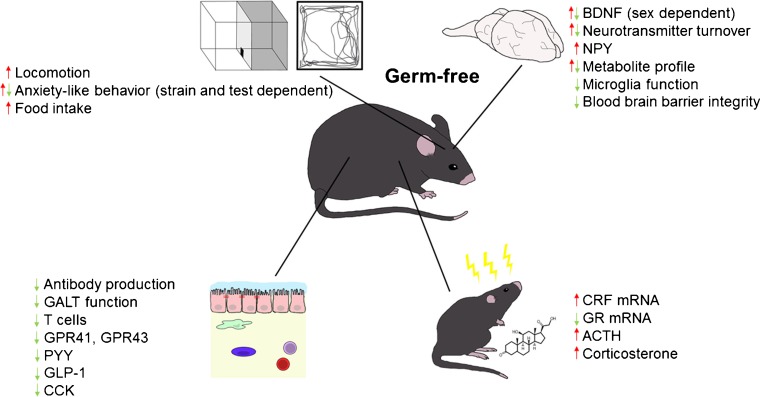
“Thus, GF mice have been demonstrated to have increased CRF expression, reduced GR expression in the cortex, and elevated plasma ACTH and corticosterone levels in response to restraint stress (Table 2) [93, 95].”
BackgroundInfluentialMetabolomics analysis reveals large effects of gut microflora on mammalian blood metabolites
Wikoff, W. R., Anfora, A. T., Liu, J., Schultz, P. G., Lesley, S. A., Peters, E. C., & Siuzdak, G. (2009) · Proceedings of the National Academy of Sciences · doi:10.1073/pnas.0812874106 · Cited by 2,677 · cited 2×
“bioactive indole-containing metabolites that derive from tryptophan is impaired, whereas the availability of tryptophan, which is a precursor of 5-HT, is increased [114].”
Background
Cited by
Items 501–509 of 509
Kelleher, S. T., Patangia, D. V., Ross, R. P., James, A. T., Stanton, C., & McMahon, C. J. (2026) · Heart · doi:10.1136/heartjnl-2026-328544
Exploring the Physiological Effects and Mechanisms of Gamma-Aminobutyric Acid in Food Systems
Liu, M., Zhu, S., Tufail, T., & Xu, B. (2026) · Foods · doi:10.3390/foods15183323
“This disinhibition leads to https://doi.org/10.3390/foods15183323 HPA axis hyperactivity, elevated plasma corticosterone (cortisol in humans), and consequent anxiety-or depression-like behaviors [65,115,116].”
InfluentialEndocrine Disruptors and Obesity
Abolhasani, S., & احمدی, ی. (2026) · IntechOpen eBooks · doi:10.5772/intechopen.1016775
Sommer, K. M. (2025) · Illinois Digital Environment for Access to Learning and Scholarship (University of Illinois at Urbana-Champaign)
Mengjuan, Y. (2026) · Journal of Clinical Personalized Medicine · doi:10.12677/jcpm.2026.55376
Ткачук, Н. В., Zelena, L. B., Denysenko, Y., Nikolaienko, D., & Zahorodnia, S. (2026) · Microorganisms · doi:10.3390/microorganisms14102399
“This is especially relevant, given the possibility of an indirect effect of yohimbine on microbial communities, which cannot be excluded, given the known interaction between the neuroendocrine system and the intestinal microbiota [63,64].”
Olojede, S. O., Alabi, B. A., Lawal, S. K., Jegede, A. I., & Adeoluwa, G. O. (2026) · Journal of Central Nervous System Disease · doi:10.1177/11795735261480710
Probiotics in the prevention and management of chronic diseases
Bhardwaj, P., Rana, A., Malik, B., Sobti, R. C., & Chopra, M. (2026) · Elsevier eBooks · doi:10.1016/b978-0-443-45154-6.00010-6
Yu, X., He, J., & Liu, M. (2026) · Journal of Neuroimmunology · doi:10.1016/j.jneuroim.2026.579117
Metadata
- Authors
- Farzi, A., Fröhlich, E. E., & Holzer, P.
- Affiliations
- Medical University of Graz (AT)
- Corresponding author
- Farzi, Aitak
- Venue
- Neurotherapeutics
- Publisher
- Elsevier BV
- Published
- 2018-01
- Volume
- 15
- Issue
- 1
- Pages
- 5-22
- ISSN
- 1878-7479 (ISSN-L)
- PMC
- PMC5794709
- OpenAlex
- W2789690147
- Semantic Scholar
- 6963f59d54a21cd764832ea5d951b1b5358dff00
- Cited by
- 478
- References
- 142
- Citations by year
- 2026: 47 · 2025: 56 · 2024: 67 · 2023: 56 · 2022: 79 · 2021: 77 · 2020: 52 · 2019: 35 · 2018: 9
- FWCI
- 4.24
- Type
- journal article
- Language
- en
- Open access
- hybrid
- doi.org
- Licence
- cc-by
- www.elsevier.com/tdm/userlicense/1.0/ (tdm)
- www.elsevier.com/legal/tdmrep-license (tdm)
- creativecommons.org/licenses/by/4.0/ (vor, 26 d)
- Locations
- Neurotherapeutics (publishedVersion, cc-by)
- PubMed Central (publishedVersion, cc-by)
- PubMed (publishedVersion)
- Funders
- Austrian Science Fund (P23097-B18, P25912-B23, W1241-B18)
- Österreichische Forschungsförderungsgesellschaft
- Topics
- Life Sciences › Biochemistry, Genetics and Molecular Biology › Molecular Biology › Gut microbiota and health
- Health Sciences › Medicine › Gastroenterology › Gastrointestinal motility and disorders
- Life Sciences › Neuroscience › Behavioral Neuroscience › Stress Responses and Cortisol
- Keywords
- gut microbiota, neuroendocrine system, hypothalamic-pituitary-adrenal axis, microbiota-gut-brain axis, stress, immune system, intestinal barrier, blood-brain barrier, microbial metabolites, gastrointestinal hormones, autonomic nervous system, early life stress, probiotics, prebiotics, germ-free mice, antibiotic-induced dysbiosis
- MeSH terms
- Gastrointestinal Microbiome, Animals, Anti-Bacterial Agents, Gastrointestinal Hormones, Humans, Hypothalamo-Hypophyseal System, Pituitary-Adrenal System, Stress, Psychological, Mice, Dysbiosis
About these checks
Registry, retraction, Cites and statistics results are computed, not judged, with one exception: a printed reference that no index lists is read once by a model before it counts as a citation error. Claims are extracted by a model and kept only when their quote appears verbatim in the text; each cited source is then checked, with a model’s help, for whether it says what the claim relies on. Those verdicts can be wrong — read the claim’s quote and the cited source before relying on one.
Statistics and arithmetic are recomputed, not judged.
Confidence bands are shown only for fields calibrated on our annotated test set. None is calibrated yet, so no band is shown.
What counts as a claim ›How we measure confidence ›How we check this ›
Are you an author, or do you see a problem with this page? Request a review
Data sources
Bibliographic data: Semantic Scholar, OpenAlex, Crossref.
Contains information from the Semantic Scholar Academic Graph Datasets, made available under the ODC Attribution License (ODC-BY 1.0).
Semantic Scholar’s data is described in: Kinney, R., et al. (2023). The Semantic Scholar Open Data Platform. arXiv:2301.10140.
