

Gut Microbiota and the Neuroendocrine System
Open accessThe DOI matches its Crossref record; 141 of the 142 references it cites were found in a registry or an index.
Abstract
The microbial ecosystem that inhabits the gastrointestinal tract of all mammals-the gut microbiota-has been in a symbiotic relationship with its hosts over many millennia. Thanks to modern technology, the myriad of functions that are controlled or modulated by the gut microbiota are beginning to unfold. One of the systems that is emerging to closely interact with the gut microbiota is the body's major neuroendocrine system that controls various body processes in response to stress, the hypothalamic-pituitary-adrenal (HPA) axis. This interaction is of pivotal importance; as various disorders of the microbiota-gut-brain axis are associated with dysregulation of the HPA axis. The present contribution describes the bidirectional communication between the gut microbiota and the HPA axis and delineates the potential underlying mechanisms. In this regard, it is important to note that the communication between the gut microbiota and the HPA axis is closely interrelated with other systems, such as the immune system, the intestinal barrier and blood-brain barrier, microbial metabolites, and gut hormones, as well as the sensory and autonomic nervous systems. These communication pathways will be exemplified through preclinical models of early life stress, beneficial roles of probiotics and prebiotics, evidence from germ-free mice, and antibiotic-induced modulation of the gut microbiota.
Overview
The claims and statistics of this paper haven’t been checked yet.
Free: it reads the open-access text and checks the first 5 claims that cite a source we can check. Create a free account to check every claim.
Integrity signals
Registry
Cites
Statistics
Figures
Verification
Claims the paper makes
The claims and statistics of this paper haven’t been checked yet.
Free: it reads the open-access text and checks the first 5 claims that cite a source we can check. Create a free account to check every claim.
Claims other papers make about this one
Each is checked against this paper’s own text: does it say what the citing paper says it does?
The source backs part of the claim, not all of it — or backs it for a different population, condition or comparison.
In the citing paper
“Similar to aging, dysbiosis has been associated with increased cortisol secretion, decreased negative feedback at the level of the hypothalamus, and changes in the circadian rhythm of cortisol release (113).”
From Signalling cognition: The gut microbiota and hypothalamic-pituitary-adrenal axis (2023) · cites this paper as [113]
Experimental — accuracy not yet measuredThe cited source says what the claim attributes to it.
In the citing paper
“This relationship, like the microbiota-gut-brain axis itself, is bidirectional -the microbiota can modulate stress-induced alterations in anxiety, memory, cognition and neuroinflammation (for reviews, see Cussotto et al., 2018;Farzi et al., 2018;Foster et al., 2017;Rea et al., 2016;Sherwin et al., 2016a).”
From The Microbiota-Gut-Brain Axis (2019) · cites this paper as Farzi et al., 2018
Self-check
Percentages, sums and reported differences re-computed from the paper’s own numbers.
The self-check needs the paper’s full text.
Citations
Cites
From inflammation to sickness and depression: when the immune system subjugates the brain
Dantzer, R., O'Connor, J. C., Freund, G. G., Johnson, R. W., & Kelley, K. W. (2008) · Nature Reviews Neuroscience · doi:10.1038/nrn2297 · Cited by 7,395 · cited 1×
“The nucleus of the solitary tract is of particular importance with regard to the gut– brain axis, as it receives visceral afferents from the vagus nerve and is activated by inflammatory challenges [37, 38].”
BackgroundEpigenetic programming by maternal behavior
Weaver, I. C. G., Cervoni, N., Champagne, F. A., D'Alessio, A. C., Sharma, S., Seckl, J. R., Dymov, S., Szyf, M., & Meaney, M. J. (2004) · Nature Neuroscience · doi:10.1038/nn1276 · Cited by 6,177
Commensal microbe-derived butyrate induces the differentiation of colonic regulatory T cells
Furusawa, Y., Obata, Y., Fukuda, S., Endo, T. A., Nakato, G., Takahashi, D., Nakanishi, Y., Uetake, C., Kato, K., Kato, T., et al. (2013) · Nature · doi:10.1038/nature12721 · Cited by 5,549
The gut microbiota shapes intestinal immune responses during health and disease
Round, J. L., & Mazmanian, S. K. (2009) · Nature Reviews Immunology · doi:10.1038/nri2515 · Cited by 5,029
Bravo, J. A., Forsythe, P., Chew, M. V., Escaravage, E., Savignac, H. M., Dinan, T. G., Bienenstock, J., & Cryan, J. F. (2011) · Proceedings of the National Academy of Sciences · doi:10.1073/pnas.1102999108 · Cited by 3,888 · cited 10×
“rhamnosus in BALB/c mice are not present in vagotimized mice, the vagus nerve is suggested to be a critical pathway of communication between probiotic signaling and the CNS [77].”
BackgroundInfluentialHost microbiota constantly control maturation and function of microglia in the CNS
Erny, D., Hrabě de Angelis, A. L., Jaitin, D., Wieghofer, P., Staszewski, O., David, E., Keren-Shaul, H., Mahlakoiv, T., Jakobshagen, K., Buch, T., et al. (2015) · Nature Neuroscience · doi:10.1038/nn.4030 · Cited by 3,569 · cited 7×
“As the behavioral effects in response to L. rhamnosus in BALB/c mice are not present in vagotimized mice, the vagus nerve is suggested to be a critical pathway of communication between probiotic signaling and the CNS [77].”
BackgroundInfluentialGut microbiota, metabolites and host immunity
Rooks, M. G., & Garrett, W. S. (2016) · Nature reviews. Immunology · doi:10.1038/nri.2016.42 · Cited by 3,409 · cited 1×
“YY (PYY) from intestinal enteroendocrine cells [56].”
Normal gut microbiota modulates brain development and behavior
Heijtz, R. D., Wang, S., Anuar, F., Qian, Y., Björkholm, B., Samuelsson, A., Hibberd, M. L., Forssberg, H., & Pettersson, S. (2011) · Proceedings of the National Academy of Sciences · doi:10.1073/pnas.1010529108 · Cited by 3,228 · cited 4×
“↑ synaptophysin + PSD-95 (striatum) [97]”
BackgroundInfluentialSudo, N., Chida, Y., Aiba, Y., Sonoda, J., Oyama, N., Yu, X., Kubo, C., & Koga, Y. (2004) · The Journal of Physiology · doi:10.1113/jphysiol.2004.063388 · Cited by 2,735 · cited 6×
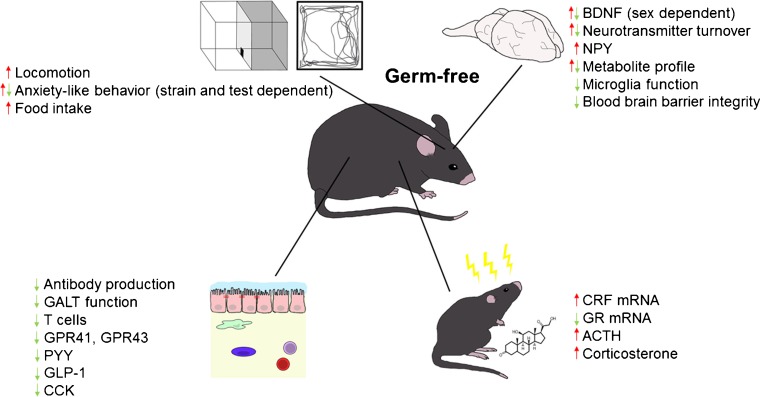
“Thus, GF mice have been demonstrated to have increased CRF expression, reduced GR expression in the cortex, and elevated plasma ACTH and corticosterone levels in response to restraint stress (Table 2) [93, 95].”
BackgroundInfluentialMetabolomics analysis reveals large effects of gut microflora on mammalian blood metabolites
Wikoff, W. R., Anfora, A. T., Liu, J., Schultz, P. G., Lesley, S. A., Peters, E. C., & Siuzdak, G. (2009) · Proceedings of the National Academy of Sciences · doi:10.1073/pnas.0812874106 · Cited by 2,677 · cited 2×
“bioactive indole-containing metabolites that derive from tryptophan is impaired, whereas the availability of tryptophan, which is a precursor of 5-HT, is increased [114].”
Background
Cited by
Cryan, J. F., O'Riordan, K. J., Cowan, C. S. M., Sandhu, K. V., Bastiaanssen, T. F. S., Boehme, M., Codagnone, M. G., Cussotto, S., Fulling, C., Golubeva, A. V., et al. (2019) · Physiological Reviews · doi:10.1152/physrev.00018.2018 · Cited by 5,286
Mikulska, J., Juszczyk, G., Gawrońska-Grzywacz, M., & Herbet, M. (2021) · Brain Sciences · doi:10.3390/brainsci11101298 · Cited by 450
“The experiments performed by researchers at Chongqing Medical University showed that mice lacking hormone receptor genes and mice given hormone receptor antagonists modulated their behavior by adapting to a stressful stimulus [66].”
Signalling cognition: The gut microbiota and hypothalamic-pituitary-adrenal axis
Rusch, J. A., Layden, B. T., & Dugas, L. R. (2023) · Frontiers in Endocrinology · doi:10.3389/fendo.2023.1130689 · Cited by 415
“Similar to aging, dysbiosis has been associated with increased cortisol secretion, decreased negative feedback at the level of the hypothalamus, and changes in the circadian rhythm of cortisol release (113).”
BackgroundChronic Stress Promotes Cancer Development
Dai, S., Mo, Y., Wang, Y., Xiang, B., Liao, Q., Zhou, M., Li, X., Li, Y., Xiong, W., Li, G., et al. (2020) · Frontiers in Oncology · doi:10.3389/fonc.2020.01492 · Cited by 405
Prebiotics and Probiotics in Digestive Health
Quigley, E. M. M. (2019) · Clinical Gastroenterology and Hepatology · doi:10.1016/j.cgh.2018.09.028 · Cited by 380
Agorastos, A., Pervanidou, P., Chrousos, G. P., & Baker, D. G. (2019) · Frontiers in Psychiatry · doi:10.3389/fpsyt.2019.00118 · Cited by 385
Chen, Q., Li, Q., Liang, Y., Zu, M., Chen, N., Canup, B. S. B., Luo, L., Wang, C., Zeng, L., & Xiao, B. (2022) · Acta Pharmaceutica Sinica B · doi:10.1016/j.apsb.2021.08.016 · Cited by 361
Gut-brain Axis and migraine headache: a comprehensive review
On behalf of the School of Advanced Studies of the European Headache Federation (EHF-SAS), Arzani, M., Jahromi, S. R., Ghorbani, Z., Vahabizad, F., Martelletti, P., Ghaemi, A., Sacco, S., & Togha, M. (2020) · The Journal of Headache and Pain · doi:10.1186/s10194-020-1078-9 · Cited by 366
Glutamatergic Signaling Along The Microbiota-Gut-Brain Axis
Baj, A., Moro, E., Bistoletti, M., Orlandi, V., Crema, F., & Giaroni, C. (2019) · International Journal of Molecular Sciences · doi:10.3390/ijms20061482 · Cited by 331
The HPA axis dysregulation in severe mental illness: Can we shift the blame to gut microbiota?
Misiak, B., Łoniewski, I., Marlicz, W., Frydecka, D., Szulc, A., Rudzki, L., & Samochowiec, J. (2020) · Progress in Neuro-Psychopharmacology and Biological Psychiatry · doi:10.1016/j.pnpbp.2020.109951 · Cited by 343
The Microbiota–Gut–Brain Axis and Alzheimer’s Disease: Neuroinflammation Is to Blame?
Megur, A., Baltriukienė, D., Bukelskienė, V., & Burokas, A. (2020) · Nutrients · doi:10.3390/nu13010037 · Cited by 323
Gut liver brain axis in diseases: the implications for therapeutic interventions
Yan, M., Man, S., Sun, B., Ma, L., Guo, L., Huang, L., & Gao, W. (2023) · Signal Transduction and Targeted Therapy · doi:10.1038/s41392-023-01673-4 · Cited by 287
“Gut-brain axis is mediated based on the circulatory system, vagus nerve, 162 immune system, 163 neuroendocrine system, 164 and ENS.”
BackgroundExercise influence on the microbiome–gut–brain axis
Dalton, A., Mermier, C., & Zuhl, M. (2019) · Gut Microbes · doi:10.1080/19490976.2018.1562268 · Cited by 251
Chakrabarti, A., Geurts, L., Hoyles, L., Iozzo, P., Kraneveld, A. D., La Fata, G., Miani, M., Patterson, E., Pot, B., Shortt, C., et al. (2022) · Cellular and Molecular Life Sciences · doi:10.1007/s00018-021-04060-w · Cited by 237
“Findings further indicate that the gut microbiota can activate the HPA axis [36]—one of the body’s major neuroendocrine systems that controls responses to stress and is involved in regulating, for example, mood and emotions [37] and the immune system [38].”
BackgroundMicrobiota and Thyroid Interaction in Health and Disease
Fröhlich, E., & Wahl, R. (2019) · Trends in Endocrinology & Metabolism · doi:10.1016/j.tem.2019.05.008 · Cited by 228
Self-citationLongo, S., Rizza, S., & Federici, M. (2023) · Acta Diabetologica · doi:10.1007/s00592-023-02088-x · Cited by 194
Cheng, J., Hu, H., Ju, Y., Liu, J., Wang, M., Liu, B., & Zhang, Y. (2024) · General Psychiatry · doi:10.1136/gpsych-2023-101374 · Cited by 196
“9 10 The interaction between the central nervous system (CNS) and gut microbiota is termed the microbiota- gut-brain axis.”
BackgroundProbiotics for Alzheimer’s Disease: A Systematic Review
Naomi, R., Embong, H., Othman, F., Ghazi, H. F., Maruthey, N., & Bahari, H. (2021) · Nutrients · doi:10.3390/nu14010020 · Cited by 194
“Investigation of the different strains of Lactobaccilus identified that probiotic Lactobacillus rhamnosus decreased the corticosterone levels and anxiety-like behaviour in non-stressed mice [74].”
BackgroundThe Role of Gut Dysbiosis in the Pathophysiology of Neuropsychiatric Disorders
Anand, N., Gorantla, V. R., & Chidambaram, S. B. (2022) · Cells · doi:10.3390/cells12010054 · Cited by 171
When Rhythms Meet the Blues: Circadian Interactions with the Microbiota-Gut-Brain Axis
Teichman, E. M., O’Riordan, K. J., Gahan, C. G. M., Dinan, T. G., & Cryan, J. F. (2020) · Cell Metabolism · doi:10.1016/j.cmet.2020.02.008 · Cited by 196
Del Toro-Barbosa, M., Hurtado-Romero, A., Garcia-Amezquita, L. E., & García-Cayuela, T. (2020) · Nutrients · doi:10.3390/nu12123896 · Cited by 183
Microbiota-gut brain axis involvement in neuropsychiatric disorders
Iannone, L. F., Preda, A., Blottière, H. M., Clarke, G., Albani, D., Belcastro, V., Carotenuto, M., Cattaneo, A., Citraro, R., Ferraris, C., et al. (2019) · Expert Review of Neurotherapeutics · doi:10.1080/14737175.2019.1638763 · Cited by 177
Santos-Marcos, J. A., Mora-Ortiz, M., Tena-Sempere, M., Lopez-Miranda, J., & Camargo, A. (2023) · Biology of Sex Differences · doi:10.1186/s13293-023-00490-2 · Cited by 176
Snigdha, S., Ha, K., Tsai, P., Dinan, T. G., Bartos, J. D., & Shahid, M. (2022) · Pharmacology & Therapeutics · doi:10.1016/j.pharmthera.2021.107978 · Cited by 171
Abnormal gut microbiota composition contributes to cognitive dysfunction in SAMP8 mice
Zhan, G., Yang, N., Li, S., Huang, N., Fang, X., Zhang, J., Zhu, B., Yang, L., Yang, C., & Luo, A. (2018) · Aging · doi:10.18632/aging.101464 · Cited by 176
The Impact of Gut Microbiota Disorders on the Blood–Brain Barrier
Tang, W., Zhu, H., Feng, Y., Guo, R., & Wan, D. (2020) · Infection and Drug Resistance · doi:10.2147/idr.s254403 · Cited by 161
Lee, H. J., Hong, J. K., Kim, J.-K., Kim, D., Jang, S. W., Han, S.-W., & Yoon, I. (2021) · Nutrients · doi:10.3390/nu13082660 · Cited by 191
Intestinal in vitro and ex vivo Models to Study Host-Microbiome Interactions and Acute Stressors
Pearce, S. C., Coia, H. G., Karl, J. P., Pantoja-Feliciano, I. G., Zachos, N. C., & Racicot, K. (2018) · Frontiers in Physiology · doi:10.3389/fphys.2018.01584 · Cited by 162
“The gut microbiota is also involved in intestinal barrier defense, and priming the immune response (Elson and Alexander, 2015) and interact with the neuroendocrine system (Farzi et al., 2018).”
BackgroundPsychobiotics: The Next-Generation Probiotics for the Brain
Sharma, R., Gupta, D., Mehrotra, R., & Mago, P. (2021) · Current Microbiology · doi:10.1007/s00284-020-02289-5 · Cited by 182
The Relationship Between the Gut Microbiome-Immune System-Brain Axis and Major Depressive Disorder
Foster, J. A., Baker, G. B., & Dursun, S. M. (2021) · Frontiers in Neurology · doi:10.3389/fneur.2021.721126 · Cited by 145
Mueed, A., Shibli, S., Korma, S. A., Madjirebaye, P., Esatbeyoglu, T., & Deng, Z. (2022) · Foods · doi:10.3390/foods11203307 · Cited by 187
Stress and cancer: The mechanisms of immune dysregulation and management
Liu, Y., Tian, S., Ning, B., Huang, T., Li, Y., & Wei, Y. (2022) · Frontiers in Immunology · doi:10.3389/fimmu.2022.1032294 · Cited by 181
Raimondi, I., Izzo, L., Tunesi, M., Comar, M., Albani, D., & Giordano, C. (2020) · Frontiers in Bioengineering and Biotechnology · doi:10.3389/fbioe.2019.00435 · Cited by 155
“In homeostatic conditions, it interacts with the intestinal mucosa and maintains its integrity (Groschwitz and Hogan, 2009), contributes to the development and maturation of the endocrine system (Farzi et al., 2018), influences the migration, functions and population of the immune system and produces neuroendocrine ho…”
BackgroundWei, C.-L., Wang, S., Yen, J.-T., Cheng, Y.-F., Liao, C.-L., Hsu, C.-C., Wu, C.-C., & Tsai, Y.-C. (2019) · Brain Research · doi:10.1016/j.brainres.2019.01.025 · Cited by 150
“These findings suggest that probiotics have great potential as alternative therapeutics for alleviating MDD symptoms without the side effects commonly seen in SSRI treatment.”
InfluentialOrtega, M. A., Álvarez-Mon, M. Á., Montero, C. G., Fraile‐Μartinez, O., Monserrat, J., Martinez-Rozas, L., Rodríguez–Jiménez, R., Álvarez‐Mon, M., & Lahera, G. (2023) · Molecular Psychiatry · doi:10.1038/s41380-023-01964-w · Cited by 151
“Then, HPA axis has an important impact on gut microbiota composition and neuroenteroendocrine functions, increasing gastrointestinal permeability, and contributing to the chronic low-grade in fl ammation [168].”
BackgroundThe neurovascular unit and systemic biology in stroke — implications for translation and treatment
Tiedt, S., Buchan, A. M., Dichgans, M., Lizasoaín, I., Moro, M. Á., & Lo, E. H. (2022) · Nature Reviews Neurology · doi:10.1038/s41582-022-00703-z · Cited by 149
A Budding Relationship: Bacterial Extracellular Vesicles in the Microbiota-Gut-Brain Axis
Haas‐Neill, S., & Forsythe, P. (2020) · International Journal of Molecular Sciences · doi:10.3390/ijms21238899 · Cited by 142
Lignans and Gut Microbiota: An Interplay Revealing Potential Health Implications
Senizza, A., Rocchetti, G., Mosele, J. I., Patrone, V., Callegari, M. L., Morelli, L., & Lucini, L. (2020) · Molecules · doi:10.3390/molecules25235709 · Cited by 146
Bicknell, B. T., Liebert, A. D., Borody, T. J., Herkes, G., McLachlan, C. S., & Kiat, H. (2023) · International Journal of Molecular Sciences · doi:10.3390/ijms24119577 · Cited by 147
“Many of the disease conditions that involve the MGBA are associated with an imbalance of the HPA axis, such as IBS, insulin resistance [99], and depression [100].”
Functional Two-Way Crosstalk Between Brain and Lung: The Brain–Lung Axis
Li, C., Chen, W., Lin, F., Li, W., Wang, P., Liao, G., & Zhang, L. (2022) · Cellular and Molecular Neurobiology · doi:10.1007/s10571-022-01238-z · Cited by 140
The Human Gut Microbiome as a Potential Factor in Autism Spectrum Disorder
Alharthi, A., Alhazmi, S., Alburae, N., & Bahieldin, A. (2022) · International Journal of Molecular Sciences · doi:10.3390/ijms23031363 · Cited by 98
“These immune cytokines can circulate and cross the blood–brain barrier (BBB), inducing systemic and CNS inflammation [67,68].”
BackgroundCao, G., Tao, F., Hu, Y., Li, Z., Zhang, Y., Deng, B., & Zhan, X. (2019) · Food & Function · doi:10.1039/c8fo02370k · Cited by 138
Direct and indirect mechanisms by which the gut microbiota influence host serotonin systems
Legan, T. B., Lavoie, B. A., & Mawe, G. M. (2022) · Neurogastroenterology & Motility · doi:10.1111/nmo.14346 · Cited by 132
Gut microbiome patterns depending on children’s psychosocial stress: Reports versus biomarkers
Michels, N., Van de Wiele, T., Fouhy, F., O'Mahony, S., Clarke, G., & Keane, J. (2019) · Brain, Behavior, and Immunity · doi:10.1016/j.bbi.2019.05.024 · Cited by 116
“the HPA axis (Farzi et al., 2018) and the nervus vagus (Bonaz et al.”
BackgroundThe Role of Microbiome in Brain Development and Neurodegenerative Diseases
Nandwana, V., Nandwana, N. K., Das, Y., Saito, M., Panda, T., Das, S., Almaguel, F. A., Hosmane, N. S., & Das, B. C. (2022) · Molecules · doi:10.3390/molecules27113402 · Cited by 140
“The hypothalamic–pituitary–adrenal (HPA) axis is a significant neuroendocrine system that regulates many physiological functions in response to psychological and physical stresses, such as infections, to ensure a proper reaction to the stressor [54].”
BackgroundTargeting the gut to treat multiple sclerosis
Ghezzi, L., Cantoni, C., Pinget, G. V., Zhou, Y., & Piccio, L. M. (2021) · Journal of Clinical Investigation · doi:10.1172/jci143774 · Cited by 122
The Developing Microbiome From Birth to 3 Years: The Gut-Brain Axis and Neurodevelopmental Outcomes
Laue, H. E., Coker, M. O., & Madan, J. C. (2022) · Frontiers in Pediatrics · doi:10.3389/fped.2022.815885 · Cited by 120
Sun, M., Ma, K., Wen, J., Wang, G., Zhang, C., Li, Q., Bao, X., & Wang, H. (2020) · Journal of Alzheimer’s Disease · doi:10.3233/jad-190872 · Cited by 113
“…communication along the axis: 1) neural, via direct connection through the enteric nervous system (ENS), 2) endocrine, via hormonal signaling, most notably via the HPA system, and 3) immune, via microbial release of inflammatory factors and modulation of mucosal and systemic immunity [9, 10, 11].”
Gut microbiota, nutrition, and mental health
Merlo, G., Bachtel, G., & Sugden, S. G. (2024) · Frontiers in Nutrition · doi:10.3389/fnut.2024.1337889 · Cited by 129
“The HPA axis and the immune system are significantly interconnected, and changes with cortisol levels can greatly impact the immune system.”
BackgroundInfluentialMicrobiota-brain interactions: Moving toward mechanisms in model organisms
Nagpal, J. K., & Cryan, J. F. (2021) · Neuron · doi:10.1016/j.neuron.2021.09.036 · Cited by 116
Heli, Z., Hongyu, C., Dapeng, B., Shin, T. Y., Yejun, Z., Xi, Z., & Yingying, W. (2022) · Frontiers in Nutrition · doi:10.3389/fnut.2022.1076223 · Cited by 118
Li, J.-W., Fang, B., Pang, G.-F., Zhang, M., & Ren, F.-Z. (2019) · Pesticide Biochemistry and Physiology · doi:10.1016/j.pestbp.2019.05.018 · Cited by 104
Gao, K., Pi, Y., Mu, C., Farzi, A., Liu, Z., & Zhu, W. (2019) · Journal of Neurochemistry · doi:10.1111/jnc.14709 · Cited by 98
“Hypothalamus is also a part of the hypothalamic–pituitary–adrenal axis, which controls the stress response in hosts (Farzi et al. 2018).”
BackgroundSelf-citationDehhaghi, M., Panahi, H. K. S., Heng, B., & Guillemin, G. J. (2020) · Frontiers in Cell and Developmental Biology · doi:10.3389/fcell.2020.562812 · Cited by 106
Jiang, S., Yan, F., Hu, J., Mohammed, A. A. A., & Cheng, H. W. (2021) · Animals · doi:10.3390/ani11061494 · Cited by 110
Dargenio, V. N., Dargenio, C., Castellaneta, S., De Giacomo, A., Laguardia, M., Schettini, F., Francavilla, R., & Cristofori, F. (2023) · Nutrients · doi:10.3390/nu15071620 · Cited by 98
“The resulting dysbiosis state and altered permeability can induce the translocation of bacterial components, which promotes the secretion of adrenocorticotropic hormone, corticosterone, prostaglandins and proinflammatory cytokines [26].”
BackgroundGastrointestinal involvement of autism spectrum disorder: focus on gut microbiota
Settanni, C. R., Bibbò, S., Ianiro, G., Rinninella, E., Cintoni, M., Mele, M. C., Cammarota, G., & Gasbarrini, A. (2021) · Expert Review of Gastroenterology & Hepatology · doi:10.1080/17474124.2021.1869938 · Cited by 98
Interactions between the microbiota and enteric nervous system during gut-brain disorders
Fried, S. G., Wemelle, E., Cani, P. D., & Knauf, C. (2021) · Neuropharmacology · doi:10.1016/j.neuropharm.2021.108721 · Cited by 102
The gut microbiome, endocannabinoids and metabolic disorders
Iannotti, F. A., & Di Marzo, V. (2021) · Journal of Endocrinology · doi:10.1530/joe-20-0444 · Cited by 88
Schulz, N., Belheouane, M., Dahmen, B., Ruan, V., Specht, H. E., Dempfle, A., Herpertz‐Dahlmann, B., Baines, J. F., & Seitz, J. (2020) · International Journal of Eating Disorders · doi:10.1002/eat.23435 · Cited by 102
Zhang, J., Bi, J., Guo, G., Yang, L., Zhu, B., Zhan, G., Li, S., Huang, N., Hashimoto, K., Yang, C., et al. (2019) · CNS Neuroscience & Therapeutics · doi:10.1111/cns.13103 · Cited by 95
Sajdel, E. M. (2023) · Microorganisms · doi:10.3390/microorganisms11092199 · Cited by 101
“Maternal gut microbiota dysbiosis may induce constant hyperactivity of the HPA axis (Figure 1C, [47]).”
BackgroundBrain modulation by the gut microbiota: From disease to therapy
Mitra, S., Dash, R., Nishan, A. A., Habiba, S. U., & Moon, I. S. (2023) · Journal of Advanced Research · doi:10.1016/j.jare.2022.12.001 · Cited by 91
“…maturation and development of the CNS [29], GM can affect this process through numerous mechanisms, including the brain–neuroanatomical pathway, neuroendocrine–hypothalamic–pituitary– adrenal (HPA) axis [30], gut immune system [31], gut metabolism system, BBB, and intestinal mucosal barrier [32].”
BackgroundThe Link between Obesity, Microbiota Dysbiosis, and Neurodegenerative Pathogenesis
Vamanu, E., & Nand, S. (2021) · Diseases · doi:10.3390/diseases9030045 · Cited by 96
Gut Microbiota as an Endocrine Organ: Unveiling Its Role in Human Physiology and Health
Pires, L., Gonzaléz‐Paramás, A. M., Heleno, S. A., & Calhelha, R. C. (2024) · Applied Sciences · doi:10.3390/app14209383 · Cited by 94
“Studies from germ-free (GF) rodents indicate that the absence of gut microbiota is associated with a hyperreactive HPA axis in response to stress [22].”
Donovan, M., Mackey, C. S., Platt, G. N., Rounds, J., Brown, A. N., Trickey, D. J., Liu, Y., Jones, K. M., & Wang, Z. (2020) · Neurobiology of Stress · doi:10.1016/j.ynstr.2020.100278 · Cited by 85
“Previous research have consistently shown bidirectional crosstalk between gut microbiota and the HPA axis (Farzi et al., 2018).”
Impact of Gut Dysbiosis on Neurohormonal Pathways in Chronic Kidney Disease
Jazani, N. H., Savoj, J., Lustgarten, M. S., Lau, W. L., & Vaziri, N. D. (2019) · Diseases · doi:10.3390/diseases7010021 · Cited by 90
“Toxic products of gut microbiota such as endotoxin and peptidoglycan are able to cross the intestinal epithelium barrier, especially under conditions of increased permeability such as CKD, and stimulate the HPA axis either directly or via the activation of the immune system [125].”
BackgroundTremblay, A., Lingrand, L., Maillard, M., Feuz, B., & Tompkins, T. A. (2020) · Progress in Neuro-Psychopharmacology and Biological Psychiatry · doi:10.1016/j.pnpbp.2020.110142 · Cited by 95
Malan‐Müller, S., Valles‐Colomer, M., Foxx, C. L., Vieira‐Silva, S., van den Heuvel, L. L., Raes, J., Seedat, S., Lowry, C. A., & Hemmings, S. M. J. (2021) · European Neuropsychopharmacology · doi:10.1016/j.euroneuro.2021.11.009 · Cited by 87
Direct and indirect effects of pathogenic bacteria on the integrity of intestinal barrier
Shu, L.-Z., Ding, Y.-D., Xue, Q.-M., Cai, W., & Deng, H. (2023) · Therapeutic Advances in Gastroenterology · doi:10.1177/17562848231176427 · Cited by 90
Role of Brain-Gut-Microbiota Axis in Depression: Emerging Therapeutic Avenues
Bhatt, S., Kanoujia, J., Mohana Lakshmi, S., Patil, C., Gupta, G., Chellappan, D. K., & Dua, K. (2023) · CNS & Neurological Disorders - Drug Targets · doi:10.2174/1871527321666220329140804 · Cited by 76
Diabesity and mood disorders: Multiple links through the microbiota-gut-brain axis
Farzi, A., Hassan, A. M., Zenz, G., & Holzer, P. D. (2018) · Molecular Aspects of Medicine · doi:10.1016/j.mam.2018.11.003 · Cited by 86
Self-citationGut dysbiosis in patients with chronic pain: a systematic review and meta-analysis
Goudman, L., Demuyser, T., Pilitsis, J. G., Billot, M., Roulaud, M., Rigoard, P., & Moens, M. (2024) · Frontiers in Immunology · doi:10.3389/fimmu.2024.1342833 · Cited by 82
“…reacts with secretion of corticotropin-releasing factor from the hypothalamus in response to stressors of any kind (e.g., emotion or stress), consecutively leading to adrenocorticotropic hormone secretion from the pituitary gland, which in turn leads to cortisol release from the adrenal glands (9).”
BackgroundWelcome, M. O. (2019) · NeuroMolecular Medicine · doi:10.1007/s12017-019-08547-5 · Cited by 83
Abdelhamid, M., Zhou, C., Ohno, K., Kuhara, T., Taslima, F., Abdullah, M., Jung, C.-G., & Michikawa, M. (2022) · Journal of Alzheimer’s Disease · doi:10.3233/jad-215025 · Cited by 68
“…gut and the brain is achieved by one of these three pathways: direct link from the gastrointestinal tract to the intrinsic nervous system, inflammatory cytokines released by microorganisms, which modulate systemic immunity, and hormonal signaling by the hypothalamic-pituitary-adrenal axis [8–10].”
Dandekar, M. P., Palepu, M. S. K., Satti, S., Jaiswal, Y., Singh, A. A., Dash, S. P., Gajula, S. N. R., & Sonti, R. (2022) · ACS Chemical Neuroscience · doi:10.1021/acschemneuro.2c00143 · Cited by 77
Ranuh, R., Fardah Athiyyah, A., Darma, A., Prasetyo Risky, V., Riawan, W., S. Surono, I., & Marto Sudarmo, S. (2019) · Iranian Journal of Microbiology · doi:10.18502/ijm.v11i2.1077 · Cited by 74
“A growing body of evidence indicates that gut– brain communication is influenced by the gut microbiome (5, 12, 14).”
BackgroundPatra, V., Gallais Sérézal, I., & Wolf, P. (2020) · Nutrients · doi:10.3390/nu12061795 · Cited by 70
Medicinal Plants and Their Impact on the Gut Microbiome in Mental Health: A Systematic Review
Pferschy‐Wenzig, E., Pausan, M.-R., Ardjomand-Woelkart, K., Röck, S., Ammar, R. M., Kelber, O., Moissl‐Eichinger, C., & Bauer, R. (2022) · Nutrients · doi:10.3390/nu14102111 · Cited by 83
Yu, W., Sun, S., Yan, Y., Zhou, H., Liu, Z., & Fu, Q. (2025) · Frontiers in Immunology · doi:10.3389/fimmu.2025.1519925 · Cited by 82
Psychedelics as a novel approach to treating autoimmune conditions
Thompson, C., & Szabo, A. (2020) · Immunology Letters · doi:10.1016/j.imlet.2020.10.001 · Cited by 71
Dong, Z., Shen, X., Hao, Y., Li, J., Li, H., Xu, H., Yin, L., & Kuang, W. (2021) · Frontiers in Psychiatry · doi:10.3389/fpsyt.2021.651536 · Cited by 66
Cheng, W., Ho, J. Y. S., & Chang, R. C. (2022) · Ageing Research Reviews · doi:10.1016/j.arr.2022.101620 · Cited by 75
The role of microRNAs in depression
Ding, R., Su, D., Zhao, Q., Wang, Y., Wang, J., Lv, S., & Ji, X. (2023) · Frontiers in Pharmacology · doi:10.3389/fphar.2023.1129186 · Cited by 75
Gut Microbiota and Obesity in Adults and Children: The State of the Art
Petraroli, M., Castellone, E., Patianna, V. D., & Esposito, S. (2021) · Frontiers in Pediatrics · doi:10.3389/fped.2021.657020 · Cited by 78
Flux, M. C., & Lowry, C. A. (2020) · Neurobiology of Disease · doi:10.1016/j.nbd.2019.104578 · Cited by 65
Lei, W., Cheng, Y., Liu, X., Gao, J., Zhu, Z., Ding, W., Xu, X., Li, Y., Ling, Z., Jiang, R., et al. (2025) · Frontiers in Immunology · doi:10.3389/fimmu.2025.1582119 · Cited by 68
“Similarly, increased populations of Lactobacillus casei , Anaplasma fragilis , and Streptococcus thermophilus positively affect brain activity and cognition (74 – 76).”
Minayo, M. D. S., Miranda, I., & Telhado, R. S. (2021) · Ciência & Saúde Coletiva · doi:10.1590/1413-81232021269.21342020 · Cited by 87
Oral Microbiota Development in Early Childhood
Kennedy, B., Peura, S., Hammar, U., Vicenzi, S., Hedman, A. M., Almqvist, C., Andolf, E. G., Pershagen, G., Dicksved, J., Bertilsson, S., et al. (2019) · Scientific Reports · doi:10.1038/s41598-019-54702-0 · Cited by 73
Targeting DNA Methylation in the Adult Brain through Diet
Allison, J., Kaliszewska, A., Uceda, S., Reiriz, M., & Arias, N. (2021) · Nutrients · doi:10.3390/nu13113979 · Cited by 67
Han, S., Kim, J.-K., Park, H.-S., Shin, Y.-J., & Kim, D.-H. (2021) · Chinese Medicine · doi:10.1186/s13020-021-00492-5 · Cited by 69
Gut microbiota and neuropsychiatric disorders: Implications for neuroendocrine-immune regulation
Ge, T., Yao, X., Zhao, H., Yang, W., Zou, X., Peng, F., Li, B., & Cui, R. (2021) · Pharmacological Research · doi:10.1016/j.phrs.2021.105909 · Cited by 65
The diet-microbiome tango: how nutrients lead the gut brain axis
Ezra-Nevo, G., Henriques, S. F., & Ribeiro, C. (2020) · Current Opinion in Neurobiology · doi:10.1016/j.conb.2020.02.005 · Cited by 66
“Likewise, SCFAs, such as butyrate and propionate, can per se stimulate vagal afferent neurons or the release of hormones from EECs to modulate food intake as well as anxiety-related phenotypes [97,98].”
BackgroundWang, Q., Wang, X. F., Xing, T., Li, J. L., Zhu, X., Zhang, L., & Gao, F. (2020) · Poultry Science · doi:10.1016/j.psj.2020.11.075 · Cited by 64
“Locally, SCFA are the major energy sources for gut microbiota itself and for intestinal epithelial cells (Farzi et al., 2018).”
BackgroundThe contribution of age-related changes in the gut-brain axis to neurological disorders
Khan, R., Gesù, C. M. D., Lee, J., & McCullough, L. D. (2024) · Gut Microbes · doi:10.1080/19490976.2024.2302801 · Cited by 63
Dietary Regulation of Gut-Brain Axis in Alzheimer’s Disease: Importance of Microbiota Metabolites
Frausto, D. M., Forsyth, C. B., Keshavarzian, A., & Voigt, R. M. (2021) · Frontiers in Neuroscience · doi:10.3389/fnins.2021.736814 · Cited by 61
Gut microbiota modulates stress-induced hypertension through the HPA axis
Wu, Q. J., Xu, Z., Song, S., Zhang, H., Zhang, W., Liu, L., Chen, Y., & Sun, J. (2020) · Brain Research Bulletin · doi:10.1016/j.brainresbull.2020.05.014 · Cited by 66
Cataldi, S., Poli, L., Şahin, F. N., Patti, A., Santacroce, L., Bianco, A., Greco, G., Ghinassi, B., Baldassarre, A. D., & Fischetti, F. (2022) · Nutrients · doi:10.3390/nu14163293 · Cited by 63
Ceppa, F., Izzo, L., Sardelli, L., Raimondi, I., Tunesi, M., Albani, D., & Giordano, C. (2020) · Frontiers in Cellular and Infection Microbiology · doi:10.3389/fcimb.2020.00297 · Cited by 60
Eshraghi, R. S., Davies, C., Iyengar, R., Perez, L., Mittal, R., & Eshraghi, A. A. (2020) · Journal of Clinical Medicine · doi:10.3390/jcm10010027 · Cited by 62
Metadata
- Authors
- Farzi, A., Fröhlich, E. E., & Holzer, P.
- Affiliations
- Medical University of Graz (AT)
- Corresponding author
- Farzi, Aitak
- Venue
- Neurotherapeutics
- Publisher
- Elsevier BV
- Published
- 2018-01
- Volume
- 15
- Issue
- 1
- Pages
- 5-22
- ISSN
- 1878-7479 (ISSN-L)
- PMC
- PMC5794709
- OpenAlex
- W2789690147
- Semantic Scholar
- 6963f59d54a21cd764832ea5d951b1b5358dff00
- Cited by
- 478
- References
- 142
- Citations by year
- 2026: 47 · 2025: 56 · 2024: 67 · 2023: 56 · 2022: 79 · 2021: 77 · 2020: 52 · 2019: 35 · 2018: 9
- FWCI
- 4.24
- Type
- journal article
- Language
- en
- Open access
- hybrid
- doi.org
- Licence
- cc-by
- www.elsevier.com/tdm/userlicense/1.0/ (tdm)
- www.elsevier.com/legal/tdmrep-license (tdm)
- creativecommons.org/licenses/by/4.0/ (vor, 26 d)
- Locations
- Neurotherapeutics (publishedVersion, cc-by)
- PubMed Central (publishedVersion, cc-by)
- PubMed (publishedVersion)
- Funders
- Austrian Science Fund (P23097-B18, P25912-B23, W1241-B18)
- Österreichische Forschungsförderungsgesellschaft
- Topics
- Life Sciences › Biochemistry, Genetics and Molecular Biology › Molecular Biology › Gut microbiota and health
- Health Sciences › Medicine › Gastroenterology › Gastrointestinal motility and disorders
- Life Sciences › Neuroscience › Behavioral Neuroscience › Stress Responses and Cortisol
- Keywords
- gut microbiota, neuroendocrine system, hypothalamic-pituitary-adrenal axis, microbiota-gut-brain axis, stress, immune system, intestinal barrier, blood-brain barrier, microbial metabolites, gastrointestinal hormones, autonomic nervous system, early life stress, probiotics, prebiotics, germ-free mice, antibiotic-induced dysbiosis
- MeSH terms
- Gastrointestinal Microbiome, Animals, Anti-Bacterial Agents, Gastrointestinal Hormones, Humans, Hypothalamo-Hypophyseal System, Pituitary-Adrenal System, Stress, Psychological, Mice, Dysbiosis
About these checks
Registry, retraction, Cites and statistics results are computed, not judged, with one exception: a printed reference that no index lists is read once by a model before it counts as a citation error. Claims are extracted by a model and kept only when their quote appears verbatim in the text; each cited source is then checked, with a model’s help, for whether it says what the claim relies on. Those verdicts can be wrong — read the claim’s quote and the cited source before relying on one.
Statistics and arithmetic are recomputed, not judged.
Confidence bands are shown only for fields calibrated on our annotated test set. None is calibrated yet, so no band is shown.
What counts as a claim ›How we measure confidence ›How we check this ›
Are you an author, or do you see a problem with this page? Request a review
Data sources
Bibliographic data: Semantic Scholar, OpenAlex, Crossref.
Contains information from the Semantic Scholar Academic Graph Datasets, made available under the ODC Attribution License (ODC-BY 1.0).
Semantic Scholar’s data is described in: Kinney, R., et al. (2023). The Semantic Scholar Open Data Platform. arXiv:2301.10140.
