

Keratin Scaffold Formulation Impacts rhBMP-2 Biodistribution and Bone Regeneration in a Rat Femur Defect Model
Open accessThe DOI matches its Crossref record; 45 of the 47 references it cites were found in a registry or an index; 22 of the 30 sources its claims cite were checked for support.
Abstract
Background: Treatment for nonunion in long bones remains a clinical need. Collagen sponges loaded with recombinant human bone morphogenetic protein 2 (rhBMP-2) are potential grafts but have limited FDA-approved applications due to safety concerns associated with rapid collagen resorption and burst release of rhBMP-2 in vivo . This work investigates keratin proteins obtained from human hair as a potential rhBMP-2 biomaterial carrier. Keratins are an appealing carrier because the extent of disulfide crosslinking can be modulated by the form of keratin present, thus allowing control over the rate of scaffold degradation. Methods: The two forms of keratin used to formulate carriers were reductively extracted keratin called kerateine (KTN) that can form disulfide crosslinks and oxidatively extracted keratin called keratose (KOS) that does not form disulfide crosslinks. Five formulations of freeze-dried keratin scaffolds containing variable amounts of KOS and KTN were fabricated and implanted into a critically-sized rat femur defect model. Results: A 50:50 KOS:KTN formulation with rhBMP-2 showed the same level of bone bridging, bone mineral density, and bone volume as collagen with rhBMP-2 by 8 weeks as determined by μ-CT. Scaffolds with the 50:50 KOS:KTN or 100% KTN showed approximately fourfold higher retention of fluorescently-labeled rhBMP-2 at the implant site 1, 3, or 7 days post-implant compared to collagen or 100% KOS scaffolds. The increased retention with 50:50 KOS:KTN or 100% KTN correlated with decreased levels of fluorescent rhBMP-2 in distal organs. Conclusions: Keratin scaffolds could provide comparable levels of bone regeneration as collagen carriers with improved safety profiles suitable for use in long bone nonunions.
Overview
CoChat Summary
TL;DR
Keratin scaffolds carrying rhBMP-2 were tested in a critically-sized rat femur defect and compared with collagen. A 50:50 KOS:KTN formulation matched collagen for bone bridging, bone mineral density, and bone volume by 8 weeks, while KTN-containing carriers improved rhBMP-2 retention and reduced distal-organ distribution.
Key findings
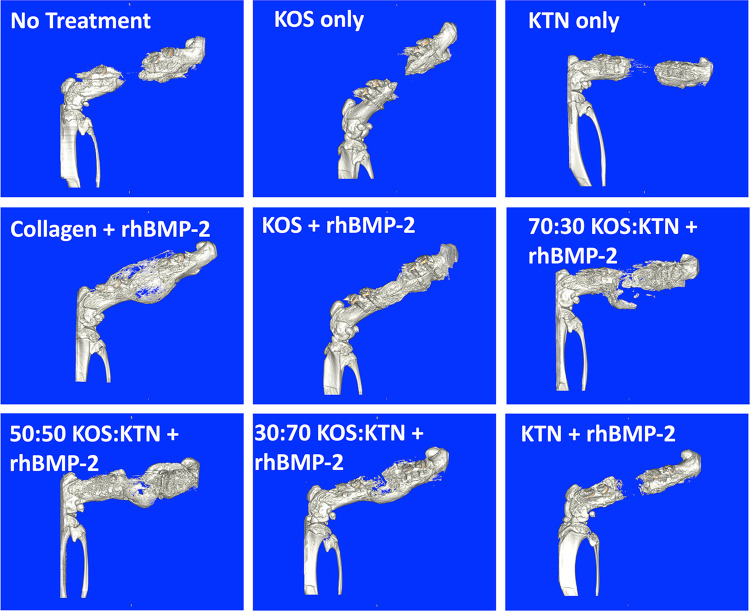
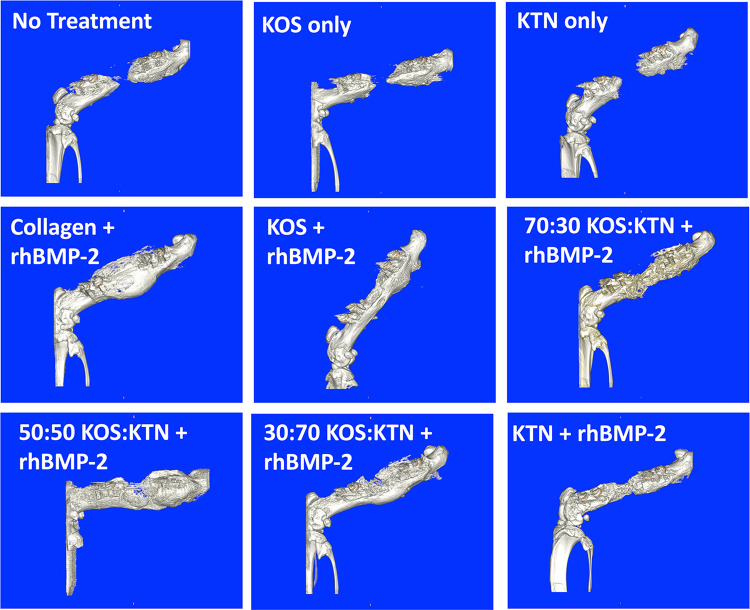
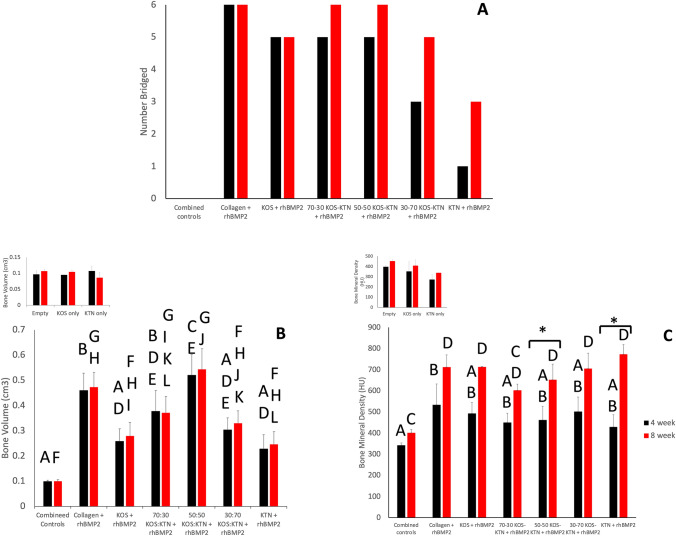
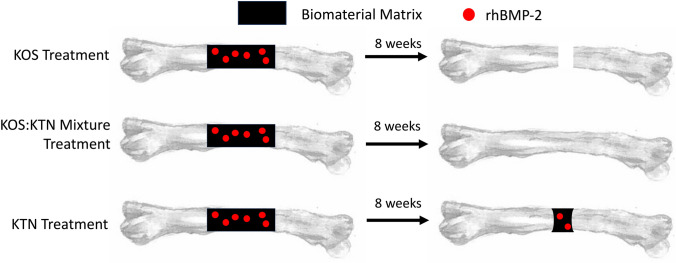
- By 8 weeks, 50:50 KOS:KTN + rhBMP-2 showed the same level of bone bridging, bone mineral density, and bone volume as collagen + rhBMP-2 by μ-CT; 70:30 KOS:KTN and 50:50 KOS:KTN bridged in 6/6 animals, whereas 30:70 KOS:KTN increased from 3 to 5 bridged and KTN + rhBMP-2 from 1 to 3 bridged from 4 to 8 weeks.
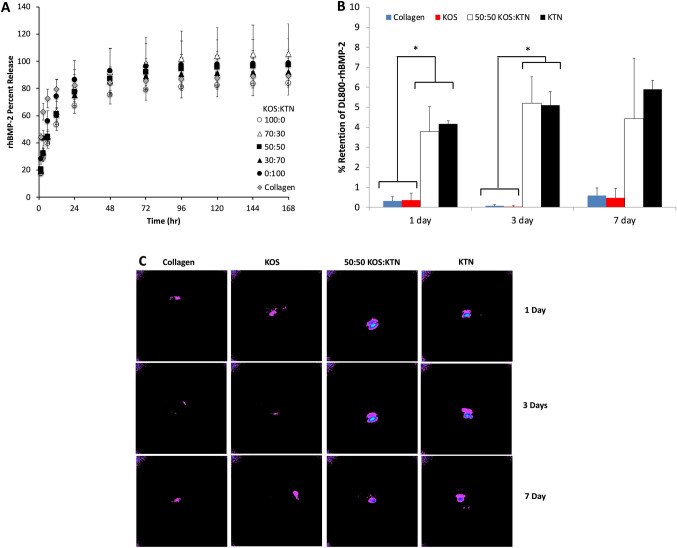
- 50:50 KOS:KTN or 100% KTN scaffolds showed approximately fourfold higher retention of fluorescently-labeled rhBMP-2 at the implant site at 1, 3, or 7 days post-implant compared to collagen or 100% KOS scaffolds.
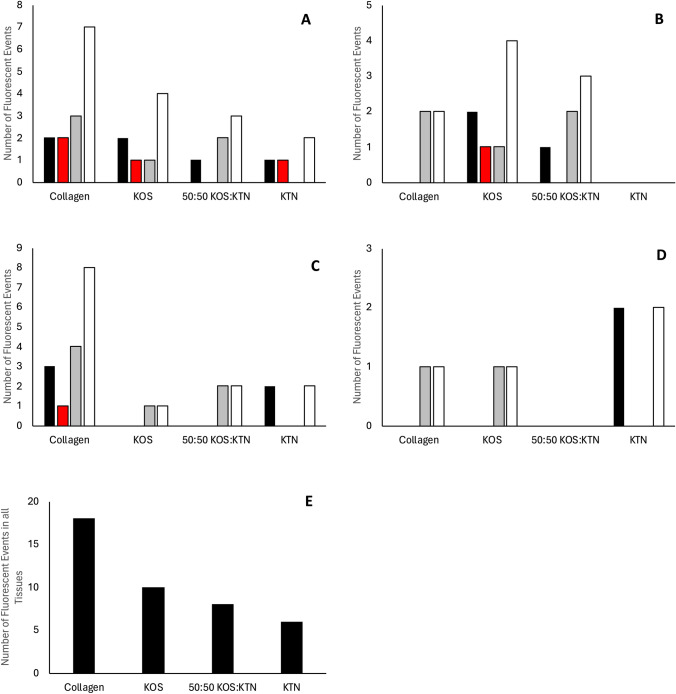
- Increased retention with 50:50 KOS:KTN or 100% KTN correlated with decreased levels of fluorescent rhBMP-2 in distal organs; collagen and KOS carriers had more detectable fluorescence events in spleen and liver, and collagen had more than double and triple the detectable events in all tissues compared to 50:50 KOS:KTN and KTN, respectively.
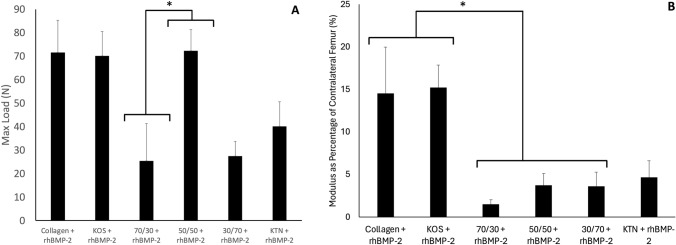
- At 8 weeks, KOS + rhBMP-2 and 50:50 KOS:KTN + rhBMP-2 had max loads of ~70 N, close to collagen + rhBMP-2; 30:70 KOS:KTN + rhBMP-2 had a statistically significantly lower max load than 50:50 KOS:KTN + rhBMP-2, but other mechanical comparisons did not reach significance.
Methods
- Five freeze-dried keratin scaffolds with variable KOS:KTN ratios (100% KOS, 70:30, 50:50, 30:70, 100% KTN) were fabricated and implanted with rhBMP-2 into an 8 mm critically-sized left femur defect in approximately 3-month-old male Sprague–Dawley rats (average weight 371.5 g), with collagen + rhBMP-2 and combined no-rhBMP-2 controls.
- The implanted rhBMP-2 mass was approximately 14.2 µg; outcomes included μ-CT at 4 and 8 weeks for bridging, bone volume, and bone mineral density, four-point bend mechanical testing at 8 weeks, histology, in vitro AF488-rhBMP-2 release, and in vivo DL800-rhBMP-2 retention/biodistribution at 1, 3, or 7 days.
- Animal studies were randomized; imaging and data analysis were blinded; comparisons used ANOVA followed by Tukey’s honestly significant difference post-hoc test.
Limitations
- The paper states that freeze-drying may decrease rhBMP-2 activity, that cryopreservation methods reported to enhance rhBMP-2 bioactivity were not used, that keratins were not characterized in this report, and that future studies on sex differences would be beneficial because only male rats were used.
- The paper states that mechanical testing assumed a solid cylinder and used four-point bend, which likely underestimates true modulus; it also notes variability in max loads and elastic moduli, and that 7-day retention differences did not reach significance due to greater variability.
- Evident from the text: only one bone sample was used for histology, some mechanical groups had N = 4 or N = 5, and the in vivo retention/biodistribution study tested only collagen, KOS, KTN, and 50:50 KOS:KTN rather than all five keratin formulations.
Model-written summary. Check it against the paper before relying on it.
Integrity signals
Registry
Cites
Statistics
Figures
Verification
Claims the paper makes
14 Valid · 1 Not valid · 5 Not checked · 82 Own results and interpretations
At least one cited source doesn’t support this claim or points to a different paper, and none confirmed it — see the verdicts below.
In the paper
“The in vitro release profiles with AF488 rhBMP-2 (Fig. 5A) followed a similar trend to those found previously when using ELISA for rhBMP-2 detection [15].”
§ Keratin Scaffold Formulation Impacts rhBMP-2 Biodistribution and Bone Regeneration in a Rat Femur Defect Model > Results > In vitro rhBMP-2 release and in vivo rhBMP-2 retention and biodistribution
What the sources say
- Disputedcites [15] Cohen DJ, Hyzy SL, Haque S, Olson LC, Boyan BD, Saul JM, et al. Effects of tunable keratin hydrogel erosion on recombinant human bone morphogenetic protein 2 release, bioactivity, and bone induction. Tissue Eng Part A. 2018;24:1616–30. 29905087 PMC6238606 sourceExperimental — accuracy not yet measured
The Materials and Methods section states that the cited paper measured rhBMP-2 release by fluorometry of AF488-labeled rhBMP-2, not by ELISA. Its Discussion describes the release trend, but the claimed prior ELISA-based detection is contrary to the method reported in our copy; the citing paper's own profiles cannot be assessed from this source. (LLM, conf=0.89)
Checked by a reasoning model — may be wrong.
plainstates an association- Asserted: passes — The authors put it forward as true.
- Checkable: passes — It can be checked against evidence.
- Load-bearing: passes — The paper’s conclusions depend on it.
- Based: passes — The paper gives a reason why it holds.
- Disputed
Every source the paper cites for this claim was checked and supports it.
In the paper
“By varying the ratios of KOS and KTN in keratin materials, the rates of degradation of materials composed of keratin can be controlled in a manner reminiscent of synthetic polymers.”
§ Keratin Scaffold Formulation Impacts rhBMP-2 Biodistribution and Bone Regeneration in a Rat Femur Defect Model > Introduction
What the sources say
- Supportedcites [14] Ham TR, Lee RT, Han S, Haque S, Vodovotz Y, Gu J, et al. Tunable keratin hydrogels for controlled erosion and growth factor delivery. Biomacromol. 2016;17:225–36. PMC5565161 26636618 source
Section 3.5, “Gel Erosion and Thiol Content,” reports that increasing the proportion of KOS increased the erosion rate and that mixing KOS and KTN allowed the rate to be fine-tuned. The tested materials were keratin hydrogels, which supports the attributed claim. (LLM, conf=0.94)
- Supportedcites [15] Cohen DJ, Hyzy SL, Haque S, Olson LC, Boyan BD, Saul JM, et al. Effects of tunable keratin hydrogel erosion on recombinant human bone morphogenetic protein 2 release, bioactivity, and bone induction. Tissue Eng Part A. 2018;24:1616–30. 29905087 PMC6238606 source
The Introduction says that mixing KOS and KTN in varying proportions tunes keratin hydrogel erosion rates, likening this to the tunability of synthetic polymers. The Results report that formulations with more KTN degraded more slowly than those with more KOS. Page numbers are not provided in our copy. (LLM, conf=0.94)
plainstates a cause- Asserted: passes — The authors put it forward as true.
- Checkable: passes — It can be checked against evidence.
- Load-bearing: passes — The paper’s conclusions depend on it.
- Based: passes — The paper gives a reason why it holds.
- Supported
Every source the paper cites for this claim was checked and supports it.
In the paper
“This is likely because formulations with more KOS or KTN with rhBMP-2 showed lower levels of callous outside of the defect site (Figs. 1 and 2), similar to previous observations with KTN in a mandible model [20].”
§ Keratin Scaffold Formulation Impacts rhBMP-2 Biodistribution and Bone Regeneration in a Rat Femur Defect Model > Results > Bone mineral density and bone volume at 4 and 8 weeks
What the sources say
- Supportedcites [20] Kowalczewski CJ, Tombyln S, Wasnick DC, Hughes MR, Ellenburg MD, Callahan MF, et al. Reduction of ectopic bone growth in critically-sized rat mandible defects by delivery of rhBMP-2 from kerateine biomaterials. Biomaterials. 2014;35:3220–8. 24439399 PMC4321825 source
The cited paper’s Results (§3.4; page unavailable) report that rhBMP-2 delivered in kerateine (KTN) gels or scaffolds produced significantly less ectopic bone growth than the collagen carrier in rat mandible defects. This supports the citing sentence’s comparison to previous KTN observations; the sentence presents its KOS findings as the citing authors’ own results, not as findings of this source. (LLM, conf=0.92)
hedgedstates a cause- Asserted: passes — The authors put it forward as true.
- Checkable: passes — It can be checked against evidence.
- Load-bearing: passes — The paper’s conclusions depend on it.
- Based: passes — The paper gives a reason why it holds.
- Supported
Every source the paper cites for this claim was checked and supports it.
In the paper
“Because KTN has been shown to enhance the bioactivity of rhBMP-2 in vitro compared to collagen carriers [15]”
§ Keratin Scaffold Formulation Impacts rhBMP-2 Biodistribution and Bone Regeneration in a Rat Femur Defect Model > Discussion
What the sources say
- Supportedcites [15] Cohen DJ, Hyzy SL, Haque S, Olson LC, Boyan BD, Saul JM, et al. Effects of tunable keratin hydrogel erosion on recombinant human bone morphogenetic protein 2 release, bioactivity, and bone induction. Tissue Eng Part A. 2018;24:1616–30. 29905087 PMC6238606 source
The Results (Figure 2B) report that rhBMP-2 released from KTN-only hydrogels had significantly greater bioactivity than rhBMP-2 released from collagen at all measured time points in the in vitro ALP assay. This directly supports the attributed comparison. (LLM, conf=0.94)
plainstates a cause- Asserted: passes — The authors put it forward as true.
- Checkable: passes — It can be checked against evidence.
- Load-bearing: passes — The paper’s conclusions depend on it.
- Based: passes — The paper gives a reason why it holds.
- Supported
Every source the paper cites for this claim was checked and supports it.
In the paper
“It has previously been demonstrated that modification of the number of cysteine residues available for disulfide crosslinking can be achieved by simply mixing the KOS and KTN forms of keratin in different ratios [14, 15].”
§ Keratin Scaffold Formulation Impacts rhBMP-2 Biodistribution and Bone Regeneration in a Rat Femur Defect Model > Introduction
What the sources say
- Supportedcites [14] Ham TR, Lee RT, Han S, Haque S, Vodovotz Y, Gu J, et al. Tunable keratin hydrogels for controlled erosion and growth factor delivery. Biomacromol. 2016;17:225–36. PMC5565161 26636618 source
The Introduction explains that KOS cysteine groups cannot form disulfide cross-links, whereas KTN cysteine groups can, and proposes mixing the two to vary cross-linking. Results §3.1 reports that KOS:KTN mixtures followed the expected trend with increasing KTN content, consistent with more disulfide cross-links. Page numbers are not provided in our copy. (LLM, conf=0.91)
- Supportedcites [15] Cohen DJ, Hyzy SL, Haque S, Olson LC, Boyan BD, Saul JM, et al. Effects of tunable keratin hydrogel erosion on recombinant human bone morphogenetic protein 2 release, bioactivity, and bone induction. Tissue Eng Part A. 2018;24:1616–30. 29905087 PMC6238606 source
The Introduction explains that KTN has cysteine thiol groups capable of forming disulfide bonds, whereas those in KOS are capped and cannot. The Discussion states that mixing KOS and KTN tunes disulfide cross-linking levels. Page numbers are not provided in our copy. (LLM, conf=0.94)
boostedstates a cause- Asserted: passes — The authors put it forward as true.
- Checkable: passes — It can be checked against evidence.
- Load-bearing: passes — The paper’s conclusions depend on it.
- Based: passes — The paper gives a reason why it holds.
- Supported
72 more claims · 3 with their cited sources checked
Create a free account to see all 102 claims and to verify the 1 reference still open.
- Probably not a substantial claim. 15
- It may state two separate claims as one. 13
- The quote only partly states this claim. 2
Self-check
Percentages, sums and reported differences re-computed from the paper’s own numbers.
Each contradiction between two passages listed here was confirmed by an independent check.
Rated minor: it would not touch a result — a value no result rests on, a p-value that stays on the same side of the significance level, or a conflict that is clerical, resolved elsewhere in the paper, or outside its own findings.
In the paper
§ Keratin Scaffold Formulation Impacts rhBMP-2 Biodistribution and Bone Regeneration in a Rat Femur Defect Model > Results > Bone mechanical properties at 8-week time point
“The 30:70 KOS:KTN + rhBMP-2 had a statistically significantly lower max load than the 50:50 KOS:KTN + rhBMP-2 load”
§ Keratin Scaffold Formulation Impacts rhBMP-2 Biodistribution and Bone Regeneration in a Rat Femur Defect Model > Results > Bone mechanical properties at 8-week time point
“The 70:30 KOS:KTN + rhBMP-2 and 30:70 KOS:KTN + rhBMP-2 had max loads less than half of the collagen, KOS, and 50:50 KOS:KTN formulations with rhBMP-2 while the KTN + rhBMP-2 was 40% less than the collagen, KOS, and 50:50 KOS:KTN formulations with rhBMP-2. However, none of these differences reached statistical significance.”
Rated minor: it would not touch a result — a value no result rests on, a p-value that stays on the same side of the significance level, or a conflict that is clerical, resolved elsewhere in the paper, or outside its own findings.
In the paper
“N = 16 (4 for spleen, 4 for liver, 8 for kidney, 8 for lung) at Day 1 and Day 3 and N = 20 (5 for spleen, 5 for liver, 10 for kidney, 10 for lung) at Day 7”
§ Keratin Scaffold Formulation Impacts rhBMP-2 Biodistribution and Bone Regeneration in a Rat Femur Defect Model > Results > In vitro rhBMP-2 release and in vivo rhBMP-2 retention and biodistribution
Reported 16 · recomputed 24
Rated minor: it would not touch a result — a value no result rests on, a p-value that stays on the same side of the significance level, or a conflict that is clerical, resolved elsewhere in the paper, or outside its own findings.
In the paper
“50, 25, 12.5, 6.25, 3.125, 1.5625 or 0 μg/mL, which correspond to 14.2, 7.25, 3.625, 1.813, 0.906, 0.453, 0.227, and 0 μg implanted mass of rhBMP-2.”
§ Keratin Scaffold Formulation Impacts rhBMP-2 Biodistribution and Bone Regeneration in a Rat Femur Defect Model > Materials and methods > In vitro release of AF488-labeled rhBMP-2
Reported 7.25 · recomputed 7.1
Citations
Cites
Basic biomechanical measurements of bone: A tutorial
Turner, C. H., & Burr, D. B. (1993) · Bone · doi:10.1016/8756-3282(93)90081-k · Cited by 1,666 · cited 2×
“Load and displacement were measured and converted to engineering stress and strain measurements as described previously [18].”
GOVENDER, S., CSIMMA, C., GENANT, H. K., & VALENTIN-OPRAN, A. (2002) · The Journal of Bone and Joint Surgery-American Volume · doi:10.2106/00004623-200212000-00001 · Cited by 1,308
A Review of the Clinical Side Effects of Bone Morphogenetic Protein-2
James, A. W., LaChaud, G., Shen, J., Asatrian, G., Nguyen, V., Zhang, X., Ting, K., & Soo, C. (2016) · Tissue Engineering Part B: Reviews · doi:10.1089/ten.teb.2015.0357 · Cited by 1,131 · cited 1×
“While off-label use is permitted, more widespread use of these products in long bone nonunions has been limited, in part due to safety concerns including edema, inflammation, ectopic bone formation, and bone cysts [8].”
Epidemiology of Fracture Nonunion in 18 Human Bones
Zura, R., Xiong, Z., Einhorn, T., Watson, J. T., Ostrum, R. F., Prayson, M. J., Della Rocca, G. J., Mehta, S., McKinley, T., Wang, Z., et al. (2016) · JAMA Surgery · doi:10.1001/jamasurg.2016.2775 · Cited by 739 · cited 1×
“The rate of nonunion in bone fractures is approximately 2% [1], but 20% rates of nonunion have been reported in dia-physeal fractures of long bones [2, 3].”
Laurencin, C., Khan, Y., & El-Amin, S. F. (2006) · Expert Review of Medical Devices · doi:10.1586/17434440.3.1.49 · Cited by 716 · cited 1×
“Donor site morbidity from cortical or trabecular autografts and less-than-satis-factory outcomes from allogeneic demineralized bone matrix have driven the search for alternative systems that can promote safe and effective bone regeneration [4, 5].”
The use of bone-graft substitutes in large bone defects: Any specific needs?
Calori, G. M., Mazza, E., Colombo, M., & Ripamonti, C. (2011) · Injury · doi:10.1016/j.injury.2011.06.011 · Cited by 435
Safety Profile for the Clinical Use of Bone Morphogenetic Proteins in the Spine
Poynton, A. R., & Lane, J. M. (2002) · Spine · doi:10.1097/00007632-200208151-00010 · Cited by 403
Mills, L. A., Aitken, S. A., & Simpson, A. H. R. W. (2017) · Acta Orthopaedica · doi:10.1080/17453674.2017.1321351 · Cited by 373
Some properties of keratin biomaterials: Kerateines
Hill, P., Brantley, H., & Van Dyke, M. (2010) · Biomaterials · doi:10.1016/j.biomaterials.2009.09.076 · Cited by 349 · cited 1×
“However, keratins extracted from a similar source and by similar methods have previously been characterized by protein-induced X-ray emission for elemental analysis, amino acid analysis, thiol content, SEM for porosity, rheological properties, and mechanical properties [14, 32–34].”
Bone Morphogenetic Protein-2 in Development and Bone Homeostasis
Halloran, D., Durbano, H. W., & Nohe, A. (2020) · Journal of Developmental Biology · doi:10.3390/jdb8030019 · Cited by 348 · cited 1×
“BMP-2 has known roles in development [36], on tumorigenesis, [37] and in various body tissues [38–40].”
Cited by
Chernysheva, M., Ruchko, E. S., & Валерьевич, Е. А. (2025) · International Journal of Molecular Sciences · doi:10.3390/ijms262110723 · Cited by 27
Zhao, P., Tian, M., He, H., et al. (2025) · Journal of Materials Chemistry B · doi:10.1039/d5tb02071a · Cited by 5
Keratins’ Advantages and Applications in Tissue Engineering: A Review
Liu, Y.-N., Wang, X., & Yu, P. (2026) · Tissue Engineering Part B Reviews · doi:10.1177/19373368261419661
Metadata
- Authors
- Saul, J. M., Bohnert, J. S., O’Brien, M., Alnuaimi, S., Carnwath, T. P., Dunivan, Q., Coffin, D. W., & Smith, T. L.
- Affiliations
- Miami University (US)
- University of Cincinnati (US)
- Cincinnati Children's Hospital Medical Center (US)
- Tawam Hospital (AE)
- Carolinas Medical Center (US)
- Wake Forest University Health Sciences (US)
- Corresponding author
- Saul, Justin M.
- Venue
- Tissue Engineering and Regenerative Medicine
- Published
- 2025-08-04
- Volume
- 22
- Issue
- 8
- Pages
- 1211-1225
- ISSN
- 1738-2696 (ISSN-L)
- 2212-5469
- PMC
- PMC12640424
- OpenAlex
- W4412928798
- Cited by
- 3
- References
- 47
- Citations by year
- 2026: 1 · 2025: 2
- FWCI
- 0.72
- Type
- journal article
- Language
- en
- Open access
- hybrid
- doi.org
- Licence
- cc-by
- creativecommons.org/licenses/by/4.0 (tdm)
- creativecommons.org/licenses/by/4.0 (vor)
- Locations
- Tissue Engineering and Regenerative Medicine (publishedVersion, cc-by)
- Europe PMC (PubMed Central) (publishedVersion, cc-by)
- PubMed (publishedVersion)
- Funders
- National Institute of Arthritis and Musculoskeletal and Skin Diseases (R01AR061391)
- Topics
- Physical Sciences › Engineering › Biomedical Engineering › Bone Tissue Engineering Materials
- Physical Sciences › Materials Science › Biomaterials › Silk-based biomaterials and applications
- Physical Sciences › Materials Science › Biomaterials › Collagen: Extraction and Characterization
- Keywords
- rhBMP-2, bone regeneration, long bone nonunion, keratosis, disulfide cross-linking, scaffold degradation, drug retention
- MeSH terms
- Animals, Bone Regeneration, Disease Models, Animal, Femur, Humans, Keratins, Male, Recombinant Proteins, Tissue Distribution, Transforming Growth Factor beta, Rats, Sprague-Dawley, Rats, Tissue Scaffolds, Bone Morphogenetic Protein 2
About these checks
Registry, retraction, Cites and statistics results are computed, not judged, with one exception: a printed reference that no index lists is read once by a model before it counts as a citation error. Claims are extracted by a model and kept only when their quote appears verbatim in the text; each cited source is then checked, with a model’s help, for whether it says what the claim relies on. Those verdicts can be wrong — read the claim’s quote and the cited source before relying on one.
The claim verdicts this report counts are experimental: their accuracy is not yet measured.
A language model drew the claims from the paper on 2026-10-10, under version 3 of the claim definition (model deepseek-v4.1-flash, prompt extract-v3).
A second model labelled each claim on 2026-10-10 (model jev-1.13-20260917, definition revision gold-guideline-v0.2).
Cited sources are checked with a language model’s help (gpt-6-sol).
Statistics and arithmetic are recomputed, not judged.
Confidence bands are shown only for fields calibrated on our annotated test set. None is calibrated yet, so no band is shown.
What counts as a claim ›How we measure confidence ›How we check this ›
Are you an author, or do you see a problem with this page? Request a review
Data sources
Bibliographic data: Semantic Scholar, OpenAlex, Crossref.
Contains information from the Semantic Scholar Academic Graph Datasets, made available under the ODC Attribution License (ODC-BY 1.0).
Semantic Scholar’s data is described in: Kinney, R., et al. (2023). The Semantic Scholar Open Data Platform. arXiv:2301.10140.
