

The DOI matches its Crossref record; 127 of the 127 references it cites were found in a registry or an index.
The Effects of Menstrual Cycle Phase on Exercise Performance in Eumenorrheic Women: A Systematic Review and Meta-Analysis
Open accessAbstract
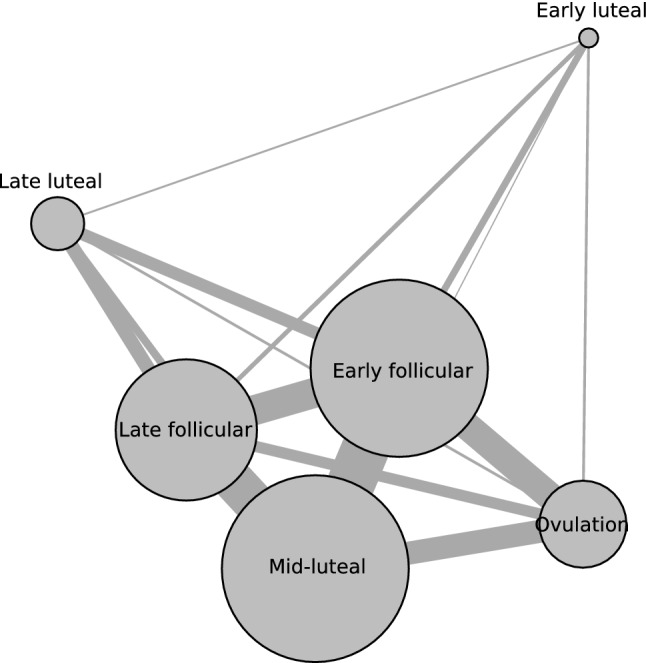
Background: Concentrations of endogenous sex hormones fluctuate across the menstrual cycle (MC), which could have implications for exercise performance in women. At present, data are conflicting, with no consensus on whether exercise performance is affected by MC phase. Objective: To determine the effects of the MC on exercise performance and provide evidence-based, practical, performance recommendations to eumenorrheic women. Methods: This review followed the Preferred Reporting Items for Systematic Reviews and Meta-Analyses (PRISMA) guidelines. Four databases were searched for published experimental studies that investigated the effects of the MC on exercise performance, which included at least one outcome measure taken in two or more defined MC phases. All data were meta-analysed using multilevel models grounded in Bayesian principles. The initial meta-analysis pooled pairwise effect sizes comparing exercise performance during the early follicular phase with all other phases (late follicular, ovulation, early luteal, mid-luteal and late luteal) amalgamated. A more comprehensive analysis was then conducted, comparing exercise performance between all phases with direct and indirect pairwise effect sizes through a network meta-analysis. Results from the network meta-analysis were summarised by calculating the Surface Under the Cumulative Ranking curve (SUCRA). Study quality was assessed using a modified Downs and Black checklist and a strategy based on the recommendations of the Grading of Recommendations Assessment Development and Evaluation (GRADE) working group. Results: Of the 78 included studies, data from 51 studies were eligible for inclusion in the initial pairwise meta-analysis. The three-level hierarchical model indicated a trivial effect for both endurance- and strength-based outcomes, with reduced exercise performance observed in the early follicular phase of the MC, based on the median pooled effect size (ES 0.5 = − 0.06 [95% credible interval (CrI): − 0.16 to 0.04]). Seventy-three studies had enough data to be included in the network meta-analysis. The largest effect was identified between the early follicular and the late follicular phases of the MC (ES 0.5 = − 0.14 [95% CrI: − 0.26 to − 0.03]). The lowest SUCRA value, which represents the likelihood that exercise performance is poor, or among the poorest, relative to other MC phases, was obtained for the early follicular phase (30%), with values for all other phases ranging between 53 and 55%. The quality of evidence for this review was classified as “low” (42%). Conclusion: The results from this systematic review and meta-analysis indicate that exercise performance might be trivially reduced during the early follicular phase of the MC, compared to all other phases. Due to the trivial effect size, the large between-study variation and the number of poor-quality studies included in this review, general guidelines on exercise performance across the MC cannot be formed; rather, it is recommended that a personalised approach should be taken based on each individual's response to exercise performance across the MC.
Overview
The claims and statistics of this paper haven’t been checked yet.
Run the check — free, no account needed. It reads the open-access text and checks the sources it cites.
Integrity signals
Registry
Cites
Statistics
Figures
Verification
Claims the paper makes
The claims and statistics of this paper haven’t been checked yet.
Run the check — free, no account needed. It reads the open-access text and checks the sources it cites.
Claims other papers make about this one
Each is checked against this paper’s own text: does it say what the citing paper says it does?
The source backs part of the claim, not all of it — or backs it for a different population, condition or comparison.
In the citing paper
“A Bayesian approach was selected because it estimates the full probability distribution of treatment effects rather than relying on binary significance testing, allowing more informative interpretation of effect sizes and associated uncertainty [40, 41].”
From The Effect of Different Psychological Interventions on Athletes' Competitive Anxiety: A Systematic Review and Bayesian Network Meta-Analysis. (2026) · cites this paper as [41]
Experimental — accuracy not yet measured
Self-check
Percentages, sums and reported differences re-computed from the paper’s own numbers.
The self-check needs the paper’s full text.
Citations
Cites
Preferred reporting items for systematic reviews and meta-analyses: the PRISMA Statement.
(2009) · PubMed Central · Cited by 44,859
Preferred reporting items for systematic reviews and meta-analyses: The PRISMA statement
Moher, D., Liberati, A., Tetzlaff, J., Altman, D. G., & the PRISMA Group* (2009) · Annals of Internal Medicine · doi:10.7326/0003-4819-151-4-200908180-00135 · Cited by 37,554
Gelman, A., Carlin, J. B., Stern, H. S., & Rubin, D. B. (2003) · doi:10.1201/9780429258480 · Cited by 27,276
Dermyshi, E., Wang, Y., Yan, C., Hong, W., Qiu, G., Gong, X., & Zhang, T. (2017) · Neonatology · doi:10.1159/000454668 · Cited by 24,586
GRADE guidelines: 1. Introduction—GRADE evidence profiles and summary of findings tables
Guyatt, G., Oxman, A. D., Akl, E. A., Kunz, R., Vist, G., Brozek, J., Norris, S., Falck-Ytter, Y., Glasziou, P., & deBeer, H. (2011) · Journal of Clinical Epidemiology · doi:10.1016/j.jclinepi.2010.04.026 · Cited by 10,681
brms : An R Package for Bayesian Multilevel Models Using Stan
Bürkner, P.-C. (2017) · Journal of Statistical Software · doi:10.18637/jss.v080.i01 · Cited by 9,476
GRADE guidelines: 3. Rating the quality of evidence
Balshem, H., Helfand, M., Schünemann, H. J., Oxman, A. D., Kunz, R., Brozek, J., Vist, G. E., Falck-Ytter, Y., Meerpohl, J., & Norris, S. (2011) · Journal of Clinical Epidemiology · doi:10.1016/j.jclinepi.2010.07.015 · Cited by 8,285
Downs, S. H., & Black, N. (1998) · Journal of Epidemiology and Community Health · doi:10.1136/jech.52.6.377 · Cited by 8,252
Salanti, G., Ades, A. E., & Ioannidis, J. P. A. (2011) · Journal of Clinical Epidemiology · doi:10.1016/j.jclinepi.2010.03.016 · Cited by 3,766
Norderyd, O. M., Koch, G., Papias, A., Köhler, A. A., Helkimo, A. N., Brahm, C., Lindmark, U., Lindfors, N., Mattsson, A., Rolander, B., et al. (2015) · PubMed · Cited by 3,584
Research works printed but not linked: 3
- Cohen J. Statistical power analysis for the social sciences. 2nd ed. New Jersey: Lawrence Erlbaum Associates; 1988.
- Grucza R, Pekkarinen H, Hanninen O. Cardiorespiratory responses to bicycle incremental exercise in women taking oral contraceptives. Biol Sport. 2002;19(3):267–79.
- Masterson G. The impact of menstrual phases on anaerobic power performance in collegiate women. J Strength Cond Res. 1999;13(4):325–9.
Cited by
Sorted by citations
Items 501–600 of 810
Albalad-Aiguabella, R., Mainer-Pardos, E., Uribarri, H. G., Vicente‐Rodríguez, G., & Muñiz-Pardos, B. (2026) · The Journal of Strength and Conditioning Research · doi:10.1519/jsc.0000000000005345 · Cited by 1
Perlet, M. R., Mendonça, L. I., Hosick, P. A., Licameli, N. M., & Matthews, E. L. (2026) · The Journal of Strength and Conditioning Research · doi:10.1519/jsc.0000000000005364 · Cited by 1
An Overview of the Impact of the Menstrual Cycle on Nutrient Metabolism: An Integrative Perspective
García-Montero, C., Castro-Martinez, P. D., Boaru, D. L., Ortega, M. A., & Fraile‐Μartinez, O. (2026) · Nutrients · doi:10.3390/nu18071063 · Cited by 3
Nose-Ogura, S., Kawabe, R., Nakamura, Y., Nakamura, M., Tomori, A., Shirai, K., & Nakajima, K. (2026) · Women's Health · doi:10.1177/17455057261440253 · Cited by 1
Menstrual Health and Sports Performance Research; Do We Need to Broaden Our Approach?
Noordhof, D. A., Bruinvels, G., Lamberts, R. P., & Taipale, R. S. (2026) · International Journal of Sports Physiology and Performance · doi:10.1123/ijspp.2025-0661 · Cited by 1
Gassner, M., Diewald, J., Leichtfried, L., Zeller, L., Ryan, S., Wagner, K.-H., & König, D. (2026) · Sports · doi:10.3390/sports14050168 · Cited by 1
“In contrast, a systematic review and meta-analysis suggested that exercise performance may be slightly impaired during the early follicular phase compared to other phases [35].”
Cichoń-Woźniak, J., Dziewiecka, H., Ostapiuk–Karolczuk, J., Mydłowska, M., Szymańczuk, M., & Skarpańska-Stejnborn, A. (2026) · Frontiers in Physiology · doi:10.3389/fphys.2026.1705876 · Cited by 2
Liebrenz, E., Smith, A. J., Liebrenz, M., Colangelo, J., & Buadze, A. (2026) · Sports · doi:10.3390/sports14050173 · Cited by 1
“Practices ranged from structured cycle-based periodisation to intuitive daily shifts based on symptoms, with some athletes dismissing them entirely when discerning little difference across their cycle; this aligns with cautions in the literature against blanket cycle-based directives [20].”
InfluentialSorensen, B. M., Meijen, C., Winter, S., & Martin, E. A. (2026) · International Journal of Sport and Exercise Psychology · doi:10.1080/1612197x.2026.2662262 · Cited by 2
Tan, Z. S., Burns, S. F., Lee, Y. X., & Goodwill, A. M. (2026) · Frontiers in Nutrition · doi:10.3389/fnut.2026.1817134 · Cited by 1
“Using an adapted two item questionnaire to assess methodological quality of determining menstrual cycle phases (31), all nine studies scored 0 out of 2, indicating that none of them determined the menstrual cycle phase via hormonal concentrations from blood profiles or via urinary ovulation test…”
InfluentialMunteanu, G., Halson, S. L., Huynh, M., Jukić, I., García‐Ramos, A., Fernandez, F., Cowley, N., & Weakley, J. J. S. (2026) · Sports Medicine · doi:10.1007/s40279-026-02459-8 · Cited by 1
“However, evidence is mixed regarding whether phase-dependent changes in hormone concentrations across the menstrual cycle can influence physical performance [1, 4–6].”
Jones, E. S., Goldsmith, E., Harrison, S. E., & Brown, N. (2026) · Journal of Sports Sciences · doi:10.1080/02640414.2026.2668818 · Cited by 1
“● Currently, research does not support a phase-based approach to exercise training (Colenso-Semple et al., 2023; McNulty et al., 2020).”
Yeh, K.-T., Cheng, H.-C., Tsai, S., Yu, P.-H., Kuo, Y.-C., & Liu, H. (2026) · The Journal of Strength and Conditioning Research · doi:10.1519/jsc.0000000000005598 · Cited by 1
Papadakis, Z., & Stamatis, A. (2026) · Sports · doi:10.3390/sports14070282 · Cited by 1
“Group-level performance effects of the menstrual cycle on objective aerobic metrics are often small or inconsistent, yet individual psychological states and performance capacities can vary dynamically across phases [43,45,46].”
Osmani, F., García, M. V. S., & Ramos-Álvarez, O. (2026) · Sports · doi:10.3390/sports14070297 · Cited by 1
Mănescu, D. C., Cerullo, G., Petri, C., Petcu, C., Bidiugan, R., Voinea, A., Bidiugan, S., IACOBINI, A. R., Dragomir, A., Gavrila, A. A., et al. (2026) · Nutrients · doi:10.3390/nu18152523 · Cited by 1
Understanding working conditions in elite women’s football: a scoping review
Le, C. Y., Culvin, A., Brown, F. F., Kryger, K. O., Gledhill, A., Gouttebarge, V., & Emmonds, S. (2026) · Science and Medicine in Football · doi:10.1080/24733938.2026.2713527 · Cited by 2
The internal and external characteristics of female netball match-play: A systematic review
Thomas, N., Read, D. B., Barke, A. J., & Dos’Santos, T. (2026) · Journal of Sports Sciences · doi:10.1080/02640414.2026.2728786 · Cited by 1
“…female athletes, including menstrual cycle phase, hormonal fluctuations, and contraceptive use, are rarely reported or controlled for, despite their potential effects on cardiovascular strain, joint laxity, neuromuscular function, and recovery capacity (Blagrove et al., 2020; McNulty et al., 2020).”
InfluentialMask, M. L., Alghamdi, B. A., Killen, L. G., Green, J. M., O'Neal, E. K., & Waldman, H. S. (2021) · International journal of exercise science · doi:10.70252/acfc7229 · Cited by 1
“the experimental trials was standardized for each participant however, the menstrual cycle phase was not standardized due to a lack of data demonstrating statistical differences in markers of female performance across the menstrual cycle (26).”
MethodWeight Class and Menstrual Symptoms in Female Judo Athletes
Itaka, T., Fujihira, K., Kawauchi, Y., Okawa, Y., Miyazaki, S., & Tsukada, M. (2022) · Asian Journal of Sports Medicine · doi:10.5812/asjsm-120184 · Cited by 1
“A recent review reported a decrease in performance during the early follicular phase (2).”
BackgroundMethodThe Effect of the Menstrual Cycle on Exercise and Sports Performance
Hicks, K. M., McNulty, K. L., & Ansdell, P. (2023) · Springer eBooks · doi:10.1007/978-3-031-21881-1_11 · Cited by 1
Self-citationGINECOLOGIA DO ESPORTE: UMA NOVA MANEIRA DE OTIMIZAR O CUIDADO E A PERFORMANCE DA MULHER ATLETA
Parmigiano, T. R., de Araújo, M. P., Benayon, P. C., Corrêa, R. P. F., Barsottini, C., & Sartori, M. G. F. (2023) · Revista Brasileira de Medicina do Esporte · doi:10.1590/1517-8692202430012022_0418p · Cited by 1
SPORTS GYNECOLOGY: A NEW WAY TO IMPROVE FEMALE ATHLETES CARE AND PERFORMANCE
Parmigiano, T. R., de Araújo, M. P., Benayon, P. C., Corrêa, R. P. F., Barsottini, C., & Sartori, M. G. F. (2023) · Revista Brasileira de Medicina do Esporte · doi:10.1590/1517-8692202430012022_0418i · Cited by 1
Impact of menstrual cycle on smoking cessation: A review
Núñez-Lauriano, M., Mandujano, J. L., Míguez, M. C., & Tiburcio, M. (2023) · Salud Mental · doi:10.17711/sm.0185-3325.2023.041 · Cited by 1
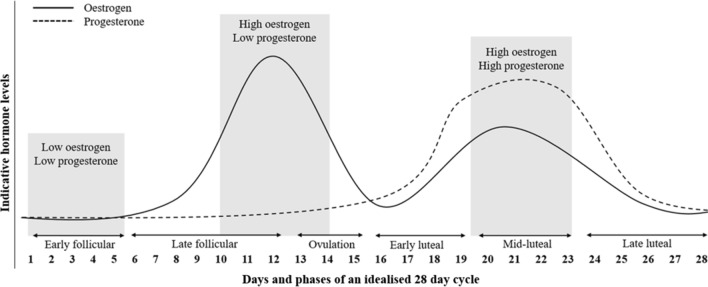
“The late follicular phase occurs until day 14 and is characterized by a peak in estradiol levels and fi - nally, in the mid luteal phase, progesterone peaks and ends on approximately day 28 (Allen et al., 2016; McNulty et al., 2020).”
Os impactos do ciclo menstrual na performance de atletas eumenorréicas: Uma revisão narrativa
Ramalho, C. H. C. D. O., Carvalho, N., & Ferreira, P. A. (2023) · Research Society and Development · doi:10.33448/rsd-v12i13.44226 · Cited by 1
Pham, K. H., Nguyen, T. H., Vi, T., Ly, H. H. V., Phung, T. M., Pham, D. N. P., & Cooper, S. J. (2024) · Current Women s Health Reviews · doi:10.2174/0115734048305970240325154923 · Cited by 1
The Evaluation of Menstrual Alterations in Mexican Women After Vaccination Against COVID-19
Contreras-Rendon, A., García, E., & Olguín-Ortega, A. (2024) · Cureus · doi:10.7759/cureus.58783 · Cited by 1
“Additionally, the US Vaccine Adverse Event Reporting System (VAERS) has documented similar reports [8].”
BackgroundValente, J. S., Moreira, O. C., da Costa, B. D. D., & de Oliveira, C. E. P. (2024) · Cuadernos de Educación y Desarrollo · doi:10.55905/cuadv16n5-045 · Cited by 1
Groff, C., Ieno, C., Romagnoli, R., Lista, M., Sgrò, P., Pittaccio, F., Luigi, L. D., & Fattorini, L. (2024) · Journal of Women s Sports Medicine · doi:10.53646/7xj3ry38 · Cited by 1
“15,16,18 Following this statements, follicular phase should be a favorable moment for training adaptations than luteal phase, and the beneficial effect of estrogen should be greater during late follicular phase and during ovulatory phase, when progesterone is lower.”
BackgroundInfluentialNo effect of aerobic fitness on exercise-induced diaphragm fatigue in females
Payne, O. T., Leahy, M. G., Burr, J. F., ROAD, J. D., McKenzie, D. C., & Sheel, A. W. (2024) · Journal of Applied Physiology · doi:10.1152/japplphysiol.00239.2024 · Cited by 1
The Association of Salivary Estradiol Levels with Anterior Cruciate Ligament Stiffness and Laxity
Smith, K., Miller, N., Laslovich, S., & Body, Y. (2024) · Journal of Women s Sports Medicine · doi:10.53646/atq23m66 · Cited by 1
Brown, G. A., Fullagar, H. H. K., & Duffield, R. (2025) · Scandinavian Journal of Medicine and Science in Sports · doi:10.1111/sms.70011 · Cited by 2
Considerations for the Rehabilitation Management of the Female Athlete
Schroeder, A. N., Graff, C. J., & Guyler, M. R. (2025) · Physical Medicine and Rehabilitation Clinics of North America · doi:10.1016/j.pmr.2024.11.012 · Cited by 1
Bockshecker, A., Nissen, A., & Smolnik, S. (2025) · Lecture notes in information systems and organisation · doi:10.1007/978-3-031-71385-9_22 · Cited by 1
Storme, F., Chassard, T., Dupuit, M., Larochelambert, Q. D., Brunet, E., Sachet, I., Toussaint, J., & Antero, J. (2025) · Scandinavian Journal of Medicine and Science in Sports · doi:10.1111/sms.70045 · Cited by 1
Chalke, A. M., Linde-Krieger, L. B., Allen, A. M., & Nair, U. S. (2025) · Nicotine & Tobacco Research · doi:10.1093/ntr/ntaf081 · Cited by 1
Kadın Sporcularda Menstrual Siklusun Farklı Fazlarının Bazı Performans Parametreleri Üzerine Etkisi
Kanik, G., & Mor, A. (2025) · Spor ve Performans Araştırmaları Dergisi · doi:10.17155/omuspd.1604320 · Cited by 1
Brefin, S. L., Anderegg, J., Nigg, C. R., Koschnick, D., Paul, C., & Ketelhut, S. (2025) · International Journal of Sports Science & Coaching · doi:10.1177/17479541251349332 · Cited by 1
Female Athlete Physiology: Addressing Gaps in Injury Prevention, Training, and Recovery
Ahmed, R. (2025) · Premier Journal of Sports Science · doi:10.70389/pjsps.100001 · Cited by 1
Goepp, T., Hayes, M., Domenico, H. D., Millet, G. Y., Hot, P., & Rupp, T. (2025) · International Journal of Sports Physiology and Performance · doi:10.1123/ijspp.2025-0022 · Cited by 1
Vascular adaptation in elite female and male rowers across a competitive season
Henley-Martin, S. R., Brade, C. J., Riddell, H., Watts, S. P., Maiorana, A., Naylor, L. H., Binnie, M. J., & Spence, A. L. (2025) · Current Research in Physiology · doi:10.1016/j.crphys.2025.100164 · Cited by 1
“This study aimed to address the methodological considerations for female participants and included menstrual status data, highlighting the importance of transparency when including female population (McNulty et al., 2020; Smith et al., 2022).”
Jarstad, E. (2025) · Czech Polar Reports · doi:10.5817/cpr2025-1-5 · Cited by 1
Abbotts, K. S. S., Hudgins, J. H., Viveros, I. S., Minson, C. T., Wilkins, B. W., & Halliwill, J. R. (2025) · Physiological Reports · doi:10.14814/phy2.70587 · Cited by 2
Bougrine, H., Gandouzi, I., Dergaa, I., Maitre, J., Alaizari, A. A., Aljuhani, O. E., Paillard, T., & Souissi, N. (2025) · Scientific Reports · doi:10.1038/s41598-025-21414-7
Effect of Menstrual Cycle on Sport Performance in Archers
Ondokuz, P. A. (2020) · AMBIENT SCIENCE · doi:10.21276/ambi.2020.07.sp1.oa27 · Cited by 1
The effects of menstrual cycle phase on physical performance in female rugby athletes: A case-study
Sella, F. S., Beaven, C. M., Sims, S. T., McMaster, D. T., Gill, N., & Hébert‐Losier, K. (2021) · The Journal of Sport and Exercise Science · doi:10.36905/jses.2021.05.01 · Cited by 1
“…findings are likely attributable to differences in study design, participants’ characteristics, number and definition of menstrual cycle phases, phase verification methods, variables measured, and relatively small sample sizes (de Jonge et al., 2019; Julian et al., 2017; McNulty et al., 2020).”
Umutoni, J. (2023) · Journal of Finance and Accounting · doi:10.53819/81018102t4154 · Cited by 1
(2023) · SCIENCE AND SPORT current trends · doi:10.36028/2308-8826-2023-11-3-93-99 · Cited by 1
Peters, L., & Klatt, S. (2023) · Zeitschrift für Sportpsychologie · doi:10.1026/1612-5010/a000400 · Cited by 1
The menstrual cycle- a neglected and taboo topic in sports and exercise – Editorial
Fridén, C. (2024) · European Journal of Physiotherapy · doi:10.1080/21679169.2024.2320051 · Cited by 1
“However, there is still conflicting results if and how the varying female sex hormones during the menstrual cycle affect training and performance [8,9].”
BackgroundThe influence of exercise-induced dehydration on cognitive performance in women
Doohan, M. A. (2024) · Queensland University of Technology · doi:10.5204/thesis.eprints.249218 · Cited by 1
Csontos, J. K., Edwards, D. J., Gillen, E., Hounsome, J. C., Kiseleva, M., Mann, M. K., Sidhu, A., Macey, S. M., Lewis, R. A., Edwards, A., et al. (2024) · medRxiv · doi:10.1101/2024.09.02.24311982 · Cited by 1
PARTEN, A. L., SMITH-RYAN, A. E., SANCHEZ, K. M., HEARD, S. A., O’NEAL, E. K., MCALLISTER, M. J., LYONS, T. S., & WALDMAN, H. S. (2026) · Medicine & Science in Sports & Exercise · doi:10.1249/mss.0000000000004022
Influence of hormonal variations on the performance and pacing of female cyclists in the heat
Hutchins, K. P. (2021) · Queensland University of Technology · doi:10.5204/thesis.eprints.207214
CICLO MENSTRUAL E O EXERCÍCIO FÍSICO
da Silva, R. E. R., Fernandes, M. H., Couto, L. D. B., & Venâncio, P. E. M. (2021) · doi:10.22533/at.ed.87721280918
Evolution of Research on Elite Adult Athlete Sleep: A Systematic Review
Silva, A. C., Facundo, L. A., Amaral, A. S., Borba, D., Rosa, J., Silva, A., & de Mello, M. D. (2021) · International Journal of Sports and Exercise Medicine · doi:10.23937/2469-5718/1510204 · Cited by 1
Romero‐Parra, N. (2020) · doi:10.20868/upm.thesis.65971
The Relationship Between Physical Activity and Premenstrual Syndrome in Female College StudentsPreprint
Chen, C. Y., Kawabe, R., Morino, S., Nagai‐Tanima, M., Aoyama, T., Mukaiyama, K., Shinohara, Y., Shimizu, H., Shimoura, K., & Kato, M. (2022) · Research Square · doi:10.21203/rs.3.rs-1248368/v1
Women in Sports and Exercise: From Health to Sports Performance
(2022) · MDPI eBooks · doi:10.3390/books978-3-0365-3132-8 · Cited by 2
Mind-Body Interactions Across the Menstrual Cycle Phases: A Systematic Review
Borlimi, R., Riboli, G., Nese, M., Buattini, M., Colombardo, M., & Brighetti, G. (2022) · OBM Integrative and Complementary Medicine · doi:10.21926/obm.icm.2202014
Do the different menstrual cycle phases influence CrossFit® performance?Preprint
Sacon, H. R. M., Peserico, C. S., & Machado, F. A. (2022) · Research Square · doi:10.21203/rs.3.rs-1815604/v1
Nardon, M., Venturelli, M., Ruzzante, F., Longo, V. D., & Bertucco, M. (2022) · European Journal of Applied Physiology · doi:10.1007/s00421-022-05015-0
Ghalayini, D., & Kaplan, S. (2022) · Türkiye Sağlık Bilimleri ve Araştırmaları Dergisi · doi:10.51536/tusbad.1110598
Tsyhanenko, O. I., Pershehuba, Y. V., Богданович, Л., & Склярова, Н. А. (2022) · Reproductive Endocrinology · doi:10.18370/2309-4117.2022.65.122-127
Domestic and International Pilates Research Trends: A Review of Literature in Natural Science
Park, B., Seon, S., & Yun, S. (2023) · The Asian Journal of Kinesiology · doi:10.15758/ajk.2023.25.1.27
EXPERIENCIAS Y PERCEPCIONES DEL CICLO MENSTRUAL DE MUJERES QUE REALIZAN ENTRENAMIENTO DE FUERZA.
BUONO, B., ERDOCIAÍN, L., ADORANTE, H., & RENDA, J. (2023) · Fiep Bulletin - online · doi:10.16887/93.a1.28
Reynolds, K. M., Juett, L. A., Funnell, M. P., Schofield, J. B., Grundig, C., Melidis, G., Brown, A., Hubbard, W., Luo, Y., Almahaireh, I., et al. (2023) · European Journal of Sport Science · doi:10.1080/17461391.2023.2207074
Supriadi, D. (2023) · Jurnal SPORTIF Jurnal Penelitian Pembelajaran · doi:10.29407/js_unpgri.v9i1.19066
Pregnancy and Other Considerations for the Female Endurance Athlete
Mottola, M. F., Thornton, J. S., & Davenport, M. H. (2023) · Springer eBooks · doi:10.1007/978-3-031-26600-3_7
Katrics, P., Laczkó, A., GOMBOS, Z., Béres, S., Tóth, L., Bogár, L., Márton, L., & Benczenleitner, O. (2021) · Acta Universitatis de Carolo Eszterházy Nominatae Sectio Sport · doi:10.33040/actauniveszterhazysport.2023.51.7
Чистякова, М. (2023) · Спортивна медицина фізична терапія та ерготерапія · doi:10.32652/spmed.2023.1.48-52
Epilogue: “How We Arrived at This Point in Time”
Lebrun, C. M. (2023) · Springer eBooks · doi:10.1007/978-3-031-21881-1_24
RELAÇÕES ENTRE O CICLO HORMONAL DA MULHER E DESEMPENHO ESPORTIVO DE PRATICANTES DE EXERCÍCIOS
Rangel, K. L., dos Santos, C. E. R., de Jesus, C. G., Dutilh, C. F. T., & Mendes, M. R. (2023) · doi:10.22533/at.ed.9742314064
INFLUÊNCIA DA ACUPUNTURA NA RESISTÊNCIA MUSCULAR DE ATLETAS: UMA REVISÃO DE LITERATURA
Gonçalves, M. A. C. (2023) · doi:10.22533/at.ed.9742314063
Educação física e qualidade de vida: reflexões e perspectivas atuais 2
da Silva, C. L. (2023) · doi:10.22533/at.ed.974231406
OVERTRAINING E O MÉTODO DE-LOAD ESTRATÉGIAS PARA A RECUPERAÇÃO E REPARAÇÃO MUSCULAR E ARTICULAR
Reis, M. B., Silva, J. M., & Cury, J. L. (2023) · doi:10.22533/at.ed.9742314065
QUALIDADE DE VIDA, ATIVIDADE FÍSICA E LAZER
de Paula, M. T., dos Santos, M. G., & da Silva, C. L. (2023) · doi:10.22533/at.ed.9742314061
Menstrual cycle changes among female athletes post a traumatic brain injury: A systematic review
Abuelhaija, Y., Alzaqh, M., Al-Bataineh, H. A., Mustafa, A., Al-Bkoor, T., Omeish, H. A., Jarrar, Y., Obeidat, M., Khafaja, A. M., Mistarihi, B. M., et al. (2023) · World Journal of Advanced Research and Reviews · doi:10.30574/wjarr.2023.18.3.1256
Activity Patterns Become a Main Factor in Adolescent Menstrual Cycle Changes
Sholihah, A. N. (2023) · Advances in health sciences research/Advances in Health Sciences Research · doi:10.2991/978-94-6463-190-6_39
Influence of the menstrual cycle on crawl performance in young female swimmers
Rodrigo-Mallorca, D., Crespo-Ojeda, D., Alonso Aubin, D. A., & Chulvi Medrano, I. (2023) · Journal of Physical Education and Sport · doi:10.7752/jpes.2023.07218
Metabolic characteristics of the body of athletes specializing in judo during anaerobic loading
Чистякова, М., Совтисік, Д., Нonshovskyi, V., Ladyniak, A., Гурман, Л., Marchuk, V., Marchuk, D., Makarchuk, B., Tereschenko, O., & Berezhok, S. (2023) · This bulletin of the Kamianets-Podilskyi National Ivan Ohiienko University Physical education Sport and Human Health · doi:10.32626/2309-8082.2023-28(2).130-135
Geschlechtsbezogene Aspekte im Sport
Platen, P., Ferrari, N., & Joisten, C. (2023) · Springer eBooks · doi:10.1007/978-3-662-62496-8_24
Zago, L. C., Lima-Trostdorf, T., & Macedo, C. D. S. G. (2023) · Semina Ciências Biológicas e da Saúde · doi:10.5433/1679-0367.2023v44n1p81
La influencia del ciclo menstrual en el entrenamiento de fuerza: revisión bibliográfica
de la Parte, D. D. L. F., Osmani, F., & Lago‐Fuentes, C. (2023) · MLS Sport Research · doi:10.54716/mlssr.v3i1.1719
Knieverletzungen bei Fußballerinnen
Hüppmeier, E.-M., & Halsband, B. (2024) · DO - Deutsche Zeitschrift für Osteopathie · doi:10.1055/a-2167-7146
Lee, S. J. L., van Rens, F. E. C. A., & Peiffer, J. J. (2024) · International Journal of Sports Physiology and Performance · doi:10.1123/ijspp.2023-0143
Cecchetto, C., Leleu, A., Calce, R. P., Arnhardt, S., Parma, V., de Groot, J. H. B., Freiherr, J., Gentili, C., Zou, L., Thunell, E., et al. (2024) · doi:10.31219/osf.io/xwgrf
Is menstrual cycle misunderstanding a bias for ergogenic aids use? A cross sectional study
de Oliveira, G. T., Leite, L. H. R., de Souza, H. L. R., Meireles, A. A. F. D. M., dos Santos, M. P., Ferreira, R. M., & Marocolo, M. (2024) · Cuadernos de Educación y Desarrollo · doi:10.55905/cuadv16n2-064
Einfluss von Umwelt und Lebensstil auf die endokrine und reproduktive Funktion
Weiss, J. M. (2024) · Springer eBooks · doi:10.1007/978-3-662-65517-7_9
Rilling, A., & Power, G. A. (2024) · bioRxiv (Cold Spring Harbor Laboratory) · doi:10.1101/2024.06.10.598231
“Menstrual cycle phases are highly variable; therefore, calendar counting may be inaccurate [28].”
BackgroundШахліна, Л., Чистякова, М., Коломієць, Т., & Гуска, М. (2024) · Спортивна медицина фізична терапія та ерготерапія · doi:10.32652/spmed.2024.1.78-82
赵, 菊. (2024) · Journal of Clinical Personalized Medicine · doi:10.12677/jcpm.2024.32060
Nieto-Acevedo, R. (2024) · UPM Digital Archive (Technical University of Madrid) · doi:10.20868/upm.thesis.81737
EXERCÍCIO FÍSICO NO CICLO MENSTRUAL E SAÚDE DA MULHER: REVISÃO
de Jesus, E. E. D., Bernardi, I. T. D. B., Brasilino, F. F., & Morales, P. (2024) · Fiep Bulletin - online · doi:10.16887/fiepbulletin.v94i2.7021
SantaBarbara, K., Helms, E. R., STEWART, T. I., Armour, M., & HARRIS, N. K. (2024) · The Journal of Sports Medicine and Physical Fitness · doi:10.23736/s0022-4707.24.15752-0 · Cited by 1
IMPACT OF MENSTRUAL LUTEAL PHASE ON INSTANTANEOUS MUSCLE TORQUE
(2024) · Egyptian Journal of Applied Science · doi:10.21608/ejas.2024.361614
Newbould, S., Walker, J., Dinsdale, A. J., Whitehead, S., & Nicholson, G. (2024) · bioRxiv (Cold Spring Harbor Laboratory) · doi:10.1101/2024.06.23.600286
Metadata
- Authors
- McNulty, K. L., Elliott-Sale, K. J., Dolan, E., Swinton, P. A., Ansdell, P., Goodall, S., Thomas, K., & Hicks, K. M.
- Affiliations
- Northumbria University (GB)
- Nottingham Trent University (GB)
- Universidade de São Paulo (BR)
- Robert Gordon University (GB)
- Corresponding author
- Elliott-Sale, Kirsty Jayne
- ORCID
- Venue
- Sports Medicine
- Published
- 2020-07-13
- Volume
- 50
- Issue
- 10
- Pages
- 1813-1827
- ISSN
- 0112-1642 (ISSN-L)
- 1179-2035
- PMC
- PMC7497427
- OpenAlex
- W3038797657
- Cited by
- 812
- References
- 127
- Citations by year
- 2026: 183 · 2025: 181 · 2024: 153 · 2023: 136 · 2022: 72 · 2021: 70 · 2020: 17
- FWCI
- 14.50
- Type
- journal article
- Language
- en
- Open access
- hybrid
- doi.org
- Locations
- Sports Medicine (publishedVersion, cc-by)
- PubMed Central (publishedVersion, cc-by)
- PubMed (publishedVersion)
- Nottingham Trent University's Institutional Repository (Nottingham Trent Repository) (acceptedVersion)
- Northumbria Research Link (Northumbria University) (acceptedVersion)
- Open Access Institutional Repository at Robert Gordon University (Robert Gordon University) (submittedVersion, cc-by)
- Funders
- Fundação de Amparo à Pesquisa do Estado de São Paulo (19/05616-6, 2019/, 2019/05616)
- Topics
- Health Sciences › Medicine › Orthopedics and Sports Medicine › Sports Performance and Training
- Health Sciences › Medicine › Physiology (medical) › Cardiovascular and exercise physiology
- Health Sciences › Medicine › Public Health, Environmental and Occupational Health › Menstrual Health and Disorders
- Keywords
- menstrual cycle phases, exercise performance, eumenorrheic women, sex hormones, follicular phase, luteal phase, endurance performance, strength performance
- MeSH terms
- Female, Humans, Menstrual Cycle, Exercise, Athletic Performance
About these checks
Registry, retraction, Cites and statistics results are computed, not judged, with one exception: a printed reference that no index lists is read once by a model before it counts as a citation error. Claims are extracted by a model and kept only when their quote appears verbatim in the text; each cited source is then checked, with a model’s help, for whether it says what the claim relies on. Those verdicts can be wrong — read the claim’s quote and the cited source before relying on one.
Statistics and arithmetic are recomputed, not judged.
Confidence bands are shown only for fields calibrated on our annotated test set. None is calibrated yet, so no band is shown.
What counts as a claim ›How we measure confidence ›How we check this ›
Are you an author, or do you see a problem with this page? Request a review
