

Organizational resilience: a capability-based conceptualization
Open accessThe DOI matches its Crossref record; 206 of the 209 references it cites were found in a registry or an index, and 2 are not checked yet; none of the 106 sources its claims cite is checked for support yet.
Abstract
In highly volatile and uncertain times, organizations need to develop a resilience capacity which enables them to cope effectively with unexpected events, bounce back from crises, and even foster future success. Although academic interest in organizational resilience has steadily grown in recent years, there is little consensus about what resilience actually means and how it is composed. More knowledge is particularly needed about organizational capabilities that constitute resilience, as well as conditions for their development. This paper aims to make a contribution to this heterogeneous research field by deepening the understanding of the complex and embedded construct of organizational resilience. We conceptualize resilience as a meta-capability and decompose the construct into its individual parts. Inspired by process-based studies, we suggest three successive resilience stages (anticipation, coping, and adaptation) and give an overview of underlying capabilities that together form organizational resilience. Based on this outline, we discuss relationships and interactions of the different resilience stages as well as main antecedents and drivers. We formulate propositions that can act as a foundation for future empirical work.
Checked 2026-11-22 · 2 references not checked yet
Overview
CoChat Summary
## TL;DR
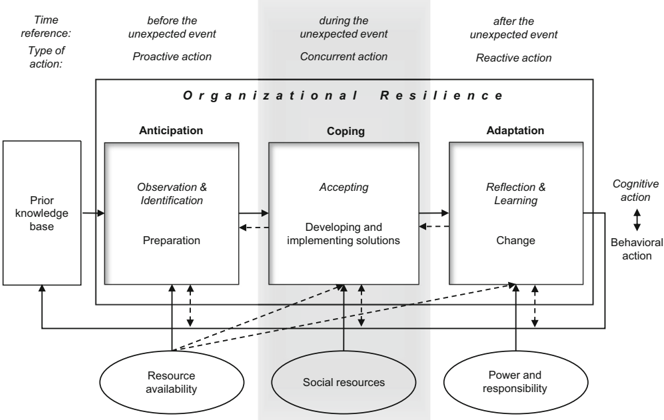
This is a conceptual paper that reframes organizational resilience as a meta-capability made up of three stages: anticipation, coping, and adaptation. It argues that resilience depends on specific underlying capabilities plus antecedents such as knowledge base, resources, social resources, and power/responsibility, and it ends by proposing propositions for future empirical work.
## Key findings
- The paper defines organizational resilience as an organization’s ability to anticipate potential threats, cope effectively with adverse events, and adapt to changing conditions.
- It decomposes resilience into three successive stages: anticipation, coping, and adaptation, and argues these stages overlap and build on each other; for example, anticipation influences coping and coping influences adaptation.
- The paper identifies capability clusters for each stage:
- anticipation: observation and identification, preparation
- coping: accepting, developing and implementing solutions
- adaptation: reflection and learning, organizational change
- It argues that resilience is a meta-capability requiring a combination of capabilities across all three stages; anticipation creates “resilience potential,” but coping and adaptation are needed to realize and improve it.
## Methods
- Conceptual/theoretical review paper, not an empirical study.
- Synthesizes literature from organizational resilience and related areas such as business continuity management, crisis management, innovation management, public administration, and organizational learning.
- Builds a conceptual framework and formulates propositions about antecedents and drivers, including:
- Proposition 1: knowledge base as an antecedent
- Proposition 2: resource availability
- Proposition 3: social resources
- Proposition 4: power based on expertise and shared responsibilities
## Limitations
- The paper explicitly notes that future research is needed to test the framework empirically and develop questionnaires; it says the framework is a first step toward a resilience theory rather than a final one.
- It states that much of the prior literature is fragmented, prescriptive/normative, and often retrospective, and that there is little knowledge about how resilience works in practice; this is the gap the paper tries to address.
- Evident from the text: the paper is entirely conceptual and does not present new data, sample, or statistical tests.
Model-written summary. Check it against the paper before relying on it.
Integrity signals
Registry
Cites
Statistics
Figures
Verification
Claims the paper makes
0 Valid · 4 Not valid · 58 Not checked · 67 Own results and interpretations
A conclusion the paper draws from its own results — it cites no other source for it, so there is none to check. The quote shows it is in the paper.
In the paper
“we suggest three successive stages of the resilience process (see Fig. 1) and argue that resilient organizations respond not only to the past (reactive action) or to current issues (concurrent action), but also to the future (anticipatory action).”
§ Organizational resilience: a capability-based conceptualization > 3.1 Fundamentals of the framework
hedgedstates a cause- Asserted: passes — The authors put it forward as true.
- Checkable: passes — It can be checked against evidence.
- Load-bearing: passes — The paper’s conclusions depend on it.
- Based: passes — The paper gives a reason why it holds.
None of the sources cited for this claim have been checked yet.
In the paper
“Most studies just point to organizational characteristics, resources, or processes that seem to be significant for resilience (e.g., Weick 1993;Kendra and Wachtendorf 2003;Gittell et al. 2006).This means that resilience is simply treated as an outcome-when organizations perform well during crisis or bounce back from interruptions (e.g., Horne and Orr 1998).”
- Also stated in: § 2.2 Previous conceptualizations of organizational resilience · plain
“Most studies treat resilience as an outcome-when organizations perform well during crisis or bounce back from interruptions (e.g., Horne and Orr 1998).”
§ Organizational resilience: a capability-based conceptualization > 1 Introduction
What the sources say
- Not matchedcites Horne and Orr 1998
An author–year citation the paper’s reference list doesn’t settle. We don’t search these by name.
- Not checked — no full text of the sourcecites Boin and van Eeten 2013 matched to “The Resilient Organization” (2013) source
- Not checked — no full text of the sourcecites Duit 2016 matched to “RESILIENCE THINKING: LESSONS FOR PUBLIC ADMINISTRATION” (2016) source
plain- Asserted: passes — The authors put it forward as true.
- Checkable: passes — It can be checked against evidence.
- Load-bearing: passes — The paper’s conclusions depend on it.
- Based: passes — The paper gives a reason why it holds.
- Also stated in: § 2.2 Previous conceptualizations of organizational resilience · plain
None of the sources cited for this claim could be matched to a paper, so there is nothing to check it against.
In the paper
“Depending on its specific configuration, resilience can be a source of sustainable competitive advantage (Hamel and Vaelikangas 2003;Sheffi 2007) and, thus, explain why some firms are more successful than others.”
§ Organizational resilience: a capability-based conceptualization > 2.1 Definitions of organizational resilience
What the sources say
- Not matchedcites Hamel and Vaelikangas 2003
An author–year citation the paper’s reference list doesn’t settle. We don’t search these by name.
- Not matchedcites Sheffi 2007
An author–year citation the paper’s reference list doesn’t settle. We don’t search these by name.
plainstates a possible cause- Asserted: passes — The authors put it forward as true.
- Checkable: passes — It can be checked against evidence.
- Load-bearing: passes — The paper’s conclusions depend on it.
- Based: passes — The paper gives a reason why it holds.
- Not matched
In the paper
“Organizational resilience capabilities develop over time and emerge from the process of coping with threatening situations and unexpected events (Linnenluecke et al. 2012).”
§ Organizational resilience: a capability-based conceptualization > 3.1 Fundamentals of the framework
What the sources say
- Not checked — no full text of the sourcecites Linnenluecke et al. 2012 matched to “Extreme Weather Events and the Critical Importance of Anticipatory Adaptation and Organizational Resilience in Responding to Impacts” (2012) source
plainstates a cause- Asserted: passes — The authors put it forward as true.
- Checkable: passes — It can be checked against evidence.
- Load-bearing: passes — The paper’s conclusions depend on it.
- Based: passes — The paper gives a reason why it holds.
A claim is checked only against the cited paper’s full text, never its abstract, and none is available for its sources.
In the paper
“research shows that newly developed solutions-regardless of how carefully they are designed-do not automatically lead to changes in the organizational patterns of action (Feldman 2003;Howard-Grenville 2005;Pentland and Feldman 2008).”
§ Organizational resilience: a capability-based conceptualization > 3.2.2 Coping capabilities
What the sources say
- Not checked — no full text of the sourcecites Feldman 2003 matched to “A performative perspective on stability and change in organizational routines” (2003) source
- Not checked — no full text of the sourcecites Howard-Grenville 2005 matched to “The Persistence of Flexible Organizational Routines: The Role of Agency and Organizational Context” (2005) source
- Not checked — no full text of the sourcecites Pentland and Feldman 2008 matched to “Designing routines: On the folly of designing artifacts, while hoping for patterns of action” (2008) source
plain- Asserted: passes — The authors put it forward as true.
- Checkable: passes — It can be checked against evidence.
- Load-bearing: passes — The paper’s conclusions depend on it.
- Based: passes — The paper gives a reason why it holds.
54 more claims
Create a free account to see all 129 claims and to verify the 7 references still open.
- Probably not a substantial claim. 48
- It may state two separate claims as one. 35
- The quote only partly states this claim. 2
Claims other papers make about this one
Each is checked against this paper’s own text: does it say what the citing paper says it does?
The cited source doesn’t support the claim as written.
In the citing paper
“The capacity conception, increasingly dominant in organizational and strategic management scholarship”
From Organizational Resilience and Crisis Management in Public Administration: Building Adaptive Governance Capacity in an Age of Compounding Disruptions (2026) · cites this paper as Duchek, 2020
Checked by a reasoning model — may be wrong.
Experimental — accuracy not yet measuredThe cited source says what the claim attributes to it.
In the citing paper
“The capacity conception, increasingly dominant in organizational and strategic management scholarship, treats resilience as a developable, manageable organizational asset the conceptualization adopted in this article (Duchek, 2020).”
From Organizational Resilience and Crisis Management in Public Administration: Building Adaptive Governance Capacity in an Age of Compounding Disruptions (2026) · cites this paper as Duchek, 2020
The cited source says what the claim attributes to it.
In the citing paper
“More recently, Duchek (2020) proposed a process model of organizational resilience comprising three sequential phases - anticipation, coping, and adaptation - each requiring distinct organizational capabilities. The AGRF builds on this process model while extending it to incorporate the distinctive institutional and governance features of public organizations.”
From Organizational Resilience and Crisis Management in Public Administration: Building Adaptive Governance Capacity in an Age of Compounding Disruptions (2026) · cites this paper as Duchek (2020)
Self-check
Percentages, sums and reported differences re-computed from the paper’s own numbers.
Each contradiction between two passages listed here was confirmed by an independent check.
Rated minor: it would not touch a result — a value no result rests on, a p-value that stays on the same side of the significance level, or a conflict that is clerical, resolved elsewhere in the paper, or outside its own findings.
In the paper
§ Organizational resilience: a capability-based conceptualization > 3.4.2 Resource availability
“Analyzing airline industry responses to September 2011, Gittell et al. (2006) found that airlines with greater financial resources”
§ Organizational resilience: a capability-based conceptualization > References
“Gittell, Jody H., Kim Cameron, Sandy Lim, and Victor Rivas. 2006. Relationships, layoffs, and organizational resilience airline industry responses to September 11.”
Citations
Cites
Absorptive Capacity: A New Perspective on Learning and Innovation
Cohen, W. M., & Levinthal, D. A. (1990) · Administrative Science Quarterly · doi:10.2307/2393553 · Cited by 35,728
An Evolutionary Theory of Economic Change.
Loasby, B. J., Nelson, R. R., & Winter, S. G. (1983) · The Economic Journal · doi:10.2307/2232409 · Cited by 21,366
Psychological Safety and Learning Behavior in Work Teams
Edmondson, A. (1999) · Administrative Science Quarterly · doi:10.2307/2666999 · Cited by 12,026 · cited 1×
“Learning can be described as ‘‘ongoing process of reflection and action characterized by asking questions, seeking feedback, experimenting, reflecting on results, and discussing errors or unexpected outcomes of actions’’ (Edmondson 1999, p. 353).”
Background(1993) · Journal of the American Dietetic Association · doi:10.1016/0002-8223(93)92196-5 · Cited by 11,976
Research in Organizational Behavior
Hammer, E. R., Cummings, L. L., & Staw, B. M. (1984) · The Academy of Management Review · doi:10.2307/258300 · Cited by 11,175
Hutchins, E. (1995) · doi:10.7551/mitpress/1881.001.0001 · Cited by 10,801 · cited 1×
“Social resources may be achieved through supportive mental processes that have been discussed as situated cognition (Suchman 1987), distributed cognition (Hutchins 1995), or joint cognitive systems (Hollnagel and Woods 2005).”
Background(1969) · Virtual Defense Library (Ministerio de Defensa) · Cited by 10,735
An Evolutionary Theory of Economic Change
Berkowitz, M. K., Nelson, R. R., & Winter, S. G. (1983) · Southern Economic Journal · doi:10.2307/1058233 · Cited by 10,549
Academy of Management Executive
(2010) · The Academy of Management executive/Academy of Management executive · doi:10.5465/ame · Cited by 8,844
A Behavioral Theory of the Firm
Day, R. H., Cyert, R. M., March, J. G., Clarkson, Cohen, Feigenbaum, D., Greenberg, Moore, Soelberg, Starbuck, et al. (1964) · Econometrica · doi:10.2307/1913056 · Cited by 7,791
Research works printed but not linked: 12
- 39. John W. Reich, Alex J. Zautra, and John Stuart Hall, 333-349. New York: The Guilford Press.
- 71. Hiltunen, Elina. 2008. Good Sources of Weak Signals: A Global Study of Where Futurists Look For Weak Signals. Journal of Futures Studies 12: 21-44.
- 74. Horne, John F. 1997. The coming of age of organizational resilience. Business Forum 22: 24-28.
- 116. March, James G., and Herbert A. Simon. 1958. Organizations. New York: Wiley.
- 135. Rerup, Claus. 2001. Houston, we have a problem: Anticipation and improvisation as sources of organizational resilience. Comportamento Organizacional E Gestao 7: 27-44.
- 138. Robert, Benoı ˆt. 2010. Organizational Resilience-Concepts and evaluation Method. Montre ´al: Presse de l'E ´cole Polytechnique de Montre ´al.
- 140. Roberts, Karlene H., Peter M. Madsen, and Vinit M. Desait. 2005. The space between in space transportation: A relational analysis of the failure of STS-107. In Organization at the limit-NASA and the Columbia Disaster, ed.
- 141. William H. Starbuck and Moshe Farjoun, 81-98. Oxford: Blackwell.
- 146. Ryle, Gilbert. 1979. On thinking. Oxford: Blackwell.
- 176. Vaughan, Diane. 2005. System effects: On slippery slopes, repeating negative patterns, and learning from mistake? In Organization at the limit-NASA and the Columbia Disaster, ed.
- 177. William H. Starbuck and Moshe Farjoun, 41-59. Oxford: Blackwell.
- 189. Westrum, Ron. 1988. Organizational and inter-organizational thought. Paper presented at the World Bank Conference on Safety Control and Risk Management.
Cited by
Items 1,001–1,100 of 1,969
5 • La resilienza nelle reti d’impresa
Cabigiosu, A., Campagnolo, D., Cipriani, M., Gianecchini, M., Mascia, D., & Pittino, D. (2024) · doi:10.30687/978-88-6969-788-3/005 · Cited by 1
Calisto, M. D. L., Costa, T. G., & Umbelino, J. (2024) · Cogent Business & Management · doi:10.1080/23311975.2024.2311112 · Cited by 4
Psychological Capital and Entrepreneurial Success: A Behavioral Perspective
GİRİŞKEN, A. (2024) · Elsevier eBooks · doi:10.1016/b978-0-443-13701-3.00420-5 · Cited by 3
How to respond to change? Evidence of cultural organizations in times of COVID-19
van Alkemade, I., Fernández, S. J., Kordian, P., Kim, E., Kyriakopoulos, N., & Choi, Y. (2024) · Proceedings of DRS · doi:10.21606/drs.2024.774 · Cited by 1
Exploring Organizational Resilience, Evolution, Determinants, and Future Directions
Hanif, R., & Pierotti, M. (2025) · Advances in logistics, operations, and management science book series · doi:10.4018/979-8-3693-8809-9.ch002 · Cited by 1
Meda, A. T. Y., Daouda, Y. H., & Boukari, M. N. (2021) · Management international · doi:10.7202/1076019ar · Cited by 4
Edeh, F. O., Neji, D. O., Irem, C. O., Alum, E. U., Nitsenko, V. S., Mwakipesile, G., Onah, G. O., Egwu, C. K., Chukwu, A. U., Oyekezie, K. S. U., et al. (2025) · Discover Sustainability · doi:10.1007/s43621-025-02116-6 · Cited by 7
“[60] went further to assert that resilience helps organisations view changes as opportunities; thus, adaptability enables organisations to properly strategise and be up-to-date with shifting environments.”
Building public sector cyber-resilience through performance audit: responses to cybersecurity risks
Cordery, C., & Rana, T. (2026) · Accounting Auditing & Accountability Journal · doi:10.1108/aaaj-09-2025-8354 · Cited by 3
Resiliente Produktionsarbeit gestalten: Arbeitsfähigkeit in den soziotechnischen Systemen sichern
von Garrel, J. (2026) · Zeitschrift für wirtschaftlichen Fabrikbetrieb · doi:10.1515/zwf-2026-1042 · Cited by 1
“Ergänzend konzeptualisiert die organisati-onswissenschaftliche Forschung Resilienz als Meta-Fähigkeit, die sich prozessual in Fähigkeiten zur Antizipation, Bewälti-gung (Coping) und Anpassung (Adaptation) ausdifferenzieren lässt [8].”
InfluentialJabeen, F., Santoro, G., Klieštik, T., & Yahiaoui, D. (2026) · International Entrepreneurship and Management Journal · doi:10.1007/s11365-026-01185-x · Cited by 3
“Therefore, we contribute to the organizational resilience literature (Lengnick-Hall et al., 2011 ; Duchek, 2020 ) by showing that, in early-stage ventures, resilience is enacted not through stable structures but through the continuous redefinition of business models, routines, and cognitive frames.”
Fischer, I., & Pflaum, A. (2024) · Eurasian studies in business and economics · doi:10.1007/978-3-031-62719-4_1 · Cited by 1
Business Resilience and Disaster Risk Management
Ha, H., & Wang, J. L. (2023) · International Handbook of Disaster Research · doi:10.1007/978-981-19-8388-7_212 · Cited by 1
Rathnayake, P. U., Abeysekera, N., Samarasinghe, D., & Gnanapala, A. C. (2026) · Strategic HR Review · doi:10.1108/shr-02-2026-0017 · Cited by 1
Navigating crises: leveraging socioemotional wealth and slack resources to build resilience
Kaddouri, M. E., González-Zapatero, C., & González, I. S. (2025) · Journal of Family Business Management · doi:10.1108/jfbm-07-2025-0209 · Cited by 2
The role of agile leadership on the resilience of hotels in crisis times
Abate, Y. A., Ukpabi, D. C., Karjaluoto, H., & Niininen, O. (2026) · Anatolia · doi:10.1080/13032917.2026.2621315 · Cited by 1
“Organizational resilience refers to a firm’s capacity to withstand, adapt to, and recover from crises while sustaining or renewing core functions (Duchek, 2020).”
Lin, B.-C., Lee, C.-H., Lin, Y.-M., & Liou, Y.-S. (2026) · Geomatics Natural Hazards and Risk · doi:10.1080/19475705.2026.2627529 · Cited by 1
Hanu, C. (2023) · DUT Open Scholar (Durban University of Technology) · doi:10.51415/10321/5212 · Cited by 1
Unlocking employee potential: a moderated mediation approach to employee engagement
Nanda, P. K. (2026) · Evidence-based HRM a Global Forum for Empirical Scholarship · doi:10.1108/ebhrm-09-2025-0401 · Cited by 1
Gren, M. (2024) · European Journal of Futures Research · doi:10.1186/s40309-024-00240-6 · Cited by 1
Mendy, J., Conz, E., & Rigotti, T. (2026) · Management Decision · doi:10.1108/md-05-2026-491 · Cited by 3
Mohammadi, A., Ziabri, H. S., & Fazli, M. M. (2024) · Journal of Human Environment and Health Promotion · doi:10.61186/jhehp.10.3.132 · Cited by 1
Nadvinychnyy, O. (2026) · Economic Analysis · doi:10.35774/econa2026.01.402 · Cited by 1
Robustness and Renewal as key dynamic capabilities for corporate resilience
Bughin, J. (2026) · European Research on Management and Business Economics · doi:10.1016/j.iedeen.2026.100308 · Cited by 4
Kwiatek, P., & Zapłata, S. (2026) · Central European Management Journal · doi:10.1108/cemj-06-2025-0163 · Cited by 2
Kononova, N. N., & Us, M. (2025) · Економіка та суспільство · doi:10.32782/2524-0072/2025-78-90 · Cited by 1
Flores, J. M. N., Delgado, S. K. C., Febrero, R. M. L., & Naces, K. G. (2025) · International Journal of Multidisciplinary Applied Business and Education Research · doi:10.11594/ijmaber.06.09.38 · Cited by 1
Surviving and Thriving: Firm Resilience in Competitive and Uncertain MarketsPreprint
Wang, Z., Chang, Y., Yang, N., & García, A. (2024) · SSRN Electronic Journal · doi:10.2139/ssrn.4754439 · Cited by 2
Da’as, R., Qadach, M., & Schechter, C. (2025) · Educational Management Administration & Leadership · doi:10.1177/17411432251387306 · Cited by 3
Bonelli, M. I. (2026) · Journal of Organizational Change Management · doi:10.1108/jocm-10-2025-0861 · Cited by 4
How do family SMEs build organizational resilience? An analysis of the agri-food supply chain
Kaddouri, M. E., González-Zapatero, C., & González, I. S. (2025) · Journal of Risk Research · doi:10.1080/13669877.2025.2539112 · Cited by 2
“Both notions describe similar processes that involve monitoring the environment to detect or anticipate risks (Duchek 2020; Zsidisin and Wagner 2010); assessing the risks (Ho et al. 2015); and identifying, planning, and implementing various practices to adapt and mitigate those risks (Sheffi and…”
Antifragility in Innovative Start-Ups: Resources, Relationships, People
Corvello, V., Montefresco, S., & Verteramo, S. (2023) · Springer proceedings in complexity · doi:10.1007/978-3-031-19560-0_40 · Cited by 1
Alyasein, O. I. Y., Ojha, D., Damali, U., Gligor, D. M., & Russo, I. (2026) · International Journal of Information Management · doi:10.1016/j.ijinfomgt.2026.103063 · Cited by 1
Concept for Increasing the Resilience of Manufacturing Companies
Tittel, J., Kuhn, M., Riesener, M., et al. (2023) · Lecture notes in production engineering · doi:10.1007/978-3-031-18318-8_75 · Cited by 1
Does Organizational Resilience Contribute to Employee Job Satisfaction?
Ntow, M. A. O., & Nukpezah, J. A. (2025) · Public Organization Review · doi:10.1007/s11115-025-00905-1 · Cited by 4
“Furthermore, supervisors’ strategic involvement, dual perspective in communica - tion, responsibility for team performance, access to training and resources, and role in shaping organizational culture foster their resilience perception (Duchek, 2020).”
InfluentialDevelopment of Organisational Resilience within SMEs through Implementation of Strategic Thinking
Andi, H. K. (2022) · Journal of Asian Research · doi:10.22158/jar.v6n2p1 · Cited by 1
Kossowska-Lai, M., Rosiński, J., Głomb, K., Żółtowska, B., Barańska, I., Różańska, A., & Wójkowska‐Mach, J. (2025) · Scientific Reports · doi:10.1038/s41598-025-18984-x · Cited by 1
“Unlike other linear, literature-based models 19,20 , this approach offers a more dynamic perspective. a modified version of Blanchard’s model adapted to the nursing context, showing how emotional and cognitive responses evolved across four stages of change—from early shock and mobilisation through…”
Tohani, E., Fathurohman, M. S., Setiana, D. S., et al. (2024) · Journal of Lifestyle and SDGs Review · doi:10.47172/2965-730x.sdgsreview.v5.n02.pe02684 · Cited by 1
Resilience During Times of Disruption: The Role of Data Analytics in a Healthcare System
Pohana, E., & Ariyachandra, T. R. (2024) · Journal of Information Systems Applied Research and Analytics · doi:10.62273/kyuf7967 · Cited by 2
da Silva, S. B., Puffal, D. P., & Flores, T. M. (2021) · Revista Ciências Administrativas · doi:10.5020/2318-0722.2021.27.2.9872 · Cited by 2
Witkowski, K. G. K., Contreras, S. L., Remington, C. L., Headley, A. M., & Ganapati, N. E. (2024) · International Journal of Disaster Risk Reduction · doi:10.1016/j.ijdrr.2024.104467 · Cited by 2
Burke, O., Walters, S., Burke, K., Colley, V. E., Bent, R., & Henry, L. (2024) · Community Development · doi:10.1080/15575330.2024.2423963 · Cited by 3
“One researcher sees resilience as the competencies or capacities of people (Duchek, 2020), while others refer to it as a positive function in the face of adversity (Southwick et al., 2014).”
The Role of Family Ownership in Survival and Bouncing Back: Good and Bad News?
Iborra, M., Safón, V., & Dolz, C. (2021) · IGI Global eBooks · doi:10.4018/978-1-7998-9155-0.ch055 · Cited by 1
Aspeteg, J., Holtström, J., Rehme, J., & Havemo, E. (2026) · Supply Chain Management An International Journal · doi:10.1108/scm-10-2025-1017 · Cited by 5
Behradfar, A., & Castanho, R. A. (2025) · Elsevier eBooks · doi:10.1016/b978-0-443-26574-7.00011-1 · Cited by 1
Can patient capital enhance corporate resilience? Evidence from China
Zhang, F. (2026) · International Review of Economics & Finance · doi:10.1016/j.iref.2026.105549 · Cited by 1
Al-Salemi, A. H., Ahmad, R., Yusof, N. A. M., et al. (2026) · Cogent Business & Management · doi:10.1080/23311975.2026.2731709 · Cited by 1
Was hat organisationale Resilienz mit Qualität zu tun?
Füreder, N. (2021) · Qualitas · doi:10.1007/s43831-021-0029-8 · Cited by 1
Makhanya, M. T. B., & Vezi-Magigaba, M. F. (2025) · IntechOpen eBooks · doi:10.5772/intechopen.1008282 · Cited by 6
Fulu, O. (2024) · International Journal of Entrepreneurship and Business Innovation · doi:10.52589/ijebi-9igeqouu · Cited by 1
Sustainability-by-design in school–university partnerships: the case of the Teaching Clinic
Froehlich, D. E., & Raberger, J. (2026) · School-University Partnerships · doi:10.1108/sup-03-2026-0015 · Cited by 2
CAPACIDADE DE ADAPTAÇÃO DAS EMPRESAS EM UM CENÁRIO DE CRISE
Sehnem, S., Mazzioni, S., Magro, C. B. D., Filho, J. J. D. O., Lunkes, R. B., & Zanella, A. C. (2020) · Revista Gestão Organizacional · doi:10.22277/rgo.v14i1.5714 · Cited by 9
Were MENA commercial banks resilient amidst COVID-19 shock? A multi-perspective efficiency analysis
Kassimi, M. E., Badraoui, K. E., & Ouenniche, J. (2025) · International Review of Economics & Finance · doi:10.1016/j.iref.2025.104786 · Cited by 1
Global Resilience Nexus: Forging a Sustainable Future
Simmonds, K., & Louime, C. J. (2023) · American Journal of Environmental Sciences · doi:10.3844/ajessp.2023.87.106 · Cited by 1
Firms’ Resilience and COVID-19: Evidence from Indonesia
Uluwiyah, A., Nachrowi, N. D., Nuryakin, C., & Hartono, D. (2024) · Journal of the Knowledge Economy · doi:10.1007/s13132-024-02396-9 · Cited by 3
“Defining and measuring resilience remains challenging (Duchek, 2020).”
Impact of digital inclusion, social innovation and social resilience in enhancing firm performance
Kumari, A., & Tiwari, M. (2026) · The TQM Journal · doi:10.1108/tqm-05-2025-0310 · Cited by 2
Mtetwa, N. B., & Kubheka, Z. F. (2026) · Jàmbá Journal of Disaster Risk Studies · doi:10.4102/jamba.v18i1.2023 · Cited by 2
“Secondly, learning mechanisms, including training, knowledge sharing and post-event reflection, enable adaptive behaviour and incremental improvement (Duchek 2020).”
Elhamma, A., & Snoussi, N. (2026) · IGI Global eBooks · doi:10.4018/979-8-3373-6991-4.ch008 · Cited by 1
Seitl, M., Viktorová, L., Hypšová, P., Bačová, V., Bahbouh, R., Baňasová, K., Bavoľár, J., Bozogáňová, M., Duriš, R., Ďurbisová, S., et al. (2021) · doi:10.5507/ff.21.24460277 · Cited by 1
Output servitization and environmental performance: impacts on manufacturing enterprises
Han, G., & Cai, X. (2025) · Journal of Business and Industrial Marketing · doi:10.1108/jbim-05-2024-0386 · Cited by 2
Tembe, Z. N. (2023) · DUT Open Scholar (Durban University of Technology) · doi:10.51415/10321/5067 · Cited by 4
Wang, S., & Feng, H. (2026) · Technology Analysis and Strategic Management · doi:10.1080/09537325.2026.2640875 · Cited by 1
Qiao, L. J., Wang, W., Mi, L., Wang, S., Zhang, Y., Zhang, Y., & Tao, M. (2025) · Engineering Construction & Architectural Management · doi:10.1108/ecam-07-2025-1113 · Cited by 1
Zhang, W., & 冉, 豪. (2026) · International Review of Economics & Finance · doi:10.1016/j.iref.2026.105595 · Cited by 3
SME resilience in response to business disruptions: A bibliometric review
Nongnuch, P., Thananusak, T., & Hallinger, P. (2026) · Sustainable Futures · doi:10.1016/j.sftr.2026.101864 · Cited by 7
Dryglas, D., Suder, M., Lis, A. M., & Lis, A. (2026) · Journal of Family Business Management · doi:10.1108/jfbm-05-2025-0141 · Cited by 1
Innovation Leadership and Resilience: Alan Joyce, Qantas
Kannan, S., & Camgöz, S. M. (2023) · Emerald Group Publishing Limited eBooks · doi:10.1108/978-1-83753-396-120231004 · Cited by 1
Strengthening Resilience in the Manufacturing Sector: A Capabilities-Based Approach
Rincón-Guio, C., Rico, A., Triana-Garcia, R. W., Jaramillo, O. C., & Patiño, D. E. M. (2025) · Lecture notes in mechanical engineering · doi:10.1007/978-3-031-95211-1_17 · Cited by 3
Distinct but Complementary: Dynamic and Improvisational Capabilities
White, S. R., & Gillis, W. E. (2026) · Journal of Small Business Strategy · doi:10.53703/001c.157805 · Cited by 3
Yao, Q., Chen, H., Zhou, W., & Tang, H. (2026) · Journal of Business-to-Business Marketing · doi:10.1080/1051712x.2026.2642248 · Cited by 4
Wen, Z., Yao, F., Zhan, X., Lu, Y., & Xu, L. D. (2025) · Enterprise Information Systems · doi:10.1080/17517575.2025.2549971 · Cited by 1
“Within strategic management and information systems, the ability to systematically assess CH has grown increasingly important for informed decision-making and sustainable corporate growth (Duchek 2020; Hillmann and Guenther 2021).”
Wing It! Enacting Project Team Resilience in Response to Major Unexpected Events
Coulon, T., Bourdeau, S., & Hémond, Y. (2025) · Project Management Journal · doi:10.1177/87569728251347214 · Cited by 2
“Differentaspects of resilience have been studied over time, and Duchek (2020) proposed a conceptual framework that breaks down the concept of resilience into three types of capabilities acknowledging that resilience is a “ means to effectively respond to adverse events, not only after adverse…”
Power Distance as Personnel Subjective Well-Being Factor and Transition to Industry 4.0
Zakharova, L. N., & Leonova, I. S. (2022) · Lecture notes in networks and systems · doi:10.1007/978-3-030-94870-2_41 · Cited by 1
THEORETICAL AND METHODOLOGICAL ASPECTS OF THE RESEARCH OF RESILIENCE OF EDUCATIONAL ORGANIZATIONS
Kalamazh, R., & Tymoshchuk, E. (2024) · Scientific Notes of Ostroh Academy National University Psychology Series · doi:10.25264/2415-7384-2024-17-98-105 · Cited by 1
Bassi, G., Valente, A., Tassoni, S., & Salcuni, S. (2026) · European Psychologist · doi:10.1027/1016-9040/a000597 · Cited by 1
Saleem, I., Weller, M., Rauf, A., & Ashfaq, M. (2026) · The International Journal of Entrepreneurship and Innovation · doi:10.1177/14657503261425121 · Cited by 1
Iqbal, A., Shakur, M. B. M. A., & Hashim, S. (2024) · International Journal of Academic Research in Business and Social Sciences · doi:10.6007/ijarbss/v14-i5/21599 · Cited by 1
Dunn, A. M., & Fallah, S. (2023) · Organizational Behavior Teaching Review · doi:10.1177/10525629231190841 · Cited by 2
EVALUASI KOMPREHENSIF KINERJA RETURN PER UNIT RISK SEKTOR-SEKTOR INDUSTRI JASICA
Budhijono, F., Sugiarto, S., Wahjudi, J., et al. (2022) · Jurnal Bina Akuntansi · doi:10.52859/jba.v9i2.219 · Cited by 1
Organizational resilience factors in Bogotá-based businesses during the Covid-19 pandemic
Hernández, P. N. V., Montenegro, Y. A., Bríñez, M. H. G., et al. (2023) · Cuadernos de Administración · doi:10.25100/cdea.v39i77.12965 · Cited by 1
Yang, S., Li, Y., & Ge, W. (2026) · International Review of Financial Analysis · doi:10.1016/j.irfa.2026.105175 · Cited by 1
The Role of Leaders in Enabling Organizational Resilience by Generating a Culture of Grit
Luning, C. R., & Ledford, A. K. (2022) · Future of business and finance · doi:10.1007/978-3-030-84867-5_9 · Cited by 1
Empowering Women Entrepreneurs: Is Digital Recruitment for Organizational Resilience?
Juneja, D., Han, J. W., & Tran, Q. N. (2025) · Springer eBooks · doi:10.1007/978-981-97-9835-3_2 · Cited by 3
The biology of work: reframing organizational behaviour through evolutionary theory
Shertzer, Y., & Nitzan, A. (2026) · International journal of organizational analysis · doi:10.1108/ijoa-09-2025-5941 · Cited by 1
Going global, staying resilient: dual-Role drivers in SMEs
Ribeiro, D. D., & Nakano, D. (2025) · Small Enterprise Research · doi:10.1080/13215906.2025.2609544 · Cited by 1
“Finally, since organizational resilience research is still in its early stages (Duchek, 2020), more attention to microfoundations is needed to understand how individual traits and managerial routines shape the dynamic capabilities of internationalized SMEs in volatile environments.”
Krüger, M. (2024) · doi:10.37307/b.978-3-503-23843-9.22 · Cited by 1
Mohamed, ِ. (2021) · Journal of Tourism, Hotels and Heritage · doi:10.21608/sis.2021.108247.1030 · Cited by 1
Covid-19 Pandemi Döneminde Eğitim Kurumlarında Örgütsel Dayanıklılık ve Örgütsel Sağlık İlişkisi
Altıntaş, M., & Özata, M. (2022) · İnönü Üniversitesi Eğitim Fakültesi Dergisi · doi:10.17679/inuefd.1062251 · Cited by 2
Liu, Y., Meng, J.-H., Ji, F., et al. (2026) · Journal of Industrial and Management Optimization · doi:10.3934/jimo.2026057 · Cited by 1
Validation of academic organizational capacity framework
Torkzadeh, J., Zeinali, F., & Pakbaz, Z. (2025) · Management and Development Process · doi:10.66224/jmdp.38.2.129 · Cited by 1
Varghese, B. B., & Bui, Q. N. (2026) · Computers & Security · doi:10.1016/j.cose.2026.104957 · Cited by 2
Advancing Organizational Performance: A Strategic Framework to Multiscale Modeling and Simulation
Kashefi, A., & Alwzinani, F. (2024) · Lecture notes in computer science · doi:10.1007/978-3-031-63775-9_32 · Cited by 1
Darabi, T., Shariatmadari, M., & Mahmoodi, A. H. (2023) · Iranian Journal of Educational Sociology · doi:10.61186/ijes.6.3.43 · Cited by 1
Integration in crisis: towards a new explicative model
Baykov, A. A., Crowley‐Vigneau, A., Neklyudov, N. N., et al. (2025) · Baltic Region · doi:10.5922/2079-8555-2025-2-1 · Cited by 1
Idrovo-Hurel, M. M., Herrera, M. M., & Reyes-Durango, J. N. (2026) · Journal of Organizational Change Management · doi:10.1108/jocm-06-2025-0580 · Cited by 14
Jungmann, R., & Grothe‐Hammer, M. (2026) · Journal of Organizational Sociology · doi:10.1515/joso-2026-0005 · Cited by 1
“…typically focuses on the capacities of single organizations and the internal practices, procedures, and structures that foster or impede resilience (Duchek 2020; Hepfer and Lawrence 2022; Hillmann and Guenther 2021), although there are some remarkable exceptions, such as research on supply-chain…”
Adu-Yeboah, S. S., Bugri, B. A., & Amoasi, R. (2026) · SN Business & Economics · doi:10.1007/s43546-026-01176-8 · Cited by 1
National Preparedness—Towards an Emergent System of Governance
Jalonen, H., & Uusikylä, P. (2024) · Information Technology and Global Governance · doi:10.1007/978-3-031-66196-9_6 · Cited by 3
Kah, S., Murithi, W., Munawar, M., Ogunmokun, O. C., & Osei-Nimo, S. (2025) · International Journal of Entrepreneurial Behaviour & Research · doi:10.1108/ijebr-01-2024-0061 · Cited by 3
Sustainable Innovations in Ugandan Financial Institutions
Wakibi, A., Ntayi, J. M., Ngoma, M., Nkote, I. N., & Tumwine, S. (2021) · Springer eBooks · doi:10.1007/978-3-319-31816-5_4325-1 · Cited by 1
Joshi, A., Galindo, S., Diaz, J. M., Outerbridge, D., & Blare, T. D. (2025) · Journal of Agricultural Education · doi:10.5032/jae.v66i1.2889 · Cited by 2
Metadata
- Authors
- Duchek, S.
- Affiliations
- Technische Universität Dresden (DE)
- Corresponding author
- Duchek, Stephanie
- ORCID
- Duchek, Stephanie
- Venue
- Business Research
- Published
- 2019-01-14
- Volume
- 13
- Issue
- 1
- Pages
- 215-246
- ISSN
- 1866-8658 (ISSN-L)
- 2198-3402
- 2198-2627
- OpenAlex
- W2910462204
- Cited by
- 2,027
- References
- 209
- Citations by year
- 2026: 640 · 2025: 398 · 2024: 311 · 2023: 280 · 2022: 213 · 2021: 131 · 2020: 50 · 2019: 3
- FWCI
- 152.43
- Type
- journal article
- Language
- en
- Open access
- gold
- doi.org
- Licence
- cc-by
- creativecommons.org/licenses/by/4.0 (tdm)
- creativecommons.org/licenses/by/4.0 (vor)
- Locations
- BuR - Business Research (publishedVersion, cc-by)
- RePEc: Research Papers in Economics (submittedVersion)
- Econstor (Econstor) (submittedVersion, cc-by)
- Topics
- Social Sciences › Business, Management and Accounting › Strategy and Management › Supply Chain Resilience and Risk Management
- Social Sciences › Business, Management and Accounting › Strategy and Management › Innovation and Knowledge Management
- Social Sciences › Sociology and Political Science › Disaster Management and Resilience
- Keywords
- organizational resilience, organizational capabilities, meta-capability, anticipation, coping, adaptation, crisis management, uncertainty, antecedents of resilience
About these checks
Registry, retraction, Cites and statistics results are computed, not judged, with one exception: a printed reference that no index lists is read once by a model before it counts as a citation error. Claims are extracted by a model and kept only when their quote appears verbatim in the text; each cited source is then checked, with a model’s help, for whether it says what the claim relies on. Those verdicts can be wrong — read the claim’s quote and the cited source before relying on one.
A language model drew the claims from the paper on 2026-10-10, under version 3 of the claim definition (model deepseek-v4.1-flash, prompt extract-v3).
A second model labelled each claim on 2026-10-10 (model jev-1.13-20260917, definition revision gold-guideline-v0.2).
Statistics and arithmetic are recomputed, not judged.
Confidence bands are shown only for fields calibrated on our annotated test set. None is calibrated yet, so no band is shown.
What counts as a claim ›How we measure confidence ›How we check this ›
Are you an author, or do you see a problem with this page? Request a review
Data sources
Bibliographic data: Semantic Scholar, OpenAlex, Crossref.
Contains information from the Semantic Scholar Academic Graph Datasets, made available under the ODC Attribution License (ODC-BY 1.0).
Semantic Scholar’s data is described in: Kinney, R., et al. (2023). The Semantic Scholar Open Data Platform. arXiv:2301.10140.
