

Organizational resilience: a capability-based conceptualization
Open accessThe DOI matches its Crossref record; 206 of the 209 references it cites were found in a registry or an index, and 2 are not checked yet; none of the 106 sources its claims cite is checked for support yet.
Abstract
In highly volatile and uncertain times, organizations need to develop a resilience capacity which enables them to cope effectively with unexpected events, bounce back from crises, and even foster future success. Although academic interest in organizational resilience has steadily grown in recent years, there is little consensus about what resilience actually means and how it is composed. More knowledge is particularly needed about organizational capabilities that constitute resilience, as well as conditions for their development. This paper aims to make a contribution to this heterogeneous research field by deepening the understanding of the complex and embedded construct of organizational resilience. We conceptualize resilience as a meta-capability and decompose the construct into its individual parts. Inspired by process-based studies, we suggest three successive resilience stages (anticipation, coping, and adaptation) and give an overview of underlying capabilities that together form organizational resilience. Based on this outline, we discuss relationships and interactions of the different resilience stages as well as main antecedents and drivers. We formulate propositions that can act as a foundation for future empirical work.
Checked 2026-11-22 · 2 references not checked yet
Overview
CoChat Summary
## TL;DR
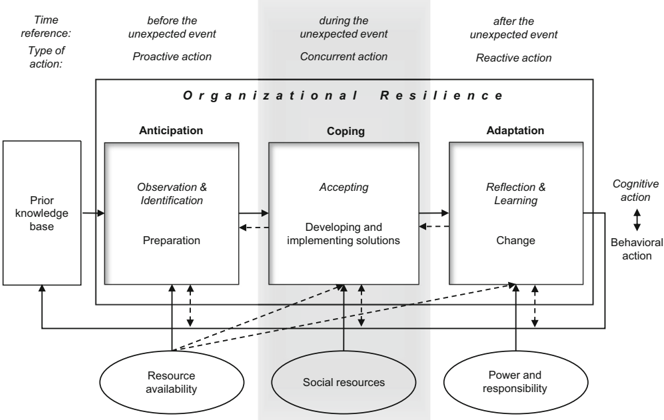
This is a conceptual paper that reframes organizational resilience as a meta-capability made up of three stages: anticipation, coping, and adaptation. It argues that resilience depends on specific underlying capabilities plus antecedents such as knowledge base, resources, social resources, and power/responsibility, and it ends by proposing propositions for future empirical work.
## Key findings
- The paper defines organizational resilience as an organization’s ability to anticipate potential threats, cope effectively with adverse events, and adapt to changing conditions.
- It decomposes resilience into three successive stages: anticipation, coping, and adaptation, and argues these stages overlap and build on each other; for example, anticipation influences coping and coping influences adaptation.
- The paper identifies capability clusters for each stage:
- anticipation: observation and identification, preparation
- coping: accepting, developing and implementing solutions
- adaptation: reflection and learning, organizational change
- It argues that resilience is a meta-capability requiring a combination of capabilities across all three stages; anticipation creates “resilience potential,” but coping and adaptation are needed to realize and improve it.
## Methods
- Conceptual/theoretical review paper, not an empirical study.
- Synthesizes literature from organizational resilience and related areas such as business continuity management, crisis management, innovation management, public administration, and organizational learning.
- Builds a conceptual framework and formulates propositions about antecedents and drivers, including:
- Proposition 1: knowledge base as an antecedent
- Proposition 2: resource availability
- Proposition 3: social resources
- Proposition 4: power based on expertise and shared responsibilities
## Limitations
- The paper explicitly notes that future research is needed to test the framework empirically and develop questionnaires; it says the framework is a first step toward a resilience theory rather than a final one.
- It states that much of the prior literature is fragmented, prescriptive/normative, and often retrospective, and that there is little knowledge about how resilience works in practice; this is the gap the paper tries to address.
- Evident from the text: the paper is entirely conceptual and does not present new data, sample, or statistical tests.
Model-written summary. Check it against the paper before relying on it.
Integrity signals
Registry
Cites
Statistics
Figures
Verification
Claims the paper makes
0 Valid · 4 Not valid · 58 Not checked · 67 Own results and interpretations
A conclusion the paper draws from its own results — it cites no other source for it, so there is none to check. The quote shows it is in the paper.
In the paper
“we suggest three successive stages of the resilience process (see Fig. 1) and argue that resilient organizations respond not only to the past (reactive action) or to current issues (concurrent action), but also to the future (anticipatory action).”
§ Organizational resilience: a capability-based conceptualization > 3.1 Fundamentals of the framework
hedgedstates a cause- Asserted: passes — The authors put it forward as true.
- Checkable: passes — It can be checked against evidence.
- Load-bearing: passes — The paper’s conclusions depend on it.
- Based: passes — The paper gives a reason why it holds.
None of the sources cited for this claim have been checked yet.
In the paper
“Most studies just point to organizational characteristics, resources, or processes that seem to be significant for resilience (e.g., Weick 1993;Kendra and Wachtendorf 2003;Gittell et al. 2006).This means that resilience is simply treated as an outcome-when organizations perform well during crisis or bounce back from interruptions (e.g., Horne and Orr 1998).”
- Also stated in: § 2.2 Previous conceptualizations of organizational resilience · plain
“Most studies treat resilience as an outcome-when organizations perform well during crisis or bounce back from interruptions (e.g., Horne and Orr 1998).”
§ Organizational resilience: a capability-based conceptualization > 1 Introduction
What the sources say
- Not matchedcites Horne and Orr 1998
An author–year citation the paper’s reference list doesn’t settle. We don’t search these by name.
- Not checked — no full text of the sourcecites Boin and van Eeten 2013 matched to “The Resilient Organization” (2013) source
- Not checked — no full text of the sourcecites Duit 2016 matched to “RESILIENCE THINKING: LESSONS FOR PUBLIC ADMINISTRATION” (2016) source
plain- Asserted: passes — The authors put it forward as true.
- Checkable: passes — It can be checked against evidence.
- Load-bearing: passes — The paper’s conclusions depend on it.
- Based: passes — The paper gives a reason why it holds.
- Also stated in: § 2.2 Previous conceptualizations of organizational resilience · plain
None of the sources cited for this claim could be matched to a paper, so there is nothing to check it against.
In the paper
“Depending on its specific configuration, resilience can be a source of sustainable competitive advantage (Hamel and Vaelikangas 2003;Sheffi 2007) and, thus, explain why some firms are more successful than others.”
§ Organizational resilience: a capability-based conceptualization > 2.1 Definitions of organizational resilience
What the sources say
- Not matchedcites Hamel and Vaelikangas 2003
An author–year citation the paper’s reference list doesn’t settle. We don’t search these by name.
- Not matchedcites Sheffi 2007
An author–year citation the paper’s reference list doesn’t settle. We don’t search these by name.
plainstates a possible cause- Asserted: passes — The authors put it forward as true.
- Checkable: passes — It can be checked against evidence.
- Load-bearing: passes — The paper’s conclusions depend on it.
- Based: passes — The paper gives a reason why it holds.
- Not matched
In the paper
“Organizational resilience capabilities develop over time and emerge from the process of coping with threatening situations and unexpected events (Linnenluecke et al. 2012).”
§ Organizational resilience: a capability-based conceptualization > 3.1 Fundamentals of the framework
What the sources say
- Not checked — no full text of the sourcecites Linnenluecke et al. 2012 matched to “Extreme Weather Events and the Critical Importance of Anticipatory Adaptation and Organizational Resilience in Responding to Impacts” (2012) source
plainstates a cause- Asserted: passes — The authors put it forward as true.
- Checkable: passes — It can be checked against evidence.
- Load-bearing: passes — The paper’s conclusions depend on it.
- Based: passes — The paper gives a reason why it holds.
A claim is checked only against the cited paper’s full text, never its abstract, and none is available for its sources.
In the paper
“research shows that newly developed solutions-regardless of how carefully they are designed-do not automatically lead to changes in the organizational patterns of action (Feldman 2003;Howard-Grenville 2005;Pentland and Feldman 2008).”
§ Organizational resilience: a capability-based conceptualization > 3.2.2 Coping capabilities
What the sources say
- Not checked — no full text of the sourcecites Feldman 2003 matched to “A performative perspective on stability and change in organizational routines” (2003) source
- Not checked — no full text of the sourcecites Howard-Grenville 2005 matched to “The Persistence of Flexible Organizational Routines: The Role of Agency and Organizational Context” (2005) source
- Not checked — no full text of the sourcecites Pentland and Feldman 2008 matched to “Designing routines: On the folly of designing artifacts, while hoping for patterns of action” (2008) source
plain- Asserted: passes — The authors put it forward as true.
- Checkable: passes — It can be checked against evidence.
- Load-bearing: passes — The paper’s conclusions depend on it.
- Based: passes — The paper gives a reason why it holds.
54 more claims
Create a free account to see all 129 claims and to verify the 7 references still open.
- Probably not a substantial claim. 48
- It may state two separate claims as one. 35
- The quote only partly states this claim. 2
Claims other papers make about this one
Each is checked against this paper’s own text: does it say what the citing paper says it does?
The cited source doesn’t support the claim as written.
In the citing paper
“The capacity conception, increasingly dominant in organizational and strategic management scholarship”
From Organizational Resilience and Crisis Management in Public Administration: Building Adaptive Governance Capacity in an Age of Compounding Disruptions (2026) · cites this paper as Duchek, 2020
Checked by a reasoning model — may be wrong.
Experimental — accuracy not yet measuredThe cited source says what the claim attributes to it.
In the citing paper
“The capacity conception, increasingly dominant in organizational and strategic management scholarship, treats resilience as a developable, manageable organizational asset the conceptualization adopted in this article (Duchek, 2020).”
From Organizational Resilience and Crisis Management in Public Administration: Building Adaptive Governance Capacity in an Age of Compounding Disruptions (2026) · cites this paper as Duchek, 2020
The cited source says what the claim attributes to it.
In the citing paper
“More recently, Duchek (2020) proposed a process model of organizational resilience comprising three sequential phases - anticipation, coping, and adaptation - each requiring distinct organizational capabilities. The AGRF builds on this process model while extending it to incorporate the distinctive institutional and governance features of public organizations.”
From Organizational Resilience and Crisis Management in Public Administration: Building Adaptive Governance Capacity in an Age of Compounding Disruptions (2026) · cites this paper as Duchek (2020)
Self-check
Percentages, sums and reported differences re-computed from the paper’s own numbers.
Each contradiction between two passages listed here was confirmed by an independent check.
Rated minor: it would not touch a result — a value no result rests on, a p-value that stays on the same side of the significance level, or a conflict that is clerical, resolved elsewhere in the paper, or outside its own findings.
In the paper
§ Organizational resilience: a capability-based conceptualization > 3.4.2 Resource availability
“Analyzing airline industry responses to September 2011, Gittell et al. (2006) found that airlines with greater financial resources”
§ Organizational resilience: a capability-based conceptualization > References
“Gittell, Jody H., Kim Cameron, Sandy Lim, and Victor Rivas. 2006. Relationships, layoffs, and organizational resilience airline industry responses to September 11.”
Citations
Cites
Absorptive Capacity: A New Perspective on Learning and Innovation
Cohen, W. M., & Levinthal, D. A. (1990) · Administrative Science Quarterly · doi:10.2307/2393553 · Cited by 35,728
An Evolutionary Theory of Economic Change.
Loasby, B. J., Nelson, R. R., & Winter, S. G. (1983) · The Economic Journal · doi:10.2307/2232409 · Cited by 21,366
Psychological Safety and Learning Behavior in Work Teams
Edmondson, A. (1999) · Administrative Science Quarterly · doi:10.2307/2666999 · Cited by 12,026 · cited 1×
“Learning can be described as ‘‘ongoing process of reflection and action characterized by asking questions, seeking feedback, experimenting, reflecting on results, and discussing errors or unexpected outcomes of actions’’ (Edmondson 1999, p. 353).”
Background(1993) · Journal of the American Dietetic Association · doi:10.1016/0002-8223(93)92196-5 · Cited by 11,976
Research in Organizational Behavior
Hammer, E. R., Cummings, L. L., & Staw, B. M. (1984) · The Academy of Management Review · doi:10.2307/258300 · Cited by 11,175
Hutchins, E. (1995) · doi:10.7551/mitpress/1881.001.0001 · Cited by 10,801 · cited 1×
“Social resources may be achieved through supportive mental processes that have been discussed as situated cognition (Suchman 1987), distributed cognition (Hutchins 1995), or joint cognitive systems (Hollnagel and Woods 2005).”
Background(1969) · Virtual Defense Library (Ministerio de Defensa) · Cited by 10,735
An Evolutionary Theory of Economic Change
Berkowitz, M. K., Nelson, R. R., & Winter, S. G. (1983) · Southern Economic Journal · doi:10.2307/1058233 · Cited by 10,549
Academy of Management Executive
(2010) · The Academy of Management executive/Academy of Management executive · doi:10.5465/ame · Cited by 8,844
A Behavioral Theory of the Firm
Day, R. H., Cyert, R. M., March, J. G., Clarkson, Cohen, Feigenbaum, D., Greenberg, Moore, Soelberg, Starbuck, et al. (1964) · Econometrica · doi:10.2307/1913056 · Cited by 7,791
Research works printed but not linked: 12
- 39. John W. Reich, Alex J. Zautra, and John Stuart Hall, 333-349. New York: The Guilford Press.
- 71. Hiltunen, Elina. 2008. Good Sources of Weak Signals: A Global Study of Where Futurists Look For Weak Signals. Journal of Futures Studies 12: 21-44.
- 74. Horne, John F. 1997. The coming of age of organizational resilience. Business Forum 22: 24-28.
- 116. March, James G., and Herbert A. Simon. 1958. Organizations. New York: Wiley.
- 135. Rerup, Claus. 2001. Houston, we have a problem: Anticipation and improvisation as sources of organizational resilience. Comportamento Organizacional E Gestao 7: 27-44.
- 138. Robert, Benoı ˆt. 2010. Organizational Resilience-Concepts and evaluation Method. Montre ´al: Presse de l'E ´cole Polytechnique de Montre ´al.
- 140. Roberts, Karlene H., Peter M. Madsen, and Vinit M. Desait. 2005. The space between in space transportation: A relational analysis of the failure of STS-107. In Organization at the limit-NASA and the Columbia Disaster, ed.
- 141. William H. Starbuck and Moshe Farjoun, 81-98. Oxford: Blackwell.
- 146. Ryle, Gilbert. 1979. On thinking. Oxford: Blackwell.
- 176. Vaughan, Diane. 2005. System effects: On slippery slopes, repeating negative patterns, and learning from mistake? In Organization at the limit-NASA and the Columbia Disaster, ed.
- 177. William H. Starbuck and Moshe Farjoun, 41-59. Oxford: Blackwell.
- 189. Westrum, Ron. 1988. Organizational and inter-organizational thought. Paper presented at the World Bank Conference on Safety Control and Risk Management.
Cited by
Items 1,201–1,300 of 1,969
بلفقيه, أ. ب. ح., & باجهام, أ. ي. (2025) · مجلة جامعة المهرة للعلوم الإنسانية · doi:10.71311/.v6i2.250
Krizden Dayanıklılığa: Afet Sonrası Kamu Kurumlarında Aile Dostu İnsan Kaynakları Politikaları
Sarnıç, A. (2026) · Ahi Evran Üniversitesi Sosyal Bilimler Enstitüsü Dergisi · doi:10.31592/aeusbed.1809540
Wang, R., & Han, R. (2026) · Research in Transportation Business & Management · doi:10.1016/j.rtbm.2026.101706
Konflikt- und Krisenkommunikation
Schwarz, A. (2024) · Springer eBooks · doi:10.1007/978-3-658-28034-5_43
Gutierrez-Castillo, F.-H., TURPO, B., Cahuana-Pacco, D.-C., Poma-Palma, Y.-M., Huacasi-Gonzales, R., Charaja-Fernandez, L., & Machaca, A. T. (2026) · Journal Of Organizational Behavior Research · doi:10.51847/yy7evdtzay
Wicks, R. J., & Werdel, M. B. (2023) · Oxford University Press eBooks · doi:10.1093/oso/9780197646281.002.0004
Digital Armor: How Digital Transformation Enhances the Resilience of Renewable Energy Enterprises
Liu, S., Chen, Z., & Xie, F. (2026) · Energies · doi:10.3390/en19163906
Castillo, V. V., Pasia, Y. L., & Padua, B. G. A. (2026) · Frontiers in Education · doi:10.3389/feduc.2026.1883953
Catapang, C. D. E., & Ashipaoloye, F. K. (2024) · The European Proceedings of Social & Behavioural Sciences · doi:10.15405/epsbs.2024.05.3
Evolution of Business Conditions in Poland and the Development Prospects of Polish Enterprises
Niewiadomski, P., Frąś, J., Czyrka, K., et al. (2026) · Journal of Modern Science · doi:10.13166/jms/224798
Organisational trauma in educational settings during wartime
Akiva, G., Mimon, M., Sagiv-Zuri, G., & Grinshtain, Y. (2026) · Journal of Educational Administration & History · doi:10.1080/00220620.2026.2693912
“In contrast, organisational resilience refers not to the characteristics of individuals but to the collective capacities, relationships, structures, and routines that enable organisations to anticipate, adapt to, and recover from disruption (Duchek 2020; Vogus and Sutcliffe 2007).”
Building Resilient Companies Through Internal Marketing
Alvarado, T. E. G., García, F. C., & Cabanelas, P. (2024) · Advances in business information systems and analytics book series · doi:10.4018/979-8-3693-7272-2.ch008
Organisational resilience conceptual model: A systems thinking approach
Manzini, D., Oosthuizen, R., & Chikwanda, H. K. (2024) · Business and management · doi:10.3846/bm.2024.1228 · Cited by 4
Salvatore, F. P., Spinnato, R., & Milone, M. (2026) · Business Strategy and the Environment · doi:10.1002/bse.70883 · Cited by 1
Barrientos, R. L. C., & Pilar, J. G. A. (2026) · Journal of Degraded and Mining Lands Management · doi:10.15243/jdmlm.2026.131.9239 · Cited by 1
Women at the Helm: Financial Resilience as a Catalyst for Stability in Innovation-Driven Enterprises
Lee, L. Y. Y., Xia, J. K. P., Kee, D. M. H., & Zhou, Y. Q. (2026) · Sustainable development goals series · doi:10.1007/978-3-032-00343-0_10
International Organizational Crisis Communication
Pyle, A. S., Fuller, R. P., & Ulmer, R. R. (2025) · Wiley eBooks · doi:10.1002/9781394180844.ch8 · Cited by 1
Optimal free energy requirements for managing disruptive and unexpected organizational change
Hartman, L. M. (2026) · Organization Management Journal · doi:10.2139/ssrn.7215538 · Cited by 1
Exploring the Gap in the Dynamic Financial Resilience of Urban and Rural SMEs
Leckė, G., & Legenzova, R. (2026) · Economies · doi:10.3390/economies14050160 · Cited by 4
“In SMEs, where resource constraints are often critical, behavioural resourcefulness enables the organisation to remain disciplined and agile in the face of shocks (Duchek, 2020).”
InfluentialBusiness System Long-Term Viability Across Life-Cycle Phases
Kremsar, S., Andrašec, E. K., & Kern, T. (2026) · Bled eConference · doi:10.18690/um.fov.4.2026.76
Langfristige Ressourcen der wirtschaftlichen Resilienz einer Stadt: Das Beispiel Leipzig
Wink, R. (2025) · Historische Resilienz-Forschung · doi:10.1007/978-3-658-48686-0_2
Simanullang, S., Cahyani, L., Subandi, Y., Rintaningrum, R., & Wulandari, A. (2026) · Ilomata International Journal of Management · doi:10.61194/ijjm.v7i3.2351
“Organizations with strong dynamic capabilities are generally more capable of reconfiguring internal resources, adjusting operational processes, and implementing strategic transformation when facing uncertainty (Duchek, 2019).”
InfluentialIntegrating Change Management and Resilience: Strategies for Organizational Adaptability and Success
Khalifa, M. M. A. (2026) · Studies in systems, decision and control · doi:10.1007/978-3-031-99466-1_1
Strategic plan development: A methodological proposal for public higher education institutions
Muñoz, K. A. M., Arriagada, N. A., Sandoval, Y. P., Gutiérrez, F. G., & Hochstetter-Diez, J. (2025) · Sapiens in Higher Education · doi:10.71068/xqrdns61 · Cited by 1
Strategic Human Resource Interventions to Enhance Workforce Resilience
Kumari, S., & Sudha, S. (2026) · IGI Global eBooks · doi:10.4018/979-8-3373-5218-3.ch013
Organizational Resilience in the Digital and Sustainable Era and the Influence of Leadership
IONICĂ, A.-M. (2026) · Proceedings of the ... International Conference on Business Excellence · doi:10.2478/picbe-2026-0397
“Resilience is generally understood as the ability of an organization to anticipate, respond to, and recover from disruptive events while continuing to function effectively (Busu and Busu, 2021; Lengnick-Hall et al., 2011; Duchek, 2020).”
Glazer-Bear, S., Aharonson‐Daniel, L., & Lahad, M. (2025) · Journal of Military Studies · doi:10.2478/jms-2025-0005
“OR is widely recognised as crucial during crises by both researchers and practitioners (Burnard and Bhamra 2011; Duchek 2020; Hillmann and Guenther 2021).”
Zondo, M., Mukwakungu, S. C., Sukdeo, N., et al. (2024) · doi:10.46254/an14.20240615
Mitrevska, I., Boshnachki, S., Burcevska, S., et al. (2026) · Journal of Pharmaceutical Innovation · doi:10.1007/s12247-026-10967-3
(2023) · doi:10.37355/kd-2023
Cross-border data risk and firm performance: The moderating role of digital resilience and agility
Xu, W., & Zuo, X. (2026) · Journal of International Management · doi:10.1016/j.intman.2026.101350 · Cited by 4
John, T. A., Ijaiya, M. A., Daniya, A. A., Shittu, K. I., Suleiman, A., & Ochepa, A. (2026) · African Journal Of Applied Research · doi:10.26437/22kz9e22
Küttner, M., Riepl, J., & Mörth, T. R. (2026) · Journal of the International Council for Small Business · doi:10.1080/26437015.2026.2723824
Alali, H. E., Gopiechand, J., Ciottone, G. R., Voskanyan, A., Hertelendy, A. J., Shintre, L., Al-Horani, S. E.-D., Balasubramanian, S., Alfaifi, M. S., Alali, J., et al. (2026) · International Journal of Emergency Services · doi:10.1108/ijes-02-2026-0019
Gao, J., Zhang, H., & Guan, T. (2026) · Management Decision · doi:10.1108/md-03-2025-0557
Beyond Tradition: New Contexts, New Challenges
Prima, C. D. (2026) · Emerald Group Publishing Limited eBooks · doi:10.1108/978-1-80686-493-520261003
Rodriguez, I. J. T. (2026) · Discover Artificial Intelligence · doi:10.1007/s44163-026-02050-0
“Following Duchek [6], resilience can be understood as a capability-based process involving anticipation, coping, and adaptation.”
Schmidtke, N., & Behrendt, F. (2026) · Procedia Computer Science · doi:10.1016/j.procs.2026.02.139
Çera, G., & Elezi, E. (2026) · International Journal of Entrepreneurial Behaviour & Research · doi:10.1108/ijebr-07-2025-0978
Taylor, C. Y. (2026) · IGI Global eBooks · doi:10.4018/979-8-3373-8079-7.ch008
Kusa, R., Randolph-Seng, B., Duda, J., Okręglicka, M., & Suder, M. (2026) · International Journal of Entrepreneurial Behaviour & Research · doi:10.1108/ijebr-12-2025-1830
Paulino, E. P., Romero, R., Mazo, P. N., & Tan, R. A. (2025) · International Journal of Research in Business and Social Science (2147-4478) · doi:10.20525/ijrbs.v14i1.3839
Faqera, A. F. O., Faqera, A. F. O., Al-Salemi, A. H., et al. (2026) · Cogent Business & Management · doi:10.1080/23311975.2026.2741953
Lin, B.-C., & Lee, C. (2022) · Research Square · doi:10.21203/rs.3.rs-1536599/v1
Niemeyer, J. F., Maier, R., Zhang, A. N. S., et al. (2025) · Cleaner Logistics and Supply Chain · doi:10.1016/j.clscn.2025.100290
Balázs, L., András, I., & Rajcsányi-Molnár, M. (2026) · Civil Szemle · doi:10.62560/csz.2026.05.3
How to Optimize Your Recruitment for Post Pandemic?
Sayyadi, M. (2023) · Muma Business Review · doi:10.28945/5199
Wang, A.-Q., Cheng, W., Fu, Y., Luo, Y.-S., Li, J., Wang, H., & Jin, C. (2024) · Frontiers in Public Health · doi:10.3389/fpubh.2024.1327738
Strategic Leadership and Crisis Adaptation: Navigating Business Uncertainty Amid Global Upheaval
Mokdad, Z. H. (2025) · IGI Global eBooks · doi:10.4018/979-8-3373-5651-8.ch012
Putri, D. A., Huda, M., & Sulistyowati, A. (2026) · Journal of Business Economics and Agribusiness · doi:10.47134/jbea.v3i4.1256
Ebata, R. (2025) · doi:10.3917/emi.benta.2025.01.0329
Marques, P. C. D. A. (2026) · International Journal of Organization Theory and Behavior · doi:10.1108/ijotb-01-2026-0022 · Cited by 2
Keravnos, N., Schechter, C., Kafa, A., & Lipsou, E. (2026) · Educational Management Administration & Leadership · doi:10.1177/17411432261472652
Naseem, S., Islam, M. S., & Iakovleva, T. A. (2026) · Businesses · doi:10.3390/businesses6030041
“Anticipation involves recognizing the approaching funding transition and developing alternative capabilities before pressure becomes acute (Duchek, 2020).”
InfluentialClinicians’ Secondary Stress Self-Awareness Questionnaire
Wicks, R. J., & Werdel, M. B. (2023) · Oxford University Press eBooks · doi:10.1093/oso/9780197646281.005.0005
Resilience of the corporate sector of the economy as a dominant of Ukraine’s post-war recovery
Aleksin, G. (2026) · Fìnansi Ukraïni · doi:10.33763/finukr2026.07.023
McCune, J., Zarch, R., Childs, J., Yadav, A. K., Marshall, S. L., & Grooms, A. A. (2026) · Educational Policy · doi:10.1177/08959048261465620 · Cited by 2
Goglio, K., Crespin‐Mazet, F., Neukam, M., & Simon, L. (2026) · Management Decision · doi:10.1108/md-04-2026-434
Untangling the role of social and environmental practices in family business resilience
Ouiakoub, M., & Hadjielias, Ε. (2026) · International Journal of Entrepreneurial Behaviour & Research · doi:10.1108/ijebr-12-2025-1793 · Cited by 1
Yang, J., Li, F., & Zhao, J. (2026) · Journal of Global Health Economics and Policy · doi:10.7189/001c.164903
Clinician: An Honorable Profession, a Meaningful Life
Wicks, R. J., & Werdel, M. B. (2023) · Oxford University Press eBooks · doi:10.1093/oso/9780197646281.003.0009
Zhang, Y., Wang, W. Y., Ye, J., Mi, L., Huang, R., Lijie, Q., Tao, M., & Zhou, P. (2026) · ENGINEERING Management · doi:10.1007/s42524-026-5454-2
“…unlike previous studies, which have largely remained at the level of qualitatively discussing the dimensional framework of OR (Brown et al., 2017; Duchek, 2020b), this study further provides a quantitative comparison of the relative strength of different capabilities and their sub-dimensions,…”
da Costa, A. D. S. (2025) · Springer eBooks · doi:10.1007/978-3-031-25960-9_13-1
Resilience Capabilities to Build Resilience Capacities: The Role of Organization Strategy
Khalaf, M. A., Mokadem, M. E., & Talaat, R. (2025) · المجلة العربیة للإدارة · doi:10.21608/aja.2025.384525.1861
Zhao, F., Alshaghdali, N. O., Chotia, V., & Almugren, H. Z. (2026) · Technology in Society · doi:10.1016/j.techsoc.2026.103572
Beyond Adaptation: A Theory of Organizational Future Readiness under Technological UncertaintyPreprint
Çakır, S., & Kurubacak, G. (2026) · SSRN Electronic Journal · doi:10.2139/ssrn.7512398
The Firm as an Intelligent System
Magni, D. (2026) · Innovation, technology and knowledge management · doi:10.1007/978-3-032-35262-0_1
Adelia, N., Dalimunthe, R. F., & Absah, Y. (2026) · KnE Social Sciences · doi:10.18502/kss.v11i8.21706
YILDIRIM, M. (2026) · Akademik Yaklaşımlar Dergisi · doi:10.54688/ayd.1853653
РОЛЬ ТА ЗНАЧЕННЯ HR-МЕНЕДЖМЕНТУ У ФОРМУВАННІ ОРГАНІЗАЦІЙНОЇ СТІЙКОСТІ ПІДПРИЄМСТВ
Новікова, М. М., & Боровик, М. В. (2026) · Black Sea Economic Studies · doi:10.32782/bses.98-22
Al-Aqrabawi, R., & Zeer, I. A. (2026) · Emerald Group Publishing Limited eBooks · doi:10.1108/978-1-80592-961-120261006
Fu, L., Wang, J., & Yang, Q. S. (2025) · Sustainability · doi:10.3390/su17177846 · Cited by 1
Гнилицька, Л. В., Бірюк, О. Г., Isai, O., et al. (2026) · Financial and credit activity problems of theory and practice · doi:10.55643/fcaptp.3.68.2026.5153
“Further development of these provisions is presented in the study by Duchek S. (Duchek, 2020), in which resilience is interpreted as a dynamic organizational capacity to ensure security, covering three interrelated phases: proactive threat anticipation, effective response to crisis events, and…”
Social Capital as a Lifeline for Business Continuity: Does Firm Resilience Matter?Preprint
Mawutor, A. P., Tutu-Boahene, B., Owusu, S., & Sidhu, R. (2026) · Research Square · doi:10.21203/rs.3.rs-9388284/v1
Jayakumar, T., Valentino, A., & Calabrò, A. (2026) · International Journal of Entrepreneurial Behaviour & Research · doi:10.1108/ijebr-10-2025-1467
Hanson, K. G., Satchell, A. K., Skinner, M. L., & Eddy, J. M. (2026) · International Journal of Adolescence and Youth · doi:10.1080/02673843.2026.2685864
“…can face), on-the-ground coping strategies (accepting problems and implementing solutions), and successful adaptation capabilities (using knowledge to implement change) that allows chapters and their mentors to cope effectively with adverse events and adapt to changing conditions (Duchek, 2020).”
Growing Weary or Growing Wise? Posttraumatic Growth and Meaning-Making Toward Wisdom
Wicks, R. J., & Werdel, M. B. (2023) · Oxford University Press eBooks · doi:10.1093/oso/9780197646281.003.0008
Jossou, M. C. (2022) · theses.fr (ABES) · doi:10.70675/a5f5be6aza16ez4d6ez817ezfd7ffc640a98 · Cited by 2
Shrivastava, U., & Salwan, P. (2025) · Journal of International Entrepreneurship · doi:10.1007/s10843-025-00374-z
Hrga, J., Mijatović, A., Ljutić, D., & Marušić, A. (2026) · Journal of Global Health · doi:10.7189/jogh.16.04017 · Cited by 1
Фінансові детермінанти стійкості підприємств у сфері торгівлі та гостинності Закарпаття
Шімон, В., Chyzmar, I., & Ганусич, В. О. (2026) · Acta Academiae Beregsasiensis Economics · doi:10.58423/2786-6742/2026-14-461-477
Research and development resilience of foreign MNE subsidiaries during the Great Recession
Aliasghar, O., Mendi, P., Un, C. A., & Asakawa, K. (2026) · Global Strategy Journal · doi:10.1002/gsj.70024
de Lange, A. H. (2026) · SpringerBriefs in applied sciences and technology · doi:10.1007/978-3-032-22924-3_8
Aviacijos paslaugas teikiančių organizacijų pokyčių valdymo sprendimai
Leonavičiūtė, V. (2026) · doi:10.20334/2026-025-m
Editorial: Corporate governance at the speed of disruption
Hajj, M. C. E. (2026) · Corporate Governance and Organizational Behavior Review · doi:10.22495/cgobrv10i1editorial
Miao, Q., Schwarz, G., & Aḥmad, J. (2026) · Nonprofit and Voluntary Sector Quarterly · doi:10.1177/08997640261448565
Borjigin, N., Ana Maria, C. R. U. Z., & ORDUZ, L. M. P. (2024) · SSRN Electronic Journal · doi:10.2139/ssrn.4812922
Fardan, A., Noermijati, N., Rofiq, A., & Sumiati, S. (2026) · KnE Social Sciences · doi:10.18502/kss.v11i8.21730
Herzog, M., Wilkens, U., Arnold, D., Lupp, D., Lutzeyer, I., Alp, E., & Kuhlenkötter, B. (2025) · Forum Dienstleistungsmanagement · doi:10.1007/978-3-658-48325-8_23
Cruz, G. D. S. M., Damasceno, E. D. J., da Silva, A. S., Rocha, A. B., & de Medeiros, P. N. (2020) · AYA Editora eBooks · doi:10.47573/aya.88580.2.6.14
Leto, A., & Marković, M. (2023) · Zbornik radova Islamskog pedagoškog fakulteta u Zenici (Online) · doi:10.51728/issn.2637-1480.2023.27
Abdullahi, U., Dhahi, A.-A. K. A., Mohamed, A. M., Senasi, V., & Aminullah, A. A. (2026) · Discover Sustainability · doi:10.1007/s43621-026-03295-6 · Cited by 5
“OR, defined as the capacity to anticipate, absorb, adapt, and transform in response to disruption, has therefore emerged as a critical capability for sustaining performance [26].”
InfluentialGenerative AI in Austrian News Media: Innovation Impact and Evidence on Path Dependence
Murschetz, P. C., Eder, M., & Wilczek, B. (2026) · Future of business and finance · doi:10.1007/978-3-032-07605-2_14
Alfaro, V. S. (2026) · Philosophy of Management · doi:10.1007/s40926-026-00405-2
Alvarenga, M. Z., & Guedes, T. D. A. (2026) · Journal of Knowledge Management · doi:10.1108/jkm-01-2026-0162
Kumari, R. (2025) · Journal of Entrepreneurship and Public Policy · doi:10.1108/jepp-04-2024-0053 · Cited by 5
New Perspectives on Economic Resilience from Industrial and Business History
Encarnación, J. A. M., & Roldán, A. (2026) · Journal of Evolutionary Studies in Business-JESB · doi:10.1344/jesb.54694
Die Dunkle Seite der Führungsresilienz
Vakilzadeh, K., & Eberl, P. (2022) · Der Betriebswirt · doi:10.3790/dbw.63.3.137
Metadata
- Authors
- Duchek, S.
- Affiliations
- Technische Universität Dresden (DE)
- Corresponding author
- Duchek, Stephanie
- ORCID
- Duchek, Stephanie
- Venue
- Business Research
- Published
- 2019-01-14
- Volume
- 13
- Issue
- 1
- Pages
- 215-246
- ISSN
- 1866-8658 (ISSN-L)
- 2198-3402
- 2198-2627
- OpenAlex
- W2910462204
- Cited by
- 2,027
- References
- 209
- Citations by year
- 2026: 640 · 2025: 398 · 2024: 311 · 2023: 280 · 2022: 213 · 2021: 131 · 2020: 50 · 2019: 3
- FWCI
- 152.43
- Type
- journal article
- Language
- en
- Open access
- gold
- doi.org
- Licence
- cc-by
- creativecommons.org/licenses/by/4.0 (tdm)
- creativecommons.org/licenses/by/4.0 (vor)
- Locations
- BuR - Business Research (publishedVersion, cc-by)
- RePEc: Research Papers in Economics (submittedVersion)
- Econstor (Econstor) (submittedVersion, cc-by)
- Topics
- Social Sciences › Business, Management and Accounting › Strategy and Management › Supply Chain Resilience and Risk Management
- Social Sciences › Business, Management and Accounting › Strategy and Management › Innovation and Knowledge Management
- Social Sciences › Sociology and Political Science › Disaster Management and Resilience
- Keywords
- organizational resilience, organizational capabilities, meta-capability, anticipation, coping, adaptation, crisis management, uncertainty, antecedents of resilience
About these checks
Registry, retraction, Cites and statistics results are computed, not judged, with one exception: a printed reference that no index lists is read once by a model before it counts as a citation error. Claims are extracted by a model and kept only when their quote appears verbatim in the text; each cited source is then checked, with a model’s help, for whether it says what the claim relies on. Those verdicts can be wrong — read the claim’s quote and the cited source before relying on one.
A language model drew the claims from the paper on 2026-10-10, under version 3 of the claim definition (model deepseek-v4.1-flash, prompt extract-v3).
A second model labelled each claim on 2026-10-10 (model jev-1.13-20260917, definition revision gold-guideline-v0.2).
Statistics and arithmetic are recomputed, not judged.
Confidence bands are shown only for fields calibrated on our annotated test set. None is calibrated yet, so no band is shown.
What counts as a claim ›How we measure confidence ›How we check this ›
Are you an author, or do you see a problem with this page? Request a review
Data sources
Bibliographic data: Semantic Scholar, OpenAlex, Crossref.
Contains information from the Semantic Scholar Academic Graph Datasets, made available under the ODC Attribution License (ODC-BY 1.0).
Semantic Scholar’s data is described in: Kinney, R., et al. (2023). The Semantic Scholar Open Data Platform. arXiv:2301.10140.
