

Organizational resilience: a capability-based conceptualization
Open accessThe DOI matches its Crossref record; 206 of the 209 references it cites were found in a registry or an index, and 2 are not checked yet; none of the 106 sources its claims cite is checked for support yet.
Abstract
In highly volatile and uncertain times, organizations need to develop a resilience capacity which enables them to cope effectively with unexpected events, bounce back from crises, and even foster future success. Although academic interest in organizational resilience has steadily grown in recent years, there is little consensus about what resilience actually means and how it is composed. More knowledge is particularly needed about organizational capabilities that constitute resilience, as well as conditions for their development. This paper aims to make a contribution to this heterogeneous research field by deepening the understanding of the complex and embedded construct of organizational resilience. We conceptualize resilience as a meta-capability and decompose the construct into its individual parts. Inspired by process-based studies, we suggest three successive resilience stages (anticipation, coping, and adaptation) and give an overview of underlying capabilities that together form organizational resilience. Based on this outline, we discuss relationships and interactions of the different resilience stages as well as main antecedents and drivers. We formulate propositions that can act as a foundation for future empirical work.
Checked 2026-11-22 · 2 references not checked yet
Overview
CoChat Summary
## TL;DR
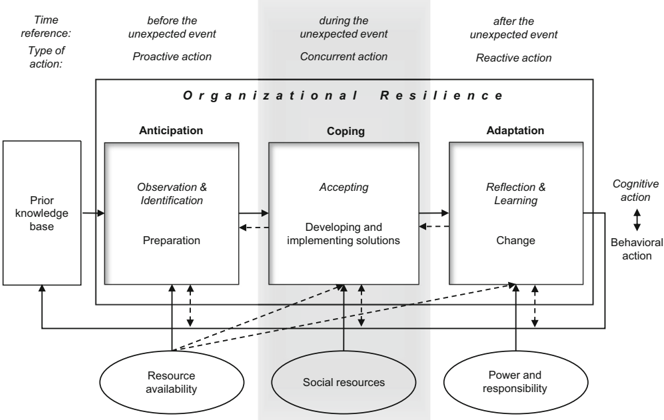
This is a conceptual paper that reframes organizational resilience as a meta-capability made up of three stages: anticipation, coping, and adaptation. It argues that resilience depends on specific underlying capabilities plus antecedents such as knowledge base, resources, social resources, and power/responsibility, and it ends by proposing propositions for future empirical work.
## Key findings
- The paper defines organizational resilience as an organization’s ability to anticipate potential threats, cope effectively with adverse events, and adapt to changing conditions.
- It decomposes resilience into three successive stages: anticipation, coping, and adaptation, and argues these stages overlap and build on each other; for example, anticipation influences coping and coping influences adaptation.
- The paper identifies capability clusters for each stage:
- anticipation: observation and identification, preparation
- coping: accepting, developing and implementing solutions
- adaptation: reflection and learning, organizational change
- It argues that resilience is a meta-capability requiring a combination of capabilities across all three stages; anticipation creates “resilience potential,” but coping and adaptation are needed to realize and improve it.
## Methods
- Conceptual/theoretical review paper, not an empirical study.
- Synthesizes literature from organizational resilience and related areas such as business continuity management, crisis management, innovation management, public administration, and organizational learning.
- Builds a conceptual framework and formulates propositions about antecedents and drivers, including:
- Proposition 1: knowledge base as an antecedent
- Proposition 2: resource availability
- Proposition 3: social resources
- Proposition 4: power based on expertise and shared responsibilities
## Limitations
- The paper explicitly notes that future research is needed to test the framework empirically and develop questionnaires; it says the framework is a first step toward a resilience theory rather than a final one.
- It states that much of the prior literature is fragmented, prescriptive/normative, and often retrospective, and that there is little knowledge about how resilience works in practice; this is the gap the paper tries to address.
- Evident from the text: the paper is entirely conceptual and does not present new data, sample, or statistical tests.
Model-written summary. Check it against the paper before relying on it.
Integrity signals
Registry
Cites
Statistics
Figures
Verification
Claims the paper makes
0 Valid · 4 Not valid · 58 Not checked · 67 Own results and interpretations
A conclusion the paper draws from its own results — it cites no other source for it, so there is none to check. The quote shows it is in the paper.
In the paper
“we suggest three successive stages of the resilience process (see Fig. 1) and argue that resilient organizations respond not only to the past (reactive action) or to current issues (concurrent action), but also to the future (anticipatory action).”
§ Organizational resilience: a capability-based conceptualization > 3.1 Fundamentals of the framework
hedgedstates a cause- Asserted: passes — The authors put it forward as true.
- Checkable: passes — It can be checked against evidence.
- Load-bearing: passes — The paper’s conclusions depend on it.
- Based: passes — The paper gives a reason why it holds.
None of the sources cited for this claim have been checked yet.
In the paper
“Most studies just point to organizational characteristics, resources, or processes that seem to be significant for resilience (e.g., Weick 1993;Kendra and Wachtendorf 2003;Gittell et al. 2006).This means that resilience is simply treated as an outcome-when organizations perform well during crisis or bounce back from interruptions (e.g., Horne and Orr 1998).”
- Also stated in: § 2.2 Previous conceptualizations of organizational resilience · plain
“Most studies treat resilience as an outcome-when organizations perform well during crisis or bounce back from interruptions (e.g., Horne and Orr 1998).”
§ Organizational resilience: a capability-based conceptualization > 1 Introduction
What the sources say
- Not matchedcites Horne and Orr 1998
An author–year citation the paper’s reference list doesn’t settle. We don’t search these by name.
- Not checked — no full text of the sourcecites Boin and van Eeten 2013 matched to “The Resilient Organization” (2013) source
- Not checked — no full text of the sourcecites Duit 2016 matched to “RESILIENCE THINKING: LESSONS FOR PUBLIC ADMINISTRATION” (2016) source
plain- Asserted: passes — The authors put it forward as true.
- Checkable: passes — It can be checked against evidence.
- Load-bearing: passes — The paper’s conclusions depend on it.
- Based: passes — The paper gives a reason why it holds.
- Also stated in: § 2.2 Previous conceptualizations of organizational resilience · plain
None of the sources cited for this claim could be matched to a paper, so there is nothing to check it against.
In the paper
“Depending on its specific configuration, resilience can be a source of sustainable competitive advantage (Hamel and Vaelikangas 2003;Sheffi 2007) and, thus, explain why some firms are more successful than others.”
§ Organizational resilience: a capability-based conceptualization > 2.1 Definitions of organizational resilience
What the sources say
- Not matchedcites Hamel and Vaelikangas 2003
An author–year citation the paper’s reference list doesn’t settle. We don’t search these by name.
- Not matchedcites Sheffi 2007
An author–year citation the paper’s reference list doesn’t settle. We don’t search these by name.
plainstates a possible cause- Asserted: passes — The authors put it forward as true.
- Checkable: passes — It can be checked against evidence.
- Load-bearing: passes — The paper’s conclusions depend on it.
- Based: passes — The paper gives a reason why it holds.
- Not matched
In the paper
“Organizational resilience capabilities develop over time and emerge from the process of coping with threatening situations and unexpected events (Linnenluecke et al. 2012).”
§ Organizational resilience: a capability-based conceptualization > 3.1 Fundamentals of the framework
What the sources say
- Not checked — no full text of the sourcecites Linnenluecke et al. 2012 matched to “Extreme Weather Events and the Critical Importance of Anticipatory Adaptation and Organizational Resilience in Responding to Impacts” (2012) source
plainstates a cause- Asserted: passes — The authors put it forward as true.
- Checkable: passes — It can be checked against evidence.
- Load-bearing: passes — The paper’s conclusions depend on it.
- Based: passes — The paper gives a reason why it holds.
A claim is checked only against the cited paper’s full text, never its abstract, and none is available for its sources.
In the paper
“research shows that newly developed solutions-regardless of how carefully they are designed-do not automatically lead to changes in the organizational patterns of action (Feldman 2003;Howard-Grenville 2005;Pentland and Feldman 2008).”
§ Organizational resilience: a capability-based conceptualization > 3.2.2 Coping capabilities
What the sources say
- Not checked — no full text of the sourcecites Feldman 2003 matched to “A performative perspective on stability and change in organizational routines” (2003) source
- Not checked — no full text of the sourcecites Howard-Grenville 2005 matched to “The Persistence of Flexible Organizational Routines: The Role of Agency and Organizational Context” (2005) source
- Not checked — no full text of the sourcecites Pentland and Feldman 2008 matched to “Designing routines: On the folly of designing artifacts, while hoping for patterns of action” (2008) source
plain- Asserted: passes — The authors put it forward as true.
- Checkable: passes — It can be checked against evidence.
- Load-bearing: passes — The paper’s conclusions depend on it.
- Based: passes — The paper gives a reason why it holds.
54 more claims
Create a free account to see all 129 claims and to verify the 7 references still open.
- Probably not a substantial claim. 48
- It may state two separate claims as one. 35
- The quote only partly states this claim. 2
Claims other papers make about this one
Each is checked against this paper’s own text: does it say what the citing paper says it does?
The cited source doesn’t support the claim as written.
In the citing paper
“The capacity conception, increasingly dominant in organizational and strategic management scholarship”
From Organizational Resilience and Crisis Management in Public Administration: Building Adaptive Governance Capacity in an Age of Compounding Disruptions (2026) · cites this paper as Duchek, 2020
Checked by a reasoning model — may be wrong.
Experimental — accuracy not yet measuredThe cited source says what the claim attributes to it.
In the citing paper
“The capacity conception, increasingly dominant in organizational and strategic management scholarship, treats resilience as a developable, manageable organizational asset the conceptualization adopted in this article (Duchek, 2020).”
From Organizational Resilience and Crisis Management in Public Administration: Building Adaptive Governance Capacity in an Age of Compounding Disruptions (2026) · cites this paper as Duchek, 2020
The cited source says what the claim attributes to it.
In the citing paper
“More recently, Duchek (2020) proposed a process model of organizational resilience comprising three sequential phases - anticipation, coping, and adaptation - each requiring distinct organizational capabilities. The AGRF builds on this process model while extending it to incorporate the distinctive institutional and governance features of public organizations.”
From Organizational Resilience and Crisis Management in Public Administration: Building Adaptive Governance Capacity in an Age of Compounding Disruptions (2026) · cites this paper as Duchek (2020)
Self-check
Percentages, sums and reported differences re-computed from the paper’s own numbers.
Each contradiction between two passages listed here was confirmed by an independent check.
Rated minor: it would not touch a result — a value no result rests on, a p-value that stays on the same side of the significance level, or a conflict that is clerical, resolved elsewhere in the paper, or outside its own findings.
In the paper
§ Organizational resilience: a capability-based conceptualization > 3.4.2 Resource availability
“Analyzing airline industry responses to September 2011, Gittell et al. (2006) found that airlines with greater financial resources”
§ Organizational resilience: a capability-based conceptualization > References
“Gittell, Jody H., Kim Cameron, Sandy Lim, and Victor Rivas. 2006. Relationships, layoffs, and organizational resilience airline industry responses to September 11.”
Citations
Cites
Absorptive Capacity: A New Perspective on Learning and Innovation
Cohen, W. M., & Levinthal, D. A. (1990) · Administrative Science Quarterly · doi:10.2307/2393553 · Cited by 35,728
An Evolutionary Theory of Economic Change.
Loasby, B. J., Nelson, R. R., & Winter, S. G. (1983) · The Economic Journal · doi:10.2307/2232409 · Cited by 21,366
Psychological Safety and Learning Behavior in Work Teams
Edmondson, A. (1999) · Administrative Science Quarterly · doi:10.2307/2666999 · Cited by 12,026 · cited 1×
“Learning can be described as ‘‘ongoing process of reflection and action characterized by asking questions, seeking feedback, experimenting, reflecting on results, and discussing errors or unexpected outcomes of actions’’ (Edmondson 1999, p. 353).”
Background(1993) · Journal of the American Dietetic Association · doi:10.1016/0002-8223(93)92196-5 · Cited by 11,976
Research in Organizational Behavior
Hammer, E. R., Cummings, L. L., & Staw, B. M. (1984) · The Academy of Management Review · doi:10.2307/258300 · Cited by 11,175
Hutchins, E. (1995) · doi:10.7551/mitpress/1881.001.0001 · Cited by 10,801 · cited 1×
“Social resources may be achieved through supportive mental processes that have been discussed as situated cognition (Suchman 1987), distributed cognition (Hutchins 1995), or joint cognitive systems (Hollnagel and Woods 2005).”
Background(1969) · Virtual Defense Library (Ministerio de Defensa) · Cited by 10,735
An Evolutionary Theory of Economic Change
Berkowitz, M. K., Nelson, R. R., & Winter, S. G. (1983) · Southern Economic Journal · doi:10.2307/1058233 · Cited by 10,549
Academy of Management Executive
(2010) · The Academy of Management executive/Academy of Management executive · doi:10.5465/ame · Cited by 8,844
A Behavioral Theory of the Firm
Day, R. H., Cyert, R. M., March, J. G., Clarkson, Cohen, Feigenbaum, D., Greenberg, Moore, Soelberg, Starbuck, et al. (1964) · Econometrica · doi:10.2307/1913056 · Cited by 7,791
Research works printed but not linked: 12
- 39. John W. Reich, Alex J. Zautra, and John Stuart Hall, 333-349. New York: The Guilford Press.
- 71. Hiltunen, Elina. 2008. Good Sources of Weak Signals: A Global Study of Where Futurists Look For Weak Signals. Journal of Futures Studies 12: 21-44.
- 74. Horne, John F. 1997. The coming of age of organizational resilience. Business Forum 22: 24-28.
- 116. March, James G., and Herbert A. Simon. 1958. Organizations. New York: Wiley.
- 135. Rerup, Claus. 2001. Houston, we have a problem: Anticipation and improvisation as sources of organizational resilience. Comportamento Organizacional E Gestao 7: 27-44.
- 138. Robert, Benoı ˆt. 2010. Organizational Resilience-Concepts and evaluation Method. Montre ´al: Presse de l'E ´cole Polytechnique de Montre ´al.
- 140. Roberts, Karlene H., Peter M. Madsen, and Vinit M. Desait. 2005. The space between in space transportation: A relational analysis of the failure of STS-107. In Organization at the limit-NASA and the Columbia Disaster, ed.
- 141. William H. Starbuck and Moshe Farjoun, 81-98. Oxford: Blackwell.
- 146. Ryle, Gilbert. 1979. On thinking. Oxford: Blackwell.
- 176. Vaughan, Diane. 2005. System effects: On slippery slopes, repeating negative patterns, and learning from mistake? In Organization at the limit-NASA and the Columbia Disaster, ed.
- 177. William H. Starbuck and Moshe Farjoun, 41-59. Oxford: Blackwell.
- 189. Westrum, Ron. 1988. Organizational and inter-organizational thought. Paper presented at the World Bank Conference on Safety Control and Risk Management.
Cited by
Items 1,301–1,400 of 1,969
Krasnopevtseva, N. J. (2022) · theses.fr (ABES) · doi:10.70675/2cc928aaze055z4c18z88d4zc935d1bd5dab · Cited by 5
Rietdijk, B., Dittrich, K., Hultink, E. J., & Nikou, S. (2026) · Journal of the International Council for Small Business · doi:10.1080/26437015.2026.2704665
Gani, E. A., Herdinata, C., & Dewi, L. (2026) · Social Sciences & Humanities Open · doi:10.2139/ssrn.6319809
The unseen levy: Local government non-tax revenue and corporate resilience
Li, J., Zhao, M., & Lin, Y. (2026) · Research in International Business and Finance · doi:10.1016/j.ribaf.2026.103627
Akturan, A. (2025) · Opus uluslararası toplum araştırmaları dergisi · doi:10.26466/opusjsr.1778265
Riepl, J., & Küttner, M. (2026) · De Gruyter eBooks · doi:10.1515/9783112218792-002
Leadership for quick recovery: CEO tenure, risk-taking and corporate resilience
Manzi, M. A., Benedetti, C., Cirillo, A., & Sciascia, S. (2026) · International Journal of Entrepreneurial Behaviour & Research · doi:10.1108/ijebr-11-2025-1752 · Cited by 1
Ting, L. (2026) · Emerging Markets Finance and Trade · doi:10.1080/1540496x.2026.2653641
Drama-free finance: structures and strategies for stability and growth in non-profit organisations
Irvin, R. A. (2024) · Routledge eBooks · doi:10.4324/9781003460572-11
Risk, Kriz ve Belirsizliğin Yönetiminde Dijitalleşme ve Karar Destek Sistemleri
Kaptanoğlu, R. Ö., ÜLER, E., & Akdemir, A. (2026) · Bulletin of Economic Theory and Analysis · doi:10.25229/beta.1852358 · Cited by 3
Šoltysová, Z., Nazarejova, J., Zajac, J., & Radchenko, S. (2026) · Applied Sciences · doi:10.3390/app16199775
Afandi, W. S. (2021) · International Journal of Computer Applications · doi:10.5120/ijca2021921693 · Cited by 1
Hanif, R., Pierotti, M., Khalique, M., & Tayyab, M. (2026) · Journal of Intellectual Capital · doi:10.1108/jic-07-2025-0280
Tang, R. L. M., & Wen, B. (2026) · Research Square · doi:10.21203/rs.3.rs-10929411/v1
Sustainable Innovations in Ugandan Financial Institutions
Wakibi, A., Ntayi, J. M., Ngoma, M., Nkote, I. N., & Tumwine, S. (2022) · Springer eBooks · doi:10.1007/978-3-030-66252-3_4325
Estratégias em tempos de crise pandêmica: evidências do varejo têxtil
Petry, J. F., Filizola, K. D. S., Uchôa, A. G. F., Brandão, C. D. N., & Júnior, A. A. D. S. (2024) · Revista Ibero-Americana de Estratégia · doi:10.5585/2024.25947
Quantifying Resilience in the Workplace
Wortelboer, G., & van der Steen, M. (2025) · Springer eBooks · doi:10.1007/978-3-031-91493-5_23
S, T. T., & Prakash, A. (2026) · International Journal of Construction Management · doi:10.1080/15623599.2026.2669834 · Cited by 1
Ruksana Banu., A., Soundararajan, G., & Salman, M. (2024) · Lecture notes in networks and systems · doi:10.1007/978-981-97-5441-0_21
Identification of Product Development Goals to Increase Organizational Resilience
Riesener, M., Keuper, A., Tittel, J., et al. (2024) · Portland International Conference on Management of Engineering and Technology (PICMET) · doi:10.23919/picmet64035.2024.10653218
“Organizational resilience describes the ability to prepare for potential risks, to effectively navigate through challenging circumstances, and to adapt to unexpected events [11].”
BackgroundThe Influence of Leadership on Organizational Resilience
Kumar, B., & Ghosh, O. (2025) · IGI Global eBooks · doi:10.4018/979-8-3373-6207-6.ch008 · Cited by 2
Abalajon, J. J. (2025) · Multidisciplinary Reviews · doi:10.31893/multirev.2026174 · Cited by 1
Reddy, B. A. K., & Srividya, H. (2026) · International journal of research - granthaalayah · doi:10.29121/granthaalayah.v14.i8.2026.7143
Financial market implications of corporate exposure to prior disasters
Tosun, O. K., & Eshraghi, A. (2024) · Elsevier eBooks · doi:10.1016/b978-0-44-313776-1.00336-6
de Almeida, A. P. A. (2024) · RCMOS - Revista Científica Multidisciplinar O Saber · doi:10.51473/rcmos.v1i1.2024.951 · Cited by 1
THE ROLE OF DIGITAL TRANSFORMATION IN SME RESILIENCE: LOOKING BACK TO LOOK FORWARD
Colovic, A., Pinheiro, A. B., & Lamotte, O. (2026) · International Journal of Innovation Management · doi:10.1142/s1363919626500349
Kaufmann, M., & Kranz, T. (2025) · Zeitschrift für Arbeitswissenschaft · doi:10.1007/s41449-025-00493-2
“…in einer von Vola-tilität, Unsicherheit, Komplexität und Ambiguität geprägten Umgebung lineare, planbasierte Prozesse nicht mehr ausrei-chend flexibel sind, weshalb proaktive Veränderungsstrate-gien notwendig sind, um schnell auf neue Herausforderungen reagieren zu können (Duchek 2020).”
Team Diversity and Resilience in Organizations
Scheuch, I. (2021) · Studien zur Resilienzforschung · doi:10.1007/978-3-658-33079-8_11
Tetteh, E. N., Nubuor, S. A., & Dartey‐Baah, K. (2026) · Strategy and Leadership · doi:10.1108/sl-12-2025-0441
Digital Leadership and Sustainability Outcomes
Xu, L., Qiu, Z., Alfawzan, A. S., & Noman, M. (2026) · Journal of Organizational and End User Computing · doi:10.4018/joeuc.410064
Kim, D., & Shin, D. (2026) · Journal of Air Transport Management · doi:10.1016/j.jairtraman.2026.103012
COVID-19 and the Future of the Aviation Industry: An Assessment in the Scope of Aviation Management
Kalkın, G. (2020) · DergiPark (Istanbul University)
Environmental advancements through additive manufacturing of functional polymers and nanocomposites
Viswalingam, V., & Kumar, D. (2025) · Elsevier eBooks · doi:10.1016/b978-0-443-26516-7.00011-0
Market effects of a comprehensive alcohol advertising ban: analysis of Lithuania’s alcohol market
Jesevičiūtė-Ufartienė, L., Barčenkova, M., & Bocevičius, H. (2026) · Business and management · doi:10.3846/bm.2026.2494
Samuel, T., Abbas, I., Vinod, R., Theresa, A., & Hewage, K. (2026) · IntechOpen eBooks · doi:10.5772/intechopen.1017884
Danks, N. P., Shela, V., Ramayah, T., & Ahmad, N. H. (2025) · SSRN Electronic Journal · doi:10.2139/ssrn.5340737
Ghouse, S. M., McElwee, G., & Baawain, A. (2026) · Journal of Small Business and Enterprise Development · doi:10.1108/jsbed-10-2025-0720 · Cited by 1
Framework for Industrial Resilience - Case from the AgriTech Industry
Henriksen, B., Thomassen, M. K., Røstad, C. C., & Buer, S.-V. (2026) · IFIP advances in information and communication technology · doi:10.1007/978-3-032-38598-7_35
Rumaji, R. (2024) · Prosiding Seminar Nasional Forum Manajemen Indonesia · doi:10.47747/snfmi.v2i1.2054
Staring Death in the Face: The Financial Impact of Corporate Exposure to Prior DisastersPreprint
Tosun, O. K., Eshraghi, A., & Muradoğlu, Y. G. (2022) · SSRN Electronic Journal · doi:10.2139/ssrn.4087539
Idrissi, F. E., & Bennani, S. (2024) · Journal of Digital Business and Management Studies · doi:10.68159/m922075470
AlQershi, N. A., & Thurasamy, R. (2026) · Sustainable Technology and Entrepreneurship · doi:10.1016/j.stae.2026.100144
Siljeur, J., Antonio, J. L., & Roppelt, J. S. (2026) · SSRN Electronic Journal · doi:10.2139/ssrn.7365851
FUZZY COGNITIVE MAPS FOR HIGH-TECH COMPANIES' RESILIENCE MODELING
Baiura, D., & Tsybulskyi, D. (2026) · Bulletin of Taras Shevchenko National University of Kyiv. Economics · doi:10.17721/1728-2667.2026/228-1/2
From Organizational Resilience to Supply Chain Resilience - A Comparative Overview
Tubis, A. A., Zabłocka-Kluczka, A., & Dopart, D. (2025) · Lecture notes in mechanical engineering · doi:10.1007/978-3-032-01517-4_33
Romero-Torres, A., Leroux, M.-P., Delisle, J., Coulon, T., & Primeau, M. (2024) · Ad machina l avenir de l humain au travail · doi:10.1522/radm.no8.1843
“La résilience ne se limite pas seulement à répondre à une situation complexe, mais elle considère également la capacité à identifier et anticiper les changements qui en résultent (Yang et Smyrnios, 2020) ainsi qu’à apprendre de ces situations (Duchek, 2020).”
Rivera, J. M. Q., & Cabrera, G. F. R. (2025) · Ciencia Digital · doi:10.33262/cienciadigital.v9i3.3488
Management of large shopping and entertainment centres under martial law
Nesterova, K., Annenkov, A., & Brynzylo, A. (2026) · Security Journal · doi:10.1057/s41284-026-00562-z
“Scholars note that this approach to planning is effective for enhancing business adaptability, mitigating risks, and ensuring enter - prise resilience during crises (Szemző et al. 2022 ; Bradley and Alamo-Pastrana 2022 ; Duchek 2020).”
(2023) · Journal of System and Management Sciences · doi:10.33168/jsms.2023.0624 · Cited by 1
Nguyen, N. C., Salloum, L., Matta, R., & Hamieh, M. B. (2026) · Journal of Enterprising Communities People and Places in the Global Economy · doi:10.1108/jec-08-2025-0251 · Cited by 1
Strategic Planning, Crisis Management, and the Development of a Resilient Organizational Culture
Peart, D., & Reid, M. K. (2025) · IGI Global eBooks · doi:10.4018/979-8-3373-4928-2.ch004
The interplay of challenges, support, and venture growth in sustainability entrepreneurship
Kannan, S., Bhowmick, B., & Kumar, C. S. (2026) · Discover Sustainability · doi:10.1007/s43621-026-02620-3
“From a resilience and dynamic capabilities perspective [12, 47], adversity becomes catalytic only when entrepreneurs possess sufficient capacity to sense, seize, and reconfigure resources.”
Gamidullaeva, L. A., Tolstykh, T. O., Morgunova, M., & Vasin, S. M. (2026) · Systems · doi:10.3390/systems14091168
Evasão em Instituições de Ensino Superior: Razões e Perspectivas de Mudança deste Cenário
de Senna, V., de Lima, A. V., & Souza, A. M. (2020) · AYA Editora eBooks · doi:10.47573/aya.88580.2.6.13
Фесун, А. С., & Полозун, І. Ю. (2026) · Actual problems of innovative economy and law · doi:10.36887/2524-0455-2026-4-63
اصل, س. پ., Najafabadi, M. O., & Hosseini, S. J. F. (2026) · Environmental Challenges · doi:10.1016/j.envc.2026.101539 · Cited by 1
Plunging and bouncing back – the corona pandemic and business continuity of Finland’s seaports
Leviäkangas, P., Wiradanti, B., & Zulkarnain, Z. (2025) · Continuity & Resilience Review · doi:10.1108/crr-04-2025-0012
Popławska, J. Z., Gać, J., Legutko‐Kobus, P., et al. (2026) · IMISCOE research series · doi:10.1007/978-3-032-28781-6_9
Neumannová, A., & Bernroider, E. W. N. (2026) · Journal of Cybersecurity · doi:10.1093/cybsec/tyag017
Towards an Autonomous and Self-Sustaining Model of the Higher Education System in Africa
Yidana, P. (2025) · British Journal of Education Learning and Development Psychology · doi:10.52589/bjeldp-olrv9yxi
Priyadarshini, S., Kuanr, J., Dash, S., Dulla, N., & Panda, S. (2026) · Research Square · doi:10.21203/rs.3.rs-10689652/v1
Resilience Process Framework for Inter-Organisational Cooperation
Dieterle, A.-K. (2021) · Studien zur Resilienzforschung · doi:10.1007/978-3-658-33079-8_10
SODE, O. O., & Mustapha, O. (2025) · International Journal of Social Sciences and Management Review · doi:10.37602/ijssmr.2025.8311
Demir, B., Arslan, E., Kaya, M., & Kurt, S. (2025) · Journal of Digital Business and Management Studies · doi:10.68159/w785557137
Zadok, A., Benoliel, P. S., & Schechter, C. (2026) · Journal of Educational Administration · doi:10.1108/jea-04-2026-0187 · Cited by 1
Orias, M. C., Chiu, S. F. A., & Mutuc, J. E. (2025) · International Journal of Industrial Engineering and Operations Management · doi:10.1108/ijieom-11-2024-0075
Guesmi, B., Taghouti, I., Escobar, C., & Roig, J. M. G. (2025) · International journal on food system dynamics · doi:10.1163/18696945-bja00003 · Cited by 2
Cicuto, L. D. C., Strickler, A., Biscaia, R. V. B., Cotian, L. F. P., & Batista, Á. A. D. S. (2020) · AYA Editora eBooks · doi:10.47573/aya.88580.2.6.4
Jossou, M. C., Hernandez, S., & Tiberghien, B. (2026) · Journal of Contingencies and Crisis Management · doi:10.1111/1468-5973.70122
Youn, J., & Park, M. J. (2026) · Technology Analysis and Strategic Management · doi:10.1080/09537325.2026.2700507
Navigating the interdependence of structural constraints in European growth (1995-2024)
Petrakis, P. E., Lomis, I., & Kanzola, A.-М. (2026) · International Review of Economics & Finance · doi:10.1016/j.iref.2026.105868
Risk Analysis for Proactive Resilience Management in Manufacturing Companies
Reinhold, J., Burzynska, B., & Schmidt, M. (2026) · IFIP advances in information and communication technology · doi:10.1007/978-3-032-38598-7_40
Key Aspects Supporting Resilient Economic Systems
Beninger, S., & Ortega, L. R. (2021) · Springer eBooks · doi:10.1007/978-3-030-42462-6_50
Zlatanović, S., & Stevanović, A. (2026) · Review of European and Comparative Law · doi:10.31743/recl.19516
El ciclo de adaptación forzada: un modelo de resiliencia estratégica en MIPYMES de México y Colombia
Flores-Bautista, E., Cab, C. R. C., Mejía, K. S. G., & Montoya, J. Y. D. (2026) · Arandu-UTIC. · doi:10.69639/arandu.v13i1.2003
Dominteanu, T., MIRZAC, V., SALAORU, A., et al. (2026) · Proceedings of the ... International Conference on Business Excellence · doi:10.2478/picbe-2026-0038
“…seen not merely as the capacity to survive a crisis, but as the ability to preserve organizational continuity while sustaining the broader ec onomic and social functions of sports in uncertain environments (Duchek, 2020; Hillmann & Guenther, 2021; Toma - Urichianu et al., 2014; Stan & Dima, 2022).”
InfluentialBasalamah, M. S. A., Said, H. M., Laekkeng, M., & Ramlawati (2026) · Multidisciplinary Science Journal · doi:10.31893/multiscience.2026539 · Cited by 1
“Organizational resilience was measured using three dimensions adapted from Duchek (2020): anticipation, coping, and adaptation.”
Reynolds‐Feighan, A. J. (2024) · Advances in airline economics · doi:10.1108/s2212-160920240000011011
Responsible Management in Covid Pandemic Times: The Case of James Cubitt Facility Managers
Ogunyemi, K., & Osa-Edoh, A. (2022) · Emerald Group Publishing Limited eBooks · doi:10.1108/978-1-80262-723-720221009
Event Management: Innovation as a Key Driver to Resilience
Papageorgiou, A., & Peistikou, M. (2025) · Springer proceedings in business and economics · doi:10.1007/978-3-031-87019-4_42
Microelement Integration Drives Smart Manufacturing: A Mixed Method Study
Li, C., Gong, J., Fu, T., & Liang, Z. (2024) · Systems · doi:10.3390/systems12120577 · Cited by 2
Kozachenko, E., Ryshtein, I., Bodolica, V., & Shirokova, G. (2026) · FIIB Business Review · doi:10.1177/23197145251404250
“As Duchek (2020) argues, outcomes depend on how capabilities are enacted, and some responses may merely preserve the organization without enhancing it (Williams et al., 2017).”
A resiliency lens on Medicaid policy disruptions: Insights from rural nursing home leaders
Powell, K., Slagle, A., Michener, P. N., Trosky, R., & Grabowski, D. C. (2026) · Nursing Outlook · doi:10.1016/j.outlook.2026.102887
Su, X. (2025) · International Journal of Research Studies in Management · doi:10.5861/ijrsm.2025.25086
Crisis as a stimulant of the resilient mindset of market entities
Burgiel, A. (2024) · Scientific Papers of Silesian University of Technology Organization and Management Series · doi:10.29119/1641-3466.2024.214.2
Entrepreneurial Ecosystems, Resilience, and Sustainable Business Growth: An Empirical Analysis
Uthamaputhran, S. A. L., Rasool, S., & Cerchione, R. (2026) · Sustainable Development · doi:10.1002/sd.70956 · Cited by 5
Straeten, P. V. (2026) · Palgrave Macmillan studies in banking and financial institutions · doi:10.1007/978-3-032-11968-1_7
Chari, A., Despeisse, M., Johansson, B., Morioka, S. N., Gohr, C. F., & Stahre, J. (2024) · SSRN Electronic Journal · doi:10.2139/ssrn.4880046
The Effect of Mismanagement of Poor Performers on Their Coworkers’ Turnover Intentions
Kim, J. (2025) · Public Personnel Management · doi:10.1177/00910260251360823 · Cited by 2
“In line with previous research (e.g., Duchek, 2020), organizational capability was measured as the extent to which employees’ work units provide the necessary knowledge and skills and foster a supportive environment, as well as the extent to which their work unit supports employees in developing…”
МОДЕЛЬ УЗГОДЖЕНИХ БРЕНД-КОМУНІКАЦІЙ У ВІДНОВЛЕННІ ТЕРИТОРІЇ: ВОЄННИЙ ТА ПІСЛЯВОЄННИЙ КОНТЕКСТИ
Шкуров, Є. В. (2026) · Український економічний часопис · doi:10.32782/2786-8273/2026-12-27
Tan, M., & Goh, A. (2025) · Journal of Digital Business and Management Studies · doi:10.68159/b834743251
Rodriguez, I. J. T. (2026) · Discover Artificial Intelligence · doi:10.1007/s44163-026-02363-0
“Duchek, [9] and Su and Junge and [36] position resilience as a process-oriented organizational capability.”
Yusuf, I. A., & Yusuf, J. A. (2026) · Nowoczesne Systemy Zarządzania · doi:10.37055/nsz/226441
From challenge to opportunity: survival strategies of Syrian migrant entrepreneurs in Türkiye
Alsaeegh, E., & Altun, İ. (2026) · Journal of Enterprising Communities People and Places in the Global Economy · doi:10.1108/jec-09-2025-0281
Crisis resilience study of Polish listed companies after the pandemic
Otola, I., & Grabowska, M. (2024) · Management · doi:10.30924/mjcmi.29.1.4
Kwiecień, A. (2023) · Scientific Papers of Silesian University of Technology Organization and Management Series · doi:10.29119/1641-3466.2023.180.17
Metadata
- Authors
- Duchek, S.
- Affiliations
- Technische Universität Dresden (DE)
- Corresponding author
- Duchek, Stephanie
- ORCID
- Duchek, Stephanie
- Venue
- Business Research
- Published
- 2019-01-14
- Volume
- 13
- Issue
- 1
- Pages
- 215-246
- ISSN
- 1866-8658 (ISSN-L)
- 2198-3402
- 2198-2627
- OpenAlex
- W2910462204
- Cited by
- 2,027
- References
- 209
- Citations by year
- 2026: 640 · 2025: 398 · 2024: 311 · 2023: 280 · 2022: 213 · 2021: 131 · 2020: 50 · 2019: 3
- FWCI
- 152.43
- Type
- journal article
- Language
- en
- Open access
- gold
- doi.org
- Licence
- cc-by
- creativecommons.org/licenses/by/4.0 (tdm)
- creativecommons.org/licenses/by/4.0 (vor)
- Locations
- BuR - Business Research (publishedVersion, cc-by)
- RePEc: Research Papers in Economics (submittedVersion)
- Econstor (Econstor) (submittedVersion, cc-by)
- Topics
- Social Sciences › Business, Management and Accounting › Strategy and Management › Supply Chain Resilience and Risk Management
- Social Sciences › Business, Management and Accounting › Strategy and Management › Innovation and Knowledge Management
- Social Sciences › Sociology and Political Science › Disaster Management and Resilience
- Keywords
- organizational resilience, organizational capabilities, meta-capability, anticipation, coping, adaptation, crisis management, uncertainty, antecedents of resilience
About these checks
Registry, retraction, Cites and statistics results are computed, not judged, with one exception: a printed reference that no index lists is read once by a model before it counts as a citation error. Claims are extracted by a model and kept only when their quote appears verbatim in the text; each cited source is then checked, with a model’s help, for whether it says what the claim relies on. Those verdicts can be wrong — read the claim’s quote and the cited source before relying on one.
A language model drew the claims from the paper on 2026-10-10, under version 3 of the claim definition (model deepseek-v4.1-flash, prompt extract-v3).
A second model labelled each claim on 2026-10-10 (model jev-1.13-20260917, definition revision gold-guideline-v0.2).
Statistics and arithmetic are recomputed, not judged.
Confidence bands are shown only for fields calibrated on our annotated test set. None is calibrated yet, so no band is shown.
What counts as a claim ›How we measure confidence ›How we check this ›
Are you an author, or do you see a problem with this page? Request a review
Data sources
Bibliographic data: Semantic Scholar, OpenAlex, Crossref.
Contains information from the Semantic Scholar Academic Graph Datasets, made available under the ODC Attribution License (ODC-BY 1.0).
Semantic Scholar’s data is described in: Kinney, R., et al. (2023). The Semantic Scholar Open Data Platform. arXiv:2301.10140.
