

Organizational resilience: a capability-based conceptualization
Open accessThe DOI matches its Crossref record; 206 of the 209 references it cites were found in a registry or an index, and 2 are not checked yet; none of the 106 sources its claims cite is checked for support yet.
Abstract
In highly volatile and uncertain times, organizations need to develop a resilience capacity which enables them to cope effectively with unexpected events, bounce back from crises, and even foster future success. Although academic interest in organizational resilience has steadily grown in recent years, there is little consensus about what resilience actually means and how it is composed. More knowledge is particularly needed about organizational capabilities that constitute resilience, as well as conditions for their development. This paper aims to make a contribution to this heterogeneous research field by deepening the understanding of the complex and embedded construct of organizational resilience. We conceptualize resilience as a meta-capability and decompose the construct into its individual parts. Inspired by process-based studies, we suggest three successive resilience stages (anticipation, coping, and adaptation) and give an overview of underlying capabilities that together form organizational resilience. Based on this outline, we discuss relationships and interactions of the different resilience stages as well as main antecedents and drivers. We formulate propositions that can act as a foundation for future empirical work.
Checked 2026-11-22 · 2 references not checked yet
Overview
CoChat Summary
## TL;DR
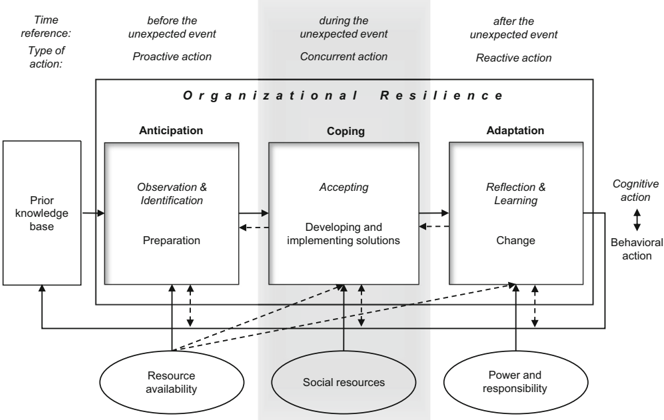
This is a conceptual paper that reframes organizational resilience as a meta-capability made up of three stages: anticipation, coping, and adaptation. It argues that resilience depends on specific underlying capabilities plus antecedents such as knowledge base, resources, social resources, and power/responsibility, and it ends by proposing propositions for future empirical work.
## Key findings
- The paper defines organizational resilience as an organization’s ability to anticipate potential threats, cope effectively with adverse events, and adapt to changing conditions.
- It decomposes resilience into three successive stages: anticipation, coping, and adaptation, and argues these stages overlap and build on each other; for example, anticipation influences coping and coping influences adaptation.
- The paper identifies capability clusters for each stage:
- anticipation: observation and identification, preparation
- coping: accepting, developing and implementing solutions
- adaptation: reflection and learning, organizational change
- It argues that resilience is a meta-capability requiring a combination of capabilities across all three stages; anticipation creates “resilience potential,” but coping and adaptation are needed to realize and improve it.
## Methods
- Conceptual/theoretical review paper, not an empirical study.
- Synthesizes literature from organizational resilience and related areas such as business continuity management, crisis management, innovation management, public administration, and organizational learning.
- Builds a conceptual framework and formulates propositions about antecedents and drivers, including:
- Proposition 1: knowledge base as an antecedent
- Proposition 2: resource availability
- Proposition 3: social resources
- Proposition 4: power based on expertise and shared responsibilities
## Limitations
- The paper explicitly notes that future research is needed to test the framework empirically and develop questionnaires; it says the framework is a first step toward a resilience theory rather than a final one.
- It states that much of the prior literature is fragmented, prescriptive/normative, and often retrospective, and that there is little knowledge about how resilience works in practice; this is the gap the paper tries to address.
- Evident from the text: the paper is entirely conceptual and does not present new data, sample, or statistical tests.
Model-written summary. Check it against the paper before relying on it.
Integrity signals
Registry
Cites
Statistics
Figures
Verification
Claims the paper makes
0 Valid · 4 Not valid · 58 Not checked · 67 Own results and interpretations
A conclusion the paper draws from its own results — it cites no other source for it, so there is none to check. The quote shows it is in the paper.
In the paper
“we suggest three successive stages of the resilience process (see Fig. 1) and argue that resilient organizations respond not only to the past (reactive action) or to current issues (concurrent action), but also to the future (anticipatory action).”
§ Organizational resilience: a capability-based conceptualization > 3.1 Fundamentals of the framework
hedgedstates a cause- Asserted: passes — The authors put it forward as true.
- Checkable: passes — It can be checked against evidence.
- Load-bearing: passes — The paper’s conclusions depend on it.
- Based: passes — The paper gives a reason why it holds.
None of the sources cited for this claim have been checked yet.
In the paper
“Most studies just point to organizational characteristics, resources, or processes that seem to be significant for resilience (e.g., Weick 1993;Kendra and Wachtendorf 2003;Gittell et al. 2006).This means that resilience is simply treated as an outcome-when organizations perform well during crisis or bounce back from interruptions (e.g., Horne and Orr 1998).”
- Also stated in: § 2.2 Previous conceptualizations of organizational resilience · plain
“Most studies treat resilience as an outcome-when organizations perform well during crisis or bounce back from interruptions (e.g., Horne and Orr 1998).”
§ Organizational resilience: a capability-based conceptualization > 1 Introduction
What the sources say
- Not matchedcites Horne and Orr 1998
An author–year citation the paper’s reference list doesn’t settle. We don’t search these by name.
- Not checked — no full text of the sourcecites Boin and van Eeten 2013 matched to “The Resilient Organization” (2013) source
- Not checked — no full text of the sourcecites Duit 2016 matched to “RESILIENCE THINKING: LESSONS FOR PUBLIC ADMINISTRATION” (2016) source
plain- Asserted: passes — The authors put it forward as true.
- Checkable: passes — It can be checked against evidence.
- Load-bearing: passes — The paper’s conclusions depend on it.
- Based: passes — The paper gives a reason why it holds.
- Also stated in: § 2.2 Previous conceptualizations of organizational resilience · plain
None of the sources cited for this claim could be matched to a paper, so there is nothing to check it against.
In the paper
“Depending on its specific configuration, resilience can be a source of sustainable competitive advantage (Hamel and Vaelikangas 2003;Sheffi 2007) and, thus, explain why some firms are more successful than others.”
§ Organizational resilience: a capability-based conceptualization > 2.1 Definitions of organizational resilience
What the sources say
- Not matchedcites Hamel and Vaelikangas 2003
An author–year citation the paper’s reference list doesn’t settle. We don’t search these by name.
- Not matchedcites Sheffi 2007
An author–year citation the paper’s reference list doesn’t settle. We don’t search these by name.
plainstates a possible cause- Asserted: passes — The authors put it forward as true.
- Checkable: passes — It can be checked against evidence.
- Load-bearing: passes — The paper’s conclusions depend on it.
- Based: passes — The paper gives a reason why it holds.
- Not matched
In the paper
“Organizational resilience capabilities develop over time and emerge from the process of coping with threatening situations and unexpected events (Linnenluecke et al. 2012).”
§ Organizational resilience: a capability-based conceptualization > 3.1 Fundamentals of the framework
What the sources say
- Not checked — no full text of the sourcecites Linnenluecke et al. 2012 matched to “Extreme Weather Events and the Critical Importance of Anticipatory Adaptation and Organizational Resilience in Responding to Impacts” (2012) source
plainstates a cause- Asserted: passes — The authors put it forward as true.
- Checkable: passes — It can be checked against evidence.
- Load-bearing: passes — The paper’s conclusions depend on it.
- Based: passes — The paper gives a reason why it holds.
A claim is checked only against the cited paper’s full text, never its abstract, and none is available for its sources.
In the paper
“research shows that newly developed solutions-regardless of how carefully they are designed-do not automatically lead to changes in the organizational patterns of action (Feldman 2003;Howard-Grenville 2005;Pentland and Feldman 2008).”
§ Organizational resilience: a capability-based conceptualization > 3.2.2 Coping capabilities
What the sources say
- Not checked — no full text of the sourcecites Feldman 2003 matched to “A performative perspective on stability and change in organizational routines” (2003) source
- Not checked — no full text of the sourcecites Howard-Grenville 2005 matched to “The Persistence of Flexible Organizational Routines: The Role of Agency and Organizational Context” (2005) source
- Not checked — no full text of the sourcecites Pentland and Feldman 2008 matched to “Designing routines: On the folly of designing artifacts, while hoping for patterns of action” (2008) source
plain- Asserted: passes — The authors put it forward as true.
- Checkable: passes — It can be checked against evidence.
- Load-bearing: passes — The paper’s conclusions depend on it.
- Based: passes — The paper gives a reason why it holds.
54 more claims
Create a free account to see all 129 claims and to verify the 7 references still open.
- Probably not a substantial claim. 48
- It may state two separate claims as one. 35
- The quote only partly states this claim. 2
Claims other papers make about this one
Each is checked against this paper’s own text: does it say what the citing paper says it does?
The cited source doesn’t support the claim as written.
In the citing paper
“The capacity conception, increasingly dominant in organizational and strategic management scholarship”
From Organizational Resilience and Crisis Management in Public Administration: Building Adaptive Governance Capacity in an Age of Compounding Disruptions (2026) · cites this paper as Duchek, 2020
Checked by a reasoning model — may be wrong.
Experimental — accuracy not yet measuredThe cited source says what the claim attributes to it.
In the citing paper
“The capacity conception, increasingly dominant in organizational and strategic management scholarship, treats resilience as a developable, manageable organizational asset the conceptualization adopted in this article (Duchek, 2020).”
From Organizational Resilience and Crisis Management in Public Administration: Building Adaptive Governance Capacity in an Age of Compounding Disruptions (2026) · cites this paper as Duchek, 2020
The cited source says what the claim attributes to it.
In the citing paper
“More recently, Duchek (2020) proposed a process model of organizational resilience comprising three sequential phases - anticipation, coping, and adaptation - each requiring distinct organizational capabilities. The AGRF builds on this process model while extending it to incorporate the distinctive institutional and governance features of public organizations.”
From Organizational Resilience and Crisis Management in Public Administration: Building Adaptive Governance Capacity in an Age of Compounding Disruptions (2026) · cites this paper as Duchek (2020)
Self-check
Percentages, sums and reported differences re-computed from the paper’s own numbers.
Each contradiction between two passages listed here was confirmed by an independent check.
Rated minor: it would not touch a result — a value no result rests on, a p-value that stays on the same side of the significance level, or a conflict that is clerical, resolved elsewhere in the paper, or outside its own findings.
In the paper
§ Organizational resilience: a capability-based conceptualization > 3.4.2 Resource availability
“Analyzing airline industry responses to September 2011, Gittell et al. (2006) found that airlines with greater financial resources”
§ Organizational resilience: a capability-based conceptualization > References
“Gittell, Jody H., Kim Cameron, Sandy Lim, and Victor Rivas. 2006. Relationships, layoffs, and organizational resilience airline industry responses to September 11.”
Citations
Cites
Absorptive Capacity: A New Perspective on Learning and Innovation
Cohen, W. M., & Levinthal, D. A. (1990) · Administrative Science Quarterly · doi:10.2307/2393553 · Cited by 35,728
An Evolutionary Theory of Economic Change.
Loasby, B. J., Nelson, R. R., & Winter, S. G. (1983) · The Economic Journal · doi:10.2307/2232409 · Cited by 21,366
Psychological Safety and Learning Behavior in Work Teams
Edmondson, A. (1999) · Administrative Science Quarterly · doi:10.2307/2666999 · Cited by 12,026 · cited 1×
“Learning can be described as ‘‘ongoing process of reflection and action characterized by asking questions, seeking feedback, experimenting, reflecting on results, and discussing errors or unexpected outcomes of actions’’ (Edmondson 1999, p. 353).”
Background(1993) · Journal of the American Dietetic Association · doi:10.1016/0002-8223(93)92196-5 · Cited by 11,976
Research in Organizational Behavior
Hammer, E. R., Cummings, L. L., & Staw, B. M. (1984) · The Academy of Management Review · doi:10.2307/258300 · Cited by 11,175
Hutchins, E. (1995) · doi:10.7551/mitpress/1881.001.0001 · Cited by 10,801 · cited 1×
“Social resources may be achieved through supportive mental processes that have been discussed as situated cognition (Suchman 1987), distributed cognition (Hutchins 1995), or joint cognitive systems (Hollnagel and Woods 2005).”
Background(1969) · Virtual Defense Library (Ministerio de Defensa) · Cited by 10,735
An Evolutionary Theory of Economic Change
Berkowitz, M. K., Nelson, R. R., & Winter, S. G. (1983) · Southern Economic Journal · doi:10.2307/1058233 · Cited by 10,549
Academy of Management Executive
(2010) · The Academy of Management executive/Academy of Management executive · doi:10.5465/ame · Cited by 8,844
A Behavioral Theory of the Firm
Day, R. H., Cyert, R. M., March, J. G., Clarkson, Cohen, Feigenbaum, D., Greenberg, Moore, Soelberg, Starbuck, et al. (1964) · Econometrica · doi:10.2307/1913056 · Cited by 7,791
Research works printed but not linked: 12
- 39. John W. Reich, Alex J. Zautra, and John Stuart Hall, 333-349. New York: The Guilford Press.
- 71. Hiltunen, Elina. 2008. Good Sources of Weak Signals: A Global Study of Where Futurists Look For Weak Signals. Journal of Futures Studies 12: 21-44.
- 74. Horne, John F. 1997. The coming of age of organizational resilience. Business Forum 22: 24-28.
- 116. March, James G., and Herbert A. Simon. 1958. Organizations. New York: Wiley.
- 135. Rerup, Claus. 2001. Houston, we have a problem: Anticipation and improvisation as sources of organizational resilience. Comportamento Organizacional E Gestao 7: 27-44.
- 138. Robert, Benoı ˆt. 2010. Organizational Resilience-Concepts and evaluation Method. Montre ´al: Presse de l'E ´cole Polytechnique de Montre ´al.
- 140. Roberts, Karlene H., Peter M. Madsen, and Vinit M. Desait. 2005. The space between in space transportation: A relational analysis of the failure of STS-107. In Organization at the limit-NASA and the Columbia Disaster, ed.
- 141. William H. Starbuck and Moshe Farjoun, 81-98. Oxford: Blackwell.
- 146. Ryle, Gilbert. 1979. On thinking. Oxford: Blackwell.
- 176. Vaughan, Diane. 2005. System effects: On slippery slopes, repeating negative patterns, and learning from mistake? In Organization at the limit-NASA and the Columbia Disaster, ed.
- 177. William H. Starbuck and Moshe Farjoun, 41-59. Oxford: Blackwell.
- 189. Westrum, Ron. 1988. Organizational and inter-organizational thought. Paper presented at the World Bank Conference on Safety Control and Risk Management.
Cited by
Items 1,501–1,600 of 1,969
Aleksić, A., Huber, M., Tadić, D., et al. (2025) · Lecture notes in networks and systems · doi:10.1007/978-3-031-99201-8_2
de Oliveira, D. G., Nascimento, N. T. A., Casemiro, Í. D. P., & Endo, G. Y. (2020) · AYA Editora eBooks · doi:10.47573/aya.88580.2.6.9
‘Go Where the Fissures Are’: Organisational Actors as Peacebuilding Entrepreneurs
Murphy, J. (2020) · Springer eBooks · doi:10.1007/978-3-030-49252-6_12
Designing and Managing for Strategic Agility
Zarkada, A. K., & Melanthiou, Y. (2026) · Future of business and finance · doi:10.1007/978-3-032-15868-0_4
Laabousse, S., & Soussi, L. H. L. (2025) · Procedia Computer Science · doi:10.1016/j.procs.2025.07.211
Park, J.-C., & Yun, J.-C. (2025) · Fire · doi:10.3390/fire8100390
“This aligns with prior scholarship on resilience and adaptive leadership, which stresses the integration of organizational systems with individual decision-making capacities [25–28].”
Ertürk, A., & Alkhayyat, R. (2021) · Advances in human and social aspects of technology book series · doi:10.4018/978-1-7998-7210-8.ch003
The Impact of Maintenance on Organisational Resilience
Stachowiak, A. (2025) · IFAC-PapersOnLine · doi:10.1016/j.ifacol.2025.11.899
Ownership Structures and Organizational Resilience: A PESTEL-Based Conceptual FrameworkPreprint
Raina, R., & Singh, H. (2026) · SSRN Electronic Journal · doi:10.2139/ssrn.6405518
Dual-loop kpi–okr model for university performance management in a resilient context
Lytvynov, O., & Shevchenko, I. (2026) · Ukrainian Journal of Applied Economics and Technology · doi:10.36887/2415-8453-2026-1-1
Rötzel, P. G., Kokott, P., & Schuhmacher, M. (2025) · Springer eBooks · doi:10.1007/978-3-658-47228-3_4
Ahras, A. (2024) · Management & Prospective · doi:10.3917/g2000.403.0032
Mgbemena, M., Charity, I., Okafor, O., Offia, K. J., Offia, O., & Chioma, A. (2024) · International Journal of Research Publication and Reviews · doi:10.55248/gengpi.5.0324.0894
Abdi, A. M., Deng, X., & Mohamud, A. J. (2026) · Energy Strategy Reviews · doi:10.1016/j.esr.2026.102299 · Cited by 2
Sherri, W., & Alsaghir, L. (2026) · SN Business & Economics · doi:10.1007/s43546-026-01281-8
“By contrast, resilience often refers to the ability to withstand, recover, and bounce back after an unexpected disturbance or shock (Duchek 2020).”
Mafud, J. L. C. (2026) · AvaCient. · doi:10.69823/avacient.v6n2a1
Reyes-Sánchez, J. D. J. (2025) · IGI Global eBooks · doi:10.4018/979-8-3373-5702-7.ch012
Wang, M.-L., Zha, G., & He, Z.-X. (2026) · International Review of Economics & Finance · doi:10.1016/j.iref.2026.105535 · Cited by 3
Nguyen, T. Q. T. (2024) · theses.fr (ABES) · doi:10.70675/dcf11e2fz43c4z4b2fzaf6ez0fefcf42baca
Low-Level Disturbances and Organizational Resilience
Sevilla-Ruiz, J., Ruiz-Martín, C., Nebro-Mellado, J. J., & López‐Paredes, A. (2026) · Lecture notes on data engineering and communications technologies · doi:10.1007/978-3-032-12099-1_1
Wang, T., Zhang, M., & Tan, X. (2026) · PLoS ONE · doi:10.1371/journal.pone.0340102
Effiong, E. L., Amaku, U. A., Jacob, E. G., et al. (2026) · UMYU Journal of Accounting and Finance Research · doi:10.61143/umyu-jafr.9(2)2026.002
“Duchek (2020) conceptualises organisational resilience as a capability involving anticipation, coping and adaptation.”
Zhang, Z., & Dang, X. (2026) · Sustainability · doi:10.3390/su18094230 · Cited by 1
Rathnayake, P. U., Abeysekera, N., Samarasinghe, D., & Gnanapala, A. C. (2026) · SAM Advanced Management Journal · doi:10.1108/samamj-05-2026-0029
Geng, Y., Yang, B., & Sun, W. (2026) · Journal of Innovation & Knowledge · doi:10.1016/j.jik.2026.101152
Resilienz jetzt – Wie Krisen unseren Blick auf Wertschöpfungsnetzwerke verändern
Stich, V. (. D.-I. )., Schröer, T., Linnartz, M., et al. (2023) · Springer eBooks · doi:10.1007/978-3-658-41084-1_5
Crisis management and business continuity: Strategies for South African SMEs post-COVID-19
Chasaya, W., & Ayandibu, A. O. (2025) · International Journal of Research in Business and Social Science (2147-4478) · doi:10.20525/ijrbs.v14i5.4228 · Cited by 1
Ajik, N., Elisha, R. G., & Micheal, I. (2026) · International Journal of Latest Technology in Engineering Management & Applied Science · doi:10.51583/ijltemas.2025.1412000067 · Cited by 1
Digital Agility and Business Resilience: Exploration through Rough Set TheoryPreprint
Acharjya, B., Das, S., Belal, H. M., & Foropon, C. R. H. (2025) · Research Square · doi:10.21203/rs.3.rs-7086056/v1
Dlamini, B. I., Lawa, E., & Shange, H. S. (2026) · Frontiers in Education · doi:10.3389/feduc.2026.1872154
An insight-based approach to higher education administration through mindfulness
Azizi, A., Salimi, J., & Tanhayee, A. (2025) · International Journal of Educational Management · doi:10.1108/ijem-11-2024-0722 · Cited by 3
Lee, W., Lower‐Hoppe, L. M., Jones, G. J., & Peachey, J. W. (2026) · European Sport Management Quarterly · doi:10.1080/16184742.2026.2659724 · Cited by 2
Tturuco, F. E. S., & Preciado, M. A. C. (2026) · Sustainability · doi:10.3390/su18189467
Tesouro, I. E. (2026) · Journal of Evolutionary Studies in Business-JESB · doi:10.1344/jesb.49948
Kumbo, L. I., Luwavi, E. O., & Hayuma, B. (2025) · ABUAD Journal of Engineering Research and Development (AJERD) · doi:10.53982/ajerd.2025.0803.23-j
Rhouiri, M., & Saidi, H. (2026) · IGI Global eBooks · doi:10.4018/979-8-3373-4144-6.ch012
Alaali, H. (2026) · SSRN Electronic Journal · doi:10.2139/ssrn.6734842
Zakia, E., & Najoua, F. (2025) · doi:10.1109/icat2i69744.2025.11472664
“Duchek's work proposes a structuring into three fundamental capacities: anticipation, adaptation, and reconfiguration[8].”
InfluentialArts Resilience Adaptive Capacity and Innovation
Kaiser, E.-Y. (2022) · Springer eBooks · doi:10.1007/978-3-658-37862-2_6
Adapting to the EU Customs Reform – Building Digital Compliance Agility and Customs Resilience
Ek, M., & Ek, P. (2026) · European Taxation · doi:10.59403/2k4n2tn
Kouskoura, A., Kalliontzi, E., Antoniadis, I., & Skalkos, D. C. (2026) · Sustainability · doi:10.3390/su18104776
“Instead, regions must simultaneously invest in institutional capacity, infrastructure resilience, civil protection, human capital development, social co-hesion, and technological innovation to foster sustainable, inclusive competitiveness [210].”
Cybersecurity Risk and Corporate Financial Policy: The Role of Product Market CompetitionPreprint
Beuselinck, C., Ohlrogge, F., & Veerhoek, J. P. (2026) · SSRN Electronic Journal · doi:10.2139/ssrn.7051845
Enduring Legacy: Proud Roots in an Uncertain Land
Salhout, S. M., & Buchanan, F. R. (2025) · Administrative Sciences · doi:10.3390/admsci15030084
“Catastrophic disruptions, such as the COVID-19 pandemic and regional wars, lead to significant financial losses (Duchek, 2020; Gu et al., 2021).”
OMNI-RESILIENT STRATEGY OF CONSTRUCTION DEVELOPMENT COMPANIES IN AN UNCERTAIN ENVIRONMENT
Калінін, О. (2026) · Bulletin of East European University of Economics and Management · doi:10.58253/2078-1628-2026-1-2(35)-015
Trust Convergence and Followership Legitimacy: A Systems Thinking Theory of Leadership PropulsionPreprint
Shepherd, D. (2026) · SSRN Electronic Journal · doi:10.2139/ssrn.7075312
Resiliencia organizacional (ERESO) en una muestra de profesores peruanos: Validación de escala
Holguin-Alvarez, J., Ruiz-Salazar, J., Castillo, F. F. L., & Acha, D. M. H. (2023) · Revista Venezolana de Gerencia · doi:10.52080/rvgluz.28.101.7 · Cited by 3
Ownership structures and organizational resilience: A domain-contingent configurational framework
Singh, H., & Raina, R. (2026) · Strategic Business Research · doi:10.1016/j.sbr.2026.100256
Wang, X., Onputtha, S., & Jotikasthira, C. (2025) · Journal of Lifestyle and SDGs Review · doi:10.47172/2965-730x.sdgsreview.v5.n03.pe04931
“However, there is still insufficient empirical study on the role of this factor in the university context (Duchek, 2020; Piprani et al ., 2020).”
Distinctive aspects of investment policy during the COVID-19 pandemic: A global analysis
Petighin, S. (2024) · Virgil Madgearu Review of Economic Studies and Research · doi:10.24193/rvm.2024.17.120
How resource configuration affects resilience and supply chain performance under disruptions
de Queiroz, M. M., Domingues, Í., Wamba, S. F., et al. (2025) · Elsevier eBooks · doi:10.1016/b978-0-443-28993-4.00201-8
Meng, Q., Li, J., & Li, Z. (2026) · Journal of Information & Knowledge Management · doi:10.1142/s0219649226500280
Economic Development amidst Conflict: Exploring Dynamics in the MEDA regionPreprint
Scalamonti, F. (2026) · SSRN Electronic Journal · doi:10.2139/ssrn.6518699 · Cited by 1
Strengthening Resilience in a Danish Health System – A Longitudinal Study
Tuxen, J., Boesen, M. I., & Møller, E. L. (2024) · doi:10.18690/um.fov.4.2024.44
Kanyangale, M. (2024) · Foundations of Management · doi:10.2478/fman-2024-0020
Mitra, A., & Roy, R. (2025) · IGI Global eBooks · doi:10.4018/979-8-3373-3596-4.ch008
Zukunft aktiv gestalten mit der Roadmap
Peuser, M. (2026) · Springer eBooks · doi:10.1007/978-3-658-51583-6_9
Navigating Christian School Resilience, Lesson Learn from Decline to Survival Strategies
Kui, D. O. K., Widjaja, A. W., & Pramono, R. (2025) · Journal of Posthumanism · doi:10.63332/joph.v5i4.1133 · Cited by 1
“Organizations must get out from distressing results by becoming more resilient in adapting to disruptive environments and surviving a setback in a stronger capability than before by identifying best practice and lesson learned (Mehta et al., 2024; Kantabutra & Ketprapakorn, 2021; Duchek, 2020).”
Haider, D. P. Z. A. D. S. A., & Haider, S. A. (2026) · International Journal of Latest Technology in Engineering Management & Applied Science · doi:10.51583/ijltemas.2026.150600263
GESTÃO ESTRATÉGICA DE RESILIÊNCIA ORGANIZACIONAL: TRAZENDO O CONCEITO PARA A PRÁTICA
de Moura, D. (2022) · doi:10.17771/pucrio.acad.58530 · Cited by 2
Lie, L. B., & Sydnes, A. K. (2026) · Climate Risk Management · doi:10.1016/j.crm.2026.100847
Enhancing Business Resilience in the Era of ChatGPT: Navigating New Age Solutions
Jonnalaa, R., Desai, K., & Loonkar, S. (2025) · IEEE International Conference on Advances in Computing Research on Science Engineering and Technology (ACROSET) · doi:10.1109/acroset66531.2025.11280845 · Cited by 1
Silva, F. C. N. S. E., & Barreto, C. G. (2025) · Revista de Gestão Social e Ambiental · doi:10.24857/rgsa.v19n4-027
Gakh, D. B. (2026) · Studies in systems, decision and control · doi:10.1007/978-3-032-11612-3_63
Tubis, A. A., & Werbińska-Wojciechowska, S. (2026) · Systems · doi:10.3390/systems14080920 · Cited by 1
Krysko, Z. (2026) · Economic Analysis · doi:10.35774/econa2026.01.107
Lee, W., Jones, G. J., Sato, M., Liechty, T., Lower‐Hoppe, L. M., & Peachey, J. W. (2026) · Managing Sport and Leisure · doi:10.1080/23750472.2026.2650643 · Cited by 1
Aden, I. A., & Muthimi, J. (2022) · International Journal of Research and Innovation in Social Science · doi:10.47772/ijriss.2022.61029
Wang, Z., Li, D., & Huo, J. (2026) · Scientific Reports · doi:10.1038/s41598-026-44121-3 · Cited by 1
“The agility, robustness, and integrity of organisational resilience form a closed loop of “fast response–robust execution–efficient collaboration,” directly promoting project goal achievement 6, 36, 37 .”
Urban, T. (2023) · Historische Resilienz-Forschung · doi:10.1007/978-3-658-39281-9_2
Karreinen, S., Janhonen, K. H., Kihlström, L., Paananen, H., Viita-aho, M., & Tynkkynen, L. (2024) · Journal of Health Organization and Management · doi:10.1108/jhom-06-2024-0257 · Cited by 2
Transformative Role of HRM in Shaping Adaptive Organisations by Empowering Resilience
Saini, D. (2026) · IGI Global eBooks · doi:10.4018/979-8-2600-2513-0.ch009
Strategic Integration of Resilience in Innovation EcosystemsPreprint
Lee, P.-C. (2024) · SSRN Electronic Journal · doi:10.2139/ssrn.4818960 · Cited by 1
Chen, Y., Zhang, X., & Ma, S. (2026) · Economic Change and Restructuring · doi:10.1007/s10644-026-10076-8
“…in multidimensional and partly overlapping ways, emphasizing the maintenance of functioning under adversity, recovery, and adaptation, while some frameworks also consider broader organizational transformation (Williams et al., 2017; Duchek, 2020; Hillmann & Guenther, 2021; Linnenluecke, 2017).”
Circular Business Model for a Sustainable Future
Basile, V. (2025) · Future of business and finance · doi:10.1007/978-3-032-02766-5_4
Schnichels, A., Breuer, N., Prinz, C., & Kuhlenkötter, B. (2026) · Production Engineering · doi:10.1007/s11740-026-01453-3 · Cited by 1
“According to Duchek [12] there are three delineated Resilience stages : anticipation , coping and adaption .”
Social Distancing and Social Barriers: The Impact of the Pandemic on Dallas Youth
Bejdaoui, N. (2023) · University of North Texas Digital Library (University of North Texas) · doi:10.12794/metadc2137518
Barbosa, I., & de Oliveira, E. R. (2026) · Journal of Workplace Behavioral Health · doi:10.1080/15555240.2026.2701417
Resilience as becoming: the coherence–complexity framework for organizing in permanent transition
Skučaitė, G., & Uygur, M. R. (2026) · Business and management · doi:10.3846/bm.2026.2417
Pengaruh Strategic Human Resource Management terhadap Organizational Resilience
Abidin, A., & Purba, H. P. (2022) · Buletin Riset Psikologi dan Kesehatan Mental (BRPKM) · doi:10.20473/brpkm.v2i1.34623 · Cited by 1
Business Resilience and Disaster Risk Management
Ha, H., & Wang, J. L. (2023) · International Handbook of Disaster Research · doi:10.1007/978-981-16-8800-3_212-1
Antinoja, V., & Suorsa, A. R. (2025) · Journal of Documentation · doi:10.1108/jd-12-2024-0298 · Cited by 1
Darshani, R. K. N. D., & Surangi, H. A. K. N. S. (2026) · South Asian Journal of Business and Management Cases · doi:10.1177/22779779261435020
“( Owner) This reflects resilience theory, which argues that when formal systems fail, organizations need to build adaptive routines internally (Duchek, 2020).”
InfluentialAlaskar, T. H. (2026) · Journal of theoretical and applied electronic commerce research · doi:10.3390/jtaer21090301 · Cited by 1
Albert, A., Bode, I., & Parschick, S. (2023) · transcript Verlag eBooks · doi:10.1515/9783839467220-008
Impact of COVID-19 state aid funds on the performance of airports in Poland
Tłoczyński, D., Mosionek-Schweda, M., Zamojska, A., & Diakowska, K. (2025) · Economics and Environment · doi:10.34659/eis.2025.94.3.1218
“At the same time, research on crisis management and organisational resilience theory highlights that the effectiveness of such interventions depends on the adaptive capacity of individual organisations organisations (Duchek, 2019; Rose, 2004).”
Phonthanukitithaworn, C., Punnyadhanasakul, P., & Naruetharadhol, P. (2026) · Journal of Open Innovation Technology Market and Complexity · doi:10.1016/j.joitmc.2026.100777 · Cited by 2
How Filipino nano-entrepreneurs survive adversity through culturally embedded resilience strategies
Bongado, K. M. C., Liquete, R. F. F., Ong, D. P., Salac, L. C., & Mabalay, A. A. (2026) · International Journal of Entrepreneurial Behaviour & Research · doi:10.1108/ijebr-08-2025-1165
Winn, M. (2024) · Cronfa (Swansea University) · doi:10.23889/suthesis.66582
Mangundjaya, W. H., & Martdianty, F. (2023) · Advances in economics, business and management research/Advances in Economics, Business and Management Research · doi:10.2991/978-94-6463-234-7_132 · Cited by 6
Inclusive Leadership Empowers International Talents to Enhance Organizational Resilience
Yu, C., Rahman, R. H. A., & Hami, M. A. B. A. (2026) · IGI Global eBooks · doi:10.4018/979-8-3373-5509-2.ch005
Pontes, E. B. M. S., Simão, J., & Trindade, J. M. R. (2026) · World sustainability series · doi:10.1007/978-3-032-22076-9_8
Strategic Change: Eurozone SMEs Pivot to Alternative Finance
Karam, C., Saad, K., Khouri, S., et al. (2026) · Strategic Change · doi:10.1002/jsc.70105
ONARAN, S., & Yurtkoru, E. S. (2024) · Journal of Research in Business · doi:10.54452/jrb.1489717 · Cited by 3
Zhao, Z. (2026) · Frontiers in Environmental Science · doi:10.3389/fenvs.2026.1874173
Altmann, M., Milan, G. S., Machado, M. A., & Brambilla, F. R. (2024) · Revista de Gestão e Secretariado (Management and Administrative Professional Review) · doi:10.7769/gesec.v15i10.4159 · Cited by 1
Business resilience in digital future: a short case study on Etisalat, UAE
Ali, N. (2024) · The CASE Journal · doi:10.1108/tcj-08-2024-0246
Metadata
- Authors
- Duchek, S.
- Affiliations
- Technische Universität Dresden (DE)
- Corresponding author
- Duchek, Stephanie
- ORCID
- Duchek, Stephanie
- Venue
- Business Research
- Published
- 2019-01-14
- Volume
- 13
- Issue
- 1
- Pages
- 215-246
- ISSN
- 1866-8658 (ISSN-L)
- 2198-3402
- 2198-2627
- OpenAlex
- W2910462204
- Cited by
- 2,027
- References
- 209
- Citations by year
- 2026: 640 · 2025: 398 · 2024: 311 · 2023: 280 · 2022: 213 · 2021: 131 · 2020: 50 · 2019: 3
- FWCI
- 152.43
- Type
- journal article
- Language
- en
- Open access
- gold
- doi.org
- Licence
- cc-by
- creativecommons.org/licenses/by/4.0 (tdm)
- creativecommons.org/licenses/by/4.0 (vor)
- Locations
- BuR - Business Research (publishedVersion, cc-by)
- RePEc: Research Papers in Economics (submittedVersion)
- Econstor (Econstor) (submittedVersion, cc-by)
- Topics
- Social Sciences › Business, Management and Accounting › Strategy and Management › Supply Chain Resilience and Risk Management
- Social Sciences › Business, Management and Accounting › Strategy and Management › Innovation and Knowledge Management
- Social Sciences › Sociology and Political Science › Disaster Management and Resilience
- Keywords
- organizational resilience, organizational capabilities, meta-capability, anticipation, coping, adaptation, crisis management, uncertainty, antecedents of resilience
About these checks
Registry, retraction, Cites and statistics results are computed, not judged, with one exception: a printed reference that no index lists is read once by a model before it counts as a citation error. Claims are extracted by a model and kept only when their quote appears verbatim in the text; each cited source is then checked, with a model’s help, for whether it says what the claim relies on. Those verdicts can be wrong — read the claim’s quote and the cited source before relying on one.
A language model drew the claims from the paper on 2026-10-10, under version 3 of the claim definition (model deepseek-v4.1-flash, prompt extract-v3).
A second model labelled each claim on 2026-10-10 (model jev-1.13-20260917, definition revision gold-guideline-v0.2).
Statistics and arithmetic are recomputed, not judged.
Confidence bands are shown only for fields calibrated on our annotated test set. None is calibrated yet, so no band is shown.
What counts as a claim ›How we measure confidence ›How we check this ›
Are you an author, or do you see a problem with this page? Request a review
Data sources
Bibliographic data: Semantic Scholar, OpenAlex, Crossref.
Contains information from the Semantic Scholar Academic Graph Datasets, made available under the ODC Attribution License (ODC-BY 1.0).
Semantic Scholar’s data is described in: Kinney, R., et al. (2023). The Semantic Scholar Open Data Platform. arXiv:2301.10140.
