

Organizational resilience: a capability-based conceptualization
Open accessThe DOI matches its Crossref record; 206 of the 209 references it cites were found in a registry or an index, and 2 are not checked yet; none of the 106 sources its claims cite is checked for support yet.
Abstract
In highly volatile and uncertain times, organizations need to develop a resilience capacity which enables them to cope effectively with unexpected events, bounce back from crises, and even foster future success. Although academic interest in organizational resilience has steadily grown in recent years, there is little consensus about what resilience actually means and how it is composed. More knowledge is particularly needed about organizational capabilities that constitute resilience, as well as conditions for their development. This paper aims to make a contribution to this heterogeneous research field by deepening the understanding of the complex and embedded construct of organizational resilience. We conceptualize resilience as a meta-capability and decompose the construct into its individual parts. Inspired by process-based studies, we suggest three successive resilience stages (anticipation, coping, and adaptation) and give an overview of underlying capabilities that together form organizational resilience. Based on this outline, we discuss relationships and interactions of the different resilience stages as well as main antecedents and drivers. We formulate propositions that can act as a foundation for future empirical work.
Checked 2026-11-22 · 2 references not checked yet
Overview
CoChat Summary
## TL;DR
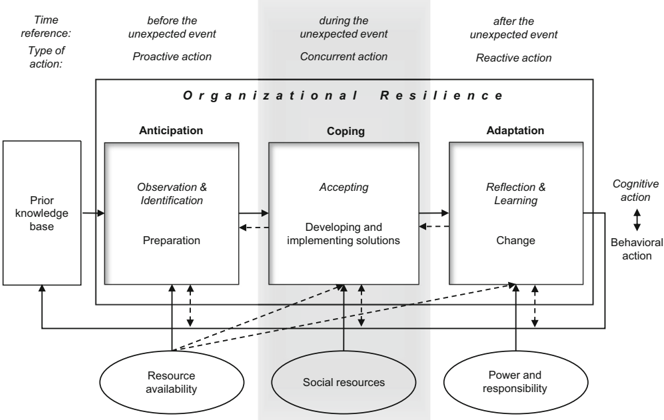
This is a conceptual paper that reframes organizational resilience as a meta-capability made up of three stages: anticipation, coping, and adaptation. It argues that resilience depends on specific underlying capabilities plus antecedents such as knowledge base, resources, social resources, and power/responsibility, and it ends by proposing propositions for future empirical work.
## Key findings
- The paper defines organizational resilience as an organization’s ability to anticipate potential threats, cope effectively with adverse events, and adapt to changing conditions.
- It decomposes resilience into three successive stages: anticipation, coping, and adaptation, and argues these stages overlap and build on each other; for example, anticipation influences coping and coping influences adaptation.
- The paper identifies capability clusters for each stage:
- anticipation: observation and identification, preparation
- coping: accepting, developing and implementing solutions
- adaptation: reflection and learning, organizational change
- It argues that resilience is a meta-capability requiring a combination of capabilities across all three stages; anticipation creates “resilience potential,” but coping and adaptation are needed to realize and improve it.
## Methods
- Conceptual/theoretical review paper, not an empirical study.
- Synthesizes literature from organizational resilience and related areas such as business continuity management, crisis management, innovation management, public administration, and organizational learning.
- Builds a conceptual framework and formulates propositions about antecedents and drivers, including:
- Proposition 1: knowledge base as an antecedent
- Proposition 2: resource availability
- Proposition 3: social resources
- Proposition 4: power based on expertise and shared responsibilities
## Limitations
- The paper explicitly notes that future research is needed to test the framework empirically and develop questionnaires; it says the framework is a first step toward a resilience theory rather than a final one.
- It states that much of the prior literature is fragmented, prescriptive/normative, and often retrospective, and that there is little knowledge about how resilience works in practice; this is the gap the paper tries to address.
- Evident from the text: the paper is entirely conceptual and does not present new data, sample, or statistical tests.
Model-written summary. Check it against the paper before relying on it.
Integrity signals
Registry
Cites
Statistics
Figures
Verification
Claims the paper makes
0 Valid · 4 Not valid · 58 Not checked · 67 Own results and interpretations
A conclusion the paper draws from its own results — it cites no other source for it, so there is none to check. The quote shows it is in the paper.
In the paper
“we suggest three successive stages of the resilience process (see Fig. 1) and argue that resilient organizations respond not only to the past (reactive action) or to current issues (concurrent action), but also to the future (anticipatory action).”
§ Organizational resilience: a capability-based conceptualization > 3.1 Fundamentals of the framework
hedgedstates a cause- Asserted: passes — The authors put it forward as true.
- Checkable: passes — It can be checked against evidence.
- Load-bearing: passes — The paper’s conclusions depend on it.
- Based: passes — The paper gives a reason why it holds.
None of the sources cited for this claim have been checked yet.
In the paper
“Most studies just point to organizational characteristics, resources, or processes that seem to be significant for resilience (e.g., Weick 1993;Kendra and Wachtendorf 2003;Gittell et al. 2006).This means that resilience is simply treated as an outcome-when organizations perform well during crisis or bounce back from interruptions (e.g., Horne and Orr 1998).”
- Also stated in: § 2.2 Previous conceptualizations of organizational resilience · plain
“Most studies treat resilience as an outcome-when organizations perform well during crisis or bounce back from interruptions (e.g., Horne and Orr 1998).”
§ Organizational resilience: a capability-based conceptualization > 1 Introduction
What the sources say
- Not matchedcites Horne and Orr 1998
An author–year citation the paper’s reference list doesn’t settle. We don’t search these by name.
- Not checked — no full text of the sourcecites Boin and van Eeten 2013 matched to “The Resilient Organization” (2013) source
- Not checked — no full text of the sourcecites Duit 2016 matched to “RESILIENCE THINKING: LESSONS FOR PUBLIC ADMINISTRATION” (2016) source
plain- Asserted: passes — The authors put it forward as true.
- Checkable: passes — It can be checked against evidence.
- Load-bearing: passes — The paper’s conclusions depend on it.
- Based: passes — The paper gives a reason why it holds.
- Also stated in: § 2.2 Previous conceptualizations of organizational resilience · plain
None of the sources cited for this claim could be matched to a paper, so there is nothing to check it against.
In the paper
“Depending on its specific configuration, resilience can be a source of sustainable competitive advantage (Hamel and Vaelikangas 2003;Sheffi 2007) and, thus, explain why some firms are more successful than others.”
§ Organizational resilience: a capability-based conceptualization > 2.1 Definitions of organizational resilience
What the sources say
- Not matchedcites Hamel and Vaelikangas 2003
An author–year citation the paper’s reference list doesn’t settle. We don’t search these by name.
- Not matchedcites Sheffi 2007
An author–year citation the paper’s reference list doesn’t settle. We don’t search these by name.
plainstates a possible cause- Asserted: passes — The authors put it forward as true.
- Checkable: passes — It can be checked against evidence.
- Load-bearing: passes — The paper’s conclusions depend on it.
- Based: passes — The paper gives a reason why it holds.
- Not matched
In the paper
“Organizational resilience capabilities develop over time and emerge from the process of coping with threatening situations and unexpected events (Linnenluecke et al. 2012).”
§ Organizational resilience: a capability-based conceptualization > 3.1 Fundamentals of the framework
What the sources say
- Not checked — no full text of the sourcecites Linnenluecke et al. 2012 matched to “Extreme Weather Events and the Critical Importance of Anticipatory Adaptation and Organizational Resilience in Responding to Impacts” (2012) source
plainstates a cause- Asserted: passes — The authors put it forward as true.
- Checkable: passes — It can be checked against evidence.
- Load-bearing: passes — The paper’s conclusions depend on it.
- Based: passes — The paper gives a reason why it holds.
A claim is checked only against the cited paper’s full text, never its abstract, and none is available for its sources.
In the paper
“research shows that newly developed solutions-regardless of how carefully they are designed-do not automatically lead to changes in the organizational patterns of action (Feldman 2003;Howard-Grenville 2005;Pentland and Feldman 2008).”
§ Organizational resilience: a capability-based conceptualization > 3.2.2 Coping capabilities
What the sources say
- Not checked — no full text of the sourcecites Feldman 2003 matched to “A performative perspective on stability and change in organizational routines” (2003) source
- Not checked — no full text of the sourcecites Howard-Grenville 2005 matched to “The Persistence of Flexible Organizational Routines: The Role of Agency and Organizational Context” (2005) source
- Not checked — no full text of the sourcecites Pentland and Feldman 2008 matched to “Designing routines: On the folly of designing artifacts, while hoping for patterns of action” (2008) source
plain- Asserted: passes — The authors put it forward as true.
- Checkable: passes — It can be checked against evidence.
- Load-bearing: passes — The paper’s conclusions depend on it.
- Based: passes — The paper gives a reason why it holds.
54 more claims
Create a free account to see all 129 claims and to verify the 7 references still open.
- Probably not a substantial claim. 48
- It may state two separate claims as one. 35
- The quote only partly states this claim. 2
Claims other papers make about this one
Each is checked against this paper’s own text: does it say what the citing paper says it does?
The cited source doesn’t support the claim as written.
In the citing paper
“The capacity conception, increasingly dominant in organizational and strategic management scholarship”
From Organizational Resilience and Crisis Management in Public Administration: Building Adaptive Governance Capacity in an Age of Compounding Disruptions (2026) · cites this paper as Duchek, 2020
Checked by a reasoning model — may be wrong.
Experimental — accuracy not yet measuredThe cited source says what the claim attributes to it.
In the citing paper
“The capacity conception, increasingly dominant in organizational and strategic management scholarship, treats resilience as a developable, manageable organizational asset the conceptualization adopted in this article (Duchek, 2020).”
From Organizational Resilience and Crisis Management in Public Administration: Building Adaptive Governance Capacity in an Age of Compounding Disruptions (2026) · cites this paper as Duchek, 2020
The cited source says what the claim attributes to it.
In the citing paper
“More recently, Duchek (2020) proposed a process model of organizational resilience comprising three sequential phases - anticipation, coping, and adaptation - each requiring distinct organizational capabilities. The AGRF builds on this process model while extending it to incorporate the distinctive institutional and governance features of public organizations.”
From Organizational Resilience and Crisis Management in Public Administration: Building Adaptive Governance Capacity in an Age of Compounding Disruptions (2026) · cites this paper as Duchek (2020)
Self-check
Percentages, sums and reported differences re-computed from the paper’s own numbers.
Each contradiction between two passages listed here was confirmed by an independent check.
Rated minor: it would not touch a result — a value no result rests on, a p-value that stays on the same side of the significance level, or a conflict that is clerical, resolved elsewhere in the paper, or outside its own findings.
In the paper
§ Organizational resilience: a capability-based conceptualization > 3.4.2 Resource availability
“Analyzing airline industry responses to September 2011, Gittell et al. (2006) found that airlines with greater financial resources”
§ Organizational resilience: a capability-based conceptualization > References
“Gittell, Jody H., Kim Cameron, Sandy Lim, and Victor Rivas. 2006. Relationships, layoffs, and organizational resilience airline industry responses to September 11.”
Citations
Cites
Absorptive Capacity: A New Perspective on Learning and Innovation
Cohen, W. M., & Levinthal, D. A. (1990) · Administrative Science Quarterly · doi:10.2307/2393553 · Cited by 35,728
An Evolutionary Theory of Economic Change.
Loasby, B. J., Nelson, R. R., & Winter, S. G. (1983) · The Economic Journal · doi:10.2307/2232409 · Cited by 21,366
Psychological Safety and Learning Behavior in Work Teams
Edmondson, A. (1999) · Administrative Science Quarterly · doi:10.2307/2666999 · Cited by 12,026 · cited 1×
“Learning can be described as ‘‘ongoing process of reflection and action characterized by asking questions, seeking feedback, experimenting, reflecting on results, and discussing errors or unexpected outcomes of actions’’ (Edmondson 1999, p. 353).”
Background(1993) · Journal of the American Dietetic Association · doi:10.1016/0002-8223(93)92196-5 · Cited by 11,976
Research in Organizational Behavior
Hammer, E. R., Cummings, L. L., & Staw, B. M. (1984) · The Academy of Management Review · doi:10.2307/258300 · Cited by 11,175
Hutchins, E. (1995) · doi:10.7551/mitpress/1881.001.0001 · Cited by 10,801 · cited 1×
“Social resources may be achieved through supportive mental processes that have been discussed as situated cognition (Suchman 1987), distributed cognition (Hutchins 1995), or joint cognitive systems (Hollnagel and Woods 2005).”
Background(1969) · Virtual Defense Library (Ministerio de Defensa) · Cited by 10,735
An Evolutionary Theory of Economic Change
Berkowitz, M. K., Nelson, R. R., & Winter, S. G. (1983) · Southern Economic Journal · doi:10.2307/1058233 · Cited by 10,549
Academy of Management Executive
(2010) · The Academy of Management executive/Academy of Management executive · doi:10.5465/ame · Cited by 8,844
A Behavioral Theory of the Firm
Day, R. H., Cyert, R. M., March, J. G., Clarkson, Cohen, Feigenbaum, D., Greenberg, Moore, Soelberg, Starbuck, et al. (1964) · Econometrica · doi:10.2307/1913056 · Cited by 7,791
Research works printed but not linked: 12
- 39. John W. Reich, Alex J. Zautra, and John Stuart Hall, 333-349. New York: The Guilford Press.
- 71. Hiltunen, Elina. 2008. Good Sources of Weak Signals: A Global Study of Where Futurists Look For Weak Signals. Journal of Futures Studies 12: 21-44.
- 74. Horne, John F. 1997. The coming of age of organizational resilience. Business Forum 22: 24-28.
- 116. March, James G., and Herbert A. Simon. 1958. Organizations. New York: Wiley.
- 135. Rerup, Claus. 2001. Houston, we have a problem: Anticipation and improvisation as sources of organizational resilience. Comportamento Organizacional E Gestao 7: 27-44.
- 138. Robert, Benoı ˆt. 2010. Organizational Resilience-Concepts and evaluation Method. Montre ´al: Presse de l'E ´cole Polytechnique de Montre ´al.
- 140. Roberts, Karlene H., Peter M. Madsen, and Vinit M. Desait. 2005. The space between in space transportation: A relational analysis of the failure of STS-107. In Organization at the limit-NASA and the Columbia Disaster, ed.
- 141. William H. Starbuck and Moshe Farjoun, 81-98. Oxford: Blackwell.
- 146. Ryle, Gilbert. 1979. On thinking. Oxford: Blackwell.
- 176. Vaughan, Diane. 2005. System effects: On slippery slopes, repeating negative patterns, and learning from mistake? In Organization at the limit-NASA and the Columbia Disaster, ed.
- 177. William H. Starbuck and Moshe Farjoun, 41-59. Oxford: Blackwell.
- 189. Westrum, Ron. 1988. Organizational and inter-organizational thought. Paper presented at the World Bank Conference on Safety Control and Risk Management.
Cited by
Items 1,701–1,800 of 1,969
Stor, M., & Haromszeki, Ł. (2026) · Wroclaw University of Economics and Business eBooks · doi:10.15611/2026.71.5.09
The Resilience Level of Lecturers from a Training Institute in Malaysia
Bahtiar, R. A., Murshid, S. F. B., Yusof, N. Y. B., Yahya, H. B., & Nor, N. B. N. M. (2023) · International Journal of Academic Research in Business and Social Sciences · doi:10.6007/ijarbss/v13-i1/16231 · Cited by 1
Mahmood, M., Uddin, M. A., Rahman, M. H. A., Absar, M. M. N., & Islam, M. N. (2026) · SN Business & Economics · doi:10.1007/s43546-026-01371-7
Embedding resilience in biological production through functional modularity: A mixed-method approach
Diep, H. T. N., Tuu, H. H., & Anh, N. T. T. (2026) · International Journal of Production Economics · doi:10.1016/j.ijpe.2026.110182
Aldoski, A. A. M., & Aldawod, A. (2026) · SSRN Electronic Journal · doi:10.2139/ssrn.6531583
Onjewu, A. E., Atiase, V. Y., Paul, S. Y., & Nyuur, C. N. (2026) · European Business Review · doi:10.1108/ebr-09-2025-0313
Responsible leadership as a driver of resilience in urban health and sanitation projects in Uganda
Kyambade, M., Mwesigwa, R., Alinda, K., Tumwine, S., & Lwanga, F. (2026) · Urbanization, sustainability and society. · doi:10.1108/uss-02-2026-0004
Leveraging capabilities to foster resilience and drive innovation in rural tourism
Naimi, D. I. A., Wibowo, A., & Alimmudin, A. (2026) · African Journal of Hospitality Tourism and Leisure · doi:10.46222/ajhtl.19770720.757
Investigating the bright side of risk in oil and gas projects: a literature review and taxonomy
Boukas, N., & Kirytopoulos, K. A. (2026) · Engineering Construction & Architectural Management · doi:10.1108/ecam-10-2024-1490
Differential Analysis of the Impact of Digital Technology on the Resilience of Aquaculture Entities1Preprint
Jiang, Q., & Li, C. (2025) · SSRN Electronic Journal · doi:10.2139/ssrn.5927786
ماضي, إ. (2026) · Arado Business Journal · doi:10.64190/abj.2026.77
Kara, O. (2026) · İş ve İnsan Dergisi · doi:10.18394/iid.1954841
Saidi, S., Sellami, M., & Chebbi, H. (2026) · Entrepreneurship Research Journal · doi:10.1515/erj-2025-0421
“Finally, the crisis literature remains overly centered on singular events, especially COVID-19, limiting generalizability across fi nancial, social, political, and environmental disruptions (Duchek 2020; Williams et al. 2017).”
InfluentialZamores, S. M., García, R. M. C., & Suárez, L. F. L. (2024) · RIDE Revista Iberoamericana para la Investigación y el Desarrollo Educativo · doi:10.23913/ride.v14i28.1979
“Sin embargo, esta interpretación se puede entender desde la misma perspectiva de Duchek (2019), quien identifica la resiliencia como un proceso sistémico en el cual varias partes de una empresa contribuyen a un resultado común: la capacidad de generar una respuesta defensiva frente a circunstancias…”
BackgroundOrganizational Resilience During Times of Trauma
Rhone, C. C. (2021) · Advances in human resources management and organizational development book series · doi:10.4018/978-1-7998-7016-6.ch009
Vargas-Hernández, J. G., Czipf, C., & Salmerón-Zapata, A. J. (2025) · IGI Global eBooks · doi:10.4018/979-8-3373-5142-1.ch004
La finanza aziendale tra rischio e continuità Attualità del pensiero di Gino Zappa
Bertinetti, G. S., & Gardenal, G. (2026) · doi:10.30687/979-12-5742-081-9/013
Khan, M. R. B. (2026) · Emerald Group Publishing Limited eBooks · doi:10.1108/978-1-83742-802-120261018
Polanco-Lahoz, D. A., & Cross, J. (2024) · ASEE Annual Conference & Exposition · doi:10.18260/1-2--47824 · Cited by 1
Digital resilience in delivering public services. A conceptual model
Sienkiewicz-Małyjurek, K. (2026) · Government Information Quarterly · doi:10.1016/j.giq.2026.102172 · Cited by 1
Torre, M. D., & Ocampo, I. (2026) · International Journal of Research Studies in Education · doi:10.5861/ijrse.2026.26100
Geo-environmental hazards and urban resilience in high-altitude Himalayan cities
Tiwari, D., & Kumar, A. (2026) · Physics and Chemistry of the Earth Parts A/B/C · doi:10.1016/j.pce.2026.104438
Woyo, E., Venganai, H., & Leung, X. Y. (2026) · International Journal of Entrepreneurial Behaviour & Research · doi:10.1108/ijebr-11-2025-1763
Neusch, E. B., Nilsson, E. J. C., Flühler, R., et al. (2025) · Zürcher Hochschule für Angewandte Wissenschaften digital collection (Zurich University of Applied Sciences) · doi:10.21256/zhaw-34594
Strategic leadership for resilience: learning from the COVID-19 event
Endaryono, T., & Kurniawan, H. T. (2026) · Continuity & Resilience Review · doi:10.1108/crr-06-2025-0021
Xiaoying, W., & Yusuf, A. (2026) · Power and Education · doi:10.1177/17577438261442768 · Cited by 4
Chițu, F., Cristian Gabriel, I. A. N. C., Mecu, A. N., et al. (2026) · Future Business Journal · doi:10.1186/s43093-026-00993-5
“Resilience in business/management literature, is defined as the ability of organizations to prepare for, react to and adjust to disruptions [10–12].”
DIGITAL MATURITY: EVIDENCE FROM A 24-COMPANY ASSESSMENT WITH THE RR-FRAMEWORK
Резніков, Р. (2026) · Економіка та суспільство · doi:10.32782/2524-0072/2026-88-44
Moreira, A. C., & Moreira, A. C. (2026) · International Journal of Entrepreneurial Behaviour & Research · doi:10.1108/ijebr-11-2025-1730
Wicks, R. J., & Werdel, M. B. (2023) · Oxford University Press eBooks · doi:10.1093/oso/9780197646281.005.0001
GRH environnementale, un vecteur de résilience organisationnelle : enjeux et perspectives
Khachan, L. (2024) · theses.fr (ABES) · doi:10.70675/1bdf9247z987bz482dzb3ddzf54b1bd98e00
Resilience in motion: tracing the path from individual to organizational resilience
Altintas, G., & Duchek, S. (2026) · Strategy and Leadership · doi:10.1108/sl-12-2025-0424 · Cited by 2
Self-citationSME resilience in wartime: the constraints of innovation
Shami, L., & Rachevski, I. (2026) · Innovation · doi:10.1080/14479338.2026.2662235
The digital economy and corporate financialization: evidence from China
Yang, Q., Feng, H., & Li, M. (2026) · Cogent Economics & Finance · doi:10.1080/23322039.2026.2670059
Remond, N., Echajari, L., & Attour, A. (2024) · SSRN Electronic Journal · doi:10.2139/ssrn.4786556
Building Resilience in Volatile Environments: The Case of the Blue Lagoon in Iceland
Guðmundsdóttir, S., Sigurjónsson, Þ. O., & Jóhannsdóttir, L. (2026) · Springer eBooks · doi:10.1007/978-3-032-02657-6_13
Housing developers' resilience in a crisis-prone region: An analysis for Turkey-Istanbul
Öztaş, Ş., & Türk, Ş. Ş. (2026) · Cities · doi:10.1016/j.cities.2026.107473
Бондаренко, С., Теловата, М., Нехай, В. В., et al. (2026) · Research Square · doi:10.21203/rs.3.rs-11162887/v1
Supporting entrepreneurial resilience: An experimental study protocol
Sinha, K., Byambadorj, N., Magnani, E., Zhu, R., Chirico, F., Gu, Y., & Green, R. (2026) · PLoS ONE · doi:10.1371/journal.pone.0349194
From Total to Quasi-Total: Organizational Resilience and Cohort Adaptation in the U.S. Army
Horvath, T. (2026) · Armed Forces & Society · doi:10.1177/0095327x261475012
Hotel resilience to prolonged uncertain disruptions: A business model dynamics analysis
Sritrairatana, F., Douglas, E. J., & Ellway, B. P. W. (2026) · International Journal of Hospitality Management · doi:10.1016/j.ijhm.2026.104814
Juárez, U. A. D. C., López, Y. L., Torres, V. G. L., & Máynez-Guaderrama, A. I. (2024) · doi:10.61728/ae20240486
Future Scenarios for the Professoriate and Higher Education: Leadership in 2035
No, S., Mai, M., Sopheak, S., & Toem, T. (2026) · Advances in computational intelligence and robotics book series · doi:10.4018/979-8-3373-8525-9.ch012
IMPACTO ECONÓMICO DE LAS DECISIONES GERENCIALES EN LA PYMES PRODUCTO DE LAS PROTESTAS MINERAS
Chong, A. L. T., Skinner, L. V. V., Olivarren, M. E., & Mendoza, O. (2026) · Gente Clave · doi:10.65050/rgc.v10n1a2
Unkrig, E. R. (2021) · Springer eBooks · doi:10.1007/978-3-658-34591-4_1
Epistemic resilience in AI-driven innovation
Ryan, J. C., Cappuccio, M. L., Georgiadou, E., & Lanteri, A. (2026) · Journal of Innovation & Knowledge · doi:10.1016/j.jik.2026.101169
Çekmecelioğlu, H. G., Uçaktürk, T., Kadıoğlu, A. A., Günsel, A., & Balkaş, J. (2026) · Management · doi:10.58691/man/217405
“…strategies, redesigning operational processes, and adopting adaptive responses to environmental volatility, resilience capabilities mitigate the adverse effects of disturbances (Duchek, 2020) and thereby advance corporate sustainability in increasingly turbulent contexts (Ciasullo et al., 2023).”
Sustainable Business Practices
Azmi, I. A. G., Mohamed, H. A.-B., & Puzi, M. A. M. (2026) · IGI Global eBooks · doi:10.4018/979-8-2600-3535-1.ch013
The resilient grass in the storm: brand resilience in uncertain contexts
Li, C., & Hao, R. (2026) · Journal of Brand Management · doi:10.1057/s41262-026-00432-4
“It focuses on the ability of a subject to anticipate potential threats, respond effectively to adverse events, and adapt to changing environments (Duchek 2020 ).”
Análise dos riscos físicos: ruído e vibração em motocoveador manual
Filho, J. A. P., & dos Santos, J. E. G. (2020) · AYA Editora eBooks · doi:10.47573/aya.88580.2.6.2
Internal Audit's Role in Disruption Management and Organisational Resilience
Verma, A., Venkatesan, S., Kodali, P., & Sanesh, P. V. (2026) · IGI Global eBooks · doi:10.4018/979-8-2600-0090-8.ch012
From Imagination to Strategy: A Multilevel Model of Strategic Foresight CapabilitiesPreprint
Choirisa, S. F., Tussyadiah, I. P., & Ling, E. C. (2026) · SSRN Electronic Journal · doi:10.2139/ssrn.6467486
The Effect of GVC Governance on Organizational Resilience: A Configurational ApproachPreprint
Song, Y., Sun, H., & Zhang, R. (2024) · SSRN Electronic Journal · doi:10.2139/ssrn.4866178
A Digital Transformation Framework for Enhancing Resilience in Construction ProjectsPreprint
Eghtesadi, M., & Jafarzadeh, M. (2026) · SSRN Electronic Journal · doi:10.2139/ssrn.6142795
Proposta de protótipo de controle de ajustes de ponto
Freitas, A. A., Silva, R. A., & Moura, L. F. (2020) · AYA Editora eBooks · doi:10.47573/aya.88580.2.6.7
Rincón-Guio, C., Trujillo-Gallego, M., & Sarache, W. A. (2026) · Circular Economy and Sustainability · doi:10.1007/s43615-026-01087-8
“Organisational Resilience Theory emphasises anticipatory risk management and adaptive recovery, positioning leadership and adaptive culture as critical enablers while identifying short-sighted planning and organisational inertia as barriers [21, 33–35].”
Sandu, M. L., Călin, M. F., & Matei, R. S. (2026) · Frontiers in Education · doi:10.3389/feduc.2026.1714542 · Cited by 1
“Although both psychological and cognitive resilience describe mechanisms of adaptation under stress, they operate at distinct functional levels (Duchek, 2019; Chen and Bonanno, 2020).”
InfluentialXing, J., Zou, H., & Zhang, G. (2026) · Systems · doi:10.3390/systems14091136
Resilience as a process: Long term effects of COVID-19 interventions
Lombardi, S., Cunha, M. P. E., & Giustiniano, L. (2025) · International Journal of Hospitality Management · doi:10.1016/j.ijhm.2025.104517 · Cited by 2
Zeng, X., Huang, M., Hou, J., & Xing, Z. (2026) · Computers & Industrial Engineering · doi:10.1016/j.cie.2026.112407
Ananta, F. R., & Basmantra, I. N. (2026) · EKOMA Jurnal Ekonomi Manajemen Akuntansi · doi:10.56799/ekoma.v5i3.14165
Schritt 6: Nachhaltiger Erfolg durch Lernen und Resilienz
Peuser, M. (2026) · Springer eBooks · doi:10.1007/978-3-658-51583-6_8
Environmental footprint, water intensity, and resilience to droughts
Foulon, B. (2025) · Journal of Environmental Management · doi:10.1016/j.jenvman.2025.127534 · Cited by 1
Fortifying Healthcare: Exploring Organizational Resilience in Israel's Healthcare OrganizationsPreprint
Velner, T., Rubinstein, Z., & Adini, B. (2024) · SSRN Electronic Journal · doi:10.2139/ssrn.4814129
Determinants of resilience-based managerial strategies in war-induced crises
Lunhu, T., Schin, G. C., Sava, V., et al. (2026) · Management Decision · doi:10.1108/md-05-2025-1484
Brodbeck, B., Jurjonas, M., & Morse, W. C. (2026) · Journal of Forestry · doi:10.1007/s44392-026-00081-0
“…natural resource systems, resilience has often been studied at ecological or community scales, but increasingly, scholars have applied it to organizational contexts to understand how firms manage crises, uncertainty, and systemic stress (Duchek 2020; Koronis and Ponis 2018; Knoppen et al. 2022).”
Replenishing the Self: Solitude, Silence, and Mindfulness
Wicks, R. J., & Werdel, M. B. (2023) · Oxford University Press eBooks · doi:10.1093/oso/9780197646281.003.0004
Westover, J. (2025) · Preprints.org · doi:10.20944/preprints202504.1258.v2
Serrasqueiro, J., & Franco, M. (2026) · European Business Review · doi:10.1108/ebr-03-2026-0111
Zeng, W. (2026) · Guangdong-Hong Kong-Macao Greater Bay Area International Conference on Digital Economy and Artificial Intelligence (DEAI) · doi:10.1145/3837873.3837968
“The outcome variable follows a capability-based conceptualization of organizational resilience, treating resilience as a meta-capability involving anticipation, coping, and adaptation to disruptions [20].”
Johnson, J. P., Lockhart, G., Yokomizo, E., & Hurtienne, M. W. (2026) · Review of Public Personnel Administration · doi:10.1177/0734371x261481345
From Digitalization to Decarbonization
Sachan, S. (2026) · IGI Global eBooks · doi:10.4018/979-8-3373-9048-2.ch017
Business model resilience in SMEs: A case for digital transformation
Kruse, C., Schache, C., Schmidtke, N., Viswanathan, V., Behrendt, F., & Meisel, C. (2026) · Journal of the International Council for Small Business · doi:10.1080/26437015.2026.2655344
“Some of the literature also argues that the goal is to achieve a competitive advantage from these disruptive events (Duchek, 2020; Lengnick-Hall et al., 2011; Somers, 2009; Sutcliffe & Vogus, 2003; Vogus & Sutcliffe, 2007).”
Svenning, J. B., Ulleberg, D., Jakobsen, K., Martell, L., & Flaten, J. G. T. (2026) · SSRN Electronic Journal · doi:10.2139/ssrn.7471080
Zukunftsfähigkeit von Individuum und Organisation herstellen
Kinder, N. P., & Danzer, E.-M. (2026) · Springer eBooks · doi:10.1007/978-3-658-50147-1_3
Innovation-driven resilience and its performance implications in machine-building enterprises
Rachynskyi, O., & Nyzhnyk, V. (2026) · Business Performance Review · doi:10.22495/bprv4i3p6
Effectively implementing knowledge management strategy through structure and support
Provitera, M. J., & Sayyadi, M. (2024) · Business Information Review · doi:10.1177/02663821241245682 · Cited by 1
Atay, E. (2026) · Social Responsibility Journal · doi:10.1108/srj-10-2025-1023
Analyzing the Elements of Startups' Resilience in COVID 19 Crisis Using Theme Analysis Approach
Chirani, F. K., & Homayounfar, M. (2023) · Disaster Prevention and Management Knowledge (quarterly) · doi:10.32598/dmkp.13.3.498.2
Rabah-Rabbou, M., Zitouni, A., Zahir, M., & Boudiaf, A. (2021) · Advances in human services and public health (AHSPH) book series · doi:10.4018/978-1-7998-8202-2.ch005
SCIENTIFIC AND PRACTICAL APPROACHES TO UNDERSTANDING BUSINESS SUSTAINABILITY
Aliev, O. M., & МАЛАКАЕВА, С. Н. (2023) · Экономика и предпринимательство · doi:10.34925/eip.2023.159.10.144
Resilience and Crisis Management Through Public–Private Partnership for Sustainability
Grunwald, G., Kara, A., & Spillan, J. E. (2025) · Palgrave studies in marketing, organizations and society · doi:10.1007/978-3-031-88349-1_5 · Cited by 1
Biswas, S., & Gupta, R. K. (2025) · Springer eBooks · doi:10.1007/978-3-031-91493-5_27 · Cited by 1
Avalos, M., & Gomis, R. (2024) · Si Somos Americanos · doi:10.61303/07190948.v24i.1127
González, V., Sierra-García, J. E., & Gabriel, V. M. D. S. (2026) · SSRN Electronic Journal · doi:10.2139/ssrn.7386941
Hu'an, P., Xie, D., Alhebri, A. A., Alfawzan, A. S., Noman, M., & Comite, U. (2026) · Journal of Organizational and End User Computing · doi:10.4018/joeuc.404391 · Cited by 2
Giarelli, G., & Mantineo, M. (2024) · Routledge Open Research · doi:10.12688/routledgeopenres.18478.1 · Cited by 3
Farjaudon, A., Nègre, E., & Portal, M. (2025) · doi:10.3917/ems.cusin.2025.01.0299
Amal, M., Grellmann, G., Falaster, C., & Floriani, D. E. (2026) · Multinational Business Review · doi:10.1108/mbr-11-2024-0233
Organizational Blindness and Paralysis in the Face of Disruption: A Sensemaking PerspectivePreprint
Kamel, M. S., Conway, S., & Gasparin, M. (2025) · SSRN Electronic Journal · doi:10.2139/ssrn.5587675
Crisis influenceability and the contingent role of entrepreneur's resilience in SMEs
Campagnolo, D., Gianecchini, M., & Leonelli, S. (2026) · European Management Review · doi:10.1111/emre.70083
Li, H., Ni, L., Chotia, V., Imre, G., & Kamal, M. M. (2026) · Business Strategy and the Environment · doi:10.1002/bse.71567
From resilience to rigidity: why organizational strength can delay strategic change
Welch, J. (2026) · Development in Learning Organizations An International Journal · doi:10.1108/dlo-05-2026-0286
When performance is not enough: elite sport systems during prolonged crises
Kuvaldina, O. (2026) · Frontiers in Sports and Active Living · doi:10.3389/fspor.2026.1973990
“It is consistent with organizational resilience literature, where resilience is understood as a capacity involving anticipation, coping, adaptation, resources, governance, and organizational learning (16 – 18).”
Tueros, L. F. A., Gamarra, J. C. C., & Sarapura, M. M. S. (2025) · SAGE Open · doi:10.1177/21582440251385755 · Cited by 1
“…that indicate that, through communication, the leader guarantees the process of change in the team according to its three stages, freezing, movement, and refreezing (Baillien et al., 2017; Burke et al., 2006; Duchek, 2020; Kelley, 1991; Lewin & Dorwin, 1951; Nagda et al. 2006; Wheeler, 2008).”
InfluentialSadeghi, A., Larimian, T., & Harrison, J. (2026) · Regional Studies · doi:10.1080/00343404.2026.2679523
Wood, P. (2026) · Journal of Contingencies and Crisis Management · doi:10.1111/1468-5973.70220
Ribeiro, D. R. P., Barbosa, A. P. F. P. L., Zomer, T. T. D. S., & Nakano, D. (2026) · Journal of Small Business Strategy · doi:10.53703/001c.163471 · Cited by 1
НИКОНОРОВА, А. В. (2026) · Экономика и предпринимательство · doi:10.34925/eip.2026.188.3.230
Metadata
- Authors
- Duchek, S.
- Affiliations
- Technische Universität Dresden (DE)
- Corresponding author
- Duchek, Stephanie
- ORCID
- Duchek, Stephanie
- Venue
- Business Research
- Published
- 2019-01-14
- Volume
- 13
- Issue
- 1
- Pages
- 215-246
- ISSN
- 1866-8658 (ISSN-L)
- 2198-3402
- 2198-2627
- OpenAlex
- W2910462204
- Cited by
- 2,027
- References
- 209
- Citations by year
- 2026: 640 · 2025: 398 · 2024: 311 · 2023: 280 · 2022: 213 · 2021: 131 · 2020: 50 · 2019: 3
- FWCI
- 152.43
- Type
- journal article
- Language
- en
- Open access
- gold
- doi.org
- Licence
- cc-by
- creativecommons.org/licenses/by/4.0 (tdm)
- creativecommons.org/licenses/by/4.0 (vor)
- Locations
- BuR - Business Research (publishedVersion, cc-by)
- RePEc: Research Papers in Economics (submittedVersion)
- Econstor (Econstor) (submittedVersion, cc-by)
- Topics
- Social Sciences › Business, Management and Accounting › Strategy and Management › Supply Chain Resilience and Risk Management
- Social Sciences › Business, Management and Accounting › Strategy and Management › Innovation and Knowledge Management
- Social Sciences › Sociology and Political Science › Disaster Management and Resilience
- Keywords
- organizational resilience, organizational capabilities, meta-capability, anticipation, coping, adaptation, crisis management, uncertainty, antecedents of resilience
About these checks
Registry, retraction, Cites and statistics results are computed, not judged, with one exception: a printed reference that no index lists is read once by a model before it counts as a citation error. Claims are extracted by a model and kept only when their quote appears verbatim in the text; each cited source is then checked, with a model’s help, for whether it says what the claim relies on. Those verdicts can be wrong — read the claim’s quote and the cited source before relying on one.
A language model drew the claims from the paper on 2026-10-10, under version 3 of the claim definition (model deepseek-v4.1-flash, prompt extract-v3).
A second model labelled each claim on 2026-10-10 (model jev-1.13-20260917, definition revision gold-guideline-v0.2).
Statistics and arithmetic are recomputed, not judged.
Confidence bands are shown only for fields calibrated on our annotated test set. None is calibrated yet, so no band is shown.
What counts as a claim ›How we measure confidence ›How we check this ›
Are you an author, or do you see a problem with this page? Request a review
Data sources
Bibliographic data: Semantic Scholar, OpenAlex, Crossref.
Contains information from the Semantic Scholar Academic Graph Datasets, made available under the ODC Attribution License (ODC-BY 1.0).
Semantic Scholar’s data is described in: Kinney, R., et al. (2023). The Semantic Scholar Open Data Platform. arXiv:2301.10140.
