

Solvable models of quantum black holes: a review on Jackiw–Teitelboim gravity
Open accessThe DOI matches its Crossref record; 284 of the 290 references it cites were found in a registry or an index; 78 of the 207 sources its claims cite were checked for support.
Abstract
We review recent developments in Jackiw-Teitelboim gravity, a simple solvable model of quantum gravity in two dimensions. It has proven fruitful for analyzing the relation between black holes and chaos, the role of wormholes in black hole physics and holography, and the way in which information that falls into a black hole can be recovered.
Overview
CoChat Summary
TL;DR
This review presents Jackiw–Teitelboim (JT) gravity as a solvable two-dimensional model of quantum black holes, with classical dynamics reducing to a boundary Schwarzian theory and quantum amplitudes computable exactly. It surveys how JT gravity connects to random matrix ensembles, spacetime wormholes, chaos, and the entropy of Hawking radiation.
Key findings
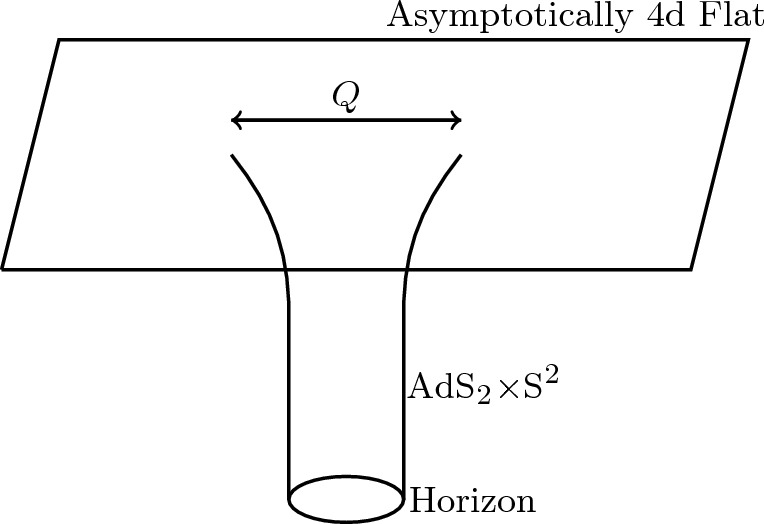
- JT gravity arises as a universal near-horizon description of near-extremal black holes and as the s-wave sector of higher-dimensional gravity with spherical symmetry; its classical solutions reduce to a boundary Schwarzian action.
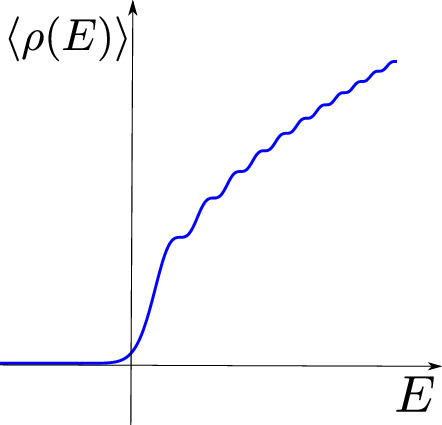
- The quantum disk partition function is one-loop exact, and the resulting density of states is continuous; for large energy the spectrum matches the classical Bekenstein–Hawking entropy, while quantum effects become large at small energies.
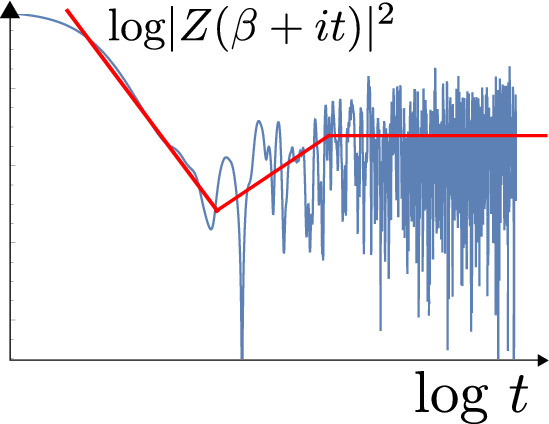
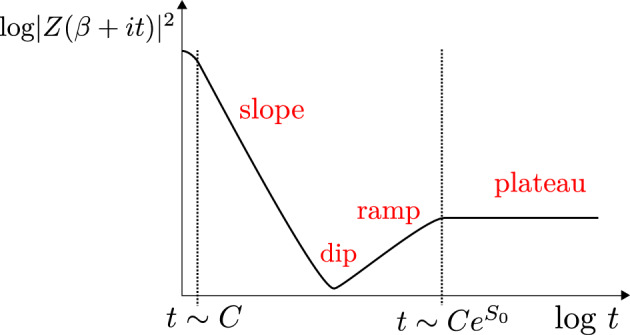
- JT gravity is equivalent, order by order in the topological expansion, to a double-scaled matrix integral; wormhole contributions produce the slope, ramp, and plateau of the spectral form factor, with the ramp explained by the double trumpet and the plateau by the contact term.
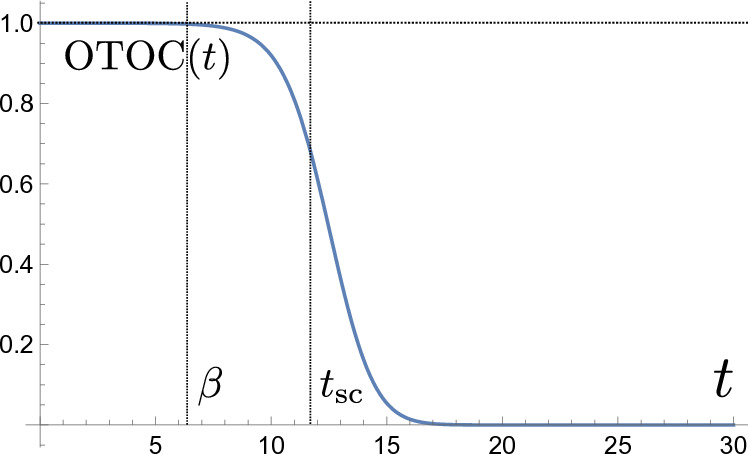
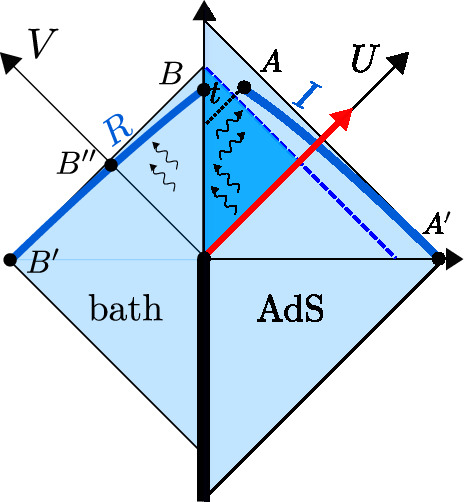
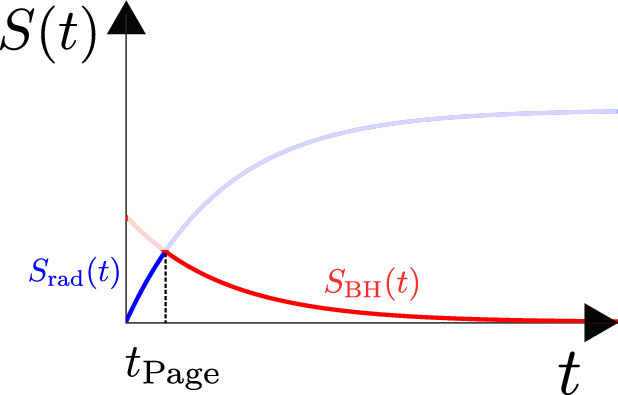
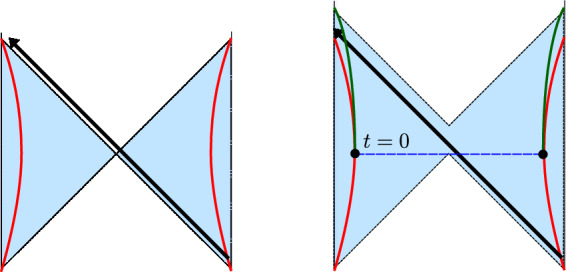
- Applications include replica wormholes and the island formula for Hawking radiation entropy, OTOCs showing maximal chaos with scrambling time logarithmic in \(C\), and black hole interior volume growth that saturates when non-perturbative random matrix effects become important.
Methods
- This is a review article synthesizing developments in JT gravity, organized into classical JT gravity, quantum JT gravity, spacetime wormholes and random matrices, and applications/future directions.
- It uses Euclidean gravitational path integrals, the Schwarzian reduction, BF/gauge-theoretic formulations, Liouville theory limits, matrix model topological recursion, and comparisons with random matrix ensembles.
- No empirical sample or dataset is analyzed; the work is theoretical and literature-based, with computations and derivations drawn from the cited JT gravity literature.
Limitations
- The paper states several open problems: the gravitational origin of erratic late-time oscillations and discreteness is not fully understood; the factorization puzzle and ensemble-averaging interpretation remain unresolved; the non-perturbative completion of the JT matrix model is ill-defined in the forbidden region; finite-cutoff results disagree; full dS matter correlators and supersymmetric OTOCs are unknown.
- The review itself notes that its applications section is not entirely self-contained and refers to the literature for details, and that it does not do justice to the information-loss topic.
- As a review, it does not present new primary data or a single new empirical test; its conclusions are syntheses of prior theoretical results.
Model-written summary. Check it against the paper before relying on it.
Integrity signals
Registry
Cites
Statistics
Figures
Verification
Claims the paper makes
58 Valid · 11 Not valid · 84 Not checked · 343 Own results and interpretations
At least one cited source doesn’t support this claim or points to a different paper, and none confirmed it — see the verdicts below.
In the paper
“This means that the matrix model dual to JT gravity is non-perturbatively ill-defined.”
§ Solvable models of quantum black holes: a review on Jackiw–Teitelboim gravity > Spacetime wormholes and random matrices > Non-perturbative effects in topological expansion
What the sources say
- Disputedcites Saad et al. (2019) matched to “JT gravity as a matrix integral” (2019) sourceExperimental — accuracy not yet measured
The Introduction (p. 7) explicitly says the model can be defined nonperturbatively on an appropriate contour, although it lacks the reality properties of a conventional matrix integral. Section 5.5 (p. 51) explains that viable nonperturbative completions exist but are not unique. That is contrary to calling the model nonperturbatively ill-defined without qualification. (LLM, conf=0.91)
Checked by a reasoning model — may be wrong.
plain- Asserted: passes — The authors put it forward as true.
- Checkable: passes — It can be checked against evidence.
- Load-bearing: passes — The paper’s conclusions depend on it.
- Based: passes — The paper gives a reason why it holds.
- Disputed
The cited sources support only part of this claim — read each source’s verdict below.
In the paper
“Eynard and Orantin (2007) started from Mirzakhani’s recursion relation (4.20) and applied to it the Laplace transform (4.41) to derive a recursion relation for . After a lengthy calculation, they obtained precisely the recursion (4.38) with the spectral curve used in JT gravity. This result completes the derivation that JT gravity is equivalent, order by order in the topological expansion, to a double-scaled matrix integral.”
- Also stated in: § JT and random matrices · boosted
“This result completes the derivation that JT gravity is equivalent, order by order in the topological expansion, to a double-scaled matrix integral.”
- Also stated in: § Non-perturbative effects in topological expansion · boosted
“By the above matching of recursion relations, the SSS duality is proven order-by-order in the topological expansion in powers of .”
§ Solvable models of quantum black holes: a review on Jackiw–Teitelboim gravity > Spacetime wormholes and random matrices > JT and random matrices
What the sources say
- Partly supportedcites Eynard and Orantin (2007) matched to “Weil-Petersson volume of moduli spaces, Mirzakhani's recursion and matrix models” (2007) sourceExperimental — accuracy not yet measured
Corollary 2.1 (p. 3) identifies the Laplace-transformed Weil–Petersson volume recursion with a spectral curve for the Kontsevich matrix integral and gives a genus expansion. The Conclusion says the transformed Mirzakhani recursion solves that integral’s loop equations. Our copy does not identify the theory as JT gravity or establish equivalence to a double-scaled matrix integral; that broader equivalence is the citing authors’ conclusion. (LLM, conf=0.86)
boostedstates an association- Asserted: passes — The authors put it forward as true.
- Checkable: passes — It can be checked against evidence.
- Load-bearing: passes — The paper’s conclusions depend on it.
- Based: passes — The paper gives a reason why it holds.
- Also stated in: § JT and random matrices · boosted
The cited sources support only part of this claim — read each source’s verdict below.
In the paper
“An important recent result is that these models are not independent, but JT gravity can be embedded in Liouville gravity. This was first noticed for the spectrum in Saad et al. (2019), and subsequently developed in detail in Mertens and Turiaci (2021), Mertens (2021), Turiaci et al. (2021), Fan and Mertens (2022a), Suzuki and Takayanagi (2021), Hirano and Kuroki (2022), Artemev (2022).”
- Also stated in: § Liouville gravity and minimal string · plain
“An important recent result is that these models are not independent, but JT gravity can be embedded in Liouville gravity.”
§ Solvable models of quantum black holes: a review on Jackiw–Teitelboim gravity > Applications and future directions > Liouville gravity and minimal string
What the sources say
- Supportedcites Saad et al. (2019) matched to “JT gravity as a matrix integral” (2019) source
Section 4 (p. 37) shows that the large-p limit of the (2,p) minimal string yields the JT gravity spectral curve. The citing sentence attributes the spectral observation—not a fully developed embedding—to Saad et al., which matches the paper's qualified conclusion that JT gravity is 'in some sense' this limit. (LLM, conf=0.90)
- Supportedcites Mertens and Turiaci (2021) matched to “Liouville quantum gravity — holography, JT and matrices” (2021) source
The Introduction and summary (page not specified) defines the minimal string’s continuum description as Liouville gravity and says JT gravity can be viewed as its parametric limit. The Conclusions (page not specified) describe the paper’s analysis of Liouville-gravity amplitudes in that JT limit. This supports the claimed embedding without attributing the initial observation to this paper. (LLM, conf=0.92)
- Not matchedcites Mertens (2021)
More than one paper fits this citation.
plainstates a cause- Asserted: passes — The authors put it forward as true.
- Checkable: passes — It can be checked against evidence.
- Load-bearing: unclear — It is unclear whether the paper’s conclusions depend on it.
- Based: passes — The paper gives a reason why it holds.
- Also stated in: § Liouville gravity and minimal string · plain
The sources with a verdict support this claim; the rest weren’t checked yet, have no full text we could read, or their verdicts aren’t rated yet.
In the paper
“To start, it is instructive to consider what is the most general theory of dilaton gravity in two dimensions with a two-derivative action (Banks and O’Loughlin 1991; Louis-Martinez et al. 1994; Ikeda 1994; Grumiller et al. 2002). Working in Euclidean signature, any such theory can be written as2.1where is the two-dimensional metric and is the dilaton field.”
§ Solvable models of quantum black holes: a review on Jackiw–Teitelboim gravity > Classical Jackiw–Teitelboim gravity > Dilaton gravity models
What the sources say
- Not checked — no full text of the sourcecites Banks and O’Loughlin 1991 matched to “Two-dimensional quantum gravity in Minkowski space” (1991) source
- Supportedcites Louis-Martinez et al. 1994 matched to “Exact Dirac quantization of all 2D dilaton gravity theories” (1994) source
The Introduction (p. 2) states that the most general two-dimensional action depending on a metric and scalar field, with at most second derivatives, can be written in the form it gives. This supports the attributed claim about the general two-derivative dilaton-gravity action; the paper does not need to use the citing document’s equation number. (LLM, conf=0.91)
- Supportedcites Ikeda 1994 matched to “Two-Dimensional Gravity and Nonlinear Gauge Theory” (1994) source
Section 4.1 (p. 22) explicitly presents the general action for a two-dimensional metric coupled to a scalar field without higher-derivative terms. It also describes a field redefinition of that action, supporting the cited characterization of two-derivative dilaton gravity. (LLM, conf=0.91)
plain- Asserted: passes — The authors put it forward as true.
- Checkable: passes — It can be checked against evidence.
- Load-bearing: unclear — It is unclear whether the paper’s conclusions depend on it.
- Based: passes — The paper gives a reason why it holds.
The cited sources support only part of this claim — read each source’s verdict below.
In the paper
“We might be tempted to refer to the extremal Bekenstein–Hawking area as extremal degeneracy of black hole microstates, although we will see this is an incorrect interpretation both in JT gravity (Stanford and Witten 2017) and for the higher-dimensional black hole.”
§ Solvable models of quantum black holes: a review on Jackiw–Teitelboim gravity > Classical Jackiw–Teitelboim gravity > Dilaton gravity models
What the sources say
- Partly supportedcites Stanford and Witten 2017 matched to “Fermionic localization of the schwarzian theory” (2017) sourceExperimental — accuracy not yet measured
In “A note on the density of states” (page unavailable), the paper cautions that the Schwarzian density is smooth and cannot by itself be interpreted as energy levels with definite multiplicities. That supports caution about inferring microstate degeneracy in dilaton gravity, but the passage does not discuss the extremal Bekenstein–Hawking area or establish what that area represents. (LLM, conf=0.78)
- Partly supportedcites Ghosh et al. (2020) matched to “A universal Schwarzian sector in two-dimensional conformal field theories” (2020) sourceExperimental — accuracy not yet measured
Section 4.1 identifies the extremal-limit area term as the classical BTZ entropy, while §2.3.2 gives a Schwarzian density of states that falls to zero at the energy threshold. This supports caution against treating that area term as a count of exactly extremal states. The paper studies near-extremal BTZ black holes, however, and notes that its treatment becomes uncontrolled at exponentially low temperatures; it does not establish the claim for higher-dimensional black holes. (LLM, conf=0.83)
- Partly supportedcites Iliesiu and Turiaci (2021) matched to “The statistical mechanics of near-extremal black holes” (2021) sourceExperimental — accuracy not yet measured
The Discussion says that, for the four-dimensional near-extremal black holes studied, the continuum of states suggests their extremal degeneracy is not given by the naive area-based entropy. The claim is broader and more definite than that conclusion: the paper cautions that non-perturbative contributions matter for a quantitative statement, and it describes a supersymmetric case in which area-based extremal degeneracy is consistent with the density of states. (LLM, conf=0.87)
hedged- Asserted: passes — The authors put it forward as true.
- Checkable: passes — It can be checked against evidence.
- Load-bearing: unclear — It is unclear whether the paper’s conclusions depend on it.
- Based: passes — The paper gives a reason why it holds.
- Partly supported
251 more claims · 39 with their cited sources checked
Create a free account to see all 496 claims and to verify the 76 references still open.
- It may state two separate claims as one. 166
- The quote only partly states this claim. 4
- Probably not a substantial claim. 85
Claims other papers make about this one
Each is checked against this paper’s own text: does it say what the citing paper says it does?
The source backs part of the claim, not all of it — or backs it for a different population, condition or comparison.
In the citing paper
“a local Weyl transformation can be used to reintroduce a dilaton kinetic term parametrized by γ [361]”
From Unveiling horizons in quantum critical collapse (2026) · cites this paper as [361]
Experimental — accuracy not yet measured
Self-check
Percentages, sums and reported differences re-computed from the paper’s own numbers.
Each contradiction between two passages listed here was confirmed by an independent check.
Rated minor: it would not touch a result — a value no result rests on, a p-value that stays on the same side of the significance level, or a conflict that is clerical, resolved elsewhere in the paper, or outside its own findings.
In the paper
§ Solvable models of quantum black holes: a review on Jackiw–Teitelboim gravity > Spacetime wormholes and random matrices > Non-perturbative effects in topological expansion
“Its Fourier transform yields a linear downward piece, starting at the time , and perfectly canceling the slope linear growth.”
§ Solvable models of quantum black holes: a review on Jackiw–Teitelboim gravity > Spacetime wormholes and random matrices > Non-perturbative effects in topological expansion
“The spectral form factor decays with a power-law expression as studied extensively for the more complicated boundary two-point functions in Sect. 3. This is the so-called slope.”
Citations
Cites
Items 201–284 of 284
Gauge theories for gravity on a line
Jackiw, R. (1992) · Theoretical and Mathematical Physics · doi:10.1007/bf01017075 · Cited by 51
Thermodynamics of the two-dimensional black hole in the Teitelboim-Jackiw theory
Lemos, J. P. S. (1996) · Physical Review D · doi:10.1103/physrevd.54.6206 · Cited by 51
$T\bar{T}$ in JT Gravity and BF Gauge Theory
Ebert, S., Ferko, C., Sun, H.-Y., & Sun, Z. (2022) · SciPost Physics · doi:10.21468/scipostphys.13.4.096 · Cited by 51
Clocks and rods in Jackiw-Teitelboim quantum gravity
Blommaert, A., Mertens, T. G., & Verschelde, H. (2019) · Journal of High Energy Physics · doi:10.1007/jhep09(2019)060 · Cited by 50
Self-citationAn effective matrix model for dynamical end of the world branes in Jackiw-Teitelboim gravity
Gao, P., Jafferis, D. L., & Kolchmeyer, D. K. (2022) · Journal of High Energy Physics · doi:10.1007/jhep01(2022)038 · Cited by 50
Complexity and behind the horizon cut off
Akhavan, A., Alishahiha, M., Naseh, A., & Zolfi, H. (2018) · Journal of High Energy Physics · doi:10.1007/jhep12(2018)090 · Cited by 48
Wormholes and holography: an introduction
Kundu, A. (2022) · The European Physical Journal C · doi:10.1140/epjc/s10052-022-10376-z · Cited by 48
From quantum groups to Liouville and dilaton quantum gravity
Fan, Y., & Mertens, T. G. (2022) · Journal of High Energy Physics · doi:10.1007/jhep05(2022)092 · Cited by 46
Self-citationTwo Dimensional Kodaira-Spencer Theory and Three Dimensional Chern-Simons Gravity
Dijkgraaf, R., & Vafa, C. (2007) · arXiv · doi:10.48550/arxiv.0711.1932 · Cited by 46
Matrix ensembles with global symmetries and ’t Hooft anomalies from 2d gauge theory
Kapec, D., Mahajan, R., & Stanford, D. (2020) · Journal of High Energy Physics · doi:10.1007/jhep04(2020)186 · Cited by 45
Half-wormholes in SYK with one time point
Mukhametzhanov, B. (2022) · SciPost Physics · doi:10.21468/scipostphys.12.1.029 · Cited by 44
Jackiw-Teitelboim gravity in the second order formalism
Moitra, U., Sake, S. K., & Trivedi, S. P. (2021) · Journal of High Energy Physics · doi:10.1007/jhep10(2021)204 · Cited by 44
Holography for people with no time
Lin, H. W., Maldacena, J., Rozenberg, L., & Shan, J. (2023) · SciPost Physics · doi:10.21468/scipostphys.14.6.150 · Cited by 42
Fine Grained Chaos in AdS2 Gravity
Haehl, F. M., & Rozali, M. (2018) · Physical Review Letters · doi:10.1103/physrevlett.120.121601 · Cited by 41
Towards black hole evaporation in Jackiw-Teitelboim gravity
Mertens, T. G. (2019) · Journal of High Energy Physics · doi:10.1007/jhep07(2019)097 · Cited by 41
Self-citationChen, H., Fitzpatrick, A. L., Kaplan, J., Li, D., & Wang, J. (2017) · Journal of High Energy Physics · doi:10.1007/jhep03(2017)167 · Cited by 40
$$ \mathcal{N} $$ = 2 JT supergravity and matrix models
Turiaci, G. J., & Witten, E. (2023) · Journal of High Energy Physics · doi:10.1007/jhep12(2023)003 · Cited by 40
Self-citationTowards the holographic dual of $$ \mathcal{N}=2 $$ SYK
Förste, S., Kames-King, J., & Wiesner, M. (2018) · Journal of High Energy Physics · doi:10.1007/jhep03(2018)028 · Cited by 39
General Form of Dilaton Gravity and Nonlinear Gauge Theory
Ikeda, N., & Izawa, K.-I. (1993) · Progress of Theoretical Physics · doi:10.1143/ptp.90.237 · Cited by 39
Matrix ensembles with global symmetries and ’t Hooft anomalies from 2d gauge theory
Kapec, D. (2023) · OSTI OAI (U.S. Department of Energy Office of Scientific and Technical Information) · doi:10.1007/jhep04%282020%29186 · Cited by 39
Gravitational perturbations from NHEK to Kerr
Castro, A., Godet, V., Simón, J., Song, W., & Yu, B. (2021) · Journal of High Energy Physics · doi:10.1007/jhep07(2021)218 · Cited by 39
Castro, A., & Verheijden, E. (2021) · Universe · doi:10.3390/universe7120475 · Cited by 38
Diffeomorphisms versus non abelian gauge transformations: an example of 1+1 dimensional gravity
Schaller, P., & Strobl, T. (1994) · Physics Letters B · doi:10.1016/0370-2693(94)90974-1 · Cited by 38
Wormholes without averagingPreprint
Saad, P., Shenker, S. H., Stanford, D., et al. (2021) · arXiv (Cornell University) · doi:10.48550/arxiv.2103.16754 · Cited by 38
Phases of $$ \mathcal{N} $$ = 2 Sachdev-Ye-Kitaev models
Heydeman, M., Turiaci, G. J., & Zhao, W. K. (2023) · Journal of High Energy Physics · doi:10.1007/jhep01(2023)098 · Cited by 37
Self-citationDegenerate operators in JT and Liouville (super)gravity
Mertens, T. G. (2021) · Journal of High Energy Physics · doi:10.1007/jhep04(2021)245 · Cited by 36
Self-citationSupergroup structure of Jackiw-Teitelboim supergravity
Fan, Y., & Mertens, T. G. (2022) · Journal of High Energy Physics · doi:10.1007/jhep08(2022)002 · Cited by 36
Self-citationBPS and near-BPS black holes in $AdS_5$ and their spectrum in $\mathcal{N}=4$ SYM
Boruch, J., Heydeman, M. T., Iliesiu, L. V., & Turiaci, G. J. (2022) · arXiv · doi:10.48550/arxiv.2203.01331 · Cited by 36
Self-citationAdS2 dilaton gravity from reductions of some nonrelativistic theories
Kolekar, K. S., & Narayan, K. (2018) · Physical Review D · doi:10.1103/physrevd.98.046012 · Cited by 35
Aspects of two-dimensional dilaton gravity, dimensional reduction, and holography
Narayan, K. (2021) · Physical review. D/Physical review. D. · doi:10.1103/physrevd.104.026007 · Cited by 34
On 2D gauge theories in Jackiw-Teitelboim gravity
Iliesiu, L. V. (2019) · arXiv · doi:10.48550/arxiv.1909.05253 · Cited by 33
Unruh detectors and quantum chaos in JT gravity
Blommaert, A., Mertens, T. G., & Verschelde, H. (2021) · Journal of High Energy Physics · doi:10.1007/jhep03(2021)086 · Cited by 32
Self-citationPicken, R. F. (1989) · Journal of Physics A: Mathematical and General · doi:10.1088/0305-4470/22/13/024 · Cited by 32
A universe field theory for JT gravity
Post, B., van der Heijden, J., & Verlinde, E. (2022) · Journal of High Energy Physics · doi:10.1007/jhep05(2022)118 · Cited by 32
Dynamics of black holes in Jackiw-Teitelboim gravity
Suh, S. J. (2020) · Journal of High Energy Physics · doi:10.1007/jhep03(2020)093 · Cited by 31
Breaking away from the near horizon of extreme Kerr
Castro, A., & Godet, V. (2020) · SciPost Physics · doi:10.21468/scipostphys.8.6.089 · Cited by 31
Eynard, B., Kimura, T., & Ribault, S. (2015) · arXiv · doi:10.48550/arxiv.1510.04430 · Cited by 30
JT gravity limit of Liouville CFT and matrix model
Suzuki, K., & Takayanagi, T. (2021) · Journal of High Energy Physics · doi:10.1007/jhep11(2021)137 · Cited by 29
From black holes to baby universes in CGHS gravity
Godet, V., & Marteau, C. (2021) · Journal of High Energy Physics · doi:10.1007/jhep07(2021)138 · Cited by 29
Free energy for deformed Jackiw-Teitelboim gravity
Alishahiha, M., Faraji Astaneh, A., Jafari, G., Naseh, A., & Taghavi, B. (2021) · Physical Review D · doi:10.1103/physrevd.103.046005 · Cited by 29
A precision test of averaging in AdS/CFT
Cotler, J., & Jensen, K. (2022) · Journal of High Energy Physics · doi:10.1007/jhep11(2022)070 · Cited by 25
Black hole spectroscopy and AdS2 holography
Larsen, F., & Zeng, Y. (2019) · Journal of High Energy Physics · doi:10.1007/jhep04(2019)164 · Cited by 25
NON-SINGULAR CONSTANT CURVATURE TWO-DIMENSIONAL BLACK HOLE
Lemos, J. P. S., & Sá, P. M. (1994) · Modern Physics Letters A · doi:10.1142/s0217732394000587 · Cited by 25
Off-shell Partition Functions in 3d Gravity
Eberhardt, L. (2022) · arXiv · doi:10.48550/arxiv.2204.09789 · Cited by 25
A one-loop test of the near-AdS2/near-CFT1 correspondence
Charles, A. M., & Larsen, F. (2020) · Journal of High Energy Physics · doi:10.1007/jhep07(2020)186 · Cited by 24
Rotating 5D black holes: Interactions and deformations near extremality
Castro, A., Pedraza, J. F., Toldo, C., & Verheijden, E. (2021) · SciPost Physics · doi:10.21468/scipostphys.11.6.102 · Cited by 24
The double cone geometry is stable to brane nucleation
Mahajan, R., Marolf, D., & Santos, J. E. (2021) · Journal of High Energy Physics · doi:10.1007/jhep09(2021)156 · Cited by 24
Entanglement dynamics in 2D CFT with boundary: entropic origin of JT gravity and Schwarzian QM
Callebaut, N., & Verlinde, H. (2019) · Journal of High Energy Physics · doi:10.1007/jhep05(2019)045 · Cited by 23
Thermodynamics of near BPS black holes in AdS4 and AdS7
Larsen, F. K. (2023) · OSTI OAI (U.S. Department of Energy Office of Scientific and Technical Information) · doi:10.1007/jhep10%282021%29198 · Cited by 23
The gravitational dynamics of kinematic space
Callebaut, N. (2019) · Journal of High Energy Physics · doi:10.1007/jhep02(2019)153 · Cited by 23
Thermodynamics of near BPS black holes in AdS4 and AdS7
Larsen, F. K., & Paranjape, S. (2021) · Journal of High Energy Physics · doi:10.1007/jhep10(2021)198 · Cited by 22
Quantum exponentials for the modular double and applications in gravity models
Mertens, T. G. (2023) · Journal of High Energy Physics · doi:10.1007/jhep09(2023)106 · Cited by 20
Self-citationTuriaci, G. J. (2019) · Journal of High Energy Physics · doi:10.1007/jhep07(2019)099 · Cited by 19
Self-citationMicrostructure in matrix elements
Blommaert, A., & Usatyuk, M. (2022) · Journal of High Energy Physics · doi:10.1007/jhep09(2022)070 · Cited by 19
A new quantum solution of Liouville field theory
Gernais, J.-L., & Neveu, A. (1983) · Physics Letters B · doi:10.1016/0370-2693(83)90964-4 · Cited by 18
Near-extremal black holes at late times, backreacted
Hadar, S. (2019) · Journal of High Energy Physics · doi:10.1007/jhep01(2019)214 · Cited by 18
Kar, A., Lamprou, L., Marteau, C., & Rosso, F. (2022) · Physical Review Letters · doi:10.1103/physrevlett.129.201601 · Cited by 18
The scales of black holes with nAdS2 geometry
Hong, J., Larsen, F., & Liu, J. T. (2019) · Journal of High Energy Physics · doi:10.1007/jhep10(2019)260 · Cited by 17
2D Dilaton Gravity and the Weil–Petersson Volumes with Conical Defects
Eberhardt, L., & Turiaci, G. J. (2024) · Communications in Mathematical Physics · doi:10.1007/s00220-024-04964-1 · Cited by 17
Self-citationJT gravity with matter, generalized ETH, and Random MatricesPreprint
Jafferis, D. L., Kolchmeyer, D. K., Mukhametzhanov, B., et al. (2022) · arXiv (Cornell University) · doi:10.48550/arxiv.2209.02131 · Cited by 17
2D dilaton gravity and the Weil-Petersson volumes with conical defects
Eberhardt, L., & Turiaci, G. J. (2023) · arXiv · doi:10.48550/arxiv.2304.14948 · Cited by 17
Self-citationNear-extremal black holes at late times, backreacted
Hadar, S. (2019) · MPG.PuRe (Max Planck Society) · Cited by 14
The scales of black holes with nAdS2 geometry
Hong, J. (2023) · OSTI OAI (U.S. Department of Energy Office of Scientific and Technical Information) · doi:10.1007/jhep10%282019%29260 · Cited by 14
Characters, coadjoint orbits and Duistermaat-Heckman integrals
Alekseev, A., & Shatashvili, S. L. (2021) · Journal of Geometry and Physics · doi:10.1016/j.geomphys.2021.104386 · Cited by 14
Gauge theory formulation of hyperbolic gravity
Ferrari, F. D. (2021) · Journal of High Energy Physics · doi:10.1007/jhep03(2021)046 · Cited by 13
On the perturbative expansion of exact bi-local correlators in JT gravity
Griguolo, L., Papalini, J., & Seminara, D. (2021) · Journal of High Energy Physics · doi:10.1007/jhep05(2021)140 · Cited by 12
Quantum correction to chaos in Schwarzian theory
Qi, Y.-H., Sin, S.-J., & Yoon, J. (2019) · Journal of High Energy Physics · doi:10.1007/jhep11(2019)035 · Cited by 11
Operational islands and black hole dissipation in JT gravity
Vuyst, J. D., & Mertens, T. G. (2023) · Journal of High Energy Physics · doi:10.1007/jhep01(2023)027 · Cited by 11
Self-citationComments on wormholes and factorizationPreprint
Saad, P., Shenker, S. H., & Yao, S. (2021) · arXiv (Cornell University) · doi:10.48550/arxiv.2107.13130 · Cited by 11
Quantum exponentials for the modular double and applications in gravity models
Mertens, T. G. (2022) · arXiv · doi:10.48550/arxiv.2212.07696 · Cited by 11
Self-citationPhase transitions for deformations of JT supergravity and matrix models
Rosso, F., & Turiaci, G. J. (2022) · Journal of High Energy Physics · doi:10.1007/jhep02(2022)187 · Cited by 10
Self-citationTime-dependent NAdS2 holography with applications
Joshi, L. K., Mukhopadhyay, A., & Soloviev, A. (2020) · Physical Review D · doi:10.1103/physrevd.101.066001 · Cited by 10
On the Quenched Free Energy of JT Gravity and Supergravity
Johnson, C. V. (2021) · arXiv · doi:10.48550/arxiv.2104.02733 · Cited by 10
Replica wormholes from Liouville theory
Hirano, S., & Kuroki, T. (2022) · Journal of High Energy Physics · doi:10.1007/jhep01(2022)094 · Cited by 8
$N=2$ JT Supergravity and Matrix ModelsPreprint
Turiaci, G. J., & Witten, E. H. (2023) · arXiv (Cornell University) · doi:10.48550/arxiv.2305.19438 · Cited by 8
Self-citationRetrieving black hole information from the main Lorentzian saddle point
Germani, C. (2022) · Physical review. D/Physical review. D. · doi:10.1103/physrevd.106.066018 · Cited by 6
Note on large-p limit of (2,2p + 1) minimal Liouville gravity and moduli space volumes
Artemev, A. (2022) · Nuclear Physics B · doi:10.1016/j.nuclphysb.2022.115876 · Cited by 5
Dissecting the ensemble in JT gravityPreprint
Blommaert, A. (2020) · arXiv (Cornell University) · doi:10.48550/arxiv.2006.13971 · Cited by 3
A convergent genus expansion for the plateauPreprint
Saad, P., Stanford, D., Yang, Z., et al. (2022) · arXiv (Cornell University) · doi:10.48550/arxiv.2210.11565 · Cited by 3
Altland, A., Post, B., Sonner, J., van der Heijden, J., & Verlinde, E. P. (2023) · SciPost Physics · doi:10.21468/scipostphys.15.2.064 · Cited by 2
Matrix models for eigenstate thermalizationPreprint
Jafferis, D. L., Kolchmeyer, D. K., Mukhametzhanov, B., et al. (2022) · arXiv (Cornell University) · doi:10.48550/arxiv.2209.02130 · Cited by 2
Altland, A., Post, B., Sonner, J., van der Heijden, J., & Verlinde, E. (2022) · arXiv · doi:10.48550/arxiv.2204.07583 · Cited by 2
Blommaert, A., Iliesiu, L. V., & Kruthoff, J. (2021) · arXiv · doi:10.48550/arxiv.2111.07863
A Note On Complex Spacetime Metrics
Witten, E. (2021) · arXiv · doi:10.48550/arxiv.2111.06514
Research works printed but not linked: 2
- Kitaev A (2014) 2015 Breakthrough prize fundamental physics symposium. https://www.youtube.com/watch?v=OQ9qN8j7EZI
- Mehta ML Random matrices 2004 3 Amsterdam Elsevier Academic Press
Cited by
Solving 3d gravity with Virasoro TQFT
Collier, S., Eberhardt, L., & Zhang, M. (2023) · SciPost Physics · doi:10.21468/scipostphys.15.4.151 · Cited by 171
Quantum complexity in gravity, quantum field theory, and quantum information science
Baiguera, S., Balasubramanian, V., Caputa, P., Chapman, S., Haferkamp, J., Heller, M. P., & Halpern, N. Y. (2025) · Physics Reports · doi:10.1016/j.physrep.2025.11.001 · Cited by 152
Dynamical actions and q-representation theory for double-scaled SYK
Blommaert, A., Mertens, T. G., & Yao, S. (2024) · Journal of High Energy Physics · doi:10.1007/jhep02(2024)067 · Cited by 73
“21), which is the usual choice one makes when discussing the correlation functions in JT gravity [11].”
BackgroundSelf-citationMicroscopic Origin of the Entropy of Black Holes in General Relativity
Balasubramanian, V., Lawrence, A., Magán, J. M., & Sasieta, M. (2024) · Physical Review X · doi:10.1103/physrevx.14.011024 · Cited by 166
“via replica wormholes (see [33] for a review).”
BackgroundSemiclassical geometry in double-scaled SYK
Goel, A., Narovlansky, V., & Verlinde, H. (2023) · Journal of High Energy Physics · doi:10.1007/jhep11(2023)093 · Cited by 72
“In fact, it was shown in [4] that for λ → 0 and restricting to low energies, the correlation functions found in double-scaled SYK agree precisely with the (quantum) correlators obtained in the Schwarzian theory [9] (for a recent review, see [10]).”
Method
Metadata
- Authors
- Mertens, T. G., & Turiaci, G. J.
- Affiliations
- Ghent University (BE)
- University of Washington (US)
- Corresponding author
- Mertens, Thomas G.
- Venue
- Living Reviews in Relativity
- Published
- 2023-07-31
- Volume
- 26
- Issue
- 1
- Pages
- 4-4
- ISSN
- 1433-8351 (ISSN-L)
- PMC
- PMC10390458
- OpenAlex
- W4385429136
- Cited by
- 181
- References
- 290
- Citations by year
- 2026: 39 · 2025: 68 · 2024: 46 · 2023: 29
- FWCI
- 36.47
- Type
- journal article
- Language
- en
- Open access
- diamond
- doi.org
- Licence
- cc-by
- creativecommons.org/licenses/by/4.0 (tdm)
- creativecommons.org/licenses/by/4.0 (vor)
- Locations
- Living Reviews in Relativity (publishedVersion, cc-by)
- PubMed (publishedVersion)
- arXiv (Cornell University) (submittedVersion)
- Ghent University Academic Bibliography (Ghent University) (submittedVersion, other-oa)
- PubMed Central (submittedVersion, cc-by)
- DOAJ (DOAJ: Directory of Open Access Journals) (submittedVersion, cc-by-sa)
- arXiv (Cornell University)
- Funders
- European Research Council (BHHQG-101040024)
- FWO Vlaanderen
- National Science Foundation (PHY-2207584)
- Institute for Advanced Study (Sivian Fund)
- Topics
- Physical Sciences › Physics and Astronomy › Nuclear and High Energy Physics › Black Holes and Theoretical Physics
- Physical Sciences › Physics and Astronomy › Nuclear and High Energy Physics › Noncommutative and Quantum Gravity Theories
- Physical Sciences › Physics and Astronomy › Astronomy and Astrophysics › Cosmology and Gravitation Theories
- Keywords
- Jackiw-Teitelboim gravity, two-dimensional quantum gravity, solvable models, black holes, chaos, wormholes, holography, spherical symmetry
About these checks
Registry, retraction, Cites and statistics results are computed, not judged, with one exception: a printed reference that no index lists is read once by a model before it counts as a citation error. Claims are extracted by a model and kept only when their quote appears verbatim in the text; each cited source is then checked, with a model’s help, for whether it says what the claim relies on. Those verdicts can be wrong — read the claim’s quote and the cited source before relying on one.
The claim verdicts this report counts are experimental: their accuracy is not yet measured.
A language model drew the claims from the paper on 2026-10-10, under version 3 of the claim definition (model deepseek-v4.1-flash, prompt extract-v3).
A second model labelled each claim on 2026-10-10 (model jev-1.13-20260917, definition revision gold-guideline-v0.2).
Cited sources are checked with a language model’s help (gpt-6-sol).
Statistics and arithmetic are recomputed, not judged.
Confidence bands are shown only for fields calibrated on our annotated test set. None is calibrated yet, so no band is shown.
What counts as a claim ›How we measure confidence ›How we check this ›
Are you an author, or do you see a problem with this page? Request a review
Data sources
Bibliographic data: Semantic Scholar, OpenAlex, Crossref.
Contains information from the Semantic Scholar Academic Graph Datasets, made available under the ODC Attribution License (ODC-BY 1.0).
Semantic Scholar’s data is described in: Kinney, R., et al. (2023). The Semantic Scholar Open Data Platform. arXiv:2301.10140.
