

The DOI matches its Crossref record; 13 of the 13 references it cites were found in a registry or an index.
Flow at Work: a Self-Determination Perspective
Overview
The claims and statistics of this paper haven’t been checked yet.
Run the check — free, no account needed. It reads the open-access text and checks the sources it cites.
Integrity signals
Registry
Cites
Statistics
Figures
Verification
Claims the paper makes
The claims and statistics of this paper haven’t been checked yet.
Run the check — free, no account needed. It reads the open-access text and checks the sources it cites.
Claims other papers make about this one
Each is checked against this paper’s own text: does it say what the citing paper says it does?
In the citing paper
“It is conceivable that other self-regulation strategies such as strengths use, playful work design, and proactive vitality management (Bakker & Van Woerkom, 2017) will also be effective in dealing with job strain.”
From Job Demands—Resources theory and self-regulation: New explanations and remedies for job burnout (2021) · cites this paper as Bakker & Van Woerkom, 2017
Self-check
Percentages, sums and reported differences re-computed from the paper’s own numbers.
The self-check needs the paper’s full text.
Citations
Cites
The "what" and "why" of goal pursuits: Human needs and the self-determination of behavior
Deci, E. L., & Ryan, R. M. (2000) · Psychological Inquiry · doi:10.1207/s15327965pli1104_01 · Cited by 34,210
Fredrickson, B. L. (2001) · American Psychologist · doi:10.1037//0003-066x.56.3.218 · Cited by 18,025
The job demands-resources model of burnout.
Demerouti, E., Bakker, A. B., Nachreiner, F., & Schaufeli, W. B. (2001) · Journal of Applied Psychology · doi:10.1037/0021-9010.86.3.499 · Cited by 13,643
Self-citationMotivation reconsidered: The concept of competence.
White, R. W. (1959) · Psychological Review · doi:10.1037/h0040934 · Cited by 5,681
Job Resources Buffer the Impact of Job Demands on Burnout.
Bakker, A. B., Demerouti, E., & Euwema, M. C. (2005) · Journal of Occupational Health Psychology · doi:10.1037/1076-8998.10.2.170 · Cited by 2,483
Self-citationLepine, J. A., Podsakoff, N. P., & Lepine, M. A. (2005) · Academy of Management Journal · doi:10.5465/amj.2005.18803921 · Cited by 2,438
An empirical examination of self-reported work stress among U.S. managers.
Cavanaugh, M. A., Boswell, W. R., Roehling, M. V., & Boudreau, J. W. (2000) · Journal of Applied Psychology · doi:10.1037/0021-9010.85.1.65 · Cited by 2,154 · cited 2×
“…a recent daily diary study, Tadic et al. (2015) investigated the role of job resources in the context of the challenge-hindrance stressor framework (Cavanaugh et al. 2000), focusing on two well-being indicators that are closely related to workrelated flow, namely daily positive affect and daily…”
BackgroundSailer, M., Hense, J. U., Mayr, S. K., & Mandl, H. (2017) · Computers in Human Behavior · doi:10.1016/j.chb.2016.12.033 · Cited by 2,064 · cited 1×
“Moreover, by engaging in playful and fun interactions with colleagues, playful work design may also fulfill the need for relatedness (Robert and Wilbanks 2012; Sailer et al. 2017).”
BackgroundDevelopment and validation of the job crafting scale
Tims, M., Bakker, A. B., & Derks, D. (2012) · Journal of Vocational Behavior · doi:10.1016/j.jvb.2011.05.009 · Cited by 2,060
Self-citationResource loss, resource gain, and emotional outcomes among inner city women.
Hobfoll, S. E., Johnson, R. J., Ennis, N., & Jackson, A. P. (2003) · Journal of Personality and Social Psychology · doi:10.1037/0022-3514.84.3.632 · Cited by 1,381 · cited 1×
“Personal resources are positive self-evaluations that are linked to resiliency and refer to individuals’ sense of their ability to control and impact their environments successfully (Hobfoll et al. 2003).”
BackgroundCrafting a job on a daily basis: Contextual correlates and the link to work engagement
Petrou, P., Demerouti, E., Peeters, M. C. W., Schaufeli, W. B., & Hetland, J. (2012) · Journal of Organizational Behavior · doi:10.1002/job.1783 · Cited by 1,026
Berg, J. M., Wrzesniewski, A., & Dutton, J. E. (2010) · Journal of Organizational Behavior · doi:10.1002/job.645 · Cited by 890 · cited 1×
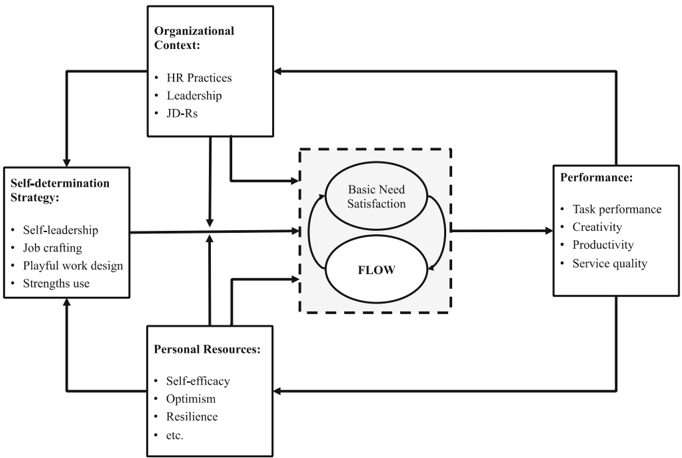
“…self-determination strategies to satisfy their basic needs and create flow experiences is more in line with the proposition that employees play an active role in the design of their job (Berg et al. 2010), and in the negotiation of their idiosyncratic employment arrangement (Rousseau et al. 2006).”
BackgroundI-Deals: Idiosyncratic Terms in Employment Relationships
Rousseau, D. M., Ho, V. T., & Greenberg, J. (2006) · Academy of Management Review · doi:10.5465/amr.2006.22527470 · Cited by 652
Research works printed but not linked: 88
- Albrecht, S., Bakker, A. B., Gruman, J., Macey, W., & Saks, A. (2015). Employee engagement, human resource management practices and competitive advantage: an integrated approach. Journal of Organizational Effectiveness: People and Performance, 2, 7–35. · DOI
- Alfes, K., Shantz, A. D., Truss, C., & Soane, E. C. (2013). The link between perceived human resource management practices, engagement and employee behaviour: a moderated mediation model. International Journal of Human Resource Management, 24, 330–351. · DOI · Paper page
- Amabile, T. M., Hill, K. G., Hennessey, B. A., & Tighe, E. M. (1994). The work preference inventory: assessing intrinsic and extrinsic motivational orientations. Journal of Personality and Social Psychology, 66, 950–967. · DOI
- Bakker, A. B. (2005). Flow among music teachers and their students: the crossover of peak experiences. Journal of Vocational Behavior, 66, 26–44. · DOI
- Bakker, A. B. (2008). The work-related flow inventory: construction and initial validation of the WOLF. Journal of Vocational Behavior, 72, 400–414. · DOI
- Bakker, A. B., & Sanz-Vergel, A. I. (2013). Weekly work engagement and flourishing: the role of hindrance and challenge demands. Journal of Vocational Behavior, 83, 397–409. · DOI
- Bakker, A. B., Tims, M., & Derks, D. (2012). Proactive personality and job performance: the role of job crafting and work engagement. Human Relations, 65, 1359–1378. · DOI · Paper page
- Bakker, A. B., Demerouti, E., & Sanz-Vergel, A. I. (2014). Burnout and work engagement: the JD-R approach. Annual Review of Organizational Psychology and Organizational Behavior, 1, 389–411. · DOI · Paper page
- Bandura, A. (1994). Self-efficacy. In V. S. Ramachaudran (Ed.), Encyclopedia of human behavior (Vol. 4, pp. 71–81). New York: Academic Press.
- Bandura, A. (2001). Social cognitive theory: an agentic perspective. Annual Review of Psychology, 52, 1–26. · DOI · Paper page
- Barnett, L. A. (2007). The nature of playfulness in young adults. Personality and Individual Differences, 43, 949–958. · DOI · Paper page
- Bass, B. M. (1985). Leadership performance beyond expectations. New York: Academic Press.
- Baumeister, R. F., & Leary, M. R. (1995). The need to belong: desire for interpersonal attachments as a fundamental human motivation. Psychological Bulletin, 117, 497–529. · DOI · Paper page
- Beard, K. S., Hoy, W. K., & Hoy, A. W. (2010). Academic optimism of individual teachers: confirming a new construct. Teaching and Teacher Education, 26, 1136–1147. · DOI
- Berg, J. M., Dutton, J. E., & Wrzesniewski, A. (2013). Job crafting and meaningful work. In B. J. Dik, Z. S. Byrne, & M. F. Steger (Eds.), Purpose and meaning in the workplace (pp. 81–104). Washington, DC: American Psychological Association. · DOI
- Breevaart, K., Bakker, A. B., Demerouti, E., Sleebos, D. M., & Maduro, V. (2014a). Uncovering the underlying relationship between transformational leaders and followers’ task performance. Journal of Personnel Psychology, 13, 194–203. · DOI
- Breevaart, K., Bakker, A. B., Hetland, J., Demerouti, E., Olsen, O. K., & Espevik, R. (2014b). Daily transactional and transformational leadership and daily employee engagement. Journal of Occupational and Organizational Psychology, 87, 138–157. · DOI · Paper page
- Burns, J. M. (1978). Leadership. New York: Harper & Row.
- Cable, D. M., Gino, F., & Staats, B. R. (2013). Breaking them in or eliciting their best? Reframing socialization around newcomers’ authentic self-expression. Administrative Science Quarterly, 58, 1–36. · DOI
- Clarke, S. G., & Haworth, J. T. (1994). “Flow” experience in the daily lives of sixth-form college students. British Journal of Psychology, 85, 511–523. · DOI
- Clifton, D. O., & Harter, J. K. (2003). Investing in strengths. In K. S. Cameron, J. E. Dutton, & R. E. Quinn (Eds.), Positive Organizational Scholarship: Foundations of a new discipline (pp. 111–121). San Francisco: Berret-Koehler.
- Csikszentmihalyi, M. (1975). Beyond boredom and anxiety: Experiencing flow in work and play (2nd ed.). San Francisco: Jossey Bass.
- Csikszentmihalyi, M. (1997). Finding flow: The psychology of engagement with everyday life. New York: HarperCollins.
- deCharms, R. (1968). Personal causation. New york: Academic Press.
- Demerouti, E. (2006). Job characteristics, flow, and performance. The moderating role of conscientiousness. Journal of Occupational Health Psychology, 11, 266–280. · DOI
- Dubreuil, P., Forest, J., & Courcy, F. (2014). From strengths use to work performance: the role of harmonious passion, subjective vitality, and concentration. The Journal of Positive Psychology, 9, 335–349. · DOI
- Fluegge-Woolf, E. R. (2014). Play hard, work hard: fun at work and job performance. Management Research Review, 37, 682–705. · DOI
- Forest, J., Mageau, G. V. A., Crevier-Braud, L., Bergeron, L., Dubreuil, P., & Lavigne, G. V. L. (2012). Harmonious passion as an explanation of the relation between signature strengths’ use and well-being at work: test of an intervention program. Human Relations, 65, 1233–1252. · DOI
- Fredrickson, B. L. (1998). What good are positive emotions? Review of General Psychology, 2, 300–319. · DOI · Paper page
- Fullagar, C., & Delle Fave, A. (2017). Flow at work: Measurement and implications. New York: Routledge. · DOI
- Fullagar, C. J., & Kelloway, E. K. (2009). Flow at work: an experience sampling approach. Journal of Occupational and Organizational Psychology, 82, 595–615. · DOI
- Gagné, M., & Vansteenkiste, M. (2013). Self-determination theory’s contribution to Positive Organizational Psychology. In A. B. Bakker (Ed.), Advances in Positive Organizational Psychology (Vol. 1, pp. 61–82). Bingley: Emerald. · DOI
- Geyser, I., Geldenhuys, M., & Crous, F. (2015). The dimensionality of the work-related flow inventory (WOLF): a South African study. Journal of Psychology in Africa, 25, 282–287. · DOI
- Gordon, H. J., Demerouti, E., Le Blanc, P. M., Bakker, A. B., Bipp, T., & Verhagen, M. A. (in press). Individual job redesign: job crafting interventions in healthcare. Journal of Vocational Behavior. https://doi.org/10.1016/j.jvb.2017.07.002 . · DOI · Paper page
- Hackman, J. R., & Oldham, G. R. (1980). Work redesign. Reading, MA: Addison Wesley.
- Happell, B., Gaskin, C., & Platania-Phung, C. (2015). The construct validity of the work-related flow inventory in a sample of Australian workers. The Journal of Psychology: Interdisciplinary and Applied, 149, 42–62. · DOI
- Harackiewicz, J. M., & Elliot, A. J. (1998). The joint effects of target and purpose goals on intrinsic motivation: a mediational analysis. Personality and Social Psychology Bulletin, 24, 657–689. · DOI
- Harju, L. K., Hakanen, J. J., & Schaufeli, W. B. (2016). Can job crafting reduce job boredom and increase work engagement? A three-year cross-lagged panel study. Journal of Vocational Behavior, 95, 11–20. · DOI
- Harris, D. J., Vine, S. J., & Wilson, M. R. (2017). Is flow really effortless? The complex role of effortful attention. Sport, Exercise, and Performance Psychology, 6, 103–114. · DOI
- Harzer, C., & Ruch, W. (2014). The role of character strengths for task performance, job dedication, interpersonal facilitation, and organizational support. Human Performance, 27, 183–205. · DOI
- Harzer, C., & Ruch, W. (2016). Your strengths are calling: preliminary results of a web-based strengths intervention to increase calling. Journal of Happiness Studies, 17, 2237–2256. · DOI
- Hetland, J., Hetland, H., Bakker, A. B., Demerouti, E., Andreassen, C. S., & Pallesen, S. (2015). Psychological need fulfillment as a mediator of the relationship between transformational leadership and positive job attitudes. Career Development International, 20, 464–481. · DOI · Paper page
- Hofslett Kopperud, K., & Vivoll Straume, L. (2009). Flow – a positive experience. In M. Christensen (Ed.), Validation and test of central concepts in positive work and organizational psychology (pp. 30–39). Copenhagen: Nordic Council of Ministers.
- Hone, L. C., Jarden, A., Duncan, S., & Schofield, G. M. (2015). Flourishing in New Zealand workers: associations with lifestyle behaviors, physical health, psychosocial, and work-related indicators. Journal of Occupational and Environmental Medicine, 57, 973–983. · DOI
- Houghton, J. D., & Neck, C. P. (2002). The revised self-leadership questionnaire: testing a hierarchical factor structure for self-leadership. Journal of Managerial Psychology, 17, 672–691. · DOI
- Houghton, J. D., Bonham, T., Neck, C. P., & Singh, K. (2004). The relationship between self-leadership and personality: a comparison of hierarchical factor structures. Journal of Managerial Psychology, 19, 427–441. · DOI
- Huizinga, J. (1949). Homo ludens: A study of the play-element in culture. London: Routledge & Kegan Paul.
- Jackson, S. A., & Marsh, H. W. (1996). Development and validation of a scale to measure optimal experience: the flow state scale. Journal of Sport and Exercise Psychology, 18, 17–35. · DOI
- Judge, T. A., Van Vianen, A. E. M. & De Pater, I. (2004). Emotional stability, core selfevaluations, and job outcomes: A review of the evidence and an agenda for future research. Human Performance, 17, 325346. · DOI
- Judge, T. A., Bono, J. E., Erez, A., & Locke, E. A. (2005). Core self-evaluations and job and life satisfaction: the role of self-concordance and goal attainment. Journal of Applied Psychology, 90, 257–268. · DOI · Paper page
- Ko, I. (2011). Crafting a job: Creating optimal experiences at work. Unpublished Doctoral Dissertation. Claremont, CA.
- Kooij, T. A. M., Van Woerkom, M., Wilkenloh, J., Dorenbosch, L., & Denissen, J. J. A. (2017). Job crafting towards strengths and interests: the effects of a job crafting intervention on person-job fit and the role of age. Journal of Applied Psychology, 102, 971–981. · DOI
- Kovjanic, S., Schuh, S. C., Jonas, K., Van Quaquebeke, N., & Van Dick, R. (2012). How do transformational leaders foster positive employee outcomes? A self-determination-based analysis of employees’ needs as mediating links. Journal of Organizational Behavior, 33, 1031–1052. · DOI
- Larson, R., & Richards, M. H. (1994). Divergent realities: The emotional lives of mothers, fathers, and adolescents. New York: Basic Books.
- Linley, P. A., & Harrington, S. (2006). Playing to your strengths. The Psychologist, 19, 86–89.
- Lu, C., Wang, H., Lu, J., Du, D., & Bakker, A. B. (2014). Does work engagement increase person–job fit? The role of job crafting and job insecurity. Journal of Vocational Behavior, 84, 142–152. · DOI
- Luthans, F., & Youssef, C. M. (2007). Emerging positive organizational behavior. Journal of Management, 33, 321–349. · DOI
- Mäkikangas, A., Bakker, A. B., Aunola, K., & Demerouti, E. (2010). Job resources and flow at work: modelling the relationship via latent growth curve and mixture model methodology. Journal of Occupational and Organizational Psychology, 83, 795–814. · DOI
- Moneta, G. B. (2012). Opportunity for creativity in the job as a moderator of the relation between trait intrinsic motivation and flow in work. Motivation and Emotion, 36, 491–503. · DOI
- Neck, C. P., & Manz, C. C. (1996). Thought self-leadership: the impact of mental strategies training on employee cognition, behavior, and affect. Journal of Organizational Behavior, 17, 445–467. · DOI
- Neck, C. P., Neck, C. P., & Houghton, J. D. (2006). Two decades of self-leadership theory and research: past developments, present trends, and future possibilities. Journal of Managerial Psychology, 21, 270–295. · DOI
- Parker, S. K., & Ohly, S. (2008). Designing motivating jobs: An expanded framework for linking work characteristics and motivation. In R. Kanfer, G. Chen, & R. D. Pritchard (Eds.), Work motivation: Past, present and future (pp. 233–284). New York: LEA/Psychology Press.
- Parker, S. K., Bindl, U. K., & Strauss, K. (2010). Making things happen: a model of proactive motivation. Journal of Management, 36, 827–856. · DOI · Paper page
- Peters, P., Poutsma, E., Van der Heijden, B. I. J. M., Bakker, A. B., & De Bruijn, T. (2014). Enjoying new ways to work: an HRM process approach to study flow. Human Resource Management, 53, 271–290. · DOI
- Peterson, C., & Seligman, M. E. P. (2004). Character strengths and virtues: A handbook and classification. New York, NY: Oxford University Press.
- Robert, C. (Ed.). (2017). The psychology of humor at work. East Sussex: Routledge.
- Robert, C., & Wilbanks, J. E. (2012). The wheel model of humor: humor events and affect in organizations. Human Relations, 65, 1069–1097. · DOI
- Salanova, M., Bakker, A. B., & Llorens, S. (2006). Flow at work: evidence for an upward spiral of personal and organizational resources. Journal of Happiness Studies, 7, 1–22. · DOI
- Scheier, M. F., Carver, C. S., & Bridges, M. W. (2001). Optimism, pessimism, and psychological well-being. In E. C. Chang (Ed.), Optimism and pessimism: Implications for theory, research, and practice (pp. 189–216). Washington DC: American Psychological Association. · DOI · Paper page
- Schiepe-Tiska, A., & Engeser, S. (2017). Measuring flow at work. In C. Fullagar & A. Delle Fave (Eds.), Flow at work: Measurement and implications (pp. 28–49). New York: Routledge. · DOI
- Tadic, M., Bakker, A. B., & Oerlemans, W. G. M. (2015). Challenge versus hindrance job demands and well-being: a diary study on the moderating role of job resources. Journal of Occupational and Organizational Psychology, 88, 702–725. · DOI
- Tims, M., & Bakker, A. B. (2010). Job crafting: towards a new model of individual job redesign. South African Journal of Industrial Psychology, 36, 1–9.
- Tims, M., Bakker, A. B., & Derks, D. (2013). The impact of job crafting on job demands, job resources, and well-being. Journal of Occupational Health Psychology, 18, 230–240. · DOI · Paper page
- Tims, M., Bakker, A. B., & Derks, D. (2014). Daily job crafting and the self-efficacy - performance relationship. Journal of Managerial Psychology, 29, 490–507. · DOI
- Van der Heijden, B. I. J. M., & Bakker, A. B. (2011). Toward a mediation model of employability enhancement: a study of employee-supervisor pairs in the building sector. The Career Development Quarterly, 59, 232–248. · DOI
- Van Wingerden, J., Bakker, A. B., & Derks, D. (2017). The longitudinal impact of a job crafting intervention. European Journal of Work and Organizational Psychology, 26, 107–119. · DOI
- Van Woerkom, M., Mostert, K., Els, C., Bakker, A. B., De Beer, L., & Rothman Jr., S. (2016a). Strengths use and deficit correction in organizations: development and validation of a questionnaire. European Journal of Work and Organizational Psychology, 25, 960–975. · DOI
- Van Woerkom, M., Oerlemans, W. G. A., & Bakker, A. B. (2016b). Strengths use and work engagement: a weekly diary study. European Journal of Work and Organizational Psychology, 25, 384–397. · DOI
- Deci, E. L., & Vansteenkiste, M. (2004). Self-determination theory and basic need satisfaction: understanding human development in positive psychology. Richerche di Psicologia, 27, 23–40.
- Waugh, C. E., & Fredrickson, B. L. (2006). Nice to know you: positive emotions, self–other overlap, and complex understanding in the formation of a new relationship. The Journal of Positive Psychology, 1, 93–106. · DOI
- Williams, S. (1997). Personality and self-leadership. Human Resource Management Review, 7, 139–155. · DOI
- Wood, A. M., Linley, P. A., Maltby, J., Kashdan, T. B., & Hurling, R. (2011). Using personal and psychological strengths leads to increases in well-being over time: a longitudinal study and the development of the strengths use questionnaire. Personality and Individual Differences, 50, 15–19. · DOI
- Wrzesniewski, A., & Dutton, J. E. (2001). Crafting a job: revisioning employees as active crafters of their work. Academy of Management Review, 26, 179–201. · DOI · Paper page
- Yan, Y., Davison, R. M., & Mo, C. (2013). Employee creativity formation: the roles of knowledge seeking, knowledge contributing and flow experience in Web 2.0 virtual communities. Computers in Human Behavior, 29, 1923–1932. · DOI
- Yerkes, L. (2007). Fun works: Creating places where people love to work. San Francisco: Berrett Koehler.
- Yu, P., Wu, J.-J., Chen, I., & Lin, Y. T. (2007). Is playfulness a benefit to work? Empirical evidence of professionals in Taiwan. International Journal of Technology Measurement, 39(3/4), 412–429.
- Zito, M., Bakker, A. B., Colombo, L., & Cortese, C. G. (2015). A two-step study for the Italian adaptation of the Work-reLated Flow (WOLF) inventory: the I-WOLF. Testing, Psychometrics, Methodology in Applied Psychology, 22, 553–570.
- Zubair, A., & Kamal, A. (2015). Authentic leadership and creativity: mediating role of work-related flow and psychological capital. Journal of Behavioral Sciences, 25, 150–171.
Cited by
Sorted by citations
Job Demands—Resources theory and self-regulation: New explanations and remedies for job burnout
Bakker, A. B., & de Vries, J. D. (2021) · Anxiety, Stress, & Coping · doi:10.1080/10615806.2020.1797695 · Cited by 1,131
“It is conceivable that other self-regulation strategies such as strengths use, playful work design, and proactive vitality management (Bakker & Van Woerkom, 2017) will also be effective in dealing with job strain.”
BackgroundUnderstanding and shaping the future of work with self-determination theory
Gagné, M., Parker, S. K., Griffin, M. A., Dunlop, P. D., Knight, C., Klonek, F. E., & Parent-Rocheleau, X. (2022) · Nature Reviews Psychology · doi:10.1038/s44159-022-00056-w · Cited by 434
Metadata
- Authors
- Bakker, A. B., & van Woerkom, M.
- Venue
- Occupational Health Science
- Published
- 2017-09-12
- Volume
- 1
- Issue
- 1-2
- Pages
- 47-65
- ISSN
- 2367-0134
- 2367-0142
- Cited by
- 187
- References
- 13
- Language
- en
- Funders
- Erasmus University
About these checks
Registry, retraction, Cites and statistics results are computed, not judged, with one exception: a printed reference that no index lists is read once by a model before it counts as a citation error. Claims are extracted by a model and kept only when their quote appears verbatim in the text; each cited source is then checked, with a model’s help, for whether it says what the claim relies on. Those verdicts can be wrong — read the claim’s quote and the cited source before relying on one.
Statistics and arithmetic are recomputed, not judged.
Confidence bands are shown only for fields calibrated on our annotated test set. None is calibrated yet, so no band is shown.
What counts as a claim ›How we measure confidence ›How we check this ›
Are you an author, or do you see a problem with this page? Request a review
