

Prospective associations of cortisol dynamics and daily stress with depression, generalized anxiety, and panic disorder symptoms
Open accessThe DOI matches its Crossref record; 88 of the 89 references it cites were found in a registry or an index; 3 of the 19 sources its claims cite were checked for support.
Abstract
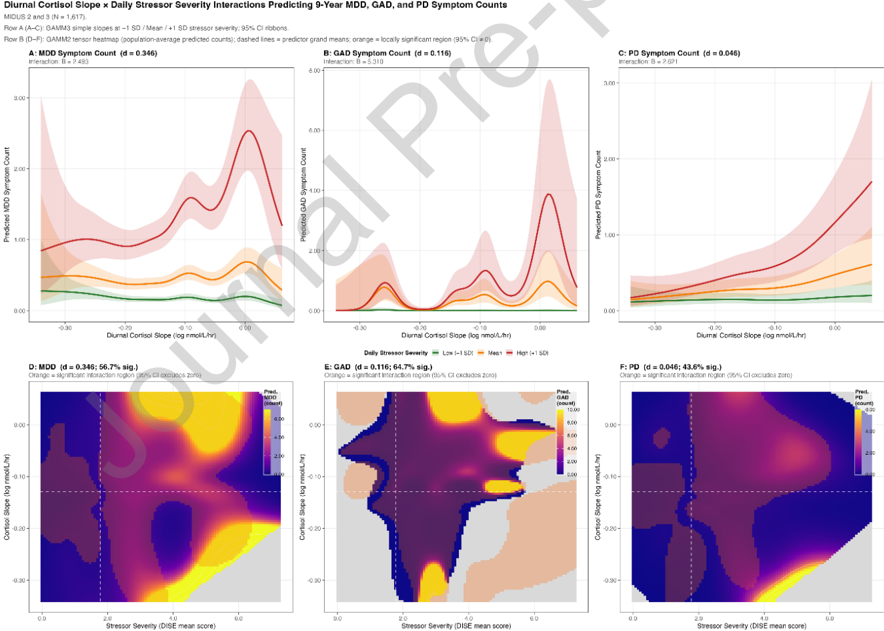
BACKGROUND: Flatter diurnal cortisol decline indicates hypothalamic-pituitary-adrenal (HPA) axis dysregulation and has been longitudinally related to major depressive disorder (MDD), generalized anxiety disorder (GAD), and panic disorder (PD) symptoms. However, given high heterogeneity in the relationship between diurnal cortisol and future common mental health symptoms, the moderators of these long-term prospective associations remain unclear. METHOD: =56.29 years). Participants completed baseline assessments of diurnal cortisol slopes and stressor severity (Daily Inventory of Stressful Events). Psychiatric symptoms (Composite International Diagnostic Interview-Short Form) were assessed at baseline and nine-year follow-up. Cortisol was sampled four times a day over four days. Day-level diurnal cortisol slope (DCS) was computed as ordinary least squares regression coefficients of log-cortisol on observed collection time, averaged across days. Generalized additive mixed models evaluated nonlinear moderator effects of stressor severity on the relations between DCS and common mental health symptoms. RESULTS: Between persons, flatter DCS significantly interacted with greater daily stressor severity to predict higher nine-year MDD (d = 0.346), GAD (d = 0.116), and PD (d = 0.046) symptom counts (all p ≤ .002). Participants with both flatter DCS and greater daily stressor severity had notably higher long-term MDD, GAD, and PD symptom counts. Complex, nonlinear associations were observed across all outcomes. DISCUSSION: Consistent with the dual-risk stress-sensitization hypothesis, the prognostic value of flatter cortisol slopes is context-specific and contingent on stressor exposures. Findings merit precision medicine investigations into targeting HPA axis dysregulation.
Overview
CoChat Summary
TL;DR
In a nine-year secondary analysis of MIDUS, flatter diurnal cortisol slopes interacted with greater daily stressor severity to predict higher MDD, GAD, and PD symptom counts. Associations were nonlinear and context-dependent, supporting dual-risk stress-sensitization and precision-medicine targeting of HPA-axis dysregulation.
Key findings
- Between persons, flatter diurnal cortisol slope significantly interacted with greater daily stressor severity to predict higher nine-year MDD (d=0.346), GAD (d=0.116), and PD (d=0.046) symptom counts (all p≤.002).
- GAMM parametric interaction terms were significant for MDD (B=2.032, SE=0.420, p<.001), GAD (B=4.228, SE=1.025, p<.001), and PD (B=1.652, SE=0.524, p=.002); deviance explained was MDD 17.5%, GAD 35.4%, and PD 16.9%.
- Significant nonlinear interaction terms occurred within 52.8% of the MDD, 48.0% of the GAD, and 50.4% of the PD parameter space; the high-stress flat-slope profile yielded the most statistically significant grid points, whereas the flat slope–low stressor profile yielded negative mean tensor values.
- Sensitivity analyses showed daily stressor severity also interacted with CAR and AUCg to predict nine-year symptom counts; these interactions were uniformly negative, indicating greater morning cortisol reactivity or total daily output weakened the positive stressor–symptom relationship. LMMs replicated core GAMM outcomes, and the interaction remained significant after adding a baseline adversity composite.
Methods
- Secondary data analysis of MIDUS 2 (2004–2006) and MIDUS 3 (2013–2014); final analytic sample was N=1,617 community-dwelling adults, mean age 56.29 years (SD=12.02, range 33–83), 56.4% women.
- Baseline diurnal cortisol slope was derived from 16 saliva samples (4 samples/day over 4 days) as the OLS regression coefficient of log-transformed cortisol on collection time, averaged across days. Daily stressor severity came from the Daily Inventory of Stressful Events over 8 consecutive evenings, with severity ratings (0–3) summed daily and averaged. MDD, GAD, and PD symptom counts were assessed with the CIDI-SF at baseline and nine-year follow-up.
- Primary analyses used generalized additive mixed models with tensor product smooths, Poisson log-link, random intercepts, and age/gender covariates; missingness was 18.5% and handled with random forest imputation. Sensitivity analyses used linear mixed models, CAR, AUCg, and an adversity covariate.
Limitations
- Stated by the paper: unmeasured third variables such as polygenic risk; CIDI-SF aligned with DSM-III-R rather than DSM-5; sample mostly White and of middle-to-upper socioeconomic status; results permitted largely correlational rather than strict causal inferences; state-level covariates (e.g., medication use, wake time) were not measured and electronic adherence tracking was absent.
- Evident from the text: inferences are between-person/trait-level and may not extend to within-person processes; random slopes were removed due to convergence issues; daily stressor severity had low within-person reliability (ω=.382) though good between-person reliability (ω=.772); cortisol slope between-person reliability was moderate (ω=.477); the sample was restricted to MIDUS participants with valid cortisol, daily diary, and follow-up data.
Model-written summary. Check it against the paper before relying on it.
Integrity signals
Registry
Cites
Statistics
Figures
Verification
Claims the paper makes
2 Valid · 1 Not valid · 10 Not checked · 75 Own results and interpretations
The cited sources support only part of this claim — read each source’s verdict below.
In the paper
“Such regulatory issues can hinder neural circuits linked to emotion regulation of glucocorticoid-implicated buffer against the buildup of neurotoxic stressors, thus maintaining common mental health symptoms across time (Joseph & Golden, 2017).”
§ Generalized Anxiety, and Panic Disorder Symptoms > J o u r n a l P r e -p r o o f
What the sources say
- Partly supportedcites Joseph & Golden, 2017 matched to “Cortisol dysregulation: the bidirectional link between stress, depression, and type 2 diabetes mellitus” (2017) sourceExperimental — accuracy not yet measured
Our copy supports the neural-circuit half of the claim: in the hypercortisolism/Cushing's section it states that chronic exposure to high cortisol produces structural and functional changes in glucocorticoid receptor–rich brain regions fundamental for emotional and cognitive function (hippocampus, amygdala, prefrontal cortex), and Figure 2's legend describes hippocampal atrophy and reduced hippocampal inhibition of the hypothalamus. However, the source nowhere casts glucocorticoids as a 'buffer against the buildup of neurotoxic stressors' — in Joseph & Golden cortisol exposure is the damaging agent, not a protective buffer — and it does not attribute the maintenance of mental health symptoms over time to hindered emotion-regulation circuits; the longitudinal material (depression section and summary) instead reports mixed, explicitly hedged associations between CAR/8 AM cortisol and unfavorable course or earlier recurrence, stating 'further studies are required to verify these findings.' The citing sentence also converts a hedged, associative literature summary into a causal mechanism. (LLM, conf=0.72)
plainstates a cause- Asserted: passes — The authors put it forward as true.
- Checkable: passes — It can be checked against evidence.
- Load-bearing: unclear — It is unclear whether the paper’s conclusions depend on it.
- Based: passes — The paper gives a reason why it holds.
- Partly supported
The cited sources support only part of this claim — read each source’s verdict below.
In the paper
“However, the current literature has mainly focused on cross-sectional relations or shorter time scales (e.g., fewer than 5 years) when studying the links between cortisol rhythm dysregulation and internalizing symptoms (Adam et al., 2017;Vrshek-Schallhorn et al., 2013).”
§ Generalized Anxiety, and Panic Disorder Symptoms > J o u r n a l P r e -p r o o f
What the sources say
- Partly supportedcites Adam et al., 2017 matched to “Diurnal cortisol slopes and mental and physical health outcomes: a systematic review and meta-analysis” (2017) sourceExperimental — accuracy not yet measured
Adam et al. (2017) supports the cross-sectional emphasis: Results §3.1 states that 'an overwhelming majority of the findings reported (91.1%, n = 163) were cross sectional in nature, with only 8.9% (n = 16) ... based on prospective studies,' and Discussion §4.4 notes 'a dearth of studies using prospective approaches' and urges longitudinal designs with repeated measures. However, that design breakdown is reported for all 179 findings across 12 mental and physical health outcomes, not for the internalizing/depression/anxiety subset the claim narrows to (§3.1 reports depression 29.1%, anxiety 8.4%, internalizing 5.0% of findings without a by-design split). The 'shorter time scales (e.g., fewer than 5 years)' element is not in our copy: the paper's time-scale moderators concern days of sampling and samples per day (§3.1, §4.3.4 Number of Days), with no reported follow-up intervals in years or any 5-year threshold. (LLM, conf=0.78)
- Supportedcites Vrshek-Schallhorn et al., 2013 matched to “The cortisol awakening response predicts major depression: predictive stability over a 4-year follow-up and effect of depression history” (2013) source
The Introduction (p. 1) states that HPA/cortisol dysregulation has been implicated in MDE 'by a large body of animal research and cross-sectional research in humans', and that the existing prospective work covers only '2 to 3 years' (Halligan et al. 2007; Shirtcliff & Essex, 2008), with 'no one has examined the CAR as a predictor of MDE onset over similar time periods'. The paper's own design is a 4-year follow-up (up to 54 months; Method/Analytic plan), and the Discussion calls it 'the first study to explicitly test the extent to which the CAR predicts MDE onsets consistently over an extended period of time' — i.e. it is itself an example of the sub-5-year time scale the citing sentence describes. The only slight stretch is the phrase 'internalizing symptoms', since this paper's outcome is major depression onset (with anxiety/neuroticism as covariates), but the background characterization is clearly treated as such in our copy. (LLM, conf=0.85)
plain- Asserted: passes — The authors put it forward as true.
- Checkable: passes — It can be checked against evidence.
- Load-bearing: passes — The paper’s conclusions depend on it.
- Based: passes — The paper gives a reason why it holds.
- Partly supported
A result the paper reports from its own data — it cites no other source for it, so there is none to check. The quote shows it is in the paper.
In the paper
“Cortisol × Stressor 2.032*** (0.420) 4.840 < .001”
§ Generalized Anxiety, and Panic Disorder Symptoms > Additional information
plainstates an association- Asserted: passes — The authors put it forward as true.
- Checkable: passes — It can be checked against evidence.
- Load-bearing: passes — The paper’s conclusions depend on it.
- Based: passes — The paper gives a reason why it holds.
A result the paper reports from its own data — it cites no other source for it, so there is none to check. The quote shows it is in the paper.
In the paper
“Cortisol × Stressor 1.652** (0.524) 3.160 .002”
§ Generalized Anxiety, and Panic Disorder Symptoms > Additional information
plainstates an association- Asserted: passes — The authors put it forward as true.
- Checkable: passes — It can be checked against evidence.
- Load-bearing: passes — The paper’s conclusions depend on it.
- Based: passes — The paper gives a reason why it holds.
A result the paper reports from its own data — it cites no other source for it, so there is none to check. The quote shows it is in the paper.
In the paper
“| Cortisol Slope | 2.082 (0.411) 1.275 2.888 5.060 < .001 |”
§ Generalized Anxiety, and Panic Disorder Symptoms > Additional information
plainstates a cause- Asserted: passes — The authors put it forward as true.
- Checkable: passes — It can be checked against evidence.
- Load-bearing: passes — The paper’s conclusions depend on it.
- Based: passes — The paper gives a reason why it holds.
46 more claims
Create a free account to see all 88 claims and to verify the 15 references still open.
- It may state two separate claims as one. 20
- The quote only partly states this claim. 3
- Probably not a substantial claim. 18
Statistics recomputed
Every reported test result, recomputed from its test statistic and degrees of freedom. A result shows as not adding up only once an independent check has confirmed it.
- Consistentχ²(1) = 35.83reported p < .001 · recomputed p < .001
“χ2(1)=35.83,p < .001”
- Consistentχ²(1) = 93.11reported p < .001 · recomputed p < .001
“χ2(1)=93.11,p < .001”
- Consistentχ²(1) = 32.59reported p < .001 · recomputed p < .001
“χ2(1)=32.59,p < .001”
- Consistentχ²(1) = 9.37reported p = .002 · recomputed p = .002
“χ2(1)=9.37,p = .002”
- Consistentχ²(1) = 29.82reported p < .001 · recomputed p < .001
“χ2(1)=29.82,p < .001”
4 more recomputed tests
Create a free account to see every test the Stats check recomputed.
Self-check
Percentages, sums and reported differences re-computed from the paper’s own numbers.
Each contradiction between two passages listed here was confirmed by an independent check.
Rated major: it would touch a result — a value a result rests on, reported and recomputed p-values on opposite sides of the significance level, two passages that conflict with no sign which is right, or a cited work retracted before this paper was published.
In the paper
§ Generalized Anxiety, and Panic Disorder Symptoms > J o u r n a l P r e -p r o o f
“Average daily stressor severity was 1.83 (SD=0.80).”
§ Generalized Anxiety, and Panic Disorder Symptoms > J o u r n a l P r e -p r o o f
“| Daily stressor severity (sum | 1617 1.78 | 0.83 | 0.00 | 7.25 |”
Rated major: it would touch a result — a value a result rests on, reported and recomputed p-values on opposite sides of the significance level, two passages that conflict with no sign which is right, or a cited work retracted before this paper was published.
In the paper
§ Generalized Anxiety, and Panic Disorder Symptoms > J o u r n a l P r e -p r o o f
“and 0.37 (SD=1.11),respectively”
§ Generalized Anxiety, and Panic Disorder Symptoms > J o u r n a l P r e -p r o o f
“| PD -Baseline (symptom | 1617 0.35 | 1.07 | 0.00 | 6.00 |”
Rated minor: it would not touch a result — a value no result rests on, a p-value that stays on the same side of the significance level, or a conflict that is clerical, resolved elsewhere in the paper, or outside its own findings.
In the paper
§ Generalized Anxiety, and Panic Disorder Symptoms > 3.3.Sensitivity Analyses: Linear Mixed Models (LMM) and Adversity Covariate
“but not GAD (B=0.045,SE=0.021, p=.034 [marginal effect]).”
§ Generalized Anxiety, and Panic Disorder Symptoms > Additional information
“Note.*** p < .001,** p < .01,* p < .05.”
Rated minor: it would not touch a result — a value no result rests on, a p-value that stays on the same side of the significance level, or a conflict that is clerical, resolved elsewhere in the paper, or outside its own findings.
In the paper
§ Generalized Anxiety, and Panic Disorder Symptoms > J o u r n a l P r e -p r o o f
“At baseline, mean symptom counts for MDD (0-7), GAD (0-10), and PD (0-6) were 0.61 (SD=1.73),0.14 (SD=0.88),and 0.37 (SD=1.11),respectively”
§ Generalized Anxiety, and Panic Disorder Symptoms > J o u r n a l P r e -p r o o f
“| MDD -Baseline (symptom | 1617 0.63 | 1.74 | 0.00 | 7.00 |”
Rated minor: it would not touch a result — a value no result rests on, a p-value that stays on the same side of the significance level, or a conflict that is clerical, resolved elsewhere in the paper, or outside its own findings.
In the paper
§ Generalized Anxiety, and Panic Disorder Symptoms > J o u r n a l P r e -p r o o f
“at nine-year follow-up, they were 0.63 (SD=1.77),0.15 (SD=0.93),and 0.34 (SD=1.07).”
§ Generalized Anxiety, and Panic Disorder Symptoms > J o u r n a l P r e -p r o o f
“| GAD -9-Year (symptom | 1617 0.16 | 0.97 | 0.00 | 10.00 |”
Citations
Cites
Fitting Linear Mixed-Effects Models Using lme4
Bates, D., Mächler, M., Bolker, B., & Walker, S. (2015) · Journal of Statistical Software · doi:10.18637/jss.v067.i01 · Cited by 86,835
A new look at the statistical model identification
Akaike, H. (1974) · IEEE Transactions on Automatic Control · doi:10.1109/tac.1974.1100705 · Cited by 51,879
Estimating the Dimension of a Model
Schwarz, G. (1978) · The Annals of Statistics · doi:10.1214/aos/1176344136 · Cited by 47,033
Model selection and multimodel inference: a practical information-theoretic approach.
Guthery, F. S., Burnham, K. P., & Anderson, D. R. (2003) · The Journal of Wildlife Management · doi:10.2307/3802723 · Cited by 41,495
Wickham, H. (2016) · Use R! · doi:10.1007/978-3-319-24277-4 · Cited by 33,115
Kessler, R. C., Chiu, W. T., Demler, O., & Walters, E. E. (2005) · Archives of General Psychiatry · doi:10.1001/archpsyc.62.6.617 · Cited by 12,052
Stress, adaptation, and disease. Allostasis and allostatic load
McEWEN, B. S. (1998) · Annals of the New York Academy of Sciences · doi:10.1111/j.1749-6632.1998.tb09546.x · Cited by 5,092
Pruessner, J. C., Kirschbaum, C., Meinlschmid, G., & Hellhammer, D. H. (2003) · Psychoneuroendocrinology · doi:10.1016/s0306-4530(02)00108-7 · Cited by 3,638
Beyond diathesis stress: differential susceptibility to environmental influences
Belsky, J., & Pluess, M. (2009) · Psychological Bulletin · doi:10.1037/a0017376 · Cited by 3,039
Hammen, C. (2005) · Annual Review of Clinical Psychology · doi:10.1146/annurev.clinpsy.1.102803.143938 · Cited by 2,979
The Epidemiology of Depression Across Cultures
Kessler, R. C., & Bromet, E. J. (2013) · Annual Review of Public Health · doi:10.1146/annurev-publhealth-031912-114409 · Cited by 2,657
(1987) · American Psychiatric Association Publishing eBooks · doi:10.1176/appi.books.9780890420188.dsm-iii-r · Cited by 2,615
Allostatic load biomarkers of chronic stress and impact on health and cognition
Juster, R.-P., McEwen, B. S., & Lupien, S. J. (2010) · Neuroscience & Biobehavioral Reviews · doi:10.1016/j.neubiorev.2009.10.002 · Cited by 2,565
Miller, G. E., Chen, E., & Zhou, E. S. (2007) · Psychological Bulletin · doi:10.1037/0033-2909.133.1.25 · Cited by 2,467
The world health organization composite international diagnostic interview short-form (CIDI-SF)
Kessler, R. C., Andrews, G., Mroczek, D., Ustun, B., & Wittchen, H. (1998) · International Journal of Methods in Psychiatric Research · doi:10.1002/mpr.47 · Cited by 2,242
Slavich, G. M., & Irwin, M. R. (2014) · Psychological Bulletin · doi:10.1037/a0035302 · Cited by 2,206
BOYCE, W. T., & ELLIS, B. J. (2005) · Development and Psychopathology · doi:10.1017/s0954579405050145 · Cited by 2,078
Molenaar, P. C. M. (2004) · Measurement: Interdisciplinary Research & Perspective · doi:10.1207/s15366359mea0204_1 · Cited by 1,943
McEwen, B. S. (2008) · European Journal of Pharmacology · doi:10.1016/j.ejphar.2007.11.071 · Cited by 1,864
Differential susceptibility to the environment: an evolutionary--neurodevelopmental theory
Ellis, B. J., Boyce, W. T., Belsky, J., Bakermans-Kranenburg, M. J., & van Ijzendoorn, M. H. (2011) · Development and Psychopathology · doi:10.1017/s0954579410000611 · Cited by 1,564
Handbook of Child Psychology and Developmental Science
(2015) · Wiley eBooks · doi:10.1002/9781118963418 · Cited by 1,345
Advances in cognitive theory and therapy: The generic cognitive model
Beck, A. T., & Haigh, E. A. P. (2014) · Annual Review of Clinical Psychology · doi:10.1146/annurev-clinpsy-032813-153734 · Cited by 1,055
Adam, E. K., Quinn, M. E., Tavernier, R., McQuillan, M. T., Dahlke, K. A., & Gilbert, K. E. (2017) · Psychoneuroendocrinology · doi:10.1016/j.psyneuen.2017.05.018 · Cited by 905
Practical variable selection for generalized additive models
Marra, G., & Wood, S. N. (2011) · Computational Statistics & Data Analysis · doi:10.1016/j.csda.2011.02.004 · Cited by 864
Quality of life in the anxiety disorders: a meta-analytic review
Olatunji, B. O., Cisler, J. M., & Tolin, D. F. (2007) · Clinical Psychology Review · doi:10.1016/j.cpr.2007.01.015 · Cited by 808
Shah, A. D., Bartlett, J. W., Carpenter, J., Nicholas, O., & Hemingway, H. (2014) · American Journal of Epidemiology · doi:10.1093/aje/kwt312 · Cited by 798
Monroe, S. M., & Harkness, K. L. (2005) · Psychological Review · doi:10.1037/0033-295x.112.2.417 · Cited by 693
Low‐Rank Scale‐Invariant Tensor Product Smooths for Generalized Additive Mixed Models
Wood, S. N. (2006) · Biometrics · doi:10.1111/j.1541-0420.2006.00574.x · Cited by 616
The Daily Inventory of Stressful Events: An Interview-Based Approach for Measuring Daily Stressors
Almeida, D. M., Wethington, E., & Kessler, R. C. (2002) · Assessment · doi:10.1177/1073191102091006 · Cited by 596
Joseph, J. J., & Golden, S. H. (2017) · Annals of the New York Academy of Sciences · doi:10.1111/nyas.13217 · Cited by 574
Hellhammer, J., Fries, E., Schweisthal, O. W., Schlotz, W., Stone, A. A., & Hagemann, D. (2007) · Psychoneuroendocrinology · doi:10.1016/j.psyneuen.2006.10.005 · Cited by 540
Slavich, G. M. (2020) · Annual Review of Clinical Psychology · doi:10.1146/annurev-clinpsy-032816-045159 · Cited by 502
Ruscio, A. M., Hallion, L. S., Lim, C. C. W., Aguilar-Gaxiola, S., Al-Hamzawi, A., Alonso, J., Andrade, L. H., Borges, G., Bromet, E. J., Bunting, B., et al. (2017) · JAMA Psychiatry · doi:10.1001/jamapsychiatry.2017.0056 · Cited by 492
Loneliness and cortisol: Momentary, day-to-day, and trait associations
Doane, L. D., & Adam, E. K. (2010) · Psychoneuroendocrinology · doi:10.1016/j.psyneuen.2009.08.005 · Cited by 342
Bioindicators in the MIDUS National Study: Protocol, Measures, Sample, and Comparative Context
Dienberg Love, G., Seeman, T. E., Weinstein, M., & Ryff, C. D. (2010) · Journal of Aging and Health · doi:10.1177/0898264310374355 · Cited by 333
The fixed versus random effects debate and how it relates to centering in multilevel modeling.
Hamaker, E. L., & Muthén, B. (2020) · Psychological Methods · doi:10.1037/met0000239 · Cited by 285
National Survey of Midlife Development in the United States (MIDUS II), 2004-2006: Archival Version
Ryff, C., Almeida, D. M., Ayanian, J. S., Carr, D. S., Cleary, P. D., Coe, C., Davidson, R., Krueger, R. F., Lachman, M. E., Marks, N. F., et al. (2007) · ICPSR Data Holdings · doi:10.3886/icpsr04652 · Cited by 269
Fiksdal, A., Hanlin, L., Kuras, Y., Gianferante, D., Chen, X., Thoma, M. V., & Rohleder, N. (2019) · Psychoneuroendocrinology · doi:10.1016/j.psyneuen.2018.11.035 · Cited by 258
Luthar, S. S., Crossman, E. J., & Small, P. J. (2015) · Handbook of Child Psychology and Developmental Science · doi:10.1002/9781118963418.childpsy307 · Cited by 256
Short, S. J., Stalder, T., Marceau, K., Entringer, S., Moog, N. K., Shirtcliff, E. A., Wadhwa, P. D., & Buss, C. (2016) · Psychoneuroendocrinology · doi:10.1016/j.psyneuen.2016.05.007 · Cited by 239
Vrshek-Schallhorn, S., Doane, L. D., Mineka, S., Zinbarg, R. E., Craske, M. G., & Adam, E. K. (2013) · Psychological Medicine · doi:10.1017/s0033291712001213 · Cited by 230
Zajkowska, Z., Gullett, N., Walsh, A., Zonca, V., Pedersen, G. A., Souza, L., Kieling, C., Fisher, H. L., Kohrt, B. A., & Mondelli, V. (2022) · Psychoneuroendocrinology · doi:10.1016/j.psyneuen.2021.105625 · Cited by 228
Salivary Cortisol in Ambulatory Assessment—Some Dos, Some Don’ts, and Some Open Questions
Kudielka, B. M., Gierens, A., Hellhammer, D. H., Wüst, S., & Schlotz, W. (2012) · Psychosomatic Medicine · doi:10.1097/psy.0b013e31825434c7 · Cited by 226
Mantella, R. C., Butters, M. A., Amico, J. A., Mazumdar, S., Rollman, B. L., Begley, A. E., Reynolds, C. F., & Lenze, E. J. (2008) · Psychoneuroendocrinology · doi:10.1016/j.psyneuen.2008.03.002 · Cited by 222
Wood, S. N. (2024) · Annual Review of Statistics and Its Application · doi:10.1146/annurev-statistics-112723-034249 · Cited by 220
Bertollo, A. G., Santos, C. F., Bagatini, M. D., & Ignácio, Z. M. (2025) · Frontiers in Neuroscience · doi:10.3389/fnins.2025.1541075 · Cited by 212
Deutschbein, T., Reimondo, G., Di Dalmazi, G., Bancos, I., Patrova, J., Vassiliadi, D. A., Nekić, A. B., Debono, M., Lardo, P., Ceccato, F., et al. (2022) · The Lancet Diabetes & Endocrinology · doi:10.1016/s2213-8587(22)00100-0 · Cited by 205
Almeida, D. M., McGonagle, K., & King, H. (2009) · Biodemography and Social Biology · doi:10.1080/19485560903382338 · Cited by 184
Doane, L. D., Mineka, S., Zinbarg, R. E., Craske, M., Griffith, J. W., & Adam, E. K. (2013) · Development and Psychopathology · doi:10.1017/s0954579413000060 · Cited by 155
Miller, R., & Plessow, F. (2013) · Psychoneuroendocrinology · doi:10.1016/j.psyneuen.2012.09.013 · Cited by 150
Stawski, R. S., Cichy, K. E., Piazza, J. R., & Almeida, D. M. (2013) · Psychoneuroendocrinology · doi:10.1016/j.psyneuen.2013.06.023 · Cited by 149
Lenze, E. J., Mantella, R. C., Shi, P., Goate, A. M., Nowotny, P., Butters, M. A., Andreescu, C., Thompson, P. A., & Rollman, B. L. (2011) · The American Journal of Geriatric Psychiatry · doi:10.1097/jgp.0b013e3181ec806c · Cited by 147
Midlife in the United States (MIDUS 3), 2013-2014
Ryff, C., Almeida, D., Ayanian, J., Binkley, N., Carr, D., Coe, C. L., Davidson, R., Grzywacz, J. G., Karlamangla, A., Krueger, R. F., et al. (2015) · ICPSR Data Holdings · doi:10.3886/icpsr36346 · Cited by 137
The Neurobiological Mechanisms of Generalized Anxiety Disorder and Chronic Stress
Patriquin, M. A., & Mathew, S. J. (2017) · Chronic Stress · doi:10.1177/2470547017703993 · Cited by 135
Gigantesco, A., & Morosini, P. (2008) · Clinical Practice and Epidemiology in Mental Health · doi:10.1186/1745-0179-4-8 · Cited by 124
Mindfulness enhances cognitive functioning: a meta-analysis of 111 randomized controlled trials
Zainal, N. H., & Newman, M. G. (2023) · Health Psychology Review · doi:10.1080/17437199.2023.2248222 · Cited by 123
Self-citationInterpreting Time Series and Autocorrelated Data Using GAMMs [R package itsadug version 2.4]
van Rij, J., Wieling, M. B., & Baayen, R. H. (2020) · Cited by 120
Segerstrom, S. C., Boggero, I. A., Smith, G. T., & Sephton, S. E. (2014) · Psychoneuroendocrinology · doi:10.1016/j.psyneuen.2014.07.022 · Cited by 115
Adam, E. K., Vrshek-Schallhorn, S., Kendall, A. D., Mineka, S., Zinbarg, R. E., & Craske, M. G. (2014) · Psychoneuroendocrinology · doi:10.1016/j.psyneuen.2014.02.014 · Cited by 108
Knight, E. L., Jiang, Y., Rodriguez-Stanley, J., Almeida, D. M., Engeland, C. G., & Zilioli, S. (2021) · Brain, Behavior, and Immunity · doi:10.1016/j.bbi.2021.01.015 · Cited by 106
Mundo, A. I., Tipton, J., & Muldoon, T. J. (2022) · Statistics in Medicine · doi:10.1002/sim.9505 · Cited by 104
The impact of depression, anxiety and comorbidity on occupational outcomes
Deady, M., Collins, D., Johnston, D., Glozier, N., Calvo, R. A., Christensen, H. M., & Harvey, S. B. (2021) · Occupational Medicine · doi:10.1093/occmed/kqab142 · Cited by 98
Frost, D. M., & Forrester, C. (2013) · Personality and Social Psychology Bulletin · doi:10.1177/0146167213476896 · Cited by 91
Starr, L. R., Dienes, K., Li, Y. I., & Shaw, Z. A. (2018) · Psychoneuroendocrinology · doi:10.1016/j.psyneuen.2018.10.003 · Cited by 81
Snyder, H. R., Young, J. F., & Hankin, B. L. (2019) · Journal of Clinical Child & Adolescent Psychology · doi:10.1080/15374416.2017.1321002 · Cited by 74
Sin, N. L., Ong, A. D., Stawski, R. S., & Almeida, D. M. (2017) · Psychoneuroendocrinology · doi:10.1016/j.psyneuen.2017.06.001 · Cited by 72
Kuhlmann, S. L., Arolt, V., Haverkamp, W., Martus, P., Ströhle, A., Waltenberger, J. L., Rieckmann, N., & Müller‐Nordhorn, J. (2019) · Psychotherapy and Psychosomatics · doi:10.1159/000501502 · Cited by 58
Hoyt, L. T., Ehrlich, K. B., Cham, H., & Adam, E. K. (2016) · Stress · doi:10.1080/10253890.2016.1206884 · Cited by 49
Murray, A. L., Xiao, Z., Zhu, X., Speyer, L. G., Yang, Y., Brown, R., Katus, L., Eisner, M., & Ribeaud, D. (2023) · Stress and Health · doi:10.1002/smi.3229 · Cited by 46
Visualizing interaction effects: a proposal for presentation and interpretation
Lamina, C., Sturm, G., Kollerits, B., & Kronenberg, F. (2012) · Journal of Clinical Epidemiology · doi:10.1016/j.jclinepi.2012.02.013 · Cited by 46
Zainal, N. H., Soh, C. P., Doren, N. V., & Benjet, C. L. (2024) · Clinical Psychology Review · doi:10.1016/j.cpr.2024.102518 · Cited by 43
Self-citationDetermining Reliability of Daily Measures: An Illustration with Data on Teacher Stress
van Alphen, T., Jak, S., de Wal, J. J. I., Schuitema, J. A., & Peetsma, T. T. D. (2022) · Applied Measurement in Education · doi:10.1080/08957347.2022.2034822 · Cited by 43
Gender Differences in Cortisol and Cortisol Receptors in Depression: A Narrative Review
Teo, C. H., Wong, A. C. H., Sivakumaran, R. N., Parhar, I. S., & Soga, T. (2023) · International Journal of Molecular Sciences · doi:10.3390/ijms24087129 · Cited by 42
Kuhlman, K. R., Robles, T. F., Dickenson, L., Reynolds, B. M., & Repetti, R. L. (2018) · Psychoneuroendocrinology · doi:10.1016/j.psyneuen.2018.09.033 · Cited by 39
Salivary cortisol as a non-invasive window on the brain
Clow, A., & Smyth, N. (2020) · International review of neurobiology · doi:10.1016/bs.irn.2019.12.003 · Cited by 38
Starr, L. R., Stroud, C. B., Shaw, Z. A., & Vrshek‐Schallhorn, S. (2020) · Development and Psychopathology · doi:10.1017/s0954579420000474 · Cited by 37
Xu, Y., Liu, Y., Chen, Z., Zhang, J., Deng, H., & Gu, J. (2019) · Frontiers in Psychology · doi:10.3389/fpsyg.2019.00297 · Cited by 37
Person-centered methods to advance developmental psychopathology
Handley, E. D., Duprey, E. B., Russotti, J. M., Levin, R. Y., & Warmingham, J. M. (2024) · Development and Psychopathology · doi:10.1017/s0954579424000282 · Cited by 25
Hoyt, L. T., Zeiders, K. H., Chaku, N., Niu, L., & Cook, S. (2021) · Psychoneuroendocrinology · doi:10.1016/j.psyneuen.2021.105204 · Cited by 22
Ng, M. H. S., Zainal, N. H., & Newman, M. G. (2024) · Journal of Anxiety Disorders · doi:10.1016/j.janxdis.2024.102826 · Cited by 20
Self-citationChanges in daily stress reactivity and changes in physical health across 18 years of adulthood
Rush, J., Charles, S. T., Willroth, E. C., Cerino, E. S., Piazza, J. R., & Almeida, D. M. (2024) · Annals of Behavioral Medicine · doi:10.1093/abm/kaae086 · Cited by 20
Heritability and polygenic load for comorbid anxiety and depression
Tabrizi, F., Rosén, J., Grönvall, H., William-Olsson, V. R., Arner, E., Magnusson, P. K., Palm, C., Larsson, H., Viktorin, A., Bernhardsson, J., et al. (2025) · Translational Psychiatry · doi:10.1038/s41398-025-03325-3 · Cited by 16
Cantave, C. Y., Brendgen, M. R., LUPIEN, S. J., Dionne, G., Vitaro, F., Boivin, M., & Ouellet‐Morin, I. (2023) · Journal of Child Psychology and Psychiatry · doi:10.1111/jcpp.13893 · Cited by 7
Daily exposure to stressors, daily perceived severity of stress, and mortality risk among US adults
Glei, D., & Weinstein, M. (2024) · PLoS ONE · doi:10.1371/journal.pone.0303266 · Cited by 7
Chong, L. S., Mejia, T., Senich, K. L., Olezeski, C. L., & Gordis, E. B. (2025) · Physiology & Behavior · doi:10.1016/j.physbeh.2025.115146 · Cited by 4
Udi, O. A. (2025) · DOAJ (DOAJ: Directory of Open Access Journals)
(2002) · Thammasat University Digital Collections
Midlife in the United States (MIDUS 3), 2013-2014: Version 7
Ryff, C., Almeida, D., Ayanian, J., Binkley, N., Carr, D. S., Coe, C., Davidson, R., Grzywacz, J., Karlamangla, A., Krueger, R., et al. (2015) · ICPSR - Interuniversity Consortium for Political and Social Research · doi:10.3886/icpsr36346.v7
Midlife in the United States (MIDUS 2), 2004-2006
Ryff, C., Almeida, D. M., Ayanian, J., Carr, D. S., Cleary, P. D., Coe, C., Davidson, R., Krueger, R. F., Lachman, M. E., Marks, N. F., et al. (2007) · ICPSR - Interuniversity Consortium for Political and Social Research · doi:10.3886/icpsr04652.v7
Research works printed but not linked: 4
- American Psychiatric Association. (1987). Diagnostic and Statistical Manual of Mental Disorders, 3rd Edition (DSM-III-R). American Psychiatric Association.
- Dunst, C. J., Hamby, D. W., & Trivette, C. M. (2004). Guidelines for calculating effect sizes for practice-based research syntheses. Centerscope, 3(1), 1-10.
- Ryff, C., Almeida, D.M., Ayanian, J., Carr, D.S., Cleary, P.D., Coe, C., … Williams, D. (2017). Midlife in the United States (MIDUS 2), 2004-2006 Inter-university Consortium for Political and Social Research [distributor]. https://doi.org/10.3886/ICPSR04652.v7. · DOI
- Wickham, H. (2016). ggplot2: Elegant graphics for data analysis. Springer-Verlag New York. Available from https://ggplot2.tidyverse.org.
Cited by
Still being checked.
Metadata
- Authors
- Zainal, N. H., & Van Doren, N.
- Affiliations
- National University of Singapore (SG)
- Corresponding author
- Zainal, Nur Hani
- ORCID
- Zainal, Nur Hani
- Venue
- Journal of Anxiety Disorders
- Publisher
- Elsevier BV
- Published
- 2026-12
- Volume
- 124
- Pages
- 103238
- ISSN
- 0887-6185 (ISSN-L)
- OpenAlex
- W7167867656
- Semantic Scholar
- 83884ca2a8856cfc18cf0760f5d758311a08f7be
- Cited by
- 0
- References
- 84
- FWCI
- 0.00
- Type
- journal article
- Language
- en
- Open access
- hybrid
- doi.org
- Licence
- cc-by
- www.elsevier.com/tdm/userlicense/1.0/ (tdm)
- www.elsevier.com/legal/tdmrep-license (tdm)
- creativecommons.org/licenses/by/4.0/ (vor)
- Locations
- Journal of Anxiety Disorders (publishedVersion, cc-by)
- PubMed (publishedVersion)
- OSF Preprints (OSF Preprints) (submittedVersion)
- Funders
- The John D and Catherine T MacArthur Foundation
- National Institute on Drug Abuse Intramural Research Program
- National University of Singapore (A-0009981-00-00, A-0009981-01-00)
- National Institute on Alcohol Abuse and Alcoholism
- National Institute on Aging
- Topics
- Life Sciences › Neuroscience › Behavioral Neuroscience › Stress Responses and Cortisol
- Social Sciences › Psychology › Experimental and Cognitive Psychology › Anxiety, Depression, Psychometrics, Treatment, Cognitive Processes
- Social Sciences › Psychology › Experimental and Cognitive Psychology › Mental Health Research Topics
- Keywords
- diurnal cortisol slope, HPA axis dysregulation, major depressive disorder, generalized anxiety disorder, panic disorder
About these checks
Registry, retraction, Cites and statistics results are computed, not judged, with one exception: a printed reference that no index lists is read once by a model before it counts as a citation error. Claims are extracted by a model and kept only when their quote appears verbatim in the text; each cited source is then checked, with a model’s help, for whether it says what the claim relies on. Those verdicts can be wrong — read the claim’s quote and the cited source before relying on one.
The claim verdicts this report counts are experimental: their accuracy is not yet measured.
A language model drew the claims from the paper on 2026-11-21, under version 3 of the claim definition (model deepseek-v4.1-flash, prompt extract-v3).
A second model labelled each claim on 2026-11-21 (model jev-1.13-20260917, definition revision gold-guideline-v0.2).
Cited sources are checked with a language model’s help (qwen3.8-omni-flash).
Statistics and arithmetic are recomputed, not judged.
Confidence bands are shown only for fields calibrated on our annotated test set. None is calibrated yet, so no band is shown.
What counts as a claim ›How we measure confidence ›How we check this ›
Are you an author, or do you see a problem with this page? Request a review
Data sources
Bibliographic data: Semantic Scholar, OpenAlex, Crossref.
Contains information from the Semantic Scholar Academic Graph Datasets, made available under the ODC Attribution License (ODC-BY 1.0).
Semantic Scholar’s data is described in: Kinney, R., et al. (2023). The Semantic Scholar Open Data Platform. arXiv:2301.10140.
