

The DOI matches its Crossref record; 3 of the 3 references it cites were found in a registry or an index.
Oldest human occupation of Wallacea at Laili Cave, Timor-Leste, shows broad-spectrum foraging responses to late Pleistocene environments
Overview
The claims and statistics of this paper haven’t been checked yet.
Run the check — free, no account needed. It reads the open-access text and checks the sources it cites.
Integrity signals
Registry
Cites
Statistics
Figures
Verification
Claims the paper makes
The claims and statistics of this paper haven’t been checked yet.
Run the check — free, no account needed. It reads the open-access text and checks the sources it cites.
Claims other papers make about this one
Each is checked against this paper’s own text: does it say what the citing paper says it does?
The source backs part of the claim, not all of it — or backs it for a different population, condition or comparison.
In the citing paper
“the recent finds from Laili cave in Timor-Leste demonstrate that modern humans did breach the Wallace Line using a southern route by around 43.3e44.6ka cal BP (Hawkins et al., 2017)”
From Least-cost pathway models indicate northern human dispersal from Sunda to Sahul (2018) · cites this paper as Hawkins et al., 2017
Experimental — accuracy not yet measuredIn the citing paper
“However, even if we consider a more conservative estimate of a ca.50e55 ka for colonization of Sahul, as proposed by O'Connell et al. (2018), significant chronological gaps still remain between the Sahul and Wallacean records (Kealy et al., 2016;Hawkins et al., 2017).”
From Least-cost pathway models indicate northern human dispersal from Sunda to Sahul (2018) · cites this paper as Hawkins et al., 2017
In the citing paper
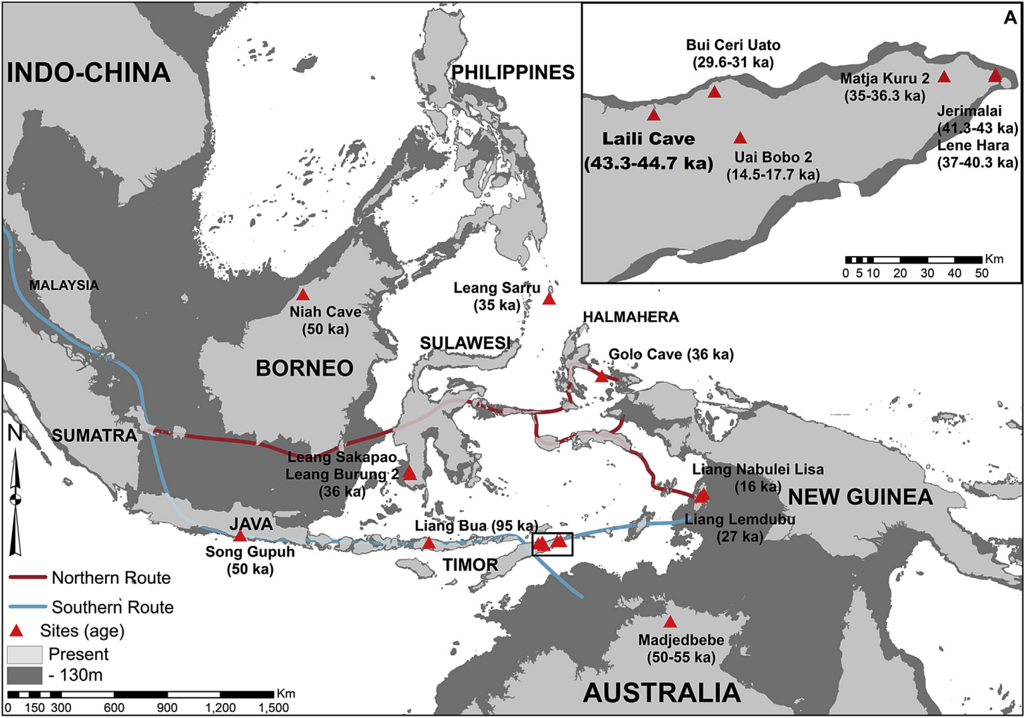
“The oldest date for early modern humans in Wallacea is known from Laili Cave, Timor-Leste (SOM Fig. S1), with a date of 43.3e44.6ka cal BP (D-AMS-007344; Hawkins et al., 2017).”
From Least-cost pathway models indicate northern human dispersal from Sunda to Sahul (2018) · cites this paper as Hawkins et al., 2017
In the citing paper
“only a very few (Langley et al., 2016;Hawkins et al., 2017;Kealy et al., 2017;O'Connor et al., 2017bO'Connor et al., , 2018a) ) have incorporated island uplift rates into their reconstructions.”
From Least-cost pathway models indicate northern human dispersal from Sunda to Sahul (2018) · cites this paper as Hawkins et al., 2017
In the citing paper
“The oldest date for Timor (and Wallacea) is from Laili, a site ca.125 km west of the eastern tip of the island (Hawkins et al., 2017).”
From Least-cost pathway models indicate northern human dispersal from Sunda to Sahul (2018) · cites this paper as Hawkins et al., 2017
Self-check
Percentages, sums and reported differences re-computed from the paper’s own numbers.
The self-check needs the paper’s full text.
Citations
Cites
IntCal13 and Marine13 radiocarbon age calibration curves 0–50,000 years cal BP
Reimer, P. J., Bard, E., Bayliss, A., Beck, J. W., Blackwell, P. G., Ramsey, C. B., Buck, C. E., Cheng, H., Edwards, R. L., Friedrich, M., et al. (2013) · Radiocarbon · doi:10.2458/azu_js_rc.55.16947 · Cited by 14,591
Homo floresiensis-like fossils from the early Middle Pleistocene of Flores
van den Bergh, G. D., Kaifu, Y., Kurniawan, I., Kono, R. T., Brumm, A., Setiyabudi, E., Aziz, F., & Morwood, M. J. (2016) · Nature · doi:10.1038/nature17999 · Cited by 171
Ingram, B. L. (1998) · Quaternary Research · doi:10.1006/qres.1997.1944 · Cited by 91
Research works printed but not linked: 58
- Anderson, 2017, Ecological contingency accounts for earliest seagoing in the western Pacific Ocean, J. Isl. Coast. Archaeol.
- Aplin, 2010, Quaternary murid rodents of Timor: Part 1 New material of Coryphomys buehleri Schaub, 1937, and description of a second species of the genus, Bull. Am. Mus. Nat. Hist., 341, 3, 10.1206/692.1 · DOI
- Böhm, 2000, Oxygen isotope fractionation in marine aragonite of coralline sponges, Geochimica Cosmochimica Acta, 64, 1695, 10.1016/S0016-7037(99)00408-1 · DOI
- Broughton, 2006, The taphonomy of owl-deposited fish remains and the origin of the Homestead Cave ichthyofauna, J. Taphon., 4, 69
- Brumm, 2006, Early stone technology on Flores and its implications for Homo floresiensis, Nature, 441, 624, 10.1038/nature04618 · DOI
- Brumm, 2017, Early human symbolic behavior in the late Pleistocene of Wallacea, Proc. Natl. Acad. Sci., 114, 4105, 10.1073/pnas.1619013114 · DOI · Paper page
- Brumm, 2012, Biface distributions and the Movius line: a Southeast asian perspective, Aust. Archaeol., 74, 32, 10.1080/03122417.2012.11681933 · DOI
- Bulbeck, 2004, Leang Sakapao 1: a second dated Pleistocene site from South Sulawesi, Indonesia, vol. 18, 111
- 1998, vol. 2
- Clarkson, 2015, The archaeology, chronology and stratigraphy of Madjedbebe (Malakunanja II): a site in northern Australia with early occupation, J. Hum. Evol., 83, 46, 10.1016/j.jhevol.2015.03.014 · DOI · Paper page
- Colonese, 2012, Oxygen isotopic composition of limpet shells from the Beagle Channel: implications for seasonal studies in shell middens of Tierra del Fuego, J. Archaeol. Sci., 39, 1738, 10.1016/j.jas.2012.01.012 · DOI
- Cranbrook, 1966, Bat remains from Niah Cave excavations, 1964, Sarawak Mus. J., 14, 224
- Fallon, 2010, The next chapter in radiocarbon dating at the Australian National University: status report on the single stage AMS, Nucl. Instrum. Methods Phys. Res. Sect. B Beam Interact. Mater. Atoms, 268, 898, 10.1016/j.nimb.2009.10.059 · DOI
- Field, 2008, Chronological overlap between humans and megafauna in Sahul (Pleistocene Australia-New Guinea): a review of the evidence, Earth Sci. Rev., 89, 97, 10.1016/j.earscirev.2008.04.006 · DOI
- Franke, 2008, Modeling variations of marine reservoir ages during the last 45, 000 years, Clim. Past, 4, 125, 10.5194/cp-4-125-2008 · DOI
- Glover, 1981, Leang Burung 2: an upper palaeolithic rock shelter in South Sulawesi, Indonesia, Mod. Quat. Res. Southeast Asia, 6, 1
- Goodwin, 1979, The bats of Timor: systematics and ecology, Bull. Am. Mus. Nat. Hist., 163, 73
- Hamm, 2016, Cultural innovation and megafauna interaction in the early settlement of arid Australia, Nature, 539, 280, 10.1038/nature20125 · DOI
- Hand, 2012, Late-Holocene bats of Mé Auré Cave, New Caledonia: evidence of human consumption and a new species record from the recent past, Holocene, 22, 79, 10.1177/0959683611409783 · DOI
- Hawkins, 2016, Late Quaternary hominin-bat (Chiroptera) interactions in the Asia-Pacific, Archaeol. Ocean., 51, 7, 10.1002/arco.5084 · DOI
- Hawkins, S., O'Connor, S., Louys, J. In press. Taphonomy of bird (Aves) remains at Laili Cave, Timor-Leste and implications for human-bird interactions during the Pleistocene. J. Archaeol. Anthropol. Sci..
- Hawkins, 2017, Human palaeoecological interactions and owl roosting at tron Bon Lei, alor island, eastern Indonesia, J. Isl. Coast. Archaeol.
- Hiscock, 2002, Quantifying the size of artefact assemblages, J. Archaeol. Sci., 29, 251, 10.1006/jasc.2001.0705 · DOI
- Hiscock, 2016, World's earliest ground-edge axe production coincides with human colonisation of Australia, Aust. Archaeol., 82, 2, 10.1080/03122417.2016.1164379 · DOI
- Hogg, 2013, SHCal13 Southern Hemisphere calibration, 0–50,000 years cal BP, Radiocarbon, 55, 1889, 10.2458/azu_js_rc.55.16783 · DOI
- Hooijer, 1969, The stegodon from Timor, Proceedings K. Ned. Akadamie Wet. Series B, 72, 203
- Ingram, 1996, A 2000-yr record of sacramento san joaquin river inflow to San Francisco Bay estuary, California, Geology, 24, 331, 10.1130/0091-7613(1996)024<0331:AYROSS>2.3.CO;2 · DOI · Paper page
- Kaiser, 2011, The herpetofauna of Timor-Leste: a first report, Zookeys, 109, 19, 10.3897/zookeys.109.1439 · DOI
- Kealy, 2015, Islands under the sea: a review of early modern human dispersal routes and migration hypotheses through Wallacea, J. Isl. Coast. Archaeol., 11, 364, 10.1080/15564894.2015.1119218 · DOI · Paper page
- Kuchling, 2007, A new subspecies of the snakeneck turtle Chelodina mccordi from Timor-Leste (East Timor) (Testudines: Chelidae), Chelonian Conservation Biol., 6, 213, 10.2744/1071-8443(2007)6[213:ANSOTS]2.0.CO;2 · DOI
- Lambeck, 2001, Sea level change through the last glacial cycle, Science, 292, 679, 10.1126/science.1059549 · DOI · Paper page
- Langley, 2016, An enduring shell artefact tradition from Timor-Leste: Oliva bead production from the Pleistocene to late Holocene at Jerimalai, Lene Hara, and Matja Kuru 1 and 2, PLoS One, 11, e0161071, 10.1371/journal.pone.0161071 · DOI
- Langley, 2016, 42,000-year old worked Nautilus shell from Jerimalai (Timor-Leste): evidence for early coastal adaptation in ISEA, J. Hum. Evol., 97, 1, 10.1016/j.jhevol.2016.04.005 · DOI · Paper page
- Lisiecki, 2005, A Pliocene-Pleistocene stack of 57 globally distributed benthic δ18O records, Paleoceanography, 20, PA1003
- Louys, 2016, Direct dating of Pleistocene stegodon from Timor Island, East Nusa Tenggara, PeerJ, 4, e1788, 10.7717/peerj.1788 · DOI
- Marwick, 2016, Early modern human lithic technology from Jerimalai, East Timor, J. Hum. Evol., 101, 451, 10.1016/j.jhevol.2016.09.004 · DOI
- McKenzie, 1995, Correspondence between plight morphology and foraging ecology in some palaeotropical bats, Aust. J. Zool., 43, 2411, 10.1071/ZO9950241 · DOI
- Morwood, 2008, Climate, people and faunal succession on Java, Indonesia: evidence from Song Gupuh, J. Archaeol. Sci., 35, 1776, 10.1016/j.jas.2007.11.025 · DOI
- O'Connell, 2012, The restaurant at the end of the universe: modelling the colonisation of Sahul, Aust. Archaeol., 74, 5, 10.1080/03122417.2012.11681932 · DOI · Paper page
- O'Connell, 2015, The process, biotic impact, and global implications of the human colonization of Sahul about 47,000 years ago, J. Archaeol. Sci., 56, 73, 10.1016/j.jas.2015.02.020 · DOI · Paper page
- O'Connor, 2007, New evidence from East Timor contributes to our understanding of earliest modern human colonisation east of the Sunda Shelf, Antiquity, 81, 523, 10.1017/S0003598X00095569 · DOI · Paper page
- O'Connor, 2007, A matter of balance: an overview of Pleistocene occupation history and the impact of the last glacial phase in East Timor and the Aru Islands, eastern Indonesia, Archaeol. Ocean., 42, 82, 10.1002/j.1834-4453.2007.tb00021.x · DOI
- O'Connor, 2016, Cave stratigraphies and cave breccias: implications for sediment accumulation and removal models and interpreting the record of human occupation, J. Archaeol. Sci., 77, 143, 10.1016/j.jas.2016.05.002 · DOI
- O'Connor, 2010, Cave archaeology and sampling issues in the tropics: a case study from Lene Hara Cave, a 42,000 year old occupation site in East Timor, Island Southeast Asia, Aust. Archaeol., 71, 29, 10.1080/03122417.2010.11689382 · DOI · Paper page
- O'Connor, 2011, Pelagic fishing at 42,000 years before the present and the maritime skills of modern humans, Science, 334, 1117, 10.1126/science.1207703 · DOI
- O'Connor, 2014, Are osseous artefacts a window to perishable material culture? Implications of an unusually complex bone tool from the Late Pleistocene of East Timor, J. Hum. Evol., 67, 108, 10.1016/j.jhevol.2013.12.002 · DOI
- Ono, 2010, Ethno-archaeology and early Austronesian fishing strategies in near-shore environments, J. Polyn. Soc., 119, 269
- Randall, 1998, Zoogeography of shore fishes of the Indo-Pacific region, Zool. Studies-Taipei, 37, 227
- Robles, 2015, Late Quaternary sea-level changes and the palaeohistory of Palawan Island, Philippines, J. Isl. Coast. Archaeol., 10, 76, 10.1080/15564894.2014.880758 · DOI
- Samper Carro, 2016, Human maritime subsistence strategies in the Lesser Sunda Islands during the Terminal Pleistocene–early Holocene: new evidence from Alor, Indonesia, Quat. Int., 416, 1, 10.1016/j.quaint.2015.07.068 · DOI · Paper page
- Smith, 1997, Global sea floor topography from satellite altimetry and ship depth soundings, Science, 277, 1956, 10.1126/science.277.5334.1956 · DOI · Paper page
- Stimpson, 2012, Local scale, proxy evidence for the presence of closed canopy forest in North-western Borneo in the late Pleistocene: bones of strategy I bats from the archaeological record of the Great Cave of Niah, Sarawak, Palaeogeogr. Palaeoclimatol. Palaeoecol., 331, 136, 10.1016/j.palaeo.2012.03.007 · DOI
- Suzuki, 1993, Using Meigen's staining for aragonite-calcite identification in fossil molluscan shells under the scanning electron microscope, J. Geol. Soc. Jpn., 99, 1, 10.5575/geosoc.99.1 · DOI
- Szabó, 2011, Molluscs in a world of islands: the use of shellfish as a food resource in the tropical island Asia-Pacific region, Quat. Int., 239, 8, 10.1016/j.quaint.2011.02.033 · DOI
- Trainor, 2008, Birds, birding and conservation in Timor-Leste, Bird. Asia, 9, 16
- Treves, 2003, Aragonite formation in the Chiton (Mollusca) girdle, Helvetica Chim. Acta, 86, 1101, 10.1002/hlca.200390096 · DOI
- van den Bergh, 2009, The Liang Bua faunal remains: a 95k.yr. sequence from Flores, East Indonesia, J. Hum. Evol., 57, 527, 10.1016/j.jhevol.2008.08.015 · DOI
- Veth, 2005, Continuity in tropical cave use: examples from East Timor and the Aru Islands, Maluku, Asian Perspect., 44, 180, 10.1353/asi.2005.0015 · DOI
Cited by
Sorted by citations
When did Homo sapiens first reach Southeast Asia and Sahul?
O’Connell, J. F., Allen, J., Williams, M. A. J., Williams, A. N., Turney, C. S. M., Spooner, N. A., Kamminga, J., Brown, G., & Cooper, A. (2018) · Proceedings of the National Academy of Sciences · doi:10.1073/pnas.1808385115 · Cited by 236
Least-cost pathway models indicate northern human dispersal from Sunda to Sahul
Kealy, S., Louys, J., & O'Connor, S. (2018) · Journal of Human Evolution · doi:10.1016/j.jhevol.2018.10.003 · Cited by 169
Self-citationEarly human settlement of Sahul was not an accident
Bird, M. I., Condie, S. A., O’Connor, S., O’Grady, D., Reepmeyer, C., Ulm, S., Zega, M., Saltré, F., & Bradshaw, C. J. A. (2019) · Scientific Reports · doi:10.1038/s41598-019-42946-9 · Cited by 114
Self-citation
Metadata
- Authors
- Hawkins, S., O'Connor, S., Maloney, T. R., Litster, M., Kealy, S., Fenner, J. N., Aplin, K., Boulanger, C., Brockwell, S., Willan, R., Piotto, E., & Louys, J.
- ORCID
- Boulanger, Clara
- Venue
- Quaternary Science Reviews
- Publisher
- Elsevier BV
- Published
- 2017-09
- Volume
- 171
- Pages
- 58-72
- ISSN
- 0277-3791
- Cited by
- 96
- References
- 3
- Language
- en
- Funders
- ARC Discovery Grant (DP0878543)
About these checks
Registry, retraction, Cites and statistics results are computed, not judged, with one exception: a printed reference that no index lists is read once by a model before it counts as a citation error. Claims are extracted by a model and kept only when their quote appears verbatim in the text; each cited source is then checked, with a model’s help, for whether it says what the claim relies on. Those verdicts can be wrong — read the claim’s quote and the cited source before relying on one.
Statistics and arithmetic are recomputed, not judged.
Confidence bands are shown only for fields calibrated on our annotated test set. None is calibrated yet, so no band is shown.
What counts as a claim ›How we measure confidence ›How we check this ›
Are you an author, or do you see a problem with this page? Request a review
How to cite
Cite CoChat for the checks on this page, and the paper for its own findings.
- This page
- CoChat. (2026). Citation check: Oldest human occupation of Wallacea at Laili Cave, Timor-Leste, shows broad-spectrum foraging responses to late Pleistocene environments. https://app.cochat.ai/papers/10.1016/j.quascirev.2017.07.008
- The paper
- Hawkins, S., O'Connor, S., Maloney, T. R., Litster, M., Kealy, S., Fenner, J. N., Aplin, K., Boulanger, C., Brockwell, S., Willan, R., Piotto, E., & Louys, J. (2017). Oldest human occupation of Wallacea at Laili Cave, Timor-Leste, shows broad-spectrum foraging responses to late Pleistocene environments. Quaternary Science Reviews. https://doi.org/10.1016/j.quascirev.2017.07.008
